EP1219640A2 - Hydrogénation de caoutchouc nitrile - Google Patents
Hydrogénation de caoutchouc nitrile Download PDFInfo
- Publication number
- EP1219640A2 EP1219640A2 EP01129343A EP01129343A EP1219640A2 EP 1219640 A2 EP1219640 A2 EP 1219640A2 EP 01129343 A EP01129343 A EP 01129343A EP 01129343 A EP01129343 A EP 01129343A EP 1219640 A2 EP1219640 A2 EP 1219640A2
- Authority
- EP
- European Patent Office
- Prior art keywords
- process according
- catalyst
- copolymer
- weight
- epoxidized
- Prior art date
- Legal status (The legal status is an assumption and is not a legal conclusion. Google has not performed a legal analysis and makes no representation as to the accuracy of the status listed.)
- Withdrawn
Links
Images
Classifications
-
- C—CHEMISTRY; METALLURGY
- C08—ORGANIC MACROMOLECULAR COMPOUNDS; THEIR PREPARATION OR CHEMICAL WORKING-UP; COMPOSITIONS BASED THEREON
- C08C—TREATMENT OR CHEMICAL MODIFICATION OF RUBBERS
- C08C19/00—Chemical modification of rubber
- C08C19/02—Hydrogenation
Definitions
- the present invention relates to a process of hydrogenating a nitrile-diene copolymer rubber.
- Nitrile rubbers obtained by the emulsion copolymerization of (meth)acrylonitrile with conjugated dienes, for example, butadiene, and optionally small amounts of other comonomers are known, for example, from German Pat. No. 658 172.
- metal-complex catalyzed hydrogenation of a nitrile-diene copolymer rubber in the presence of a cocatalyst, can be accelerated by the addition of a small amount of a proton acceptor that is non-coordinating with the metal-complex catalyst.
- the amount of co-catalyst used can be lowered in the presence of the proton acceptor.
- this invention provides a process of hydrogenating a nitrile copolymer rubber, which comprises subjecting the copolymer to hydrogenation in the presence of a hydrogenation catalyst, a co-catalyst, and a proton acceptor that is non-coordinating with the metal-complex catalyst.
- the non-coordinating proton acceptor is to be understood generally as any compound, which will accept a proton through protonation of a basic moiety.
- the proton acceptor should not coordinate with the metal of the hydrogenation catalyst. Some proton acceptors may coordinate with the metal-complex catalyst. This coordination is not desirable. Proton acceptors that have a significant adverse effect on the hydrogenation reaction should be avoided.
- the non-coordinating proton acceptor may be a mono-, di-, or triacylglycerol comprising epoxide moieties, preferably a triacylglycerol comprising epoxide moieties.
- a specific example of such a non-coordinating proton acceptor is suitably selected from the group consisting of epoxidized soy bean oil (ESBO), epoxidized linseed oil, epoxidized corn oil, epoxidized coconut oil, epoxidized cottonseed oil, epoxidized olive oil, epoxidized palm oil, epoxidized palm kernel oil, epoxidized peanut oil, epoxidized cod liver oil, epoxidized tung oil, epoxidized beef tallow, and epoxidized butter, and a mixture of two or more of the above compounds.
- ESBO epoxidized soy bean oil
- epoxidized linseed oil epoxidized corn oil
- coconut oil epoxidized coconut oil
- cottonseed oil epoxidized olive oil
- epoxidized palm oil epoxidized palm kernel oil
- peanut oil epoxidized cod liver oil
- epoxidized tung oil
- Epoxidized peanut oil, epoxidized cottonseed oil, epoxidized corn oil, epoxidized soybean oil, epoxidized olive oil, epoxidized linseed oil, and epoxidized tung oil are preferably used as non-coordinating proton acceptors.
- the non-coordinating proton acceptor is more preferably epoxidized soy bean oil (ESBO).
- epoxidized compounds are formed from the corresponding oils and fats, using standard methods known in the art for converting unsaturated compounds into epoxides.
- Table 1 provides a list of these corresponding fats and oils, showing the percentages of the constituent fatty acids in each fat or oil.
- the non-coordinating proton acceptor may also be an ester comprising epoxide moieties.
- R 4 is a hydrocarbyl group, for example, a C 1 -C 6 alkyl group.
- the non-coordinating proton acceptor may also be an amide comprising epoxide moieties.
- the non-coordinating proton acceptor may suitably be used in the range of from 0.3 to 20 parts by weight per hundred parts by weight of copolymer, preferably 0.5 to 10 parts by weight per hundred parts by weight of copolymer, most preferably 0.5 to 5 parts by weight, per hundred parts by weight of copolymer.
- conjugated dienes are used in copolymer rubbers and all can be used in the process of this invention. Mention is made of 1,3-butadiene, isoprene, 2,3-dimethyl-1,3-butadiene, 1,3-pentadiene and piperylene, of which 1,3-butadiene is preferred.
- the nitrile is normally acrylonitrile or methacrylonitrile, of which acrylonitrile is preferred.
- the copolymer that undergoes hydrogenation in this invention may comprise from 95 to 50% by weight, preferably 70 to 60% by weight of conjugated diene, and from 5 to 50% by weight, preferably 30 to 40% by weight of an unsaturated nitrile.
- the copolymer may also contain up to about 45%, preferably up to 40%, more preferably up to 10%, of one or more copolymerisable monomers, for example, an ester of an unsaturated acid, say ethyl, propyl or butyl acrylate or methacrylate, or a vinyl compound, for example, styrene, ⁇ -methylstyrene or a corresponding compound bearing an alkyl substituent on the phenyl ring, for instance, a p -alkylstyrene such as p -methylstyrene.
- copolymerisable monomers include ⁇ , ⁇ -unsaturated acids, for example, acrylic, methacrylic, ethacrylic, crotonic, maleic (possibly in the form of its anhydride), fumaric or itaconic acid, and other conjugated dienes, for example 2,3-dimethyl-1,3-butadiene, 1,3-pentadiene, isoprene, and piperylene.
- the copolymer preferably is a solid that has a molecular weight in excess of about 60,000, most preferably in excess of about 100,000. There is effectively no upper limit on the molecular weight of the copolymer, however, the molecular weight of the copolymer will usually not exceed 1,000,000.
- the copolymer that is to be hydrogenated can be made in known manner, by emulsion or solution polymerisation, resulting in a statistical copolymer.
- the copolymer will have a backbone composed entirely of carbon atoms. It will have some vinyl side-chains, caused by 1,2-addition of the conjugated diene during the copolymerisation. It will also have double bonds in the backbone from 1,4-addition of the diene. Some of these double bonds will be in the cis and most in the trans orientation.
- These carbon-carbon double bonds are selectively hydrogenated by the process of the invention, without concomitant hydrogenation of the nitrile groups present in the copolymer. If carboxyl groups (from an ⁇ , ⁇ -unsaturated acid) are present, it is desired that these should not undergo hydrogenation.
- a complex of rhodium or palladium is generally used as the catalyst, although platinum, iridium, rhenium, ruthenium, osmium, cobalt or copper in the form of the metals, but preferably in the form of metal compounds, may also be used, cf.
- Suitable catalysts and solvents for hydrogenation in homogeneous phase are described in the following, and in GB 1558491 of Bayer AG and in EP 471,250, incorporated herein by reference. It is not intended to restrict the catalysts and solvents for hydrogenation useful for the invention, and these are provided only by way of example.
- the hydrogenation can be achieved by means of a rhodium-complex catalyst.
- Preferred catalysts are tris-(triphenylphosphine)-rhodium(I)-chloride, tris(triphenylphosphine)-rhodium(III)-chloride and tris-(dimethyl-sulphoxide)-rhodium(III)-chloride, and tetrakis- (triphenylphosphine)-rhodium hydride of formula ((C 6 H 5 ) 3 P) 4 RhH, and the corresponding compounds in which triphenylphosphine moieties are replaced by tricyclohexylphosphine moieties.
- the catalyst can be used in small quantities. An amount in the range of 0.01 to 1.0%, preferably 0.02% to 0.6%,more preferably 0.03 to 0.2%, most preferably 0.06 to 0.12% by weight based on the weight of copolymer is suitable.
- the catalyst is used with a co-catalyst that is a ligand of formula R m B, where R, m and B are as defined above, and m is preferably 3.
- B is phosphorus
- the R groups can be the same or different.
- co-catalyst ligands are given in US Patent No 4,631,315, the disclosure of which is incorporated by reference.
- Examples of co-catalyst ligands given in US Patent No 4,631,315 include triphenylphosphine, diethylphenylphosphine, tritolylphosphine, trinaphthylphosphine, diphenylmethylphosphine, diphenylbutylphosphine, tris-(p-carbomethoxyphenyl)-phosphine, tris-(p-cyanophenyl)-phosphine, tributylphosphine, tris-(trimethoxyphenyl)-phosphines, bis-(trimethylphenyl)-phenyl-phosphines, bis-(trimethoxyphenyl)-phenylphosphines, trimethylphenyldiphenylphosphines, trimethoxyphenyldiphenyl-phosphines, tris-(dimethylphenyl)-phenylphosphines, tris
- co-catalyst ligands are bisphosphines corresponding to the formula (VIII): in which m represents an integer from 1 to 10 and the groups R 7 , R 8 , R 9 , R 10 which may be the same or different represent alkyl, cycloalkyl, aryl, or aralkyl radicals, these groups optionally being substituted by alkyl, hydroxy, alkoxy, carbalkoxy or halogen groups.
- co-catalyst ligands are compounds corresponding to the formula (IX): wherein q and r which may be the same or different represent an integer from 1 to 6 and the radicals R 11 , R 12 and R 13 which may be the same or different have the same meaning as R 7 -R 10 .
- ligands examples include 1,4-diphospha-6-cyclopentadienyl-1,1,4-triphenylhexane, preferably 1,5-diphospha-7-cyclopentadienyl-1,1,5-triphenylheptane and, in particular, 1,6-diphospha-8-cyclopentadienyl-1,1,6-triphenyloctane.
- the preferred co-catalyst ligand is triphenylphosphine.
- the co-catalyst ligand is suitably used in an amount in the range of from 0.1 to 33% more suitably 0.2 to 20%, preferably 0.3 to 5%, more preferably 0.5 to 4%, based on the weight of the copolymer.
- the weight ratio of the catalyst compound to co-catalyst is in the range 1:3 to 1:66, preferably in the range 1:5 to 1:45.
- Triphenylphosphine is difficult to separate from the hydrogenated copolymer product, and if it is present in any significant quantity may create some difficulties in processing of the hydrogenated product.
- the use of a non-coordinating proton acceptor lowers the amount of triphenylphosphine cocatalyst needed in the hydrogenation reaction, without lowering the efficiency of the reaction.
- Use of a proton acceptor in place of part of the co-catalyst therefore, gives rise to significant and unexpected advantages.
- the hydrogenation reaction can be carried out in solution.
- the solvent must be one that will dissolve the copolymer. This limitation excludes use of unsubstituted aliphatic hydrocarbons.
- Suitable organic solvents are aromatic compounds including halogenated aryl compounds of 6 to 12 carbon atoms. The preferred halogen is chlorine and the preferred solvent is a chlorobenzene, especially monochlorobenzene (MCB).
- Other solvents that can be used include toluene, halogenated aliphatic compounds, especially chlorinated aliphatic compounds, ketones such as methyl ethyl ketone and methyl isobutyl ketone, tetrahydrofuran and dimethylformamide.
- the concentration of copolymer in the solvent is not particularly critical but is suitably in the range from 1 to 20% by weight, preferably from 2.5 to 15% by weight more preferably 10 to 15% by weight.
- the concentration of the solution may depend upon the molecular weight of the copolymer rubber that is to be hydrogenated. Rubbers of higher molecular weight are more difficult to dissolve, and so are used at lower concentration.
- the reaction can be carried out in a wide range of pressures, from 10 to 250 atm. and preferably from 50 to 100 atm.
- the temperature range can also be wide. Temperatures from 40 to 160°, preferably 100 to 160°C, are suitable and from 110 to 140°C are preferred. Under these conditions, the hydrogenation is usually completed in about 3 to 7 hours, although longer or shorter reaction times can be used if required.
- the reaction is carried out, with agitation, in an autoclave.
- the mixture can be worked up by any suitable method.
- One method is to distil off the solvent.
- Another method is to inject steam, followed by drying the copolymer.
- Another method is to add an alcohol, to cause the copolymer to coagulate.
- the copolymer of the invention can be compounded with any of the usual compounding agents, for example fillers such as carbon black or silica, heat stabilisers, antioxidants, activators such as zinc oxide or zinc peroxide, curing agents co-agents, processing oils and extenders.
- compounding agents for example fillers such as carbon black or silica, heat stabilisers, antioxidants, activators such as zinc oxide or zinc peroxide, curing agents co-agents, processing oils and extenders.
- fillers such as carbon black or silica
- heat stabilisers such as carbon black or silica
- antioxidants antioxidants
- activators such as zinc oxide or zinc peroxide
- curing agents co-agents processing oils and extenders.
- Example 1 illustrates hydrogenation of a carboxylated acrylonitrile-butadiene rubber, Krynac® X7.40 (available from Bayer) without the addition of a proton acceptor.
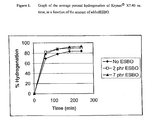
- Example 2 illustrates the hydrogenation of Krynac® X7.40 in the presence of ESBO as proton acceptor.
- the temperature of the reactor was raised to 130°C and a solution of 0.139 g (0.076 phr) of tris-(triphenylphosphine)-rhodium-(I)chloride and 2.2 g of triphenylphosphine in 60 mL of monochlorobenzene was then charged to the reactor under hydrogen.
- the temperature was raised to 138°C and the pressure of the reactor was set at 1200 psi.
- the reaction temperature and hydrogen pressures of the reactor was maintained constant throughout the whole reaction.
- the degree of hydrogenation was monitored by sampling after a certain reaction time followed by FTIR analysis of the sample. The hydrogenation was carried out for a certain period of time at 138°C under a hydrogen pressure of 1200 psi.
- Copolymer Load 6%; Catalyst Load: 0.076 phr; Co-catalyst Load: 1.26 phr.
- Copolymer Load 6%; Catalyst Load: 0.076 ; Co-catalyst Load: 1.26 phr.
- Examples 3 and 4 show the hydrogenation of an acrylonitrile-butadiene copolymer, Perbunan® NT 3429T (available from Bayer), without and with the addition of ESBO, respectively.
- the temperature of the reactor was raised to 130°C and a solution of 0.176 g (0.045 phr) of tris-(triphenylphosphine)rhodium (1) chloride catalyst and 3.92 g of co-catalyst triphenylphosphine in 60 mL of monochlorobenzene was then charged to the reactor under hydrogen.
- the temperature was then raised to 138°C and the pressure of the reactor was set at 1200 psi.
- the reaction temperature and hydrogen pressure of the reactor were maintained constant throughout the reaction.
- the degree of hydrogenation was monitored by sampling after a certain reaction time followed by FTIR analysis of the sample.
- the hydrogenation was carried out after a certain period of time at 138°C under a hydrogen pressure of 1200 psi.
- the chlorobenzene was removed by the injection of steam and the copolymer was dried in an oven at 80°C.
- the hydrogenation results (as determined by IR spectroscopy and 1 H-NMR)
- Copolymer Load 12%; Catalyst Load: 0.045 ; Co-catalyst Load: 1 phr.
- Copolymer Load 12%; Catalyst Load: 0.045 phr; Co-catalyst Load: 1 phr.
- Perbunan® NT 3429T occurred much faster than that of the carboxylated copolymer, Krynac® X7.40.
- an acrylonitrile-butadiene copolymer can be hydrogenated easily to 97-98% saturation, then the rate of hydrogenation slows down significantly. It is well known that the aged properties of a hydrogenated acrylonitrile-butadiene copolymer improve significantly as the percent hydrogenation approaches 100. It is economically beneficial to hydrogenate an acrylonitrile-butadiene copolymer to greater than 99% as quickly as possible. As shown in Table 4 and 5, the presence of ESBO increases the rate of hydrogenation of Perbunan® NT 3429T.
- This example shows the hydrogenation of Perbunan® NT 3429T using 2 phr ESBO, in the absence of the triphenylphosphine co-catalyst.
- Copolymer Load 12%; Catalyst load: 0.045 phr.
- This example shows the hydrogenation of Perbunan® NT 3429T using 0.3 phr triphenylphosphine co-catalyst, in the absence of ESBO.
- Copolymer Load 12%; Catalyst load: 0.045 phr; Triphenylphosphine: 0.3 phr.
- Substrate Perbunan® NT 34529 T; Copolymer Load: 12%; Catalyst load: 0.045 phr; TPP: 0.3 phr.
Landscapes
- Chemical & Material Sciences (AREA)
- General Chemical & Material Sciences (AREA)
- Health & Medical Sciences (AREA)
- Chemical Kinetics & Catalysis (AREA)
- Medicinal Chemistry (AREA)
- Polymers & Plastics (AREA)
- Organic Chemistry (AREA)
- Addition Polymer Or Copolymer, Post-Treatments, Or Chemical Modifications (AREA)
- Catalysts (AREA)
Applications Claiming Priority (2)
| Application Number | Priority Date | Filing Date | Title |
|---|---|---|---|
| CA2329844 | 2000-12-28 | ||
| CA002329844A CA2329844A1 (fr) | 2000-12-28 | 2000-12-28 | Hydrogenation amelioree a l'aide de esbo |
Publications (2)
| Publication Number | Publication Date |
|---|---|
| EP1219640A2 true EP1219640A2 (fr) | 2002-07-03 |
| EP1219640A3 EP1219640A3 (fr) | 2002-11-13 |
Family
ID=4168007
Family Applications (1)
| Application Number | Title | Priority Date | Filing Date |
|---|---|---|---|
| EP01129343A Withdrawn EP1219640A3 (fr) | 2000-12-28 | 2001-12-17 | Hydrogénation de caoutchouc nitrile |
Country Status (5)
| Country | Link |
|---|---|
| US (1) | US6683136B2 (fr) |
| EP (1) | EP1219640A3 (fr) |
| JP (1) | JP2002212203A (fr) |
| CA (1) | CA2329844A1 (fr) |
| MX (1) | MXPA01012875A (fr) |
Cited By (3)
| Publication number | Priority date | Publication date | Assignee | Title |
|---|---|---|---|---|
| CN104338558A (zh) * | 2014-09-11 | 2015-02-11 | 华南理工大学 | 杂化树状聚合物负载双金属纳米粒子催化剂及其制备方法与应用 |
| CN105622783A (zh) * | 2014-10-29 | 2016-06-01 | 中国石油化工股份有限公司 | 一种共聚物的制备方法 |
| CN106179504A (zh) * | 2016-07-11 | 2016-12-07 | 华南理工大学 | 杂化树状聚合物负载金属催化剂及其制备方法与应用 |
Families Citing this family (67)
| Publication number | Priority date | Publication date | Assignee | Title |
|---|---|---|---|---|
| EP1757623A1 (fr) * | 2005-07-14 | 2007-02-28 | Lanxess Inc. | Procédé de préparation des terpolymères de nitrile à faible viscosité mooney |
| ATE538139T1 (de) * | 2005-08-30 | 2012-01-15 | Lanxess Deutschland Gmbh | Verwendung von katalysatoren für den metatheseabbau von nitrilkautschuk |
| DE102005042265A1 (de) * | 2005-09-06 | 2007-03-08 | Lanxess Deutschland Gmbh | Vernetzbare Zusammensetzungen, daraus erhältliche thermoplastische Elastomere und deren Verwendung |
| DE102005047115A1 (de) * | 2005-09-30 | 2007-04-05 | Lanxess Deutschland Gmbh | Vernetzbare Zusammensetzungen, Verfahren zu deren Herstellung und deren Verwendung |
| DE102005059625A1 (de) | 2005-12-14 | 2007-06-21 | Lanxess Deutschland Gmbh | Mikrogel-enthaltende vulkanisierbare Zusammensetzung auf Basis von hydriertem Nitrilkautschuk |
| DE102005061628A1 (de) * | 2005-12-21 | 2007-06-28 | Lanxess Deutschland Gmbh | Hydrierter Nitrilkautschuk mit enger Molekulargewichtsverteilung, ein Verfahren zu seiner Herstellung und seine Verwendung |
| DE102005061627A1 (de) * | 2005-12-21 | 2007-06-28 | Lanxess Deutschland Gmbh | Synthetischer Kautschuk mit enger Molekulargewichtsverteilung, ein Verfahren zu seiner Herstellung und seine Verwendung |
| DE102006008521A1 (de) * | 2006-02-22 | 2007-08-23 | Lanxess Deutschland Gmbh | Verwendung von Katalysatoren mit erhöhter Aktivität für die NBR-Metathese |
| DE102006008520A1 (de) | 2006-02-22 | 2007-08-23 | Lanxess Deutschland Gmbh | Neue Katalysator-Systeme und deren Verwendung für Metathese-Reaktionen |
| DE102006040569A1 (de) * | 2006-08-30 | 2008-03-06 | Lanxess Deutschland Gmbh | Verfahren zum Metathese-Abbau von Nitrilkautschuken |
| DE102007024008A1 (de) * | 2007-05-22 | 2008-11-27 | Lanxess Deutschland Gmbh | Nitrilkautschuke |
| DE102007024010A1 (de) * | 2007-05-22 | 2008-11-27 | Lanxess Deutschland Gmbh | Nitrilkautschuke |
| DE102007024011A1 (de) * | 2007-05-22 | 2008-11-27 | Lanxess Deutschland Gmbh | Nitrilkautschuke |
| ATE467644T1 (de) | 2007-08-21 | 2010-05-15 | Lanxess Deutschland Gmbh | Metathese eines nitrilkautschuks in gegenwart von übergangsmetallkomplexkatalysatoren |
| DE102007039527A1 (de) | 2007-08-21 | 2009-02-26 | Lanxess Deutschland Gmbh | Katalysatoren für Metathese-Reaktionen |
| DE102007039695A1 (de) | 2007-08-22 | 2009-02-26 | Lanxess Deutschland Gmbh | Katalysatoren für Metathese-Reaktionen |
| DE102007039525A1 (de) * | 2007-08-21 | 2009-02-26 | Lanxess Deutschland Gmbh | Verfahren zum Metathese-Abbau von Nitrilkautschuk |
| EP2027920B1 (fr) | 2007-08-21 | 2014-10-08 | LANXESS Deutschland GmbH | Catalyseurs pour les réactions de metathèses |
| DE102007039526A1 (de) * | 2007-08-21 | 2009-02-26 | Lanxess Deutschland Gmbh | Katalysator-Systeme und deren Verwendung für Metathese-Reaktionen |
| EP2075262A1 (fr) | 2007-12-17 | 2009-07-01 | Lanxess Inc. | Hydrogénation de polymères à base de diène |
| EP2072536A1 (fr) | 2007-12-17 | 2009-06-24 | Lanxess Inc. | Hydrogénation de polymères à base de diène |
| BRPI0907377B1 (pt) * | 2008-01-29 | 2019-09-03 | Arlanxeo Deutschland Gmbh | borracha nitrílica, processo para a produção de borrachas nitrílicas, utilização de borrachas nitrílicas, mistura vulcanizável, processo para a produção de uma mistura vulcanizável, e processo para a produção de moldados |
| CA2713452C (fr) * | 2008-01-29 | 2013-04-23 | Lanxess Deutschland Gmbh | Caoutchoucs nitrile optionnellement hydrogenes contenant optionnellement des terminaisons alkylthio |
| EP2238177B1 (fr) * | 2008-01-29 | 2012-07-25 | LANXESS Deutschland GmbH | Caoutchoucs nitrile optionnellement hydrogénés contenant optionnellement des terminaisons alkylthio |
| EP2147721A1 (fr) * | 2008-07-08 | 2010-01-27 | Lanxess Deutschland GmbH | Systèmes des catalyseurs et usage en réactions de métathèse |
| EP2143489A1 (fr) * | 2008-07-08 | 2010-01-13 | Lanxess Deutschland GmbH | Systèmes de catalyseurs et usage en réactions de métathèse |
| EP2267037B1 (fr) | 2009-06-26 | 2012-11-14 | LANXESS Deutschland GmbH | Utilisation de caoutchouc de nitrile totalement ou partiellement hydrogéné |
| EP2289623A1 (fr) | 2009-08-31 | 2011-03-02 | LANXESS Deutschland GmbH | Métathèse de caoutchoucs de nitrile en présence de catalyseurs de métal de transition |
| CA2771242A1 (fr) | 2009-08-31 | 2011-03-03 | Lanxess Deutschland Gmbh | Composition polymere vulcanisable comprenant un caoutchouc nitrile eventuellement hydrogene a faible poids moleculaire |
| EP2289622A1 (fr) | 2009-08-31 | 2011-03-02 | LANXESS Deutschland GmbH | Catalyseurs à base de ruthénium pour la métathèse de caoutchoucs au nitrile |
| IN2012DN02284A (fr) | 2009-09-17 | 2015-08-21 | Lanxess Deutschland Gmbh | |
| EP2385074A1 (fr) | 2010-05-07 | 2011-11-09 | LANXESS Deutschland GmbH | Caoutchouc nitrile et sa fabrication dans des solvants organiques |
| EP2298824A1 (fr) | 2009-09-17 | 2011-03-23 | LANXESS Deutschland GmbH | Caoutchouc nitrile et sa fabrication dans des solvants organiques |
| EP2316861A1 (fr) | 2009-11-03 | 2011-05-04 | LANXESS Deutschland GmbH | Caoutchouc de nitrile |
| EP2368917B1 (fr) | 2010-03-25 | 2013-01-09 | LANXESS International SA | Processus pour la production d'eau et de caoutchoucs de nitrile hydrogéné sans solvant |
| EP2386600B1 (fr) | 2010-04-15 | 2013-06-19 | LANXESS Deutschland GmbH | Réseau contenant des groupes d'isocyanates pour caoutchoucs nitriles |
| EP2418225A1 (fr) | 2010-08-09 | 2012-02-15 | LANXESS Deutschland GmbH | Caoutchoucs nitriles partiellement hydrogénés |
| EP2423235A1 (fr) | 2010-08-31 | 2012-02-29 | LANXESS Deutschland GmbH | Procédé de fabrication de caoutchoucs nitriles dans des solvants organiques |
| EP2423238A1 (fr) | 2010-08-31 | 2012-02-29 | LANXESS Deutschland GmbH | Procédé de fabrication de caoutchoucs nitriles dans des solvants organiques |
| EP2423234A1 (fr) | 2010-08-31 | 2012-02-29 | LANXESS Deutschland GmbH | Dormants en caoutchouc constitués de différents caoutchoucs nitriles |
| EP2471852A1 (fr) | 2010-12-29 | 2012-07-04 | Lanxess Deutschland GmbH | Compositions vulcanisables à base de caoutchoucs nitriles contenant des groupes époxy |
| EP2471851A1 (fr) | 2010-12-29 | 2012-07-04 | LANXESS Deutschland GmbH | Compositions vulcanisables à base de caoutchoucs nitriles contenant des groupes époxy |
| EP2484700B1 (fr) | 2011-02-04 | 2013-10-09 | LANXESS Deutschland GmbH | Caoutchoucs nitriles fonctionnalisés et leur fabrication |
| WO2012174734A1 (fr) | 2011-06-24 | 2012-12-27 | Lanxess Deutschland Gmbh | Polymérisation/copolymérisation en solution des diènes, hydrogénation des caoutchoucs diènes et caoutchoucs diènes hydrogénés |
| EP2554558A1 (fr) | 2011-08-02 | 2013-02-06 | Lanxess Deutschland GmbH | Procédé de fabrication de caoutchoucs nitriles dans des solvants organiques |
| EP2565229A1 (fr) | 2011-09-02 | 2013-03-06 | LANXESS Deutschland GmbH | Compositions vulcanisables à base de copolymères d'éthylène-acétate de vinyle contenant des groupes époxy |
| EP2581409A1 (fr) | 2011-10-11 | 2013-04-17 | Lanxess Deutschland GmbH | Compositions vulcanisables à base de caoutchoucs nitriles contenant des groupes époxy |
| EP2581407A1 (fr) | 2011-10-11 | 2013-04-17 | Lanxess Deutschland GmbH | Compositions vulcanisables à base de caoutchoucs nitriles contenant des groupes époxy |
| WO2013098052A2 (fr) | 2011-12-28 | 2013-07-04 | Lanxess Deutschland Gmbh | Métathèse de caoutchoucs nitrile en présence de catalyseurs à base de complexes de métaux de transition |
| TWI639638B (zh) | 2014-02-03 | 2018-11-01 | 德商朗盛德意志有限公司 | 安定化橡膠 |
| EP3034518B1 (fr) | 2014-12-19 | 2017-05-24 | ARLANXEO Deutschland GmbH | Caoutchouc de nitrile à couleur stabilisée |
| EP3196239A1 (fr) | 2016-01-25 | 2017-07-26 | ARLANXEO Deutschland GmbH | Compositions vulcanisables a base de caoutchouc de nitrile hydrogene, leur procede de fabrication et leur utilisation |
| EP3248989B1 (fr) | 2016-05-23 | 2020-12-02 | University Of Waterloo | Hydrogénation de groupes nitriles dans un caoutchouc nitrile-butadiène hydrogéné et hydrogénation tandem des groupes nitriles et des groupes oléfiniques dans un caoutchouc nitrile-butadiène à l'aide d'un complexe de ruthénium ou de rhodium et d'un réactif basique |
| EP3248988B1 (fr) | 2016-05-23 | 2020-12-02 | University Of Waterloo | Hydrogénation de groupes nitriles dans un caoutchouc nitrile-butadiène hydrogéné et hydrogénation tandem de groupes nitriles et de groupes oléfiniques dans un caoutchouc nitrile-butadiène à l'aide d'un catalyseur contenant du rhodium non supporté |
| EP3255088B1 (fr) | 2016-06-07 | 2020-04-29 | ARLANXEO Deutschland GmbH | Utilisation de compositions vulcanisables et vulcanisats en contact avec un agent de refroidissement comprenant un wollastonite recouvert de silane |
| CN106512993B (zh) * | 2016-08-30 | 2018-11-16 | 北京化工大学 | 钯-钌双金属纳米催化剂制备及加氢应用 |
| CN106423283B (zh) * | 2016-08-31 | 2019-05-17 | 北京化工大学 | 二元胺过渡金属络合物催化剂及其制备方法与应用 |
| CN111032764A (zh) | 2017-08-16 | 2020-04-17 | 阿朗新科德国有限责任公司 | 包含氢化丁腈橡胶的可固化的组合物、由其生产的固化橡胶以及其用途 |
| KR102644018B1 (ko) | 2017-09-20 | 2024-03-07 | 아란세오 도이치란드 게엠베하 | 높은 열 전도도를 갖는 가황성 hnbr 조성물 |
| KR102702569B1 (ko) | 2017-12-08 | 2024-09-06 | 아란세오 도이치란드 게엠베하 | 루테늄 착물 촉매를 사용하여 니트릴 고무를 생성하기 위한 방법 |
| WO2019201730A1 (fr) | 2018-04-20 | 2019-10-24 | Arlanxeo Deutschland Gmbh | Compositions de catalyseurs d'hydrogénation et leur utilisation pour l'hydrogénation du caoutchouc nitrile |
| EP3784390A1 (fr) | 2018-04-27 | 2021-03-03 | ARLANXEO Deutschland GmbH | Utilisation de catalyseurs à base de ruthénium et d'osmium pour la métathèse de caoutchoucs nitrile |
| US11311868B2 (en) | 2018-07-23 | 2022-04-26 | Arlanxeo Deutschland Gmbh | Use of catalysts for the metathesis of nitrile rubber |
| US20210340285A1 (en) | 2018-07-23 | 2021-11-04 | Arlanxeo Deutschland Gmbh | Method for producing hydrogenated nitrile rubber and hnbr compositions thereof |
| US11673130B2 (en) | 2018-12-12 | 2023-06-13 | Arlanxeo Deutschland Gmbh | Catalyst system containing a metathesis catalyst and at least one phenolic compound and a process for metathesis of nitrile-butadiene rubber (NBR) using the catalyst system |
| JP7525485B2 (ja) | 2018-12-17 | 2024-07-30 | アランセオ・ドイチュランド・ゲーエムベーハー | 代替溶媒を使用してhnbr溶液を調製するための方法 |
| KR102928057B1 (ko) | 2018-12-19 | 2026-02-20 | 아란세오 도이치란드 게엠베하 | 리튬 이온 배터리의 전지의 캐소드에 대한 전극 조성물, 캐소드 슬러리 조성물, 캐소드 및 이를 혼입한 배터리 |
Family Cites Families (10)
| Publication number | Priority date | Publication date | Assignee | Title |
|---|---|---|---|---|
| DE654989C (de) | 1930-05-06 | 1938-01-06 | Ig Farbenindustrie Ag | Verfahren zur Herstellung von Polymerisationsprodukten |
| US3700637A (en) | 1970-05-08 | 1972-10-24 | Shell Oil Co | Diene-nitrile rubbers |
| US3673281A (en) * | 1971-01-29 | 1972-06-27 | Basf Ag | Catalytic hydrogenation of polymers containing double bonds |
| DE2539132C2 (de) * | 1975-09-03 | 1987-04-09 | Bayer Ag, 5090 Leverkusen | Verwendung hydrierter Dien-Copolymere als temperaturbeständige Materialien auf dem Dichtungssektor |
| CA1220300A (fr) * | 1982-12-08 | 1987-04-07 | Polysar Limited | Hydrogenation du polymere |
| DE3433075A1 (de) * | 1984-09-08 | 1986-03-20 | Bayer Ag, 5090 Leverkusen | Niedermolekulare copolymerisate und daraus hergestellte covulkanisate |
| DE3433392A1 (de) | 1984-09-12 | 1986-03-20 | Bayer Ag, 5090 Leverkusen | Hydrierung nitrilgruppenhaltiger ungesaettigter polymerer |
| US5075388A (en) * | 1990-12-13 | 1991-12-24 | Rempel Garry L | Amine modified hydrogenation of nitrile rubber |
| NL1004993C2 (nl) * | 1997-01-14 | 1998-07-15 | Dsm Nv | Werkwijze voor de bereiding van RuHX(H2)(PR3)2 en de toepassing hiervan als hydrogeneringskatalysator. |
| CA2329551A1 (fr) * | 2000-12-22 | 2002-06-22 | Bayer Inc. | Procede de production de caoutchouc nitrile hydrogene |
-
2000
- 2000-12-28 CA CA002329844A patent/CA2329844A1/fr not_active Abandoned
-
2001
- 2001-12-13 MX MXPA01012875A patent/MXPA01012875A/es not_active Application Discontinuation
- 2001-12-17 EP EP01129343A patent/EP1219640A3/fr not_active Withdrawn
- 2001-12-19 US US10/027,762 patent/US6683136B2/en not_active Expired - Fee Related
- 2001-12-27 JP JP2001396245A patent/JP2002212203A/ja active Pending
Cited By (6)
| Publication number | Priority date | Publication date | Assignee | Title |
|---|---|---|---|---|
| CN104338558A (zh) * | 2014-09-11 | 2015-02-11 | 华南理工大学 | 杂化树状聚合物负载双金属纳米粒子催化剂及其制备方法与应用 |
| CN104338558B (zh) * | 2014-09-11 | 2017-04-05 | 华南理工大学 | 杂化树状聚合物负载双金属纳米粒子催化剂及其制备方法与应用 |
| CN105622783A (zh) * | 2014-10-29 | 2016-06-01 | 中国石油化工股份有限公司 | 一种共聚物的制备方法 |
| CN105622783B (zh) * | 2014-10-29 | 2017-06-30 | 中国石油化工股份有限公司 | 一种共聚物的制备方法 |
| CN106179504A (zh) * | 2016-07-11 | 2016-12-07 | 华南理工大学 | 杂化树状聚合物负载金属催化剂及其制备方法与应用 |
| CN106179504B (zh) * | 2016-07-11 | 2018-10-09 | 华南理工大学 | 杂化树状聚合物负载金属催化剂及其制备方法与应用 |
Also Published As
| Publication number | Publication date |
|---|---|
| US6683136B2 (en) | 2004-01-27 |
| MXPA01012875A (es) | 2002-07-09 |
| US20020128393A1 (en) | 2002-09-12 |
| EP1219640A3 (fr) | 2002-11-13 |
| JP2002212203A (ja) | 2002-07-31 |
| CA2329844A1 (fr) | 2002-06-28 |
Similar Documents
| Publication | Publication Date | Title |
|---|---|---|
| EP1219640A2 (fr) | Hydrogénation de caoutchouc nitrile | |
| KR920001317B1 (ko) | 중합체 수소화 방법 | |
| EP1440096B1 (fr) | Procede de preparation de caoutchouc nitrile hydrogene de faible poids moleculaire | |
| EP1426383B1 (fr) | Procédé de préparation de caoutchouc nitrile hydrogéné à bas poids moléculaire | |
| US7585920B2 (en) | Process for the preparation of low molecular weight hydrogenated nitrile rubber | |
| MXPA02010994A (es) | Composicion de caucho mejorada. | |
| US7385010B2 (en) | Hydrogenation of diene-based polymer latex | |
| EP1705194B1 (fr) | Procédé d'hydrogénation des dispersions de latex de polymère conjugués | |
| KR20070009480A (ko) | 낮은 무니 점도를 가지는 니트릴 삼원공중합체의 제조 방법 | |
| CA2368684A1 (fr) | Hydrogenation amelioree de l'huile de soja epoxydee | |
| EP0751151B1 (fr) | Hydrogénation de copolymères diéniques | |
| US6602962B2 (en) | Process for the production of hydrogenated nitrile rubber | |
| EP3827030A2 (fr) | Hydrogénation de caoutchouc nitrile | |
| US20060211826A1 (en) | Organic solvent-free hydrogenation of diene-based polymers | |
| KR101162394B1 (ko) | 저분자량 니트릴 고무의 제조 방법 | |
| KR20020095475A (ko) | 개선된 고무 조성물 |
Legal Events
| Date | Code | Title | Description |
|---|---|---|---|
| PUAI | Public reference made under article 153(3) epc to a published international application that has entered the european phase |
Free format text: ORIGINAL CODE: 0009012 |
|
| AK | Designated contracting states |
Kind code of ref document: A2 Designated state(s): AT BE CH CY DE DK ES FI FR GB GR IE IT LI LU MC NL PT SE TR |
|
| AX | Request for extension of the european patent |
Free format text: AL;LT;LV;MK;RO;SI |
|
| PUAL | Search report despatched |
Free format text: ORIGINAL CODE: 0009013 |
|
| AK | Designated contracting states |
Kind code of ref document: A3 Designated state(s): AT BE CH CY DE DK ES FI FR GB GR IE IT LI LU MC NL PT SE TR |
|
| AX | Request for extension of the european patent |
Free format text: AL;LT;LV;MK;RO;SI |
|
| 17P | Request for examination filed |
Effective date: 20030513 |
|
| AKX | Designation fees paid |
Designated state(s): DE FR GB IT |
|
| 17Q | First examination report despatched |
Effective date: 20050302 |
|
| RAP1 | Party data changed (applicant data changed or rights of an application transferred) |
Owner name: LANXESS INC. |
|
| STAA | Information on the status of an ep patent application or granted ep patent |
Free format text: STATUS: THE APPLICATION IS DEEMED TO BE WITHDRAWN |
|
| 18D | Application deemed to be withdrawn |
Effective date: 20050913 |