EP1219652A2 - Elastomere mit oligo- und/oder polymeren Hartsegment-Einheiten und Verfahren zu ihrer Herstellung - Google Patents
Elastomere mit oligo- und/oder polymeren Hartsegment-Einheiten und Verfahren zu ihrer Herstellung Download PDFInfo
- Publication number
- EP1219652A2 EP1219652A2 EP01129905A EP01129905A EP1219652A2 EP 1219652 A2 EP1219652 A2 EP 1219652A2 EP 01129905 A EP01129905 A EP 01129905A EP 01129905 A EP01129905 A EP 01129905A EP 1219652 A2 EP1219652 A2 EP 1219652A2
- Authority
- EP
- European Patent Office
- Prior art keywords
- prepo
- reactive
- compounds
- reaction
- amino
- Prior art date
- Legal status (The legal status is an assumption and is not a legal conclusion. Google has not performed a legal analysis and makes no representation as to the accuracy of the status listed.)
- Withdrawn
Links
Classifications
-
- C—CHEMISTRY; METALLURGY
- C08—ORGANIC MACROMOLECULAR COMPOUNDS; THEIR PREPARATION OR CHEMICAL WORKING-UP; COMPOSITIONS BASED THEREON
- C08G—MACROMOLECULAR COMPOUNDS OBTAINED OTHERWISE THAN BY REACTIONS ONLY INVOLVING UNSATURATED CARBON-TO-CARBON BONDS
- C08G18/00—Polymeric products of isocyanates or isothiocyanates
- C08G18/06—Polymeric products of isocyanates or isothiocyanates with compounds having active hydrogen
- C08G18/70—Polymeric products of isocyanates or isothiocyanates with compounds having active hydrogen characterised by the isocyanates or isothiocyanates used
- C08G18/72—Polyisocyanates or polyisothiocyanates
- C08G18/80—Masked polyisocyanates
- C08G18/8061—Masked polyisocyanates masked with compounds having only one group containing active hydrogen
- C08G18/807—Masked polyisocyanates masked with compounds having only one group containing active hydrogen with nitrogen containing compounds
- C08G18/8074—Lactams
-
- C—CHEMISTRY; METALLURGY
- C08—ORGANIC MACROMOLECULAR COMPOUNDS; THEIR PREPARATION OR CHEMICAL WORKING-UP; COMPOSITIONS BASED THEREON
- C08G—MACROMOLECULAR COMPOUNDS OBTAINED OTHERWISE THAN BY REACTIONS ONLY INVOLVING UNSATURATED CARBON-TO-CARBON BONDS
- C08G18/00—Polymeric products of isocyanates or isothiocyanates
- C08G18/06—Polymeric products of isocyanates or isothiocyanates with compounds having active hydrogen
- C08G18/08—Processes
- C08G18/0895—Manufacture of polymers by continuous processes
-
- C—CHEMISTRY; METALLURGY
- C08—ORGANIC MACROMOLECULAR COMPOUNDS; THEIR PREPARATION OR CHEMICAL WORKING-UP; COMPOSITIONS BASED THEREON
- C08G—MACROMOLECULAR COMPOUNDS OBTAINED OTHERWISE THAN BY REACTIONS ONLY INVOLVING UNSATURATED CARBON-TO-CARBON BONDS
- C08G18/00—Polymeric products of isocyanates or isothiocyanates
- C08G18/06—Polymeric products of isocyanates or isothiocyanates with compounds having active hydrogen
- C08G18/08—Processes
- C08G18/10—Prepolymer processes involving reaction of isocyanates or isothiocyanates with compounds having active hydrogen in a first reaction step
-
- C—CHEMISTRY; METALLURGY
- C08—ORGANIC MACROMOLECULAR COMPOUNDS; THEIR PREPARATION OR CHEMICAL WORKING-UP; COMPOSITIONS BASED THEREON
- C08G—MACROMOLECULAR COMPOUNDS OBTAINED OTHERWISE THAN BY REACTIONS ONLY INVOLVING UNSATURATED CARBON-TO-CARBON BONDS
- C08G18/00—Polymeric products of isocyanates or isothiocyanates
- C08G18/06—Polymeric products of isocyanates or isothiocyanates with compounds having active hydrogen
- C08G18/28—Polymeric products of isocyanates or isothiocyanates with compounds having active hydrogen characterised by the compounds used containing active hydrogen
- C08G18/40—High-molecular-weight compounds
- C08G18/48—Polyethers
- C08G18/4854—Polyethers containing oxyalkylene groups having four carbon atoms in the alkylene group
Definitions
- the invention relates to the fields of chemistry, mechanical engineering and Electrical engineering and relates to elastomers with oligomeric and / or polymeric hard segment units, which, for example, as a soft component in hard-soft composites or can be used as a flexible component or as a sealing and insulation material can.
- the object of the invention is to provide oligomeric and / or polymeric elastomers with oligomeric and / or to produce polymeric hard segment units in which the synthesis can be carried out faster and linear but also branched to cross-linked Elastomers can be produced.
- a low-viscosity prepolymer A (prepo A) is used in the melt as a compound of the ba- (b) n type with n ⁇ 0, which has a soft segment (a) and to which one or more short oligoamide blocks ( b) are coupled as hard segment units, manufactured.
- These oligomeric compounds have neither polymer nor elastomer properties.
- the statistical length of these (b) blocks can be practically determined by the amount of lactam used, e.g. B. ⁇ -caprolactam can be adjusted.
- the chain ends of the ba- (b) n blocks with n 0 0 blocked by the reaction with ⁇ -caprolactam are condensed with a preferably bifunctional agent in the second stage to form a high molecular weight block copolymer with corresponding elastomer properties.
- the elastomers according to the invention are produced according to the invention by according to the method of anionic polymerization a prepo A over a reactive one Implementation with at least one di- or polyfunctional amino and / or Hydroxy compound is condensed.
- the linear or branched prepo A is produced in a preliminary reaction.
- the prepo A can range from oligomer to polymer.
- the soft segment units (a) of prepo A are advantageously obtained by reacting oligomers or polymers which are composed of ether and / or ester monomer units and have a molecular weight of at least 500 D to 10,000 D, preferably up to 6,000 D, with reactive difunctional compounds in a molar ratio of 1: 1.4 to 1: 1.95, preferably 1: 1.8.
- Diacyl lactams and / or diisocyanates and / or preferably diisocyanates capped with lactam can advantageously be used for the reaction as difunctional compounds for the reactive reaction.
- prepo A with the hard segment units (b) via anionic Polymerization is advantageously lactam as a hard segment-forming component in the form of ⁇ -caprolactam and / or laurolactam in a mass ratio of Soft segment (a) to hard segment (b) from 10:90 to 95: 5 used in mass%.
- the reaction mixture is based on the known criteria of the anionic Polymerization implemented for prepo A.
- An advantageous variant of the invention is when a linear prepo A is preferred in an equimolar ratio of diamino and / or amino hydroxy and / or Dihydroxy compounds, preferably with diamine compounds and especially preferably with hexamethylenediamine and / or difunctional amine-terminated Polyether soft segments to those reactively terminated in the reaction system End groups in the form of blocked isocyanate groups and / or Acyl lactam groups of prepo A via a reactive reaction, preferably by reactive extrusion.
- a linear prepo A after mixing the Components with preferably in an equimolar ratio of amino and / or hydroxy compounds with more than two functional groups or in a mixture with two and more functional groups for setting the branch or Degree of crosslinking, preferably with polyamine compounds and particularly preferred with triamine compounds such as dipropylenetriamine to those in the reaction system existing reactive terminated end groups in the form of masked Isocyanate groups and / or acyllactam groups of prepo A via a reactive Implementation, preferably in a tool, is implemented.
- branched prepo A or a mixture of linear and branched prepo A with preferably in an equimolar ratio of di- and / or polyfunctional amino and / or Hydroxy compounds, preferably with diamine and / or triamine compounds and particularly preferably with hexamethylenediamine and / or difunctional amine-terminated polyether soft segments and / or Dipropylenetriamine to those reactively terminated in the reaction system End groups in the form of blocked isocyanate groups and / or acyllactam groups
- the pre-reaction to prepolymer A is usually carried out in a stirred System / stirred tank carried out.
- Condensation too thermoplastic Processable elastomers are preferably made via reactive extrusion, which means at the same time, due to the compulsory mixing, largely complete sales and thus optimal material properties are obtained. Be at the same time Residues of unreacted and of lactam released in the coupling reaction removed from the polymer via the degassing.
- Products that are to be crosslinked are preferably produced directly by thermal treatment in a tool / mold after the starting materials have been homogenized.
- the invention is explained in more detail using several exemplary embodiments.
- the examples also include reactive reactions Forced mixing cited.
- the linear products have elastomeric properties and are remeltable.
- the reaction conditions and the material properties are in can be varied over a wide range.
- the two soft segment units are each larger in a 1 liter container Prepared batches and under inert conditions in defined quantities in good transferred to filled reaction vessels.
- X g soft segment (a) are transferred under inert conditions into a dried 3-neck flask under nitrogen (mass determination via differential weighing).
- Y g of ⁇ -caprolactam purification by vacuum distillation with forerun
- the catalyst a spatula tip of K-tert-butoxide or 1.0 ml of K-caprolactamate melt [K-CL: made from 10 ml of ⁇ -caprolactam and 1 g of K- tert-butoxide added under inert conditions]).
- K-CL made from 10 ml of ⁇ -caprolactam and 1 g of K- tert-butoxide added under inert conditions
- Oligomer product - without condensation Substance as a melt bright, cloudy, can be just pour out; Cold substance: sticky, viscous, viscous, clear.
- the product Crupo A has no elastomeric properties.
- a viscous melt is obtained as the reaction product, which after cooling solidified into a solid substance with elastomeric properties; Melting range of the Elastomers 170 to 180 ° C
Landscapes
- Chemical & Material Sciences (AREA)
- Health & Medical Sciences (AREA)
- Chemical Kinetics & Catalysis (AREA)
- Medicinal Chemistry (AREA)
- Polymers & Plastics (AREA)
- Organic Chemistry (AREA)
- Engineering & Computer Science (AREA)
- Manufacturing & Machinery (AREA)
- Polyamides (AREA)
- Macromolecular Compounds Obtained By Forming Nitrogen-Containing Linkages In General (AREA)
- Polyurethanes Or Polyureas (AREA)
Abstract
Description
Bekannt ist, dass acylierte ε-Caprolactam-Verbindungen in der anionischen Polymerisation als Aktivatoren dienen. Analog wirken caprolactamverkappte Isocyanat-Verbindungen. Mit Poly-THF umgesetzte Diisocyanate, die mit ε-Caprolactam verkappt sind, werden schon zur Schlagzähmodifizierung von anionisch hergestellten Polyamiden als Aktivatoren im Unterschuß eingesetzt.
Die durch die Reaktion mit ε-Caprolactam verkappten Kettenenden der b-a-(b)n-Blöcke mit n ≥ 0 werden mit einem vorzugsweise bifunktionellen Agens in der zweiten Stufe zum hochmolekularen Blockcopolymer mit entsprechenden Elastomereigenschaften aufkondensiert.

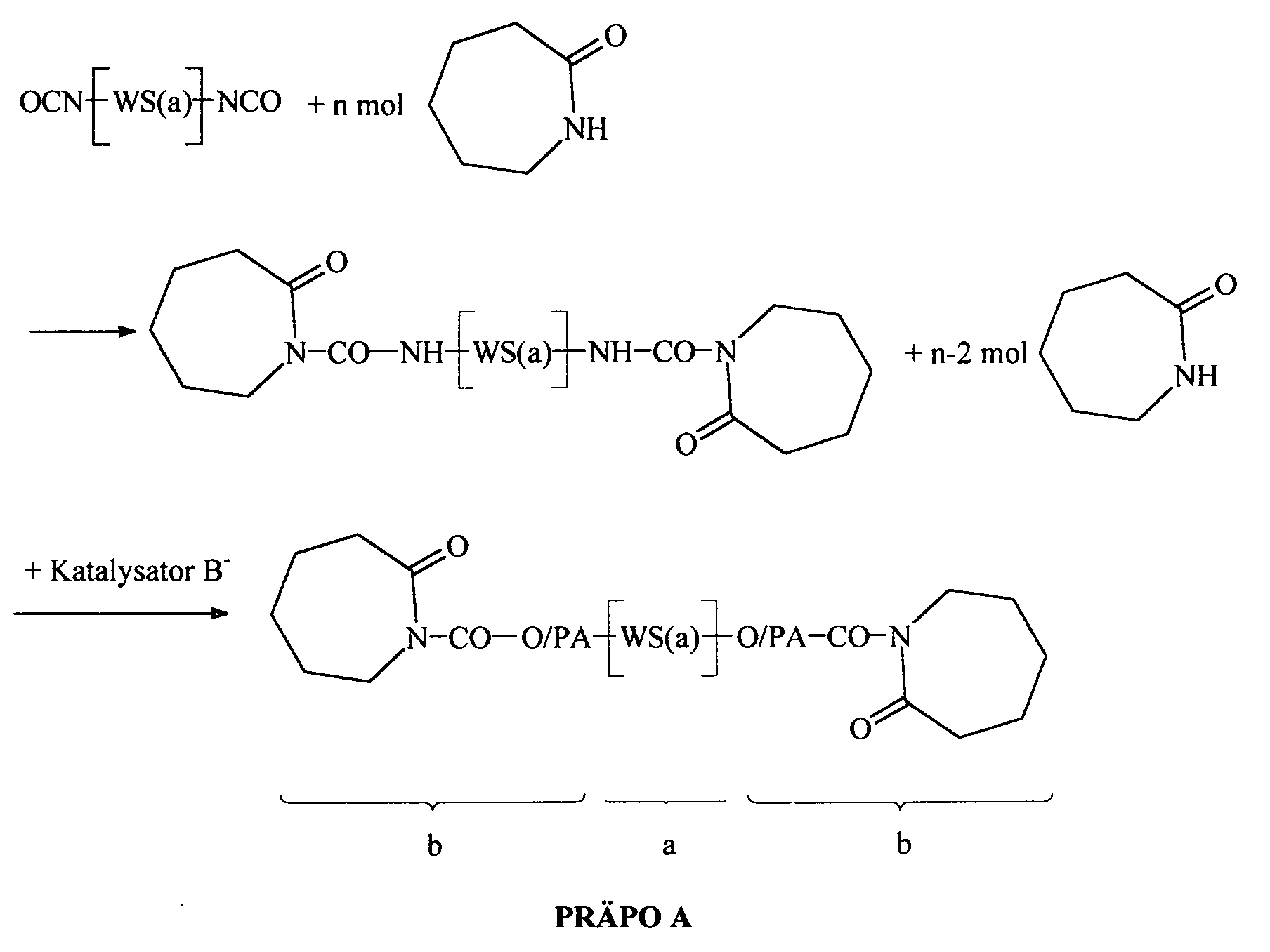

O/PA = Oligo- und/oder Polyamidsegment
- Weichsegmenteinheiten (a),
- die vorteilhafterweise aus Ether- und/oder Ester-Monomereinheiten aufgebaut sind und Molmassen von mindestens 500 D bis 10 000 D, vorzugsweise 500 D bis 6 000 D aufweisen,
- die vorteilhafterweise aus einer homogen aufgebauten Weichsegment-Oligomer- oder Polymerkette oder aus einer zusammengesetzten Weichsegment-Oligomer- oder Polymerkette bestehen, wobei die zusammengesetzten Ketten aus gleichen oder verschiedenen oligomeren Weichsegment-Typen aufgebaut und mittels Kopplungsagenzien, wie z.B. Isocyanat-, verkappte Isocyanat- und Acyllactamverbindungen, verbunden sind,
- die vorteilhafterweise aus Polytetrahydrofuran-Einheiten mit der mittleren Molmasse von 2.000 D mit aliphatischen Diisocyanat-Verbindungen und vorzugsweise mit Hexamathylendiisocyanat verbunden und terminiert sind. Dabei ist dieses Weichsegment (a) vorteilhafterweise in einer Vorreaktion zur anionischen Polymerisation im molaren Verhältnis von 1 : 1,4 bis 1 : 1,95, vorzugsweise 1 : 1,8 hergestellt worden.
- Hartsegmenteinheiten (b), die vorteilhafterweise aus ε-Caprolactam und/oder Laurinlactam an die Weichsegmenteinheit (a) über anionische Polymerisation an mindestens ein Kettenende anpolymerisiert sind und eine Molmasse bis 10.000 D, vorzugsweise bis 5.000 D besitzen.
- Acyllactam-Einheiten in Form von solchen Kettenenden, die z.B. bei der Herstellung der Weichsegmenteinheiten (a) eingesetzt wurden oder bei der anionischen Polymerisation entstehen,
- reaktiven Einheiten in Form von verkappten Isocyanatgruppen, vorzugsweise von lactamverkappten Isocyanatgruppen.
Das Präpo A kann hinsichtlich seiner Molmasse im Bereich von Oligomer bis Polymer liegen.
Die Weichsegmenteinheiten (a) des Präpo A werden vorteilhafterweise durch Umsetzung von Oligomeren oder Polymeren, die aus Ether- und/oder Ester-Monomereinheiten aufgebaut sind und eine Molmasse von mindestens 500 D bis 10.000 D, vorzugsweise bis 6.000 D besitzen, mit reaktiven difunktionellen Verbindungen im molaren Verhältnis von 1 : 1,4 bis 1 : 1,95, vorzugsweise 1 : 1,8 hergestellt.
Dabei können als difunktionelle Verbindungen für die reaktive Umsetzung vorteilhafterweise Diacyllactame und/oder Diisocyanate und/oder vorzugsweise mit Lactam verkappte Diisocyanate zur Umsetzung eingesetzt werden.
Im weiteren wird die Erfindung an mehreren Ausführungsbeispielen näher erläutert.
- Weichsegment (a)1 : Poly-THF[2000/2-OH] : HMDI = 1,8 : 1,0
Getrocknetes Polytetrahydrofuran (P-THF, mittlere Molmasse 2000 D, hydroxyterminiert, Mol-Verhältnis von 1,8 Isocyanatgruppen zu 1,0 Hydroxygruppen, bezogen auf OH-Zahl) wird in einen 3-Hals-Kolben mit Rührer, Stickstoff-Begasung und Tropftrichter mit Überströmkanal eingewogen. Bei 80°C wird unter Rühren das Hexamethylendiisocyanat (HMDI) im molaren Verhältnis von 1,8 zugetropft. Nach 1 Stunde Rühren wird langsam auf 120°C erwärmt und 1 Stunde nachgerührt. - Weichsegment (a)2: Poly-THF[2000/2-OH]: HMDI = 1,0 : 1,5 Synthese analog Weichsegment (a)1 - veränderte HMDI-Menge (Verlängerung der Weichsegmenteinheiten)
Bei Temperaturen größer 100°C (Metallbadtemperatur) wird unter Rühren und Stickstoffspülung der Katalysator (eine Spatelspitze K-tert.-Butylat oder 1,0 ml K-Caprolactamatschmelze [K-CL: hergestellt aus 10 ml ε-Caprolactam und 1 g K-tert.-Butylat unter inerten Bedingungen]) zudosiert. Die Temperatur wird langsam erhöht. Zur Schmelze werden äquimolare Mengen eines bifunktionellen Kettenverlängerers (Zugabemenge errechnet aus Ansatz X g Präpo) zudosiert.
Unter Inertgas (N2) wird als Katalysator eine Spatelspitze K-tert.-Butylat zugegeben. Mit der Temperaturerhöhung auf 170°C wird die Substanz/Schmelze trüb. Nach der Temperaturerhöhung auf 190°C wird die Reaktion nach kurzer Zeit abgebrochen.
Einwaage Weichsegment (a)1 = 80,29 g Substanz und 21,10 g ε-Caprolactam werden im 3-Halskolben mit Rührer, Inertgaszuführung und Rückflußkühler bei 120°C aufgeschmolzen und gerührt. Unter Inertgas (N2) wird als Katalysator eine Spatelspitze K-tert.-Butylat zugegeben. Mit der Temperaturerhöhung auf 180°C wird die Substanz/Schmelze trüb - Präpo A.
Im gleichen Reaktionssystem wird nach der Zugabe von 3,55 g Hexamethylendiamin unter Rühren die Badtemperatur auf 210°C erhöht und die Reaktion nach kurzer Zeit abgebrochen.
Schmelze viskos; Substanz kalt: fest, elastomere Eigenschaften, Schmelzbereich des Elastomers 185 bis 200°C
Einwaage Weichsegment (a)1 = 79,98 g Substanz und 30,49 g ε-Caprolactam - Herstellung des Präpolymer A nach Versuchsdurchführung analog Versuch 1; 49 g des erhaltenen Präpolymer A werden in einen Laborkneter umgefüllt und mit 1,58 g Hexamethylendiamin (HMDA) bei 210°C 5 min mit 80 U/min umgesetzt.
Als Reaktionsprodukt wird eine viskose Schmelze erhalten, die nach dem Abkühlen zu einer Festsubstanz mit elastomeren Eigenschaften erstarrt; Schmelzbereich des Elastomers 205 bis 220°C
Einwaage Weichsegment (a)1 = 76,98 g Substanz mit 21,52 g ε-Caprolactam - Herstellung des Präpo A nach Versuchsdurchführung analog Versuch 1;
Nach der Zugabe von 2 g HMDA zum Präpolymer A wird die Reaktionsmischung als Schmelze dosiert in einem Laborextruder (Wellendurchmesser 16 mm, 60 U/min, Temperaturprofil 190°C-220°C-220°C-160°C-Düse140°C) reaktiv aufkondensiert. Elastomer: Schmelzestrang viskos; Schmelzbereich des Elastomers 190 bis 205°C
Einwaage Weichsegment (a)2 = 79,33 g Substanz mit 30,20 g ε-Caprolactam - Herstellung des Präpo A nach Versuchsdurchführung analog Versuch 1; 49 g des erhaltenen Präpo A werden in einen Laborkneter umgefüllt und mit 1,0 g Hexamethylendiamin (HMDA) bei 210°C 10 min mit 80 U/min umgesetzt. Als Reaktionsprodukt wird eine viskose Schmelze erhalten, die nach dem Abkühlen zu einer Festsubstanz mit elastomeren Eigenschaften erstarrt; Schmelzbereich des Elastomers 170 bis 185°C
Einwaage Weichsegment (a)1 = 79,27 g Substanz + 30,34 g Laurinlactam werden im 3-Halskolben mit Rührer, Inertgaszuführung und Rückflußkühler bei 170°C aufgeschmolzen und gerührt. Unter Inertgas (N2) wird als Katalysator 1 ml K-CL zugegeben - Temperaturerhöhung auf 190°C; Präpo A.
Im gleichen Reaktionssystem wird nach der Zugabe von 3,55 g Hexamethylendiamin unter Rühren die Badtemperatur auf 210°C erhöht und die Reaktion nach kurzer Zeit abgebrochen.
Elastomer: Schmelze viskos; Substanz kalt: fest, elastomere Eigenschaften, Schmelzbereich des Elastomers 160 bis 180°C
Einwaage Weichsegment (a)1 = 78,77 g Substanz und 25,36 g Laurinlactam - Herstellung des Präpo A nach Versuchsdurchführung analog Versuch 5;
49 g des erhaltenen Präpo A werden in einen Laborkneter umgefüllt und mit 0,9 g Hexamethylendiamin (HMDA) bei 210°C in kurzer Zeit mit 80 U/min umgesetzt.
Einwaage Weichsegment (a)1 = 81,37 g Substanz + 32,54 g Laurinlactam werden im 3-Halskolben mit Rührer, Inertgaszuführung und Rückflußkühler bei 170°C aufgeschmolzen und gerührt. Unter Inertgas (N2) wird als Katalysator 1 ml K-CL zugegeben - Temperaturerhöhung auf 190°C; Präpolymer A.
In das Reaktionssystem werden 2,55 g Dipropylentriamin zugegeben und unter Rühren bei 190°C verteilt. Die Badtemperatur wird ohne Rühren auf 220°C erhöht und die Reaktion nach kurzer Zeit abgebrochen.
Substanz heiß - elastomere Masse, nicht als Schmelze vorliegend, Masse muß mechanisch als geleeartige Substanz aus dem Reaktionskolben eliminiert werden; kalt: fest, elastomere Eigenschaften, kein Schmelzen der Elastomermasse (vernetztes Produkt), Schmelzen unter Zersetzung ab ca. 260°C
Claims (17)
- Elastomere mit oligo- und/oder polymeren Hartsegment-Einheiten, dadurch gekennzeichnet, dass ein Präpolymer A (Präpo A) als Verbindung vom Typ b - a - (b)n mit n ≥ 0 ist, wobei (a) ein Weichsegment und (b) ein Hartsegment ist, die miteinander verbunden sind und wobei das Hartsegment (b) nach dem Verfahren der anionischen Polymerisation hergestellt ist, dass das Präpo A mindestens zwei reaktive Kettenenden aufweist und dieses Präpolymer A über eine reaktive Umsetzung mit mindestens difunktionellen Amino- und/oder Hydroxy-Verbindungen kondensiert ist.
- Elastomere nach Anspruch 1, dadurch gekennzeichnet, dass das Präpo A linear oder verzweigt ist und mindestens eine Weichsegmenteinheit (a) enthält, die aus Ether- und/oder Ester-Monomereinheiten aufgebaut ist und eine Molmasse von mindestens 500 D bis 10.000 D, vorzugsweise bis 6.000 D besitzen, und über eine reaktive Umsetzung mit mindestens difunktionellen Amino- und/oder Hydroxy-Verbindungen kondensiert ist.
- Elastomere nach Anspruch 2, dadurch gekennzeichnet, dass die Weichsegmenteinheit (a) aus einer homogen aufgebauten Weichsegment-Oligomer- oder Polymerkette oder aus einer zusammengesetzten Weichsegment-Oligomer- oder Polymerkette, die aus gleichen oder verschiedenen oligomeren Weichsegment-Typen aufgebaut und mittels Kopplungsagens verbunden ist, besteht und im Präpo A über eine reaktive Umsetzung mit mindestens difunktionellen Amino- und/oder Hydroxy-Verbindungen kondensiert ist.
- Elastomere nach Anspruch 3, dadurch gekennzeichnet, dass die Weichsegmenteinheit (a) aus Polytetrahydrofuran-Einheiten mit der mittleren Molmasse von 2.000 D besteht und mit aliphatischen Diisocyanat-Verbindungen, vorzugsweise mit Hexamethylendiisocyanat, verbunden ist, das in einer Vorreaktion zur anionischen Polymerisation im molaren Verhältnis von 1 : 1,4 bis 1 : 1,95, vorzugsweise 1 : 1,8 hergestellt wird und im Präpo A über eine reaktive Umsetzung mit mindestens difunktionellen Amino- und/oder Hydroxy-Verbindungen kondensiert ist.
- Elastomere nach Anspruch 2, dadurch gekennzeichnet, dass das lineare oder verzweigte Präpo A mindestens zwei reaktive Kettenenden aufweist und mindestens eine Hartsegmenteinheit (b) enthält, die aus ε-Caprolactam und/oder Laurinlactam an die Weichsegmenteinheit (a) über anionische Polymerisation anpolymerisiert wird und eine Molmasse bis 10.000 D, vorzugsweise bis 5.000 D besitzt und über eine reaktive Umsetzung mit mindestens difunktionellen Amino- und/oder Hydroxy-Verbindungen kondensiert ist.
- Elastomere nach einem der Ansprüche 1 bis 5, dadurch gekennzeichnet, dass das lineare oder verzweigte Präpo A an den mindestens zwei reaktiven Kettenenden Acyllactam-Einheiten in Form von solchen Kettenenden, die bei der anionischen Polymerisation entstehen und/oder reaktive Einheiten in Form von verkappten Isocyanatgruppen, vorzugsweise von lactamverkappten Isocyanatgruppen besitzt und über eine reaktive Umsetzung mit mindestens difunktionellen Amino- und/oder Hydroxy-Verbindungen kondensiert ist.
- Elastomere nach einem der Ansprüche 1 bis 6, dadurch gekennzeichnet, dass das lineare Präpo A mit aliphatischen Diamino- und/oder Amino-hydroxy- und/oder Dihydroxy-Verbindungen über einen reaktiven Prozess, vorzugsweise über reaktive Extrusion zu hochmolekularen Verbindungen kondensiert ist.
- Elastomere nach einem der Ansprüche 1 bis 7, dadurch gekennzeichnet, dass das lineare Präpo A mit aliphatischen Diamino-Verbindungen, vorzugsweise mit 1,6-Hexamethylendiamin über reaktive Extrusion zu hochmolekularen Verbindungen kondensiert ist.
- Elastomere nach einem der Ansprüche 1 bis 6, dadurch gekennzeichnet, dass das lineare Präpo A mit aliphatischen Amino- und/oder Amino-hydroxy- und/oder Hydroxy-Verbindungen mit mehr als zwei funktionellen Gruppen über einen reaktiven Prozess in einer Form zu hochmolekularen, verzweigten oder vernetzten Verbindungen kondensiert ist.
- Elastomere nach einem der Ansprüche 1 bis 6, dadurch gekennzeichnet, dass das verzweigte Präpo A mit aliphatischen Amino- und/oder Amino-hydroxy- und/oder Hydroxy-Verbindungen mit mehr als einer funktionellen Gruppe über einen reaktiven Prozess in einer Form zu hochmolekularen, verzweigten oder vernetzten Verbindungen kondensiert ist.
- Verfahren zur Herstellung von Elastomeren nach einem der Ansprüche 1 bis 10, dadurch gekennzeichnet, dass das Präpo A, hergestellt nach dem Verfahren der anionischen Polymerisation, über eine reaktive Umsetzung mit mindestens einer difunktionellen Amino- und/oder Hydroxy-Verbindungen kondensiert wird.
- Verfahren zur Herstellung von Elastomeren nach Anspruch 11, dadurch gekennzeichnet, dass die Weichsegmenteinheit(en) (a) im linearen und/oder verzweigten Präpo A in einer Vorreaktion durch Umsetzung von Oligomeren oder Polymeren, die aus Ether- und/oder Ester-Monomereinheiten aufgebaut sind und eine Molmasse von mindestens 500 D bis 10.000 D, vorzugsweise bis 6.000 D besitzen, mit reaktiven difunktionellen Verbindungen im molaren Verhältnis von 1 : 1,4 bis 1:1,95, vorzugsweise 1:1,8, hergestellt werden.
- Verfahren zur Herstellung von Elastomeren nach einem der Ansprüche 11 oder 12, dadurch gekennzeichnet, dass als reaktive difunktionelle Verbindungen in der Vorreaktion Diacyllactame und/oder Diisocyanate und/oder vorzugsweise mit Lactam verkappte Diisocyanate zur Herstellung der Weichsegmenteinheiten (a) eingesetzt werden.
- Verfahren zur Herstellung von Elastomeren nach Anspruch 11, dadurch gekennzeichnet, dass zur Herstellung des Präpo A Lactam als hartsegmentbildende Komponente in Form von ε-Caprolactam und/oder Laurinlactam in einem Masse-Verhältnis von Weichsegment zu Hartsegment von 10 : 90 bis 95 : 5 in Masse-% zum Weichsegment zugesetzt wird und die Reaktionsmischung nach den bekannten Kriterien der anionischen Polymerisation zum Präpo A umgesetzt wird.
- Verfahren zur Herstellung von Elastomeren nach einem der Ansprüche 11 bis 14, dadurch gekennzeichnet, dass das lineare Präpo A mit bevorzugt im äquimolaren Verhältnis an Diamino- und/oder Amino-Hydroxy- und/oder Dihydroxy-Verbindungen, vorzugsweise mit Diamin-Verbindungen und besonders bevorzugt mit Hexamethylendiamin und/oder difunktionellen aminterminierten Polyetherweichsegmenten zu den im Reaktionssystem vorhandenen reaktiv terminierten Endgruppen des Präpo A in Form von verkappten Isocyanatgruppen und/oder Acyllactamgruppen über eine reaktive Umsetzung, vorzugsweise durch reaktive Extrusion umgesetzt werden.
- Verfahren zur Herstellung von Elastomeren nach einem der Ansprüche 11 bis 14, dadurch gekennzeichnet, dass das lineare Präpo A nach dem Mischen der Komponenten mit bevorzugt im äquimolaren Verhältnis an Amino- und/oder Hydroxy-Verbindungen mit mehr als zwei funktionellen Gruppen oder im Gemisch mit zwei und mehr funktionellen Gruppen zur Einstellung des Verzweigungs- oder Vernetzungsgrades, vorzugsweise mit Polyamin-Verbindungen und besonders bevorzugt mit Triamin-Verbindungen wie Dipropylentriamin zu den im Reaktionssystem vorhandenen reaktiv terminierten Endgruppen des Präpo A in Form von verkappten Isocyanatgruppen und/oder Acyllactamgruppen über eine reaktive Umsetzung, vorzugsweise in einer Form oder einem Werkzeug umgesetzt werden.
- Verfahren zur Herstellung von Elastomeren nach einem der Ansprüche 11 bis 14, dadurch gekennzeichnet, daß das verzweigte Präpo A oder ein Gemisch aus linearem und verzweigtem Präpo A mit bevorzugt im äquimolaren Verhältnis an di- und/oder polyfunktionellen Amino- und/oder Hydroxy-Verbindungen, vorzugsweise mit Diamin- und/oder Triamin-Verbindungen und besonders bevorzugt mit Hexamethylendiamin und/oder difunktionellen aminterminierten Polyetherweichsegmenten und/oder Dipropylentriamin zu den im Reaktionssystem vorhandenen reaktiv terminierten Endgruppen des Präpo A in Form von verkappten Isocyanatgruppen und/oder Acyllactamgruppen über eine reaktive Umsetzung, vorzugsweise in einer Form oder einem Werkzeug umgesetzt werden.
Applications Claiming Priority (2)
| Application Number | Priority Date | Filing Date | Title |
|---|---|---|---|
| DE2000165792 DE10065792B4 (de) | 2000-12-30 | 2000-12-30 | Elastomere mit oligo- und/oder polymeren Hartsegment-Einheiten und Verfahren zu ihrer Herstellung |
| DE10065792 | 2000-12-30 |
Publications (2)
| Publication Number | Publication Date |
|---|---|
| EP1219652A2 true EP1219652A2 (de) | 2002-07-03 |
| EP1219652A3 EP1219652A3 (de) | 2002-12-18 |
Family
ID=7669474
Family Applications (1)
| Application Number | Title | Priority Date | Filing Date |
|---|---|---|---|
| EP01129905A Withdrawn EP1219652A3 (de) | 2000-12-30 | 2001-12-15 | Elastomere mit oligo- und/oder polymeren Hartsegment-Einheiten und Verfahren zu ihrer Herstellung |
Country Status (2)
| Country | Link |
|---|---|
| EP (1) | EP1219652A3 (de) |
| DE (1) | DE10065792B4 (de) |
Cited By (2)
| Publication number | Priority date | Publication date | Assignee | Title |
|---|---|---|---|---|
| WO2006122845A3 (de) * | 2005-05-14 | 2007-05-24 | Degussa | Thermoplastische elastomere auf basis von polykondensaten |
| WO2017069926A1 (en) * | 2015-10-19 | 2017-04-27 | Aerojet Rocketdyne, Inc. | Solid rocket propellant with low glass transition |
Family Cites Families (4)
| Publication number | Priority date | Publication date | Assignee | Title |
|---|---|---|---|---|
| US3758631A (en) * | 1971-07-12 | 1973-09-11 | Firestone Tire & Rubber Co | Polycaprolactam block polymers of polyesters |
| US4626385A (en) * | 1984-03-22 | 1986-12-02 | Kaneyoshi Ashida | N-substituted carbamoyl-lactam |
| DE3643789A1 (de) * | 1986-12-20 | 1988-06-30 | Bayer Ag | Thermoplastisch verarbeitbare, im wesentlichen lineare poly-(alpha)-aryl-olefin/polyurethan-blockcopolymere, verfahren zu deren herstellung und deren verwendung |
| DE4203297A1 (de) * | 1992-01-31 | 1993-08-05 | Fischer Karl Ind Gmbh | Verfahren zur herstellung von polyurethan- und/oder polyurethanharnstoff-elastomer |
-
2000
- 2000-12-30 DE DE2000165792 patent/DE10065792B4/de not_active Expired - Fee Related
-
2001
- 2001-12-15 EP EP01129905A patent/EP1219652A3/de not_active Withdrawn
Cited By (4)
| Publication number | Priority date | Publication date | Assignee | Title |
|---|---|---|---|---|
| WO2006122845A3 (de) * | 2005-05-14 | 2007-05-24 | Degussa | Thermoplastische elastomere auf basis von polykondensaten |
| WO2017069926A1 (en) * | 2015-10-19 | 2017-04-27 | Aerojet Rocketdyne, Inc. | Solid rocket propellant with low glass transition |
| JP2018537375A (ja) * | 2015-10-19 | 2018-12-20 | エアロジェット ロケットダイン インコーポレイテッド | 低ガラス転移を有する固体ロケット推進薬 |
| US11312814B2 (en) | 2015-10-19 | 2022-04-26 | Aerojet Rocketdyne, Inc. | Solid rocket propellant with low glass transition |
Also Published As
| Publication number | Publication date |
|---|---|
| DE10065792A1 (de) | 2002-07-11 |
| EP1219652A3 (de) | 2002-12-18 |
| DE10065792B4 (de) | 2006-03-23 |
Similar Documents
| Publication | Publication Date | Title |
|---|---|---|
| DE69636105T2 (de) | Polyamid und Verfahren zu dessen Herstellung | |
| EP0167908B1 (de) | Verzweigte, thermoplastisch verarbeitbare, schlagzähe Polyamide | |
| DE69915741T2 (de) | Verfahren zur Herstellung von Polyamiden | |
| EP0345648B1 (de) | Thermoplastisch verarbeitbare Polyamide | |
| EP1189970B1 (de) | Carboxylfunktionelles additiv zur aufkondensierung von polyamiden | |
| EP0872508B1 (de) | Verfahren zur Herstellung eines lagerstabilen Flüssigsystems zur Durchführung der anionischen Lactam-Polymerisation | |
| CH667462A5 (de) | Transparente copolyamide, verfahren zu deren herstellung und deren verwendung zur herstellung von formkoerpern. | |
| DE69333406T2 (de) | Amidoamine | |
| EP0025487B1 (de) | Verfahren zur Herstellung von Polyether(ester)amiden | |
| EP0725100B1 (de) | Farblose, transparente Copolyamide, ihre Herstellung sowie Formkörper aus diesen Copolyamiden, ihren Blends oder Legierungen | |
| EP0399415B1 (de) | Thermoplastische verarbeitbare elastomere Blockcopolyetheresteretheramide, Verfahren zu ihrer Herstellung und ihre Verwendung | |
| DE2756605A1 (de) | Mischpolyamide und verfahren zu ihrer herstellung | |
| EP0786486B1 (de) | Flüssiges Mehrkomponentensystem für die anionische Lactampolymerisation | |
| DE10065792B4 (de) | Elastomere mit oligo- und/oder polymeren Hartsegment-Einheiten und Verfahren zu ihrer Herstellung | |
| DE69010036T2 (de) | Blockcopolymer und Verfahren zu seiner Herstellung. | |
| DE3909215A1 (de) | Polyetheramid-schmelzklebstoffe | |
| EP0288894B1 (de) | Alpha-amino-epsilon-caprolactam modifizierte Polyamide | |
| DE69112661T2 (de) | Verfahren zur Modifizierung von thermoplastischen Polyurethanen mittels Extrusion sowie in diesem Verfahren verwendete Modifizierungsmittel. | |
| DE3043114C2 (de) | ||
| DE68916977T2 (de) | Verfahren zur Herstellung modifizierter Polyamide und so erhaltene Produkte. | |
| DE69903069T2 (de) | Verfahren zur polymerisation von epsilon-caprolactam zu polyamid-6 | |
| EP0408957A2 (de) | Lactamschmelzen mit erhöhter Viskosität und ihre Verwendung | |
| EP0023248A1 (de) | Formmasse aus einem hochmolekularen linearen Polyester | |
| EP0553617B1 (de) | Verfahren zur Herstellung füllstoffhaltiger thermoplastischer Formmassen | |
| Arun et al. | Polyurethane tri‐block copolymers—Synthesis, mechanical, elastic, and rheological properties |
Legal Events
| Date | Code | Title | Description |
|---|---|---|---|
| PUAI | Public reference made under article 153(3) epc to a published international application that has entered the european phase |
Free format text: ORIGINAL CODE: 0009012 |
|
| AK | Designated contracting states |
Kind code of ref document: A2 Designated state(s): AT BE CH CY DE DK ES FI FR GB GR IE IT LI LU MC NL PT SE TR |
|
| AX | Request for extension of the european patent |
Free format text: AL;LT;LV;MK;RO;SI |
|
| PUAL | Search report despatched |
Free format text: ORIGINAL CODE: 0009013 |
|
| RIC1 | Information provided on ipc code assigned before grant |
Free format text: 7C 08G 18/08 A, 7C 08G 18/10 B, 7C 08G 18/48 B, 7C 08G 18/83 B, 7C 08G 69/40 B |
|
| AK | Designated contracting states |
Kind code of ref document: A3 Designated state(s): AT BE CH CY DE DK ES FI FR GB GR IE IT LI LU MC NL PT SE TR |
|
| AX | Request for extension of the european patent |
Free format text: AL;LT;LV;MK;RO;SI |
|
| RAP1 | Party data changed (applicant data changed or rights of an application transferred) |
Owner name: DEGUSSA AG |
|
| 17P | Request for examination filed |
Effective date: 20030616 |
|
| AKX | Designation fees paid |
Designated state(s): AT BE CH CY DE DK ES FI FR GB GR IE IT LI LU MC NL PT SE TR |
|
| 17Q | First examination report despatched |
Effective date: 20050512 |
|
| STAA | Information on the status of an ep patent application or granted ep patent |
Free format text: STATUS: THE APPLICATION HAS BEEN WITHDRAWN |
|
| 18W | Application withdrawn |
Effective date: 20060819 |