EP1219921A2 - Verfahren zur Bestimmung der Abweichung des Pixelortes der Pixel mindestens einer Bildaufnahmematrix von der Sollposition - Google Patents
Verfahren zur Bestimmung der Abweichung des Pixelortes der Pixel mindestens einer Bildaufnahmematrix von der Sollposition Download PDFInfo
- Publication number
- EP1219921A2 EP1219921A2 EP01130552A EP01130552A EP1219921A2 EP 1219921 A2 EP1219921 A2 EP 1219921A2 EP 01130552 A EP01130552 A EP 01130552A EP 01130552 A EP01130552 A EP 01130552A EP 1219921 A2 EP1219921 A2 EP 1219921A2
- Authority
- EP
- European Patent Office
- Prior art keywords
- determined
- pixels
- pixel
- data
- matrix
- Prior art date
- Legal status (The legal status is an assumption and is not a legal conclusion. Google has not performed a legal analysis and makes no representation as to the accuracy of the status listed.)
- Granted
Links
Images


Classifications
-
- H—ELECTRICITY
- H04—ELECTRIC COMMUNICATION TECHNIQUE
- H04N—PICTORIAL COMMUNICATION, e.g. TELEVISION
- H04N13/00—Stereoscopic video systems; Multi-view video systems; Details thereof
- H04N13/20—Image signal generators
- H04N13/204—Image signal generators using stereoscopic image cameras
- H04N13/246—Calibration of cameras
-
- H—ELECTRICITY
- H10—SEMICONDUCTOR DEVICES; ELECTRIC SOLID-STATE DEVICES NOT OTHERWISE PROVIDED FOR
- H10F—INORGANIC SEMICONDUCTOR DEVICES SENSITIVE TO INFRARED RADIATION, LIGHT, ELECTROMAGNETIC RADIATION OF SHORTER WAVELENGTH OR CORPUSCULAR RADIATION
- H10F39/00—Integrated devices, or assemblies of multiple devices, comprising at least one element covered by group H10F30/00, e.g. radiation detectors comprising photodiode arrays
- H10F39/10—Integrated devices
- H10F39/12—Image sensors
- H10F39/15—Charge-coupled device [CCD] image sensors
Definitions
- the invention relates to a method for determining the deviation of the position of the pixels at least one image acquisition matrix from the target position.
- the method is preferred can be used to determine such deviations in the position of pixels that occur at a Calibration of a 3D measuring system is not taken into account. From the deviation of the If the target position is known, the position of the pixels from the target position is the absolute position of the Pixels can be determined.
- An “image recording matrix” is to be understood as an arrangement which can record a light intensity distributed over an area and output it as a matrix. Examples are the CCD sensor and the CMOS sensor, which is also used in cameras.
- the individual elements of the matrix are called pixels.
- the term "pixel location" is used in abbreviated form for the "position of a pixel", the "position of a pixel” being represented by the position of the center of the pixel.
- the pixel locations are arranged in an ideal grid with a constant grid width.
- the pixel locations of such an ideal image recording matrix are ideal pixel locations; their position is called the "target position".
- the distance between two points can be measured by determining the center points of both points. To determine each center point, several pixels are included. In this way, a possible error is averaged out. The average distance between the pixels can be determined with great accuracy, since the overall error in determining the center points remains the same and the relative error becomes smaller with a corresponding number of pixels.
- Such errors are usually found when calibrating a 3D measuring system [Luhmann, T .: close-range photogrammetry. Wichmann Verlag, Heidelberg] also taken into account.
- deviations of individual pixel locations from the ideal pixel grid are not recorded.
- the signal generated by a particular pixel can be determined as follows:
- u denotes the output signal for this pixel.
- MTF is the modulation transfer function depending on the position (x, y) and ⁇ is the luminous flux / area at the position x, y.
- the integration area A is normally larger than the area of the pixel, since electrons can diffuse across the pixel boundaries from neighboring pixels. In the mathematical further processing of the signals of the pixels, it is normally assumed that the intensity distribution corresponds to a Dirac pulse at the center of the pixel.
- PSFU photo response Non Uniformity, Photosensitivity Nonuniformity
- DSNU Dark Signal Non Uniformity, dark signal non-uniformity
- One way to determine the real pixel locations is to scan the image acquisition matrix with a laser. For each point that is approached by the laser, it can be determined how the light sensitivity is at this point and to which pixel this point belongs. In this way, the MTF can be determined for each pixel. For many users of optical 3D measurement with cameras, however, the effort for a system for scanning the image recording matrix with a laser is unacceptably great.
- the invention is therefore based on the object of being usable with reasonable effort Specify the method with which the real pixel locations of an image recording matrix or Deviations between the real pixel locations and the ideal pixel locations can be determined can without the use of a laser scanner.
- Claims 1 and 2 contain alternative solutions.
- the solution according to claim 2 is used when the object provided for measurement by means of the optical 3D measuring system which in step a of claim 1 conditions not met. If these conditions are not met and the smoothing of the 3D data of the object leads to erroneous values otherwise determined the correct 3D data of the object according to step c of claim 2 become.
- measuring points on the surface of the object used in the method according to the invention are referred to as “3D measuring points” and their coordinates as “3D data”.
- the object that is used in the method according to the invention is basically subject to the requirement that it be suitable for measurement by means of an optical 3D measuring system. Furthermore, it is necessary that a flat object or an object with such a curvature is used that only the local errors of the 3D data are averaged out by smoothing the determined 3D data of the object and not the contours of the object being changed. Under the local error, errors such as B. the statistical measurement uncertainty can be understood. This error is distinguished in particular from the global error, that is, the absolute error of the measured 3D coordinates to the world coordinate system.
- the person skilled in the art can determine suitable concrete objects on the basis of this information. In particular, the person skilled in the art knows that the surface of the object used must not have any roughness relevant to the result.
- the shift takes place between Object and 3D measuring system advantageous in the direction of the surface normal of the object usually points in the direction of the z-axis of the measuring system.
- the surface normal of the object in the direction of the z-axis of the 3D measuring system is not necessary condition for the application of the method according to the invention.
- FIG. 1 illustrates the influence of the error of a pixel location of an image recording matrix on the measurement result. The view is from the direction of the y axis to the xz plane. This means that only one error of the pixel location in the x or z direction of the world coordinate system is illustrated in this figure. Analogous relationships also arise for a view from the x direction to the yz plane.
- the calculation of the error of the 3D data of a specified measuring point is carried out by Difference formation between the measured, faulty 3D data and the correct 3D data of the measuring point.
- this procedure results in correct 3D data of a measurement point.
- the error can now be determined by forming the difference.
- the geometric relationships shown in FIG. 2 can also be used to calculate the correct 3D data of a measuring point.
- the x and y position on the sensor can now be used for the correct 3D data and the incorrect 3D data of the respective measuring point can be calculated.
- the difference between the sensor positions determined in this way correspond to the error of the pixel location at the relevant point of the sensor.
- Figure 4 illustrates the Procedure for calculating the error according to FIG. 2.
- the error of a certain pixel of a camera always occurs in the same place.
- the influence of the error of the other pixel always occurs at a different point always combined with another pixel) and disappears through the averaging.
- the averaging for each pixel can e.g. B. take place by averaging all calculated errors that can be assigned to a particular pixel. It makes sense if the measurement points are determined with a higher density than the density of the associated pixels. A relatively dense cloud of points is then available as the basis for averaging. This makes the result more precise after averaging. It is also possible to approximate the point cloud with a function (e.g. by means of a spline approximation). The end result is a matrix that contains two values for each pixel: an error of the pixel location in the x direction and in the y direction.
Landscapes
- Engineering & Computer Science (AREA)
- Multimedia (AREA)
- Signal Processing (AREA)
- Length Measuring Devices By Optical Means (AREA)
- Transforming Light Signals Into Electric Signals (AREA)
- Apparatus For Radiation Diagnosis (AREA)
Abstract
Description
Für die "Position eines Pixels" wird abkürzend die Bezeichnung "Pixelort" verwendet, wobei die "Position eines Pixels" durch die Position des Mittelpunkts des Pixels repräsentiert wird.
Bei einer idealen Bildaufnahmematrix sind die Pixelorte in einem idealen Raster mit konstanter Rasterweite angeordnet. Die Pixelorte einer solchen idealen Bildaufnahmematrix sind ideale Pixelorte; ihre Position wird als "Sollposition" bezeichnet.
Solche Fehler werden normalerweise bei einer Kalibrierung eines 3D-Messsystems [Luhmann, T.: Nahbereichsphotogrammetrie. Wichmann Verlag, Heidelberg] mit berücksichtigt. Abweichungen einzelner Pixelorte vom idealen Pixelraster werden so aber nicht erfasst.

Bei der mathematischen Weiterverarbeitung der Signale der Pixel wird normalerweise angenommen, dass die Intensitätsverteilung einem Dirac-Impuls im Mittelpunkt des Pixels entspricht.
So findet man in [Theuwissen, A. J. P.: Solid State Imaging with Charge-Coupled Devices. Kluwer Academic Publishers] den Hinweis, dass Ungleichmäßigkeiten in der Geometrie, Dicke der Layer, Dotierungsgrad oder Dotierungsprofil existieren und zu Ungleichmäßigkeiten der Pixel führen.
Für viele Anwender der optischen 3D-Vermessung mit Kameras ist jedoch der Aufwand für eine Anlage zum Scannen der Bildaufnahmematrix mit einem Laser indiskutabel groß.
In den Ansprüchen und dem folgenden Text werden Messpunkte auf der Oberfläche des im erfindungsgemäßen Verfahren eingesetzten Objektes als "3D-Messpunkte" und deren Koordinaten als "3D-Daten" bezeichnet.
- der reale Pixelort bestimmt werden. Dadurch können bei Verfahren, die z. B. zur vollen Ausschöpfung ihrer Genauigkeit auf den realen Pixelort angewiesen sind, die korrekten Werte verwendet werden.
- bei Verfahren, die von einem idealen Pixelort ausgehen, eine solche Erweiterung erfolgen, dass Fehler der Pixelorte mit berücksichtigt werden, wodurch z. B. der Einsatzbereich und/oder die Genauigkeit derartiger Verfahren vergrößert werden kann.
Der Fachmann kann aufgrund dieser Angaben geeignete konkrete Objekte festlegen. Insbesondere ist dem Fachmann bekannt, dass die Oberfläche des verwendeten Objektes keine für das Ergebnis relevante Rauhigkeit besitzen darf.
In den Zeichnungen zeigen
- Figur 1:
- Auswirkungen eines Fehlers des Pixelortes auf die berechneten 3D-Daten,
- Figur 2:
- Auswirkungen eines Fehlers des Pixelortes in zwei Kameras auf die berechneten 3D-Daten,
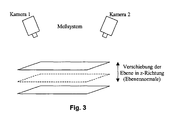
- Figur 3:
- Verschiebung des ebenen Objektes in Richtung seiner Flächennormale (z-Achse),
- Figur 4:
- Schematischer Ablaufplan der Erfindung
Figur 1 illustriert den Einfluss des Fehlers eines Pixelortes einer Bildaufnahmematrix auf das Messergebnis. Die Ansicht erfolgt aus Richtung der y-Achse auf die xz-Ebene. Das bedeutet, dass nur ein Fehler des Pixelortes in x- bzw. z-Richtung des Weltkoordinatensystems in dieser Abbildung illustriert wird. Analoge Zusammenhänge ergeben sich auch für eine Sicht aus der x-Richtung auf die yz-Ebene.
- Die Fläche sollte keine für das Ergebnis relevante Rauhigkeit besitzen. Eine zu große Rauhigkeit bewirkt ein fehlerhaftes Ergebnis bei der Berechnung des genauen Pixelortes.
- Die Fläche muss keine ideale Ebene sein. Die Krümmung darf aber nicht zu groß sein.
- Eine Filterung mit einem linearen oder nichtlinearen lokalen Glättungs-Operator. Dazu sollten sich die x- und y-Koordinaten der einzelnen Messpunkte in einem äquidistanten Raster befinden. Die z-Koordinaten können so in einer Matrix angeordnet werden und diese Matrix kann als Bild aufgefasst werden. Die Glättung eines solchen Bildes ist Stand der Technik.
- Eine Approximation der 3D-Daten. Die Approximationsfunktion (z. B. eine Splines-Fläche) muss so beschaffen sein, dass ein ausreichender Glättungseffekt erfolgt.
Statt von Figur 1 kann auch von den in Figur 2 dargestellten geometrischen Relationen ausgegangen werden, um die korrekten 3D-Daten eines Messpunktes zu berechnen.
Die Projektion eines Punktes vom Weltkoordinatensystem in das Bild erfolgt folgendermaßen:

Figur 3 illustriert diese Verfahrensweise. Dadurch werden bei der Rückprojektion des Messpunktes immer andere Pixel der Bildaufnahmematrix miteinander kombiniert.
- nur eine Bildaufnahmematrix den Fehler verursacht. Der Fehler des Pixelortes muss dann zunächst für alle Bildaufnahmematrizen separat berechnet werden.
- beide (bzw. alle) Bildaufnahmematrizen den Fehler verursachen.
- wirklicher Fehler des betreffenden Pixelortes. Dieser Fehler tritt in allen Messungen gleichermaßen auf und wird durch die Mittelung nicht verringert.
- Fehler des korrespondierenden Pixels auf der anderen Bildaufnahmematrix. Da das korrespondierende Pixel bei jeder Einzelmessung wechselt, würde sich dieser Fehler durch die Mittelung verringern.
- Sonstige Fehlerquellen, z. B. Rauschen. Diese Fehlerquellen würden ebenfalls durch die Mittelung verringert werden.
Es ist sinnvoll, wenn die Bestimmung der Messpunkte mit einer höheren Dichte als der Dichte der zugehörigen Pixel erfolgt. Als Ausgangsbasis für die Mittelwertbildung liegt dann eine relativ dichte Punktewolke vor. Dadurch wird das Ergebnis nach der Mittelwertbildung exakter.
Es besteht auch die Möglichkeit, die Punktewolke mit einer Funktion zu approximieren (z. B. durch eine Splineapproximation).
Endergebnis ist eine Matrix, die für jedes Pixel zwei Werte enthält: einen Fehler des Pixelortes in x-Richtung und in y-Richtung.
Claims (8)
- Verfahren zur Bestimmung der Abweichung des Pixelortes der Pixel mindestens einer Bildaufnahmematrix von der Sollposition, wobei die Bildaufnahmematrix mindestens während des Verfahrensablaufs Bestandteil eines optischen 3D-Messsystem ist, dadurch gekennzeichnet, dassa) ein Objekt bereitgestellt wird, das zur Vermessung mittels des optischen 3D-Messsystems geeignet ist, wobei dieses Objekt eben ist oder eine solche Krümmung aufweist, dass bei der durch die Glättung entsprechende Schritt c nur die lokalen Fehler der 3D-Daten ausgemittelt und nicht die Konturen des Objektes verändert werden,b) das Objekt durch das 3D-Messsystem vermessen wird und dabei 3D-Daten des Objektes ermittelt werden,c) danach die ermittelten 3D-Daten des Objektes geglättet werden,d) die 3D-Messpunkte des Objektes unter Verwendung ihrer sowohl nach Schritt b ermittelten als auch nach Schritt c geglätteten 3D-Daten auf die Sensoren der mindestens einen Matrixkamera rückprojiziert werden,e) die Differenz zwischen der Position der beiden auf die Sensoren rückprojizierten Punkte ermittelt wird, die einem 3D-Messpunkt zugeordnet sind,f) danach wahlweise eine Verschiebung zwischen Objekt und optischem 3D-Messsystem erfolgt oder unterlassen wird,g) die Schritte b bis f solange wiederholt werden, bis die gewünschte Genauigkeit der durch das Verfahren zu bestimmenden Abweichungen des Pixelortes der Pixel einer Bildaufnahmematrix erreicht ist, wobei die Genauigkeit von der Anzahl der Wiederholungen und der Anzahl der Verschiebungen entsprechend Schritt fabhängt,h) und aus den entsprechend Schritt e ermittelten Werten für jedes Pixel oder für ausgewählte Pixel die Abweichung des Pixelortes der Pixel von der Sollposition bestimmt wird.
- Verfahren zur Bestimmung der Abweichung des Pixelortes der Pixel mindestens einer Bildaufnahmematrix von der Sollposition,wobei die Bildaufnahmematrix mindestens während des Verfahrensablaufs Bestandteil eines optischen 3D-Messsystem ist, dadurch gekennzeichnet, dassa) ein zur Vermessung mittels eines optischen 3D-Messsystem geeignetes Objekt bereitgestellt wird,b) das Objekt durch das 3D-Messsystem vermessen wird und dabei 3D-Daten des Objektes ermittelt werden,c) danach die ermittelten 3D-Daten des Objektes geglättet werden oder die korrekten 3D-Daten anderweitig bestimmt werden,d) die 3D-Messpunkte des Objektes unter Verwendung ihrer sowohl nach Schritt b ermittelten als auch nach Schritt c geglätteten 3D-Daten auf die Sensoren der mindestens einen Matrixkamera rückprojiziert werden,e) die Differenz zwischen der Position der beiden auf die Sensoren rückprojizierten Punkte ermittelt wird, die einem 3D-Messpunkt zugeordnet sind,f) danach wahlweise eine Verschiebung zwischen Objekt und optischem 3D-Messsystem erfolgt oder unterlassen wird,g) die Schritte b bis f solange wiederholt werden, bis die gewünschte Genauigkeit der durch das Verfahren zu bestimmenden Abweichungen des Pixelortes der Pixel einer Bildaufnahmematrix erreicht ist, wobei die Genauigkeit von der Anzahl der Wiederholungen und der Anzahl der Verschiebungen entsprechend Schritt fabhängt,h) und aus den entsprechend Schritt e ermittelten Werten für jedes Pixel oder für ausgewählte Pixel die Abweichung des Pixelortes der Pixel von der Sollposition bestimmt wird.
- Verfahren nach Anspruch 1 oder 2, dadurch gekennzeichnet, dass
die Verschiebung zwischen Objekt und Messsystem im wesentlichen in Richtung der Flächennormale des Objektes erfolgt. - Verfahren nach einem der vorhergehenden Ansprüche, dadurch gekennzeichnet, dass
als 3D-Messverfahren das Verfahren nach DE 19623172 verwendet wird. - Verfahren nach einem der vorhergehenden Ansprüche, dadurch gekennzeichnet, dass
die Abweichung des Pixelortes der Pixel von der Sollposition ermittelt wird, indem jeweils für das betreffende Pixel der Fehler des Pixelortes durch Mittelwertbildung aller entsprechend Schritt 1e oder 2e des Anspruchs 1 oder 2 ermittelten und für das betreffende Pixel relevanten Werte bestimmt wird. - Verfahren nach Anspruch 1 bis 4, dadurch gekennzeichnet, dass
die Abweichung des Pixelortes der Pixel von der Sollposition ermittelt wird, indem jeweils für das betreffende Pixel der Fehler des Pixelortes mittels Approximation aller entsprechend Schritt 1e oder 2e des Anspruchs 1 oder 2 ermittelten Werte durch einer Funktion bestimmt wird. - Verfahren nach einem der vorhergehenden Ansprüche, dadurch gekennzeichnet, dass
die Bildaufnahmematrix ein CCD-Sensor oder ein CMOS-Sensor ist. - Verfahren nach einem der vorhergehenden Ansprüche, dadurch gekennzeichnet, dass
die Sollposition durch eine Kalibrierung des Messsystems bestimmt wird.
Applications Claiming Priority (2)
| Application Number | Priority Date | Filing Date | Title |
|---|---|---|---|
| DE10065120 | 2000-12-28 | ||
| DE10065120A DE10065120C2 (de) | 2000-12-28 | 2000-12-28 | Verfahren zur Bestimmung der Abweichung des Pixelortes der Pixel mindestens einer Bildaufnahmematrix von der Sollposition |
Publications (3)
| Publication Number | Publication Date |
|---|---|
| EP1219921A2 true EP1219921A2 (de) | 2002-07-03 |
| EP1219921A3 EP1219921A3 (de) | 2006-04-26 |
| EP1219921B1 EP1219921B1 (de) | 2010-10-27 |
Family
ID=7669063
Family Applications (1)
| Application Number | Title | Priority Date | Filing Date |
|---|---|---|---|
| EP01130552A Expired - Lifetime EP1219921B1 (de) | 2000-12-28 | 2001-12-21 | Verfahren zur Bestimmung der Abweichung des Pixelortes der Pixel mindestens einer Bildaufnahmematrix von der Sollposition |
Country Status (4)
| Country | Link |
|---|---|
| US (1) | US7072505B2 (de) |
| EP (1) | EP1219921B1 (de) |
| AT (1) | ATE486264T1 (de) |
| DE (2) | DE10065120C2 (de) |
Cited By (1)
| Publication number | Priority date | Publication date | Assignee | Title |
|---|---|---|---|---|
| CN107631693A (zh) * | 2017-09-14 | 2018-01-26 | 重庆大学 | 一种二维多点激光位移测量系统 |
Families Citing this family (2)
| Publication number | Priority date | Publication date | Assignee | Title |
|---|---|---|---|---|
| CN107036559A (zh) * | 2017-05-31 | 2017-08-11 | 天津大学 | 一种曲面斜率的测量方法 |
| CN109883335B (zh) * | 2019-03-15 | 2025-04-22 | 广州市合熠智能科技股份有限公司 | 一种微型数字cmos激光位移传感器电路系统 |
Family Cites Families (10)
| Publication number | Priority date | Publication date | Assignee | Title |
|---|---|---|---|---|
| US4938600A (en) * | 1989-02-09 | 1990-07-03 | Interactive Video Systems, Inc. | Method and apparatus for measuring registration between layers of a semiconductor wafer |
| DE4039743A1 (de) * | 1990-12-08 | 1992-06-11 | Thaelmann Schwermaschbau Veb | Verfahren zur erfassung von korrekturwerten fuer die korrektur optischer abbildungsfehler in durchmessermessgeraeten auf der basis von ccd-zeilen |
| US5444481A (en) * | 1993-01-15 | 1995-08-22 | Sanyo Machine Works, Ltd. | Method of calibrating a CCD camera |
| DE19623172C1 (de) * | 1996-06-10 | 1997-10-23 | Univ Magdeburg Tech | Verfahren zur dreidimensionalen optischen Vermessung von Objektoberflächen |
| JPH1069543A (ja) * | 1996-08-29 | 1998-03-10 | Oki Electric Ind Co Ltd | 被写体の曲面再構成方法及び被写体の曲面再構成装置 |
| US6064759A (en) * | 1996-11-08 | 2000-05-16 | Buckley; B. Shawn | Computer aided inspection machine |
| DE19727281C1 (de) * | 1997-06-27 | 1998-10-22 | Deutsch Zentr Luft & Raumfahrt | Verfahren und Vorrichtung zur geometrischen Kalibrierung von CCD-Kameras |
| JP2000125313A (ja) * | 1998-10-20 | 2000-04-28 | Matsushita Electric Ind Co Ltd | 欠陥補正装置 |
| KR100291186B1 (ko) * | 1998-12-30 | 2001-06-01 | 박종섭 | 이미지 센서에서의 불량 화소 검출 및 보정을위한 장치 및 그방법 |
| JP4453119B2 (ja) * | 1999-06-08 | 2010-04-21 | ソニー株式会社 | カメラ・キャリブレーション装置及び方法、画像処理装置及び方法、プログラム提供媒体、並びに、カメラ |
-
2000
- 2000-12-28 DE DE10065120A patent/DE10065120C2/de not_active Expired - Fee Related
-
2001
- 2001-12-21 DE DE50115674T patent/DE50115674D1/de not_active Expired - Lifetime
- 2001-12-21 AT AT01130552T patent/ATE486264T1/de not_active IP Right Cessation
- 2001-12-21 EP EP01130552A patent/EP1219921B1/de not_active Expired - Lifetime
- 2001-12-28 US US10/035,491 patent/US7072505B2/en not_active Expired - Fee Related
Cited By (1)
| Publication number | Priority date | Publication date | Assignee | Title |
|---|---|---|---|---|
| CN107631693A (zh) * | 2017-09-14 | 2018-01-26 | 重庆大学 | 一种二维多点激光位移测量系统 |
Also Published As
| Publication number | Publication date |
|---|---|
| DE10065120A1 (de) | 2002-07-11 |
| DE50115674D1 (de) | 2010-12-09 |
| DE10065120C2 (de) | 2003-03-20 |
| ATE486264T1 (de) | 2010-11-15 |
| EP1219921A3 (de) | 2006-04-26 |
| EP1219921B1 (de) | 2010-10-27 |
| US7072505B2 (en) | 2006-07-04 |
| US20020146165A1 (en) | 2002-10-10 |
Similar Documents
| Publication | Publication Date | Title |
|---|---|---|
| DE102008015499B4 (de) | Verfahren und Vorrichtung zur Bestimmung der 3D-Koordinaten eines Objekts | |
| DE19804205B4 (de) | Fotogrammetrisches Meßverfahren und fotogrammetrische Meßeinrichtung | |
| DE19825829C2 (de) | Verfahren zur Bestimmung des Abstandes P einer Kante eines Strukturelementes auf einem Substrat | |
| DE10020893B4 (de) | Verfahren zur optischen Formerfassung von Gegenständen | |
| DE19623172C1 (de) | Verfahren zur dreidimensionalen optischen Vermessung von Objektoberflächen | |
| DE102011114674C5 (de) | Verfahren und Vorrichtung zum Bestimmen der 3D-Koordinaten eines Objekts | |
| EP3775767B1 (de) | Verfahren und system zur vermessung eines objekts mittels stereoskopie | |
| DE102019128814A1 (de) | Kamera zur Erfassung eines Objektstroms und Verfahren zur Bestimmung der Höhe von Objekten | |
| DE102007025304B4 (de) | Verfahren zur Verbesserung der Reproduzierbarkeit einer Koordinaten-Messmaschine und deren Genauigkeit | |
| EP3907466A1 (de) | 3d-sensor und verfahren zur erfassung von dreidimensionalen bilddaten eines objekts | |
| DE3785430T2 (de) | Verfahren und einrichtung zum automatischen lesen von vernier-mustern. | |
| DE102018104913A1 (de) | Schwingungsüberwachung eines Objekts mittels Videokamera | |
| DE102006059431B4 (de) | Vorrichtung und Verfahren zum Bestimmen der Position einer Struktur auf einem Träger relativ zu einem Referenzpunkt des Trägers | |
| DE19953063A1 (de) | Verfahren zur dreidimensionalen optischen Vermessung von Objektoberflächen | |
| DE102004058655A1 (de) | Verfahren und Anordnung zum Messen von Geometrien eines Objektes mittels eines Koordinatenmessgerätes | |
| DE102007038785A1 (de) | Verfahren und Vorrichtung zum Bestimmen von Geometriedaten eines Messobjekts | |
| DE4125688C2 (de) | Abstandserfassungseinrichtung | |
| DE10065120C2 (de) | Verfahren zur Bestimmung der Abweichung des Pixelortes der Pixel mindestens einer Bildaufnahmematrix von der Sollposition | |
| DE3786139T2 (de) | Automatisches fokussierungsverfahren fuer mittel zur untersuchung eines objekts. | |
| DE3247238A1 (de) | Ebenheitsmessgeraet | |
| DE60115013T2 (de) | Messung der ausrichtung von fahrzeugrädern mit videokameras und wiederholten näherungsrechnungen | |
| DE102007017649A1 (de) | Verfahren zum Bestimmen der Fokuslage von mindestens zwei Kanten von Strukturen auf einem Substrat | |
| DE102013011848A1 (de) | Vorrichtung und Verfahren zum Bestimmen der 3D-Koordinaten eines Objekts | |
| DE102006004060B4 (de) | Verfahren und Vorrichtung zum Messen der Höhe und/oder des Höhenverlaufs eines Objekts | |
| DE102004014967B4 (de) | Variolinsensystem und Verfahren zu dessen Schärfenjustierung |
Legal Events
| Date | Code | Title | Description |
|---|---|---|---|
| PUAI | Public reference made under article 153(3) epc to a published international application that has entered the european phase |
Free format text: ORIGINAL CODE: 0009012 |
|
| AK | Designated contracting states |
Kind code of ref document: A2 Designated state(s): AT BE CH CY DE DK ES FI FR GB GR IE IT LI LU MC NL PT SE TR |
|
| AX | Request for extension of the european patent |
Free format text: AL;LT;LV;MK;RO;SI |
|
| PUAL | Search report despatched |
Free format text: ORIGINAL CODE: 0009013 |
|
| AK | Designated contracting states |
Kind code of ref document: A3 Designated state(s): AT BE CH CY DE DK ES FI FR GB GR IE IT LI LU MC NL PT SE TR |
|
| AX | Request for extension of the european patent |
Extension state: AL LT LV MK RO SI |
|
| RIC1 | Information provided on ipc code assigned before grant |
Ipc: H04N 13/00 20060101ALI20060306BHEP Ipc: G01B 11/24 20060101ALI20060306BHEP Ipc: G01B 11/02 20060101AFI20020410BHEP Ipc: H01L 27/146 20060101ALI20060306BHEP |
|
| 17P | Request for examination filed |
Effective date: 20060614 |
|
| AKX | Designation fees paid |
Designated state(s): AT BE CH CY DE DK ES FI FR GB GR IE IT LI LU MC NL PT SE TR |
|
| 17Q | First examination report despatched |
Effective date: 20071122 |
|
| GRAP | Despatch of communication of intention to grant a patent |
Free format text: ORIGINAL CODE: EPIDOSNIGR1 |
|
| RTI1 | Title (correction) |
Free format text: PROCEDURE TO DETERMINE THE DEVIATION OF THE DESIRED PIXEL POSITION OF THE PIXELS OF AT LEAST ONE IMAGE MATRIX |
|
| GRAS | Grant fee paid |
Free format text: ORIGINAL CODE: EPIDOSNIGR3 |
|
| GRAA | (expected) grant |
Free format text: ORIGINAL CODE: 0009210 |
|
| AK | Designated contracting states |
Kind code of ref document: B1 Designated state(s): AT BE CH CY DE DK ES FI FR GB GR IE IT LI LU MC NL PT SE TR |
|
| REG | Reference to a national code |
Ref country code: GB Ref legal event code: FG4D Free format text: NOT ENGLISH |
|
| REG | Reference to a national code |
Ref country code: CH Ref legal event code: EP |
|
| REG | Reference to a national code |
Ref country code: IE Ref legal event code: FG4D Free format text: LANGUAGE OF EP DOCUMENT: GERMAN |
|
| REF | Corresponds to: |
Ref document number: 50115674 Country of ref document: DE Date of ref document: 20101209 Kind code of ref document: P |
|
| REG | Reference to a national code |
Ref country code: NL Ref legal event code: VDEP Effective date: 20101027 |
|
| REG | Reference to a national code |
Ref country code: IE Ref legal event code: FD4D |
|
| PG25 | Lapsed in a contracting state [announced via postgrant information from national office to epo] |
Ref country code: PT Free format text: LAPSE BECAUSE OF FAILURE TO SUBMIT A TRANSLATION OF THE DESCRIPTION OR TO PAY THE FEE WITHIN THE PRESCRIBED TIME-LIMIT Effective date: 20110228 Ref country code: SE Free format text: LAPSE BECAUSE OF FAILURE TO SUBMIT A TRANSLATION OF THE DESCRIPTION OR TO PAY THE FEE WITHIN THE PRESCRIBED TIME-LIMIT Effective date: 20101027 Ref country code: FI Free format text: LAPSE BECAUSE OF FAILURE TO SUBMIT A TRANSLATION OF THE DESCRIPTION OR TO PAY THE FEE WITHIN THE PRESCRIBED TIME-LIMIT Effective date: 20101027 Ref country code: NL Free format text: LAPSE BECAUSE OF FAILURE TO SUBMIT A TRANSLATION OF THE DESCRIPTION OR TO PAY THE FEE WITHIN THE PRESCRIBED TIME-LIMIT Effective date: 20101027 |
|
| BERE | Be: lapsed |
Owner name: INB VISION A.G. Effective date: 20101231 |
|
| PG25 | Lapsed in a contracting state [announced via postgrant information from national office to epo] |
Ref country code: GR Free format text: LAPSE BECAUSE OF FAILURE TO SUBMIT A TRANSLATION OF THE DESCRIPTION OR TO PAY THE FEE WITHIN THE PRESCRIBED TIME-LIMIT Effective date: 20110128 |
|
| PG25 | Lapsed in a contracting state [announced via postgrant information from national office to epo] |
Ref country code: IE Free format text: LAPSE BECAUSE OF FAILURE TO SUBMIT A TRANSLATION OF THE DESCRIPTION OR TO PAY THE FEE WITHIN THE PRESCRIBED TIME-LIMIT Effective date: 20101027 Ref country code: MC Free format text: LAPSE BECAUSE OF NON-PAYMENT OF DUE FEES Effective date: 20101231 Ref country code: ES Free format text: LAPSE BECAUSE OF FAILURE TO SUBMIT A TRANSLATION OF THE DESCRIPTION OR TO PAY THE FEE WITHIN THE PRESCRIBED TIME-LIMIT Effective date: 20110207 |
|
| REG | Reference to a national code |
Ref country code: CH Ref legal event code: PL |
|
| PG25 | Lapsed in a contracting state [announced via postgrant information from national office to epo] |
Ref country code: DK Free format text: LAPSE BECAUSE OF FAILURE TO SUBMIT A TRANSLATION OF THE DESCRIPTION OR TO PAY THE FEE WITHIN THE PRESCRIBED TIME-LIMIT Effective date: 20101027 |
|
| PLBE | No opposition filed within time limit |
Free format text: ORIGINAL CODE: 0009261 |
|
| STAA | Information on the status of an ep patent application or granted ep patent |
Free format text: STATUS: NO OPPOSITION FILED WITHIN TIME LIMIT |
|
| GBPC | Gb: european patent ceased through non-payment of renewal fee |
Effective date: 20110127 |
|
| PG25 | Lapsed in a contracting state [announced via postgrant information from national office to epo] |
Ref country code: BE Free format text: LAPSE BECAUSE OF NON-PAYMENT OF DUE FEES Effective date: 20101231 |
|
| 26N | No opposition filed |
Effective date: 20110728 |
|
| PG25 | Lapsed in a contracting state [announced via postgrant information from national office to epo] |
Ref country code: CH Free format text: LAPSE BECAUSE OF NON-PAYMENT OF DUE FEES Effective date: 20101231 Ref country code: LI Free format text: LAPSE BECAUSE OF NON-PAYMENT OF DUE FEES Effective date: 20101231 |
|
| REG | Reference to a national code |
Ref country code: DE Ref legal event code: R097 Ref document number: 50115674 Country of ref document: DE Effective date: 20110728 |
|
| PG25 | Lapsed in a contracting state [announced via postgrant information from national office to epo] |
Ref country code: GB Free format text: LAPSE BECAUSE OF NON-PAYMENT OF DUE FEES Effective date: 20110127 |
|
| PG25 | Lapsed in a contracting state [announced via postgrant information from national office to epo] |
Ref country code: AT Free format text: LAPSE BECAUSE OF NON-PAYMENT OF DUE FEES Effective date: 20101221 |
|
| REG | Reference to a national code |
Ref country code: AT Ref legal event code: MM01 Ref document number: 486264 Country of ref document: AT Kind code of ref document: T Effective date: 20101221 |
|
| PG25 | Lapsed in a contracting state [announced via postgrant information from national office to epo] |
Ref country code: CY Free format text: LAPSE BECAUSE OF FAILURE TO SUBMIT A TRANSLATION OF THE DESCRIPTION OR TO PAY THE FEE WITHIN THE PRESCRIBED TIME-LIMIT Effective date: 20101027 |
|
| PG25 | Lapsed in a contracting state [announced via postgrant information from national office to epo] |
Ref country code: LU Free format text: LAPSE BECAUSE OF NON-PAYMENT OF DUE FEES Effective date: 20101221 |
|
| PG25 | Lapsed in a contracting state [announced via postgrant information from national office to epo] |
Ref country code: TR Free format text: LAPSE BECAUSE OF FAILURE TO SUBMIT A TRANSLATION OF THE DESCRIPTION OR TO PAY THE FEE WITHIN THE PRESCRIBED TIME-LIMIT Effective date: 20101027 |
|
| REG | Reference to a national code |
Ref country code: FR Ref legal event code: PLFP Year of fee payment: 15 |
|
| PGFP | Annual fee paid to national office [announced via postgrant information from national office to epo] |
Ref country code: FR Payment date: 20151218 Year of fee payment: 15 |
|
| PGFP | Annual fee paid to national office [announced via postgrant information from national office to epo] |
Ref country code: DE Payment date: 20151231 Year of fee payment: 15 |
|
| PGFP | Annual fee paid to national office [announced via postgrant information from national office to epo] |
Ref country code: IT Payment date: 20151222 Year of fee payment: 15 |
|
| REG | Reference to a national code |
Ref country code: DE Ref legal event code: R119 Ref document number: 50115674 Country of ref document: DE |
|
| REG | Reference to a national code |
Ref country code: FR Ref legal event code: ST Effective date: 20170831 |
|
| PG25 | Lapsed in a contracting state [announced via postgrant information from national office to epo] |
Ref country code: FR Free format text: LAPSE BECAUSE OF NON-PAYMENT OF DUE FEES Effective date: 20170102 Ref country code: IT Free format text: LAPSE BECAUSE OF NON-PAYMENT OF DUE FEES Effective date: 20161221 |
|
| PG25 | Lapsed in a contracting state [announced via postgrant information from national office to epo] |
Ref country code: DE Free format text: LAPSE BECAUSE OF NON-PAYMENT OF DUE FEES Effective date: 20170701 |