EP1220044A2 - Systèmes de développement pour toners magnétiques et toners à teneur réduite en matériau magnétique - Google Patents
Systèmes de développement pour toners magnétiques et toners à teneur réduite en matériau magnétique Download PDFInfo
- Publication number
- EP1220044A2 EP1220044A2 EP01130250A EP01130250A EP1220044A2 EP 1220044 A2 EP1220044 A2 EP 1220044A2 EP 01130250 A EP01130250 A EP 01130250A EP 01130250 A EP01130250 A EP 01130250A EP 1220044 A2 EP1220044 A2 EP 1220044A2
- Authority
- EP
- European Patent Office
- Prior art keywords
- magnetic
- developer
- toner
- spacing agent
- development system
- Prior art date
- Legal status (The legal status is an assumption and is not a legal conclusion. Google has not performed a legal analysis and makes no representation as to the accuracy of the status listed.)
- Granted
Links
Images


Classifications
-
- G—PHYSICS
- G03—PHOTOGRAPHY; CINEMATOGRAPHY; ANALOGOUS TECHNIQUES USING WAVES OTHER THAN OPTICAL WAVES; ELECTROGRAPHY; HOLOGRAPHY
- G03G—ELECTROGRAPHY; ELECTROPHOTOGRAPHY; MAGNETOGRAPHY
- G03G9/00—Developers
- G03G9/08—Developers with toner particles
- G03G9/083—Magnetic toner particles
-
- B—PERFORMING OPERATIONS; TRANSPORTING
- B82—NANOTECHNOLOGY
- B82Y—SPECIFIC USES OR APPLICATIONS OF NANOSTRUCTURES; MEASUREMENT OR ANALYSIS OF NANOSTRUCTURES; MANUFACTURE OR TREATMENT OF NANOSTRUCTURES
- B82Y15/00—Nanotechnology for interacting, sensing or actuating, e.g. quantum dots as markers in protein assays or molecular motors
-
- G—PHYSICS
- G03—PHOTOGRAPHY; CINEMATOGRAPHY; ANALOGOUS TECHNIQUES USING WAVES OTHER THAN OPTICAL WAVES; ELECTROGRAPHY; HOLOGRAPHY
- G03G—ELECTROGRAPHY; ELECTROPHOTOGRAPHY; MAGNETOGRAPHY
- G03G13/00—Electrographic processes using a charge pattern
- G03G13/06—Developing
- G03G13/08—Developing using a solid developer, e.g. powder developer
- G03G13/09—Developing using a solid developer, e.g. powder developer using magnetic brush
-
- G—PHYSICS
- G03—PHOTOGRAPHY; CINEMATOGRAPHY; ANALOGOUS TECHNIQUES USING WAVES OTHER THAN OPTICAL WAVES; ELECTROGRAPHY; HOLOGRAPHY
- G03G—ELECTROGRAPHY; ELECTROPHOTOGRAPHY; MAGNETOGRAPHY
- G03G9/00—Developers
- G03G9/08—Developers with toner particles
- G03G9/097—Plasticisers; Charge controlling agents
-
- G—PHYSICS
- G03—PHOTOGRAPHY; CINEMATOGRAPHY; ANALOGOUS TECHNIQUES USING WAVES OTHER THAN OPTICAL WAVES; ELECTROGRAPHY; HOLOGRAPHY
- G03G—ELECTROGRAPHY; ELECTROPHOTOGRAPHY; MAGNETOGRAPHY
- G03G9/00—Developers
- G03G9/08—Developers with toner particles
- G03G9/097—Plasticisers; Charge controlling agents
- G03G9/09708—Inorganic compounds
-
- G—PHYSICS
- G03—PHOTOGRAPHY; CINEMATOGRAPHY; ANALOGOUS TECHNIQUES USING WAVES OTHER THAN OPTICAL WAVES; ELECTROGRAPHY; HOLOGRAPHY
- G03G—ELECTROGRAPHY; ELECTROPHOTOGRAPHY; MAGNETOGRAPHY
- G03G9/00—Developers
- G03G9/08—Developers with toner particles
- G03G9/097—Plasticisers; Charge controlling agents
- G03G9/09733—Organic compounds
-
- G—PHYSICS
- G03—PHOTOGRAPHY; CINEMATOGRAPHY; ANALOGOUS TECHNIQUES USING WAVES OTHER THAN OPTICAL WAVES; ELECTROGRAPHY; HOLOGRAPHY
- G03G—ELECTROGRAPHY; ELECTROPHOTOGRAPHY; MAGNETOGRAPHY
- G03G2215/00—Apparatus for electrophotographic processes
- G03G2215/00025—Machine control, e.g. regulating different parts of the machine
- G03G2215/0013—Machine control, e.g. regulating different parts of the machine for producing copies with MICR
Definitions
- the present invention relates to magnetic toners and development systems for magnetic toners.
- Magnetic ink character recognition (MICR) printing has been used for many years for checks and negotiable documents as well as for other documents in need of high speed reading and sorting.
- Various electrophotographic printers which are capable of printing magnetic inks or toners have been available from such sources as IBM and Kodak.
- the toner or ink used for MICR applications contains a heavy loading of iron oxide or other magnetic material in order to obtain the required adequate magnetic signal strength for speed reading and sorting and the like.
- MICR toner having such heavy iron oxide loadings can be quite difficult to manufacture since an adequate dispersion of the iron oxide particles in the toner resin, for instance, is hard to achieve and maintain.
- the resulting image quality from the MICR toner can be degraded relative to images made with normal toner due to decreased toning and fusing efficiencies resulting from the magnetic loadings that are required in the toner.
- MICR toners in the industry range in iron oxide loadings of up to and even above 50% by weight of the toner.
- the signal strength for the release toner is between 120% and 140% average signal strength of the "on-us" characters as measured on a DOCU-MATE Check Reader. This 120% signal strength is sufficient and required to compensate for character voids and otherwise low density individual image.
- using such a toner no matter what currently available printer or development system is used, typically leads to image quality which is at best mediocre.
- a feature of the present invention is to provide a development system for magnetic toner which provides a printed image having sharp image quality.
- Another feature of the present invention is to provide magnetic toner having a reduced magnetic loading and yet achieves the desired magnetic signal strength.
- a further feature of the present invention is to provide a magnetic toner which provides a reduced amount of magnetic loading and provides a final image which is above mediocre.
- the present invention relates to a development system for magnetic toner.
- the development system includes a supply of dry developer mixture which contains magnetic toner particles and hard magnetic carrier particles.
- the development system further includes a non-magnetic, cylindrical shell for transporting the developer between the supply and the development zone wherein the shell can be rotatable or stationary.
- a rotating magnetic core of a pre-selected magnetic field strength and means for rotating at least the magnetic core to provide for the transport of the toner particles from the shell to an electrostatic image are also provided as part of the development system.
- the present invention further relates to a method for developing an electrostatic image with a magnetic toner.
- the method involves developing an electrostatic image member bearing an electrostatic image pattern by moving the image member through a development zone and transporting developer through the development zone in developing relation with the charge pattern of the moving imaging member by rotating an alternating-pole magnetic core of a pre-selected magnetic field strength within an outer non-magnetic shell, which can be rotating or stationary, and controlling the directions and speeds of the core and optionally the shell rotations so that developer flows through the development zone in a direction co-current with the image member movement, wherein an electrographic two-component dry developer composition is preferably used.
- the dry developer composition contains charged magnetic toner particles and oppositely charged carrier particles.
- the carrier particles are a hard magnetic material exhibiting a coercivity of at least about 300 gauss when magnetically saturated and also exhibit an induced magnetic moment of at least about 20 EMU/gm when in an externally applied field of 1,000 gauss.
- the carrier particles have a sufficient magnetic moment to prevent the carrier particles from transferring to the electrostatic image.
- the present invention also relates to a developer which contains magnetic toner particles and hard magnetic carrier particles.
- the magnetic toner particles have a low magnetic loading, such as on the order of 28% by weight or less, based on the weight of the toner.
- the present invention in addition, relates to magnetic toner particles and developers containing at least one resin, at least one colorant, at least one charge agent, and at least one magnetic additive, such as iron oxide, wherein the amount of the magnetic additive is considerably lower than conventional magnetic toners, such as on the order of 28% by weight or less, based on the weight of the toner.
- the magnetic toner is surface treated with a spacing agent to reduce the attractive forces between the toner particle and carrier particle and yet not interfere with the toner particle transferring to the electrostatic image by electrostatic forces.
- the toner of the present invention having a reduced amount of magnetic additives leads to toners which are easier to manufacture, and toners which are easier to fuse into an image. Further, toners with reduced magnetic loadings permit easier separation of the toner particles from the carrier particles and also permits more toner to reach the image which leads to good visual image quality.
- the present invention relates to development systems and methods for developing using magnetic toner.
- the present invention further relates to the developer used in the development system as well as the toner in the developer.
- the present invention in part, relates to a development system.
- the development system contains a supply of dry developer mixture which includes magnetic toner and hard magnetic carrier particles.
- a non-magnetic, cylindrical shell which can be a stationary shell or a rotating shell is used for transporting the developer mixture from the supply to the development zone.
- a magnetic core which includes a plurality of magnetic pole portions is arranged around the core periphery in alternating magnetic polarity relation and which is rotatable on an axis within the non-magnetic, cylindrical shell.
- means for rotating the core and optionally the shell are present in order to deliver the developer mixture to the development zone wherein the toner of the developer is transferred to the electrostatic image.
- the set up of the development system is preferably a digital printer, such as a Heidelberg Digimaster 9110 printer using a development station comprising a non-magnetic, cylindrical shell, a magnetic core, and means for rotating the core and optionally the shell as described, for instance, in detail in U.S. Patent Nos. 4,473,029 and 4,546,060.
- the development systems described in these patents can be adapted for use in the present invention.
- the development systems described in these patents preferably use hard magnetic carrier particles.
- the hard magnetic carrier particles can exhibit a coercivity of at least about 300 gauss when magnetically saturated and also exhibit an induced magnetic moment of at least about 20 EMU/gm when in an externally applied field of 1,000 gauss.
- the magnetic carrier particles can be binder-less carriers or composite carriers.
- Useful hard magnetic materials include ferrites and gamma ferric oxide.
- the carrier particles are composed of ferrites, which are compounds of magnetic oxides containing iron as a major metallic component.
- ferrites which are compounds of magnetic oxides containing iron as a major metallic component.
- compounds of ferric oxide, Fe 2 O 3 formed with basic metallic oxides such as those having the general formula MFeO 2 or MFe 2 O 4 wherein M represents a mono- or di-valent metal and the iron is in the oxidation state of +3.
- Preferred ferrites are those containing barium and/or strontium, such as BaFe 12 O 19 , SrFe 12 O 19 , and the magnetic ferrites having the formula MO.6 Fe 2 O 3 , wherein M is barium, strontium, or lead as disclosed in U.S. Patent No, 3,716,630.
- the size of the magnetic carrier particles useful in the present invention can vary widely, and preferably have an average particle size of less than 100 microns, and more preferably have an average carrier particle size of from about 5 to about 45 microns.
- the hard magnetic carrier particles of the developer become a permanent magnet which is in contrast to other developer particles which are only temporarily magnetized. This situation results in difficulty in removing the toner from the developer particles to allow toning of the electrostatic latent image. This difficulty can be further increased due to the magnetic loading in the magnetic toner as well as the hard magnetic carrier particles being used.
- the most preferred solution of the present invention is to use surface treated magnetic toner particles.
- the surface treatment with a spacing agent reduces the attraction between the toner particles and the hard magnetic carrier particles to a degree sufficient that the magnetic toner particles are transported by the carrier particles to the development zone where the electrostatic image is present and then the magnetic toner particles leave the carrier particles due at least in part to the sufficient electrostatic forces associated with the charged image.
- the preferred magnetic toner particles of the present invention permit attachment with the magnetic carrier particles but further permit the stripping of the magnetic toner particles from the hard magnetic carrier particles by the electrostatic and/or mechanical forces and with surface treatment on the magnetic toner particles.
- the spacing agent on the surface of the magnetic toner particles is sufficient to reduce the attraction between the magnetic toner particles and the hard magnetic carrier particles such that the magnetic toner particles can be stripped from the carrier particles by the electrostatic forces associated with the charged image or by mechanical forces.
- the preferred spacing agent is silica, such as those commercially available from Degussa, like R-972, or from Wacker, like H2000.
- Other suitable spacing agents include, but are not limited to, other inorganic oxide particles and the like. Specific examples include, but are not limited to, titania, alumina, zirconia, and other metal oxides; and also polymer beads preferably less than 1 ⁇ m in diameter (more preferably about 0.1 ⁇ m), such as acrylic polymers, silicone-based polymers, styrenic polymers, fluoropolymers, copolymers thereof, and mixtures thereof.
- the amount of the spacing agent on the magnetic toner particles is an amount sufficient to permit the magnetic toner particles to be stripped from the magnetic carrier particles by the electrostatic forces associated with the charged image or by mechanical forces.
- Preferred amounts of the spacing agent are from about 0.05 to about 1.5 wt%, and more preferably from about 0.1 to about 1.0 wt%, and most preferably from about 0.2 to about 0.6 wt%, based on the weight of the toner.
- the spacing agent can be applied onto the surfaces of magnetic toner particles by conventional surface treatment techniques such as, but not limited to, conventional mixing techniques, such as tumbling the toner particles in the presence of the spacing agent.
- the spacing agent is distributed on the surface of the magnetic toner particles.
- the spacing agent is attached onto the surface of the magnetic toner particles and can be attached by electrostatic forces or physical means or both. With mixing, preferably uniform mixing is preferred and achieved by such mixers as a high energy Henschel-type mixer which is sufficient to keep the spacing agent from agglomerating or at least minimizes agglomeration.
- the spacing agent when the spacing agent is mixed with the magnetic toner particles in order to achieve distribution on the surface of the magnetic toner particles, the mixture can be sieved to remove any agglomerated spacing agent.
- Other means to separate agglomerated particles can also be used for purposes of the present invention.
- the magnetic toner particles of the present invention preferably contain at least one type of magnetic material such as soft iron oxide (Fe 3 O 4 ) which is dispersed in the toner or ink and thus makes the toner or ink ferro-magnetic.
- the soft iron oxide can be cubic and/or acicular.
- Other suitable magnetic materials can be present in the toner.
- the amount of the magnetic material in the magnetic toner particles of the present invention can be any amount sufficient to preferably meet commercial needs, such as providing a signal strength for the imaged toners for an IBM 3828 MICR printer of from about 120% to about 140% average signal strength of the "on-us" characters as measured on a DOCU-MATE Check Reader. Depending on the equipment, the signal strength can be from about 80% to about 200%. Accordingly, there is preferably a sufficient amount of magnetic material in the toner to cause the imaged toner to have signal strength of about 100% or greater. Examples of preferred amounts of magnetic loadings are less than 28% by weight of the toner particles.
- the magnetic loadings in the toner are from about 10% or less to about 24% by weight of the toner and even more preferably from about 16% to about 22% by weight of the toner. These amounts, especially the more preferred ranges, are significantly below magnetic loadings in commercially available magnetic MICR toners which use large amounts of magnetic loadings in order to achieve the necessary signal strengths for the released toner.
- the remaining components of the magnetic toner particles as well as the hard magnetic carrier particles can be conventional ingredients.
- various resin materials can be optionally used as a coating on the hard magnetic carrier particles, such as fluorocarbon polymers like poly (tetrafluoro ethylene), poly(vinylidene fluoride) and polyvinylidene fluoride-co-tetrafluoroethlyene).
- suitable resin materials for the carrier particles include, but are not limited to, silicone resin, fluoropolymers, polyacrylics, polymethacrylics, copolymers thereof, and mixtures thereof, other commercially available coated carriers, and the like.
- the toner particles can include one or more toner resins which can be optionally colored by one or more colorants by compounding the resin(s) with at least one colorant and any other ingredients. Although coloring is optional, normally a colorant is included and can be any of the materials mentioned in Colour Index, Volumes I and II, Second Edition, incorporated herein by reference. Carbon black is generally used in MICR toner particles. The amount of colorant can vary over a wide range, for instance, from about 3 to about 20 weight percent of the polymer and combinations of colorants may be used.
- the toner resin can be selected from a wide variety of materials including both natural and synthetic resins and modified natural resins as disclosed, for example, in U.S. Patent No.
- Preferred resin or binder materials include polyesters and styrene-acrylic copolymers.
- the shape of the toner particles can be any shape, regular or irregular, such as spherical particles, which can be obtained by spray-drying a solution of the toner resin in a solvent.
- spherical particles can be prepared by the polymer bead swelling techniques, such as those described in European Patent No. 3905 published September 5, 1979.
- the charge control agent for negatively charging toners are metal salts of 3,5 ditert-butyl salicylic acid, and for positively charging toners, quaternary ammonium salts, such as TP 415 from Hodogaya. Specific examples include, but are not limited to, Orient Bontron E-84 and Hodogaya T-77 (iron chelate). As indicated above, the toner can also contain other components such as those described in U.S. Patent Nos.: 3,893,935; 5,358,814; 5,358,815; 5,358,816; 5,358,817; and 5,358,818 and British Patent No. 1,501,065.
- At least one wax is preferably present in the toner particles of the present invention.
- the wax is preferably present in an amount of from about 0.1 to about 10 wt% and more preferably in an amount of from about 1 to about 6 wt% based on the toner weight.
- suitable waxes include, but are not limited to, polyolefin waxes, such as low molecular weight polyethylene, polypropylene, copolymers thereof and mixtures thereof.
- Preferred waxes are waxes available from Baker Petrolite, such as Polywax 2000, Polywax 3000, and/or Unicid 700; and waxes from Sanyo such as Viscol 550P and/or Viscol 660P.
- the carrier particles and toner developer mixtures can have various toner concentrations, such as from about 70 to 99 wt% carrier and from about 1 wt% to about 30 wt% toner, based on the total weight of the developer, and preferably from about 15 to about 25 wt% toner and more preferably from about 17 to about 20 wt% toner.
- the weight percent toner in the preferred developer compositions of the present invention are sufficiently higher than conventional developer compositions.
- Most conventional soft carrier MICR developers have approximately 1 to 5 wt% toner.
- the present invention permits excellent flow of the toner even at such high loadings of toner in the developer. With the high amount of toner present in the developer, high speed printing is easier without jeopardizing image quality.
- the present invention further relates to the use of the above-described development system in developing electrostatic images with the magnetic toner of the present invention.
- the method involves contacting an electrostatic image with the magnetic toner of the present invention.
- the method involves developing an electrostatic image member bearing an electrostatic image pattern by moving the image member through a development zone and transporting developer through the development zone in developing relation with the charge pattern of the moving imaging member by rotating an alternating-pole magnetic core of a pre-selected magnetic field strength within an outer non-magnetic shell, which can be rotating or stationary, and controlling the directions and speeds of the core and optionally the shell rotations so that developer flows through the development zone in a direction co-current with the image member movement, wherein an electrographic two-component dry developer composition is preferably used.
- the dry developer composition contains charged magnetic toner particles and oppositely charged carrier particles.
- the carrier particles are preferably a hard magnetic material exhibiting a coercivity of at least about 300 gauss when magnetically saturated and also exhibit an induced magnetic moment of at least about 20 EMU/gm when in an externally applied field of 1,000 gauss.
- the carrier particles have a sufficient magnetic moment to prevent the carrier particle from transferring to the electrostatic image.
- the electrostatic image so developed can be formed by a number of methods such as by imagewise photodecay of a photoreceptor or imagewise application of a charge pattern on the surface of a dielectric recording element.
- imagewise photodecay of a photoreceptor or imagewise application of a charge pattern on the surface of a dielectric recording element.
- half-tone screening to modify an electrostatic image is particularly desirable; the combination of screening with development in accordance with the method of the present invention producing high-quality images exhibiting high Dmax and excellent tonal range.
- Representative screening methods include those employing photoreceptors with integral half-tone screen, such as those described in U.S. Patent No. 4,385,823.
- Developers in the development system of the present invention are preferably capable of delivering toner to a charged image at high rates and hence are particularly suited to high-volume electrophotographic printing applications and copying applications.
- the toner particles are easier to manufacture since magnetic particles in toners are quite difficult to disperse and to form into toner particles. Also, with the low magnetic loading in the toner particles, the toner particles are easier to fuse into an image. In addition, with a lower magnetic loading, the magnetic toner particles are easier to separate from the carrier particles and thus more toner reaches the charged image which provides excellent sharpness and/or good line quality. Furthermore, since more toner reaches the charged image, the magnetic strength is sufficient to provide the necessary signal strength for the released toner as indicated above. Finally, as indicated above, with the present invention, the above-described benefits, including faster printer speeds, are achieved with the magnetic toner particles of the present invention preferably in combination with the development system of the present invention compared to conventional magnetic toner particles.
- the transfer potential can be significantly increased such that the electrostatic forces associated with the charged image are quite high, such as from about 1,000 volts to about 2,500 so that these electrostatic charges are sufficient to strip the magnetic toner particles away from the carrier particles.
- Another alternative way of using the development system of the present invention is to increase the speed of the rotating magnetic core which permits the shaking of the toner particles to such an extent that their stripping from the carrier particles is possible.
- the speed of the rotating core is at least about 100 rpm or at least about 500 rpm.
- the speed of the rotating magnetic core is at least about 1,000 rpm and can be at least about 2,000 rpm or at least about 2,500 rpm, and more preferably is from about 500 to about 2,500 rpm.
- An additional alternative way of using the development system of the present invention is to add an AC bias in superposition with the DC bias of the toning station.
- the AC bias agitates the toner particles so that the stripping of toner particles from carrier particles is enhanced.
- the AC bias waveform preferably has a frequency of from about 300 Hz to about 3000 Hz and peak-to-peak amplitudes of from about 0.2 kV to about 5 kV; and most preferably range from about 1000 to about 1500 Hz, with a 2-3 kV peak-to-peak.
- AC voltages having the form of a trapezoidal wave and most preferably a square wave are preferable to waveforms with lower average rms voltage, such as sine waves or triangle waves.
- the development system and the toner particles of the present invention preferably provide one or more of the following image quality attributes:
- the present invention obtains one or more of these attributes, and preferably at least 3 or 4 of these attributes, and most preferably, all of these attributes.
- a MICR toner was made from the following components: Chemical Trade name Manufacturer Weight % Polyester resin 5EXP NexPress 71.9% Carbon Black Black Pearls 430 Cabot Corp 5.8% Polypropylene wax Viscol 550P Sanyo 1.44% Polyethylene wax Unicid 700 Petrolite 1.44% Iron oxide Magnox B-XT-2552 Magnox 18.0% Iron organic chealate charge agent T77 Hodogaya 1.44%
- the components were dry powder blended in a 40 liter Henschel mixer for 60 seconds at 1000 RPM to produce a homogeneous blend.
- the powder blend was then melt compounded in a twin screw co-rotating extruder to melt the polymer binder and disperse the pigments, charge agents, and waxes. Melt compounding was done at a temperature of 230 °F at the extruder inlet, 230 °F increasing to 385 °F in the extruder compounding zones, and 385 °F at the extruder die outlet.
- the processing conditions were a powder blend feed rate of 10 kg/hr and an extruder screw speed of 490 RPM.
- the cooled extrudate was then chopped to approximately 1/8 inch size granules.
- the granules were then fine ground in an air jet mill to a particle size of 11 micron median, volume weighted, diameter.
- the toner particle size distribution was measured with a Coulter Counter Multisizer.
- the fine ground toner was then classified in a centrifugal air classifier to remove very small toner particles and toner fines that were not desired in the finished toner.
- the toner had a particle size distribution with a width, expressed as the diameter at the 50% percentile / diameter at the 16% percentile of the cumulative particle number versus particle diameter, of 1.30 to 1.35.
- the classified toner was then surface treated with fumed silica.
- a hyrdophobic silica designated R972, and manufactured by Nippon Aerosil was used. 2000 grams of toner were mixed with 10 grams of silica to give a product containing 0.5 weight percent silica. The toner and silica were mixed in a 10 liter Henschel mixer with a 4 element impeller for 2 minutes at 2000 RPM.
- silica surface treated toner was sieved through a 230 mesh vibratory sieve to remove undispersed silica agglomerates and any toner flakes that may have formed during the surface treatment process.
- the toner in this example prepared as above and designated 9834-8, consisted of a polyester binder with 18% by weight Fe 3 O 4 , carbon black as a colorant, waxes for release from the fusing roller, no charge agent, and a silica particle surface treatment.
- the carrier was strontium ferrite, magnetized to 400 gauss and sieved.
- the two part developer was made by weighing out toner and carrier and then mixing them together by hand in a container. The resulting developer was then installed in the rotating magnetic core toning station of a printing machine substantially like the Digisource 9110 printer.
- This material was use to make 10,000 prints of various image types with data being taken as the test progressed. At the end of this 10,000 print run, additional setpoints were used to identify the useful setpoint conditions which result in both good visual appearance and acceptable magnetic performance.
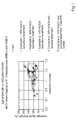
- Figure 1 shows the performance of this toner in two critical dimensions, i.e. reflective solid area density and average magnetic signal strength as measured by a MICR QUALIFIER, a diagnostic check reader manufactured by the RDM Corporation of Waterloo, Ontario, Canada.
- the box marked "AIM” represents values for average signal strength and reflection density which are considered to be preferably magnetically useful and visually pleasing.
- the data for the toner in example 2 indicates a good balance between magnetic performance and visual image quality.
- Toner for example 3 was prepared as above with 30% Fe 3 O 4 by weight.
- the developer was the same as for example 2.
- the experimental run followed the same pattern as in example 2.
- Toner for example 4 was prepared as above with 14% Fe 3 O 4 by weight.
- the developer was the same as for example 2.
- the experimental run followed the same pattern as in example 2.
- Toner for example 5 was prepared as above with 18% Fe 3 O 4 by weight but it was not surface treated. The developer was otherwise the same as for example 2. The experimental run followed the same pattern as in example 2.
- Toner for example 6 was prepared as above with 18% Fe 3 O 4 by weight but it was not surface treated.
- the developer was otherwise the same as for example 2.
- the experimental run differed from that used in example 2 in that the toning station shaft speeds were varied to see the effects of core magnet and shell RPM on the image quality and magnetic strength of the resulting image.
- Figure 2a, 2b, 3a, and 3b are SEM photographs showing some toners of the present invention at magnifications of 5,000 and 10,000.
- the toner in Figure 2 was prepared as in Example 1 using 0.15 wt% silica and blended for 2 minutes at 2,000 RPM in the mixture.
- the toner in Figure 3 was prepared as in Example 1 using 0.15 wt% to silica and blended for 10 minutes at 3,900 RPM. Surface analysis showed that the toner of Figure 2 had 2.98 atomic % silica while the toner of Figure 3 had 1.58 atomic % silica.
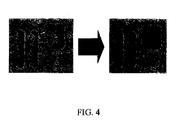
- Figure 4 is a photograph of images produced with surface treatment and without surface treatment.
- the toner (with no surface treatment) had no spacing agent but otherwise had substantially the same components and was printed on printers like the Digisource 9110 printer. The differences in image were dramatic.
- the image printed with the toner of the present invention (right image) was sharper and darker than the image printed with toner having no surface treatment (left image).
Landscapes
- Physics & Mathematics (AREA)
- General Physics & Mathematics (AREA)
- Chemical & Material Sciences (AREA)
- Nanotechnology (AREA)
- Engineering & Computer Science (AREA)
- General Health & Medical Sciences (AREA)
- Life Sciences & Earth Sciences (AREA)
- Molecular Biology (AREA)
- Health & Medical Sciences (AREA)
- Crystallography & Structural Chemistry (AREA)
- Inorganic Chemistry (AREA)
- Developing Agents For Electrophotography (AREA)
- Magnetic Brush Developing In Electrophotography (AREA)
- Dry Development In Electrophotography (AREA)
Applications Claiming Priority (2)
| Application Number | Priority Date | Filing Date | Title |
|---|---|---|---|
| US747764 | 2000-12-26 | ||
| US09/747,764 US6610451B2 (en) | 2000-12-26 | 2000-12-26 | Development systems for magnetic toners having reduced magnetic loadings |
Publications (3)
| Publication Number | Publication Date |
|---|---|
| EP1220044A2 true EP1220044A2 (fr) | 2002-07-03 |
| EP1220044A3 EP1220044A3 (fr) | 2005-11-16 |
| EP1220044B1 EP1220044B1 (fr) | 2009-05-20 |
Family
ID=25006528
Family Applications (1)
| Application Number | Title | Priority Date | Filing Date |
|---|---|---|---|
| EP01130250A Expired - Lifetime EP1220044B1 (fr) | 2000-12-26 | 2001-12-19 | Systèmes de développement pour toners magnétiques et toners à teneur réduite en matériau magnétique |
Country Status (5)
| Country | Link |
|---|---|
| US (3) | US6610451B2 (fr) |
| EP (1) | EP1220044B1 (fr) |
| JP (1) | JP2002304057A (fr) |
| CA (1) | CA2363468C (fr) |
| DE (1) | DE60138750D1 (fr) |
Families Citing this family (19)
| Publication number | Priority date | Publication date | Assignee | Title |
|---|---|---|---|---|
| WO2001088628A1 (fr) * | 2000-05-17 | 2001-11-22 | Heidelberg Digital, L.L.C. | Procede de developpement d'image electrostatique avec points de consigne optimises |
| US6728503B2 (en) | 2001-02-28 | 2004-04-27 | Heidelberger Druckmaschinen Ag | Electrophotographic image developing process with optimized average developer bulk velocity |
| US6797448B2 (en) * | 2001-05-14 | 2004-09-28 | Eastman Kodak Company | Electrophotographic toner and development process with improved image and fusing quality |
| JP2004252402A (ja) * | 2002-06-24 | 2004-09-09 | Heidelberger Druckmas Ag | 化学的に調製されたトナーを用いるエレクトロフォトグラフィックトナーおよび現像法 |
| US6909856B2 (en) * | 2002-10-01 | 2005-06-21 | Eastman Kodak Company | Functionality switching for MICR printing |
| US20040179867A1 (en) * | 2003-03-11 | 2004-09-16 | Crichton John F. | Method and apparatus for improved printing with toner having magnetic content |
| US7157202B1 (en) | 2003-09-23 | 2007-01-02 | Eastman Kodak Company | Method and apparatus for reducing densification of multiple component electrographic developer |
| US7248823B2 (en) * | 2003-09-26 | 2007-07-24 | Eastman Kodak Company | Electrographic ribbon and method implementing a skive |
| US20050271961A1 (en) * | 2004-03-05 | 2005-12-08 | Jadwin Thomas A | Substrate and near infrared absorbing toner |
| US20050220518A1 (en) * | 2004-03-31 | 2005-10-06 | Eastman Kodak Company | Treatment of preprinted media for improved toner adhesion |
| US7208252B2 (en) * | 2004-06-30 | 2007-04-24 | Xerox Corporation | Magnetic toner and conductive developer compositions |
| US20060230273A1 (en) * | 2005-04-08 | 2006-10-12 | Eastman Kodak Company | Hidden MIRC printing for security |
| US7666562B2 (en) * | 2006-02-23 | 2010-02-23 | Lexmark International, Inc. | Image forming media containing reflecting pigment |
| US8101326B2 (en) | 2006-05-19 | 2012-01-24 | Eastman Kodak Company | Secure document printing method and system |
| US20070268511A1 (en) * | 2006-05-19 | 2007-11-22 | Eastman Kodak Company | Secure document printing |
| US20090238616A1 (en) * | 2008-03-19 | 2009-09-24 | Andrew Ciaschi | Ultra-low color density print finishing system with high gloss for image highlighting |
| US8092970B2 (en) * | 2008-05-15 | 2012-01-10 | Eastman Kodak Company | Adjustable gloss document printing |
| US8137879B2 (en) * | 2008-06-26 | 2012-03-20 | Xerox Corporation | Ferromagnetic nanoparticles with high magnetocrystalline anisotropy for MICR toner applications |
| US8236192B2 (en) * | 2008-06-26 | 2012-08-07 | Xerox Corporation | Ferromagnetic nanoparticles with high magnetocrystalline anisotropy for MICR ink applications |
Family Cites Families (59)
| Publication number | Priority date | Publication date | Assignee | Title |
|---|---|---|---|---|
| NL7006084A (fr) | 1969-06-02 | 1970-12-04 | ||
| US3914181A (en) | 1971-07-08 | 1975-10-21 | Xerox Corp | Electrostatographic developer mixtures comprising ferrite carrier beads |
| US3893935A (en) | 1972-05-30 | 1975-07-08 | Eastman Kodak Co | Electrographic toner and developer composition |
| JPS5123354B2 (fr) | 1973-01-16 | 1976-07-16 | ||
| US4076587A (en) * | 1974-05-14 | 1978-02-28 | Electricite De France (Service National) | Fuse and application of said fuse to the construction of an emergency shutdown system for a nuclear reactor |
| US3983992A (en) | 1975-10-31 | 1976-10-05 | Owens-Illinois, Inc. | Assembly of two component closure |
| US4076857A (en) | 1976-06-28 | 1978-02-28 | Eastman Kodak Company | Process for developing electrographic images by causing electrical breakdown in the developer |
| AU530410B2 (en) | 1978-02-21 | 1983-07-14 | Sintef | Preparing aqueous emulsions |
| US4385823A (en) | 1979-04-16 | 1983-05-31 | Eastman Kodak Company | Method and means for improving maximum density and tonal range of electrographic images |
| US4634649A (en) | 1980-12-24 | 1987-01-06 | Xerox Corporation | Developer compositions |
| US4407925A (en) | 1981-03-13 | 1983-10-04 | Xerox Corporation | Process for developing electrostatic images with magnetic toner |
| CH659530A5 (fr) | 1982-11-08 | 1987-01-30 | Eastman Kodak Co | Revelateur electrographique et procede de developpement d'image electrostatique l'utilisant. |
| US4473029A (en) | 1983-07-01 | 1984-09-25 | Eastman Kodak Company | Electrographic magnetic brush development method, apparatus and system |
| USRE33172E (en) | 1983-09-12 | 1990-02-27 | Xerox Corporation | Process for magnetic image character recognition |
| US4578338A (en) | 1984-08-31 | 1986-03-25 | Xerox Corporation | Development process with toner composition containing low molecular weight waxes |
| US4556624A (en) | 1984-09-27 | 1985-12-03 | Xerox Corporation | Toner compositions with crosslinked resins and low molecular weight wax components |
| US4609603A (en) | 1984-12-14 | 1986-09-02 | Xerox Corporation | Process for achieving consistent high quality images with magnetic developer composition |
| US4690603A (en) | 1985-07-02 | 1987-09-01 | Heyl & Patterson, Inc. | Car dumping apparatus |
| US4695524A (en) | 1986-05-21 | 1987-09-22 | Xerox Corporation | Process for ultra high quality images with magnetic developer composition |
| US4758493A (en) | 1986-11-24 | 1988-07-19 | Xerox Corporation | Magnetic single component toner compositions |
| US4883736A (en) | 1987-01-20 | 1989-11-28 | Xerox Corporation | Electrophotographic toner and developer compositions with polymeric alcohol waxes |
| US4859550A (en) | 1988-09-02 | 1989-08-22 | Xerox Corporation | Smear resistant magnetic image character recognition processes |
| DE3926934A1 (de) * | 1989-08-16 | 1991-02-21 | Deutsches Krebsforsch | Hyperthermie-mikrowellenapplikator zur erwaermung einer begrenzten umgebung in einem dissipativen medium |
| US5780190A (en) | 1989-12-04 | 1998-07-14 | Xerox Corporation | Magnetic image character recognition processes with encapsulated toners |
| US5124271A (en) | 1990-06-20 | 1992-06-23 | Texas Instruments Incorporated | Process for fabricating a BiCMOS integrated circuit |
| US5124217A (en) | 1990-06-27 | 1992-06-23 | Xerox Corporation | Magnetic image character recognition processes |
| US5057392A (en) | 1990-08-06 | 1991-10-15 | Eastman Kodak Company | Low fusing temperature toner powder of cross-linked crystalline and amorphous polyester blends |
| US5147747A (en) | 1990-08-06 | 1992-09-15 | Eastman Kodak Company | Low fusing temperature tone powder of crosslinked crystalline and amorphous polyesters |
| US5089547A (en) | 1990-08-06 | 1992-02-18 | Eastman Kodak Company | Cross-linked low surface adhesion additives for toner compositions |
| US5102765A (en) | 1990-08-06 | 1992-04-07 | Eastman Kodak Company | Toner compositions containing 2-imidazolines, imidazoles or benzimidazoles as charge control agents |
| US5112715A (en) | 1990-08-06 | 1992-05-12 | Eastman Kodak Company | Toner compositions containing a multi-purpose additive |
| DE69129529T2 (de) * | 1990-12-28 | 1998-11-26 | Kawamura, Takao, Sakai, Osaka | Elektrophotographische elektrisch leitende magnetische Trägerteilchen, Entwickler mit derartigen Teilchen und Bildherstellungsverfahren |
| US5102755A (en) | 1991-02-01 | 1992-04-07 | Xerox Corporation | Magnetic image character recognition processes |
| US5296324A (en) * | 1991-05-14 | 1994-03-22 | Fuji Xerox Co., Ltd. | Toner for developing electrostatic charge image and process for preparing the same |
| US5914209A (en) * | 1991-05-20 | 1999-06-22 | Xerox Corporation | Single development toner for improved MICR |
| EP0566790B1 (fr) | 1992-04-23 | 1996-08-07 | Toda Kogyo Corp. | Poudre magnétique et toner magnétique |
| DE69316086T2 (de) * | 1992-05-25 | 1998-05-20 | Canon Kk | Magnetischer Entwickler und Verfahren zur Erkennung von Zeichen aus magnetischer Tinte |
| JP3219926B2 (ja) * | 1993-02-05 | 2001-10-15 | 京セラ株式会社 | 静電潜像現像剤用磁性キャリア、静電潜像現像剤および画像形成方法 |
| US5344737A (en) | 1993-02-25 | 1994-09-06 | Xerox Corporation | Polywax toner compositions and processes |
| US5439772A (en) | 1993-03-26 | 1995-08-08 | Fuji Xerox Co., Ltd. | Magnetic toner and process for producing the same |
| US5358818A (en) | 1993-08-31 | 1994-10-25 | Eastman Kodak Company | Ortho-benzoic sulfimide as charge-controlling agent |
| US5358816A (en) | 1993-08-31 | 1994-10-25 | Eastman Kodak Company | Zinc salt of ortho-benzoic sulfimide as negative charge-controlling additive for toner and developer compositions |
| US5358815A (en) | 1993-08-31 | 1994-10-25 | Eastman Kodak Company | Toner compositions containing negative charge-controlling additive |
| US5358817A (en) | 1993-08-31 | 1994-10-25 | Eastman Kodak Company | Toner compositions containing as a negative charge-controlling agent the calcium salt of ortho-benzoic sulfimide |
| US5358814A (en) | 1993-08-31 | 1994-10-25 | Eastman Kodak Company | Toner compositions containing as a negative charge-controlling agent a mixture of ortho-benzoic sulfimide and para-anisic acid |
| US5512404A (en) * | 1994-08-29 | 1996-04-30 | Eastman Kodak Company | Developer compositions exhibiting high development speeds |
| DE69511209T2 (de) * | 1994-10-05 | 1999-11-25 | Toda Kogyo Corp., Hiroshima | Magnetischer Träger für Elektrophotographie |
| US5482805A (en) | 1994-10-31 | 1996-01-09 | Xerox Corporation | Magnetic toner compositions with aluminum oxide, strontium titanate and polyvinylidene fluoride |
| US5486443A (en) | 1994-10-31 | 1996-01-23 | Xerox Corporation | Magnetic toner compositions with silica, strontium titanate and polyvinylidene fluoride |
| US5510221A (en) | 1995-03-30 | 1996-04-23 | Xerox Corporation | Magnetic toner compositions |
| US5552252A (en) | 1995-03-30 | 1996-09-03 | Xerox Corporation | Magnetic toner imaging |
| US5780195A (en) | 1996-06-17 | 1998-07-14 | Reichhold Chemicals, Inc. | Toner resin compositions |
| US6075965A (en) | 1996-07-29 | 2000-06-13 | Eastman Kodak Company | Method and apparatus using an endless web for facilitating transfer of a marking particle image from an intermediate image transfer member to a receiver member |
| US5976748A (en) * | 1997-11-07 | 1999-11-02 | Kyocera Corporation | Magnetic toner for MICR printer |
| US5998076A (en) | 1998-03-09 | 1999-12-07 | Xerox Corporation | Carrier |
| US6083654A (en) | 1998-12-21 | 2000-07-04 | Xerox Corporation | Toner compositions and processes thereof |
| US6228549B1 (en) * | 2000-05-17 | 2001-05-08 | Heidelberg Digital L.L.C. | Magnetic carrier particles |
| EP1156373A1 (fr) * | 2000-05-17 | 2001-11-21 | Heidelberger Druckmaschinen Aktiengesellschaft | Composition de développement électrophotgraphique et méthode de développement électrophotgraphique |
| EP1501065A1 (fr) | 2003-07-22 | 2005-01-26 | William Lai | Simulateur dynamique hexapodal à architecture parallèle |
-
2000
- 2000-12-26 US US09/747,764 patent/US6610451B2/en not_active Expired - Lifetime
-
2001
- 2001-11-15 CA CA002363468A patent/CA2363468C/fr not_active Expired - Fee Related
- 2001-12-19 EP EP01130250A patent/EP1220044B1/fr not_active Expired - Lifetime
- 2001-12-19 DE DE60138750T patent/DE60138750D1/de not_active Expired - Lifetime
- 2001-12-21 JP JP2001388926A patent/JP2002304057A/ja active Pending
-
2003
- 2003-03-31 US US10/403,539 patent/US6766136B2/en not_active Expired - Lifetime
-
2004
- 2004-06-02 US US10/858,960 patent/US7033720B2/en not_active Expired - Fee Related
Also Published As
| Publication number | Publication date |
|---|---|
| US20040219447A1 (en) | 2004-11-04 |
| DE60138750D1 (de) | 2009-07-02 |
| US7033720B2 (en) | 2006-04-25 |
| CA2363468A1 (fr) | 2002-06-26 |
| JP2002304057A (ja) | 2002-10-18 |
| US6766136B2 (en) | 2004-07-20 |
| EP1220044B1 (fr) | 2009-05-20 |
| CA2363468C (fr) | 2005-01-25 |
| EP1220044A3 (fr) | 2005-11-16 |
| US20030190541A1 (en) | 2003-10-09 |
| US6610451B2 (en) | 2003-08-26 |
| US20020115006A1 (en) | 2002-08-22 |
Similar Documents
| Publication | Publication Date | Title |
|---|---|---|
| US7033720B2 (en) | Development systems for magnetic toners and toners having reduced magnetic loadings | |
| EP1158366B1 (fr) | Révélateur à deux composants, un récipient rempli d'un révélateur à deux composants et appareil de formation d'images | |
| EP1156391B1 (fr) | Procédé électrophotographique utilisant des compositions de développeurs contenant un matériau magnétique dur | |
| JP2006038961A (ja) | 静電荷像現像用キャリア、静電荷像現像剤、静電荷像現像用キャリアの製造方法および画像形成方法 | |
| EP1291727B1 (fr) | Toner électrophotographique contenant une cire polyalkylène à base très crystalline | |
| US6797448B2 (en) | Electrophotographic toner and development process with improved image and fusing quality | |
| JPH10198077A (ja) | 静電潜像現像剤用キャリア、二成分現像剤及び画像形成方法 | |
| US5336580A (en) | Carrier composition for electrophotography | |
| US5484676A (en) | Developer for electrophotography and method for electrophotographic development using the same | |
| JPH08272132A (ja) | 静電潜像現像剤 | |
| JP4165822B2 (ja) | フルカラートナーキット、プロセスカートリッジ、画像形成方法及び画像形成装置 | |
| US6165664A (en) | Two-component developing agent and image forming method using such a developing agent | |
| JP3232903B2 (ja) | 静電潜像現像剤用キャリア | |
| JPH08314280A (ja) | 現像方法 | |
| JP3258858B2 (ja) | 画像形成方法 | |
| EP0559250B1 (fr) | Particules de support magnétiques | |
| JP2899117B2 (ja) | 静電荷像現像用磁性トナー | |
| JPH0764322A (ja) | 磁性トナー | |
| JP2002214838A (ja) | 電子写真用トナー、電子写真用現像剤、及び画像形成方法 | |
| JPH0962103A (ja) | 画像形成方法 | |
| JPH08272130A (ja) | 静電潜像現像剤及びその製造方法 | |
| JP2005265962A (ja) | 静電潜像現像用トナー及び現像方法 | |
| JPH0854749A (ja) | 静電画像現像用現像剤 | |
| JPH07287416A (ja) | 電子写真用トナーの製造方法 |
Legal Events
| Date | Code | Title | Description |
|---|---|---|---|
| PUAI | Public reference made under article 153(3) epc to a published international application that has entered the european phase |
Free format text: ORIGINAL CODE: 0009012 |
|
| AK | Designated contracting states |
Kind code of ref document: A2 Designated state(s): AT BE CH CY DE DK ES FI FR GB GR IE IT LI LU MC NL PT SE TR |
|
| AX | Request for extension of the european patent |
Free format text: AL;LT;LV;MK;RO;SI |
|
| RAP1 | Party data changed (applicant data changed or rights of an application transferred) |
Owner name: EASTMAN KODAK COMPANY |
|
| PUAL | Search report despatched |
Free format text: ORIGINAL CODE: 0009013 |
|
| AK | Designated contracting states |
Kind code of ref document: A3 Designated state(s): AT BE CH CY DE DK ES FI FR GB GR IE IT LI LU MC NL PT SE TR |
|
| AX | Request for extension of the european patent |
Extension state: AL LT LV MK RO SI |
|
| 17P | Request for examination filed |
Effective date: 20060328 |
|
| AKX | Designation fees paid |
Designated state(s): BE DE GB NL |
|
| 17Q | First examination report despatched |
Effective date: 20061221 |
|
| GRAP | Despatch of communication of intention to grant a patent |
Free format text: ORIGINAL CODE: EPIDOSNIGR1 |
|
| GRAS | Grant fee paid |
Free format text: ORIGINAL CODE: EPIDOSNIGR3 |
|
| GRAA | (expected) grant |
Free format text: ORIGINAL CODE: 0009210 |
|
| AK | Designated contracting states |
Kind code of ref document: B1 Designated state(s): BE DE GB NL |
|
| REG | Reference to a national code |
Ref country code: GB Ref legal event code: FG4D |
|
| REF | Corresponds to: |
Ref document number: 60138750 Country of ref document: DE Date of ref document: 20090702 Kind code of ref document: P |
|
| PLBE | No opposition filed within time limit |
Free format text: ORIGINAL CODE: 0009261 |
|
| STAA | Information on the status of an ep patent application or granted ep patent |
Free format text: STATUS: NO OPPOSITION FILED WITHIN TIME LIMIT |
|
| 26N | No opposition filed |
Effective date: 20100223 |
|
| PGFP | Annual fee paid to national office [announced via postgrant information from national office to epo] |
Ref country code: BE Payment date: 20120103 Year of fee payment: 11 |
|
| PGFP | Annual fee paid to national office [announced via postgrant information from national office to epo] |
Ref country code: GB Payment date: 20121128 Year of fee payment: 12 |
|
| PGFP | Annual fee paid to national office [announced via postgrant information from national office to epo] |
Ref country code: NL Payment date: 20121212 Year of fee payment: 12 |
|
| PGFP | Annual fee paid to national office [announced via postgrant information from national office to epo] |
Ref country code: DE Payment date: 20121221 Year of fee payment: 12 |
|
| BERE | Be: lapsed |
Owner name: EASTMAN KODAK CY Effective date: 20121231 |
|
| PG25 | Lapsed in a contracting state [announced via postgrant information from national office to epo] |
Ref country code: BE Free format text: LAPSE BECAUSE OF NON-PAYMENT OF DUE FEES Effective date: 20121231 |
|
| REG | Reference to a national code |
Ref country code: DE Ref legal event code: R119 Ref document number: 60138750 Country of ref document: DE |
|
| REG | Reference to a national code |
Ref country code: NL Ref legal event code: V1 Effective date: 20140701 |
|
| GBPC | Gb: european patent ceased through non-payment of renewal fee |
Effective date: 20131219 |
|
| REG | Reference to a national code |
Ref country code: DE Ref legal event code: R119 Ref document number: 60138750 Country of ref document: DE Effective date: 20140701 |
|
| PG25 | Lapsed in a contracting state [announced via postgrant information from national office to epo] |
Ref country code: NL Free format text: LAPSE BECAUSE OF NON-PAYMENT OF DUE FEES Effective date: 20140701 Ref country code: DE Free format text: LAPSE BECAUSE OF NON-PAYMENT OF DUE FEES Effective date: 20140701 |
|
| PG25 | Lapsed in a contracting state [announced via postgrant information from national office to epo] |
Ref country code: GB Free format text: LAPSE BECAUSE OF NON-PAYMENT OF DUE FEES Effective date: 20131219 |