EP1221471A1 - Composition adhesiv comprenant une polyetherimide et une resine epoxy - Google Patents
Composition adhesiv comprenant une polyetherimide et une resine epoxy Download PDFInfo
- Publication number
- EP1221471A1 EP1221471A1 EP01810022A EP01810022A EP1221471A1 EP 1221471 A1 EP1221471 A1 EP 1221471A1 EP 01810022 A EP01810022 A EP 01810022A EP 01810022 A EP01810022 A EP 01810022A EP 1221471 A1 EP1221471 A1 EP 1221471A1
- Authority
- EP
- European Patent Office
- Prior art keywords
- pei
- polyetherimide
- adhesive
- adhesive mixture
- polymer
- Prior art date
- Legal status (The legal status is an assumption and is not a legal conclusion. Google has not performed a legal analysis and makes no representation as to the accuracy of the status listed.)
- Withdrawn
Links
- 239000000203 mixture Substances 0.000 title claims abstract description 42
- 239000004697 Polyetherimide Substances 0.000 title claims description 52
- 229920001601 polyetherimide Polymers 0.000 title claims description 52
- 239000000853 adhesive Substances 0.000 title claims description 49
- 230000001070 adhesive effect Effects 0.000 title claims description 49
- 239000003822 epoxy resin Substances 0.000 title claims description 6
- 229920000647 polyepoxide Polymers 0.000 title claims description 6
- 229920000642 polymer Polymers 0.000 claims abstract description 10
- 239000000758 substrate Substances 0.000 claims abstract description 6
- 150000001412 amines Chemical class 0.000 claims description 6
- 238000004026 adhesive bonding Methods 0.000 claims description 4
- 150000002118 epoxides Chemical class 0.000 claims description 4
- 150000008064 anhydrides Chemical class 0.000 claims description 2
- 239000012948 isocyanate Substances 0.000 claims description 2
- 150000002513 isocyanates Chemical class 0.000 claims description 2
- 238000002156 mixing Methods 0.000 claims description 2
- 229920005862 polyol Polymers 0.000 claims description 2
- 150000003077 polyols Chemical class 0.000 claims description 2
- 239000010410 layer Substances 0.000 description 20
- LCFVJGUPQDGYKZ-UHFFFAOYSA-N Bisphenol A diglycidyl ether Chemical compound C=1C=C(OCC2OC2)C=CC=1C(C)(C)C(C=C1)=CC=C1OCC1CO1 LCFVJGUPQDGYKZ-UHFFFAOYSA-N 0.000 description 11
- 239000007787 solid Substances 0.000 description 11
- VIOMIGLBMQVNLY-UHFFFAOYSA-N 4-[(4-amino-2-chloro-3,5-diethylphenyl)methyl]-3-chloro-2,6-diethylaniline Chemical compound CCC1=C(N)C(CC)=CC(CC=2C(=C(CC)C(N)=C(CC)C=2)Cl)=C1Cl VIOMIGLBMQVNLY-UHFFFAOYSA-N 0.000 description 9
- 239000004593 Epoxy Substances 0.000 description 9
- SECXISVLQFMRJM-UHFFFAOYSA-N N-Methylpyrrolidone Chemical compound CN1CCCC1=O SECXISVLQFMRJM-UHFFFAOYSA-N 0.000 description 7
- 239000002904 solvent Substances 0.000 description 5
- 238000006243 chemical reaction Methods 0.000 description 4
- 239000011159 matrix material Substances 0.000 description 4
- 239000004014 plasticizer Substances 0.000 description 4
- 239000002356 single layer Substances 0.000 description 4
- 239000003292 glue Substances 0.000 description 3
- 238000004519 manufacturing process Methods 0.000 description 3
- 239000011521 glass Substances 0.000 description 2
- 239000003365 glass fiber Substances 0.000 description 2
- 230000009477 glass transition Effects 0.000 description 2
- 239000004848 polyfunctional curative Substances 0.000 description 2
- 238000003756 stirring Methods 0.000 description 2
- OKTJSMMVPCPJKN-UHFFFAOYSA-N Carbon Chemical compound [C] OKTJSMMVPCPJKN-UHFFFAOYSA-N 0.000 description 1
- 150000004984 aromatic diamines Chemical class 0.000 description 1
- 239000004841 bisphenol A epoxy resin Substances 0.000 description 1
- 229910052799 carbon Inorganic materials 0.000 description 1
- 230000015556 catabolic process Effects 0.000 description 1
- 239000007795 chemical reaction product Substances 0.000 description 1
- 230000000052 comparative effect Effects 0.000 description 1
- 238000001816 cooling Methods 0.000 description 1
- 238000004132 cross linking Methods 0.000 description 1
- 230000007423 decrease Effects 0.000 description 1
- 238000006731 degradation reaction Methods 0.000 description 1
- 238000009792 diffusion process Methods 0.000 description 1
- 230000008030 elimination Effects 0.000 description 1
- 238000003379 elimination reaction Methods 0.000 description 1
- 239000000945 filler Substances 0.000 description 1
- 238000011835 investigation Methods 0.000 description 1
- 239000007788 liquid Substances 0.000 description 1
- 239000006193 liquid solution Substances 0.000 description 1
- 239000002184 metal Substances 0.000 description 1
- 238000000034 method Methods 0.000 description 1
- 238000005191 phase separation Methods 0.000 description 1
- 229920003023 plastic Polymers 0.000 description 1
- 239000004033 plastic Substances 0.000 description 1
- 239000000843 powder Substances 0.000 description 1
- 238000002360 preparation method Methods 0.000 description 1
- 239000011347 resin Substances 0.000 description 1
- 229920005989 resin Polymers 0.000 description 1
- 239000007858 starting material Substances 0.000 description 1
- 239000000126 substance Substances 0.000 description 1
Images
Classifications
-
- C—CHEMISTRY; METALLURGY
- C09—DYES; PAINTS; POLISHES; NATURAL RESINS; ADHESIVES; COMPOSITIONS NOT OTHERWISE PROVIDED FOR; APPLICATIONS OF MATERIALS NOT OTHERWISE PROVIDED FOR
- C09J—ADHESIVES; NON-MECHANICAL ASPECTS OF ADHESIVE PROCESSES IN GENERAL; ADHESIVE PROCESSES NOT PROVIDED FOR ELSEWHERE; USE OF MATERIALS AS ADHESIVES
- C09J163/00—Adhesives based on epoxy resins; Adhesives based on derivatives of epoxy resins
-
- C—CHEMISTRY; METALLURGY
- C08—ORGANIC MACROMOLECULAR COMPOUNDS; THEIR PREPARATION OR CHEMICAL WORKING-UP; COMPOSITIONS BASED THEREON
- C08L—COMPOSITIONS OF MACROMOLECULAR COMPOUNDS
- C08L63/00—Compositions of epoxy resins; Compositions of derivatives of epoxy resins
-
- C—CHEMISTRY; METALLURGY
- C08—ORGANIC MACROMOLECULAR COMPOUNDS; THEIR PREPARATION OR CHEMICAL WORKING-UP; COMPOSITIONS BASED THEREON
- C08L—COMPOSITIONS OF MACROMOLECULAR COMPOUNDS
- C08L79/00—Compositions of macromolecular compounds obtained by reactions forming in the main chain of the macromolecule a linkage containing nitrogen with or without oxygen or carbon only, not provided for in groups C08L61/00 - C08L77/00
- C08L79/04—Polycondensates having nitrogen-containing heterocyclic rings in the main chain; Polyhydrazides; Polyamide acids or similar polyimide precursors
- C08L79/08—Polyimides; Polyester-imides; Polyamide-imides; Polyamide acids or similar polyimide precursors
-
- C—CHEMISTRY; METALLURGY
- C09—DYES; PAINTS; POLISHES; NATURAL RESINS; ADHESIVES; COMPOSITIONS NOT OTHERWISE PROVIDED FOR; APPLICATIONS OF MATERIALS NOT OTHERWISE PROVIDED FOR
- C09J—ADHESIVES; NON-MECHANICAL ASPECTS OF ADHESIVE PROCESSES IN GENERAL; ADHESIVE PROCESSES NOT PROVIDED FOR ELSEWHERE; USE OF MATERIALS AS ADHESIVES
- C09J179/00—Adhesives based on macromolecular compounds obtained by reactions forming in the main chain of the macromolecule a linkage containing nitrogen, with or without oxygen, or carbon only, not provided for in groups C09J161/00 - C09J177/00
- C09J179/04—Polycondensates having nitrogen-containing heterocyclic rings in the main chain; Polyhydrazides; Polyamide acids or similar polyimide precursors
- C09J179/08—Polyimides; Polyester-imides; Polyamide-imides; Polyamide acids or similar polyimide precursors
Definitions
- the invention relates to an adhesive mixture with a polymer for hot gluing of substrates.
- the use also lies within the scope of the invention the adhesive mixture for gluing foamed sheets made of polyetherimide with cover layers made of polyetherimide.
- Aircraft interiors are largely used today Sandwich structural components made.
- a well-known example of this is plates with a foamed core made of polyetherimide and top layers made of glass or carbon fiber-reinforced cover layers made of polyetherimide. So that the to the High fire requirements must be met also the one used to glue the outer layers to the foamed core Glue should be given attention.
- a common glue on Epoxy resin base does not meet the requirements.
- FR-A-2 766 834 discloses an adhesive mixture of polyetherimide and one Plasticizer known, which corresponds to today's fire requirements.
- a disadvantage of this adhesive is that because of the degradation the glass transition temperature of polyetherimide through the plasticizer the temperature of the press to take out the sandwich structure must be reduced what the production and the economy of the Adhesion process affected.
- the invention is therefore based on the object of an adhesive mixture provide initially mentioned type, which the above mentioned Avoids disadvantages of the adhesives according to the prior art.
- the mixture in addition to the polymer still contains at least one reactive component pair.
- the reactive component pair is preferably selected from the group of Isocyanates / polyols, epoxides / amines or epoxides / anhydrides.
- the polymer with the substrates to be bonded is also expedient chemically related.
- a particularly preferred adhesive mixture contains polyetherimide as the polymer and as a reactive component pair, an epoxy resin and an amine, i.e. on Resin and a hardener.
- the mixing ratio of epoxy resin / polyetherimide is preferably between about 1:50 and 50: 1, preferably between about 10: 1 and 1:10.
- the adhesive mixture according to the invention is suitable for bonding substrates both plastic and metal.
- the area of application is the gluing of foamed boards Polyetherimide with cover layers made of polyetherimide.
- the polymer PEI was in powder form.
- M-CDEA is a commercially available aromatic Diamine hardener, which together with the diepoxide prepolymer DGEBA reactive pair of components.
- NMP is a good solvent for polyetherimide.
- the Consistency of the adhesive mixture in a wide range from filler to can be changed sprayable.
- Two adhesive mixtures were made from the above-mentioned starting materials prepared with 45% or 80% PEI.
- NMP was heated to 170 ° C in an oil bath.
- M-CDEA was then added with vigorous stirring until the solution was complete.
- PEI was subsequently entered for a complete solution.
- the temperature was reduced to 100 ° C before the addition of DGEBA.
- the finished solution was left at this temperature for 10 min and then removed from the oil bath.
- the amounts of M-CDEA and DGEBA are stoichometric, ie the ratio of amine function / epoxy function is 1.
- the amount of PEI corresponds to 45% of the total amount of solids.
- the amount of solvent used was about twice the amount of all other components, resulting in a liquid solution.
- the composition of the adhesive mixture with 45% PEI is shown in Table 1.
- the solution could be prepared at room temperature.
- the adhesive mixture with 80% PEI was prepared in the same way with stirring as the preparation of the adhesive mixture with 45% PEI described above.
- the amount of PEI corresponds to 80% of the total solid content. Less solvent was added to obtain a spreadable paste.
- the composition of the adhesive mixture with 80% PEI is shown in Table 2. Composition of the adhesive mixture with 80% PEI DGEBA 10% by weight of the total solids content M-DEAC 10% by weight of the total solids content PEI 80% by weight of the total solids content NMP 100% by weight of the total solids content
- Adhesive tests were carried out with foamed sheets made of PEI and cover layers made of glass fiber reinforced PEI.
- the foamed PEI sheets had a density of 60 kg / m 3 .
- the cover layers were used in one and two layers.
- the single-layer cover layer had a weight per unit area of 455 g / m 2 , of which 300 g / m 2 were glass fibers; the two-ply version weighed twice.
- the mechanical properties of the various components are summarized in Table 3.
- the adhesive mixture was applied to the top layers. To the exact To determine the amount of adhesive applied, use a spatula used for adhesive application. However, this adhesive mixture was liquid enough to be applied with a brush or roller. With Adhesive-coated top layers were left until the solvent evaporated leave in an oven. Then the top layers were laid on both sides of the foamed sheet and the arrangement was in one Press at 160 ° C and under a hydraulic pressure between 3.2 and 6.4 bar pressed to a sandwich plate with a thickness of 7 mm. After 10 min the press was cooled to 140 ° C. and the sandwich plate was removed. The plates produced for experimental purposes were 140 mm wide, 220 mm long and 7 mm thick.
- this adhesive mixture contains only a small amount of solvent, it was also used applied with a spatula to the top layers.
- the top layers were dried in an oven under the same conditions as above for the adhesive mixture with 45% PEI.
- the cover layers were then covered on both sides applied to the foamed sheet and the arrangement was in a press at a temperature of 160 ° C and a hydraulic pressure between 3.2 and 6.4 bar to a sandwich plate with a thickness of 10 mm. After 120 min, the sandwich plate was removed from the press without prior cooling, as would also be the case with plate production.
- the received Sandwich panels were 130 mm wide, 200 mm long and 10 mm thick.
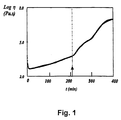
- the reactive component pair DGEBA / M-CDEA added to the PEI acts like a temporary plasticizer. Below the glass transition temperature T g , the epoxy molecules do not have sufficient mobility for crosslinking. Above T g , however, they can diffuse and react together. As soon as the reaction has started, a second phase is formed by the elimination of the reaction product of the epoxy and amine molecules in the PEI matrix. If the adhesive system is heated to a temperature greater than T g , its viscosity changes over time. In a first step, the viscosity decreases as a result of the increase in temperature. As soon as the temperature assumes a constant value, the viscosity rises slightly until phase separation occurs.
Landscapes
- Chemical & Material Sciences (AREA)
- Organic Chemistry (AREA)
- Chemical Kinetics & Catalysis (AREA)
- Health & Medical Sciences (AREA)
- Medicinal Chemistry (AREA)
- Polymers & Plastics (AREA)
- Laminated Bodies (AREA)
- Adhesives Or Adhesive Processes (AREA)
Priority Applications (1)
| Application Number | Priority Date | Filing Date | Title |
|---|---|---|---|
| EP01810022A EP1221471A1 (fr) | 2001-01-09 | 2001-01-09 | Composition adhesiv comprenant une polyetherimide et une resine epoxy |
Applications Claiming Priority (1)
| Application Number | Priority Date | Filing Date | Title |
|---|---|---|---|
| EP01810022A EP1221471A1 (fr) | 2001-01-09 | 2001-01-09 | Composition adhesiv comprenant une polyetherimide et une resine epoxy |
Publications (1)
| Publication Number | Publication Date |
|---|---|
| EP1221471A1 true EP1221471A1 (fr) | 2002-07-10 |
Family
ID=8183665
Family Applications (1)
| Application Number | Title | Priority Date | Filing Date |
|---|---|---|---|
| EP01810022A Withdrawn EP1221471A1 (fr) | 2001-01-09 | 2001-01-09 | Composition adhesiv comprenant une polyetherimide et une resine epoxy |
Country Status (1)
| Country | Link |
|---|---|
| EP (1) | EP1221471A1 (fr) |
Cited By (1)
| Publication number | Priority date | Publication date | Assignee | Title |
|---|---|---|---|---|
| CN104212393A (zh) * | 2014-09-26 | 2014-12-17 | 北京化工大学常州先进材料研究院 | 一种单组份环氧胶基体树脂结构的设计 |
Citations (5)
| Publication number | Priority date | Publication date | Assignee | Title |
|---|---|---|---|---|
| JPH0229328A (ja) * | 1988-07-19 | 1990-01-31 | Sumitomo Bakelite Co Ltd | フレキシブル銅張板 |
| US5002821A (en) * | 1987-12-15 | 1991-03-26 | The Dexter Corporation | Toughened prepregs and formulations |
| EP0493786A2 (fr) * | 1990-12-28 | 1992-07-08 | Toho Rayon Co., Ltd. | Composition de résine et procédé pour sa préparation |
| US5368922A (en) * | 1990-01-19 | 1994-11-29 | Minnesota Mining And Manufacturing Company | Prepreg of thermoplastic polymer particles in liquid thermosettable resin |
| FR2739101A1 (fr) * | 1995-09-21 | 1997-03-28 | Inst Nat Sciences Appliq | Additif pour alliage de copolymeres, et alliages le comportant |
-
2001
- 2001-01-09 EP EP01810022A patent/EP1221471A1/fr not_active Withdrawn
Patent Citations (5)
| Publication number | Priority date | Publication date | Assignee | Title |
|---|---|---|---|---|
| US5002821A (en) * | 1987-12-15 | 1991-03-26 | The Dexter Corporation | Toughened prepregs and formulations |
| JPH0229328A (ja) * | 1988-07-19 | 1990-01-31 | Sumitomo Bakelite Co Ltd | フレキシブル銅張板 |
| US5368922A (en) * | 1990-01-19 | 1994-11-29 | Minnesota Mining And Manufacturing Company | Prepreg of thermoplastic polymer particles in liquid thermosettable resin |
| EP0493786A2 (fr) * | 1990-12-28 | 1992-07-08 | Toho Rayon Co., Ltd. | Composition de résine et procédé pour sa préparation |
| FR2739101A1 (fr) * | 1995-09-21 | 1997-03-28 | Inst Nat Sciences Appliq | Additif pour alliage de copolymeres, et alliages le comportant |
Non-Patent Citations (1)
| Title |
|---|
| DATABASE WPI Section Ch Week 199011, Derwent World Patents Index; Class A21, AN 1990-078095, XP002169046 * |
Cited By (1)
| Publication number | Priority date | Publication date | Assignee | Title |
|---|---|---|---|---|
| CN104212393A (zh) * | 2014-09-26 | 2014-12-17 | 北京化工大学常州先进材料研究院 | 一种单组份环氧胶基体树脂结构的设计 |
Similar Documents
| Publication | Publication Date | Title |
|---|---|---|
| DE68925340T2 (de) | Zwischenschicht in geschichteten faserverstärkten plastischen Verbundwerkstoffen | |
| DE60107850T2 (de) | Auf epoxidharz basierter verstärkter streifen mit verbesserter haftung an ölartigen metalloberflächen | |
| DE1570615C3 (de) | Verfahren zur Herstellung von dispergierbaren Polyurethanen | |
| EP0354498A2 (fr) | Colle fusible réactive | |
| DE112014004472T5 (de) | Herstellungsverfahren für feuchtigkeitshärtende Polyurethan-Reaktivheissschmelzkleber für Textilzusammensetzung | |
| EP0522321A1 (fr) | Adhésif fusible | |
| EP0670853A1 (fr) | Utilisation d'une colle a fusion en polyurethane durcissant a l'humidite | |
| DE69924440T2 (de) | Prepreg, mehrschichtige gedruckte Schaltungsplatte und Verfahren zu seiner Herstellung | |
| DE2410409B2 (de) | Verfahren zur herstellung von schichtstoffen | |
| EP0798102A2 (fr) | Produit pré-impregné auto-adhésif, procédé pour sa fabrication et son utilisation | |
| DE2042786C3 (de) | Verfahren zur Herstellung von verstärkten Laminaten | |
| DE2232493A1 (de) | Verfahren zur herstellung von kohlenstoffaeden enthaltenden verbundstoffen | |
| EP0542160A1 (fr) | Revêtement thermoscellable à base de dispersion | |
| DE69300465T2 (de) | Wärmebeständige Klebstoffzusammensetzung. | |
| DE19725108A1 (de) | Polycarbodiimid enthaltender Klebstoff und flexible gedruckte Schaltungen | |
| DE60109696T2 (de) | Wärmehärtbare Harzzusammensetzung und harzbeschichtete Metallfolie, Prepreg und folienförmiger Klebstoff diese Zusammensetzung benutzend | |
| DE2419882A1 (de) | Waermebestaendige klebstoffzusammensetzung | |
| EP1221471A1 (fr) | Composition adhesiv comprenant une polyetherimide et une resine epoxy | |
| DE69024807T2 (de) | Schlagfestes hochtemperaturharz enthaltendes matrixsystem | |
| DE2442780A1 (de) | Verfahren zur herstellung von gedruckten schaltungs-mehrschichtenplatten | |
| EP0866925B1 (fr) | Courroie sans tissu | |
| CH623070A5 (fr) | ||
| AT396240B (de) | Prepreg verfahren zu seiner herstellung und seine verwendung | |
| DE3917306A1 (de) | Waessrige klebstoffdispersion | |
| DE2549371B2 (de) | Verfahren zur Herstellung von Verbundfolien |
Legal Events
| Date | Code | Title | Description |
|---|---|---|---|
| PUAI | Public reference made under article 153(3) epc to a published international application that has entered the european phase |
Free format text: ORIGINAL CODE: 0009012 |
|
| AK | Designated contracting states |
Kind code of ref document: A1 Designated state(s): AT BE CH CY DE DK ES FI FR GB GR IE IT LI LU MC NL PT SE TR |
|
| AX | Request for extension of the european patent |
Free format text: AL;LT;LV;MK;RO;SI |
|
| STAA | Information on the status of an ep patent application or granted ep patent |
Free format text: STATUS: THE APPLICATION IS DEEMED TO BE WITHDRAWN |
|
| 18D | Application deemed to be withdrawn |
Effective date: 20020511 |