EP1221652A2 - System und Verfahren zur Bestimmung gerätespezifischer Benutzer-Schnittstellen-Informationen in der Firmware eines USB-gerätes - Google Patents
System und Verfahren zur Bestimmung gerätespezifischer Benutzer-Schnittstellen-Informationen in der Firmware eines USB-gerätes Download PDFInfo
- Publication number
- EP1221652A2 EP1221652A2 EP01130303A EP01130303A EP1221652A2 EP 1221652 A2 EP1221652 A2 EP 1221652A2 EP 01130303 A EP01130303 A EP 01130303A EP 01130303 A EP01130303 A EP 01130303A EP 1221652 A2 EP1221652 A2 EP 1221652A2
- Authority
- EP
- European Patent Office
- Prior art keywords
- property
- descriptor
- custom
- user interface
- usb device
- Prior art date
- Legal status (The legal status is an assumption and is not a legal conclusion. Google has not performed a legal analysis and makes no representation as to the accuracy of the status listed.)
- Ceased
Links
Images

Classifications
-
- G—PHYSICS
- G06—COMPUTING OR CALCULATING; COUNTING
- G06F—ELECTRIC DIGITAL DATA PROCESSING
- G06F9/00—Arrangements for program control, e.g. control units
- G06F9/06—Arrangements for program control, e.g. control units using stored programs, i.e. using an internal store of processing equipment to receive or retain programs
- G06F9/44—Arrangements for executing specific programs
- G06F9/4401—Bootstrapping
- G06F9/4411—Configuring for operating with peripheral devices; Loading of device drivers
-
- G—PHYSICS
- G06—COMPUTING OR CALCULATING; COUNTING
- G06F—ELECTRIC DIGITAL DATA PROCESSING
- G06F9/00—Arrangements for program control, e.g. control units
- G06F9/06—Arrangements for program control, e.g. control units using stored programs, i.e. using an internal store of processing equipment to receive or retain programs
- G06F9/44—Arrangements for executing specific programs
- G06F9/451—Execution arrangements for user interfaces
Definitions
- the following description relates generally to the use of peripheral devices with software applications. More specifically following description relates to the use of device-specific information and resources with such software applications.
- USB Universal Serial Bus
- USB is a cable bus that supports data exchange between a host computer and a wide range of simultaneously accessible peripheral devices.
- the attached peripheral devices share USB bandwidth through a host-scheduled, token-based protocol.
- the bus allows peripherals to be attached, configured, used, and detached while the host and other peripherals are in operation.
- USB is defined by a specification that is approved by a committee of industry representatives.
- the specification covers all aspects of USB operation, including electrical, mechanical, and communications characteristics.
- a peripheral To be called a USB device, a peripheral must conform to this very exacting specification.
- USB device information is typically stored in so-called “descriptors” or request codes ⁇ data structures formatted as specified by the USB specification.
- Descriptors are used in a USB system to define "device requests" from a host to a peripheral device.
- a device request is a data structure that is conveyed in a “control transfer” from the host to the peripheral device.
- a control transfer contains the following fields:
- USB-specific requests All USB devices are supposed to support and respond to "standard" requests ⁇ referred to herein as "USB-specific" requests.
- the request type portion of the bmRequestType field contains a predefined value indicative of the "standard" request type.
- Each different USB-specific request has a pre-assigned USB-specific request code, defined in the USB specification. This is the value used in the bRequest field of the device request, to differentiate between different USB-specific requests.
- the USB specification sets forth the meanings of wValue and wIndex , as well as the format of any returned data.
- USB devices can optionally support "vendor” requests ⁇ referred to herein as “device-specific” requests.
- the request type portion of the bmRequestType field contains a predefined value to indicate a "vendor" request type.
- the USB specification does not assign request codes, define the meanings of wValue and wIndex , or define the format of returned data. Rather, each device has nearly complete control over the meaning, functionality, and data format of device-specific requests. Specifically, the device can define its own requests and assign device-specified request codes to them. This allows devices to implement their own device requests for use by host computers, and provides tremendous flexibility for manufacturers of peripherals.
- the inventors have discovered a need for a similar feature that would benefit various hosts, application programs, host operating systems, hardware manufacturers (OEMs), and Independent Hardware Vendors (IHVs). Specifically, designers of application programs and operating systems would value the opportunity to define their own device requests (and the associated responses), and to have such requests supported in a uniform way by compatible peripherals. Moreover, OEMs and IHVs (makers and distributors of USB devices) would value the ability to supply additional USB device-specific information to the hosts, application programs and host operating systems in response to such device requests. However, the different request types supported in the bmRequestType field of a USB device request do not include a "host" type of request.
- a typical USB device installation scenario typically involves customer use of installation media such as OEM/IHV supplied installation disks (e.g., a floppy disk) and/or setup computer program applications.
- installation media are generally shipped with the device or made available over the Internet.
- Installation media typically provide device-specific settings and resources such as: (a) a device driver to control the device; (b) one or more user interface elements; and (c) an information file (e.g., an ".inf" file) to specify names and locations of the setting and resources.
- UI user interface
- Such user interface (UI) elements include, for example, icons, fonts, pictures, labels, help pages, Universal Resource Locator (URL) Internet links, and the like.
- a USB device Upon installation, a USB device typically provides an operating system with USB standard class and subclass codes which are used to determine whether a generic, or default device driver can be used to control the device. If so, a special OEM/IHV supplied device driver may not be necessary to control the device. Thus, it is often unnecessary for customers to install the device drivers provided on the installation media for the device to function properly upon being attached.
- USB device One of the benefits of using a USB device is the reduced the amount of interaction typically required of a user to attach and configure a device. This ease of use has typically reduced the amount of device installation related customer support that OEMs/IHVs have needed to provide. Thus, when a default device driver can be used to control a device, it would be beneficial (both in terms of customer ease of use and in terms of the amount of customer support typically required) if installation media such as installation disks or setup programs were not required to be distributed to specify device-specific UI information. Rather, an operating system could query a device for this additional device specific information. Unfortunately, because host-specific USB requests are not provided or considered by the USB specification, there are no standards that allow a vendor to provide additional USB device-specific information in a USB device in a format that is determined by an operating system.
- the invention arose out of concerns associated with providing a host-specific device request that solves the problems described above.
- the described system and procedure provide for storing device-specific UI information into firmware on a USB device. Responsive to receiving a host specific device request, the USB device communicates the device specific information to a requestor such as an operating system or other computer program application.
- a requestor such as an operating system or other computer program application.
- the system and procedure allow OEMs/IHVs to provide additional brand specific information in a USB device in a format that can be determined by an operating system.
- the system and procedure allows OEMs/IHVs to store device-specific UI information in the firmware of a USB device such that installation media does not need to be distributed with each USB device to specify the device-specific information.
- Fig. 1 is a block diagram of an exemplary host/peripheral USB system.
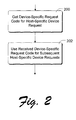
- Fig. 2 shows top-level methodological aspects of an exemplary procedure to obtain a device-specific request code for computer to use when making a host-specific device request.
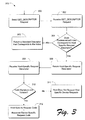
- Fig. 3 is a flowchart diagram that shows detailed aspects of an exemplary procedure to obtain a device-specific request code.
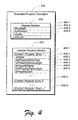
- Fig. 4 is a block diagram showing aspects of an exemplary data structure for an extended property descriptor.
- Fig. 1 shows a system 100 wherein device-specific settings and resources are stored on the USB device's firmware in a format specified by an operating system. These settings and resources are made available to the operating system and applications through a host-specified device request.
- the system and procedure of this implementation simplifies device installation scenarios and allows operating systems to identify an attached USB device and/or provide user interfaces that are appropriate for the device.
- USB System 100 is compatible with the Universal Serial Bus (USB) specifications. These specifications are available from USB Implementers Forum, which has current administrative headquarters in Portland, Oregon (current Internet URL: www.usb.org ).
- System 100 includes a host computer 102 and a USB peripheral device 114.
- the respective functionality of the computer and peripheral device is embodied in many cases by computer-executable instructions, such as program modules, that are executed by respective processors.
- program modules include routines, programs, objects, components, data structures, etc. that perform particular tasks or implement particular abstract data types.
- Computer 102 is a conventional desktop PC or other type of computer.
- Computer 102 has one or more processors 104 and one or more forms of computer-readable memory media 106 such electronic memory, magnetic storage media, optical storage media, or some other type of data storage.
- Programs are stored in memory 106 from where they are executed by processor 104.
- such programs include an operating system 108 such as the Microsoft "Windows"® family of operating systems.
- the operating system provides various system services to one or more application programs 110 running on the computer.
- the computer also has a USB communications driver and port 112.
- the USB port is supported by operating system 108.
- an application program 110 makes high-level calls to system services provided by the operating system. The system services take care of lower level communications details, and return requested information to the application program.
- Peripheral device 114 is one of any number of different types of USB devices such as a data storage device, a digital camera, a scanner, a joystick, game pad, steering unit, mouse, stylus, digital speaker, microphone, display device, and the like. Peripheral device 114 has one or more processors 116 and one or more forms of computer-readable memory media 118, including at least some form of non-volatile memory media 120.
- the peripheral device 114 has a USB port 126 and communicates with computer 102 via a USB communications medium 128.
- the peripheral device also has operating logic 124, which is executed by processor 116 to detect control actuation and for communicating with computer 102 across communication path 128.
- the peripheral device 114 responds to requests from the host computer 102 across the communication path 128. These requests are made using control transfers where setup packets (not shown) are exchanged.
- the USB device returns descriptors in response to exchanging such setup packets.
- an extended property descriptor 122 is not defined in the USB specification.
- the extended property descriptor includes UI information that pertains to the peripheral device.
- the UI information can be in any format such as a format specified by an operating system vendor.
- the extended property descriptor allows OEMs/IHVs to device specific UI information such as store icons, fonts, pictures, labels, help pages, Universal Resource Locator (URL) Internet links, and the like, in non-volatile memory 118 of the device.
- the computer prior to using the peripheral device, the computer sends a host-specific request to the peripheral device requesting device-specific UI information corresponding to the peripheral device.
- device specific UI information can be used, for example, to influence the behavior of an operating system UI shell, or to influence the behavior ofother non-kernel components.
- a camera that exposes a "Volume” interface (a type of a disk storage device interface) is typically represented by an operating system such as a Microsoft "Windows”® operating system, as a disk storage device such as a logical drive.
- an operating system such as a Microsoft "Windows”® operating system
- the operating system can obtain additional information that corresponding to the camera.
- This additional information allows the operating system to display a more particular, or "device-centric" interface that illustrates the device as a "camera”, rather than merely illustrating the device as a diskstorage device.
- UI information is often referred to as a device's "extended properties", or "properties”.
- the peripheral device 114 In response to the host-specific request, the peripheral device 114 provides the extended property descriptor 122 to a requestor such as the host computer 102. Using the extended property descriptor, the requestor locates data corresponding to the peripheral device 114, and extracts the UI information.
- the operating system can use the UI information for any number of purposes such as to display text or "special names" that correspond to the device, icons, informational URLs, and the like.
- the operating system 108 optionally stores the UI information provided by the extended configuration descriptor into a configuration file (not shown) such as a registry provided by a Microsoft Windows® operating system.
- a configuration file such as a registry provided by a Microsoft Windows® operating system. The stored information can be subsequently accessed by other computer program applications.
- Fig. 2 shows top-level methodological aspects of an exemplary procedure to obtain a device-specific request code for computer to use when making a host-specific device request.
- a new, non-USB-specific device request is defined for use with various USB peripherals. This request is referred to herein as a host-specific device request.
- the host-specific device request can be defined by the manufacturer of an operating system or application program, and can then be made available to peripheral vendors so that they can support and respond to the newly defined request.
- an OS manufacturer might define a new descriptor allowing peripherals to return device-specific data and resources to an operating system in a data format that is determined by the operating system. This would allow the operating system to use a single device request to obtain this information from various different peripherals (assuming those peripherals are configured to support the new device request).
- the host sends a request to the peripheral in the form of a USB-specified device request.
- the request is for a device-specific request code ⁇ of the device's choosing ⁇ that will be subsequently be used as the request code for the host-specific device request.
- this request code is used in a subsequent phase 202 to initiate the host-specified device request to obtain the extended property descriptor 122 of Fig. 1. Specifically, the host specifies the request code as the bRequest value in a control transfer. The actual protocol of this device request (meanings of bIndex , bValue , and the like) is as specified in the definition of the host-specific device request. Phase 202 is repeated as desired during subsequent operation, without repetition of initialization phase 200.
- Fig. 3 shows more details regarding the initialization phase 200.
- the host performs an action 300 of sending a GET_DESCRIPTOR device request to the peripheral device.
- the fields of the control transfer (discussed above in the background section) have values as follows:
- the extended property descriptor is not defined by the USB standard, but has fields as defined in the following discussion.
- the host-specific request descriptor designates a device-specific request code that will work on this device to initiate the host-specific request code. In other words, the manufacturer of the device can select any device-specific request code, and associate it with an implementation of the host-specific device request.
- the device receives the GET_DESCRIPTOR device request (block 302) and performs a decision 304 regarding whether the index value (the second byte of wValue ) corresponds to the predetermined value (EE (hex)).
- This predetermined value is a value that is chosen to be used specifically for this purpose.
- the device responds in an appropriate way, usually by returning some other descriptor that corresponds to the index value. If the index value does correspond to the predetermined value, an action 306 is performed of returning the host-specific request descriptor to the host.
- the host-specific request descriptor includes, for example, the following fields:
- the host receives the host-specific request descriptor (block 308) and then performs an action 310 of checking or verifying the signature and version number found in the qwSignature field.
- the correct signature confirms that the device is configured to support host-specific request codes. If either the signature or version number is incorrect, the host assumes at block 311 that the device does not support host-specific request codes, and no further attempts are made to use this feature.
- the signature field of the host-specific request descriptor block is what provides backward compatibility.
- a non-compatible device one that doesn't support host-specific request codes
- the host at block 312 reads the device-specific request code from the bVendorCode field, and uses it in the future as a host-specific request code, to initiate the host-specific device request.
- the host sends the host-specific device request by specifying the obtained device-specific request code as part of a control transfer.
- the device responds by performing one or more predefined actions or functions that correspond to the host-specific device request, in accordance with the specification of the host-specific device request.
- the host-specific device request itself is in the format of a normal USB control transfer, including the fields discussed in the "Background" section above.
- the bRequest field is set to the value of the bVendorCode field of the host-specific request descriptor, which was earlier obtained from the peripheral device.
- the bmRequestType field is set to 11000001 (binary), indicating a device-to-host data transfer, a "vendor" or device-specific request type, and a device recipient.
- the wValue and wIndex fields are used as defined by the definition of the host-specific device request.
- the wLength field indicates the number of bytes to transfer if there is a subsequent data transfer phase in the device request.
- the host-specific device request is used to request one of a plurality of available host-defined string descriptors from the device.
- the wIndex field of the host-specific device request indicates which of the plurality of strings are to be returned.
- the device returns the descriptor referred to by wIndex.
- the techniques described above allow an operating system designer to specify informational descriptors that devices can implement to provide additional data about themselves ⁇ data that is not directly addressed by the USB specification.
- the techniques described above advantageously allow an operating system designer to specify the extended property descriptor 122 of Fig. 1, which is described in greater detail below in reference to Fig. 4 and Tables 1-2.
- the techniques provide these advantages while retaining backward compatibility and without requiring changes to the USB specification.
- Fig. 4 shows elements of an exemplary data structure of property descriptor 122.
- the property descriptor is an example of a host-specific request descriptor as described above.
- the property descriptor includes a header section 400 and a custom property section 402.
- the header section includes a number of elements 404 that describe the custom property section.
- the custom property section includes information corresponding to one or more control properties 406.
- Each instance of a control property 406 encapsulates information corresponding to a single custom property for the peripheral device 114 of Fig. 1.
- Header section 400 stores information about the remaining portions of the extended property descriptor 122. Header section 400 includes the following fields:
- Custom property section 402 is of variable size because it includes one or more custom property entries 406.
- Each control property section includes information that corresponds to a single custom property for the peripheral device 114 of Fig. 1.
- the custom property section includes the following fields:
- the device For an operating system to use a property descriptor stored on a device, the device must first provide information to the operating system that indicates that the device supports host-specific device requests. In this implementation, this is accomplished by storing the string descriptor shown in TABLE 1 at index 0xEE on the USB device.
- the string descriptor defines an operating system descriptor that is returned to the operating system in response to a USB device request as discussed above.
- the string descriptor index is 0xEE, however it could be stored at some other location in the USB device.
- the property descriptor is stored in a format specified by the operating system on the firmware of the USB device.
- the property descriptor is shown below in TABLE 2.
- the USB device is a USB compatible memory stick and the property descriptor defines a string property of the USB device.
- the operating system retrieves the property descriptor from the memory stick by using the following API call:
- the USB device receives the GET_DESCRIPTOR device request and in response returns the property descriptor to the operating system.
- the operating system extracts the GUI information to display special names, icons, URLs, and the like, to present a GUI that is appropriate for the device.
Landscapes
- Engineering & Computer Science (AREA)
- Software Systems (AREA)
- Theoretical Computer Science (AREA)
- Physics & Mathematics (AREA)
- General Engineering & Computer Science (AREA)
- General Physics & Mathematics (AREA)
- Computer Security & Cryptography (AREA)
- Human Computer Interaction (AREA)
- Information Transfer Systems (AREA)
- Stored Programmes (AREA)
Applications Claiming Priority (2)
| Application Number | Priority Date | Filing Date | Title |
|---|---|---|---|
| US09/745,385 US7127678B2 (en) | 2000-12-21 | 2000-12-21 | System and method to specify device specific user interface information in the firmware of a USB device |
| US745385 | 2000-12-21 |
Publications (2)
| Publication Number | Publication Date |
|---|---|
| EP1221652A2 true EP1221652A2 (de) | 2002-07-10 |
| EP1221652A3 EP1221652A3 (de) | 2007-06-20 |
Family
ID=24996464
Family Applications (1)
| Application Number | Title | Priority Date | Filing Date |
|---|---|---|---|
| EP01130303A Ceased EP1221652A3 (de) | 2000-12-21 | 2001-12-19 | System und Verfahren zur Bestimmung gerätespezifischer Benutzer-Schnittstellen-Informationen in der Firmware eines USB-gerätes |
Country Status (3)
| Country | Link |
|---|---|
| US (2) | US7127678B2 (de) |
| EP (1) | EP1221652A3 (de) |
| JP (1) | JP2002215395A (de) |
Cited By (5)
| Publication number | Priority date | Publication date | Assignee | Title |
|---|---|---|---|---|
| EP1542124A1 (de) * | 2003-12-01 | 2005-06-15 | Sony Corporation | Dynamisches Menü zur Auswahl einer Anwendung für ein angeschlossenes Gerät |
| EP2059865A4 (de) * | 2006-09-07 | 2010-05-26 | Novatel Wireless Inc | Benutzerdefinierte markierung einer host-anwendung auf basis einer verteilten speicherung graphischer elemente im mitgelieferten zubehör |
| CN102222052A (zh) * | 2010-04-16 | 2011-10-19 | 埃森哲环球服务有限公司 | 扩展嵌入式系统的功能 |
| EP2474913A1 (de) * | 2011-01-06 | 2012-07-11 | Huawei Device Co., Ltd. | Betriebsmodus schaltende USB-Vorrichtung |
| EP2169542A3 (de) * | 2008-09-30 | 2012-12-05 | Nintendo Co., Ltd. | Computerlesbares Speichermedium mit darauf gespeichertem Aktivierungssteuerungsprogramm und Aktivierungssteuerung |
Families Citing this family (57)
| Publication number | Priority date | Publication date | Assignee | Title |
|---|---|---|---|---|
| US8078973B1 (en) * | 2002-06-25 | 2011-12-13 | Cypress Semiconductor Corporation | Visual indication of a device connection speed |
| US7441108B2 (en) * | 2002-11-19 | 2008-10-21 | Ken Scott Fisher | Portable memory drive with portable applications and cross-computer system management application |
| US8881023B2 (en) * | 2003-07-07 | 2014-11-04 | Avocent Utah | Methods and apparatus for synchronizing virtual and physical mouse pointers on remote KVM systems |
| US20050027807A1 (en) * | 2003-07-30 | 2005-02-03 | Lynda Fengler | Systems and methods for facilitating peripheral device firmware installation |
| CN100336006C (zh) * | 2003-12-01 | 2007-09-05 | 国际商业机器公司 | 用于连接外设到计算机系统的方法和系统 |
| US8683347B2 (en) * | 2003-12-18 | 2014-03-25 | Blackberry Limited | Computer peripheral product and method of branding utility software associated with same |
| EP1544730B1 (de) * | 2003-12-18 | 2007-08-15 | Research In Motion Limited | Computer-Peripheriegerät und Verfahren zum Kennzeichnen eines mit dem Gerät verbundenen Dienstprogramms |
| US7480789B1 (en) * | 2004-03-29 | 2009-01-20 | Xilinx, Inc. | Virtual file system interface to configuration data of a PLD |
| US7526588B1 (en) | 2004-04-27 | 2009-04-28 | Apple Inc. | Communication between an accessory and a media player using a protocol with multiple lingoes |
| US7529872B1 (en) | 2004-04-27 | 2009-05-05 | Apple Inc. | Communication between an accessory and a media player using a protocol with multiple lingoes |
| US7797471B2 (en) | 2004-04-27 | 2010-09-14 | Apple Inc. | Method and system for transferring album artwork between a media player and an accessory |
| US8117651B2 (en) | 2004-04-27 | 2012-02-14 | Apple Inc. | Method and system for authenticating an accessory |
| US7441058B1 (en) | 2006-09-11 | 2008-10-21 | Apple Inc. | Method and system for controlling an accessory having a tuner |
| US7673083B2 (en) | 2004-04-27 | 2010-03-02 | Apple Inc. | Method and system for controlling video selection and playback in a portable media player |
| US7826318B2 (en) | 2004-04-27 | 2010-11-02 | Apple Inc. | Method and system for allowing a media player to transfer digital audio to an accessory |
| US7529871B1 (en) | 2004-04-27 | 2009-05-05 | Apple Inc. | Communication between an accessory and a media player with multiple protocol versions |
| US7895378B2 (en) | 2004-04-27 | 2011-02-22 | Apple Inc. | Method and system for allowing a media player to transfer digital audio to an accessory |
| US7529870B1 (en) | 2004-04-27 | 2009-05-05 | Apple Inc. | Communication between an accessory and a media player with multiple lingoes |
| US7634605B2 (en) | 2004-04-27 | 2009-12-15 | Apple Inc. | Method and system for transferring stored data between a media player and an accessory |
| US7441062B2 (en) | 2004-04-27 | 2008-10-21 | Apple Inc. | Connector interface system for enabling data communication with a multi-communication device |
| US7525216B2 (en) | 2005-01-07 | 2009-04-28 | Apple Inc. | Portable power source to provide power to an electronic device via an interface |
| US7823214B2 (en) | 2005-01-07 | 2010-10-26 | Apple Inc. | Accessory authentication for electronic devices |
| US8086332B2 (en) * | 2006-02-27 | 2011-12-27 | Apple Inc. | Media delivery system with improved interaction |
| US8073984B2 (en) | 2006-05-22 | 2011-12-06 | Apple Inc. | Communication protocol for use with portable electronic devices |
| US8006019B2 (en) | 2006-05-22 | 2011-08-23 | Apple, Inc. | Method and system for transferring stored data between a media player and an accessory |
| US7415563B1 (en) | 2006-06-27 | 2008-08-19 | Apple Inc. | Method and system for allowing a media player to determine if it supports the capabilities of an accessory |
| US7558894B1 (en) | 2006-09-11 | 2009-07-07 | Apple Inc. | Method and system for controlling power provided to an accessory |
| US8316158B1 (en) | 2007-03-12 | 2012-11-20 | Cypress Semiconductor Corporation | Configuration of programmable device using a DMA controller |
| JP2008305073A (ja) * | 2007-06-06 | 2008-12-18 | Hitachi Ltd | ファイル共有システム及びファイル共有装置の起動方法 |
| US7853725B2 (en) | 2007-06-19 | 2010-12-14 | Micron Technology, Inc. | USB device communication apparatus, systems, and methods |
| US20090006537A1 (en) * | 2007-06-29 | 2009-01-01 | Microsoft Corporation | Virtual Desktop Integration with Terminal Services |
| US8195660B2 (en) * | 2007-06-29 | 2012-06-05 | Intel Corporation | Method and apparatus to reorder search results in view of identified information of interest |
| AU2008296673B2 (en) * | 2007-09-04 | 2010-05-27 | Apple Inc. | Smart dock for chaining accessories |
| US8271911B1 (en) | 2007-09-13 | 2012-09-18 | Xilinx, Inc. | Programmable hardware event reporting |
| US8812970B2 (en) * | 2008-02-27 | 2014-08-19 | Microsoft Corporation | Dynamic device state representation in a user interface |
| US8683062B2 (en) * | 2008-02-28 | 2014-03-25 | Microsoft Corporation | Centralized publishing of network resources |
| US8047966B2 (en) | 2008-02-29 | 2011-11-01 | Apple Inc. | Interfacing portable media devices and sports equipment |
| US7890916B1 (en) | 2008-03-25 | 2011-02-15 | Xilinx, Inc. | Debugging using a virtual file system interface |
| WO2009125586A1 (ja) * | 2008-04-07 | 2009-10-15 | パナソニック株式会社 | デバイス制御方法、デバイス制御プログラムおよびデバイス選択装置 |
| US20090259757A1 (en) * | 2008-04-15 | 2009-10-15 | Microsoft Corporation | Securely Pushing Connection Settings to a Terminal Server Using Tickets |
| US8612862B2 (en) * | 2008-06-27 | 2013-12-17 | Microsoft Corporation | Integrated client for access to remote resources |
| US8208853B2 (en) | 2008-09-08 | 2012-06-26 | Apple Inc. | Accessory device authentication |
| US8238811B2 (en) | 2008-09-08 | 2012-08-07 | Apple Inc. | Cross-transport authentication |
| US8909803B2 (en) | 2009-03-16 | 2014-12-09 | Apple Inc. | Accessory identification for mobile computing devices |
| US8452903B2 (en) | 2009-03-16 | 2013-05-28 | Apple Inc. | Mobile computing device capabilities for accessories |
| US8271557B1 (en) | 2009-04-20 | 2012-09-18 | Xilinx, Inc. | Configuration of a large-scale reconfigurable computing arrangement using a virtual file system interface |
| US9104252B2 (en) * | 2010-02-12 | 2015-08-11 | Microsoft Technology Licensing, Llc | Assignment of control of peripherals of a computing device |
| US8370550B2 (en) | 2010-02-12 | 2013-02-05 | Microsoft Corporation | Rule-based assignment of control of peripherals of a computing device |
| GB2477794A (en) * | 2010-02-15 | 2011-08-17 | Sony Europ | Customisation of the appearance of a user interface when a storage device is connected |
| GB2477795A (en) * | 2010-02-15 | 2011-08-17 | Sony Europ | Customisation of actions selectable by a user interface when a storage device is connected |
| US8347014B2 (en) | 2010-06-04 | 2013-01-01 | Apple Inc. | Class-based compatibility testing and notification |
| US9281535B2 (en) * | 2010-08-12 | 2016-03-08 | Imergy Power Systems, Inc. | System dongle |
| US8615544B2 (en) * | 2011-02-25 | 2013-12-24 | Wyse Technology Inc. | System and method for unlocking a device remotely from a server |
| US8904048B2 (en) | 2011-09-08 | 2014-12-02 | Microsoft Corporation | Bidi extension for connected devices |
| US9306879B2 (en) | 2012-06-08 | 2016-04-05 | Apple Inc. | Message-based identification of an electronic device |
| BR112015021282B1 (pt) * | 2013-03-07 | 2022-01-25 | Koninklijke Philips N.V. | Dispositivo de captura de imagem por ultrassom, sistema de imageamento por ultrassom, kit de captura de imagens por ultrassom, e, método para especificar um estado operacional para um captura de imagem por ultrassom |
| US10742866B2 (en) | 2016-09-30 | 2020-08-11 | Microsoft Technology Licensing, Llc | Universal serial bus (USB) video extension |
Citations (2)
| Publication number | Priority date | Publication date | Assignee | Title |
|---|---|---|---|---|
| WO1999006910A1 (en) | 1997-07-31 | 1999-02-11 | Sony Electronics Inc. | A method and apparatus for including self-describing information within devices |
| WO2000059594A1 (en) * | 1999-04-06 | 2000-10-12 | Microsoft Corporation | Game control device having genre data |
Family Cites Families (41)
| Publication number | Priority date | Publication date | Assignee | Title |
|---|---|---|---|---|
| US5787246A (en) | 1994-05-27 | 1998-07-28 | Microsoft Corporation | System for configuring devices for a computer system |
| US5832298A (en) * | 1995-05-30 | 1998-11-03 | Canon Kabushiki Kaisha | Adaptive graphical user interface for a network peripheral |
| US5742845A (en) * | 1995-06-22 | 1998-04-21 | Datascape, Inc. | System for extending present open network communication protocols to communicate with non-standard I/O devices directly coupled to an open network |
| US5835791A (en) * | 1996-03-26 | 1998-11-10 | Vlsi Technology, Inc. | Versatile connection of a first keyboard/mouse interface and a second keyboard/mouse interface to a host computer |
| US6233540B1 (en) * | 1997-03-14 | 2001-05-15 | Interuniversitair Micro-Elektronica Centrum | Design environment and a method for generating an implementable description of a digital system |
| US6219736B1 (en) * | 1997-04-24 | 2001-04-17 | Edwin E. Klingman | Universal serial bus (USB) RAM architecture for use with microcomputers via an interface optimized for integrated services device network (ISDN) |
| US6268845B1 (en) * | 1997-06-11 | 2001-07-31 | Compaq Computer Corporation | Bezel button controls over USB |
| US6289466B1 (en) * | 1997-06-11 | 2001-09-11 | Compaq Computer Corporation | Usage of monitor bezel buttons to control and indicate multimedia functions |
| US6012103A (en) * | 1997-07-02 | 2000-01-04 | Cypress Semiconductor Corp. | Bus interface system and method |
| US6211870B1 (en) * | 1997-07-07 | 2001-04-03 | Combi/Mote Corp. | Computer programmable remote control |
| US6040792A (en) * | 1997-11-19 | 2000-03-21 | In-System Design, Inc. | Universal serial bus to parallel bus signal converter and method of conversion |
| US6930709B1 (en) * | 1997-12-04 | 2005-08-16 | Pentax Of America, Inc. | Integrated internet/intranet camera |
| US6085265A (en) * | 1998-01-09 | 2000-07-04 | Toshiba America Information Systems, Inc. | System for handling an asynchronous interrupt a universal serial bus device |
| US6233640B1 (en) * | 1999-03-19 | 2001-05-15 | In-System Design, Inc. | Universal serial bus peripheral bridge with sequencer |
| US6408351B1 (en) * | 1998-03-31 | 2002-06-18 | Compaq Computer Corporation | Host modem having a peripheral codec powered by a peripheral bus |
| US6067628A (en) * | 1998-04-09 | 2000-05-23 | Intel Corporation | Method to monitor universal serial bus hub overcurrent |
| US6260084B1 (en) * | 1998-05-18 | 2001-07-10 | 3Com Corporation | Modem apparatus and method for serial command and data multiplexing |
| US6178468B1 (en) * | 1998-06-19 | 2001-01-23 | Hewlett-Packard Company | Real time supply PF plug-and-play installation resources |
| US6256687B1 (en) * | 1998-08-04 | 2001-07-03 | Intel Corporation | Managing data flow between a serial bus device and a parallel port |
| US6481013B1 (en) * | 1998-11-09 | 2002-11-12 | Peracom Networks, Inc. | Entertainment and computer coaxial network and method of distributing signals therethrough |
| JP2000194654A (ja) | 1998-12-28 | 2000-07-14 | Nec Eng Ltd | Scsiバス優先制御装置及び方法 |
| US6263392B1 (en) * | 1999-01-04 | 2001-07-17 | Mccauley Jack J. | Method and apparatus for interfacing multiple peripheral devices to a host computer |
| US6389495B1 (en) * | 1999-01-16 | 2002-05-14 | Cypress Semiconductor Corp. | Dedicated circuit and method for enumerating and operating a peripheral device on a universal serial bus |
| US6343260B1 (en) * | 1999-01-19 | 2002-01-29 | Sun Microsystems, Inc. | Universal serial bus test system |
| US6389560B1 (en) * | 1999-01-19 | 2002-05-14 | Sun Microsystems, Inc. | Universal serial bus interpreter |
| EP1155370B1 (de) * | 1999-02-19 | 2003-05-02 | Icron Systems Inc. | Verfahren und vorrichtung zur erweiterung des usb-protokollbereichs |
| US6538668B1 (en) * | 1999-04-09 | 2003-03-25 | Sun Microsystems, Inc. | Distributed settings control protocol |
| US6725281B1 (en) * | 1999-06-11 | 2004-04-20 | Microsoft Corporation | Synchronization of controlled device state using state table and eventing in data-driven remote device control model |
| JP2001075682A (ja) * | 1999-09-01 | 2001-03-23 | Canon Inc | 電子機器及びその制御方法及び記憶媒体 |
| US6633933B1 (en) * | 1999-09-30 | 2003-10-14 | Oak Technology, Inc. | Controller for ATAPI mode operation and ATAPI driven universal serial bus mode operation and methods for making the same |
| US6251014B1 (en) * | 1999-10-06 | 2001-06-26 | International Game Technology | Standard peripheral communication |
| US6934774B1 (en) * | 1999-12-20 | 2005-08-23 | Fujitsu Limited | Method and system for reliable device configuration in a computer system |
| US6394900B1 (en) * | 2000-01-05 | 2002-05-28 | International Game Technology | Slot reel peripheral device with a peripheral controller therein |
| US6484219B1 (en) * | 2000-02-04 | 2002-11-19 | Microsoft Corporation | Host-specified USB device requests |
| US6584601B1 (en) * | 2000-02-07 | 2003-06-24 | National Instruments Corporation | System and method for converting graphical programs into hardware implementations which utilize probe insertion |
| FR2806505A1 (fr) * | 2000-03-15 | 2001-09-21 | Schlumberger Systems & Service | Procede de communication entre une carte a puce et une station hote |
| US6591310B1 (en) * | 2000-05-11 | 2003-07-08 | Lsi Logic Corporation | Method of responding to I/O request and associated reply descriptor |
| US6754811B1 (en) * | 2000-06-16 | 2004-06-22 | International Business Machines Corporation | Operating system device centric agent |
| US6832273B2 (en) * | 2000-12-21 | 2004-12-14 | Microsoft Corporation | System and method to specify extended configuration descriptor information in USB devices |
| DE102005057250A1 (de) | 2005-11-29 | 2007-06-06 | Bayer Cropscience Gmbh | Wirkstoffe zur Steigerung der Stressabwehr in Pflanzen gegenüber abiotischem Stress und Methoden zu ihrer Auffindung |
| USPP20027P3 (en) | 2005-11-30 | 2009-05-26 | Florida Foundation Seed Producers, Inc. | ‘Sweetcrisp’ southern highbush blueberry plant |
-
2000
- 2000-12-21 US US09/745,385 patent/US7127678B2/en not_active Expired - Lifetime
-
2001
- 2001-12-19 EP EP01130303A patent/EP1221652A3/de not_active Ceased
- 2001-12-21 JP JP2001390570A patent/JP2002215395A/ja active Pending
-
2005
- 2005-03-10 US US11/076,624 patent/US7676752B2/en not_active Expired - Fee Related
Patent Citations (2)
| Publication number | Priority date | Publication date | Assignee | Title |
|---|---|---|---|---|
| WO1999006910A1 (en) | 1997-07-31 | 1999-02-11 | Sony Electronics Inc. | A method and apparatus for including self-describing information within devices |
| WO2000059594A1 (en) * | 1999-04-06 | 2000-10-12 | Microsoft Corporation | Game control device having genre data |
Non-Patent Citations (1)
| Title |
|---|
| FLANDERN VAN M: "DEVICE CLASS DEFINITION FOR HUMAN INTERFACE DEVICES (HID)", UNIVERSAL SERIAL BUS (USB), XX, XX, 4 July 1999 (1999-07-04), pages COMPLETE, XP002143239 * |
Cited By (16)
| Publication number | Priority date | Publication date | Assignee | Title |
|---|---|---|---|---|
| US7802190B2 (en) | 2003-12-01 | 2010-09-21 | Sony Corporation | Application display apparatus and application display system |
| EP1542124A1 (de) * | 2003-12-01 | 2005-06-15 | Sony Corporation | Dynamisches Menü zur Auswahl einer Anwendung für ein angeschlossenes Gerät |
| EP2059865A4 (de) * | 2006-09-07 | 2010-05-26 | Novatel Wireless Inc | Benutzerdefinierte markierung einer host-anwendung auf basis einer verteilten speicherung graphischer elemente im mitgelieferten zubehör |
| US8726192B2 (en) | 2008-09-30 | 2014-05-13 | Nintendo Co., Ltd. | Computer-readable storage medium having activation control program stored therein and activation control apparatus |
| US10248288B2 (en) | 2008-09-30 | 2019-04-02 | Nintendo Co., Ltd. | Computer-readable storage medium having activation control program stored therein and activation control apparatus |
| US9864488B2 (en) | 2008-09-30 | 2018-01-09 | Nintendo Co., Ltd. | Computer-readable storage medium having activation control program stored therein and activation control apparatus |
| EP2169542A3 (de) * | 2008-09-30 | 2012-12-05 | Nintendo Co., Ltd. | Computerlesbares Speichermedium mit darauf gespeichertem Aktivierungssteuerungsprogramm und Aktivierungssteuerung |
| US8977985B2 (en) | 2008-09-30 | 2015-03-10 | Nintendo Co., Ltd. | Computer-readable storage medium having activation control program stored therein and activation control apparatus |
| US8972896B2 (en) | 2008-09-30 | 2015-03-03 | Nintentdo Co., Ltd. | Computer-readable storage medium having activation control program stored therein and activation control apparatus |
| EP2378417A1 (de) * | 2010-04-16 | 2011-10-19 | Accenture Global Services Limited | Ausweitung der Funktionalität eines eingebetteten Systems |
| US8627307B2 (en) | 2010-04-16 | 2014-01-07 | Accenture Global Services Limited | Extending the functionality of an embedded system |
| CN102222052B (zh) * | 2010-04-16 | 2015-10-21 | 埃森哲环球服务有限公司 | 扩展嵌入式系统的功能 |
| CN102222052A (zh) * | 2010-04-16 | 2011-10-19 | 埃森哲环球服务有限公司 | 扩展嵌入式系统的功能 |
| US8650332B2 (en) | 2011-01-06 | 2014-02-11 | Huawei Device Co., Ltd. | Method for switching working mode, USB device, and host device |
| US8499104B2 (en) | 2011-01-06 | 2013-07-30 | Huawei Device Co., Ltd. | Method for switching working mode, USB device, and host device |
| EP2474913A1 (de) * | 2011-01-06 | 2012-07-11 | Huawei Device Co., Ltd. | Betriebsmodus schaltende USB-Vorrichtung |
Also Published As
| Publication number | Publication date |
|---|---|
| US20020122056A1 (en) | 2002-09-05 |
| US7676752B2 (en) | 2010-03-09 |
| EP1221652A3 (de) | 2007-06-20 |
| US7127678B2 (en) | 2006-10-24 |
| US20050160190A1 (en) | 2005-07-21 |
| JP2002215395A (ja) | 2002-08-02 |
Similar Documents
| Publication | Publication Date | Title |
|---|---|---|
| US7676752B2 (en) | System and method to specify device specific user interface information in the firmware of a USB device | |
| US6832273B2 (en) | System and method to specify extended configuration descriptor information in USB devices | |
| US6484219B1 (en) | Host-specified USB device requests | |
| US20080276012A1 (en) | Driver Loading via a PnP Device | |
| US5968152A (en) | Method and apparatus for extending key space in a plug and play ROM | |
| US8243306B2 (en) | Communication program, method of installing image processing apparatus control program and image processing apparatus | |
| US6968307B1 (en) | Creation and use of virtual device drivers on a serial bus | |
| US9588775B2 (en) | Method and apparatus for configuring electronic devices to perform selectable predefined functions using device drivers | |
| US7089551B2 (en) | System for installing peripheral software during peripheral installation | |
| US8836962B2 (en) | Universal device driver and device control program | |
| US20050028172A1 (en) | Method and apparatus for installing software | |
| US7568053B2 (en) | USB composite device, USB communication system, and USB communication method | |
| JP2002288110A (ja) | エレクトロニック周辺デバイスに関係するソフトウェアへのアクセスを周辺デバイスにストアされたアドレスに基づいて行う方法とシステム | |
| US20030234811A1 (en) | Home network system for driving a remote user interface and method thereof | |
| US20030131149A1 (en) | Installer for driver of network device | |
| JP4310172B2 (ja) | 情報処理装置、方法、システム、制御プログラム | |
| US9141321B1 (en) | Configurable printer server device | |
| HK1047993A (en) | System and method to specify device specific user interface information in the firmware of a usb device | |
| CN114238194A (zh) | Usb组合设备和枚举方法 | |
| US6014511A (en) | O/S abstraction architecture for HID PC applications | |
| CN101226466B (zh) | 主机设备及其打印机驱动程序的安装方法 | |
| EP1764702A1 (de) | Verfahren und system zum identifizieren von usb-einrichtungen | |
| HK1048172A (en) | System and method to specify extended configuration descriptor information in usb devices | |
| JP2006178704A (ja) | 複数の機能を有する装置、及び当該装置と接続可能な上位装置 | |
| CN116155721B (zh) | 端口配置方法、装置、存储介质和计算机设备 |
Legal Events
| Date | Code | Title | Description |
|---|---|---|---|
| PUAI | Public reference made under article 153(3) epc to a published international application that has entered the european phase |
Free format text: ORIGINAL CODE: 0009012 |
|
| AK | Designated contracting states |
Kind code of ref document: A2 Designated state(s): AT BE CH CY DE DK ES FI FR GB GR IE IT LI LU MC NL PT SE TR |
|
| AX | Request for extension of the european patent |
Free format text: AL;LT;LV;MK;RO;SI |
|
| PUAL | Search report despatched |
Free format text: ORIGINAL CODE: 0009013 |
|
| AK | Designated contracting states |
Kind code of ref document: A3 Designated state(s): AT BE CH CY DE DK ES FI FR GB GR IE IT LI LU MC NL PT SE TR |
|
| AX | Request for extension of the european patent |
Extension state: AL LT LV MK RO SI |
|
| 17P | Request for examination filed |
Effective date: 20071123 |
|
| AKX | Designation fees paid |
Designated state(s): AT BE CH CY DE DK ES FI FR GB GR IE IT LI LU MC NL PT SE TR |
|
| 17Q | First examination report despatched |
Effective date: 20080708 |
|
| APBK | Appeal reference recorded |
Free format text: ORIGINAL CODE: EPIDOSNREFNE |
|
| APBN | Date of receipt of notice of appeal recorded |
Free format text: ORIGINAL CODE: EPIDOSNNOA2E |
|
| APAF | Appeal reference modified |
Free format text: ORIGINAL CODE: EPIDOSCREFNE |
|
| APBT | Appeal procedure closed |
Free format text: ORIGINAL CODE: EPIDOSNNOA9E |
|
| STAA | Information on the status of an ep patent application or granted ep patent |
Free format text: STATUS: THE APPLICATION HAS BEEN REFUSED |
|
| 18R | Application refused |
Effective date: 20130222 |
|
| REG | Reference to a national code |
Ref country code: HK Ref legal event code: WD Ref document number: 1047993 Country of ref document: HK |