EP1221738A2 - Kleine Antenne und Verfahren zu deren Herstellung - Google Patents
Kleine Antenne und Verfahren zu deren Herstellung Download PDFInfo
- Publication number
- EP1221738A2 EP1221738A2 EP01130266A EP01130266A EP1221738A2 EP 1221738 A2 EP1221738 A2 EP 1221738A2 EP 01130266 A EP01130266 A EP 01130266A EP 01130266 A EP01130266 A EP 01130266A EP 1221738 A2 EP1221738 A2 EP 1221738A2
- Authority
- EP
- European Patent Office
- Prior art keywords
- antenna element
- mold
- molded body
- resin molded
- resin
- Prior art date
- Legal status (The legal status is an assumption and is not a legal conclusion. Google has not performed a legal analysis and makes no representation as to the accuracy of the status listed.)
- Withdrawn
Links
- 238000004519 manufacturing process Methods 0.000 title claims description 45
- 239000011347 resin Substances 0.000 claims abstract description 327
- 229920005989 resin Polymers 0.000 claims abstract description 327
- 238000000465 moulding Methods 0.000 claims abstract description 42
- 239000004020 conductor Substances 0.000 claims description 54
- 239000003989 dielectric material Substances 0.000 claims description 28
- 238000001746 injection moulding Methods 0.000 claims description 20
- 239000000463 material Substances 0.000 claims description 7
- 239000000919 ceramic Substances 0.000 claims description 4
- 150000001875 compounds Chemical class 0.000 claims description 4
- 230000010354 integration Effects 0.000 claims description 2
- 238000012545 processing Methods 0.000 description 18
- 238000000034 method Methods 0.000 description 6
- 230000000694 effects Effects 0.000 description 5
- 238000002347 injection Methods 0.000 description 4
- 239000007924 injection Substances 0.000 description 4
- 238000007747 plating Methods 0.000 description 4
- 230000007423 decrease Effects 0.000 description 3
- 238000005530 etching Methods 0.000 description 3
- XEEYBQQBJWHFJM-UHFFFAOYSA-N Iron Chemical compound [Fe] XEEYBQQBJWHFJM-UHFFFAOYSA-N 0.000 description 2
- 230000001413 cellular effect Effects 0.000 description 2
- 230000002040 relaxant effect Effects 0.000 description 2
- 229910000906 Bronze Inorganic materials 0.000 description 1
- RYGMFSIKBFXOCR-UHFFFAOYSA-N Copper Chemical compound [Cu] RYGMFSIKBFXOCR-UHFFFAOYSA-N 0.000 description 1
- OAICVXFJPJFONN-UHFFFAOYSA-N Phosphorus Chemical compound [P] OAICVXFJPJFONN-UHFFFAOYSA-N 0.000 description 1
- 238000005452 bending Methods 0.000 description 1
- 239000010974 bronze Substances 0.000 description 1
- 239000010949 copper Substances 0.000 description 1
- 229910052802 copper Inorganic materials 0.000 description 1
- KUNSUQLRTQLHQQ-UHFFFAOYSA-N copper tin Chemical compound [Cu].[Sn] KUNSUQLRTQLHQQ-UHFFFAOYSA-N 0.000 description 1
- 230000003247 decreasing effect Effects 0.000 description 1
- 229910052742 iron Inorganic materials 0.000 description 1
- 230000004048 modification Effects 0.000 description 1
- 238000012986 modification Methods 0.000 description 1
- 229910052698 phosphorus Inorganic materials 0.000 description 1
- 239000011574 phosphorus Substances 0.000 description 1
- 238000012805 post-processing Methods 0.000 description 1
- 239000000843 powder Substances 0.000 description 1
- 230000009291 secondary effect Effects 0.000 description 1
- 238000009751 slip forming Methods 0.000 description 1
Images








Classifications
-
- B—PERFORMING OPERATIONS; TRANSPORTING
- B29—WORKING OF PLASTICS; WORKING OF SUBSTANCES IN A PLASTIC STATE IN GENERAL
- B29C—SHAPING OR JOINING OF PLASTICS; SHAPING OF MATERIAL IN A PLASTIC STATE, NOT OTHERWISE PROVIDED FOR; AFTER-TREATMENT OF THE SHAPED PRODUCTS, e.g. REPAIRING
- B29C45/00—Injection moulding, i.e. forcing the required volume of moulding material through a nozzle into a closed mould; Apparatus therefor
- B29C45/17—Component parts, details or accessories; Auxiliary operations
- B29C45/26—Moulds
- B29C45/2669—Moulds with means for removing excess material, e.g. with overflow cavities
-
- H—ELECTRICITY
- H01—ELECTRIC ELEMENTS
- H01Q—ANTENNAS, i.e. RADIO AERIALS
- H01Q1/00—Details of, or arrangements associated with, antennas
- H01Q1/36—Structural form of radiating elements, e.g. cone, spiral, umbrella; Particular materials used therewith
- H01Q1/38—Structural form of radiating elements, e.g. cone, spiral, umbrella; Particular materials used therewith formed by a conductive layer on an insulating support
-
- B—PERFORMING OPERATIONS; TRANSPORTING
- B29—WORKING OF PLASTICS; WORKING OF SUBSTANCES IN A PLASTIC STATE IN GENERAL
- B29C—SHAPING OR JOINING OF PLASTICS; SHAPING OF MATERIAL IN A PLASTIC STATE, NOT OTHERWISE PROVIDED FOR; AFTER-TREATMENT OF THE SHAPED PRODUCTS, e.g. REPAIRING
- B29C45/00—Injection moulding, i.e. forcing the required volume of moulding material through a nozzle into a closed mould; Apparatus therefor
- B29C45/0046—Details relating to the filling pattern or flow paths or flow characteristics of moulding material in the mould cavity
-
- B—PERFORMING OPERATIONS; TRANSPORTING
- B29—WORKING OF PLASTICS; WORKING OF SUBSTANCES IN A PLASTIC STATE IN GENERAL
- B29C—SHAPING OR JOINING OF PLASTICS; SHAPING OF MATERIAL IN A PLASTIC STATE, NOT OTHERWISE PROVIDED FOR; AFTER-TREATMENT OF THE SHAPED PRODUCTS, e.g. REPAIRING
- B29C45/00—Injection moulding, i.e. forcing the required volume of moulding material through a nozzle into a closed mould; Apparatus therefor
- B29C45/14—Injection moulding, i.e. forcing the required volume of moulding material through a nozzle into a closed mould; Apparatus therefor incorporating preformed parts or layers, e.g. injection moulding around inserts or for coating articles
- B29C45/14639—Injection moulding, i.e. forcing the required volume of moulding material through a nozzle into a closed mould; Apparatus therefor incorporating preformed parts or layers, e.g. injection moulding around inserts or for coating articles for obtaining an insulating effect, e.g. for electrical components
-
- B—PERFORMING OPERATIONS; TRANSPORTING
- B29—WORKING OF PLASTICS; WORKING OF SUBSTANCES IN A PLASTIC STATE IN GENERAL
- B29C—SHAPING OR JOINING OF PLASTICS; SHAPING OF MATERIAL IN A PLASTIC STATE, NOT OTHERWISE PROVIDED FOR; AFTER-TREATMENT OF THE SHAPED PRODUCTS, e.g. REPAIRING
- B29C45/00—Injection moulding, i.e. forcing the required volume of moulding material through a nozzle into a closed mould; Apparatus therefor
- B29C45/14—Injection moulding, i.e. forcing the required volume of moulding material through a nozzle into a closed mould; Apparatus therefor incorporating preformed parts or layers, e.g. injection moulding around inserts or for coating articles
- B29C45/14836—Preventing damage of inserts during injection, e.g. collapse of hollow inserts, breakage
-
- H—ELECTRICITY
- H01—ELECTRIC ELEMENTS
- H01Q—ANTENNAS, i.e. RADIO AERIALS
- H01Q1/00—Details of, or arrangements associated with, antennas
- H01Q1/12—Supports; Mounting means
- H01Q1/22—Supports; Mounting means by structural association with other equipment or articles
- H01Q1/24—Supports; Mounting means by structural association with other equipment or articles with receiving set
- H01Q1/241—Supports; Mounting means by structural association with other equipment or articles with receiving set used in mobile communications, e.g. GSM
- H01Q1/242—Supports; Mounting means by structural association with other equipment or articles with receiving set used in mobile communications, e.g. GSM specially adapted for hand-held use
-
- H—ELECTRICITY
- H01—ELECTRIC ELEMENTS
- H01Q—ANTENNAS, i.e. RADIO AERIALS
- H01Q1/00—Details of, or arrangements associated with, antennas
- H01Q1/36—Structural form of radiating elements, e.g. cone, spiral, umbrella; Particular materials used therewith
-
- H—ELECTRICITY
- H01—ELECTRIC ELEMENTS
- H01Q—ANTENNAS, i.e. RADIO AERIALS
- H01Q1/00—Details of, or arrangements associated with, antennas
- H01Q1/40—Radiating elements coated with or embedded in protective material
-
- B—PERFORMING OPERATIONS; TRANSPORTING
- B29—WORKING OF PLASTICS; WORKING OF SUBSTANCES IN A PLASTIC STATE IN GENERAL
- B29C—SHAPING OR JOINING OF PLASTICS; SHAPING OF MATERIAL IN A PLASTIC STATE, NOT OTHERWISE PROVIDED FOR; AFTER-TREATMENT OF THE SHAPED PRODUCTS, e.g. REPAIRING
- B29C45/00—Injection moulding, i.e. forcing the required volume of moulding material through a nozzle into a closed mould; Apparatus therefor
- B29C45/0025—Preventing defects on the moulded article, e.g. weld lines, shrinkage marks
- B29C2045/0027—Gate or gate mark locations
-
- B—PERFORMING OPERATIONS; TRANSPORTING
- B29—WORKING OF PLASTICS; WORKING OF SUBSTANCES IN A PLASTIC STATE IN GENERAL
- B29C—SHAPING OR JOINING OF PLASTICS; SHAPING OF MATERIAL IN A PLASTIC STATE, NOT OTHERWISE PROVIDED FOR; AFTER-TREATMENT OF THE SHAPED PRODUCTS, e.g. REPAIRING
- B29C33/00—Moulds or cores; Details thereof or accessories therefor
- B29C33/005—Moulds or cores; Details thereof or accessories therefor characterised by the location of the parting line of the mould parts
-
- B—PERFORMING OPERATIONS; TRANSPORTING
- B29—WORKING OF PLASTICS; WORKING OF SUBSTANCES IN A PLASTIC STATE IN GENERAL
- B29C—SHAPING OR JOINING OF PLASTICS; SHAPING OF MATERIAL IN A PLASTIC STATE, NOT OTHERWISE PROVIDED FOR; AFTER-TREATMENT OF THE SHAPED PRODUCTS, e.g. REPAIRING
- B29C45/00—Injection moulding, i.e. forcing the required volume of moulding material through a nozzle into a closed mould; Apparatus therefor
- B29C45/0053—Injection moulding, i.e. forcing the required volume of moulding material through a nozzle into a closed mould; Apparatus therefor combined with a final operation, e.g. shaping
- B29C45/0055—Shaping
-
- B—PERFORMING OPERATIONS; TRANSPORTING
- B29—WORKING OF PLASTICS; WORKING OF SUBSTANCES IN A PLASTIC STATE IN GENERAL
- B29C—SHAPING OR JOINING OF PLASTICS; SHAPING OF MATERIAL IN A PLASTIC STATE, NOT OTHERWISE PROVIDED FOR; AFTER-TREATMENT OF THE SHAPED PRODUCTS, e.g. REPAIRING
- B29C45/00—Injection moulding, i.e. forcing the required volume of moulding material through a nozzle into a closed mould; Apparatus therefor
- B29C45/14—Injection moulding, i.e. forcing the required volume of moulding material through a nozzle into a closed mould; Apparatus therefor incorporating preformed parts or layers, e.g. injection moulding around inserts or for coating articles
- B29C45/14336—Coating a portion of the article, e.g. the edge of the article
- B29C45/14344—Moulding in or through a hole in the article, e.g. outsert moulding
-
- B—PERFORMING OPERATIONS; TRANSPORTING
- B29—WORKING OF PLASTICS; WORKING OF SUBSTANCES IN A PLASTIC STATE IN GENERAL
- B29C—SHAPING OR JOINING OF PLASTICS; SHAPING OF MATERIAL IN A PLASTIC STATE, NOT OTHERWISE PROVIDED FOR; AFTER-TREATMENT OF THE SHAPED PRODUCTS, e.g. REPAIRING
- B29C45/00—Injection moulding, i.e. forcing the required volume of moulding material through a nozzle into a closed mould; Apparatus therefor
- B29C45/17—Component parts, details or accessories; Auxiliary operations
- B29C45/40—Removing or ejecting moulded articles
- B29C45/4005—Ejector constructions; Ejector operating mechanisms
-
- B—PERFORMING OPERATIONS; TRANSPORTING
- B29—WORKING OF PLASTICS; WORKING OF SUBSTANCES IN A PLASTIC STATE IN GENERAL
- B29L—INDEXING SCHEME ASSOCIATED WITH SUBCLASS B29C, RELATING TO PARTICULAR ARTICLES
- B29L2031/00—Other particular articles
- B29L2031/34—Electrical apparatus, e.g. sparking plugs or parts thereof
- B29L2031/3456—Antennas, e.g. radomes
Definitions
- the present invention relates to a small antenna and a manufacturing method thereof used for small telecommunication equipment such as cellular phones.
- the miniaturization is requested as much as possible to reduce the mounting area to a circuit board, etc.
- a small antenna is mounted in small telecommunication equipments such as cellular phones. Therefore, it is requested to a small antenna that thickness thereof is as thin as possible in addition to the miniaturization.
- the insert molding method is employed to this kind of the small antenna. That is, the antenna element is integrated with the resin molded body by setting the antenna element formed to the necessary shape in the mold and injecting the resin.
- the strength of the small antenna lowers, when the area of the antenna element is reduced as much as possible or the thickness of the resin molded body is thinned as much as possible to miniaturize the antenna. Therefore, the antenna becomes easily deformed when producing. The deformation of the antenna influences the impedance characteristic of the antenna. Therefore, it is important to prevent the deformation when the antenna is produced.
- An object of the present invention is to provide a small antenna and a manufacturing method thereof, in which the crack of the resin molded body and the deformation of the antenna element are hardly generated.
- the small antenna according to the first aspect of the present invention is characterized by comprising: a planar antenna element; and a resin molded body integrally molded with the antenna element, in which the resin molded body has a thin part and a thick part on both sides of the antenna element, and a gate portion at a resin molding is provided to the thin part.
- the small antenna according to the second aspect of the present invention is characterized by comprising: a planar antenna element; a resin molded body integrally molded with the antenna element; and a hole formed to the antenna element.
- the small antenna according to the third aspect of the present invention is characterized by comprising: an antenna element; and a resin molded body in which the antenna element is embedded or which is accumulated, the antenna element having a terminal extended to an outside of the resin molded body, in which the terminal comprises a narrowed portion with narrow width of a conductor at a base thereof, and the narrowed portion is bent at an outside of the resin molded body.
- the manufacturing method of the small antenna according to the fourth aspect of the present invention is characterized by comprising: setting an antenna element to place the antenna element between a first mold and a second mold of the mold; and integrally molding a resin molded body to embed the antenna element by injecting the resin to the mold, in which a depth of a cavity of the first mold is shallower than a depth of a cavity of the second the mold, and a gate portion is provided to the first mold.
- the manufacturing method of the small antenna according to the fifth aspect of the present invention is characterized by comprising: setting an antenna element in a mold; performing injection molding by injecting a resin which is a dielectric material in the mold; and ejecting a resin molded body by striking an ejector pin to the resin molded body, when the mold is opened and the resin molded body after the injection molding is taken out, in which the resin molded body has the surfaces whose thickness are different at both sides of the antenna element, and ejecting including striking the ejector pin to a thicker surface of the resin molded body and ejecting the resin molded body.
- the manufacturing method of the small antenna according to the sixth aspect of the present invention is characterized by comprising: setting an antenna element in a mold; performing injection molding by injecting a resin which is dielectric material in the mold; and ejecting a resin molded body by striking an ejector pin to the resin molded body, when the mold is opened and the resin molded body after the injection molding is taken out, in which ejecting includes striking the ejector pin to a position where a part to which the resin molded body is picked up is avoided and ejecting the resin molded body.
- the manufacturing method of the small antenna according to the seventh aspect of the present invention is characterized by comprising: setting an antenna element by placing at least a part between parting faces of a mold; and injecting a resin in the mold, in which setting includes setting the antenna element to form a space in a part where the antenna element is not placed in the parting faces.
- the manufacturing method of the small antenna according to the eighth aspect of the present invention is characterized by comprising: setting an antenna element by placing at least a part between parting faces of the mold; and injecting a resin in the mold and performing a molding, in which a plurality of support parts extended to an outside to at least two opposite sides in the antenna element are integrally formed, and setting includes setting the antenna element to place the support parts between the parting faces of the mold in the parting faces, and form a space in a part where the support parts between the parting faces of the mold is not placed.
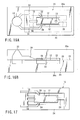
- FIG. 1A to FIG. 1E are figures which show the small antenna according to the first embodiment of the present invention.
- the small antenna according to the first embodiment is an antenna of the surface mounting type in which the planar antenna element 12 is embedded in the resin molded body 14.
- Thickness t1 of the resin molded body 14a (called as a, "lower part” for convenience' sake) on the circuit board side of the antenna element 12 (lower side of the antenna element 12 of FIG. 1B) is set in the necessary thickness so that the antenna element 12 is apart from the circuit board not to occur the influence of the characteristic lowering.
- Thickness t2 of the resin molded body 14b (called as an, "upper part” for convenience' sake) on the other side of the circuit board of the antenna element 12 (upper side of the antenna element 12 of FIG. 1B) is set in as thin as possible than the thickness t1.
- Thickness t2 is the minimum thickness necessary to protect the antenna element 12, for example.
- the gate portion 28 of the resin molding is provided to the upper side portion 14b with thin thickness of the resin molded body 14 (t2 side) in the first embodiment.
- the mark in this gate portion is actually called the gate portion 28 in this specification though mark 28 of the gate portion is a mark where the gate portion is removed after the resin molding.
- the gate portion 28 is provided on both sides of the resin molded body 14.
- the gate portion 28 may be provided at one end or both ends of the resin molded body 14.
- the gate portion 28 is also provided on the upper part 14b in which the thickness of the resin molded body 14 is thinner one (t2 side) in this case.
- the antenna element 12 is a rectangle and a planar.
- the feeder terminal part 16 and the ground terminal part 18 extended outside of the resin molded body 14 are formed on another end of the antenna element 12.
- the fixed terminal part 20 extended outside of the resin molded body 14 is formed on another end of the antenna element 12.
- Each of terminal parts 16, 18, and 20 is formed by being bent, so that the surface mounted on circuit board is almost the same level as the bottom of the resin molded body 14.
- the fixed terminal part 20 is provided if necessary, and might be omitted.
- a plurality of salients 12a are formed in a suitable interval on the both side ends of the antenna element 12.
- the resin molded body 14 which covers both sides of the antenna element 12 is integrally formed to continue in a part where there is no salient 12a. It is preferable that the resin molded body 14 which covers both sides of the antenna element 12 is continuously formed in the part without each terminal part 16, 18, and 20 on the both ends of the antenna element 12 as shown in the figure. However, these parts may be discontinuous.
- the small antenna of the surface mounting type as shown in FIG. 1A to FIG. 1E is manufactured as follows.
- the conductor pattern 10 as shown in FIG. 2 is formed by piercing processing or etching processing etc. of a metallic thin plate, first.
- the conductor pattern 10 has the frame 24 which surrounds the antenna element 12 and the circumference thereof.
- the antenna element 12 is a rectangle and a planar which consists of a metallic plate of about 0.1 mm in thickness, for example.
- the antenna element 12 and the frame 24 are connected by a plurality of the support parts 26, the feeder terminal part 16, the ground terminal part 18, and the fixed terminal part 20.
- a plurality of the support parts 26 are formed on the both side ends of the antenna element 12 in a suitable interval.
- the opening 50 is formed by the piercing processing etc. (The positioning hole for the piercing processing is omitted in the figure).
- the conductor pattern 10 is set in the molds 30a and 30b as shown in FIG. 3A and FIG. 3B. That is, the frame 24, the outside end side of each the support parts 26 and the outside end sides of each of terminal parts 16, 18 and 20 are placed in the parting faces of the upper mold 30a and the lower mold 30b.
- the conductor pattern 10 is set so that the entire antenna element 12, a part of end side in each the support part 26 and a part of end side in each terminal part 16 and 18 and 20 are positioned in the cavity of the upper and lower molds 30a and 30b.
- the depth of the cavity (Correspond to the thickness of the resin molded body) is shallowly formed with the lower mold 30b to mold the resin under the antenna element 12 (circuit board side).
- the resin flows easily into deeper side of the cavity usually when the depth of the cavity is different because of both sides of the antenna element 12 like this. Therefore, the resin pressure becomes unbalanced on both sides of the antenna element 12, and the deformation is occurred easily in the antenna element 12.
- the first embodiment solves this respect by providing the spool 33, the runner 34, and the gate 28 for the resin injection to the upper mold 30a side.
- the gate 28 is provided to be located to the opening 50 between the support parts 26 of the conductor pattern 10.
- FIG. 5A and FIG. 5B are figures which show the second embodiment of the present invention.
- the point where the second embodiment is different from the first embodiment is to form the part 14c whose thickness is thin at a part of the lower part 14a of the resin molded body.
- the part 14c whose thickness is thin is formed with the trench having the semicircle section formed over total length of the width direction of the antenna. Thickness t3 of the thinnest part of the part 14c whose thickness is thin is set to almost the same thickness as the thickness of the upper part 14b of the resin molded body.
- the part 14c whose thickness is thin is formed in the part of the lower part 14a of the resin molded body. Therefore, the resin flowing to the lower part 14a of the resin molded body can be limited more by the part 14c. As a result, the pressure balance when the lower part 14a and the upper part 14b of the resin molded body are molded becomes more excellent. Therefore, the antenna element 12 can be prevented from being deformed.
- the mark (gate portion) after the gate is cut may be in the same surface as the side surface of the resin molded body 14, may be projected or may be recessed as shown in FIG. 1A to FIG. 1E.
- FIG. 6 is a figure which shows the third embodiment of the manufacturing method of the small antenna according to the present invention.
- an interval d of a plurality of the support parts 26 which connect the antenna element 12 located in the cavity of the mold and the frame 24 which is held and fixed by the mold at the circumference thereof is wider at the position of the gate (position of gate part 28) and becomes narrow while being apart from the gate.
- the same marks are fixed to the same parts of FIG. 4, and a detailed explanation will be omitted since it is the same as the manufacturing method explained in the first embodiment.
- the resin filling pressure which is applied in the vicinity of the gate is easily spread to the lower mold 30b (FIG. 3A and FIG.
- FIG. 7 is a figure which shows the fourth embodiment of the manufacturing method of the small antenna according to the present invention.
- the gate (corresponding to the gate portion 28) is provided (In a word, only one gate is provided) only to the one side of the cavity in the fourth embodiment.
- the resin molded body 14 is formed by filling the resin from one gate. Besides, it is the same as the third embodiment. The opportunity that the flow of the resin injected thus at the injection molding intersects decreases. Therefore, the generation of the weld is suppressed, and the strength of the resin molded body can be improved.
- the gate may be provided at the lower mold 30b if necessary.
- the thickness of the resin molded body is thinned on the side of the other side (the upper part 14b) than on one side of the antenna element (the lower part 14a).
- the gate portion of the resin molding is provided to another side of the antenna element, that is, to thinner side of the resin molded body.
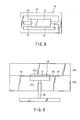
- FIG. 8 is a plan view which shows an example of the antenna element set in the mold.
- the same marks are fixed to the same parts as the first embodiment, and a detailed explanation will be omitted.
- the thickness of the resin molded body is thinner in another side of the antenna element than in one side thereof in the fifth embodiment as well as the first to fourth embodiments.
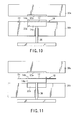
- the antenna element 12 is set in the molds 30a and 30b for injection molding as shown in FIG. 9 first as well as the first embodiment.
- the cavity 32b of the lower mold 30b is deeply formed with the cavity 32a of the upper mold 30a.
- the projection pin 36 to take out the resin molded body is provided to the lower mold 30b.
- the injection molding is performed by injecting the dielectric material in the cavity 32 in the state of FIG. 9.
- the molds 30a and 30b are opened as shown in FIG. 10.
- the ejector pin 36 is projected as shown in FIG. 11, and the resin molded body 14 is taken out from the lower mold 30b.
- the ejector pin 36 pierces thicker side of the resin molded body 14 (with large strength, that is, lower part 14a). Therefore, even if the ejection speed of the ejector pin 36 is made fast, fear that the crack is generated in the resin molded body 14 and the deformation is occurred in the antenna element is a little.
- each of terminal parts 16, 18, and 20 is cut off from the frame 24 and is bent.
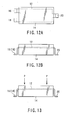
- the small antenna shown in FIG. 12A and FIG. 12B is finally obtained.
- the small antenna manufactured like this has the incrustation of the projection pin under the resin molded body 14.
- the upper middle part of the resin molded body 14 sucked by the mounter becomes a smooth surface to which the mold surface is transferred. Therefore, there is no fear of the air leakage at picking-up, and the pickup mistake can be reduced.
- the projection pin is struck and ejected at lower surface (the lower part 14a) of the resin molded body when the resin molded body is taken out from the mold.
- the projection pin may be struck to the position where an upper position of arrow P, that is, the position avoiding the middle part as shown in FIG. 13 to prevent the pickup miss and the resin molded body may be ejected, when the projection pin is struck to the resin molded body and the resin molded body is taken out.
- the thicknesses of the resin molded body on both sides of the antenna element are deferent as well as the first embodiment, and the ejector pin is struck to the surface of the lower part 14a of the resin molded body and the resin molded body is ejected according to the fifth embodiment. Therefore, the strength of the resin molded body on the side where the ejector pin is struck increases. As a result, since it becomes possible to endure more high-speed projection operation, the production efficiency can be improved.
- the ejector pin is struck to the position where an upper middle part of the resin molded body is avoided and the resin molded body is ejected according to the fifth embodiment. Therefore, the position sucked by the mounter becomes a flat surface without the incrustation of the ejector pin in the small antenna manufactured from the manufacturing method according to the fifth embodiment. As a result, there is no fear of the air leakage when picking-up, and the pickup mistake can be reduced.
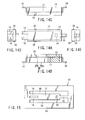
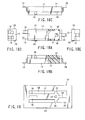
- FIG. 14A to FIG. 14E is a figure which shows the sixth embodiment of the present invention.
- the same marks are fixed to the same parts as the first embodiment, and a detailed explanation will be omitted.
- the gate part 28 is provided near the end portion inclined to (in other rectangular example of shown in the figure of inclined to it of the end portion of the antenna of element 10 on terminal 16 and 18 sides).
- the hole 22 is provided to the vicinity of the end portion (end portion on a fixed terminal 18 side in the example shown in the figure) far from the gate portion 28 of the resin molded body 14 of the antenna element 12.
- the resin on both sides of the antenna element 12 is continuous (integrated) in the hole 22.
- the deformation in the vicinity of the end portion far from the gate portion 28 of the antenna element 12 can be controlled with such a structure (details are described later).
- the hole 22 is formed at the middle of the width direction of the antenna element 12.
- a small antenna as shown in FIG. 14A to FIG. 14E is manufactured as follows.
- the conductor pattern 10 shown in FIG. 15 is formed by piercing processing or etching processing of a metallic thin plate.
- the conductor pattern 10 has a rectangular planar antenna element 12 and a frame 24 which surrounds the circumference thereof.
- the antenna element 12 and the frame 24 are connected by the feeder terminal part 16 and the ground terminal part 18 formed on one end of the antenna element 12, and the fixed terminal part 20 formed on another end of the antenna element 12.
- the hole 22 is formed in the vicinity of the end portion of the antenna element 12 at the fixed terminal part 20 sides.
- the opening 50 is formed by the piercing processing etc. (the positioning hole for piercing processing is omitted in the figure).
- the conductor pattern 10 is set in the molds 30a and 30b for injection molding as shown in FIG. 16A and FIG. 16B, etc. as well as the first embodiment.
- the gate is provided to an upper side of the antenna element 12 in this embodiment.
- the resin which entered in the cavity 32 from the gate 28 is rapidly filled in the cavity 32, and flows on an upper side and a lower side of the antenna element 12. And, the flow of the resin changes greatly at the place where the front of the flow of the resin strikes the wall of the cavity 32 far from the gate 28.
- the depths of the cavity 32 thickness of the resin
- the injection pressure and flow velocity of the resin at the upper and the lower sides of the antenna element 12 are different. Therefore, the reach time of the resin to the cavity end portion far from the gate 28 is also different.
- the change of the flow of the resin is enlarged at the cavity end portion far from the gate 28.
- the hole 22 is formed to the antenna element 12 as described above, the resin can pass through the hole 22. Therefore, the unbalance of the resin pressure is reduced on both sides of the antenna element 12. Therefore, it can be controlled to occur the deformation of the antenna element 12 in the vicinity of the end portion far from the gate 28.
- the small antenna of FIG. 14A to FIG. 14E is formed so that the thickness of the resin molded body 14 is thick on the lower part 14a of the antenna element 12 (circuit board side) and is thin on the upper part 14b thereof as well as the first embodiment. But, the thickness of the resin molded body 14 needs not differ in the lower part 14a and the upper part 14b. When the thickness of the resin molded body 14 is different on both sides of the antenna element 12 as in the sixth embodiment, it is preferable to provide the gate portion 28 to thinner side to reduce the deformation of the antenna element 12 further.
- the resin molded body 14 may be projected or recessed and may be in the same plane as the side surface of the resin molded body 14 as shown in FIG. 14A to FIG. 14E.
- the gate 28 is provided to both sides of the resin molded body 14 in the sixth embodiment, the gate 28 may be provided on one side of the resin molded body 14.
- FIG. 18A to FIG. 18E are figures which show the seventh embodiment of the present invention.
- the same marks are fixed to the same parts as FIG. 14A to FIG. 14E.
- the point where the small antenna according to the seventh embodiment is different from a small antenna of the sixth embodiment is that the projection 40 is provided on the both side ends of the part to which the hole 22 of the antenna element 12 is provided. The strength lowering of the antenna element 12 by providing the hole 22 is supplemented by the projection 40, and the deformation of the antenna element 12 near the hole 22 is decreased more.
- the small antenna of FIG. 18A to FIG. 18E can be manufactured as follows. First, the conductor pattern 10 as shown in FIG. 19 is formed. In the conductor pattern 10, both side ends of the part to which the hole 22 of the antenna element 12 is provided and the frame 24 are connected by the bridge part 26 (support part). Besides, it is the same as the conductor pattern 10 of FIG. 15.
- the conductor pattern 10 is set in the molds 30a and 30b as shown in FIG. 20.
- the molds 30a and 30b in FIG. 20 are the same as the molds 30a and 30b in FIG. 16A and FIG. 16B.
- the method of setting the conductor pattern 10 to the molds 30a and 30b is also the same as FIG. 16A and FIG. 16B.
- the resin molding by injecting the resin in the state of FIG. 20. Fear that the antenna element 12 is deformed near the hole 22 when the resin molding is a little in a case of FIG. 20, since the bridge part 26 is placed between the molds 30a and 30b and pressed thereby.
- the small antenna as shown in FIG. 18A to FIG. 18E can be obtained by performing a similar cutting processing and bending processing to the sixth embodiment after the resin molding.
- the projection 40 in FIG. 18A to FIG. 18E is a part in which the bridge part 26 is cut and is left in the resin molded body 14.
- the hole is provided to the antenna element in a small antenna in which a planar antenna element is embedded in the resin molded body according to the sixth embodiment and the seventh embodiment.
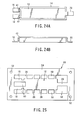
- FIG. 21A to FIG. 21D are figures which show the eighth embodiment of the present invention.
- the planar antenna element 12 is embedded in the resin molded body 14 as well as the first embodiment in the small antenna according to the eighth embodiment.
- the feeder terminal part 16 and the ground terminal part 18 extended from one end of the antenna element 12 are bent and are molded at the outside of the resin molded body 14 which is dielectric.
- the small antenna according to the eighth embodiment has the feature in the point that the narrowed portion 42 with narrow width of the conductor is provided to the bent part at the end surface of the resin molded body 14 of the feeder terminal part 16 and the ground terminal part 18.
- the feeder terminal part 16 and the ground terminal part 18 are bent in the end surface of the resin molded body 14, it is possible to bend them by the small power, when the narrowed portion 42 is provided on the base portion. In addition, the strength of the resin molded body therearound improves, too. Therefore, the crack of the resin molded body can be controlled.
- the configuration of the eighth embodiment is especially preferable, when the antenna element is formed by performing the copper plating to the board material of high strength which comprises the phosphorus bronze, and the iron, etc. used also for the spring material.
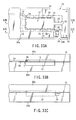
- FIG. 22A to FIG. 22D are figures which show the ninth embodiment of the present invention.
- the small antenna according to the ninth embodiment also comprises a configuration in which the planar antenna element 12 is embedded in the resin molded body 14 the feeder terminal part 16 and the ground terminal part 18 are extended from the antenna element 12 as well as the first embodiment.
- the base portion side of the feeder terminal part 16 and the ground terminal part 18 are integrated.
- the narrowed portion 42 whose conductor width is narrow is provided on the integrated part 44, and the narrowed portion 42 is bent at the end of the resin molded body.
- the previous state to which each of terminal parts 16, 18, and 20 are bent is FIG. 23A and FIG. 23B.
- the ninth embodiment has the advantage of generating the crack of the resin molded body 14 hardly than the case of the eighth embodiment.
- FIG. 24A and FIG. 24B are figures which show the tenth embodiment of the present invention.
- the point where the small antenna according to the tenth embodiment is different from the small antenna according to the eighth embodiment is that the antenna elements 12 are accumulated on the surface of the resin molded body (dielectric material) 14. Even in the small antenna having such a configuration, the same effect as the small antenna of the eighth embodiment can be achieved.
- the narrowed portion 42 is provided to the bent part of the terminal drawn out from the dielectric material at the end surface of the dielectric material.
- the power applied to dielectric material when the terminal part is bent can be reduced.
- the strength of dielectric material therearound can be improved. Therefore, the crack of dielectric material can be controlled. Therefore, the product yield can be improved, and the manufacturing cost can be reduced.
- FIG. 25 is a figure which shows the eleventh embodiment of the present invention.
- the conductor pattern 10 as shown in FIG. 25 is formed by performing the piercing processing or the etching processing of the metallic thin plate to the small antenna according to the eleventh embodiment, first, as well as the first embodiment.
- the conductor pattern 10 has the antenna element 12 and a frame 24 which surrounds the circumference thereof.
- the antenna element 12 and the frame 24 are connected by a plurality of the support parts 26 formed on the both side ends of the antenna element 12 in a suitable interval, the feeder terminal part 16 and the ground terminal part 18 formed on one end of the antenna element 12, and the fixed terminal part 20 formed on another end of the antenna element 12.
- the opening 50 and the positioning hole 52 formed by the piercing processing etc. are shown in FIG. 25.
- FIG. 25 it is also possible to omit the frame 24. However, it is preferable to restrict the limit of begin the expansion in the part molded by handle of the conductor pattern 10 an easy, as for there is the frame 24 extra resin as described later.
- the fixed terminal part 20 is provided if necessary, and can also be omitted.
- the ground terminal part 18 may be omitted according to the kind of the antenna element (for example, it is unnecessary when the antenna element is the meander antenna element, etc.).
- the conductor pattern 10 is set in the molds 30a and 30b based on the positioning pin 56 of the lower mold 30b as shown in FIG. 26 to FIG. 28. That is, the frame 24, the outside end side of the support parts 26 and the outside end sides of each terminal part 16, 18 and 20 are placed between the parting faces of the upper mold 30a and the lower mold 30b. And, the antenna element, a part of the end side of each support part 26, and a part of the end side of each terminal part 16, 18 and 20 are set to be located partly in the cavity 32 of the molds 30a and 30b. In the eleventh embodiment, the parting faces at the circumference of the cavity 32 of the molds 30a and 30b are flattened.
- the space S which is led to the cavity 32 is appeared by placing the conductor pattern 10 between the molds 30a and 30b in the part (part where the frame 24, the support part 26, the terminal parts 16, 18, and 20 are not placed) which corresponds to the opening 50 of the conductor pattern 10 between in the parting faces of the molds 30a and 30b.
- the resin molded body integrated with the conductor pattern 10 taken out by opening the molds 30a and 30b after molding is shown in FIG. 29.
- the antenna element 12 is embedded in the resin molded body 14 according to FIG. 29.
- the part 54 (hereinafter, called as a "fin") molded in the opening 50 of the circumference of the resin molded body 14 by an extra resin of the same thickness as the conductor pattern 10 is formed.
- the conductor pattern 10 has the frame 24 in circumference thereof. Therefore, the fin 54 is extended only to the inner end of the frame 24 even if it is the maximum. In a word, the frame 24 restricts the limit of begin the extension of the fin 54, and has the function to prevent the resin from being leaked to outside of the molds 30a and 30b at the resin molding.
- the fin 54 is essentially unnecessary, but has a secondary effect which can be judged whether the molding condition is proper as a result of the fin 54.
- the support parts 26 and the fin 54 are cut along both sides of the resin molded body 14.
- the outside ends of each of terminal parts 16, 18, and 20 are cut off from the frame 24 and are bent.
- a small antenna as shown in FIG. 30A to FIG. 30D can be obtained.
- the antenna element 12 is embedded in the resin molded body 14.
- the feeder terminal part 16 and the ground terminal part 18 are extended from one end surface of the resin molded body 14.
- the fixed terminal part 20 is extended from another end surface of the resin molded body 14.
- the lower part 14a of the resin molded body 14 is thicker than that of the upper part 14b.
- FIG. 31 is a figure which shows the twelfth embodiment of the present invention.
- the point where the twelfth embodiment is different from the eleventh embodiment is that the antenna element 12 and the frame 24 are connected only by the terminal parts 16, 18, and 20, and the conductor pattern 10 to which the support parts 26 is not provided is used.
- the end of in the fixed terminal part 20 side of the antenna element 12, the feeder terminal part 16, and the ground terminal part 18 are placed between the parting faces of the upper and lower molds 30a and 30b.
- the space is formed in the part where the antenna element, etc. are not placed between the parting faces of the upper and lower molds 30a and 30b.
- the resin is injected, the point that an extra resin flows into the space is the same as the eleventh embodiment. Therefore, the same effect as the eleventh embodiment can be achieved by the twelfth embodiment.
- FIG. 32 is a figure which shows the thirteenth embodiment of the present invention.
- FIG. 32 is a state when the molding step ends.
- the point where the thirteenth embodiment is different from the eleventh embodiment is to use the conductor pattern 10 in which each of terminal parts 16, 18, and 20 are not connected with the frame 24.
- the mold 30, which forms the salient engaged with the opening 50 of the circumference of each of terminal parts 16, 18, and 20, is used for the parting face of the lower mold 30b.
- the resin is prevented from flowing into the opening 50 of the circumference of each of terminal parts 16, 18, and 20 by the salient formed to the lower mold 30b. Therefore, the fin 54 is not formed to the opening 50.
- the resin can be prevented from adhering to the terminal parts 16, 18, and 20. Therefore, the plating processing to the terminal part performed by the post-processing and the bend processing of the terminal part, etc. become easy. Since the terminal parts 16, 18, and 20 are separated from the frame 24 beforehand, the plating processing to the entire surface the circumference surface (cutting surface) of the terminal part becomes easy, too.
- FIG. 33A to FIG. 33C are figures which show the fourteenth embodiment of the present invention.
- the resin receiver 38 which is led to the cavity 32 is formed at the side of the cavity 32 of the lower mold 30b.
- the resin receiver 38 is led to the cavity by the narrow opening part 38a.
- An entrance of the opening part 38a is little deeper than the interval of the space S and becomes wider from the entrance toward the interior.
- the wide space 38b is formed to the depth part.
- the resin receiver 38 is provided to a position different from the support part 26.
- the entrance of the resin receiver 38 is formed to 1 mm in width and 0.5 mm in depth.
- the thickness of the conductor pattern 10 is 0.127 mm.
- the size of the entire antenna is 2 mm in width, 15 mm in length, and 2.8 mm in thickness, or 4 mm in width, 8 mm in length, and 2.8 mm in thickness. Besides, the same marks are fixed to the same parts since it is similar to the eleventh embodiment.
- the support parts 26 and the resin receiver 38 are adjusted to different positions not to overlap the different materials in the fourteenth embodiment. Therefore, the removal work of the support parts 26 and the resin receiver 38 is easy.
- the thickness of the conductor pattern 10 is adjusted to 0.13 mm or less, when the resin with bad liquidity in which a ceramic powder is mixed, for example, is injection-molded to improve the permittivity, the generation of fin can be suppressed.
- the resin receiver 38 is folded later and is removed. As mentioned above, since opening part 38a of the resin receiver 38 has a taper-shape, this removal work is easy.
- FIG. 35A to FIG. 35C are figures which show the fifteenth embodiment of the present invention.
- the parting face of the upper mold is flat as well as FIG. 33A to FIG. 33C, though only the lower mold 30b is shown in FIG. 35A to FIG. 35C.
- the point where the fifteenth embodiment is different from the fourteenth embodiment is to use the mold which forms the salient 58 engaged with the opening 50 in both vicinity of each of terminal parts 16, 18, and 20 (see FIG. 36) for the parting faces of the lower mold 30b.
- the thickness of salient 58 is set to the same thickness as the conductor pattern 10 or some thinner than it.
- FIG. 36 shows the state that the resin molded body 14 which is molded by the above-mentioned molding and is integrated with the conductor pattern 10 is taken out from the mold.
- the part 38' molded by the resin receiver 38 of the resin molded body 14 is cut off later together with the support parts 26 etc.
- the insert molding of the antenna element is performed in the state of providing the space to which the resin can flow between in the parting faces of the mold and the resin receiver. Therefore, the resin pressure in the mold is not raised too much and the residual stress of the resin molded body becomes small, too. Therefore, the deformation of the antenna element caused by the resin pressure in the mold and the residual stress of the resin molded body can be controlled. Therefore, the small antenna with stable characteristic can be efficiently manufactured. Since the product yield improves, the manufacturing cost can be reduced.
- FIG. 37 is an upper view of the small antenna according to the sixteenth embodiment of the present invention immediately after the molding
- FIG. 38 is a side view of the small antenna according to the sixteenth embodiment of the present invention
- FIG. 39 is a method of taking out a small antenna of FIG. 37 from the mold.
- the same marks are fixed to the same parts as each above-mentioned embodiment.
- the small antenna according to the sixteenth embodiment is an antenna of the surface mounting type which shows the planar antenna element 12 is embedded in the resin molded body 14.
- the thickness of the lower part 14a of the resin molded body 14 of the antenna element 12 is set in the thickness necessary so that the circuit board is separated from the antenna element 12 not to generate the influence of the characteristic lowering of the antenna element 12.
- the thickness of the upper part 14b of the resin molded body 14 of the antenna element 12 is set to a thickness as thin as possible than the lower part 14a.
- the thickness of the upper part 14b is, for example, the lowest thickness necessary to protect the antenna element 12. As a result, it is possible to miniaturize the small antenna by thinning the resin molded body.
- the gate portion 28 is provided to the upper part 14b of the resin molded body 14 at the resin molding in the sixteenth embodiment.
- the small antenna with little deformation of the antenna element and stable characteristic can be obtained by such a configuration. It is preferable that an interval d of plurality of the support part 26 which connects the antenna element 12 located in the cavity of the mold and the frame 24 to the mold by the circumference is wider at the position of the gate (position of gate part 28) and becomes narrow while being apart from the gate. As a result, the unbalance of the resin pressure which is applied upper and lower surfaces of the antenna element 12 from the filling final step to the pressure-maintaining step is relaxed. Therefore, the antenna element 12 can be prevented from being deformed by the resin pressure to the antenna element 12.
- the hole 22 is provided in the vicinity of the end portion (it is a end portion on a fixed terminal 18 side in the example of shown in the figure) far from the gate portion 28 of the resin molded body 14 of the antenna element 12 in the small antenna according to the sixteenth embodiment.
- the hole 22 is formed at the middle of the width direction of the antenna element 12.
- the resin on both sides of the antenna element 12 is continuous (integrated) in the hole 22.
- the deformation in the vicinity of the end portion far from the gate portion 28 of the antenna element 12 can be controlled by such a structure. Therefore, the small antenna with little difference in characteristic can be provided.
- the resin molded body might be cracked in this case.
- the power applied to dielectric material when the terminal part is bent can be reduced.
- the strength of the dielectric material in the vicinity thereof can be improved. Therefore, the crack of dielectric material can be controlled. Therefore, the product yield can be improved, and the manufacturing cost can be reduced.
- planar antenna element is shown as the antenna element 12 in each above-mentioned embodiment.
- the compound material which enables the injection molding by mixing the resin and ceramics, though the dielectric material is not especially limited.
- the small antenna according to the first aspect is characterized by comprising: a planar antenna element; and a resin molded body integrally molded with the antenna element, in which the resin molded body has a thin part and a thick part on both sides of the antenna element, and a gate portion at a resin molding is provided to the thin part.
- the necessary thickness of the resin molded body is secured at one surface side of the antenna element and the thickness of another side of the antenna element of the resin molded body is thinner than that of one surface side.
- the thickness of the resin molded body can be thinned as a whole.
- the deformation of the antenna element can be controlled by providing the gate portion of the resin molding to the thinner side of the resin molded body. It is thought that the resin comes to be supplied enough to thinner side when the resin molded body is molded, and the resin pressure on both sides of the antenna element is more balanced, though this reason is not clear.
- the thin part is provided on a part of the thick part of the antenna element in the first aspect.
- the resin flowing to one surface side can be limited further by partially providing the thin part to one surface side of the antenna element, that is, the side where the thick resin molded body is formed. Therefore, the deformation of the antenna element can be more reduced.
- the small antenna according to the second aspect is characterized by comprising: a planar antenna element; a resin molded body integrally molded with the antenna element; and a hole formed to the antenna element.
- the balance of the resin pressure is not kept off greatly on both sides of the antenna element 12 by providing the hole. Therefore, the small antenna with little deformation of the antenna element can be obtained.
- a projection formed on both side ends of a part where the hole of the antenna element is provided is further comprised. It is preferable to provide the "hole” in the vicinity of both ends, when the gate portion is in the vicinity of a middle part of the antenna element. However, even if the "hole” is provided in the vicinity of either end portion a good result is obtained than the case that the "hole” is not provided,.
- the hole of the antenna element is provided to an end portion side far from the gate portion of the resin molded body.
- the strength in the corresponding part lowers and the deformation might be occurred. Therefore, the projection as mentioned above is formed, and the projection is placed between the molds. As a result, the antenna element can be prevented from being deformed by forming the hole.
- the small antenna according to the third aspect is characterized by comprising: an antenna element; and a resin molded body in which the antenna element is embedded or which is accumulated, the antenna element having a terminal extended to an outside of the resin molded body, in which the terminal comprises a narrowed portion with narrow width of a conductor at a base thereof, and the narrowed portion is bent at an outside of the resin molded body.
- the part drawn out from the dielectric material is bent in the end surface of dielectric material, it is possible to bend by the smaller power by providing the narrowed portion.
- the strength in the vicinity of the dielectric material can be improved. Therefore, the crack of the dielectric material is not generated easily.
- the crack is generated easily in the part of the dielectric material located between the feeder terminal and the ground terminal especially, in the antenna having the configuration in which the feeder terminal and the ground terminal are extended from the side of the antenna element. It is preferable that a base side of a feeder terminal and a ground terminal extended from the antenna element are integrated, and the narrowed portion with the narrow width of the conductor is provided to the integration part for the above-mentioned antenna. With this configuration, it becomes the same state as performing the bend processing of one terminal, since there is no the part of the dielectric material placed between two terminals. Therefore, the crack of the dielectric material is generated more hardly.
- the manufacturing method of the small antenna according to the fourth aspect is characterized by comprising: setting an antenna element to place the antenna element between a first mold and a second mold of the mold; and integrally molding a resin molded body to embed the antenna element by injecting the resin to the mold, in which a depth of a cavity of the first mold is shallower than a depth of a cavity of the second the mold, and a gate portion is provided to the first mold.
- a depth of a cavity of the first mold is shallower than a depth of a cavity of the second the mold, and a gate portion is provided to the first mold.
- an interval of support parts which connects the antenna element set in the cavity of the mold and a frame placed between the mold at a circumference thereof is wide at a position of the gate portion and becomes narrow apart from the gate portion in the fourth aspect.
- the manufacturing method of the small antenna according to the fifth aspect is characterized by comprising: setting an antenna element in a mold; performing injection molding by injecting a resin which is a dielectric material in the mold; and ejecting a resin molded body by striking an ejector pin to the resin molded body, when the mold is opened and the resin molded body after the injection molding is taken out, in which the resin molded body has the surfaces whose thickness are different at both sides of the antenna element, and ejecting including striking the ejector pin to a thicker surface of the resin molded body and ejecting the resin molded body.
- the manufacturing method of the small antenna according to the sixth aspect is characterized by comprising: setting an antenna element in a mold; performing injection molding by injecting a resin which is dielectric material in the mold; and ejecting a resin molded body by striking an ejector pin to the resin molded body, when the mold is opened and the resin molded body after the injection molding is taken out, in which ejecting includes striking the ejector pin to a position where a part to which the resin molded body is picked up is avoided and ejecting the resin molded body. Since the position sucked by the mounter becomes a flat surface without the incrustation of the ejector pin in the small antenna manufactured as mentioned above, there is no fear of the air leakage at picking-up, and the pickup mistake can be reduced.
- a compound material of a resin and a ceramics is used as the dielectric material in the fifth aspect and the sixth aspects.
- a practicable small antenna can be efficiently manufactured by the injection molding method, since such a compound material has the high permittivity, in addition, excellent stability in the temperature and the humidity, and the injection molding is possible.
- the manufacturing method of the small antenna according to the seventh aspect is characterized by comprising: setting an antenna element by placing at least a part between parting faces of a mold; and injecting a resin in the mold, in which setting includes setting the antenna element to form a space in a part where the antenna element is not placed in the parting faces.
- the manufacturing method of the small antenna according to the eighth aspect is characterized by comprising: setting an antenna element by placing at least a part between parting faces of the mold; and injecting a resin in the mold and performing a molding, in which a plurality of support parts extended to an outside to at least two opposite sides in the antenna element are integrally formed, and setting includes setting the antenna element to place the support parts between the parting faces of the mold in the parting faces, and form a space in a part where the support parts between the parting faces of the mold is not placed.
- the support parts are formed to connect between the antenna element and a frame which surrounds a circumference thereof, and the resin molding is performed in a state that the support parts and the frame placed between the parting faces of the mold in the seventh aspect and the eighth aspect.
- the mold has a flat parting faces to decrease the mold cost as the mold in each above-mentioned aspect.
- the part molded by the extra resin is generated to the space at the resin molding in each above-mentioned aspect. It is preferable to take out the resin molded body from the mold after molding; and cut off and remove a part which is molded by the space with the support part and is projected to an outside of the resin molded body. This part can be easily removed by cutting it at the same time when the support parts projected to the outside of the resin molded body is cut, after the resin molded body is taken out from the mold.
- the mold has a resin receiver which is led to the cavity at a side of the cavity of the mold in each above-mentioned aspect.
- the same effect as the fin can be achieved by providing such a resin receiver and flowing the extra resin thereto.
- the effect same as the fin can be achieved.
Landscapes
- Engineering & Computer Science (AREA)
- Manufacturing & Machinery (AREA)
- Mechanical Engineering (AREA)
- Computer Networks & Wireless Communication (AREA)
- Details Of Aerials (AREA)
- Moulds For Moulding Plastics Or The Like (AREA)
- Injection Moulding Of Plastics Or The Like (AREA)
- Waveguide Aerials (AREA)
Applications Claiming Priority (10)
| Application Number | Priority Date | Filing Date | Title |
|---|---|---|---|
| JP2000397311 | 2000-12-27 | ||
| JP2000397311 | 2000-12-27 | ||
| JP2001002163 | 2001-01-10 | ||
| JP2001002163 | 2001-01-10 | ||
| JP2001005007 | 2001-01-12 | ||
| JP2001005007 | 2001-01-12 | ||
| JP2001016217 | 2001-01-24 | ||
| JP2001016217 | 2001-01-24 | ||
| JP2001218569 | 2001-07-18 | ||
| JP2001218569A JP2003025374A (ja) | 2001-07-18 | 2001-07-18 | 小型アンテナの製造方法 |
Publications (2)
| Publication Number | Publication Date |
|---|---|
| EP1221738A2 true EP1221738A2 (de) | 2002-07-10 |
| EP1221738A3 EP1221738A3 (de) | 2002-10-23 |
Family
ID=27531761
Family Applications (1)
| Application Number | Title | Priority Date | Filing Date |
|---|---|---|---|
| EP01130266A Withdrawn EP1221738A3 (de) | 2000-12-27 | 2001-12-20 | Kleine Antenne und Verfahren zu deren Herstellung |
Country Status (5)
| Country | Link |
|---|---|
| US (1) | US6639557B2 (de) |
| EP (1) | EP1221738A3 (de) |
| KR (1) | KR20020053725A (de) |
| CN (1) | CN1287486C (de) |
| TW (1) | TW527748B (de) |
Cited By (2)
| Publication number | Priority date | Publication date | Assignee | Title |
|---|---|---|---|---|
| EP3041131A1 (de) * | 2014-11-16 | 2016-07-06 | Marek Adamczewski | Verfahren zur herstellung eines bauelements mit einer fotovoltaischen zelle und bauelement mit einer fotovoltaischen zelle |
| US9882268B2 (en) | 2014-08-21 | 2018-01-30 | Samsung Electro-Mechanics Co., Ltd. | Radiator frame having antenna pattern embedded therein and method of manufacturing the same |
Families Citing this family (21)
| Publication number | Priority date | Publication date | Assignee | Title |
|---|---|---|---|---|
| JP4149974B2 (ja) * | 2004-08-26 | 2008-09-17 | オムロン株式会社 | チップアンテナ |
| US7607249B2 (en) * | 2005-07-15 | 2009-10-27 | Innovatier Inc. | RFID bracelet and method for manufacturing a RFID bracelet |
| WO2007126748A2 (en) * | 2006-04-10 | 2007-11-08 | Innovatier, Inc. | An electronic inlay module for electronic cards and tags, electronic card and methods for manufacturing such electronic inlay modules and cards |
| US20070290048A1 (en) | 2006-06-20 | 2007-12-20 | Innovatier, Inc. | Embedded electronic device and method for manufacturing an embedded electronic device |
| US20080055824A1 (en) * | 2006-08-25 | 2008-03-06 | Innovatier, Inc. | Battery powered device having a protective frame |
| US20080160397A1 (en) * | 2006-08-25 | 2008-07-03 | Innovatier, Inc | Battery powered device having a protective frame |
| WO2008118352A1 (en) * | 2007-03-23 | 2008-10-02 | Innovatier, Inc. | A step card and method for making a step card |
| WO2008130340A1 (en) * | 2007-04-11 | 2008-10-30 | Science Applications International Corporation | Radio frequency transponders embedded in surfaces |
| US20080282540A1 (en) * | 2007-05-14 | 2008-11-20 | Innovatier, Inc. | Method for making advanced smart cards with integrated electronics using isotropic thermoset adhesive materials with high quality exterior surfaces |
| US20080299340A1 (en) * | 2007-06-01 | 2008-12-04 | Joseph Kamienski | Over-molded thick wall parts |
| US20090096614A1 (en) * | 2007-10-15 | 2009-04-16 | Innovatier, Inc. | Rfid power bracelet and method for manufacturing a rfid power bracelet |
| US20090167608A1 (en) * | 2007-12-31 | 2009-07-02 | Chang-Hai Chen | Soft plate antenna |
| US20090181215A1 (en) * | 2008-01-15 | 2009-07-16 | Innovatier, Inc. | Plastic card and method for making a plastic card |
| KR100944932B1 (ko) * | 2009-02-27 | 2010-03-02 | 삼성전기주식회사 | 안테나가 내장된 이동통신 단말기 케이스 및 그 제조방법, 이동통신 단말기 |
| KR100935954B1 (ko) * | 2009-04-23 | 2010-01-12 | 삼성전기주식회사 | 전자장치 케이스, 그 제조방법 및 제조금형, 이동통신 단말기 |
| KR100945123B1 (ko) | 2009-04-23 | 2010-03-02 | 삼성전기주식회사 | 안테나 패턴 프레임, 그 제조방법 및 제조금형, 전자장치 |
| KR101101622B1 (ko) * | 2010-02-25 | 2012-01-02 | 삼성전기주식회사 | 안테나 패턴 프레임 및 이를 포함하는 전자장치 케이스 제조금형 |
| JP2014072562A (ja) * | 2012-09-27 | 2014-04-21 | Alps Electric Co Ltd | アンテナ装置の製造方法 |
| US10166705B2 (en) * | 2016-04-27 | 2019-01-01 | Jtekt Corporation | Method of manufacturing housing structure and housing structure |
| JP6745645B2 (ja) | 2016-05-25 | 2020-08-26 | オリンパス株式会社 | インサート成形方法 |
| CN106827400A (zh) * | 2016-12-20 | 2017-06-13 | 广东长盈精密技术有限公司 | 注塑方法及注塑模具 |
Citations (3)
| Publication number | Priority date | Publication date | Assignee | Title |
|---|---|---|---|---|
| JPS607760A (ja) * | 1983-06-28 | 1985-01-16 | Toshiba Corp | Icカ−ドの製造方法 |
| EP1085597A2 (de) * | 1999-09-15 | 2001-03-21 | Lucent Technologies Inc. | Antennenzusammenbau für ein drahtloses Kommunikationsgerät |
| EP1217688A1 (de) * | 2000-12-20 | 2002-06-26 | The Furukawa Electric Co., Ltd. | Chipantenne und korrespondierendes Herstellungsverfahren |
Family Cites Families (16)
| Publication number | Priority date | Publication date | Assignee | Title |
|---|---|---|---|---|
| JPS5966128A (ja) * | 1982-10-07 | 1984-04-14 | Matsushita Electronics Corp | 樹脂封止型半導体装置の製造方法 |
| US4681718A (en) * | 1984-05-09 | 1987-07-21 | Hughes Aircraft Company | Method of fabricating composite or encapsulated articles |
| JPS61117842A (ja) * | 1984-11-14 | 1986-06-05 | Hitachi Micro Comput Eng Ltd | 成形装置 |
| US4862586A (en) * | 1985-02-28 | 1989-09-05 | Michio Osada | Lead frame for enclosing semiconductor chips with resin |
| JP2893085B2 (ja) * | 1988-10-18 | 1999-05-17 | トーワ株式会社 | 電子部品の樹脂封止成形方法及び装置 |
| JPH0780203B2 (ja) * | 1990-08-08 | 1995-08-30 | 三国プラスチックス株式会社 | パラボラアンテナの製造方法 |
| TW222346B (en) * | 1993-05-17 | 1994-04-11 | American Telephone & Telegraph | Method for packaging an electronic device substrate in a plastic encapsulant |
| WO1997007560A1 (en) * | 1995-08-11 | 1997-02-27 | The Whitaker Corporation | Flexible antenna and method of manufacturing same |
| US5898215A (en) * | 1996-12-16 | 1999-04-27 | Motorola, Inc. | Microelectronic assembly with connection to a buried electrical element, and method for forming same |
| EP0854536B1 (de) * | 1997-01-15 | 2007-05-09 | Menzolit-Fibron GmbH | Faserverstärktes Kunststoff-Formteil mit integrierter Antenne |
| FR2760998B1 (fr) * | 1997-03-21 | 1999-05-21 | Equisecurite Sa | Procede d'inclusion d'une etiquette electronique dans un objet realise en plastique, au moment de la fabrication de l'objet |
| US5955021A (en) * | 1997-05-19 | 1999-09-21 | Cardxx, Llc | Method of making smart cards |
| JP3669117B2 (ja) * | 1997-07-23 | 2005-07-06 | 松下電器産業株式会社 | ヘリカルアンテナ及びその製造方法 |
| US6049463A (en) * | 1997-07-25 | 2000-04-11 | Motorola, Inc. | Microelectronic assembly including an antenna element embedded within a polymeric card, and method for forming same |
| WO1999035708A1 (en) * | 1998-01-05 | 1999-07-15 | The Furukawa Electric Co., Ltd. | Antenna device for portable telephone, and method of manufacture |
| JP3492533B2 (ja) * | 1998-12-16 | 2004-02-03 | Smk株式会社 | ヘリカルアンテナの成形方法 |
-
2001
- 2001-12-20 EP EP01130266A patent/EP1221738A3/de not_active Withdrawn
- 2001-12-24 KR KR1020010083852A patent/KR20020053725A/ko not_active Ceased
- 2001-12-26 CN CNB011457473A patent/CN1287486C/zh not_active Expired - Fee Related
- 2001-12-26 TW TW090132350A patent/TW527748B/zh not_active IP Right Cessation
- 2001-12-27 US US10/033,272 patent/US6639557B2/en not_active Expired - Fee Related
Patent Citations (3)
| Publication number | Priority date | Publication date | Assignee | Title |
|---|---|---|---|---|
| JPS607760A (ja) * | 1983-06-28 | 1985-01-16 | Toshiba Corp | Icカ−ドの製造方法 |
| EP1085597A2 (de) * | 1999-09-15 | 2001-03-21 | Lucent Technologies Inc. | Antennenzusammenbau für ein drahtloses Kommunikationsgerät |
| EP1217688A1 (de) * | 2000-12-20 | 2002-06-26 | The Furukawa Electric Co., Ltd. | Chipantenne und korrespondierendes Herstellungsverfahren |
Cited By (2)
| Publication number | Priority date | Publication date | Assignee | Title |
|---|---|---|---|---|
| US9882268B2 (en) | 2014-08-21 | 2018-01-30 | Samsung Electro-Mechanics Co., Ltd. | Radiator frame having antenna pattern embedded therein and method of manufacturing the same |
| EP3041131A1 (de) * | 2014-11-16 | 2016-07-06 | Marek Adamczewski | Verfahren zur herstellung eines bauelements mit einer fotovoltaischen zelle und bauelement mit einer fotovoltaischen zelle |
Also Published As
| Publication number | Publication date |
|---|---|
| EP1221738A3 (de) | 2002-10-23 |
| US20020080077A1 (en) | 2002-06-27 |
| US6639557B2 (en) | 2003-10-28 |
| CN1287486C (zh) | 2006-11-29 |
| CN1363967A (zh) | 2002-08-14 |
| TW527748B (en) | 2003-04-11 |
| KR20020053725A (ko) | 2002-07-05 |
Similar Documents
| Publication | Publication Date | Title |
|---|---|---|
| US6639557B2 (en) | Small antenna and manufacturing method thereof | |
| KR100944932B1 (ko) | 안테나가 내장된 이동통신 단말기 케이스 및 그 제조방법, 이동통신 단말기 | |
| US8442603B2 (en) | Method of manufacturing case for mobile communications terminal, case for mobile communications terminal, and mobile communications terminal having the same | |
| KR100910161B1 (ko) | 내장형 안테나 일체형 휴대단말기 케이스 및 그 제조 방법 | |
| KR100935954B1 (ko) | 전자장치 케이스, 그 제조방법 및 제조금형, 이동통신 단말기 | |
| KR100945123B1 (ko) | 안테나 패턴 프레임, 그 제조방법 및 제조금형, 전자장치 | |
| KR101079496B1 (ko) | 안테나 패턴 프레임, 그 제조방법 및 제조금형, 그리고 안테나 패턴 프레임이 매립된 전자장치 케이스 및 그 제조방법 | |
| JP5211366B2 (ja) | アンテナパターンフレーム、その製造方法及び製造金型、電子装置のケースの製造方法及び電子装置 | |
| TW201524044A (zh) | 具有一接地帶及一嵌入模鑄接觸總成之插塞連接器 | |
| US7217153B2 (en) | Electronic circuit apparatus and production method thereof | |
| JP7173503B2 (ja) | 端子、端子を備えたパワーモジュール用射出成形体、及びその製造方法 | |
| US7632153B1 (en) | Electrical connector and method of manufacturing the same | |
| KR101339565B1 (ko) | 안테나 패턴부가 매립되는 전자장치 | |
| KR20100117009A (ko) | 전자장치 케이스, 그 제조방법 및 제조금형, 이동통신 단말기 | |
| JP2007279300A (ja) | 光接続部品および光接続部品の製造方法 | |
| CN220569928U (zh) | 插塞式连接器及插塞式连接器用壳体 | |
| CN112366494A (zh) | 连接器的制造方法及其连接器 | |
| CN101320700A (zh) | 制造具有树脂模制外壳的电子装置的方法及模制工具 | |
| KR102389636B1 (ko) | 안테나 방사체 제조 방법 및 이에 의한 안테나 방사체 | |
| CN210015855U (zh) | 一种芯片模组及使用该芯片模组的电连接器 | |
| US20060075634A1 (en) | Method for manufacturing electrical connectors for enhancing coplanarity | |
| KR101570497B1 (ko) | 무선통신단말기용 인테나 및 그 제조방법 | |
| KR20120129241A (ko) | 안테나 및 그 제조방법 | |
| JP3869261B2 (ja) | 小型アンテナ | |
| JP2002290140A (ja) | アンテナ装置 |
Legal Events
| Date | Code | Title | Description |
|---|---|---|---|
| PUAI | Public reference made under article 153(3) epc to a published international application that has entered the european phase |
Free format text: ORIGINAL CODE: 0009012 |
|
| AK | Designated contracting states |
Kind code of ref document: A2 Designated state(s): AT BE CH CY DE DK ES FI FR GB GR IE IT LI LU MC NL PT SE TR |
|
| AX | Request for extension of the european patent |
Free format text: AL;LT;LV;MK;RO;SI |
|
| PUAL | Search report despatched |
Free format text: ORIGINAL CODE: 0009013 |
|
| AK | Designated contracting states |
Kind code of ref document: A3 Designated state(s): AT BE CH CY DE DK ES FI FR GB GR IE IT LI LU MC NL PT SE TR |
|
| AX | Request for extension of the european patent |
Free format text: AL;LT;LV;MK;RO;SI |
|
| 17P | Request for examination filed |
Effective date: 20030404 |
|
| AKX | Designation fees paid |
Designated state(s): DE GB |
|
| 17Q | First examination report despatched |
Effective date: 20031112 |
|
| STAA | Information on the status of an ep patent application or granted ep patent |
Free format text: STATUS: THE APPLICATION IS DEEMED TO BE WITHDRAWN |
|
| 18D | Application deemed to be withdrawn |
Effective date: 20060118 |