EP1223031A2 - Dämmstoffelement aus Mineralwolle sowie Verfahren zu dessen Herstellung - Google Patents
Dämmstoffelement aus Mineralwolle sowie Verfahren zu dessen Herstellung Download PDFInfo
- Publication number
- EP1223031A2 EP1223031A2 EP02000461A EP02000461A EP1223031A2 EP 1223031 A2 EP1223031 A2 EP 1223031A2 EP 02000461 A EP02000461 A EP 02000461A EP 02000461 A EP02000461 A EP 02000461A EP 1223031 A2 EP1223031 A2 EP 1223031A2
- Authority
- EP
- European Patent Office
- Prior art keywords
- barrier layer
- insulating element
- fibers
- element according
- insulation
- Prior art date
- Legal status (The legal status is an assumption and is not a legal conclusion. Google has not performed a legal analysis and makes no representation as to the accuracy of the status listed.)
- Granted
Links
- 239000011490 mineral wool Substances 0.000 title claims description 37
- 238000004519 manufacturing process Methods 0.000 title claims description 13
- 238000000034 method Methods 0.000 title claims description 9
- 238000005520 cutting process Methods 0.000 claims abstract description 11
- 239000003365 glass fiber Substances 0.000 claims abstract description 4
- 239000010410 layer Substances 0.000 claims description 139
- 230000004888 barrier function Effects 0.000 claims description 128
- 238000009413 insulation Methods 0.000 claims description 119
- 239000000835 fiber Substances 0.000 claims description 98
- 239000011230 binding agent Substances 0.000 claims description 38
- 239000011810 insulating material Substances 0.000 claims description 9
- 239000002002 slurry Substances 0.000 claims description 9
- 239000002344 surface layer Substances 0.000 claims description 8
- 239000011521 glass Substances 0.000 claims description 4
- 210000004209 hair Anatomy 0.000 claims description 4
- 239000004014 plasticizer Substances 0.000 claims description 4
- 229920000058 polyacrylate Polymers 0.000 claims description 4
- 239000004745 nonwoven fabric Substances 0.000 claims description 3
- 238000003825 pressing Methods 0.000 claims description 3
- 239000004094 surface-active agent Substances 0.000 claims description 3
- 239000004753 textile Substances 0.000 claims description 3
- 230000002787 reinforcement Effects 0.000 claims 2
- 238000005516 engineering process Methods 0.000 claims 1
- 239000011491 glass wool Substances 0.000 claims 1
- 238000002791 soaking Methods 0.000 claims 1
- 238000013461 design Methods 0.000 abstract description 7
- 239000012774 insulation material Substances 0.000 abstract description 2
- 230000000903 blocking effect Effects 0.000 abstract 2
- 239000000463 material Substances 0.000 abstract 1
- 230000006835 compression Effects 0.000 description 5
- 238000007906 compression Methods 0.000 description 5
- 238000004804 winding Methods 0.000 description 5
- 238000009434 installation Methods 0.000 description 4
- 238000003860 storage Methods 0.000 description 4
- XAGFODPZIPBFFR-UHFFFAOYSA-N aluminium Chemical compound [Al] XAGFODPZIPBFFR-UHFFFAOYSA-N 0.000 description 3
- 229910052782 aluminium Inorganic materials 0.000 description 3
- 230000001771 impaired effect Effects 0.000 description 3
- KXGFMDJXCMQABM-UHFFFAOYSA-N 2-methoxy-6-methylphenol Chemical compound [CH]OC1=CC=CC([CH])=C1O KXGFMDJXCMQABM-UHFFFAOYSA-N 0.000 description 2
- 239000000654 additive Substances 0.000 description 2
- 230000015572 biosynthetic process Effects 0.000 description 2
- 238000004040 coloring Methods 0.000 description 2
- 239000002131 composite material Substances 0.000 description 2
- 238000011161 development Methods 0.000 description 2
- 230000018109 developmental process Effects 0.000 description 2
- 238000009826 distribution Methods 0.000 description 2
- 230000000694 effects Effects 0.000 description 2
- 239000011888 foil Substances 0.000 description 2
- 239000005011 phenolic resin Substances 0.000 description 2
- 229920001568 phenolic resin Polymers 0.000 description 2
- 239000004033 plastic Substances 0.000 description 2
- 238000005096 rolling process Methods 0.000 description 2
- 230000009182 swimming Effects 0.000 description 2
- 229910018072 Al 2 O 3 Inorganic materials 0.000 description 1
- 208000002193 Pain Diseases 0.000 description 1
- 229910004298 SiO 2 Inorganic materials 0.000 description 1
- BLRPTPMANUNPDV-UHFFFAOYSA-N Silane Chemical compound [SiH4] BLRPTPMANUNPDV-UHFFFAOYSA-N 0.000 description 1
- 238000010521 absorption reaction Methods 0.000 description 1
- 239000000853 adhesive Substances 0.000 description 1
- 230000001070 adhesive effect Effects 0.000 description 1
- 239000004566 building material Substances 0.000 description 1
- 230000003760 hair shine Effects 0.000 description 1
- 239000012535 impurity Substances 0.000 description 1
- 238000003780 insertion Methods 0.000 description 1
- 230000037431 insertion Effects 0.000 description 1
- 238000003475 lamination Methods 0.000 description 1
- 239000003550 marker Substances 0.000 description 1
- 239000012528 membrane Substances 0.000 description 1
- 239000000178 monomer Substances 0.000 description 1
- 238000004806 packaging method and process Methods 0.000 description 1
- 230000035515 penetration Effects 0.000 description 1
- 239000002985 plastic film Substances 0.000 description 1
- 229920006255 plastic film Polymers 0.000 description 1
- 229920000642 polymer Polymers 0.000 description 1
- 230000000717 retained effect Effects 0.000 description 1
- 229910000077 silane Inorganic materials 0.000 description 1
- 238000005507 spraying Methods 0.000 description 1
- 238000012549 training Methods 0.000 description 1
- 230000000007 visual effect Effects 0.000 description 1
- 239000002699 waste material Substances 0.000 description 1
- 239000000080 wetting agent Substances 0.000 description 1
Images


Classifications
-
- B—PERFORMING OPERATIONS; TRANSPORTING
- B32—LAYERED PRODUCTS
- B32B—LAYERED PRODUCTS, i.e. PRODUCTS BUILT-UP OF STRATA OF FLAT OR NON-FLAT, e.g. CELLULAR OR HONEYCOMB, FORM
- B32B5/00—Layered products characterised by the non- homogeneity or physical structure, i.e. comprising a fibrous, filamentary, particulate or foam layer; Layered products characterised by having a layer differing constitutionally or physically in different parts
- B32B5/22—Layered products characterised by the non- homogeneity or physical structure, i.e. comprising a fibrous, filamentary, particulate or foam layer; Layered products characterised by having a layer differing constitutionally or physically in different parts characterised by the presence of two or more layers which are next to each other and are fibrous, filamentary, formed of particles or foamed
- B32B5/24—Layered products characterised by the non- homogeneity or physical structure, i.e. comprising a fibrous, filamentary, particulate or foam layer; Layered products characterised by having a layer differing constitutionally or physically in different parts characterised by the presence of two or more layers which are next to each other and are fibrous, filamentary, formed of particles or foamed one layer being a fibrous or filamentary layer
- B32B5/26—Layered products characterised by the non- homogeneity or physical structure, i.e. comprising a fibrous, filamentary, particulate or foam layer; Layered products characterised by having a layer differing constitutionally or physically in different parts characterised by the presence of two or more layers which are next to each other and are fibrous, filamentary, formed of particles or foamed one layer being a fibrous or filamentary layer another layer next to it also being fibrous or filamentary
-
- B—PERFORMING OPERATIONS; TRANSPORTING
- B32—LAYERED PRODUCTS
- B32B—LAYERED PRODUCTS, i.e. PRODUCTS BUILT-UP OF STRATA OF FLAT OR NON-FLAT, e.g. CELLULAR OR HONEYCOMB, FORM
- B32B38/00—Ancillary operations in connection with laminating processes
- B32B38/14—Printing or colouring
- B32B38/145—Printing
-
- B—PERFORMING OPERATIONS; TRANSPORTING
- B32—LAYERED PRODUCTS
- B32B—LAYERED PRODUCTS, i.e. PRODUCTS BUILT-UP OF STRATA OF FLAT OR NON-FLAT, e.g. CELLULAR OR HONEYCOMB, FORM
- B32B5/00—Layered products characterised by the non- homogeneity or physical structure, i.e. comprising a fibrous, filamentary, particulate or foam layer; Layered products characterised by having a layer differing constitutionally or physically in different parts
- B32B5/02—Layered products characterised by the non- homogeneity or physical structure, i.e. comprising a fibrous, filamentary, particulate or foam layer; Layered products characterised by having a layer differing constitutionally or physically in different parts characterised by structural features of a fibrous or filamentary layer
- B32B5/022—Non-woven fabric
-
- D—TEXTILES; PAPER
- D04—BRAIDING; LACE-MAKING; KNITTING; TRIMMINGS; NON-WOVEN FABRICS
- D04H—MAKING TEXTILE FABRICS, e.g. FROM FIBRES OR FILAMENTARY MATERIAL; FABRICS MADE BY SUCH PROCESSES OR APPARATUS, e.g. FELTS, NON-WOVEN FABRICS; COTTON-WOOL; WADDING ; NON-WOVEN FABRICS FROM STAPLE FIBRES, FILAMENTS OR YARNS, BONDED WITH AT LEAST ONE WEB-LIKE MATERIAL DURING THEIR CONSOLIDATION
- D04H1/00—Non-woven fabrics formed wholly or mainly of staple fibres or like relatively short fibres
- D04H1/40—Non-woven fabrics formed wholly or mainly of staple fibres or like relatively short fibres from fleeces or layers composed of fibres without existing or potential cohesive properties
- D04H1/42—Non-woven fabrics formed wholly or mainly of staple fibres or like relatively short fibres from fleeces or layers composed of fibres without existing or potential cohesive properties characterised by the use of certain kinds of fibres insofar as this use has no preponderant influence on the consolidation of the fleece
- D04H1/4209—Inorganic fibres
-
- D—TEXTILES; PAPER
- D04—BRAIDING; LACE-MAKING; KNITTING; TRIMMINGS; NON-WOVEN FABRICS
- D04H—MAKING TEXTILE FABRICS, e.g. FROM FIBRES OR FILAMENTARY MATERIAL; FABRICS MADE BY SUCH PROCESSES OR APPARATUS, e.g. FELTS, NON-WOVEN FABRICS; COTTON-WOOL; WADDING ; NON-WOVEN FABRICS FROM STAPLE FIBRES, FILAMENTS OR YARNS, BONDED WITH AT LEAST ONE WEB-LIKE MATERIAL DURING THEIR CONSOLIDATION
- D04H1/00—Non-woven fabrics formed wholly or mainly of staple fibres or like relatively short fibres
- D04H1/40—Non-woven fabrics formed wholly or mainly of staple fibres or like relatively short fibres from fleeces or layers composed of fibres without existing or potential cohesive properties
- D04H1/42—Non-woven fabrics formed wholly or mainly of staple fibres or like relatively short fibres from fleeces or layers composed of fibres without existing or potential cohesive properties characterised by the use of certain kinds of fibres insofar as this use has no preponderant influence on the consolidation of the fleece
- D04H1/4209—Inorganic fibres
- D04H1/4218—Glass fibres
-
- D—TEXTILES; PAPER
- D04—BRAIDING; LACE-MAKING; KNITTING; TRIMMINGS; NON-WOVEN FABRICS
- D04H—MAKING TEXTILE FABRICS, e.g. FROM FIBRES OR FILAMENTARY MATERIAL; FABRICS MADE BY SUCH PROCESSES OR APPARATUS, e.g. FELTS, NON-WOVEN FABRICS; COTTON-WOOL; WADDING ; NON-WOVEN FABRICS FROM STAPLE FIBRES, FILAMENTS OR YARNS, BONDED WITH AT LEAST ONE WEB-LIKE MATERIAL DURING THEIR CONSOLIDATION
- D04H1/00—Non-woven fabrics formed wholly or mainly of staple fibres or like relatively short fibres
- D04H1/40—Non-woven fabrics formed wholly or mainly of staple fibres or like relatively short fibres from fleeces or layers composed of fibres without existing or potential cohesive properties
- D04H1/58—Non-woven fabrics formed wholly or mainly of staple fibres or like relatively short fibres from fleeces or layers composed of fibres without existing or potential cohesive properties by applying, incorporating or activating chemical or thermoplastic bonding agents, e.g. adhesives
- D04H1/593—Non-woven fabrics formed wholly or mainly of staple fibres or like relatively short fibres from fleeces or layers composed of fibres without existing or potential cohesive properties by applying, incorporating or activating chemical or thermoplastic bonding agents, e.g. adhesives to layered webs
-
- D—TEXTILES; PAPER
- D04—BRAIDING; LACE-MAKING; KNITTING; TRIMMINGS; NON-WOVEN FABRICS
- D04H—MAKING TEXTILE FABRICS, e.g. FROM FIBRES OR FILAMENTARY MATERIAL; FABRICS MADE BY SUCH PROCESSES OR APPARATUS, e.g. FELTS, NON-WOVEN FABRICS; COTTON-WOOL; WADDING ; NON-WOVEN FABRICS FROM STAPLE FIBRES, FILAMENTS OR YARNS, BONDED WITH AT LEAST ONE WEB-LIKE MATERIAL DURING THEIR CONSOLIDATION
- D04H13/00—Other non-woven fabrics
-
- D—TEXTILES; PAPER
- D21—PAPER-MAKING; PRODUCTION OF CELLULOSE
- D21H—PULP COMPOSITIONS; PREPARATION THEREOF NOT COVERED BY SUBCLASSES D21C OR D21D; IMPREGNATING OR COATING OF PAPER; TREATMENT OF FINISHED PAPER NOT COVERED BY CLASS B31 OR SUBCLASS D21G; PAPER NOT OTHERWISE PROVIDED FOR
- D21H27/00—Special paper not otherwise provided for, e.g. made by multi-step processes
- D21H27/30—Multi-ply
- D21H27/38—Multi-ply at least one of the sheets having a fibrous composition differing from that of other sheets
-
- E—FIXED CONSTRUCTIONS
- E04—BUILDING
- E04B—GENERAL BUILDING CONSTRUCTIONS; WALLS, e.g. PARTITIONS; ROOFS; FLOORS; CEILINGS; INSULATION OR OTHER PROTECTION OF BUILDINGS
- E04B1/00—Constructions in general; Structures which are not restricted either to walls, e.g. partitions, or floors or ceilings or roofs
- E04B1/62—Insulation or other protection; Elements or use of specified material therefor
- E04B1/74—Heat, sound or noise insulation, absorption, or reflection; Other building methods affording favourable thermal or acoustical conditions, e.g. accumulating of heat within walls
- E04B1/76—Heat, sound or noise insulation, absorption, or reflection; Other building methods affording favourable thermal or acoustical conditions, e.g. accumulating of heat within walls specifically with respect to heat only
- E04B1/7654—Heat, sound or noise insulation, absorption, or reflection; Other building methods affording favourable thermal or acoustical conditions, e.g. accumulating of heat within walls specifically with respect to heat only comprising an insulating layer, disposed between two longitudinal supporting elements, e.g. to insulate ceilings
- E04B1/7658—Heat, sound or noise insulation, absorption, or reflection; Other building methods affording favourable thermal or acoustical conditions, e.g. accumulating of heat within walls specifically with respect to heat only comprising an insulating layer, disposed between two longitudinal supporting elements, e.g. to insulate ceilings comprising fiber insulation, e.g. as panels or loose filled fibres
- E04B1/7662—Heat, sound or noise insulation, absorption, or reflection; Other building methods affording favourable thermal or acoustical conditions, e.g. accumulating of heat within walls specifically with respect to heat only comprising an insulating layer, disposed between two longitudinal supporting elements, e.g. to insulate ceilings comprising fiber insulation, e.g. as panels or loose filled fibres comprising fiber blankets or batts
-
- E—FIXED CONSTRUCTIONS
- E04—BUILDING
- E04B—GENERAL BUILDING CONSTRUCTIONS; WALLS, e.g. PARTITIONS; ROOFS; FLOORS; CEILINGS; INSULATION OR OTHER PROTECTION OF BUILDINGS
- E04B1/00—Constructions in general; Structures which are not restricted either to walls, e.g. partitions, or floors or ceilings or roofs
- E04B1/62—Insulation or other protection; Elements or use of specified material therefor
- E04B1/74—Heat, sound or noise insulation, absorption, or reflection; Other building methods affording favourable thermal or acoustical conditions, e.g. accumulating of heat within walls
- E04B1/76—Heat, sound or noise insulation, absorption, or reflection; Other building methods affording favourable thermal or acoustical conditions, e.g. accumulating of heat within walls specifically with respect to heat only
- E04B1/78—Heat insulating elements
-
- E—FIXED CONSTRUCTIONS
- E04—BUILDING
- E04B—GENERAL BUILDING CONSTRUCTIONS; WALLS, e.g. PARTITIONS; ROOFS; FLOORS; CEILINGS; INSULATION OR OTHER PROTECTION OF BUILDINGS
- E04B9/00—Ceilings; Construction of ceilings, e.g. false ceilings; Ceiling construction with regard to insulation
- E04B9/04—Ceilings; Construction of ceilings, e.g. false ceilings; Ceiling construction with regard to insulation comprising slabs, panels, sheets or the like
- E04B9/045—Ceilings; Construction of ceilings, e.g. false ceilings; Ceiling construction with regard to insulation comprising slabs, panels, sheets or the like being laminated
-
- B—PERFORMING OPERATIONS; TRANSPORTING
- B32—LAYERED PRODUCTS
- B32B—LAYERED PRODUCTS, i.e. PRODUCTS BUILT-UP OF STRATA OF FLAT OR NON-FLAT, e.g. CELLULAR OR HONEYCOMB, FORM
- B32B2262/00—Composition or structural features of fibres which form a fibrous or filamentary layer or are present as additives
- B32B2262/10—Inorganic fibres
- B32B2262/101—Glass fibres
-
- B—PERFORMING OPERATIONS; TRANSPORTING
- B32—LAYERED PRODUCTS
- B32B—LAYERED PRODUCTS, i.e. PRODUCTS BUILT-UP OF STRATA OF FLAT OR NON-FLAT, e.g. CELLULAR OR HONEYCOMB, FORM
- B32B2307/00—Properties of the layers or laminate
- B32B2307/30—Properties of the layers or laminate having particular thermal properties
- B32B2307/304—Insulating
-
- B—PERFORMING OPERATIONS; TRANSPORTING
- B32—LAYERED PRODUCTS
- B32B—LAYERED PRODUCTS, i.e. PRODUCTS BUILT-UP OF STRATA OF FLAT OR NON-FLAT, e.g. CELLULAR OR HONEYCOMB, FORM
- B32B2315/00—Other materials containing non-metallic inorganic compounds not provided for in groups B32B2311/00 - B32B2313/04
- B32B2315/14—Mineral wool
-
- D—TEXTILES; PAPER
- D21—PAPER-MAKING; PRODUCTION OF CELLULOSE
- D21H—PULP COMPOSITIONS; PREPARATION THEREOF NOT COVERED BY SUBCLASSES D21C OR D21D; IMPREGNATING OR COATING OF PAPER; TREATMENT OF FINISHED PAPER NOT COVERED BY CLASS B31 OR SUBCLASS D21G; PAPER NOT OTHERWISE PROVIDED FOR
- D21H13/00—Pulp or paper, comprising synthetic cellulose or non-cellulose fibres or web-forming material
- D21H13/36—Inorganic fibres or flakes
- D21H13/38—Inorganic fibres or flakes siliceous
- D21H13/40—Inorganic fibres or flakes siliceous vitreous, e.g. mineral wool, glass fibres
-
- E—FIXED CONSTRUCTIONS
- E04—BUILDING
- E04B—GENERAL BUILDING CONSTRUCTIONS; WALLS, e.g. PARTITIONS; ROOFS; FLOORS; CEILINGS; INSULATION OR OTHER PROTECTION OF BUILDINGS
- E04B1/00—Constructions in general; Structures which are not restricted either to walls, e.g. partitions, or floors or ceilings or roofs
- E04B1/62—Insulation or other protection; Elements or use of specified material therefor
- E04B1/74—Heat, sound or noise insulation, absorption, or reflection; Other building methods affording favourable thermal or acoustical conditions, e.g. accumulating of heat within walls
- E04B2001/741—Insulation elements with markings, e.g. identification or cutting template
Definitions
- the invention relates to an insulating element made of mineral wool according to the preamble of Claim 1 and a method for producing the same.
- Mineral wool insulation elements are usually produced by collecting fibers emerging from spinnerets on an endless conveyor belt to form a fiber mat.
- a binder is also added by spraying the fibers emerging from the spinnerets with binder.
- Phenolic resin is mostly used as a binder. Due to the production process due to the collection of the fibers on the rotating endless conveyor belt, the fibers are oriented essentially in the longitudinal direction of the fiber mat and thus parallel to both main surfaces of the insulation element, but in three dimensions are in a tangled position.
- the fiber mat mixed with binder is passed through a so-called tunnel oven for the purpose of curing the binder, usually between two endless conveyor belts, which are each formed from hinged gratings, so that warm air is directed towards the purpose of curing and can be blown through the fiber mat.
- the hardened and cut insulation element is often in the form of mineral wool panels, usually with bulk densities of up to 100 kg / m 3 , whereby these mineral wool panels are primarily used as panels for ventilated facades, as impact sound insulation panels or the like.
- insulating material sheets are used in which the bulk density values are less than 40 kg / m 3 .
- the insulation element i.e. the insulation sheet
- the insulation element is flexible and can be wound up with compression to form an insulation roll, which is advantageous for transport and storage.
- these insulating material strips are inserted between the rafters under clamping pressure.
- the distance between the rafters is measured, transferred to the insulation sheet and then a section corresponding to the distance between the rafters is cut off from the insulation sheet using the marking lines as cutting lines and then installed transversely between the rafters.
- the cutting is carried out with oversize, so that after compressing the insulation section laterally, it is held under clamping pressure after insertion between the rafters.
- insulation sheeting laminated with aluminum foil is used, in which the aluminum foil protrudes like a flap on both sides with a protrusion and the insulation sheeting introduced in the longitudinal direction between the rafters is then held between the rafters by fastening the laterally projecting aluminum strips to the rafters by means of clip-like fastening means.
- the first-mentioned laying of insulation sheeting with marking lines is characterized by the fact that the production and storage of insulation sheeting with finely graduated nominal widths is eliminated and, above all, the waste that occurs with the other laying method during installation is minimized or completely avoided.
- the insulation webs are wound up into a roll for transport and storage under compression and packed in a plastic sleeve. If the plastic film is removed on site to unpack the insulation sheet, the insulation roll springs up into an elongated insulation sheet, whereby the compressed insulation sheet also springs up to its nominal thickness.
- the outer exposed surface layer is formed directly by mineral wool fibers. Especially with density ⁇ 30 kg / m 3 , the surface layer of these insulation sheeting is very flexible and yields resiliently when touched. When the mineral wool insulation element is firmly gripped, the processor can feel a slightly stinging surface, which is undesirable.
- the object of the invention is to provide an insulating element made of mineral wool, in particular one Designing the insulation web in such a way that the grip-friendliness improves and thus that Handling of the insulation elements becomes easier during installation. In doing so, the Further training does not accept any loss in the quality of the insulation elements, rather, the advantageous properties of the insulation elements for transport, Storage and installation remain unchanged. It is also sought that through the measures the familiar appearance of the insulation elements to increase grip-friendliness remains, which is due to the typical coloring of the mineral wool fibers and whose appearance is shaped by the manufacturing process, in particular due to the yellowish or yellowish / brownish color, depending on the starting product.
- the invention sees a very thin, in particular film-thin barrier layer structure with a skin-like character and porous structure on at least one of the main surfaces of the insulation sheet or the insulation element is applied and attached.
- This barrier layer structure is characterized by its high flexibility and is designed so elastic and smooth that the barrier layer, when it is crumpled, it returns to its original shape without creasing.
- the behavior of the mineral wool web is not impaired by the barrier layer, however the grip behavior and feel as well as the visual impression improved, as a after externally optically closed surface is conveyed and the barrier layer due to their Design prevents fibers of the insulation element from coming out.
- the Fibers of the barrier layer are firmly bound so that they do not come loose even when rubbed.
- the barrier layer is made of a wet nonwoven fabric or a slurry-like structure, in which, after the fiber-binder composite has hardened, also splitting into layers prevented.
- the stillage is preferably formed from chopped E-glass fibers and polyacrylate. Due to the flexible design of the barrier layer, the user means directly when handling of the element to grasp the mineral wool, which is not the case, however, since the relevant Main surface of the element is covered by this barrier layer.
- An insulation sheet with such a barrier layer, apart from the improved grip-friendliness, is easy to handle completely like an insulation sheet without such a barrier layer, that is, the soft one Characteristic of the insulation sheet, which for the user is the synonym of the insulation capacity represents, is also conveyed by the insulating material web designed according to the invention.
- the insulation sheet can still be angled well Press arrangements, whereby in the case of a clamping felt, the clamping capacity changes even increased advantageously. Furthermore, the insulation sheet can also be used under high Wrap compression well without any loss, and interfere with the barrier layer in no way, even if it is provided on both sides. The necessary springing of the Insulation sheet after removal of the packaging is also not due to the barrier layer impaired. Since the barrier layer is also predominantly in a flat network structure is designed, it overlaps the fibers of the mineral wool insulation element and prevents a possible detachment of the fibers when unrolling the insulation roll, but also when gripping the insulation element.
- the thickness of the barrier layer is expediently ⁇ 1 mm, in particular ⁇ 0.5 mm and preferably ⁇ 0.2 mm, in particular 0.18 mm, which for flexibility and ease of grip is advantageous.
- the insulation membrane shimmers due to the film-thin network structure through, so that the user knows the yellowish or yellowish / brownish color of the mineral wool web is not visually hidden.
- the fiber density per Area unit of the barrier layer in the sense of fiber detachment protection on the fiber length of the mineral wool fibers turned off. If the mineral wool fibers are longer, then the density can the network structure may be smaller than in the case of shorter mineral wool fibers.
- barrier layer from a slurry or mash of binder and chopped Fibers, to which a plasticizer is optionally added, by rolling and Pulling over a sieve can create a predominant orientation of the confused present Fiber layer largely in the plane of the spear layer with a predominant tendency an orientation in the longitudinal direction, i.e. the rolling direction during layer production, to adjust.
- the weight per unit area of the barrier layer is expediently ⁇ 30 g / m 2 and preferably there in the range of 14 g / m 2 .
- the density of the fibers per unit area is low overall, so that the barrier layer is expediently essentially transparent, that is to say the network structure of the barrier layer essentially does not hide the appearance of the underlying insulation web.
- the average fiber diameter in the arithmetic mean of the fibers of the barrier layer is preferably in the range from 7 to 20 ⁇ m, preferably in the range from 8 to 14 ⁇ m.
- the weight per unit area of the fibers is expediently in the range from 1.7 to 2.0, in particular from 1.85 to 1.95 mg / cm 2 .
- the preferred average fiber weight is approximately in the range from 0, 0007 to 0.0011 and the number of fibers per unit area / cm 2 is in the range from 2000 to 2200 fibers, in particular the number of fibers is approximately 2100.
- the result is a network-like barrier layer that is very flexible and conformable is what is important for the touch behavior, i.e. the ease of grip, the barrier layer advantageously being supple and resilient, that after crumpling up the barrier layer with hand pressure the barrier layer finally returns to its flat starting position and wrinkle-free.
- the insulation sheeting under relatively high compression in the ratio e.g. 1: 4 to 1: 6 wrapped and then packed in a plastic cover for weeks can be stored, as when unrolling the insulation roll, especially on the barrier layer arranged on the inner main surface is nevertheless wrinkle-free, which is for the qualitative Appearance of the insulation sheet is very essential.
- the insulation sheet according to the invention or the insulation element according to the invention consists in that it falls into building material class A according to DIN standard 4102, i.e. as not can be classified as flammable.
- the barrier layer is expediently attached by applying them to the not yet hardened insulation web, alternatively but also the lamination of the barrier layer after the insulation sheet has hardened is possible.
- the junction is then connected during the curing of the insulation material within a curing oven, if necessary using only the binder within the mineral wool element during its curing, so that there is a surface connection of the barrier layer on the Insulation sheeting comes, with the addition of a further proportion of binder also possible is.
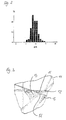
- Figure 1 shows a left in the winding 1 and the right in a partially unrolled and stretched position shown insulation sheet 2, as used for pitched roof insulation.
- This Insulation sheet is with a barrier layer 3 on the inner surface of the winding Insulation sheet 2 provided which forms one of the two main surfaces.
- the barrier layer 3 as a film-thin layer is indicated here by the bold line 4, which is schematic is also continued in the winding 1 to show the arrangement of the barrier layer 3.
- the barrier layer 3 is at constant modular distances d with transverse Marking lines 5 printed over the entire length of the insulation web, which as Orientation aid or cutting aid for cutting a longitudinal section L from the Insulation sheet serve, as is indicated schematically by a knife 6.
- the length L the section corresponds to a previously measured distance between two rafters, between which the cut longitudinal section is installed under clamping pressure, so that it is fixed sits between the rafters.
- the barrier layer 3 prevents the Pressing in a longitudinal section L fiber breakage can be released.
- the Longitudinal section L cut off with an oversize Ü to the clamping pressure of the press between to produce the length section used in the rafters.
- the barrier layer 3 only on the in the winding inner (and in the stretched representation in Figure 1 above) main surface provided, but if necessary, the barrier layer on the end faces, such as the End face 7, on the underlying main surface 8 and on the two longitudinal edges 10 of the Insulation sheet provided or attached.
- the reference number 9 is the cutting direction of the knife 6 is designated schematically.
- the barrier layer 3 which is why it is only represented by the solid line 4, has only a small thickness, for example film or film thickness, the thickness in the preferred exemplary embodiment being approximately 0.18 mm.
- the barrier layer 3 is in a flat network structure and overlaps the main surface of the insulating material in the manner of a hair net, so that on the one hand it forms a barrier layer for the emergence of fiber breakage that can possibly arise during installation under clamping pressure of the longitudinal sections L, and on the other hand the handling in the form a grip-friendly surface significantly improved.
- the barrier layer 3 has a skin-like character, which is due to the small thickness in comparison to the insulation sheet with, for example, a nominal thickness of 100 mm and the network structure of fibers arranged crosswise, which are held together by binders in a porous composite.
- the flexibility of the barrier layer is designed in such a way that it is essentially adapted to the flexibility of the insulation sheet, i.e. the behavior of the insulation sheet, for example when winding under compression but also when springing up to the nominal thickness is not hindered when the roll is unrolled.
- the barrier layer is essentially translucent due to the very thin design, the surface occupied by the barrier layer is also significantly influenced by the color of the mineral wool of the insulating material web, so that the barrier layer itself is not easily perceptible as a separate barrier layer.
- this effect can also be compensated for, for example by appropriate coloring of the barrier layer, for example when using a colored plasticizer.
- the barrier layer has the effect that those fibers which can emerge in the surface region with their end tips are made "harmless", which makes them easy to grip.
- the barrier layer 3 in the embodiment according to FIG. 1 is made from chopped glass-based textile fibers, in particular E-glass, FIG. 2 showing an advantageous distribution of the fiber diameter of a barrier layer.
- the arithmetic mean of the fiber diameter is 9.3 ⁇ m and the geometric mean is 9.2 ⁇ m.
- the average fiber diameter is predominantly in the range from 8.5 to 9.5 ⁇ m as shown in FIG. 2.
- the fiber weight is approximately 0.0009 g and the number of fibers per unit area cm 2 is approximately 2100.
- the chopped fibers are evenly distributed over the entire surface.
- This network-like barrier layer 3 is produced analogously to paper manufacture, in that a slurry or mash is formed from the chopped fibers with a binder, here phenolic resin, to which a plasticizer for ease of grip, namely a surfactant, is added.
- a binder here phenolic resin
- a plasticizer for ease of grip namely a surfactant
- the proportion of surfactant is about 0.2% based on the barrier layer.
- This stillage or mash is drawn over a sieve so that excess binder drips off, and passed through press rolls and thus drawn into a film-thick layer, the thickness of which in the exemplary embodiment shown is 0.18 mm.
- This manufacturing process that is to say the drawing of the mash over a sieve and by pressing rollers, results in a predominantly longitudinal orientation of the fibers within the barrier layer and their orientation essentially in the barrier layer plane.
- the tensile force expansion of the barrier layer is greater in the longitudinal direction than in the transverse direction, the ratio being approximately 3: 2.
- the maximum tensile force is approximately 23 N / 50 mm in the longitudinal direction and 15N / 50 mm in the transverse direction, a maximum tensile force elongation in the longitudinal and transverse directions of 1% being sought.
- the binder absorption of the network structure from the fibers, which are in principle distributed in a confused manner, is approximately 160 g / m 2 .
- the basis weight of this barrier layer is 14 g / m 2 .
- the porous barrier layer which is structured like a hair net, clings from above the main surface of the insulation sheet, so that the predominantly in the longitudinal direction the mineral wool fibers of the insulating sheet present on the insulating sheet are prevented and also penetration of fiber tips of the insulating material through the barrier layer is largely prevented, which affects the soft and pleasant touch behavior of the Barrier layer results, which is desired for handling.
- the resilient behavior and the high flexibility of the barrier layer 3 can thereby achieved that the binder in the region of the crossing points of the fibers of the barrier layer flat the intersection areas, for example in the manner of a swimming skin or a gusset plate overlaps, and connects the fibers spatially and areal, as schematically from Figure 3 evident.
- the fibers of the barrier layer with 12 intersection areas are 11 Fibers 11, and with 13, 14 and 15 swimming-pool-like, very thin binder areas designated.
- the binder areas 13 to 15 extend spatially, that is, it can not only have two neighboring and crossing fibers but also several fibers connect with each other, as shown on the left for the binder area 13. It deals is a preferred embodiment of the binder arrangement within the Network structure of the fibers 11.
- the Binder areas can be larger or smaller.
- the marking lines shown in FIG. 1 are provided on the barrier layer, and preferably by printing, but other embodiments are also possible are. If necessary, the marking lines can also be placed directly on the insulation sheet surface be applied, for example via hot air nozzles, the marking lines then through the transparent barrier layer 3 shine through.
- the one produced in the illustrated embodiment is preferably separate from the insulation web Barrier layer structure 3 can after the curing of the insulation sheet on the insulation sheet are applied, expediently the barrier layer with the insulation web is glued.
- the The barrier layer in front of the curing oven for the insulation web was pulled off a roll and is placed on the insulation sheet so that it together with the insulation sheet Passes through curing oven. Then, on the one hand, the existing in the insulation web and on the other hand, by optionally an additional binder, the surface sticking the barrier layer 3 on the insulation web 2 during the curing process in the curing oven respectively.
- marking lines 16 and 17 are alternately and at an equal distance from each other and thus arranged as modular markings.
- Each of these marker lines is formed by closely spaced grid-like points 18 in the illustrated embodiment.
- bar-like structures 19 and 20 are also advantageous for the purpose of specifying the manufacturer and type of the insulating element provided in the longitudinal direction bar-like structures 19 and 20, from to which a bar-like structure, namely structure 19, the manufacturer's specification and the other bar-like structures, here the structure 20, which can contain the type designation.
- these bar-like structures are modular in the illustrated embodiment, that is, with Distance to each other arranged along the length. Through this pattern of lengthways and crossways arranged markings and the design of the longitudinal markings as Identification marks are also optically the transverse marking lines as Cutting guidelines are highlighted, which is very useful for the user of the insulation elements is appropriate.
- E-glass fibers are advantageously used for the barrier layer, that is to say fibers with a defined diameter between 12 and 20 ⁇ m and formed from SiO 2 of 53-57% by weight, Al 2 O 3 of 12-15% by weight. %, CaO + MgO from 22-26% by weight, B 2 O 3 from 5-8% by weight, F 2 from 0-0.6% by weight, Na 2 O + K 2 O ⁇ 1% by weight .-% and impurities.
- the binder is preferably based on polyacrylate.
- Additives are advantageously present in ⁇ 1% by weight, in particular ⁇ 0.7% by weight, in particular fiber polymer additives (fiber size: silane adhesive wetting agent) and residual monomers.
- the invention is in no way limited to insulating material webs, but in general to Mineral wool-based insulation elements can be used, with the insulation element on provide one or both major surfaces or the entire circumference with the barrier layer can be what is chosen application-specifically as required.
Landscapes
- Engineering & Computer Science (AREA)
- Architecture (AREA)
- Textile Engineering (AREA)
- Physics & Mathematics (AREA)
- Electromagnetism (AREA)
- Civil Engineering (AREA)
- Structural Engineering (AREA)
- Chemical & Material Sciences (AREA)
- Acoustics & Sound (AREA)
- Inorganic Chemistry (AREA)
- Laminated Bodies (AREA)
- Nonwoven Fabrics (AREA)
- Inorganic Insulating Materials (AREA)
- Glass Compositions (AREA)
- Building Environments (AREA)
Abstract
Description
Claims (39)
- Dämmstoffelement aus Mineralwolle, insbesondere zu einer Dämmstoffrolle wickelbare Dämmstoffbahn, dadurch gekennzeichnet, dass das Dämmstoffelement mindestens auf einer seiner Hauptflächen mit einer hautähnlichen, jedoch porösen Sperrschicht versehen ist, die durch einen Nassvliesstoff aus Glasfasern und einem Bindemittel gebildet und derart gestaltet ist, dass die Sperrschicht grifffreundlich ist und sich an die Flexibilität der Oberflächenschicht des Dämmstoffelements anpasst.
- Dämmstoffelement nach einem der vorhergehenden Ansprüche, dadurch gekennzeichnet, dass das Bindemittel der Sperrschicht aus Polyacrylat oder auf der Basis von Polyacrylat gebildet ist.
- Dämmstoffelement nach Anspruch 1 oder Anspruch 2, dadurch gekennzeichnet, dass die Sperrschicht aus Textilfasern auf Glasbasis, vorzugsweise aus E-Glas, insbesondere aus gechoppten Fasern gebildet ist.
- Dämmstoffelement nach Anspruch 3, dadurch gekennzeichnet, dass die gechoppten Fasern über die gesamte Fläche des Nassvliesstoffes gleichmäßig verteilt sind.
- Dämmstoffelement nach einem der vorhergehenden Ansprüche, dadurch gekennzeichnet, dass der mittlere Faserdurchmesser der Sperrschicht im Bereich von 7 bis 20 µm, bevorzugt 8 bis 14 µm liegt.
- Dämmstoffelement nach einem der vorhergehenden Ansprüche, dadurch gekennzeichnet, dass das Flächengewicht der Fasern der Sperrschicht im Bereich von 1,7 bis 2,0, insbesondere 1,85 bis 1,95 mg/cm2 liegt und bevorzugt 1,89 mg/cm2 beträgt.
- Dämmstoffelement nach einem der vorhergehenden Ansprüche, dadurch gekennzeichnet, dass mittlere Fasergewicht der Fasern der Sperrschicht etwa 0,0007 bis 0,0011, insbesondere etwa 0,0009 g beträgt.
- Dämmstoffelement nach einem der vorhergehenden Ansprüche, dadurch gekennzeichnet, dass die Anzahl der Fasern der Sperrschicht pro Flächeneinheit (cm2) im Bereich von 2000 bis 2200, insbesondere bei circa 2100 Fasern/cm2 liegt.
- Dämmstoffelemente nach einem der vorhergehenden Ansprüche, dadurch gekennzeichnet, dass die Dicke der Sperrschicht auf Filmstärke reduziert ist.
- Dämmstoffelemente nach Anspruch 9, dadurch gekennzeichnet, dass die Sperrschicht eine Dicke < 1 mm, insbesondere < 0,5 mm und bevorzugt < 0,2 mm aufweist und insbesondere 0,18 mm beträgt.
- Dämmstoffelement nach einem der vorhergehenden Ansprüche, dadurch gekennzeichnet, dass die Sperrschicht mit derart feiner haarnetzartiger Struktur ausgebildet ist, dass die Fasern der von der haarartigen Struktur übergriffenen Oberflächenschicht des Dämmstoffelements gegen ein Ablösen eingekammert sind und dass vorzugsweise die Fasern der Oberfläche der Sperrschicht fest gebunden sind.
- Dämmstoffelement nach Anspruch 11, dadurch gekennzeichnet, dass die Netzwerkdichte pro Flächeneinheit auf die Eigenschaften der Faserablösungssicherung abgestellt ist, insbesondere auf die Faserlänge der Fasern in der Mineralwolle abgestimmt ist.
- Dämmstoffelement nach einem der vorhergehenden Ansprüche, dadurch gekennzeichnet, dass die Haarnetzstruktur der Sperrschicht durch wirr angeordnete Fasern gebildet ist, die vorzugsweise im wesentlichen in Richtung der Sperrschichtebene ausgerichtet sind.
- Dämmstoffelement nach einem der vorhergehenden Ansprüche, dadurch gekennzeichnet, dass die Kreuzungspunkte der Fasern sowie die Fasererstreckung innerhalb der Sperrschicht im wesentlichen längs der Sperrschichtebene ausgerichtet sind.
- Dämmstoffelement nach einem der vorhergehenden Ansprüche, dadurch gekennzeichnet, dass die Dicke der Sperrschicht im wesentlichen durch die Dicke der Fasern der Sperrschicht bestimmt ist und im wesentlichen weniger als das 25-fache der mittleren Faserdicke entspricht, bevorzugt im wesentlichen etwa 20-fache mittlere Faserdicke beträgt.
- Dämmstoffelement nach einem der vorhergehenden Ansprüche, dadurch gekennzeichnet, dass die Sperrschicht ein Flächengewicht kleiner 30 g/m2, insbesondere kleiner 20 g/m2 aufweist, bevorzugt im Bereich von 12 bis 16 g/m2 liegt.
- Dämmstoffelement nach einem der vorhergehenden Ansprüche, dadurch gekennzeichnet, dass die Zugkraft der Sperrschicht in Längsrichtung größer als in Querrichtung ist, bevorzugt im Verhältnis von etwa 3:2 liegt, und insbesondere in Längsrichtung etwa 23 N/50mm und quer etwa 15 N/50mm beträgt.
- Dämmstoffelement nach einem der vorhergehenden Ansprüche, dadurch gekennzeichnet, dass die Fasern der Sperrschicht an ihren Kreuzungspunkten bzw. in ihren Kreuzungsbereichen durch schwimmhautähnliche oder knotenblechähnliche Bindemittelabschnitte (räumlich-flächige Aufspannung) verbunden sind.
- Dämmstoffelement nach einem der vorhergehenden Ansprüche, dadurch gekennzeichnet, dass die Sperrschicht geschmeidig und elastischfedernd gebildet ist, derart, daß die Sperrschicht nach Deformation wieder knitterfrei in ihre flächige Ausgangslage zurückfedert.
- Dämmstoffelement nach einem der vorhergehenden Ansprüche, dadurch gekennzeichnet, dass die Sperrschicht aus einer Schlempe aus Fasern und Bindemittel (Nassvliesstoff) gebildet ist, die über eine Siebpartie und durch eine Pressenpartie geführt und schließlich ausgehärtet ist.
- Dämmstoffelement nach Anspruch 20, dadurch gekennzeichnet dass der Schlempe oder Maische ein Weichmacher, insbesondere Tensid zugegeben ist und zwar in einer Menge bevorzugt von 0,1 bis 0,7 %, insbesondere bevorzugt ≤ 0,2 %,der gegebenenfalls eingefärbt ist.
- Dämmstoffelement nach Anspruch 20 oder 21, dadurch gekennzeichnet, dass die Schlempe zur Bildung der ebenen Netzwerkstruktur in der Pressenpartie derart ausgewalzt ist, dass die Fasern überwiegend zweidimensional in Produktionsrichtung ausgerichtet sind.
- Dämmstoffelement nach einem der vorhergehenden Ansprüche, dadurch gekennzeichnet, dass die Sperrschicht derart porös ist bzw. eine derart geringe Faserdichte pro Flächeneinheit aufweist, dass die Sperrschicht im wesentlichen transparent ist, derart, dass die Oberflächenschicht des Dämmstoffelements im wesentlichen nach außen hin durch die Netzwerkstruktur nicht optisch verdeckt ist (optisch verdeckungsfrei).
- Dämmstoffelement nach einem der vorhergehenden Ansprüche, dadurch gekennzeichnet, dass die Sperrschicht mit an sich bekannten Markierungen zur Identifizierung des Dämmstoffelements oder zur Bearbeitung des Dämmstoffelements, etwa Hilfsschnittlinien zum Abschneiden von Abschnitten, versehen, vorzugsweise bedruckt ist.
- Dämmstoffelement nach einem der vorhergehende Ansprüche, dadurch gekennzeichnet, dass die Sperrschicht auf sämtlichen Hauptflächen des Dämmstoffelements insbesondere den beiden Hauptflächen der Dämmstoffbahn vorgesehen ist.
- Dämmstoffelement nach Anspruch 14 oder 15, dadurch gekennzeichnet, dass die Sperrschicht über den gesamten Umfang des Dämmstoffelements vorgesehen ist.
- Dämmstoffelement nach einem der vorhergehenden Ansprüche, dadurch gekennzeichnet, dass die Sperrschicht mit der Oberflächenschicht des Dämmstoffelements verklebt ist.
- Dämmstoffelement nach einem der vorhergehenden Ansprüche, dadurch gekennzeichnet, dass der Bindemittelgehalt innerhalb der Sperrschicht derart eingestellt ist, dass eine für die Fasern der Mineralwolle des Dämmstoffelements im wesentlichen undurchdringdichte Schicht gebildet ist, insbesondere höher eingestellt ist als der Bindemittelgehalt der Mineralwolle.
- Dämmstoffelement nach einem der vorhergehenden Ansprüche, dadurch gekennzeichnet, dass das Dämmstoffelement eine Rohdichte der Mineralwolle von < 40 kg/m3 aufweist, insbesondere eine Dichte im Bereich von 10 bis 25 kg/m3.
- Dämmstoffelement nach einem der vorhergehenden Ansprüche, dadurch gekennzeichnet, dass die Aufkaschierung der Sperrschicht in Folge der Anbindung des in der Mineralwolle befindlichen Bindemittels erfolgt.
- Dämmstoffelement nach einem der vorhergehenden Ansprüche, dadurch gekennzeichnet, dass die Sperrschicht eine Verstärkung aufweist, insbesondere eine Faden-, Faser- oder Gitterverstärkung.
- Dämmstoffelement nach einem der vorherigen Ansprüche, dadurch gekennzeichnet, dass das Dämmstoffelement eine zur Verlegung als Klemmfilz gerüstete Dämmstoffbahn aus Glaswolle ist, bei der der Klemmfilz durch einen mit Klemmdruckübermaß von der Bahn abgeschnittener und quer zur Bahnlängsrichtung zwischen den Sparren mit Klemmsitz verlegten Längsabschnitt gebildet ist.
- Verfahren zur Herstellung eines Dämmstoffelements gemäß einem der vorhergehenden Ansprüche, dadurch gekennzeichnet, dass eine Sperrschicht gebildet wird, indem vorzugsweise gechoppte Textilfasern mit Bindemittel zur Bildung einer Schlempe durchtränkt werden, die Schlempe dann in Art der Papierherstellungstechnik verarbeitet wird, indem die Schlempe über eine Siebpartie geführt wird, um überschüssiges Bindemittel abzuführen und die Schlempe in ein blattartiges Gebilde zu überführen, die Schlempe dann durch eine Pressenpartie geführt wird, wo eine Pressung vorzugsweise über Walzen erfolgt, derart, dass das blattartige Gebilde auf Filmstärkendicke reduziert wird und ein Ausrichtung der Fasern überwiegend in der Ebene des Sperrschichtfilms erfolgt, wonach dann eine Trocknung bzw. Aushärtung des Sperrschichtfilms erfolgt, und dass die Sperrschicht dann auf ein aus Mineralwolle mit darin versetztem Bindemittel gebildetes Dämmstoffelement, insbesondere Dämmstoffbahn gelegt, und mit dem Dämmstoffelement verbunden wird.
- Verfahren nach Anspruch 33, dadurch gekennzeichnet, dass die Sperrschicht vor Aushärtung des Bindemittels des Mineralwolle-Dämmstoffelements auf mindestens eine seiner Hauptflächen zugeführt und die Anbindung zu der Sperrschicht an das Dämmstoffelement in Folge Aushärtung des Bindemittels innerhalb der Mineralwolle durch oberflächenaktive Anbindung während des Aushärtvorganges erfolgt.
- Verfahren nach Anspruch 33 oder 34, dadurch gekennzeichnet, dass die Sperrschicht auf wenigstens eine der Hauptflächen des bereits ausgehärteten Mineralwolle-Dämmstoffelements geführt und mittels eines aufgesprühten Bindemittels verklebt wird.
- Verfahren nach einem der vorhergehenden Verfahrensansprüche, dadurch gekennzeichnet, dass die Sperrschicht mit Markierungslinien bedruckt wird und zwar nach Aushärtung der Sperrschicht.
- Mit Markierungen als Schneidhilfe bedruckte Schicht, insbesondere Sperrschicht für Dämmstoffelemente gemäß vorstehenden Ansprüchen, dadurch gekennzeichnet, dass die Sperrschicht über die Länge hin mit im Muster abwechselnden modularen Markierungen (16, 17) bedruckt ist.
- Schicht nach Anspruch 37, dadurch gekennzeichnet, dass die Sperrschicht mit quer verlaufenden, insbesondere senkrecht zur Längsrichtung verlaufenden Markierungen (16, 17) in zwei Mustern bedruckt ist, von denen eine Markierung eine durchgehende Markierungslinie und die andere Markierung eine strichlierte Markierungslinie bildet, wobei die beiden Muster regelmäßig abwechselnd der Gestalt angeordnet sind, dass sich jeweils zwischen zwei benachbarten durchgehenden Markierungslinien eine strichlierte Markierungslinie befindet.
- Schicht nach Anspruch 37 oder 38, dadurch gekennzeichnet, dass die Markierungslinien (16, 17) jeweils durch eine Vielzahl von in einer Reihe und mit engem Abstand zueinander angeordneten rasterartigen Punkte (18) gebildet sind.
Applications Claiming Priority (2)
| Application Number | Priority Date | Filing Date | Title |
|---|---|---|---|
| DE10100640 | 2001-01-09 | ||
| DE10100640A DE10100640A1 (de) | 2001-01-09 | 2001-01-09 | Dämmstoffelement aus Mineralwolle, insbesondere zu einer Dämmstoffrolle wickelbare Dämmstoffbahn |
Publications (3)
| Publication Number | Publication Date |
|---|---|
| EP1223031A2 true EP1223031A2 (de) | 2002-07-17 |
| EP1223031A3 EP1223031A3 (de) | 2005-01-19 |
| EP1223031B1 EP1223031B1 (de) | 2010-09-15 |
Family
ID=7670022
Family Applications (1)
| Application Number | Title | Priority Date | Filing Date |
|---|---|---|---|
| EP02000461A Expired - Lifetime EP1223031B1 (de) | 2001-01-09 | 2002-01-08 | Dämmstoffelement aus Mineralwolle sowie Verfahren zu dessen Herstellung |
Country Status (3)
| Country | Link |
|---|---|
| EP (1) | EP1223031B1 (de) |
| AT (1) | ATE481236T1 (de) |
| DE (2) | DE10100640A1 (de) |
Cited By (1)
| Publication number | Priority date | Publication date | Assignee | Title |
|---|---|---|---|---|
| US20220341070A1 (en) * | 2019-09-27 | 2022-10-27 | Yoshino Gypsum Co., Ltd. | Heat-insulating sound-absorbing material, and partition wall |
Families Citing this family (1)
| Publication number | Priority date | Publication date | Assignee | Title |
|---|---|---|---|---|
| DE10152385B4 (de) * | 2001-10-24 | 2012-11-22 | Saint-Gobain Isover G+H Ag | Großgebinde aus mehreren jeweils zu einer Rolle gewickelten, folienverpackten Dämmstoffbahnen aus Mineralwolle, insbesondere Glaswolle |
Citations (1)
| Publication number | Priority date | Publication date | Assignee | Title |
|---|---|---|---|---|
| DE3612857A1 (de) | 1986-04-16 | 1986-09-18 | Grünzweig + Hartmann und Glasfaser AG, 6700 Ludwigshafen | Zu einer rolle aufwickelbare daemmstoffbahn, insesondere aus mineralfaserfilz, sowie deren verwendung |
Family Cites Families (6)
| Publication number | Priority date | Publication date | Assignee | Title |
|---|---|---|---|---|
| US2868684A (en) * | 1956-01-03 | 1959-01-13 | Lof Glass Fibers Co | Decorative acoustical materials |
| DK443481A (da) * | 1981-10-07 | 1983-04-08 | Rockwool Int | Isoleringsplade |
| US4433020A (en) * | 1981-10-22 | 1984-02-21 | Kuraray Co., Ltd. | Sheet-like material, heat-insulating material derived therefrom and methods of manufacturing same |
| DE29616962U1 (de) * | 1996-09-28 | 1996-12-19 | Deutsche Rockwool Mineralwoll-Gmbh, 45966 Gladbeck | Dämmstoffelement |
| DE29616964U1 (de) * | 1996-09-28 | 1997-01-09 | Deutsche Rockwool Mineralwoll-Gmbh, 45966 Gladbeck | Dämmstoffelement |
| DE19914782A1 (de) * | 1999-03-31 | 2000-10-05 | Pfleiderer Daemmstofftechnik | Dämmstoffprodukt mit Diagonalmarkierungen |
-
2001
- 2001-01-09 DE DE10100640A patent/DE10100640A1/de not_active Withdrawn
-
2002
- 2002-01-08 AT AT02000461T patent/ATE481236T1/de active
- 2002-01-08 DE DE50214654T patent/DE50214654D1/de not_active Expired - Lifetime
- 2002-01-08 EP EP02000461A patent/EP1223031B1/de not_active Expired - Lifetime
Patent Citations (1)
| Publication number | Priority date | Publication date | Assignee | Title |
|---|---|---|---|---|
| DE3612857A1 (de) | 1986-04-16 | 1986-09-18 | Grünzweig + Hartmann und Glasfaser AG, 6700 Ludwigshafen | Zu einer rolle aufwickelbare daemmstoffbahn, insesondere aus mineralfaserfilz, sowie deren verwendung |
Cited By (1)
| Publication number | Priority date | Publication date | Assignee | Title |
|---|---|---|---|---|
| US20220341070A1 (en) * | 2019-09-27 | 2022-10-27 | Yoshino Gypsum Co., Ltd. | Heat-insulating sound-absorbing material, and partition wall |
Also Published As
| Publication number | Publication date |
|---|---|
| EP1223031B1 (de) | 2010-09-15 |
| ATE481236T1 (de) | 2010-10-15 |
| EP1223031A3 (de) | 2005-01-19 |
| DE10100640A1 (de) | 2002-07-11 |
| DE50214654D1 (de) | 2010-10-28 |
Similar Documents
| Publication | Publication Date | Title |
|---|---|---|
| DE69321840T2 (de) | Isolationszusammenstellung | |
| DE69634088T2 (de) | Eingekapselte isolationsvorrichtung | |
| DE69025355T2 (de) | Flexibles Verbundmaterial mit einer an einer Faserschicht angeklebten perforierten Kunststoffolie sowie Verfahren zur Herstellung desselben | |
| EP1678386B1 (de) | Dämmstoffelement aus Mineralfaserfilz für den klemmenden Einbau zwischen Balken | |
| DE69909454T2 (de) | Verfahren und vorrichtung zur herstellung eines mineralfaserprodukts. | |
| DE10135111C2 (de) | Verbundstoff, Verfahren zu dessen Herstellung und dessen Verwendung | |
| DE69525484T2 (de) | Verfahren zur Herstellung eines Isolieraufbaus | |
| DE19523834A1 (de) | Plastisch von Hand verformbares Abdeckmaterial | |
| DE2236445B2 (de) | Ausgangsmaterial für Textilersatzstoffe | |
| EP1522642A1 (de) | Dämmstoffbahnen aus einem zu einer Rolle aufgewickelten Mineralfaserfilz für den klemmenden Einbau zwischen Balken | |
| DE2117794A1 (de) | Wellpappe und Verfahren zu deren Herstellung | |
| EP0250005A1 (de) | Flächenförmiger Sandwichformkörper | |
| EP1223031A2 (de) | Dämmstoffelement aus Mineralwolle sowie Verfahren zu dessen Herstellung | |
| DE4223614C2 (de) | Dämmstoff sowie Verfahren zu seiner Herstellung | |
| DE2642168C3 (de) | Verfahren zum Herstellen eines verstärkten Verpackungsmaterials | |
| EP0867572B1 (de) | Mineralwolleprodukt | |
| DE9422147U1 (de) | Mehrschichtkörper | |
| EP1893825B1 (de) | Verfahren und vorrichtung zur herstellung von dämmstoffelementen aus mineralfasern | |
| EP0606844A1 (de) | Isoliermaterial | |
| EP0855478A2 (de) | Verbundplatte aus Kunststoff und Verfahren zu ihrer Herstellung | |
| DE102006028841B4 (de) | Dämmanordnung und Verfahren zur Herstellung eines Dämmstoffstreifens | |
| DE19818406C1 (de) | Verfahren zum Herstellen einer Wellplatte | |
| DE69424722T2 (de) | Dachdeckungsmaterial | |
| DE4333187C2 (de) | Formkörper mit einer Papier enthaltenden Bahn | |
| EP1192320A1 (de) | Dämmstoffelement |
Legal Events
| Date | Code | Title | Description |
|---|---|---|---|
| PUAI | Public reference made under article 153(3) epc to a published international application that has entered the european phase |
Free format text: ORIGINAL CODE: 0009012 |
|
| AK | Designated contracting states |
Kind code of ref document: A2 Designated state(s): AT BE CH CY DE DK ES FI FR GB GR IE IT LI LU MC NL PT SE TR |
|
| AX | Request for extension of the european patent |
Free format text: AL;LT;LV;MK;RO;SI |
|
| PUAL | Search report despatched |
Free format text: ORIGINAL CODE: 0009013 |
|
| AK | Designated contracting states |
Kind code of ref document: A3 Designated state(s): AT BE CH CY DE DK ES FI FR GB GR IE IT LI LU MC NL PT SE TR |
|
| AX | Request for extension of the european patent |
Extension state: AL LT LV MK RO SI |
|
| 17P | Request for examination filed |
Effective date: 20050404 |
|
| AKX | Designation fees paid |
Designated state(s): AT BE CH CY DE DK ES FI FR GB GR IE IT LI LU MC NL PT SE TR |
|
| AXX | Extension fees paid |
Extension state: SI Payment date: 20050404 |
|
| GRAP | Despatch of communication of intention to grant a patent |
Free format text: ORIGINAL CODE: EPIDOSNIGR1 |
|
| RIN1 | Information on inventor provided before grant (corrected) |
Inventor name: BUGERT, KARL-HANS Inventor name: BIHY, LOTHAR Inventor name: GROENER, WILHELM |
|
| GRAS | Grant fee paid |
Free format text: ORIGINAL CODE: EPIDOSNIGR3 |
|
| GRAA | (expected) grant |
Free format text: ORIGINAL CODE: 0009210 |
|
| RAP1 | Party data changed (applicant data changed or rights of an application transferred) |
Owner name: SAINT-GOBAIN ISOVER G+H AG |
|
| AK | Designated contracting states |
Kind code of ref document: B1 Designated state(s): AT BE CH CY DE DK ES FI FR GB GR IE IT LI LU MC NL PT SE TR |
|
| AX | Request for extension of the european patent |
Extension state: SI |
|
| REG | Reference to a national code |
Ref country code: CH Ref legal event code: EP Ref country code: GB Ref legal event code: FG4D Free format text: NOT ENGLISH |
|
| REG | Reference to a national code |
Ref country code: IE Ref legal event code: FG4D Free format text: LANGUAGE OF EP DOCUMENT: GERMAN |
|
| REF | Corresponds to: |
Ref document number: 50214654 Country of ref document: DE Date of ref document: 20101028 Kind code of ref document: P |
|
| REG | Reference to a national code |
Ref country code: CH Ref legal event code: NV Representative=s name: URS WEGMANN DIPL.-ING. |
|
| REG | Reference to a national code |
Ref country code: NL Ref legal event code: VDEP Effective date: 20100915 |
|
| PG25 | Lapsed in a contracting state [announced via postgrant information from national office to epo] |
Ref country code: FI Free format text: LAPSE BECAUSE OF FAILURE TO SUBMIT A TRANSLATION OF THE DESCRIPTION OR TO PAY THE FEE WITHIN THE PRESCRIBED TIME-LIMIT Effective date: 20100915 |
|
| PG25 | Lapsed in a contracting state [announced via postgrant information from national office to epo] |
Ref country code: CY Free format text: LAPSE BECAUSE OF FAILURE TO SUBMIT A TRANSLATION OF THE DESCRIPTION OR TO PAY THE FEE WITHIN THE PRESCRIBED TIME-LIMIT Effective date: 20100915 |
|
| PG25 | Lapsed in a contracting state [announced via postgrant information from national office to epo] |
Ref country code: SE Free format text: LAPSE BECAUSE OF FAILURE TO SUBMIT A TRANSLATION OF THE DESCRIPTION OR TO PAY THE FEE WITHIN THE PRESCRIBED TIME-LIMIT Effective date: 20100915 Ref country code: GR Free format text: LAPSE BECAUSE OF FAILURE TO SUBMIT A TRANSLATION OF THE DESCRIPTION OR TO PAY THE FEE WITHIN THE PRESCRIBED TIME-LIMIT Effective date: 20101216 |
|
| REG | Reference to a national code |
Ref country code: IE Ref legal event code: FD4D |
|
| PG25 | Lapsed in a contracting state [announced via postgrant information from national office to epo] |
Ref country code: IE Free format text: LAPSE BECAUSE OF FAILURE TO SUBMIT A TRANSLATION OF THE DESCRIPTION OR TO PAY THE FEE WITHIN THE PRESCRIBED TIME-LIMIT Effective date: 20100915 |
|
| PG25 | Lapsed in a contracting state [announced via postgrant information from national office to epo] |
Ref country code: PT Free format text: LAPSE BECAUSE OF FAILURE TO SUBMIT A TRANSLATION OF THE DESCRIPTION OR TO PAY THE FEE WITHIN THE PRESCRIBED TIME-LIMIT Effective date: 20110117 Ref country code: IT Free format text: LAPSE BECAUSE OF FAILURE TO SUBMIT A TRANSLATION OF THE DESCRIPTION OR TO PAY THE FEE WITHIN THE PRESCRIBED TIME-LIMIT Effective date: 20100915 Ref country code: NL Free format text: LAPSE BECAUSE OF FAILURE TO SUBMIT A TRANSLATION OF THE DESCRIPTION OR TO PAY THE FEE WITHIN THE PRESCRIBED TIME-LIMIT Effective date: 20100915 |
|
| PG25 | Lapsed in a contracting state [announced via postgrant information from national office to epo] |
Ref country code: ES Free format text: LAPSE BECAUSE OF FAILURE TO SUBMIT A TRANSLATION OF THE DESCRIPTION OR TO PAY THE FEE WITHIN THE PRESCRIBED TIME-LIMIT Effective date: 20101226 |
|
| PLBE | No opposition filed within time limit |
Free format text: ORIGINAL CODE: 0009261 |
|
| STAA | Information on the status of an ep patent application or granted ep patent |
Free format text: STATUS: NO OPPOSITION FILED WITHIN TIME LIMIT |
|
| BERE | Be: lapsed |
Owner name: SAINT-GOBAIN ISOVER G+H A.G. Effective date: 20110131 |
|
| 26N | No opposition filed |
Effective date: 20110616 |
|
| PG25 | Lapsed in a contracting state [announced via postgrant information from national office to epo] |
Ref country code: MC Free format text: LAPSE BECAUSE OF NON-PAYMENT OF DUE FEES Effective date: 20110131 Ref country code: DK Free format text: LAPSE BECAUSE OF FAILURE TO SUBMIT A TRANSLATION OF THE DESCRIPTION OR TO PAY THE FEE WITHIN THE PRESCRIBED TIME-LIMIT Effective date: 20100915 |
|
| GBPC | Gb: european patent ceased through non-payment of renewal fee |
Effective date: 20110108 |
|
| REG | Reference to a national code |
Ref country code: DE Ref legal event code: R097 Ref document number: 50214654 Country of ref document: DE Effective date: 20110616 |
|
| REG | Reference to a national code |
Ref country code: FR Ref legal event code: ST Effective date: 20110930 |
|
| PG25 | Lapsed in a contracting state [announced via postgrant information from national office to epo] |
Ref country code: FR Free format text: LAPSE BECAUSE OF NON-PAYMENT OF DUE FEES Effective date: 20110131 |
|
| PG25 | Lapsed in a contracting state [announced via postgrant information from national office to epo] |
Ref country code: BE Free format text: LAPSE BECAUSE OF NON-PAYMENT OF DUE FEES Effective date: 20110131 Ref country code: GB Free format text: LAPSE BECAUSE OF NON-PAYMENT OF DUE FEES Effective date: 20110108 |
|
| PG25 | Lapsed in a contracting state [announced via postgrant information from national office to epo] |
Ref country code: LU Free format text: LAPSE BECAUSE OF NON-PAYMENT OF DUE FEES Effective date: 20110108 |
|
| PG25 | Lapsed in a contracting state [announced via postgrant information from national office to epo] |
Ref country code: TR Free format text: LAPSE BECAUSE OF FAILURE TO SUBMIT A TRANSLATION OF THE DESCRIPTION OR TO PAY THE FEE WITHIN THE PRESCRIBED TIME-LIMIT Effective date: 20100915 |
|
| PGFP | Annual fee paid to national office [announced via postgrant information from national office to epo] |
Ref country code: DE Payment date: 20160105 Year of fee payment: 15 Ref country code: CH Payment date: 20160111 Year of fee payment: 15 |
|
| PGFP | Annual fee paid to national office [announced via postgrant information from national office to epo] |
Ref country code: AT Payment date: 20151223 Year of fee payment: 15 |
|
| REG | Reference to a national code |
Ref country code: DE Ref legal event code: R119 Ref document number: 50214654 Country of ref document: DE |
|
| REG | Reference to a national code |
Ref country code: CH Ref legal event code: PL |
|
| REG | Reference to a national code |
Ref country code: AT Ref legal event code: MM01 Ref document number: 481236 Country of ref document: AT Kind code of ref document: T Effective date: 20170108 |
|
| PG25 | Lapsed in a contracting state [announced via postgrant information from national office to epo] |
Ref country code: AT Free format text: LAPSE BECAUSE OF NON-PAYMENT OF DUE FEES Effective date: 20170108 Ref country code: CH Free format text: LAPSE BECAUSE OF NON-PAYMENT OF DUE FEES Effective date: 20170131 Ref country code: LI Free format text: LAPSE BECAUSE OF NON-PAYMENT OF DUE FEES Effective date: 20170131 |
|
| PG25 | Lapsed in a contracting state [announced via postgrant information from national office to epo] |
Ref country code: DE Free format text: LAPSE BECAUSE OF NON-PAYMENT OF DUE FEES Effective date: 20170801 |