EP1223701A1 - Verfahren zum Senden und Empfangen von produktkodierten und QPSK-modulierten Signalen - Google Patents
Verfahren zum Senden und Empfangen von produktkodierten und QPSK-modulierten Signalen Download PDFInfo
- Publication number
- EP1223701A1 EP1223701A1 EP01403327A EP01403327A EP1223701A1 EP 1223701 A1 EP1223701 A1 EP 1223701A1 EP 01403327 A EP01403327 A EP 01403327A EP 01403327 A EP01403327 A EP 01403327A EP 1223701 A1 EP1223701 A1 EP 1223701A1
- Authority
- EP
- European Patent Office
- Prior art keywords
- bits
- coding
- columns
- phase
- symbols
- Prior art date
- Legal status (The legal status is an assumption and is not a legal conclusion. Google has not performed a legal analysis and makes no representation as to the accuracy of the status listed.)
- Granted
Links
- 238000000034 method Methods 0.000 title claims abstract description 21
- 230000005540 biological transmission Effects 0.000 claims description 15
- 239000011159 matrix material Substances 0.000 description 8
- 238000010586 diagram Methods 0.000 description 6
- 230000010363 phase shift Effects 0.000 description 3
- 230000009466 transformation Effects 0.000 description 2
- 238000000844 transformation Methods 0.000 description 2
- 230000001174 ascending effect Effects 0.000 description 1
- 230000001771 impaired effect Effects 0.000 description 1
- 230000008054 signal transmission Effects 0.000 description 1
Images


Classifications
-
- H—ELECTRICITY
- H04—ELECTRIC COMMUNICATION TECHNIQUE
- H04L—TRANSMISSION OF DIGITAL INFORMATION, e.g. TELEGRAPHIC COMMUNICATION
- H04L1/00—Arrangements for detecting or preventing errors in the information received
- H04L1/004—Arrangements for detecting or preventing errors in the information received by using forward error control
- H04L1/0056—Systems characterized by the type of code used
- H04L1/0064—Concatenated codes
- H04L1/0066—Parallel concatenated codes
-
- H—ELECTRICITY
- H04—ELECTRIC COMMUNICATION TECHNIQUE
- H04L—TRANSMISSION OF DIGITAL INFORMATION, e.g. TELEGRAPHIC COMMUNICATION
- H04L27/00—Modulated-carrier systems
- H04L27/32—Carrier systems characterised by combinations of two or more of the types covered by groups H04L27/02, H04L27/10, H04L27/18 or H04L27/26
- H04L27/34—Amplitude- and phase-modulated carrier systems, e.g. quadrature-amplitude modulated carrier systems
- H04L27/3405—Modifications of the signal space to increase the efficiency of transmission, e.g. reduction of the bit error rate, bandwidth, or average power
- H04L27/3416—Modifications of the signal space to increase the efficiency of transmission, e.g. reduction of the bit error rate, bandwidth, or average power in which the information is carried by both the individual signal points and the subset to which the individual points belong, e.g. using coset coding, lattice coding, or related schemes
- H04L27/3427—Modifications of the signal space to increase the efficiency of transmission, e.g. reduction of the bit error rate, bandwidth, or average power in which the information is carried by both the individual signal points and the subset to which the individual points belong, e.g. using coset coding, lattice coding, or related schemes in which the constellation is the n - fold Cartesian product of a single underlying two-dimensional constellation
- H04L27/3433—Modifications of the signal space to increase the efficiency of transmission, e.g. reduction of the bit error rate, bandwidth, or average power in which the information is carried by both the individual signal points and the subset to which the individual points belong, e.g. using coset coding, lattice coding, or related schemes in which the constellation is the n - fold Cartesian product of a single underlying two-dimensional constellation using an underlying square constellation
Definitions
- the invention relates to a method for transmitting digital signals in four-state phase modulation as well as combined amplitude and phase with sixteen states.
- modulation is commonly used four-state phase which consists of representing a couple of binary digits by the phase of a sinusoidal signal relative to a reference.
- a two-digit binary number can take four values
- the phases can differ by ⁇ / 2 radians.
- a signal with a phase shift of ⁇ / 4 radians with respect to the reference signal corresponds to the number 00.
- a signal phase shifted by 3 ⁇ / 4 with respect to the reference represents the number 01
- the signal phase shifted by 5 ⁇ / 4 compared to the reference represents the number 11
- the signal 7 ⁇ / 4 phase shifted from the reference represents the number 10.
- Such a correspondence between the pair of binary digits and the phase shifts in which, for each increment of ⁇ / 2 a single binary digit is changed is called a match from Gray.
- Other correspondences are possible, for example correspondence natural by increasing values of numbers, the succession of binary numbers being then 00, 01, 10 and 11.
- QPSK Quadrature Phase Shift Keying
- phase reference that is to say distinguish between the four transmitted phase values, for example, ⁇ / 4, 3 ⁇ / 4, 5 ⁇ / 4 and 7 ⁇ / 4 or 0, ⁇ / 2, ⁇ and 3 ⁇ / 2.
- the simplest method to retrieve the reference, that is to say raise phase ambiguity, consists in periodically emitting a known symbol, i.e. consisting of bits of predetermined values.
- the disadvantage of this process is that it does not not correct errors due to noise, inevitable, transmissions and which has as a consequence of producing phase jumps between two symbol emissions known.
- Another method relatively complex, consists in detecting the errors of decoding and controlling phase rotations in increments of + ⁇ / 4 in order to determine which phase is correct. This process requires a processing time not negligible which is not compatible with real-time packet transmission because the processing time leads to loss of information.
- the process providing the best results is to assign the data transmitted an error correcting code and to correct errors not simultaneously transmission, as in the known methods, but later, after the decoding proper.
- the most effective error correction codes are product codes or turbo.
- To form a product code we assemble binary digits to transmit according to a matrix with L rows and C columns and the rows and columns are coded by block, i.e. to each line comprising C bits of information, we add (K - C) bits of correction of errors or parity bits and, likewise, to each column comprising L bits information, add P - L correction bits. If a line is completely wrong, the parity bits of this line will not allow correction; however, the line error can be corrected using the parity bits in columns because in each single bit column is wrong.
- turbocodes cannot be used for QPSK modulation because the turbocodes known so far are such that the decodings are affected by the phase rotations. In other words, the known turbocode error correcting codes so far are not transparent to phase rotations and therefore cannot be used for QPSK transmission.
- the invention provides turbo or product error correcting codes for QPSK modulated signals which are insensitive to phase rotation.
- the invention therefore provides a turbocode for QPSK modulation which is transparent to rotations of phases.
- the two bits, I and Q, of a QPSK symbol to be transmitted are arranged on different lines, but on the same column, and so that each row has only one bit type, I or Q, the coding for error correction being carried out, on the one hand, line per line and, on the other hand, by pair of adjacent columns, the coding I bits of two associated adjacent columns being deduced from the bits I of these two columns and, similarly, all the coding bits Q of these two adjacent adjacent columns being deduced Q bits of these columns, these coding bits being arranged in the same way as the start bits, i.e. so that each line has only one type of bit, I or Q, the pairs of adjacent I and Q coding bits on the same column being also transmitted as symbols.
- the first mode of coding is transparent to the rotations of ⁇ , ⁇ / 2 and 3 ⁇ / 2, i.e. for all rotations.
- this coding has the same properties for a natural succession of QPSK symbols. This coding is therefore completely trans-parent rotations, which allows correct decoding.
- a second embodiment of the invention for coding the symbols to be transmitted, we have the two bits I and Q of a QPSK symbol on the same line, each of these lines thus being formed of pairs of bits I and Q, the lines and the columns being arranged in such a way that in each column, the bits I and Q are alternating, the rows and columns being coded in adjacent pairs so that the coding bits I are derived from the coding bits I of two lines (columns) adjacent and that, likewise, the Q coding bits of these two lines (columns) adjacent are derived only from the Q bits of these two lines (columns), the bits of coding being arranged like the original bits, the pairs of I and Q bits of coding on each line being transmitted like the other QPSK symbols.
- the error correcting codings according to the invention are used for the signal transmission.
- the invention also relates to a method for receiving signals. affected by error correcting codes described above and in which the decoding in order to recover the symbols of origins.
- the codings of the QPSK symbols transparent to the phase rotations are usable, according to another aspect of the invention (which can be used independently of the other aspects of the invention), for performing turbo coding of a phase modulation and amplitude with sixteen states, called QAM-16.
- each quadrant of the complex plane there is provided a distribution of the four QAM-16 symbols such that these binary numbers have the same last two digits and the first two digits form different numbers: 00, 01, 11 and 10, and we distribute these numbers in four throughout the complex plane subsets, each subset being formed by the set of numbers having the same first two binary digits and, being therefore in the four quadrants different, the coordinates of the symbols in the complex plane being chosen so such that after a rotation of ⁇ / 2, each subset takes the place of another subset.
- coding is carried out by pair of bits, forming a QPSK symbol, of each symbol QAM-16, this coding of QPSK symbols being of the type transparent to phase rotations and the data thus coded is transmitted according to the distribution in the complex plane of the type defined above.
- the coding of such a set of QAM-16 symbols is carried out bit by bit, using a classic BPSK code that is transparent to phase rotation.
- phase and amplitude modulation can be used for transmission of information.
- the invention also relates to the reception of information modulated as defined above, the demodulation consisting in recovering the symbols origins from the phases and amplitudes of the received signals.
- two-state phase modulation consists in transmitting a carrier of determined frequency and of determined amplitude and to confer four possible values to the phase of this carrier compared to a reference.
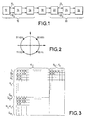
- Two successive phases are, in the complex plane shown in Figure 2, separated by an angular deviation of ⁇ / 2 radians.
- the first one phase is in the first quadrant, the second phase in the second quadrant, the third phase in the third quadrant and the fourth in the fourth quadrant.
- the first phase is offset by ⁇ / 4 radians compared to the reference, the second phase of 3 ⁇ / 4, the third phase of 5 ⁇ / 4 and the fourth phase of 7 ⁇ / 4.
- Each of these phases is associated with two binary digits.
- a couple (or more generally a set) of binary digits is, usually called a symbol.
- Modulation and demodulation is more effective if you do not transmit phases but phase differences between two consecutive symbols. So in case of rotation, the phase difference between two consecutive symbols will not be changed.
- data is expected to be transmitted with an error correction code so that errors are corrected only at the reception.
- the most effective error correcting code is the product or turbo code. However, it has been found that such a product code is affected by phase rotations. So, the invention provides a product code which is insensitive to phase rotation.
- the modulator 10 (FIG. 1) comprises a two-dimensional differential encoder 12 intended to supply consecutive QPSK symbols.
- a first bit I is obtained and on the second output 12 2 , a second bit Q of the difference between two consecutive symbols is obtained.
- the symbols provided by the encoder 12 are applied to the inputs of an encoder 14 of product type according to the invention and the function of which will be described later in particular in relation to FIGS. 3 and 4.
- This encoder 14 provides a set of symbols which includes, on the one hand, the symbols applied to its input and, on the other hand, additional symbols that are used for error correction after transmission.
- the symbols at the output of the encoder 14 are transformed by a block 16 of QPSK modulation in carrier phases and these modulated signals are transmitted by a channel, for example a radio channel 18.
- a demodulator 20 On reception, a demodulator 20 is provided which comprises a block 22 of QPSK demodulation which receives the signals of the channel and which delivers on its outputs 22 1 and 22 2 binary symbols which are applied to the two inputs of a decoder 24 of codes produced in order to determine the original symbols corresponding to the output of the encoder 12.
- the output symbols of the decoder 24 are applied to the input of a two-dimensional differential decoder 26 which performs the opposite operation to that performed by the encoder 12 and which therefore provides the original symbols on its output.
- the product code used must be transparent to rotations of ⁇ / 2, ⁇ and 3 ⁇ / 2, i.e. such a rotation must transform each code word into a valid code word, that is to say belonging to the same family.
- a classic product code consists of arranging the binary digits according to lines and according to columns and to add to each line and each column bits which will be used for error correction.
- Codes by line or by column are called block codes. Since such codes are well known, it is not necessary to describe them in detail.
- the advantage of a product code is that it allows the correction of a line strongly impaired. Indeed, a line comprising more than two erroneous bits is not necessarily correctable. On the other hand, if the columns are not altered, each bit of the line can thus be corrected using the error correction codes of the columns. Likewise, if a column is altered while the rows are not, this column can be corrected thanks to the line codes.
- l represents a first bit (for example the most significant) of a QPSK symbol and Q the second bit of such a symbol.
- two symbols I 11 , Q 21 ) and (I 12 , Q 22 ) are presented at the input of the encoder 14.
- table I is obtained.
- the lines are coded in the conventional way by a block code while the columns are coded in pairs.
- the first two lines of table I are obtained. Then, the coding is carried out in such a way that the set of two bits I 11 and I 12 provides the set of two bits I 31 and I 32 and that the bits Q 21 and Q 22 provide the bits Q 41 and Q 42 . Likewise, the bits I 33 and I 34 result from the coding of the bits I 13 and I 14 and the bits Q 23 and Q 24 are coded so as to obtain the bits Q 43 and Q 44 .
- Coding by column is carried out as follows: first of all the first two columns are considered, and in these columns the bits I: I 11 , I 12 ; I 31 , I 32 , etc. lying on the odd rank lines. From these I bits, we determine in the N L - K L additional lines, I values which are also available in the lines of odd rank.
- pairs of additional Q bits are determined which are available in the even rank lines of the N L - K L additional lines.
- the set of Q bits of the even rank rows of each pair of columns is considered to be a single column to which are added error correction bits which are arranged in pairs in the even rank rows of the set N L - K L.
- the l bits provide I bits and the Q bits provide Q bits.
- a pair formed by an I bit and the next Q bit in the same column is a symbol transmitted through the channel.
- the Q bits being coded by the same row or column code and the code being linear, it is transparent to rotations ⁇ , ⁇ / 2 and 3 ⁇ / 2.
- bits I of the rows of rows 1 and 2 are coded as if they were on the same row. They thus provide the bits I 13 and I 24 which are available on the rows of rows 1 and 2, at row 3 (that is to say in the column of row 3) on row 1 (bit I 13 ) and in row 4 (row column 4) on line 2 (bit I 24 ).
- bits Q 12 and Q 21 are coded as if they were on the same line and they provide the bits Q 14 and Q 23 which are also available on lines 1 and 2, in rows, respectively, 4 (for Q 14 ) and 3 (Q 23 ).
- bits I 13 and Q 14 are on line number 1 with the same IQ succession as bits I 11 and Q 12 and, similarly, bits Q 23 and I 24 are on line number 2 with the same QI succession as bits Q 21 and I 22 .
- bits I 11 and I 22 forming part of the first and second columns which are coded are considered. They provide the bits I 31 and I 42 arranged, respectively, in the first and second columns. Similarly, the bits Q 12 and Q 21 of the second and first columns provide the bits Q 32 and Q 41 arranged, respectively, in the second and the first column.
- bits I 33 and I 44 result from the coding in columns of bits I 13 and I 24 and, similarly, bits Q 34 and Q 43 result from the coding in columns of bits Q 14 and Q 23 .
- the bits I 31 and I 42 of the third and fourth lines provide the coding bits I 33 and I 44 arranged, respectively, on the third and the fourth lines and the bits Q 32 of the third line and Q 41 of the fourth line provides the coding bits Q 34 and Q 43 arranged, respectively, on the third and the fourth lines.
- N L - K L coding bit lines and N C - K C coding columns so as to form a matrix with N L lines and N C columns.
- the coding bits found in the additional rows and columns are calculated in the same manner as described in relation to Table II, that is to say first of all consider rows 1 and 2 and in these lines 1 and 2, we consider all the bits I to which we assign N C - K C coding bits I which are available in the same way as in the original matrix, that is to say that at rank K C + 1 we have the first bit on the first line, at rank K C + 2 we have the second bit I on the second line, etc.
- the Q bit that is to say that the Q bits of lines 1 and 2
- we assign N C - K C Q coding bits the first being placed on the second line, the second on the first line, the third on the second line, etc.
- the matrix with N L lines and N C columns is formed by coding the columns two by two in an analogous manner, that is to say that we code columns 1 and 2 together, we code columns 3 and 4 together, etc. More precisely, in each pair of columns, we consider together the I bits to which N L - K L coding bits are assigned which are arranged like the I bits in the same rows of columns.
- the first coding bit I is arranged in the first column at row K L + 1
- the second coding bit is arranged in the second column at row K L + 2
- the third coding bit I is arranged in the first column in row K L + 3, etc.
- the product coding of the type of that represented in FIG. 4 is transparent to rotations of ⁇ , ⁇ / 2, and 3 ⁇ / 2 radians. This transparency is deduced from formulas (1), (2), (3), (4), (5) and (6) above.
- QAM-16 modulation consists in representing the sixteen binary numbers to four digits by amplitude and phase modulation of a carrier.
- the constellation of the sixteen binary numbers is represented, as shown on Figure 5, in the complex plane by sixteen points.
- Each point has an abscissa of ⁇ 0.5 or ⁇ 1.5 and a ordinate of ⁇ 0.5 or ⁇ 1.5.
- each quadrant of the plane complex has four points.
- the invention consists in choosing the values assigned to each point in the complex plane so that the sixteen points are distributed in four subsets of four points each, each subset having a point in each quadrant.
- these subsets are such that a rotation of ⁇ / 2 radians around the origin causes a subset to take the place of another subset.
- a first subset whose points are assigned a triangle on Figure 5, is formed by the coordinate points (+ 1.5; + 1.5); (- 0.5; + 1.5); (- 0.5; - 0.5) and (+ 1.5; -0.5).
- the third subset, whose points are marked by a circle includes the coordinate points (+ 0.5; + 0.5); (- 1.5; + 0.5); (- 1.5; - 1.5) and (+ 0.5; - 1.5).
- the fourth subset whose points are marked with a star in Figure 5, includes the coordinate points: (+ 1.5; +0.5); (- 0.5; + 0.5); (- 0.5; - 1.5) and (+ 1.5; - 1.5).
- the first subset (whose points are marked by a triangle) has the same first two digits 00 and the succession of the last two digits, starting of the first quadrant, and in the positive direction, is: 00, 01, 11, 10.
- the first two digits are 01
- the third subset the points of which are marked by a circle
- both first digits are 11
- the fourth subset the points of which are marked with a star
- the first two digits are 10.
- the last two digits are the same. So, the first quadrant has symbols belonging to the first, second, third and fourth subsets whose last two digits are 00. In the second quadrant the last two digits are 01, in the third quadrant, the last two digits are 11, and in the fourth quadrant the last two digits are 10.
- FIG. 6 represents transmission means in accordance with the invention.
- These transmission means comprise two two-dimensional differential encoders, 50 and 52 respectively.
- Each of these differential encoders is of the same type as the encoder 12 shown in FIG. 1.
- On the two inputs 50 1 and 50 2 of the encoder 50 one the first two bits of each four-digit binary number are applied and to the two inputs 52 1 , 52 2 of the differential encoder 52, the last two bits of the same four-digit number are applied.
- Each differential encoder differentiates between two successive two-digit numbers
- the two binary digits delivered by each of the differential encoders 50, 52 are subject to turbo coding transparent to phase rotations thanks to coders, 54 and 56 respectively.
- the codings carried out by these coders 54 and 56 are either of the type BPSK, i.e. the coding is carried out individually on each bit, either of the type QPSK as described in relation to FIG. 3 or FIG. 4, the two bits therefore being considered collectively.
- the modulated signals supplied by the modulator 58 are transmitted by a channel 60 and are received by a demodulator 62 carrying out the opposite operation to that carried out by the modulator 58, that is to say determining the symbols (four-digit binary numbers ) from the phases and amplitudes of the signals received.
- the demodulator 62 has two outputs 62 1 , 62 2 which deliver digital signals, on the one hand, to a first turbo decoder 64 and, on the other hand, to a second turbo decoder 66 via a delay element 68.
- the output signals from the first decoder 64 are transmitted to a first two-dimensional differential decoder 70 via a second delay element 72 and the second decoder 66 transmits directly, in the example , its output signals to a second two-dimensional differential decoder 74.
- Delay elements 68 and 72 and a connection 76 between the two decoders 64 and 66 allow synchronization of the decoder output signals differentials 70 and 74.
Landscapes
- Engineering & Computer Science (AREA)
- Computer Networks & Wireless Communication (AREA)
- Signal Processing (AREA)
- Digital Transmission Methods That Use Modulated Carrier Waves (AREA)
- Reduction Or Emphasis Of Bandwidth Of Signals (AREA)
Applications Claiming Priority (2)
| Application Number | Priority Date | Filing Date | Title |
|---|---|---|---|
| FR0100464A FR2819654B1 (fr) | 2001-01-15 | 2001-01-15 | Procede pour la transmission et la reception de signaux numeriques modules en phase a quatre etats |
| FR0100464 | 2001-01-15 |
Publications (2)
| Publication Number | Publication Date |
|---|---|
| EP1223701A1 true EP1223701A1 (de) | 2002-07-17 |
| EP1223701B1 EP1223701B1 (de) | 2004-02-18 |
Family
ID=8858807
Family Applications (1)
| Application Number | Title | Priority Date | Filing Date |
|---|---|---|---|
| EP01403327A Expired - Lifetime EP1223701B1 (de) | 2001-01-15 | 2001-12-20 | Verfahren zum Senden und Empfangen von produktkodierten und QPSK-modulierten Signalen |
Country Status (5)
| Country | Link |
|---|---|
| US (1) | US7027524B2 (de) |
| EP (1) | EP1223701B1 (de) |
| AT (1) | ATE260005T1 (de) |
| DE (1) | DE60102067T2 (de) |
| FR (1) | FR2819654B1 (de) |
Families Citing this family (5)
| Publication number | Priority date | Publication date | Assignee | Title |
|---|---|---|---|---|
| US6775801B2 (en) * | 2001-09-26 | 2004-08-10 | Texas Instruments Incorporated | Turbo decoder extrinsic normalization |
| GB2525878B (en) * | 2014-05-07 | 2016-08-24 | Cisco Tech Inc | Rate adaptive turbo forward error correction |
| US9319147B2 (en) * | 2014-06-30 | 2016-04-19 | Alcatel Lucent | Optical receiver for quadrature-phase-shift-keying and quadrature-duobinary signals |
| US20220152203A1 (en) * | 2020-11-15 | 2022-05-19 | Trevor P. Castor | Broad-based therapeutic for inactivating covid-19 and other viral pathogens using chemiluminescence-activated compounds encapsulated in nanoparticles |
| FR3167016A1 (fr) * | 2024-09-30 | 2026-04-03 | Orange | Procédé d’encodage relatif d’un signal |
Citations (2)
| Publication number | Priority date | Publication date | Assignee | Title |
|---|---|---|---|---|
| EP0716529A2 (de) * | 1994-12-09 | 1996-06-12 | General Instrument Corporation Of Delaware | Rotationsinvarianter Trelliskode |
| EP0780987A1 (de) * | 1995-12-19 | 1997-06-25 | Alcatel Telspace | Kodierungs-/Dekodierungssystem mit Anwendung der Mehrpegel-Block-kodierten MAQ-16 Modulation |
Family Cites Families (5)
| Publication number | Priority date | Publication date | Assignee | Title |
|---|---|---|---|---|
| US4660214A (en) * | 1985-08-01 | 1987-04-21 | Infinet, Inc. | QANI Trellis-coded signal structure |
| US5692007A (en) * | 1994-09-09 | 1997-11-25 | Omnipoint Corporation | Method and apparatus for differential phase encoding and decoding in spread-spectrum communication systems with continuous-phase modulation |
| US6185259B1 (en) * | 1996-06-12 | 2001-02-06 | Ericsson Inc. | Transmitter/receiver for GMSK and offset-QAM |
| US5966412A (en) * | 1997-06-30 | 1999-10-12 | Thomson Consumer Electronics, Inc. | Apparatus and method for processing a Quadrature Amplitude Modulated (QAM) signal |
| US6470055B1 (en) * | 1998-08-10 | 2002-10-22 | Kamilo Feher | Spectrally efficient FQPSK, FGMSK, and FQAM for enhanced performance CDMA, TDMA, GSM, OFDN, and other systems |
-
2001
- 2001-01-15 FR FR0100464A patent/FR2819654B1/fr not_active Expired - Fee Related
- 2001-12-20 EP EP01403327A patent/EP1223701B1/de not_active Expired - Lifetime
- 2001-12-20 DE DE60102067T patent/DE60102067T2/de not_active Expired - Lifetime
- 2001-12-20 AT AT01403327T patent/ATE260005T1/de not_active IP Right Cessation
-
2002
- 2002-01-14 US US10/043,111 patent/US7027524B2/en not_active Expired - Fee Related
Patent Citations (2)
| Publication number | Priority date | Publication date | Assignee | Title |
|---|---|---|---|---|
| EP0716529A2 (de) * | 1994-12-09 | 1996-06-12 | General Instrument Corporation Of Delaware | Rotationsinvarianter Trelliskode |
| EP0780987A1 (de) * | 1995-12-19 | 1997-06-25 | Alcatel Telspace | Kodierungs-/Dekodierungssystem mit Anwendung der Mehrpegel-Block-kodierten MAQ-16 Modulation |
Non-Patent Citations (2)
| Title |
|---|
| CAVALEC-AMIS K ET AL: "Block turbo codes for space-time systems", GLOBECOM '00 - IEEE. GLOBAL TELECOMMUNICATIONS CONFERENCE, vol. 2, 27 November 2000 (2000-11-27) - 1 December 2000 (2000-12-01), IEEE, Piscataway, NJ, USA, pages 1021 - 1025, XP002174801, ISBN: 0-7803-6451-1 * |
| SANDEEP RAJPAL ET AL: "PRODUCT CODED MODULATION", PROCEEDINGS OF THE GLOBAL TELECOMMUNICATIONS CONFERENCE (GLOBECOM)., vol. 4, 29 November 1993 (1993-11-29) - 2 December 1993 (1993-12-02), IEEE, NEW YORK, USA, pages 7 - 11, XP000428396 * |
Also Published As
| Publication number | Publication date |
|---|---|
| DE60102067D1 (de) | 2004-03-25 |
| FR2819654B1 (fr) | 2003-04-11 |
| US7027524B2 (en) | 2006-04-11 |
| US20020133644A1 (en) | 2002-09-19 |
| EP1223701B1 (de) | 2004-02-18 |
| DE60102067T2 (de) | 2004-08-05 |
| ATE260005T1 (de) | 2004-03-15 |
| FR2819654A1 (fr) | 2002-07-19 |
Similar Documents
| Publication | Publication Date | Title |
|---|---|---|
| EP0511141B1 (de) | Fehlerkorrekturkodierungsverfahren mit mindestens zwei parallellen, systematischen Faltungsenkodern, iterativem Dekodierungsverfahren, Dekodierungsmodul und Dekoder dafür | |
| EP0481549B1 (de) | Kodier/Dekodier-Einrichtung und Verfahren für durch kodierte Modulation übertragene, digitale Signale | |
| EP0627821B1 (de) | Verfahren und Vorrichtung zur Verschachtelung einer Folge von Datenelementen | |
| EP0780987A1 (de) | Kodierungs-/Dekodierungssystem mit Anwendung der Mehrpegel-Block-kodierten MAQ-16 Modulation | |
| CN1072302A (zh) | 用于辨格式编码调制数据中相位多义性的方法和装置 | |
| FR2639781A1 (fr) | Procede d'entrelacement pour dispositif de transmission numerique | |
| JPH0642682B2 (ja) | 誤り訂正多値符号化復号化装置 | |
| EP1223701B1 (de) | Verfahren zum Senden und Empfangen von produktkodierten und QPSK-modulierten Signalen | |
| EP0183765A1 (de) | Verfahren und gerät zur datenübertragung | |
| EP2415193B1 (de) | Modulationsverfahren und vorrichtung zur durchführung einer differenzmodulation und entsprechende(s) demodulationsverfahren und vorrichtung, signal und rechnerprogrammprodukte | |
| AU2002309310B2 (en) | Method and apparatus for rearranging codeword sequence in a communication system | |
| EP1841078A1 (de) | Zweikanal Empfangsschaltkreis | |
| WO1995015638A1 (fr) | Codeur et decodeur differentiels pour la modulation mdp-8 codee en treillis par l'approche pragmatique | |
| EP1300952A1 (de) | Hocheffizienter Fehlerdetektion - und/oder korrekturcode | |
| FR2527874A1 (fr) | Procede et dispositif de maintien de la synchronisation de trame dans un systeme de transmission en modulation d'amplitude en quadrature | |
| EP1223720A1 (de) | Verfahren zum Senden und Empfangen von Produktkodierten und 16-QAM modulierten Signalen | |
| EP0273815B1 (de) | Verfahren und Einrichtung mit einstellbarem Schutzniveau für Modulation und Demodulation mit verschiedenen Zuständen | |
| FR2900294A1 (fr) | Chargement de la memoire d'entree d'un decodeur ldpc avec des donnees a decoder | |
| EP1754311B1 (de) | System zur kompensation der phasenverschiebung eines turbodekodierers | |
| FR2814612A1 (fr) | Code de detection et/ou de correction d'erreurs a haute efficacite | |
| CA2682410A1 (en) | Hierarchical offset compensation to improve synchronization and performance | |
| FR2777144A1 (fr) | Dispositif et procede de transmission d'information et dispositif et procede de reception d'information | |
| EP0370442B1 (de) | Verfahren zur Herstellung einer invertierten Pilotfolge für eine Entschachtelung für eine digitale Übertragung | |
| FR2800947A1 (fr) | Procedes et dispositifs d'emission et de reception multi-porteuses, et systemes les mettant en oeuvre | |
| WO2002043251A1 (fr) | Codeur a turbocodes a synchronisation facilitee |
Legal Events
| Date | Code | Title | Description |
|---|---|---|---|
| PUAI | Public reference made under article 153(3) epc to a published international application that has entered the european phase |
Free format text: ORIGINAL CODE: 0009012 |
|
| AK | Designated contracting states |
Kind code of ref document: A1 Designated state(s): AT BE CH CY DE DK ES FI FR GB GR IE IT LI LU MC NL PT SE TR |
|
| AX | Request for extension of the european patent |
Free format text: AL;LT;LV;MK;RO;SI |
|
| 17P | Request for examination filed |
Effective date: 20030117 |
|
| AKX | Designation fees paid |
Designated state(s): AT BE CH CY DE DK ES FI FR GB GR IE IT LI LU MC NL PT SE TR |
|
| GRAH | Despatch of communication of intention to grant a patent |
Free format text: ORIGINAL CODE: EPIDOS IGRA |
|
| GRAS | Grant fee paid |
Free format text: ORIGINAL CODE: EPIDOSNIGR3 |
|
| GRAA | (expected) grant |
Free format text: ORIGINAL CODE: 0009210 |
|
| AK | Designated contracting states |
Kind code of ref document: B1 Designated state(s): AT BE CH CY DE DK ES FI FR GB GR IE IT LI LU MC NL PT SE TR |
|
| PG25 | Lapsed in a contracting state [announced via postgrant information from national office to epo] |
Ref country code: AT Free format text: LAPSE BECAUSE OF FAILURE TO SUBMIT A TRANSLATION OF THE DESCRIPTION OR TO PAY THE FEE WITHIN THE PRESCRIBED TIME-LIMIT Effective date: 20040218 Ref country code: CY Free format text: LAPSE BECAUSE OF FAILURE TO SUBMIT A TRANSLATION OF THE DESCRIPTION OR TO PAY THE FEE WITHIN THE PRESCRIBED TIME-LIMIT Effective date: 20040218 Ref country code: NL Free format text: LAPSE BECAUSE OF FAILURE TO SUBMIT A TRANSLATION OF THE DESCRIPTION OR TO PAY THE FEE WITHIN THE PRESCRIBED TIME-LIMIT Effective date: 20040218 Ref country code: TR Free format text: LAPSE BECAUSE OF FAILURE TO SUBMIT A TRANSLATION OF THE DESCRIPTION OR TO PAY THE FEE WITHIN THE PRESCRIBED TIME-LIMIT Effective date: 20040218 Ref country code: FI Free format text: LAPSE BECAUSE OF FAILURE TO SUBMIT A TRANSLATION OF THE DESCRIPTION OR TO PAY THE FEE WITHIN THE PRESCRIBED TIME-LIMIT Effective date: 20040218 Ref country code: IE Free format text: LAPSE BECAUSE OF FAILURE TO SUBMIT A TRANSLATION OF THE DESCRIPTION OR TO PAY THE FEE WITHIN THE PRESCRIBED TIME-LIMIT Effective date: 20040218 |
|
| REG | Reference to a national code |
Ref country code: GB Ref legal event code: FG4D Free format text: NOT ENGLISH |
|
| REG | Reference to a national code |
Ref country code: CH Ref legal event code: EP |
|
| GBT | Gb: translation of ep patent filed (gb section 77(6)(a)/1977) |
Effective date: 20040218 |
|
| REG | Reference to a national code |
Ref country code: IE Ref legal event code: FG4D Free format text: FRENCH |
|
| REF | Corresponds to: |
Ref document number: 60102067 Country of ref document: DE Date of ref document: 20040325 Kind code of ref document: P |
|
| PG25 | Lapsed in a contracting state [announced via postgrant information from national office to epo] |
Ref country code: SE Free format text: LAPSE BECAUSE OF FAILURE TO SUBMIT A TRANSLATION OF THE DESCRIPTION OR TO PAY THE FEE WITHIN THE PRESCRIBED TIME-LIMIT Effective date: 20040518 Ref country code: DK Free format text: LAPSE BECAUSE OF FAILURE TO SUBMIT A TRANSLATION OF THE DESCRIPTION OR TO PAY THE FEE WITHIN THE PRESCRIBED TIME-LIMIT Effective date: 20040518 Ref country code: GR Free format text: LAPSE BECAUSE OF FAILURE TO SUBMIT A TRANSLATION OF THE DESCRIPTION OR TO PAY THE FEE WITHIN THE PRESCRIBED TIME-LIMIT Effective date: 20040518 |
|
| PG25 | Lapsed in a contracting state [announced via postgrant information from national office to epo] |
Ref country code: ES Free format text: LAPSE BECAUSE OF FAILURE TO SUBMIT A TRANSLATION OF THE DESCRIPTION OR TO PAY THE FEE WITHIN THE PRESCRIBED TIME-LIMIT Effective date: 20040529 |
|
| NLV1 | Nl: lapsed or annulled due to failure to fulfill the requirements of art. 29p and 29m of the patents act | ||
| REG | Reference to a national code |
Ref country code: IE Ref legal event code: FD4D |
|
| PG25 | Lapsed in a contracting state [announced via postgrant information from national office to epo] |
Ref country code: LU Free format text: LAPSE BECAUSE OF NON-PAYMENT OF DUE FEES Effective date: 20041220 |
|
| PLBE | No opposition filed within time limit |
Free format text: ORIGINAL CODE: 0009261 |
|
| STAA | Information on the status of an ep patent application or granted ep patent |
Free format text: STATUS: NO OPPOSITION FILED WITHIN TIME LIMIT |
|
| PG25 | Lapsed in a contracting state [announced via postgrant information from national office to epo] |
Ref country code: BE Free format text: LAPSE BECAUSE OF NON-PAYMENT OF DUE FEES Effective date: 20041231 Ref country code: MC Free format text: LAPSE BECAUSE OF NON-PAYMENT OF DUE FEES Effective date: 20041231 |
|
| 26N | No opposition filed |
Effective date: 20041119 |
|
| BERE | Be: lapsed |
Owner name: *ALCATEL Effective date: 20041231 |
|
| PG25 | Lapsed in a contracting state [announced via postgrant information from national office to epo] |
Ref country code: LI Free format text: LAPSE BECAUSE OF NON-PAYMENT OF DUE FEES Effective date: 20051231 Ref country code: CH Free format text: LAPSE BECAUSE OF NON-PAYMENT OF DUE FEES Effective date: 20051231 |
|
| REG | Reference to a national code |
Ref country code: CH Ref legal event code: PL |
|
| REG | Reference to a national code |
Ref country code: FR Ref legal event code: CD |
|
| BERE | Be: lapsed |
Owner name: *ALCATEL Effective date: 20041231 |
|
| PG25 | Lapsed in a contracting state [announced via postgrant information from national office to epo] |
Ref country code: PT Free format text: LAPSE BECAUSE OF NON-PAYMENT OF DUE FEES Effective date: 20040718 |
|
| PGFP | Annual fee paid to national office [announced via postgrant information from national office to epo] |
Ref country code: GB Payment date: 20101215 Year of fee payment: 10 Ref country code: IT Payment date: 20101224 Year of fee payment: 10 |
|
| PGFP | Annual fee paid to national office [announced via postgrant information from national office to epo] |
Ref country code: DE Payment date: 20101215 Year of fee payment: 10 |
|
| GBPC | Gb: european patent ceased through non-payment of renewal fee |
Effective date: 20111220 |
|
| REG | Reference to a national code |
Ref country code: DE Ref legal event code: R119 Ref document number: 60102067 Country of ref document: DE Effective date: 20120703 |
|
| PG25 | Lapsed in a contracting state [announced via postgrant information from national office to epo] |
Ref country code: DE Free format text: LAPSE BECAUSE OF NON-PAYMENT OF DUE FEES Effective date: 20120703 Ref country code: GB Free format text: LAPSE BECAUSE OF NON-PAYMENT OF DUE FEES Effective date: 20111220 |
|
| PG25 | Lapsed in a contracting state [announced via postgrant information from national office to epo] |
Ref country code: IT Free format text: LAPSE BECAUSE OF NON-PAYMENT OF DUE FEES Effective date: 20111220 |
|
| REG | Reference to a national code |
Ref country code: FR Ref legal event code: PLFP Year of fee payment: 15 |
|
| PGFP | Annual fee paid to national office [announced via postgrant information from national office to epo] |
Ref country code: FR Payment date: 20151123 Year of fee payment: 15 |
|
| REG | Reference to a national code |
Ref country code: FR Ref legal event code: ST Effective date: 20170831 |
|
| PG25 | Lapsed in a contracting state [announced via postgrant information from national office to epo] |
Ref country code: FR Free format text: LAPSE BECAUSE OF NON-PAYMENT OF DUE FEES Effective date: 20170102 |