EP1224182B1 - 1-(butyrolactone)-isoquinolines n-substituees pour le traitement des troubles nerveux - Google Patents
1-(butyrolactone)-isoquinolines n-substituees pour le traitement des troubles nerveux Download PDFInfo
- Publication number
- EP1224182B1 EP1224182B1 EP00969659A EP00969659A EP1224182B1 EP 1224182 B1 EP1224182 B1 EP 1224182B1 EP 00969659 A EP00969659 A EP 00969659A EP 00969659 A EP00969659 A EP 00969659A EP 1224182 B1 EP1224182 B1 EP 1224182B1
- Authority
- EP
- European Patent Office
- Prior art keywords
- group
- gaba
- alkyl
- compounds
- compound
- Prior art date
- Legal status (The legal status is an assumption and is not a legal conclusion. Google has not performed a legal analysis and makes no representation as to the accuracy of the status listed.)
- Expired - Lifetime
Links
- 0 O=C(CC1)O[C@@]1[C@]1c2ccccc2C*1 Chemical compound O=C(CC1)O[C@@]1[C@]1c2ccccc2C*1 0.000 description 1
Classifications
-
- C—CHEMISTRY; METALLURGY
- C07—ORGANIC CHEMISTRY
- C07D—HETEROCYCLIC COMPOUNDS
- C07D401/00—Heterocyclic compounds containing two or more hetero rings, having nitrogen atoms as the only ring hetero atoms, at least one ring being a six-membered ring with only one nitrogen atom
- C07D401/02—Heterocyclic compounds containing two or more hetero rings, having nitrogen atoms as the only ring hetero atoms, at least one ring being a six-membered ring with only one nitrogen atom containing two hetero rings
- C07D401/04—Heterocyclic compounds containing two or more hetero rings, having nitrogen atoms as the only ring hetero atoms, at least one ring being a six-membered ring with only one nitrogen atom containing two hetero rings directly linked by a ring-member-to-ring-member bond
-
- A—HUMAN NECESSITIES
- A61—MEDICAL OR VETERINARY SCIENCE; HYGIENE
- A61P—SPECIFIC THERAPEUTIC ACTIVITY OF CHEMICAL COMPOUNDS OR MEDICINAL PREPARATIONS
- A61P21/00—Drugs for disorders of the muscular or neuromuscular system
- A61P21/02—Muscle relaxants, e.g. for tetanus or cramps
-
- A—HUMAN NECESSITIES
- A61—MEDICAL OR VETERINARY SCIENCE; HYGIENE
- A61P—SPECIFIC THERAPEUTIC ACTIVITY OF CHEMICAL COMPOUNDS OR MEDICINAL PREPARATIONS
- A61P25/00—Drugs for disorders of the nervous system
-
- A—HUMAN NECESSITIES
- A61—MEDICAL OR VETERINARY SCIENCE; HYGIENE
- A61P—SPECIFIC THERAPEUTIC ACTIVITY OF CHEMICAL COMPOUNDS OR MEDICINAL PREPARATIONS
- A61P25/00—Drugs for disorders of the nervous system
- A61P25/04—Centrally acting analgesics, e.g. opioids
-
- A—HUMAN NECESSITIES
- A61—MEDICAL OR VETERINARY SCIENCE; HYGIENE
- A61P—SPECIFIC THERAPEUTIC ACTIVITY OF CHEMICAL COMPOUNDS OR MEDICINAL PREPARATIONS
- A61P25/00—Drugs for disorders of the nervous system
- A61P25/08—Antiepileptics; Anticonvulsants
-
- A—HUMAN NECESSITIES
- A61—MEDICAL OR VETERINARY SCIENCE; HYGIENE
- A61P—SPECIFIC THERAPEUTIC ACTIVITY OF CHEMICAL COMPOUNDS OR MEDICINAL PREPARATIONS
- A61P25/00—Drugs for disorders of the nervous system
- A61P25/18—Antipsychotics, i.e. neuroleptics; Drugs for mania or schizophrenia
-
- A—HUMAN NECESSITIES
- A61—MEDICAL OR VETERINARY SCIENCE; HYGIENE
- A61P—SPECIFIC THERAPEUTIC ACTIVITY OF CHEMICAL COMPOUNDS OR MEDICINAL PREPARATIONS
- A61P25/00—Drugs for disorders of the nervous system
- A61P25/20—Hypnotics; Sedatives
-
- A—HUMAN NECESSITIES
- A61—MEDICAL OR VETERINARY SCIENCE; HYGIENE
- A61P—SPECIFIC THERAPEUTIC ACTIVITY OF CHEMICAL COMPOUNDS OR MEDICINAL PREPARATIONS
- A61P25/00—Drugs for disorders of the nervous system
- A61P25/22—Anxiolytics
-
- A—HUMAN NECESSITIES
- A61—MEDICAL OR VETERINARY SCIENCE; HYGIENE
- A61P—SPECIFIC THERAPEUTIC ACTIVITY OF CHEMICAL COMPOUNDS OR MEDICINAL PREPARATIONS
- A61P25/00—Drugs for disorders of the nervous system
- A61P25/24—Antidepressants
-
- A—HUMAN NECESSITIES
- A61—MEDICAL OR VETERINARY SCIENCE; HYGIENE
- A61P—SPECIFIC THERAPEUTIC ACTIVITY OF CHEMICAL COMPOUNDS OR MEDICINAL PREPARATIONS
- A61P25/00—Drugs for disorders of the nervous system
- A61P25/28—Drugs for disorders of the nervous system for treating neurodegenerative disorders of the central nervous system, e.g. nootropic agents, cognition enhancers, drugs for treating Alzheimer's disease or other forms of dementia
-
- A—HUMAN NECESSITIES
- A61—MEDICAL OR VETERINARY SCIENCE; HYGIENE
- A61P—SPECIFIC THERAPEUTIC ACTIVITY OF CHEMICAL COMPOUNDS OR MEDICINAL PREPARATIONS
- A61P25/00—Drugs for disorders of the nervous system
- A61P25/30—Drugs for disorders of the nervous system for treating abuse or dependence
- A61P25/32—Alcohol-abuse
-
- A—HUMAN NECESSITIES
- A61—MEDICAL OR VETERINARY SCIENCE; HYGIENE
- A61P—SPECIFIC THERAPEUTIC ACTIVITY OF CHEMICAL COMPOUNDS OR MEDICINAL PREPARATIONS
- A61P43/00—Drugs for specific purposes, not provided for in groups A61P1/00-A61P41/00
-
- C—CHEMISTRY; METALLURGY
- C07—ORGANIC CHEMISTRY
- C07D—HETEROCYCLIC COMPOUNDS
- C07D405/00—Heterocyclic compounds containing both one or more hetero rings having oxygen atoms as the only ring hetero atoms, and one or more rings having nitrogen as the only ring hetero atom
- C07D405/02—Heterocyclic compounds containing both one or more hetero rings having oxygen atoms as the only ring hetero atoms, and one or more rings having nitrogen as the only ring hetero atom containing two hetero rings
- C07D405/04—Heterocyclic compounds containing both one or more hetero rings having oxygen atoms as the only ring hetero atoms, and one or more rings having nitrogen as the only ring hetero atom containing two hetero rings directly linked by a ring-member-to-ring-member bond
-
- C—CHEMISTRY; METALLURGY
- C07—ORGANIC CHEMISTRY
- C07D—HETEROCYCLIC COMPOUNDS
- C07D409/00—Heterocyclic compounds containing two or more hetero rings, at least one ring having sulfur atoms as the only ring hetero atoms
- C07D409/02—Heterocyclic compounds containing two or more hetero rings, at least one ring having sulfur atoms as the only ring hetero atoms containing two hetero rings
- C07D409/04—Heterocyclic compounds containing two or more hetero rings, at least one ring having sulfur atoms as the only ring hetero atoms containing two hetero rings directly linked by a ring-member-to-ring-member bond
Definitions
- the present invention relates to 1- (2-butyrolactones and 2-thiobutyrolactones) -isoquinolines N-substituted, their preparation, compositions pharmaceutical products comprising them and their use as a stimulant for the activity of ⁇ -aminobutyric acid and as a drug preferably for treatment nervous disorders.
- ⁇ -Aminobutyric acid (or GABA (1)) is the most important inhibitory neurotransmitter in the central nervous system. It acts at three distinct classes of receptors called GABA-A, GABA-B and GABA-C receptors.
- the GABA-A receptor whose amino acid sequence has been determined by cloning techniques, is a pentameric structure composed of ⁇ , ⁇ , ⁇ , ⁇ and / or ⁇ subunits. So far, 6 subunits ⁇ , 3 subunits ⁇ , 3 subunits ⁇ , 1 subunit ⁇ and 2 subunits ⁇ have been identified and sequenced. Five of these subunits (for example 2 ⁇ 1 2 ⁇ 2 ⁇ 2 ) pool to form a channel permeable to chloride ions.
- GABA increases the permeability of the chloride ion channel, thereby inhibiting neuronal transmission.
- GABA-A receptor By binding to this GABA-A receptor, GABA increases the permeability of the chloride ion channel, thereby inhibiting neuronal transmission.
- GABA-A receptor Given the large number of possible permutations of the various subunits, a very large heterogeneity of the GABA-A receptor is observed in the mammalian brain and different brain structures generally show a preponderance for certain combinations of subunits.
- GABA Apart from GABA, a large number of different classes of compounds binding to the GABA-A receptor are known. Some products, such as muscimol and isoguvacin, bind directly to the same site as GABA on the GABA-A receptor and stimulate the receptor in the same way as GABA itself. In contrast to these agonists, certain substances, such as bicuculline ( 2 ), competitively inhibit the action of GABA.
- GABA receptor antagonists show convulsive properties in vivo (P. Krogsgaard-Larsen, B. Frolund, FS Jorgensen, A. Schousboe, J. Med Chem, 1994, 37, 2489).
- the inhibitory action of GABA can be modulated by compounds that interact with a variety of allosteric sites on the GABA-A receptor distinct from the GABA recognition site.
- One of the best-known classes of allosteric modulators of the GABA-A receptor is that of benzodiazepines (for example diazepam ( 3 )).
- benzodiazepines for example diazepam ( 3 )
- BZR benzodiazepine receptor
- benzodiazepines such as triazolopyridazines (e.g., Cl 218872 ( 4 )), imidazopyridines (e.g. zolpidem ( 5 )), cyclopyrrolones (e.g., zopicolone ( 6 )) and ⁇ -carbolines (for example ⁇ -TLC ( 7 )) can also bind to benzodiazepine receptors.
- triazolopyridazines e.g., Cl 218872 ( 4 )
- imidazopyridines e.g. zolpidem ( 5 )
- cyclopyrrolones e.g., zopicolone ( 6 )
- ⁇ -carbolines for example ⁇ -TLC ( 7 )
- zolpidem clinically used as a hypnotic, is selective for the sub-class of benzodiazepine receptors found predominantly in the cerebellum (BZ1 receptors) (S. Arbilla, Depoortere H., P. George, SZ Langer Naunyn-Schmiedeberg's Arch Pharmacol., 1985, 330, 248).
- BZ1 receptors cerebellum
- This selectivity results either in a narrower spectrum of activity (for example, anxiolysis without hypnotic effect) or in a decrease in the undesirable effects of this type of product (habituation, dependence, amnesia, etc.).
- GABA-A receiver Other sites exist on the GABA-A receiver that also allow, depending on its binding to an appropriate molecule, to modulate the activity of the GABA. These sites include those for neurosteroids (eg 3 ⁇ -OH-5 ⁇ -pregnane-20-one), barbiturates (eg pentobarbital), anesthetics (eg propofol), cage convulsants t-butylbicyclophosphorothionate that bind to the site of the receptor picrotoxin GABA-A (Sieghart W., Pharmacol.Rev., 1995, 47, 181 and C.R. Gardner, W.R. Tully, C.J.R. Hedgecock, Prog. Neurobiol., 1993, 40, 1).
- neurosteroids eg 3 ⁇ -OH-5 ⁇ -pregnane-20-one
- barbiturates eg pentobarbital
- anesthetics eg propofol
- link sites are those of Loreclezole and ⁇ -butyrolactone. Such compounds also positively modulate the action of GABA and this effect is translated into an in vivo anticonvulsant and / or anxiolytic action.
- Compound 17 are antagonists of the GABA auto-receptor and thus are useful for the treatment of central nervous system disorders and pain (European Patent No. EP0419247A2).
- the GABA autoreceptor is considered to be a pharmacological entity distinct from the GABA-A receptor itself.
- the compounds of type 17 thus have no action or a very weak action on GABA-A receptors.
- the GABA autoreceptor ligands show different structural requirements than the GABA-A receptor.
- the compounds of the present invention best bind only weakly at the GABA site on the GABA-A receptor (as measured by H 3 -muscimol displacement studies) but rather, bind to the GABA receptor benzodiazepine site. -A or on an unidentified site of this receiver or, in some cases, on these last two sites. More importantly, while bicuculline and these known analogs inhibit GABA-induced currents in neurons (giving rise to their convulsant pharmacological profile in vivo ), the compounds of the present invention strongly stimulate GABA-derived currents. the same way as therapeutically useful benzodiazepines.
- a preferred group of compounds according to the invention consists of compounds for which Z is an oxygen atom or Nboc.
- the compounds of the present invention for which Z is an oxygen atom are particularly preferred because of their important activity.
- alkyl group is meant alkyl groups of 1 to 4 carbon atoms, linear or branched, substituted or unsubstituted. Preferred examples of alkyl groups are CH 3 and C 2 H 5 .
- alkenyl group alkenyl groups of 1 to 4 linear or branched, substituted or unsubstituted carbon atoms.
- aryl groups aromatic rings having 5 to 8 carbon atoms, substituted or unsubstituted, having one or more aromatic rings.
- the aromatic rings can be contiguous or fused.
- preferred aromatic rings are phenyls, naphthyls.
- preferred substituents of these rings are alkyl groups such as CH 3 , halogen atoms such as Cl, halogenated alkyl groups such as CF 3 or OCH 3 groups .
- aralkyl groups is understood to mean aryl groups, defined as above, linked to the sulphonyl or carbonyl or CO 2 group via an alkyl group defined as above.
- a preferred example of aralkyl is CH 2 Ph.
- the compounds according to the invention all have a center of asymmetry and can therefore exist as optical isomers.
- the present invention includes these isomers either separately or as a mixture.
- the present invention also relates to the compositions pharmaceutical compositions comprising as active ingredient one of the compounds defined above and a suitable excipient.
- These compositions can be formulated to administration to mammals, including man.
- the dosage varies according to treatment and according to the condition in question.
- These compositions are made so as to can be administered by the digestive or parenteral route.
- the active ingredient can be administered in forms administration units, mixed with pharmaceutical carriers classics, animals or humans.
- the unitary forms appropriate forms of administration include oral forms such as tablets, capsules, powders, granules and solutions or suspensions oral forms of administration, sublingual and oral subcutaneous, intramuscular, intravenous, intranasal intraocular and rectal administration forms.
- a solid composition in the form of tablets mix the main active ingredient with a pharmaceutical vehicle such as the gelatin, starch, lactose, magnesium stearate, talc, gum arabic or the like.
- a pharmaceutical vehicle such as the gelatin, starch, lactose, magnesium stearate, talc, gum arabic or the like.
- the tablets can be coated with sucrose or other materials appropriate or they can be treated in such a way that they have an activity prolonged or delayed and that they release in a continuous way a quantity predetermined active ingredient.
- a preparation in capsules is obtained by mixing the active ingredient with diluent and pouring the resulting mixture into soft or hard gelatin capsules.
- a preparation in the form of syrup or elixir may contain the ingredient together with a sweetener, an antiseptic and a taste and a suitable dye.
- Powders or granules dispersible in water may contain the active ingredient in admixture with dispersants or agents wetting agents, or suspending agents, as well as with correctors taste or sweeteners.
- suppositories are used which are prepared with binders melting at the rectal temperature, for example butter of cocoa or polyethylene glycols.
- aqueous suspensions For parenteral, intranasal or intraocular administration, aqueous suspensions, isotonic saline solutions or sterile solutions and injectables that contain dispersing agents and / or wetting agents pharmacologically compatible.
- the active ingredient can be formulated also in the form of microcapsules, optionally with one or more additive carriers.
- the present invention also relates to the use of these compounds as stimulating the activity of ⁇ -aminobutyric acid acting via the receptor GABA-A of the central nervous system.
- the compounds according to the invention and the pharmaceutical compositions comprising can be used as a medicament, in particular for treatment of nervous disorders.
- These disorders are preferably of the epilepsy type, anxiety, depression, sleep and memory disorders, panic attacks, muscle contractions, pain, alcohol or benzodiazepine dependence, or psychotic behavior.
- the active compounds of the present invention can all be prepared by the same method (Scheme 2). Briefly, substituted or unsubstituted 3,4-dihydroisoquinoline derivatives 11 (prepared according to the published methods: Hillard RL, CA Parnell, KPC Vollhardt, Tetrahedron, 1983, 39, 905 and WM Whaley, M. Meadow, J. Chem Soc., 1953, 1067) first react in acetonitrile at 0 ° C with an aromatic acid chloride or an aryl chloroformate or an arylsulfonyl chloride for 15 to 30 min.
- reaction mixture is then treated with a diénolique silyl ether 10 (prepared by reacting commercial butyrolactone 9 with trialkylsilyltriflates following published methods: (a) G. Casiraghi, L. Colombo, G. Rassu, R. Spanu, J Org Chem, 1990, 55, 2565, (b) Y. Morimoto, K. Nishida, Y. Hayashi, H. Shirahama, Tet Lett, 1993, 34, 5773, (c) G. Casiraghi, G. Rassu, P. Spanu, L. Pinna, J.
- a diénolique silyl ether 10 prepared by reacting commercial butyrolactone 9 with trialkylsilyltriflates following published methods: (a) G. Casiraghi, L. Colombo, G. Rassu, R. Spanu, J Org Chem, 1990, 55, 2565, (b) Y
- the erythro and threo isomers can be separated by silica gel chromatography.
- the catalytic hydrogenation of threo - 12 (the most active isomer) compound on palladium on carbon simultaneously led to the reduction of the double bond and the removal of the Cbz group to give the threo - 13 compound.
- the reaction of the latter with an aromatic acid chloride or an aryl chloroformate or an arylsulfonyl chloride in the presence of triethylamine can then give the desired threo - 8 compound.
- the synthesized compounds are tested in vitro for their ability to bind to different sites on the GABA-A receptor, including the GABA site itself (by H 3 -muscimol displacement studies), the benzodiazepine site (by displacement of H 3 -flunitrazepam), the site of the picrotoxin (by displacement of S 35 -TBPS).
- the GABA site itself (by H 3 -muscimol displacement studies)
- the benzodiazepine site by displacement of H 3 -flunitrazepam
- the site of the picrotoxin by displacement of S 35 -TBPS.
- frozen membranes from cerebellum or brain without cerebellum are thawed, centrifuged and resuspended in 50 mM Tris-citrate buffer, pH 7.4, at a protein concentration of about 1 mg / ml.
- the membranes (0.5 ml) are then incubated in a total of 1 ml of solution containing 50 mM Tris-citrate buffer, pH 7.4, 150 mM NaCl and 2 nM [H 3 ] flunitrazepam or 2 nM [H 3 ] muscimol in the absence or in the presence of various concentrations of the test compound or 10 ⁇ M diazepam or 10 ⁇ M GABA, for 90 min at 4 ° C, respectively.
- the membranes are incubated in a total of 1 ml of solution containing 50 mM Tris-citrate buffer, pH 7.4, 200 mM NaBr and 2 nM [S 35 ] TBPS in the absence or in the presence of various concentrations of the test compound or 10 ⁇ M TBPS or picrotoxinin for 180 min at room temperature (W. Sieghart, A. Schuster, Biochem Pharmacol., 1984, 33, 4033 and J. Zezula et al. Eur J Pharmacol., 1996, 301, 207).
- the membranes are then filtered through Whatman GF / B filters.
- the filters are rinsed twice with 5 ml of a 50 mM buffer solution of ice-cold Tris-citrate.
- the filters are rinsed three times with 3.5 ml of this buffer solution. The filters are transferred to scintillation vials and scintillation counted after the addition of 3.5 ml of scintillation fluid.
- the compounds synthesized are also studied for their ability to cause the opening of the GABA-A receptor channel or to modulate allosterically the currents caused by GABA.
- the recombinant GABA-A receptors are expressed in Xenopus oocytes. Briefly, the oocytes of Xenopus laevis are prepared, injected, defolliculated and the currents are recorded as described (E. Sigel, J. Physiol., 1987, 386, 73 and E. Sigel, R. Baur, G. Trube, H. Möhler, P. Malherbe, Neuron, 1990, 5, 703).
- the oocytes are injected with 50 ⁇ l of cRNA dissolved in 5 mM K-Hepes (pH 6.8).
- This solution contains the coding transcripts for the different subunits at a concentration of 10 nM for ⁇ 1 , 10 nM for ⁇ 2 and 50 nM for ⁇ 2 .
- the RNA transcripts are synthesized from linearized plasmids encoding the desired protein using the machine message kit (Ambion) according to manufacturers' recommendation.
- a poly (A) tail of about 300 residues is added to the transcripts using the yeast poly (A) polymerase (USB or Amersham).
- the combinations of cRNA are co-precipitated in ethanol and stored at -20 ° C.
- the transcripts are quantified on agarose gels after being stained with Radiant Red RNA (Bio-Rad) dye by comparing staining intensities with different amounts of molecular weight markers (Ladder-RNA, Gibco-BRL). Electrophysiological experiments are performed by the two-electrode voltage clamp method at a fixation potential of -80 mV.
- the medium contains 90 mM NaCl, 1 mM KCl, 1 mM MgCl 2 , 1 mM CaCl 2 and 10 mM Na-Hepes (pH 7.4).
- GABA is applied for 20 sec and a 4 min wash period is allowed to ensure full recovery of desensitization.
- the infusion system is cleaned between the applications of the compounds by washing with dimethyl sulfoxide to avoid contamination.
- the compounds are applied at a concentration of 100 microM in the absence of GABA to see if they can act as agonists of the channel.
- GABA is first applied alone and then in combination with either 0.1 microM or 100 microM of compounds.
- the synthesized compounds are tested in vitro for their ability to displace tritiated flunitrazepam (H 3 -Flu, selective GABA-A receptor benzodiazepine binding site ligand), S 35 -TBPS (selective for the picrotoxin binding site). ) and tritiated muscimol (selective for the GABA binding site). These compounds are also tested for their ability to prevent or stimulate GABA-induced currents in frog oocytes expressing the ⁇ 1 ⁇ 2 ⁇ 2 subtype of the GABA receptor.
- the XR group is arylsulfonyl (e.g. compounds 65-69 ).
- the stimulations of the current are much more energetic than with the analogous carbamate derivative 54 .
- the binding affinities with the benzodiazepine receptor are considerably lower.
- the compound 69 stimulates the GABA current 2.5 times more strongly than the compound 54 , and yet shows a 250-fold lower binding affinity for the benzodiazepine receptor.
- only 28% of the stimulating activity of compound 69 is prevented by flumazenil, a BZR antagonist.
- carbamate compounds such as 54 represent a new and selective subclass of benzodiazepine receptor agonist ligands, the arylsulfonyl analogs, while demonstrating the same kind of GABA stimulating activity as the benzodiazepines, do this only by binding mainly on a site not yet characterized by the GABA-A receptor.
- These compounds are therefore new both from a structural point of view and also from the point of view of their new mode of action.
- the stimulatory activities of GABA of these compounds are of therapeutic significance, which is demonstrated by the fact that benzodiazepines are widely prescribed.
- the novel apparent mode of action of the compounds of the present invention suggests that they may possess the beneficial clinical effects of benzodiazepines but with lower or even no side effects.
- the 1 H NMR analysis of the purified product indicates the presence of a mixture (3: 2) of diastereomers.
- the diastereomers are separated by preparative HPLC on a column of PrepaPak silica gel (15-20 ⁇ M) using ethyl acetate-heptane (35:65) as eluent, a flow rate of 50 ml / min. and a pressure of 220 psi.
- the first compound to be eluted is the major threo isomer ( 32a , retention time: 10.3 min) which is crystallized from methanol and has a melting point of 143 ° C.
Landscapes
- Health & Medical Sciences (AREA)
- Organic Chemistry (AREA)
- Chemical & Material Sciences (AREA)
- Bioinformatics & Cheminformatics (AREA)
- Engineering & Computer Science (AREA)
- Veterinary Medicine (AREA)
- Neurology (AREA)
- Nuclear Medicine, Radiotherapy & Molecular Imaging (AREA)
- General Chemical & Material Sciences (AREA)
- Pharmacology & Pharmacy (AREA)
- Life Sciences & Earth Sciences (AREA)
- Animal Behavior & Ethology (AREA)
- General Health & Medical Sciences (AREA)
- Public Health (AREA)
- Chemical Kinetics & Catalysis (AREA)
- Medicinal Chemistry (AREA)
- Biomedical Technology (AREA)
- Neurosurgery (AREA)
- Psychiatry (AREA)
- Pain & Pain Management (AREA)
- Addiction (AREA)
- Hospice & Palliative Care (AREA)
- Anesthesiology (AREA)
- Orthopedic Medicine & Surgery (AREA)
- Physical Education & Sports Medicine (AREA)
- Pharmaceuticals Containing Other Organic And Inorganic Compounds (AREA)
- Nitrogen Condensed Heterocyclic Rings (AREA)
- Plural Heterocyclic Compounds (AREA)
Description


- le cycle fusionné « A » est absent et les liaisons 3,4 sont saturées,
- les isomères thréo plutôt qu'érythro sont les plus actifs,
- le cycle aromatique benzo de l'entité isoquinoline n'est pas substitué,
- l'atome d'azote de l'entité isoquinoline est substitué par un carbamate d'aryle un sulfonate d'aryle plutôt qu'un groupe méthyle.


- Z représente un atome de soufre, d'oxygène, NH, N-alkyle ou Nboc, de préférence un atome d'oxygène,
- les groupes R', qui peuvent être identiques ou différents l'un de l'autre, représentent chacun un atome d'hydrogène, un groupe OCH3 ou ensemble un groupe OCH2O,
- le groupe R" représente un hydrogène ou un groupe CH3,
- le groupe X représente un groupe carbonyle, sulfonyle ou CO2
- et le groupe R représente un groupe alkyle, aryle, alcényle ou aralkyle. est hydrogéné sélectivement par H2 en présence de Pd-C pour donner les composés selon la présente invention.

avec un sel de 3,4-dihydroisoquinoline représentée par la formule générale suivante:

- les groupes R', qui peuvent être identiques ou différents l'un de l'autre, représentent chacun un atome d'hydrogène, un groupe OCH3 ou ensemble un groupe OCH2O,
- le groupe X représente un groupe carbonyle, sulfonyle ou CO2
- et le groupe R représente un groupe alkyle, aryle, alcényle ou aralkyle.


Les diastéréomères sont séparés par HPLC préparatif sur une colonne de gel de silice PrépaPak (15-20 µM) en utilisant de l'acétate d'éthyle-heptane (35:65) comme éluant, une vitesse d'écoulement de 50 ml/min et une pression de 220 psi. Le premier composé à être élué est l'isomère majeur thréo (32a, temps de rétention : 10,3 min) qui est cristallisé dans du méthanol et a un point de fusion de 143°C. Analyse élémentaire pour C23H23NO6.0,25H2O : Calculée, % : C, 66,74 ; H, 5,72; N, 3,38. Trouvée, % : C, 66,73 ; H, 5,61; N, 3,42. Le diastéréomère mineur (32b) est élué en 12,1 min et est cristallisé dans du méthanol. Point de fusion : 154°C.
Analyse élémentaire pour C23H23NO6.0,3SH2O : Calculée, % : C, 66,45 ; H, 5,75 ; N, 3,37. Trouvée, % C, 66,47; H, 5,85 ; N, 3,13.
Analyse élémentaire pour C15H19NO4.0,4H2O : Calculée, % : C, 63,32 ; H, 7,01 ; N, 4,92. Trouvée, % : C, 63,24 ; H, 6,91 ; N, 4,65.
Analyse élémentaire pour C15H19NO4.0,6H2O : Calculée, % : C, 62,53 ; H, 7,07 ; N, 4,86. Trouvée, % : C, 62,33 ; H, 6,76 ; N, 4,77.
Analyse élémentaire pour C23H25NO6.0,2H2O : Calculée, % : C, 66,56 ; H, 6,17 ; N, 3,37. Trouvée, % : C, 66,48 ; H, 6,25 ; N, 3,32.
SM(IC) = 350 (MH+)
SM (IC) : 370 (MH+).
Analyse élémentaire pour C20H21NSO4 : Calculée, %.: C, 64,67; H, 5,66; N, 3,77 ; S, 8,63. Trouvée, % : C, 64,53 ; H, 5,67 ; N, 4,06 ; S, 8,51.
Analyse élémentaire pour C19H18NSO4Cl :
Calculée, % : C, 58,18 ; H, 4,59 ; N, 3,57 ; S, 8,16.
Trouvée, % : C, 57,97 ; H, 4,74 ; N, 3,41; S, 7,92.
Analyse élémentaire pour C19H19NSO4.0,4 H2O : Calculée, % : C, 62,59 ; H, 5,47 ; N, 3,84 ; S, 8,79. Trouvée, % : C, 62,54 ; H, 5,38 ; N, 3,92 ; S, 8,71.
Analyse élémentaire pour C21H21NO4.0,2 H2O : Calculée, % : C, 71,05 ; H, 6,08 ; N, 3,95. Trouvée, % : C, 71,09 ; H, 6,09 ; N, 3,76.
Claims (13)
- Composé représenté par la formule générale suivante :dans laquelle :
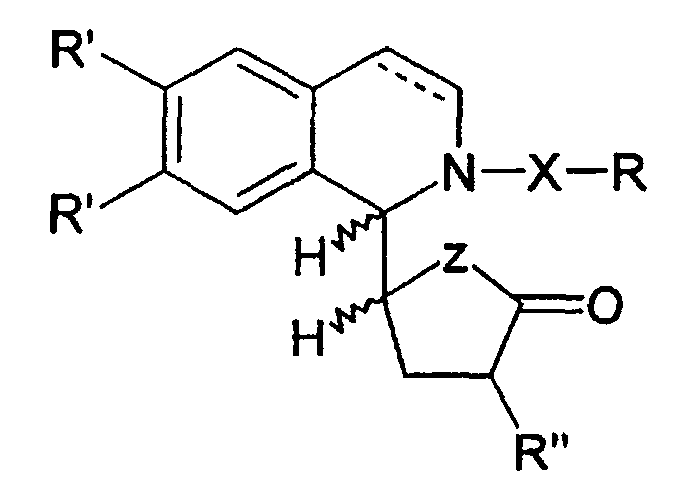 Z représente un atome de soufre, d'oxygène, NH, N-alkyle ou Nboc,les groupes R', qui peuvent être identiques ou différents l'un de l'autre, représentent chacun un atome d'hydrogène, un groupe OCH3 ou ensemble un groupe OCH2O,le groupe R" représente un hydrogène ou un groupe CH3,le groupe X représente un groupe carbonyle, sulfonyle ou CO2,et le groupe R représente un groupe alkyle, aryle, alcényle ou aralkylesous forme de leur mélange racémique ou de leurs isomères optiquement purs.
 - Composé selon la revendication 1 caractérisé en ce que Z représente un atome d'oxygène ou Nboc.
- Composé selon les revendications 1 et 2 caractérisé en ce que Z est un atome d'oxygène.
- Composé selon les revendications 1 à 3 caractérisé en ce qu'il est représenté par la formule générale :dans laquelle :
 le groupe X représente un groupe carbonyle, sulfonyle ou CO2et le groupe R représente un groupe alkyle, aryle, alcényle ou aralkyle.
 - Composé selon les revendications 1 à 4 caractérisé en ce qu'il est représenté par la formule :
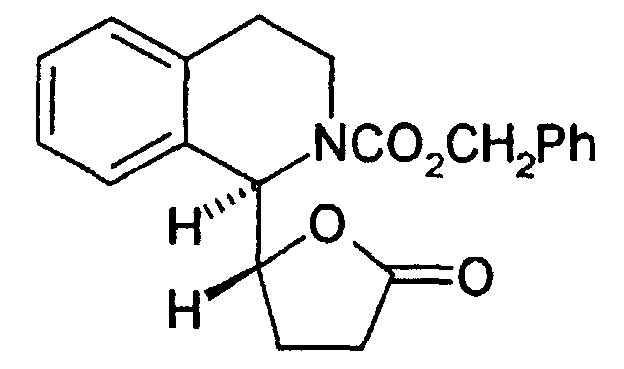
- Composé selon les revendications 1 à 4 caractérisé en ce qu'il est représenté par la formule :

- Procédé de préparation des composés selon les revendications 1 à 6 caractérisé en ce que le composé de formule générale :dans laquelle :
 Z représente un atome de soufre, d'oxygène, NH, N-alkyle ou Nboc,les groupes R', qui peuvent être identiques ou différents l'un de l'autre, représentent chacun un atome d'hydrogène, un groupe OCH3 ou ensemble un groupe OCH2O,le groupe R" représente un hydrogène ou un groupe CH3,le groupe X représente un groupe carbonyle, sulfonyle ou CO2et le groupe R représente un groupe alkyle, aryle, alcényle ou aralkyle. est hydrogéné sélectivement par H2 en présence de Pd-C pour donner le composé selon la revendication 1.
 - Procédé de préparation selon la revendication 7 caractérisé en ce qu'il comporte une étape préalable de condensation en présence d'un agent acylant ou sulfonylant d'un silyle énol éther représenté par la formule générale :dans laquelle :
 dans laquelle :Z représente un atome de soufre, d'oxygène, NH, N-alkyle ou Nbocet R" représente un atome d'hydrogène ou un CH3 avec un sel de 3,4-dihydroisoquinoline représentée par la formule générale suivante:
 les groupes R', qui peuvent être identiques ou différents l'un de l'autre, représentent chacun un atome d'hydrogène, un groupe OCH3 ou ensemble un groupe OCH2O,le groupe X représente un groupe carbonyle, sulfonyle ou CO2et le groupe R représente un groupe alkyle, aryle, alcényle ou aralkyle.
 - Composition pharmaceutique comprenant un composé selon les revendications 1 à 6 et un support pharmaceutique approprié.
- Composé selon les revendications 1 à 6 et 9 pour son utilisation comme stimulant de l'activité de l'acide γ-aminobutyrique agissant via le récepteur GABA-A du système nerveux central.
- Composé selon les revendications 1 à 6 et 9 pour son utilisation comme médicament.
- Utilisation des composés selon les revendications 1 à 6 et 9 pour la fabrication d'un médicament destiné au traitement des troubles nerveux.
- Utilisation selon la revendication 12 caractérisée en ce que les troubles nerveux sont du type épilepsie, anxiété, dépression, troubles du sommeil et de la mémoire, attaques de panique, contractions musculaires, douleur, dépendance à l'alcool ou aux benzodiazépines ou comportements psychotiques.
Applications Claiming Priority (3)
| Application Number | Priority Date | Filing Date | Title |
|---|---|---|---|
| FR9913232A FR2800072B1 (fr) | 1999-10-22 | 1999-10-22 | 1-(2-butyrolactones et 2-thiobutyrolactones)-isoquinolines n-substituees utiles comme stimulant de l'activite de l'acide gamma-aminobutyrique et dans le traitement des troubles nerveux et leur procede de preparation |
| FR9913232 | 1999-10-22 | ||
| PCT/FR2000/002927 WO2001029030A1 (fr) | 1999-10-22 | 2000-10-20 | 1-(lactone)-isoquinolones n-substituees pour le traitement des troubles nerveux |
Publications (2)
| Publication Number | Publication Date |
|---|---|
| EP1224182A1 EP1224182A1 (fr) | 2002-07-24 |
| EP1224182B1 true EP1224182B1 (fr) | 2003-07-16 |
Family
ID=9551261
Family Applications (1)
| Application Number | Title | Priority Date | Filing Date |
|---|---|---|---|
| EP00969659A Expired - Lifetime EP1224182B1 (fr) | 1999-10-22 | 2000-10-20 | 1-(butyrolactone)-isoquinolines n-substituees pour le traitement des troubles nerveux |
Country Status (9)
| Country | Link |
|---|---|
| US (1) | US6649626B1 (fr) |
| EP (1) | EP1224182B1 (fr) |
| JP (1) | JP2003512373A (fr) |
| AT (1) | ATE245155T1 (fr) |
| AU (1) | AU7932000A (fr) |
| CA (1) | CA2387972A1 (fr) |
| DE (1) | DE60003941T2 (fr) |
| FR (1) | FR2800072B1 (fr) |
| WO (1) | WO2001029030A1 (fr) |
Families Citing this family (3)
| Publication number | Priority date | Publication date | Assignee | Title |
|---|---|---|---|---|
| JP2008524134A (ja) * | 2004-12-17 | 2008-07-10 | エフ.ホフマン−ラ ロシュ アーゲー | Gaba−bアロステリックエンハンサーとしてのチエノ−ピリジン誘導体 |
| MX2007014929A (es) * | 2005-06-02 | 2008-02-15 | Hoffmann La Roche | 3-metansulfonilquinolinas como mejoradores de gaba-b. |
| WO2009073203A1 (fr) * | 2007-12-04 | 2009-06-11 | Amgen Inc. | Ligands du récepteur trp-m8 et leur utilisation dans des traitements |
Family Cites Families (2)
| Publication number | Priority date | Publication date | Assignee | Title |
|---|---|---|---|---|
| GB8921304D0 (en) * | 1989-09-20 | 1989-11-08 | Wyeth John & Brother Ltd | New method of treatment and heterocyclic compounds used therein |
| FR2750427B1 (fr) * | 1996-06-28 | 1998-08-07 | Synthelabo | Derives de 1-oxo-1, 2-dihydroisoquinoleine-4-propanamide, leur preparation et leur application en therapeutique |
-
1999
- 1999-10-22 FR FR9913232A patent/FR2800072B1/fr not_active Expired - Fee Related
-
2000
- 2000-10-20 AT AT00969659T patent/ATE245155T1/de not_active IP Right Cessation
- 2000-10-20 DE DE60003941T patent/DE60003941T2/de not_active Expired - Fee Related
- 2000-10-20 EP EP00969659A patent/EP1224182B1/fr not_active Expired - Lifetime
- 2000-10-20 AU AU79320/00A patent/AU7932000A/en not_active Abandoned
- 2000-10-20 CA CA002387972A patent/CA2387972A1/fr not_active Abandoned
- 2000-10-20 JP JP2001531829A patent/JP2003512373A/ja active Pending
- 2000-10-20 US US10/111,081 patent/US6649626B1/en not_active Expired - Fee Related
- 2000-10-20 WO PCT/FR2000/002927 patent/WO2001029030A1/fr not_active Ceased
Also Published As
| Publication number | Publication date |
|---|---|
| CA2387972A1 (fr) | 2001-04-26 |
| FR2800072B1 (fr) | 2002-01-11 |
| JP2003512373A (ja) | 2003-04-02 |
| DE60003941T2 (de) | 2004-05-06 |
| DE60003941D1 (de) | 2003-08-21 |
| ATE245155T1 (de) | 2003-08-15 |
| AU7932000A (en) | 2001-04-30 |
| US6649626B1 (en) | 2003-11-18 |
| WO2001029030A1 (fr) | 2001-04-26 |
| FR2800072A1 (fr) | 2001-04-27 |
| EP1224182A1 (fr) | 2002-07-24 |
Similar Documents
| Publication | Publication Date | Title |
|---|---|---|
| EP0867436B1 (fr) | Dérivés de N-aryl pipéridine et leur utilisation comme ligands du récepteur 5-HT1B | |
| CA2317053A1 (fr) | Nouveaux derives de la pyridine, leur procede de preparation et les compositions pharmaceutiques qui les contiennent | |
| EP0452204B1 (fr) | Nouveaux dérivés du 3-aminochromane, leur procédé de préparation et les compositions pharmaceutiques qui les contiennent | |
| EP1753725B1 (fr) | Derives de tetrahydroisoquinolilsulfonamides, leur preparation et leur utilisation en therapeutique | |
| EP0982305B1 (fr) | Nouveaux dérivés de l'indane-1-ol, leur procédé de préparation et les compositions pharmaceutiques qui les contiennent. | |
| EP0861837B1 (fr) | Nouveaux composés de 2-amino indane, leur procédé de préparation et les compositions pharmaceutiques qui les contiennent | |
| EP0906912B1 (fr) | Nouveaux composés de l'indanol, leur procédé de préparation et les compositions pharmaceutiques qui les contiennent | |
| EP1224182B1 (fr) | 1-(butyrolactone)-isoquinolines n-substituees pour le traitement des troubles nerveux | |
| EP1466604B1 (fr) | Nouveaux dérivés d'isoquinoléine, leur procédé de préparation et leur utilisation pour traiter les troubles du système mélatoninergique | |
| CA2674097A1 (fr) | Nouveaux derives aminopyrrolo[1,2-.alpha.]indole et aminopyridazino[1,6-.alpha.]indole, leur procede de preparation et les compositions pharmaceutiques qui les contiennent | |
| CA2630655C (fr) | Derives de isoquinoline et benzo[h]isoquinoline, leur preparation et leur utilisation en therapeutique en tant qu'antagonistes du recepteur de l'histamine h3 | |
| EP0499527B1 (fr) | Composés dérivés des beta-carbolines ligands du récepteur des benzodiazépines ayant un effet agoniste inverse et antagoniste vis-à-vis des benzodiazépines et médicaments les contenant | |
| EP1873139A1 (fr) | Nouveaux dérivés naphtaleniques, leur procédé de préparation et les compositions pharmaceutiques qui les contiennent | |
| EP1119564B1 (fr) | Derives d'aryl- 4-fluoro-4- (2-pyridin-2-yl-ethylamino)-methyl]-piperidin-1-yl -methanone comme agonistes du recepteur 5-ht1 | |
| EP0170549B1 (fr) | Dérivés de tétrahydro-4,5,6,7 furo ou 1H-pyrrolo[2,3-c]pyridine, leur préparation et leur application en therapeutique | |
| EP1226133B1 (fr) | 3-AMINO-2,2-DI-C-ALKYL-1,4-BUTYROLACTONES ET 1,4-THIOBUTYROLACTONES N-SUBSTITUEES UTILES COMME STIMULANT DE L'ACTIVITE DE L'ACIDE $g(g)-AMINOBUTYRIQUE ET DANS LE TRAITEMENT DES TROUBLES NERVEUX ET LEUR PROCEDE DE PREPARATION | |
| EP1146041A1 (fr) | Dérivés d'hétérocycloalkylbenzocyclobutane et d'hétéroarylbenzocyclobutane et leur utilisation en tant qu'inhibiteurs de recapture de la sérotonine et de la noradrénaline | |
| EP0534856A1 (fr) | Ethers d'oximes de thiénocyclopentanones, leur préparation et compositions pharmaceutiques les contenant | |
| EP1038873B1 (fr) | Dérivés du benzo[3,4]cyclobuta[1,2-c]pyrrole en tant qu' inhibiteurs de recapture de sérotonine | |
| EP0220104A2 (fr) | Dérivés d'amino-5 pentanenitrile, leurs procédés de préparation et les compositions pharmaceutiques qui les contiennent |
Legal Events
| Date | Code | Title | Description |
|---|---|---|---|
| PUAI | Public reference made under article 153(3) epc to a published international application that has entered the european phase |
Free format text: ORIGINAL CODE: 0009012 |
|
| 17P | Request for examination filed |
Effective date: 20020513 |
|
| AK | Designated contracting states |
Kind code of ref document: A1 Designated state(s): AT BE CH CY DE DK ES FI FR GB GR IE IT LI LU MC NL PT SE |
|
| AX | Request for extension of the european patent |
Free format text: AL;LT;LV;MK;RO;SI |
|
| RTI1 | Title (correction) |
Free format text: N-SUBSTITUTED 1-(BUTYROLACTONE)-ISOQUINOLINES FOR TREATING NERVOUS DISORDERS |
|
| GRAH | Despatch of communication of intention to grant a patent |
Free format text: ORIGINAL CODE: EPIDOS IGRA |
|
| GRAH | Despatch of communication of intention to grant a patent |
Free format text: ORIGINAL CODE: EPIDOS IGRA |
|
| GRAA | (expected) grant |
Free format text: ORIGINAL CODE: 0009210 |
|
| AK | Designated contracting states |
Designated state(s): AT BE CH CY DE DK ES FI FR GB GR IE IT LI LU MC NL PT SE |
|
| PG25 | Lapsed in a contracting state [announced via postgrant information from national office to epo] |
Ref country code: NL Free format text: LAPSE BECAUSE OF FAILURE TO SUBMIT A TRANSLATION OF THE DESCRIPTION OR TO PAY THE FEE WITHIN THE PRESCRIBED TIME-LIMIT Effective date: 20030716 Ref country code: IT Free format text: LAPSE BECAUSE OF FAILURE TO SUBMIT A TRANSLATION OF THE DESCRIPTION OR TO PAY THE FEE WITHIN THE PRE;WARNING: LAPSES OF ITALIAN PATENTS WITH EFFECTIVE DATE BEFORE 2007 MAY HAVE OCCURRED AT ANY TIME BEFORE 2007. THE CORRECT EFFECTIVE DATE MAY BE DIFFERENT FROM THE ONE RECORDED.SCRIBED TIME-LIMIT Effective date: 20030716 Ref country code: IE Free format text: LAPSE BECAUSE OF FAILURE TO SUBMIT A TRANSLATION OF THE DESCRIPTION OR TO PAY THE FEE WITHIN THE PRESCRIBED TIME-LIMIT Effective date: 20030716 Ref country code: FI Free format text: LAPSE BECAUSE OF FAILURE TO SUBMIT A TRANSLATION OF THE DESCRIPTION OR TO PAY THE FEE WITHIN THE PRESCRIBED TIME-LIMIT Effective date: 20030716 Ref country code: AT Free format text: LAPSE BECAUSE OF FAILURE TO SUBMIT A TRANSLATION OF THE DESCRIPTION OR TO PAY THE FEE WITHIN THE PRESCRIBED TIME-LIMIT Effective date: 20030716 |
|
| REG | Reference to a national code |
Ref country code: GB Ref legal event code: FG4D Free format text: NOT ENGLISH |
|
| REG | Reference to a national code |
Ref country code: CH Ref legal event code: EP |
|
| REG | Reference to a national code |
Ref country code: IE Ref legal event code: FG4D Free format text: FRENCH |
|
| REF | Corresponds to: |
Ref document number: 60003941 Country of ref document: DE Date of ref document: 20030821 Kind code of ref document: P |
|
| REG | Reference to a national code |
Ref country code: CH Ref legal event code: NV Representative=s name: MICHELI & CIE INGENIEURS-CONSEILS |
|
| PG25 | Lapsed in a contracting state [announced via postgrant information from national office to epo] |
Ref country code: SE Free format text: LAPSE BECAUSE OF FAILURE TO SUBMIT A TRANSLATION OF THE DESCRIPTION OR TO PAY THE FEE WITHIN THE PRESCRIBED TIME-LIMIT Effective date: 20031016 Ref country code: GR Free format text: LAPSE BECAUSE OF FAILURE TO SUBMIT A TRANSLATION OF THE DESCRIPTION OR TO PAY THE FEE WITHIN THE PRESCRIBED TIME-LIMIT Effective date: 20031016 Ref country code: DK Free format text: LAPSE BECAUSE OF FAILURE TO SUBMIT A TRANSLATION OF THE DESCRIPTION OR TO PAY THE FEE WITHIN THE PRESCRIBED TIME-LIMIT Effective date: 20031016 |
|
| PG25 | Lapsed in a contracting state [announced via postgrant information from national office to epo] |
Ref country code: LU Free format text: LAPSE BECAUSE OF NON-PAYMENT OF DUE FEES Effective date: 20031020 Ref country code: CY Free format text: LAPSE BECAUSE OF FAILURE TO SUBMIT A TRANSLATION OF THE DESCRIPTION OR TO PAY THE FEE WITHIN THE PRESCRIBED TIME-LIMIT Effective date: 20031020 |
|
| PG25 | Lapsed in a contracting state [announced via postgrant information from national office to epo] |
Ref country code: ES Free format text: LAPSE BECAUSE OF FAILURE TO SUBMIT A TRANSLATION OF THE DESCRIPTION OR TO PAY THE FEE WITHIN THE PRESCRIBED TIME-LIMIT Effective date: 20031027 |
|
| PG25 | Lapsed in a contracting state [announced via postgrant information from national office to epo] |
Ref country code: MC Free format text: LAPSE BECAUSE OF NON-PAYMENT OF DUE FEES Effective date: 20031031 Ref country code: BE Free format text: LAPSE BECAUSE OF NON-PAYMENT OF DUE FEES Effective date: 20031031 |
|
| NLV1 | Nl: lapsed or annulled due to failure to fulfill the requirements of art. 29p and 29m of the patents act | ||
| GBT | Gb: translation of ep patent filed (gb section 77(6)(a)/1977) |
Effective date: 20031117 |
|
| PG25 | Lapsed in a contracting state [announced via postgrant information from national office to epo] |
Ref country code: PT Free format text: LAPSE BECAUSE OF FAILURE TO SUBMIT A TRANSLATION OF THE DESCRIPTION OR TO PAY THE FEE WITHIN THE PRESCRIBED TIME-LIMIT Effective date: 20031216 |
|
| LTIE | Lt: invalidation of european patent or patent extension |
Effective date: 20030716 |
|
| REG | Reference to a national code |
Ref country code: IE Ref legal event code: FD4D |
|
| BERE | Be: lapsed |
Owner name: *UNIVERSITE DE BERNE Effective date: 20031031 Owner name: INNOVATIONSAGENTUR GMBH BU TECHNOLOGY MARKETING AU Effective date: 20031031 Owner name: CENTRE NATIONAL DE LA RECHERCHE SCIENTIFIQUE *CNRS Effective date: 20031031 |
|
| PLBE | No opposition filed within time limit |
Free format text: ORIGINAL CODE: 0009261 |
|
| STAA | Information on the status of an ep patent application or granted ep patent |
Free format text: STATUS: NO OPPOSITION FILED WITHIN TIME LIMIT |
|
| 26N | No opposition filed |
Effective date: 20040419 |
|
| PGFP | Annual fee paid to national office [announced via postgrant information from national office to epo] |
Ref country code: FR Payment date: 20041011 Year of fee payment: 5 |
|
| PGFP | Annual fee paid to national office [announced via postgrant information from national office to epo] |
Ref country code: GB Payment date: 20041020 Year of fee payment: 5 |
|
| PGFP | Annual fee paid to national office [announced via postgrant information from national office to epo] |
Ref country code: DE Payment date: 20041029 Year of fee payment: 5 |
|
| PGFP | Annual fee paid to national office [announced via postgrant information from national office to epo] |
Ref country code: CH Payment date: 20041207 Year of fee payment: 5 |
|
| PG25 | Lapsed in a contracting state [announced via postgrant information from national office to epo] |
Ref country code: GB Free format text: LAPSE BECAUSE OF NON-PAYMENT OF DUE FEES Effective date: 20051020 |
|
| PG25 | Lapsed in a contracting state [announced via postgrant information from national office to epo] |
Ref country code: LI Free format text: LAPSE BECAUSE OF NON-PAYMENT OF DUE FEES Effective date: 20051031 Ref country code: CH Free format text: LAPSE BECAUSE OF NON-PAYMENT OF DUE FEES Effective date: 20051031 |
|
| PG25 | Lapsed in a contracting state [announced via postgrant information from national office to epo] |
Ref country code: DE Free format text: LAPSE BECAUSE OF NON-PAYMENT OF DUE FEES Effective date: 20060503 |
|
| REG | Reference to a national code |
Ref country code: CH Ref legal event code: PL |
|
| GBPC | Gb: european patent ceased through non-payment of renewal fee |
Effective date: 20051020 |
|
| PG25 | Lapsed in a contracting state [announced via postgrant information from national office to epo] |
Ref country code: FR Free format text: LAPSE BECAUSE OF NON-PAYMENT OF DUE FEES Effective date: 20060630 |
|
| REG | Reference to a national code |
Ref country code: FR Ref legal event code: ST Effective date: 20060630 |