EP1225414A2 - Vorrichtung zum Tarnen eines Gegenstandes - Google Patents
Vorrichtung zum Tarnen eines Gegenstandes Download PDFInfo
- Publication number
- EP1225414A2 EP1225414A2 EP01130162A EP01130162A EP1225414A2 EP 1225414 A2 EP1225414 A2 EP 1225414A2 EP 01130162 A EP01130162 A EP 01130162A EP 01130162 A EP01130162 A EP 01130162A EP 1225414 A2 EP1225414 A2 EP 1225414A2
- Authority
- EP
- European Patent Office
- Prior art keywords
- camouflage
- side edges
- nets
- tarpaulin
- spots
- Prior art date
- Legal status (The legal status is an assumption and is not a legal conclusion. Google has not performed a legal analysis and makes no representation as to the accuracy of the status listed.)
- Withdrawn
Links
Images

Classifications
-
- F—MECHANICAL ENGINEERING; LIGHTING; HEATING; WEAPONS; BLASTING
- F41—WEAPONS
- F41H—ARMOUR; ARMOURED TURRETS; ARMOURED OR ARMED VEHICLES; MEANS OF ATTACK OR DEFENCE, e.g. CAMOUFLAGE, IN GENERAL
- F41H3/00—Camouflage, i.e. means or methods for concealment or disguise
-
- Y—GENERAL TAGGING OF NEW TECHNOLOGICAL DEVELOPMENTS; GENERAL TAGGING OF CROSS-SECTIONAL TECHNOLOGIES SPANNING OVER SEVERAL SECTIONS OF THE IPC; TECHNICAL SUBJECTS COVERED BY FORMER USPC CROSS-REFERENCE ART COLLECTIONS [XRACs] AND DIGESTS
- Y10—TECHNICAL SUBJECTS COVERED BY FORMER USPC
- Y10T—TECHNICAL SUBJECTS COVERED BY FORMER US CLASSIFICATION
- Y10T442/00—Fabric [woven, knitted, or nonwoven textile or cloth, etc.]
- Y10T442/10—Scrim [e.g., open net or mesh, gauze, loose or open weave or knit, etc.]
Definitions
- the invention relates to a device for camouflaging a Object, a person or the like the one defined in the preamble of claim 1 Art.
- Tarpaulin and camouflage nets are from the field of military technology well known.
- camouflage nets which corresponding, over the actual area of the network or the tarpaulin have protruding elements also known as camouflage nets, which can only be printed camouflage pattern on a flat surface Achieve camouflage.
- the three-dimensional camouflage nets have their advantages thereby in the better camouflage effect and in a very good connectivity from individual networks to a large one composite network, because the protruding camouflage elements the neck seams or edges relatively good cover. Due to the protruding camouflage elements of the However, the handling of individual nets will be different very bad, because on the one hand they also merged take up a lot of space and on the other hand the Camouflage elements can leave very easily.
- camouflage nets which are only printed and in general be called two-dimensional here decisive advantages in handling, since they are the Avoid the disadvantages mentioned above.
- visual camouflage is not that good like that of three-dimensional camouflage nets.
- camouflage patterns are generally designed that they are the ones to be camouflaged by the tarpaulin Dissolve the object in its contours and with the surroundings blur.
- camouflage nets generally different colored spots, which depending on the environment in which the camouflage net or Camouflage tarpaulin is used, different color schemes demonstrate.
- edge areas By appropriately designing the edge areas, namely, in the way that they fit together although this is still possible to a limited extent, however, it is only possible to print So generally the same size, camouflage nets on the for it provided side edges combined with each other become. This in turn creates serious disadvantages in terms of handling and time when building the camouflage.
- this task is characterized by Part of claim 1 mentioned features solved.
- Repeats composite camouflage cover with it achieve a camouflage effect comparable to that of any individual tracks.
- a small, easy to manufacture and easy to print Repeat which is also very easy in military Vehicles or the like can be carried, if necessary, by merging several of these Repeats a large camouflage net or a large one Form camouflage cover, which then also several vehicles, Objects, people or the like under can hide.
- the tarpaulin or some of the nets before joining against each other while maintaining their visible surface can be rotated by 180 °, so that the corresponding camouflage patterns are not very different repeat short intervals.
- the camouflage effect to be achieved is almost independent on the size of the object to be camouflaged or the like optimized in an advantageous manner.
- the different sizes of the spots, i.e. their area, vary very much, so that between the area of the larger and the smaller ones Stains are of the order of magnitude Can be 50 to 250.
- the device enables very advantageous Way the camouflage effect of a three-dimensional camouflage net with a two-dimensional camouflage tarpaulin in the invention Achieve design.
- the advantages in terms of handling the two-dimensional So camouflage nets are added along with the advantages comparable to the three-dimensional camouflage net Camouflage achieved.
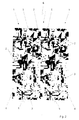
- Fig. 1 shows a tarpaulin or a network, a so-called Repeat 1, with a corresponding camouflage design, which, for example, in the form of repeat 1 printed spots 2 is executed.
- a majority the patch 2 has side edges 3 which to a large extent from at least approximately straight lines Assemble sections.
- a big number the straight sections is at least approximately parallel to the side edges 4, 5 of the repeat 1 trained. To achieve the ideal camouflage effect To get this number, if possible comprise more than half of the straight sections.
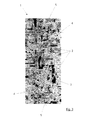
- Fig. 2 now shows how several of the repeats 1, here two of the repeats 1, put together to form a camouflage cover 6 are.
- the two repeats 1 are along one side edge 4 connected to each other, this directly by sewing the repeats together 1 can be made to a camouflage cover 6.
- this it is also possible for this to be put together of the individual repeats to a larger camouflage cover 6 done on site when camouflage. Due to the side edges 3 of individual spots that to a large extent parallel to the side edges 4, 5 of the repeats, there is a seam 7 between the individual repeats 1 then practically not recognizable.
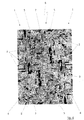
- Repeat 1 is included like the repeats 1 in the previous figures with an aspect ratio of 1: 3 and can be, for example, in a size of approximately 1.5 mx 4.5 m are manufactured. This size allows a lot inexpensive processing on conventional textile processing machines.
- the pattern of the entire camouflage cover 6 is compared the pattern shown in Fig. 2 even more uneven, the camouflage effect is further increased.
- one of the Repeats 1 e.g. turn 90 ° to make it even more effective to reinforce.
- Camouflage covers 6 In addition to the rectangular ones shown here, they are fundamental Camouflage covers 6 also different types of Camouflage covers 6 possible. Is particularly well suited a hexagonal cut of the camouflage cover 6 (not shown), because such hexagonal Camouflage covers 6 very easily in the manner of honeycombs too a continuous, almost any size camouflage get connected. The angles through which the individual Camouflage covers 6 rotated before assembling can of course adapt accordingly on.
- camouflage cover 6 which for example consists of six or eight repeats 1, or one large camouflage, which consists of several of the camouflage covers 6 is a combination of identical and Repeated reports 1 or Camouflage covers 6 to use one as possible to achieve ideal visual camouflage.
- Camouflage covers 6 or camouflages apply, however, that the Position of the seam 7 in or between the camouflage covers 6 visually practically disappears, so with very simple means quickly and inexpensively a very large camouflage cover 6 or camouflage from many individual ones identical repeats 1 or camouflage covers 6 can be manufactured.
Landscapes
- Engineering & Computer Science (AREA)
- General Engineering & Computer Science (AREA)
- Aiming, Guidance, Guns With A Light Source, Armor, Camouflage, And Targets (AREA)
- Treatment Of Fiber Materials (AREA)
- Massaging Devices (AREA)
Abstract
Description
- Fig. 1
- zeigt eine beispielhafte erfindungsgemäße Tarnplane;
- Fig. 2
- zeigt die Kombination von zwei der Planen gemäß Fig. 1 zu einer Tarnabdeckung;
- Fig. 3
- zeigt eine beispielhafte erfindungsgemäße Tarnplane in einer alternativen Ausführungsform; und
- Fig. 4
- zeigt die Kombination von zwei der Planen gemäß Fig. 3 zu einer Tarnabdeckung;
Claims (7)
- Vorrichtung zum Tarnen eines Gegenstandes einer Person oder dergleichen, bestehend aus wenigstens einem Netz oder wenigstens einer Plane mit jeweils geraden Seitenkanten, welche ein Tarnmuster aufweist, welches aus mehreren verschiedenfarbigen, einzelnen Flecken besteht,
dadurch gekennzeichnet, daß
die Seitenkanten (3) einer Mehrzahl der Flecken (2) zu einem großen Teil aus wenigstens annähernd geradlinigen Abschnitten zusammengesetzt sind, wobei eine Anzahl der geradlinigen Abschnitte wenigstens annähernd parallel zu den Seitenkanten (4,5) des Netzes oder der Plane (1) ausgerichtet sind. - Vorrichtung nach Anspruch 1,
dadurch gekennzeichnet, daß
die einzelnen Flecken hinsichtlich ihres Flächeninhalts sehr unterschiedlich ausgebildet sind. - Vorrichtung nach Anspruch 1 oder 2,
dadurch gekennzeichnet, daß
mehrere der Netze oder der Planen (1) zu einer Tarnabdeckung (6) zusammengefaßt sind. - Vorrichtung nach Anspruch 3,
dadurch gekennzeichnet, daß
wenigstens eines der Netze oder der Planen (1) in der Tarnabdeckung (6) gegenüber den anderen Netzen oder Planen (1) um einen Winkel gedreht ist. - Vorrichtung nach einem der Ansprüche 1 bis 4,
dadurch gekennzeichnet, daß
die Anzahl der geradlinigen Abschnitte, welche wenigstens annähernd parallel zu den Seitenkanten (4,5) des Netzes oder der Plane (1) ausgerichtet sind, mehr als die Hälfte der vorhandenen geradlinigen Abschnitte umfaßt. - Vorrichtung nach einem der Ansprüche 1 bis 5,
dadurch gekennzeichnet, daß
die Netze bzw. Planen (1) rechteckig ausgebildet sind und ein Verhältnis ihrer Seitenkanten (4,5) von 1:3 aufweisen. - Vorrichtung nach einem der Ansprüche 3 bis 6,
dadurch gekennzeichnet, daß
die Tarnabdeckungen (6) jeweils hexagonal ausgebildet sind.
Applications Claiming Priority (2)
| Application Number | Priority Date | Filing Date | Title |
|---|---|---|---|
| DE20100931U | 2001-01-18 | ||
| DE20100931U DE20100931U1 (de) | 2001-01-18 | 2001-01-18 | Vorrichtung zum Tarnen eines Gegenstandes |
Publications (2)
| Publication Number | Publication Date |
|---|---|
| EP1225414A2 true EP1225414A2 (de) | 2002-07-24 |
| EP1225414A3 EP1225414A3 (de) | 2003-07-23 |
Family
ID=7951814
Family Applications (1)
| Application Number | Title | Priority Date | Filing Date |
|---|---|---|---|
| EP01130162A Withdrawn EP1225414A3 (de) | 2001-01-18 | 2001-12-19 | Vorrichtung zum Tarnen eines Gegenstandes |
Country Status (3)
| Country | Link |
|---|---|
| US (1) | US20020094736A1 (de) |
| EP (1) | EP1225414A3 (de) |
| DE (1) | DE20100931U1 (de) |
Cited By (1)
| Publication number | Priority date | Publication date | Assignee | Title |
|---|---|---|---|---|
| DE202011109331U1 (de) | 2011-12-21 | 2012-01-26 | Blücher Systems GmbH | Tarnvorrichtung |
Families Citing this family (6)
| Publication number | Priority date | Publication date | Assignee | Title |
|---|---|---|---|---|
| USD874158S1 (en) * | 2018-04-27 | 2020-02-04 | Gregory Paul Kewekordes | Textile with camouflage pattern |
| FI3855982T3 (fi) | 2018-10-23 | 2023-11-20 | Yeti Coolers Llc | Suljin ja kansi ja menetelmä sulkimen ja kannen muodostamiseksi |
| USD964102S1 (en) | 2019-10-09 | 2022-09-20 | Yeti Coolers, Llc | Tumbler |
| USD982973S1 (en) | 2019-10-09 | 2023-04-11 | Yeti Coolers, Llc | Tumbler |
| USD977912S1 (en) | 2020-10-01 | 2023-02-14 | Yeti Coolers, Llc | Tumbler |
| USD982982S1 (en) | 2020-10-01 | 2023-04-11 | Yeti Coolers, Llc | Tumbler |
Family Cites Families (5)
| Publication number | Priority date | Publication date | Assignee | Title |
|---|---|---|---|---|
| GB537254A (en) * | 1939-08-15 | 1941-06-16 | Percy Leonard Stafford Mathews | Improvements in or relating to camouflage screens |
| DE2558050A1 (de) * | 1975-12-22 | 1977-06-23 | Barracudaverken Ab | Tarnplane mit verstaerkungsnetz und verfahren zur herstellung derselben |
| US5281451A (en) * | 1992-06-15 | 1994-01-25 | Milliken Research Corporation | Heat treated camouflage fabric |
| US5972479A (en) * | 1996-11-18 | 1999-10-26 | Lehman; Victoria L. | Camouflage configuration |
| US6061828A (en) * | 1997-03-21 | 2000-05-16 | Josephs; Ira | Camouflage items and camouflage material thereon |
-
2001
- 2001-01-18 DE DE20100931U patent/DE20100931U1/de not_active Expired - Lifetime
- 2001-12-19 EP EP01130162A patent/EP1225414A3/de not_active Withdrawn
- 2001-12-20 US US10/037,232 patent/US20020094736A1/en not_active Abandoned
Cited By (1)
| Publication number | Priority date | Publication date | Assignee | Title |
|---|---|---|---|---|
| DE202011109331U1 (de) | 2011-12-21 | 2012-01-26 | Blücher Systems GmbH | Tarnvorrichtung |
Also Published As
| Publication number | Publication date |
|---|---|
| US20020094736A1 (en) | 2002-07-18 |
| DE20100931U1 (de) | 2001-04-19 |
| EP1225414A3 (de) | 2003-07-23 |
Similar Documents
| Publication | Publication Date | Title |
|---|---|---|
| EP0955515B1 (de) | Gewebe, insbesondere Stichschutzgewebe | |
| Hoegg | SchulRecht! | |
| DE2048205A1 (de) | Verkleidung fur Ketten und Radfahr zeuge | |
| EP1225414A2 (de) | Vorrichtung zum Tarnen eines Gegenstandes | |
| DE20305956U1 (de) | Flexibles Fachsystem | |
| DE2619512C3 (de) | Tarnfolie mit Lochmusterung | |
| DE2943430A1 (de) | Breitbandtarnnetz | |
| EP2386815A2 (de) | Getarntes militärisches Objekt | |
| AT406198B (de) | Vorrichtung zur tarnung militärischer geräte | |
| DE202020101223U1 (de) | Warnfläche | |
| EP1078820A2 (de) | Clipsverbindung | |
| DE4337743C5 (de) | Paneelelement zur Wand- und Deckenverkleidung | |
| DE909667C (de) | Verfahren zur Herstellung von Tarnmustern auf Gewebebahnen und aehnlichen flaechigen Gebilden | |
| DE3130856A1 (de) | Abdeckung fuer ein fahrzeug | |
| Lash et al. | Arbeitsbeziehungen im disorganisierten Kapitalismus: Ein Vergleich von fünf Nationen | |
| AT406303B (de) | Einrichtung zur tarnung | |
| EP3400830A1 (de) | Regalsystem | |
| Oancea | Gemeinschaft von Verschiedenheiten-religionsphilosophische Vorüberlegungen. | |
| DE102014002551A1 (de) | Verkleidung für einen Kraftwagen | |
| DE102006031126B4 (de) | Plane zur Abdeckung des Aufbaus eines Nutzfahrzeugs, aufweisend eine im Randbereich der Plane angeordnete Abdichtung | |
| DE10361921B4 (de) | Veränderbare Tarnoberfläche | |
| Schachner | Die Schule Konons: Karrieren athenischer Feldherren am Beginn des 4. Jahrhunderts | |
| DE102022119214A1 (de) | Rollbares Textil | |
| CH704144A1 (de) | Adaptive visuelle Tarnung. | |
| Morgan et al. | Learning from the future? Begegnungen deutscher und britischer Gewerkschafter mit Amerika in den Zwanzigerjahren |
Legal Events
| Date | Code | Title | Description |
|---|---|---|---|
| PUAI | Public reference made under article 153(3) epc to a published international application that has entered the european phase |
Free format text: ORIGINAL CODE: 0009012 |
|
| AK | Designated contracting states |
Kind code of ref document: A2 Designated state(s): AT BE CH CY DE DK ES FI FR GB GR IE IT LI LU MC NL PT SE TR |
|
| AX | Request for extension of the european patent |
Free format text: AL;LT;LV;MK;RO;SI |
|
| PUAL | Search report despatched |
Free format text: ORIGINAL CODE: 0009013 |
|
| AK | Designated contracting states |
Designated state(s): AT BE CH CY DE DK ES FI FR GB GR IE IT LI LU MC NL PT SE TR |
|
| AX | Request for extension of the european patent |
Extension state: AL LT LV MK RO SI |
|
| RIC1 | Information provided on ipc code assigned before grant |
Ipc: 7F 41H 3/02 B Ipc: 7F 41H 3/00 A |
|
| 17P | Request for examination filed |
Effective date: 20031030 |
|
| AKX | Designation fees paid |
Designated state(s): AT BE CH CY DE DK ES FI FR GB GR IE IT LI LU MC NL PT SE TR |
|
| STAA | Information on the status of an ep patent application or granted ep patent |
Free format text: STATUS: THE APPLICATION IS DEEMED TO BE WITHDRAWN |
|
| 18D | Application deemed to be withdrawn |
Effective date: 20060221 |