EP1225599B1 - Procédé de fabrication pour un produit en polymère PCT - Google Patents
Procédé de fabrication pour un produit en polymère PCT Download PDFInfo
- Publication number
- EP1225599B1 EP1225599B1 EP01101331A EP01101331A EP1225599B1 EP 1225599 B1 EP1225599 B1 EP 1225599B1 EP 01101331 A EP01101331 A EP 01101331A EP 01101331 A EP01101331 A EP 01101331A EP 1225599 B1 EP1225599 B1 EP 1225599B1
- Authority
- EP
- European Patent Office
- Prior art keywords
- ptc
- polymer material
- vol
- amount
- filler material
- Prior art date
- Legal status (The legal status is an assumption and is not a legal conclusion. Google has not performed a legal analysis and makes no representation as to the accuracy of the status listed.)
- Expired - Lifetime
Links
Images


Classifications
-
- H—ELECTRICITY
- H01—ELECTRIC ELEMENTS
- H01C—RESISTORS
- H01C7/00—Non-adjustable resistors formed as one or more layers or coatings; Non-adjustable resistors made from powdered conducting material or powdered semi-conducting material with or without insulating material
- H01C7/02—Non-adjustable resistors formed as one or more layers or coatings; Non-adjustable resistors made from powdered conducting material or powdered semi-conducting material with or without insulating material having positive temperature coefficient
- H01C7/027—Non-adjustable resistors formed as one or more layers or coatings; Non-adjustable resistors made from powdered conducting material or powdered semi-conducting material with or without insulating material having positive temperature coefficient consisting of conducting or semi-conducting material dispersed in a non-conductive organic material
-
- H—ELECTRICITY
- H01—ELECTRIC ELEMENTS
- H01C—RESISTORS
- H01C17/00—Apparatus or processes specially adapted for manufacturing resistors
- H01C17/06—Apparatus or processes specially adapted for manufacturing resistors adapted for coating resistive material on a base
- H01C17/065—Apparatus or processes specially adapted for manufacturing resistors adapted for coating resistive material on a base by thick film techniques, e.g. serigraphy
- H01C17/06506—Precursor compositions therefor, e.g. pastes, inks, glass frits or green body
- H01C17/06573—Precursor compositions therefor, e.g. pastes, inks, glass frits or green body characterised by the permanent binder
- H01C17/06586—Precursor compositions therefor, e.g. pastes, inks, glass frits or green body characterised by the permanent binder composed of organic material
Definitions
- the present invention relates to a production process for a product made of a polymer having an electric resistivity with a positive temperature coefficient (PTC resistivity; in the following: PTC-polymer product), namely, it relates to a forming process in which heat and pressure are applied to PTC-polymer material to deform said material in order to arrive at a desired product form.
- PTC resistivity positive temperature coefficient
- polymers In order to be deformable, polymers generally must be heated to decrease their viscosity and to avoid breaks and cracks. Especially for mass-produced parts, the time required for the forming process is an essential parameter. Further, the pressures to be applied during forming shall not be too high in order to avoid excessive technical equipment. Consequently, in conventional polymer forming processes the polymer material temperature is much higher than the so called melting temperature of this material.
- the above at first, relates to pure polymer materials.
- PTC-polymer materials to which the invention relates there are solid filler materials included in a polymer matrix, e.g. carbon powder or metal powder. It goes without saying that the inclusion of substantive amounts of filler materials drastically increases the viscosity of the polymer material so that the pressure or the temperature of the forming process have to be increased even more.
- the technical problem underlying the present invention is to provide a production process for forming a PTC-polymer product with improved and stabilised quality.
- the present invention relates to a method of producing a form product from PTC-polymer material consisting of a conducting filler material and optionally further filler material in a matrix of polymer material, wherein said product is formed by a forming method which deforms said PTC-polymer material by means of heat and pressure, characterised in that said PTC-polymer material is heated during said forming process on an absolute temperature of at most 1,1 x the absolute melting temperature of said matrix polymer material, as well as to a method of producing elements from PTC-polymer material, wherein semi-finished products are produced from said PTC-polymer material with a method as defined above and wherein said semi-finished product is divided in order to produce said elements.
- the idea underlying the invention is to use a relatively low temperature in deforming the PTC-polymer material.
- the inventors have found that higher temperatures decrease the quality of the PTC-products, namely the stability of their tripping behaviour.
- the resistance values in the cold, normal conducting state are stabilised over an increased number of repetitive tripping actions, when reduced temperatures according to the invention are used during forming.
- a general formulation for the upper limits of the maximum temperatures of the forming process is used which relates to the so called melting temperature of the polymer of the matrix. According to the invention, this melting temperature shall not be exceeded by more than 10 % with regard to the absolute temperatures. It has to be noted, that this criterion uses the absolute temperature for the process temperature and the melting temperature, namely the Kelvin temperature scale.
- T S melting temperature
- the forming process used with the above described temperature limit can be a pressing process, an injection-moulding process or an extrusion process. Of these process types, however, extrusion and pressing are preferred. Especially, it is preferred to use such a process to produce semi-finished products that shall be divided into smaller elements later on. These elements can be used as PTC-elements, e.g. for resistor elements for short-circuit interruption or current limitation. Producing semi-finished products and dividing them afterwards into a multiplicity of PTC elements compensates for the increased time consumption in the forming process, that follows from the relatively low temperature used, if excessive pressures, which can also lead to material problems, are avoided.
- Subdividing the comparatively large semi-finished product can be a process step that runs very fast without being of large relevance for the material quality, especially if dividing techniques are used that avoid excessive melting of the polymer.
- One simple and preferred embodiment refers to a plate-like semi-finished product.
- Such plates can be pressed from PTC-polymer material without any problems even with very low temperatures (which, however, preferably are above T S ).
- injection-moulding or extrusion is possible, however, these techniques require higher pressures in comparison to pressing.
- Preferred pressures are not higher than 300 bar, more preferably not higher than 200 bar and further preferably not higher than 120 bar.
- polystyrene resin e.g. polystyrene resin
- PES polystyrene resin
- PEEK polystyrene resin
- the most preferred material is high-density PE (HDPE).
- PTC-polymer materials generally include a conductive filler material.
- Preferred quantitative ranges for the inclusion of the highly conductive first filler material inherent to PTC-polymer materials are 20-60 vol.-%, more preferably 30-55 vol.-% and even more preferably 35-50 vol.-% (with respect to the total volume of the PTC-polymer material).
- a preferred choice for this (first) conductive filler material is TiB 2 .
- the PTC-polymer material may include a second filler material having varistor characteristics.
- This second filler material preferably is SiC.
- the preferred quantity ranges are 10-30 vol.-%, preferably 12-28 vol.-% and more preferably 14-26 vol.-% of that second filler material.
- the invention should also hold without second (SiC) filler, e.g. 50% HDPE and 50% TiB 2 .
- filler materials are included in powder form dispersed in the polymer matrix. Further the average particle size of the second filler material should be larger than the one of the first filler material, namely by a factor of 2 - 5. Preferred ranges for the particle sizes are 10 ⁇ m to 50 ⁇ m for the first filler material and 20 ⁇ m to 250 ⁇ m for the second filler material.
- thermoplastic polymer matrix is preferably comprised in an amount of 30 - 55 vol.-% and more preferably of 37 - 50 vol.-%.
- the above specified PTC-polymer material at a predetermined voltage, shows a notably large zone of high resistance ("hot zone").
- a typical example for a PTC-polymer material according to the invention thus is comprised of 40 vol.-% HDPE, 40 vol.-% TiB 2 , and 20 vol.-% SiC.
- the particle sizes defined above are - besides the materials themselves, especially the polymer material - of relevance for the viscosities of the complete mixture.
- Such viscosities can be defined by a melt flow index, which can be measured according to the German Industrial Standard (DIN) with a standard orifice at a standard temperature of 190°C and a standard load of 21,6 kg by the amount of material running through the orifice in ten minutes.
- DIN German Industrial Standard
- Preferred values for this invention are melt flow indices of at least 1 g/10 min., preferably at least 1,5 g/10 min., and most preferably at least 2 g/10 min.
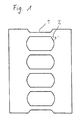
- Fig. 1 illustrates a typical structure of a PTC-polymer element according to the invention
- Fig. 2 and fig. 3 are diagrams illustrating the improvement of the tripping characteristics achieved by the invention.
- the production process starts with compounding the appropriate amounts of a polymer powder or granulate, in this case HDPE, and filler material by standard compounding with a BUSS MDK/E46-11D (screw compounder). For about 2 ⁇ 10 4 samples as referred to in Fig. 1 about 100 kg compound must be produced .
- the compound material is then pressed in a standard pressing device (PINETTE EMIDECAU INDUSTRIE, max. load of 15 tons) at a temperature of 140-145°C, i.e. 413-418 K, to form a rectangular plate with side lengths of 16 cms, 4 cms and a thickness of e.g. 0.2 cms. Also much larger plates can be pressed for purposes of mass-production.
- PINETTE EMIDECAU INDUSTRIE max. load of 15 tons
- Table 1 lists several melting temperatures of typical polymers to be used, and further typical forming temperatures according to the invention. Melting temperatures are abbreviated T S and given in °C, maximum forming temperatures are abbreviated with T P and also given in °C. The last column gives the temperature difference ⁇ T therebetween divided by the melting temperature T S (as given in K) in %.. Polymer T S (°C) T P (°C) ⁇ T / T S (%) PE 134 140-145 1,47-2,7 PP 175 192 3,8 ETFE 265 284 3,5 Aurum 388 410 3,3 PPS 288 303 2,7 PEEK 335 360 4,1 Incidentally, Aurum is the name of a polyimide.
- melt-injection of pure PE are between 200 and 280 °C, i.e. at ⁇ T/T S values of 16 - 36 %.
- the usual forming temperatures are much higher than the ones given in table 1. It is to be noted, however, that the conventional temperatures relate to pure polymer without filler material. Because the substantial amounts of the filler materials drastically increase the viscosity, usually much higher temperatures would have been chosen for PTC-polymer materials including filler.
- the pressure used is still not very high, e.g. 110 bar in the case of HDPE as filled with 50 vol.-% of metal powders. Pressure values for other materials are in the same range.
- the plates so formed can now be stored without any quality problems for longer periods. They can be used for cutting special and also very complicated device geometries.
- high-pressure water jet cutting is used.
- a typical geometry to be cut is shown in fig. 1.
- the direction of pressure during the pressing process is perpendicular to the plane of the figure.
- the plates are produced by pressed in the thickness of the device shown in fig. 1
- only the borderlines to be seen in fig. 1 must be cut in order to subdivide the pressed plate into single devices and in order to arrive at the desired geometry.
- the current direction is in the plane of the drawing and horizontal.
- the preferred geometry shows pronounced webs 1 wherein the opening angles 2 of the material at each side of each web are 60°.
- a typical web-length can be around 2 cm.
- Several webs are mutually parallel, also in an electrical sense.
- the aperture angle of the constriction at the border of the web in a longitudinal section plane containing the main current direction should be at least 100°, preferably at least 110° in the sum of both sides (i.e. it is 120° in fig. 1).
- the pressing method according to the invention has various advantages for the above sketched geometry because such long webs are quite difficult to produce with injection molding. It is very important to arrive at an optimal material quality, especially within the webs, so that the temperature reduction according to the invention results in a much improved performance of the devices produced.
- Fig. 2 and 3 show the improvement in the electrical characteristics achieved by the invention.
- fig. 2 a comparison between injection moulded parts (triangular symbols) and parts according to the invention (square symbols) is shown.
- the material composition has been 45 vol.-% HDPE / 35 vol.-% TiB 2 20 vol.-% SiC with a geometry according to fig. 1 and a web-length of 1,8 cm.
- the resistor elements according to the invention have a higher cold resistance, i.e. resistance at a normal conducting state, the cold resistance is much stabilised in comparison to the injection moulding example. This applies to the cold resistance after the first tripping and to each following cold resistance value after a further tripping up to the value after a tenth tripping. Thus, this resistor element can very well be described by a constant resistance value at least between the first and the ninth tripping.
- the injection moulded resistor element has been destroyed after the fourth tripping compared to ten tripping actions in the example according to the invention.
- the tests were short-circuit tests at 690V (root mean square) system voltage and a prospective short-circuit current of 12kA (root mean square) at 50 Hz.
- Fig. 3 shows another example for the electrical characteristics of resistor elements according to the invention.
- the square symbols refer to pressed and cut elements according to the invention whereas the triangular and circular symbols refer to injection-moulded and press-injected samples.
- Press-injection is a technique quasi between injection-moulding and pressing. It is a quasi-static pressing of molten composite material into a mould to form an end product.
- the parameters are close to the limits defined by the melt flow of the material, e.g. the polymer material is at a lower temperature compared to injection moulding.
- the press-injected elements are a part of the invention in that the temperature limit is fulfilled.
- fig. 3 shows that the pressed and cut elements are still better.
- Table 2 shows the parameters relevant for the examples of figure 2 and 3.
- the mould temperature and material temperature are identical in the case of press-injection and the case of pressing and are both below 1.1 T S .
- the temperature of 146°C in the case of pressing is even below 1.03 T S .
- the material temperature of the injection-moulded elements has been at 260°C, i.e. at approximately 1.31 T S .
- the pressure in the pressing process has been as low as 110 bar but has been much higher in both other cases.
- the geometry was the one of fig. 1 with a web-length of 2 cm.
- the material composition was 40 vol.-% HDPE / 40 vol.-% TiB 2 / 20 vol.-% SiC.
- the electrical data of the tests in fig. 3 were the same as given above.
- the pressed and cut resistor element according to the invention shows a larger member of possible tripping actions and a more stable behaviour between the first and the ninth tripping.
- the differences between the cold resistance before the first tripping and the cold resistance after the first tripping can, if necessary, be avoided by including one tripping action in the manufacture process.
Landscapes
- Engineering & Computer Science (AREA)
- Microelectronics & Electronic Packaging (AREA)
- Chemical & Material Sciences (AREA)
- Dispersion Chemistry (AREA)
- Ceramic Engineering (AREA)
- Physics & Mathematics (AREA)
- Electromagnetism (AREA)
- Manufacturing & Machinery (AREA)
- Thermistors And Varistors (AREA)
- Processing And Handling Of Plastics And Other Materials For Molding In General (AREA)
- Polyesters Or Polycarbonates (AREA)
- Polyoxymethylene Polymers And Polymers With Carbon-To-Carbon Bonds (AREA)
Claims (19)
- Procédé de fabrication d'un produit de forme à partir d'un matériau polymère PTC constitué d'un matériau de remplissage conducteur et, éventuellement, d'un autre matériau de remplissage dans une matrice de matériau polymère,
dans lequel ledit produit est formé par un procédé de formage qui déforme ledit matériau polymère PTC par application de chaleur et d'une pression,
caractérisé en ce que ledit matériau polymère PTC est chauffé au cours dudit procédé de formage à une température absolue d'au plus 1,1 x TS, TS étant la température de fusion absolue dudit matériau polymère en matrice. - Procédé selon la revendication 1, dans laquelle ledit procédé de formage est un pressage, un moulage par injection, un procédé d'extrusion ou un procédé d'infiltration.
- Procédé selon la revendication 2, dans lequel ledit procédé de formage est un procédé de pressage ou un procédé d'extrusion.
- Procédé selon l'une des revendications précédentes, dans lequel ledit matériau polymère en matrice comprend du PE, du PP, de l'ETFE, un polyimide, du PPS ou du PEEK.
- Procédé selon la revendication 4, dans lequel ledit matériau polymère en matrice est principalement constitué de HDPE.
- Procédé selon les revendications 3 et 5, dans lequel ledit procédé de pressage est mis en oeuvre avec une pression au sein dudit matériau polymère PTC d'au plus 300 bars, de préférence 200 bars et le plus préférablement 120 bars.
- Procédé selon l'une des revendications précédentes, dans lequel ladite température est d'au plus 1,075 x TS, et plus préférablement d'au plus 1,05 x TS.
- Procédé selon l'une des revendications précédentes, dans lequel ledit matériau polymère PTC comprend un premier matériau polymère conducteur dans une quantité comprise entre 20 et 60 % en volume, de préférence dans une quantité comprise entre 30 et 55 % en volume, et plus préférablement dans une quantité comprise entre 35 et 50 % en volume.
- Procédé selon l'une des revendications précédentes, dans lequel ledit matériau polymère PTC comprend un premier matériau de remplissage conducteur sous forme de TiB2.
- Procédé selon l'une des revendications précédentes, dans lequel ledit matériau polymère PTC comprend un deuxième matériau de remplissage à caractéristique de varistance.
- Procédé selon la revendication 10, dans lequel ledit deuxième matériau de remplissage est du SiC dopé.
- Procédé selon la revendication 10 ou 11, dans lequel ledit deuxième matériau de remplissage représente une quantité de 10 à 30 % en volume, de préférence une quantité de 14 à 26 % en volume.
- Procédé selon l'une des revendications précédentes, dans lequel ledit matériau polymère en matrice représente une quantité de 30 à 55 % en volume, de préférence une quantité de 37 à 50 % en volume.
- Procédé de fabrication d'éléments PTC à partir d'un matériau polymère PTC, dans lequel des produits semi-finis sont fabriqués à partir dudit matériau polymère PTC à l'aide d'un procédé selon l'une des revendications précédentes, et dans lequel ledit produit fini est divisé pour produire lesdits éléments PTC.
- Procédé selon la revendication 14, dans lequel ladite division se fait par découpe (notamment par sciage).
- Procédé selon la revendication 15, dans lequel ladite découpe se fait par un jet d'eau à haute pression ou au moyen d'un laser.
- Procédé selon l'une des revendications 14 à 16, dans lequel ledit produit semi-fini est une plaque en matériau polymère PTC.
- Procédé selon l'une des revendications 14 à 17, dans lequel des éléments résistants sont fabriqués à partir desdits éléments PTC en vue d'une interruption par court-circuit ou d'une limitation du courant.
- Procédé selon la revendication 18, dans lequel lesdits éléments résistants sont soumis à une action de déclenchement préliminaire avant d'être mis en service.
Priority Applications (3)
| Application Number | Priority Date | Filing Date | Title |
|---|---|---|---|
| AT01101331T ATE253768T1 (de) | 2001-01-22 | 2001-01-22 | Herstellungsverfahren für ein pct-polymer produkt |
| DE60101141T DE60101141T2 (de) | 2001-01-22 | 2001-01-22 | Herstellungsverfahren für ein PCT-Polymer Produkt |
| EP01101331A EP1225599B1 (fr) | 2001-01-22 | 2001-01-22 | Procédé de fabrication pour un produit en polymère PCT |
Applications Claiming Priority (1)
| Application Number | Priority Date | Filing Date | Title |
|---|---|---|---|
| EP01101331A EP1225599B1 (fr) | 2001-01-22 | 2001-01-22 | Procédé de fabrication pour un produit en polymère PCT |
Publications (2)
| Publication Number | Publication Date |
|---|---|
| EP1225599A1 EP1225599A1 (fr) | 2002-07-24 |
| EP1225599B1 true EP1225599B1 (fr) | 2003-11-05 |
Family
ID=8176264
Family Applications (1)
| Application Number | Title | Priority Date | Filing Date |
|---|---|---|---|
| EP01101331A Expired - Lifetime EP1225599B1 (fr) | 2001-01-22 | 2001-01-22 | Procédé de fabrication pour un produit en polymère PCT |
Country Status (3)
| Country | Link |
|---|---|
| EP (1) | EP1225599B1 (fr) |
| AT (1) | ATE253768T1 (fr) |
| DE (1) | DE60101141T2 (fr) |
Families Citing this family (1)
| Publication number | Priority date | Publication date | Assignee | Title |
|---|---|---|---|---|
| WO2012001465A1 (fr) * | 2010-06-29 | 2012-01-05 | Indian Institute Of Technology Kanpur | Capteur de température souple et ensemble de capteurs |
Family Cites Families (3)
| Publication number | Priority date | Publication date | Assignee | Title |
|---|---|---|---|---|
| ATE280995T1 (de) * | 1995-03-22 | 2004-11-15 | Tyco Electronics Corp | Leitfähige polymerzusammensetzung und vorrichtung |
| TW309619B (fr) * | 1995-08-15 | 1997-07-01 | Mourns Multifuse Hong Kong Ltd | |
| DE69736662T2 (de) * | 1996-09-18 | 2007-09-13 | Kabushiki Kaisha Toyota Chuo Kenkyusho | Grossbereichthermistormaterial und dessen herstellungsverfahren |
-
2001
- 2001-01-22 AT AT01101331T patent/ATE253768T1/de not_active IP Right Cessation
- 2001-01-22 EP EP01101331A patent/EP1225599B1/fr not_active Expired - Lifetime
- 2001-01-22 DE DE60101141T patent/DE60101141T2/de not_active Expired - Lifetime
Also Published As
| Publication number | Publication date |
|---|---|
| DE60101141D1 (de) | 2003-12-11 |
| ATE253768T1 (de) | 2003-11-15 |
| DE60101141T2 (de) | 2005-06-16 |
| EP1225599A1 (fr) | 2002-07-24 |
Similar Documents
| Publication | Publication Date | Title |
|---|---|---|
| US3914363A (en) | Method of forming self-limiting conductive extrudates | |
| EP2592628B1 (fr) | Matériau composite conducteur à coefficient de température positif en résistance et composant de protection contre les surintensités | |
| DE10196757B4 (de) | Leitfähige Polymerzusammensetzungen, die N,N-m-Phenylendimaleinimid enthalten, und Vorrichtungen | |
| CA1142342A (fr) | Compositions de facteur ix de faible resistivite | |
| DE69625864T2 (de) | Elektrische Schutzschaltungskreisvorrichtung, die leitende PTC Flüssigkristallpolymerverbindungen enthält | |
| US5378407A (en) | Conductive polymer composition | |
| EP0417204B1 (fr) | Composition ctp polymere et son dispositif electrique | |
| CA2289824A1 (fr) | Materiaux polymeriques conducteurs pour dispositifs haute tension a ctp | |
| EP1225599B1 (fr) | Procédé de fabrication pour un produit en polymère PCT | |
| DE3135716A1 (de) | Verfahren zur verwertung von alu-pvc-abfallfolien, insbesondere der pharmaindustrie | |
| US6359544B1 (en) | Conductive polymer compositions containing surface treated kaolin clay and devices | |
| EP0892980B1 (fr) | Procedes de fabrication pour des materiaux a coefficient de temperature positif | |
| US6540944B2 (en) | Current limiting device with conductive composite material and method of manufacturing the conductive composite material and the current limiting device | |
| US5968419A (en) | Conductive polymer compositions, electrical devices and methods of making | |
| JP2002012777A (ja) | フィブリル状繊維を含む導電性高分子組成物およびその素子 | |
| KR20070070092A (ko) | Ptc 소자 | |
| US20210354332A1 (en) | Compositions for bipolar plates and methods for manufacturing said compositions | |
| US10090085B2 (en) | Varistor and production method thereof | |
| CN1799831A (zh) | 高分子ptc芯片多层复合制造方法 | |
| US6932928B2 (en) | Method of producing a PTC-resistor device | |
| CN101819837A (zh) | 一种正温度系数过流过温保护元件及制备方法 | |
| KR100378927B1 (ko) | 과전류 차단용 피티씨 폴리머 퓨즈 제조 방법 | |
| KR100436581B1 (ko) | 균일한 특성의 조성을 갖는 ptc 디바이스 제조방법 | |
| KR100438046B1 (ko) | 양의 온도계수 특성을 가지는 전도성 폴리머 조성물 및그의 제조방법 | |
| EP2217545A1 (fr) | Charge d'alimentation et son procédé de préparation |
Legal Events
| Date | Code | Title | Description |
|---|---|---|---|
| PUAI | Public reference made under article 153(3) epc to a published international application that has entered the european phase |
Free format text: ORIGINAL CODE: 0009012 |
|
| AK | Designated contracting states |
Kind code of ref document: A1 Designated state(s): AT BE CH CY DE DK ES FI FR GB GR IE IT LI LU MC NL PT SE TR |
|
| AX | Request for extension of the european patent |
Free format text: AL;LT;LV;MK;RO;SI |
|
| 17P | Request for examination filed |
Effective date: 20021220 |
|
| AKX | Designation fees paid |
Designated state(s): AT BE CH CY DE DK ES FI FR GB GR IE IT LI LU MC NL PT SE TR |
|
| GRAH | Despatch of communication of intention to grant a patent |
Free format text: ORIGINAL CODE: EPIDOS IGRA |
|
| GRAS | Grant fee paid |
Free format text: ORIGINAL CODE: EPIDOSNIGR3 |
|
| GRAA | (expected) grant |
Free format text: ORIGINAL CODE: 0009210 |
|
| AK | Designated contracting states |
Kind code of ref document: B1 Designated state(s): AT BE CH CY DE DK ES FI FR GB GR IE IT LI LU MC NL PT SE TR |
|
| PG25 | Lapsed in a contracting state [announced via postgrant information from national office to epo] |
Ref country code: IT Free format text: LAPSE BECAUSE OF FAILURE TO SUBMIT A TRANSLATION OF THE DESCRIPTION OR TO PAY THE FEE WITHIN THE PRESCRIBED TIME-LIMIT;WARNING: LAPSES OF ITALIAN PATENTS WITH EFFECTIVE DATE BEFORE 2007 MAY HAVE OCCURRED AT ANY TIME BEFORE 2007. THE CORRECT EFFECTIVE DATE MAY BE DIFFERENT FROM THE ONE RECORDED. Effective date: 20031105 Ref country code: CH Free format text: LAPSE BECAUSE OF FAILURE TO SUBMIT A TRANSLATION OF THE DESCRIPTION OR TO PAY THE FEE WITHIN THE PRESCRIBED TIME-LIMIT Effective date: 20031105 Ref country code: FI Free format text: LAPSE BECAUSE OF FAILURE TO SUBMIT A TRANSLATION OF THE DESCRIPTION OR TO PAY THE FEE WITHIN THE PRESCRIBED TIME-LIMIT Effective date: 20031105 Ref country code: TR Free format text: LAPSE BECAUSE OF FAILURE TO SUBMIT A TRANSLATION OF THE DESCRIPTION OR TO PAY THE FEE WITHIN THE PRESCRIBED TIME-LIMIT Effective date: 20031105 Ref country code: CY Free format text: LAPSE BECAUSE OF FAILURE TO SUBMIT A TRANSLATION OF THE DESCRIPTION OR TO PAY THE FEE WITHIN THE PRESCRIBED TIME-LIMIT Effective date: 20031105 Ref country code: LI Free format text: LAPSE BECAUSE OF FAILURE TO SUBMIT A TRANSLATION OF THE DESCRIPTION OR TO PAY THE FEE WITHIN THE PRESCRIBED TIME-LIMIT Effective date: 20031105 Ref country code: NL Free format text: LAPSE BECAUSE OF FAILURE TO SUBMIT A TRANSLATION OF THE DESCRIPTION OR TO PAY THE FEE WITHIN THE PRESCRIBED TIME-LIMIT Effective date: 20031105 Ref country code: AT Free format text: LAPSE BECAUSE OF FAILURE TO SUBMIT A TRANSLATION OF THE DESCRIPTION OR TO PAY THE FEE WITHIN THE PRESCRIBED TIME-LIMIT Effective date: 20031105 Ref country code: BE Free format text: LAPSE BECAUSE OF FAILURE TO SUBMIT A TRANSLATION OF THE DESCRIPTION OR TO PAY THE FEE WITHIN THE PRESCRIBED TIME-LIMIT Effective date: 20031105 |
|
| REG | Reference to a national code |
Ref country code: GB Ref legal event code: FG4D |
|
| REG | Reference to a national code |
Ref country code: CH Ref legal event code: EP |
|
| REF | Corresponds to: |
Ref document number: 60101141 Country of ref document: DE Date of ref document: 20031211 Kind code of ref document: P |
|
| REG | Reference to a national code |
Ref country code: IE Ref legal event code: FG4D |
|
| PG25 | Lapsed in a contracting state [announced via postgrant information from national office to epo] |
Ref country code: IE Free format text: LAPSE BECAUSE OF NON-PAYMENT OF DUE FEES Effective date: 20040122 Ref country code: LU Free format text: LAPSE BECAUSE OF NON-PAYMENT OF DUE FEES Effective date: 20040122 |
|
| PG25 | Lapsed in a contracting state [announced via postgrant information from national office to epo] |
Ref country code: MC Free format text: LAPSE BECAUSE OF NON-PAYMENT OF DUE FEES Effective date: 20040131 |
|
| PG25 | Lapsed in a contracting state [announced via postgrant information from national office to epo] |
Ref country code: DK Free format text: LAPSE BECAUSE OF FAILURE TO SUBMIT A TRANSLATION OF THE DESCRIPTION OR TO PAY THE FEE WITHIN THE PRESCRIBED TIME-LIMIT Effective date: 20040205 Ref country code: GR Free format text: LAPSE BECAUSE OF FAILURE TO SUBMIT A TRANSLATION OF THE DESCRIPTION OR TO PAY THE FEE WITHIN THE PRESCRIBED TIME-LIMIT Effective date: 20040205 Ref country code: SE Free format text: LAPSE BECAUSE OF FAILURE TO SUBMIT A TRANSLATION OF THE DESCRIPTION OR TO PAY THE FEE WITHIN THE PRESCRIBED TIME-LIMIT Effective date: 20040205 |
|
| PG25 | Lapsed in a contracting state [announced via postgrant information from national office to epo] |
Ref country code: ES Free format text: LAPSE BECAUSE OF FAILURE TO SUBMIT A TRANSLATION OF THE DESCRIPTION OR TO PAY THE FEE WITHIN THE PRESCRIBED TIME-LIMIT Effective date: 20040216 |
|
| NLV1 | Nl: lapsed or annulled due to failure to fulfill the requirements of art. 29p and 29m of the patents act | ||
| REG | Reference to a national code |
Ref country code: CH Ref legal event code: PL |
|
| ET | Fr: translation filed | ||
| PLBE | No opposition filed within time limit |
Free format text: ORIGINAL CODE: 0009261 |
|
| STAA | Information on the status of an ep patent application or granted ep patent |
Free format text: STATUS: NO OPPOSITION FILED WITHIN TIME LIMIT |
|
| REG | Reference to a national code |
Ref country code: IE Ref legal event code: MM4A |
|
| 26N | No opposition filed |
Effective date: 20040806 |
|
| PG25 | Lapsed in a contracting state [announced via postgrant information from national office to epo] |
Ref country code: PT Free format text: LAPSE BECAUSE OF NON-PAYMENT OF DUE FEES Effective date: 20040405 |
|
| PGFP | Annual fee paid to national office [announced via postgrant information from national office to epo] |
Ref country code: FR Payment date: 20100223 Year of fee payment: 10 |
|
| PGFP | Annual fee paid to national office [announced via postgrant information from national office to epo] |
Ref country code: DE Payment date: 20100121 Year of fee payment: 10 Ref country code: GB Payment date: 20100121 Year of fee payment: 10 |
|
| GBPC | Gb: european patent ceased through non-payment of renewal fee |
Effective date: 20110122 |
|
| REG | Reference to a national code |
Ref country code: FR Ref legal event code: ST Effective date: 20110930 |
|
| PG25 | Lapsed in a contracting state [announced via postgrant information from national office to epo] |
Ref country code: FR Free format text: LAPSE BECAUSE OF NON-PAYMENT OF DUE FEES Effective date: 20110131 |
|
| PG25 | Lapsed in a contracting state [announced via postgrant information from national office to epo] |
Ref country code: GB Free format text: LAPSE BECAUSE OF NON-PAYMENT OF DUE FEES Effective date: 20110122 |
|
| REG | Reference to a national code |
Ref country code: DE Ref legal event code: R119 Ref document number: 60101141 Country of ref document: DE Effective date: 20110802 |
|
| PG25 | Lapsed in a contracting state [announced via postgrant information from national office to epo] |
Ref country code: DE Free format text: LAPSE BECAUSE OF FAILURE TO SUBMIT A TRANSLATION OF THE DESCRIPTION OR TO PAY THE FEE WITHIN THE PRESCRIBED TIME-LIMIT Effective date: 20110802 |