EP1225738A1 - Adaptives bidirektionales Modem, mit Filtermitteln gemeinsam für die Emissions- und Empfangseinrichtungen und angeordnet um wechselweise zu funktionieren - Google Patents
Adaptives bidirektionales Modem, mit Filtermitteln gemeinsam für die Emissions- und Empfangseinrichtungen und angeordnet um wechselweise zu funktionieren Download PDFInfo
- Publication number
- EP1225738A1 EP1225738A1 EP02290161A EP02290161A EP1225738A1 EP 1225738 A1 EP1225738 A1 EP 1225738A1 EP 02290161 A EP02290161 A EP 02290161A EP 02290161 A EP02290161 A EP 02290161A EP 1225738 A1 EP1225738 A1 EP 1225738A1
- Authority
- EP
- European Patent Office
- Prior art keywords
- modem
- symbols
- filtering
- block
- reception
- Prior art date
- Legal status (The legal status is an assumption and is not a legal conclusion. Google has not performed a legal analysis and makes no representation as to the accuracy of the status listed.)
- Granted
Links
Images

Classifications
-
- H—ELECTRICITY
- H04—ELECTRIC COMMUNICATION TECHNIQUE
- H04L—TRANSMISSION OF DIGITAL INFORMATION, e.g. TELEGRAPHIC COMMUNICATION
- H04L25/00—Baseband systems
- H04L25/38—Synchronous or start-stop systems, e.g. for Baudot code
- H04L25/40—Transmitting circuits; Receiving circuits
- H04L25/49—Transmitting circuits; Receiving circuits using code conversion at the transmitter; using predistortion; using insertion of idle bits for obtaining a desired frequency spectrum; using three or more amplitude levels ; Baseband coding techniques specific to data transmission systems
- H04L25/497—Transmitting circuits; Receiving circuits using code conversion at the transmitter; using predistortion; using insertion of idle bits for obtaining a desired frequency spectrum; using three or more amplitude levels ; Baseband coding techniques specific to data transmission systems by correlative coding, e.g. partial response coding or echo modulation coding transmitters and receivers for partial response systems
- H04L25/4975—Correlative coding using Tomlinson precoding, Harashima precoding, Trellis precoding or GPRS
-
- H—ELECTRICITY
- H04—ELECTRIC COMMUNICATION TECHNIQUE
- H04L—TRANSMISSION OF DIGITAL INFORMATION, e.g. TELEGRAPHIC COMMUNICATION
- H04L25/00—Baseband systems
- H04L25/02—Details ; arrangements for supplying electrical power along data transmission lines
- H04L25/03—Shaping networks in transmitter or receiver, e.g. adaptive shaping networks
- H04L25/03006—Arrangements for removing intersymbol interference
- H04L25/03343—Arrangements at the transmitter end
-
- H—ELECTRICITY
- H04—ELECTRIC COMMUNICATION TECHNIQUE
- H04L—TRANSMISSION OF DIGITAL INFORMATION, e.g. TELEGRAPHIC COMMUNICATION
- H04L25/00—Baseband systems
- H04L25/38—Synchronous or start-stop systems, e.g. for Baudot code
- H04L25/40—Transmitting circuits; Receiving circuits
- H04L25/49—Transmitting circuits; Receiving circuits using code conversion at the transmitter; using predistortion; using insertion of idle bits for obtaining a desired frequency spectrum; using three or more amplitude levels ; Baseband coding techniques specific to data transmission systems
- H04L25/497—Transmitting circuits; Receiving circuits using code conversion at the transmitter; using predistortion; using insertion of idle bits for obtaining a desired frequency spectrum; using three or more amplitude levels ; Baseband coding techniques specific to data transmission systems by correlative coding, e.g. partial response coding or echo modulation coding transmitters and receivers for partial response systems
-
- H—ELECTRICITY
- H04—ELECTRIC COMMUNICATION TECHNIQUE
- H04L—TRANSMISSION OF DIGITAL INFORMATION, e.g. TELEGRAPHIC COMMUNICATION
- H04L27/00—Modulated-carrier systems
- H04L27/32—Carrier systems characterised by combinations of two or more of the types covered by groups H04L27/02, H04L27/10, H04L27/18 or H04L27/26
- H04L27/34—Amplitude- and phase-modulated carrier systems, e.g. quadrature-amplitude modulated carrier systems
- H04L27/3405—Modifications of the signal space to increase the efficiency of transmission, e.g. reduction of the bit error rate, bandwidth, or average power
Definitions
- the present invention relates to the transmission of data by a modem on a link with distortions of propagation of signals.
- the link used to transmit digital signals between two modems in the form of successive symbols representing a block of bits of particular value, is generally imperfect and propagates the components of each signal at different speeds and / or attenuates them differently.
- the shape of an emitted symbol is therefore altered by the transmission and, in particular, each of the successive symbols, of period predetermined, tends to widen and therefore extends over time adjacent symbols and distorts them.
- the filtering is adapted by changing the filter coefficients acting on stages, crossed by samples of each symbol, respective multiplication in cascade of a filter numerical, so as to tend towards a minimum of an error function representing the form deviation of the filtered symbol compared to that, of the expected nominal symbols expected, which a priori presents the same numerical meaning, i.e. the one that most closely resembles the symbol received.
- weights of the respective samples therefore represent, after adaptation or stabilization, the distortion of the connection for the transmission speed and the type of modulation considered.
- the modem must therefore include an adaptive equalization filter in reception, to measure, by elimination, the distortion of symbols of learning determining the optimal values of the coefficients of weighting, and include a homologous emission filter, to introduce the counter-distortion of precoding useful symbols.
- This represents a volume and / or computing power and therefore a relatively high cost.
- the present invention aims to simplify such a modem.
- the invention firstly relates to an adaptive modem bidirectional comprising a chain for receiving symbol signals digital comprising means for adapting received symbols, arranged to order decision means provided for ordering back the adaptation means, through downstream filtering means for the return of decision, and comprising a chain of digital symbols comprising filtering means for precoding the symbols to be transmitted, characterized by the fact that the filtering means on reception and the means of emission filtering, are constituted by a filtering set common to two chains and arranged to operate in the alternation.
- the modem according to the invention can exchange data or symbols for commissioning a connection with a remote modem, conventional or also according to the invention, to adapt the reception of the data it receives or that it emits.
- This adaptation either uses the filtering set of the modem of the invention in reception with return of decision, either it does not not use it if it is the modem of the invention which emits the test symbols of nominal form for adapting the remote modem.
- the filter assembly is used only for transmission, the filtering being controlled according to the reception parameters determined previously by this same filtering set or received from the remote modem.
- a modem 2 according to the invention is connected to a modem 1, also according to the invention in this example, by a channel or link of data transmission 3 which here is a twisted pair of telephone wires broadband subscriber line, well suited for data exchange at across the Internet.
- a channel or link of data transmission 3 which here is a twisted pair of telephone wires broadband subscriber line, well suited for data exchange at across the Internet.
- This is a transmission according to the SDSL standard, symmetrical subscriber loop.
- Figure 1 aims to illustrate the functions classic adaptation or equalization for data exchanges, the invention being highlighted in FIG. 3 and especially in FIG. 4.
- the modem 1 comprises a chain 10 for transmitting data connected by the link 3 to a corresponding chain 20 for receiving the data, belonging to modem 2.
- the transmission chain 10 comprises a block 11 of coding and modulation of data to be transmitted, in the form of signals digital symbols each representing the logical states of a number determined of bits to send in block.
- Block 11 is followed by a functional block precoding 12, with optional controlled operation, connected to link 3 by a block 13 of digital / analog conversion and interface physical or analog adaptation of a symbol signal transmitter the characteristics of link line 3, such as its characteristic impedance.
- the data reception chain 20 comprises a block 21 of analog / digital conversion and physical adaptation interface line symbol signals, followed by an equalizer functional block 22 connected in downstream to a decoding and decision block 24, here a Viterbi decoder.
- FIG. 2 shows in more detail the block 12 for precoding the symbol signals to be transmitted.
- the data bits to be transmitted are applied to the positive input of a subtractor 121 connected at output to an operator unit modulo, referenced 122, providing a corresponding series of symbols.
- the output of the modulo operator block referenced 122 is also looped back to the negative input of subtractor 121 through a functional block of cross-filtered feedback 123.
- FIG. 3 shows the details of the block 22 for equalizing the symbol signals received. It has a transverse filter block at the top adapter 221 connected at the output to the positive input of a subtractor 222 of which the output is connected, through a modulo demodulation operator block symbol, referenced 223, at the input of a block 224 for determining slices voltage level, or threshold comparator (s), conventionally designated by the English term "slicer", providing an analog signal that represents a state symbol logic from a scale of nominal logical states or levels of possible and expected symbols.
- the output of comparator block 224 controls the decoding and decision block 24. This same output is in additionally connected to the input of an adaptive transversal feedback filter block 225, also called downstream decision return filter, connected at output to input negative of subtractor 222.
- an adaptive transversal feedback filter block 225 also called downstream decision return filter
- the link 3 being here bidirectional, the modem 1 comprises a data reception chain 20 'similar to chain 20 and modem 2 comprises a data transmission chain 10 ′ similar to the chain 10.
- the functional blocks have the same reference that the homologous block of chain 10, respectively 20, with in addition the "prime" index.
- the internal link 15 (15 '), between the chains 10, 20' (10 ', 20), illustrates the fact that the output of the reception chain 20 '(20) controls a activation and adjustment input of the precoding block 12 (12 ').
- a learning phase in which the link 3 by emitting predetermined sequences of test symbols therein and the distortion of the symbols received, which characterizes the link 3, is determined.
- the transmission precoding block 12 is transparent and the filter downstream feedback 225 on reception is active.
- the various stages in cascade, of delay, of the downstream transversal filter block 225 are controlled by a set of multiplicative coefficients, weighting, weighting samples of the current received symbol stored in respective stages, the weighted samples then being added to represent the value a distortion correction or compensation function applied to the subtractor 222.
- the state of the filter block 225 converges to a value asymptotic optimal of the correction function for which the block of filtering 225 compensates for, or substantially cancels out, the distortion induced by the connecting line 3.
- the set of coefficients filtering is considered to have sufficiently focused on the game optimal asymptote and its value is then frozen and stored.
- the precoder block 12 is then activated and adjusted, i.e. the filtering functional block 123 is controlled according to the coefficients received from modem 2, receiver of test symbols, so that the modem 1 applies, to the symbols to be transmitted, a predistortion, or counter-distortion, representing an inverse transformation of the distortion that was measured on reception.
- the filter block 225 of receiver modem 2 is then almost useless and is therefore deactivated, the head filter 221 providing compensation for distortion residue and drifts of it.
- Link 3 is then in service and a transmission of symbols of useful data can then take place in the direction indicated.
- the receiving modem 2 commands itself, locally, the filter 123 'of its precoder 12' from the optimal coefficients of its reception feedback filter block 225.
- the present invention provides, in modem 2, a set bifunctional filtering, common to the 10 'transmission and reception chains 20, operating in alternation to process the functions of the filter blocks 123 ' and 225.
- modem 1 is identical to modem 2 of the invention and therefore includes such a bifunctional assembly.
- the qualification of bifunctional is linked to the fact that this set operates, as desired, in transmission or reception, even if its basic function, filtering, is unique.
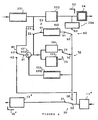
- Figure 4 shows in more detail the modem 2 and in particular means for switching or switching the operation of the assembly or common filter block.
- the bits to be transmitted in the form of symbols by the interface block 13 ' are applied to the coding block 11'.
- the interface block 13 ' is connected at the input to the common output terminal 31 of a 2-way switch or switch 30 or terminals, including one terminal 32, without precoding, is connected to the output of the coding block 11 '.
- a terminal 33, transmission with precoding, of the switch 30 allows to insert the filter assembly between blocks 11 'and 13'.
- the internal connections shown are either of the serial type or of the type parallel, possibly in the form of a bus common to several blocks functional.
- the switcher 30 and the others 40, 50, 60, 70 mentioned below are represented as a relay contact to two positions.
- the terminals have a reference whose ten is that of the signalman, the unit digit being 1 for the terminal common, equal to 2 for the active terminal when the filter assembly is inserted in the reception chain 20 and worth 3 for the active terminal when this set is inserted into the transmission chain 10 ', for precoding.
- the parallel terminals of the various switches are respectively called reception terminal and transmission terminal, these qualifications designating only the state of the connections, for filtering in transmission or reception, regardless of whether the terminal considered is a signal input or output from the signalman in question.
- the filter block of this set bearing the double reference 123 ', 225, controls the negative input of the double reference subtractor 121 ', 222, the positive input of which is connected to the common terminal 41 of the switch 40 whose transmission terminal 43 is connected to the reception terminal 32 of the switch 30.
- the output of the head filter 221, connected to the modulo operator unit referenced 223, is further connected to the reception terminal 42 of the switchman 40 as well as at the transmission terminal 53 of the switch 50.
- a block 150 with an algorithm for calculating the adaptation of the coefficients of weighting of the filter block 123 ', 225, is connected, on one side, to the terminal common 51 of the switch 50 and, on the other hand, to the common terminal 61 of the switcher 60, whose transmitting terminal 63 is connected, through the block comparator 224, to the link connecting the output of the modulo operator block referenced 223 in the decoding and decision block 24.
- Terminal 62 of switch 60 is connected to the input of the filter unit 123 ', 225, at transmission terminal 33 and at common terminal 71 of the switch 70.
- the link connecting the output of the subtractor 121 ', 222, to the operator modulo referenced 122 ′ is also connected to the reception terminal 52 as well as to the input of a sign processing block 124 ′.
- reception 72 and transmission 73 terminals are respectively connected at the output of the sign processing block 124 'and the operator block 122' modulo.
- Block 150 is therefore either connected in parallel to block 223 modulo operator and block 224, through transmission terminals 53 and 63, i.e. connected, on one side, to the output of subtractor 121 ', 222 by terminal 52 and, from the other, at the input of the filter block 123 ', 225 via terminal 62.
- FIG. 4 represents the state, called reception, of the dispatchers, for which the common terminal is connected to the reception terminal, with even reference (2), blocks 11 'and 13' of the transmission chain are connected directly by the terminals 31, 32.
- the signal to be transmitted which is also derived towards the transmission terminal 43, cannot be propagated further by this derivation since it is isolated.
- the subtractor 121 ′, 222 receives the signal from the filter block of head 221 through the reception terminal 42 and the sign block 124 'is brought into service through terminal 72 and therefore controls the filter block 123 ', 225.
- the output of the subtractor 121 ′, 222 also controls the algorithm block 150, through terminal 52, this providing the filter block 123 ′, 225, via terminal 62, new values of weighting coefficients, updated according to the output signals of the subtractor 121 ', 222.
- the signal to be transmitted is precoded by the entire filter block 123 ', 225 associated with the operator 122' modulo transmission according to FIG. 2.
- the signal to be transmitted reaches the subtractor 121 ′, 222 through the transmission terminal 43 and therefore crosses the block 122 'operator emission modulo.
- the output of the latter is then connected, by the terminal 73, to the filter block 123 ', 225 and to the interface block 13' by the transmission terminal 33.
- the algorithm block 150 is then in parallel on block 223 modulo reception operator and comparator block 224, via terminals 53 and 63, to process the symbol signals received and adapt the filtering block of head 221.
- the algorithm block 150 includes a random access memory buffer for keep the two sets of adaptation parameter values, in transmission and in reception, in particular to transmit the distortion parameters in reception at the precoding block 12 of the associated modem 1, before switching its operating in transmission mode of useful symbols to modem 1. This transmission takes place through the reception chain 20 'and the internal link 15, for the transmission of useful data to the modem 2.
Landscapes
- Engineering & Computer Science (AREA)
- Computer Networks & Wireless Communication (AREA)
- Signal Processing (AREA)
- Physics & Mathematics (AREA)
- Spectroscopy & Molecular Physics (AREA)
- Power Engineering (AREA)
- Cable Transmission Systems, Equalization Of Radio And Reduction Of Echo (AREA)
Applications Claiming Priority (2)
| Application Number | Priority Date | Filing Date | Title |
|---|---|---|---|
| FR0100865 | 2001-01-23 | ||
| FR0100865A FR2819970B1 (fr) | 2001-01-23 | 2001-01-23 | Procede de mise en service et d'utilisation d'une liaison bidirectionnelle de donnees et modem pour la mise en oeuvre du procede |
Publications (2)
| Publication Number | Publication Date |
|---|---|
| EP1225738A1 true EP1225738A1 (de) | 2002-07-24 |
| EP1225738B1 EP1225738B1 (de) | 2008-04-02 |
Family
ID=8859121
Family Applications (1)
| Application Number | Title | Priority Date | Filing Date |
|---|---|---|---|
| EP20020290161 Expired - Lifetime EP1225738B1 (de) | 2001-01-23 | 2002-01-23 | Adaptives bidirektionales Modem, mit gemeinsamen Filtermitteln für die Sende- und Empfangseinrichtungen und angeordnet um wechselweise zu funktionieren |
Country Status (3)
| Country | Link |
|---|---|
| EP (1) | EP1225738B1 (de) |
| DE (1) | DE60225863T2 (de) |
| FR (1) | FR2819970B1 (de) |
Citations (3)
| Publication number | Priority date | Publication date | Assignee | Title |
|---|---|---|---|---|
| EP0529986A2 (de) * | 1991-08-30 | 1993-03-03 | International Control Automation Finance S.A. | FSK-Modulator und Demodulator |
| US5881108A (en) * | 1996-02-22 | 1999-03-09 | Globespan Technologies, Inc. | Adaptive pre-equalizer for use in data communications equipment |
| US5881363A (en) * | 1996-04-29 | 1999-03-09 | Philips Electronics North America | Method and apparatus for combatting ingress and multipath in a CATV return channel |
-
2001
- 2001-01-23 FR FR0100865A patent/FR2819970B1/fr not_active Expired - Lifetime
-
2002
- 2002-01-23 EP EP20020290161 patent/EP1225738B1/de not_active Expired - Lifetime
- 2002-01-23 DE DE2002625863 patent/DE60225863T2/de not_active Expired - Lifetime
Patent Citations (3)
| Publication number | Priority date | Publication date | Assignee | Title |
|---|---|---|---|---|
| EP0529986A2 (de) * | 1991-08-30 | 1993-03-03 | International Control Automation Finance S.A. | FSK-Modulator und Demodulator |
| US5881108A (en) * | 1996-02-22 | 1999-03-09 | Globespan Technologies, Inc. | Adaptive pre-equalizer for use in data communications equipment |
| US5881363A (en) * | 1996-04-29 | 1999-03-09 | Philips Electronics North America | Method and apparatus for combatting ingress and multipath in a CATV return channel |
Also Published As
| Publication number | Publication date |
|---|---|
| FR2819970A1 (fr) | 2002-07-26 |
| EP1225738B1 (de) | 2008-04-02 |
| DE60225863D1 (de) | 2008-05-15 |
| FR2819970B1 (fr) | 2003-02-28 |
| DE60225863T2 (de) | 2009-07-16 |
Similar Documents
| Publication | Publication Date | Title |
|---|---|---|
| US4995057A (en) | Technique for achieving the theoretical coding gain of digital signals incorporating error correction | |
| KR100346530B1 (ko) | 데이타통신장비용하이브리드등화기장치 | |
| CA2158014C (en) | Adaptive noise-predictive partial-response equalization for channels with spectral nulls | |
| EP0707400B1 (de) | Hybrid-Entzerrer für eine Datenübertragungseinrichtung | |
| EP0332655B1 (de) | Verfahren und gerät zur entzerrung in datenübertragungssystemen | |
| EP1232617B1 (de) | Verfahren und empfänger zum weissmachen einer signalstörung in einem kommunikationssystem | |
| EP0146979B1 (de) | Verfahren und Einrichtung zur Bestimmung der optimalen Lage des Referenzkoeffizienten eines adaptiven Entzerrers | |
| US20020094043A1 (en) | Apparatus, method and system for correlated noise reduction in a trellis coded environment | |
| US20130148712A1 (en) | Conditional adaptation of linear filters in a system having nonlinearity | |
| US6243425B1 (en) | Adaptive precoding system and method for equalizing communication signal | |
| WO2004077111A2 (en) | Adaptive optical transponder | |
| FR2652692A1 (fr) | Procede et appareil pour obtenir le gain de codage integral pour des signaux numeriques codes. | |
| JPH0629866A (ja) | モジュロ復号器 | |
| CA1137176A (fr) | Procede de compensation des bruits de phase a la reception d'une transmission de donnees | |
| US5963598A (en) | Symbol decoder | |
| US7161980B2 (en) | Receiver for high rate digital communication system | |
| EP1748611B1 (de) | Entzerrerschaltung und -verfahren für hohe Datenraten | |
| US6996230B1 (en) | Echo-canceler for precoded fractionally spaced receiver using signal estimator | |
| US6721279B1 (en) | Method and apparatus for adaptive PCM level estimation and constellation training | |
| WO1999027702A1 (fr) | Mise en communication d'equipements terminaux | |
| Kammeyer | Time truncation of channel impulse responses by linear filtering: A method to reduce the complexity of Viterbi equalization | |
| FR2679721A1 (fr) | Procede d'egalisation adaptative reduisant l'interference intersymbole, et dispositif de reception et application correspondants. | |
| EP1225738B1 (de) | Adaptives bidirektionales Modem, mit gemeinsamen Filtermitteln für die Sende- und Empfangseinrichtungen und angeordnet um wechselweise zu funktionieren | |
| EP2798805A1 (de) | Digitales filter, entzerrer mit partieller reaktion und digitaler kohärenzempfänger sowie verfahren | |
| Wettlin et al. | Investigation of weighted DFE for high-rate short-reach transmission |
Legal Events
| Date | Code | Title | Description |
|---|---|---|---|
| PUAI | Public reference made under article 153(3) epc to a published international application that has entered the european phase |
Free format text: ORIGINAL CODE: 0009012 |
|
| AK | Designated contracting states |
Kind code of ref document: A1 Designated state(s): AT BE CH CY DE DK ES FI FR GB GR IE IT LI LU MC NL PT SE TR |
|
| AX | Request for extension of the european patent |
Free format text: AL;LT;LV;MK;RO;SI |
|
| 17P | Request for examination filed |
Effective date: 20030124 |
|
| AKX | Designation fees paid |
Designated state(s): BE DE GB IT |
|
| RAP1 | Party data changed (applicant data changed or rights of an application transferred) |
Owner name: SAGEM COMMUNICATION |
|
| 17Q | First examination report despatched |
Effective date: 20070411 |
|
| GRAP | Despatch of communication of intention to grant a patent |
Free format text: ORIGINAL CODE: EPIDOSNIGR1 |
|
| GRAS | Grant fee paid |
Free format text: ORIGINAL CODE: EPIDOSNIGR3 |
|
| GRAA | (expected) grant |
Free format text: ORIGINAL CODE: 0009210 |
|
| AK | Designated contracting states |
Kind code of ref document: B1 Designated state(s): BE DE GB IT |
|
| REG | Reference to a national code |
Ref country code: GB Ref legal event code: FG4D Free format text: NOT ENGLISH |
|
| REF | Corresponds to: |
Ref document number: 60225863 Country of ref document: DE Date of ref document: 20080515 Kind code of ref document: P |
|
| PLBE | No opposition filed within time limit |
Free format text: ORIGINAL CODE: 0009261 |
|
| STAA | Information on the status of an ep patent application or granted ep patent |
Free format text: STATUS: NO OPPOSITION FILED WITHIN TIME LIMIT |
|
| 26N | No opposition filed |
Effective date: 20090106 |
|
| PGFP | Annual fee paid to national office [announced via postgrant information from national office to epo] |
Ref country code: GB Payment date: 20201218 Year of fee payment: 20 |
|
| PGFP | Annual fee paid to national office [announced via postgrant information from national office to epo] |
Ref country code: BE Payment date: 20201222 Year of fee payment: 20 |
|
| PGFP | Annual fee paid to national office [announced via postgrant information from national office to epo] |
Ref country code: DE Payment date: 20201217 Year of fee payment: 20 |
|
| PGFP | Annual fee paid to national office [announced via postgrant information from national office to epo] |
Ref country code: IT Payment date: 20210104 Year of fee payment: 20 |
|
| REG | Reference to a national code |
Ref country code: DE Ref legal event code: R071 Ref document number: 60225863 Country of ref document: DE |
|
| REG | Reference to a national code |
Ref country code: GB Ref legal event code: PE20 Expiry date: 20220122 |
|
| REG | Reference to a national code |
Ref country code: BE Ref legal event code: MK Effective date: 20220123 |
|
| PG25 | Lapsed in a contracting state [announced via postgrant information from national office to epo] |
Ref country code: GB Free format text: LAPSE BECAUSE OF EXPIRATION OF PROTECTION Effective date: 20220122 |