EP1226042B1 - Pneu a haute performance a bande de roulement dotee d'une sous-couche anisotrope stable aux variations de temperature - Google Patents
Pneu a haute performance a bande de roulement dotee d'une sous-couche anisotrope stable aux variations de temperature Download PDFInfo
- Publication number
- EP1226042B1 EP1226042B1 EP00947937A EP00947937A EP1226042B1 EP 1226042 B1 EP1226042 B1 EP 1226042B1 EP 00947937 A EP00947937 A EP 00947937A EP 00947937 A EP00947937 A EP 00947937A EP 1226042 B1 EP1226042 B1 EP 1226042B1
- Authority
- EP
- European Patent Office
- Prior art keywords
- underlayer
- tyre according
- fibres
- tyre
- layer
- Prior art date
- Legal status (The legal status is an assumption and is not a legal conclusion. Google has not performed a legal analysis and makes no representation as to the accuracy of the status listed.)
- Expired - Lifetime
Links
- 150000001875 compounds Chemical class 0.000 claims abstract description 32
- 229920005989 resin Polymers 0.000 claims abstract description 21
- 239000011347 resin Substances 0.000 claims abstract description 21
- 230000003014 reinforcing effect Effects 0.000 claims abstract description 17
- 229920001971 elastomer Polymers 0.000 claims abstract description 13
- 239000000806 elastomer Substances 0.000 claims abstract description 3
- 238000000034 method Methods 0.000 claims abstract 4
- GHMLBKRAJCXXBS-UHFFFAOYSA-N resorcinol Chemical compound OC1=CC=CC(O)=C1 GHMLBKRAJCXXBS-UHFFFAOYSA-N 0.000 claims description 24
- 125000000325 methylidene group Chemical group [H]C([H])=* 0.000 claims description 10
- NTUYQCWDUQBNTK-UHFFFAOYSA-N 2-N,2-N,1,2,5,6-hexamethoxy-6-(methylideneamino)-1,3,5-triazine-2,4-diamine Chemical compound CON(C1(N(C(N(C(=N1)N)OC)(N=C)OC)OC)OC)OC NTUYQCWDUQBNTK-UHFFFAOYSA-N 0.000 claims description 9
- 229920003235 aromatic polyamide Polymers 0.000 claims description 9
- 241000531908 Aramides Species 0.000 claims description 8
- 238000003490 calendering Methods 0.000 claims description 6
- 238000004519 manufacturing process Methods 0.000 claims description 5
- 229920002647 polyamide Polymers 0.000 claims description 4
- 229920000728 polyester Polymers 0.000 claims description 4
- 229920000098 polyolefin Polymers 0.000 claims description 4
- 239000004952 Polyamide Substances 0.000 claims description 3
- 239000004372 Polyvinyl alcohol Substances 0.000 claims description 3
- 229920005862 polyol Polymers 0.000 claims description 3
- 229920002451 polyvinyl alcohol Polymers 0.000 claims description 3
- OKTJSMMVPCPJKN-UHFFFAOYSA-N Carbon Chemical compound [C] OKTJSMMVPCPJKN-UHFFFAOYSA-N 0.000 claims 2
- 229910052799 carbon Inorganic materials 0.000 claims 2
- 239000003365 glass fiber Substances 0.000 claims 2
- 239000012783 reinforcing fiber Substances 0.000 abstract 1
- 239000005060 rubber Substances 0.000 description 10
- 244000043261 Hevea brasiliensis Species 0.000 description 8
- VKYKSIONXSXAKP-UHFFFAOYSA-N hexamethylenetetramine Chemical compound C1N(C2)CN3CN1CN2C3 VKYKSIONXSXAKP-UHFFFAOYSA-N 0.000 description 8
- 229920003052 natural elastomer Polymers 0.000 description 7
- 229920001194 natural rubber Polymers 0.000 description 7
- XLOMVQKBTHCTTD-UHFFFAOYSA-N Zinc monoxide Chemical compound [Zn]=O XLOMVQKBTHCTTD-UHFFFAOYSA-N 0.000 description 6
- 229920000271 Kevlar® Polymers 0.000 description 5
- 239000011324 bead Substances 0.000 description 5
- 239000000203 mixture Substances 0.000 description 5
- 229920003048 styrene butadiene rubber Polymers 0.000 description 5
- 239000004677 Nylon Substances 0.000 description 4
- 239000002174 Styrene-butadiene Substances 0.000 description 4
- NINIDFKCEFEMDL-UHFFFAOYSA-N Sulfur Chemical compound [S] NINIDFKCEFEMDL-UHFFFAOYSA-N 0.000 description 4
- 239000006229 carbon black Substances 0.000 description 4
- 235000010299 hexamethylene tetramine Nutrition 0.000 description 4
- 239000004312 hexamethylene tetramine Substances 0.000 description 4
- 229920001778 nylon Polymers 0.000 description 4
- 239000004594 Masterbatch (MB) Substances 0.000 description 3
- 239000000463 material Substances 0.000 description 3
- 238000005096 rolling process Methods 0.000 description 3
- 239000011787 zinc oxide Substances 0.000 description 3
- VYPSYNLAJGMNEJ-UHFFFAOYSA-N Silicium dioxide Chemical compound O=[Si]=O VYPSYNLAJGMNEJ-UHFFFAOYSA-N 0.000 description 2
- PPBRXRYQALVLMV-UHFFFAOYSA-N Styrene Chemical compound C=CC1=CC=CC=C1 PPBRXRYQALVLMV-UHFFFAOYSA-N 0.000 description 2
- 239000005864 Sulphur Substances 0.000 description 2
- 239000003963 antioxidant agent Substances 0.000 description 2
- 235000006708 antioxidants Nutrition 0.000 description 2
- 239000004760 aramid Substances 0.000 description 2
- 239000004615 ingredient Substances 0.000 description 2
- 239000002184 metal Substances 0.000 description 2
- 229910052751 metal Inorganic materials 0.000 description 2
- 229920000642 polymer Polymers 0.000 description 2
- KUAZQDVKQLNFPE-UHFFFAOYSA-N thiram Chemical compound CN(C)C(=S)SSC(=S)N(C)C KUAZQDVKQLNFPE-UHFFFAOYSA-N 0.000 description 2
- 229960002447 thiram Drugs 0.000 description 2
- 238000004804 winding Methods 0.000 description 2
- CBCKQZAAMUWICA-UHFFFAOYSA-N 1,4-phenylenediamine Chemical compound NC1=CC=C(N)C=C1 CBCKQZAAMUWICA-UHFFFAOYSA-N 0.000 description 1
- LFQSCWFLJHTTHZ-UHFFFAOYSA-N Ethanol Chemical compound CCO LFQSCWFLJHTTHZ-UHFFFAOYSA-N 0.000 description 1
- 229920000561 Twaron Polymers 0.000 description 1
- 229920000180 alkyd Polymers 0.000 description 1
- 230000003078 antioxidant effect Effects 0.000 description 1
- 230000003542 behavioural effect Effects 0.000 description 1
- 230000000052 comparative effect Effects 0.000 description 1
- 230000000694 effects Effects 0.000 description 1
- 238000011156 evaluation Methods 0.000 description 1
- 238000001125 extrusion Methods 0.000 description 1
- 239000011521 glass Substances 0.000 description 1
- 238000009776 industrial production Methods 0.000 description 1
- 238000005304 joining Methods 0.000 description 1
- CMAUJSNXENPPOF-UHFFFAOYSA-N n-(1,3-benzothiazol-2-ylsulfanyl)-n-cyclohexylcyclohexanamine Chemical compound C1CCCCC1N(C1CCCCC1)SC1=NC2=CC=CC=C2S1 CMAUJSNXENPPOF-UHFFFAOYSA-N 0.000 description 1
- 230000002035 prolonged effect Effects 0.000 description 1
- 238000007493 shaping process Methods 0.000 description 1
- 239000000377 silicon dioxide Substances 0.000 description 1
- 239000000126 substance Substances 0.000 description 1
Images

Classifications
-
- B—PERFORMING OPERATIONS; TRANSPORTING
- B60—VEHICLES IN GENERAL
- B60C—VEHICLE TYRES; TYRE INFLATION; TYRE CHANGING; CONNECTING VALVES TO INFLATABLE ELASTIC BODIES IN GENERAL; DEVICES OR ARRANGEMENTS RELATED TO TYRES
- B60C11/00—Tyre tread bands; Tread patterns; Anti-skid inserts
- B60C11/14—Anti-skid inserts, e.g. vulcanised into the tread band
-
- B—PERFORMING OPERATIONS; TRANSPORTING
- B60—VEHICLES IN GENERAL
- B60C—VEHICLE TYRES; TYRE INFLATION; TYRE CHANGING; CONNECTING VALVES TO INFLATABLE ELASTIC BODIES IN GENERAL; DEVICES OR ARRANGEMENTS RELATED TO TYRES
- B60C1/00—Tyres characterised by the chemical composition or the physical arrangement or mixture of the composition
- B60C1/0016—Compositions of the tread
-
- B—PERFORMING OPERATIONS; TRANSPORTING
- B60—VEHICLES IN GENERAL
- B60C—VEHICLE TYRES; TYRE INFLATION; TYRE CHANGING; CONNECTING VALVES TO INFLATABLE ELASTIC BODIES IN GENERAL; DEVICES OR ARRANGEMENTS RELATED TO TYRES
- B60C11/00—Tyre tread bands; Tread patterns; Anti-skid inserts
-
- B—PERFORMING OPERATIONS; TRANSPORTING
- B60—VEHICLES IN GENERAL
- B60C—VEHICLE TYRES; TYRE INFLATION; TYRE CHANGING; CONNECTING VALVES TO INFLATABLE ELASTIC BODIES IN GENERAL; DEVICES OR ARRANGEMENTS RELATED TO TYRES
- B60C11/00—Tyre tread bands; Tread patterns; Anti-skid inserts
- B60C11/0041—Tyre tread bands; Tread patterns; Anti-skid inserts comprising different tread rubber layers
- B60C11/005—Tyre tread bands; Tread patterns; Anti-skid inserts comprising different tread rubber layers with cap and base layers
-
- B—PERFORMING OPERATIONS; TRANSPORTING
- B60—VEHICLES IN GENERAL
- B60C—VEHICLE TYRES; TYRE INFLATION; TYRE CHANGING; CONNECTING VALVES TO INFLATABLE ELASTIC BODIES IN GENERAL; DEVICES OR ARRANGEMENTS RELATED TO TYRES
- B60C9/00—Reinforcements or ply arrangement of pneumatic tyres
- B60C9/18—Structure or arrangement of belts or breakers, crown-reinforcing or cushioning layers
- B60C9/20—Structure or arrangement of belts or breakers, crown-reinforcing or cushioning layers built-up from rubberised plies each having all cords arranged substantially parallel
- B60C9/22—Structure or arrangement of belts or breakers, crown-reinforcing or cushioning layers built-up from rubberised plies each having all cords arranged substantially parallel the plies being arranged with all cords disposed along the circumference of the tyre
-
- Y—GENERAL TAGGING OF NEW TECHNOLOGICAL DEVELOPMENTS; GENERAL TAGGING OF CROSS-SECTIONAL TECHNOLOGIES SPANNING OVER SEVERAL SECTIONS OF THE IPC; TECHNICAL SUBJECTS COVERED BY FORMER USPC CROSS-REFERENCE ART COLLECTIONS [XRACs] AND DIGESTS
- Y10—TECHNICAL SUBJECTS COVERED BY FORMER USPC
- Y10T—TECHNICAL SUBJECTS COVERED BY FORMER US CLASSIFICATION
- Y10T152/00—Resilient tires and wheels
- Y10T152/10—Tires, resilient
- Y10T152/10495—Pneumatic tire or inner tube
-
- Y—GENERAL TAGGING OF NEW TECHNOLOGICAL DEVELOPMENTS; GENERAL TAGGING OF CROSS-SECTIONAL TECHNOLOGIES SPANNING OVER SEVERAL SECTIONS OF THE IPC; TECHNICAL SUBJECTS COVERED BY FORMER USPC CROSS-REFERENCE ART COLLECTIONS [XRACs] AND DIGESTS
- Y10—TECHNICAL SUBJECTS COVERED BY FORMER USPC
- Y10T—TECHNICAL SUBJECTS COVERED BY FORMER US CLASSIFICATION
- Y10T152/00—Resilient tires and wheels
- Y10T152/10—Tires, resilient
- Y10T152/10495—Pneumatic tire or inner tube
- Y10T152/10513—Tire reinforcement material characterized by short length fibers or the like
Definitions
- the present invention relates to high performance tyres such as, for example, tyres designed for high-powered cars or, more generally, tyres intended for applications involving high operating speeds.
- HP and UHP High Performance and Ultra High Performance tyres
- HP and UHP High Performance and Ultra High Performance tyres
- V and Z Classes “V” and “Z” that respectively provide for maximum speeds over 210 Km/h and 240 Km/h, for which the operating performance is undoubtedly one of the most important features.
- This performance depends both on the friction coefficient (or grip) and on the response to lateral stresses of the tyre during rolling on the road surface.
- the friction coefficient depends on the properties of the compound used for the tread, while the response to lateral stresses and to centrifugal forces depends on the tyre structure; for these reasons there exist structures designed to compensate for the force systems to which HP and UHP tyres are subject.
- One of these structures envisages the presence of a so-called "0°” layer, namely a layer of rubber reinforced by a cord which is usually heat-shrinkable, for example made of nylon, wound spirally in the circumferential direction around the tyre belt.
- the winding angle of the cord with respect to a median (or equatorial) plane of the tyre is fairly small and it is for this reason that the layer in which it is located, is referred to as a "0°" layer; the tread band is then mounted on top of this layer.
- the first of these documents suggests to combine an underlayer with an external cap having a high grip and a predefined ratio between its modulus of elasticity and that of the underlayer, in order to improve the steering performance of the tyre at high speeds.
- European patent EP 592218 teaches, on the other hand, to add reinforcing fibres to the compound of the underlayer and orienting them in a particular manner so as to obtain an anisotropic behaviour thereof with a different modulus of elasticity, respectively, in a circumferential and a transverse direction with respect to the tyre.
- European patent Application EP 904 958 discloses a tyre with tread band having a cap and base structure; the rubber compound in this case is reinforced with short fibres having a sea-island cross section composed of at least two polymers.
- These fibres consist of materials such as polyamides (in particular aromatic polyamides shortly referred to as “aramides”), polyesters or polyolefins, which are already known in the art for their use in the manufacture of tyres.
- the HP and UHP tyres currently known are not fully satisfactory from the point of view of their performance at high speed and over long operating periods: the present invention proposes to solve this problem by providing a high performance tyre having structural and operating features that remain substantially unvaried during the different conditions of use.
- the invention arises from the Applicant's realization that the characteristics of a high modulus and/or hardness of the compound of the underlayer, as an alternative to or in combination with each other, must also be guaranteed at the high speeds referred to above and in particular must not deteriorate with an increase in the temperature due to prolonged use at high speed, and that this object may be attained using the abovementioned fibres.
- the Applicant has discovered that the problem may be solved using a tyre wherein on the reinforcing layer with cord at 0°, there is applied a tread band with a "cap and base” structure whose underlayer has hardness and/or elasticity values which are substantially stable between 23°C and 100°C.
- the tyre ensures a uniform performance also at the high operating speeds which may cause a substantial increase in the temperature of the tread.
- the invention relates to a tyre wherein the hardness of the tread underlayer between 23°C e 100°C does not vary by more than five units on the IRHD (International Rubber Hardness Degrees) scale; preferably this variation must not exceed three units and, even better, one IRHD unit.
- IRHD International Rubber Hardness Degrees
- the tyre tread band has an underlayer with a dynamic modulus (E') which between 70°C and 100°C does not vary by more than 10% and, preferably, varies by less than 5%.
- E' dynamic modulus
- the tread underlayer also has high ratios (greater than 4) between the rigidity in the direction of travel (i.e. in the circumferential direction) and in the direction perpendicular to it; this means that it has an anisotropic behaviour.
- the properties of the tread underlayer indicated above may be obtained using a compound reinforced with a quantity of fibres preferably ranging between 3 and 10 phr (parts per hundred of rubber), and even more preferably between 6 and 9 phr, in combination with hardening resins; the latter are preferably based on resorcinol and methylene donors.
- methylene donors include hexamethoxymethylenemelamine (HMMM) or hexamethylenetetramine (HMT); the Applicant has found, however, that other methylene donors and other types of hardening resins may be used.
- HMMM hexamethoxymethylenemelamine
- HMT hexamethylenetetramine
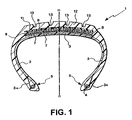
- reference 1 indicates a tyre according to the invention.
- This tyre comprises a carcass provided with at least one ply 3, the ends 3a thereof are associated with respective cores 4 (commonly known as bead wires), each of which is incorporated in a bead 5 defined along the inner circumferential edge of the tyre; the core or bead wire 4 of the beads may be constructed in any manner known in the art, for example using metal wires or cords.
- cores 4 commonly known as bead wires
- the beads 5 are intended to rest against the edge of the rim, not shown in the drawings, on which the tyre 1 is mounted.
- one or more belt layers 7 made conventionally with a meshwork of metal strands or cords embedded in a rubber sheet, and arranged parallel to each other in a layer and crossed with respect to those of the adjacent layer.
- the belt 7 there is the 0° layer in which a cord 8, for example made of nylon, is spirally wound coaxially with the tyre; the winding angle of the cord 8 is, as usual, small with respect to a median plane m-m of the tyre and said cord is also incorporated in a rubber layer, as is commonly performed in the art (using so-called "strips" or other solutions).
- a cord 8 for example made of nylon
- the tyre 1 also has a tread band 10 which is peripherally mounted around the 0° layer, more specifically, this tread band is of the "cap and base" type formed by an underlayer 11 and an external layer 12 on which a tread pattern, comprising recesses and grooves 13 that define a plurality of seams and blocks, is formed in a conventional manner.
- the underlayer 11 of the tread 10 in this case has a uniform thickness; preferably this thickness is greater than 1 mm and, even, more preferably, is between 1.5 and 2 mm.
- the thickness of the underlayer 11 may in any case not be uniform but, for example, greater in the vicinity of its outer edges (with reference to the cross-sections shown in Figs. 1 and 2) and/or in the central zone.
- the external layer 12 of the tread band must have a thickness at least equal to, and preferably greater than, that of the grooves 13 (usually 7-8 mm. in car tyres), so as not to allow the underlayer to come into contact with the road when the external layer is worn.
- the compound from which the underlayer 11 is formed is preferably reinforced with aramide fibres, in this case made from Kevlar® produced by the company Du Pont de Nemour, in the present example these fibres have a configuration with a main trunk having a diameter D equal to about 10 ⁇ m and a length L of about 200 ⁇ m, from which small branches or fibrils extend.
- aramide fibres in this case made from Kevlar® produced by the company Du Pont de Nemour, in the present example these fibres have a configuration with a main trunk having a diameter D equal to about 10 ⁇ m and a length L of about 200 ⁇ m, from which small branches or fibrils extend.
- the fibres have an aspect ratio L/D of the order of 20 units.
- Kevlar® pulp a material has been used in which the abovementioned fibres (commonly known as "Kevlar® pulp") are dispersed in a natural rubber, thereby giving rise to a "masterbatch” distributed by the company Du Pont under the tradename Kevlartex®, having a composition of 23 % Kevlar® and 77 % natural rubber.
- composition of the compound of the underlayer is shown in detail in Table 1, where for the various elements the common tradename and a brief chemical definition are indicated.
- E-SBR emulsion-polymerized rubber
- ASTM Standard emulsion-polymerized rubber
- N the abbreviation consisting of the letter N followed by a number indicates the type of carbon black in the ASTM nomenclature.
- Table 1 refers to the percentages with respect to the rubber (phr) and the overall compound; in the case in question it just has to be mentioned that the compound used contains 39 phr of Kevlartex® and therefore, in view of the composition of this masterbatch, it means that basically the 39 phr present are divided up into 30 phr of natural rubber (NR) and 9 phr of aramide fibres.
- the preferred methylene donors include, in addition to HMMM, hexamethylenetetramine (HMT); other donors, however, could also be used and the hardening resins may also be in the precbndensed form.
- HMT hexamethylenetetramine
- hardening resins such as, for example, those based on epoxides-polyols, epoxides-diamines, epoxides-dicarboxylic acids or resins obtained by reacting alcohol with a diacid (alkyd resins).
- These resins may be used either in precondensed form and in the form of two components.
- the quantity of hardening resins utilized in the compound of the underlayer may be optimized depending on the mechanical properties (modulus, hardness, etc.) which are to be obtained.
- a quantity of precondensed resin greater than 0.5 phr.
- a quantity of resorcinol greater than 0.5 phr and a quantity of methylene donor (type HMMM) which is in a ratio of between 0.5 and 3 therewith.
- the underlayer 11 obtained with the compound according to the invention may be coextruded together with the external layer 12, or may be formed separately and assembled together with the latter subsequently; coextrusion is, however, preferable for obtaining underlayers of limited thickness and if necessary for shaping their profile.
- test-pieces were formed by rolling up strips slightly wider than 25 mm (i.e. the height of the test pieces themselves), which were obtained by calendering a 1 mm thick strip cut in the direction of orientation of the fibres inside it; following rolling-up of the strips, the fibres are then arranged in the circumferential direction with respect to the cylinder which forms the test piece.
- test pieces were then vulcanized for a duration of 30 minutes at 151°C and subjected to dynamic tests performed with a (sinusoidal) frequency of 100 Hz, applying an initial pre-strain of 10 % and a true dynamic strain equal to 0.033; this latter variable represents the deformation in relation to the length of the pre-deformed test piece.
- Such load values were obtained in accordance with the standard ASTM 412, by subjecting to traction traditional test pieces of the Dunbbell type; they provide an evaluation of the strenght of the underlayer in mutually perpendicular directions.
- the ratio M1/M2 shown in the table constitutes an index of the anisotropy of the underlayer due to the presence of the oriented fibres.
- Table 2 also shows the results of comparative experiments carried out on samples of compounds corresponding to the already mentioned European patent EP 592218 (Sumitomo Rubber Industries) and patent CA 1228282 (Bridgestone), respectively.
- Example 3 IRHD at 23°C 90 89 77.5 IRHD at 100 °C 89 83 67.4 Load M1 at 10 % elongation in the calendering direct-ion (MPa) 11.77 11.62 2.5 Load M2 at 10 % elongation in the direction transverse to that of calendering (MPa) 1.23 1.5 2.05 M1/M2 9.6 7.75 1.22 E' 23°C (MPa) 36.71 34.91 11.42 E' 70°C (MPa) 33.18 20.32 7.16 E' 100°C (MPa) 33.15 16.67 5.7
- the hardness is very stable between 23°C and 100°C (ranging from 90 IRHD to 89 IRHD within the limits of the measuring range); more generally, the hardness variation must in any case not be greater than 5 IRHD in the abovementioned temperature range.
- the hardness of the underlayer in terms of absolute value, is preferably greater than that of the external layer of the tread band; more specifically, this hardness must be preferably greater than 80 IRHD at 100°C and, even more preferably, greater than 85 IRHD at 100°C.
- the variation of the elastic modulus E' is not greater than 10 % and, even more preferably 5%, in the abovementioned temperature range.
- the absolute value of the elastic modulus E' of the underlayer is preferably greater than that of external layer of the tread band: more specifically, this modulus must be preferably greater than 15 MPa at 100 °C and, even more preferably, greater than 20 MPa at this temperature.
- the Applicant has realized that, with the values for hardness and/or elastic modulus E' mentioned above, a substantial qualitative increase in all the known tyres is obtained, independently of the characteristics of the external layer of the tread band.
- the tyres manufactured in accordance with the invention have achieved surprisingly superior results compared to other tyres of the HP and UHP type; these results are summarised in the following Table 4 showing ratings on a scale of values ranging from - 2 a + 2, in respect of particular behavioural parameters of the tyres.
- Table 4 confirms what was stated above regarding the results achieved by the invention; the tyre, indeed, achieves excellent results for all the parameters considered, obtaining the maximum rating in all the categories and being remarkably superior to the tyre of Example 3, with the sole exception of the grip.
- the grip of a tyre depends in particular on the compound of the "cap" of the tread and not on that of the underlayer, in this case, since the same compound has been used for the external layer of the tyre according to the invention and that of the tyre according to Example 3, the data relating to the grip is itself consistent with that which could be expected.
- the reinforcing fibres used may be different from the Kevlar® mentioned above; other aramide fibres may indeed be used, such as for example those known with the name Twaron® and distributed by the company Akzo Nobel; also in general the Applicant has found that it is possible to use fibres based on other polyamides or on polyesters, polyolefins, polyvinyl alcohol, nylon, glass or the like.
- the usual thin joining sheet may be inserted between the 0° reinforcing layer and the tread underlayer, as already occurs in the known art.
Landscapes
- Engineering & Computer Science (AREA)
- Mechanical Engineering (AREA)
- Tires In General (AREA)
- Compositions Of Macromolecular Compounds (AREA)
- Ropes Or Cables (AREA)
Claims (22)
- Pneu haute performance comprenant une carcasse munie d'au moins une nappe de carcasse (3), une ceinture appliquée de manière circonférentielle sur la carcasse dans laquelle il y a deux couches (7), ou plus, de câbles de renforcement qui sont parallèles les uns aux autres dans une couche et croisés par rapport à ceux de la couche adjacente, une couche radialement extérieure (8) de câbles de renforcement orientés de manière circonférentielle appliquée sur la ceinture, une bande de roulement (10) qui comprend une sous-couche (11) et une couche externe (12), caractérisé en ce que la sous-couche (11) est faite d'un composé élastomère comprenant des fibres de renforcement et des résines durcissables, la sous-couche (11) ayant une dureté qui ne varie pas plus de 5 IRHD dans une plage de température comprise entre 23 °C et 100 °C.
- Pneu selon la revendication 1, dans lequel les résines durcissables sont à base de composants choisis parmi un ou plusieurs des ensembles suivants : Resorcinol® et donneurs de méthylène, époxydes et acides dicarboxyliques, époxydes et diamines, époxydes et polyols, alcools et diacides.
- Pneu selon la revendication 2, dans lequel les donneurs de méthylène sont l'hexaméthoxy-méthylène-mélamine (HMMM) ou l'hexaméthoxy-méthylène-tétramine (HMT).
- Pneu selon la revendication 3, dans lequel la sous-couche (11) comprend une résine durcissable à base de Resorcinol® et donneurs de méthylène sous forme précondensée, en quantité supérieure à 0,5 pcpr.
- Pneu selon la revendication 3, dans lequel le composé de la sous-couche comprend une résine durcissable à base de Resorcinol® et donneurs de méthylène sous la forme de deux composants, avec une quantité de Resorcinol® supérieure à 0,5 pcpr et une quantité de donneurs de méthylène qui correspond à un rapport avec un Resorcinol® compris entre 0,5 et 3.
- Pneu selon l'une quelconque des revendications 1 à 5, dans lequel les fibres de renforcement sont choisies parmi : polyamides, polyesters, polyoléfines, fibres de carbone, fibres de verre et poly(alcool vinylique).
- Pneu selon la revendication 6, dans lequel les fibres de renforcement sont des fibres d'aramide.
- Pneu selon la revendication 7, dans lequel le composé de la sous-couche (11) contient une quantité de fibres d'aramide comprise entre 3 et 10 pcpr.
- Pneu selon la revendication 8, dans lequel le composé de la sous-couche (11) contient une quantité de fibres d'aramide comprise entre 6 et 9 pcpr.
- Pneu selon l'une quelconque des revendications précédentes, dans lequel la dureté de la sous-couche ne varie pas plus de 1 IRHD dans une plage de température comprise entre 23 °C et 100 °C.
- Pneu selon l'une quelconque des revendications précédentes, dans lequel la dureté de la sous-couche (11) est supérieure à 80 IRHD à 100 °C.
- Pneu selon la revendication 11, dans lequel la dureté de la sous-couche (11) est supérieure à 85 IRHD à 100 °C.
- Pneu selon l'une quelconque des revendications précédentes, dans lequel la sous-couche (11) a un module d'élasticité (E') qui ne varie pas plus de 10 % dans une plage de température comprise entre 70 °C et 100 °C.
- Pneu selon la revendication 13, dans lequel le module d'élasticité (E') de la sous-couche (11) ne varie pas plus de 5 % dans une plage de température comprise entre 70 °C et 100 °C.
- Pneu selon la revendication 14, dans lequel le module d'élasticité (E') de la sous-couche (11) est supérieur à 15 MPa à 100 °C.
- Pneu selon la revendication 15, dans lequel le module d'élasticité (E') est supérieur à 20 MPa à 100 °C.
- Pneu selon la revendication 1, dans lequel la sous-couche (11) présente un rapport entre la charge d'allongement de 10 % dans la direction circonférentielle et la charge d'allongement de 10 % dans la direction transversale qui est supérieur à 3.
- Pneu selon la revendication 17, dans lequel la sous-couche (11) a une épaisseur comprise entre 1,5 et 2 mm.
- Procédé de fabrication d'un pneu haute performance conforme à l'une quelconque des revendications précédentes, comprenant les étapes consistant à :caractérisé en ce que ladite sous-couche (11) est faite d'un composé thermostable obtenu en utilisant des fibres de renforcement et des résines durcissables.prendre une carcasse munie d'une nappe de carcasse (3),appliquer une ceinture de manière circonférentielle sur ladite carcasse, qui comprend deux couches (7), ou plus, de câbles de renforcement qui sont parallèles les uns aux autres dans une couche et croisés par rapport à ceux de la couche adjacente,appliquer sur la ceinture une couche extérieure de câbles de renforcement (8) orientés de manière circonférentielle,appliquer sur le câble orienté de manière circonférentielle (8) une bande de roulement (10) munie d'une couche externe (12) et d'une sous-couche (11),
- Procédé selon la revendication 19, dans lequel lesdites résines durcissables sont à base de composants choisis parmi un ou plusieurs des ensembles suivants : Resorcinol® et donneurs de méthylène, époxydes et acides dicarboxyliques, époxydes et diamines, époxydes et polyols, alcools et diacides, et dans lequel lesdites fibres de renforcement sont choisies parmi : polyamides, polyesters, polyoléfines, fibres de carbone, fibres de verre et poly(alcool vinylique).
- Procédé selon la revendication 20, dans lequel la bande de roulement (10) est obtenue par coextrusion de la couche externe (12) et de la sous-couche (11).
- Procédé selon la revendication 20, dans lequel ladite sous-couche (11) est obtenue au moyen d'un procédé de calandrage.
Priority Applications (1)
| Application Number | Priority Date | Filing Date | Title |
|---|---|---|---|
| EP00947937A EP1226042B1 (fr) | 1999-07-09 | 2000-07-04 | Pneu a haute performance a bande de roulement dotee d'une sous-couche anisotrope stable aux variations de temperature |
Applications Claiming Priority (6)
| Application Number | Priority Date | Filing Date | Title |
|---|---|---|---|
| EP99202260 | 1999-07-09 | ||
| EP99202260 | 1999-07-09 | ||
| US14597699P | 1999-07-29 | 1999-07-29 | |
| US145976P | 1999-07-29 | ||
| PCT/EP2000/006357 WO2001003954A1 (fr) | 1999-07-09 | 2000-07-04 | Pneu a haute performance a bande de roulement dotee d'une sous-couche anisotrope stable aux variations de temperature |
| EP00947937A EP1226042B1 (fr) | 1999-07-09 | 2000-07-04 | Pneu a haute performance a bande de roulement dotee d'une sous-couche anisotrope stable aux variations de temperature |
Publications (2)
| Publication Number | Publication Date |
|---|---|
| EP1226042A1 EP1226042A1 (fr) | 2002-07-31 |
| EP1226042B1 true EP1226042B1 (fr) | 2004-09-29 |
Family
ID=26153338
Family Applications (1)
| Application Number | Title | Priority Date | Filing Date |
|---|---|---|---|
| EP00947937A Expired - Lifetime EP1226042B1 (fr) | 1999-07-09 | 2000-07-04 | Pneu a haute performance a bande de roulement dotee d'une sous-couche anisotrope stable aux variations de temperature |
Country Status (10)
| Country | Link |
|---|---|
| US (1) | US6805177B2 (fr) |
| EP (1) | EP1226042B1 (fr) |
| JP (1) | JP4649083B2 (fr) |
| AT (1) | ATE277782T1 (fr) |
| AU (1) | AU6155600A (fr) |
| DE (1) | DE60014414T2 (fr) |
| ES (1) | ES2228581T3 (fr) |
| PT (1) | PT1226042E (fr) |
| TR (1) | TR200200007T2 (fr) |
| WO (1) | WO2001003954A1 (fr) |
Families Citing this family (19)
| Publication number | Priority date | Publication date | Assignee | Title |
|---|---|---|---|---|
| KR100717292B1 (ko) | 1998-10-28 | 2007-05-15 | 피렐리 타이어 소시에떼 퍼 아찌오니 | 타이어 및 타이어 제조 방법 |
| WO2005049340A1 (fr) * | 2003-10-31 | 2005-06-02 | Pirelli Pneumatici S.P.A. | Pneu tres performant destine a des roues de vehicule |
| ES2304556T3 (es) * | 2003-12-30 | 2008-10-16 | Pirelli Tyre S.P.A. | Neumatico y procedimiento para su fabricacion. |
| EP1701854B1 (fr) | 2003-12-30 | 2008-04-09 | PIRELLI TYRE S.p.A. | Pneumatique pour vehicules |
| KR100582003B1 (ko) * | 2005-06-03 | 2006-05-22 | 한국타이어 주식회사 | 스터드리스 타이어의 트레드용 고무 조성물 |
| DE602006000118D1 (de) * | 2005-06-03 | 2007-10-31 | Hankook Tire Co Ltd | Kautschukzusammensetzung für spikelose Reifenlaufflächen |
| JP5208361B2 (ja) * | 2005-10-28 | 2013-06-12 | 住友ゴム工業株式会社 | タイヤ用ゴム組成物およびそれを用いた空気入りタイヤ |
| US20090266462A1 (en) * | 2005-11-29 | 2009-10-29 | Bridgestone Corporation | Pneumatic tire for motorcycle |
| JP4263232B2 (ja) | 2006-11-01 | 2009-05-13 | 横浜ゴム株式会社 | 高速耐久性能に優れる空気入りタイヤ |
| US7605202B2 (en) * | 2007-11-27 | 2009-10-20 | The Goodyear Tire & Rubber Company | Tire with silica tread having self condensing resin |
| ITMI20110974A1 (it) | 2011-05-30 | 2012-12-01 | Pirelli | Pneumatico ad alte prestazioni per ruote di veicoli |
| JP5282807B2 (ja) * | 2011-08-10 | 2013-09-04 | 横浜ゴム株式会社 | 空気入りタイヤ |
| US9720231B2 (en) | 2012-09-26 | 2017-08-01 | Dolby Laboratories Licensing Corporation | Display, imaging system and controller for eyewear display device |
| FR2999473B1 (fr) * | 2012-12-14 | 2015-03-20 | Michelin & Cie | Pneumatique ayant une basse resistance au roulement |
| JP6704406B2 (ja) * | 2015-10-07 | 2020-06-03 | 株式会社ブリヂストン | タイヤ |
| EP3366720B1 (fr) | 2015-10-22 | 2020-04-08 | Bridgestone Corporation | Composition de caoutchouc et pneu obtenu à l'aide de cette dernière |
| CN110291114B (zh) | 2017-01-31 | 2022-05-13 | 米其林集团总公司 | 包括橡胶组合物的轮胎 |
| US11241912B2 (en) * | 2017-03-21 | 2022-02-08 | Compagnie Generale Des Etablissements Michelin | Tire comprising a tread |
| JP7526141B2 (ja) * | 2021-06-30 | 2024-07-31 | 株式会社ブリヂストン | タイヤ |
Family Cites Families (24)
| Publication number | Priority date | Publication date | Assignee | Title |
|---|---|---|---|---|
| FR2110703A5 (fr) | 1970-10-27 | 1972-06-02 | Kleber Colombes | |
| US3772130A (en) | 1971-11-15 | 1973-11-13 | Owens Corning Fiberglass Corp | Tire construction and assembly technique |
| FR2215331B1 (fr) | 1973-01-29 | 1976-05-14 | Kleber Colombes | |
| JPS583842B2 (ja) * | 1979-05-15 | 1983-01-24 | 株式会社ブリヂストン | 高耐久性高速用大型空気入りタイヤ |
| DE3211917A1 (de) * | 1982-03-31 | 1983-10-13 | Hoechst Ag, 6230 Frankfurt | Kautschukvulkanisate mit relativ niedriger haerte und verfahren zur verminderung des bei dynamischer verformung in waerme umgewandelten energieanteils der vulkanisate |
| DE3223959A1 (de) * | 1982-06-26 | 1983-12-29 | Continental Gummi-Werke Ag, 3000 Hannover | Fahrzeugluftreifen fuer die winterverwendung |
| JPH0684121B2 (ja) | 1983-11-29 | 1994-10-26 | 株式会社ブリヂストン | 高速操縦安定性に優れる乗用車用ラジアルタイヤ |
| JP2668358B2 (ja) | 1987-04-22 | 1997-10-27 | 横浜ゴム株式会社 | ラジアルタイヤ |
| US4871004A (en) | 1988-02-17 | 1989-10-03 | The Goodyear Tire & Rubber Company | Rubber containing aramid pulp reinforcement |
| US5226987A (en) * | 1988-07-27 | 1993-07-13 | Toyo Tire & Rubber Company Limited | Radial tire for heavy load vehicles including a rubber reinforcing layer between belt and tread |
| GB8827338D0 (en) * | 1988-11-23 | 1988-12-29 | Sumitomo Rubber Ind | Aircraft tyres |
| CA2107752C (fr) * | 1992-10-08 | 2001-06-05 | Yuichi Saito | Pneus |
| US5526859A (en) | 1992-12-14 | 1996-06-18 | Sumitomo Rubber Industries, Ltd. | Radial tires including short fibers |
| JPH06191208A (ja) | 1992-12-25 | 1994-07-12 | Bridgestone Corp | 空気入りラジアルタイヤ |
| JPH06297911A (ja) * | 1993-04-14 | 1994-10-25 | Toyo Tire & Rubber Co Ltd | タイヤ |
| AT401639B (de) | 1993-11-08 | 1996-10-25 | Semperit Ag | Fahrzeugreifen |
| US5513683A (en) | 1994-07-01 | 1996-05-07 | The Goodyear Tire & Rubber Company | Tires made using elastomers containing springy fibers |
| US5576104A (en) | 1994-07-01 | 1996-11-19 | The Goodyear Tire & Rubber Company | Elastomers containing partially oriented reinforcing fibers, tires made using said elastomers, and a method therefor |
| EP0698510B1 (fr) * | 1994-08-23 | 1999-04-28 | Dunlop GmbH | Bandage pneumatique pour véhicules |
| JP3672373B2 (ja) * | 1996-04-15 | 2005-07-20 | 横浜ゴム株式会社 | ゴム組成物 |
| JP3782875B2 (ja) * | 1997-09-30 | 2006-06-07 | 横浜ゴム株式会社 | 空気入りラジアルタイヤ |
| US6214919B1 (en) * | 1998-08-07 | 2001-04-10 | The Goodyear Tire & Rubber Company | Pneumatic tire having a tread containing resin |
| JP2002528316A (ja) | 1998-10-28 | 2002-09-03 | ピレリ・プネウマティチ・ソチエタ・ペル・アツィオーニ | タイヤおよびその製造方法 |
| KR100717292B1 (ko) | 1998-10-28 | 2007-05-15 | 피렐리 타이어 소시에떼 퍼 아찌오니 | 타이어 및 타이어 제조 방법 |
-
2000
- 2000-07-04 WO PCT/EP2000/006357 patent/WO2001003954A1/fr not_active Ceased
- 2000-07-04 ES ES00947937T patent/ES2228581T3/es not_active Expired - Lifetime
- 2000-07-04 AT AT00947937T patent/ATE277782T1/de not_active IP Right Cessation
- 2000-07-04 AU AU61556/00A patent/AU6155600A/en not_active Abandoned
- 2000-07-04 TR TR2002/00007T patent/TR200200007T2/xx unknown
- 2000-07-04 PT PT00947937T patent/PT1226042E/pt unknown
- 2000-07-04 JP JP2001509592A patent/JP4649083B2/ja not_active Expired - Lifetime
- 2000-07-04 EP EP00947937A patent/EP1226042B1/fr not_active Expired - Lifetime
- 2000-07-04 DE DE60014414T patent/DE60014414T2/de not_active Expired - Lifetime
-
2002
- 2002-01-08 US US10/038,622 patent/US6805177B2/en not_active Expired - Lifetime
Also Published As
| Publication number | Publication date |
|---|---|
| TR200200007T2 (tr) | 2002-06-21 |
| JP2003527268A (ja) | 2003-09-16 |
| AU6155600A (en) | 2001-01-30 |
| DE60014414T2 (de) | 2006-02-23 |
| DE60014414D1 (de) | 2004-11-04 |
| WO2001003954A1 (fr) | 2001-01-18 |
| ES2228581T3 (es) | 2005-04-16 |
| ATE277782T1 (de) | 2004-10-15 |
| PT1226042E (pt) | 2005-02-28 |
| JP4649083B2 (ja) | 2011-03-09 |
| EP1226042A1 (fr) | 2002-07-31 |
| US6805177B2 (en) | 2004-10-19 |
| US20020148545A1 (en) | 2002-10-17 |
Similar Documents
| Publication | Publication Date | Title |
|---|---|---|
| US6805177B2 (en) | High performance tire with tread band having an anisotropic underlayer stable with temperature variation | |
| US9738118B2 (en) | Tyre for wheels of heavy transport vehicles | |
| EP3305550B1 (fr) | Élément de renforcement pour pneumatique, et pneumatique mettant en oeuvre celui-ci | |
| CN111511983A (zh) | 具有极低、低和中等的模量的双层多线股帘线 | |
| CN111094014B (zh) | 具有改进的带束层结构的轮胎 | |
| CN111902577A (zh) | 具有极低、低和中等的模量的双层多线股帘线 | |
| JP4262849B2 (ja) | 空気入りラジアルタイヤ | |
| US20190283503A1 (en) | Rubber-cord composite, reinforcing member for tires, and tire using same | |
| EP1452342A2 (fr) | Bandage pneumatique | |
| CN111094015B (zh) | 具有改进的带束层结构的轮胎 | |
| US20210370722A1 (en) | Tire for Passenger Vehicle | |
| US20190275838A1 (en) | Rubber-cord composite, reinforcing member for tires, and tire using same | |
| CA1274759A (fr) | Bande de pneumatique | |
| CN1307063C (zh) | 外胎圈具有一个在温度变化下稳定的各向异性底层的高性能轮胎 | |
| US20200114693A1 (en) | Tire | |
| EP3643515A1 (fr) | Pneumatique | |
| US20200307317A1 (en) | Tire | |
| JP2013086667A (ja) | 空気入りタイヤ | |
| KR102005184B1 (ko) | 하이브리드 코드 및 이를 포함하는 타이어 | |
| CN109982866B (zh) | 轮胎 | |
| JP4149711B2 (ja) | 空気入りラジアルタイヤ | |
| US20220169078A1 (en) | Hybrid cord and tyre with such cord | |
| JP2008001164A (ja) | 空気入りラジアルタイヤ | |
| JP7572605B2 (ja) | 空気入りタイヤ | |
| EP3643516B1 (fr) | Pneumatique |
Legal Events
| Date | Code | Title | Description |
|---|---|---|---|
| PUAI | Public reference made under article 153(3) epc to a published international application that has entered the european phase |
Free format text: ORIGINAL CODE: 0009012 |
|
| 17P | Request for examination filed |
Effective date: 20020208 |
|
| AK | Designated contracting states |
Kind code of ref document: A1 Designated state(s): AT BE CH CY DE DK ES FI FR GB GR IE IT LI LU MC NL PT SE |
|
| AX | Request for extension of the european patent |
Free format text: AL;LT;LV;MK;RO;SI |
|
| 17Q | First examination report despatched |
Effective date: 20030702 |
|
| GRAP | Despatch of communication of intention to grant a patent |
Free format text: ORIGINAL CODE: EPIDOSNIGR1 |
|
| GRAS | Grant fee paid |
Free format text: ORIGINAL CODE: EPIDOSNIGR3 |
|
| GRAA | (expected) grant |
Free format text: ORIGINAL CODE: 0009210 |
|
| AK | Designated contracting states |
Kind code of ref document: B1 Designated state(s): AT BE CH CY DE DK ES FI FR GB GR IE IT LI LU MC NL PT SE |
|
| PG25 | Lapsed in a contracting state [announced via postgrant information from national office to epo] |
Ref country code: FI Free format text: LAPSE BECAUSE OF FAILURE TO SUBMIT A TRANSLATION OF THE DESCRIPTION OR TO PAY THE FEE WITHIN THE PRESCRIBED TIME-LIMIT Effective date: 20040929 |
|
| REG | Reference to a national code |
Ref country code: GB Ref legal event code: FG4D |
|
| REG | Reference to a national code |
Ref country code: CH Ref legal event code: NV Representative=s name: FIAMMENGHI-FIAMMENGHI Ref country code: CH Ref legal event code: EP |
|
| REG | Reference to a national code |
Ref country code: SE Ref legal event code: TRGR |
|
| REG | Reference to a national code |
Ref country code: IE Ref legal event code: FG4D |
|
| REF | Corresponds to: |
Ref document number: 60014414 Country of ref document: DE Date of ref document: 20041104 Kind code of ref document: P |
|
| PG25 | Lapsed in a contracting state [announced via postgrant information from national office to epo] |
Ref country code: DK Free format text: LAPSE BECAUSE OF FAILURE TO SUBMIT A TRANSLATION OF THE DESCRIPTION OR TO PAY THE FEE WITHIN THE PRESCRIBED TIME-LIMIT Effective date: 20041229 Ref country code: GR Free format text: LAPSE BECAUSE OF FAILURE TO SUBMIT A TRANSLATION OF THE DESCRIPTION OR TO PAY THE FEE WITHIN THE PRESCRIBED TIME-LIMIT Effective date: 20041229 |
|
| REG | Reference to a national code |
Ref country code: PT Ref legal event code: SC4A Free format text: AVAILABILITY OF NATIONAL TRANSLATION Effective date: 20041221 |
|
| LTIE | Lt: invalidation of european patent or patent extension |
Effective date: 20040929 |
|
| REG | Reference to a national code |
Ref country code: ES Ref legal event code: FG2A Ref document number: 2228581 Country of ref document: ES Kind code of ref document: T3 |
|
| ET | Fr: translation filed | ||
| PG25 | Lapsed in a contracting state [announced via postgrant information from national office to epo] |
Ref country code: IE Free format text: LAPSE BECAUSE OF NON-PAYMENT OF DUE FEES Effective date: 20050704 Ref country code: CY Free format text: LAPSE BECAUSE OF FAILURE TO SUBMIT A TRANSLATION OF THE DESCRIPTION OR TO PAY THE FEE WITHIN THE PRESCRIBED TIME-LIMIT Effective date: 20050704 |
|
| PG25 | Lapsed in a contracting state [announced via postgrant information from national office to epo] |
Ref country code: MC Free format text: LAPSE BECAUSE OF NON-PAYMENT OF DUE FEES Effective date: 20050731 |
|
| PLBE | No opposition filed within time limit |
Free format text: ORIGINAL CODE: 0009261 |
|
| STAA | Information on the status of an ep patent application or granted ep patent |
Free format text: STATUS: NO OPPOSITION FILED WITHIN TIME LIMIT |
|
| 26N | No opposition filed |
Effective date: 20050630 |
|
| REG | Reference to a national code |
Ref country code: IE Ref legal event code: MM4A |
|
| PGFP | Annual fee paid to national office [announced via postgrant information from national office to epo] |
Ref country code: PT Payment date: 20080620 Year of fee payment: 9 |
|
| PGFP | Annual fee paid to national office [announced via postgrant information from national office to epo] |
Ref country code: CH Payment date: 20080730 Year of fee payment: 9 Ref country code: ES Payment date: 20080728 Year of fee payment: 9 Ref country code: LU Payment date: 20080804 Year of fee payment: 9 |
|
| PGFP | Annual fee paid to national office [announced via postgrant information from national office to epo] |
Ref country code: AT Payment date: 20080619 Year of fee payment: 9 |
|
| PGFP | Annual fee paid to national office [announced via postgrant information from national office to epo] |
Ref country code: SE Payment date: 20080729 Year of fee payment: 9 |
|
| REG | Reference to a national code |
Ref country code: PT Ref legal event code: MM4A Free format text: LAPSE DUE TO NON-PAYMENT OF FEES Effective date: 20100104 |
|
| REG | Reference to a national code |
Ref country code: CH Ref legal event code: PL |
|
| EUG | Se: european patent has lapsed | ||
| PG25 | Lapsed in a contracting state [announced via postgrant information from national office to epo] |
Ref country code: PT Free format text: LAPSE BECAUSE OF NON-PAYMENT OF DUE FEES Effective date: 20100104 Ref country code: LI Free format text: LAPSE BECAUSE OF NON-PAYMENT OF DUE FEES Effective date: 20090731 Ref country code: CH Free format text: LAPSE BECAUSE OF NON-PAYMENT OF DUE FEES Effective date: 20090731 |
|
| PG25 | Lapsed in a contracting state [announced via postgrant information from national office to epo] |
Ref country code: AT Free format text: LAPSE BECAUSE OF NON-PAYMENT OF DUE FEES Effective date: 20090704 |
|
| REG | Reference to a national code |
Ref country code: ES Ref legal event code: FD2A Effective date: 20090706 |
|
| PG25 | Lapsed in a contracting state [announced via postgrant information from national office to epo] |
Ref country code: ES Free format text: LAPSE BECAUSE OF NON-PAYMENT OF DUE FEES Effective date: 20090706 |
|
| PG25 | Lapsed in a contracting state [announced via postgrant information from national office to epo] |
Ref country code: LU Free format text: LAPSE BECAUSE OF NON-PAYMENT OF DUE FEES Effective date: 20090704 |
|
| PG25 | Lapsed in a contracting state [announced via postgrant information from national office to epo] |
Ref country code: SE Free format text: LAPSE BECAUSE OF NON-PAYMENT OF DUE FEES Effective date: 20090705 |
|
| REG | Reference to a national code |
Ref country code: FR Ref legal event code: PLFP Year of fee payment: 17 |
|
| REG | Reference to a national code |
Ref country code: FR Ref legal event code: PLFP Year of fee payment: 18 |
|
| REG | Reference to a national code |
Ref country code: FR Ref legal event code: PLFP Year of fee payment: 19 |
|
| PGFP | Annual fee paid to national office [announced via postgrant information from national office to epo] |
Ref country code: NL Payment date: 20190726 Year of fee payment: 20 |
|
| PGFP | Annual fee paid to national office [announced via postgrant information from national office to epo] |
Ref country code: DE Payment date: 20190729 Year of fee payment: 20 Ref country code: FR Payment date: 20190725 Year of fee payment: 20 Ref country code: IT Payment date: 20190726 Year of fee payment: 20 |
|
| PGFP | Annual fee paid to national office [announced via postgrant information from national office to epo] |
Ref country code: BE Payment date: 20190729 Year of fee payment: 20 |
|
| PGFP | Annual fee paid to national office [announced via postgrant information from national office to epo] |
Ref country code: GB Payment date: 20190729 Year of fee payment: 20 |
|
| REG | Reference to a national code |
Ref country code: DE Ref legal event code: R071 Ref document number: 60014414 Country of ref document: DE |
|
| REG | Reference to a national code |
Ref country code: NL Ref legal event code: MK Effective date: 20200703 |
|
| REG | Reference to a national code |
Ref country code: GB Ref legal event code: PE20 Expiry date: 20200703 |
|
| REG | Reference to a national code |
Ref country code: BE Ref legal event code: MK Effective date: 20200704 |
|
| PG25 | Lapsed in a contracting state [announced via postgrant information from national office to epo] |
Ref country code: GB Free format text: LAPSE BECAUSE OF EXPIRATION OF PROTECTION Effective date: 20200703 |