EP1227632B1 - Procédé pour faire fonctionner un réseau de communications multimedia - Google Patents
Procédé pour faire fonctionner un réseau de communications multimedia Download PDFInfo
- Publication number
- EP1227632B1 EP1227632B1 EP01000790A EP01000790A EP1227632B1 EP 1227632 B1 EP1227632 B1 EP 1227632B1 EP 01000790 A EP01000790 A EP 01000790A EP 01000790 A EP01000790 A EP 01000790A EP 1227632 B1 EP1227632 B1 EP 1227632B1
- Authority
- EP
- European Patent Office
- Prior art keywords
- call
- call status
- endpoints
- message
- acknowledge message
- Prior art date
- Legal status (The legal status is an assumption and is not a legal conclusion. Google has not performed a legal analysis and makes no representation as to the accuracy of the status listed.)
- Expired - Lifetime
Links
- 238000000034 method Methods 0.000 title claims description 20
- 238000013475 authorization Methods 0.000 claims 1
- 230000011664 signaling Effects 0.000 description 16
- 230000005540 biological transmission Effects 0.000 description 3
- 230000000977 initiatory effect Effects 0.000 description 2
- 230000002457 bidirectional effect Effects 0.000 description 1
- 230000001934 delay Effects 0.000 description 1
- 230000001419 dependent effect Effects 0.000 description 1
- 238000012804 iterative process Methods 0.000 description 1
- 238000000275 quality assurance Methods 0.000 description 1
- 230000005641 tunneling Effects 0.000 description 1
Images



Classifications
-
- H—ELECTRICITY
- H04—ELECTRIC COMMUNICATION TECHNIQUE
- H04L—TRANSMISSION OF DIGITAL INFORMATION, e.g. TELEGRAPHIC COMMUNICATION
- H04L65/00—Network arrangements, protocols or services for supporting real-time applications in data packet communication
- H04L65/10—Architectures or entities
- H04L65/102—Gateways
- H04L65/1043—Gateway controllers, e.g. media gateway control protocol [MGCP] controllers
-
- H—ELECTRICITY
- H04—ELECTRIC COMMUNICATION TECHNIQUE
- H04L—TRANSMISSION OF DIGITAL INFORMATION, e.g. TELEGRAPHIC COMMUNICATION
- H04L61/00—Network arrangements, protocols or services for addressing or naming
- H04L61/45—Network directories; Name-to-address mapping
- H04L61/4535—Network directories; Name-to-address mapping using an address exchange platform which sets up a session between two nodes, e.g. rendezvous servers, session initiation protocols [SIP] registrars or H.323 gatekeepers
-
- H—ELECTRICITY
- H04—ELECTRIC COMMUNICATION TECHNIQUE
- H04L—TRANSMISSION OF DIGITAL INFORMATION, e.g. TELEGRAPHIC COMMUNICATION
- H04L65/00—Network arrangements, protocols or services for supporting real-time applications in data packet communication
- H04L65/1066—Session management
- H04L65/1101—Session protocols
-
- H—ELECTRICITY
- H04—ELECTRIC COMMUNICATION TECHNIQUE
- H04L—TRANSMISSION OF DIGITAL INFORMATION, e.g. TELEGRAPHIC COMMUNICATION
- H04L65/00—Network arrangements, protocols or services for supporting real-time applications in data packet communication
- H04L65/1066—Session management
- H04L65/1101—Session protocols
- H04L65/1106—Call signalling protocols; H.323 and related
-
- H—ELECTRICITY
- H04—ELECTRIC COMMUNICATION TECHNIQUE
- H04L—TRANSMISSION OF DIGITAL INFORMATION, e.g. TELEGRAPHIC COMMUNICATION
- H04L65/00—Network arrangements, protocols or services for supporting real-time applications in data packet communication
- H04L65/80—Responding to QoS
-
- H—ELECTRICITY
- H04—ELECTRIC COMMUNICATION TECHNIQUE
- H04L—TRANSMISSION OF DIGITAL INFORMATION, e.g. TELEGRAPHIC COMMUNICATION
- H04L67/00—Network arrangements or protocols for supporting network services or applications
- H04L67/14—Session management
-
- H—ELECTRICITY
- H04—ELECTRIC COMMUNICATION TECHNIQUE
- H04L—TRANSMISSION OF DIGITAL INFORMATION, e.g. TELEGRAPHIC COMMUNICATION
- H04L9/00—Cryptographic mechanisms or cryptographic arrangements for secret or secure communications; Network security protocols
- H04L9/40—Network security protocols
-
- H—ELECTRICITY
- H04—ELECTRIC COMMUNICATION TECHNIQUE
- H04L—TRANSMISSION OF DIGITAL INFORMATION, e.g. TELEGRAPHIC COMMUNICATION
- H04L69/00—Network arrangements, protocols or services independent of the application payload and not provided for in the other groups of this subclass
- H04L69/30—Definitions, standards or architectural aspects of layered protocol stacks
- H04L69/32—Architecture of open systems interconnection [OSI] 7-layer type protocol stacks, e.g. the interfaces between the data link level and the physical level
- H04L69/322—Intralayer communication protocols among peer entities or protocol data unit [PDU] definitions
- H04L69/329—Intralayer communication protocols among peer entities or protocol data unit [PDU] definitions in the application layer [OSI layer 7]
Definitions
- the invention relates to a method for operating a multimedia communication network having at least two endpoints and at least one registration unit. Further, the invention is concerned with a method of operating a multimedia communication network having at least two endpoints between which media and / or data connections are established by a call.
- Registry units are network elements or features that authenticate and register endpoint users and authorize the pending reputation.
- the so-called gatekeeper is such a registration unit;
- SIP server with its server functions such as registrar or redirect server.
- Multimedia communication networks are networks, for example for video conferencing, in which the information (service components video and / or audio and data) is transmitted by means of standardized signaling methods, eg according to the ITU-T standard H.323 or the IETF-defined Session Initiation Protocol ( SIP), for example via the Internet.
- H.323 the IETF-defined Session Initiation Protocol
- SIP Session Initiation Protocol
- the unidirectional media connections and the bidirectional data connections are each identified by their transport address. In the IP-based Internet, this is the IP address and the so-called UDP / TCP port number.
- QoS quality of service
- QoS facilities are network elements or functions that monitor and ensure quality of service.
- the QoS facilities it is necessary to determine the respective transport addresses of the connections.
- the determination of the transport addresses in the H.323 signaling protocol is a multi-stage iterative process in which various signaling channels in the context of call and call establishment of the H.323 protocol (H.225-RAS, H.225 / Q.931, H. 245) are successfully tested have to.
- the determination of the transport address is made even more difficult by the fact that the H.323 protocol provides several options for H.245 signaling (eg normal call setup, early H.245, fast connect, H.245 tunneling).
- the determination of the transport address by means of the known iterative methods is time-critical, as this burdens the network elements, implementation-intensive, since opportunities must be created to perform the iterative method and error prone.
- the technical problem underlying the invention is to propose a method for operating a multimedia communication network, in which the identification of the connections is simpler.
- the call status request message in the form of the H.225 RAS IRQ message and the call status acknowledgment message in the form of the H.225 RAS IRR message already exist and can be used as standard.
- the call status request message includes a call status acknowledgment message redirection instruction.
- This makes it possible to send the information on the connection directly to a specific recipient, without having the information forwarded by the actual receiving-specific registration unit.
- the redirect instruction may request transmission of the call status acknowledgment message to the QoS device or to a resource manager of the multimedia communication network. Thereby, the information about the connection can be transmitted more quickly to the desired recipient. In addition, this measure reduces the signaling traffic in the network.
- the call can be made directly between the endpoints without the intervention of the registration unit.
- the media and / or data connection is assigned the transport address.
- the use according to the invention of call status request and acknowledgment messages creates the possibility of not having the information about the properties of the connection, which is known to the endpoints at the latest at the time of establishing the connections, without preceding ones to send complex iterative determination directly to the recipient.
- the call status request messages instruct the endpoints to report the properties of the media connections established between the endpoints, the status, the transport address, and the bandwidth of the connection to be allocated.
- the H.225 RAS IRQ messages are sent to the H.323-based network by the gatekeeper upon arrival of the call, that is, as soon as the call has been assigned a reference (callReference-Value).
- the registration unit has an interface with a QoS device or a resource manager and, after receiving the call status acknowledgment message, forwards its information to the QoS device or the resource manager.
- Resource managers are network topology aware units that monitor the current network utilization level and participate in call acceptance control of the connection relative to the connection path.
- an endpoint assumes the role of the registry unit. This calls for the call status request message, the further, involved in the call endpoints to send call status acknowledgment messages, for example, to a QoS device.
- the endpoint itself sending the call status request message may also send an unsolicited call status acknowledgment message to the QoS unit as well.
- IP multicast address is then used as the forwarding destination address in the call status acknowledgment messages. This ensures that the information about the connections is forwarded to all affected QoS units.
- the call status request message include a request to cyclically send the requested call status acknowledgment message.
- the call status request message can be handled by the endpoints so that a call status acknowledgment message is transmitted promptly and subsequently unsolicited call status acknowledgment messages are transmitted whenever the properties of a connection have been changed; For example, if a media connection was set up or down, or changed in its bandwidth request. In this way, information about the media connections that were not known at the time the call status request message was sent can be obtained in a timely manner.
- the network structure shown in Fig. 1 comprises two multimedia communication networks 1, 2, each operated according to the H.323 standard.
- the networks 1, 2 have end points 3, 4 as well as a registration unit 5 embodied as a gatekeeper and a common resource manager 6.
- the networks 1, 2 are connected via a wide area network (WAN) link 7.
- WAN wide area network
- each network 1, 2 an access router 8, or 9, which with the other access router via the WAN link 7 is connected.
- Each network 1, 2 also contains a QoS device 10, or 11 before and after the access routers.
- H.323 call signaling occurs through gatekeeper 5, while the H.323 media connection is built directly between the endpoints 3, 4.
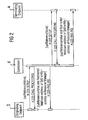
- FIGS. 2 to 4 show H.323 signaling sequences which take place during the establishment of media connections between the end points 3, 4 according to the method according to the invention. Shown are only the messages essential to the invention. Other messages, in particular packets containing the messages to the access routers 8, 9, and other known in the art from regular practice messages H.323 network are not shown for reasons of clarity.
- an H.225 SETUP message is sent to the registration unit 5 from the originating endpoint (for example, endpoint 3).
- the registration unit 5 transmits an H.225 RAS IRQ message to both the outbound endpoint 3 and the destination endpoint 4.
- This H.225 RAS message contains a redirect instruction and an instruction requesting the required H.225 RAS IRR message. Always repeat a message when the media connections associated with the call are being set up or cleared down, or when their bandwidth request has changed, for example, by changing the media encoding of the connection.
- the rerouting instruction contained in the H.225 RAS IRQ message determines transmission of the respective H.225 RAS IRR message of the endpoints 3, 4 to the QoS devices 11, or 10.
- the QoS facilities are thus informed directly about the setup, resolution, or change of the bandwidth requirements of the media connection.
- the redirect instruction of the H.225 RAS IRQ message determines transmission of the H.225 RAS IRR message from the endpoints 3, 4 to the resource manager 6. It forwards the information to the QoS devices 10, 11 on. If desired, the H.255 RAS IRR message may be acknowledged by the resource manager 6 using H.225 RAS IACK or INSACK messages, not shown. Negative acknowledgment can not guarantee bandwidth and quality of service for the connection.
- the call status request message does not contain a redirect address.
- the call status acknowledgment message is transmitted back from the endpoints to the registration unit.
- the latter has an interface to the QoS devices or the resource manager and forwards the call status acknowledgment messages either directly to the QoS devices or the resource manager or the information from the call status acknowledgment messages in any protocol that is available on these interfaces is defined.
- the signaling sequences of a multimedia network structure described in detail above make it possible to simplify the identification of the media connections for the purpose of quality assurance and resource management in the transport network.
Landscapes
- Engineering & Computer Science (AREA)
- Computer Networks & Wireless Communication (AREA)
- Signal Processing (AREA)
- Multimedia (AREA)
- Computer Security & Cryptography (AREA)
- Business, Economics & Management (AREA)
- General Business, Economics & Management (AREA)
- Data Exchanges In Wide-Area Networks (AREA)
Claims (7)
- Procédé pour faire fonctionner un réseau de communications multimédia, comprenant au moins deux points terminaux (3, 4) et au moins une unité d'enregistrement (5),- un message de demande d'état d'appel étant respectivement émis, après l'arrivée ou l'autorisation d'un appel, par l'unité d'enregistrement (5) aux points terminaux (3, 4) participant respectivement à l'appel,- le message de demande d'état d'appel contenant une invitation pour les points terminaux (3, 4) d'informer, dans un message d'accusé de réception d'un état d'appel, d'un état, d'une adresse de transport et d'une largeur de bande à affecter d'une liaison média et/ou d'une liaison de données établie entre les points terminaux (3, 4) en relation avec l'appel,- le message de demande d'état d'appel contenant une instruction de renvoi pour le message d'accusé de réception de l'état d'appel, et- l'instruction de renvoi demandant une transmission du message d'accusé de réception de l'état d'appel à un gestionnaire de ressources (6).
- Procédé pour faire fonctionner un réseau de communications multimédia, comprenant au moins deux points terminaux (3, 4) entre lesquels des liaisons média et/ou des liaisons de données sont établies par un appel,- un message de demande d'état d'appel étant respectivement émis, après l'arrivée d'un appel, par l'un des points terminaux aux points terminaux (3, 4) participant respectivement à l'appel,- le message de demande d'état d'appel contenant une invitation pour les points terminaux (3, 4) d'informer, dans un message d'accusé de réception d'un état d'appel, d'un état, d'une adresse de transport et d'une largeur de bande à affecter d'une liaison média et/ou d'une liaison de données établie entre les points terminaux (3, 4) en relation avec l'appel,- le message de demande d'état d'appel contenant une instruction de renvoi pour le message d'accusé de réception de l'état d'appel, et- l'instruction de renvoi demandant une transmission du message d'accusé de réception de l'état d'appel à un dispositif QoS (10, 11).
- Procédé selon la revendication 2,
caractérisé en ce
que l'instruction de renvoi contient une adresse IP Multicast pour laquelle les dispositifs QoS (10, 11) se sont enregistrés. - Procédé selon la revendication 2 ou 3,
caractérisé en ce
qu'au moins un dispositif QoS (10, 11) accuse réception, de manière positive ou négative, du message d'accusé de réception de l'état d'appel. - Procédé selon la revendication 1,
caractérisé en ce
qu'au moins un gestionnaire de ressources (6) accuse réception, de manière positive ou négative, du message d'accusé de réception de l'état d'appel. - Procédé selon l'une quelconque des revendications précédentes,
caractérisé en ce
que le message de demande d'état d'appel contient une invitation à émettre cycliquement le message d'accusé de réception de l'état d'appel. - Procédé selon l'une quelconque des revendications précédentes,
caractérisé en ce
que le point terminal (3, 4), après la réception du message de demande d'état d'appel, transmet le message d'accusé de réception de l'état d'appel à chaque fois qu'une liaison média et/ou une liaison de données a modifié ses propriétés.
Applications Claiming Priority (2)
| Application Number | Priority Date | Filing Date | Title |
|---|---|---|---|
| DE10103527A DE10103527A1 (de) | 2001-01-26 | 2001-01-26 | Verfahren zum Betrieb eines Multimedia-Kommunikationsnetzwerkes |
| DE10103527 | 2001-01-26 |
Publications (3)
| Publication Number | Publication Date |
|---|---|
| EP1227632A2 EP1227632A2 (fr) | 2002-07-31 |
| EP1227632A3 EP1227632A3 (fr) | 2003-07-30 |
| EP1227632B1 true EP1227632B1 (fr) | 2006-08-09 |
Family
ID=7671845
Family Applications (1)
| Application Number | Title | Priority Date | Filing Date |
|---|---|---|---|
| EP01000790A Expired - Lifetime EP1227632B1 (fr) | 2001-01-26 | 2001-12-21 | Procédé pour faire fonctionner un réseau de communications multimedia |
Country Status (3)
| Country | Link |
|---|---|
| US (1) | US7221384B2 (fr) |
| EP (1) | EP1227632B1 (fr) |
| DE (2) | DE10103527A1 (fr) |
Families Citing this family (8)
| Publication number | Priority date | Publication date | Assignee | Title |
|---|---|---|---|---|
| US7886054B1 (en) | 2000-10-11 | 2011-02-08 | Siddhartha Nag | Graphical user interface (GUI) for administering a network implementing media aggregation |
| US7013338B1 (en) * | 2000-07-28 | 2006-03-14 | Prominence Networks, Inc. | Multiplexing several individual application sessions over a pre-allocated reservation protocol session |
| US7788354B2 (en) * | 2000-07-28 | 2010-08-31 | Siddhartha Nag | End-to-end service quality in a voice over Internet Protocol (VoIP) Network |
| US7774468B1 (en) | 2000-07-28 | 2010-08-10 | Siddhartha Nag | Network traffic admission control |
| US8428074B2 (en) * | 2005-04-29 | 2013-04-23 | Prom Ks Mgmt Limited Liability Company | Back-to back H.323 proxy gatekeeper |
| KR100728280B1 (ko) * | 2005-07-19 | 2007-06-13 | 삼성전자주식회사 | Sip를 이용한 통신 시스템에서 호 해제 요청/응답메시지를 이용한 네트워크 상태 관리 방법 |
| US8957939B1 (en) * | 2010-10-29 | 2015-02-17 | Arris Enterprises, Inc. | Method and apparatus for a videophone |
| US8984148B2 (en) * | 2012-07-23 | 2015-03-17 | Cisco Technology, Inc. | Method and apparatus for signaling post-ring reservations |
Family Cites Families (1)
| Publication number | Priority date | Publication date | Assignee | Title |
|---|---|---|---|---|
| US7023839B1 (en) * | 1999-01-26 | 2006-04-04 | Siemens Communications, Inc. | System and method for dynamic codec alteration |
-
2001
- 2001-01-26 DE DE10103527A patent/DE10103527A1/de not_active Withdrawn
- 2001-12-21 DE DE50110687T patent/DE50110687D1/de not_active Expired - Lifetime
- 2001-12-21 EP EP01000790A patent/EP1227632B1/fr not_active Expired - Lifetime
-
2002
- 2002-01-25 US US10/055,019 patent/US7221384B2/en not_active Expired - Fee Related
Also Published As
| Publication number | Publication date |
|---|---|
| EP1227632A3 (fr) | 2003-07-30 |
| EP1227632A2 (fr) | 2002-07-31 |
| DE50110687D1 (de) | 2006-09-21 |
| US20020112246A1 (en) | 2002-08-15 |
| US7221384B2 (en) | 2007-05-22 |
| DE10103527A1 (de) | 2002-08-14 |
Similar Documents
| Publication | Publication Date | Title |
|---|---|---|
| EP1561328B1 (fr) | Transmission de parametres de commande d'appel entre deux controleurs de passerelle de telecommunication dans des reseaux sip/sip-t | |
| DE60124087T2 (de) | Verfahren zur überwachung von anrufen in einem ip-basierten netzwerk | |
| DE60014234T2 (de) | System und Verfahren zum Ermöglichen von Fehlertolerante Systeme | |
| DE60201827T2 (de) | Legales Abfangen für VOIP Anrufe in einem IP-Fernmeldenetz | |
| EP2018765B1 (fr) | Controle de qualite de service et/ou taxation de service de telecommunication | |
| DE60036491T2 (de) | Verfahren, system und endgerät zur aktivierung eines teilnehmerkontextes für paketdaten | |
| EP1480431A1 (fr) | Procédé de signalisation de paramètres de renvoi d'appel dans un réseau SIP | |
| DE60212988T2 (de) | Verfahren, Einrichtung und Computerprogramm zur Auswahl einer Medienübergangskontrollfunktion basierend auf der Überwachung von Resourcen von Medienübergangsfunktionen | |
| EP1282280B1 (fr) | Methode, dispositif de commande et un module de logiciel pour commande et guidage de flux de données de connexion de communication entre deux utilisateurs de réseau de donnée par paquet | |
| EP1317820B1 (fr) | Procede pour etablir des liaisons avec des qualites de service predefinies dans un reseau de communication oriente paquet, a l'aide d'un gestionnaire de ressources | |
| EP1227632A2 (fr) | Procédé pour faire fonctionner un réseau de communications multimedia | |
| EP1284551A1 (fr) | Marquage de qualité de service d'un transfert d'information dans un réseau de communication | |
| EP1421766B1 (fr) | Pre-negociation d'adresses nat | |
| EP1341357B1 (fr) | Procédé pour sécuriser la qualité de service dans un réseau de communication, dispositif et appareils pour sa mise en oeuvre | |
| EP1418729A2 (fr) | Procédé et ensemble permettant de communiquer entre un réseau orienté à connexion et plusieurs domaines de réseaux VoIP | |
| EP1430688B1 (fr) | Unite de connexion de reseaux et systeme de communication pour liaisons de communication en temps reel | |
| WO2007025905A1 (fr) | Systeme de communication, ordinateur a noeud de commutation et procede pour definir un noeud de controle | |
| EP2036313B1 (fr) | Procédé de gestion de liaisons de communication par l'intermédiaire de noeuds de traduction d'adresse réseau | |
| DE10226901B3 (de) | Verfahren zur Verbindungssteuerung in einem paketorientierten Kommunikationsnetz sowie Anordnungen zu seiner Durchführung | |
| DE19833969A1 (de) | Verfahren zum Aufbau einer Kommunikationsverbindung | |
| EP1513312A1 (fr) | Téléphonie Vidéo multimédia | |
| EP2208319A1 (fr) | Commande d'appel en mode commutation de circuits par le biais d'un canal utile ip dans le réseau d'accès | |
| EP1841164A1 (fr) | Système, procédé et dispositif de connexion pour configurer des routeurs NAT | |
| WO2007128618A1 (fr) | Dispositif et procédé pour prendre en charge la caractéristique de performance 'hand off call' dans des réseaux fmc | |
| WO2007065738A1 (fr) | Dispositif et procede pour prendre en charge des applications de fax t.38 dans des reseaux fmc |
Legal Events
| Date | Code | Title | Description |
|---|---|---|---|
| PUAI | Public reference made under article 153(3) epc to a published international application that has entered the european phase |
Free format text: ORIGINAL CODE: 0009012 |
|
| AK | Designated contracting states |
Kind code of ref document: A2 Designated state(s): AT BE CH CY DE DK ES FI FR GB GR IE IT LI LU MC NL PT SE TR |
|
| AX | Request for extension of the european patent |
Free format text: AL;LT;LV;MK;RO;SI |
|
| PUAL | Search report despatched |
Free format text: ORIGINAL CODE: 0009013 |
|
| RIC1 | Information provided on ipc code assigned before grant |
Ipc: 7H 04L 29/06 A Ipc: 7H 04L 12/56 B Ipc: 7H 04M 7/00 B |
|
| AK | Designated contracting states |
Designated state(s): AT BE CH CY DE DK ES FI FR GB GR IE IT LI LU MC NL PT SE TR |
|
| AX | Request for extension of the european patent |
Extension state: AL LT LV MK RO SI |
|
| 17P | Request for examination filed |
Effective date: 20030818 |
|
| 17Q | First examination report despatched |
Effective date: 20030925 |
|
| AKX | Designation fees paid |
Designated state(s): DE FR GB IT |
|
| GRAP | Despatch of communication of intention to grant a patent |
Free format text: ORIGINAL CODE: EPIDOSNIGR1 |
|
| GRAS | Grant fee paid |
Free format text: ORIGINAL CODE: EPIDOSNIGR3 |
|
| GRAA | (expected) grant |
Free format text: ORIGINAL CODE: 0009210 |
|
| AK | Designated contracting states |
Kind code of ref document: B1 Designated state(s): DE FR GB IT |
|
| REG | Reference to a national code |
Ref country code: GB Ref legal event code: FG4D Free format text: NOT ENGLISH |
|
| REF | Corresponds to: |
Ref document number: 50110687 Country of ref document: DE Date of ref document: 20060921 Kind code of ref document: P |
|
| GBT | Gb: translation of ep patent filed (gb section 77(6)(a)/1977) |
Effective date: 20061025 |
|
| ET | Fr: translation filed | ||
| PLBE | No opposition filed within time limit |
Free format text: ORIGINAL CODE: 0009261 |
|
| STAA | Information on the status of an ep patent application or granted ep patent |
Free format text: STATUS: NO OPPOSITION FILED WITHIN TIME LIMIT |
|
| 26N | No opposition filed |
Effective date: 20070510 |
|
| REG | Reference to a national code |
Ref country code: GB Ref legal event code: 732E Free format text: REGISTERED BETWEEN 20121025 AND 20121031 |
|
| REG | Reference to a national code |
Ref country code: FR Ref legal event code: TP Owner name: SIEMENS ENTERPRISE COMMUNICATIONS GMBH & CO. K, DE Effective date: 20130108 |
|
| REG | Reference to a national code |
Ref country code: DE Ref legal event code: R082 Ref document number: 50110687 Country of ref document: DE Representative=s name: FRITZSCHE PATENT, DE |
|
| REG | Reference to a national code |
Ref country code: DE Ref legal event code: R081 Ref document number: 50110687 Country of ref document: DE Owner name: SIEMENS ENTERPRISE COMMUNICATIONS GMBH & CO. K, DE Free format text: FORMER OWNER: SIEMENS AKTIENGESELLSCHAFT, 80333 MUENCHEN, DE Effective date: 20130313 Ref country code: DE Ref legal event code: R082 Ref document number: 50110687 Country of ref document: DE Representative=s name: FRITZSCHE PATENT, DE Effective date: 20130313 Ref country code: DE Ref legal event code: R081 Ref document number: 50110687 Country of ref document: DE Owner name: UNIFY GMBH & CO. KG, DE Free format text: FORMER OWNER: SIEMENS AKTIENGESELLSCHAFT, 80333 MUENCHEN, DE Effective date: 20130313 Ref country code: DE Ref legal event code: R082 Ref document number: 50110687 Country of ref document: DE Representative=s name: FRITZSCHE PATENTANWAELTE, DE Effective date: 20130313 |
|
| REG | Reference to a national code |
Ref country code: DE Ref legal event code: R082 Ref document number: 50110687 Country of ref document: DE Representative=s name: FRITZSCHE PATENT, DE |
|
| REG | Reference to a national code |
Ref country code: DE Ref legal event code: R081 Ref document number: 50110687 Country of ref document: DE Owner name: UNIFY GMBH & CO. KG, DE Free format text: FORMER OWNER: SIEMENS ENTERPRISE COMMUNICATIONS GMBH & CO. KG, 81379 MUENCHEN, DE Effective date: 20131112 Ref country code: DE Ref legal event code: R082 Ref document number: 50110687 Country of ref document: DE Representative=s name: FRITZSCHE PATENT, DE Effective date: 20131112 Ref country code: DE Ref legal event code: R082 Ref document number: 50110687 Country of ref document: DE Representative=s name: FRITZSCHE PATENTANWAELTE, DE Effective date: 20131112 |
|
| REG | Reference to a national code |
Ref country code: FR Ref legal event code: CD Owner name: UNIFY GMBH & CO.KG, DE Effective date: 20140429 |
|
| REG | Reference to a national code |
Ref country code: FR Ref legal event code: PLFP Year of fee payment: 15 |
|
| PGFP | Annual fee paid to national office [announced via postgrant information from national office to epo] |
Ref country code: IT Payment date: 20151222 Year of fee payment: 15 |
|
| REG | Reference to a national code |
Ref country code: DE Ref legal event code: R082 Ref document number: 50110687 Country of ref document: DE Representative=s name: FRITZSCHE PATENTANWAELTE, DE Ref country code: DE Ref legal event code: R081 Ref document number: 50110687 Country of ref document: DE Owner name: UNIFY GMBH & CO. KG, DE Free format text: FORMER OWNER: UNIFY GMBH & CO. KG, 81379 MUENCHEN, DE |
|
| REG | Reference to a national code |
Ref country code: FR Ref legal event code: PLFP Year of fee payment: 16 |
|
| PG25 | Lapsed in a contracting state [announced via postgrant information from national office to epo] |
Ref country code: IT Free format text: LAPSE BECAUSE OF NON-PAYMENT OF DUE FEES Effective date: 20161221 |
|
| REG | Reference to a national code |
Ref country code: FR Ref legal event code: PLFP Year of fee payment: 17 |
|
| PGFP | Annual fee paid to national office [announced via postgrant information from national office to epo] |
Ref country code: GB Payment date: 20171221 Year of fee payment: 17 |
|
| PGFP | Annual fee paid to national office [announced via postgrant information from national office to epo] |
Ref country code: DE Payment date: 20171219 Year of fee payment: 17 |
|
| PGFP | Annual fee paid to national office [announced via postgrant information from national office to epo] |
Ref country code: FR Payment date: 20181227 Year of fee payment: 18 |
|
| REG | Reference to a national code |
Ref country code: DE Ref legal event code: R119 Ref document number: 50110687 Country of ref document: DE |
|
| GBPC | Gb: european patent ceased through non-payment of renewal fee |
Effective date: 20181221 |
|
| PG25 | Lapsed in a contracting state [announced via postgrant information from national office to epo] |
Ref country code: FR Free format text: LAPSE BECAUSE OF NON-PAYMENT OF DUE FEES Effective date: 20181231 Ref country code: DE Free format text: LAPSE BECAUSE OF NON-PAYMENT OF DUE FEES Effective date: 20190702 |
|
| PG25 | Lapsed in a contracting state [announced via postgrant information from national office to epo] |
Ref country code: GB Free format text: LAPSE BECAUSE OF NON-PAYMENT OF DUE FEES Effective date: 20181221 |