EP1228024B1 - Novel hydronaphthalene compounds, prepared by a rhodium catalyzed ring opening reaction in the presence of phosphine ligand - Google Patents
Novel hydronaphthalene compounds, prepared by a rhodium catalyzed ring opening reaction in the presence of phosphine ligand Download PDFInfo
- Publication number
- EP1228024B1 EP1228024B1 EP00975109A EP00975109A EP1228024B1 EP 1228024 B1 EP1228024 B1 EP 1228024B1 EP 00975109 A EP00975109 A EP 00975109A EP 00975109 A EP00975109 A EP 00975109A EP 1228024 B1 EP1228024 B1 EP 1228024B1
- Authority
- EP
- European Patent Office
- Prior art keywords
- dihydro
- naphthalen
- mmol
- alkyl
- naphthalenyl
- Prior art date
- Legal status (The legal status is an assumption and is not a legal conclusion. Google has not performed a legal analysis and makes no representation as to the accuracy of the status listed.)
- Expired - Lifetime
Links
- 0 *[C@]([C@@]([C@@](CO1)C(c2c3)O*)C1=O)c2cc1c3OCO1 Chemical compound *[C@]([C@@]([C@@](CO1)C(c2c3)O*)C1=O)c2cc1c3OCO1 0.000 description 6
- OYZMJSFDBLSFPA-UHFFFAOYSA-N C1Oc2cc(C3OC4C=C3)c4cc2O1 Chemical compound C1Oc2cc(C3OC4C=C3)c4cc2O1 OYZMJSFDBLSFPA-UHFFFAOYSA-N 0.000 description 1
- FAVHSLDABLQPHK-CIHDQMCQSA-N CC(C12)C=CC=C1C=CN2[C@@H]([C@@H]1O)C=Cc2c1cccc2 Chemical compound CC(C12)C=CC=C1C=CN2[C@@H]([C@@H]1O)C=Cc2c1cccc2 FAVHSLDABLQPHK-CIHDQMCQSA-N 0.000 description 1
- ZPHRCLDUBGFRQE-LDWJVGPZSA-N CC(C[C@H]1CC2)=CCC1C([C@H](c1c(C3=O)c(O)ccc1)O)[C@@]23O Chemical compound CC(C[C@H]1CC2)=CCC1C([C@H](c1c(C3=O)c(O)ccc1)O)[C@@]23O ZPHRCLDUBGFRQE-LDWJVGPZSA-N 0.000 description 1
- MDQCAHMEJABKEL-IRXDYDNUSA-N Cc(cc1)ccc1O[C@H]1C=Cc2ccccc2[C@@H]1O Chemical compound Cc(cc1)ccc1O[C@H]1C=Cc2ccccc2[C@@H]1O MDQCAHMEJABKEL-IRXDYDNUSA-N 0.000 description 1
- FVCUVBTZQCSCDD-QZTJIDSGSA-N Cc(cc1)ccc1S(N[C@@H]1c2ccccc2C=C[C@H]1OC)(=O)=O Chemical compound Cc(cc1)ccc1S(N[C@@H]1c2ccccc2C=C[C@H]1OC)(=O)=O FVCUVBTZQCSCDD-QZTJIDSGSA-N 0.000 description 1
- HZNBNNXKWSXQIE-VYRBHSGPSA-N OC1c(cccc2)c2C=C[C@@H]1Oc(cc1)ccc1Cl Chemical compound OC1c(cccc2)c2C=C[C@@H]1Oc(cc1)ccc1Cl HZNBNNXKWSXQIE-VYRBHSGPSA-N 0.000 description 1
Classifications
-
- C—CHEMISTRY; METALLURGY
- C07—ORGANIC CHEMISTRY
- C07C—ACYCLIC OR CARBOCYCLIC COMPOUNDS
- C07C311/00—Amides of sulfonic acids, i.e. compounds having singly-bound oxygen atoms of sulfo groups replaced by nitrogen atoms, not being part of nitro or nitroso groups
- C07C311/01—Sulfonamides having sulfur atoms of sulfonamide groups bound to acyclic carbon atoms
-
- C—CHEMISTRY; METALLURGY
- C07—ORGANIC CHEMISTRY
- C07D—HETEROCYCLIC COMPOUNDS
- C07D295/00—Heterocyclic compounds containing polymethylene-imine rings with at least five ring members, 3-azabicyclo [3.2.2] nonane, piperazine, morpholine or thiomorpholine rings, having only hydrogen atoms directly attached to the ring carbon atoms
- C07D295/04—Heterocyclic compounds containing polymethylene-imine rings with at least five ring members, 3-azabicyclo [3.2.2] nonane, piperazine, morpholine or thiomorpholine rings, having only hydrogen atoms directly attached to the ring carbon atoms with substituted hydrocarbon radicals attached to ring nitrogen atoms
- C07D295/08—Heterocyclic compounds containing polymethylene-imine rings with at least five ring members, 3-azabicyclo [3.2.2] nonane, piperazine, morpholine or thiomorpholine rings, having only hydrogen atoms directly attached to the ring carbon atoms with substituted hydrocarbon radicals attached to ring nitrogen atoms substituted by singly bound oxygen or sulfur atoms
- C07D295/096—Heterocyclic compounds containing polymethylene-imine rings with at least five ring members, 3-azabicyclo [3.2.2] nonane, piperazine, morpholine or thiomorpholine rings, having only hydrogen atoms directly attached to the ring carbon atoms with substituted hydrocarbon radicals attached to ring nitrogen atoms substituted by singly bound oxygen or sulfur atoms with the ring nitrogen atoms and the oxygen or sulfur atoms separated by carbocyclic rings or by carbon chains interrupted by carbocyclic rings
-
- A—HUMAN NECESSITIES
- A61—MEDICAL OR VETERINARY SCIENCE; HYGIENE
- A61P—SPECIFIC THERAPEUTIC ACTIVITY OF CHEMICAL COMPOUNDS OR MEDICINAL PREPARATIONS
- A61P25/00—Drugs for disorders of the nervous system
- A61P25/14—Drugs for disorders of the nervous system for treating abnormal movements, e.g. chorea, dyskinesia
- A61P25/16—Anti-Parkinson drugs
-
- A—HUMAN NECESSITIES
- A61—MEDICAL OR VETERINARY SCIENCE; HYGIENE
- A61P—SPECIFIC THERAPEUTIC ACTIVITY OF CHEMICAL COMPOUNDS OR MEDICINAL PREPARATIONS
- A61P29/00—Non-central analgesic, antipyretic or antiinflammatory agents, e.g. antirheumatic agents; Non-steroidal antiinflammatory drugs [NSAID]
-
- A—HUMAN NECESSITIES
- A61—MEDICAL OR VETERINARY SCIENCE; HYGIENE
- A61P—SPECIFIC THERAPEUTIC ACTIVITY OF CHEMICAL COMPOUNDS OR MEDICINAL PREPARATIONS
- A61P31/00—Antiinfectives, i.e. antibiotics, antiseptics, chemotherapeutics
- A61P31/04—Antibacterial agents
-
- A—HUMAN NECESSITIES
- A61—MEDICAL OR VETERINARY SCIENCE; HYGIENE
- A61P—SPECIFIC THERAPEUTIC ACTIVITY OF CHEMICAL COMPOUNDS OR MEDICINAL PREPARATIONS
- A61P31/00—Antiinfectives, i.e. antibiotics, antiseptics, chemotherapeutics
- A61P31/12—Antivirals
-
- A—HUMAN NECESSITIES
- A61—MEDICAL OR VETERINARY SCIENCE; HYGIENE
- A61P—SPECIFIC THERAPEUTIC ACTIVITY OF CHEMICAL COMPOUNDS OR MEDICINAL PREPARATIONS
- A61P31/00—Antiinfectives, i.e. antibiotics, antiseptics, chemotherapeutics
- A61P31/12—Antivirals
- A61P31/14—Antivirals for RNA viruses
- A61P31/18—Antivirals for RNA viruses for HIV
-
- A—HUMAN NECESSITIES
- A61—MEDICAL OR VETERINARY SCIENCE; HYGIENE
- A61P—SPECIFIC THERAPEUTIC ACTIVITY OF CHEMICAL COMPOUNDS OR MEDICINAL PREPARATIONS
- A61P35/00—Antineoplastic agents
-
- A—HUMAN NECESSITIES
- A61—MEDICAL OR VETERINARY SCIENCE; HYGIENE
- A61P—SPECIFIC THERAPEUTIC ACTIVITY OF CHEMICAL COMPOUNDS OR MEDICINAL PREPARATIONS
- A61P37/00—Drugs for immunological or allergic disorders
- A61P37/02—Immunomodulators
-
- A—HUMAN NECESSITIES
- A61—MEDICAL OR VETERINARY SCIENCE; HYGIENE
- A61P—SPECIFIC THERAPEUTIC ACTIVITY OF CHEMICAL COMPOUNDS OR MEDICINAL PREPARATIONS
- A61P43/00—Drugs for specific purposes, not provided for in groups A61P1/00-A61P41/00
-
- C—CHEMISTRY; METALLURGY
- C07—ORGANIC CHEMISTRY
- C07C—ACYCLIC OR CARBOCYCLIC COMPOUNDS
- C07C205/00—Compounds containing nitro groups bound to a carbon skeleton
- C07C205/27—Compounds containing nitro groups bound to a carbon skeleton the carbon skeleton being further substituted by etherified hydroxy groups
- C07C205/35—Compounds containing nitro groups bound to a carbon skeleton the carbon skeleton being further substituted by etherified hydroxy groups having nitro groups and etherified hydroxy groups bound to carbon atoms of six-membered aromatic rings of the carbon skeleton
- C07C205/36—Compounds containing nitro groups bound to a carbon skeleton the carbon skeleton being further substituted by etherified hydroxy groups having nitro groups and etherified hydroxy groups bound to carbon atoms of six-membered aromatic rings of the carbon skeleton to carbon atoms of the same non-condensed six-membered aromatic ring or to carbon atoms of six-membered aromatic rings being part of the same condensed ring system
- C07C205/38—Compounds containing nitro groups bound to a carbon skeleton the carbon skeleton being further substituted by etherified hydroxy groups having nitro groups and etherified hydroxy groups bound to carbon atoms of six-membered aromatic rings of the carbon skeleton to carbon atoms of the same non-condensed six-membered aromatic ring or to carbon atoms of six-membered aromatic rings being part of the same condensed ring system the oxygen atom of at least one of the etherified hydroxy groups being further bound to a carbon atom of a six-membered aromatic ring, e.g. nitrodiphenyl ethers
-
- C—CHEMISTRY; METALLURGY
- C07—ORGANIC CHEMISTRY
- C07C—ACYCLIC OR CARBOCYCLIC COMPOUNDS
- C07C215/00—Compounds containing amino and hydroxy groups bound to the same carbon skeleton
- C07C215/42—Compounds containing amino and hydroxy groups bound to the same carbon skeleton having amino groups or hydroxy groups bound to carbon atoms of rings other than six-membered aromatic rings of the same carbon skeleton
- C07C215/44—Compounds containing amino and hydroxy groups bound to the same carbon skeleton having amino groups or hydroxy groups bound to carbon atoms of rings other than six-membered aromatic rings of the same carbon skeleton bound to carbon atoms of the same ring or condensed ring system
-
- C—CHEMISTRY; METALLURGY
- C07—ORGANIC CHEMISTRY
- C07C—ACYCLIC OR CARBOCYCLIC COMPOUNDS
- C07C217/00—Compounds containing amino and etherified hydroxy groups bound to the same carbon skeleton
- C07C217/52—Compounds containing amino and etherified hydroxy groups bound to the same carbon skeleton having etherified hydroxy groups or amino groups bound to carbon atoms of rings other than six-membered aromatic rings of the same carbon skeleton
-
- C—CHEMISTRY; METALLURGY
- C07—ORGANIC CHEMISTRY
- C07C—ACYCLIC OR CARBOCYCLIC COMPOUNDS
- C07C255/00—Carboxylic acid nitriles
- C07C255/49—Carboxylic acid nitriles having cyano groups bound to carbon atoms of six-membered aromatic rings of a carbon skeleton
- C07C255/54—Carboxylic acid nitriles having cyano groups bound to carbon atoms of six-membered aromatic rings of a carbon skeleton containing cyano groups and etherified hydroxy groups bound to the carbon skeleton
-
- C—CHEMISTRY; METALLURGY
- C07—ORGANIC CHEMISTRY
- C07C—ACYCLIC OR CARBOCYCLIC COMPOUNDS
- C07C271/00—Derivatives of carbamic acids, i.e. compounds containing any of the groups, the nitrogen atom not being part of nitro or nitroso groups
- C07C271/06—Esters of carbamic acids
- C07C271/08—Esters of carbamic acids having oxygen atoms of carbamate groups bound to acyclic carbon atoms
- C07C271/24—Esters of carbamic acids having oxygen atoms of carbamate groups bound to acyclic carbon atoms with the nitrogen atom of at least one of the carbamate groups bound to a carbon atom of a ring other than a six-membered aromatic ring
-
- C—CHEMISTRY; METALLURGY
- C07—ORGANIC CHEMISTRY
- C07C—ACYCLIC OR CARBOCYCLIC COMPOUNDS
- C07C311/00—Amides of sulfonic acids, i.e. compounds having singly-bound oxygen atoms of sulfo groups replaced by nitrogen atoms, not being part of nitro or nitroso groups
- C07C311/15—Sulfonamides having sulfur atoms of sulfonamide groups bound to carbon atoms of six-membered aromatic rings
- C07C311/20—Sulfonamides having sulfur atoms of sulfonamide groups bound to carbon atoms of six-membered aromatic rings having the nitrogen atom of at least one of the sulfonamide groups bound to a carbon atom of a ring other than a six-membered aromatic ring
-
- C—CHEMISTRY; METALLURGY
- C07—ORGANIC CHEMISTRY
- C07C—ACYCLIC OR CARBOCYCLIC COMPOUNDS
- C07C41/00—Preparation of ethers; Preparation of compounds having groups, groups or groups
- C07C41/01—Preparation of ethers
-
- C—CHEMISTRY; METALLURGY
- C07—ORGANIC CHEMISTRY
- C07C—ACYCLIC OR CARBOCYCLIC COMPOUNDS
- C07C43/00—Ethers; Compounds having groups, groups or groups
- C07C43/02—Ethers
- C07C43/18—Ethers having an ether-oxygen atom bound to a carbon atom of a ring other than a six-membered aromatic ring
- C07C43/196—Ethers having an ether-oxygen atom bound to a carbon atom of a ring other than a six-membered aromatic ring containing hydroxy or O-metal groups
-
- C—CHEMISTRY; METALLURGY
- C07—ORGANIC CHEMISTRY
- C07C—ACYCLIC OR CARBOCYCLIC COMPOUNDS
- C07C43/00—Ethers; Compounds having groups, groups or groups
- C07C43/02—Ethers
- C07C43/20—Ethers having an ether-oxygen atom bound to a carbon atom of a six-membered aromatic ring
- C07C43/23—Ethers having an ether-oxygen atom bound to a carbon atom of a six-membered aromatic ring containing hydroxy or O-metal groups
-
- C—CHEMISTRY; METALLURGY
- C07—ORGANIC CHEMISTRY
- C07C—ACYCLIC OR CARBOCYCLIC COMPOUNDS
- C07C43/00—Ethers; Compounds having groups, groups or groups
- C07C43/02—Ethers
- C07C43/235—Ethers having an ether-oxygen atom bound to a carbon atom of a six-membered aromatic ring and to a carbon atom of a ring other than a six-membered aromatic ring
- C07C43/253—Ethers having an ether-oxygen atom bound to a carbon atom of a six-membered aromatic ring and to a carbon atom of a ring other than a six-membered aromatic ring containing hydroxy or O-metal groups
-
- C—CHEMISTRY; METALLURGY
- C07—ORGANIC CHEMISTRY
- C07C—ACYCLIC OR CARBOCYCLIC COMPOUNDS
- C07C45/00—Preparation of compounds having >C = O groups bound only to carbon or hydrogen atoms; Preparation of chelates of such compounds
- C07C45/61—Preparation of compounds having >C = O groups bound only to carbon or hydrogen atoms; Preparation of chelates of such compounds by reactions not involving the formation of >C = O groups
- C07C45/67—Preparation of compounds having >C = O groups bound only to carbon or hydrogen atoms; Preparation of chelates of such compounds by reactions not involving the formation of >C = O groups by isomerisation; by change of size of the carbon skeleton
- C07C45/68—Preparation of compounds having >C = O groups bound only to carbon or hydrogen atoms; Preparation of chelates of such compounds by reactions not involving the formation of >C = O groups by isomerisation; by change of size of the carbon skeleton by increase in the number of carbon atoms
- C07C45/70—Preparation of compounds having >C = O groups bound only to carbon or hydrogen atoms; Preparation of chelates of such compounds by reactions not involving the formation of >C = O groups by isomerisation; by change of size of the carbon skeleton by increase in the number of carbon atoms by reaction with functional groups containing oxygen only in singly bound form
- C07C45/71—Preparation of compounds having >C = O groups bound only to carbon or hydrogen atoms; Preparation of chelates of such compounds by reactions not involving the formation of >C = O groups by isomerisation; by change of size of the carbon skeleton by increase in the number of carbon atoms by reaction with functional groups containing oxygen only in singly bound form being hydroxy groups
-
- C—CHEMISTRY; METALLURGY
- C07—ORGANIC CHEMISTRY
- C07C—ACYCLIC OR CARBOCYCLIC COMPOUNDS
- C07C49/00—Ketones; Ketenes; Dimeric ketenes; Ketonic chelates
- C07C49/76—Ketones containing a keto group bound to a six-membered aromatic ring
- C07C49/84—Ketones containing a keto group bound to a six-membered aromatic ring containing ether groups, groups, groups, or groups
-
- C—CHEMISTRY; METALLURGY
- C07—ORGANIC CHEMISTRY
- C07C—ACYCLIC OR CARBOCYCLIC COMPOUNDS
- C07C67/00—Preparation of carboxylic acid esters
- C07C67/24—Preparation of carboxylic acid esters by reacting carboxylic acids or derivatives thereof with a carbon-to-oxygen ether bond, e.g. acetal, tetrahydrofuran
-
- C—CHEMISTRY; METALLURGY
- C07—ORGANIC CHEMISTRY
- C07C—ACYCLIC OR CARBOCYCLIC COMPOUNDS
- C07C69/00—Esters of carboxylic acids; Esters of carbonic or haloformic acids
- C07C69/013—Esters of alcohols having the esterified hydroxy group bound to a carbon atom of a ring other than a six-membered aromatic ring
-
- C—CHEMISTRY; METALLURGY
- C07—ORGANIC CHEMISTRY
- C07C—ACYCLIC OR CARBOCYCLIC COMPOUNDS
- C07C69/00—Esters of carboxylic acids; Esters of carbonic or haloformic acids
- C07C69/66—Esters of carboxylic acids having esterified carboxylic groups bound to acyclic carbon atoms and having any of the groups OH, O—metal, —CHO, keto, ether, acyloxy, groups, groups, or in the acid moiety
- C07C69/73—Esters of carboxylic acids having esterified carboxylic groups bound to acyclic carbon atoms and having any of the groups OH, O—metal, —CHO, keto, ether, acyloxy, groups, groups, or in the acid moiety of unsaturated acids
- C07C69/732—Esters of carboxylic acids having esterified carboxylic groups bound to acyclic carbon atoms and having any of the groups OH, O—metal, —CHO, keto, ether, acyloxy, groups, groups, or in the acid moiety of unsaturated acids of unsaturated hydroxy carboxylic acids
-
- C—CHEMISTRY; METALLURGY
- C07—ORGANIC CHEMISTRY
- C07D—HETEROCYCLIC COMPOUNDS
- C07D209/00—Heterocyclic compounds containing five-membered rings, condensed with other rings, with one nitrogen atom as the only ring hetero atom
- C07D209/02—Heterocyclic compounds containing five-membered rings, condensed with other rings, with one nitrogen atom as the only ring hetero atom condensed with one carbocyclic ring
- C07D209/04—Indoles; Hydrogenated indoles
- C07D209/08—Indoles; Hydrogenated indoles with only hydrogen atoms or radicals containing only hydrogen and carbon atoms, directly attached to carbon atoms of the hetero ring
-
- C—CHEMISTRY; METALLURGY
- C07—ORGANIC CHEMISTRY
- C07D—HETEROCYCLIC COMPOUNDS
- C07D215/00—Heterocyclic compounds containing quinoline or hydrogenated quinoline ring systems
- C07D215/02—Heterocyclic compounds containing quinoline or hydrogenated quinoline ring systems having no bond between the ring nitrogen atom and a non-ring member or having only hydrogen atoms or carbon atoms directly attached to the ring nitrogen atom
- C07D215/04—Heterocyclic compounds containing quinoline or hydrogenated quinoline ring systems having no bond between the ring nitrogen atom and a non-ring member or having only hydrogen atoms or carbon atoms directly attached to the ring nitrogen atom with only hydrogen atoms or radicals containing only hydrogen and carbon atoms, directly attached to the ring carbon atoms
- C07D215/06—Heterocyclic compounds containing quinoline or hydrogenated quinoline ring systems having no bond between the ring nitrogen atom and a non-ring member or having only hydrogen atoms or carbon atoms directly attached to the ring nitrogen atom with only hydrogen atoms or radicals containing only hydrogen and carbon atoms, directly attached to the ring carbon atoms having only hydrogen atoms, hydrocarbon or substituted hydrocarbon radicals, attached to the ring nitrogen atom
-
- C—CHEMISTRY; METALLURGY
- C07—ORGANIC CHEMISTRY
- C07D—HETEROCYCLIC COMPOUNDS
- C07D217/00—Heterocyclic compounds containing isoquinoline or hydrogenated isoquinoline ring systems
- C07D217/02—Heterocyclic compounds containing isoquinoline or hydrogenated isoquinoline ring systems with only hydrogen atoms or radicals containing only carbon and hydrogen atoms, directly attached to carbon atoms of the nitrogen-containing ring; Alkylene-bis-isoquinolines
- C07D217/04—Heterocyclic compounds containing isoquinoline or hydrogenated isoquinoline ring systems with only hydrogen atoms or radicals containing only carbon and hydrogen atoms, directly attached to carbon atoms of the nitrogen-containing ring; Alkylene-bis-isoquinolines with hydrocarbon or substituted hydrocarbon radicals attached to the ring nitrogen atom
-
- C—CHEMISTRY; METALLURGY
- C07—ORGANIC CHEMISTRY
- C07D—HETEROCYCLIC COMPOUNDS
- C07D295/00—Heterocyclic compounds containing polymethylene-imine rings with at least five ring members, 3-azabicyclo [3.2.2] nonane, piperazine, morpholine or thiomorpholine rings, having only hydrogen atoms directly attached to the ring carbon atoms
- C07D295/04—Heterocyclic compounds containing polymethylene-imine rings with at least five ring members, 3-azabicyclo [3.2.2] nonane, piperazine, morpholine or thiomorpholine rings, having only hydrogen atoms directly attached to the ring carbon atoms with substituted hydrocarbon radicals attached to ring nitrogen atoms
- C07D295/12—Heterocyclic compounds containing polymethylene-imine rings with at least five ring members, 3-azabicyclo [3.2.2] nonane, piperazine, morpholine or thiomorpholine rings, having only hydrogen atoms directly attached to the ring carbon atoms with substituted hydrocarbon radicals attached to ring nitrogen atoms substituted by singly or doubly bound nitrogen atoms
- C07D295/135—Heterocyclic compounds containing polymethylene-imine rings with at least five ring members, 3-azabicyclo [3.2.2] nonane, piperazine, morpholine or thiomorpholine rings, having only hydrogen atoms directly attached to the ring carbon atoms with substituted hydrocarbon radicals attached to ring nitrogen atoms substituted by singly or doubly bound nitrogen atoms with the ring nitrogen atoms and the substituent nitrogen atoms separated by carbocyclic rings or by carbon chains interrupted by carbocyclic rings
-
- C—CHEMISTRY; METALLURGY
- C07—ORGANIC CHEMISTRY
- C07F—ACYCLIC, CARBOCYCLIC OR HETEROCYCLIC COMPOUNDS CONTAINING ELEMENTS OTHER THAN CARBON, HYDROGEN, HALOGEN, OXYGEN, NITROGEN, SULFUR, SELENIUM OR TELLURIUM
- C07F7/00—Compounds containing elements of Groups 4 or 14 of the Periodic Table
- C07F7/02—Silicon compounds
- C07F7/08—Compounds having one or more C—Si linkages
- C07F7/0803—Compounds with Si-C or Si-Si linkages
- C07F7/081—Compounds with Si-C or Si-Si linkages comprising at least one atom selected from the elements N, O, halogen, S, Se or Te
-
- C—CHEMISTRY; METALLURGY
- C07—ORGANIC CHEMISTRY
- C07F—ACYCLIC, CARBOCYCLIC OR HETEROCYCLIC COMPOUNDS CONTAINING ELEMENTS OTHER THAN CARBON, HYDROGEN, HALOGEN, OXYGEN, NITROGEN, SULFUR, SELENIUM OR TELLURIUM
- C07F7/00—Compounds containing elements of Groups 4 or 14 of the Periodic Table
- C07F7/02—Silicon compounds
- C07F7/08—Compounds having one or more C—Si linkages
- C07F7/18—Compounds having one or more C—Si linkages as well as one or more C—O—Si linkages
- C07F7/1804—Compounds having Si-O-C linkages
-
- C—CHEMISTRY; METALLURGY
- C07—ORGANIC CHEMISTRY
- C07B—GENERAL METHODS OF ORGANIC CHEMISTRY; APPARATUS THEREFOR
- C07B2200/00—Indexing scheme relating to specific properties of organic compounds
- C07B2200/07—Optical isomers
-
- C—CHEMISTRY; METALLURGY
- C07—ORGANIC CHEMISTRY
- C07C—ACYCLIC OR CARBOCYCLIC COMPOUNDS
- C07C2602/00—Systems containing two condensed rings
- C07C2602/02—Systems containing two condensed rings the rings having only two atoms in common
- C07C2602/04—One of the condensed rings being a six-membered aromatic ring
- C07C2602/10—One of the condensed rings being a six-membered aromatic ring the other ring being six-membered, e.g. tetraline
Definitions
- the present invention is directed to methods for chemically synthesizing compounds containing a hydronaphthalene ring structure. It encompasses the compounds made by the methods.
- hydronaphthalene structure can be found in many natural products and pharmaceutical agents. These include homochelidonine 1 (Slavik, J.; et al ., Collect . Czech. Chem. Commun . 30 :3697 (1965); Spath, E., et al ., Ber., 64 :1123 (1931); Bersch, H. W., Arch. Pharm. (Weinheim, Ger.), 291 4:91 (1958)) an alkaloid isolated from Chelidonium plants, dihydrexidine 2 (Snyder, S. E., J . Med .
- CNS agents, immunoregulatory agents and antibiotics contain variations on this framework (Perrone, R., et al ., J . Med . Chem. 38 :942 (1995)).
- Duan and Chen developed a method of introducing aryl groups by using catalytic amounts of palladium (Duan, J.-P., et al ., Tetrahedron Lett., 34 :4019 (1993); Duan, J.-P., et al ., Organometallics 1 4 :1608 (1995)).
- Moinet et al . later developed an enantioselective version of this reaction but the yields were low ( Tetrahedron Lett., 36 :2051 (1995)).
- the present invention is based upon the discovery of a rhodium catalyzed ring opening reaction of oxabenzonorbomadienes or azabicyclic compounds to produce a new carbon-oxygen bond via an intermolecular reaction with various alcohols. This reaction occurs in good yields with complete regio and diastereoselectivity and excellent enantioselectivity ( e . g ., eq. 1).
- Z is O or NR a .
- This reaction will work when oxabenzonorbomadienes are reacted with nitrogen nucleophiles, carboxylate nucleophiles, carbon nucleophiles or phenol nucleophiles.
- the invention encompasses not only the chemical reactions but also the compounds made by the reactions .
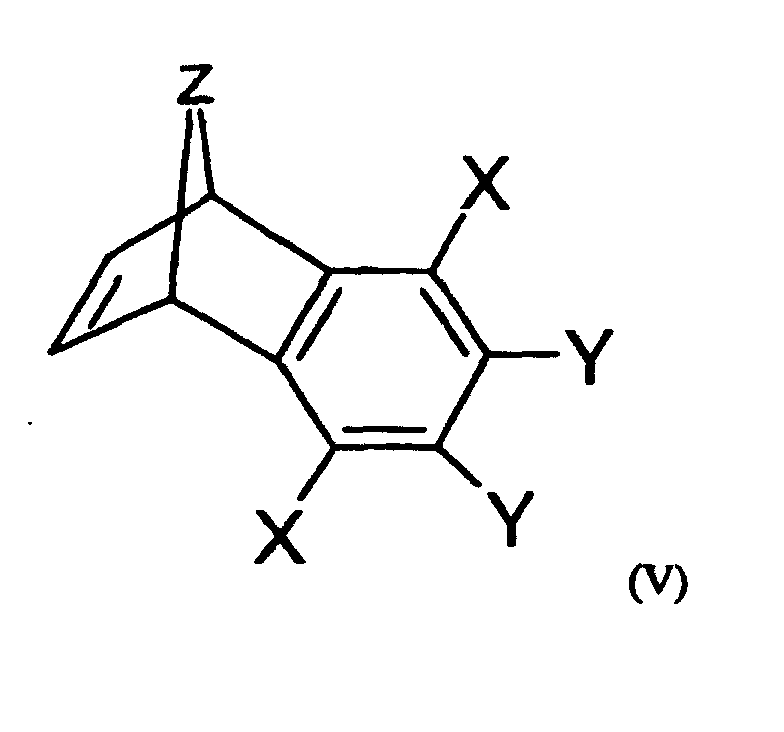
- the compounds of formula I described above may be prepared by reacting a compound of formula ROH with a compound of formula V: in which R, X, and Y are as defined above.
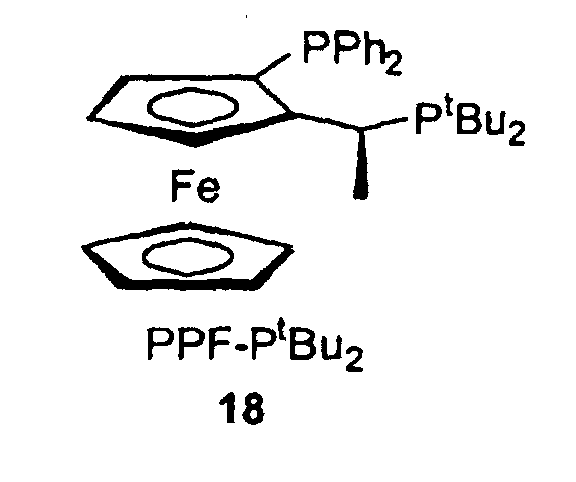
- the reaction is catalyzed by [Rh(COD)Cl] 2 in the presence of a phosphine ligand, preferably selected from the group consisting of: DPPF; (R)-(S)-BPPFA; and (R)-(S)-PPF-P t Bu 2 .
- the compound made is (1R*,2R*)-acetic acid 1-hydroxy-1,2-dihydro-naphthalen-2-yl ester and ROH is acetic acid;
- the compound made is (1R*,2R*)-propionic acid 1-hydroxy-1,2-dihydro-naphthalen-2-yl ester and ROH is propionic acid;
- the compound made is (1R,2R)-benzoic acid 1-hydmxy-1,2-dihydro-naphthalen-2-yl-ester and ROH is benzoic acid;
- the compound made is (1R*,2R*)-formic acid 1-hydroxy-1,2-dihydro-naphthalen-2-yl-ester and ROH is formic acid;
- the compound made is (1R*,2R*)-2-methyl acrylic acid 1-hydroxy-1,2-dihydro-naphthalen-2-yl-ester and ROH is methacrylic acid;
- the compounds of formula II described above may be prepared by reacting a compound of formula ROH with a compound of formula V: wherein R, X, Y, and Z are as defined above in connection with formula II and in which the reaction is catalyzed by [Rh(COD)Cl] 2 in the presence of a phosphine ligand, preferably (S)-(R)-PPF-P t Bu 2 .
- R a is preferably phenyl; (O)C-O-C-(CH 3 ) 3 ; ; or (O)S(O)-(CH 2 ) 2 -Si(CH 3 ) 3 .
- the invention is also directed to a compound according to formula III: wherein TBDMSO is a tert-butyldimethylsiloxy group, and R, X, and Y are as defined in above in connection with formula I.
- These compounds may made by preparing a compound of formula I according to the process described above and then reacting the compound formed with a salt of tert-butytdimethylsilylic acid.
- the compound formed is (1R*,2R*)-malonic acid (1-tert-butyldimethylsiloxy-1,2-dihydro-naphthalen-2-yl) ester ethyl ester and ROH is tert-butyldimethylsilylic acid.
- the invention is directed to A compound according to formula IV: wherein:
- the compounds of formula IV described above may be prepared by reacting a compound of formula R 9 -(CH 2 ) t NHR 8 with a compound of formula V in which R 8 , R 9 , t, X, Y, and Z are as defined above in connection with compounds of formula IV and the reaction is catalyzed by [Rh(COD)Cl] 2 in the presence of a phosphine ligand; preferably selected from the group consisting of: DPPF; (R)-(S)-BPPFA; and (R)-(S)-PPF-P t Bu 2 .
- Z is NR a
- the reaction will produce a product in which R 10 is H.
- a subsequent reaction may be used to convert R 10 to a methyl as set forth in the Examples section below.
- the process will be used to produce products in which R 9 together with N form a ring selected from the group consisting of: a phthalamide ring; a pyrrolidine ring; a piperidine ring; a tetrahydroquinoline ring; and an indole ring; said ring structures being optionally substituted at one or more positions with a group selected from: a C 1 -C 3 alkyl; a C 1 -C 3 alkoxy; Cl; F; NO 2 ; and CF 3 .
- the invention also encompasses seven other processes.
- (1S,2S)-N-(1-hydroxy-1,2-dihydro-naphthalen-2-yl)-benzene sulfonamide is formed by reacting oxabenzonorbomadiene with benzenesulfonamide.
- (1S*,2R*)-2-(hydroxy-1,2-dihydro-naphthalen-2-yl)malonic acid dimethyl ester is formed by reacting oxabenzonorbornadiene with dimethyl malonate. Both reactions are catalyzed by [Rh(COD)Cl] 2 in the presence of a phosphine ligand.
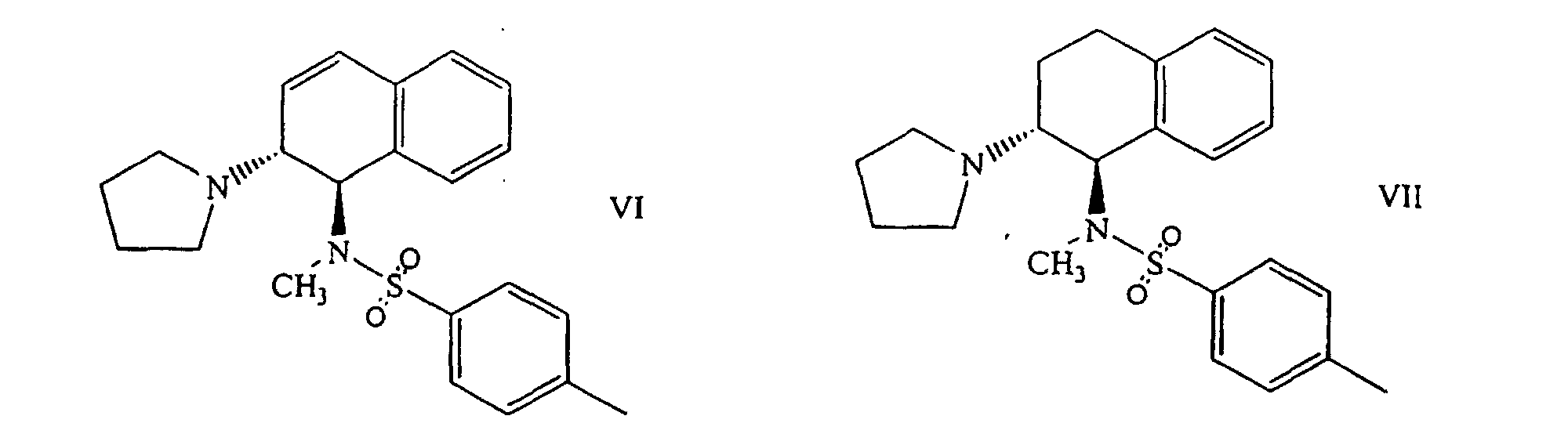
- the compound of formula VI is formed by reacting a compound of formula IV, which is produced as described above in connection with formation of compounds of formula IV, with iodomethane.
- the compound made is N,4-dimethyl-N-[(1R,2S)-2-(1-pyrrolidinyl)-1,2-dihydro-1-naphthalenyl]benzenesulfonamide.
- the compound of formula VII is formed by reacting compound of formula VI with hydrogen in the presence of palladium catalyst.
- the compound made is N,4-dimethyl-N-[(1R,2S)-2-(1-pyrrolidinyl)-1,2,3,4-tetrahydro-1-naphthalenyl]benzenesulfonamide.
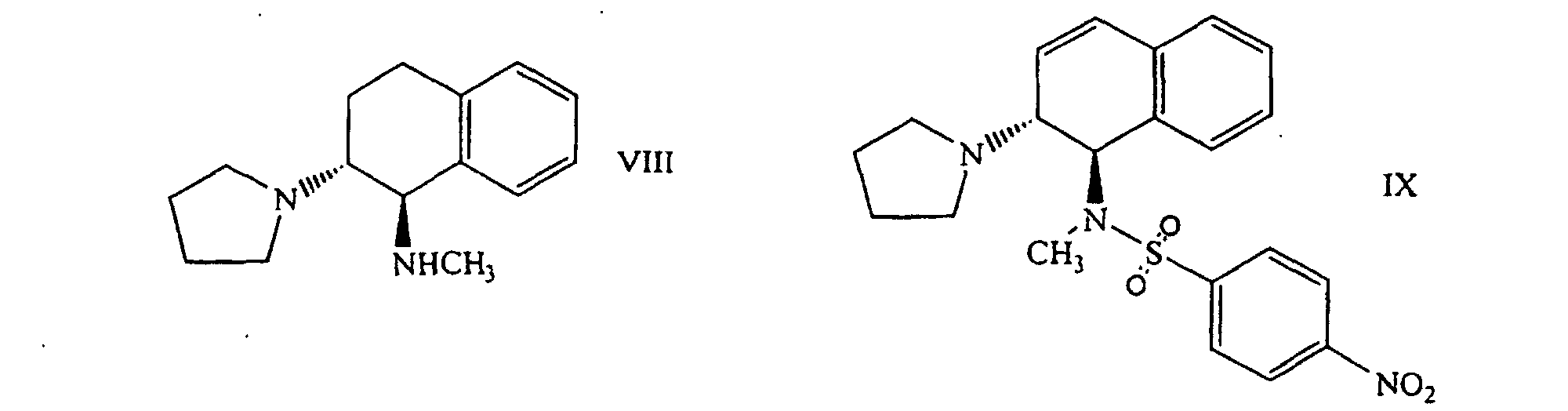
- the compound of formula VIII is formed by reacting the compound of formula VII with sodium borohydride.
- the compound made using this reaction is (1 R ,2 S )- N -methyl-2-(1-pyrrolidinyl)-1,2,3,4-tetrahydro-1-naphthalenamine.
- the compound of formula IX is formed by reacting a compound of formula IV which is produced as described above in connection with formation of compounds of formula IV, with iodomethane.
- the compound made using this reaction is N-methyl-4-nitro-N-[(1R,2S)-2-(1-pyrrolidinyl)-1,2-dihydro-1-naphthalenyl]benzenesulfonamide.
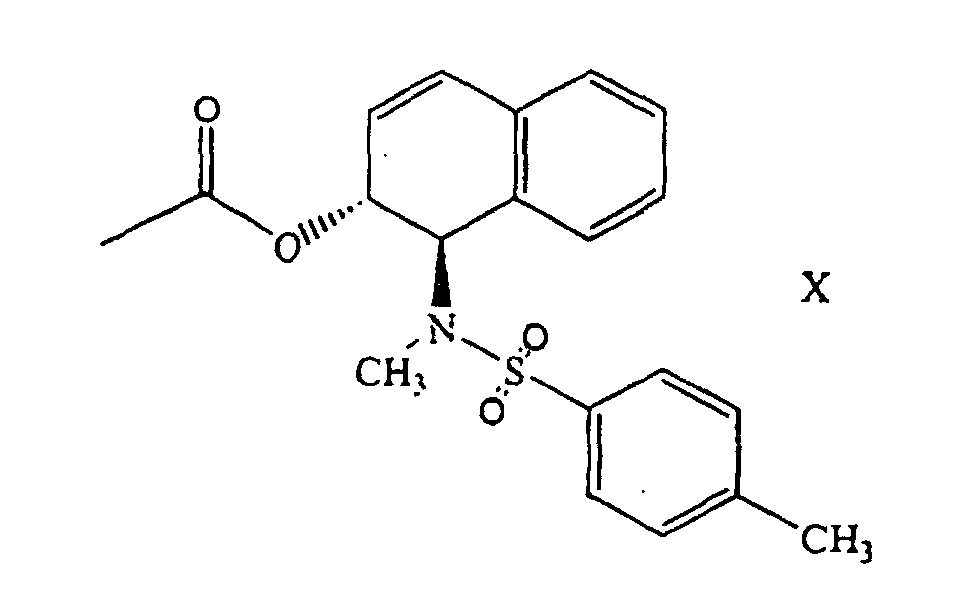
- the compound of formula X is formed by reacting a compound of formula I which is produced as described above in connection with formation of compounds of formula I, with iodomethane.
- the compound made using this reaction is (1 R ,2 S )-1- ⁇ methyl[(4-methylphenyl)sulfonyl]amino ⁇ -1,2-dihydro-2-naphthalenyl acetate.
- the present invention is based upon the discovery of a new process for the formation of enantiomerically enriched compounds containing the hydronaphthalene ring structure.
- the process involves reacting an oxabenzonorbomadiene with a nucleophile in the presence of a rhodium catalyst and a phosphine ligand.
- a nucleophile in the presence of a rhodium catalyst and a phosphine ligand.
- Preferred nucleophiles are alcohols, phenols, amines, and stabilized carbanions such as malonates and malonate equivalents.
- reactions should be performed in the presence of a tertiary amine hydrochloride. This is not necessary for other types of amines.
- carboxylic acids When carboxylic acids are used, reactions should be carried out in the presence of a tertiary amine, e.g., triethylamine.
- the sodium or potassium salt of the carboxylic acid may be reacted in the presence of the hyrochloride of a tertiary amine, e . g . in the presence of triethylamine hydrochloride.
- carboxylate ring-opened products can be made to undergo a subsequent transformation to produce 1,4-disubstituted dihyronaphthalenes. This is accomplished by an S N 2' addition of nucleophiles under catalytic or non-catalytic conditions to the allyl acetate functionality.
- the preferred catalyst is [Rh(COD)Cl] 2 and, depending upon the particular product desired, preferred ligands are DPPF or a chiral analogue of DPPF, (R)-(S)-BPPFA; (R)-(S)-PPF-P t Bu 2 and (S)-(R)-PPF-P t Bu 2 .
- the ligands may be prepared by any process described in the literature ( see , e . g ., Togni et al ., J . Am. Chem. Soc. 116 :4062 (1994)).
- Reactions may be carried out using trifluoroethanol (TFE) or tetrahydrofuran (THF) as solvents under an inert atmosphere, preferably of nitrogen.
- TFE trifluoroethanol
- THF tetrahydrofuran
- the reaction temperature should typically be at least 60°C and preferably about 80°C.
- the cis isomer of 15 was prepared by reaction of 1,2-dihydronaphthalene with OSO 4 followed by methylation with dimethylsulfate (DMS).
- the trans isomer was prepared by epoxidation of 1,2-dihydronaphthalene followed by ring opening with hyroxide and dimethylation with DMS).
- DPPF was very efficient, however, giving 14 in 88% yield.
- One advantage of DPPF is that a number of chiral analogues have been prepared and could be studied to determine enantioselectivity.
- JOSIPHOS ligands (Togni, A.., et al., J Am. Chem . Soc. 116 :4062 (1994)) were among the chiral ligands examined which gave the most promising results.
- PPF-P t Bu 2 16 gave 14 in 84% yield and 86% ee at 60°C. The ee could be significantly improved to 97% when the reaction temperature was increased by 20°C.
- the resulting oil was purified by flash chromatography (10% ethyl acetate in hexanes) to give 18 as a colourless oil (133.7 mg, 94%).
- the resulting oil was purified by flash chromatography (10% ethyl acetate in hexanes) to give 20 as a colourless oil (84.7 mg, 53%).
- the resulting solid was purified by flash chromatography (10% ethyl acetate in hexanes) to give 23 as a white solid (107.1mg, 90%).
- the resulting solid was purified by flash chromatography (30% ethyl acetate in hexanes) to give 28 as a white crystalline solid (127.5 mg, 90%).
- the resulting mixture was purified by flash chromatography (20% ethyl acetate in hexanes) to give 4 a white crystalline solid (129 mg, 70%).
- aqueous extracts were combined and back-extracted three times with diethyl ether.
- the combined ether extracts were washed with brine and dried with anhydrous sodium sulfate.
- the solvents were removed in vacuo , yielding a solid which was purified by flash chromatography on silica gel (30% ethyl acetate in hexanes) giving a white crystalline solid 3 (184 mg, 94%).
- the ee was determined to be 97% by formation of Mosher's ester.
- aqueous extracts were combined and back-extracted three times with diethyl ether.
- the combined ether extracts were washed with brine and dried with anhydrous sodium sulfate.
- the solvents were removed in vacuo , yielding a solid which was purified by flash chromatography on silica gel (30% ethyl acetate in hexanes) giving a white crystalline solid 4 (160 mg, 88%).
- aqueous extracts were combined and back-extracted three times with diethyl ether.
- the combined ether extracts were washed with brine and dried with anhydrous sodium sulfate.
- the solvents were removed in vacuo , yielding a solid which was purified by flash chromatography on silica gel (30% ethyl acetate in hexanes) giving a white crystalline solid 5 (177 mg, 91%).
- aqueous extracts were combined and back-extracted three times with diethyl ether.
- the combined ether extracts were washed with brine and dried with anhydrous sodium sulfate.
- the solvents were removed in vacuo , yielding a solid which was purified by flash chromatography on silica gel (10% ethyl acetate in hexanes) to give a white crystalline solid 6 (184 mg, 87%).
- aqueous extracts were combined and back-extracted three times with diethyl ether.
- the combined ether extracts were washed with brine and dried with anhydrous sodium sulfate.
- the solvents were removed in vacuo , yielding a solid which was purified by flash chromatography on silica gel (10% ethyl acetate in hexanes) giving a white crystalline solid 7 (163 mg, 92%).
- aqueous extracts were combined and back-extracted three times with diethyl ether.
- the combined ether extracts were washed with brine and dried with anhydrous sodium sulfate.
- the solvents were removed in vacuo , yielding a solid which was purified by flash chromatography on silica gel (5% ethyl acetate in hexanes) giving a white crystalline solid 8 (169 mg, 89%).
- the ee was determined to be 92% by formation of Mosher's ester.
- aqueous extracts were combined and back-extracted three times with diethyl ether.
- the combined ether extracts were washed with brine and dried with anhydrous sodium sulfate.
- the solvents were removed in vacuo , yielding a solid which was purified by flash chromatography on silica gel (10% ethyl acetate in hexanes) as a white crystalline solid 9 (193 mg, 73%).
- the ee was determined by deiodinating 9 (40 mg, 0.11 mmol) by reaction with t-BuLi (0.32 mL, 1.7M) in diethyl ether (2 mL) at -78°C followed by quenching with isopropanol.
- aqueous extracts were combined and back-extracted three times with diethyl ether.
- the combined ether extracts were washed with brine and dried with anhydrous sodium sulfate.
- the solvents were removed in vacuo , yielding a solid which was purified by flash chromatography on silica gel (5% ethyl acetate in hexanes) giving a white crystalline solid 11 (57 mg, 65%).
- aqueous extracts were combined and back-extracted three times with diethyl ether.
- the combined ether extracts were washed with brine and dried with anhydrous sodium sulfate.
- the solvents were removed in vacuo , yielding a solid which was purified by flash chromatography on silica gel (10% ethyl acetate in hexanes) as a white crystalline solid 12 (159 mg, 85%).
- aqueous extracts were combined and back-extracted three times with diethyl ether.
- the combined ether extracts were washed with brine and dried with anhydrous sodium sulfate.
- the solvents were removed in vacuo , yielding a solid which was purified by flash chromatography on silica gel (5% ethyl acetate in hexanes) as a white crystalline solid 13 (75 mg, 37%).
- Example 11 Compounds Formed in Reactions Involving Nitrogen or Carbon Nucleophiles
Landscapes
- Chemical & Material Sciences (AREA)
- Organic Chemistry (AREA)
- Health & Medical Sciences (AREA)
- Chemical Kinetics & Catalysis (AREA)
- Life Sciences & Earth Sciences (AREA)
- General Chemical & Material Sciences (AREA)
- Veterinary Medicine (AREA)
- Medicinal Chemistry (AREA)
- Nuclear Medicine, Radiotherapy & Molecular Imaging (AREA)
- Pharmacology & Pharmacy (AREA)
- Animal Behavior & Ethology (AREA)
- General Health & Medical Sciences (AREA)
- Public Health (AREA)
- Bioinformatics & Cheminformatics (AREA)
- Engineering & Computer Science (AREA)
- Oncology (AREA)
- Communicable Diseases (AREA)
- Virology (AREA)
- Biomedical Technology (AREA)
- Immunology (AREA)
- Neurosurgery (AREA)
- Neurology (AREA)
- Pain & Pain Management (AREA)
- Molecular Biology (AREA)
- Tropical Medicine & Parasitology (AREA)
- Psychology (AREA)
- AIDS & HIV (AREA)
- Rheumatology (AREA)
- Organic Low-Molecular-Weight Compounds And Preparation Thereof (AREA)
- Pharmaceuticals Containing Other Organic And Inorganic Compounds (AREA)
- Low-Molecular Organic Synthesis Reactions Using Catalysts (AREA)
- Acyclic And Carbocyclic Compounds In Medicinal Compositions (AREA)
- Indole Compounds (AREA)
- Catalysts (AREA)
- Other In-Based Heterocyclic Compounds (AREA)
- Quinoline Compounds (AREA)
- Heterocyclic Carbon Compounds Containing A Hetero Ring Having Oxygen Or Sulfur (AREA)
Abstract
Description
- The present invention is directed to methods for chemically synthesizing compounds containing a hydronaphthalene ring structure. It encompasses the compounds made by the methods.
- The hydronaphthalene structure can be found in many natural products and pharmaceutical agents. These include homochelidonine 1 (Slavik, J.; et al., Collect. Czech. Chem. Commun. 30:3697 (1965); Spath, E., et al., Ber., 64:1123 (1931); Bersch, H. W., Arch. Pharm. (Weinheim, Ger.), 2914:91 (1958)) an alkaloid isolated from Chelidonium plants, dihydrexidine 2 (Snyder, S. E., J. Med. Chem., 38:2395 (1995)) which shows antiparkinsonian character, etoposide 3 (Kamal, A., et al., Tetrahedron Lett. 37:3359 (1996)) which is used in the treatment of various cancers, and SF-2315B 4 (Kim, K., et al., J. Org. Chem. 60:6866 (1995)) which is a viral reverse transcriptase inhibitor. In addition, CNS agents, immunoregulatory agents and antibiotics contain variations on this framework (Perrone, R., et al., J. Med. Chem. 38:942 (1995)).


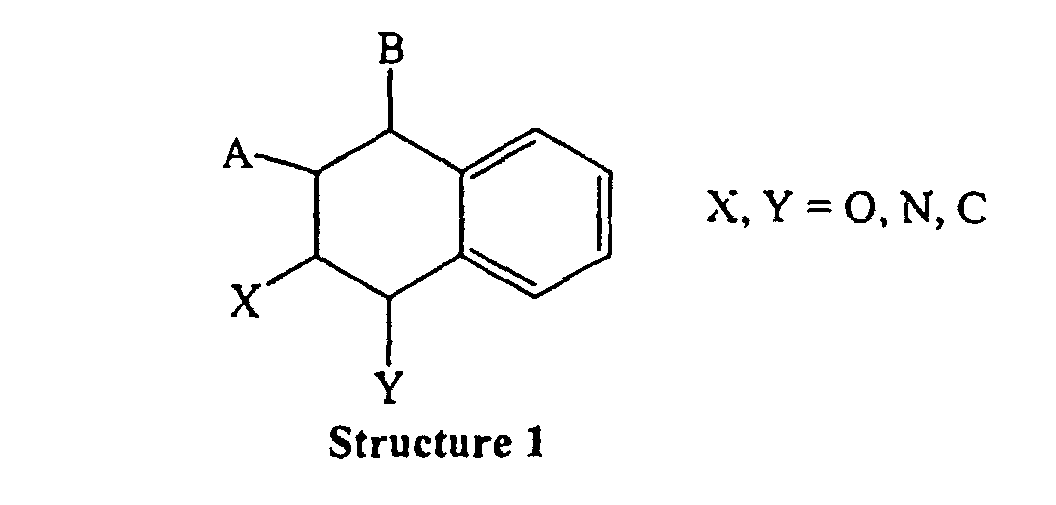
- Given the large number of pharmaceutically useful compounds which contain this core skeleton, new methodology which produces functionalized hydronaphthalene skeletons (structure 1) would clearly be of value.
- Previous work on oxabicyclic ring opening reactions led to a catalytic enantioselective route to dihydronaphthol (Lautens, M., et al., Tetrahedron 54:1107 (1998)) which was a key step in the total synthesis of sertraline (Lautens, M., et al., J. Org. Chem. 63:5276 (1997)). However, little is known about the ring opening of oxabenzonorbomadiene or similar compounds with the incorporation of nucleophiles during the ring opening step. Duan and Chen developed a method of introducing aryl groups by using catalytic amounts of palladium (Duan, J.-P., et al., Tetrahedron Lett., 34:4019 (1993); Duan, J.-P., et al., Organometallics 14:1608 (1995)). Moinet et al., later developed an enantioselective version of this reaction but the yields were low (Tetrahedron Lett., 36:2051 (1995)).
- Catalytic organometallic processes that form carbon-heteroatom bonds are far fewer in number than those which form carbon-carbon bonds. The Wacker Process (Henry, P.M., Paladium Catalysed Oxidation of Hydrocarbons, vol. 2, Reidel, Boston, (1980)), oxidative carbonylations of amines and alcohols (Applied Homogeneous Catalysis with Organometallic Compounds: A Comprehensive Handbook in Two Volumes (eds.: B. Comils, W.A. Herrmann), VCH, New York, (1984)) and the formation of arylamines and aryl ethers (Hartwig, J.F., Agnew. Chem. Int. Ed. 37:2046 (1998); Widenhoefer, R.A., et al., J. Am. Chem. Soc. 119:6787 (1997)) are a few that have been described to date.
- The present invention is based upon the discovery of a rhodium catalyzed ring opening reaction of oxabenzonorbomadienes or azabicyclic compounds to produce a new carbon-oxygen bond via an intermolecular reaction with various alcohols. This reaction occurs in good yields with complete regio and diastereoselectivity and excellent enantioselectivity (e.g., eq. 1).

- In the reaction above, Z is O or NRa. This reaction will work when oxabenzonorbomadienes are reacted with nitrogen nucleophiles, carboxylate nucleophiles, carbon nucleophiles or phenol nucleophiles. The invention encompasses not only the chemical reactions but also the compounds made by the reactions .
In its first aspect, the invention is directed to a compound according to formula I:R is -(CH2)nR1 and R1 is a C3-C6 aryl optionally substituted at one or more positions with a group selected from: Cl; F; NO2; I; Br; a C1-C3 alkyl; and a C1-C3 alkoxy and wherein n=0-3;
wherein X and Y are independently selected from the group consisting of H; NH2; F; Cl; Br; a C1-C3 alkyl; and a C1-C3 alkoxy;
or wherein adjacent X and Y or Y and Y together with the carbon atoms to which they are attached from form a C3-C6 carbocyclic ring or a C3-C6 heterocyclic ring containing one or more heteroatoms selected from the group consisting of: O; N; and S; and
wherein Z is selected from O or NRa, wherein Ra is selected from: - (i) phenyl;
- (j) (O)C-O-Rb, wherein Rb is a straight or branched C1-C6 alkyl;
- (k) -SO2-Rc, wherein Rc is selected from the group consisting of:
- i) C1-C6 straight or branched alkyl;
- ii) -(CH2)qRe, wherein q=O-3 and Re is a C3-C6 aryl, optionally substituted at one or more positions with a group selected from: Cl; F; NO2; CN; I; Br; a straight or branched C1-C3 alkyl; a C1-C3 alkoxy; and -C(O)Rf, wherein Rf is a C1-C3 alkyl; -(CH2)rCF3, wherein r=0-3;
- iii) -Rg(CF3)s, wherein Rg is a C1-C3 straight or branched alkyl and s=1-3;
- iv) -(CH2)s-TMS, wherein TMS = trimethylsilyl and s= 1-3;
- (l) -SO2-(CH2)q-Si(CH3)3 wherein q is 1-3.
-
- The compounds of formula I described above may be prepared by reacting a compound of formula ROH with a compound of formula V:in which R, X, and Y are as defined above. The reaction is catalyzed by [Rh(COD)Cl]2 in the presence of a phosphine ligand, preferably selected from the group consisting of: DPPF; (R)-(S)-BPPFA; and (R)-(S)-PPF-PtBu2. In prefered reactions: (a) the compound made is (1R*,2R*)-acetic acid 1-hydroxy-1,2-dihydro-naphthalen-2-yl ester and ROH is acetic acid; (b) the compound made is (1R*,2R*)-propionic acid 1-hydroxy-1,2-dihydro-naphthalen-2-yl ester and ROH is propionic acid; (c) the compound made is (1R,2R)-benzoic acid 1-hydmxy-1,2-dihydro-naphthalen-2-yl-ester and ROH is benzoic acid; (d) the compound made is (1R*,2R*)-formic acid 1-hydroxy-1,2-dihydro-naphthalen-2-yl-ester and ROH is formic acid; (e) the compound made is (1R*,2R*)-2-methyl acrylic acid 1-hydroxy-1,2-dihydro-naphthalen-2-yl-ester and ROH is methacrylic acid; (f) the compound made is (1R*,2R*)-malonic acid ethyl-ester (1-hydroxy-1,2-dihydro-naphthalen-2-yl) ester and ROH is ethyl malonic acid; and (g) the compound made is (1R,2R)-2-(4-bromo-phenoxy)-1,2-dihydro-naphthalen-1-ol and ROH is p-bromophenol; (h) the compound made is N-[(1R,2S)-2-methoxy-1,2-dihydro-1-naphthalenyl]-2-(trimethylsilyl)ethanesulfonamide and ROH is MeOH; (i) the compound made is 4-methyl-N-[(1R, 2S)-2-phenoxy-1,2-dihydrohydro-1-naphthalenyl]bemzenesulfonamide and the ROH is phenol; (j) the compound made is (1R, 2S)-1-{[(4-methylpehnyl)sulfonyl]amino}-1,2-dihydrohydro-2-naphthalenyl acetate and the ROH is acetic acid; (k) the compound made is (1R, 2S)-1-{[(4-methylphenyl)-sulfonyl]amino}-1,2-dihydro-2-naphthalenyl benzoate and the ROH is benzoic acid; (I) the compound made is (1R, 2S)-1-{[(4-methylphenyl)sulfonyl]amino}-1,2-dihydro-2-naphthalenyl pivalate and the ROH is pivalic acid; (m) the compound made is N-[(1R, 2S)-2-methoxy-1,2-dihydro-1-naphthatenyl]-2-(trimethylsilyl)ethanesulfonamide and ROH is methanol.
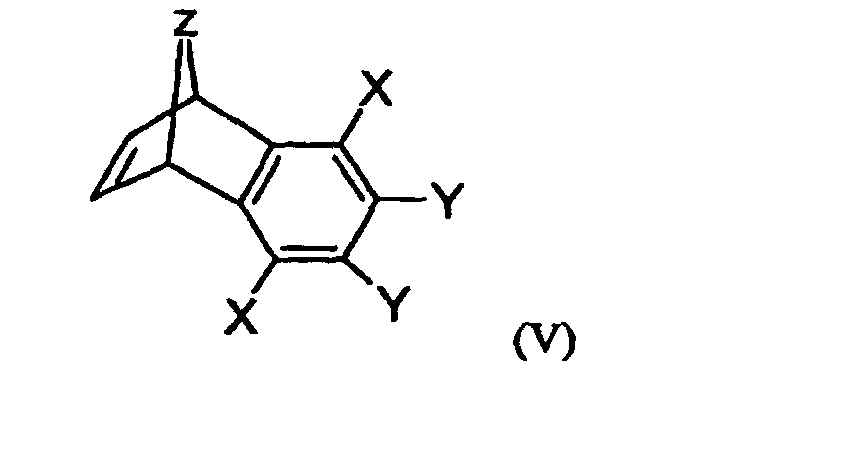
In a second aspect the invention is directed to a compound according to formula II:wherein R is -(CH2)qR5 wherein q=0-3 and R5 is a C3-C6 aryl optionally substituted at one or more positions with a group selected from: a straight or branched C1-C3 alkyl; a C1-C3 alkoxy; I; Cl; CN; F; NO2; -(CH2)rCF3, wherein r=0-3; and -C(O)R6, wherein R6 is a C1-C3 alkyl;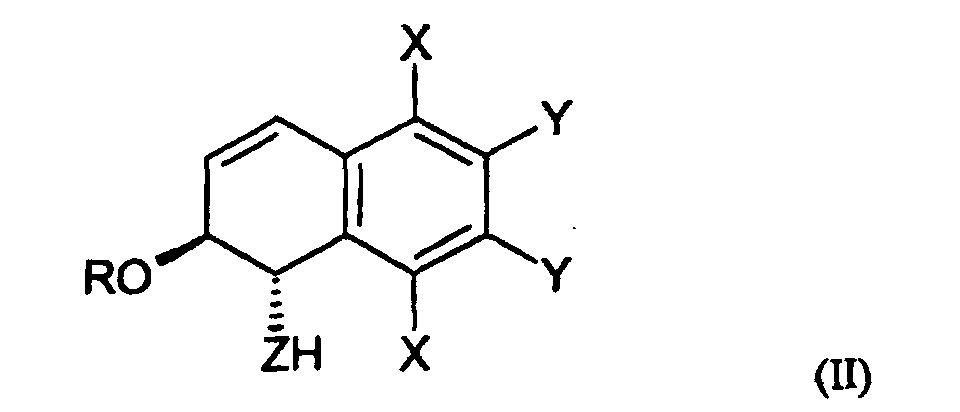
wherein X and Y are independently selected from the group consisting of H; NH2; F; Cl; Br; a C1-C3 alkyl; and a C1-C3 alkoxy;
or wherein adjacent X and Y or Y and Y together with the carbon atoms to which they are attached from form a C3-C6 carbocyclic ring or a C3-C6 heterocyclic ring containing one or more heteroatoms selected from the group consisting of: O; N; and S; and
wherein Z is selected from O or NRa, wherein Ra is selected from: - (e) phenyl;
- (f) (O)C-O-Rb, wherein Rb is a straight or branched C1-C6 alkyl;
- (g) -SO2-Rc, wherein Rc is selected from the group consisting of:
- i) C1-C6 straight or branched alkyl;
- ii) -(CH2)qRe, wherein q=0-3 and Re is a C3-C6 aryl, optionally substituted at one or more positions with a group selected from: Cl; F; NO2; CN; I; Br; a straight or branched C1 -C3 alkyl; a C1-C3 alkoxy; and -C(O)Rf, wherein Rf is a C1-C3 alkyl; -(CH2)rCF3, wherein r=0-3;
- iii) -Rg(CF3)s, wherein Rg is a C1-C3 straight or branched alkyl and s=1-3;
- iv) -(CH2)s-TMS, wherein TMS = trimethylsilyl and s= 1-3;
- (h) -SO2-(CH2)q-Si(CH3)3 wherein q is 1-3.
-
- The compounds of formula II described above may be prepared by reacting a compound of formula ROH with a compound of formula V:wherein R, X, Y, and Z are as defined above in connection with formula II and in which the reaction is catalyzed by [Rh(COD)Cl]2 in the presence of a phosphine ligand, preferably (S)-(R)-PPF-PtBu2. In preferred reactions: (a) the compound made is (1S,2S)-2-methoxy-1,2-dihydro-naphthalen-1-ol, and ROH is methanol; (b) the compound made is (1S,2S)-2-(ethoxy)-1,2-dihydro-naphthalen-1-ol, and ROH is ethanol; (c) the compound made is (1S,2S)-2-isopropoxy)-1,2-dihydro-naphthalen-1-ol and ROH is isopropanol; (d) the compound made is (1S,2S)-2-1-propenyloxy)-1,2-dihydro-naphthalen-1-ol, and ROH is allyl alcohol; (e) the compound made is (1S,2S)-2-(2-trimethylsilyl-ethoxy)-1,2-dihydro-naphthalen-1-ol, and ROH is trimethylsilylethanol; (f) the compound made is (1S,2S)-2-benzyloxy-1,2-dihydro-naphthalen-1-ol, and ROH is benzylalcohol; (g) the compound made is (1S,2S)-2-4-methoxybenzyloxy-1,2-dihydro-naphthalen-1-ol, and ROH is anisylalcohol; (h) the compound made is (1S,2S)-2-(2,2,2-trifluoroethoxy)-1,2-dihydro-naphthalen-1-ol, and ROH is trifluoroethanol; (i) the compound made is (1S,2S)-2-(2,2,2-trifluoro-1-trifluoromethyl-ethoxy)-1,2-dihydro-naphthalen-1-ol and ROH is hexafluoro-isopropanol; (j) the compound made is (1S,2S)-6,7-difluoro-2-methoxy-1,2-dihydro-naphthalen-1-ol and ROH is methanol; (k) the compound made is (1S,2S)-6-methoxy-5,6-dihydro-naphtho[2,3-d][1,3]dioxol-5-ol and ROH is methanol; (1) the compound made is (1S,2S)-6,7-dibromo-2-methoxy-5,8-dimethyl-1,2-dihydro-riaphthalen-1-ol and ROH is methanol; (m) the compound made is (1S,2S)-2-phenoxy-1,2-dihydro-naphthalen-1-ol and ROH is phenol; (n) the compound made is (1S,2S)-2-(4-nitrophenoxy)-1,2-dihydro-naphthalen-1-ol and ROH is 4-nitrophenol; (o) the compound made is (1S,2S)-2-(4-cyanophenoxy)-1,2-dihydro-naphthalen-1-ol and ROH is 4-cyanophenol; (p) the compound made is (1S,2S)-2-(4-acylphenoxy)-1,2,-dihydro-naphthalen-1-ol and ROH is 4-hydroxyaceto-phenone; (q) the compound made is (1S,2S)-2-(4-trifluoromethylphenoxy)-1,2,-dihydro-naphthalen-1-ol and ROH is 4-trifluoromethylphenyl; (r) the compound made is (1S,2S)-2-(4-fluorophenoxy)-1,2-dihydro-naphthalen-1-ol and ROH is 4-fluorophenol; (s) the compound made is (1S,2S)-2-(4-chlorophenoxy)-1,2-dihydro-naphthalen-1-ol and ROH is 4-chlorophenol; (t) the compound made is (1S,2S)-2-(4-iodophenoxy)-1,2-dihydro-naphthalen-1-ol and ROH is 4-iodophenol; (u) the compound made is (1S,2S)-2-(4-methylphenoxy)-1,2-dihydro-naphthalen-1-ol and ROH is p-cresol; (v) the compound made is (1S,2S)-2-(4-methoxyphenoxy)-1,2-dihydro-naphthalen-1-ol and ROH is 4-methoxyphenol; and (w) the compound made is (1S,2S)-2-(2-bromophenoxy)-1,2-dihydro-naphthalen-1-ol and ROH is 2-bromophenol. When Z is NRa, Ra is preferably phenyl; (O)C-O-C-(CH3)3;
 ; or (O)S(O)-(CH2)2-Si(CH3)3.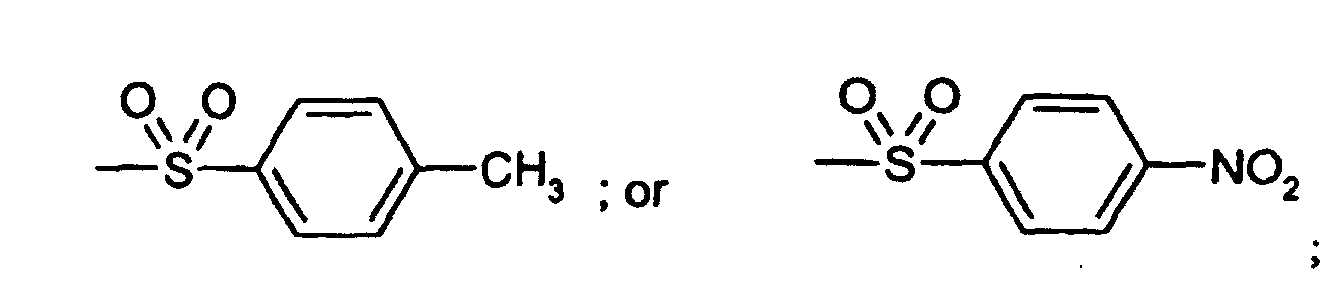
- The invention is also directed to a compound according to formula III:wherein TBDMSO is a tert-butyldimethylsiloxy group, and R, X, and Y are as defined in above in connection with formula I. These compounds may made by preparing a compound of formula I according to the process described above and then reacting the compound formed with a salt of tert-butytdimethylsilylic acid. Preferably, the compound formed is (1R*,2R*)-malonic acid (1-tert-butyldimethylsiloxy-1,2-dihydro-naphthalen-2-yl) ester ethyl ester and ROH is tert-butyldimethylsilylic acid.
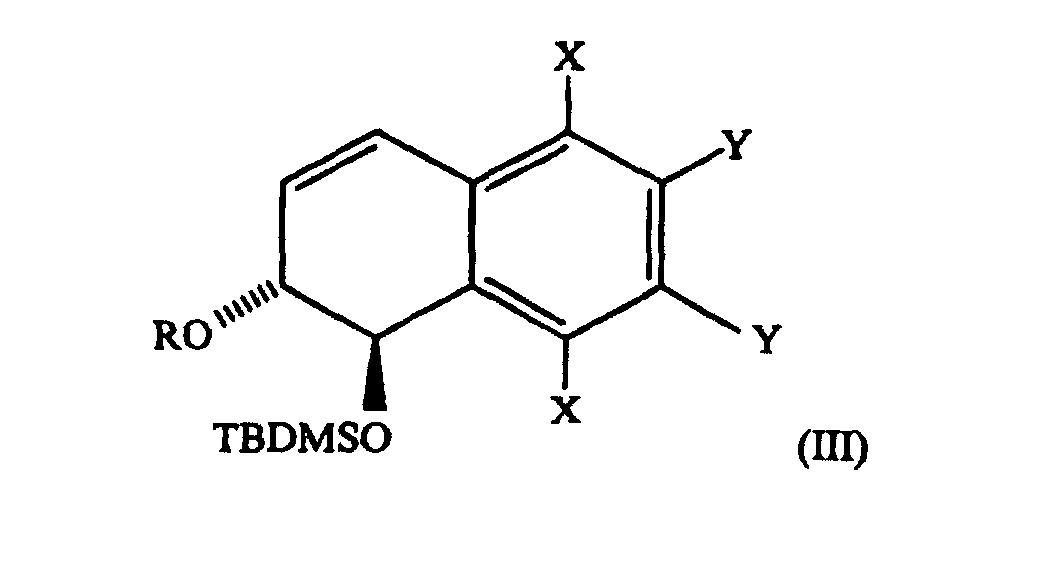
- In another aspect, the invention is directed to A compound according to formula IV:wherein:
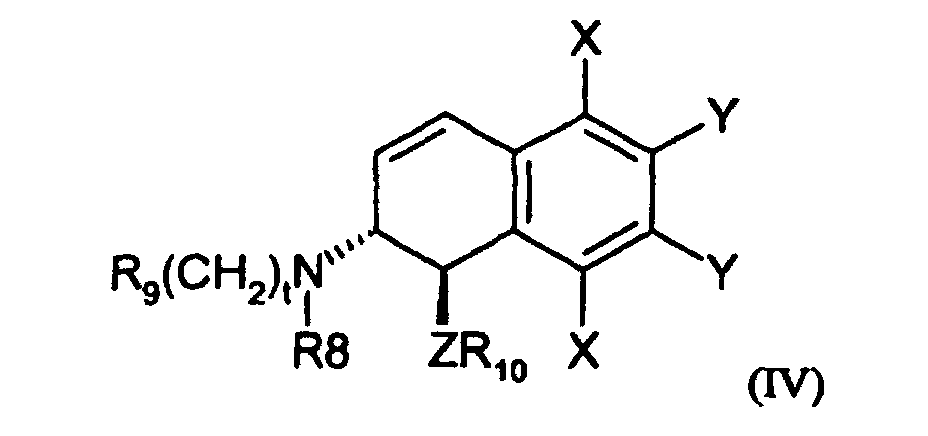
- a) in which R8 is H, CH3 or as defined in c);
- b) t=0-3;
- c) R9 is a C3-C6 aryl optionally substituted at one or more positions with a group selected from: a C1-C3 alkyl; a C1-C3 alkoxy; Cl; F; NO2; and CF3; or R9 together with N, R8 and (CH2)t of formula IV forms a ring structure selected from: a phthalamide ring; a pyrrolidine ring; a piperidine ring; a tetrahydroquinoline ring; and an indole ring; said ring structure being optionally substituted at one or more positions with a group selected from: a C1-C3 alkyl; a C1-C3 alkoxy; Cl; F; NO2; and CF3;
- d) X and Y are independently selected from the group consisting of H; NH2; F; Cl; Br; a C1-C3 alkyl; and a C1-C3 alkoxy; or wherein adjacent X and Y or Y and Y together with the carbon atoms to which they are attached from form a C3-C6 carbocyclic ring or a C3-C6 heterocyclic ring containing one or more heteroatoms selected from the group consisting of: O; N; and S;
- e) Z is selected from O or NRa, wherein Ra is selected from:
- (i) a straight or branched C1-C6 alkyl;
- (ii) phenyl;
- (iii) (O)C-O-Rb, wherein Rb is a straight or branched C1-C6 alkyl;
- (iv) ―SO2-Rc, wherein Rc is an unsubstituted phenyl or a phenyl substituted with a C1-C3 alkyl or NO2; and
- (v) -SO2-(CH2)q-Si(CH3)3 wherein q isl-3; and
- f) when Z is O, R10 is H; when Z is NRa, R10 is either H or CH3.
-
- The compounds of formula IV described above may be prepared by reacting a compound of formula R9-(CH2)tNHR8 with a compound of formula Vin which R8, R9, t, X, Y, and Z are as defined above in connection with compounds of formula IV and the reaction is catalyzed by [Rh(COD)Cl]2 in the presence of a phosphine ligand; preferably selected from the group consisting of: DPPF; (R)-(S)-BPPFA; and (R)-(S)-PPF-PtBu2. When Z is NRa, the reaction will produce a product in which R10 is H. A subsequent reaction may be used to convert R10 to a methyl as set forth in the Examples section below. Most typically, the process will be used to produce products in which R9 together with N form a ring selected from the group consisting of: a phthalamide ring; a pyrrolidine ring; a piperidine ring; a tetrahydroquinoline ring; and an indole ring; said ring structures being optionally substituted at one or more positions with a group selected from: a C1-C3 alkyl; a C1-C3 alkoxy; Cl; F; NO2; and CF3. In preferred reactions: (a) the compound made is (1R,2R)-2-(1-hydroxy-1,2-dihydro-naphthalen-2-yl) isoindole-1,3-dione and R9-(CH2)sNHR8 is phthalimide; (b) the compound made is (1R*,2R*)-2-pyrrolidin-1-yl-1,2-dihydro-naphthalen-1-ol and R9-(CH2)5NHR8 is pyrrolidine; (c) the compound made is (1R*,2R*)-2-piperidin-1-yl-1,2-dihydro-naphthalen-1-ol and R9-(CH2)sNHR8 is piperidine; (d) the compound made is (1R,2R)-2-(3,4-dihydro-2H-quinolin-1-yl)-1,2-dihydro-naphthalen-1-ol and R9-(CH2)sNHR8 is tetrahydroisoquin-oline; (e) the compound made is (1R,2R)-2(methyl-phenyl-amino)-1,2-dihydro-naphthalen-1-ol and R9-(CH2)sNHR8 is N-methylaniline; (f) the compound made is (1R*,2R*)-2-benzylamino-1,2-dihydro-naphthalen-1-ol and R9-(CH2)sNHR8 is benzyl-amine; (g) the compound made is (1R*,2R*)-2-(4-methoxybenzylamino)-1,2-dihydro-naphthalen-1-ol and R9-(CH2)sNHR8 is p-methoxybenzylamine; and (h) the compound made is (1R,2R)-2-indol-1-yl-1,2-dihydro-naphthalen-1-ol and R9-(CH2)sNHR8 is indole; (i) the compound made is N-[1R,2R)-2(1-pyrrolidinyl)-1,2-dihydronaphthalenyl]-4-methylbenzenesulfonamide and the R9-(CH2)tNHR8 is pyrrolidine; (j) the compound made is N-[(1R,2S)-2-(1H-indol-1-yl)-1,2-dihydro-1-naphthalenyl]-4-methylbenzenesulfonamide and the R9-(CH2)tNHR8 is indole; (k) the compound made is N-[(1R,2S)-2-(3,4-dihydro-2(1H)-isoquinolinyl)-1,2-dihydro-1-naphthalenyl]-4-methylbenzenesulfonamide and the R9-(CH2)tNHR8 is tetrahydroisoquinoline; (1) the compound made is N-[(1R,2S)-2-(3,4-dihydro-1(2H)-quinolinyl)-1,2-dihydro-1-naphthalenyl]-4-methylbenzenesulfonamide and the R9-(CH2)tNHR8 is tetrahydroquinoline; (m) the compound made is 4-methyl-N-[(1R,2S)-2-(1-piperidinyl)-1,2-dihydro-1-naphthalenyl]-benzenesulfonamide and the R9-(CH2)tNHR8 is piperidine.

- The invention also encompasses seven other processes. In the first (1S,2S)-N-(1-hydroxy-1,2-dihydro-naphthalen-2-yl)-benzene sulfonamide is formed by reacting oxabenzonorbomadiene with benzenesulfonamide. In the second, (1S*,2R*)-2-(hydroxy-1,2-dihydro-naphthalen-2-yl)malonic acid dimethyl ester is formed by reacting oxabenzonorbornadiene with dimethyl malonate. Both reactions are catalyzed by [Rh(COD)Cl]2 in the presence of a phosphine ligand. In the third, the compound of formula VI is formed by reacting a compound of formula IV, which is produced as described above in connection with formation of compounds of formula IV, with iodomethane. In preferred reactions, the compound made is N,4-dimethyl-N-[(1R,2S)-2-(1-pyrrolidinyl)-1,2-dihydro-1-naphthalenyl]benzenesulfonamide. In the fourth, the compound of formula VII is formed by reacting compound of formula VI with hydrogen in the presence of palladium catalyst. The compound made is N,4-dimethyl-N-[(1R,2S)-2-(1-pyrrolidinyl)-1,2,3,4-tetrahydro-1-naphthalenyl]benzenesulfonamide. In the fifth, the compound of formula VIII is formed by reacting the compound of formula VII with sodium borohydride. The compound made using this reaction is (1R,2S)-N-methyl-2-(1-pyrrolidinyl)-1,2,3,4-tetrahydro-1-naphthalenamine. In the sixth, the compound of formula IX is formed by reacting a compound of formula IV which is produced as described above in connection with formation of compounds of formula IV, with iodomethane. The compound made using this reaction is N-methyl-4-nitro-N-[(1R,2S)-2-(1-pyrrolidinyl)-1,2-dihydro-1-naphthalenyl]benzenesulfonamide. In the seventh, the compound of formula X is formed by reacting a compound of formula I which is produced as described above in connection with formation of compounds of formula I, with iodomethane. The compound made using this reaction is (1R,2S)-1-{methyl[(4-methylphenyl)sulfonyl]amino}-1,2-dihydro-2-naphthalenyl acetate.
- Overall, the most preferred compounds of the invention are:
- a) (1S,2S)-2-methoxy-1,2-dihydro-naphthalen-1-ol;
- b) (1S,2S)-2-(ethoxy)-1,2-dihydro-naphthalen-1-ol;
- c) (1S,2S)-2-(isopropoxy)-1,2-dihydro-naphthalen-1-ol;
- d) (1S,2S)-2-(1-propenyloxy)-1,2-dihydro-naphthalen-1-ol;
- e) (1S,2S)-2-(2-trimethylsilyl-ethoxy)1,2-dihydro-naphthalen-1-ol;
- f) (1S,2S)-2-benzyloxy-1,2-dihydro-naphthalen-1-ol;
- g) (1S,2S)-2-(4-methoxybenzyloxy)-1,2-dihydro-naphthalen-1-ol;
- h) (1S,2S)-2-(2,2,2-trifluoro-ethoxy)-1,2-dihydro-naphthalen-1-ol;
- i) (1S,2S)-2-(2,2,2-trifluoro-1-trifluoromethyl-ethoxy)-1,2-dihydro-naphthalen-1-ol;
- j) (1S,2S)-6,7-difluoro-2-methoxy-1,2-dihydro-naphthalen-1-ol;
- k) (1S,2S)-6-methoxy-5,6-dihydro-naphthol[2,3-d][1,3]dioxol-5-ol;
- l) (1S,2S)-6,7-dibromo-2-methoxy-5,8-dimethyl-1,2-dihydro-naphthalen-1-ol;
- m) (1R*,2R*)-acetic acid 1-hydroxy-1,2-dihydro-naphthalen-2-yl-ester;
- n) (1R*,2R*)-propionic acid 1-hydroxy-1,2-dihydro-naphthalen-2-yl-ester;
- o) (1R,2R)-benzoic acid 1-hydroxy-1,2-dihydro-naphthalen-2-yl-ester;
- p) (1R*,2R*)-formic acid 1-hydroxy-1,2-dihydro-naphthalen-2-yl-ester;
- q) (1R*,2R*)-2-methyl acrylic acid 1-hydroxy-1,2-dihydro-naphthalen-2-yl-ester;
- r) (1R*,2R*)-malonic acid ethyl ester (1-hydroxy-1,2-dihydro-naphthalen-2-yl) ester;
- s) (1R*,2R*)-malonic acid (1-tert-butylbimethylsiloxy-1,2-dihydro-naphthalen-2-yl) ethyl ester;
- t) (1S*,2S*)4-tert-butyldimethylsiloxy-1,4-dihydro-naphthalen-2-yl) acetic acid ethyl ester;
- u) (1R,2R)-2-(1-hydroxy-1,2-dihydro-naphthalen-2-yl)-isoindote-1,3-dione;
- v) (1S,2S)-N-(1-hydroxy-1,2-dihydro-naphthalen-2-yl)-benzene sulfonamide;
- w) (1R*,2R*)-2-pyrrolidin-1-yl-1,2-dihydro-naphthalen-1-ol;
- x) (1R*,2R*)-2-piperidin-1-yl-1,2-dihydro-naphthalen-1-ol;
- y) (1R,2R)-2-(3,4-dihydro-2H-quinolin-1-yl)-1,2-dihydro-naphthalen-1-ol;
- z) (1R,2R)-2-(methyl-phenyl-amino)-1,2-dihydro-naphthalen-1-ol;
- aa) (1R*,2R*)-2-benzylamino-1,2-dihydro-naphthalen-1-ol;
- bb) (1R*,2R*)-2-(4-methoxy-benzylamino)-1,2-dihydro-naphthalen-1-ol;
- cc) (1R,2R)-2-indol-1-yl-1,2-dihydro-naphthalen-1-ol;
- dd) (1S*,2R*)-2-(hydroxy-1,2-dihydro-naphthalen-2-yl)malonic acid dimethyl ester;
- ee) (1S,2S)-2-phenoxy-1,2-dihydro-naphthalen-1-ol;
- ff) (1S,2S)-2-(4-nitrophenoxy)-1,2-dihydro-naphthalen-1-ol;
- gg) (1S,2S)-2-(4-cyanophenoxy)-1,2-dihydro-naphthalen-1-ol;
- hh) (1S,2-S)-2-(4-acylphenoxy)-1,2-dihydro-naphthalen-1-ol;
- ii) (1S,2S)-2-(4-trifluoromethylphenoxy)-1,2-dihydro-naphthalen-1-ol;
- jj) (1S,2S)-2-(4-fluorophenoxy)-1,2-dihydro-naphthalen-1-ol;
- kk) (1S,2S)-2-(4-chlorophenoxy)-1,2-dihydro-naphthalen-1-ol;
- ll) (1S,2S)-2-(4-iodophenoxy)-1,2-dihydro-naphthalen-1-ol;
- mm) (1R,2R)-2-(4-bromo-phenoxy)-1,2-dihydro-naphthalen-1-ol;
- nn) (1S,2S)-2-(4-methylphenoxy)-1,2-dihydro-naphthalen-1-ol;
- oo) (1S,2S)-2-(4-methoxyphenoxy)-1,2-dihydro-naphthalen-1-ol;
- pp) (1S,2S)-2-(2-bromophenoxy)-1,2-dihydro-naphthalen-1-ol;
- qq) 4-methyl-N-[(1R,2S)-2-(1-piperidinyl)-1,2-dihydro-1-naphthalenyl]benzenesulfonamide;
- rr) N-[(1R,2S)-2-(3,4-dihydro-1(2H)-quinolinyl)-1,2-dihydro-1-naphthalenyl]-4-methylbenzenesulfonamide;
- ss) N-[(1R,2S)-2-(3,4-dihydro-2(1H)-isoquinolinyl)-1,2-dihydro-1-naphthalenyl]-4-methylbenzenesulfonamide;
- tt) N-[(1R,2S)-2-(1H-indol-1-yl)-1,2-dihydro-1-naphthalenyl]-4-methylbenzenesulfonamide;
- uu) (1R,2S)-2-methoxy-N-phenyl-1,2-dihydro-1-naphthalenamine;
- vv) tert-butyl (1R,2S)-2-methoxy-1,2-dihydro-1-naphthalenylcarbamate;
- ww) N-[(1R,2S)-2-methoxy-1,2-dihydro-1-naphthalenyl]-2-(trimethylsilyl)ethanesulfonamide;
- xx) N,4-dimethyl-N-[(1R,2S)-2-(1-pyrrolidinyl)-1,2,3,4-tetrahydro-1-naphthalenyl]-benzenesulfonamide;
- yy) N,4-dimethyl-N-[(1R,2S)-2-(1-pyrrolidinyl)-1,2-dihydro-1-naphthalenyl]-benzenesulfonamide;
- zz) N-hydroxy-4-({methyl[(1R,2S)-2-(1-pyrrolidinyl)-1,2-dihydro-1-naphthalenyl]amino}sulfonyl)-N-oxobenzenaminium;
- aaa) N,4-dimethyl-N-[(1R,2S)-2-(1-pyrrolidinyl)-1,2-dihydro-1-naphthalenyl]-benzenesulfonamide;
- bbb) N-hydroxy-4-({methyl[(1R,2S)-2-(1-pyrrolidinyl)-1,2-dihydro-1-naphthalenyllamino}sulfonyl)-N-oxobenzenaminium;
- ccc) N-methyl-4-nitro-N-[(1R,2S)-2-(1-pyrrolidinyl)-1,2-dihydro-1-naphthalenyl]-benzenesulfonamide;
- ddd) (1R,2S)-N-methyl-2-(1-pyrrolidinyl)-1,2,3,4-tetrahydro-1-naphthalenamine;
- eee) N-[(1R, 2S)-2-methoxy-1,2,3,4-tetrahydro-1-naphthalenyl]-4-methylbenzenesulfonamide;
- fff) N-[(1R,2S)-2-methoxy-1,2,3,4-tetrahydro-1-naphthalenyl]-4-methylbenzenesulfonamide;
- ggg) 4-methyl-N-[(1R,2S)-2-phenoxy-1,2,3,4-tetrahydro-1-naphthalenyl]benzenesulfonamide;
- hhh) (1R,2S)-1-{[(4-methylphenyl)sulfonyl]amino)-1,2,3,4-tetrahydro-2-naphthalenyl acetate;
- iii) (1R,2S)-1-{[(4-methylphenyl)sulfonyl]amino}-1,2-dihydro-2-naphthalenyl benzoate;
- jjj) (1R,2S)-1-{[(4-methylphenyl)sulfonyl]amino1,2-dihydro-2-naphthalenyl pivalate;
- kkk) N-[(1R,2S)-2-methoxy-1,2-dihydro-1-naghthalenyl]-2-(trimethylsilyl)ethanesulfonamide;
- lll) tert-butyl (1R,2S)-2-methoxy-1,2-dihydro-1-naphthalenylcarbamate; and
- mmm) 4-nitro-N-[(1R,2S)-2-(1-pyrrolidinyl)-1,2-dihydro-1-naphthalenyl]benzenesulfonamide.
-
- The present invention is based upon the discovery of a new process for the formation of enantiomerically enriched compounds containing the hydronaphthalene ring structure. The process involves reacting an oxabenzonorbomadiene with a nucleophile in the presence of a rhodium catalyst and a phosphine ligand. Detailed procedures for the formation of oxabenzonorbomadiene compounds and their use in reactions are set forth in the Examples section below. Preferred nucleophiles are alcohols, phenols, amines, and stabilized carbanions such as malonates and malonate equivalents. In cases where simple aliphatic amines are used, reactions should be performed in the presence of a tertiary amine hydrochloride. This is not necessary for other types of amines. When carboxylic acids are used, reactions should be carried out in the presence of a tertiary amine, e.g., triethylamine. Alternatively, the sodium or potassium salt of the carboxylic acid may be reacted in the presence of the hyrochloride of a tertiary amine, e.g. in the presence of triethylamine hydrochloride. It has been found that carboxylate ring-opened products can be made to undergo a subsequent transformation to produce 1,4-disubstituted dihyronaphthalenes. This is accomplished by an SN2' addition of nucleophiles under catalytic or non-catalytic conditions to the allyl acetate functionality. For an example of the conversion of (1R*,2R*)-Malonic acid (1-tert-butyldimethylsiloxy-1,2-dihydro-naphthalen-2-yl) ester ethyl ester to (1S*,2S*)-(4-Tert-butyidimethylsiloxy-1,4-dihydro-naphthalen-2-yl) acetic acid ethyl ester see the Examples section below.
- The preferred catalyst is [Rh(COD)Cl]2 and, depending upon the particular product desired, preferred ligands are DPPF or a chiral analogue of DPPF, (R)-(S)-BPPFA; (R)-(S)-PPF-PtBu2 and (S)-(R)-PPF-PtBu2. The ligands may be prepared by any process described in the literature (see, e.g., Togni et al., J. Am. Chem. Soc. 116:4062 (1994)). Reactions may be carried out using trifluoroethanol (TFE) or tetrahydrofuran (THF) as solvents under an inert atmosphere, preferably of nitrogen. The reaction temperature should typically be at least 60°C and preferably about 80°C.
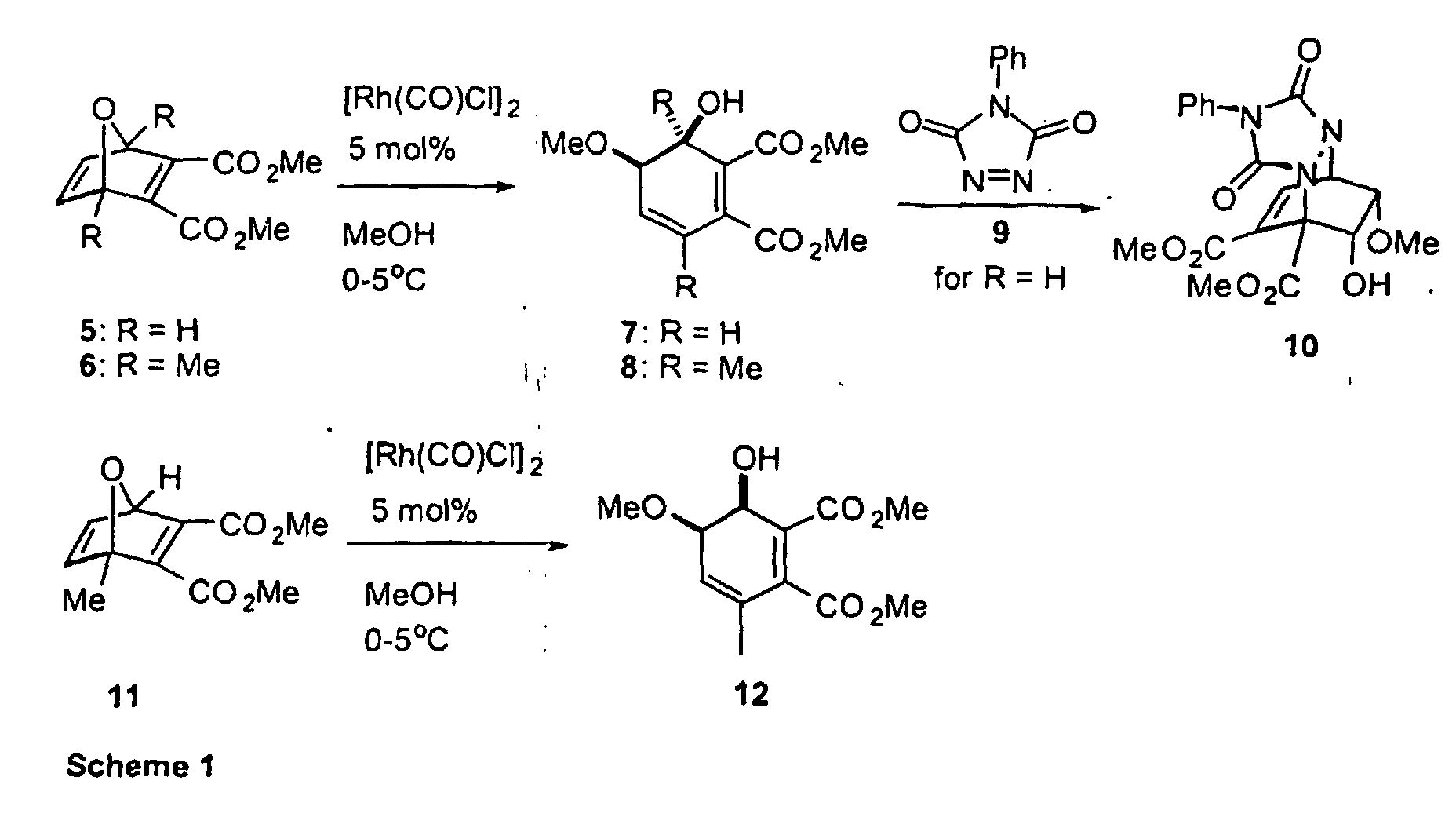
- In 1973, Hogeveen and Middelkoop reported a [Rh(CO)2Cl]2 catalyzed ring opening reaction of 5 by reaction with methanol giving 6. (Hogeveen, H., et al., Tetrahedron Lett. 190:1 (1973)) Subsequently, Ashworth and Berchtold reported the stereochemistry of this reaction to be cis as shown after the formation of a Diels-Alder adduct with 9 (scheme 1) (Ashworth, R. W., et al., Tetrehedron Lett. 339 (1977)). This stereochemistry is in keeping with the observation of exo attack by nucleophiles with other oxabicyclic starting materials (Lautens, M., Synlett 179 (1993)). Hogeveen and Middelkoop also reported that the reaction was regioselective when only one of the bridgehead positions was substituted, that is 11 gave only regioisomer 12.
- When 13 (Stiles, M., e al., J. Am. Chem. Soc. 82:3802 (1960)) was subjected to the Hogeveen and Middelkoop conditions, no reaction was observed. However, by changing the solvent system to a 1:1 mixture of trifluoroethanol (TFE):methanol and by increasing the temperature to 60°C, the desired product 14 was isolated in 70% yield. Remarkably, the stereochemistry of 14 was trans as proven by comparison with authentic samples of both stereoisomers of dimethoxytetrahydronaphthalene 15 (eq. 2) (The cis isomer of 15 was prepared by reaction of 1,2-dihydronaphthalene with OSO4 followed by methylation with dimethylsulfate (DMS). The trans isomer was prepared by epoxidation of 1,2-dihydronaphthalene followed by ring opening with hyroxide and dimethylation with DMS).

- Given the ability of this reaction to set up two stereocentres with complete regio and stereocontrol, the possibility of rendering it asymmetric was investigated. A serious drawback of the existing catalyst [Rh(CO)2Cl]2, however, was that the addition of phosphine ligands completely inhibited the reaction. By changing to a rhodium source possessing the more labile COD ligand, [Rh(COD)Cl]2, it was possible to examine the catalytic ability of several chiral phosphine ligands. Not all rhodium-ligand combinations performed equally well. DPPE and BINAP did not produce the desired product, and phosphites resulted in poor yields. DPPF was very efficient, however, giving 14 in 88% yield. One advantage of DPPF is that a number of chiral analogues have been prepared and could be studied to determine enantioselectivity. JOSIPHOS ligands (Togni, A.., et al., J Am. Chem. Soc. 116:4062 (1994)) were among the chiral ligands examined which gave the most promising results. For example, PPF-PtBu2 16 gave 14 in 84% yield and 86% ee at 60°C. The ee could be significantly improved to 97% when the reaction temperature was increased by 20°C.
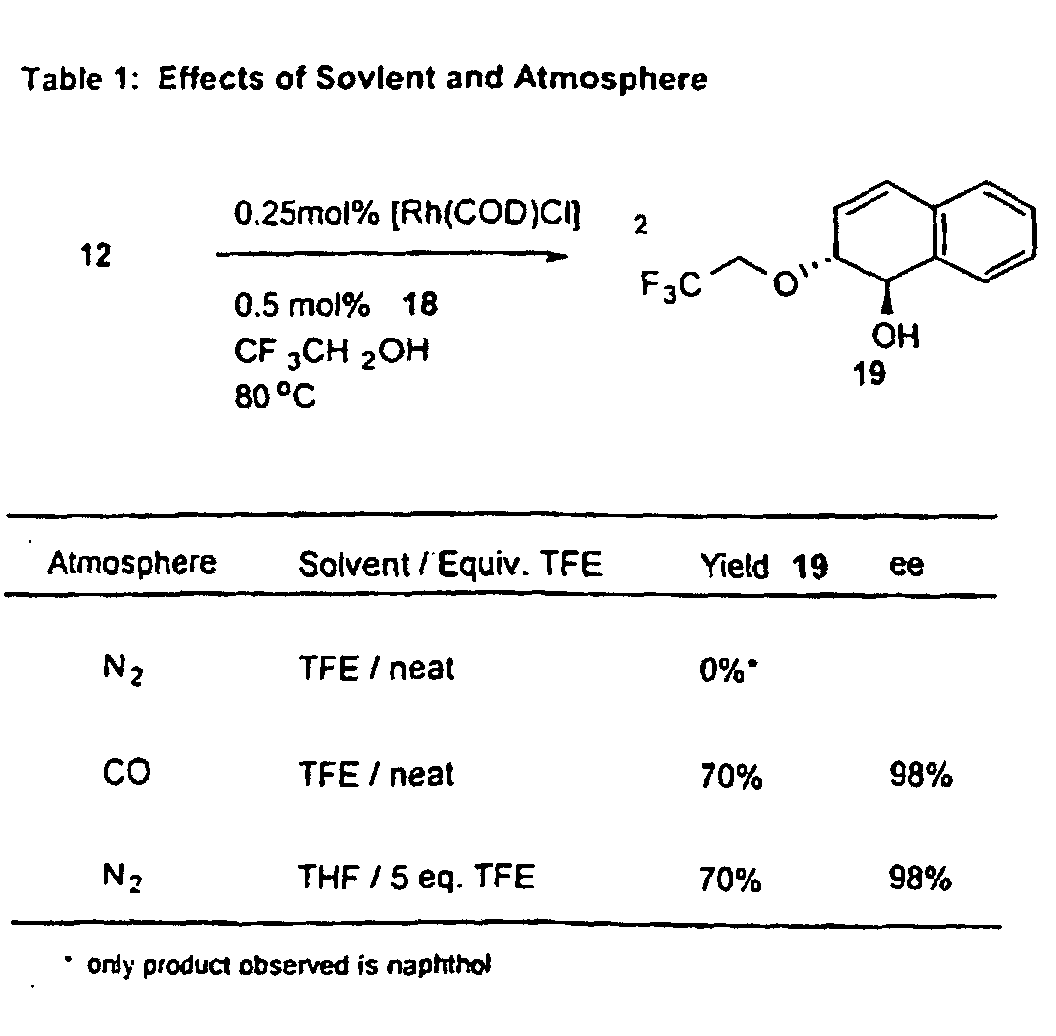
- These reactions were typically run as a 1:1 mixture of MeOH:TFE under a nitrogen atmosphere which gave 13 accompanied by small amounts of naphthol. In neat trifluoroethanol under a nitrogen atmosphere, naphthol is the major product with less than 5% conversion to the trifluoroethanol ring-opened product. Remarkably, this is not the case when the reaction is run under a carbon monoxide atmosphere. In the presence of CO, the reaction with neat TFE gives the TFE ring-opened product 17 in 70% yield after 3 hours. A colour change of the solution, from yellow to red was observed, suggesting that the CO was interacting with the rhodium metal. When the reaction was performed under asymmetric conditions using PPF-PtBu2, 17 was obtained in 70% yield and 98% ee indicating that the ligand remains bound to the metal even if CO binding has occurred (table 1).
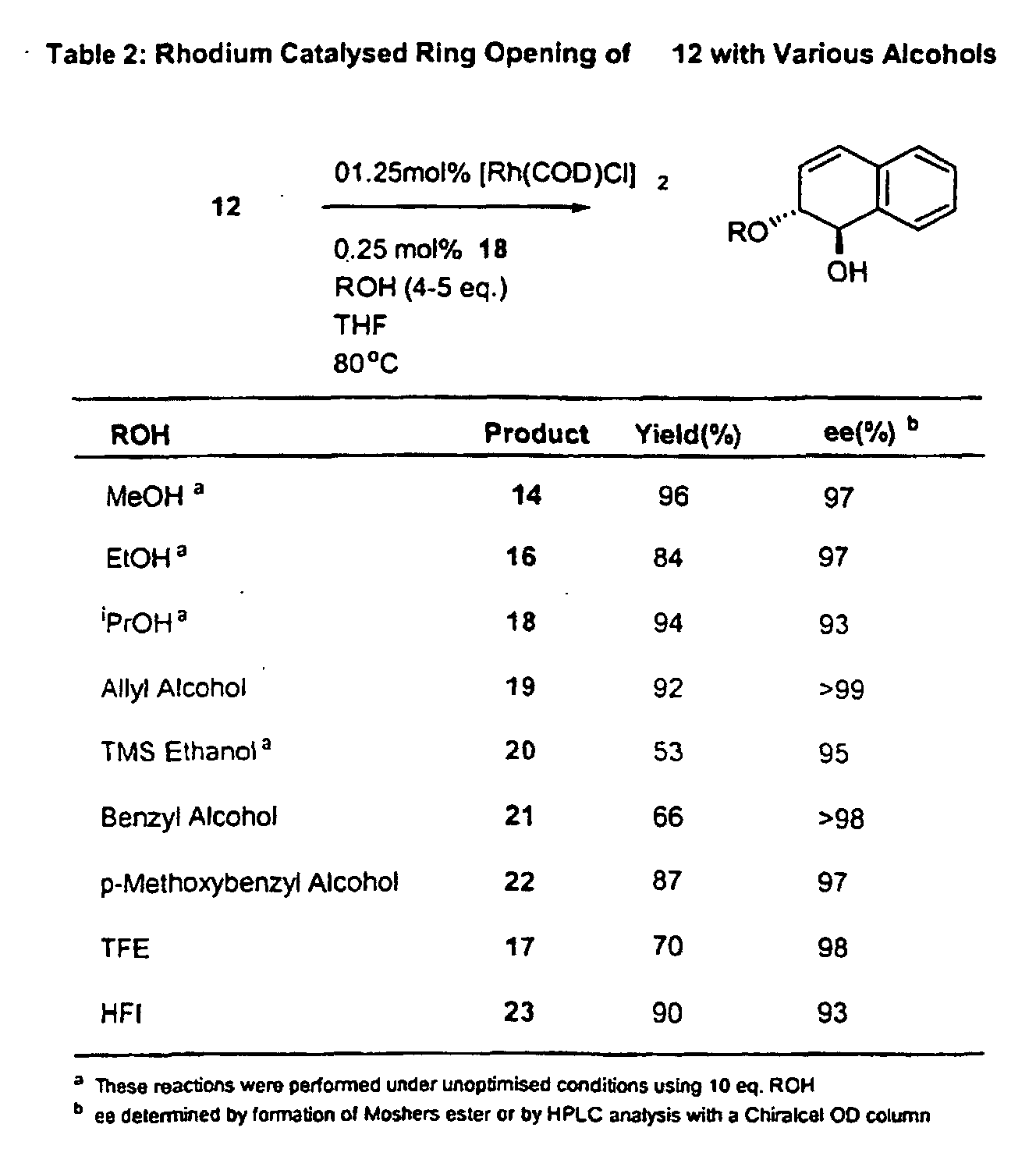
- Reactions run in alcohols other that TFE proceeded at a much slower rate. When the solvent was changed to THF, the reaction worked equally well with a broad range of alcohols under racemic and enantioselective conditions, and only five equivalents of the alcohol were required. THF also allowed the use of very low catalyst loadings, typically in the range of 0.125 mol% of [Rh(COD)Cl]2 and 0.25 mol% of 16. While TFE would only add to give 17 when the reaction was run under a CO atmosphere in neat TFE, this was not the case in THF. When THF was used as the solvent, TFE added efficiently under an inert nitrogen atmosphere to give 17 in 70% yield and 98% ee. Even the very weakly nucleophilic hexafluoroisopropanol (HFI) added under these reaction conditions to give 23 in 90% yield and 93% ee (table 2).
- In order to investigate the effects of substituents on the aromatic ring of 13, difluoro (24), methylenedioxy (25), and dimethyldibromo (26) substrates were prepared (Hart, H., Tetrahedron 43:5203 (1987)) and reacted them under the standard conditions. All gave the corresponding ring opened products in good yields and excellent ee's (chart 1) indicating that this reaction is not sensitive to remote substitution or electronic effects on the aromatic ring.

-

- To furan (100 ml, 1.37 ml) in DME (100 ml) at 50°C in a flame dried three neck flask with a reflux condenser and two addition funnels attached was added simultaneously over two hours a solution of anthranilic acid (27.5 g, 200 mmol) in DME (100 ml) and a separate solution of isoamylnitrite (40 mL, 298 mmol) in DME (50 mL). Upon completion of addition, the reaction was allowed to stir at 50°C for 30 min until no further gas was evolved. The reaction mixture was then cooled to room temperature and portioned between Et2O and saturated K2CO3 and the aqueous layer was extracted three times with Et2O. The combined organic layer were washed with brine, dried over MgSO4 and concentrated. Bulb to bulb distillation gave 13 (18.5 g, 64%) as a white solid. The spectral data correspond well with the literature data.17
-

- (1S,2S)-2-Methoxy-1,2-dihydro-naphthalen-1-ol (14) To a flame dried round bottom flask, [Rh(COD)Cl]2 (0.5 mg, 0.0009 mmol), (R)-(S)-PPF-PtBu2 (1.0 mg, 0.0018 mmol) and 13 (27 mg, 0.187 mmol) were added followed by addition of THF (0.5 mL) and methanol (0.5 mL). The mixture was heated for 15 hours and the solvents were removed in vacuo. The resulting solid was purified by flash chromatography (20% ethyl acetate in hexanes) to give 14 a white crystalline solid (31.7 mg, 96%). The ee was determined to be 97% using HPLC analysis on a CHIRALCEL OD column, λ= 486 nm. Retention times in 4% isopropanol in hexanes were 10.1 min (major) and 11.1 min. Rf= 0.29 on silica gel (10% ethyl acetate:hexanes); mp 86-87° (Et2O); [α]25 D=-208° (c= 10.1, CHCl3); Rf= 0.39 on silica (20% ethyl acetate:hexanes). IR (KBr, cm-1) 3277 (br), 2971 (m), 1466(m), 1285(m), 1114(s), 1048(m), 979(m), 775(s); 1H NMR (400MHz, acetone-d) δ 7.60-7.62 (1H, m), 7.30-7.21 (2H, m), 7.13-7.11 (1H, m), 6.50 (1H, dd, J= 9.9,1.8 Hz), 6.04 (1H, dd, J= 9.9, 2.2 Hz), 4.85 (1H, dd, J= 9.9, 6.2 Hz), 3.50 (3H, s), 2.89 (1H, d, J= 12.8 Hz); 13C NMR (400MHz, acetone-d) δ 138.5, 133.2, 129.1, 128.4, 128.3, 128.2, 126.8, 126.3, 83.1, 73.0, 57.1. HRMS calcd for C11H12O2 (M+): 176.0837. Found: 176.0835.
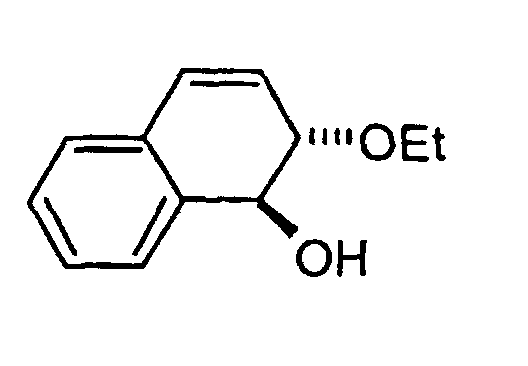
- (1S,2S)-2-(Ethoxy)-1,2-dihydro-naphthalen-1-ol (16): : To a flame dried round bottom flask, [Rh(COD)Cl]2 (2.1 mg, 0.043 mmol), (S)-(R)-PPF-PtBu2 (3.8 mg, 0.087 mmol) and 13 (500 mg, 3.47 mmol) were added followed by addition of ethanol (4 mL) and THF (4 mL). The mixture was heated to reflux for five hours and the solvent was removed in vacuo. The resulting solid was purified by flash chromatography (20% ethyl acetate in hexanes) to give 16 as a white crystalline solid (553 mg, 84%). The ee was determined to be 97% using HPLC analysis on a CHIRALCEL OD column, λ = 254 nm. Retention times in 1.5% isopropanol in hexanes were 13.6 min and 14.2 min (major). Rf= 0.26 on silica gel (20% ethyl acetate:hexanes); mp 33° (Et2O); [α]25 D= 185.9° (c= 9.6, CHCl3); IR (KBr, cm-1) 3601 (br), 3040 (m), 2977 (s), 1454 (s), 1396 (m), 1185 (s), 1104 (s); 1H NMR (400MHz, CDCl3) δ 7.59-7.57 (1H, m), 7.27-7.20 (2H, m), 7.07-7.05 (1H, m), 6.43 (1H, dd, J= 9.9, 2.2 Hz), 6.01 (1H, dd, J= 9.9, 2.2 Hz), 4.90 (1H, d, J= 10.6 Hz), 4.18 (1H, ddd, J= 10.6,2.2,2.2 Hz), 3.79 (1H, AB, dq, J= 9.4, 6.9 Hz), ), 3.58 (1H, AB, dq, J= 9.4, 6.9 Hz), 2.65 (1H, s), 1.27 (3H, t, J= 6.9 Hz),; 13C NMR (400MHz, CDCl3) δ 135.9, 131.9, 128.0, 127.8, 127.8, 126.1, 124.9, 80.7, 72.5, 64.6, 15.5. HRMS calcd for C12H14O2 (M+): 190.0994. Found: 190.0993.
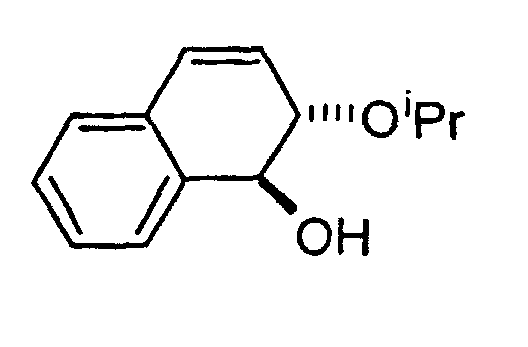
- (1S,2S)-2-(Isopropoxy)-1,2-dihydro-naphthalen-1-ol (18): : To a flame dried round bottom flask, [Rh(COD)Cl]2 (3.5 mg, 0.007 mmol), (S)-(R)-PPF-PtBu2 (7.5 mg, 0.014 mmol) and 13 (100 mg, 0.694 mmol) were added followed by addition of THF (1.5 mL) and isopropanol (1.5 mL). The mixture was heated to 80°C for two hours and the solvent was removed in vacuo. The resulting oil was purified by flash chromatography (10% ethyl acetate in hexanes) to give 18 as a colourless oil (133.7 mg, 94%). The ee was determined to be 92% using HPLC analysis on a CHIRALCEL OD column, λ = 486 nm. Retention times in 1.5% isopropanol in hexanes were 9.7 min (major) and 10.7 min. Rf= 0.42 on silica gel (10% ethyl acetate:hexanes); [α]25 D= +154.0° (c= 12.6, CHCl3); IR (KBr, cm-1) 3435(br), 3038(w), 2952(s), 1454(m), 1249(s), 1087(s); 1H NMR (400MHz, CDCl3) δ 7.61-7.58 (1H, m), 7.27-7.19 (2H, m), 7.06-7.04 (1H, m), 6.40 (1H, dd, J= 9.9, 2.0 Hz), 5.95 (1H, dd, J= 9.9, 2.2 Hz), 4.87 (1 H, d, J= 10.8 Hz), 4.24 (1H, ddd, J= 10.8, 2.2,2.2 Hz), 3.85 (1H, h, J= 6.2 Hz), 2.98 (1H, s), 1.25 (6H, dd, J= 8.8, 6.2 Hz); 13C NMR (400MHz, CDCl3) δ136.2, 132.3, 129.6, 128.0, 127.9, 127.8, 126.3, 125.0, 78.9, 73.0, 71.1, 23.5, 22.4. HRMS calcd for C13H16O2 (M+): 204.1150. Found: 204.1150.

- (1S,2S)-3-(1-propenyloxy)-1,2-dihydro-naphthalen-1-ol (19): : To a flame dried round bottom flask, [Rh(COD)Cl]2 (9.1 mg, 0.018 mmol), (S)-(R)-PPF-PtBu2 (15 mg, 0.028 mmol) and 13 (1.06 g, 7.35 mmol) were added followed by addition of THF (1.5 mL) and allyl alcohol (2 mL, 29.4 mmol). The mixture was heated to 80°C for two hours and the THF was removed in vacuo. The resulting oil was purified by flash chromatography (10% ethyl acetate in hexanes) to give 19 as a colourless oil (898mg, 60%) which solidified on sitting. The ee was determined to be >99% using HPLC analysis on a CHIRALCEL OD column, λ = 486 nm. Retention times in 1.5% isopropanol in hexanes were 15.2 min and 16.3 min (major). Rf= 0.17 on silica gel (10% ethyl acetate:hexanes); mp 25-26° (Et2O); [α]25 D= +195.1° (c= 11.5, CHCl3); IR (KBr, cm-1) 3435(br), 3037(m), 2857(s), 1454(s), 1165(s), 1083(s); 1H NMR (400MHz, CDCl3) δ 7.61-7.58 (1H, m), 7.27-7.20 (2H, m), 7.08-7.05 (1H, m), 6.44 (1H, dd, J= 9.9, 2.0 Hz), 6.00 (1H, dd, J= 9.9, 2.4 Hz), 6.00-5.92 (1H,m), 5.32 (1 H, ddd, J= 17.2, 3.3, 1.6 Hz), 5.21 (1H, ddd, J= 10.4, 2.9, 1.3 Hz), 4.94 (1H, d, J= 10.2 Hz), 4.27 (1H, ddd, J = 10.3, 2.2, 2.2 Hz), ), 4.23 (1H, dddd, J = 12.8, 5.5, 1.5, 1.5 Hz), 4.12 (1H, dddd, J = 12.8, 5.9, 1.5, 1.5 Hz), 3.09 (1H, s); 13C NMR (400MHz, CDCl3) δ135.8, 134.5, 131.8, 128.1, 127.7, 127.6, 127.4, 126.1, 125.0, 117.5, 80.1, 76.7, 72.4, 70.2. HRMS calcd for C14H14O2 (M+):202.0994. Found: 202.0994.

- (1S,2S)-2-(2-Trimethylsilyl-ethoxy)-1,2-dihydro-naphthalen-1-ol (20): : To a flame dried round bottom flask, [Rh(COD)Cl]2 (4.3 mg, 0.0087 mmol), (S)-(R)-PPF-PtBu2 (9.4 mg, 0.0174 mmol) and 13 (100 mg, 0.694 mmol) were added followed by addition ofTHF (1.25 mL) and trimethylsilylethanol (1.25 mL). The mixture was heated to reflux for two hours and the THF was removed in vacuo. The resulting oil was purified by flash chromatography (10% ethyl acetate in hexanes) to give 20 as a colourless oil (84.7 mg, 53%). The ee was determined to be 95% using HPLC analysis on a CHIRALCEL OD column, λ = 486nm. Retention times in 0.5% isopropanol in hexanes were 17.9 min and 18.5 min (major). Rf= 0.25 on silica gel (10% ethyl acetate:hexanes); [α]25 D= +119.2° (c= 13.0, CHCl3); IR (KBr, cm-1) 3447(br), 3037(m), 2972(s), 1454(m), 1381(m), 1118(s), 1078(s); 1H NMR (400MHz, CDCl3) δ 7.59-7.57 (1H, m), 7.28-7.21 (2H, m), 7.08-7.06 (1H, m), 6.43 (1H, dd, J= 9.9, 2.0 Hz), 6.03 (1H, dd, J= 9.9, 2.2 Hz), 4.89 (1 H, d, J= 10.6 Hz), 4.18 (1H, ddd, J= 10.6, 2.2, 2.2 Hz), 3.85-3.78 (2H, m), 3.63-3.56 (2H, m), 2.79 (1H, s), 1.05-0.97 (2H, m), 0.36 (9H, m); 13C NMR (400MHz, CDCl3) δ. 135.9, 132.0, 127.9, 127.9, 127.8, 127.6, 126.1, 124.9, 80.4, 72.6, 66.5, 18.6, -1.4. HRMS calcd for C15H22O2Si (M+): 262.1389. Found: 262.1388.

- (1S,2S)-2-Benzyloxy-1,2-dihydro-naphthalen-1-ol (21): To a flame dried round bottom flask, [Rh(COD)Cl]2 (9.0 mg, 0.018 mmol), (S),(R)-PPF-PtBu2 (19.0 mg, 0.035 mmol), and 13 (1.00 g, 6.94 mmol) were added followed by addition of THF (1.8 mL) and benzylalcohol (3.6 mL, 34.7 mmol) and heating to 80°C for 24 hours. The THF was then removed in vacuo and the resulting oil was purified by flash chromatography (10% ethyl acetate in hexanes) to give 21 as a crystalline solid (1.22 g, 70%). The ee was determined to be >98% using HPLC analysis on a CHIRALCEL OD column, λ = 486 nm. Retention times in 1.5% isopropanol in hexanes were 29.0 min and 32.5 min (major). Rf= 0.34 on silica gel (20% ethyl acetate:hexanes); mp 52-54° (Et2O); [α]25 D= +167.3° (c= 10.0, CHCl3); IR (KBr, cm-1) 3305 (br), 3020 (w), 2876 (w), 1496 (m), 1352 (m), 1281 (m), 1169 (m), 1050 (s), 777 (s); 1H NMR (400MHz, CDCl3) δ 7.58-7.56 (1H, m), 7.41-7.22 (7H, m), 7.22-7.07 (1H, m), 6.46 (1H, dd, J= 9.9, 2.1 Hz), 6.05 (1H, dd, J= 9.9, 2.1 Hz), 4.98 (1H, d, J= 10.4 Hz), 4.78 (1H, d, J= 11.7 Hz), 4.63 (1H, d, J= 11.7 Hz), 4.33 (1H, ddd, J= 10.4, 2.2, 2.2 Hz), 2.61 (1H, s); 13C NMR (400MHz, CDCl3) δ 138.0, 135.9, 131.9, 128.5, 128.3, 128.1, 127.9, 127.9, 127.8, 127.4, 126.2, 125.1, 80.4, 72.6, 71.3. HRMS calcd for C17H16O2 (M+): 252.1150. Found: 252.1148.
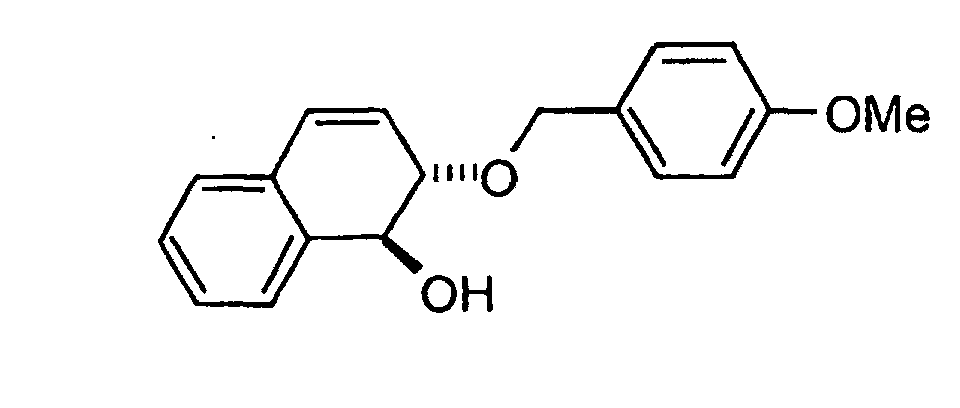
- (1S,2S)-2-(4-Methoxybenzyloxy-1,2-dihydro-naphthalen-1-ol (22): To a flame dried round bottom flask, [Rh(COD)Cl]2 (6.0 mg, 0.012 mmol), (S),(R)-PPF-PtBu2 (13.0 mg, 0.024 mmol), and 13 (693 mg, 4.81 mmol) were added followed by addition of THF (1.5 mL) and anisyl alcohol (3.0 mL, 24.1 mmol) and heating to 80°C for 24 hours.. The THF was then removed in vacuo and the resulting oil was purified by flash chromatography (20% ethyl acetate in hexanes) to give 22 as a crystalline solid (1.18 g, 87%). The ee was determined to be 97% using HPLC analysis on a CHIRALCEL OD column, λ = 486 nm. Retention times in 1.5% isopropanol in hexanes were 37.1 min and 42.1 min (major). Rf= 0.53 on silica gel (30% ethyl acetate:hexanes); mp 63-64° (Et2O); [α]25 D= +138.5° (c= 10.5, CHCl3); IR (KBr, cm-1) 3435(br), 3035(m), 2836(s), 1612(s), 1513(s), 1454(m), 1249(s), 1082(s); 1H NMR (400MHz, CDCl3) δ 7.59-7.57 (1H, m), 7.32 (2H, ddd, J= 8.7,2.8, 1.9 Hz), 7.28-7.22 (1H, m), ), 6.90 (2H, ddd, J= 8.7, 2.8, 1.9 Hz), 6.46 (1H, dd, J= 9.9, 2.1 Hz), 6.04 (1H, dd, J= 9.9, 2.4 Hz), 4.96 (1H, d, J= 10.1 Hz), 4.64 (1H, dd, J= 57.1, 11.4 Hz), 4.32 (1H, ddd, J= 10.2,2.2,2.2 Hz), 3.80 (1H, s), 2.96 (1H, s); 13C NMR (400MHz, CDCl3) δ 159.2, 135.9, 131.9, 129.9, 129.5, 128.1, 127.8, 127.6, 127.5, 126.1, 125.0, 113.8, 80.0, 72.5, 70.9, 55.1. HRMS calcd for C17H16O2 (M+): 252.1150. Found: 252.1148.

- (1S,2S)-2-(2,2,2-Trifluoro-ethoxy)-1,2-dihydro-naphthaten-1-ol (17): To a flame dried round bottom flask, [Rh(COD)Cl]2 (2.1 mg, 0.043 mmol), (S)-(R)-PPF-PtBu2 (3.8 mg, 0.087 mmol) and 13 (500 mg, 3.47 mmol) were added followed by addition of trifluoroethanol (4 mL) and THF (4 mL). The mixture was heated to reflux for three hours and the solvent was removed in vacuo. The resulting solid was purified by flash chromatography (10% ethyl acetate in hexanes) to give 17 as a white crystalline solid (594 mg, 70%). The ee was determined to be 98% using HPLC analysis on a CHIRALCEL OD column, λ = 254 nm. Retention times in 4% isopropanol in hexanes were 11.3 min (major) and 13.3 min. Rf= 0.41 on silica gel (20% ethyl acetate:hexanes); mp 79-80° (Et2O); [α]25 D= 145.4° (c= 12.6, CHCl3); IR (KBr, cm-1) 3354 (br), 3036 (w), 2939 (w), 1455 (w), 1275 (s), 1169 (s), 1050(m), 977 (m); 1H NMR (400MHz, CDCl3) δ 7.57-7.55 (1H, m), 7.30-7.23 (2H, m), 7.10-7.08 ( 1 H, m), 6.48 (1H, dd, J= 9.9, 2.0 Hz), 5.94 (1H, dd, J= 9.9, 2.4 Hz), 4.96 (1 H, d, J= 2.2 Hz), 4.38 (1H, ddd, J= 9.9, 2.4, 2.2 Hz), 4.03 (2H, q, JH-F = 8.6 Hz), 2.55 (1H, s); 13C NMR (400MHz, CDCl3) δ 135.5, 131.7, 129.2, 128.3, 128.1, 126.6, 125.9, 125.2, 122.4, 83.0, 72.8, 67.0 (q, JC-F= 34.4 Hz). HRMS calcd for C12H11O2F3 (M+): 244.0711. Found: 244.0720.

- (1S,2S)-2-(2,2,2-Trifluoro-1-trifluoromethyl-ethoxy)-1,2-dihydro-naphthalen-1-ol (23): To a flame dried round bottom flask, [Rh(COD)Cl]2 (1.7 mg, 0.003 mmol),(S)-(R)-PPF-PtBu2 (3.8 mg, 0.007 mmol) and 13 (55 mg, 0.382 mmol) were added followed by addition of THF (2.0 mL) and hexafluoroisopropanol (240 mg, 1.74 mmol). The mixture was heated to reflux for two hours and the solvent was removed in vacuo. The resulting solid was purified by flash chromatography (10% ethyl acetate in hexanes) to give 23 as a white solid (107.1mg, 90%). The ee was determined to be 93% using HPLC analysis on a CHIRALCEL OD column, λ = 486 nm. Retention times in 1.5% isopropanol in hexanes were 11.3 min and 17.6 min (major); Rf= 0.28 on silica gel (10% ethyl acetate:hexanes); mp 88.5-90° (Et2O); [α]25 D= +101.8° (c= 10.9, CHCl3); IR (KBr, cm-1) 3191 (br), 2937 (m), 1379 (s), 1280 (s), 1247 (s), 1194 (s), 1100 (s), 954 (s), 753 (m); 1H NMR (400MHz, CDCl3) δ 7.55-7.53 (1H, m), 7.31-7.26 (2H, m), 7.11-7.09 (1H, m), 6.49 (1H, dd, J= 9.9, 2.1 Hz), 5.92 (1H, dd, J= 9.9, 2.4 Hz), 5.07 (1H, dd, J= 9.7, 5.0 Hz), 4.63 (1H, ddd, J= 9.9, 1.5. 1.5 Hz), 4.58 (1H, h, JH-F = 6.1 Hz), 2.50 (1H, d, J= 4.2 Hz); 13C NMR (400MHz, CDCl3) δ 135.2, 131.5, 129.7, 128.5, 128.3, 126.7, 125.2, 122.9, 120.1, 85.4, 75.4 (h, JC-F = 32.2 Hz), 73.5. HRMS calcd for C13H10O2F6 (M+): 312.0585 Found: 312.0574.

- 6,7-Difluoro-1,4-epoxy-1,4-dihydronaphthalene (24). To 3,4-difluoro-1,2-dibromo-benzene (0.75 g, 2.78 mmol) and furan (1 mL, 14.7 mmol) in Et2O (15 mL) at -78°C was added BuLi (1.1 mL, 2.5M in hexanes, 2.75 mmol) dropwise. The reaction was stirred for two hours at -78°C and then was allowed to warm to room temperature. After 2 hours, the reaction mixture was quenched with water dropwise and then was poured into water. The organic layer was separated and the aqueous layer was extracted three times with Et2O. The combined organic layers were washed with brine, dried over MgSO4, concentrated and chromatographed (25% ethyl acetate:hexanes) on silica gel to give 24 (350 mg, 70%) as a colourless oil. Rf= 0.21 on silica gel (20% ethyl acetate:hexanes); bp 40°C @ 0.5mmHg]; IR (neat, cm-1), 3017 (M), 1624 (s), 1465 (s), 1365 (s), 1253 (s), 1190 (m), 1040 (s), 857 (s). 1H NMR (400MHz, CDCl3) δ 7.06 (2H, dd, JH-F= 7.7, 7.7 Hz), 7.01 (2H, s), 5.67 (2H, s); 13C NMR (400MHz, CDCl3) δ 147.2 (dd, JC-F= 247.9, 14.5 Hz), 145.1 (dd, JC-F= 4.3, 4.3 Hz), 143.1, 110.8 (m), 82.1. HRMS calcd for C10H6O (M+): 180.0387. Found: 180.0394.
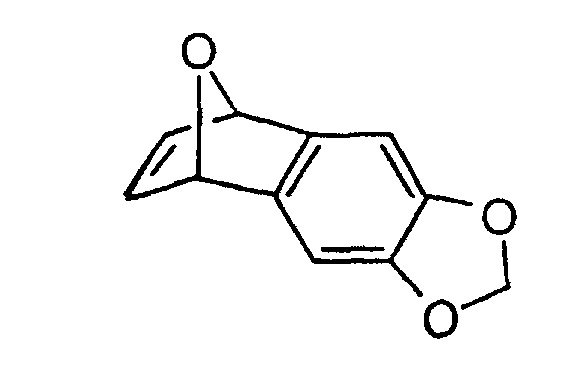
- 5,8-epoxy-5,8-dihydronaphtho[2,3-d][1,3]dioxole (25): To 3,4-dibromobenzo-1,3-dioxolane (1.54 g, 5.50 mmol) and furan (4 g, 58.8 mmol) in PhMe (55 mL) at -78°C was added BuLi (2.2 mL, 2.5M in hexanes, 5.5 mmol) dropwise. The reaction was stirred for two hours at - 78°C and the allowed to warm to rt. After 3 hours, MeOH (2 mL) was added and the reaction mixture was poured into water.. The organic layer was separated and the aqueous layer was extracted three times with Et2O. The combined organic layers were washed with brine, dried over MgSO4, and concentrated. Recrystallization from hexanes gave 25 (560 mg, 54%) as white crystals). Rf= 0.47 on silica gel (30% ethyl acetate:hexanes); mp 111-112°C (Et2O); IR (KBr, cm-1) 2895, 1455, 1292, 1138, 1038, 1014, 848; 1H NMR (400MHz, CDCl3) δ 7.02 (2H, dd, J= 0.9,0.9 Hz), 6.82 (2H, s), 5.92 (1H, d, J= 1.5 Hz), 5.87 (1H, d, J= 1.5 Hz), 5.62 (2H, s); 13C NMR (400MHz, CDCl3) δ 144.3, 143.3, 103.9, 101.1, 82.4. HRMS calcd for C11H8O2 (M+): 188.0473. Found: 188.0463.

- 5,6-Dibromo-4,7-dimethyl-1,4-epoxy-1,4-dihydronaphthalene (26): To tetrabromo para-xylene (2.1 g, 5.0 mmol) and furan (4 g, 58.8 mmol) in PhMe (55 mL) at -78°C was added BuLi (2.2 mL, 2.5M in hexanes, 5.5 mmol) dropwise. The reaction was stirred for two hours at -78°C and the allowed to warm to rt. After 3 hours, MeOH (2 mL) was added and the reaction mixture was poured into water.. The organic layer was separated and the aqueous layer was extracted three times with Et2O. The combined organic layers were washed with brine, dried over MgSO4, and concentrated. Flash chromatography on silca gel gave 26 (185 mg, 50%) as a white solid. The spectral data correlates well with the literature values.22
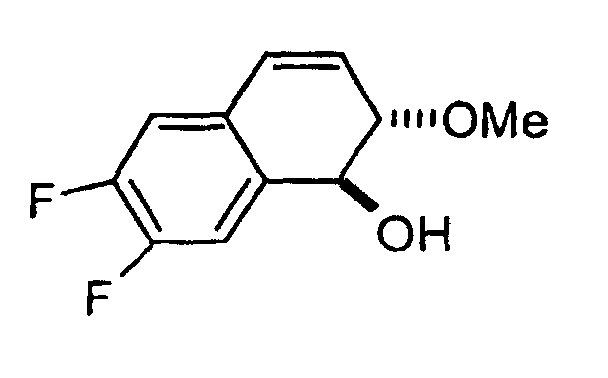
- (1S,2S)-6,7-Difluoro-2-methoxy-1,2-dihydro-naphthalen-1-ol (27): To a flame dried round bottom flask, [Rh(COD)Cl]2 (2.5 mg, 0.005 mmol), (S)-(R)-PPF-PtBu2 (5.4 mg, 0.010mmol) and 24 (72 mg, 0.40 mmol) were added followed by addition of THF (1.0 mL) and methanol (1.0 mL). The mixture was heated to reflux for 1 hour. The solvents were then removed in vacuo. The resulting solid was purified by flash chromatography (20% ethyl acetate in hexanes) to give 27 as a white crystalline solid (74.9 mg, 88%). The ee was determined to be 96.4% using HPLC analysis on a CHIRALCEL OD column, λ = 486 nm. Retention times in 4% isopropanol in hexanes were 8.9 min and 10.1 min (major). Rf= 0.27 on silica gel (30% ethyl acetate:hexanes); mp 129-131° (Et2O); [α]25 D= +134.4° (c= 9.3, CHCl3); IR (KBr, cm-1) 3269 (br), 2937 (w), 1597 (m), 1503 (s), 1306 (s), 1103 (s), 893 (s); 1H NMR (400MHz, CDCl3) δ 7.40 (1H, ddd, JH-F = 10.8, 7.8 Hz, JH-H =0.6 Hz), 6.85 (1H, dd, JH-F = 10.9, 7.8 Hz), 6.31 (1H, dd, J= 10.0, 2.0 Hz), 6.05 (1H, dd, J= 10.0, 2.0 Hz), 4.79 (1H, d, J= 11.0 Hz), 4.05 (1H, ddd, J= 11.0, 2.0, 2.0 Hz), 3.49 (3H, s), 2.94 (1H, d, J= 2.2 Hz); 13C NMR (400MHz, CDCl3) δ 151.0 (d, JH-F = 12.5 Hz), 148.5 (dd, JH-F= 12.5,2.9 Hz), 133.2 (dd, JH-F= 5.2, 3.6 Hz), 128.9 (dd, JH-F= 6.6, 4.4 Hz), 128.0(d, JH-F =2.2 Hz), 126.5 (dd, JH - F =2.2, 1.5 Hz), 115.1 (d, JH-F = 18.3 Hz), 114.8 (d, JH- F = 19.8 Hz), 82.3, 72.0, 57.0. HRMS calcd for C10H10O2F2 (M+): 212.0649. Found: 212.0658.
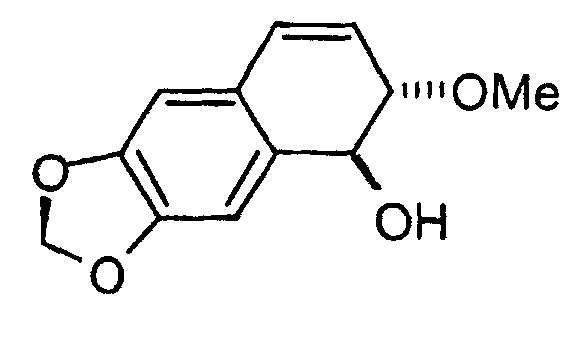
- (1S,2S)-6-Methoxy-5,6-dihydro-naphtho[2,3-d][1,3]dioxol-5-ol (28): To a flame dried round bottom flask, [Rh(COD)Cl]2 (1.7 mg, 0.0035 mmol), (S)-(R)-PPF-PtBu2 (3.8 mg, 0.0069 mmol) and 25 (100 mg, 0.694 mmol) were added followed by addition of THF (1.0 mL) and methanol (1.0 mL) and heating to reflux for 30 minutes. The solvents were then removed in vacuo. The resulting solid was purified by flash chromatography (30% ethyl acetate in hexanes) to give 28 as a white crystalline solid (127.5 mg, 90%). The ee was determined to be 95% using HPLC analysis on a CHIRALCEL OD column, λ = 486 nm. Retention times in 4% isopropanol in hexanes were 19.2 min (major) and 22.6 min. Rf= 0.24 on silica (30% ethyl acetate:hexanes); mp 117-119° (Et2O); [α]25 D= +298.7° (c= 11.1, CHCl3); IR (KBr, cm-1) 3248 (br), 2926 (s), 1600 (m), 1483 (s), 1260 (s), 1113 (s), 941 (s), 876 (s); 1H NMR (400MHz, acetone-d) δ 7.06 (1H, s), 6.65 (1H, s), 6.35 (1H, dd, J= 10.0, 2.0 Hz), 5.94 (2H, dd, J= 9.8, 1.0 Hz), 5.91 (1H, dd, J= 10.0, 2.5 Hz), 4.72 (1H, dt, J= 9.9 Hz), 4.02 (1H, dt, J= 10.3,2.2 Hz), 3.48 (3H, s), 2.87 (1H, d, J= 13.2 Hz); 13C NMR (400MHz, acetone-d) δ 147.8, 147.6, 133.0, 128.1, 127.2, 127.2, 107.5, 107.5, 101.9, 82.1, 73.0, 57.0. HRMS calcd for C12H12O4 (M+): 220.0736. Found: 220.0684.
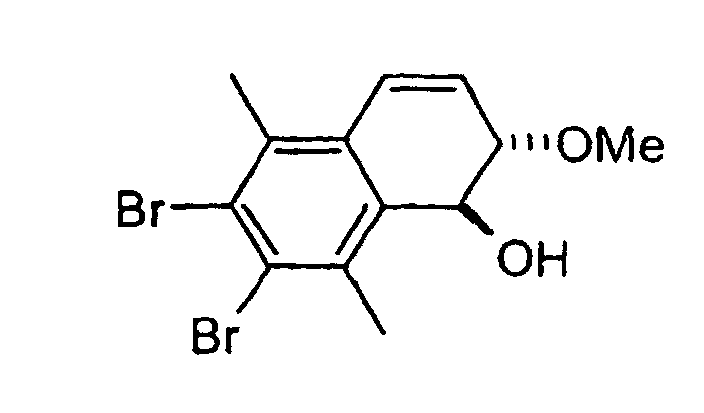
- (1S,2S)-6,7-Dibromo-2-methoxy-5,8-dimethyl-1,2-dihydro-naphthalen-1-ol (29): To a flame dried round bottom flask, [Rh(COD)Cl]2 (1.5 mg, 0.0029 mmol), (R)-(S)-PPF-PtBu2 (3.2 mg, 0.0059 mmol) and 26 (195 mg, 0.59 mmol) were added followed by addition of trifluoroethanol (1.0 mL) and methanol (1.0 mL). The mixture was heated to reflux for 20 hours. The solvents were then removed in vacuo. The resulting solid was purified by flash chromatography (50% ethyl acetate in hexanes) to give 29 as a white crystalline solid (171.6 mg, 79%). The ee was determined to be 97% using HPLC analysis on a CHIRALCEL OD column, λ = 486 nm. Retention times in 4% isopropanol in hexanes were 16.8 min (major) and 19.3 min. Rf= 0.39 on silica gel (50% ethyl acetate:hexanes); mp 114-116° (Et2O); [α]25 D=-197.1° (c= 10.0, CHCl3); IR (KBr, cm-1) 3349 (s), 2901 (m), 1700 (w), 1532 (w), 1404 (m), 1258 (m), 1081 (s), 936 (s); 1H NMR (400MHz, CDCl3) δ 6.96-6.93 (1H, m), 6.23-6.19 (1H, m), 4.89 (1H, s), 3.96-3.90 (1H, m), 3.38-3.35 (3H, m), 2.61-2.57 (3H, m), 2.54 (3H, s), 1.82-1.54 (1H, m); 13C NMR (400MHz, CDCl3) δ 137.3, 134.4, 133.2, 129.7, 129.5, 129.0, 128.1, 125.3, 75.3, 66.6, 56.6, 21.0, 20.6. HRMS calcd for C13H16O2Br2 (M+): 361.9518. Found: 361.9335.
-
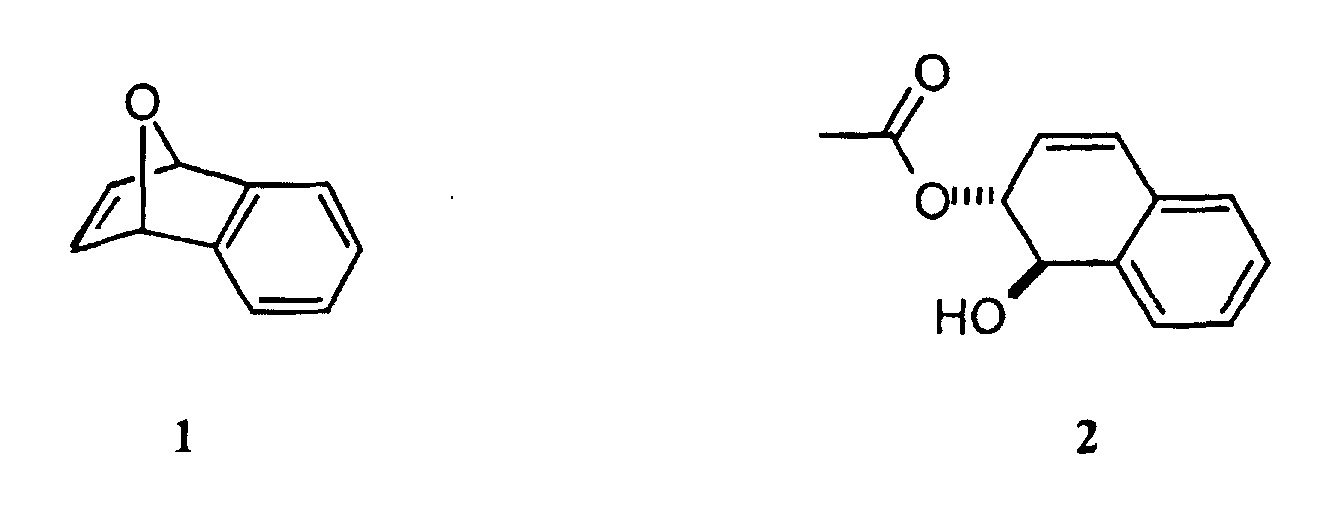
- (1R*,2R*)-Acetic acid 1-hydroxy-1,2-dihydro-naphthalen-2-yl-ester (2): To a flame dried round bottom flask, [Rh(COD)Cl]2 (4.3 mg, 0.008 mmol DPPF (9.6 mg, 0.017 mmol), 1 (50 mg, 1.39 mmol), and sodium acetate (142 mg, 1.74 mmol) were added followed by addition of THF (2 mL) and triethylamine hydrochloride (239 mg, 1.74 mmol). The mixture was heated at reflux for 3 hours and the solvents were removed in vacuo. The resulting mixture was purified by flash chromatography (30% ethyl acetate in hexanes) to give 2 as a crystalline solid (41 mg), 63%). Rf= 0.26 on silica gel (20% ethyl acetate:hexanes); mp 67-68° (Et2O); IR (KBr, cm-1) 1H NMR (400MHz, CDCl3) δ 7.54-7.53 (1H, m), 7.29-7.24 (2H, m), 7.10-7.08 (1H, m), 6.50 (1H, dd, J= 3.9, 1.3 Hz), 5.85 (1H, dd, J= 9.9, 3.1 Hz), 5.59 (1H, ddd, J= 9.0, 2.8, 1.9 Hz), 4.92 (1H, d, J= 9.0 Hz), 2.64 (1H, s), 2.12 (3H, s); 13C NMR (400MHz, CDCl3) δ 171.3, 135.2, 131.5, 129.5, 128.3, 126.7, 126.0, 125.4, 75.3, 71.7, 21.2. HRMS calcd for C12H12O3 (M+): 204.0786. Found: 204.0791.

- (1R*,2R*)-Propionic acid 1-hydroxy-1,2-dihydro-naphthalen-2-yl-ester (3): To a flame dried round bottom flask, [Rh(COD)Cl]2 (4.3 mg, 0.0087 mmol), DPPF (9.6 mg, 0.017 mmol) and 1 (50 mg, 0.347 mmol) were added followed by addition of THF (2.5 mL), triethylamine (242 µL, 1.735 mmol) and propionic acid (130 µL, 1.735 mmol). The mixture was heated at reflux for 3 hours and the solvents were removed in vacuo. The resulting mixture was purified by flash chromatography (20% ethyl acetate in hexanes) to give 3 a white crystalline solid (50 mg, 66%). Rf= 0.24 on silica gel (% 20 ethyl acetate:hexanes); mp 55-56° (Et2O); IR (KBr, cm-1) 3491 (br), 3048 (w), 2984 (w), 1739 (s), 1454 (m), 1363 (w), 1182 (s), 1083 (m). 1H NMR (400MHz, CDCl3) δ 7.55-7.52 (1H, m), 7.29-7.24 (2H, m), 7.11-7.08 (1H, m), 6.50 (1H, dd, J= 10.0, 2.0 Hz), 5.85 (1H, dd, J= 12.8, 2.8 Hz), 5.61 (1H, ddd, J= 9.2,2.8,2.0 Hz), 4.93 (1H, d, J= 9.2 Hz), 2.40 (2H, qd, J= 7.6, 1.2 Hz), 1.16 (3H, t, J= 7.6 Hz); 13C NMR (400MHz, CDCl3) δ 174.8, 135.3, 131.5, 129.4, 128.3, 128.3, 126.7, 125.9, 125.5, 75.2, 71.9, 27.7, 9.0. HRMS calcd C13H14O3 (M+): 218.0943. Found: 218.0938
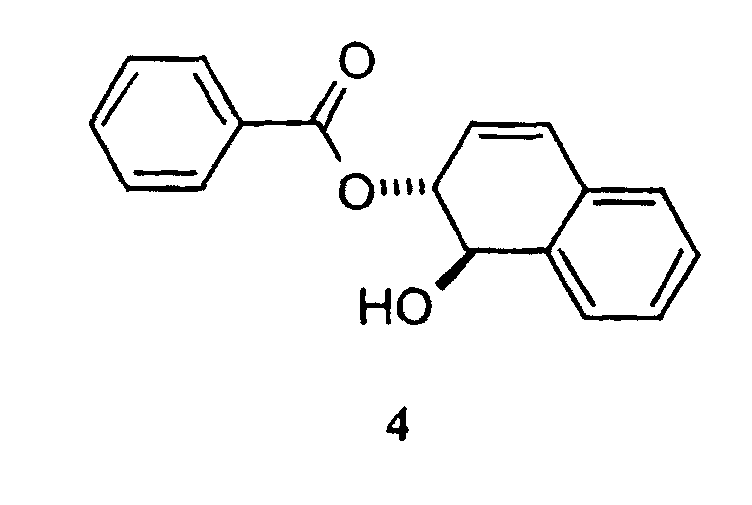
- (1R,2R)-Benzoic acid 1-hydroxy-1,2-dihydro-naphthalen-2-yl-ester (4): To a flame dried round bottom flask, [Rh(COD)Cl]2 (4.3 mg, 0.0087 mmol), (R)-(S)-BPPFA (9.6 mg, 0.017 mmol) and 1 (100 mg, 0.694 mmol) were added followed by addition of THF (4 mL), triethylamine (483 µL, 3.47 mmol) and benzoic acid (424 mg, 3.47 mmol). The mixture was heated at reflux for 6 hours and the solvents were removed in vacuo. The resulting mixture was purified by flash chromatography (20% ethyl acetate in hexanes) to give 4 a white crystalline solid (129 mg, 70%). The ee was determined to be 76% using HPLC analysis on a CHIRALCEL OD column, 10% isopropanol in hexanes, λ=254 nm. Retention times were 10.0 min (major) and 12.9 min. Rf= 0.3 on silica gel (10% ethyl acetate:hexanes); mp 107-109° (Et2O); [α]25 D= -298.4° (c= 11.3, CHCl3); IR (KBr, cm-1) 3619 (br), 3071 (w), 2977 (w), 1724 (s), 1451 (m), 1324 (m), 1265 (s), 1110 (s). 1H NMR (400MHz, CDCl3) δ 8.10 (2H, d, J= 7.6 Hz), 7.64-7.59 (2H, m), 7.48-7.45 (2H, m), 7.34-7.32 (2H, m), 7.13-7.11 (1H, m), 6.55 (1H, d, J= 10.0 Hz), 5.97 (1H, dd, J= 9.8, 2.9 Hz), 5.86 (1H, ddd, J= 9.8, 2.0, 2.0 Hz), 5.11 (1H, d, J= 9.0 Hz), 2.84 (1H, s); 13C NMR (400MHz, CDCl3) δ 166.9, 135.3, 133.3, 131.6, 129.9, 129.8, 129.7, 128.4, 128.4, 128.4, 126.8, 126.1, 125.5, 76.1, 71.9. HRMS calcd for C17H14O3 (M+): 266.0943. Found: 266.0938.

- (1R*,2R*)-Formic acid 1-hydroxy-1,2-dihydro-naphthalen-2-yl-ester (5): To a flame dried round bottom flask, [Rh(COD)Cl]2 (4.3 mg, 0.0087 mmol), DPPF (9.6 mg, 0.017 mmol), 1 (100 mg, 0.694 mmol), and ammonium formate (219 mg, 3.47 mmol), were added followed by addition of THF (5 mL). The mixture was heated at reflux for 3 hours and the solvents were removed in vacuo. The resulting mixture was purified by flash chromatography (30% ethyl acetate in hexanes) to give 5 a white crystalline solid (84 mg, 64%). Rf= 0.25 on silica gel (30% ethyl acetate:hexanes); mp 133-135° (Et2O); IR (KBr, cm-1) 3146 (br), 2935 (w), 1720 (s), 1482 (w), 1186 (s), 1049 (m), 968 (m); 1H NMR (400MHz, CDCl3) δ 8.17 (1H, d, J= 0.8 Hz), 7.52-7.50 (1H, m), 7.29-7.27 (2H, m), 7.13-7.11 (1H, m), 6.54 (1H, dd, J= 9.6, 1.6 Hz), 5.88 (1H, dd, J= 9.6, 2.8 Hz), 5.71-5.68 (1H, m), 4.96 (1H, d, J= 8.8 Hz), 2.8 (1H, s); 13C NMR (400MHz, CDCl3) δ 160.9, 134.8, 131.4, 130.0, 128.5, 126.9, 126.1, 124.6, 74.8, 71.4. HRMS calcd for C11H10O3 (M+): 190.0630. Found: 190.0625.
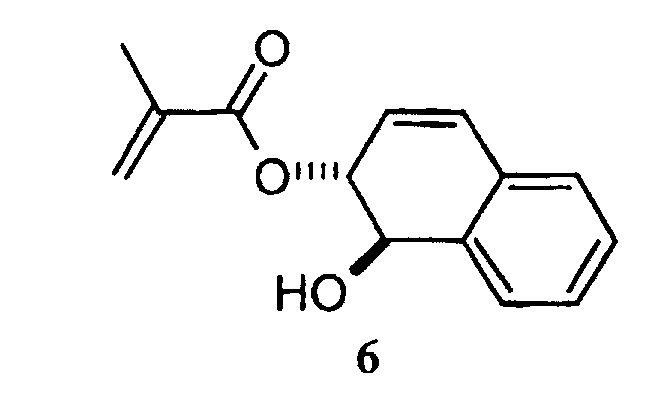
- (1R*,2R*)-2-Methyl acrylic acid 1-hydroxy-1,2-dihydro-naphthalen-2-yl-ester (6): To a flame dried round bottom flask, [Rh(COD)Cl]2 (4.3 mg, 0.0087 mmol), DPPF (9.6 mg, 0.017 mmol) and 1 (50 mg, 0.347 mmol) were added followed by addition of THF (2.5 mL), triethylamine (242 µL, 1.735 mmol) and methacrylic acid (147 µL, 1.735 mmol). The mixture was heated at reflux for 3 hours and the solvents were removed in vacuo. The resulting mixture was purified by flash chromatography (30% ethyl acetate in hexanes) to give 6 a white crystalline solid (50 mg, 63%). Rf= 0.32 on silica gel (20% ethyl acetate:hexanes); mp 80-82° (Et2O); IR (KBr, cm-1) 3450 (br), 3030 (w), 2928 (w), 1722 (s), 1637 (m), 1454 (m), 1289 (m), 1163 (s); 1H NMR (400MHz, CDCl3) δ 7.56-7.55 (1H, m), 7.29-7.24 (2H, m), 7.10-7.09 (1H, m), 6.51 (1H, dd, J= 9.9, 1.9 Hz), 6.15 (1H, s), 5.87 (1H, dd, J= 9.9, 3.0 Hz), 5.67 (1H, ddd, J= 9.3, 2.1, 2.1 Hz), 5.61 (1H, s), 5.01 (1H, dd, J= 9.0, 5.7 Hz), 2.74 (1H, d, J= 6.1 Hz), 1.96 (3H, s); 13C NMR (400MHz, CDCl3) δ 167.6, 135.9, 135.3, 131.5, 129.4, 128.3, 128.2, 126.6, 126.4, 125.8, 125.5, 75.9, 71.9, 18.3.. HRMS calcd C14H12O2 (M+-H2O): 212.0837. Found: 212.0831

- (1R*,2R*)-Malonic acid ethyl ester (1-hydroxy-1,2-dihydro-naphthalen-2-yl) ester (7): To a flame dried round bottom flask, [Rh(COD)Cl]2 (8.6 mg, 0.017 mmol DPPF (19.2 mg, 0.035 mmol), 1 (200 mg, 1.39 mmol), ethyl malonate potassium salt (590 mg, 3.47 mmol), and triethylamine hydrochloride (478 mg, 3.47 mmol) were added followed by addition of THF (8 mL). The mixture was heated at reflux for 3 hours and the solvents were removed in vacuo. The resulting mixture was purified by flash chromatography (30% ethyl acetate in hexanes) to give 7 a colourless oil (300 mg), 79%). Rf= 0.29 on silica gel (30% ethyl acetate:hexanes); IR (KBr, cm-1) 3470 (br), 2983 (w), 1731 (s), 1453 (w), 1370 (m), 1150 (s), 1031 (m); 1H NMR (400MHz, CDCl3) δ 7.56-7.54 (1H, m), 7.27-7.21 (2H, m), 7.08-7.06 (1H, m), 6.48 (1H, dd, J= 9.9, 2.1 Hz), 5.83 (1H, dd, J= 9.7, 2.8 Hz), 5.70 ( 1 H, ddd, J= 9.7, 2.5, 2.2 Hz), 4.97 (1H, d, J= 9.5 Hz), 4.18 (2H, q, J= 7.2 Hz), 3.43 (2H, dd, J= 23.6, 15.9 Hz), 3.21 (1H, s), 1.25 (3H, t, J= 7.1 Hz); 13C NMR (400MHz, CDCl3) δ 167.1, 166.5, 135.0, 131.5, 129.6, 128.3, 128.1, 126.6, 125.6, 125.1, 77.0, 71.6, 61.9, 41.6, 14.0. HRMS calcd for C15H14O4 (M+-H2O): 258.0892. Found: 258.0899.

- (1R*,2R*)-Malonic acid (1-tert-butyldimethylsiloxy-1,2-dihydro-naphthalen-2-yl) ester ethyl ester (8): To a dried round bottom flask, 7 (270 mg, 0.98 mmol), imidazole (134 mg, 1.96 mmol), dimethylaminopyridine (6 mg, 0.05 mmol) were dissolved in dichloromethane (4 mL). Tert-butyldimethylsilyl chloride (222 mg, 1.47 mmol) was then added portionwise and allowed to react for 24 hours. The reaction was then quenched with water, extracted with dichloromethane, dried over Na2SO4 and concentrated in vacuo. Flash chromatography (10% ethyl acetate in hexanes) gave a colourless oil 8 (343 mg, 90%). Rf= 0.48 on silica gel (10% ethyl acetate:hexanes. IR (KBr, cm-1) 2983 (w), 1731 (s), 1453 (w), 1370 (m), 1150 (s), 1031 (m); 1H NMR (400MHz, CDCl3) δ 7.41-7.39 (1H, m), 7.24-7.22 (2H, m), 7.07-7.05 (1H, m), 6.47 (1H, dd, J= 9.9, 1.8 Hz), 5.83 (1H, dd, J= 9.7, 2.7 Hz), 5.60 (1H, ddd, J= 9.3, 2.9, 2.0 Hz), 5.00 (1H, dd,J= 9.3, 0.5 Hz), 4.22-4.15 (2H, m), 3.40 (2H, dd, J= 19.6, 16.0 Hz), 1.57 (1H, s), 1.25 (3H, t, J= 7.1 Hz), 0.92 (9H, s), 0.13 (3H, s), 0.09 (3H, s); 13C NMR (400MHz, CDCl3) δ 166.3, 166.2, 136.2, 132.1, 129.4, 128.0, 127.9, 126.5, 125.9, 125.7, 76.4, 71.6, 61.6, 41.7, 25.8, 18.1, 14.0, -4.3, -4.5. HRMS calcd for C17H21O5Si (M+-C4H9): 333.1158. Found: 333.1149.

- (1S*,2S*)-(4-Tert-butyldimethylsiloxy-1,4-dihydro-naphthalen-2-yl) acetic acid ethyl ester (9): To a dried round bottom flask, 8 (100 mg, 0.256 mmol) was dissolved in THF (4 mL). Potassium hydride (11.3 mg, 0.28 mmol) was then added portionwise and allowed to react for five minutes at room temperature. Triphenylphosphine (34.1 mg, 0.13 mmol) was then added followed by Pd(PPh3)4 (14.8 mg, 0.013 mmol). The reaction was then heated to reflux for two hours. The solvent was then removed in vacuo and the resulting oil purified by flash chromatography (5% ethyl acetate in hexanes) giving 9 a colourless oil (54 mg, 61%). Rf= 0.27 on silica gel (5% ethyl acetate:hexanes); IR (KBr, cm-1) 3036(w), 2956(s), 1735(s), 1472(m), 1257(s), 1077(s); 1H NMR (400MHz, CDCl3) δ 7.54-7.52 (1H, m), 7.30-7.23 (3H, m), 6.09 (1H, ddd, J= 2.4, 4.6, 10.2 Hz), 6.02 (1H, ddd, J= 10.2, 2.0, 0.5 Hz), 5.22-5.21 (1H, m), 4.15 (2H, q, J= 7.2 Hz), 3.92-3.87 (1H, m), 2.62 (1H, dd, J= 15.7,5.7 Hz), 2.39 (1H, dd, J= 15.2, 9.0 Hz), 1.25 (3H, t, J= 7.2 Hz), 0.98 (9H, s), 0.21 (3H, s), 0.15 (3H, s); 13C NMR (400MHz, CDCl3) δ 171.7, 138.3, 136.1, 131.8, 128.2, 127.2, 127.0, 126.9, 126.6, 65.3, 60.5, 42.7, 36.5, 25.9, 18.2, 14.2, -4.2, -4.5. HRMS calcd C17H21O5Si (M+-C4H9): 289.1260. Found: 289.1257
-
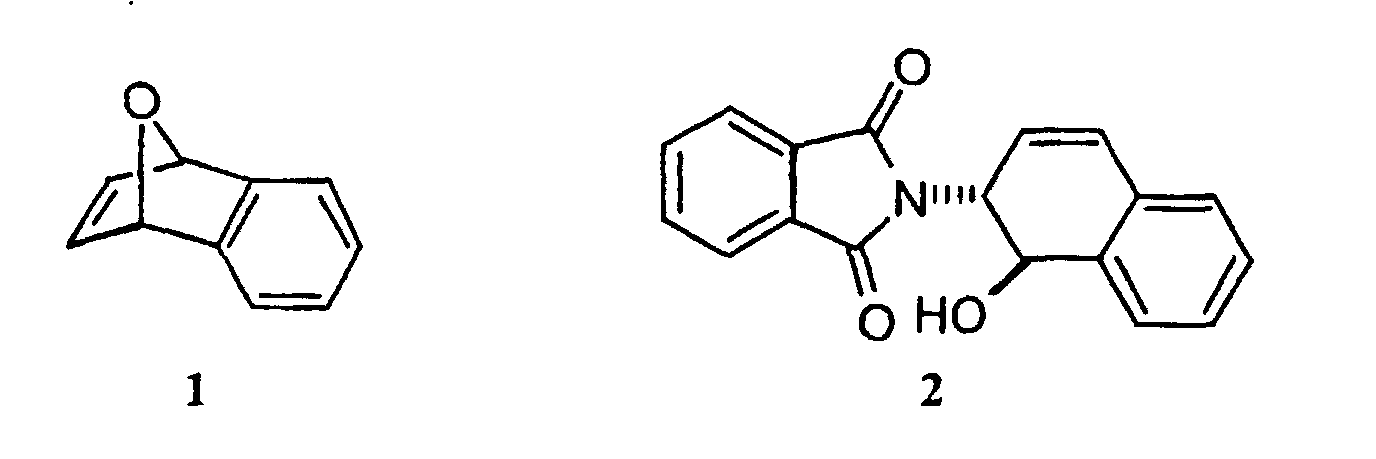
- (1R,2R)-2-(1-hydroxy-1,2-dihydro-naphthalen-2-yl)-isoindole-1,3-dione (2): To a flame dried round bottom flask, [Rh(COD)Cl]2 (5.4mg, 0.011 mmol), (R)-(S)-BPPFA (12.2 mg, 0.022 mmol), phthalimide (510 mg, 3.47 mmol) and 1 (100 mg, 0.69 mmol) were added. THF (4 mL) was then added, followed by heating to 80°C for 3 days. The reaction mixture was then poured in to water and extracted three times with ethyl acetate. The organic layers were combined, washed with brine dried over Na2SO4, and concentrated in vacuo. The resulting solid was purified by flash chromatography (30% ethyl acetate in hexanes) to give 2 as a white crystalline solid (103.5 mg, 52%). The ee was determined to be 74% using HPLC analysis on a CHIRALCEL OD column, λ= 486nm. Retention times in 10% isopropanol in hexanes were 21.1 min (major)and 29.1 min. Rf= 0.36 on silica gel (30% ethyl acetate:hexanes); mp 175-176° (dec); [α]25 D= -6.1° (c= 12.9, CHCl3); IR (KBr, cm-1) 3536 (br), 3067 (w), 2921 (w), 1772 (m), 1693 (s), 1388 (s), 1084 (m), 955 (m), 719 (s); 1H NMR (400MHz, CDCl3) δ 7.78-7.75 (2H, m), 7.68-7.64 (2H, m), 7.57-7.55 (1H, m), 7.26-7.22 (2H, m), 7.09-7.07 (1H, m), 6.51 (1H, dd, J= 9.7, 2.7 Hz), 5.84 (1H, ddd, J= 9.7, 2.7, 2.2 Hz), 5.48 (1H, d, J= 12.8 Hz), 5.12 (1H, ddd, J= 12.8, 2.5, 2.4 Hz), 2.82 (1H, s); 13C NMR (400MHz, CDCl3) δ 168.6, 137.3, 134.2, 132.6, 132.1, 128.7, 128.2, 128.1, 126.9, 126.5, 124.4, 123.5, 70.9, 55.3. HRMS calcd for C18H11NO2 (M+-H2O): 273.2939. Found: 273.0793.
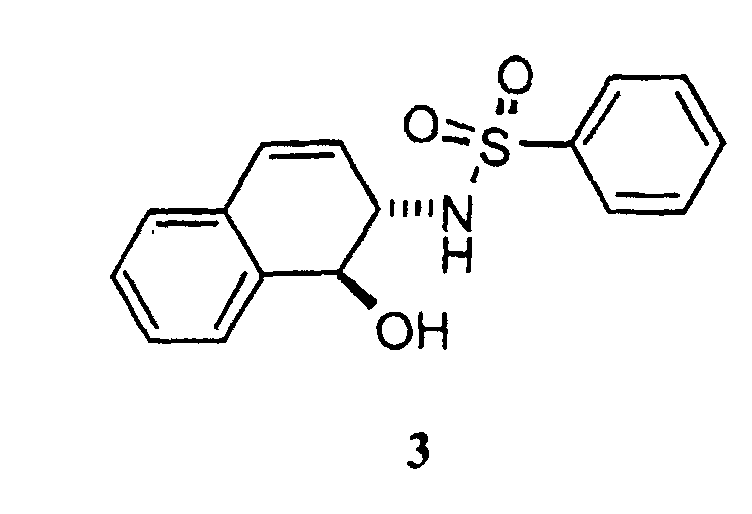
- (1S,2S)-N-(1-Hydroxy-1,2-dihydro-naphthalen-2-yl)-benzene sulfonamide (3): To a flame dried round bottom flask, [Rh(COD)Cl]2 (4.3 mg, 0.0087 mmol), (S)-(R)-PPF-PtBu2 (9.4 mg, 0.0173 mmol), benzenesulfonamide (545 mg, 3.47 mmol) and 1 (100 mg, 0.69 mmol) were added. THF (2 mL) was then added, followed by heating to 80°C for 12 hours. The reaction mixture was then poured into water and extracted three times with ethyl acetate. The organic layers were combined, washed with brine dried over Na2SO4, and concentrated in vacuo. The resulting solid was purified by flash chromatography (30% ethyl acetate in hexanes) to give 3 a white crystalline solid (223 mg, 96%). The ee was determined to be 95% by Mosher's ester formation and HPLC analysis on a CHIRALCEL OD column, λ= 486nm. Retention times in 10% isopropanol in hexanes were 26.6 min (major) and 39.4 min. Rf= 0.22 on silica gel (30% ethyl acetate:hexanes); mp 128-130° (dec); [α]25 D= 70° (c= 8.3, CHCl3); IR (KBr, cm-1) 3462 (br), 3200 (m), 2957 (w), 1447 (m), 1329 (m), 1329 (m), 1164 (s), 1093 (m). 1H NMR (400MHz, CDCl3) δ 7.91-7.90 (2H, m), 7.62-7.58 (1H, m), 7.54-7.50 (2H, m), 7.47-7.45 (1H, m), 7.27-7.23 (2H, m), 6.40 (1 H, dd, J= 9.7, 1.7 Hz), 5.55 (1H, dd, J= 9.7, 3.1 Hz), 5.26 (1H, s), 4.77 (1H, d, J= 8.8 Hz), 4.13-4.07 (1H, m), 2.91 (1H, s); 13C NMR (400MHz, CDCl3) δ 140.2, 134.9, 132.9, 131.3, 129.5, 129.2, 128.4, 128.4, 127.1, 126.4, 126.0, 72.0, 56.3. HRMS calcd for C16H15NO3S (M+): 301.0773. Found: 301.0769.

- (1R*,2R*)-2-Pyrrolidin-1-yl-1,2-dihydro-naphthalen-1-ol (4): To a flame dried round bottom flask, [Rh(COD)Cl]2 (4.3mg, 0.009 mmol), DPPF (9.6 mg, 0.017 mmol), pyrrolidine (146 mg, 3.47 mmol), triethylamine hydrochloride (478 mg, 3.47 mmol) and 1 (125 mg, 0.865 mmol) followed by addition of THF (3 mL) and heating to reflux for 8 hours. The solvent was then removed in vacuo and the resulting mixture purified by flash chromatography (10% methanol in acetone) to give 4 a white crystalline solid (119 mg, 80%). Rf= 0.14 on silica gel (10% methanol in acetone); mp 97-98° (Et2O); IR (KBr, cm-1) 3496 (br), 3035 (m), 2967 (s), 1454 (m), 1193 (s), 1117 (m), 1048 (s). 1H NMR (400MHz, CDCl3) δ 7.56 (1H, d, J= 7.1 Hz), 7.29-7.21 (2H, m), 7.08-7.06 (1H, m), 6.57 (1H, dd, J= 9.9, 2.4 Hz), 6.05 (1H, dd, J= 9.9, 2.4 Hz), 4.83 (1H, d, J= 11.3 Hz), 3.66 (1H, ddd, J= 11.3, 2.4, 2.4 Hz), 3.5 7 (1H, s), 2.81-2.79 (2H, m), 2.73-2.71 (2H, m), 1.84-1.80 (4H, m); 13C NMR (400MHz, CDCl3) δ 136.9, 131.8, 129.6, 127.7, 127.3, 126.1, 125.4, 124.7, 69.8, 63.3, 48.7, 23.8. HRMS calcd for C14H17NO (M+): 215.1310.. Found: 215.1314.

- (1R*,2R*)-2-Piperidin-1-yl-1,2-dihydro-naphthalen-1-ol: To a flame dried round bottom flask, [Rh(COD)Cl]2 (4.3 mg, 0.0087 mmol), DPPF (9.6 mg, 0.0173 mmol), piperidine hydrochloride (422 mg, 3.47 mmol), triethylamine (350 µL, 2.51 mmol) and 1 (100 mg, 0.69 mmol) were added followed by THF (3 mL) and heating to 80°C for 12 hours. The reaction mixture was then concentrated in vacuo and purified by flash chromatography (50% ethyl acetate, 48% hexanes, 2% methanol) to give 5 a white crystalline solid (130 mg, 82%). Rf= 0.24 on silica gel (50% ethyl acetate, 48% hexanes, 2% methanol); mp 62-64° (Et2O); IR (KBr, cm-1) 3482 (br), 3036 (w), 2937 (s), 2853 (m), 1453 (s), 1193 (s), 1109 (s), 1046 (s). 1H NMR (400MHz, CDCl3) δ 7.57 (1H, d, J= 7.1 Hz), 7.27-7.18 (2H, m), 7.05 (1H, dd, J= 6.9, 0.9 Hz), 6.49 (1H, dd, J= 9.9, 2.6 Hz), 6.12 (1H, dd, J= 9.9, 2.4 Hz), 4.87 (1H, d, J= 12.2 Hz), 3.58 (1H, s), 3.37 (1H, ddd, J= 12.2, 2.4, 2.4 Hz), 2.79-2.73 (2H, m), 2.48 (2H, m), 1.67-1.57 (4H, m), 1.56-1.46 (2H, m); 13C NMR (400MHz, CDCl3) δ 137.4, 131.8, 128.8, 127.1, 125.9, 125.2, 124.4, 68.2, 67.6, 50.4, 26.5, 24.6. HRMS calcd for C15H18NO (M+-H): 228.1388. Found: 228.1318.
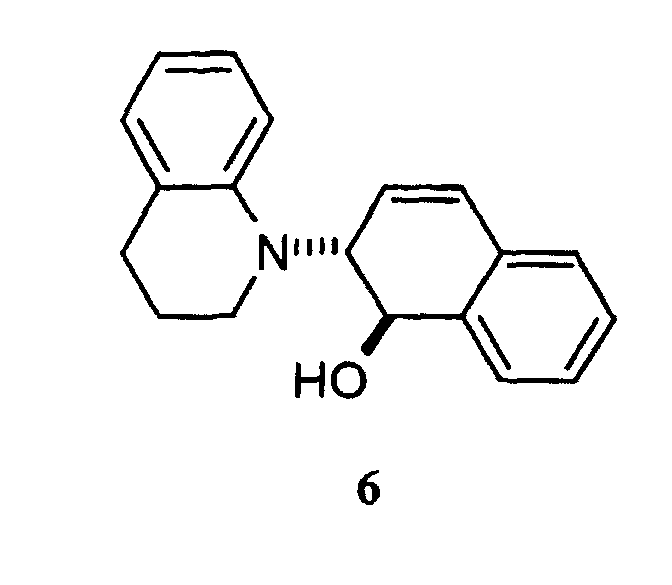
- (1R,2R)-2-(3,4-Dihydro-2H-quinolin-1-yl)-1,2-dihydro-naphthalen-1-ol: To a flame dried round bottom flask, [Rh(COD)Cl]2 (4.3 mg, 0.0087 mmol), (R)-(S)-BPPFA (9.6 mg, 0.0173 mmol), tetrahydroisoquinoline (231 mg, 1.735 mmol), 1 (60 mg, 0.416 mmol) and THF (2.5 mL) were added followed by heating to reflux for 3 hours. The solvent was then removed in vacuo and the resulting oil purified by flash chromatography (5% ethyl acetate in hexanes) to give 6 a colourless oil (114.1 mg, 98%). The ee was determined to be 65% using HPLC analysis on a CHIRALCEL OD column, λ= 254nm. Retention times in 10% isopropanol in hexanes were 10.3 min (major) and 11.2 min. Rf= 0.30 on silica gel (10% ethyl acetate:hexanes); [α]25 D= -30.0° (c= 13.8, CHCl3); IR (KBr, cm-1) 3588 (br), 3037 (w), 2932 (w), 1601 (s), 1495 (m), 1190 (m). 1H NMR (400MHz, CDCl3) δ 7.54-7.52 (1H, m), 7.31-7.29 (2H, m), 7.17-7.14 (1H, m), 7.10-7.09 (1H, m), 7.06-7.04 (1H, m), 6.94-6.93 (1H, m), 6.68-6-67 (1H, m), 6.65 (1H, dd, J= 9.4, 2.2 Hz), 5.96 (1H, dd, J= 9.9, 3.3 Hz), 5.13 (1H, d, J= 8.8 Hz), 4.78 (1H, ddd, J= 8.8, 2.5, 2.5 Hz), 3.31-3.26 (1H, m), 3.14-3.08 (1H, m), 2.81-2.80 (2H, m), 2.30 (1H, s), 1.95-1.89 (2H, m); 13C NMR (400MHz, CDCl3) δ 145.1, 136.5, 131.9, 129.7, 129.5, 128.0, 128.0, 128.0, 127.9, 127.0, 126.5, 125.9, 124.0, 116.8, 112.2, 69.5, 60.9, 44.1, 28.1, 22.5. HRMS calcd for C19H19NO (M+): 277.1467. Found: 277.1463.
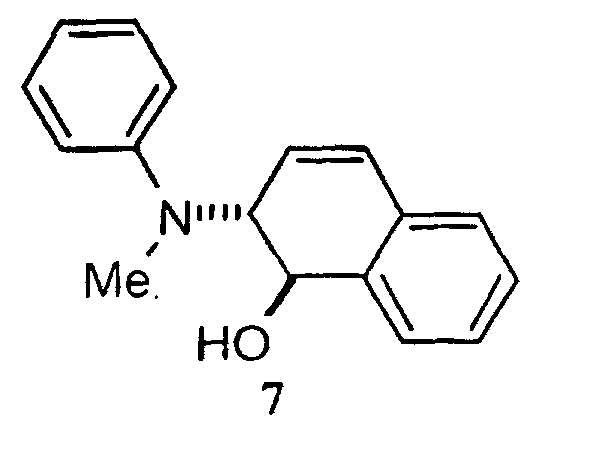
- (1R,2R)-2-(Methyl-phenyl-amino)-1,2-dihydro-naphthalen-1-ol (7): To a flame dried round bottom flask, [Rh(COD)Cl]2 (3.5 mg, 0.007 mmol), (R)-(S)-BPPFA (7.7 mg, 0.014 mmol), N-methylaniline (372 mg, 3.47 mmol), 1 (105 mg, 0.728 mmol) and THF (3 mL) were added followed by heating to reflux for 3 hours. The solvent was then removed in vacuo and the resulting oil purified by flash chromatography (5% ethyl acetate in hexanes) to give 7 a white crystalline solid (176.3 mg, 96%). The ee was determined to be 74% using HPLC analysis on a CHIRALCEL OD column, λ= 254nm. Retention times in 10% isopropanol in hexanes were 11.1 min (major) and 13.3 min. Rf= 0.41 on silica gel (20% ethyl acetate:hexanes); mp 55-56° (Et2O); [α]25 D= 50.4° (c= 11.8, CHCl3); IR (KBr, cm-1) 3594 (br), 3037 (m), 2884 (m), 1596 (s), 1503 (s), 1463 (m), 1186(m), 935 (m). 1H NMR (400MHz, CDCl3) δ 7.57-7.55 (1H, m), 7.31-7.26 (4H, m), 7.15-7.13 (1H, m), 6.99-6.97 (2H, m), 6.84-6.81 (1H, m), 6.61 (1H, dd, J= 9.8, 2.6 Hz), 5.94 (1H, dd, J= 9.7, 2.9 Hz), 5.11 (1H, d, J= 9.8 Hz), 4.76 (1H, ddd, J= 9.7, 2.6, 2.6 Hz), 2.85 (3H, s), 2.50 (1H, s); 13C NMR (400MHz, CDCl3) δ 150.1, 136.4, 131.9, 129.6, 129.2, 128.0, 127.8, 127.7, 126.4, 125.5, 118.0, 114.5, 70.0, 63.3, 33.3. HRMS calcd for C17H17NO (M+): 251.1310. Found: 251.1307.(1R*,2R*)-2-Benzylamino-1,2-dihydro-naphthalen-1-ol (8): To a flame dried round bottom flask, [Rh(COD)Cl]2 (4.3 mg, 0.009 mmol), DPPF (9.6 mg, 0.017 mmol), benzylamine hydrochloride (279 mg, 1.74 mmol), triethylamine (242 µL, 1.74 mmol) and 1 (50 mg, 0.347 mmol) followed by addition of THF (3 mL) and heating to reflux for 3 days. The solvent was then removed in vacuo and the resulting mixture purified by flash chromatography (50% ethyl acetate in hexanes) to give 8 a white crystalline solid (26.9 mg, 31 %). Rf= 0.44 on silica gel (50% ethyl acetate, 48% hexanes, 2% methanol); mp 115-117° (dec) (Et2O); IR (KBr, cm-1) 3528 (br), 3030 (w), 2849 (w), 1455 (s), 1190 (m), 1112 (m), 1048 (m). 1H NMR (400MHz, CDCl3) δ 7.47-7.45 (1H, m), 7.29-7.24 (4H, m), 7.24-7.17 (3H, m), 7.02-7.01 (1H, m), 6.41 (1H, dd, J= 9.7, 2.0 Hz), 6.00 (1H, dd, J= 9.7, 2.5 Hz), 4.64 (1H, d, J= 9.0 Hz), 3.94 ( 1 H, AB, J= 13.0 Hz), 3.75 (1H, AB, J= 13.0 Hz), 3.42 (1H, ddd, J= 11.0, 2.4, 2.4 Hz), 2.44 ( 1 H, s); 13C NMR (400MHz, CDCl3) δ 139.8, 136.6, 132.1, 128.8, 128.5, 128.2, 127.9, 127.8, 127.6, 127.2, 126.1, 124.9, 72.1, 59.7, 50.7. HRMS calcd for C17H17NO (M+): 251.1310. Found: 251.1316.
 (1R*,2R*)-2-(4-Methoxy-benzylamino)-1,2-dihydro-naphthalen-1-ol (9): To a flame dried round bottom flask, [Rh(COD)Cl]2 (4.3mg, 0.009 mmol), DPPF (9.6 mg, 0.017 mmol), p-methoxybenzylamine (238 mg, 1.74 mmol), triethylamine hydrochloride (239 mg, 1.74 mmol) and 1 (50 mg, 0.728 mmol) followed by addition of THF (3 mL) and heating to reflux for 3 days. The solvent was then removed in vacuo and the resulting mixture purified by flash chromatography (50% ethyl acetate in hexanes) to give 9 a white crystalline solid (43 mg, 44%).
- Rf= 0.27 on silica gel (50% ethyl acetate, 48% hexanes, 2% methanol); mp 96-98° (dec) (Et2O); IR (KBr, cm-1) 3528 (br), 3033 (w), 2835 (m), 1612 (m), 1512 (s), 1455 (m), 1248 (s), 1040 (m). 1H NMR (400MHz, CDCl3) δ 7.52-7.50 (1H, m), 7.26-7.22 (4H, m), 7.08-7.06 (1H, m), 6.85 (2H, d, J= 9.0 Hz), 6.47 (1H, dd, J= 9.7, 2.0 Hz), 6.05 (1H, dd, J= 9.9, 2.6 Hz), 4.68 (1H, d, J= 11.0 Hz), 3.95 (1H, d, J= 12.9 Hz), 3.79 (3H, s), 3.75 (1H, d, J= 2.9 Hz), 3.46 (1H, ddd, J= 11.0, 2.4, 2.4 Hz), 3.0-2.0 (2H, s (br)); 13C NMR (400MHz, CDCl3) δ 158.7, 136.7, 132.1, 131.9, 129.4, 128.9, 127.9, 127.7, 127.5, 126.0, 124.9, 113.9, 72.1, 59.6, 55.2, 50.1. HRMS calcd for C18H19NO2 (M+): 281.1416. Found: 281.1403.

- (1R,2R)-2-Indol-1-yl-1,2-dihydro-naphthalen-1-ol (10): To a flame dried round bottom flask, [Rh(COD)Cl]2 (4.3 mg, 0.009 mmol), (R)-(S)-BPPFA (9.6 mg, 0.017 mmol), indole (407 mg, 3.47 mmol) and 1 (100 mg, 0.69 mmol) were added. THF (4 mL) was then added, followed by heating to 80°C for 3 days. The reaction mixture was then concentrated in vacuo. The resulting oil was purified by flash chromatography (30% ethyl acetate in hexanes) to give 10 a colourless oil (147 mg, 81%). The ee was determined to be 79% using HPLC analysis on a CHIRALCEL OD column, λ= 254nm. Retention times in 10% isopropanol in hexanes were 28.5 min (major) and 30.1 min. Rf= 0.26 on silica gel (30% ethyl acetate:hexanes); [α]25 D= -46.7° (c= 11.3, CHCl3); IR (KBr, cm-1) 3485 (br), 3059 (m), 1592 (m), 1455 (s), 1414 (s), 1245 (m), 1091 (m), 908 (m); 1H NMR (400MHz, CDCl3) δ 8.13 (1H, s), 7.79 (1H, d, J= 7.8 Hz), 7.42 (1H, d, J= 7.3 Hz), 7.34-7.19 (6H, m), 6.85 (1H, d, J= 2.2 Hz), 6.69 (1H, dd, J= 9.5, 2.0 Hz), 6.20 (1H, dd, J= 9.5, 3.8 Hz), 5.06 (1H, d, J= 7.9 Hz), 4.12-4.08 (1H, m), 2.35 (1H, s); 13C NMR (400MHz, CDCl3) δ 136.5, 135.9, 132.5, 130.1, 128.0, 127.7, 126.9, 126.5, 126.4, 126.2, 122.6, 122.0, 119.3, 119.2, 113.9, 111.4, 72.7, 41.0. HRMS calcd for C18H15NO (M+): 261.1154. Found: 261.1141.
-
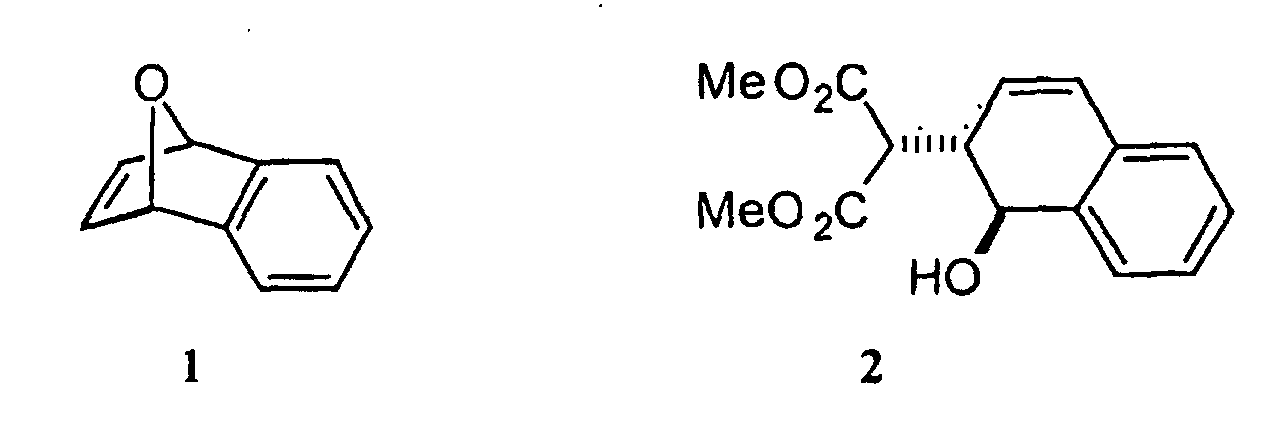
- (1S*,2R*)-2-(Hydroxy-1,2-dihydro-naphthalen-2-yl)malonic acid dimethyl ester (2): To a flame dried round bottom flask, [Rh(COD)Cl]2 (8.6 mg, 0.0174 mmol), DPPF (19.2 mg, 0.0347 mmol), dimethyl malonate (137 mg, 1.041 mmol) and 1 (100 mg, 0.694 mmol) were added followed by addition of THF (1.5 mL) and heating to 80°C for 24 hours. The reaction mixture was then poured in to water and extracted three times with ethyl acetate. The organic layers were combined, washed with brine dried over Na2SO4, and concentrated in vacuo. The resulting oil was purified by flash chromatography (20% ethyl acetate in hexanes then increasing to 50% ethyl acetate in hexanes) to give 2 a colourless oil which crystallized on sitting (124.3 mg, 65%). Rf= 0.27 on silica gel (50% ethyl acetate:hexanes); mp 65-67° (Et2O); IR (neat, cm-1) 3490 (br), 3024 (m), 2954 (s), 1744 (s), 1436 (s), 1159 (s), 1026 (s), 913 (m), 783 (s); 1H NMR (400MHz, CDCl3) δ 7.40-7.38 (1H, m), 7.30-7.24 (2H, m), 7.13-7.11 (1H, m), 6.57 (1H, dd, J= 9.7, 1.5 Hz), 5.97 (1H, dd, J= 9.7, 4.2 Hz), 4.70 (1H, dd, J= 6.2, 6.2 Hz), 3.73 (3H, s), 3.70 (3H, s), 3.52 (1H, d, J= 7.6 Hz), 3.37-3.35 (1H, m), 2.09 (1H, d, J= 6.2 Hz); 13C NMR (400MHz, CDCl3) δ 168.6, 168.3, 135.4, 131.9, 128.3, 128.1, 126.8, 126.7, 70.3, 52.6, 52.6, 52.5, 42.3. HRMS calcd for C15H16O5 (M+): 276.0998. Found: 276.0104.
-
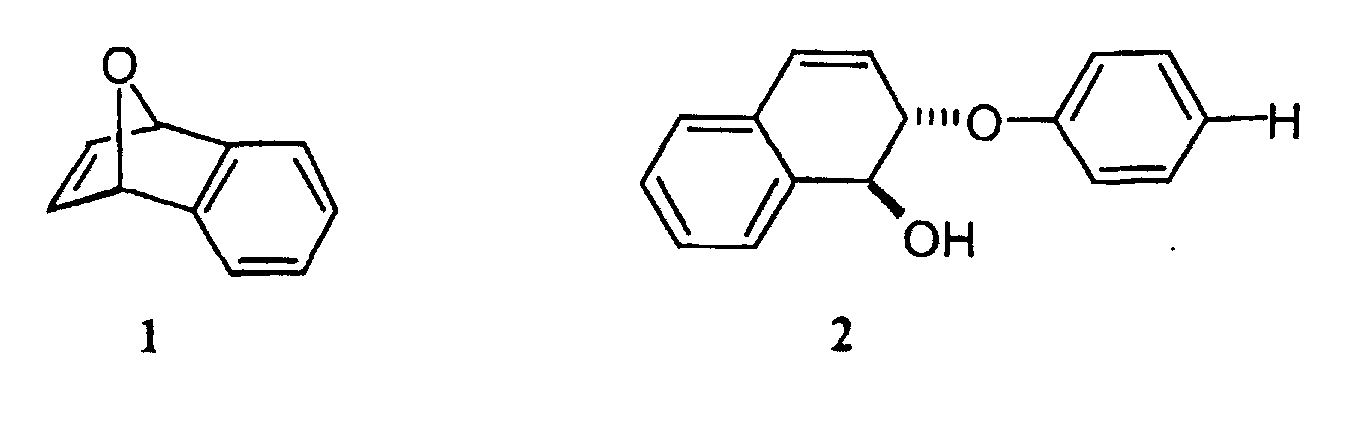
- (1S,2S)-2-Phenoxy-1,2-dihydro-naphthalen-1-ol (2): To a flame dried round bottom flask, [Rh(COD)Cl]2 (1.7 mg, 0.0035 mmol), (S)-(R)- PPF-PtBu2 (3.8 mg, 0.0069 mmol, and 1 (100 mg, 0.694 mmol) were added. THF (2 mL) and phenol (327 mg, 3.47 mmol) were then added followed by heating to 80°C for 1.5 hours. The reaction mixture was then poured in to ether and washed three times with 5% aqueous Noah. The aqueous layers were combined and back extracted three times with ether. The organic layers were combined, washed with brine, dried over Na2SO4, and concentrated in vacuo. The resulting solid was purified by flash chromatography (20% ethyl acetate in hexanes) to give 2 as a white crystalline solid (130.7 mg, 83%). The ee was determined to be 99.2% using HPLC analysis on a CHIRALCEL OD column, λ= 486 nm. Retention times in 4% isopropanol in hexanes were 15.2 min (major) and 17.8 min. Fr= 0.26 on silica gel (10% ethyl acetate:hexanes); mp 109-110°C (Et2O); [α]25 D= +204.7° (c= 10.1, CHCl3); IR (KBr, cm-1) 3337 (br), 3029 (w), 2866 (w), 1600 (m), 1496 (s), 1249 (s), 1062 (s); 1H NMR (400 MHz, CDCl3) δ 7.65-7.63 (1H, m), 7.33-7.25 (4H, m), 7.13-7.11 (1H, m), 7.01-6.95 (3H, m), 6.51 (1H, dd, J= 9.9, 1.6 Hz), 6.02 (1H, dd, J= 9.9, 2.2 Hz), 5.19 (1H, d, J= 10.4 Hz), 5.11 (1H, ddd, J= 10.4, 2.0, 2.0 Hz), 2.66 (1H, s); 13C NMR (400 MHz, CDCl3) δ 157.4, 135.5, 131.9, 129.7, 129.0, 128.2, 128.0, 126.4, 126.1, 125.2, 121.5, 115.9, 79.1, 72.4. HRMS calcd for C16H14O2 (M+): 238.0994. Found: 238.0984.

- (1S,2S)-2-(4-nitrophenoxy)-1,2,-dihydro-naphthalen-1-ol (3): To a flame dried round-bottomed flask, [Rh(COD)Cl]2 (1.7 mg, 0.0035 mmol), (S)-(R)-PPF-PtBu2 (3.8 mg, 0.0069 mmol) and 1 (100 mg, 0.694 mmol) were added followed by addition of THF (2.5 mL) and 4-nitrophenol (483 mg, 3.47 mmol). The mixture was heated at 80°C for 45 minutes, then poured into diethyl ether and extracted 3 times with 10% aqueous sodium hydroxide solution. The aqueous extracts were combined and back-extracted three times with diethyl ether. The combined ether extracts were washed with brine and dried with anhydrous sodium sulfate. The solvents were removed in vacuo, yielding a solid which was purified by flash chromatography on silica gel (30% ethyl acetate in hexanes) giving a white crystalline solid 3 (184 mg, 94%). The ee was determined to be 97% by formation of Mosher's ester. Fr = 0.43 on silica (30% ethyl acetate:hexanes); mp 123-125°C (dec.); [α]25 D = +169.9° (c = 10.3, CHCl3); IR (KBr, cm-1) 3351 (br), 3113 (w), 3071 (w), 2884 (w), 2843 (w), 1591 (s), 1503 (s), 1342 (s), 1295 (m), 1110 (m), 896 (w); 1H NMR (400 MHz, CDCl3): δ 8.18 (2H, d, J=9.2 Hz), 7.62-7.60 (1H, m), 7.31-7.29 (2H, m), 7.15-7.13 (1H, m), 6.99 (2H, d, J= 9.2 Hz), 6.57 (1H, d, J= 9.9 Hz), 5.94 (1H, d, J= 9.9 Hz), 5.20 (2H, s), 2.61 (1H, s); 13C NMR (400 MHz, CDCl3): δ 162.6, 141.8, 135.0, 131.5, 130.2, 128.5, 128.4, 126.8, 126.0, 125.5, 124.1, 115.4,79.6,72.0.
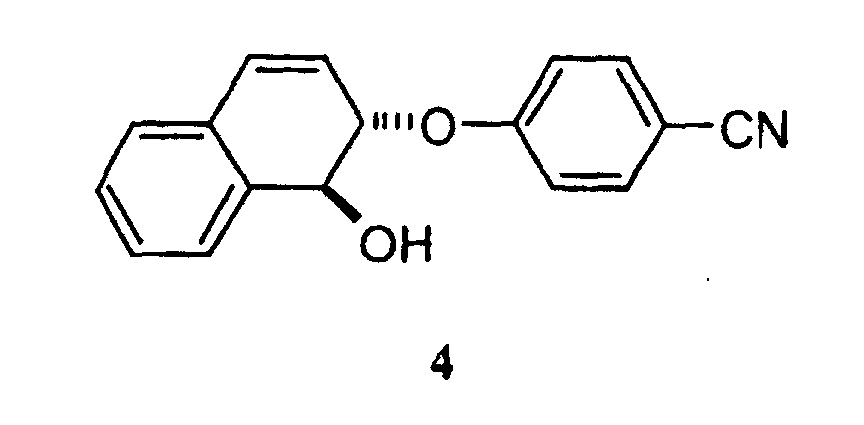
- (1S,2S)-2-(4-Cyanophenoxy)-1,2,-dihydro-naphthalen-1-ol (4): To a flame dried round-bottomed flask, [Rh(COD)Cl]2 (1.7 mg, 0.0035 mmol), (S)-(R)- PPF-PtBu2 (3.8 mg, 0.0069 mmol) and 1 (100 mg, 0.694 mmol) were added followed by addition of THF (2.5 mL) and 4-cyanophenol (413 mg, 3.47 mmol). The mixture was heated at 80°C for 5 hours, then poured into diethyl ether and extracted 3 times with 10% aqueous sodium hydroxide solution. The aqueous extracts were combined and back-extracted three times with diethyl ether. The combined ether extracts were washed with brine and dried with anhydrous sodium sulfate. The solvents were removed in vacuo, yielding a solid which was purified by flash chromatography on silica gel (30% ethyl acetate in hexanes) giving a white crystalline solid 4 (160 mg, 88%). The ee was determined to be 97% by HPLC analysis on a CHIRALCEL OD column, λ= 256 nm. Retention times in 3% isopropanol in hexanes were 35.3 min and 37.7 min (major). Fr = 0.40 on silica (30% ethyl acetate in hexanes); mp 140-141°C (Et2O); [α]25 D = +182.3° (c = 11.2, CHCl3) IR (KBr, cm-1) 3303 (b) 3050 (w) 2210 (m) 1598 (s) 1503 (s) 1238 (s) 1025 (m) 859 (m) 778 (m); 1H NMR (400 MHz, CDCl3): δ 7.62-7.57 (3H, m), 7.33-7.27 (3H, m), 7.14-7.12 (1H, m), 6.56 (1H, dd, J= 1.4, 9.7 Hz), 5.93 (1H, dd, J= 1.4,9.7 Hz), 5.20-5.13 (2H, m), 2.25 (1H, s). 13C NMR (400 MHz, CDCl3): δ 160.8, 135.0, 134.2, 131.5, 130.0, 128.5, 128.3, 126.7, 125.4, 124.4, 119.0, 116.2, 104.6, 79.2, 72.0. HRMS calcd for (M-H2O)+ (C17H11ON): 245.0841. Found: 245.0845.

- (1S,2S)-2-(4-acylphenoxy)-1,2,-dihydro-naphthalen-1-ol (5): To a flame dried round-bottomed flask, [Rh(COD)Cl]2 (1.7 mg, 0.0035 mmol), (S)-(R)- PPF-PtBu2 (3.8 mg, 0.0069 mmol) and 1 (100 mg, 0.694 mmol) were added followed by addition of THF (2.5 mL) and 4-hydroxyacetophenone (472 mg, 3.47 mmol). The mixture was heated at 80° C for 2.5 hours, then poured into diethyl ether and extracted 3 times with 10% aqueous sodium hydroxide solution. The aqueous extracts were combined and back-extracted three times with diethyl ether. The combined ether extracts were washed with brine and dried with anhydrous sodium sulfate. The solvents were removed in vacuo, yielding a solid which was purified by flash chromatography on silica gel (30% ethyl acetate in hexanes) giving a white crystalline solid 5 (177 mg, 91%). The ee was determined to be > 99% by formation of Mosher's ester; Rf = 0.28 on silica (30% ethyl acetate in hexanes); mp 124-126°C (Et2O); [α]25 D = +153° (c = 9.8, CHCl3). IR (KBr, cm-1) 3367 (b), 3069 (w), 2916 (w), 1668 (s), 1601 (s), 1265 (s), 1053 (m), 835 (m), 779 (m); 1H NMR (400 MHz, CDCl3): δ 7.94 (2H, d, J=8.8 Hz), 7.66-7.64 (1H, m), 7.34-7.27 (2H, m), 7.16-7.14 (1H, m), 6.98 (2H, d, J= 8.8 Hz), 6.57 (1H, d, J= 9.9 Hz), 5.99 (1H, d, J= 9.9 Hz), 5.21 (2H, s), 2.85 (1H, s), 2.56 (3H, s); 13C NMR (400 MHz, CDCl3): δ 196.8, 161.4, 135.3, 131.7, 130.7, 130.6, 129.6, 128.3, 128.1, 126.6, 125.4, 125.0, 115.2, 79.0, 72.0, 26.3. HRMS calcd for (M-H2O)+ (C18H14O2): 262.0994. Found: 262.0989.

- (1S,2S)-2-(4-Trifluoromethylphenoxy)-1,2,-dihydro-naphthalen-1-ol (6): To a flame dried round-bottomed flask, [Rh(COD)Cl]2 (1.7 mg, 0.0035 mmol), (S)-(R)- PPF-PtBu2 (3.8 mg, 0.0069 mmol) and 1 (100 mg, 0.694 mmol) were added followed by addition of THF (2.5 mL) and4-trifluoromethylphenyl (563 mg, 3.47 mmol). The mixture was heated at 80° C for 8 hours, then poured into diethyl ether and extracted 3 times with 10% aqueous sodium hydroxide solution. The aqueous extracts were combined and back-extracted three times with diethyl ether. The combined ether extracts were washed with brine and dried with anhydrous sodium sulfate. The solvents were removed in vacuo, yielding a solid which was purified by flash chromatography on silica gel (10% ethyl acetate in hexanes) to give a white crystalline solid 6 (184 mg, 87%). The ee was determined to be 95% by HPLC analysis on a CHIRALCEL OD column, λ= 486 nm. Retention times in 4% isopropanol in hexanes were 14.8 min and 17.3 min (major). Rf= 0.46 on silica (20% ethyl acetate in hexanes); mp 118-119°C (Et2O); [α]25 D = +178° (c = 9.6, CHCl3). IR (KBr, cm-1) 3360 (br), 3061 (w), 2874 (w), 1617 (m), 1518 (m), 1326 (s), 1103 (s), 1051 (m), 839 (m), 782 (m), 745 (w); 1H NMR (400 MHz, CDCl3): δ 7.63-7.54 (1H, m), 7.55 (2H, d, J= 8.6 Hz), 7.33-7.24 (2H, m), 7.14-7.12 (1H, m), 7.01 (2H, d, J= 8.6 Hz), 6.55 (1H, dd, J= 1.6, 9.9 Hz), 5.97 (1H, dd, J= 2.0, 9.9 Hz), 5.21-5.13 (2H, m), 2.47 (1H, d, J= 3.6 Hz); 13C NMR (400 MHz, CDCl3): δ 159.9, 135.2, 131.7, 129.6, 128.4, 128.2, 127.1 (q, J C-F= 3.6 Hz), 126.6, 125.4, 124.9, 123.4 (d, J C-F= 33.0 Hz), 122.9 (d, J C-F= 271.6 Hz), 115.6, 79.1, 72.1; HRMS calcd for (M+) (C17H13O2F3): 306.0868. Found: 306.0852.

- (1S,2S)-2-(4-Fluorophenoxy)-1,2,-dihydro-naphthalen-1-ol (7): To a flame dried round-bottomed flask, [Rh(COD)Cl]2 (1.7 mg, 0.0035 mmol), (S)-(R)- PPF-PtBu2 (3.8 mg, 0.0069 mmol) and 1 (100 mg, 0.694 mmol) were added followed by addition of THF (2.5 mL) and 4-fluorophenol (389 mg, 3.47 mmol). The mixture was heated at 80°C for 5 hours, then poured into diethyl ether and extracted 3 times with 10% aqueous sodium hydroxide solution. The aqueous extracts were combined and back-extracted three times with diethyl ether. The combined ether extracts were washed with brine and dried with anhydrous sodium sulfate. The solvents were removed in vacuo, yielding a solid which was purified by flash chromatography on silica gel (10% ethyl acetate in hexanes) giving a white crystalline solid 7 (163 mg, 92%). The ee was determined to be 97% by HPLC analysis on a CHIRALCEL OD column, λ= 486 nm). Retention times in 1.5% isopropanol in hexanes were 28.1 min (major) and 29.5 min. Rf = 0.39 on silica (20% ethyl acetate in hexanes); mp 127-129°C (Et2O); [α]25 D = +216° (c = 9.5, CHCl3). IR (KBr, cm-1) 3309 (b), 3071 (w), 2864 (w), 1504 (s), 1284 (m), 1052 (s), 781 (s), 692 (m); 1H NMR (400 MHz, CDCl3): δ 7.63-7.61 (1H, m), 7.31-7.26 (2H, m), 7.12-7.10 (1H, m), 7.00-6.95 (2H, m), 6.92-6.88 (2H, m), 6.51 (1H, dd, J= 2.1, 9.9 Hz), 5.98 (1H, dd, J= 2.2, 9.9 Hz), 5.15 (1H, dd, J= 3.6, 10.0 Hz), 5.01 (1H, ddd, J= 2.1, 2.1, 10.1 Hz), 2.54 (1H, d, J= 3.8 Hz); 13C NMR (400 MHz, CDCl3): δ 157.6 (d, J C-F= 239 Hz), 156.4, 153.4, 135.4, 131.8, 129.1, 128.2, 126.5, 125.7, 125.2, 117.5 (d, J C-F= 8 Hz), 116.1 (d, J C-F= 23.5 Hz);. HRMS calcd for (M+) (C16H13O2F): 256.0810. Found: 256.0911.
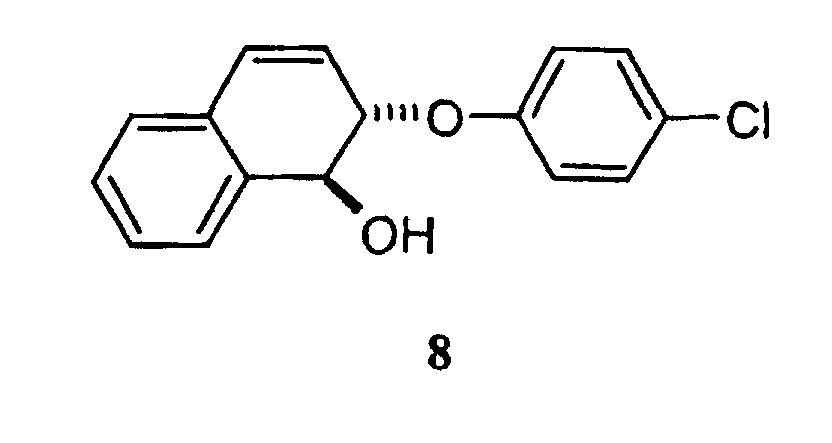
- (1S,2S)-2-(4-Chlorophenoxy)-1,2,-dihydro-naphthalen-1-ol (8): To a flame dried round-bottomed flask, [Rh(COD)Cl]2 (1.7 mg, 0.0035 mmol), (S)-(R)- PPF-PtBu2 (3.8 mg, 0.0069 mmol) and 1 (100 mg, 0.694 mmol) were added followed by addition of THF (2.5 mL) and 4-chlorophenol (446 mg, 3.47 mmol). The mixture was heated at 80°C for 6 hours, then poured into diethyl ether and extracted 3 times with 10% aqueous sodium hydroxide solution. The aqueous extracts were combined and back-extracted three times with diethyl ether. The combined ether extracts were washed with brine and dried with anhydrous sodium sulfate. The solvents were removed in vacuo, yielding a solid which was purified by flash chromatography on silica gel (5% ethyl acetate in hexanes) giving a white crystalline solid 8 (169 mg, 89%). The ee was determined to be 92% by formation of Mosher's ester. Rf = 0.47 on silica (20% ethyl acetate in hexanes); mp 1.25-125.5°C (Et2O); [α]25 D = +150° (c = 10.6, CHCl3). IR (KBr, cm-1) 3302 (br), 3064 (w), 2874 (w), 1590 (m), 1489 (s), 1362 (w), 1230 (s), 1052 (m), 890 (w), 846 (m), 778 (s), 663 (m); 1H NMR (400 MHz, CDCl3): δ 7.65-7.64 (1H, m), 7.33-7.26 (4H, m), 7.16-7.13 (1H, m), 6.91(1H, ddd, J= 2.0, 2.0, 8.9 Hz), 6.55 (1H, dd, J= 1.8, 9.9 Hz), 5.99 (1H, dd, J= 2.2, 9.9 Hz), 5.19 (1H, dd, J= 3.8, 10.0 Hz), 5.07 (1H, ddd, J= 2.0, 2.0, 10.1 Hz), 2.56 (1H, d, J= 4.0 Hz); 13C NMR (400 MHz, CDCl3): δ 155.8, 135.2, 131.7, 129.5, 129.3, 128.2, 128.1, 126.5, 126.2, 125.3, 125.2, 116.9, 79.2, 72.1. HRMS calcd for (M-H2O)+ (C16H11OCl): 254.0498. Found: 254.0499.
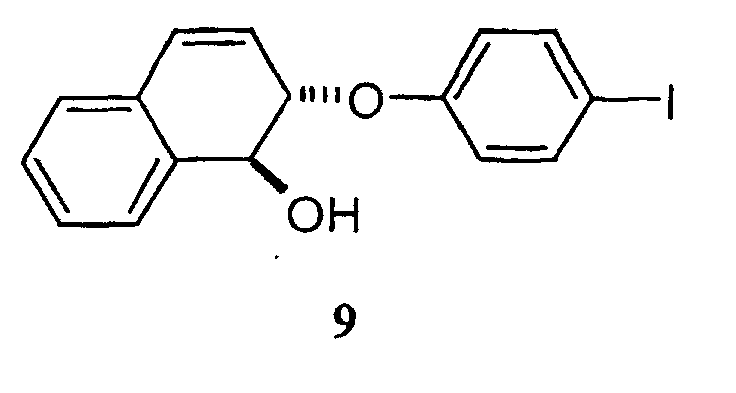
- (1S,2S)-2-(4-Iodophenoxy)-1,2,-dihydro-naphthalen-1-ol (9): To a flame dried round-bottomed flask, [Rh(COD)Cl]2 (1.7 mg, 0.0035 mmol), (S)-(R)- PPF-PtBu2 (3.8 mg, 0.0069 mmol) and 1 (100 mg, 0.694 mmol) were added followed by addition of THF (2.5 mL) and 4-iodophenol (763 mg, 3.47 mmol). The mixture was heated at 80°C for 12 hours, then poured into diethyl ether and extracted 3 times with 10% aqueous sodium hydroxide solution. The aqueous extracts were combined and back-extracted three times with diethyl ether. The combined ether extracts were washed with brine and dried with anhydrous sodium sulfate. The solvents were removed in vacuo, yielding a solid which was purified by flash chromatography on silica gel (10% ethyl acetate in hexanes) as a white crystalline solid 9 (193 mg, 73%). The ee was determined by deiodinating 9 (40 mg, 0.11 mmol) by reaction with t-BuLi (0.32 mL, 1.7M) in diethyl ether (2 mL) at -78°C followed by quenching with isopropanol. Extraction with ether from water, washing with brine, drying over anhydrous sodium sulfate and removal of the solvents in vacuo gave a white crystalline solid (24 mg, 92%). The ee was determined to be 98% by HPLC analysis on a CHIRALCEL OD column, λ= 256 nm. Retention times in 4% isopropanol in hexanes were 15.2 min (major) and 17.9 min; Rf = 0.44 on silica (20% ethyl acetate in hexanes); mp 160-162°C (Et2O); [α]25 D = +107° (c = 9.7, CHCl3). IR (KBr, cm-1) 3264 (br), 3050 (w), 2926 (w), 2843 (w), 1581 (m), 1485 (s), 1388 (w), 1279 (m), 1246 (s), 1046 (m), 824 (m), 780 (m), 571 (w); 1H NMR (400 MHz, CDCl3): δ 7.63-7.61 (1H, m), 7.58-7.55 (2H, m), 7.30-7.27 (2H, m), 7.13-7.11 (1H, m), 6.73 (2H, ddd, J= 2.2, 2.2, 9.0 Hz), 6.52 (1H, dd, J= 1.8, 9.8 Hz), 5.96 (1H,dd, J= 2.2, 9.8 Hz), 5.16 (1H, d, J= 10.0 Hz), 5.05 (1H, ddd, J= 2.0, 2.0, 10.0 Hz), 2.54 (1H, s); 13C NMR (400 MHz, CDCl3): δ 157.3, 138.5, 135.3, 131.7, 129.4, 128.3, 128.1, 126.6, 125.3, 125.3, 118.1, 83.6, 79.2, 72.2. HRMS calcd for (M-H2O)+ (C16H11OI): 345.9855. Found: 345.9849.
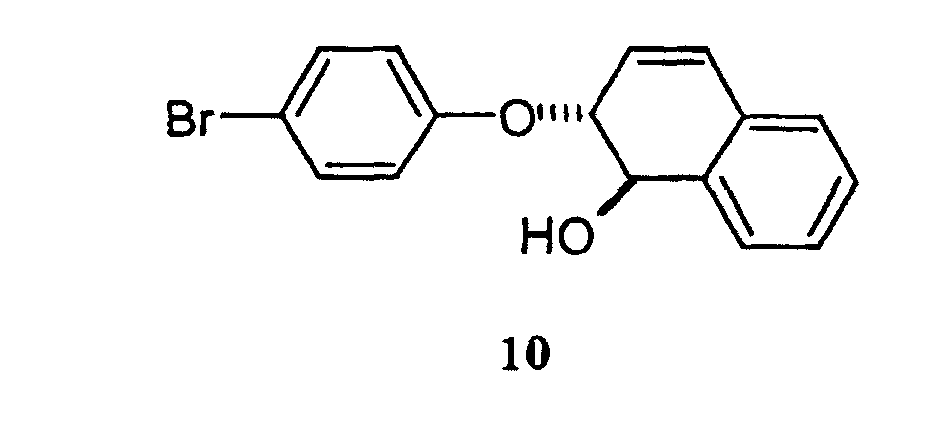
- (1R,2R)-2-(4-Bromo-phenoxy)-1,2-dihydro-naphthalen-1-ol: To a flame dried round bottom flask, [Rh(COD)Cl]2 (2.1 mg, 0.0043 mmol), (R)-(S)- PPF-PtBu2 (4.6 mg, 0.0085 mmol, and 1 (122 mg, 0.85 mmol) were added. ). THF (2 mL) and p-bromophenol (734 mg, 4.245 mmol) were then added followed by heating to 80°C for 1.5 hours. The reaction mixture was then poured in to ether and washed three times with 5% aqueous NaOH. The aqueous layers were combined and back extracted three times with ether. The organic layers were combined, washed with brine, dried over Na2SO4, and concentrated in vacuo. The resulting solid was purified by flash chromatography (20% ethyl acetate in hexanes) to give 10 a white crystalline solid (239.7 mg, 90%). The ee was determined by debrominating 10 (44 mg, 0.139 mmol) by reaction with t-BuLi (0.2 mL, 1.7M) in ether (2mL) at -78°C followed by quenching with isopropanol. Extraction with ether from water, washing with brine, drying over Na2SO4 and concentration gave a white crystalline solid 2 (31.5 mg, 95%). The ee was determined to be 96.8% by HPLC analysis on a CHIRALCEL OD column, λ= 486nm. Retention times in 4% isopropanol in hexanes were 15.2 min and 17.5 min (major). Rf= 0.26 on silica gel (10% ethyl acetate:hexanes); mp 145-146° (Et2O); [α]25 D= -135.7° (c= 10.2, CHCl3); IR (KBr, cm-1) 3290 (br), 3060 (m), 2870 (w), 1583 (m), 1484 (s), 1227 (s), 1052 (m), 980 (s), 776 (s); 1H NMR (400MHz, CDCl3) δ 7.70-7.65 (1H, m), 7.44-7.42 (2H, m), 7.35-7.32 (2H, m), 7.18-7.16 (1H, m), 6.88-6.86 (2H, m), 6.56 (1H, dd, J= 10.0, 2.0 Hz), 6.00 (1H, dd, J= 9.7, 2.2 Hz), 5.20 (1H, dd, J= 9.7, 3.6 Hz), 5.09 (1H, ddd, J= 10.0, 2.0, 2.0 Hz), 2.70 (1H, d, J= 3.9 Hz); 13C NMR (400MHz, CDCl3) δ 156.5, 135.3, 132.5, 131.7, 129.3, 128.3, 128.1, 126.5, 125.3, 117.6, 113.7, 79.4, 72.2. HRMS calcd for C16H11OBr (M-H2O)+ 297.9994. Found: 297.9995.

- (1S,2S)-2-(4-Methylphenoxy)-1,2,-dihydro-naphthalen-1-ol (11): To a flame dried round-bottomed flask, [Rh(COD)Cl]2 (1.7 mg, 0.0035 mmol), (S)-(R)- PPF-PtBu2 (3.8 mg, 0.0069 mmol) and 1 (50 mg, 0.347 mmol) were added followed by addition of THF (2.5 mL) and p-cresol (188 mg, 1.74 mmol). The mixture was heated at 80°C for 24 hours, then poured into diethyl ether and extracted 3 times with 10% aqueous sodium hydroxide solution. The aqueous extracts were combined and back-extracted three times with diethyl ether. The combined ether extracts were washed with brine and dried with anhydrous sodium sulfate. The solvents were removed in vacuo, yielding a solid which was purified by flash chromatography on silica gel (5% ethyl acetate in hexanes) giving a white crystalline solid 11 (57 mg, 65%). The ee was determined to be 91% by HPLC analysis on a CHIRALCEL OD column, λ=256 nm. Retention times in 1% isopropanol in hexanes were 33.8 min (major) and 37.1 min. Rf= 0.49 on silica (20% ethyl acetate in hexanes); mp 80-81°C (Et2O); [α]25 D = +145° (c = 12.1, CHCl3). IR (KBr, cm-1) 3303 (br), 3050 (w), 2210 (m), 1598 (s), 1503 (s), 1238 (s), 1025 (m), 859 (m), 778 (m); 1H NMR (400 MHz, CDCl3): δ 7.67-7.65 (1H, m), 7.33-7.28 (2H, m), 7.14-7.11 (3H, m), 6.88 (2H, d, J= 8.4 Hz), 6.51 (1H, dd, J= 1.8, 9.9 Hz), 6.04 (1H, dd, J= 2.0, 9.9 Hz), 5.20 (1H, dd, J= 1.6, 10.2 Hz), 5.09 (1H, ddd, J= 1.8, 1.8, 10.2 Hz), 2.87 (1H, d, J= 2.7 Hz), 2.33 (3H, s). 13C NMR (400 MHz, CDCl3): δ 155.0, 135.4, 131.8, 130.7, 130.1, 128.8, 128.1, 127.9, 126.4, 126.2, 125.1, 115.6,79.0,72.3,20.5. HRMS calcd for (M+) (C17H16O2): 252.1150. Found: 252.1140.
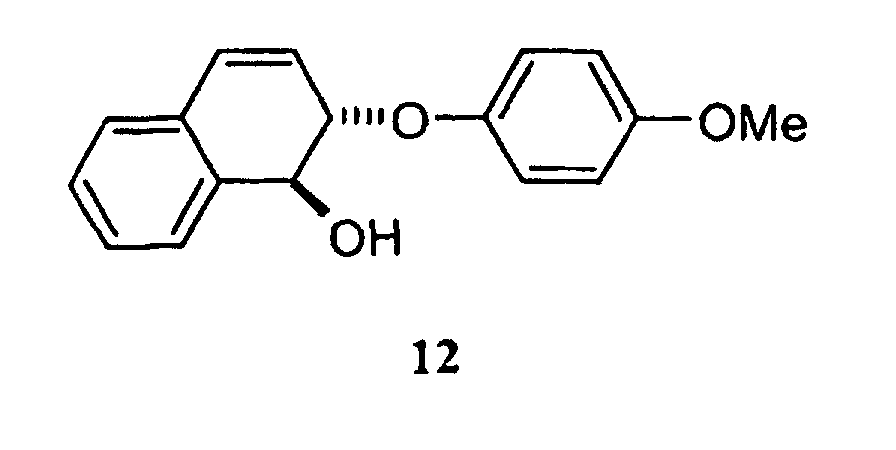
- (1S,2S)-2-(4-Methoxyphenoxy)-1,2,-dibydro-naphthalen-1-ol (12): To a flame dried round-bottomed flask, [Rh(COD)Cl]2 (1.7 mg, 0.0035 mmol), (S)-(R)- PPF-PtBu2 (3.8 mg, 0.0069 mmol) and 1 (100 mg, 0.694 mmol) were added followed by addition of THF (2.5 mL) and 4-methoxyphenol (431 mg, 3.47 mmol). The mixture was heated at 80°C for 6 hours, then poured into diethyl ether and extracted 3 times with 10% aqueous sodium hydroxide solution. The aqueous extracts were combined and back-extracted three times with diethyl ether. The combined ether extracts were washed with brine and dried with anhydrous sodium sulfate. The solvents were removed in vacuo, yielding a solid which was purified by flash chromatography on silica gel (10% ethyl acetate in hexanes) as a white crystalline solid 12 (159 mg, 85%). The ee was determined to be 95% by HPLC analysis on a CHIRALCEL OD column, λ= 256 nm. Retention times in 4% isopropanol in hexanes were 22.1 min (major) and 25.9 min. Rf= 0.33 on silica (20% ethyl acetate in hexanes); mp 91-92°C (Et2O); [α]25 D = +129° (c = 9.9, CHCl3); IR (KBr, cm-1) 3349 (br), 3050 (w), 2822 (w), 1508 (s), 1233 (s), 1046 (m), 825 (m), 751 (m), 695 (w); 1H NMR (400 MHz, CDCl3): δ 7.66-7.64 (1H, m), 7.30-7.27 (2H, m), 7.12-7.10 (1H, m), 6.91 (2H, ddd, J= 2.3, 2.3, 9.1 Hz), 6.84 (2H, ddd, J= 2.4, 2.4, 9.2 Hz), 6.49 (1H, dd, J= 2.0, 9.9 Hz), 6.02 (1H, dd, J= 2.4, 9.9 Hz), 5.17 (1H, dd, J= 3.3, 10.1 Hz), 5.02 (1H, ddd, J= 2.0, 2.0, 10.3 Hz), 3.77 (3H, s), 3.12 (1H, d, J= 3.4 Hz). 13C NMR (400 MHz, CDCl3): δ 154.3, 151.2,135.5, 131.9, 128.7, 128.1, 127.9, 126.4, 126.3, 125.2, 117.2, 114.8, 80.0, 72.4, 55.7. HRMS calcd for (M+) (C17H14O2): 250.0994. Found: 250.1006.

- (1S,2S)-2-(2-Bromophenoxy)-1,2,-dihydro-naphthalen-1-ol (13): To a flame dried round-bottomed flask, [Rh(COD)Cl]2 (1.7 mg, 0.0035 mmol), (S)-(R)- PPF-PtBu2 (3.8 mg, 0.0069 mmol) and 1 (100 mg, 0.694 mmol) were added followed by addition of THF (2.5 mL) and 2-bromophenol (0.40 mL, 3.47 mmol). The mixture was heated at 80°C for 24 hours, then poured into diethyl ether and extracted 3 times with 10% aqueous sodium hydroxide solution. The aqueous extracts were combined and back-extracted three times with diethyl ether. The combined ether extracts were washed with brine and dried with anhydrous sodium sulfate. The solvents were removed in vacuo, yielding a solid which was purified by flash chromatography on silica gel (5% ethyl acetate in hexanes) as a white crystalline solid 13 (75 mg, 37%). The ee was determined to be 81% by HPLC analysis on a CHIRALCEL OD column, λ= 486 nm. Retention times in 1.5% isopropanol in hexanes were 22.8 min and 32.1 min (major). Rf = 0.44 on silica (20% ethyl acetate in hexanes); mp 120-122°C (Et2O); [α]25 D = +254° (c = 9.2, CHCl3). IR (KBr, cm-1) 3341 (br), 3071 (w), 2884 (w), 1581 (m), 1472 (s), 1358 (m), 1237 (s), 1028 (s), 987 (s), 780 (s), 689 (m), 569 (m); 1H NMR (400 MHz, CDCl3): δ 7.67 (1H, d J= 6.8 Hz), 7.58 (1H, dd, J= 1.5, 7.9 Hz), 7.33-7.23 (3H, m), 7.14-7.12 (1H, m), 6.95(1H, dd, J= 1.1, 8.2 Hz), 6.92-6.87 (1H, m), 6.52 (1H, dd, J= 2.0, 9.9 Hz), 6.06 (1H, dd, J= 1.8, 9.9 Hz), 5.32 (1H, d, J= 11. 0 Hz), 5.10 (1H, ddd, J= 2.0, 2.0, 11.0 Hz), 2.85 (1H, d, J= 3.2 Hz). 13C NMR (400 MHz, CDCl3): δ 154.3, 135.4, 133.6, 131.8, 129.1, 128.6, 128.3, 128.0, 126.4, 126.0, 124.9, 122.9, 115.6, 113.5, 82.2, 72.5. HRMS calculated for (M-H2O)+ (C16H11OBr): 297.9993. Found: 297.9976.
-

-
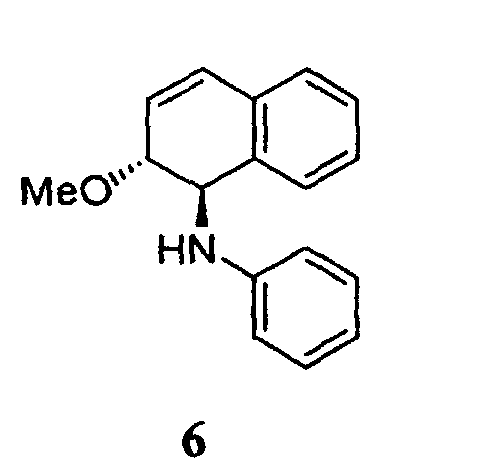
- To a round bottomed flask was added 1 (44 mg, 0.2 mmol), [Rh(COD)Cl]2 (2.5 mg, 0.005 mmol), and DPPF (5.5 mg, 0.01 mmol). THF (1 ml) and MeOH (1 ml) were then added and the solution heated to reflux for 6 hours. The reaction mixture was then concentrated and chromatographed to give 6 (28 mg, 56%) a colourless oil. 1H NMR (400MHz, CDCl3) δ 7.35 (1H, d, J= 7.2Hz), 7.28-7.13 (4H, m), 6.76-6.68 (4H, m), 6.64 (1H, d, J= 9.9Hz), 6.11 (1H, dd, J= 4.0, 9.7Hz), 5.73 (1H, d, J= 6.0Hz), 4.21 (1H, dd, J= 4.3, 4.3Hz), 3.82 (1H, s), 3.42 (3 H, s); 13C NMR (400MHz, CDCl3) δ 147.1, 135.2, 132.0, 129.9, 129.4, 129.3, 128.4, 128.3, 128.1, 127.0, 126.5, 126.5, 75.8, 56.1, 55.8. HRMS calcd for C17H17NO (M+): 251.1310. Found: 251.1315.To a round bottomed flask was added 2 (49 mg, 0.2 mmol), [Rh(COD)Cl]2 (2.5 mg, 0.005 mmol), and DPPF (5.5 mg, 0.01 mmol). THF (1 ml) and MeOH (1 ml) were then added and the solution heated to reflux for 48 hours. The reaction mixture was then concentrated and chromatographed (10% ethyl acetate:hexanes) to give 7 (41 mg, 74%) a white solid. The regiochemistry and relative stereochemistry was proven by X-ray crystal diffraction. Rf= 0.25 on silica gel (10% ethyl acetate:hexanes); 1H NMR (400MHz, CDCl3) δ 7.35-7.34 (1H, m), 7.25-7.20 (2H, m), 7.10-7.08 (1H, m), 6.58 (2H, d, J= 9.7Hz), 6.07 (1H, dd, J= 4.3, 9.7Hz), 4.98 (1H, dd, J= 5.5, 8.0Hz), 4.61 (1H, d, J= 7.7Hz), 4.00 (1H, dd, J= 4.6, 4.6Hz), 3.45 (3H, s), 1.44 (9H, s); 13C NMR (400MHz, CDCl3) δ 155.3, 134.1, 131.9, 130.0, 130.0, 128.3, 128.3, 127.0, 125.9, 79.6, 56.3, 51.3, 28.4. HRMS calcd for C16H21NO3 (M+): 275.1521. Found: 275.1518.
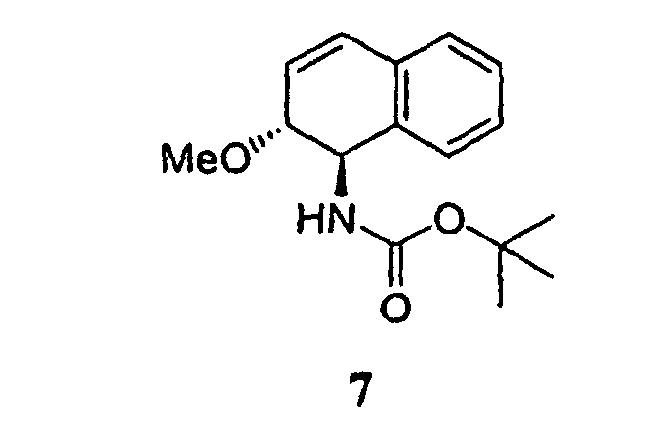
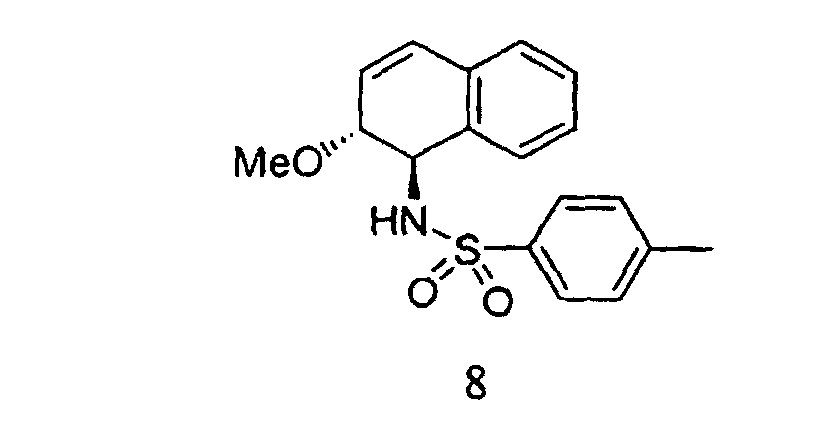
- To a round bottomed flask was added 3 (60 mg, 0.2 mmol), [Rh(COD)Cl]2 (2.5 mg, 0.005 mmol), and DPPF (5.5 mg, 0.01 mmol). THF (1 ml) and MeOH (1 ml) were then added and the solution heated to reflux for 9 hours (Note: 3 and 8 nearly co-spot by TLC but 8 stains red with permanganate whereas 3 stains white). The reaction mixture was then concentrated and chromatographed to give 8 (60 mg, 91 %) a crystalline solid. mp 128-129°C; 1H NMR (400MHz, CDCl3) δ 7.78 (2H, d, J= 8.0Hz), 7.33 (2H, d, J= 7.9Hz), 7.25-7.18 (1H, m), 7.11-7.04 (2H, m), 6.80 (2H, d, J= 7.5Hz), 6.60 (1H, d, J= 9.7Hz), 6.06 (1H, dd, J= 5.1, 9.2Hz), 4.50 (2H, s (br)), 3.98 (1H, s), 2.29 (3H, s), 2.47 (3H, s); 13C NMR (400MHz, CDCl3) δ 144.9, 137.2, 132.4, 131.7, 130.3, 129.6, 128.8, 128.4, 127.3, 124.9, 77.2, 56.5, 54.1, 21.6. Anal. Calcd for C18H19NO3S: C, 65.63; H, 5.81; N, 4.25. Found: C, 65.74; H, 5.89; N, 4.19.
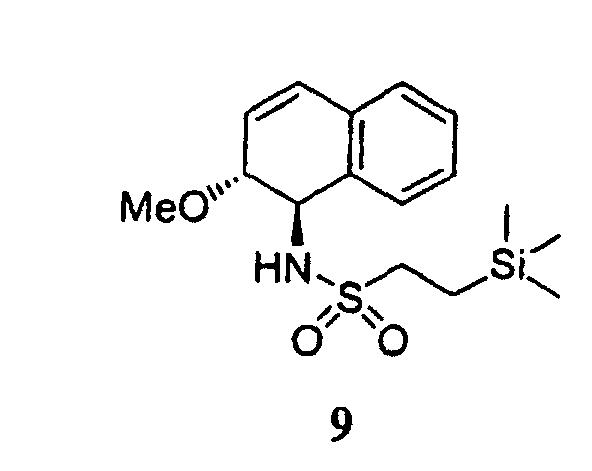
- To a round bottomed flask was added 5 (61 mg, 0.2 mmol), [Rh(COD)Cl]2(2.5 mg, 0.005 mmol), and DPPF (5.5 mg, 0.01 mmol). THF (1 ml) and MeOH (1 ml) were then added and the solution heated to reflux for 6 hours. The reaction mixture was then concentrated and chromatographed to give 9 (53 mg, 78%) a colourless oil. 1H NMR (400MHz, CDCl3) δ 7.51-7.47 (1H, m), 7.30-7.24 (2H, m), 7.14-7.10 (1H, m), 6.59 (1H, d, J= 9.9Hz), 6.10 (1H, dd, J= 3.7, 9.9Hz), 5.41 (1H, dd, J= 8.8, 8.8Hz), 4.55 (1H, d, J= 8.8Hz), 4.06 (1H, dd, J= 3.6, 6.9Hz), 3.45 (3H, s), 3.04-2.95 (2H, m), 1.07-0.85 (2H, m), 0.03 (6H, s); 13C NMR (400MHz, CDCl3) δ 133.7, 131.9, 129.9, 128.7, 128.4, 127.7,127.2, 125.5, 77.3, 56.5, 55.5, 50.2, 10.5, -2.0. HRMS calcd for C16H25NO3SSi (M+): 339.1324. Found: 339.1327.
-

- To a round bottomed flask was added 3 (60 mg, 0.2 mmol), [Rh(COD)Cl]2 (2.5 mg, 0.005 mmol), and DPPF (5.5 mg, 0.01 mmol). THF (2 ml) and PhOH (94 mg, 1.0 mmol) were added and the solution heated to reflux for 12 hours. The reaction mixture was then concentrated and chromatographed to give 10 (63 mg, 81 %) a crystalline solid. 1H NMR (400MHz, CDCl3) δ 7.72 (2H, d, J= 8.2Hz), 7.30-7.20 (5H, m), 7.14-7.09 (2H, m), 6.98-6.92 (1H, m), 6.87 (1H, d, J= 7.4Hz), 6.77 (2H, d, J= 8.4Hz), 6.64 (1H, d, J= 10.2Hz), 6.06 (1H, dd, J= 4.6, 9.2Hz), 5.00 (1H, dd, J= 4.7, 4.7Hz), 4.71-4.64 (2H, m), 2.44 (3H, s); 13C NMR (400MHz, CDCl3) δ 156.8, 143.6, 137.5, 132.5, 131.7, 130.9, 129.7, 129.5, 128.9, 128.6, 128.2, 127.4, 127.4, 124.2, 121.4, 115.9, 73.2, 54.4, 21.5. Anal. Calcd for C23H21NO3S: C, 70.56; H, 5.41; N, 3.58. Found: C, 70.58; H, 5.43; N, 4.18.
-
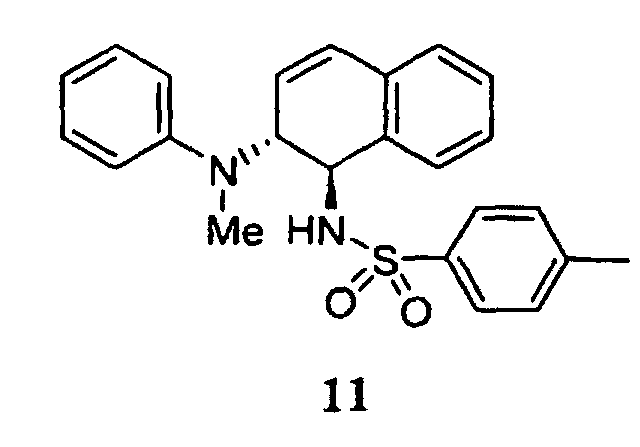
- To a round bottomed flask was added 3 (60 mg, 0.2 mmol), [Rh(COD)Cl]2 (2.5 mg, 0.005 mmol), and DPPF (5.5 mg, 0.01 mmol). THF (2 ml) and N-methylaniline (107 mg, 1.0 mmol) were added and the solution heated to reflux for 8 hours. The reaction mixture was then concentrated and chromatographed to give 11 (72 mg, 89%) a crystalline solid. mp 136-142°C; 1H NMR (400MHz, CDCl3) δ 7.62 (2H, d, J= 8.1Hz), 7.26-7.18 (4H, m), 7.14-7.08 (2H, m), 6.90 (1H, d, J= 7.3Hz), 6.80-6.68 (4H, m), 5.86 (1H, dd, J= 4.6, 9.9Hz), 4.73-4.53 (2H, m), 2.42 (3H, s), 2.34 (3H, s); 13C NMR (400MHz, CDCl3) δ 148.9, 143.4, 137.5, 133.7, 132.2, 130.4, 129.6, 129.2, 128.7, 128.4, 127.7, 127.3, 127.0, 126.0, 117.6, 113.8, 58.9, 54.6, 32.3, 21.5. Anal. Calcd for C24H24N2O2S: C, 71.26; H, 5.98; N, 6.93. Found: C, 71.32; H, 6.01; N, 4.16.

- To a round bottomed flask was added 3 (60 mg, 0.2 mmol), [Rh(COD)Cl]2 (2.5 mg, 0.005 mmol), and DPPF (5.5 mg, 0.01 mmol). THF (2 ml) and tetrahydroquinoline (133 mg, 1.0 mmol) were added and the solution heated to reflux for 9 hours. The reaction mixture was then concentrated and chromatographed to give 12 (63 mg, 73%) a crystalline solid. mp 135-137°C; 1H NMR (400MHz, CDCl3) δ 7.63 (2H, d, J= 8.2Hz), 7.25-7.20 (1H, m), 7.18 (2H, d, J= 8.2Hz), 7.11-7.00 (3H, m), 6.90 (1H, d, J= 6.4Hz), 6.83 (2H, d, J= 7.9Hz), 6.71 (1H, d, J= 9.7Hz), 6.64-6.58 (1H, m), 5.84 (1H, dd, J= 5.0, 9.7Hz), 4.83 (1H, d, J= 8.1Hz), 4.66 (1H, dd, J= 4.6, 4.6Hz), 4.58 (1H, dd, J= 4.7, 7.8Hz), 3.00-2.94 (1H, m), 2.62-2.40 (3H, m), 2.41 (3H, s), 1.60-1.52 (2H, m); 13C NMR (400MHz, CDCl3) δ 144.3, 143.2, 137.7, 133.8, 132.2, 130.7, 129.5, 129.5, 128.6, 128.2, 127.8, 127.1, 127.1, 127.0, 125.8, 123.3, 116.4, 111.7, 57.1, 53.9, 43.0, 28.0, 22.2, 21.5. Anal. Calcd for C26H26N2O2S: C, 72.53; H, 6.09; N, 6.51. Found: C, 72.55; H, 6.11; N, 6.50.
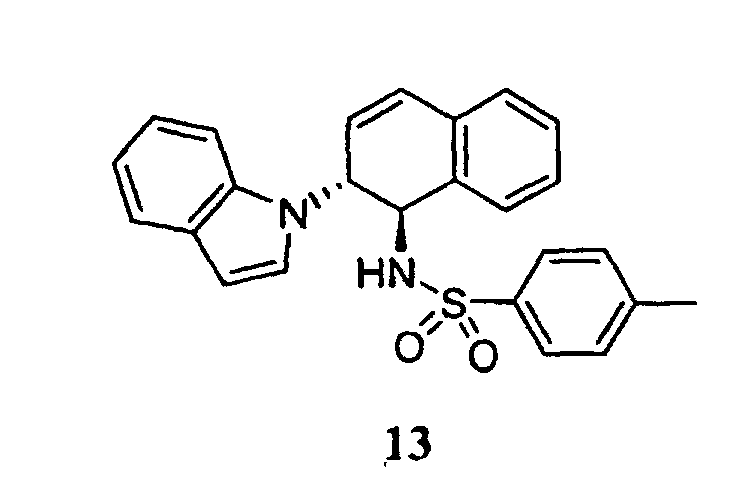
- To a round bottomed flask was added 3 (60 mg, 0.2 mmol), [Rh(COD)Cl]2 (2.5 mg, 0.005 mmol), and DPPF (5.5 mg, 0.01 mmol). THF (2 ml) and indole (117 mg, 1.0 mmol) were added and the solution heated to reflux for 11 hours. The reaction mixture was then concentrated and chromatographed to give 13 (75 mg, 91%) a white solid. mp 132-135°C; 1H NMR (400MHz, CDCl3) δ 7.84 (1H, s), 7.70-7.64 (3H, m), 7.24-7.07 (7H, m), 6.95-6.89 (1H, m), 6.65 (1H, d, J= 9.7Hz), 6.57 (1H, d, J= 2.4Hz), 6.50 (1H, d, J= 7.5Hz), 6.09 (1H, dd, J= 5.1, 9.5Hz), 4.99 (1H, d, J= 7.7Hz), 4.54 (1H, dd, J= 2.9, 7.7Hz), 4.26-4.22 (1H, m), 2.38 (3H, s); 13C NMR (400MHz, CDCl3) δ 143.2, 136.5, 132.4, 132.2, 132.2, 129.5, 128.9, 128.7, 128.6, 127.7, 127.1, 127.0, 126.4, 126.3, 122.5, 122.0, 119.5, 119.0, 112.2, 111.2, 56.0, 38.8, 21.5. HRMS calcd for C25H22N2O2S (M+): 414.1402. Found: 414.1407.

- To a round bottomed flask was added 3 (60 mg, 0.2 mmol), [Rh(COD)Cl]2 (2.5 mg, 0.005 mmol), and DPPF (5.5 mg, 0.01 mmol). THF (2 ml) was then added followed by triethylamine hydrochloride (138 mg, 1.0 mmol) and pyrrolidine (83 µl, 1.0 mmol). The resulting heterogeneous mixture was heated to reflux for 14 hours. Upon completion, the reaction mixture was concentrated and chromatographed to give 14 (70 mg, 96%) a white solid. The regiochemistry and relative stereochemistry was proven by X-ray diffraction. 1H NMR (400MHz, CDCl3) δ 7.74 (2H, d, J= 8.3Hz), 7.30 (2H, d, J= 8.2Hz), 7.22-7.17 (1H, m), 7.08-7.02 (2H, m), 6.84 (1H, d, J= 7.5Hz), 6.61 (1H, d, J= 9.7Hz), 5.93 (1H, dd, J= 4.9, 9.7Hz), 4.70 (1H, br s), 4.45 (1H, d, J= 3.7Hz), 3.89 (1H, dd, J= 4.2, 4.2Hz), 2.58-2.49 (2H, m), 2.45 (3H, s), 2.36-2.29 (2H, m), 1.63-1.58 (4H, m); Anal. Calcd for C21H24N2O2S: C, 68.45; H, 6.56; N, 7.60. Found: C, 68.51; H, 6.62; N, 7.55.
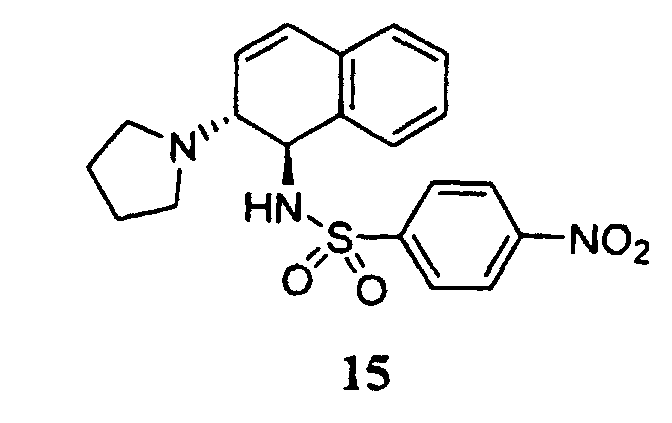
- To a round bottomed flask was added 4 (66 mg, 0.2 mmol), [Rh(COD)Cl]2 (2.5 mg, 0.005 mmol), and DPPF (5.5 mg, 0.01 mmol). THF (2 ml) was then added followed by triethylamine hydrochloride (138 mg, 1.0 mmol) and pyrrolidine (83 µl, 1.0 mmol). The resulting heterogeneous mixture was heated to reflux for 16 hours. Upon completion, the reaction mixture was concentrated and chromatographed to give 15 (67 mg, 84%) a white solid. mp 142-145°C; 1H NMR (400MHz, CDCl3) δ 8.30 (2H, d, J= 8.8Hz), 7.99 (2H, d, J= 8.8Hz), 7.24-7.18 (1H, m), 7.10-7.04 (2H, m), 6.95-6.90 (1H, m), 6.63 (1H, d, J= 9.9Hz), 5.93 (1H, dd, J= 4.7, 9.7Hz), 5.20-4.80 (1H, br s), 4.60 (1H, d, J= 3.8Hz), 3.40-3.35 (1H, m), 2.58-2.50 (2H, m), 2.43-2.34 (2H, m), 1.64-1.57 (4H, m); 13C NMR (400MHz, CDCl3) δ 149.8, 147.1, 132.8, 131.9, 129.7, 128.8, 128.2, 128.1, 128.0, 127.1, 125.0, 124.1, 61.4, 54.4, 50.0, 23.4. Anal. Calcd for C20H21N3O4S: C, 60.13; H, 5.30; N, 10.52. Found: C, 60.16; H, 5.33; N, 10.50.
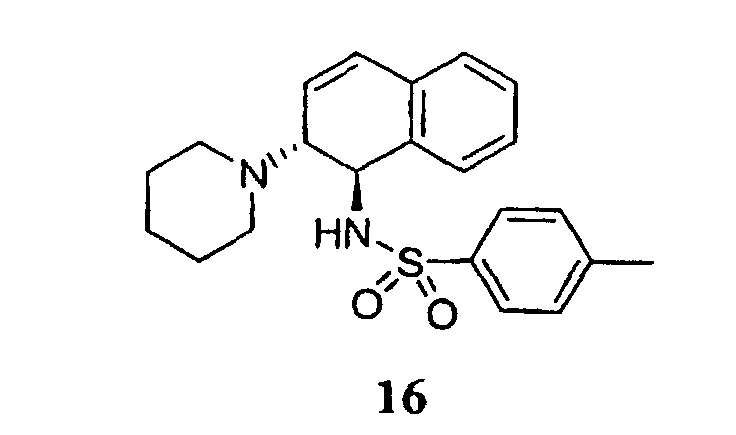
- To a round bottomed flask was added 3 (60 mg, 0.2 mmol), [Rh(COD)Cl]2 (2.5 mg, 0.005 mmol), and DPPF (5.5 mg, 0.01 mmol). THF (2 ml) was then added followed by triethylamine (140 µl, 1.0 mmol) and piperidine hydrochloride (121 mg, 1.0 mmol). The resulting heterogeneous mixture was heated to reflux for 14 hours. Upon completion, the reaction mixture was concentrated and chromatographed to give 16 (72 mg, 94%) a white solid. mp 116-117°C; 1H NMR (400MHz, CDCl3) δ 7.75 (2H, d, J= 8.2Hz), 7.30 (2H, d, J= 7.8Hz), 7.21-7.18 (1H, m), 7.10-7.05 (1H, m), 7.04 (1H, d, J= 7.5Hz), 6.94 (1H, d, J= 7.5Hz), 6.61 (1H, dd, J= 1.0, 9.7Hz), 5.91 (1H, dd, J= 4.8, 9.7Hz), 4.82 (1H, s (br)), 4.53 (1H, d, J= 4.4Hz), 3.38-3.35 (1H, m), 2.44 (3H, s), 2.41-2.34 (2H, m), 2.16-2.09 (2H, m), 1.40-1.26 (6H, m); 13C NMR (400MHz, CDCl3) δ 143.3, 137.7, 134.2, 132.2, 129.6, 129.4, 128.2, 128.0, 127.7, 127.2, 126.6, 125.0, 64.2, 50.9, 49.6, 26.2, 24.3, 21.5. HRMS calcd for C22H26N2O2S (M+): 382.1715. Found: 382.1713.
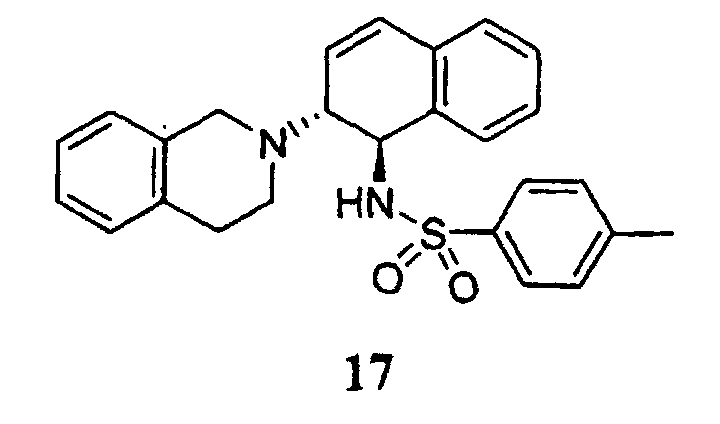
- To a round bottomed flask was added 3 (60 mg, 0.2 mmol), [Rh(COD)Cl]2 (2.5 mg, 0.005 mmol), and DPPF (5.5 mg, 0.01 mmol). THF (2 ml) was then added followed by triethylamine hydrochloride (138 mg, 1.0 mmol) and tetrahydroisoqinoline (125 µl, 1.0 mmol). The resulting heterogeneous mixture was heated to reflux for 15 hours. Upon completion, the reaction mixture was concentrated and chromatographed to give 17 (70 mg, 81%) a white solid. mp 142-146°C; 1H NMR (400MHz, CDCl3) δ 7.73 (2H, d, J= 8.2Hz), 7.26-7.18 (3H, m), 7.12-6.98 (5H, m), 6.90 (1H, d, J= 8.1Hz), 6.80 (1H, d, J= 6.8Hz), 6.67 (1H, d, J= 9.7Hz), 5.95 (1H, dd, J= 4.7, 9.7Hz), 4.80 (1H, s), 4.62 (1H, s), 3.68 (1H, AB, d, J= 15.0Hz), 3.63 (1H, dd, J= 4.5, 4.5Hz), 3.40 (1H, AB, d, J= 15.0Hz), 2.68-2.56 (4H, m), 2.40 (3H, s); 13C NMR (400MHz, CDCl3) δ 143.4, 137.7, 137.7, 134.1, 133.8, 132.2, 129.9, 129.6, 128.6, 128.5, 128.3, 127.9, 127.2, 126.8, 126.5, 125.9, 125.4, 124.6. Anal. Calcd for C26H26N2O2S: C, 72.53; H, 6.09; N, 6.51. Found: C, 72.56; H, 6.12; N, 6.50.
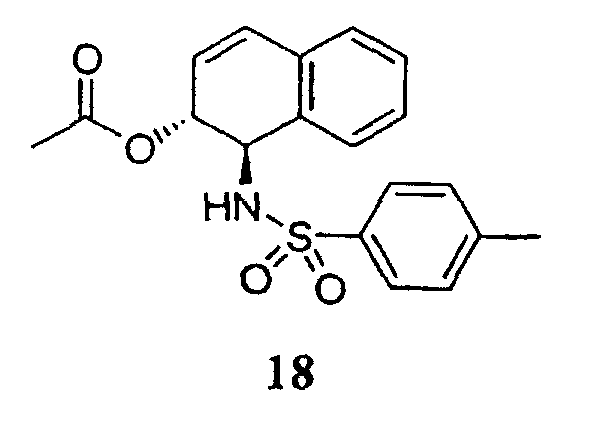
- To a round bottomed flask was added 3 (60 mg, 0.2 mmol), [Rh(COD)Cl]2 (2.5 mg, 0.005 mmol), and DPPF (5.5 mg, 0.01 mmol). THF (1 ml) was then added followed by triethylamine hydrochloride (138 mg, 1.0 mmol) and potassium acetate (98 mg, 1.0 mmol). The resulting heterogeneous mixture was heated to reflux for 15 hours. Upon completion, the reaction mixture was concentrated and chromatographed to give 18 (63 mg, 88%) a white solid. 1H NMR (400MHz, CDCl3) δ 7.77 (2H, d, J= 8.3Hz), 7.31(2H, d, J= 8.2Hz), 7.27-7.22 (1H, m), 7.19-7.07 (3H, m), 6.54 (1H, d, J= 10.2Hz), 5.88 (1H, dd, J= 3.7, 10.2Hz), 5.48 -5.44 (1H, m), 4.90 (1H, d, J= 8.4Hz), 4.74-4.69 (1H, m), 2.44 (3H, s), 1.78 (3H, s); 13C NMR (400MHz, CDCl3) δ 170.6, 143.4, 138.2, 132.8, 131.9, 130.3, 129.7, 128.7, 128.5, 127.4, 127.1, 127.1, 125.0, 71.0, 55.7, 21.5, 20.7. Anal. Calcd for C19H19NO4S: C, 63.85; H, 5.36; N, 3.92. Found: C, 63.88; H, 5.40; N, 3.81.

- To a round bottomed flask was added 3 (60 mg, 0.2 mmol), [Rh(COD)Cl]2 (2.5 mg, 0.005 mmol), and DPPF (5.5 mg, 0.01 mmol). THF (1 ml) was then added followed by triethylamine (140 µl, 1.0 mmol) and benzoic acid (122 mg, 1.0 mmol). The resulting homogeneous solution was heated to reflux for 15 hours. Upon completion, the reaction mixture was concentrated and chromatographed to give 19 (73 mg, 87%) a white solid. mp 158-162°C; 1H NMR (400MHz, CDCl3) δ 7.77 (2H, d, J= 7.1Hz), 7.65 (2H, d, J= 8.3Hz), 7.56-7.50 (1H, m), 7.40-7.32 (3H, m), 7.30-7.22 (2H, m), 7.11 (1H, dd, J= 1.3, 7.2Hz), 6.98 (2H, d, J= 8.1Hz), 6.56 (1H, dd, J= 1.3, 9.9Hz), 5.93 (1H, dd, J= 3.3, 9.7Hz), 5.79 (1H, ddd, J= 1.7, 3.3, 9.2Hz), 5.12 (1H, d, J= 8.4Hz), 4.90 (1H, dd, J= 8.8, 8.8Hz), 2.19 (3H, s); 13C NMR (400MHz, CDCl3) δ 166.4, 143.3, 138.0, 133.4, 133.3, 132.3, 130.4, 130.0, 129.7, 128.8, 128.8, 128.3, 127.5, 127.2, 126.9, 125.7, 72.3, 56.8,21.6. HRMS calcd for C24H21NO4S (M+): 419.1191. Found: 419.1997.
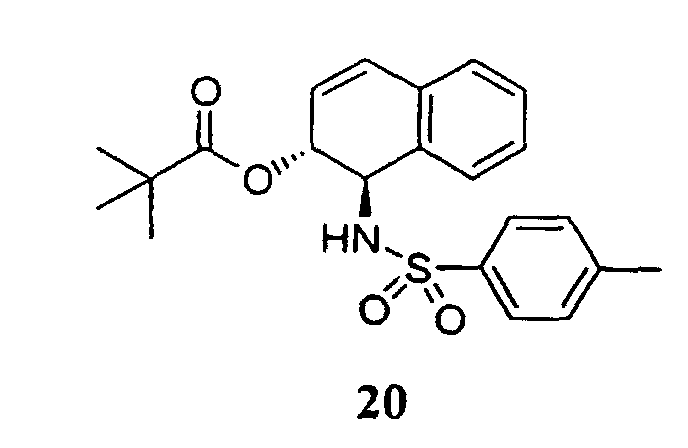
- To a round bottomed flask was added 3 (60 mg, 0.2 mmol), [Rh(COD)Cl]2 (2.5 mg, 0.005 mmol), and DPPF (5.5 mg, 0.01 mmol). THF (1 ml) was then added followed by triethylamine (140 µl, 1.0 mmol) and pivalic acid (102 mg, 1.0 mmol). The resulting homogeneous solution was heated to reflux for 15 hours. Upon completion, the reaction mixture was concentrated and chromatographed to give 20 (61 mg, 77%) a white solid. 1H NMR (400MHz, CDCl3) δ 7.75 (2H, d, J= 8.0Hz), 7.28 (2H, d, J= 8.0Hz), 7.16-7.00 (3H, m), 6.85 (1H, d, J= 7.6Hz), 6.55 (1H, d, J= 9.7Hz), 5.91 (1H, dd, J= 4.1, 9.7Hz), 5.34 (1H, dd, J= 5.9, 5.9Hz), 4.98 (1H, d, J= 8.4Hz), 4.70 (1H, dd, J= 7.3, 7.3Hz), 2.42 (3H, s), 1.07 (9H, s). HRMS calcd for C22H25NO4S (M+): 399.1504. Found: 399.1507.
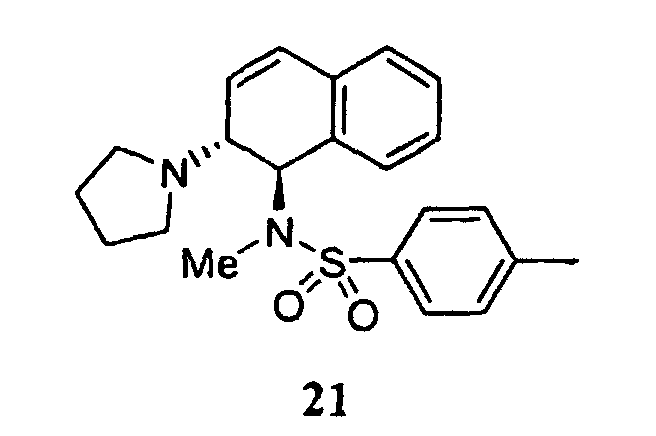
- To a round bottomed flask was added 21 (100 mg, 0.27 mmol) and potassium carbonate (112 mg, 0.81 mmol). Acetone (3 ml) was then added followed by iodomethane (18 µl, 0.28 mmol). The mixture was stirred at room temperature for 4 hours then quenched with water. Extraction with ethylacetate, combining of the organic fractions and concentration gave a light yellow solid. Chromatography gave pure 21 (101 mg, 98%) a white crystalline solid. mp 109-111°C; 1H NMR (400MHz, CDCl3) δ 7.86 (2H, d, J= 8.0Hz), 7.31 (2H, d, J= 8.0Hz), 7.26-7.12 (3H, m), 7.06 (1H, d, J= 6.9Hz), 6.58 (1H, d, J= 9.7Hz), 5.95 (1H, dd, J= 4.6, 9.9Hz), 5.35 (1H, d, J= 4.5Hz), 3.42 (1H, dd, J= 4.5, 4.5Hz), 2.62-2.48 (4H, m), 2.50 (3H, s), 2.45 (3H, s), 1.70-1.63 (4H, m); 13C NMR (400MHz, CDCl3) δ 143.0, 137.7, 133.6, 132.1, 129.5, 129.1, 128.9, 128.2, 128.1, 127.4, 126.5, 125.9, 58.2, 56.5, 48.6, 29.6, 23.5, 21.5. Anal. Calcd for C22H26N2O2S: C, 69.08; H, 6.85; N, 7.32. Found: C, 69.14; H, 6.91; N, 7.30.
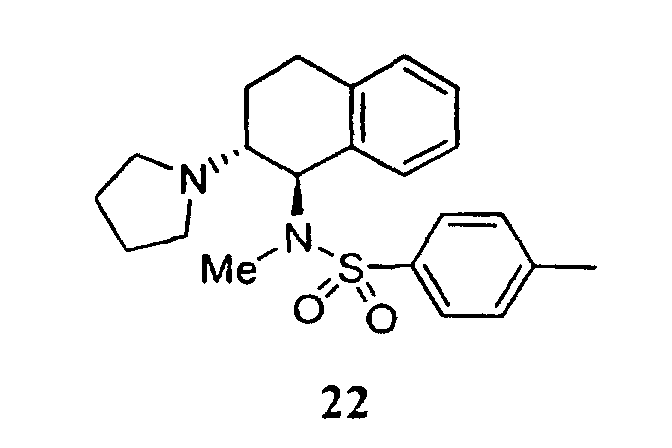
- To a round bottomed flask was added 21 (100 mg, 0.26 mmol), ethylacetate (2 ml) and palladium on carbon (5mg). Hydrogen was added over this heterogeneous mixture via balloon for 15 hours. Upon completion, the mixture was filtred through celite and concentrated to give 22 a white solid. Crude 1H NMR showed that this crude product was >95% pure. Further purification could be obtained by chromatography giving pure 22 (98 mg, 98%). mp 109-110°C; 1H NMR (400MHz, CDCl3) δ 7.99 (2H, d, J= 8.1Hz), 7.30 (2H, d, J= 8.3Hz), 7.15-7.02 (4H, m), 5.29 (1H, d, J= 8.1Hz), 3.03-2.67 (5H, m), 2.65-2.52 (2H, m), 2.44 (3H, s), 2.43 (3H, s), 2.05-1.96 (1H, m), 1.90-1.80 (1H, m), 1.72-1.64 (4H, m); 13C NMR (400MHz, CDCl3) δ 142.8, 138.5, 137.5, 133.9, 129.2, 128.5, 127.7, 127.1, 126.4, 60.0, 59.3, 48.7, 30.3, 27.9, 23.6, 21.5, 21.4. Anal. Calcd for C22H28N2O2S: C, 68.72; H, 7.34; N, 7.29. Found: C, 68.79; H, 7.37; N, 7.22.

- To a quartz tube was added 22 (80 mg, 0.2 mmol), 1,4-dimethoxybenzene (110 mg, 0.8 mmol) and sodium borohydride (76 mg, 2.0 mmol) followed by 90% aqueous ethanol solution (3 ml). The mixture was irradiated at 254 nm in a rayonet reactor for 2.5 hours. The crude mixture was concentrated azeotropically with ethanol and then chromatographed (90% acetone, 9% MeOH, 1% triethylamine) to give 23 (42 mg, 91%). Spectral data was identical to the literature data.
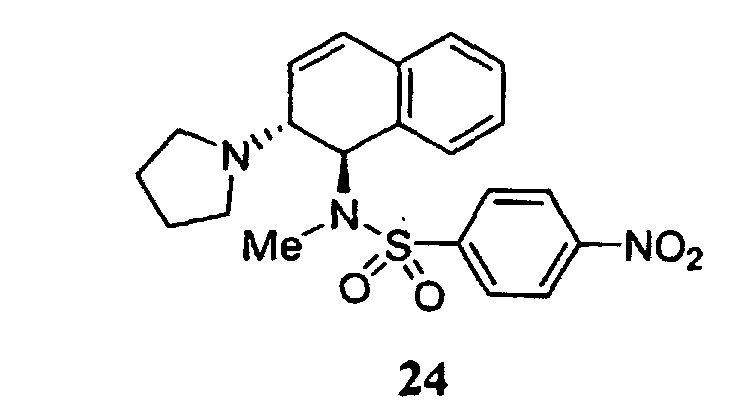
- To a round bottomed flask was added 16 (100 mg, 0.25 mmol) and potassium carbonate (112 mg, 0.81 mmol). Acetone (3 ml) was then added followed by iodomethane (18 µl, 0.28 mmol). The mixture was stirred at room temperature for 4 hours then quenched with water. Extraction with ethylacetate, combining of the organic fractions and concentration gave a light yellow solid. Chromatography gave pure 24 (101 mg, 98%) a white crystalline solid. mp 139-141°C; 1H NMR (400MHz, CDCl3) δ 8.35 (2H, d, J= 8.8Hz), 8.22 (2H, d, J= 8.8Hz), 7.28-7.22 (3H, m), 7.09 (1H, d, J= 6.2Hz), 6.60 (1H, d, J= 9.9Hz), 5.95 (1H, dd, J= 4.0, 9.9Hz), 5.43 (1H, d, J= 6.6Hz), 3.54-3.49 (1H, m), 2.62 (3H, s), 2.60-2.54 (4H, m), 1.72-1.66 (4H, m); 13C NMR (400MHz, CDCl3) δ 149.8, 146.6, 133.6, 131.6, 129.5, 128.6, 128.3, 128.0, 126.8, 125.3, 124.0, 58.4, 58.0, 48.5, 29.8, 23.7. Anal. Calcd for C21H23N3O4S: C, 61.00; H, 5.61; N, 10.16. Found: C, 61.11; H, 5.65; N, 10.12.

- To a round bottomed flask was added 18 (70 mg, 0.20 mmol) and potassium carbonate (110 mg, 0.80 mmol). Acetone (2.5 ml) was then added followed by iodomethane (15 µl, 0.24 mmol). The mixture was stirred at room temperature for 4 hours then quenched with water. Extraction with ethylacetate, combining of the organic fractions and concentration gave a light yellow solid. Chromatography gave pure 25 (67 mg, 91 %) a white crystalline solid. mp 113-116°C; 1H NMR (400MHz, CDCl3) δ 7.78 (2H, d, J= 8.2Hz), 7.32 (2H, d, J= 8.2Hz), 7.25-7.17 (2H, m), 7.13-6.98 (2H, m), 6.46 (1H, dd, J= 1.8, 9.9Hz), 5.85 (1H, dd, J= 2.9, 9.9Hz), 5.71 (1H, ddd, J= 2.0, 2.6, 10.1Hz), 5.60 (1H, d, J= 10.1Hz), 2.69 (3H, s), 2.44 (3H, s), 1.90 (3H, s); 13C NMR (400MHz, CDCl3) δ 170.2, 143.4, 137.3, 133.2, 131.4, 129.6, 129.2, 128.4, 128.3, 127.1, 126.7, 126.4, 69.7, 60.0, 29.5, 21.4, 20.8. Anal. Calcd for C20H21NO4S: C, 64.67; H, 5.70; N, 3.77. Found: C, 64.75; H, 5.77; N, 3.72.
-
- ee
- "enantiomerically enriched," or "enantiomeric enrichment"
- THF
- tetrahydrofuran
- DPPE
- 1,2-bis(diphenylphosphino)ethane
- BINAP
- 2,2'-bis(diphenylphosphino)-1,1'-binaphthyl
Claims (14)
- A compound according to formula I:wherein R is -(CH2)nR1 and R1 is a C3-C6 aryl optionally substituted at one or more positions with a group selected from: Cl; F; NO2; I; Br; a C1-C3 alkyl; and a C1-C3 alkoxy and wherein n=0-3;
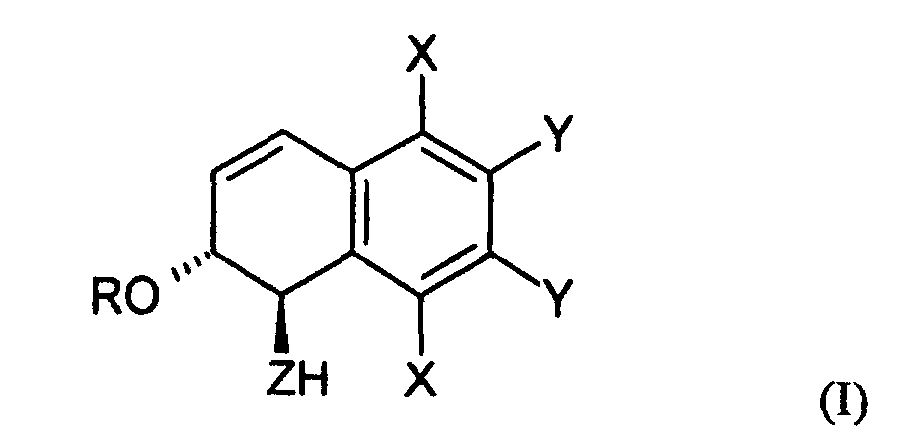
wherein X and Y are independently selected from the group consisting of H; NH2; F; Cl; Br; a C1-C3 alkyl; and a C1-C3 alkoxy;
or wherein adjacent X and Y or Y and Y together with the carbon atoms to which they are attached from form a C3-C6 carbocyclic ring or a C3-C6 heterocyclic ring containing one or more heteroatoms selected from the group consisting of: O; N; and S; and
wherein Z is selected from O or NRa, wherein Ra is selected from:(i) phenyl;(j) (O)C-O-Rb , wherein Rb is a straight or branched C1-C6 alkyl;(k) -SO2-Rc, wherein Rc is selected from the group consisting of:i) C1-C6 straight or branched alkyl;ii) -(CH2)qRe, wherein q=O-3 and Re is a C3-C6 aryl, optionally substituted at one or more positions with a group selected from: Cl; F; NO2; CN; I; Br; a straight or branched C1-C3 alkyl; a C1-C3 alkoxy; and -C(O)Rf, wherein Rf is a C1-C3 alkyl; -(CH2)rCF3, wherein r=0-3;iii) -Rg(CF3)s, wherein Rg is a C1-C3 straight or branched alkyl and s=1-3;iv) -(CH2)s-TMS, wherein TMS = trimethylsilyl and s= 1-3;(l) -SO2-(CH2)q-Si(CH3)3 wherein q is 1-3. - A compound according to formula II:wherein R is -(CH2)qR5 wherein q=0-3 and R5 is a C3-C6 aryl optionally substituted at one or more positions with a group selected from: a straight or branched C1-C3 alkyl; a C1-C3 alkoxy; I; Cl; CN; F; NO2; -(CH2)rCF3, wherein r=0-3; and -C(O)R6, wherein R6 is a C1-C3 alkyl;
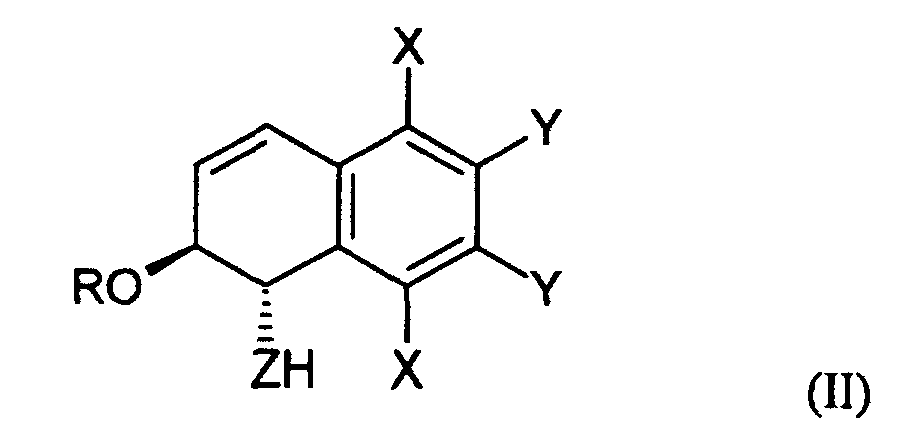
wherein X and Y are independently selected from the group consisting of H; NH2; F; Cl; Br; a C1-C3 alkyl; and a C1-C3 alkoxy;
or wherein adjacent X and Y or Y and Y together with the carbon atoms to which they are attached from form a C3-C6 carbocyclic ring or a C3-C6 heterocyclic ring containing one or more heteroatoms selected from the group consisting of: O; N; and S; and
wherein Z is selected from O or NRa, wherein Ra is selected from:(e) phenyl;(f) (O)C-O-Rb, wherein Rb is a straight or branched C1-C6 alkyl;(g) -SO2-Rc, wherein Rc is selected from the group consisting of:i) C1-C6 straight or branched alkyl; ii) -(CH2)qRe, wherein q=0-3 and Re is a C3-C6 aryl, optionally substituted at one or more positions with a group selected from: Cl; F; NO2; CN; I; Br; a straight or branched C1-C3 alkyl; a C1-C3 alkoxy; and -C(O)Rf, wherein Rf is a C1-C3 alkyl; -(CH2)rCF3, wherein r=0-3;iii) -Rg(CF3)s, wherein Rg is a C1-C3 straight or branched alkyl and s=1-3;iv) -(CH2)s-TMS, wherein TMS = trimethylsilyl and s= 1-3;(h) -SO2-(CH2)q-Si(CH3)3 wherein q is 1-3. - A compound according to formula III:wherein TBDMSO is a tert-butyldimethylsiloxy group, and R, X, and Y are as defined in claim 1.
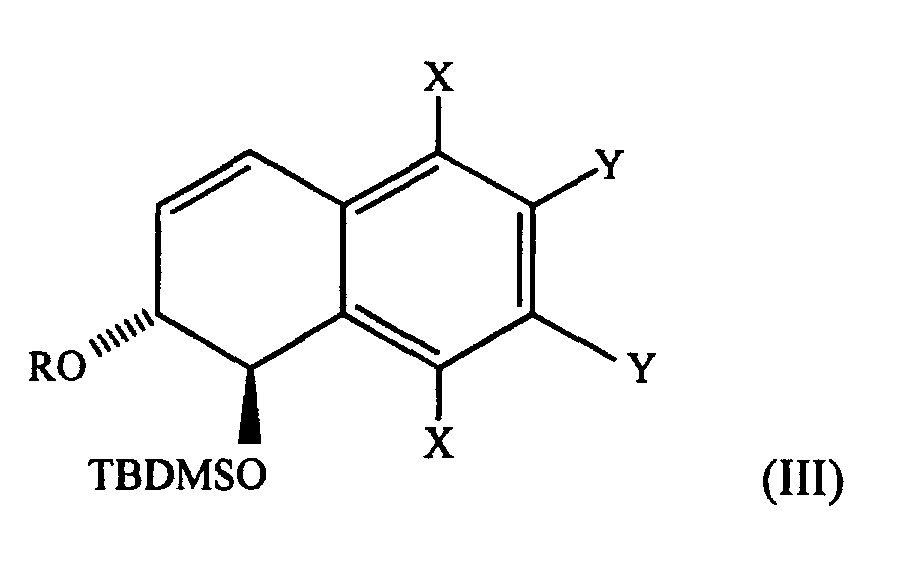
- A compound according to formula IV:wherein:
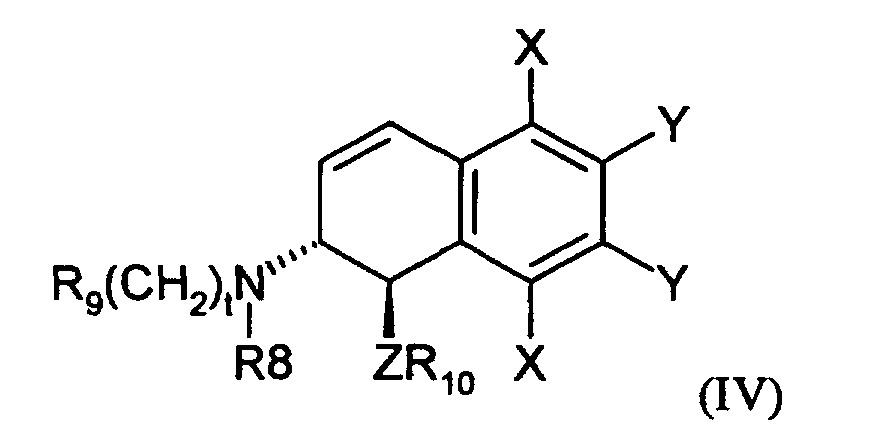 a) R8 is H, CH3 or as defined in c);b) t=0-3;c) R9 is a C3-C6 aryl optionally substituted at one or more positions with a group selected from: a C1-C3 alkyl; a C1-C3 alkoxy; Cl; F; NO2; and CF3; or R9 together with N, R8 and (CH2)t of formula IV forms a ring structure selected from: a phthalamide ring; a pyrrolidine ring; a piperidine ring; a tetrahydroquinoline ring; and an indole ring; said ring structure being optionally substituted at one or more positions with a group selected from: a C1-C3 alkyl; a C1-C3 alkoxy; Cl; F; NO2; and CF3;d) X and Y are independently selected from the group consisting of H; NH2; F; Cl; Br; a C1-C3 alkyl; and a C1-C3 alkoxy; or wherein adjacent X and Y or Y and Y together with the carbon atoms to which they are attached from form a C3-C6 carbocyclic ring or a C3-C6 heterocyclic ring containing one or more heteroatoms selected from the group consisting of: O; N; and S;e) Z is selected from O or NRa, wherein Ra is selected from:(i) a straight or branched C1-C6 alkyl;(ii) phenyl;(iii) (O)C-O-Rb, wherein Rb is a straight or branched C1-C6 alkyl;(iv) -SO2-Rc, wherein Rc is an unsubstituted phenyl or a phenyl substituted with a C1-C3 alkyl or NO2; and(v) -SO2-(CH2)q-Si(CH3)3 wherein q isl-3; andf) when Z is O, R10 is H; when Z is NRa, R10 is either H or CH3.
 - The compound of any one of claims 1-4, wherein X=H and Y=H.
- A compound selected from the group consisting of:(1S,2S)-2-methoxy-1,2-dihydro-naphthalen-1-ol;(1S,2S)-2-(ethoxy)-1,2-dihydro-naphthalen-1-ol;(1S,2S)-2-(isopropoxy)-1,2-dihydro-naphthalen-1-ol;(1S,2S)-2-(1-propenyloxy)-1,2-dihydro-naphthalen-1-ol;(1S,2S)-2-(2-trimethylsilyl-ethoxy)1,2-dihydro-naphthalen-1-ol;(1S,2S)-2-benzyloxy-1,2-dihydro-naphthalen-1-ol;(1S,2S)-2-(4-methoxybenzyloxy)-1,2-dihydro-naphthalen-1-ol;(1S,2S)-2-(2,2,2-trifluoro-ethoxy)-1,2-dihydro-naphthalen-1-ol;(1S,2S)-2-(2,2,2-trifluoro-1-trifluoromethyl-ethoxy)-1,2-dihydro-naphthalen-1-ol;(1S,2S)-6,7-difluoro-2-methoxy-1,2-dihydro-naphthalen-1-ol;(1S,2S)-6-methoxy-5,6-dihydro-naphthol[2,3-d][1,3]dioxol-5-ol;(1S,2S)-6,7-dibromo-2-methoxy-5,8-dimethyl-1,2-dihydro-naphthalen-1-ol;(1R*,2R*)-acetic acid 1-hydroxy-1,2-dihydro-naphthalen-2-yl-ester;(1R*,2R*)-propionic acid 1-hydroxy-1,2-dihydro-naphthalen-2-yl-ester;(1R,2R)-benzoic acid 1-hydroxy-1,2-dihydro-naphthalen-2-yl-ester;(1R*,2R*)-formic acid 1-hydroxy-1,2-dihydro-naphthalen-2-yl-ester;(1R*,2R*)-2-methyl acrylic acid 1-hydroxy-1,2-dihydro-naphthalen-2-yl-ester;(1R*,2R*)-malonic acid ethyl ester (1-hydroxy-1,2-dihydro-naphthalen-2-yl) ester;(1R*,2R*)-malonic acid (1-tert-butylbimethylsiloxy-1,2-dihydro-naphthalen-2-yl) ethyl ester;(1S*,2S*)(4-tert-butyldimethylsiloxy-1,4-dihydro-naphthalen-2-yl) acetic acid ethyl ester;(1R,2R)-2-(1-hydroxy-1,2-dihydro-naphthalen-2-yl)-isoindole-1,3-dione;(1S,2S)-N-(1-hydroxy-1,2-dihydro-naphthalen-2-yl)-benzene sulfonamide;(1R*,2R*)-2-pyrrolidin-1-yl-1,2-dihydro-naphthalen-1-ol;(1R*,2R*)-2-piperidin-1-yl-1,2-dihydro-naphthalen-1-ol;(1R,2R)-2-(3,4-dihydro-2H-quinolin-1-yl)-1,2-dihydro-naphthalen-1-ol;(1R,2R)-2-(methyl-phenyl-amino)-1,2-dihydro-naphthalen-1-ol;(1R*,2R*)-2-benzylamino-1,2-dihydro-naphthalen-1-ol;(1R*,2R*)-2-(4-methoxy-benzylamino)-1,2-dihydro-naphthalen-1-ol;(1R,2R)-2-indol-1-yl-1,2-dihydro-naphthalen-1-ol;(1S*,2R*)-2-(hydroxy-1,2-dihydro-naphthalen-2-yl)malonic acid dimethyl ester;(1S,2S)-2-phenoxy-1,2-dihydro-naphthalen-1-ol;(1S,2S)-2-(4-nitrophenoxy)-1,2-dihydro-naphthalen-1-ol;(1S,2S)-2-(4-cyanophenoxy)-1,2-dihydro-naphthalen-1-ol;(1S,2S)-2-(4-acylphenoxy)-1,2-dihydro-naphthalen-1-ol;(1S,2S)-2-(4-trifluoromethylphenoxy)-1,2-dihydro-naphthalen-1-ol;(1S,2S)-2-(4-fluorophenoxy)-1,2-dihydro-naphthalen-1-ol;(1S,2S)-2-(4-chlorophenoxy)-1,2-dihydro-naphthalen-1-ol;(1S,2S)-2-(4-iodophenoxy)-1,2-dihydro-naphthalen-1-ol;(1R,2R)-2-(4-bromo-phenoxy)-1,2-dihydro-naphthalen-1-ol;(1S,2S)-2-(4-methylphenoxy)-1,2-dihydro-naphthalen-1-ol;(1S,2S)-2-(4-methoxyphenoxy)-1,2-dihydro-naphthalen-1-ol;(1S,2S)-2-(2-bromophenoxy)-1,2-dihydro-naphthalen-1-ol;4-methyl-N-[(1R, 2S)-2-( 1-piperidinyl)-1,2-dihydro-1-naphthalenyl]benzenesulfonamide;N-[(1R,2S)-2-(3,4-dihydro-1(2H)-quinolinyl)-1,2-dihydro-1-naphthalenyl]-4-methylbenzenesulfonamide;N-[(1R,2S)-2-(3,4-dihydro-2(1H-isoquinolinyl)-1,2-dihydro-1-naphthalenyl]-4-methylbenzenesulfonamide;N-[(1R,2S)-2-(1H-indol-1-yl)-1,2-dihydro-1-naphthalenyl]-4-methylbenzenesulfonmidde;(1R,2S)-2-methoxy-N-phenyl- 1,2-dihydro-1 -naphthalenamine;tert-butyl (1R,2S)-2-methoxy- 1,2-dihydro- 1 -naphthalenylcarbamate;N-[(1R,2S)-2-methoxy-1,2-dihydro-1-naphthalenyl]-2-(trimethylsilyl)ethanesulfonamide;N,4-dimethyl-N-[(1R,2S)-2-(1-pyrrolidinyl)-1,2,3,4-tetrahydro-1-naphthalenyl]-benzenesulfonamide;N,4-dimethyl-N-[ (1R,2S)-2-(1-pyrrolidinyl)-1,2-dihydro-1-naphthalenyl]-benzenesulfonamide;N-hydroxy-4-({methyl[(1R,2S)-2-(1-pyrrolidinyl)-1,2-dihydro-1-naphthalenyllamino}sulfonyl) -N-oxobenzenaminium;N-methyl-4-nitro-N-[( 1R,2S)-2-(1-pyrrolidinyl)-1,2-dihydro-1-naphthalenyl]-benzenesulfonamide;(1R,2S)-N-methyl-2-(1-pyrrolidinyl)-1,2,3,4-tetrahydro-1-naphthalenamine;N-[( 1R, 2S)-2-methoxy-1,2,3,4-tetrahydro-1-naphthalenyl]-4-methylbenzenesulfonamide;N-[(1R,2S)-2-methoxy-1,2,3,4-tetrahydro-1-naphthalenyl]-4-methylbenzenesulfonamide;4-methyl-N-[(1R,2S)-2-phenoxy-1,2,3,4-tetrahydro-1-naphthalenyl]benzenesulfonamide;(1R,2S)-1-{[(4-methylphenyl)sulfonyl]amino)-1,2,3,4-tetrahydro-2-naphthalenyl acetate;(1R,2S)-1-{[(4-methylphenyl)sulfonyl]amino}-1,2-dihydro-2-naphthalenyl benzoate;(1R,2S)-1-{[(4-methylphenyl)sulfonyl]amino1,2-dihydro-2-naphthalenyl pivalate;N-[(1R,2S)-2-methoxy-1,2-dihydro-1-naphthalenyl]-2-(trimethylsilyl)ethanesulfonamide;tert-butyl (1R,2S)-2-methoxy-1,2-dihydro-1-naphthalenylcarbamate; and4-nitro-N-[(1R,2S)-2-( 1-pyrrolidinyl)-1,2-dihydro-1-naphthalenyl]benzenesulfonamide.
- A process for preparing a compound according to formula I of claim 1, comprising reacting a compound of formula ROH with a compound of formula V:wherein R, X, Y and Z are as defined in claim 1;
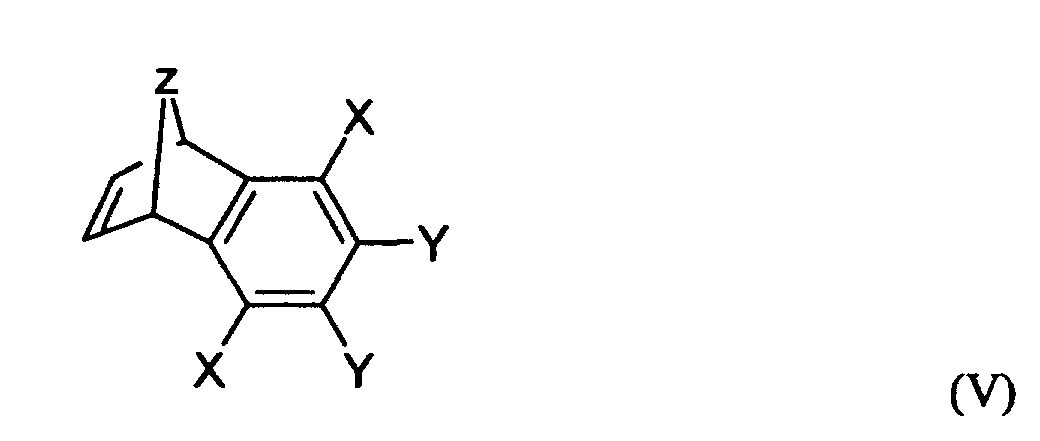
and wherein said reaction is catalyzed by [Rh(COD)Cl]2 in the presence of a first chiral phosphine ligand. - The process of claim 7, wherein said first chiral phosphine ligand is selected from the group consisting of: DPPF; (R)-(S)-BPPFA; and (R)-(S)-PPF-PtBu2.
- A process for preparing a compound according to formula II of claim 2, comprising reacting a compound of formula ROH with a compound of formula V:wherein R, X, Y and Z are as defined in claim 3;
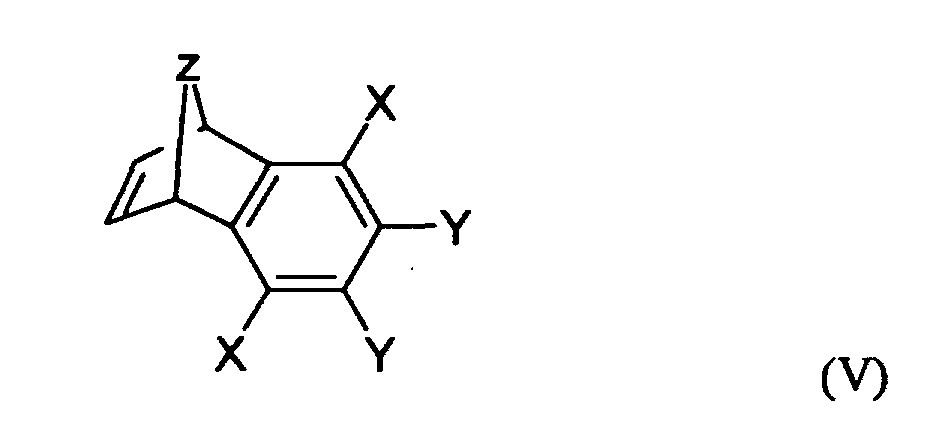
and wherein said reaction is catalyzed by [Rh(COD)Cl]2 in the presence of a second chiral phosphine ligand. - The process of claim 9, wherein said second chiral phosphine ligand is (S)-(R)-PPF-PtBu2.
- A process for preparing a compound according to formula III of claim 3, comprising:(a) preparing a compound of formula I according to the process of claim 7; and(b) reacting the compound formed in step (a) with a salt of tert-butyldimethylsilylic acid.
- A process for preparing a compound of formula IV according to claim 4, comprising reacting a compound of formula R9-(CH2)tNHR8 with a compound of formula Vwherein R8, R9, t, X, Y and Z are as defined in claim 4 and wherein said reaction is catalyzed by [Rh(COD)Cl]2 in the presence of a chiral phosphine ligand.

- The process of claim 12, wherein said chiral phosphine ligand is selected from the group consisting of: DPPF; (R)-(S)-BPPFA; and (R)-(S)-PPF-PtBu2.
- The process of claim 13, wherein R9 together with N form a ring selected from the group consisting of: a phthalamide ring; a pyrrolidine ring; a piperidine ring; a tetrahydroquinoline ring; and an indole ring; said ring structure being optionally substituted at one or more positions with a group selected from: a C1-C3 alkyl; a C1-C3 alkoxy; Cl; F; NO2; and CF3.
Priority Applications (3)
| Application Number | Priority Date | Filing Date | Title |
|---|---|---|---|
| DK00975109T DK1228024T3 (en) | 2000-10-26 | 2000-10-26 | Novel hydronaphthalene compounds prepared by a rhodium-catalyzed ring-opening reaction in the presence of a phosphine ligand |
| SI200030491T SI1228024T1 (en) | 1999-10-29 | 2000-10-26 | Novel hydronaphthalene compounds, prepared by a rhodium catalyzed ring opening reaction in the presence of phosphine ligand |
| EP04015462A EP1498406A1 (en) | 1999-10-29 | 2000-10-26 | Novel hydronaphthalene compounds, prepared by a rhodium catalysed ring opening reaction in the presence of phosphine ligand |
Applications Claiming Priority (3)
| Application Number | Priority Date | Filing Date | Title |
|---|---|---|---|
| SE9903930A SE9903930D0 (en) | 1999-10-29 | 1999-10-29 | Novel compounds and a novel process for their preparation |
| SE9903930 | 1999-10-29 | ||
| PCT/SE2000/002090 WO2001030734A1 (en) | 1999-10-29 | 2000-10-26 | Novel hydronaphtalene compounds, prepared by a rhodium catalyzed ring opening reaction in the presence of phosphine ligand |
Related Child Applications (1)
| Application Number | Title | Priority Date | Filing Date |
|---|---|---|---|
| EP04015462A Division EP1498406A1 (en) | 1999-10-29 | 2000-10-26 | Novel hydronaphthalene compounds, prepared by a rhodium catalysed ring opening reaction in the presence of phosphine ligand |
Publications (2)
| Publication Number | Publication Date |
|---|---|
| EP1228024A1 EP1228024A1 (en) | 2002-08-07 |
| EP1228024B1 true EP1228024B1 (en) | 2004-09-01 |
Family
ID=20417551
Family Applications (2)
| Application Number | Title | Priority Date | Filing Date |
|---|---|---|---|
| EP00975109A Expired - Lifetime EP1228024B1 (en) | 1999-10-29 | 2000-10-26 | Novel hydronaphthalene compounds, prepared by a rhodium catalyzed ring opening reaction in the presence of phosphine ligand |
| EP04015462A Withdrawn EP1498406A1 (en) | 1999-10-29 | 2000-10-26 | Novel hydronaphthalene compounds, prepared by a rhodium catalysed ring opening reaction in the presence of phosphine ligand |
Family Applications After (1)
| Application Number | Title | Priority Date | Filing Date |
|---|---|---|---|
| EP04015462A Withdrawn EP1498406A1 (en) | 1999-10-29 | 2000-10-26 | Novel hydronaphthalene compounds, prepared by a rhodium catalysed ring opening reaction in the presence of phosphine ligand |
Country Status (20)
| Country | Link |
|---|---|
| US (4) | US6525068B1 (en) |
| EP (2) | EP1228024B1 (en) |
| JP (1) | JP2003512446A (en) |
| KR (1) | KR100741177B1 (en) |
| CN (1) | CN1231439C (en) |
| AT (1) | ATE275120T1 (en) |
| AU (1) | AU776118B2 (en) |
| BR (1) | BR0015117A (en) |
| CA (1) | CA2387675C (en) |
| DE (1) | DE60013471T2 (en) |
| ES (1) | ES2225253T3 (en) |
| HK (1) | HK1047083B (en) |
| IL (2) | IL149368A0 (en) |
| MX (1) | MXPA02004224A (en) |
| NO (1) | NO328015B1 (en) |
| NZ (1) | NZ518451A (en) |
| PT (1) | PT1228024E (en) |
| SE (1) | SE9903930D0 (en) |
| WO (1) | WO2001030734A1 (en) |
| ZA (1) | ZA200203050B (en) |
Families Citing this family (20)
| Publication number | Priority date | Publication date | Assignee | Title |
|---|---|---|---|---|
| FR2852958B1 (en) * | 2003-03-25 | 2005-06-24 | Fournier Lab Sa | NOVEL BENZENESULFONAMIDE DERIVATIVES AND THEIR USE IN THERAPEUTICS |
| DE602004021358D1 (en) * | 2003-03-25 | 2009-07-16 | Fournier Lab Sa | BENZOSULFONAMIDE DERIVATIVES, THEIR METHOD OF PREPARATION, AND THEIR USE FOR THE TREATMENT OF PAIN |
| PT1670458E (en) | 2003-10-08 | 2007-03-30 | Schering Ag | 1-amino-2-oxy-substituted tetrahydronaphtalene derivatives, methods for the production thereof, and their use as antiphlogistics |
| US7638515B2 (en) | 2003-10-08 | 2009-12-29 | Bayer Schering Pharma Aktiengesellschaft | Tetrahydronaphthalene derivatives, process for their production and their use as anti-inflammatory agents |
| US7662821B2 (en) | 2003-10-08 | 2010-02-16 | Bayer Schering Pharma Ag | Tetrahydronaphthalene derivatives, process for their production and their use as anti-inflammatory agents |
| US20080153859A1 (en) | 2004-04-05 | 2008-06-26 | Hartmut Rehwinkel | Multiply-substituted tetrahydronaphthalene derivatives, process for their production and their use as anti-inflammatory agents |
| DE102005017316A1 (en) * | 2005-04-14 | 2006-10-19 | Schering Ag | Tetrahydronaphthalene derivatives, process for their preparation and their use as anti-inflammatory agents |
| EP1834948A1 (en) | 2006-03-15 | 2007-09-19 | Bayer Schering Pharma Aktiengesellschaft | Tetrahydronaphtalene derivatives, methods for the production thereof, and their use as antiinflammatory drugs |
| EP2070904A1 (en) | 2007-12-12 | 2009-06-17 | Laboratorios Del. Dr. Esteve, S.A. | Rhodium-phosphorus complexes and their use in ring opening reactions |
| EP2070903A1 (en) | 2007-12-12 | 2009-06-17 | Laboratorios del Dr. Esteve S.A. | Microwave-assisted ring opening reaction |
| KR101229822B1 (en) | 2008-03-04 | 2013-02-05 | 연세대학교 산학협력단 | Pharmaceutical Compositions for Inhibiting Angiogenesis |
| EP2098511A1 (en) * | 2008-03-07 | 2009-09-09 | Solvias AG | Process for preparing compounds containing a hydronaphtalene structure with an unsymmetrically substituted benzene ring |
| JP5656364B2 (en) * | 2009-04-20 | 2015-01-21 | 株式会社トクヤマ | Method for producing naphthopyran derivatives |
| NZ601635A (en) * | 2010-01-27 | 2013-06-28 | Takeda Pharmaceutical | Compounds for suppressing a peripheral nerve disorder induced by an anti-cancer agent |
| JP6236785B2 (en) * | 2012-02-28 | 2017-11-29 | 株式会社リコー | Arylamine compound, organic EL material and method for producing the same |
| CN105399752B (en) * | 2015-11-04 | 2019-03-15 | 云南民族大学 | A novel compound and its preparation method and application |
| US11560384B2 (en) | 2017-05-04 | 2023-01-24 | University Of Utah Research Foundation | Benzonorbornadiene derivatives and reactions thereof |
| CN108863855B (en) * | 2018-05-29 | 2020-12-15 | 云南民族大学 | A kind of method for synthesizing (1R,2S)-1,2-dihydronaphthalene-1,2-diamine derivative |
| CN111471005B (en) * | 2020-05-21 | 2023-04-07 | 南方科技大学 | Indole-dihydronaphthalene compound and preparation method and application thereof |
| CN116459873B (en) * | 2022-01-12 | 2025-02-18 | 万华化学集团股份有限公司 | A catalyst for carbonylation of olefinic unsaturated compounds and its preparation method and application |
Family Cites Families (1)
| Publication number | Priority date | Publication date | Assignee | Title |
|---|---|---|---|---|
| CA2301870A1 (en) * | 1997-08-27 | 1999-03-04 | Kyowa Hakko Kogyo Co., Ltd. | Process for preparing optically active 1,2-diols |
-
1999
- 1999-10-29 SE SE9903930A patent/SE9903930D0/en unknown
-
2000
- 2000-10-26 NZ NZ518451A patent/NZ518451A/en unknown
- 2000-10-26 WO PCT/SE2000/002090 patent/WO2001030734A1/en not_active Ceased
- 2000-10-26 KR KR1020027005436A patent/KR100741177B1/en not_active Expired - Fee Related
- 2000-10-26 CN CNB008177481A patent/CN1231439C/en not_active Expired - Fee Related
- 2000-10-26 PT PT00975109T patent/PT1228024E/en unknown
- 2000-10-26 US US09/763,759 patent/US6525068B1/en not_active Expired - Fee Related
- 2000-10-26 AU AU13206/01A patent/AU776118B2/en not_active Ceased
- 2000-10-26 IL IL14936800A patent/IL149368A0/en unknown
- 2000-10-26 HK HK02108588.9A patent/HK1047083B/en not_active IP Right Cessation
- 2000-10-26 MX MXPA02004224A patent/MXPA02004224A/en active IP Right Grant
- 2000-10-26 AT AT00975109T patent/ATE275120T1/en not_active IP Right Cessation
- 2000-10-26 DE DE60013471T patent/DE60013471T2/en not_active Expired - Lifetime
- 2000-10-26 JP JP2001533091A patent/JP2003512446A/en active Pending
- 2000-10-26 BR BR0015117-3A patent/BR0015117A/en not_active Application Discontinuation
- 2000-10-26 EP EP00975109A patent/EP1228024B1/en not_active Expired - Lifetime
- 2000-10-26 ES ES00975109T patent/ES2225253T3/en not_active Expired - Lifetime
- 2000-10-26 EP EP04015462A patent/EP1498406A1/en not_active Withdrawn
- 2000-10-26 CA CA002387675A patent/CA2387675C/en not_active Expired - Fee Related
-
2002
- 2002-04-17 ZA ZA200203050A patent/ZA200203050B/en unknown
- 2002-04-25 NO NO20021968A patent/NO328015B1/en not_active IP Right Cessation
- 2002-04-25 IL IL149368A patent/IL149368A/en not_active IP Right Cessation
- 2002-12-12 US US10/317,183 patent/US6784210B2/en not_active Expired - Fee Related
-
2004
- 2004-05-28 US US10/855,783 patent/US7420003B2/en not_active Expired - Fee Related
-
2008
- 2008-07-28 US US12/219,752 patent/US20080300271A1/en not_active Abandoned
Also Published As
Similar Documents
| Publication | Publication Date | Title |
|---|---|---|
| US20080300271A1 (en) | Novel compounds and a novel process for their preparation | |
| Gong et al. | BF3-Promoted aromatic substitution of N-alkyl α-trifluoromethylated imine: facile synthesis of 1-aryl-2, 2, 2-trifluoroethylamines | |
| US9701601B2 (en) | Optically active axially chiral alpha-allenic alcohol, synthesis method and use thereof | |
| IE54216B1 (en) | Stereospecific synthesis of 5-phenyl-2s-pentanol | |
| JP4165858B2 (en) | tert-Amyloxyhalogenobenzene compound and method for producing the same, tert-amyloxycyanobiphenyl compound and method for producing the same, and method for producing cyanohydroxybiphenyl compound | |
| ES2216278T3 (en) | PROCEDURE TO PRODUCE N-CYCLOPROPYLANILINES AND INTERMEDIATE PRODUCTS USED FOR THE SAME. | |
| JP4203192B2 (en) | Process for producing nitrophenylphenol compounds | |
| CN112299937A (en) | Efficient preparation method of symmetrical diarylethene compound | |
| JP4750286B2 (en) | Method for producing novel biphenyl compound having reactive group | |
| US6316658B1 (en) | N-cyclopropyl-2-difluoromethoxy-3-halogenoanilines and intermediates for the preparation thereof | |
| JPH06145086A (en) | Binaphthol derivative and method for producing the same | |
| CN116854565A (en) | A kind of preparation method of diaryl ether compounds | |
| JPH04283521A (en) | Production of olefins | |
| KR100976749B1 (en) | Process for preparing glycidyl ether | |
| CN114380863A (en) | NNP ligands derived from cinchonasine, and preparation methods and uses thereof | |
| KR20030078245A (en) | Method for preparing aryl- or alkenyl-substituted or -disubstituted terminal alkynes using copper catalyst and iodonium salts | |
| JPH0316338B2 (en) | ||
| JPH0246017B2 (en) | JIMECHIRUOKUTENJIOORUJUDOTAIOYOBISONOSEIZOHOHO | |
| JPS6259688B2 (en) | ||
| JPH08157469A (en) | Process for producing cyclopropenone acetal derivative | |
| JPS6411009B2 (en) |
Legal Events
| Date | Code | Title | Description |
|---|---|---|---|
| PUAI | Public reference made under article 153(3) epc to a published international application that has entered the european phase |
Free format text: ORIGINAL CODE: 0009012 |
|
| 17P | Request for examination filed |
Effective date: 20020529 |
|
| AK | Designated contracting states |
Kind code of ref document: A1 Designated state(s): AT BE CH CY DE DK ES FI FR GB GR IE IT LI LU MC NL PT SE |
|
| AX | Request for extension of the european patent |
Free format text: AL;LT;LV;MK;RO;SI PAYMENT 20020529 |
|
| 17Q | First examination report despatched |
Effective date: 20021112 |
|
| RTI1 | Title (correction) |
Free format text: NOVEL HYDRONAPHTHALENE COMPOUNDS, PREPARED BY A RHODIUM CATALYZED RING OPENING REACTION IN THE PRESENCE OF PHOSPHINE LIGA |
|
| GRAP | Despatch of communication of intention to grant a patent |
Free format text: ORIGINAL CODE: EPIDOSNIGR1 |
|
| GRAS | Grant fee paid |
Free format text: ORIGINAL CODE: EPIDOSNIGR3 |
|
| GRAA | (expected) grant |
Free format text: ORIGINAL CODE: 0009210 |
|
| AK | Designated contracting states |
Kind code of ref document: B1 Designated state(s): AT BE CH CY DE DK ES FI FR GB GR IE IT LI LU MC NL PT SE |
|
| AX | Request for extension of the european patent |
Extension state: SI |
|
| REG | Reference to a national code |
Ref country code: GB Ref legal event code: FG4D |
|
| REG | Reference to a national code |
Ref country code: CH Ref legal event code: EP |
|
| REG | Reference to a national code |
Ref country code: IE Ref legal event code: FG4D |
|
| REF | Corresponds to: |
Ref document number: 60013471 Country of ref document: DE Date of ref document: 20041007 Kind code of ref document: P |
|
| REG | Reference to a national code |
Ref country code: DK Ref legal event code: T3 |
|
| REG | Reference to a national code |
Ref country code: SE Ref legal event code: TRGR |
|
| REG | Reference to a national code |
Ref country code: PT Ref legal event code: SC4A Free format text: AVAILABILITY OF NATIONAL TRANSLATION Effective date: 20041026 |
|
| REG | Reference to a national code |
Ref country code: GR Ref legal event code: EP Ref document number: 20040404167 Country of ref document: GR |
|
| LTIE | Lt: invalidation of european patent or patent extension |
Effective date: 20040901 |
|
| REG | Reference to a national code |
Ref country code: ES Ref legal event code: FG2A Ref document number: 2225253 Country of ref document: ES Kind code of ref document: T3 |
|
| REG | Reference to a national code |
Ref country code: HK Ref legal event code: GR Ref document number: 1047083 Country of ref document: HK |
|
| ET | Fr: translation filed | ||
| PLBE | No opposition filed within time limit |
Free format text: ORIGINAL CODE: 0009261 |
|
| STAA | Information on the status of an ep patent application or granted ep patent |
Free format text: STATUS: NO OPPOSITION FILED WITHIN TIME LIMIT |
|
| 26N | No opposition filed |
Effective date: 20050602 |
|
| PGFP | Annual fee paid to national office [announced via postgrant information from national office to epo] |
Ref country code: IE Payment date: 20091028 Year of fee payment: 10 Ref country code: LU Payment date: 20091120 Year of fee payment: 10 Ref country code: MC Payment date: 20091014 Year of fee payment: 10 Ref country code: SE Payment date: 20091014 Year of fee payment: 10 Ref country code: AT Payment date: 20091015 Year of fee payment: 10 Ref country code: ES Payment date: 20091023 Year of fee payment: 10 Ref country code: FI Payment date: 20091015 Year of fee payment: 10 Ref country code: DK Payment date: 20091014 Year of fee payment: 10 |
|
| PGFP | Annual fee paid to national office [announced via postgrant information from national office to epo] |
Ref country code: NL Payment date: 20091016 Year of fee payment: 10 |
|
| PGFP | Annual fee paid to national office [announced via postgrant information from national office to epo] |
Ref country code: PT Payment date: 20091015 Year of fee payment: 10 Ref country code: CY Payment date: 20091013 Year of fee payment: 10 |
|
| PGFP | Annual fee paid to national office [announced via postgrant information from national office to epo] |
Ref country code: IT Payment date: 20091027 Year of fee payment: 10 Ref country code: FR Payment date: 20091110 Year of fee payment: 10 |
|
| PGFP | Annual fee paid to national office [announced via postgrant information from national office to epo] |
Ref country code: BE Payment date: 20091130 Year of fee payment: 10 Ref country code: GR Payment date: 20091015 Year of fee payment: 10 |
|
| BERE | Be: lapsed |
Owner name: *ASTRAZENECA A.B. Effective date: 20101031 |
|
| REG | Reference to a national code |
Ref country code: PT Ref legal event code: MM4A Free format text: LAPSE DUE TO NON-PAYMENT OF FEES Effective date: 20110426 |
|
| REG | Reference to a national code |
Ref country code: NL Ref legal event code: V1 Effective date: 20110501 |
|
| REG | Reference to a national code |
Ref country code: DK Ref legal event code: EBP |
|
| PG25 | Lapsed in a contracting state [announced via postgrant information from national office to epo] |
Ref country code: MC Free format text: LAPSE BECAUSE OF NON-PAYMENT OF DUE FEES Effective date: 20101031 |
|
| PG25 | Lapsed in a contracting state [announced via postgrant information from national office to epo] |
Ref country code: PT Free format text: LAPSE BECAUSE OF NON-PAYMENT OF DUE FEES Effective date: 20110426 Ref country code: FR Free format text: LAPSE BECAUSE OF NON-PAYMENT OF DUE FEES Effective date: 20101102 Ref country code: GR Free format text: LAPSE BECAUSE OF NON-PAYMENT OF DUE FEES Effective date: 20110503 |
|
| REG | Reference to a national code |
Ref country code: SI Ref legal event code: KO00 Effective date: 20110608 Ref country code: FR Ref legal event code: ST Effective date: 20110630 |
|
| REG | Reference to a national code |
Ref country code: IE Ref legal event code: MM4A |
|
| PG25 | Lapsed in a contracting state [announced via postgrant information from national office to epo] |
Ref country code: CY Free format text: LAPSE BECAUSE OF NON-PAYMENT OF DUE FEES Effective date: 20101026 Ref country code: NL Free format text: LAPSE BECAUSE OF NON-PAYMENT OF DUE FEES Effective date: 20110501 Ref country code: BE Free format text: LAPSE BECAUSE OF NON-PAYMENT OF DUE FEES Effective date: 20101031 Ref country code: FI Free format text: LAPSE BECAUSE OF NON-PAYMENT OF DUE FEES Effective date: 20101026 Ref country code: AT Free format text: LAPSE BECAUSE OF NON-PAYMENT OF DUE FEES Effective date: 20101026 |
|
| PG25 | Lapsed in a contracting state [announced via postgrant information from national office to epo] |
Ref country code: SE Free format text: LAPSE BECAUSE OF NON-PAYMENT OF DUE FEES Effective date: 20101027 |
|
| PG25 | Lapsed in a contracting state [announced via postgrant information from national office to epo] |
Ref country code: DK Free format text: LAPSE BECAUSE OF NON-PAYMENT OF DUE FEES Effective date: 20101031 Ref country code: IE Free format text: LAPSE BECAUSE OF NON-PAYMENT OF DUE FEES Effective date: 20101026 |
|
| REG | Reference to a national code |
Ref country code: ES Ref legal event code: FD2A Effective date: 20111118 |
|
| PG25 | Lapsed in a contracting state [announced via postgrant information from national office to epo] |
Ref country code: IT Free format text: LAPSE BECAUSE OF NON-PAYMENT OF DUE FEES Effective date: 20101026 |
|
| PG25 | Lapsed in a contracting state [announced via postgrant information from national office to epo] |
Ref country code: ES Free format text: LAPSE BECAUSE OF NON-PAYMENT OF DUE FEES Effective date: 20101027 |
|
| PG25 | Lapsed in a contracting state [announced via postgrant information from national office to epo] |
Ref country code: LU Free format text: LAPSE BECAUSE OF NON-PAYMENT OF DUE FEES Effective date: 20101026 |
|
| PGFP | Annual fee paid to national office [announced via postgrant information from national office to epo] |
Ref country code: DE Payment date: 20131029 Year of fee payment: 14 Ref country code: GB Payment date: 20131028 Year of fee payment: 14 Ref country code: CH Payment date: 20131029 Year of fee payment: 14 |
|
| REG | Reference to a national code |
Ref country code: DE Ref legal event code: R119 Ref document number: 60013471 Country of ref document: DE |
|
| REG | Reference to a national code |
Ref country code: CH Ref legal event code: PL |
|
| GBPC | Gb: european patent ceased through non-payment of renewal fee |
Effective date: 20141026 |
|
| PG25 | Lapsed in a contracting state [announced via postgrant information from national office to epo] |
Ref country code: CH Free format text: LAPSE BECAUSE OF NON-PAYMENT OF DUE FEES Effective date: 20141031 Ref country code: GB Free format text: LAPSE BECAUSE OF NON-PAYMENT OF DUE FEES Effective date: 20141026 Ref country code: DE Free format text: LAPSE BECAUSE OF NON-PAYMENT OF DUE FEES Effective date: 20150501 Ref country code: LI Free format text: LAPSE BECAUSE OF NON-PAYMENT OF DUE FEES Effective date: 20141031 |