EP1228735A2 - Verfahren und Vorrichtung zur Detektierung von Regenerationsmittelmangel in einer Waschmaschine, insbesondere einer Geschirrspülmaschine - Google Patents
Verfahren und Vorrichtung zur Detektierung von Regenerationsmittelmangel in einer Waschmaschine, insbesondere einer Geschirrspülmaschine Download PDFInfo
- Publication number
- EP1228735A2 EP1228735A2 EP02002619A EP02002619A EP1228735A2 EP 1228735 A2 EP1228735 A2 EP 1228735A2 EP 02002619 A EP02002619 A EP 02002619A EP 02002619 A EP02002619 A EP 02002619A EP 1228735 A2 EP1228735 A2 EP 1228735A2
- Authority
- EP
- European Patent Office
- Prior art keywords
- resins
- sensor
- lack
- regenerating agent
- regeneration
- Prior art date
- Legal status (The legal status is an assumption and is not a legal conclusion. Google has not performed a legal analysis and makes no representation as to the accuracy of the status listed.)
- Granted
Links
Images


Classifications
-
- A—HUMAN NECESSITIES
- A47—FURNITURE; DOMESTIC ARTICLES OR APPLIANCES; COFFEE MILLS; SPICE MILLS; SUCTION CLEANERS IN GENERAL
- A47L—DOMESTIC WASHING OR CLEANING; SUCTION CLEANERS IN GENERAL
- A47L15/00—Washing or rinsing machines for crockery or tableware
- A47L15/42—Details
- A47L15/4229—Water softening arrangements
Definitions
- the present invention concerns a method for detecting the lack of a regenerating agent in a washing machine, in particular a dishwasher, and detection system thereof.
- dishwashing machines are equipped with a water softening device containing ion exchange resins.
- the softening capacity of the resins becomes exhausted and the resins have to be regenerated.
- they are commonly flushed with a water and salt solution, called brine in the following.
- brine a water and salt solution
- a float containing a magnet In order to detect the lack of salt, systems have been commonly manufactured with a float containing a magnet.
- the float is located inside the tank containing the brine, whereas a reed is provided outside the tank in line with the magnet, i.e. a switch fitted with foils enclosed in a glass case filled with inert gas, which can be activated by a magnetic field.
- the float is located in an appropriate seat operating as a guide, wherein it can slide, to hinder it from fluctuating freely inside the salt tank.
- the float When filling the salt tank, the float goes back to its initial position, so the reed no longer involved by the magnetic field of the magnet goes back to its open position and the warning light goes off.
- Patent application TO2000A000012 filed in the applicant's name of the present patent application discloses a system for reducing water hardness of the water required for operation of an apparatus.
- it refers to a household washing machine as well as to a device for detecting the state of the softening resins and control methods thereof for direct control of the resins regeneration step, i.e. depending on actual restoration of the resins performance having been reached, where also the lack of salt can be detected from the resins state, without the use of any additional devices as described above.
- the device for detecting the state of the softening resins mentioned above hereafter called sensor, has a container filled with an amount of sample resins, on which a movable element is resting containing a permanent magnet.
- a movable element As known, as the resins gradually exhaust their efficiency level, their volume also decreases and the movable element follows the volume change of the resins accordingly; the position of the movable element is detected by means of at least one reed.
- the reed is activated by the magnet of the movable element when affected by the magnetic field generated by it; when activated, the reed will also activate some machine functions, such as resins regeneration and their rinsing after regeneration.
- it will activate a warning light indicating the lack of salt, should the sample resins not have reached a preset volume after resins regeneration and washing, due to a bad regeneration caused by the lack of salt.
- This system may face several problems if no well defined application methods are available.
- One problem is related to the execution time for resins regeneration during the wash cycle and their washing after regeneration; in some conditions, as known to the man skilled in the art, if both the structure and management of the wash cycle of dishwashing machines remain unchanged, this may cause a delay of one or more cycles in signalling the user about the lack of salt.
- regeneration in dishwashing machines fitted with an electromechanical programmer or electronic programmer takes place at a fixed time during the wash cycle or towards cycle end (regeneration followed by a resins wash) or during the hot wash (flushing the resins at the end of the wash, with the circulation pump still).
- the reed activates the salt warning light and the user will add salt in the special container.
- the warning light may have been activated not due to a lack of salt, but rather to a poor wash of the sample resins after their regeneration. After regeneration of the resins, in fact, at least a resins wash is required by a softening system to wash away any salt excess from regeneration as well as any calcium excess released by the resins during regeneration.
- the volume of water flowing through the water softening resins and through the sample resins is proportionate to their quantity; for instance, if the amount of sample resins ranges from 1/30 to 1/50 of the quantity of softening resins, also the water flowing through the sample resins will be 1/30 to 1/50 of the volume of water flowing through the water softening resins.
- This smaller volume of water may not be enough for ensuring a complete removal of the excess salt contained therein; in fact, a small quantity of salt left back in the sample resins is still enough to cause their shrinkage due to the osmotic pressure exerted on the resins by the salt rest not flushed away and have the sensor maintaining the warning light circuit in its closed condition.
- this condition of the salt warning light remaining on may even last for a complete cycle; in dishwashing machines with an electronic programmer, this condition can last over one wash cycle before the sensor is able to detect that salt has been added so the salt warning light is put off.
- a first aim of the present invention is to provide a method for detecting the lack of salt, wherein this situation is safely detected, without any delay for the user.
- a second aim of the present invention is to provide a method, which can be managed by an electromechanical programmer or electronic control device.
- a further aim of the present invention is to provide a system for detecting the lack of a regenerating agent in a washing machine, in particular a dishwasher, comprising a device for detecting the state of the water softening resins, which is reliable and advantageous.
- the above aims are reached by a method for detecting the lack of a regenerating agent in a device for reducing water hardness as required for operation of a household washing machine, in particular a dishwasher, using a sensor for detecting the state of the water softening resins, incorporating the features of the annexed claims, which form an integral part of the present invention.
- reference 1 indicates in its whole a water softening device of a dishwasher comprising a sensor for detecting the resins state according to a preferred embodiment of the present invention.
- Reference 2 indicates the softening device
- reference 3 indicates the sensor for detecting the resins state.
- the sensor 3 is mechanically and hydraulically connected to the device 2.
- the present invention is also based on the teachings described in the above patent application.
- the sensor 3 has a body 4, wherein sample resins are contained and whereon a movable element containing a permanent magnet M is located (not represented in the figure). Outside the body 4 there is at least a reed indicated with 5, which is activated (ON) when subject to the magnetic field of the magnet M of the movable element.
- the position of the movable element derives from a shrinkage and/or expansion of the sample resins following their exhaustion and/or regeneration and/or osmotic pressure.
- the movable element can be subject to additional movements upwards for facilitating an expansion and/or compaction of the sample resins during the resins regeneration and wash steps.
- This movement to the movable element is obtained by means of an outer coil 6 above the body 4; when the coil 6 is excited, a ferromagnetic core located on the end of a rod protruding from the movable element is drawn inside it as commonly known, moving the element upwards.
- Reference 7 indicates a pipe-union for introducing the salt to obtain the brine for resins regeneration
- reference 8 indicates a compartment inside the device 2, being apt for a likely housing of a float for salt lack detection.
- the movable element of the sensor 3 goes further downwards, also displacing the magnet M contained in it to a lower level which, when it comes in line with the reed causing its closure (ON).
- the various resins regeneration and wash steps are activated and/or deactivated by a closed (ON) and/or open (OFF) condition of the reed 5, i.e. corresponding to the position taken by the magnet M of the movable element with respect to the reed 5 in function of the volume of the sample resins.
- this condition of the reed 5 may also be due to a poor wash of the sample resins and cause problems to the user if the resins regeneration step is performed in special moments during the cycle.
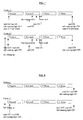
- Fig. 2 is schematically represented a wash cycle of a dishwasher fitted with an electromechanical programmer, wherein the resins regeneration step is performed during certain wash cycle steps to overcome the above problems.
- the regeneration of the water softening resins and sample resins of the sensor 3 is performed at about half the wash cycle instead of cycle end. Since regeneration is performed during the hot wash or straight after it, the resins of the sensor 3 are submitted after their regeneration to a wash for removing any excess salt and to a further flushing with the water intake for rinsing the crockery, so that all possible salt rests eventually left back in the sample resins are removed and the resins can go back to their original condition.
- the salt warning light L will be activated only at cycle end or better during the last rinse, so there will be enough time for the user to become aware of the warning light eventually on.
- the user would become aware of this condition because the salt warning light L is on at the end of the wash cycle of the dishwasher. Now, salt can be added in the special softener tank for a subsequent efficient regeneration. During the entire cycle up to the first cold rinse, the salt warning light L is not enabled by the programmer cam C10 to avoid wrong information to the user.
- the reed 5 can in fact still be in its closed condition (ON) not due to a poor regeneration but rather to salt rests that have not been removed when flushing the resins; therefore, should the salt warning light L be activated at that time, it would be on and deceive the user about the brine condition.
- the reed 5 opens (OFF) at the last rinse, since the sample resins have restored their original volume, in fact flushing the resins and the water intake for rinsing the crockery have removed any salt rests from the sample resins.
- the regeneration can be performed at any time, also at the end of a wash cycle; in other words, the machine knows when regeneration is performed.
- the electronic programmer will not activate the warning light; should it ascertain at about half the subsequent wash cycle that the reed 5 is still closed (ON) after water intake for the washing, it will activate the salt warning light at cycle end.
- the electronic programmer at half of this cycle will perform a regeneration step (either during or after the hot wash) to check the condition of the reed 5; if at the end of this unusual cycle, wherein the time of resins regeneration has been changed, the electronic programmer detects that the reed 5 is in open condition (OFF) as it should be, it is then clear to it that salt has been added; if, vice-versa, a closed condition (ON) is detected, it is clear to the electronic programmer that no salt has been added; as a result, it will activate the salt warning light again at cycle end.
- the electronic programmer will check during the next cycle whether salt has been added or not, as done for the previous cycle.
- the salt warning light L if required, will be activated by the electronic programmer at cycle end only, whereas it remains deactivated during all the remaining cycle.
- the regeneration step in dishwashing machines fitted with the sensor 3 for detecting the resins state is automatically activated by the sensor only when resins exhaustion has been ascertained during the step 2 of its detecting operation; therefore, according to water hardness the regeneration can be activated at every wash cycle for very hard water, or after a few wash cycles for not very hard water, as described in the above patent application.
- the method employed for detecting the lack of salt in a water softening device comprising a sensor for detecting the resins exhaustion state, is obtained by means of a device incorporated in the washing machine.
- This method allows a simple, reliable and easy detection of the lack of salt in a dishwasher.
- the device for detecting the state of resins exhaustion may be combined with a softening device comprising a float for detecting the lack of salt, as represented in Fig. 5.
- Fig. 5 the same reference numbers are used for those components that do not change with respect to Fig. 1; reference 1A indicates the water softening device as a whole, reference 2A indicates the softening device, reference 3 indicates the sensor for detecting the resins state.
- Reference 9 indicates a float for detecting the lack of salt in the softening device 2A.
- the float 9 has an inner permanent magnet M1 and can freely slide vertically in the compartment 7 located inside the softening device 2A in contact with the brine.
- the compartment 7 is so positioned to have the magnet M1 of the float 9 involving with its magnetic field the reed 5 of the resins sensor 3 when salt is lacking in the softening device 2A. Moreover, it must be located at such a distance not to affect the behaviour of the reed 5, which indicates the position of the movable element of the sensor 3.
- the resins regeneration step is performed in well determined times of the wash cycle, so as to overcome the problems previously indicated.
- Resins regeneration in a dishwashing machine fitted with an electromechanical programmer as schematically illustrated in Fig. 7 will be performed at the same time as in the preferred embodiment previously described, i.e. at about half wash cycle.
- the resins of the sensor 3 are submitted after their regeneration to a wash for removing any excess salt and to a further flushing with the water intake for rinsing the crockery, which will remove all possible salt rests from the sample resins, and let them go back to their original condition.
- This condition causes the movable element with the relevant magnet M to move upwards and no longer affect the reed 5 with its magnetic field; as a result, the reed 5 will take its open condition (OFF) at the beginning of the last rinse.
- the salt warning light L will be activated by the cam C10 both at cycle end and at the start of the next cycle, so the user has enough time to become aware of the warning light eventually on.
- the user adds salt in the special softener tank at the beginning of the next cycle, the brine increases its concentration and the float moves upwards out of reach of the reed 5 of the sensor 3; the reed 5 being no longer affected by the magnetic field of the float will take its open condition (OFF), cutting the circuit of the salt warning light L.
- the coil 6 is activated at cycle start to avoid that the sample resins of the sensor 3 not yet regenerated at cycle start may affect the salt warning light L after performing a salt filling up; activation of the coil 6 causes the magnet M of the movable element of the sensor 3 to move upwards and no longer affect the reed 5 with its magnetic field.
- the salt lack is only signalled depending on the position of the magnet M1 of the float 9, whose magnetic field affects the reed 5 and causes its closure.
- the cam C10 will cut the circuit of the salt warning light L to avoid that the magnet may affect the reed 5 following a release of the movable element and cause its closure with the salt warning light L turning on also after the filling up with salt, as previously mentioned.
- a dishwashing machine fitted with an electronic programmer as schematically represented in Fig. 8, if the electronic programmer detects the reed 5 in its closed condition (ON) at cycle end, independently from the cycle time at which regeneration is performed, it will check whether this condition is due to a poor wash of the sample resins of the sensor 3 or to the lack of salt, by shortly activating the coil 6 of the sensor 3. As previously mentioned for a machine fitted with an electromechanical programmer, activation of the coil 6 causes the magnet M of the movable element of the sensor 3 to move upwards and no longer affect the reed 5 with its magnetic field.
- the electronic programmer will perform the same check by shortly activating the coil 6 of the sensor 3. If the user has performed a salt filling up, the programmer detects the open condition of the reed 5, since the float 9 with its relevant magnet M1 has been displaced upwards and the reed 5 is no longer affected by its magnetic field; with this condition of the reed 5, the electronic programmer will put the salt warning light L off.
- This embodiment both with an electromechanical programmer and electronic programmer allows the use of the reed 5 and relevant electric circuit of the sensor 3 also when a float with magnet is employed for detecting the lack of salt. Moreover, this embodiment also allows putting off the salt warning light without delay with respect to the salt filling up.
- Another implementation may be the use of two reeds 5 located on the same strip of the sensor 3, with a float device with magnet for detecting the lack of salt.
- One of the two reeds 5 will be used by the sensor 3 for detecting the resins state and activate the various resins regeneration and wash steps.
- the second reed 5 will be provided to detect the position of the float magnet indicating the lack of salt.
- This implementation can be used indifferently on machines with an electromechanical and/or electronic programmer, as well as also with a wash cycle providing regeneration at cycle end.
- the salt warning light will be linked to the reed for detecting the float position and activated only in case of actual lack of salt.
- a further implementation can be an acoustic signal indicating the lack of salt in replacement of and/or in combination with the luminescent signal of a warning light.
Landscapes
- Washing And Drying Of Tableware (AREA)
- Detergent Compositions (AREA)
Applications Claiming Priority (2)
| Application Number | Priority Date | Filing Date | Title |
|---|---|---|---|
| ITTO010103 | 2001-02-05 | ||
| IT2001TO000103A ITTO20010103A1 (it) | 2001-02-05 | 2001-02-05 | Metodo per il rilevamento della mancanza di un agente rigenerante in una macchina di lavaggio, in particolare una lavastoviglie e relativo s |
Publications (3)
| Publication Number | Publication Date |
|---|---|
| EP1228735A2 true EP1228735A2 (de) | 2002-08-07 |
| EP1228735A3 EP1228735A3 (de) | 2004-08-25 |
| EP1228735B1 EP1228735B1 (de) | 2008-05-14 |
Family
ID=11458508
Family Applications (1)
| Application Number | Title | Priority Date | Filing Date |
|---|---|---|---|
| EP02002619A Expired - Lifetime EP1228735B1 (de) | 2001-02-05 | 2002-02-05 | Verfahren und Vorrichtung zur Detektierung von Regenerationsmittelmangel in einer Waschmaschine, insbesondere einer Geschirrspülmaschine |
Country Status (5)
| Country | Link |
|---|---|
| EP (1) | EP1228735B1 (de) |
| AT (1) | ATE394986T1 (de) |
| DE (1) | DE60226530D1 (de) |
| ES (1) | ES2305143T3 (de) |
| IT (1) | ITTO20010103A1 (de) |
Cited By (2)
| Publication number | Priority date | Publication date | Assignee | Title |
|---|---|---|---|---|
| EP1723889A1 (de) * | 2005-05-13 | 2006-11-22 | INVENSYS CONTROLS ITALY Srl | Verfahren und Vorrichtung zum Anzeigen des Bedürfnis zum Nachfüllen einer Regeneriersubstanz der Enthärter-Function in einer Waschvorrichtung wie zum Beispiel Geschirrspülmaschinen |
| EP1862105A3 (de) * | 2006-05-30 | 2013-05-15 | T & P - S.p.A. | Behälter für Ionenaustauscherharze |
Family Cites Families (3)
| Publication number | Priority date | Publication date | Assignee | Title |
|---|---|---|---|---|
| IT975699B (it) * | 1972-11-10 | 1974-08-10 | Elbi Spa | Dsipositivo segnalatore di allarme per decalcificatori d acqua par ticolarmente per macchine lavastovi gli5 |
| DE19643151B4 (de) * | 1996-10-18 | 2004-02-19 | BSH Bosch und Siemens Hausgeräte GmbH | Verfahren zum Betrieb einer Enthärtungseinrichtung einer Haushalt-Geschirrspülmaschine |
| IT1307228B1 (it) * | 1999-03-30 | 2001-10-30 | T & P Spa | Dispositivo per l'abbattimento della durezza dell'acqua(dolcificatore) dotato di sensore di esaurimento resine e relativo |
-
2001
- 2001-02-05 IT IT2001TO000103A patent/ITTO20010103A1/it unknown
-
2002
- 2002-02-05 EP EP02002619A patent/EP1228735B1/de not_active Expired - Lifetime
- 2002-02-05 ES ES02002619T patent/ES2305143T3/es not_active Expired - Lifetime
- 2002-02-05 AT AT02002619T patent/ATE394986T1/de not_active IP Right Cessation
- 2002-02-05 DE DE60226530T patent/DE60226530D1/de not_active Expired - Lifetime
Cited By (2)
| Publication number | Priority date | Publication date | Assignee | Title |
|---|---|---|---|---|
| EP1723889A1 (de) * | 2005-05-13 | 2006-11-22 | INVENSYS CONTROLS ITALY Srl | Verfahren und Vorrichtung zum Anzeigen des Bedürfnis zum Nachfüllen einer Regeneriersubstanz der Enthärter-Function in einer Waschvorrichtung wie zum Beispiel Geschirrspülmaschinen |
| EP1862105A3 (de) * | 2006-05-30 | 2013-05-15 | T & P - S.p.A. | Behälter für Ionenaustauscherharze |
Also Published As
| Publication number | Publication date |
|---|---|
| EP1228735A3 (de) | 2004-08-25 |
| DE60226530D1 (de) | 2008-06-26 |
| ES2305143T3 (es) | 2008-11-01 |
| EP1228735B1 (de) | 2008-05-14 |
| ITTO20010103A0 (it) | 2001-02-05 |
| ATE394986T1 (de) | 2008-05-15 |
| ITTO20010103A1 (it) | 2002-08-05 |
Similar Documents
| Publication | Publication Date | Title |
|---|---|---|
| US6823878B1 (en) | Household appliance using water, namely a washing machine, with improved device for softening the water | |
| US9861253B2 (en) | Water softening apparatus, dishwasher having the same and control method thereof | |
| EP1048776B1 (de) | Vorrichtung zum Reduzieren von Wasserhärte | |
| NZ518288A (en) | Washing appliance water softner | |
| EP2175767B1 (de) | Geschirrspülmaschine | |
| EP1409782B1 (de) | System zur reduzierung der wasserhärte und überwachungsverfahren davon | |
| CN105728065B (zh) | 软水树脂的再生方法 | |
| EP1228735B1 (de) | Verfahren und Vorrichtung zur Detektierung von Regenerationsmittelmangel in einer Waschmaschine, insbesondere einer Geschirrspülmaschine | |
| CN111051596A (zh) | 洗衣机 | |
| EP0741991B1 (de) | Regenerierungsvorrichtung für eine Geschirrspülmaschine mit Wasserenthärtungseinrichtung | |
| US3531402A (en) | Apparatus and method for regenerating a water softening system | |
| EP0919178B9 (de) | Wasserenthärtungsvorrichtung mit einem Harzerschöpfungsdetektor und Waschmaschine mit einer solchen Vorrichtung | |
| EP0094357B1 (de) | Waschmaschine und Verfahren zum Regenerieren der Austauschermasse | |
| WO2026086334A1 (zh) | 洗碗机的树脂腔的冲洗方法、装置、洗碗机以及存储介质 | |
| EP1275335A1 (de) | Vorrichtung und Verfahren zum Kontrollieren der Wasserhärte einer Waschmaschine | |
| JP3246507B2 (ja) | イオン除去手段及びイオン除去方法 | |
| EP1785084A2 (de) | Vorrichtung und Verfahren zur Reduzierung der Wasserhärte in einer Waschmaschine, insbesondere in einer Geschirrspülmaschine | |
| JPH07270214A (ja) | 軟水器の塩水タンクにおける塩水水位並びに塩水濃度の検出方法及びその装置 | |
| JP4269229B2 (ja) | 軟水装置 | |
| US20080264448A1 (en) | Method for performing wash cycles in a dishwasher | |
| EP2366322B1 (de) | Verfahren zum Regenerieren eines Wasserenthärtungsharzes in einer Geschirrspülmaschine | |
| DE4423866A1 (de) | Geschirrspülmaschine mit einem Salzbehälter | |
| CN114182497A (zh) | 洗衣机 | |
| EP2237716B1 (de) | Geschirrspülmaschine | |
| EP1270072B1 (de) | Einrichtung zum Erfassen des Harzzustandes eines Systems zur Reduzierung der erforderlichen Wasserhärte in einem Gerät |
Legal Events
| Date | Code | Title | Description |
|---|---|---|---|
| PUAI | Public reference made under article 153(3) epc to a published international application that has entered the european phase |
Free format text: ORIGINAL CODE: 0009012 |
|
| AK | Designated contracting states |
Kind code of ref document: A2 Designated state(s): AT BE CH CY DE DK ES FI FR GB GR IE IT LI LU MC NL PT SE TR |
|
| AX | Request for extension of the european patent |
Free format text: AL;LT;LV;MK;RO;SI |
|
| PUAL | Search report despatched |
Free format text: ORIGINAL CODE: 0009013 |
|
| AK | Designated contracting states |
Kind code of ref document: A3 Designated state(s): AT BE CH CY DE DK ES FI FR GB GR IE IT LI LU MC NL PT SE TR |
|
| AX | Request for extension of the european patent |
Extension state: AL LT LV MK RO SI |
|
| 17P | Request for examination filed |
Effective date: 20050207 |
|
| AKX | Designation fees paid |
Designated state(s): AT BE CH CY DE DK ES FI FR GB GR IE IT LI LU MC NL PT SE TR |
|
| 17Q | First examination report despatched |
Effective date: 20060630 |
|
| GRAP | Despatch of communication of intention to grant a patent |
Free format text: ORIGINAL CODE: EPIDOSNIGR1 |
|
| GRAS | Grant fee paid |
Free format text: ORIGINAL CODE: EPIDOSNIGR3 |
|
| GRAA | (expected) grant |
Free format text: ORIGINAL CODE: 0009210 |
|
| AK | Designated contracting states |
Kind code of ref document: B1 Designated state(s): AT BE CH CY DE DK ES FI FR GB GR IE IT LI LU MC NL PT SE TR |
|
| REG | Reference to a national code |
Ref country code: GB Ref legal event code: FG4D |
|
| REG | Reference to a national code |
Ref country code: CH Ref legal event code: EP |
|
| REG | Reference to a national code |
Ref country code: IE Ref legal event code: FG4D Free format text: LANGUAGE OF EP DOCUMENT: FRENCH |
|
| REF | Corresponds to: |
Ref document number: 60226530 Country of ref document: DE Date of ref document: 20080626 Kind code of ref document: P |
|
| PG25 | Lapsed in a contracting state [announced via postgrant information from national office to epo] |
Ref country code: FI Free format text: LAPSE BECAUSE OF FAILURE TO SUBMIT A TRANSLATION OF THE DESCRIPTION OR TO PAY THE FEE WITHIN THE PRESCRIBED TIME-LIMIT Effective date: 20080514 |
|
| REG | Reference to a national code |
Ref country code: ES Ref legal event code: FG2A Ref document number: 2305143 Country of ref document: ES Kind code of ref document: T3 |
|
| NLV1 | Nl: lapsed or annulled due to failure to fulfill the requirements of art. 29p and 29m of the patents act | ||
| PG25 | Lapsed in a contracting state [announced via postgrant information from national office to epo] |
Ref country code: AT Free format text: LAPSE BECAUSE OF FAILURE TO SUBMIT A TRANSLATION OF THE DESCRIPTION OR TO PAY THE FEE WITHIN THE PRESCRIBED TIME-LIMIT Effective date: 20080514 Ref country code: NL Free format text: LAPSE BECAUSE OF FAILURE TO SUBMIT A TRANSLATION OF THE DESCRIPTION OR TO PAY THE FEE WITHIN THE PRESCRIBED TIME-LIMIT Effective date: 20080514 |
|
| PG25 | Lapsed in a contracting state [announced via postgrant information from national office to epo] |
Ref country code: DK Free format text: LAPSE BECAUSE OF FAILURE TO SUBMIT A TRANSLATION OF THE DESCRIPTION OR TO PAY THE FEE WITHIN THE PRESCRIBED TIME-LIMIT Effective date: 20080514 Ref country code: SE Free format text: LAPSE BECAUSE OF FAILURE TO SUBMIT A TRANSLATION OF THE DESCRIPTION OR TO PAY THE FEE WITHIN THE PRESCRIBED TIME-LIMIT Effective date: 20080814 Ref country code: PT Free format text: LAPSE BECAUSE OF FAILURE TO SUBMIT A TRANSLATION OF THE DESCRIPTION OR TO PAY THE FEE WITHIN THE PRESCRIBED TIME-LIMIT Effective date: 20081014 |
|
| PG25 | Lapsed in a contracting state [announced via postgrant information from national office to epo] |
Ref country code: BE Free format text: LAPSE BECAUSE OF FAILURE TO SUBMIT A TRANSLATION OF THE DESCRIPTION OR TO PAY THE FEE WITHIN THE PRESCRIBED TIME-LIMIT Effective date: 20080514 |
|
| PLBE | No opposition filed within time limit |
Free format text: ORIGINAL CODE: 0009261 |
|
| STAA | Information on the status of an ep patent application or granted ep patent |
Free format text: STATUS: NO OPPOSITION FILED WITHIN TIME LIMIT |
|
| 26N | No opposition filed |
Effective date: 20090217 |
|
| PG25 | Lapsed in a contracting state [announced via postgrant information from national office to epo] |
Ref country code: MC Free format text: LAPSE BECAUSE OF NON-PAYMENT OF DUE FEES Effective date: 20090228 |
|
| REG | Reference to a national code |
Ref country code: CH Ref legal event code: PL |
|
| PG25 | Lapsed in a contracting state [announced via postgrant information from national office to epo] |
Ref country code: CH Free format text: LAPSE BECAUSE OF NON-PAYMENT OF DUE FEES Effective date: 20090228 Ref country code: LI Free format text: LAPSE BECAUSE OF NON-PAYMENT OF DUE FEES Effective date: 20090228 |
|
| PG25 | Lapsed in a contracting state [announced via postgrant information from national office to epo] |
Ref country code: IE Free format text: LAPSE BECAUSE OF NON-PAYMENT OF DUE FEES Effective date: 20090205 |
|
| PG25 | Lapsed in a contracting state [announced via postgrant information from national office to epo] |
Ref country code: GR Free format text: LAPSE BECAUSE OF FAILURE TO SUBMIT A TRANSLATION OF THE DESCRIPTION OR TO PAY THE FEE WITHIN THE PRESCRIBED TIME-LIMIT Effective date: 20080815 |
|
| PG25 | Lapsed in a contracting state [announced via postgrant information from national office to epo] |
Ref country code: LU Free format text: LAPSE BECAUSE OF NON-PAYMENT OF DUE FEES Effective date: 20090205 |
|
| PG25 | Lapsed in a contracting state [announced via postgrant information from national office to epo] |
Ref country code: CY Free format text: LAPSE BECAUSE OF FAILURE TO SUBMIT A TRANSLATION OF THE DESCRIPTION OR TO PAY THE FEE WITHIN THE PRESCRIBED TIME-LIMIT Effective date: 20080514 |
|
| REG | Reference to a national code |
Ref country code: FR Ref legal event code: PLFP Year of fee payment: 15 |
|
| REG | Reference to a national code |
Ref country code: FR Ref legal event code: PLFP Year of fee payment: 16 |
|
| PGFP | Annual fee paid to national office [announced via postgrant information from national office to epo] |
Ref country code: GB Payment date: 20170221 Year of fee payment: 16 |
|
| PGFP | Annual fee paid to national office [announced via postgrant information from national office to epo] |
Ref country code: ES Payment date: 20170224 Year of fee payment: 16 Ref country code: TR Payment date: 20170206 Year of fee payment: 16 |
|
| GBPC | Gb: european patent ceased through non-payment of renewal fee |
Effective date: 20180205 |
|
| REG | Reference to a national code |
Ref country code: FR Ref legal event code: ST Effective date: 20181031 |
|
| PG25 | Lapsed in a contracting state [announced via postgrant information from national office to epo] |
Ref country code: FR Free format text: LAPSE BECAUSE OF NON-PAYMENT OF DUE FEES Effective date: 20180228 Ref country code: GB Free format text: LAPSE BECAUSE OF NON-PAYMENT OF DUE FEES Effective date: 20180205 |
|
| PGFP | Annual fee paid to national office [announced via postgrant information from national office to epo] |
Ref country code: FR Payment date: 20190125 Year of fee payment: 18 |
|
| REG | Reference to a national code |
Ref country code: ES Ref legal event code: FD2A Effective date: 20190801 |
|
| PG25 | Lapsed in a contracting state [announced via postgrant information from national office to epo] |
Ref country code: ES Free format text: LAPSE BECAUSE OF NON-PAYMENT OF DUE FEES Effective date: 20180206 |
|
| PGFP | Annual fee paid to national office [announced via postgrant information from national office to epo] |
Ref country code: IT Payment date: 20200228 Year of fee payment: 19 |
|
| REG | Reference to a national code |
Ref country code: DE Ref legal event code: R119 Ref document number: 60226530 Country of ref document: DE |
|
| PG25 | Lapsed in a contracting state [announced via postgrant information from national office to epo] |
Ref country code: DE Free format text: LAPSE BECAUSE OF NON-PAYMENT OF DUE FEES Effective date: 20200901 |
|
| PG25 | Lapsed in a contracting state [announced via postgrant information from national office to epo] |
Ref country code: IT Free format text: LAPSE BECAUSE OF NON-PAYMENT OF DUE FEES Effective date: 20210205 |
|
| PG25 | Lapsed in a contracting state [announced via postgrant information from national office to epo] |
Ref country code: TR Free format text: LAPSE BECAUSE OF NON-PAYMENT OF DUE FEES Effective date: 20180205 |