EP1229528A2 - Information recording medium - Google Patents

Information recording medium Download PDF

Info

Publication number
EP1229528A2
EP1229528A2 EP02001938A EP02001938A EP1229528A2 EP 1229528 A2 EP1229528 A2 EP 1229528A2 EP 02001938 A EP02001938 A EP 02001938A EP 02001938 A EP02001938 A EP 02001938A EP 1229528 A2 EP1229528 A2 EP 1229528A2
Authority
EP
European Patent Office
Prior art keywords
information recording
layer
recording layer
protective
film
Prior art date
Legal status (The legal status is an assumption and is not a legal conclusion. Google has not performed a legal analysis and makes no representation as to the accuracy of the status listed.)
Withdrawn
Application number
EP02001938A
Other languages
German (de)
French (fr)
Other versions
EP1229528A3 (en
Inventor
Masataka Yamaguchi
Takahiro Togashi
Yoichi Okumura
Current Assignee (The listed assignees may be inaccurate. Google has not performed a legal analysis and makes no representation or warranty as to the accuracy of the list.)
Pioneer Corp
Original Assignee
Pioneer Corp
Priority date (The priority date is an assumption and is not a legal conclusion. Google has not performed a legal analysis and makes no representation as to the accuracy of the date listed.)
Filing date
Publication date
Application filed by Pioneer Corp filed Critical Pioneer Corp
Publication of EP1229528A2 publication Critical patent/EP1229528A2/en
Publication of EP1229528A3 publication Critical patent/EP1229528A3/en
Withdrawn legal-status Critical Current

Links

Images

Classifications

    • GPHYSICS
    • G11INFORMATION STORAGE
    • G11BINFORMATION STORAGE BASED ON RELATIVE MOVEMENT BETWEEN RECORD CARRIER AND TRANSDUCER
    • G11B7/00Recording or reproducing by optical means, e.g. recording using a thermal beam of optical radiation by modifying optical properties or the physical structure, reproducing using an optical beam at lower power by sensing optical properties; Record carriers therefor
    • G11B7/24Record carriers characterised by shape, structure or physical properties, or by the selection of the material

Definitions

  • the present invention relates to an information recording medium having a plurality of information recording layers including information recording layers made of a phase change material.
  • FIG. 11 shows a track format of a DVD-RAM disk.
  • the DVD-RAM disk includes headers 201 called "CAPA" (Complementary Allocated Pit Addressing) and lands/grooves 202, in which each land alternates with each groove in the radial direction, extend in the circumferential direction over the disk surface as guide grooves.
  • CAA Computer Allocated Pit Addressing
  • lands/grooves 202 in which each land alternates with each groove in the radial direction, extend in the circumferential direction over the disk surface as guide grooves.
  • address information is recorded as pre-pits, but no signals are recorded on a phase change recording film portion extending over the header 201, leaving the phase change recording film portion as-initialized i.e., crystalline.
  • signals are recorded on the lands/grooves 202 in which both an amorphous region (amorphous marks are recorded) and a crystalline region (initialized with no amorphous marks recorded) are present.
  • a recording medium having this land/groove structure for increasing the recording density includes the headers 201 at circumferential locations of the disk surface as described above, and the headers 201 are also used to adjust signals that control the switching of the optical spot from a land 202A to a groove 202B and vice versa, for example.
  • Such an information recording medium stacking two or more information recording layers made of a phase change material are disclosed in, for example, EP 0957477 A2 and USP 6,221,455 B1.
  • a first information recording layer is stacked on a second information recording layer through an optically transparent layer.
  • the optical transmission must be considered for a disk in which the headers of the first information recording layer do not superimpose upon those of the second information recording layer. Then, in such a disk, in accessing the second information recording layer, the laser light transmitting through the first information recording layer fluctuates in accordance with whether signals are recorded or unrecorded on the first information recording layer, i.e., for example, whether the laser light transmits through the header or through the recorded marks on the land/groove, independently of whether information is recorded or not on the second information recording layer.
  • This fluctuation of the laser light in turn results in the fluctuation of recording power during recording on the second information recording layer, and further in the fluctuation of the level of reproduced signals during reproduction from the second information recording layer.
  • these fluctuations exceed their tolerances, the signals cannot be accurately recorded on the disk/reproduced from the disk.
  • An object of the invention is, therefore, to provide an information recording medium capable of satisfactorily recording/reproducing information signals on/from the second information recording layer through the first information recording layer having a phase change recording film.
  • the present invention provides an information recording medium having a light transmissive layer (103), a first information recording layer (L1), a transparent layer (102), and a second information recording layer (L2) sequentially stacked to reproduce information signals upon exposure of the light transmissive layer (103) to laser light, wherein the first information recording layer (L1) is provided with a first protective layer (11), a phase change recording film (1), and a second protective layer (12) sequentially from the light transmissive layer (103), and the rate of power fluctuation between a reproducing light passing through a recorded region of said first information recording layer (L1) and that passing through an unrecorded region of said first information recording layer (L1), during reproduction of the information signals from said second information recording layer (L2), are within 10%.
  • the rate of fluctuation between a reproducing light passing through a recorded regions of the first information recording layer and that passing through an unrecorded region of the first information recording layer, during reproduction of the information signals from the second information recording layer are within 10%, whereby optical power fluctuation dependent upon whether signals are recorded or unrecorded on the first information recording layer can be suppressed when signals are recorded/reproduced on/from the second recording layer, and hence information signals can be recorded/reproduced on/from the second recording layer satisfactorily. Additionally, there is no need to adjust the positional relationship between the recorded region of the first information recording layer and that of the second information recording layer.
  • each recorded mark alternates with each unrecorded portion when recorded, and each recorded mark may not be too small, whereby a practically applicable information recording medium can be obtained which is capable of satisfactorily recording/reproducing information signals on/from the second recording layer and which requires no adjustment of the positional relationship between the recorded region of the first information recording layer and that of the second information recording layer.
  • the transmissivity of the first information recording layer is not too small, whereby sufficiently intense signals can be obtained from the second information recording layer. Furthermore, the transmissivity of the first information recording layer is not too large, either, whereby the amount of light reflecting from the first information recording layer itself and the light absorption coefficient during recording on the first information recording layer can be suppressed. Hence, information signals can be recorded/reproduced satisfactorily.
  • An information recording medium may be provided which has a light transmissive layer (103), a first information recording layer (L1), a transparent layer (102), and a second information recording layer (L2) sequentially stacked to reproduce information signals upon exposure of the light transmissive layer (103) to laser light, wherein the first information recording layer (L1) is provided with a first protective layer (11), a phase change recording film (1), and a second protective layer (12) sequentially from the light transmissive layer (103), and assuming that the refractive index and extinction coefficient of a crystalline portion of the phase change recording film (1) are n 1c and k 1c , respectively, and the refractive index and extinction coefficient of an amorphous portion of the phase change recording film (1) are n 1a and k 1a , respectively, then (n 1c - n 1a ) ⁇ (k 1c - k 1a ) ⁇ 0 and
  • An information recording medium may be provided which has a light transmissive layer (103), a first information recording layer (L1), a transparent layer (102), and a second information recording layer (L2) sequentially stacked to reproduce information signals upon exposure of the light transmissive layer to laser light, wherein the first information recording layer (L1) is provided with a first protective layer (11), a phase change recording film (1), and a second protective layer (12) sequentially from the light transmissive layer (103), and assuming that the number of protective films constituting the first protective layer (11) is I, the thickness of each of the protective films is di [nm] (where i is a natural number), the refractive index of each of the protective films is ni, the wavelength of the laser light is ⁇ [nm], and m is an integer, then the sum ⁇ for all i running from 1 to I is given substantially as (m/2 + 1/4) - 1/8 ⁇ ⁇ (di/( ⁇ /ni)) ⁇ (m/2 + 1/4) + 1/8, and assuming
  • suitable thicknesses are selected for the protective films respectively constituting the first and second protective layers, whereby optical power fluctuation dependent upon whether signals are recorded or unrecorded on the first information recording layer can be suppressed when signals are recorded/reproduced on/from the second recording layer.
  • An information recording medium may be provided which has a light transmissive layer (103), a first information recording layer (L1), a transparent layer (102), and a second information recording layer (L2) sequentially stacked to reproduce information signals upon exposure of the light transmissive layer (103) to laser light, wherein the first information recording layer (L1) is provided with a first protective layer (11), a phase change recording film (1), and a second protective layer (12) sequentially from the light transmissive layer (103), and assuming that the number of protective films constituting the first protective layer (11) is I, the thickness of each of the protective films is di [nm] (where i is a natural number), the refractive index of each of the protective films is ni, the wavelength of the laser light is ⁇ [nm], and m is an integer, then the sum ⁇ for all i running from 1 to I is given substantially as (m/2 + 1/4) - 1/8 ⁇ ⁇ (di/( ⁇ /ni)) ⁇ (m/2+1/4) + 1/8, and
  • optical power fluctuation dependent upon whether signals are recorded or unrecorded on the first information recording layer can be suppressed when signals are recorded/reproduced on/from the second recording layer.
  • desirable tolerances for recording/reproducing power fluctuations during recording/reproduction should range from 5 to 10% or less.
  • the reflectivity of a crystalline portion is R 1c , its transmissivity T 1c , and its absorption coefficient A 1c
  • the reflectivity of an amorphous portion is R 1a , its transmissivity T 1a , and its absorption coefficient A 1a
  • the transmissivity Tnr of the unrecorded portion and the transmissivity Tr of the recorded portion in the first information recording layer L1 satisfy the following condition.
  • the transmissivity of the first information recording layer is set to 45% for the crystalline portion and 70% for the amorphous portion.
  • the rates of laser power fluctuation under this condition are given by [Eq.
  • the transmissivity of the first information recording layer in this disk is set to 62.6% for the crystalline portion and 80.4% for the amorphous portion.
  • the rates of laser power fluctuation under this condition are given by [Eq.
  • the information recording medium of the invention allows information signals to be recorded/reproduced satisfactorily on/from the second information recording layer through the first information recording layer having a phase change recording film.
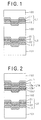
  • FIG. 1 is a sectional view showing an information recording medium according to a first embodiment of the invention.
  • the information recording medium is comprised of a substrate 101, a second information recording layer L2, a transparent layer 102, a first information recording layer L1, and a light transmissive layer 103.
  • Information is recorded on the first and second information recording layers L1 and L2 independently of each other.
  • the first information recording layer L1 is comprised of a second dielectric protective film 12, a phase change recording film 1, and a first dielectric protective film 11.
  • the second information recording layer L2 is comprised of a reflector film 3, a second dielectric protective film 22, a phase change recording film 2, and a first dielectric protective film 21.
  • the second information recording layer L2 may be recordable and also reproducible only, and that information signals are recorded/reproduced upon exposure of the light transmissive layer 103 to laser light.
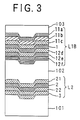
  • FIG. 2 is a sectional view showing an information recording medium according to a second embodiment of the invention.
  • the information recording medium is comprised of a substrate 101, a second information recording layer L2, a transparent layer 102, a first information recording layer L1A, and a light transmissive layer 103.
  • the first information recording layer L1A is comprised of a fourth dielectric protective film 12c, a third dielectric protective film 12b, a second dielectric protective film 12a, a phase change recording film 1, and a first dielectric protective film 11.
  • the second information recording layer L2 is comprised of a reflector film 3, a second dielectric protective film 22, a phase change recording film 2, and a first dielectric protective film 21.
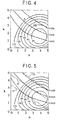
  • FIG. 3 is a sectional view showing an information recording medium according to a third embodiment of the invention.
  • the information recording medium is comprised of a substrate 101, a second information recording layer L2, a transparent layer 102, a first information recording layer L1B, and a light transmission layer 103.
  • the first information recording layer L1B is comprised of a sixth dielectric protective film 12f, a fifth dielectric protective film 12e, a fourth dielectric protective film 12d, a phase change recording film 1, a third dielectric protective film 11c, a second dielectric protective film 11b, and a first dielectric protective film 11a.
  • the second information recording layer L2 is comprised of a reflector film 3, a second dielectric protective film 22, a phase change recording film 2, and a first dielectric protective film 21.
  • a fundamental solution to the above problem which the information recording media according to the first to third embodiments should find is to reduce the difference in transmissivity between the recorded and unrecorded portions of the first information recording layer L1 to make its influence on the recording/reproducing of information signals on/from the second information recording layer L2 negligible.
  • the invention is featured in the film forming structure and material selection for preparing the first information recording layer L1 in order to suppress the difference in transmissivity between the recorded and unrecorded portions of the first information recording layer.
  • the invention is not limited to the information recording media according to the first to third embodiments as to the number of dielectric protective films, etc.
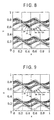
  • FIGS. 4 and 5 show calculated reflectivities and transmissivities of the first information recording layer having a three-layered structure comprised of PC substrate/dielectric film/phase change recording film/dielectric film.
  • the calculation is performed by appropriately selecting the thickness of each film and using the optical constants (n, k) of the phase change recording film as variables.
  • the optical constants (n, k) so paired as to set the reflectivity to 2, 4, 6, 8, 10, and 12% are plotted as substantially concentric curves.
  • the optical constants (n, k) so paired as to set the transmissivity T to 38, 50, and 64% are plotted as broken lines.
  • the wavelength is 405 nm
  • the thickness of the phase change recording film is 6 nm
  • a recording medium be considered whose crystalline portion has a transmissivity of 50%, for example.
  • the first information recording layer is required to maximize the difference in reflectivity between its crystalline and amorphous portions.
  • R 1c the reflectivity of the unrecorded portion (the crystalline portion) of the first information recording layer L1 be in the order of 10% and that R 1a (the reflectivity of the recorded mark (the amorphous portion) of the first information recording layer L1) be minimized.
  • R 1a 0%.
  • R 1c is large, laser power required for recording is so large that practically no information can be recorded.
  • the (transmissivity, reflectivity) of the crystalline portion at the point A and of the amorphous portion at the point B are (50%, 12%) and (46%, 4%), respectively.
  • the transmissivities are within their tolerance, and the reflectivities are also sufficient.
  • Aa is the ratio of the area occupied by the marks recorded on guide grooves such as grooves or lands
  • these marks are recorded such that a recorded portion alternates with an unrecorded portion, and the area occupied by these marks does not exceed the area occupied by the unrecorded portions, and hence Aa ⁇ 0.5 is established.
  • each recorded mark is too small, no signal can be produced therefrom, and thus, 0.2 ⁇ Aa should be satisfied.
  • the transmissivity Tnr of the unrecorded portion and the transmissivity Tr of the recorded portion in the first information recording layer L1 satisfy 0.3 ⁇ Tnr ⁇ 0.8 0.3 ⁇ Tr ⁇ 0.8
  • a reproduced signal from the second information recording layer L2 can be expressed as a value obtained by multiplying the square of the transmissivity of the first information recording layer L1 and the reflectivity of the second information recording layer L2 with the amount of incident light.
  • the first information recording layer L1 has too small a transmissivity
  • the level of signals reproduced from the second information recording layer L2 becomes too small and thus insufficient.
  • the recording layer L1 has too large a transmissivity, the amount of light reflecting from itself and the light absorption coefficient during recording on itself are decreased to such a small extent that satisfactory reproduction and recording cannot be achieved. This is why any reproduced signal from the second information recording layer L2 must satisfy 0.3 ⁇ Tnr ⁇ 0.8 and 3 ⁇ Tr ⁇ 0.8.
  • T 1a the transmissivity of the amorphous portion
  • T 1c the transmissivity of the crystalline portion
  • Aa the area occupied by the amorphous portions (recorded marks)
  • T 1a -(1+K)+(1+K)Aa+ 1+K (1+K)Aa
  • T 1a -(1+K)+(1+K)Aa- 1+K (1+K)Aa
  • T 1c -(1+K)(1-Aa)- 1+K (1+K)Aa
  • T 1c - 1+ 1+K (1-Aa) 1+K Aa T 1c
  • T 1a 1- 1+K (1-Aa) 1+K Aa T 1c
  • T 1a 1- 1-K (1-Aa) 1-K Aa T 1c are established.
  • T 1a satisfying -0.15 ⁇ ⁇ Pr 2 ⁇ 0.15 is indicated as a zone interposed between the two straight lines (a) and (f)
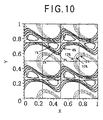
  • FIGS. 8 to 10 show the relationship between the thickness and optical constants of the dielectric protective films.
  • FIG. 8 which corresponds to the configuration according to the first embodiment shown in FIG. 1, shows the case where the thickness of the phase change recording film 1 is 6 nm.
  • the X axis indicates the value obtained by dividing the thickness of the dielectric film 12 by ⁇ /n (where n is the optical constant of the film 12).
  • the Y axis indicates the value obtained by dividing the thickness of the first dielectric film 11 by ⁇ /n (where n is the optical constant of the film 11).
  • FIG. 9 which corresponds to the configuration according to the second embodiment shown in FIG. 2, shows the case where the thickness of the phase change recording film 1 is 6 nm.
  • the X axis indicates the value obtained by dividing the thickness of the second dielectric film 12a by ⁇ /n (where n is the optical constant of the film 12a).
  • the Y axis indicates the value obtained by dividing the thickness of the first dielectric film 11 by ⁇ /n (where n is the optical constant of the film 11).
  • the thickness of the third dielectric film 12b is 104 nm (( ⁇ /n) ⁇ 4/8), and that of the fourth dielectric film 12c is 131 nm (( ⁇ /n) ⁇ 6/8).
  • FIG. 10 which corresponds to the configuration according to the third embodiment shown in FIG. 3, shows the case where the thickness of the phase change recording film 1 is 6 nm.
  • the X axis indicates the value obtained by dividing the thickness of the fourth dielectric film 12d by ⁇ /n (where n is the optical constant of the film 12d).
  • the Y axis indicates the value obtained by dividing the thickness of the first dielectric film 11a by ⁇ /n (where n is the optical constant of the film 11a).
  • the thickness of the second dielectric film 11b is 182 nm (( ⁇ /n) ⁇ 7/8), that of the third dielectric film 11c is 22 nm (( ⁇ /n) ⁇ 1/8), that of the fifth dielectric film 12e is 22 nm (( ⁇ /n) ⁇ 1/8), and that of the sixth dielectric film 12f is 153 nm (( ⁇ /n) ⁇ 7/8).
  • a first protective layer (m/2 + 1/4) - 1/8 ⁇ ⁇ (di/( ⁇ /ni)) ⁇ (m/2 + 1/4) + 1/8 (where m is an integer, i is a natural number, di is the thickness of each protective film [nm], ni is the refractive index of each protective film [nm], and ⁇ is the wavelength of the laser light [nm]), and as to a second protective layer (k/2) - 1/8 ⁇ ⁇ (dj/( ⁇ /nj)) ⁇ (k/2) + 1/8 (where k is an integer, j is a natural number, dj is the thickness of each protective film [nm], nj is the refractive index of each protective film [nm], and ⁇ is the wavelength of the laser light [nm]).
  • the reflector film 3, the second dielectric film 22, the phase change recording film 2, the first dielectric film 21 were sequentially vacuum deposited by sputtering onto the 0.6 mm thick substrate 101, and then a UV curable resin was spin coated.
  • the first dielectric film 11, the phase change recording film 1, and the second dielectric film 12 were sequentially vacuum deposited by sputtering onto another 0.6 mm thick substrate for the light transmissive layer 103, and then the UV curable resin was spin coated.
  • the entire surfaces of the phase change recording films 1 and 2 of the respective substrates were exposed to laser light to become crystalline, and the resulting substrates were then bonded together using the UV curable resin.
  • the transparent layer 102 formed of the UV cured resin between the two information recording layers L1 and L2 is 40 ⁇ m thick.
  • the first dielectric film 11 corresponds to the first protective layer, and the second dielectric film 12 to the second protective layer.
  • the first dielectric film 11 of the first information recording layer L1 is made of ZnS ⁇ SiO 2 and is 220 nm thick. Its phase change recording film 1 is made of AgInSbTe and is 6 nm thick. Its second dielectric film 12 is made of ZnS ⁇ SiO 2 and is 260 nm thick.
  • the first dielectric film 21 of the second information recording layer L2 is made of ZnS ⁇ SiO 2 and is 160 nm thick.
  • Its phase change recording film 2 is made of AgInSbTe and is 14 nm thick.
  • Its second dielectric film 22 is made of ZnS ⁇ SiO 2 and is 30 nm thick.
  • Its reflector film 3 is made of Al and is 100 nm thick.
  • the optical properties of the first and second information recording layers L1 and L2 are indicated below. It should be noted that the following reflectivities, light absorption coefficients, and light transmissivities are obtained on condition that the intensity of light entering the respective information recording layers is 100%. Thus, for the second information recording layer L2, the light has 100% intensity upon entrance into the layer L2 after having passed through the light transmissive layer and the first information recording layer.
  • first information recording layer > Crystalline portion Reflectivity R 1c 11.2% Light absorption coefficient A 1c 36.1% Light transmissivity T 1c 52.6% Amorphous portion Reflectivity R 1a 1.7% Light absorption coefficient A 1a 48.2% Light transmissivity T 1a 50.1%
  • second information recording layer > Crystalline portion Reflectivity R 1c 40.3% Amorphous portion Reflectivity R 1a 15.5%
  • the transmissivity for light transmitting through the recorded portions (lands/grooves) of the first information recording layer is 51.3%, and that for light transmitting through the unrecorded portions is 52.6%.
  • the rate of fluctuation of the light for recording on the second information recording layer L2 is 2.4% and for reproducing from the same layer L2 is 4.8%, provided that the light has transmitted through the recorded portion of the first information recording layer L1.
  • Recording/reproducing experiments were carried out using a bluish purple laser beam having a wavelength of 405 nm, as to the information recording layers L1 and L2 of the information recording medium according to the first embodiment. Since the difference in transmissivity between the recorded and unrecorded portions of the first information recording layer L1 was small, the first embodiment allowed information signals to be recorded/reproduced satisfactorily also on/from the second information recording layer L2, independently of whether information is recorded or not on the first information recording layer L1.
  • the reflector film 3, the second dielectric film 22, the phase change recording film 2, and the first dielectric film 21 were sequentially vacuum deposited by sputtering onto the 0.6 mm thick substrate 101, and then the UV curable resin was spin coated.
  • the first dielectric film 11, the phase change recording film 1, the second dielectric film 12a, the third dielectric film 12b, and the fourth dielectric film 12c were sequentially vacuum deposited by sputtering onto another 0.6 mm thick substrate for the light transmissive layer 103, and then the UV curable resin was spin coated.
  • the transparent layer 102 formed of the UV cured resin between the two information recording layers L1A and L2 was 40 ⁇ m thick.
  • the first dielectric film 11 corresponds to the first protective layer, and a layer formed of the second to fourth dielectric films 12a to 12c corresponds to the second protective layer.
  • the first dielectric film 11 of the first information recording layer L1A is made of ZnS ⁇ SiO 2 and is 230 nm thick.
  • Its phase change recording film 1 is made of AgInSbTe and is 6 nm thick.
  • Its second dielectric film 12a is made of ZnS ⁇ SiO 2 and is 20 nm thick.
  • Its third dielectric film 12b is made of AlN and is 180 nm thick.
  • Its fourth dielectric film 12c is made of ZnS ⁇ SiO 2 and is 90 nm thick.
  • the first dielectric film 21 of the second information recording layer L2 is made of ZnS ⁇ SiO 2 and is 160 nm thick.
  • Its phase change recording film 2 is made of AgInSbTe and is 14 nm thick.
  • Its second dielectric film 22 is made of ZnS ⁇ SiO 2 and is 30 nm thick.
  • Its reflector film 3 is made of Al and is 100 nm thick.
  • the optical properties of the first and second information recording layers L1A and L2 are indicated below. It should be noted that the following reflectivities, light absorption coefficients, and light transmissivities are obtained on condition that the intensity of light entering the respective information recording layers is 100%. Thus, for the second information recording layer L2, the light has 100% intensity upon entrance into the layer L2 after having passed through the light transmissive layer and the first information recording layer L1A.
  • first information recording layer > Crystalline portion Reflectivity R 1c 11.2% Light absorption coefficient A 1c 32.7% Light transmissivity T 1c 56.1% Amorphous portion Reflectivity R 1a 2.7% Light absorption coefficient A 1a 43.6% Light transmissivity T 1a 53.6% ⁇ Optical properties of second information recording layer> Crystalline portion Reflectivity R 1c 40.3% Amorphous portion Reflectivity R 1a 15.5%
  • the transmissivity for light transmitting through the recorded portions (lands/grooves) of the first information recording layer is 54.9%, and that for light transmitting through its unrecorded portions is 56.1%.
  • the rate of fluctuation of the light for recording on the second information recording layer L2 is 2.2% and for reproducing from the same layer L2 is 4.5%, provided that the light has transmitted through the recorded portion of the first information recording layer L1A.
  • the reflector film 3, the second dielectric film 22, the phase change recording film 2, and the first dielectric film 21 were sequentially vacuum deposited by sputtering onto the 0.6 mm thick substrate 101, and then the UV curable resin was spin coated.
  • the first dielectric film 11a, the second dielectric film 11b, the third dielectric film 11c, the phase change recording film 1, the fourth dielectric film 12d, the fifth dielectric film 12e, and the sixth dielectric film 12f were sequentially vacuum deposited by sputtering onto another 0.6 mm thick substrate for the light transmissive layer 103, and then the UV curable resin was spin coated.
  • the transparent layer 102 formed of the UV cured resin between the two information recording layers L1B and L2 is 40 ⁇ m thick.
  • a layer formed of the first to third dielectric films 11a to 11c corresponds to the first protective layer, and a layer formed of the fourth to sixth dielectric films 12d to 12f corresponds to the second protective layer.
  • the first dielectric film 11a of the first information recording layer L1B is made of ZnS ⁇ SiO 2 and is 90 nm thick. Its second dielectric film 11b is made of AlN and is 110 nm thick. Its third dielectric film 11c is made of ZnS ⁇ SiO 2 and is 90 nm thick. Its phase change recording film 1 is made of AgInSbTe and is 6 nm thick. Its fourth dielectric film 12d is made of ZnS ⁇ SiO 2 and is 40 nm thick. Its fifth dielectric film 12e is made of AlN and is 100 nm thick. Its sixth dielectric film 12f is made of ZnS ⁇ SiO 2 and is 50 nm thick.
  • the first dielectric film 21 of the second information recording layer L2 is made of ZnS ⁇ SiO 2 and is 160 nm thick.
  • Its phase change recording film 2 is made of AgInSbTe and is 14 nm thick.
  • Its second dielectric film 22 is made of ZnS ⁇ SiO 2 and is 30 nm thick.
  • Its reflector film 3 is made of Al and is 100 nm thick.
  • the optical constant of the dielectric film ZnS ⁇ SiO 2 is 2.3 and that of AlN is 1.95
  • the previously mentioned condition is also satisfied.
  • the optical properties of the first and second information recording layers L1B and L2 are indicated below. It should be noted that the following reflectivities, light absorption coefficients, and light transmissivities are obtained on condition that the intensity of light entering the respective information recording layers is 100%. Thus, for the second information recording layer L2, the light has 100% intensity upon entrance into the layer L2 after having passed through the light transmissive layer and the first information recording layer L1B.
  • first information recording layer > Crystalline portion Reflectivity R 1c 11.3% Light absorption coefficient A 1c 36.1% Light transmissivity T 1c 52.6% Amorphous portion Reflectivity R 1a 1.8% Light absorption coefficient A 1a 48.0% Light transmissivity T 1a 50.2%
  • second information recording layer > Crystalline portion Reflectivity R 1c 40.3% Amorphous portion Reflectivity R 1a 15.5%
  • the transmissivity for light transmitting through the recorded portions (lands/grooves) of the first information recording layer is 51.4%
  • that for light transmitting through its unrecorded portions is 52.6%.
  • the rate of fluctuation of the light for recording on the second information recording layer L2 is 2.4% and for reproducing from the same layer L2 is 4.8%, provided that the light has transmitted through the recorded section of the first information recording layer L1B.
  • phase change recording film satisfying R c2 > R a2 used for the second information recording layer in each of the above embodiments a so-called reversible phase change recording film satisfying R c2 ⁇ R a2 may be used.
  • the second information recording layer may be reproducible only (ROM) and magneto-optic. There is no limitation as to how information signals are recorded/reproduced on/from the second information recording layer.

Landscapes

  • Optical Recording Or Reproduction (AREA)
  • Optical Record Carriers And Manufacture Thereof (AREA)

Abstract

An information recording medium has a light transmissive layer (103), a first information recording layer (L1), a transparent layer (102), and a second information recording layer (L2) sequentially stacked to reproduce information signals upon exposure of the light transmissive layer (103) to laser light, wherein the first information recording layer (L1) is comprised of a first protective layer (11), a phase change recording film (1), and a second protective layer (12) sequentially from the light transmissive layer (103), and the rate of power fluctuation between a reproducing light passing through a recorded region and that passing through an unrecorded region of the first information recording layer (L1), during reproduction of the information signals from the second information recording layer (L2), are within 10%, whereby the information signals can be recorded/reproduced on/from the second information recording layer through the first information recording layer (L1) satisfactorily.

Description

The present invention relates to an information recording medium having a plurality of information recording layers including information recording layers made of a phase change material.
DVD-RAM disks are known as information recording media using a phase change material. FIG. 11 shows a track format of a DVD-RAM disk. As shown in the figure, the DVD-RAM disk includes headers 201 called "CAPA" (Complementary Allocated Pit Addressing) and lands/grooves 202, in which each land alternates with each groove in the radial direction, extend in the circumferential direction over the disk surface as guide grooves. In each header 201, address information is recorded as pre-pits, but no signals are recorded on a phase change recording film portion extending over the header 201, leaving the phase change recording film portion as-initialized i.e., crystalline. On the other hand, signals are recorded on the lands/grooves 202 in which both an amorphous region (amorphous marks are recorded) and a crystalline region (initialized with no amorphous marks recorded) are present. A recording medium having this land/groove structure for increasing the recording density includes the headers 201 at circumferential locations of the disk surface as described above, and the headers 201 are also used to adjust signals that control the switching of the optical spot from a land 202A to a groove 202B and vice versa, for example.
Such an information recording medium stacking two or more information recording layers made of a phase change material are disclosed in, for example, EP 0957477 A2 and USP 6,221,455 B1.
In the case of an information recording medium having two information recording layers each being formatted analogously to the DVD-RAM track format, for example, a first information recording layer is stacked on a second information recording layer through an optically transparent layer. To record signals on the second information recording layer through the first information recording layer, or to reproduce signals from the second information recording layer through the first information recording layer, there is a difference in the amount of optical transmission between when the laser light transmits through a header of the first information recording layer and when the laser light transmits through a signal-recorded land/groove. Since it is difficult to manufacture a disk with headers such that the headers of the first information recording layer superimpose upon those of the second information recording layer, the optical transmission must be considered for a disk in which the headers of the first information recording layer do not superimpose upon those of the second information recording layer. Then, in such a disk, in accessing the second information recording layer, the laser light transmitting through the first information recording layer fluctuates in accordance with whether signals are recorded or unrecorded on the first information recording layer, i.e., for example, whether the laser light transmits through the header or through the recorded marks on the land/groove, independently of whether information is recorded or not on the second information recording layer. This fluctuation of the laser light in turn results in the fluctuation of recording power during recording on the second information recording layer, and further in the fluctuation of the level of reproduced signals during reproduction from the second information recording layer. When these fluctuations exceed their tolerances, the signals cannot be accurately recorded on the disk/reproduced from the disk.
SUMMARY OF THE INVENTION
An object of the invention is, therefore, to provide an information recording medium capable of satisfactorily recording/reproducing information signals on/from the second information recording layer through the first information recording layer having a phase change recording film.
The present invention provides an information recording medium having a light transmissive layer (103), a first information recording layer (L1), a transparent layer (102), and a second information recording layer (L2) sequentially stacked to reproduce information signals upon exposure of the light transmissive layer (103) to laser light, wherein the first information recording layer (L1) is provided with a first protective layer (11), a phase change recording film (1), and a second protective layer (12) sequentially from the light transmissive layer (103), and the rate of power fluctuation between a reproducing light passing through a recorded region of said first information recording layer (L1) and that passing through an unrecorded region of said first information recording layer (L1), during reproduction of the information signals from said second information recording layer (L2), are within 10%.
According to this invention, the rate of fluctuation between a reproducing light passing through a recorded regions of the first information recording layer and that passing through an unrecorded region of the first information recording layer, during reproduction of the information signals from the second information recording layer, are within 10%, whereby optical power fluctuation dependent upon whether signals are recorded or unrecorded on the first information recording layer can be suppressed when signals are recorded/reproduced on/from the second recording layer, and hence information signals can be recorded/reproduced on/from the second recording layer satisfactorily. Additionally, there is no need to adjust the positional relationship between the recorded region of the first information recording layer and that of the second information recording layer.
Assuming that the percentage of an area occupied by recorded marks in the recorded region of the first information recording layer (L1) is Aa, then 0.2 ≤ Aa ≤ 0.5 may be satisfied.
In this case, each recorded mark alternates with each unrecorded portion when recorded, and each recorded mark may not be too small, whereby a practically applicable information recording medium can be obtained which is capable of satisfactorily recording/reproducing information signals on/from the second recording layer and which requires no adjustment of the positional relationship between the recorded region of the first information recording layer and that of the second information recording layer.
Assuming that the transmissivity of the recorded region of the first information recording layer (L1) is Tr, then 0.3 ≤ Tr ≤ 0.8 may be satisfied, and assuming that the transmissivity of the unrecorded region of the first information recording layer (L1) is Tnr, then 0.3 ≤ Tnr ≤ 0.8 may be satisfied.
In this case, since 0.3 ≤ Tr ≤ 0.8 and 0.3 ≤ Tnr ≤ 0.8, the transmissivity of the first information recording layer is not too small, whereby sufficiently intense signals can be obtained from the second information recording layer. Furthermore, the transmissivity of the first information recording layer is not too large, either, whereby the amount of light reflecting from the first information recording layer itself and the light absorption coefficient during recording on the first information recording layer can be suppressed. Hence, information signals can be recorded/reproduced satisfactorily.
An information recording medium may be provided which has a light transmissive layer (103), a first information recording layer (L1), a transparent layer (102), and a second information recording layer (L2) sequentially stacked to reproduce information signals upon exposure of the light transmissive layer (103) to laser light, wherein the first information recording layer (L1) is provided with a first protective layer (11), a phase change recording film (1), and a second protective layer (12) sequentially from the light transmissive layer (103), and assuming that the refractive index and extinction coefficient of a crystalline portion of the phase change recording film (1) are n1c and k1c, respectively, and the refractive index and extinction coefficient of an amorphous portion of the phase change recording film (1) are n1a and k1a, respectively, then (n1c - n1a) × (k1c - k1a) < 0 and |(n1c + 3/2 × k1c) - (n1a + 3/2 × k1a)| ≤ 2.
In this case, since the condition (n1c - n1a) × (k1c - k1a) < 0 and |(n1c + 3/2 × k1c) - (n1a + 3/2 × k1a)| ≤ 2 is satisfied, optical power fluctuation dependent upon whether signals are recorded or unrecorded on the first information recording layer can be suppressed when signals are recorded/reproduced on/from the second recording layer, and hence information signals can be recorded/reproduced on/from the second recording layer satisfactorily. Additionally, there is no need to adjust the positional relationship between the recorded region of the first information recording layer and that of the second information recording layer.
An information recording medium may be provided which has a light transmissive layer (103), a first information recording layer (L1), a transparent layer (102), and a second information recording layer (L2) sequentially stacked to reproduce information signals upon exposure of the light transmissive layer to laser light, wherein the first information recording layer (L1) is provided with a first protective layer (11), a phase change recording film (1), and a second protective layer (12) sequentially from the light transmissive layer (103), and assuming that the number of protective films constituting the first protective layer (11) is I, the thickness of each of the protective films is di [nm] (where i is a natural number), the refractive index of each of the protective films is ni, the wavelength of the laser light is λ [nm], and m is an integer, then the sum Σ for all i running from 1 to I is given substantially as (m/2 + 1/4) - 1/8 ≤ Σ (di/(λ/ni)) ≤ (m/2 + 1/4) + 1/8, and assuming that the number of protective films constituting the second protective layer (12) is J, the thickness of each of the protective films is dj [nm] (where j is a natural number), the refractive index of each of the protective films is nj, and k is an integer, then the sum Σ for all j running from 1 to J is given substantially as (k/2) - 1/8 ≤ Σ (dj/(λ/nj)) ≤ (k/2) + 1/8.
According to this information recording medium, suitable thicknesses are selected for the protective films respectively constituting the first and second protective layers, whereby optical power fluctuation dependent upon whether signals are recorded or unrecorded on the first information recording layer can be suppressed when signals are recorded/reproduced on/from the second recording layer.
An information recording medium may be provided which has a light transmissive layer (103), a first information recording layer (L1), a transparent layer (102), and a second information recording layer (L2) sequentially stacked to reproduce information signals upon exposure of the light transmissive layer (103) to laser light, wherein the first information recording layer (L1) is provided with a first protective layer (11), a phase change recording film (1), and a second protective layer (12) sequentially from the light transmissive layer (103), and assuming that the number of protective films constituting the first protective layer (11) is I, the thickness of each of the protective films is di [nm] (where i is a natural number), the refractive index of each of the protective films is ni, the wavelength of the laser light is λ [nm], and m is an integer, then the sum Σ for all i running from 1 to I is given substantially as (m/2 + 1/4) - 1/8 ≤ Σ (di/(λ/ni)) ≤ (m/2+1/4) + 1/8, and assuming that the number of protective films constituting the second protective layer (12) is J, the thickness of each of the protective films is dj [nm] (where j is a natural number), the refractive index of each of the protective films is nj, and k is an integer, then the sum Σ for all j running from 1 to J is given substantially as (k/2) - 1/8 ≤ Σ (dj/(λ/nj)) ≤ (k/2) + 1/8, and assuming that the refractive index and extinction coefficient of a crystalline portion of the phase change recording film (1) are n1c and k1c, respectively, and the refractive index and extinction coefficient of an amorphous portion of the phase change recording film (1) are n1a and k1a, respectively, then (n1c - n1a) × (k1c - k1a) < 0 and |(n1c + 3/2 × k1c) - (n1a + 3/2 × k1a)| ≤ 2.
In this case, optical power fluctuation dependent upon whether signals are recorded or unrecorded on the first information recording layer can be suppressed when signals are recorded/reproduced on/from the second recording layer.
While reference symbols referred to in the accompanying drawings are appended to the above description in parentheses to facilitate the understanding of the invention, this is not to limit the invention to embodiments shown in the drawings.
BRIEF DESCRIPTION OF THE DRAWINGS
  • FIG. 1 is a sectional view showing a basic configuration of an information recording medium according to a first embodiment of the invention;
  • FIG. 2 is a sectional view showing an information recording medium according to a second embodiment of the invention;
  • FIG. 3 is a sectional view showing an information recording medium according to a third embodiment of the invention;
  • FIG. 4 is a diagram showing reflectivities and transmissivities calculated using the optical constants (n, k) of a phase change recording film as variables in a three-layered structure comprised of PC substrate/dielectric protective film/phase change recording film/dielectric protective film as a first information recording layer;
  • FIG. 5 is a diagram showing reflectivities and transmissivities calculated using the optical constants (n, k) of a phase change recording film as variables in a three-layered structure comprising PC substrate/dielectric protective film/phase change recording film/dielectric protective film as the first information recording layer;
  • FIG. 6 is a diagram showing ΔPr2 (=K) when Aa = 0.5;
  • FIG. 7 is a diagram showing ΔPr2 (=K) when Aa = 0.3;
  • FIG. 8 is a diagram showing the relationship between the thickness and optical constants of dielectric protective films in the first embodiment;
  • FIG. 9 is a diagram showing the relationship between the thickness and optical constants of dielectric protective films in the second embodiment;
  • FIG. 10 is a diagram showing the relationship between the thickness and optical constants of dielectric protective films in the third embodiment; and
  • FIG. 11 is a diagram showing a track format of a DVD-RAM disk.
  • DETAILED DESCRIPTION OF THE PREFERRED EMBODIMENTS
    Preferred embodiments of an information recording medium of the invention will now be described with reference to FIGS. 1 to 10.
    In an information recording medium having a first information recording layer L1 and a second information recording layer L2, to record or reproduce information signals on or from the second information recording layer L2 through the first information recording layer L2, optical power fluctuates as mentioned above. For recording/reproduction on/from the second information recording layer L2, desirable tolerances for recording/reproducing power fluctuations during recording/reproduction should range from 5 to 10% or less.
    Here, let it be assumed as to the first information recording layer L1 that the reflectivity of a crystalline portion is R1c, its transmissivity T1c, and its absorption coefficient A1c, and that the reflectivity of an amorphous portion is R1a, its transmissivity T1a, and its absorption coefficient A1a. Let it also be assumed that the area occupied by the crystalline portions in the recorded region (land/groove) is Ac and that the area occupied by the amorphous portions is Aa (where Ac + Aa = 1).
    Assuming as to the second information recording layer L2 that the reflectivity of a crystalline portion is R2c and the reflectivity of an amorphous portion R2a (where R2c > R2a), then the following relationships are established.
    [Eq. 1]
    Transmissivity of recorded portion of layer L1: t1r = (Ac × T1c + Aa × T1a)/(Ac + Aa) Transmissivity of unrecorded portion of layer L1: t1nr = T1c Reflectivity of layer L2 when light transmits through recorded portion of layer L1: r2r = R2c × (Ac × T1c + Aa × T1a)2/(Ac + Aa)2 Reflectivity of layer L2 when light transmits through unrecorded portion of layer L1: r2nr = R2c × T1c 2 Power for recording on layer L2 when light transmits through recorded portion of layer L1: Pw2r = Pw × t1r (Pw: Incident recording power) Power for recording on layer L2 when light transmits through unrecorded portion of layer L1: Pw2nr = Pw × t1nr Power for reproducing from layer L2 when light transmits through recorded portion of layer L1: Pr2r = Pr × t1r 2 (Pr: Incident reproducing power) Power for reproducing from layer L2 when light transmits through unrecorded portion of layer L1: Pr2nr = Pr × t1nr 2 Amount of fluctuation of power for recording on layer L2 δPw2 = Pw2nr - Pw2r = Pw × (t1nr - t1r) Rate of fluctuation of power for recording on layer L2 ΔPw2 = δPw2/Pw2r = (t1nr - t1r)/t1r Amount of fluctuation of power for reproducing from layer L2 δPr2 = Pr2nr - Pr2r = Pr × (t1nr 2 - t1r 2) Rate of fluctuation of power for reproducing from layer L2 ΔPr2 = δPr2/Pr2r = (t1nr 2 - t1r 2)/t1r 2
    Considering ΔPr2, [Eq. 2] ΔPr2 = (t1nr + t1r)/t1r × (t1nr - t1r)/t1r = (t1nr + t1r)/t1r × ΔPw2 is given, and [Eq. 3] (t1nr + t1r)/t1r > 1 is also given, and hence the relationship [Eq. 4] ΔPw2 < ΔPr2 is always satisfied.
    In this embodiment, which is the recording medium stacking two information recording layers L1 and L2 through a transparent layer to reproduce information signals recorded on the second information recording layer L2 via the first information recording layer L1, the transmissivity Tnr of the unrecorded portion and the transmissivity Tr of the recorded portion in the first information recording layer L1 satisfy the following condition. [Eq. 5] ΔPr2 = δPr2 Pr2 = (t1nr 2 - t1r 2)t1r 2 < 0.1
    This condition is based on the following experiments. Generally, the value |ΔPr2| does not take 0, and hence the level of reproduced signals from the second information recording layer L2 fluctuates depending on the recorded/unrecorded states of the first information recording layer L1. In the experiments, a plurality of disks respectively having ΔPr2=-0.05, -0.08, -0.12, and -0.15 were prepared for the experiments. During reproduction of the disk having ΔPr2=-0.15, the phase lock maintained by the signal producing PLL is lost when the laser light beam has moved from the recorded to the unrecorded portion of the first information recording layer L1, hence resulting in failure to read data. The same phenomenon was observed in the disk having ΔPr2=-0.12. However, the disks respectively having ΔPr2=-0.05 and -0.08 exhibited no such phenomenon, hence reproducing signals satisfactorily.
    The area Aa occupied by the amorphous portions in the lands/ grooves is within the following range. [Eq. 6] 0.2 ≤ Aa ≤ 0.5 Hence, it is when Aa = 0.5 that the largest difference in transmissivity is observed between the headers and the lands/grooves. This is observed when the area ratio of the crystalline to the amorphous portions in the signal-recorded lands/grooves is 1:1.
    The rates of laser power fluctuation ΔPw2 and ΔPr2 for some conventional disks are calculated below when Aa = 0.5.
    For example, in some conventional disks, the transmissivity of the first information recording layer is set to 45% for the crystalline portion and 70% for the amorphous portion. When such an information recording layer is adopted as an address section comprised of a mirror section, the transmissivity t1nr (equaling the transmissivity of the crystalline portion) of the address section is 45% and the transmissivity t1r=(45+70)/2 of the signal-recorded portion is 57.5%, resulting in a difference of 12.5%. The rates of laser power fluctuation under this condition are given by [Eq. 7] ΔPw2= (t1nr - t1r)/t1r = (45 - 57.5)/57.5= -12.5/57.5 = -21.7% ΔPr2 = (t1nr 2-t1r 2)/t1r 2 = (452 - 57.52)/57.52 = -38.7% These values are far beyond their tolerances, hence affecting the recording/reproducing performance. In the conventional disk, to solve this problem, i.e., to avoid fluctuation in transmissivity due to the recorded/unrecorded states of the first information recording layer, it is known that dummy signals are recorded on the first information recording layer in advance such that an area where the dummy signals are recorded occupies 20 to 50% of the total area of the first information recording layer. Although this technique is effective when guide grooves are formed over the total surfaces of the information recording layers, this technique may not be so when address signals are present as pre-pits in the mirror section as in a DVD-RAM, hence resulting in errors during reading of the address signals, for example. Even if the dummy signals are recorded successfully to give no effect on the address signals, they must be recorded over the entire surface of every disk at the time of its shipment or formatting, and hence this technique is not practical.
    In the conventional disk, if no dummy signals are recorded on the first information recording layer, signals are recorded on the second information recording layer by controlling signal recording such that whenever signals are recorded on a region of the second information recording layer, the signals are also recorded on the corresponding region of the first information recording layer. However, such a technique still requires that signals be recorded on the address section in the above-mentioned disk having an address section, and this restriction complicates access to the disk, hence leading to an increase in the cost of its drive.
    Next, another conventional disk will be discussed. It is assumed that The transmissivity of the first information recording layer in this disk is set to 62.6% for the crystalline portion and 80.4% for the amorphous portion. In this case, the transmissivity of the address portion (equaling the transmissivity of the crystalline portion) is 62.6% and that of the signal-recorded portion is (62.6+80.4)/2=71.5%, resulting in a difference of 8.9%. The rates of laser power fluctuation under this condition are given by [Eq. 8] ΔPw2= (t1nr - t1r)/t1r = (62.6 - 71.5)/71.5 = -8.9/71.5 = -12.4% ΔPr2 = (t1nr 2 - t1r 2)/t1r 2 = (62.62 - 71.52)/71.52 = -23.3% These values are far beyond their tolerances, hence affecting the recording/reproducing performance.
    It is understood that laser power fluctuates so largely in these examples that satisfactory recording/reproducing cannot be performed as to the second information recording layer.
    In contrast to these examples, the information recording medium of the invention allows information signals to be recorded/reproduced satisfactorily on/from the second information recording layer through the first information recording layer having a phase change recording film.
    FIG. 1 is a sectional view showing an information recording medium according to a first embodiment of the invention. As shown in the figure, the information recording medium is comprised of a substrate 101, a second information recording layer L2, a transparent layer 102, a first information recording layer L1, and a light transmissive layer 103. Information is recorded on the first and second information recording layers L1 and L2 independently of each other.
    The first information recording layer L1 is comprised of a second dielectric protective film 12, a phase change recording film 1, and a first dielectric protective film 11. The second information recording layer L2 is comprised of a reflector film 3, a second dielectric protective film 22, a phase change recording film 2, and a first dielectric protective film 21.
    It should be noted that the second information recording layer L2 may be recordable and also reproducible only, and that information signals are recorded/reproduced upon exposure of the light transmissive layer 103 to laser light. The same applies to second and third embodiments which will be described below.
    FIG. 2 is a sectional view showing an information recording medium according to a second embodiment of the invention. As shown in the figure, the information recording medium is comprised of a substrate 101, a second information recording layer L2, a transparent layer 102, a first information recording layer L1A, and a light transmissive layer 103. The first information recording layer L1A is comprised of a fourth dielectric protective film 12c, a third dielectric protective film 12b, a second dielectric protective film 12a, a phase change recording film 1, and a first dielectric protective film 11. The second information recording layer L2 is comprised of a reflector film 3, a second dielectric protective film 22, a phase change recording film 2, and a first dielectric protective film 21.
    FIG. 3 is a sectional view showing an information recording medium according to a third embodiment of the invention. As shown in the figure, the information recording medium is comprised of a substrate 101, a second information recording layer L2, a transparent layer 102, a first information recording layer L1B, and a light transmission layer 103. The first information recording layer L1B is comprised of a sixth dielectric protective film 12f, a fifth dielectric protective film 12e, a fourth dielectric protective film 12d, a phase change recording film 1, a third dielectric protective film 11c, a second dielectric protective film 11b, and a first dielectric protective film 11a. The second information recording layer L2 is comprised of a reflector film 3, a second dielectric protective film 22, a phase change recording film 2, and a first dielectric protective film 21.
    A fundamental solution to the above problem which the information recording media according to the first to third embodiments should find is to reduce the difference in transmissivity between the recorded and unrecorded portions of the first information recording layer L1 to make its influence on the recording/reproducing of information signals on/from the second information recording layer L2 negligible. The invention is featured in the film forming structure and material selection for preparing the first information recording layer L1 in order to suppress the difference in transmissivity between the recorded and unrecorded portions of the first information recording layer. Notably, the invention is not limited to the information recording media according to the first to third embodiments as to the number of dielectric protective films, etc.
    Specific configurations of the information recording media of the invention will be described below.
    In each embodiment, as to the phase change recording film of the first information recording layer, its refractive index n1c and extinction coefficient k1c in the crystalline state, and its refractive index n1a and extinction coefficient k1a in the amorphous state satisfy the following condition. [Eq. 9] (n1c - n1a) × (k1c - k1a) < 0 and [Eq. 10] (n1c +32 k1c)-(n1a +32 k1a) ≤ 2
    Here, FIGS. 4 and 5 show calculated reflectivities and transmissivities of the first information recording layer having a three-layered structure comprised of PC substrate/dielectric film/phase change recording film/dielectric film. The calculation is performed by appropriately selecting the thickness of each film and using the optical constants (n, k) of the phase change recording film as variables. The optical constants (n, k) so paired as to set the reflectivity to 2, 4, 6, 8, 10, and 12% are plotted as substantially concentric curves. The optical constants (n, k) so paired as to set the transmissivity T to 38, 50, and 64% are plotted as broken lines. As to the parameters used for the calculation, the wavelength is 405 nm, the thickness of the phase change recording film is 6 nm, the optical constant of the dielectric film (ZnS·SiO2) is n=2.3, and the optical constant of the PC substrate is n=1.61.
    Let a recording medium be considered whose crystalline portion has a transmissivity of 50%, for example. The optical constants (n, k) of the crystalline portion stays on a line T=50%. To contain the rate of power fluctuation of the reproducing light (ΔPr2) within ±10% for such a transmissivity, (n, k) of the amorphous portion must be found between T=45% and T=56% when Aa=0.5, and between T=38% and T=64% when Aa=0.2. That is, as long as (n, k) of the amorphous portion is found between T=38% and T=64%, the rate of power fluctuation of the reproducing light (ΔPr2) can theoretically be contained within ±10%.
    On the other hand, to ensure signal intensity for satisfactory reproduction, the first information recording layer is required to maximize the difference in reflectivity between its crystalline and amorphous portions. To obtain signals which are practically intense enough for satisfactory recording/reproduction, it is preferred that R1c (the reflectivity of the unrecorded portion (the crystalline portion) of the first information recording layer L1) be in the order of 10% and that R1a (the reflectivity of the recorded mark (the amorphous portion) of the first information recording layer L1) be minimized. Ideally, R1a=0%. When R1c is large, laser power required for recording is so large that practically no information can be recorded. Notably, R1c=10% and R1a=4% have been achieved with the currently available materials. In FIG. 4, a point A indicates (n, k) = (nc, kc) = (1.8, 3.5) of the crystalline portion and a point B indicates (n, k) = (na, ka) = (3.2, 3.0) of the amorphous portion.
    In FIG. 4, the (transmissivity, reflectivity) of the crystalline portion at the point A and of the amorphous portion at the point B are (50%, 12%) and (46%, 4%), respectively. The transmissivities are within their tolerance, and the reflectivities are also sufficient. Here, let a straight line connecting the points A and B be considered. Since it is a zone extending to the lower right of the figure that satisfies the transmissivity requirement, the inclination {=(kc-ka)/(nc-na)} of the straight line connecting the point A (nc, kc) and point B (na, ka) must be negative. That is, the condition (kc-ka)/(nc-na)<0 (or (kc-ka)x(nc-na)<0) must be satisfied.
    Moreover, obliquely depicted straight lines in FIG. 5 indicate a straight line X1 (n+1.5×k=7.05-2), a straight line X2 (n+1.5×k=1.8+1.5×3.5=7.05), and a straight line X3 (n+1.5×k=7.05+2). The straight line X2 is drawn to pass through (nc, kc)=(1.8, 3.5) and thus satisfy n+3/2×k=nc+3/2×kc.
    When Tc=0.5 (T=50%) and Aa=0.2, it is the zone between T=38% and T=64% that satisfies the above condition. Any (n, k) under this condition substantially coincides with a zone interposed between the straight lines X1 and X3.
    Furthermore, assuming that the ratio of the area occupied by the recorded marks and of the area occupied by the unrecorded portions in the recorded region of the first information recording layer L1 are Aa and Ac, respectively, then 0.2 ≤ Aa ≤ 0.5 Aa + Ac = 1 are given.
    Here, while Aa is the ratio of the area occupied by the marks recorded on guide grooves such as grooves or lands, these marks are recorded such that a recorded portion alternates with an unrecorded portion, and the area occupied by these marks does not exceed the area occupied by the unrecorded portions, and hence Aa ≤ 0.5 is established. Moreover, when each recorded mark is too small, no signal can be produced therefrom, and thus, 0.2 ≤ Aa should be satisfied.
    Furthermore, the transmissivity Tnr of the unrecorded portion and the transmissivity Tr of the recorded portion in the first information recording layer L1 satisfy 0.3 ≤ Tnr ≤ 0.8 0.3 ≤ Tr ≤ 0.8
    Here, a reproduced signal from the second information recording layer L2 can be expressed as a value obtained by multiplying the square of the transmissivity of the first information recording layer L1 and the reflectivity of the second information recording layer L2 with the amount of incident light. When the first information recording layer L1 has too small a transmissivity, the level of signals reproduced from the second information recording layer L2 becomes too small and thus insufficient. Conversely, when the recording layer L1 has too large a transmissivity, the amount of light reflecting from itself and the light absorption coefficient during recording on itself are decreased to such a small extent that satisfactory reproduction and recording cannot be achieved. This is why any reproduced signal from the second information recording layer L2 must satisfy 0.3 ≤ Tnr ≤ 0.8 and 3 ≤ Tr ≤ 0.8.
    Next, the relationship between the transmissivity T1c of the crystalline portion and the transmissivity T1a of the amorphous portion (recorded mark), and the area Aa occupied by the amorphous portions will be described below.
    The rate of fluctuation (ΔPr2) of light reflecting from the second information recording layer L2 after having passed through the first information recording layer L1 is given, provided that the light has passed through the recorded region of the first information recording layer L1, by [Eq. 11] ΔPr2 = δPr2 Pr2 = (t1nr 2-t1r 2)t1r 2 = T1c 2-(AcT1c + AaT1a)2 (AcT1c + AaT1a)2 where Aa + Ac = 1.
    When a value K is used for the rate of fluctuation (ΔPr2) of the reflected light (i.e., when ΔPr2 = K), ΔPr2 can be written in the form of quartic equations for T1a (the transmissivity of the amorphous portion), where T1c (the transmissivity of the crystalline portion) and Aa (the area occupied by the amorphous portions (recorded marks)) are the coefficients. The following four solutions T1a are obtained.
    [Eq. 12] T1a = -(1+K)+(1+K)Aa+1+K (1+K)Aa T1c = -(1+K)(1-Aa)+1+K (1+K)Aa T1c = 1-1+K(1-Aa) 1+KAa T1c T1a = -(1+K)+(1+K)Aa-1+K (1+K)Aa T1c = -(1+K)(1-Aa)-1+K (1+K)Aa T1c = -1+1+K(1-Aa) 1+KAa T1c T1a = -(1-K)-(1-K)Aa-1-K (1-K)Aa T1c = -(1-K)(1-Aa)-1-K (1-K)Aa T1c = 1-1-K(1-Aa) 1-KAa T1c T1a = -(1-K)-(1-K)Aa+1-K (1-K)Aa T1c = -(1-K)(1-Aa)+1-K (1-K)Aa T1c = -1+1-K(1-Aa) 1-KAa T1c
    Considering any values which T1a, T1c, Aa, and K can respectively take on, it is only the solutions of Eqs. (12-1) and (12-3) that are implementable. Eqs. (12-2) and (12-4) cannot give viable solutions because T1a<0. That is,
    [Eq. 13] T1a = 1-1+K(1-Aa) 1+KAa T1c T1a = 1-1-K(1-Aa) 1-KAa T1c are established.
    FIG. 6 shows T1a and T1c calculated for ΔPr2 (=K)=0.05, 0.10, and 0.15 when Aa=0.5, while FIG. 7 shows the same when Aa=0.3. In FIGS. 6 and 7, straight lines (a) and (f) represent for ΔPr2 (=K)=0.15, straight lines (b) and (e) for ΔPr2 (=K)=0.10, and straight lines (c) and (d) for ΔPr2 (=K)=0.05.
    For example, in FIG. 6, when Aa=0.5 and with respect to any value for T1c, T1a satisfying -0.15 ≤ ΔPr2 ≤ 0.15 is indicated as a zone interposed between the two straight lines (a) and (f), T1a satisfying -0.10 ≤ ΔPr2 ≤ 0.10 as a zone interposed between the two straight lines (b) and (e), and T1a satisfying -0.05 ≤ ΔPr2 ≤ 0.05 as a zone interposed between the two straight lines (c) and (d). Furthermore, to satisfy |ΔPr2| ≦ 0.10 when T1c=0.50 and Aa=0.5, T1a must be 0.383 < T1a < 0.63.
    FIGS. 8 to 10 show the relationship between the thickness and optical constants of the dielectric protective films.
    FIG. 8, which corresponds to the configuration according to the first embodiment shown in FIG. 1, shows the case where the thickness of the phase change recording film 1 is 6 nm. The X axis indicates the value obtained by dividing the thickness of the dielectric film 12 by λ/n (where n is the optical constant of the film 12). The Y axis indicates the value obtained by dividing the thickness of the first dielectric film 11 by λ/n (where n is the optical constant of the film 11).
    FIG. 9, which corresponds to the configuration according to the second embodiment shown in FIG. 2, shows the case where the thickness of the phase change recording film 1 is 6 nm. The X axis indicates the value obtained by dividing the thickness of the second dielectric film 12a by λ/n (where n is the optical constant of the film 12a). The Y axis indicates the value obtained by dividing the thickness of the first dielectric film 11 by λ/n (where n is the optical constant of the film 11). The thickness of the third dielectric film 12b is 104 nm ((λ/n)×4/8), and that of the fourth dielectric film 12c is 131 nm ((λ/n) ×6/8).
    FIG. 10, which corresponds to the configuration according to the third embodiment shown in FIG. 3, shows the case where the thickness of the phase change recording film 1 is 6 nm. The X axis indicates the value obtained by dividing the thickness of the fourth dielectric film 12d by λ/n (where n is the optical constant of the film 12d). The Y axis indicates the value obtained by dividing the thickness of the first dielectric film 11a by λ/n (where n is the optical constant of the film 11a). The thickness of the second dielectric film 11b is 182 nm ((λ/n)×7/8), that of the third dielectric film 11c is 22 nm ((λ/n) ×1/8), that of the fifth dielectric film 12e is 22 nm ((λ/n) ×1/8), and that of the sixth dielectric film 12f is 153 nm ((λ/n) ×7/8).
    In each of FIGS. 8 to 10, such X and Y coordinates as to set the reflectivity of the crystalline portion to 8, 10, and 12% are plotted as thin broken lines, and such X and Y coordinates as to set the reflectivity of the amorphous portion to 1, 2, 3, and 4% as thick broken lines. A zone practically contributing to good reproduced signals is where both broken lines overlap.
    According to FIG. 8, the zone where both broken lines overlap, for the first embodiment, is near {X=0, 1/2, 1} and {Y=1/4, 3/4}. That is, Σ{thickness/(λ/n)}=0, 1/2, 1 (=k/2) as to the thickness of the dielectric film 12, and Σ{thickness/(λ/n)}=1/4, 4/3 (=m/2+1/4) as to the thickness of the dielectric film 11.
    According to FIG. 9, the zone where both broken lines overlap, for the second embodiment, is near {X=1/4, 3/4} and {Y=1/4, 3/4}. That is, S{thickness/(λ/n)}=1/2+3/4+(1/4, 3/4)=6/4, 8/4=1+1/2, 2 (=k/2) as to the thickness of the second dielectric film 12a, and Σ{thickness/(λ/n)}=1/4, 4/3 (=m/2+1/4) as to the thickness of the first dielectric film 11.
    According to FIG. 10, the zone where both broken lines overlap, for the third embodiment, is near (X, Y)=(0 to 1/8, 2/8 to 3/8), (3/8 to 5/8, 2/8 to 3/8), (7/8 to 1, 2/8 to 3/8), (0 to 1/8, 6/8 to 7/8), (3/8 to 5/8, 6/8 to 7/8). That is, Σ{thickness/(λ/n)}=1/8+7/8+(X, Y)=1+(X, Y) as to the thickness of the fourth dielectric film 12d, and Σ{thickness/(λ/n)}=7/8+1/8+(X, Y)=1+(X, Y) as to the thickness of the first dielectric film 11a.
    Therefore, the zone where the broken lines overlap in each of FIGS. 8 to 10 satisfies the following relationships.
    [Eq. 14]
    As to a first protective layer (m/2 + 1/4) - 1/8 ≤ Σ (di/(λ/ni)) ≤ (m/2 + 1/4) + 1/8 (where m is an integer, i is a natural number, di is the thickness of each protective film [nm], ni is the refractive index of each protective film [nm], and λ is the wavelength of the laser light [nm]), and as to a second protective layer (k/2) - 1/8 ≤ Σ (dj/(λ/nj)) ≤ (k/2) + 1/8 (where k is an integer, j is a natural number, dj is the thickness of each protective film [nm], nj is the refractive index of each protective film [nm], and λ is the wavelength of the laser light [nm]).
    Notably, there are other zones where both broken lines overlap than those indicated in FIGS. 8 to 10, to be exact. However, such zones are too narrow to provide a margin for fabricating an information recording medium. In addition, the difference in transmissivity is also so large in these zones that the effects of the fluctuation rate ΔPr2, which is another restriction, prevent satisfactory performance.
    (Examples)
    Specific examples will be described below.
    - First Example -
    Referring to FIG. 1 again, the information recording medium according to the first example will further be described.
    To prepare this information recording medium, first, the reflector film 3, the second dielectric film 22, the phase change recording film 2, the first dielectric film 21 were sequentially vacuum deposited by sputtering onto the 0.6 mm thick substrate 101, and then a UV curable resin was spin coated. Next, the first dielectric film 11, the phase change recording film 1, and the second dielectric film 12 were sequentially vacuum deposited by sputtering onto another 0.6 mm thick substrate for the light transmissive layer 103, and then the UV curable resin was spin coated. Successively, the entire surfaces of the phase change recording films 1 and 2 of the respective substrates were exposed to laser light to become crystalline, and the resulting substrates were then bonded together using the UV curable resin. The transparent layer 102 formed of the UV cured resin between the two information recording layers L1 and L2 is 40 µm thick.
    The first dielectric film 11 corresponds to the first protective layer, and the second dielectric film 12 to the second protective layer.
    The first dielectric film 11 of the first information recording layer L1 is made of ZnS·SiO2 and is 220 nm thick. Its phase change recording film 1 is made of AgInSbTe and is 6 nm thick. Its second dielectric film 12 is made of ZnS·SiO2 and is 260 nm thick.
    The first dielectric film 21 of the second information recording layer L2 is made of ZnS·SiO2 and is 160 nm thick. Its phase change recording film 2 is made of AgInSbTe and is 14 nm thick. Its second dielectric film 22 is made of ZnS·SiO2 and is 30 nm thick. Its reflector film 3 is made of Al and is 100 nm thick.
    The optical constants of the phase change recording films 1 and 2 of the first and second information recording layers L1 and L2 are: (nc, kc)=(1.5, 3.8) and (na, ka)=(2.9, 2.84). Therefore, (nc+3/2kc)-(na+3/2ka)=+0.04, and (nc-na)×(kc-ka)=-1.34, thus satisfying the previously mentioned condition.
    Moreover, since the optical constant of the dielectric film ZnS·SiO2 is 2.3, thickness/(λ/n) of the first dielectric film 11 of the first information recording layer L1 is 220/(λ/2.3)=1.249 and thickness/(λ/n) of the second dielectric film 12 is 260/(λ/2.3)=1.477 Hence, the previously mentioned condition is also satisfied.
    The optical properties of the first and second information recording layers L1 and L2 are indicated below. It should be noted that the following reflectivities, light absorption coefficients, and light transmissivities are obtained on condition that the intensity of light entering the respective information recording layers is 100%. Thus, for the second information recording layer L2, the light has 100% intensity upon entrance into the layer L2 after having passed through the light transmissive layer and the first information recording layer.
    <Optical properties of first information recording layer>
    Crystalline portion
       Reflectivity R1c 11.2%
       Light absorption coefficient A1c 36.1%
       Light transmissivity T1c 52.6%
    Amorphous portion
       Reflectivity R1a 1.7%
       Light absorption coefficient A1a 48.2%
       Light transmissivity T1a 50.1%
    <Optical properties of second information recording layer>
    Crystalline portion
       Reflectivity R1c 40.3%
    Amorphous portion
       Reflectivity R1a 15.5%
    Assuming that the area occupied by the recorded marks in the lands/grooves, i.e., the guide grooves of the first information recording layer L1 is 50% (Aa=0.5), the transmissivity for light transmitting through the recorded portions (lands/grooves) of the first information recording layer is 51.3%, and that for light transmitting through the unrecorded portions is 52.6%. Under this condition, the rate of fluctuation of the light for recording on the second information recording layer L2 is 2.4% and for reproducing from the same layer L2 is 4.8%, provided that the light has transmitted through the recorded portion of the first information recording layer L1.
    Recording/reproducing experiments were carried out using a bluish purple laser beam having a wavelength of 405 nm, as to the information recording layers L1 and L2 of the information recording medium according to the first embodiment. Since the difference in transmissivity between the recorded and unrecorded portions of the first information recording layer L1 was small, the first embodiment allowed information signals to be recorded/reproduced satisfactorily also on/from the second information recording layer L2, independently of whether information is recorded or not on the first information recording layer L1.
    - Second Example -
    Referring to FIG. 2 again, the information recording medium according to the second example will further be described.
    To prepare this information recording medium, first, the reflector film 3, the second dielectric film 22, the phase change recording film 2, and the first dielectric film 21 were sequentially vacuum deposited by sputtering onto the 0.6 mm thick substrate 101, and then the UV curable resin was spin coated. Next, the first dielectric film 11, the phase change recording film 1, the second dielectric film 12a, the third dielectric film 12b, and the fourth dielectric film 12c were sequentially vacuum deposited by sputtering onto another 0.6 mm thick substrate for the light transmissive layer 103, and then the UV curable resin was spin coated. Successively, the entire surfaces of the phase change recording films 1 and 2 of the respective substrates were exposed to laser light to become crystalline, and the resulting substrates were then bonded together using the UV curable resin. The transparent layer 102 formed of the UV cured resin between the two information recording layers L1A and L2 was 40 µm thick.
    The first dielectric film 11 corresponds to the first protective layer, and a layer formed of the second to fourth dielectric films 12a to 12c corresponds to the second protective layer.
    The first dielectric film 11 of the first information recording layer L1A is made of ZnS·SiO2 and is 230 nm thick. Its phase change recording film 1 is made of AgInSbTe and is 6 nm thick. Its second dielectric film 12a is made of ZnS·SiO2 and is 20 nm thick. Its third dielectric film 12b is made of AlN and is 180 nm thick. Its fourth dielectric film 12c is made of ZnS·SiO2 and is 90 nm thick.
    The first dielectric film 21 of the second information recording layer L2 is made of ZnS·SiO2 and is 160 nm thick. Its phase change recording film 2 is made of AgInSbTe and is 14 nm thick. Its second dielectric film 22 is made of ZnS·SiO2 and is 30 nm thick. Its reflector film 3 is made of Al and is 100 nm thick.
    The optical constants of the phase change recording films 1 and 2 of the first and second information recording layers L1A and L2 are: (nc, kc)=(1.5, 3.8) and (na, ka)=(2.9, 2.84). Therefore, (nc + 3/2kc) - (na + 3/2ka) = +0.04, and (nc - na) × (kc - ka) = -1.34, thus satisfying the previously mentioned condition.
    Moreover, since the optical constant of the dielectric film ZnS·SiO2 is 2.3 and that of AlN is 1.95, thickness/(λ/n) of the first dielectric film 11 of the first information recording layer L1A is 230/(λ/2.3)=1.306 and the sum of the values (thickness/(λ/n)) of the second to fourth dielectric films 12a to 12c is 20/(λ/2.3)+180/(λ/1.95)+90/(λ/2.3)=1.49 Hence, the previously mentioned condition is also satisfied.
    The optical properties of the first and second information recording layers L1A and L2 are indicated below. It should be noted that the following reflectivities, light absorption coefficients, and light transmissivities are obtained on condition that the intensity of light entering the respective information recording layers is 100%. Thus, for the second information recording layer L2, the light has 100% intensity upon entrance into the layer L2 after having passed through the light transmissive layer and the first information recording layer L1A.
    <Optical properties of first information recording layer>
    Crystalline portion
       Reflectivity R1c 11.2%
       Light absorption coefficient A1c 32.7%
       Light transmissivity T1c 56.1%
    Amorphous portion
       Reflectivity R1a 2.7%
       Light absorption coefficient A1a 43.6%
       Light transmissivity T1a 53.6%
    <Optical properties of second information recording layer>
    Crystalline portion
       Reflectivity R1c 40.3%
    Amorphous portion
       Reflectivity R1a 15.5%
    Assuming that the area occupied by the recorded marks in the lands/grooves, i.e., the guide grooves of the first information recording layer L1A is 50% (Aa=0.5), the transmissivity for light transmitting through the recorded portions (lands/grooves) of the first information recording layer is 54.9%, and that for light transmitting through its unrecorded portions is 56.1%. Under this condition, the rate of fluctuation of the light for recording on the second information recording layer L2 is 2.2% and for reproducing from the same layer L2 is 4.5%, provided that the light has transmitted through the recorded portion of the first information recording layer L1A.
    Recording/reproducing experiments were carried out using the bluish purple laser beam having a wavelength of 405 nm, as to the information recording layers L1A and L2 of the information recording medium according to the second embodiment. Since the difference in transmissivity between the recorded and unrecorded portions of the first information recording layer L1A was small, the second embodiment allowed information to be recorded/reproduced satisfactorily also on/from the second information recording layer L2, independently of whether information is recorded or not on the first information recording layer L1A.
    - Third Example -
    Referring to FIG. 3 again, the information recording medium according to the third example will further be described.
    To prepare this information recording medium, first, the reflector film 3, the second dielectric film 22, the phase change recording film 2, and the first dielectric film 21 were sequentially vacuum deposited by sputtering onto the 0.6 mm thick substrate 101, and then the UV curable resin was spin coated. Next, the first dielectric film 11a, the second dielectric film 11b, the third dielectric film 11c, the phase change recording film 1, the fourth dielectric film 12d, the fifth dielectric film 12e, and the sixth dielectric film 12f were sequentially vacuum deposited by sputtering onto another 0.6 mm thick substrate for the light transmissive layer 103, and then the UV curable resin was spin coated. Successively, the entire surfaces of the phase change recording films 1 and 2 of the respective substrates were exposed to laser light to become crystalline, and the resulting substrates were then bonded together using the UV curable resin. The transparent layer 102 formed of the UV cured resin between the two information recording layers L1B and L2 is 40 µm thick.
    A layer formed of the first to third dielectric films 11a to 11c corresponds to the first protective layer, and a layer formed of the fourth to sixth dielectric films 12d to 12f corresponds to the second protective layer.
    The first dielectric film 11a of the first information recording layer L1B is made of ZnS·SiO2 and is 90 nm thick. Its second dielectric film 11b is made of AlN and is 110 nm thick. Its third dielectric film 11c is made of ZnS·SiO2 and is 90 nm thick. Its phase change recording film 1 is made of AgInSbTe and is 6 nm thick. Its fourth dielectric film 12d is made of ZnS·SiO2 and is 40 nm thick. Its fifth dielectric film 12e is made of AlN and is 100 nm thick. Its sixth dielectric film 12f is made of ZnS·SiO2 and is 50 nm thick.
    The first dielectric film 21 of the second information recording layer L2 is made of ZnS·SiO2 and is 160 nm thick. Its phase change recording film 2 is made of AgInSbTe and is 14 nm thick. Its second dielectric film 22 is made of ZnS·SiO2 and is 30 nm thick. Its reflector film 3 is made of Al and is 100 nm thick.
    The optical constants of the phase change recording films 1 and 2 of the first and second information recording layers L1B and L2 are: (nc, kc)=(1.5, 3.8) and (na, ka)=(2.9, 2.84). Therefore, (nc+3/2kc)-(na+3/2ka)=+0.04, and (nc-na)×(kc-ka)=-1.34, thus satisfying the previously mentioned condition.
    Moreover, since the optical constant of the dielectric film ZnS·SiO2 is 2.3 and that of AlN is 1.95, the sum of the values (thickness/(λ/n)) of the first to third dielectric films 11a to 11c of the first information recording layer L1B is 90/(λ/2.3)+110/(λ/1.95)+90/(λ/2.3)=1.02679 and the sum of the values (thickness/(λ/n)) of the fourth to sixth dielectric films 12d to 12f is 40/(λ/2.3)+100/(λ/1.95)+50/(λ/2.3)=0.9926. Hence, the previously mentioned condition is also satisfied.
    The optical properties of the first and second information recording layers L1B and L2 are indicated below. It should be noted that the following reflectivities, light absorption coefficients, and light transmissivities are obtained on condition that the intensity of light entering the respective information recording layers is 100%. Thus, for the second information recording layer L2, the light has 100% intensity upon entrance into the layer L2 after having passed through the light transmissive layer and the first information recording layer L1B.
    <Optical properties of first information recording layer>
    Crystalline portion
       Reflectivity R1c 11.3%
       Light absorption coefficient A1c 36.1%
       Light transmissivity T1c 52.6%
    Amorphous portion
       Reflectivity R1a 1.8%
       Light absorption coefficient A1a 48.0%
       Light transmissivity T1a 50.2%
    <Optical properties of second information recording layer>
    Crystalline portion
       Reflectivity R1c 40.3%
    Amorphous portion
       Reflectivity R1a 15.5%
    Assuming that the area occupied by the recorded marks in the lands/grooves, i.e., the guide grooves of the first information recording layer L1B is 50% (Aa=0.5), the transmissivity for light transmitting through the recorded portions (lands/grooves) of the first information recording layer is 51.4%, and that for light transmitting through its unrecorded portions is 52.6%. Under this condition, the rate of fluctuation of the light for recording on the second information recording layer L2 is 2.4% and for reproducing from the same layer L2 is 4.8%, provided that the light has transmitted through the recorded section of the first information recording layer L1B.
    Recording/reproducing experiments were carried out using the bluish purple laser beam having a wavelength of 405 nm, as to the information recording layers L1B and L2 of the information recording medium according to the third embodiment. Since the difference in transmissivity between the recorded and unrecorded portions of the first information recording layer L1B was small, the third embodiment allowed information signals to be recorded/reproduced satisfactorily also on/from the second information recording layer L2, independently of whether information is recorded or not on the first information recording layer L1B.
    As an alternative to the phase change recording film satisfying Rc2 > Ra2 used for the second information recording layer in each of the above embodiments, a so-called reversible phase change recording film satisfying Rc2 < Ra2 may be used. As other alternatives, the second information recording layer may be reproducible only (ROM) and magneto-optic. There is no limitation as to how information signals are recorded/reproduced on/from the second information recording layer.

    Claims (6)

    1. An information recording medium having a light transmissive layer (103), a first information recording layer (L1), a transparent layer (102), and a second information recording layer (L2) sequentially stacked to reproduce information signals upon exposure of said light transmissive layer (103) to laser light, characterized in that
         said first information recording layer (L1) comprises a first protective layer (11), a phase change recording film (1), and a second protective layer (12) sequentially from said light transmissive layer (103), and
         the rate of power fluctuation between a reproducing light passing through a recorded region of said first information recording layer (L1) and that passing through an unrecorded region of said first information recording layer (L1), during reproduction of the information signals from said second information recording layer (L2), are within 10%.
    2. The information recording medium according to claim 1, wherein
         assuming that a percentage of an area occupied by recorded marks in the recorded region of said first information recording layer (L1) is Aa, then 0.2 ≤ Aa ≤ 0.5.
    3. The information recording medium according to claim 1 or 2, wherein
         assuming that a transmissivity of the recorded region of said first information recording layer (L1) is Tr, then 0.3 ≤ Tr ≤ 0.8 and
         assuming that a transmissivity of the unrecorded region of said first information recording layer (L1) is Tnr, then 0.3 ≤ Tnr ≤ 0.8.
    4. The information recording medium according to any one of claims 1 to 3, said medium having a light transmissive layer (103), a first information recording layer (L1), a transparent layer (102), and a second information recording layer (L2) sequentially stacked to reproduce information signals upon exposure of said light transmissive layer (103) to laser light, wherein
         said first information recording layer (L1) comprises a first protective layer (11), a phase change recording film (1), and a second protective layer (12) sequentially from said light transmissive layer (103), and
         assuming that a refractive index and an extinction coefficient of a crystalline portion of said phase change recording film (1) are n1c and k1c, respectively, and that a refractive index and an extinction coefficient of an amorphous portion of said phase change recording film (1) are n1a and k1a, respectively, then (n1c - n1a) × (k1c - k1a) < 0 and (n1c + 3/2 × k1c) - (n1a + 3/2 × k1a) ≤ 2.
    5. The information recording medium according to any one of claims 1 to 3, said medium having a light transmissive layer (103), a first information recording layer (L1), a transparent layer (102), and a second information recording layer (L2) sequentially stacked to reproduce information signals upon exposure of said light transmissive layer (103) to laser light, wherein
         said first information recording layer (L1) comprises a first protective layer (11), a phase change recording film (1), and a second protective layer (12) sequentially from said light transmissive layer (103), and
         assuming that a number of protective films constituting said first protective layer (11) is I, a thickness of each of said protective films is di [nm] (where i is a natural number), a refractive index of each of said protective films is ni, a wavelength of the laser light is λ [nm], and m is an integer, then a sum Σ for all i running from 1 to I is given substantially as (m/2 + 1/4) - 1/8 ≤ Σ (di/(λ/ni)) ≤ (m/2 + 1/4) + 1/8 and
         assuming that a number of protective films constituting said second protective layer (12) is J, a thickness of each of said protective films is dj [nm] (where j is a natural number), a refractive index of each of said protective films is nj, and k is an integer, then a sum Σ for all j running from 1 to J is given substantially as (k/2) - 1/8 ≤ Σ (dj/(λ/nj)) ≤ (k/2) + 1/8.
    6. The information recording medium according to any one of claims 1 to 3, said medium having a light transmissive layer (103), a first information recording layer (L1), a transparent layer (102), and a second information recording layer (L2) sequentially stacked to reproduce information signals upon exposure of said light transmissive layer (103) to laser light, wherein
         said first information recording layer (L1) comprises a first protective layer (11), a phase change recording film (1), and a second protective layer (12) sequentially from said light transmissive layer, and
         assuming that a number of protective films constituting said first protective layer (11) is I, a thickness of each of said protective films is di [nm] (where i is a natural number), a refractive index of each of said protective films is ni, a wavelength of the laser light is λ [nm], and m is an integer, then a sum Σ for all i running from 1 to I is given substantially as (m/2 + 1/4) - 1/8 ≤ Σ (di/(λ/ni)) ≤ (m/2 + 1/4) + 1/8 and
         assuming that a number of protective films constituting said second protective layer (12) is J, a thickness of each of said protective films is dj [nm] (where j is a natural number), a refractive index of each of said protective films is nj, and k is an integer, then a sum Σ for all j running from 1 to J is given substantially as (k/2) - 1/8 ≤ Σ (dj/(λ/nj)) ≤ (k/2) + 1/8 and
         assuming that a refractive index and an extinction coefficient of a crystalline portion of said phase change recording film (1) are n1c and k1c, respectively, and that a refractive index and an extinction coefficient of an amorphous portion of said phase change recording film (1) are n1a and k1a, respectively, then (n1c - n1a) × (k1c - k1a) < 0 and (n1c + 3/2 × k1c) - (n1a + 3/2 × k1a) ≤ 2.
    EP02001938A 2001-01-31 2002-01-31 Information recording medium Withdrawn EP1229528A3 (en)

    Applications Claiming Priority (2)

    Application Number Priority Date Filing Date Title
    JP2001023195 2001-01-31
    JP2001023195A JP2002230828A (en) 2001-01-31 2001-01-31 Information recording medium

    Publications (2)

    Publication Number Publication Date
    EP1229528A2 true EP1229528A2 (en) 2002-08-07
    EP1229528A3 EP1229528A3 (en) 2005-07-13

    Family

    ID=18888508

    Family Applications (1)

    Application Number Title Priority Date Filing Date
    EP02001938A Withdrawn EP1229528A3 (en) 2001-01-31 2002-01-31 Information recording medium

    Country Status (3)

    Country Link
    US (1) US6724716B2 (en)
    EP (1) EP1229528A3 (en)
    JP (1) JP2002230828A (en)

    Cited By (5)

    * Cited by examiner, † Cited by third party
    Publication number Priority date Publication date Assignee Title
    EP1302934A3 (en) * 2001-10-12 2003-08-13 Matsushita Electric Industrial Co., Ltd. Optical information recording medium, its measuring method and optical information recording/reproducing method
    EP1496509A3 (en) * 2003-07-10 2005-03-16 Ricoh Company, Ltd. Optical recording medium and production thereof
    EP1580740A1 (en) * 2004-03-19 2005-09-28 Ricoh Company Optical information recording medium
    EP1542217A4 (en) * 2002-09-18 2008-04-09 Matsushita Electric Industrial Co Ltd OPTICAL INFORMATION RECORDING MEDIUM AND METHOD OF MANUFACTURING
    US9412407B2 (en) 2002-08-29 2016-08-09 Koninklijke Philips N.V. Multi-stack optical storage medium

    Families Citing this family (10)

    * Cited by examiner, † Cited by third party
    Publication number Priority date Publication date Assignee Title
    JP2003173573A (en) 2001-12-07 2003-06-20 Toshiba Corp Optical information recording medium and optical disk drive
    CA2489597A1 (en) * 2002-06-18 2003-12-24 Koninklijke Philips Electronics N.V. Optical data storage medium
    KR101049985B1 (en) * 2003-08-07 2011-07-19 파나소닉 주식회사 Optical information recording medium, its manufacturing method, manufacturing apparatus, recording / reproducing method, and recording / reproducing apparatus
    JP2005100526A (en) * 2003-09-25 2005-04-14 Hitachi Ltd Device manufacturing method and observation method
    JP4313648B2 (en) * 2003-11-05 2009-08-12 Tdk株式会社 Optical recording medium and manufacturing method thereof
    JP2005209247A (en) * 2004-01-20 2005-08-04 Tdk Corp Optical recording medium
    EP2230665B1 (en) * 2004-07-12 2011-11-02 Panasonic Corporation Method of producing an information recording medium and information recording/reproducing method
    EP1714757B1 (en) * 2005-04-21 2008-09-10 Rohm and Haas Company Wood preservatives
    JP4285451B2 (en) * 2005-07-06 2009-06-24 株式会社日立製作所 Information recording medium, information reproducing method and information recording method
    JP2008097802A (en) * 2006-09-15 2008-04-24 Tdk Corp Multilayer optical recording medium and recording method on multilayer optical recording medium

    Family Cites Families (10)

    * Cited by examiner, † Cited by third party
    Publication number Priority date Publication date Assignee Title
    US5424106A (en) * 1992-04-17 1995-06-13 Matsushita Electric Industrial Co., Ltd. Optical information recording medium and method of designing its structure
    US5958649A (en) * 1995-03-27 1999-09-28 Hitachi, Ltd. Information recording medium and information memory apparatus
    US5764619A (en) * 1995-04-07 1998-06-09 Matsushita Electric Industrial Co., Ltd. Optical recording medium having two separate recording layers
    TW414892B (en) * 1996-05-28 2000-12-11 Ibm Optical data storage system with multiple rewriteable phase-change recording layers
    JPH11195243A (en) * 1997-12-26 1999-07-21 Sony Corp Multilayer optical disc and recording / reproducing device
    JPH11203725A (en) * 1998-01-16 1999-07-30 Nec Corp Phase transition optical disk
    JPH11250502A (en) * 1998-02-26 1999-09-17 Sony Corp optical disk
    EP0957477A3 (en) 1998-05-15 2003-11-05 Matsushita Electric Industrial Co., Ltd. Optical information recording medium, recording and reproducing method therefor and optical information recording and reproduction apparatus
    JP2000235732A (en) * 1999-02-12 2000-08-29 Sony Corp Multilayer optical disc
    JP2000322770A (en) * 1999-05-12 2000-11-24 Matsushita Electric Ind Co Ltd Optical information recording medium

    Cited By (8)

    * Cited by examiner, † Cited by third party
    Publication number Priority date Publication date Assignee Title
    EP1302934A3 (en) * 2001-10-12 2003-08-13 Matsushita Electric Industrial Co., Ltd. Optical information recording medium, its measuring method and optical information recording/reproducing method
    US6893698B2 (en) 2001-10-12 2005-05-17 Matsushita Electric Industrial Co., Ltd. Optical information recording medium, optical measuring method and optical information recording/reproducing method
    US9412407B2 (en) 2002-08-29 2016-08-09 Koninklijke Philips N.V. Multi-stack optical storage medium
    EP1542217A4 (en) * 2002-09-18 2008-04-09 Matsushita Electric Industrial Co Ltd OPTICAL INFORMATION RECORDING MEDIUM AND METHOD OF MANUFACTURING
    EP1496509A3 (en) * 2003-07-10 2005-03-16 Ricoh Company, Ltd. Optical recording medium and production thereof
    EP1580740A1 (en) * 2004-03-19 2005-09-28 Ricoh Company Optical information recording medium
    US7095706B2 (en) 2004-03-19 2006-08-22 Ricoh Company, Ltd. Optical information recording medium
    US7251212B2 (en) 2004-03-19 2007-07-31 Ricoh Company, Ltd. Optical information recording medium

    Also Published As

    Publication number Publication date
    JP2002230828A (en) 2002-08-16
    EP1229528A3 (en) 2005-07-13
    US6724716B2 (en) 2004-04-20
    US20020146875A1 (en) 2002-10-10

    Similar Documents

    Publication Publication Date Title
    US5485452A (en) Optical information recording medium
    KR100776850B1 (en) Optical recording medium and optical recording and reproducing apparatus
    EP1229528A2 (en) Information recording medium
    KR20000029042A (en) optical recording medium and optical recording/reproducing apparatus
    US6240060B1 (en) Phase change optical recording medium
    EP1500094B1 (en) Dual stack optical data storage medium
    KR100731472B1 (en) Optical record reproducing method and optical recording medium
    KR100385980B1 (en) High density optical recording medium and method for recording data on the same
    EP1184858A2 (en) Optical information recording medium and method for optical recording, reproducing and erasing information
    US6657946B2 (en) Phase change type optical disk having different reflectances at crystalline and amorphous states
    JPH09237441A (en) Optical disc and recording / reproducing method thereof
    JPH11120613A (en) Optical recording medium
    US7566523B2 (en) Optical information-recording media and optical information-recording/reproduction apparatus
    KR19990023532A (en) Phase change optical disc media
    EP0762408B1 (en) Multi-layer optical disk
    KR20010010401A (en) Phase change optical medium
    US20100002559A1 (en) Compatible optical recording medium
    JP3539000B2 (en) Multilayer optical disc
    KR20060032992A (en) Multilayer Optical Data Storage Media and Uses of It
    US7420908B2 (en) Optical recording medium
    JP2001189033A (en) Optical recording medium
    KR20050012252A (en) Optical data storage medium and use of such medium
    EP1501086A1 (en) Method and apparatus for recording/reproducing optical information
    US8693302B2 (en) Compatible optical recording medium
    JPH03241538A (en) Optical recording medium disk

    Legal Events

    Date Code Title Description
    PUAI Public reference made under article 153(3) epc to a published international application that has entered the european phase

    Free format text: ORIGINAL CODE: 0009012

    AK Designated contracting states

    Kind code of ref document: A2

    Designated state(s): AT BE CH CY DE DK ES FI FR GB GR IE IT LI LU MC NL PT SE TR

    AX Request for extension of the european patent

    Free format text: AL;LT;LV;MK;RO;SI

    PUAL Search report despatched

    Free format text: ORIGINAL CODE: 0009013

    AK Designated contracting states

    Kind code of ref document: A3

    Designated state(s): AT BE CH CY DE DK ES FI FR GB GR IE IT LI LU MC NL PT SE TR

    AX Request for extension of the european patent

    Extension state: AL LT LV MK RO SI

    17P Request for examination filed

    Effective date: 20050801

    AKX Designation fees paid

    Designated state(s): AT BE CH CY DE DK ES FI FR GB GR IE IT LI LU MC NL PT SE TR

    STAA Information on the status of an ep patent application or granted ep patent

    Free format text: STATUS: THE APPLICATION IS DEEMED TO BE WITHDRAWN

    18D Application deemed to be withdrawn

    Effective date: 20060902