EP1229668A2 - Procedé et dispositif de réception dans un système de communications mobile - Google Patents
Procedé et dispositif de réception dans un système de communications mobile Download PDFInfo
- Publication number
- EP1229668A2 EP1229668A2 EP02250647A EP02250647A EP1229668A2 EP 1229668 A2 EP1229668 A2 EP 1229668A2 EP 02250647 A EP02250647 A EP 02250647A EP 02250647 A EP02250647 A EP 02250647A EP 1229668 A2 EP1229668 A2 EP 1229668A2
- Authority
- EP
- European Patent Office
- Prior art keywords
- received
- channel
- signals
- code
- receiving apparatus
- Prior art date
- Legal status (The legal status is an assumption and is not a legal conclusion. Google has not performed a legal analysis and makes no representation as to the accuracy of the status listed.)
- Granted
Links
Images


Classifications
-
- H—ELECTRICITY
- H04—ELECTRIC COMMUNICATION TECHNIQUE
- H04B—TRANSMISSION
- H04B1/00—Details of transmission systems, not covered by a single one of groups H04B3/00 - H04B13/00; Details of transmission systems not characterised by the medium used for transmission
- H04B1/69—Spread spectrum techniques
- H04B1/707—Spread spectrum techniques using direct sequence modulation
- H04B1/7097—Interference-related aspects
- H04B1/7103—Interference-related aspects the interference being multiple access interference
- H04B1/7107—Subtractive interference cancellation
Definitions
- the present invention relates to a mobile communication system adopting CDMA (DS-CDMA) for performing spread spectrum multiple access. More particularly, the present invention relates to a receiving process method for canceling interference due to multipath when high speed data transmission is performed for down-link transmission from a base station in cellular communication using DS-CDMA.
- CDMA CDMA
- the present invention relates to a receiving process method for canceling interference due to multipath when high speed data transmission is performed for down-link transmission from a base station in cellular communication using DS-CDMA.
- the present invention relates to a receiving apparatus which can remove multipath interference according to the receiving process method.
- W-CDMA Wide band DS-CDMA
- IMT-2000 International Mobile Telecommunication 2000
- the maximum information transmission speed in IMT-2000 is 144kbps in a mobile environment, 384kbps in a walking environment and 2Mbps in a quasi-still environment.
- multimedia services in addition to voice services will be provided in the next generation mobile communication system.
- multiplicity of information, enlarging capacity and developments of the next generation internet in recent years it becomes necessary to develop a wireless access method for realizing information transmission speed exceeding 2Mbps in mobile communication.
- the adaptive modulation/demodulation and error correction based on the link adaptation are methods for switching modulation level (number of bits in one symbol), SF (spreading factor), multi-code multiplexing number, and coding ratio of error correction according to propagation environment of each user in order to perform high speed data transmission effectively. For example, as the propagation environment for a user becomes better, maximum throughput of the mobile communication system can be increased by switching modulation methods of W-CDMA from QPSK to more effective multilevel modulation, that is, 8PSK, 16QAM, 64QAM modulation.
- tolerance to multipath fading becomes important.
- orthogonalization between users (between code channels) is possible in the same transmission path in a down-link in the W-CDMA.
- degradation of transmission quality occurs due to interference between multipaths under multipath environment.
- this multipath interference can be suppressed to 1/SF of received signal power on average for each code channel like general multi-user interference.
- W-CDMA wireless interface having chip rate 3.84Mcps it is necessary to decrease SF near to 1 and increase the multi-code number for increasing data rate. In this case, degradation of received SIR due to multipath interference becomes very large.
- an area for realizing high-speed packet transmission of multilevel modulation, low SF and high coding ratio is limited to an area very close to a base station where there is no multipath interference so that average throughput of the system deteriorates.
- a first object of the present invention is to provide a receiving process method for avoiding degradation of receiving characteristics due to multipath interference which is a problem for performing high-speed transmission such as down-link high-speed packet transmission using DS-CDMA in a mobile communication system.
- a second object of the present invention is to provide a receiving apparatus for removing multipath interference according to the receiving process method.
- a receiving process method of a receiving apparatus used in a mobile communication system in which a sending apparatus sends a plurality of code channels as code channel groups to which spreading codes are assigned to a receiving apparatus, and the receiving apparatus receives the code channels, the receiving process method comprising the steps of:
- interference path occurring between own code channel groups due to multipath is removed by using the multipath interference replicas.
- interference path due to multipath is canceled, received SIR (Signal-to-interference power ratio) in the receiving apparatus can be improved even under multipath environment. That is, even when high speed data transmission is performed by multiplexing a plurality of code channels under multipath environment, degradation of mean throughput of information transmission speed can be avoided since receiving quality improves. As a result, an area where a base station can provide high speed data transmission in required quality can be enlarged.
- the receiving process method may includes the steps of:
- multipath interference occurring between multipaths of other code channel groups sent from the sending apparatus to which own code channels are connected can be canceled. Therefore, received SIR of the receiving apparatus can be further improved.
- the receiving process method may includes the steps of:
- the receiving process method it becomes possible to cancel multipath interference occurring between multipaths of other code channel groups (non-orthogonal channel) sent from the sending apparatus to which own code channels are connected and multipath interference occurring in the same path. Therefore, received SIR of the receiving apparatus can be further improved.
- the receiving process method may includes the steps of:
- the receiving spreading code sequence may be generated on the basis of an estimated value of channel variations and an estimated value of data modulation obtained for each code channel.
- the receiving process method may include the steps of:
- the receiving process method may include the steps of:
- the receiving process method may include the steps of:
- the same estimated value may be used as the estimated value of channel variations for code channels sent form the same sending apparatus.
- the receiving process method may includes the steps of:
- the receiving process method may include the steps of:
- the receiving process method may include the steps of:
- a receiving apparatus which receives code channel groups each including code channels from sending apparatuses, the receiving apparatus including an interference canceler which comprises a plurality of stages, a first stage of the stages comprising:
- the receiving apparatus may include:
- the receiving apparatus may include:
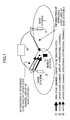
- Fig.1 shows a configuration of a mobile communication system in which a multipath interference canceling method is applied according to an embodiment of the present invention.
- the mobile communication system adopts, for example, CDMA for wireless access.
- the mobile communication system includes a receiving apparatus 10 (which will be called a mobile station hereinafter), a sending apparatus 1 20 (which will be called a base station 1 hereinafter), a sending apparatus 2 21 (which will be called a base station 2 hereinafter), and an upper station (example : wireless circuit control apparatus).
- Each base station 20, 21 sends a plurality of code channels.
- a part of code channels sent from the same base station are orthogonalized by using orthogonal spreading code and other code channels are not orthogonalized.
- all code channels of down-link are basically orthogonalized.
- other code channel groups (2 ⁇ , 3 ⁇ ) sent from the base station 1 20 can be considered to be common channels such as common control channels or communication channels to other carrier.
- Code channels of other base station (base station 2 21 in this case) can be orthogonalized in the same path.
- the code channel from the base station 2 21 can not be orthogonalized to the code channel sent from the base station 1 20 since they are received by the mobile station 10 asynchronously.
- the base station 1 20 and the base station 2 21 send spreading code information to the mobile station 10 as down-link control information for the mobile station 10 to obtain spreading code information of each code channel other than its own channel.
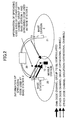
- Fig.2 shows the same configuration as Fig.1 in which the mobile station 10 obtains the spreading code information of each code channel other than the own channel by using a way different from the way shown in Fig.1.
- the base station 2 21 sends its own spreading code information to the base station 1 20 via an upper station, and the base station 1 20 sends spreading code information of the both base stations (base station 1 20 and base station 2 21) to the mobile station 10 as down-link control information.
- the mobile station 10 recognizes spreading codes without information from the base station 1 20.
- the mobile station 10 prepares estimated spreading code candidate beforehand, obtains correlation between received signal and the spreading code candidate.
- the mobile station 10 can recognize spreading code used in other base station by obtaining spreading code having large correlation.
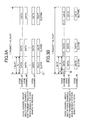
- a sending format of packet data sent from the base station 1 20 is as shown in Figs.3A and 3B, wherein packet data is a sending unit of data, and is obtained by dividing sending data into each constant amount of data.
- Fig.3A shows a sending format example in a case in which a pilot channel is code-multiplexed.
- one packet includes Ns slots, and the pilot signals for estimating channels are code-multiplexed to data channels as a code channel which is spread by a spreading code (1 ⁇ ).
- Fig.3B shows a sending format example in a case in which the pilot channel is time-multiplexed. In this case, the pilot signals are inserted into data signals periodically (for each slot) (2 ⁇ ).
- the pilot channel will be called a common pilot channel (CPICH) since the pilot channel can be also used for channel estimation of other transmission data channels.
- CPICH common pilot channel
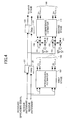
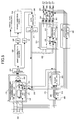
- a receiving apparatus (which will be called an interference canceler hereinafter) to which the receiving process method of the present invention is applied is configured as shown in Fig.4 for example.
- the interference canceler is used for a down-link by which the base station sends data and the mobile station receives the data.
- the interference canceler (first configuration example) includes a plurality of stages of interference estimators 100 and 110, delay lines 121-124, subtractors 150-153, multipliers 140, 141, and interference estimator signal output parts 130, 160.
- I ( p -l) / b,l represents a received spreading signal sequence of lth path (1 ⁇ l ⁇ L) of bth antenna branch (1 ⁇ b ⁇ B) in pth stage (1 ⁇ p ⁇ P) of the interference estimator.
- the received spreading signal sequence will be called a multipath interference replica hereinafter.
- signals received by the receiving antennas #1 and #2 are directly input.
- the interference estimators 100, 110 estimate channels (channel estimation).
- the channel estimation value is updated for each stage (for each interference estimator stage) by using common pilot channel, or, in addition to this, by using decision data modulation and data symbol. Decision of data modulation by using this is also updated.
- the multipath interference replica is updated by using the channel estimation value for each stage. Therefore, as channel estimation accuracy and data decision accuracy improve, generation accuracy of the multipath interference replica improves.
- the configuration and the operation of the interference estimator 100, 110 will be described with reference to Fig.5.
- the first stage interference estimator 100 will be described as an example.
- P/S converter parallel/serial converter
- S/P converter serial/parallel converter
- a multiplier 280 which performs complex conjugate operation between signals of the Rake/antenna diversity combining parts 200, 210 and signals from the data modulator 260 is provided in the interference estimator.
- the Rake/antenna diversity combining part 200 includes despreading parts 201, 202, multipliers 203, 204 and an adder 205.
- the channel estimator 300 includes despreading parts 301. 302, and channel estimators 303, 304.
- the multipath interference replica generator 320 includes spreading parts 321, 322, and multipliers 323, 324.
- An input signal to the despreading part which performs despreading of the 1th path of the bth antenna in the pth stage in the interference estimator in the multipath interference canceler is a signal in which all other multipath interference replicas are subtracted from the received signal.
- a narrow band modulation signal wave form d k (t) and spreading signal modulation wave form c k (t) of kth code channel is represented by the following equations 1 and 2.
- Td indicates a symbol interval
- an Tc indicates a chip interval
- N Td/Tc is SF.
- q 0,1,2,3 ⁇ indicates QPSK spreading modulation by spreading codes in which code channels are orthogonalized by using orthogonal spreading codes.
- g k (i) and ⁇ k (i) indicate data modulation amplitude and phase respectively.
- g k (i) and ⁇ k (i) are represented by the following equations respectively according to the data modulation method.
- a narrow band modulation signal wave form d cpich (t) and a spreading modulation signal wave form c cpich (t) of the common pilot channel can be represented as follows.
- T cpich indicates a symbol interval
- u cpich (t) 1(0) for 0 ⁇ t ⁇ T cpich (otherwise). Since spreading by orthogonal spreading code is performed also for the common pilot channel, code channels in the same path are orthogonalized.
- the sending signals are transmitted in L multipath channels and are received by B receiving antennas.
- a received signal r b (t) at the bth antenna can be represented by (17), wherein ⁇ b,l indicates complex fading envelope of the lth path of the bth antenna, ⁇ l indicates propagation delay of the 1th path.
- n(t) indicates additive Gaussian noise component of one-sided power spectrum densely NO/2.
- a despreading part output of the interference estimator corresponding to the mth symbol of the nth slot for the the 1th path of the bth antenna of the kth code channel in the 1th stage is indicated by the following equation.
- despreading output of the common pilot channel is represented by the following equation. wherein Tslot indicates a slot interval.
- a channel estimation value used for Rake combining in rth time of repeated channel estimation (1 ⁇ r ⁇ R) of the pth stage (1 ⁇ p ⁇ P) is represented by ( p,r ) / b,l ( n ).
- a first stage channel estimation value (l,l) / b,l ( n ) is obtained by the following equation by using the common pilot channel. wherein Ncpich is a symbol number of the common pilot channel included in one slot. That is, by multiplying the received complex signal by complex conjugate of sending complex signal, complex envelop change of channel is obtained.
- Error correction coding is performed for the decoded information data sequence, and the decoded information data sequence is assigned to K code channels by serial/parallel conversion. After that, data modulation is performed so that tentative decision data symbol sequence is reproduced. Then, by multiplying data symbol z (l) / k,b,l ( n,m ) of the despreading part output by complex conjugate of (reverse modulation) so that data modulation component is removed, the data symbol can be used as pseudo-pilot symbol. Thus, channel estimation is performed again by using the KNd pseudo-pilot symbols in addition to the common pilot channel, Rake combining is performed and the tentative data decision value is updated.
- the channel estimation value (l, r +l) / b,l ( n ) obtained after repeating this process r times is represented by
- the first term of the equation (24) indicates a channel estimation value using the common pilot channel
- the second term indicates a channel estimation value in which decision feedback data symbol is regarded as the pseudo-pilot symbol.
- the channel estimation value by decision feedback data is obtained by using weighted mean value according to amplitude.
- w in the equation (24) is a weight coefficient in averaging the channel estimation value by the common pilot channel and the channel estimation value by the decision feedback data symbol. Optimal estimation accuracy can be obtained by using a small value for w when data decision error is large and by using a large value when data decision error is small.
- the interference estimator by using thus obtained channel estimation value (l, R +l) / b,l ( n ) and the tentative decision data symbol sequence (l, R ) / k ( n,m ), the multipath interference replica of the 1th path of the bth antenna can be obtained by a following equation.
- a despreading part input signal of the interference estimator of the 1th path of the bth antenna in the second stage can be represented by the following equation.
- ⁇ is an interference canceling weight coefficient and 0 ⁇ .
- a despreading input signal of the interference estimator of the pth stage (p>2) can be obtained by the following equation by using the multipath interference replicas generated in previous stage.
- each stage for s signal in which the multipath interference replicas are subtracted, channel estimation, tentative decision of data modulation are performed like in the first stage so that the multipath interference replica is updated.
- the multipath interference replica is updated for each stage. Therefore, the multipath interference replica having high accuracy can be used for removing multipath interference of the own channel. Thus, interference canceling of high receiving quality can be realized.
- the interference canceler of the present invention can be easily applied to a sending format shown in Fig.3B (a case where common pilot channels are time-multiplexed).
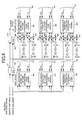
- the multipath interference canceler shown in Fig.6 includes interference estimators 510, 540 of other orthogonal code channel, and interference estimators 520, 550 of other non-orthogonal code channel.
- the multipath interference canceler includes the interference estimators 520, 550 of other non-orthogonal code channel, it is possible to use processing parts of other sending apparatus instead of the interference estimators 520, 550 of other non-orthogonal code channel.
- each interference estimator performs channel estimation and decision of data modulation so that the multipath interference replica is output.
- the multipath interference replica of the own channel is indicated by Î ( p ) / b,l
- the multipath interference replica of other orthogonal channel is indicated by ⁇ ( p ) / b,l
- the multipath interference replica of the other non-orthogonal channel is indicated by ⁇ ( p ) / b,l .
- estimation of the multipath interference replica for each code channel group is performed in parallel for each stage. That is, in the first stage, the multipath interference replica is generated by using the received signal itself. In the second stage, the multipath interference replica is estimated more accurately on the basis of a signal in which the multipath interference replica estimation value of the first stage is subtracted from the received signal.
- the interference estimator in and after the second stage receives a signal obtained by subtracting all other multipath interference replicas generated by the previous stage from the received signal.
- multipath interference replica of the same path is also subtracted from the received signal so that receiving quality improves.
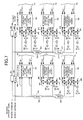
- the configuration example 3 of the interference canceler shown in Fig.7 estimation of the multipath interference replica for each code channel group is performed in series.
- the configuration of this interference canceler is the same as that of Fig.6.
- Interference estimators 700, 730 of the own code channel, interference estimators 710, 740 of other orthogonal code channel, and interference estimators 720, 750 of other non-orthogonal code channel are added.
- the multipath interference canceler includes the interference estimators 720, 750 of other non-orthogonal code channel, it is possible to use possessing parts of other sending apparatus instead of the interference estimators 720, 750 of other non-orthogonal code channel.
- the configuration example 2 or the configuration example 3 is selected according to the circumstances.
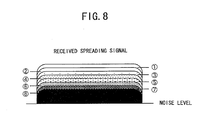
- Fig.8 indicates a case where code channel signals sent from the base stations (base station 1 20 and base station 2 21) are received by the mobile station 10 by using two paths on the basis of Figs.1 and 2, in which the received paths from the base station 1 20 are indicated as path 1 and path 2 and the received paths from the base station 2 21 are indicated as path 3 and path 4. Therefore, received signal at the mobile station 10 is one in which following code channels are multiplexed.
- the mobile station 10 receives the signals of 1 ⁇ -8 ⁇ in the same bandwidth as received spread signals corresponding to the examples of Figs.1 and 2.
- the mobile station 10 performs despreading by using spreading code of code channel desired to be demodulated so that only the code channel is converted into narrow band signal and is demodulated.
- Figs.9A shows a case where the interference canceling method of the present invention is not applied.
- signal component of the same path (1 ⁇ in Fig.8) of the other orthogonal code channels of the base station 1 does not remain in the despreaded signal, however, other received signals ( 2 ⁇ - 8 ⁇ ) remain as interference. Therefore, the receiving quality becomes one according to SIR shown in Fig.9A.
- interference canceler shown in Fig.4 When the interference canceler shown in Fig.4 is applied for performing interference canceling, interference of other multipath ( 2 ⁇ of Fig.8) of the own code channel is removed as shown in Fig.9B.
- the SIR of despread signal becomes larger than that of Fig.9A in which the interference canceling is not performed so that the receiving quality improves.
- interference canceling is performed on the basis of the interference canceler shown Fig.5 or Fig.6, interference estimation is performed for the other orthogonal channels and the other non-orthogonal channels other than the own code channels. Therefore, the effect of interference decreasing becomes as shown in Figs.9C-9E.
- Fig.9C shows a case where interference canceling is performed for the own code channel and the other code channel group (orthogonal channel) of the base station 1 20. In this case, interference signals of 3 ⁇ and 4 ⁇ of Fig.8 are removed.
- Fig.9D shows a case where interference canceling is performed for the own code channel + other code channel group (orthogonal channel) of the base station 1 20 + other code channel group (non-orthogonal channel) of the base station 1 20. In this case, the interference signals of 5 ⁇ and 6 ⁇ shown in Fig.8 are removed.
- Fig.9E shows a case where interference canceling is performed for the own code channel + other code channel group (orthogonal channel) of the base station 1 20 + other code channel group (non-orthogonal channel) of the base station 1 20 + code channel group of the base station 2 21.
- the interference signals from two paths of the code channel of the base station 2 21 are removed, further improvement of the received quality becomes possible as shown in Fig.9E.
- Fig.10 shows the throughput characteristics
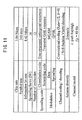
- Fig.11 shows data used for the computer simulation.
- the data for the computer simulation is as follows.
- the information bit rate 8.42Mbps is realized by using 64QAM data modulation in 3.84Mcps chip rate, spreading ratio 16, 12 multicodes, convolutional coding ratio 1/2.
- Fig.10 shows the result of the computer simulation performed by using the data shown in Fig.11.
- the vertical axis indicates throughput (bits/sec)
- the lateral axis indicates average receiving Eb/No(dB) in which Eb/No is signal power to noise power density ratio per 1 information bit.
- the multipath interference replicas are generated on the basis of accurate channel estimation values using decision feedback data after or before error correction (channel coding) decoding of common pilot channels and communication channels in code channels which are spread by orthogonal code sequence and non-orthogonal code sequence, and the multipath interference replicas are removed from the revived signals (multipath interference cancel).
- error correction channel coding
- the multipath interference replicas are removed from the revived signals (multipath interference cancel).
- the channel estimation can be performed without the decision feedback data.
- the function of the interference canceler corresponds to the other channel multipath interference canceling part, the own channel multipath interference canceling part and the subtracting part.
- the function of the interference estimator in the interference canceler corresponds to the data modulation estimation part, the channel estimation part, multiplier, received spreading signal sequence generation part, the data modulation estimation updating part, channel estimation updating part, the received spreading code sequence updating part and the data demodulation part.
- the function of interference estimator of the interference canceler corresponds to the first to third channel variation estimation part, the data modulation decision updating part, the channel variation estimation updating part, the same estimation value application part, the coherent detection part, the first and second data modulation estimation part, the original information data sequence estimation part and data modulation estimation adaptive switching part.
- received quality can be largely improved in multipath environment by generating multipath interference which largely degrade received quality and by subtracting the multipath interference from the received signals.
- a receiving apparatus which can cancel multipath interference even when performing ultrahigh-speed data transmission in multipath environment can be provided.
Landscapes
- Engineering & Computer Science (AREA)
- Computer Networks & Wireless Communication (AREA)
- Signal Processing (AREA)
- Mobile Radio Communication Systems (AREA)
- Radio Transmission System (AREA)
Applications Claiming Priority (3)
| Application Number | Priority Date | Filing Date | Title |
|---|---|---|---|
| JP2001024557A JP2002232397A (ja) | 2001-01-31 | 2001-01-31 | 移動通信システムにおける受信処理方法及び受信装置 |
| JP2001024557 | 2001-01-31 | ||
| US10/058,382 US7333420B2 (en) | 2001-01-31 | 2002-01-30 | Receiving process method and receiving apparatus in mobile communication system |
Publications (3)
| Publication Number | Publication Date |
|---|---|
| EP1229668A2 true EP1229668A2 (fr) | 2002-08-07 |
| EP1229668A3 EP1229668A3 (fr) | 2005-03-23 |
| EP1229668B1 EP1229668B1 (fr) | 2010-05-26 |
Family
ID=29252800
Family Applications (1)
| Application Number | Title | Priority Date | Filing Date |
|---|---|---|---|
| EP20020250647 Expired - Lifetime EP1229668B1 (fr) | 2001-01-31 | 2002-01-30 | Procedé et dispositif de réception dans un système de communications mobile |
Country Status (6)
| Country | Link |
|---|---|
| US (1) | US7333420B2 (fr) |
| EP (1) | EP1229668B1 (fr) |
| JP (1) | JP2002232397A (fr) |
| CN (1) | CN1172472C (fr) |
| AU (1) | AU762238B2 (fr) |
| CA (1) | CA2369863C (fr) |
Cited By (15)
| Publication number | Priority date | Publication date | Assignee | Title |
|---|---|---|---|---|
| EP1526650A3 (fr) * | 2003-10-24 | 2005-06-08 | Samsung Electronics Co., Ltd. | Appareil et procédé pour l'élimination des interferences par trajets multiples dans un système de communication mobile |
| WO2006072088A1 (fr) * | 2004-12-23 | 2006-07-06 | Qualcomm Incorporated | Estimation de canal pour annulation de brouillage |
| US7116998B2 (en) | 2003-05-14 | 2006-10-03 | Telefonaktiebolaget L M Ericsson (Publ) | Subtractive multipath delay detection |
| WO2007016553A1 (fr) * | 2005-08-01 | 2007-02-08 | Qualcomm Incorporated | Annulation de brouillage dans des communications sans fil |
| WO2007021952A3 (fr) * | 2005-08-12 | 2007-04-12 | Qualcomm Inc | Estimation de canal pour communication sans fil |
| US7239677B2 (en) | 2003-04-29 | 2007-07-03 | Telefonaktiebolaget L M Ericsson (Publ) | Method and apparatus for soft symbol scaling |
| US7400692B2 (en) | 2004-01-14 | 2008-07-15 | Interdigital Technology Corporation | Telescoping window based equalization |
| US7437135B2 (en) | 2003-10-30 | 2008-10-14 | Interdigital Technology Corporation | Joint channel equalizer interference canceller advanced receiver |
| WO2009096876A2 (fr) | 2008-01-31 | 2009-08-06 | Telefonaktiebolaget L M Ericsson (Publ) | Estimation de canaux pour une transmission à haut débit utilisant plusieurs canaux de commande |
| WO2009107079A1 (fr) * | 2008-02-25 | 2009-09-03 | Nxp B.V. | Système et procédé pour une détection de constellation pour une détection combinée par une annulation d'interférence |
| CN1788444B (zh) * | 2003-03-13 | 2010-04-28 | 高通股份有限公司 | 通信系统中的数据传输的方法和系统 |
| US8385388B2 (en) | 2005-12-06 | 2013-02-26 | Qualcomm Incorporated | Method and system for signal reconstruction from spatially and temporally correlated received samples |
| US8472877B2 (en) | 2005-10-24 | 2013-06-25 | Qualcomm Incorporated | Iterative interference cancellation system and method |
| US8644264B2 (en) | 2001-06-06 | 2014-02-04 | Qualcomm Incorporated | Method and apparatus for canceling pilot interference in a wireless communication system |
| EP2606619A4 (fr) * | 2010-08-20 | 2015-06-24 | Univ Texas | Insertion et décodage de symboles de données dupliquées dans des communications sans fil |
Families Citing this family (28)
| Publication number | Priority date | Publication date | Assignee | Title |
|---|---|---|---|---|
| US7190749B2 (en) * | 2001-06-06 | 2007-03-13 | Qualcomm Incorporated | Method and apparatus for canceling pilot interference in a wireless communication system |
| US7327809B2 (en) * | 2001-06-08 | 2008-02-05 | Broadcom Corporation | Channel equalization with SCDMA modulation |
| CA2474662A1 (fr) * | 2002-01-31 | 2003-08-07 | Seabury Analytic Llc | Procede et modele d'evaluation de risque dans une entreprise |
| GB2386038A (en) * | 2002-02-27 | 2003-09-03 | Motorola Inc | Channel estimation in a radio receiver |
| JP2003309875A (ja) * | 2002-04-16 | 2003-10-31 | Ntt Docomo Inc | 移動通信システム、無線制御局、基地局、移動局および移動通信システムにおける無線リソースの割当制御方法 |
| US7075972B2 (en) * | 2002-08-19 | 2006-07-11 | Mitsubishi Electric Research Laboratories, Inc. | Intra-cell interference cancellation in a W-CDMA communications network |
| CN100579309C (zh) * | 2002-08-23 | 2010-01-06 | 松下电器产业株式会社 | Ofdm-cdma发送装置和ofdm-cdma发送方法 |
| US6957175B2 (en) * | 2002-11-08 | 2005-10-18 | Interdigital Technology Corporation | Method and apparatus for determining signal-to-interference ratio with reduced bias effect |
| US7257377B2 (en) | 2003-02-18 | 2007-08-14 | Qualcomm, Incorporated | Systems and methods for improving channel estimation |
| US7272176B2 (en) * | 2003-02-18 | 2007-09-18 | Qualcomm Incorporated | Communication receiver with an adaptive equalizer |
| US7254158B2 (en) * | 2003-05-12 | 2007-08-07 | Qualcomm Incorporated | Soft handoff with interference cancellation in a wireless frequency hopping communication system |
| US7684372B2 (en) | 2004-05-04 | 2010-03-23 | Ipwireless, Inc. | Signaling MIMO allocations |
| JP4744965B2 (ja) | 2004-08-09 | 2011-08-10 | パナソニック株式会社 | 無線通信装置 |
| US7643839B2 (en) * | 2004-10-06 | 2010-01-05 | Broadcom Corporation | Method and system for diversity processing |
| US8099123B2 (en) * | 2004-12-23 | 2012-01-17 | Qualcomm Incorporated | Adaptation of transmit subchannel gains in a system with interference cancellation |
| US8406695B2 (en) * | 2004-12-23 | 2013-03-26 | Qualcomm Incorporated | Joint interference cancellation of pilot, overhead and traffic channels |
| US8442441B2 (en) | 2004-12-23 | 2013-05-14 | Qualcomm Incorporated | Traffic interference cancellation |
| US20070030914A1 (en) * | 2005-08-02 | 2007-02-08 | Samsung Electronics Co., Ltd. | Method and system for channel estimation and interference cancellation in an orthogonal frequency division multiple access network |
| US8781043B2 (en) | 2006-11-15 | 2014-07-15 | Qualcomm Incorporated | Successive equalization and cancellation and successive mini multi-user detection for wireless communication |
| KR100906127B1 (ko) * | 2007-07-25 | 2009-07-07 | (주)에어포인트 | 일체형 적응형 귀환 예측 소거기 및 그 방법과 그를 이용한시분할 이중화 무선중계 장치 |
| US8249540B1 (en) | 2008-08-07 | 2012-08-21 | Hypres, Inc. | Two stage radio frequency interference cancellation system and method |
| CN101345567B (zh) * | 2008-08-21 | 2012-10-10 | 成都九洲电子信息系统股份有限公司 | 基于同步序列的分集接收方法及装置 |
| JP4889756B2 (ja) * | 2009-03-03 | 2012-03-07 | ソフトバンクモバイル株式会社 | 無線アクセスシステム及び移動局装置 |
| JP5596168B2 (ja) * | 2009-11-27 | 2014-09-24 | クゥアルコム・インコーポレイテッド | 非直交チャネルセットのための干渉除去 |
| WO2014139550A1 (fr) * | 2013-03-11 | 2014-09-18 | Huawei Technologies Co., Ltd. | Procédé itératif d'annulation d'interférence |
| CN107079463B (zh) * | 2014-11-04 | 2021-10-12 | 瑞典爱立信有限公司 | 向通信设备分配部分重叠的资源 |
| JP6817945B2 (ja) * | 2015-08-31 | 2021-01-20 | 株式会社Nttドコモ | ユーザ端末、無線基地局及び無線通信方法 |
| CN118337573B (zh) * | 2024-04-24 | 2026-01-30 | 中国科学院国家授时中心 | 一种广义码分复用调制及解调方法 |
Citations (2)
| Publication number | Priority date | Publication date | Assignee | Title |
|---|---|---|---|---|
| WO1997021294A2 (fr) | 1995-12-04 | 1997-06-12 | Aironet Wireless Communications, Inc. | Systeme de communication cellulaire avec parametres de transmission de donnees dynamiquement modifies |
| EP0810742A2 (fr) | 1996-05-30 | 1997-12-03 | Ntt Mobile Communications Network Inc. | Procédé de transmission à accès multiple par division de code en séquence directe utilisant des symboles pilotes |
Family Cites Families (18)
| Publication number | Priority date | Publication date | Assignee | Title |
|---|---|---|---|---|
| US5103459B1 (en) * | 1990-06-25 | 1999-07-06 | Qualcomm Inc | System and method for generating signal waveforms in a cdma cellular telephone system |
| US5103495A (en) * | 1991-04-11 | 1992-04-07 | The United States Of America As Represented By The Secretary Of The Air Force | Partitioned optical delay line architecture for time steering of large 1-D array antennas |
| US5553062A (en) * | 1993-04-22 | 1996-09-03 | Interdigital Communication Corporation | Spread spectrum CDMA interference canceler system and method |
| JP2570967B2 (ja) * | 1993-07-08 | 1997-01-16 | 日本電気株式会社 | Cdma受信機 |
| JP2655092B2 (ja) | 1994-08-11 | 1997-09-17 | 日本電気株式会社 | 符号分割多重式受信機 |
| JPH08335928A (ja) | 1995-06-07 | 1996-12-17 | Oki Electric Ind Co Ltd | 受信装置 |
| US5764687A (en) * | 1995-06-20 | 1998-06-09 | Qualcomm Incorporated | Mobile demodulator architecture for a spread spectrum multiple access communication system |
| JP3483991B2 (ja) * | 1995-07-27 | 2004-01-06 | 沖電気工業株式会社 | 符号分割多重アクセス通信用拡散符号発生器、符号分割多重アクセス通信システム及び符号分割多重アクセス通信用拡散符号発生方法 |
| JP2743912B2 (ja) | 1996-05-30 | 1998-04-28 | 日本電気株式会社 | Cdma干渉除去装置 |
| US6067292A (en) * | 1996-08-20 | 2000-05-23 | Lucent Technologies Inc | Pilot interference cancellation for a coherent wireless code division multiple access receiver |
| US5787130A (en) * | 1996-12-10 | 1998-07-28 | Motorola Inc. | Method and apparatus for canceling interference in a spread-spectrum communication system |
| IL120538A (en) * | 1997-03-26 | 2000-11-21 | Dspc Tech Ltd | Method and apparatus for reducing spread-spectrum noise |
| US6075793A (en) * | 1998-02-06 | 2000-06-13 | Golden Bridge Technology, Inc. | High efficiency spread spectrum system and method |
| KR100318959B1 (ko) * | 1998-07-07 | 2002-04-22 | 윤종용 | 부호분할다중접속통신시스템의서로다른부호간의간섭을제거하는장치및방법 |
| JP3160590B2 (ja) | 1999-06-14 | 2001-04-25 | 株式会社ワイ・アール・ピー移動通信基盤技術研究所 | 直接拡散受信装置および直接拡散送信装置 |
| JP3160591B2 (ja) | 1999-06-14 | 2001-04-25 | 株式会社ワイ・アール・ピー移動通信基盤技術研究所 | 直接拡散受信装置および直接拡散送信装置 |
| JP3153531B2 (ja) | 1999-06-14 | 2001-04-09 | 株式会社ワイ・アール・ピー移動通信基盤技術研究所 | 直接拡散受信装置 |
| US6917642B1 (en) * | 2000-02-23 | 2005-07-12 | Ipr Licensing, Inc. | Method for using a non-orthogonal pilot signal with data channel interference cancellation |
-
2001
- 2001-01-31 JP JP2001024557A patent/JP2002232397A/ja active Pending
-
2002
- 2002-01-30 US US10/058,382 patent/US7333420B2/en not_active Expired - Fee Related
- 2002-01-30 CA CA 2369863 patent/CA2369863C/fr not_active Expired - Fee Related
- 2002-01-30 EP EP20020250647 patent/EP1229668B1/fr not_active Expired - Lifetime
- 2002-01-31 CN CNB021031312A patent/CN1172472C/zh not_active Expired - Fee Related
- 2002-01-31 AU AU14732/02A patent/AU762238B2/en not_active Ceased
Patent Citations (2)
| Publication number | Priority date | Publication date | Assignee | Title |
|---|---|---|---|---|
| WO1997021294A2 (fr) | 1995-12-04 | 1997-06-12 | Aironet Wireless Communications, Inc. | Systeme de communication cellulaire avec parametres de transmission de donnees dynamiquement modifies |
| EP0810742A2 (fr) | 1996-05-30 | 1997-12-03 | Ntt Mobile Communications Network Inc. | Procédé de transmission à accès multiple par division de code en séquence directe utilisant des symboles pilotes |
Non-Patent Citations (1)
| Title |
|---|
| SU IL KIM ET AL.: "Performance improvement of RAKE receiver for a multicode DS-CDMA system with multistage interference cancellation detectors", PROCEEDINGS OF THE IEEE REGION 10 CONFERENCE CHEJU ISLAND, vol. 1, 15 September 1999 (1999-09-15), pages 573 - 576 |
Cited By (25)
| Publication number | Priority date | Publication date | Assignee | Title |
|---|---|---|---|---|
| US8644264B2 (en) | 2001-06-06 | 2014-02-04 | Qualcomm Incorporated | Method and apparatus for canceling pilot interference in a wireless communication system |
| CN1788444B (zh) * | 2003-03-13 | 2010-04-28 | 高通股份有限公司 | 通信系统中的数据传输的方法和系统 |
| US7239677B2 (en) | 2003-04-29 | 2007-07-03 | Telefonaktiebolaget L M Ericsson (Publ) | Method and apparatus for soft symbol scaling |
| US7116998B2 (en) | 2003-05-14 | 2006-10-03 | Telefonaktiebolaget L M Ericsson (Publ) | Subtractive multipath delay detection |
| EP1526650A3 (fr) * | 2003-10-24 | 2005-06-08 | Samsung Electronics Co., Ltd. | Appareil et procédé pour l'élimination des interferences par trajets multiples dans un système de communication mobile |
| US7437135B2 (en) | 2003-10-30 | 2008-10-14 | Interdigital Technology Corporation | Joint channel equalizer interference canceller advanced receiver |
| US7400692B2 (en) | 2004-01-14 | 2008-07-15 | Interdigital Technology Corporation | Telescoping window based equalization |
| AU2005321821B2 (en) * | 2004-12-23 | 2010-05-27 | Qualcomm Incorporated | Channel estimation for interference cancellation |
| US8422955B2 (en) * | 2004-12-23 | 2013-04-16 | Qualcomm Incorporated | Channel estimation for interference cancellation |
| WO2006072088A1 (fr) * | 2004-12-23 | 2006-07-06 | Qualcomm Incorporated | Estimation de canal pour annulation de brouillage |
| EP2204916A1 (fr) * | 2004-12-23 | 2010-07-07 | Qualcom Incorporated | Estimation de canal pour une annulation d'interférence |
| WO2007016553A1 (fr) * | 2005-08-01 | 2007-02-08 | Qualcomm Incorporated | Annulation de brouillage dans des communications sans fil |
| US8493942B2 (en) | 2005-08-01 | 2013-07-23 | Qualcomm Incorporated | Interference cancellation in wireless communication |
| US8625656B2 (en) | 2005-08-12 | 2014-01-07 | Qualcomm Incorporated | Channel estimation for wireless communication |
| WO2007021952A3 (fr) * | 2005-08-12 | 2007-04-12 | Qualcomm Inc | Estimation de canal pour communication sans fil |
| US8165186B2 (en) | 2005-08-12 | 2012-04-24 | Qualcomm Incorporated | Channel estimation for wireless communication |
| US8437380B2 (en) | 2005-08-12 | 2013-05-07 | Qualcomm Incorporated | Channel estimation for wireless communication |
| EP2273742A3 (fr) * | 2005-08-12 | 2013-03-06 | Qualcomm Incorporated | Estimation de canal pour communication sans fil |
| US8472877B2 (en) | 2005-10-24 | 2013-06-25 | Qualcomm Incorporated | Iterative interference cancellation system and method |
| US8385388B2 (en) | 2005-12-06 | 2013-02-26 | Qualcomm Incorporated | Method and system for signal reconstruction from spatially and temporally correlated received samples |
| WO2009096876A2 (fr) | 2008-01-31 | 2009-08-06 | Telefonaktiebolaget L M Ericsson (Publ) | Estimation de canaux pour une transmission à haut débit utilisant plusieurs canaux de commande |
| US8094701B2 (en) | 2008-01-31 | 2012-01-10 | Telefonaktiebolaget Lm Ericsson (Publ) | Channel estimation for high data rate transmission using multiple control channels |
| WO2009096876A3 (fr) * | 2008-01-31 | 2009-09-24 | Telefonaktiebolaget L M Ericsson (Publ) | Estimation de canaux pour une transmission à haut débit utilisant plusieurs canaux de commande |
| WO2009107079A1 (fr) * | 2008-02-25 | 2009-09-03 | Nxp B.V. | Système et procédé pour une détection de constellation pour une détection combinée par une annulation d'interférence |
| EP2606619A4 (fr) * | 2010-08-20 | 2015-06-24 | Univ Texas | Insertion et décodage de symboles de données dupliquées dans des communications sans fil |
Also Published As
| Publication number | Publication date |
|---|---|
| EP1229668A3 (fr) | 2005-03-23 |
| JP2002232397A (ja) | 2002-08-16 |
| AU762238B2 (en) | 2003-06-19 |
| US7333420B2 (en) | 2008-02-19 |
| EP1229668B1 (fr) | 2010-05-26 |
| CA2369863C (fr) | 2008-12-09 |
| CN1172472C (zh) | 2004-10-20 |
| CN1369981A (zh) | 2002-09-18 |
| AU1473202A (en) | 2002-08-01 |
| CA2369863A1 (fr) | 2002-07-31 |
| US20030142655A1 (en) | 2003-07-31 |
Similar Documents
| Publication | Publication Date | Title |
|---|---|---|
| US7333420B2 (en) | Receiving process method and receiving apparatus in mobile communication system | |
| US7313167B2 (en) | Signal-to-noise ratio estimation of CDMA signals | |
| US6215814B1 (en) | RAKE receiver | |
| JP3786422B2 (ja) | 符号化通信信号を識別する方法および装置 | |
| US6529545B2 (en) | Rake receiver | |
| AU697493B2 (en) | A direct sequence CDMA coherent uplink detector | |
| EP1263179B1 (fr) | Estimation de canal dans un système CDMA utilisant des symboles de service codés comme symboles pilotes supplémentaires | |
| US7697594B2 (en) | Method and apparatus for regenerative based interference cancellation within a communication system | |
| JP2000196522A (ja) | 制御信号を発生する装置および方法 | |
| CN101119130A (zh) | 在无线通信系统中的自适应信道估计 | |
| US20040042537A1 (en) | Spread spectrum receiver apparatus and method | |
| WO2002019577A1 (fr) | Recepteur rake pour communications sans fil amcr | |
| WO2002003561A1 (fr) | Recepteur et procede de reception d'un signal cdma (acces multiple a repartition par codes) en presence de parasites a facteurs d'etalement inconnus | |
| US7746917B2 (en) | Data transmission method and receiver | |
| EP1437838A1 (fr) | Procédé et dispositif de réception radio | |
| US7376195B2 (en) | Digital communication systems having decreased memory | |
| CA2484277C (fr) | Methode de processus de reception et apparaillage de reception dans un systeme de communication du service mobile | |
| AU2003203918B2 (en) | Receiving Process Method and Receiving Apparatus in Mobile Communication System | |
| KR100448446B1 (ko) | 이동통신시스템에서 수신처리방법 및 수신장치 |
Legal Events
| Date | Code | Title | Description |
|---|---|---|---|
| PUAI | Public reference made under article 153(3) epc to a published international application that has entered the european phase |
Free format text: ORIGINAL CODE: 0009012 |
|
| 17P | Request for examination filed |
Effective date: 20020130 |
|
| AK | Designated contracting states |
Kind code of ref document: A2 Designated state(s): AT BE CH CY DE DK ES FI FR GB GR IE IT LI LU MC NL PT SE TR |
|
| AX | Request for extension of the european patent |
Free format text: AL;LT;LV;MK;RO;SI |
|
| RIN1 | Information on inventor provided before grant (corrected) |
Inventor name: HIGUCHI, KENICHI Inventor name: SAWAHASHI, MAMORU |
|
| PUAL | Search report despatched |
Free format text: ORIGINAL CODE: 0009013 |
|
| AK | Designated contracting states |
Kind code of ref document: A3 Designated state(s): AT BE CH CY DE DK ES FI FR GB GR IE IT LI LU MC NL PT SE TR |
|
| AX | Request for extension of the european patent |
Extension state: AL LT LV MK RO SI |
|
| AKX | Designation fees paid |
Designated state(s): DE FR GB IT |
|
| 17Q | First examination report despatched |
Effective date: 20071008 |
|
| GRAP | Despatch of communication of intention to grant a patent |
Free format text: ORIGINAL CODE: EPIDOSNIGR1 |
|
| GRAS | Grant fee paid |
Free format text: ORIGINAL CODE: EPIDOSNIGR3 |
|
| GRAA | (expected) grant |
Free format text: ORIGINAL CODE: 0009210 |
|
| AK | Designated contracting states |
Kind code of ref document: B1 Designated state(s): DE FR GB IT |
|
| REG | Reference to a national code |
Ref country code: GB Ref legal event code: FG4D |
|
| REF | Corresponds to: |
Ref document number: 60236473 Country of ref document: DE Date of ref document: 20100708 Kind code of ref document: P |
|
| PLBE | No opposition filed within time limit |
Free format text: ORIGINAL CODE: 0009261 |
|
| STAA | Information on the status of an ep patent application or granted ep patent |
Free format text: STATUS: NO OPPOSITION FILED WITHIN TIME LIMIT |
|
| 26N | No opposition filed |
Effective date: 20110301 |
|
| REG | Reference to a national code |
Ref country code: DE Ref legal event code: R097 Ref document number: 60236473 Country of ref document: DE Effective date: 20110228 |
|
| PGFP | Annual fee paid to national office [announced via postgrant information from national office to epo] |
Ref country code: IT Payment date: 20120117 Year of fee payment: 11 |
|
| PGFP | Annual fee paid to national office [announced via postgrant information from national office to epo] |
Ref country code: GB Payment date: 20130130 Year of fee payment: 12 Ref country code: DE Payment date: 20130123 Year of fee payment: 12 Ref country code: FR Payment date: 20130204 Year of fee payment: 12 |
|
| REG | Reference to a national code |
Ref country code: DE Ref legal event code: R119 Ref document number: 60236473 Country of ref document: DE |
|
| GBPC | Gb: european patent ceased through non-payment of renewal fee |
Effective date: 20140130 |
|
| REG | Reference to a national code |
Ref country code: DE Ref legal event code: R119 Ref document number: 60236473 Country of ref document: DE Effective date: 20140801 |
|
| PG25 | Lapsed in a contracting state [announced via postgrant information from national office to epo] |
Ref country code: DE Free format text: LAPSE BECAUSE OF NON-PAYMENT OF DUE FEES Effective date: 20140801 |
|
| REG | Reference to a national code |
Ref country code: FR Ref legal event code: ST Effective date: 20140930 |
|
| PG25 | Lapsed in a contracting state [announced via postgrant information from national office to epo] |
Ref country code: GB Free format text: LAPSE BECAUSE OF NON-PAYMENT OF DUE FEES Effective date: 20140130 Ref country code: FR Free format text: LAPSE BECAUSE OF NON-PAYMENT OF DUE FEES Effective date: 20140131 |
|
| PG25 | Lapsed in a contracting state [announced via postgrant information from national office to epo] |
Ref country code: IT Free format text: LAPSE BECAUSE OF NON-PAYMENT OF DUE FEES Effective date: 20140130 |
|
| P01 | Opt-out of the competence of the unified patent court (upc) registered |
Effective date: 20230520 |