EP1229671A2 - Appareil et méthode d'allocation d'intervalles temporelles, mémoires et programmes, système de communication mobile et méthode d'opération - Google Patents
Appareil et méthode d'allocation d'intervalles temporelles, mémoires et programmes, système de communication mobile et méthode d'opération Download PDFInfo
- Publication number
- EP1229671A2 EP1229671A2 EP02002631A EP02002631A EP1229671A2 EP 1229671 A2 EP1229671 A2 EP 1229671A2 EP 02002631 A EP02002631 A EP 02002631A EP 02002631 A EP02002631 A EP 02002631A EP 1229671 A2 EP1229671 A2 EP 1229671A2
- Authority
- EP
- European Patent Office
- Prior art keywords
- mobile station
- time slot
- area
- allocating
- allocated
- Prior art date
- Legal status (The legal status is an assumption and is not a legal conclusion. Google has not performed a legal analysis and makes no representation as to the accuracy of the status listed.)
- Withdrawn
Links
Images



Classifications
-
- H—ELECTRICITY
- H04—ELECTRIC COMMUNICATION TECHNIQUE
- H04B—TRANSMISSION
- H04B7/00—Radio transmission systems, i.e. using radiation field
- H04B7/24—Radio transmission systems, i.e. using radiation field for communication between two or more posts
- H04B7/26—Radio transmission systems, i.e. using radiation field for communication between two or more posts at least one of which is mobile
- H04B7/2643—Radio transmission systems, i.e. using radiation field for communication between two or more posts at least one of which is mobile using time-division multiple access [TDMA]
-
- H—ELECTRICITY
- H04—ELECTRIC COMMUNICATION TECHNIQUE
- H04W—WIRELESS COMMUNICATION NETWORKS
- H04W72/00—Local resource management
- H04W72/04—Wireless resource allocation
- H04W72/044—Wireless resource allocation based on the type of the allocated resource
- H04W72/0446—Resources in time domain, e.g. slots or frames
Definitions
- the present invention relates to time slot allocating apparatus, a time slot allocating method thereof, memories and programs, a mobile communication system and operating method, more particularly, to time slot allocating apparatus, a time slot allocating method thereof, memories and programs, a mobile communication system and operating method in a scheme applying a common frequency band to sending and receiving operations, for example, like the TDD (Time Division Duplex) scheme.
- TDD Time Division Duplex
- the TDD scheme is one of communication systems and is a scheme that substantiates two-way communications by allocating a common frequency to up and down links in time division.
- the same frequency band is used for sending and receiving operations.
- the frequency selective fading can be predicted from received signals.
- the TDD scheme is also commonly used, for example, in CDMA (Code Division Multiple Access) in the mobile communication field.
- Fig. 9 shows a configuration of an example of a frame in the IMT-2000 CDMA-TDD scheme.
- the number of time slots allocated to uplinks and downlinks, and positions thereof are preliminarily set respectively.
- the number of time slots is 15.
- the positions of the time slots are indicated by time slot numbers of #1 to #15.
- DL represents a time slot allocated to a downlink, and UL a time slot allocated to an uplink.
- the time slots in the first half of the frame all are the DLs (downlinks), and the time slots in the second half all the ULs (uplinks).
- there is one switching point between ULs and DLs but there are also cases of two or more switching points.
- a vacant spreading code is allocated among spreading codes in the time slot in consideration of an interference level and others in the time slot.
- Fig. 10 is a diagram showing a conventional example of adjacent cell 1 and cell 2.
- a base station BS1 for the cell 1 there are a base station BS1 for the cell 1, a time slot allocating unit for the cell 1, not shown, and a mobile station MS1 under communications with the base station BS1.
- a base station BS2 for the cell 2 there are a base station BS2 for the cell 2, a time slot allocating unit for the cell 2, not shown, and a mobile station MS2 under communications with the base station BS2.
- the frame configurations of cell 1 and cell 2 are identical with each other. Therefore, while the time slots of uplinks are used in the cell 1, the time slots of uplinks are also used in the cell 2; while the time slots of downlinks are used in the cell 1, the time slots of downlinks are also used in the cell 2.
- the frame configurations are identical with each other means that the number of time slots of uplinks and positions thereof, and the number of time slots of downlinks and positions thereof are identical between the frames.
- the frame configurations of cell 1 and cell 2 both are the one as shown in Fig. 9.
- the system herein refers to a system consisting of a plurality of base stations under control of a certain radio network control device, or a system consisting of a plurality of base stations under control of plural radio network control devices.
- Slow DCA Dynamic Channel Allocation
- Fig. 11 is a diagram showing an example where a common time slot number is allocated to an uplink and a downlink in adjacent cell 1 and cell 2.
- a time slot of an uplink is allocated to the mobile station MS1 under communications with the base station BS1 in the cell 1, and a time slot of a downlink to the mobile station MS2 under communications with the base station BS2 in the cell 2.
- the mobile station MS2 using the downlink is affected by interfering waves from the mobile station MS1 using the uplink. If the quality of communications is deteriorated by the power of the interfering waves or the like, there can occur trouble in the communications of the mobile station MS2.
- the practice heretofore was to avoid such allocation that when a time slot of an up(down)link is allocated to a mobile station in a certain cell, a time slot of a down(up)link having the same time slot number as that of the time slot is allocated to a mobile station in an adjacent cell.
- An object of the present invention is to provide time slot allocating apparatus, a time slot allocating method thereof, memories and programs, a mobile communication system and operating method.
- the present invention provides time slot allocating apparatus in a scheme applying a common frequency band to up/downlinks and using the frequency band in a first area and a second area, the time slot allocating apparatus being located in the respective areas, the apparatus comprising:
- the utilization efficiency of links can be enhanced in such a way that when a certain time slot is allocated to either one link of up/downlinks for the first mobile station, a time slot having the same time slot number as that of the allocated time slot is used for the other link in another area.
- the second time slot is a time slot of a downlink; when the first time slot is a time slot of a downlink, the second time slot is a time slot of an uplink.
- the first area and the second area are minimum units for allocation of time slots in the common frame, which refer, for example, to cells, micro cells, or sectors.
- the application of the common frequency band to sending and receiving operations refers, for example, to the TDD scheme.
- the scheme applying the common frequency band to sending and receiving operations and using the common frequency band in the first area and the second area adjacent to each other refers, for example, to the CDMA-TDD scheme.
- a specific means functioning as the time slot allocating means to the second mobile station can be, for example, a time slot management section in embodiments of the present invention.
- the time slot allocating apparatus can be configured to further comprise:
- the deterioration of the communication quality caused by interference with the first mobile station and the second mobile station is estimated and it is determined whether the second time slot is to be allocated to the second mobile station. That is, when the first mobile station is at the prescribed distance from the second mobile station, it is estimated that the interference level is low or there is no interference. Thus, in such cases the second time slot is allocated to the second mobile station. Against such cases, when the first mobile station is not at the prescribed distance from the second mobile station, it is estimated that the interference level is high. Thus, in this case the second time slot is not allocated to the second mobile station. When the interference level is high, the communication quality is deteriorated and the second time slot allocating is fruitless.
- the present invention when it is estimated that the interference level is high, the second time slot is not allocated to the second mobile station.
- the present invention can prevent fruitless allocation of the second time slot.
- a specific means functioning as the means for accepting the allocation request to the second mobile station can be, for example, the time slot management section in the embodiments of the invention.
- the means for performing the estimation of the interference level can be, for example, an interference estimation section in the embodiment of the invention.
- the above configurations can be applied to programs and memories storing the programs and further to a mobile communication system including the foregoing time slot allocating apparatus and operation of the system.
- Fig. 1 is a diagram showing the whole of mobile communication system 1 according to the present embodiment.
- the mobile communication system 1 is placed in cell 1 and cell 2 adjacent thereto.
- the mobile communication system 1 is provided with a base station BS1 for the cell 1, a time slot allocating unit for the cell 1, not shown, a mobile station MS1 located in the cell 1, a base station BS2 for the cell 2, a time slot allocating unit for the cell 2, not shown, and mobile stations MS2 (MS2-1, MS2-2) located in the cell 2.
- the time slot allocating units are placed separately from and independently of the base stations BS, but may be placed in the base stations BS.
- the time slot allocating units may be placed in the radio network controller RNC that collectively controls the plural base stations.
- the cell 1 is an example of the first area and the cell 2 an example of the second area.
- the cells may be replaced by micro cells or sectors.
- Fig. 2 shows part of cells in the present embodiment, in which a service area is constructed by spreading many cells over the area.
- Each cell includes a time slot allocating unit for each cell. It is noted that in the present invention the numbers of cells, base stations, and mobile stations are not limited to those in Fig. 1.
- the adjacent cell may be each cell in a partially overlapping state of two cells, as shown in Fig. 1, or each cell in a partially overlapping state of three or more cells.
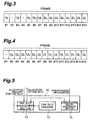
- Fig. 3 shows a configuration of an example of a frame allocated to the cell 2 and Fig. 4 a configuration of an example of a frame allocated to the cell 1.
- Predetermined time slots are allocated to the frames of Fig. 3 and Fig. 4.
- Positions of the time slots are represented by time slot numbers of #1 to #15.
- DL represents a time slot allocated to a downlink
- UL a time slot allocated to an uplink.
- "-" (hyphen) indicates that no time slot is allocated. Since the present embodiment is of the CDMA scheme, a time slot can be allocated to plural users by spreading with a plurality of different spreading codes in each time slot.
- Fig. 5 is a block diagram of the time slot allocating unit in the first embodiment.
- the time slot allocating unit 10 is placed separately from the base station BS2 in the cell 2.
- the time slot allocating apparatus placed in the other cells also has the structure similar to that of the time slot allocating unit 10.
- the time slot allocating unit 10 is provided with a time slot management section 11, a time slot database 13, and a communication quality management section 15.
- the time slot management section 11 manages the time slots of the mobile stations MS2 in the cell 2, e.g., those of the mobile stations MS2-1, MS2-2.
- the mobile stations MS2-1, MS2-2 are collectively described as "mobile station MS2".
- the time slot management section 11 performs a process of allocating a time slot to a mobile station MS2, based on a time slot allocation request from the mobile station MS2.
- the time slot database 13 stores time slot data.
- the time slot management section 11 when the time slot management section 11 accepts an allocation request for a time slot, the time slot management section 11 consults the time slot data in the time slot database 13 to search for an available spreading code in the time slot requested by the allocation request. If there is one the time slot management section 11 allocates it to the mobile station MS2.
- the communication quality management section 15 is informed, for example, of information necessary for a judgment on the deterioration of quality of communications, e.g., interference information by the mobile station MS2.
- the mobile station MS2 measures the power of interfering waves and results in judging that the interference level such as the interference power or the like is high enough to cause trouble in communications, it informs the communication quality management section 15 of the interference information. Namely, when the interference level to the mobile station MS2 is high, the interference information is informed of.
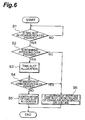
- the operation of the first embodiment starts from a state in which a time slot of an uplink (UL) is allocated to the mobile station MS1 (Fig. 1). It is then determined whether a mobile station MS2 in the cell 2 has issued an allocation request for a time slot of a downlink (DL) having the same time slot number as that of the foregoing uplink, to the time slot allocating unit 10 placed separately from the base station BS2 in the cell 2 (step S1). With no request, the flow returns to step S1. With a request, whether there remains a spreading code in the time slot under the allocation request is determined by consulting the time slot database 13 (step S2).
- the time slot allocation state at this time is one wherein a time slot of an uplink is allocated to the cell 1 and no time slot is allocated to the cell 2, as seen at the time slot number #2 shown in Figs. 3 and 4.
- the time slot is allocated under that spreading code (step S3).
- This time slot allocation results in allocating a time slot of an uplink to the cell 1 and allocating a time slot of a downlink to the cell 2, as seen at the time slot number #5 shown in Figs. 3 and 4.
- the mobile station MS2 in the cell 2 determines whether there will occur deterioration of the communication quality, based on the interference information or the like (step S4). If the power of interfering waves is high as at the mobile station MS2-1, the mobile station MS2-1 will suffer trouble in communications. Thus the mobile station MS2-1 informs the communication quality management section 15 of the interference information.
- the communication quality management section 15 performs the process of requesting the time slot management section 11 to allocate another time slot, decreasing the communication speed, or the like (step S6). If the power of interfering waves is null or low as at the mobile station MS2-2, the mobile station MS2-2 will suffer no trouble in communications. Since the mobile station MS2-2 does not inform the communication quality management section 15 of the interference information, the time slot management section 11 continues the allocation of the time slot to the mobile station MS2-2 (step S5).
- the present invention does not have to be limited to this, but can also employ any control other than the continuation.
- a time slot of a downlink having the same time slot number as that of the foregoing time slot is allocated to the mobile station MS2 without avoiding the allocation.
- the communication quality can be deteriorated because of the power of interfering waves or the like, the process of allocating another time slot or the like is performed.
- the allocation of the time slot of the downlink is continued. Accordingly, the present embodiment can enhance the frequency efficiency in the cell 1 and cell 2 adjacent to each other.
- the present invention can also be applied to a case in which while a time slot of a downlink is allocated to the mobile station MS1, a time slot of an uplink having the same time slot number as that of the foregoing time slot is allocated to the mobile station MS2.
- the mobile station MS1 in the cell 1 measures the power of interfering waves from the mobile station MS2 in the cell 2.
- the mobile station MS1 informs the communication quality management section of the time slot allocating unit in the cell 1 of the interference information.
- the communication quality management section informs the time slot management section of the time slot allocating unit in the cell 2 of the information.
- the time slot management section of the time slot allocating unit in the cell 2 performs the process of allocating another time slot to the mobile station MS2 in the cell 2, or the like.
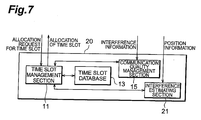
- Fig. 7 is a block diagram of the time slot allocating unit 20 in the second embodiment.
- the same members as those in the configuration of the time slot allocating unit 10 are denoted by the same reference symbols and the description thereof is omitted herein.
- the second embodiment is different in provision of an interference estimating section 21 from the first embodiment.
- the interference estimating section 21 estimates the power of interfering waves at the mobile station with a time slot of a downlink being allocated thereto from the mobile station with a time slot of an uplink being allocated thereto out of the mobile station MS1 and the mobile station MS2, from the distance between the mobile station MS1 and the mobile station MS2 shown in Fig. 1.
- the distance between the mobile station MS1 and the mobile station MS2 is determined based on information from the Global Positioning System GPS or a plurality of base stations BS. Further interference information shown in Fig. 7 is used to decide if the prescribed communication quality is kept with a time slot after the time slot has been allocated. And as the information to decide if a time slot is allocated, the distance between the mobile station MS1 and the mobile station MS2, that is position information in Fig. 7, is used.
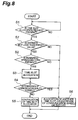
- step S7 is interposed between step S1 and step S2.
- the interference estimating section 21 estimates the power of interfering waves at the mobile station MS2 to which a time slot of a downlink is allocated, from the mobile station MS1 to which a time slot of an uplink is allocated, from the distance between the mobile station MS1 and the mobile station MS2.
- the distance is not less than a predetermined value (e.g., as at the mobile station MS2-2)
- a predetermined value e.g., as at the mobile station MS2-2
- step S2 it is estimated that there occurs no deterioration of the communication quality, and then the flow proceeds to step S2.
- the distance is smaller than the predetermined value (for example, as at the mobile station MS2-1)
- the power of interfering waves is high. Based on this, it is estimated that there occurs deterioration of the communication quality, and then the flow proceeds to step S6.
- the deterioration of the communication quality is estimated based on the estimation of the interference level and whether the time slot of the downlink is allocated to the mobile station MS2 is determined based thereon.
- the time slot of the downlink is allocated to the mobile station MS2.
- the time slot of the downlink is not allocated to the mobile station MS2. Therefore, the second embodiment can prevent fruitless allocation of the time slot of the downlink.
- the physical quantity used for the estimation of the interference level is not limited to the power of interfering waves.
- the second embodiment can also be applied to the case wherein while a time slot of a downlink is allocated to the mobile station MS1, there arises an allocation request for a time slot of an uplink at the mobile station MS2.
- a time slot of an up(down)link is allocated to the first mobile station
- a time slot of a down(up)link having the same time slot number as that of the time slot is allocated to the second mobile station without avoiding the allocation. Accordingly, the link utilization efficiency can be increased among the adjacent areas.
Landscapes
- Engineering & Computer Science (AREA)
- Computer Networks & Wireless Communication (AREA)
- Signal Processing (AREA)
- Mobile Radio Communication Systems (AREA)
- Time-Division Multiplex Systems (AREA)
Applications Claiming Priority (2)
| Application Number | Priority Date | Filing Date | Title |
|---|---|---|---|
| JP2001028806 | 2001-02-05 | ||
| JP2001028806A JP2002232940A (ja) | 2001-02-05 | 2001-02-05 | タイムスロット割り当て装置、タイムスロット割り当て方法、移動体通信システム及びその動作方法、プログラム、記録媒体 |
Publications (2)
| Publication Number | Publication Date |
|---|---|
| EP1229671A2 true EP1229671A2 (fr) | 2002-08-07 |
| EP1229671A3 EP1229671A3 (fr) | 2003-11-19 |
Family
ID=18893243
Family Applications (1)
| Application Number | Title | Priority Date | Filing Date |
|---|---|---|---|
| EP20020002631 Withdrawn EP1229671A3 (fr) | 2001-02-05 | 2002-02-05 | Appareil et méthode d'allocation d'intervalles temporelles, mémoires et programmes, système de communication mobile et méthode d'opération |
Country Status (4)
| Country | Link |
|---|---|
| US (1) | US20020105918A1 (fr) |
| EP (1) | EP1229671A3 (fr) |
| JP (1) | JP2002232940A (fr) |
| CN (1) | CN1369975A (fr) |
Cited By (12)
| Publication number | Priority date | Publication date | Assignee | Title |
|---|---|---|---|---|
| WO2004019649A3 (fr) * | 2002-08-23 | 2004-04-22 | Qualcomm Inc | Methode et systeme pour une transmission de donnees dans un systeme de communication |
| EP1543686A4 (fr) * | 2002-08-15 | 2005-08-31 | Interdigital Tech Corp | Maximisation de la flexibilite de l'affectation fente-cellule a l'aide d'antennes adaptatives dans un systeme tdd |
| WO2006046889A1 (fr) * | 2004-10-25 | 2006-05-04 | Telefonaktiebolaget Lm Ericsson (Publ) | Gestion de ressources en canaux fonction de la qualite radio |
| US7050405B2 (en) | 2002-08-23 | 2006-05-23 | Qualcomm Incorporated | Method and system for a data transmission in a communication system |
| US7139274B2 (en) | 2002-08-23 | 2006-11-21 | Qualcomm, Incorporated | Method and system for a data transmission in a communication system |
| WO2011162656A1 (fr) * | 2010-06-24 | 2011-12-29 | Telefonaktiebolaget Lm Eriksson (Publ) | Procédé d'allocation de créneaux temporels dans un réseau hertzien en tdd |
| WO2012044444A1 (fr) * | 2010-10-01 | 2012-04-05 | Clear Wireless, Llc | Comment autoriser la coexistence entre des réseaux sans fil fdd et tdd |
| US8179833B2 (en) | 2002-12-06 | 2012-05-15 | Qualcomm Incorporated | Hybrid TDM/OFDM/CDM reverse link transmission |
| WO2013017295A1 (fr) | 2011-08-03 | 2013-02-07 | Telefonaktiebolaget L M Ericsson (Publ) | Appareil et procédé de programmation pour un système de communication tdd |
| WO2013074401A3 (fr) * | 2011-11-14 | 2013-07-25 | Qualcomm Incorporated | Prise en charge de configurations lte-tdd différentes dans des zones voisines et/ou des porteuses adjacentes |
| US8908571B2 (en) | 2010-10-01 | 2014-12-09 | Clearwire Ip Holdings Llc | Enabling coexistence between wireless networks |
| US9930678B2 (en) | 2012-07-19 | 2018-03-27 | Qualcomm Incorporated | Multiplexing UEs with different TDD configurations and some techniques to mitigate UE-to-UE and base station-to-base station interference |
Families Citing this family (36)
| Publication number | Priority date | Publication date | Assignee | Title |
|---|---|---|---|---|
| IL154151A0 (en) | 2000-07-27 | 2003-07-31 | Interdigital Tech Corp | Adaptive uplink/downlink timeslot assignment in a hybrid wireless time division multiple access/code division multiple access communication system |
| JP3801460B2 (ja) * | 2001-04-19 | 2006-07-26 | 松下電器産業株式会社 | 基地局装置及び無線通信方法 |
| US6591109B2 (en) | 2001-08-17 | 2003-07-08 | Interdigital Technology Corporation | Cross cell user equipment interference reduction in a time division duplex communication system using code division multiple access |
| CA2807352C (fr) * | 2003-03-26 | 2016-08-16 | Interdigital Technology Corporation | Methode et appareillage de communication sans fil permettant d'obtenir des services d'acces par paquets a liaison descendante a haute vitesse |
| DE10331311B4 (de) * | 2003-07-10 | 2008-02-07 | Siemens Ag | Verfahren zur Synchronisation eines in Funkzellen aufgeteilten Funkkommunikationssystems |
| WO2005109705A1 (fr) * | 2004-05-01 | 2005-11-17 | Neocific, Inc. | Procedes et appareil destines a la communication avec duplexage a repartition dans le temps |
| WO2005086802A2 (fr) | 2004-03-08 | 2005-09-22 | Proxense, Llc | Systeme de compte lie utilisant une cle numerique personnelle |
| GB2413240A (en) * | 2004-04-13 | 2005-10-19 | Ipwireless Inc | Dynamic channel assignment in a TDD communication system |
| RU2007127725A (ru) | 2004-12-20 | 2009-01-27 | ПРОКСЕНС, ЭлЭлСи (US) | Аутентификация по биометрическому ключу персональных данных (pdk) |
| US8433919B2 (en) | 2005-11-30 | 2013-04-30 | Proxense, Llc | Two-level authentication for secure transactions |
| US11206664B2 (en) | 2006-01-06 | 2021-12-21 | Proxense, Llc | Wireless network synchronization of cells and client devices on a network |
| US8340672B2 (en) | 2006-01-06 | 2012-12-25 | Proxense, Llc | Wireless network synchronization of cells and client devices on a network |
| US20080002598A1 (en) * | 2006-04-19 | 2008-01-03 | Telsima Corporation | Reducing inter-ss interference |
| WO2008035718A1 (fr) * | 2006-09-22 | 2008-03-27 | Kyocera Corporation | Système de communication ofdma et procédé de communication associé |
| JP4459204B2 (ja) * | 2006-09-22 | 2010-04-28 | 京セラ株式会社 | Ofdma方式の通信システム及び通信方法 |
| KR100816256B1 (ko) | 2006-10-30 | 2008-03-21 | 에스케이 텔레콤주식회사 | 시분할 듀플렉스 시스템에서 타임 슬롯 할당 방법 및 그장치 |
| US9269221B2 (en) | 2006-11-13 | 2016-02-23 | John J. Gobbi | Configuration of interfaces for a location detection system and application |
| US20090052353A1 (en) * | 2007-08-23 | 2009-02-26 | Motorola, Inc. | System and method for transmission timeslot assignment in wireless time division duplex systems |
| WO2009062194A1 (fr) | 2007-11-09 | 2009-05-14 | Proxense, Llc | Capteur de proximité de support de services d'applications multiples |
| US8171528B1 (en) | 2007-12-06 | 2012-05-01 | Proxense, Llc | Hybrid device having a personal digital key and receiver-decoder circuit and methods of use |
| US9251332B2 (en) | 2007-12-19 | 2016-02-02 | Proxense, Llc | Security system and method for controlling access to computing resources |
| US20090161647A1 (en) * | 2007-12-20 | 2009-06-25 | Russ Mestechkin | Td-scdma uplink processing |
| US8391267B2 (en) * | 2007-12-20 | 2013-03-05 | Mediatek Inc. | TD-SCDMA uplink processing for synchronization of signals at base station receiver |
| US7860521B2 (en) * | 2007-12-26 | 2010-12-28 | Motorola, Inc. | System and method for minimizing inter-communications system mobile station-to-mobile station interference |
| WO2009102979A2 (fr) | 2008-02-14 | 2009-08-20 | Proxense, Llc | Système de gestion de soins de santé de proximité équipé d’un accès automatique aux informations privées |
| US11120449B2 (en) | 2008-04-08 | 2021-09-14 | Proxense, Llc | Automated service-based order processing |
| US8717981B1 (en) * | 2008-05-01 | 2014-05-06 | Sprint Communications Company L.P. | Priority allocation of contention resources |
| JP5245584B2 (ja) * | 2008-07-04 | 2013-07-24 | 富士通株式会社 | 無線基地局および無線通信方法 |
| JP2010283756A (ja) * | 2009-06-08 | 2010-12-16 | Sony Corp | 無線通信装置、通信制御装置、無線通信システム、無線通信方法および通信制御方法 |
| US9418205B2 (en) | 2010-03-15 | 2016-08-16 | Proxense, Llc | Proximity-based system for automatic application or data access and item tracking |
| US9322974B1 (en) | 2010-07-15 | 2016-04-26 | Proxense, Llc. | Proximity-based system for object tracking |
| GB2485387B (en) | 2010-11-12 | 2013-10-02 | Intellectual Ventures Holding 81 Llc | Wireless communication system, communication unit, and method for scheduling |
| US9265450B1 (en) | 2011-02-21 | 2016-02-23 | Proxense, Llc | Proximity-based system for object tracking and automatic application initialization |
| US9405898B2 (en) | 2013-05-10 | 2016-08-02 | Proxense, Llc | Secure element as a digital pocket |
| EP3323260B1 (fr) | 2015-07-13 | 2021-02-17 | Isolynx, LLC | Système et procédé de programmation dynamique d'émissions radioélectriques sans collision |
| GB2543800B (en) * | 2015-10-28 | 2020-02-26 | Ayyeka Tech Ltd | Method and system for scheduling transmit time slots for network-connected measurement units |
Family Cites Families (13)
| Publication number | Priority date | Publication date | Assignee | Title |
|---|---|---|---|---|
| JPH0329430A (ja) * | 1989-06-26 | 1991-02-07 | Iwatsu Electric Co Ltd | 移動体通信の時間分割通信方法 |
| FR2702320B1 (fr) * | 1993-03-03 | 1995-04-14 | Alcatel Radiotelephone | Procédé pour allouer un intervalle de temps au sein d'une trame à un mobile accédant à une cellule de communication et station émettrice-réceptrice de base mettant en Óoeuvre ce procédé. |
| US5594738A (en) * | 1993-10-18 | 1997-01-14 | Motorola, Inc. | Time slot allocation method |
| US5594720A (en) * | 1993-11-24 | 1997-01-14 | Lucent Technologies Inc. | Multiple access cellular communication with dynamic slot allocation and reduced co-channel interferences |
| US5943324A (en) * | 1994-01-11 | 1999-08-24 | Ericsson, Inc. | Methods and apparatus for mobile station to mobile station communications in a mobile satellite communication system |
| FI104142B (fi) * | 1996-10-25 | 1999-11-15 | Nokia Mobile Phones Ltd | Radioresurssien käytön ohjausmenetelmä |
| FI103848B1 (fi) * | 1996-12-02 | 1999-09-30 | Nokia Telecommunications Oy | Ryhmäpuhelun ylläpitäminen matkaviestinjärjestelmässä |
| WO1998058503A1 (fr) * | 1997-06-16 | 1998-12-23 | Mitsubishi Denki Kabushiki Kaisha | Systeme de communication mobile |
| EP0935353B1 (fr) * | 1997-10-31 | 2011-08-24 | Alcatel-Lucent USA Inc. | Un protocole d'accès multiple asymétrique pour un système de communication |
| EP1555771B1 (fr) * | 1998-03-31 | 2010-10-13 | Sony Deutschland GmbH | Méthode et dispositif pour attribuer des intervalles de temps dans un système TDD |
| EP1080551B1 (fr) * | 1998-05-29 | 2003-07-09 | Nokia Corporation | Procede de transmission de donnees dans un systeme de telecommunication cellulaire |
| US6795428B1 (en) * | 2000-01-07 | 2004-09-21 | Ericsson Inc. | Fast notification access channel for realtime users in EGPRS networks |
| DE10034248A1 (de) * | 2000-07-14 | 2002-01-31 | Siemens Ag | Verfahren zum schnellen Zuweisen von Funk-Ressourcen zu logischen Kanälen in Abwärtsrichtung |
-
2001
- 2001-02-05 JP JP2001028806A patent/JP2002232940A/ja active Pending
-
2002
- 2002-02-05 EP EP20020002631 patent/EP1229671A3/fr not_active Withdrawn
- 2002-02-05 CN CN02107073A patent/CN1369975A/zh active Pending
- 2002-02-05 US US10/062,456 patent/US20020105918A1/en not_active Abandoned
Cited By (24)
| Publication number | Priority date | Publication date | Assignee | Title |
|---|---|---|---|---|
| US7046655B2 (en) | 2002-08-15 | 2006-05-16 | Interdigital Technology Corporation | Wireless communication method and system for minimizing interference by determining mobile station zone locations and potential conflicts between cell zones |
| EP1543686A4 (fr) * | 2002-08-15 | 2005-08-31 | Interdigital Tech Corp | Maximisation de la flexibilite de l'affectation fente-cellule a l'aide d'antennes adaptatives dans un systeme tdd |
| WO2004019649A3 (fr) * | 2002-08-23 | 2004-04-22 | Qualcomm Inc | Methode et systeme pour une transmission de donnees dans un systeme de communication |
| US7050405B2 (en) | 2002-08-23 | 2006-05-23 | Qualcomm Incorporated | Method and system for a data transmission in a communication system |
| US7139274B2 (en) | 2002-08-23 | 2006-11-21 | Qualcomm, Incorporated | Method and system for a data transmission in a communication system |
| CN100593354C (zh) * | 2002-08-23 | 2010-03-03 | 高通股份有限公司 | 用于通信系统中数据传输的方法和装置 |
| US8194598B2 (en) | 2002-08-23 | 2012-06-05 | Qualcomm Incorporated | Method and system for a data transmission in a communication system |
| US8179833B2 (en) | 2002-12-06 | 2012-05-15 | Qualcomm Incorporated | Hybrid TDM/OFDM/CDM reverse link transmission |
| US8107425B2 (en) | 2004-10-25 | 2012-01-31 | Telefonaktiebolaget Lm Ericsson (Publ) | Radio quality based channel resource management |
| WO2006046889A1 (fr) * | 2004-10-25 | 2006-05-04 | Telefonaktiebolaget Lm Ericsson (Publ) | Gestion de ressources en canaux fonction de la qualite radio |
| EP2586255A4 (fr) * | 2010-06-24 | 2015-09-30 | Ericsson Telefon Ab L M | Procédé d'allocation de créneaux temporels dans un réseau hertzien en tdd |
| WO2011162656A1 (fr) * | 2010-06-24 | 2011-12-29 | Telefonaktiebolaget Lm Eriksson (Publ) | Procédé d'allocation de créneaux temporels dans un réseau hertzien en tdd |
| US8837335B2 (en) | 2010-06-24 | 2014-09-16 | Telefonaktiebolaget L M Ericsson (Publ) | Timeslot allocation method in a wireless TDD network |
| WO2012044444A1 (fr) * | 2010-10-01 | 2012-04-05 | Clear Wireless, Llc | Comment autoriser la coexistence entre des réseaux sans fil fdd et tdd |
| US8681660B2 (en) | 2010-10-01 | 2014-03-25 | Clearwire Ip Holdings Llc | Enabling coexistence between FDD and TDD wireless networks |
| US8830985B2 (en) | 2010-10-01 | 2014-09-09 | Clearwire Ip Holdings Llc | Enabling coexistence between FDD and TDD wireless networks |
| US8908571B2 (en) | 2010-10-01 | 2014-12-09 | Clearwire Ip Holdings Llc | Enabling coexistence between wireless networks |
| WO2013017295A1 (fr) | 2011-08-03 | 2013-02-07 | Telefonaktiebolaget L M Ericsson (Publ) | Appareil et procédé de programmation pour un système de communication tdd |
| US9398592B2 (en) | 2011-08-03 | 2016-07-19 | Telefonaktiebolaget Lm Ericsson (Publ) | Scheduling apparatus and method for a TDD communication system |
| EP2843870A3 (fr) * | 2011-11-14 | 2015-04-08 | Qualcomm Incorporated | Prise en charge de configurations LTE-TDD différentes dans des zones voisines et/ou des porteuses adjacentes |
| WO2013074401A3 (fr) * | 2011-11-14 | 2013-07-25 | Qualcomm Incorporated | Prise en charge de configurations lte-tdd différentes dans des zones voisines et/ou des porteuses adjacentes |
| US9585156B2 (en) | 2011-11-14 | 2017-02-28 | Qualcomm Incorporated | Supporting different LTE-TDD configurations in neighboring regions and/or adjacent carriers |
| US9930678B2 (en) | 2012-07-19 | 2018-03-27 | Qualcomm Incorporated | Multiplexing UEs with different TDD configurations and some techniques to mitigate UE-to-UE and base station-to-base station interference |
| US10602525B2 (en) | 2012-07-19 | 2020-03-24 | Qualcomm Incorporated | Multiplexing UES with different TDD configurations and some techniques to mitigate UE-to-UE and base station-to-base station interference |
Also Published As
| Publication number | Publication date |
|---|---|
| CN1369975A (zh) | 2002-09-18 |
| US20020105918A1 (en) | 2002-08-08 |
| EP1229671A3 (fr) | 2003-11-19 |
| JP2002232940A (ja) | 2002-08-16 |
Similar Documents
| Publication | Publication Date | Title |
|---|---|---|
| EP1229671A2 (fr) | Appareil et méthode d'allocation d'intervalles temporelles, mémoires et programmes, système de communication mobile et méthode d'opération | |
| JP3744542B2 (ja) | 移動通信システムにおいて電源制御を備えた適応チャンネル割り当て方法および装置 | |
| US8787922B2 (en) | System and method for cooperative inter-cell interference control | |
| US5513379A (en) | Apparatus and method for dynamic resource allocation in wireless communication networks utilizing ordered borrowing | |
| RU2197791C2 (ru) | Автоматическое планирование каналов управления в системах с адаптивным распределением каналов | |
| EP1303928B1 (fr) | Allocation adaptative d'intervalles de temps de liaison ascendante/descendante dans un systeme de communication sans fils hybride a acces multiple par repartition dans le temps/acces multiple par repartition de code | |
| US6262980B1 (en) | Dynamic resource allocation method and apparatus for broadband services in a wireless communications system | |
| EP0544095B1 (fr) | Réduction d'interférence par partage de fréquences dans des systèmes de communication cellulaire | |
| US8290529B2 (en) | Uplink radio resource allocation method, radio base station, and radio network controller | |
| JP2719619B2 (ja) | 移動通信チャネル割当て制御方法 | |
| EP1021925B1 (fr) | Affectation hybride de canaux avec sauts et allocation de canaux selon la classe de service (temps réel / non temps réel) dans une station de base 3g. | |
| JP2004015697A (ja) | 移動通信システム及び複数周波数の負荷分散方式 | |
| CN110505696A (zh) | 一种波束分配方法、装置、设备及计算机存储介质 | |
| JP2007529954A (ja) | タイムスロットを共通制御チャネルに割り当てる方法およびシステム | |
| CA2255355C (fr) | Methode et appareil permettant d'eviter les brouillages dans un systeme de telecommunications sans fil | |
| CN101167391A (zh) | 用于信道分配分层的信道分配 | |
| WO2002047413A1 (fr) | Station de base et procede d'affectation de canaux de communication radio | |
| JP2908991B2 (ja) | 無線チャネル割当方法 | |
| WO1997030528A1 (fr) | Procede et appareil correspondant permettant d'attenuer des interferences occasionnees par un systeme de communication a superposition | |
| JP3810618B2 (ja) | チャネル割当方法および通信装置 | |
| KR100198954B1 (ko) | 도시고속도로상에서의 부호분할다중접속(cdma) 채널할당방법 | |
| JP2001320316A (ja) | 無線データ通信システム、基地局、移動局、無線サーバ及びコンピュータ読み取り可能な記憶媒体 | |
| Finean | Channel assignment in mobile satellite networks |
Legal Events
| Date | Code | Title | Description |
|---|---|---|---|
| PUAI | Public reference made under article 153(3) epc to a published international application that has entered the european phase |
Free format text: ORIGINAL CODE: 0009012 |
|
| 17P | Request for examination filed |
Effective date: 20020205 |
|
| AK | Designated contracting states |
Kind code of ref document: A2 Designated state(s): AT BE CH CY DE DK ES FI FR GB GR IE IT LI LU MC NL PT SE TR |
|
| AX | Request for extension of the european patent |
Free format text: AL;LT;LV;MK;RO;SI |
|
| PUAL | Search report despatched |
Free format text: ORIGINAL CODE: 0009013 |
|
| AK | Designated contracting states |
Kind code of ref document: A3 Designated state(s): AT BE CH CY DE DK ES FI FR GB GR IE IT LI LU MC NL PT SE TR |
|
| AX | Request for extension of the european patent |
Extension state: AL LT LV MK RO SI |
|
| AKX | Designation fees paid |
Designated state(s): DE GB |
|
| 17Q | First examination report despatched |
Effective date: 20050301 |
|
| STAA | Information on the status of an ep patent application or granted ep patent |
Free format text: STATUS: THE APPLICATION HAS BEEN WITHDRAWN |
|
| 18W | Application withdrawn |
Effective date: 20050803 |