EP1229731A2 - Procédé et système pour la conception de trames stochastiques partialement divisées pour l'obtention de demi-teintes en couleur - Google Patents
Procédé et système pour la conception de trames stochastiques partialement divisées pour l'obtention de demi-teintes en couleur Download PDFInfo
- Publication number
- EP1229731A2 EP1229731A2 EP01129654A EP01129654A EP1229731A2 EP 1229731 A2 EP1229731 A2 EP 1229731A2 EP 01129654 A EP01129654 A EP 01129654A EP 01129654 A EP01129654 A EP 01129654A EP 1229731 A2 EP1229731 A2 EP 1229731A2
- Authority
- EP
- European Patent Office
- Prior art keywords
- screen
- screens
- merit
- color
- merit function
- Prior art date
- Legal status (The legal status is an assumption and is not a legal conclusion. Google has not performed a legal analysis and makes no representation as to the accuracy of the status listed.)
- Withdrawn
Links
Images


Classifications
-
- H—ELECTRICITY
- H04—ELECTRIC COMMUNICATION TECHNIQUE
- H04N—PICTORIAL COMMUNICATION, e.g. TELEVISION
- H04N1/00—Scanning, transmission or reproduction of documents or the like, e.g. facsimile transmission; Details thereof
- H04N1/46—Colour picture communication systems
- H04N1/52—Circuits or arrangements for halftone screening
Definitions
- the subject invention pertains to the art of color image/text printing or display systems, and is especially applicable to a method and apparatus wherein color halftoning (representing a continuous tone image with a binary representation) is implemented with a partitioned stochastic screen or correlated stochastic screens for maximal ink dispersion and optimized spatial frequency response in the printing or display process.
- Color images are commonly represented as one or more separations, each separation comprising a set of color density signals for a single primary or secondary color.
- Color density signals are commonly represented as digital gray or contone pixels, varying in magnitude from a minimum to a maximum, with a number of gradients between corresponding to the bit density of the system.
- a common 8bit system provides 256 shades of each primary color.
- a color can therefore be considered the combination of magnitudes of each pixel, which when viewed together, present the combination color.
- printer signals include three subtractive primary color signals (Cyan, Magenta and Yellow) and a Black signal which together can be considered the printer colorant signals.
- Each color signal forms a separation and when combined together with the other separations, forms the color image.
- DPS Document Processing System devices
- Such devices include marking engines, printers, scanners, fax machines, electronic libraries, and the like many of which can be employed in a xerographic environment.
- the present invention addresses situations particularly relevant to printing systems and discusses them as a prime example of a Document Processing System, but should not be construed to be limited to any such particular printing application. Any DPS is intended to benefit from the advantages of this invention.
- Printers provide a limited number of output possibilities, and are commonly binary, i.e., they produce either a dot or no dot at a given pixel location. Thus, given a color separation with 256 shades of each additive primary color, a set of binary printer signals must be produced representing the contone effect. This process is referred to as halftoning. In such arrangements, over a given area and the separation having a number of contone pixels therein, each pixel value of an array of contone pixels within the area is compared to one of a set of preselected thresholds (the thresholds may be stored as a dither matrix and the repetitive pattern generated by this matrix is considered a halftone cell) as taught for example in U.S. Patent No. 4,149,194 to Holladay.
- the effect of such an arrangement is that, for an area where the image is a contone, some of the thresholds in the matrix will be exceeded, i.e., the image value at that specific location is larger than the value stored in the dither matrix for that same location, while others are not.
- the pixels or cell elements for which the thresholds are exceeded might be printed as black or some color, while the remaining elements are allowed to remain white or uncolored, dependent on the actual physical quantity described by the data. Since the human visual system tends to average out rapidly varying spatial patterns and perceives only a spatial average of the micro-variation in spot-color produced by a printer, the halftone process described above can be used to produce a close approximation to the desired color in the contone input.
- the dither matrix of threshold values is often referred to as a "screen", and the process of generating the binary image from the contone image using the screen is called “screening".
- Conventional digital halftones start as a number of isolated dots which grow bigger as more colorant is requested on the paper. These screens are referred to as clustered-dot screens.
- the fundamental rate at which the dots in a clustered dot screen are repeated is commonly referred to as the screen's spatial frequency [Note R. Ulichney, "Digital Halftoning", MIT Press, Cambridge, MA, 1987].
- the higher the screen spatial frequency the finer and smoother appearing the image and also the greater is the capacity for the dots to represent fine detail in the image. Dithering creates problems in color document reproduction where the repeating pattern of a screen through the image, when superposed over similar repeating patterns in multiple separations, can cause moir ⁇ or other artifacts, particularly in a printing system with less than ideal registration between separations.
- Stochastic, or non-periodic screening is an alternative to conventional clustered dot screens. Instead of producing dots that grow with increased colorant on paper, the stochastic screening method produces a well-dispersed pattern of isolated dots at spaced pixel locations. Thus there is no fundamental periodicity in the dots, instead the design of the screen attempts to produce patterns with pleasant noise characteristics.
- the pleasant noise characteristics are achieved by designing the screen so as to distribute the noise energy in the region of high spatial frequency, where the human visual system has a significantly reduced sensitivity.
- Color stochastic screening has typically been implemented in the prior art by using the same screen for all separations (dot-on-dot) or by using independent screens (possibly obtained by shifting/rotating/flipping a single screen). These methods do not produce halftones with maximal ink dispersion and optimized spatial frequency response because there is no control of the overlap between the printed dots for different separations.
- the less successful the screening processes the less smooth, i.e. more grainy, the resultant image appears. It is of course an overall objective of the subject invention to produce a resultant image in which the graininess is minimized, smoothness is enhanced and the intended colors are accurately reproduced.
- One way to design and promote the desirable aspects of a single screen is through application and assessment of a "merit function" to the screen.
- the binary output B(x,y) is determined by the following dithering rule: where x,y are the spatial coordinates, T is the threshold value at (x,y) and G is the gray-level input ranging from 0 to N .
- the value one of the output B represents a white pixel and zero, a black pixel. Without dot overlapping, a binary halftone pattern corresponding to a constant input level G will have G black pixels and N - G white pixels within the area defined by the halftone screen.
- the visual appearance of this halftone pattern depends on whether the black pixels or the white pixels are minorities. If the white pixels are, i.e., G ⁇ N / 2 , the appearance of the output should be based on the distribution of white pixels. Otherwise, the appearance should be on the distribution of black pixels.
- a merit function can be used to combine evaluations of all levels, thus, a half of the merit is on distributions of black pixels and another half is on white.
- the quantitative measure of visual evaluation on halftone outputs varies with specifications of the desired screens. For example, it is visually pleasant to have all minority pixels "evenly" distributed on the output of a stochastic screen. Mathematically, it could be translated as maximizing the summation of all distances between any two minorities.
- the contribution to the merit function from each gray level can be written as a function of the gray level and locations of all minorities appearing at this level. Since being minority or majority is determined by the dithering rule given by Eq. (1), in consequence, the contribution Q at level G can be written as a function of G and locations of corresponding thresholds in the halftone screen: where x T , y T are coordinates of a threshold T.
- the entire merit function M can be defined as a sum of contributions Q(G) from all levels: where w (G) is a weighting function of G .
- the objective of optimization is to maximize (or minimize) the single-value merit function M given above. Since the merit is used throughout the entire optimization process, the design can reach the best balance of all gray levels and the best compromise between given constraints in size, shape and other geometrical requirements.
- Simulated annealing is a standard optimization technique and it has many different variations and modifications. It can be usefully applied to halftone screen design by analogizing the temperature to control the acceptance of a random swapping of screen threshold values in the iterative computing of the merit function to identify an optimized merit value. The acceptance is stochastically set by the temperature and compared with the change of the merit function due to swapping.
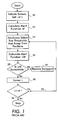
- Fig. 1 demonstrates the basic optimization process for a single halftone screen design. At the beginning, all threshold values of the halftone screen are randomly set or copied from a previous design. The control temperature ⁇ is set 20 to the starting temperature ⁇ 1. Whatever merit function is defined for the specific halftone screen is calculated 22 .
- the optimization loop begins with a random selection 24 of two threshold values, T1 and T2. After swapping the selected thresholds, the change of the merit function due to swapping is calculated 26. In general, the entire merit function M does not need to be recalculated, instead, only the contribution of levels between T1 and T2. If the change of the merit function meets 28 the acceptance set by the current temperature of simulated annealing, the swapped order is kept, the temperature ⁇ is lowered 30, and the process proceeds 32 to the next swapping loop. Otherwise, the order is restored 34 before swapping and movement on to the next loop. This iteration process is continued until the temperature reaches 36 a desired low level ⁇ 0 and the final configuration of the screen is saved.
- a merit function M summarizes Q(G) of all levels with a chosen weighting function w(G) for example, defined by
- a merit function is associated with each screen or screen portion.
- the merit function represents a measure of the desirability of the screen, particularly with regard to maximizing ink dispersion and optimizing spatial frequency response.
- An additional merit function is associated with the combination of the screens and screen portions.
- the additional merit function represents a measure of desirability of the screen combination with regard to ink dispersion and combined spatial frequency response.
- the screens are constructed so as to optimize the merit functions.
- the image is generated using the selected screens in a conventional color halftoning process with a plurality of color separations.
- the individual merit functions are combined into a single composite merit function using a weighted average and the screen construction process optimizes this composite merit function.
- embodiments may utilize the individual merit functions in the screen construction process or may use forms of combination other than a simple weighted average.
- the constructing of the plurality of screens preferably comprises an iterative process for optimizing the merit functions indicative of the desirability of each screen and the screen combination.
- the process starts with a random initial set of screens and iteratively modifies the screens for optimizing the chosen merit value or values.
- the merit functions are preferably based on placement of minority pixels for a plurality of tone and color values.
- a principal advantage of the subject invention is a process for designing screens useful in color halftoning that achieve maximal ink dispersion and optimize the spatial frequency response in the imaging process.
- Another advantage of the subject invention is a screen design process which facilitates screen design by assessing merit function values representative of maximal ink dispersion and optimized spatial frequency response through assessment of primary pixel locations.
- the subject invention pertains to a method and system for stochastic screen design and implementation that maximizes ink dispersion and provides improved smoothness for combined printing of multiple color separations.
- the method applies concepts of either a partitioned single stochastic screen, or a plurality of distinct screens to a multicolor setting wherein the partitions or distinct screens are concurrently designed so that interseparation overlap is minimized for the color separations respectively associated with the partitions or screens and the appearance of the screen combinations is optimized in addition to the individual screens.
- the second partition or a second screen is a conjugate of the first screen (or partition), wherein the thresholds are in reverse order.
- a merit function is employed to optimize screen configuration and includes merit factors for an analysis of a combination of the screens for maximizing dispersion of minority pixels.
- the merit function can comprise several formulations and for whatever embodiment is implemented, color relations between the distinct screens or partitions are computed to identify a maximal optimization value corresponding to the desired system output or print quality.
- the desired stochastic screen is designed to be linear in the number of pixels turned on.
- the stochastic screen is, e.g., a 128x128 array of thresholds between 1 and 255.
- a pixel is turned on if the image value at the pixel exceeds the threshold.
- the linearity of the screen implies that when a constant image with value V is halftoned, the fraction of the pixels turned on in the output is V/255 (or the nearest obtainable approximation) for all values of V between 0 and 255.
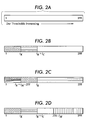
- Fig. 2(a) represents the screen by its thresholds.
- 2(a) represents the thresholds of a dot in the screen in increasing order from left to right, going from 1 to 255.
- Each threshold represents all the pixels that get turned on just when the image reaches that value.
- a particular threshold or threshold region of the dot is filled by a given separation to indicate that the dots of that separation completely cover the pixels corresponding to that threshold/threshold region.
- threshold conjugate (x,y) 256 - threshold(x,y) for the other separation.
- any poor spatial frequency characteristics of the halftone dot under simultaneous filling of the original and conjugate dots can be overcome by incorporating suitable constraints in the dot design process.
- the method described in US Patent 6,014,500 by Wang is used.
- the complete screen S is spatially partitioned into two regions S1 and S2 using a conjugate pattern as the basis of the partitioning (say the regions corresponding to the white pixels of the checkerboard are in S1 and those corresponding to black pixels are in S2 .)
- the rationale behind this choice of weights is explained later.
- the overall merit function is a weighted combination of three parts: M(S1) evaluates the quality of textures printed on only the S1 part of the screen (white part of checkerboard), M(S2) evaluates the quality of textures printed on only the S2 part of the screen (black part of checkerboard), and M(S) evaluates the quality of textures printed simultaneously on both the S1 and S2 parts of the screen.
- a complete fill-order for each separation is obtained by concatenating the fill-orders for the different sets of pixel locations in a chosen sequence, and the complete fill-order is utilized to create a screen.
- the screen design process returns a fill-order for pixels for each of the regions S1 and S2 such that when pixels are filled according to that order they have desirable spatial frequency characteristics in all three cases (a) when only S1 is filled, (b) when only S2 is filled, and (c) when both S1 and S2 are filled simultaneously.
- the screen can be used for color halftoning of two separations as follows.
- One separation begins by successively filling the pixels corresponding to S1 in order till the 50% point and then fills the pixels corresponding to S2 in reversed order.
- the second separation begins by filling the pixels corresponding to S2 in order till the 50% point and then fills the pixels corresponding to S1 in reversed order.
- the above rule can be converted into a threshold based stochastic screen for the first separation, where levels 0 through 50% turn on pixels in the S1 part of the checkerboard in the fill-order obtained from the dot design, and levels between 50% and 100% turn on pixels in the S2 part of the checkerboard in the reverse-order from the fill-order obtained from the design.
- S ckr denotes the screen designed with this process and "t ckr (x,y)" the threshold array matrix corresponding to this screen.
- the halftoning method is generalized to CMYK halftoning by using the same screen for K and C with "separation in thresholds" (as described later), the conjugate screen for M, and with Y on an independent rotated screen. Since the Y separation produces almost no change in luminance in the print and because the yellow colorants tend to have the least unwanted absorptions, the use of an independent halftone screen for yellow causes minimum degradation in image quality.
- the idea behind "separation in thresholds” is the one used in U.S. Patent 5,631,748 by Harrington and in U.S. Serial No. 09/602,746, "Color halftoning using a single successive filling color stochastic screen", by Sharma, Fan and Wang.
- the K separation occupies the first i K thresholds of the halftone screen and if there is no overlap required (i K +i C ⁇ 255) the Cyan separation occupies thresholds from i K +1 through i K +i C . (See Fig. 2(b)) If overlap is necessary, the thresholds are re-used starting at zero. This is shown graphically in Fig. 2(c).
- the actual modification required in the Cyan separation to achieve this objective is simply the addition of the halftone error from the black separation (contone input - halftone output).
- the ON CMK pixels from the above algorithm populate the thresholds of the dot S ckr as shown in Fig. 2(d).
- the ON pixels for the different separations occupy separate thresholds and therefore avoid overlap.
- the halftone has good spatial frequency characteristics on account of the design criterion incorporating the simultaneous printing from both ends into the design process.
- the invention may be generalized to use alternate spatial partitions of the screen in the design process or to directly design with good spatial characteristics under simultaneous filling from both directions (from 0 going up and coming down from 255).
- the Cyan region could be adjacent to magenta (in thresholds) instead of being next to black and the scheme for allocation of the thresholds may be permuted between the separations.
- the invention has been described with reference to designing combined screen partitions or conjugate screens, and then rendering such designed screens for improved image quality, the invention is applicable to another embodiment wherein the design process is directed to designing distinct but correlated screens in a manner to similarly achieve maximal ink dispersion and optimized spatial frequency response.
- Two or more stochastic screens can be designed simultaneously by not only using the optimization criteria for conventional stochastic screens, but also applying an additional merit requirement during the design process for screen optimization.
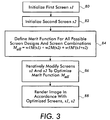
- a merit function is applied to identify the effect of a combination of the appropriate screens, which if used for respective color separations, provides a desired ink dispersion and special frequency response.
- M'(s1+s2) is the additional "merit factor" for the combined minority pixels of both the screens s1 and s2, and w1 , w2 , w3 are weights for balancing the overall quality.
- the merit function of Eq. (9) can be applied for all possible screen designs so that an optimized merit value M all can be identified 86 and the corresponding screen designs s1 , s2 corresponding to the optimized merit value can be selected for image rendering 88.
- FIG. 5 With particular reference to the flowchart of Fig. 5, the design process for a single spatially-partitioned stochastic screen, wherein the partitions can be used for the highlight regions of different color separations, is illustrated.
- An original screen S is initialized 90 and two spatial partitions thereof s1 and s2 are defined 92, practically corresponding to the first and second screens as in the process of Fig. 3.
- the optimization merit function for all possible screen partitions and combinations is defined 94 in a manner as noted in the foregoing descriptions.
- Iterative modification 96 of the screen S using evaluated merit values is employed for the construction of the optimized stochastic screen.
- the merit function for the design of two correlated stochastic partitions is the same as Eq. 9 above wherein s1 and s2 correspond to the two spatial partitions.
- the optimized screen design can be selected for image rendering 98.
- the invention also envisions incorporating additional constraints on the screen design process in the framework of the merit function of Eq. (9).
- This factor would then produce a single screen such that when the original and conjugate screens are used for different separations, the halftone textures for the combinations are also optimized.
- the advantage of having a single screen is reduced system storage requirements over the requirements for distinctive independent screens per separation.
Landscapes
- Engineering & Computer Science (AREA)
- Multimedia (AREA)
- Signal Processing (AREA)
- Facsimile Image Signal Circuits (AREA)
- Image Processing (AREA)
- Color Image Communication Systems (AREA)
- Image Analysis (AREA)
- Record Information Processing For Printing (AREA)
- Spectrometry And Color Measurement (AREA)
Applications Claiming Priority (2)
| Application Number | Priority Date | Filing Date | Title |
|---|---|---|---|
| US09/737,537 US6501567B2 (en) | 2000-12-15 | 2000-12-15 | Method and system for designing spatially-partitioned and correlated stochastic screens for color halftoning |
| US737537 | 2000-12-15 |
Publications (2)
| Publication Number | Publication Date |
|---|---|
| EP1229731A2 true EP1229731A2 (fr) | 2002-08-07 |
| EP1229731A3 EP1229731A3 (fr) | 2005-01-26 |
Family
ID=24964306
Family Applications (1)
| Application Number | Title | Priority Date | Filing Date |
|---|---|---|---|
| EP01129654A Withdrawn EP1229731A3 (fr) | 2000-12-15 | 2001-12-12 | Procédé et système pour la conception de trames stochastiques partialement divisées pour l'obtention de demi-teintes en couleur |
Country Status (3)
| Country | Link |
|---|---|
| US (1) | US6501567B2 (fr) |
| EP (1) | EP1229731A3 (fr) |
| JP (1) | JP4172932B2 (fr) |
Cited By (3)
| Publication number | Priority date | Publication date | Assignee | Title |
|---|---|---|---|---|
| EP1521450A3 (fr) * | 2003-09-30 | 2006-12-27 | Sharp Kabushiki Kaisha | Système et procédés pour la création d'une structure de tramage multi-dimensionnelle et application |
| WO2006136599A1 (fr) * | 2005-06-24 | 2006-12-28 | Agfa Graphics Nv | Ensemble de trames de similigravure a modulation de frequence et procede permettant de produire ces trames |
| EP1926302A3 (fr) * | 2006-11-24 | 2009-05-27 | Seiko Epson Corporation | Contrôle de quantité d'éjection d'encre selon une commande de formation de points |
Families Citing this family (16)
| Publication number | Priority date | Publication date | Assignee | Title |
|---|---|---|---|---|
| US6606168B1 (en) * | 1999-03-31 | 2003-08-12 | 3M Innovative Properties Company | Narrow band, anisotropic stochastic halftone patterns and methods of creating and using the same |
| US6844941B1 (en) * | 2000-06-23 | 2005-01-18 | Xerox Corporation | Color halftoning using a single successive-filling halftone screen |
| WO2003028362A1 (fr) * | 2001-09-21 | 2003-04-03 | Ricoh Company, Ltd. | Procede de production de matrices a valeur seuil, systeme d'emission d'images, support d'enregistrement, procede de reproduction de gradation, matrices a valeur seuil, procede de traitement d'images, dispositif de traitement d'images, dispositif de production d'images et commande d'imprimante |
| JP4285127B2 (ja) * | 2003-07-30 | 2009-06-24 | セイコーエプソン株式会社 | 減色処理装置及び減色処理方法 |
| JP4143560B2 (ja) * | 2004-03-05 | 2008-09-03 | 富士フイルム株式会社 | 閾値マトリクスの作成方法及びその装置 |
| JP2005286999A (ja) * | 2004-03-05 | 2005-10-13 | Fuji Photo Film Co Ltd | 閾値マトリクスの割当方法 |
| JP4241632B2 (ja) * | 2005-01-25 | 2009-03-18 | 富士フイルム株式会社 | 色版作成用閾値マトリクスの作成方法、カラー画像の再現方法、カラー画像分版作成装置及び閾値マトリクス |
| US20060197992A1 (en) * | 2005-03-02 | 2006-09-07 | Xerox Corporation | Stochastic screens for rendering devices with high-addressability |
| JP4604940B2 (ja) * | 2005-06-10 | 2011-01-05 | セイコーエプソン株式会社 | 双方向印刷を行うための画像処理装置および印刷装置 |
| KR100725538B1 (ko) * | 2005-06-27 | 2007-06-08 | 삼성전자주식회사 | 모아레 패턴이 발생하지 않는 스크린간의 주파수 비율 및각도 차이 설정방법 |
| TWI368116B (en) * | 2007-04-04 | 2012-07-11 | Primax Electronics Ltd | Method for generating basic template utilized to form screening mask |
| US8593654B2 (en) * | 2007-10-03 | 2013-11-26 | Hewlett-Packard Development Company, L.P. | Setting a partition size for a print job |
| US20100027074A1 (en) * | 2008-07-31 | 2010-02-04 | Sharp Laboratories Of America, Inc. | Partition halftone for multi-tone level output device |
| US8203760B2 (en) * | 2009-03-03 | 2012-06-19 | Xerox Corporation | Vector halftoning in an image path utilizing sub-sampled cross-channel image values |
| US8564840B2 (en) | 2010-05-28 | 2013-10-22 | Xerox Corporation | Halftone tiling and halftoning for annular rasters |
| US8681383B2 (en) | 2011-12-22 | 2014-03-25 | Xerox Corporation | 2nd generation dot-off-dot stochastic halftone |
Family Cites Families (6)
| Publication number | Priority date | Publication date | Assignee | Title |
|---|---|---|---|---|
| PT68709A (en) * | 1977-10-28 | 1978-11-01 | Bates As Ab | Process of making negative or positive films for use multi-color printing |
| DE3067060D1 (en) * | 1979-12-20 | 1984-04-19 | Cambridge Consultants | Apparatus and method for generating a dispersed dot half tone picture from a continuous tone picture |
| US5631748A (en) | 1995-11-16 | 1997-05-20 | Xerox Corporation | Color images having multiple separations with minimally overlapping halftone dots and reduced interpixel contrast |
| US5822451A (en) * | 1996-06-05 | 1998-10-13 | Eastman Kodak Company | Method for halftoning a multi-channel digital color image |
| US6020978A (en) * | 1997-09-30 | 2000-02-01 | Lexmark International, Inc. | Method and apparatus for color halftoning using interlocked threshold arrays |
| US6376834B1 (en) * | 1999-10-26 | 2002-04-23 | Hewlett-Packard Company | Moire interference pattern reduction for scanning of half-toned images |
-
2000
- 2000-12-15 US US09/737,537 patent/US6501567B2/en not_active Expired - Fee Related
-
2001
- 2001-12-07 JP JP2001373584A patent/JP4172932B2/ja not_active Expired - Fee Related
- 2001-12-12 EP EP01129654A patent/EP1229731A3/fr not_active Withdrawn
Cited By (3)
| Publication number | Priority date | Publication date | Assignee | Title |
|---|---|---|---|---|
| EP1521450A3 (fr) * | 2003-09-30 | 2006-12-27 | Sharp Kabushiki Kaisha | Système et procédés pour la création d'une structure de tramage multi-dimensionnelle et application |
| WO2006136599A1 (fr) * | 2005-06-24 | 2006-12-28 | Agfa Graphics Nv | Ensemble de trames de similigravure a modulation de frequence et procede permettant de produire ces trames |
| EP1926302A3 (fr) * | 2006-11-24 | 2009-05-27 | Seiko Epson Corporation | Contrôle de quantité d'éjection d'encre selon une commande de formation de points |
Also Published As
| Publication number | Publication date |
|---|---|
| EP1229731A3 (fr) | 2005-01-26 |
| JP2002251611A (ja) | 2002-09-06 |
| JP4172932B2 (ja) | 2008-10-29 |
| US20020114011A1 (en) | 2002-08-22 |
| US6501567B2 (en) | 2002-12-31 |
Similar Documents
| Publication | Publication Date | Title |
|---|---|---|
| US6501567B2 (en) | Method and system for designing spatially-partitioned and correlated stochastic screens for color halftoning | |
| US5321525A (en) | Clustered halftoning with dot-to-dot error diffusion | |
| US5748785A (en) | Inter-separation color image processing using error diffusion | |
| US5325211A (en) | Error diffusion with output and input based feedback | |
| US5243443A (en) | Halftoning with error feedback and image dependent enhancement | |
| US5268774A (en) | Halftoning with enhanced dynamic range and edge enhanced error diffusion | |
| US5631748A (en) | Color images having multiple separations with minimally overlapping halftone dots and reduced interpixel contrast | |
| EP0637886B1 (fr) | Procédé pour préparer une image en couleurs | |
| US7136189B2 (en) | Color halftoning using a multi-level successive-filling halftone screening algorithm | |
| US6778299B2 (en) | Error diffusion with partial dots method and system | |
| US6844941B1 (en) | Color halftoning using a single successive-filling halftone screen | |
| US6014500A (en) | Stochastic halftoning screening method | |
| US7095530B2 (en) | Color vector halftoning using a successive filling with improved color registration latitude | |
| US5598204A (en) | Image halftoning system capable of producing additional gradations | |
| US6791718B1 (en) | Halftone printing with dither matrices generated by using cluster filters | |
| US20110032573A1 (en) | System and Method of Halftone Printing of Image Spot Colors Using Ranked Ordered Pairing of Colorants and Halftone Screens | |
| US20040090654A1 (en) | FM screening with sub-dot phase modulation | |
| US20060197992A1 (en) | Stochastic screens for rendering devices with high-addressability | |
| US7920293B2 (en) | System and method for patterned encoded halftoning | |
| EP2187616A1 (fr) | Traitement de données d'image pour l'impression | |
| JP2800117B2 (ja) | 画像形成装置 | |
| EP1401189A1 (fr) | Tramage à modulation de fréquence et à modulation de phase des sous-points | |
| JP2002010079A5 (fr) | ||
| US7434906B2 (en) | Method for converting printing data and device using the same | |
| JPH05169720A (ja) | カラー画像形成装置 |
Legal Events
| Date | Code | Title | Description |
|---|---|---|---|
| PUAI | Public reference made under article 153(3) epc to a published international application that has entered the european phase |
Free format text: ORIGINAL CODE: 0009012 |
|
| AK | Designated contracting states |
Kind code of ref document: A2 Designated state(s): AT BE CH CY DE DK ES FI FR GB GR IE IT LI LU MC NL PT SE TR |
|
| AX | Request for extension of the european patent |
Free format text: AL;LT;LV;MK;RO;SI |
|
| PUAL | Search report despatched |
Free format text: ORIGINAL CODE: 0009013 |
|
| AK | Designated contracting states |
Kind code of ref document: A3 Designated state(s): AT BE CH CY DE DK ES FI FR GB GR IE IT LI LU MC NL PT SE TR |
|
| AX | Request for extension of the european patent |
Extension state: AL LT LV MK RO SI |
|
| 17P | Request for examination filed |
Effective date: 20050726 |
|
| AKX | Designation fees paid |
Designated state(s): DE FR GB |
|
| STAA | Information on the status of an ep patent application or granted ep patent |
Free format text: STATUS: THE APPLICATION IS DEEMED TO BE WITHDRAWN |
|
| 18D | Application deemed to be withdrawn |
Effective date: 20061010 |