EP1231199A1 - Procédé pour la condensation d'aldéhydes avec des cétones par réaction multiphasique - Google Patents
Procédé pour la condensation d'aldéhydes avec des cétones par réaction multiphasique Download PDFInfo
- Publication number
- EP1231199A1 EP1231199A1 EP20020000633 EP02000633A EP1231199A1 EP 1231199 A1 EP1231199 A1 EP 1231199A1 EP 20020000633 EP20020000633 EP 20020000633 EP 02000633 A EP02000633 A EP 02000633A EP 1231199 A1 EP1231199 A1 EP 1231199A1
- Authority
- EP
- European Patent Office
- Prior art keywords
- phase
- catalyst
- solvent
- ketones
- reaction
- Prior art date
- Legal status (The legal status is an assumption and is not a legal conclusion. Google has not performed a legal analysis and makes no representation as to the accuracy of the status listed.)
- Granted
Links
- 150000002576 ketones Chemical class 0.000 title claims abstract description 49
- 150000001299 aldehydes Chemical class 0.000 title claims abstract description 42
- 238000000034 method Methods 0.000 title claims description 74
- 230000008569 process Effects 0.000 title claims description 27
- 238000006243 chemical reaction Methods 0.000 title abstract description 61
- 238000009833 condensation Methods 0.000 title description 5
- 230000005494 condensation Effects 0.000 title description 3
- 239000012071 phase Substances 0.000 claims abstract description 88
- 239000003054 catalyst Substances 0.000 claims abstract description 64
- 125000004432 carbon atom Chemical group C* 0.000 claims abstract description 16
- 239000007858 starting material Substances 0.000 claims abstract description 12
- 239000007791 liquid phase Substances 0.000 claims abstract description 11
- 238000011068 loading method Methods 0.000 claims abstract description 7
- 125000002915 carbonyl group Chemical group [*:2]C([*:1])=O 0.000 claims abstract description 5
- 125000001570 methylene group Chemical group [H]C([H])([*:1])[*:2] 0.000 claims abstract description 4
- 125000002723 alicyclic group Chemical group 0.000 claims abstract description 3
- 125000001931 aliphatic group Chemical group 0.000 claims abstract description 3
- 125000001797 benzyl group Chemical group [H]C1=C([H])C([H])=C(C([H])=C1[H])C([H])([H])* 0.000 claims abstract description 3
- 229910052760 oxygen Inorganic materials 0.000 claims abstract description 3
- 125000001997 phenyl group Chemical group [H]C1=C([H])C([H])=C(*)C([H])=C1[H] 0.000 claims abstract description 3
- 125000004434 sulfur atom Chemical group 0.000 claims abstract description 3
- CSCPPACGZOOCGX-UHFFFAOYSA-N Acetone Chemical compound CC(C)=O CSCPPACGZOOCGX-UHFFFAOYSA-N 0.000 claims description 42
- 239000002904 solvent Substances 0.000 claims description 31
- XLYOFNOQVPJJNP-UHFFFAOYSA-N water Substances O XLYOFNOQVPJJNP-UHFFFAOYSA-N 0.000 claims description 29
- 239000000203 mixture Substances 0.000 claims description 27
- 229920006395 saturated elastomer Polymers 0.000 claims description 8
- 229930195733 hydrocarbon Natural products 0.000 claims description 5
- 239000004215 Carbon black (E152) Substances 0.000 claims description 4
- 102000003712 Complement factor B Human genes 0.000 claims description 4
- 108090000056 Complement factor B Proteins 0.000 claims description 4
- 238000002360 preparation method Methods 0.000 claims description 4
- WSNMPAVSZJSIMT-UHFFFAOYSA-N COc1c(C)c2COC(=O)c2c(O)c1CC(O)C1(C)CCC(=O)O1 Chemical compound COc1c(C)c2COC(=O)c2c(O)c1CC(O)C1(C)CCC(=O)O1 WSNMPAVSZJSIMT-UHFFFAOYSA-N 0.000 claims description 3
- 125000004435 hydrogen atom Chemical group [H]* 0.000 claims description 3
- 239000003960 organic solvent Substances 0.000 claims description 3
- XDTMQSROBMDMFD-UHFFFAOYSA-N Cyclohexane Chemical compound C1CCCCC1 XDTMQSROBMDMFD-UHFFFAOYSA-N 0.000 claims description 2
- MYMOFIZGZYHOMD-UHFFFAOYSA-N Dioxygen Chemical compound O=O MYMOFIZGZYHOMD-UHFFFAOYSA-N 0.000 claims description 2
- 150000001298 alcohols Chemical class 0.000 claims description 2
- 150000001341 alkaline earth metal compounds Chemical class 0.000 claims description 2
- 125000000217 alkyl group Chemical group 0.000 claims description 2
- 150000007514 bases Chemical class 0.000 claims description 2
- BVKZGUZCCUSVTD-UHFFFAOYSA-N carbonic acid Chemical class OC(O)=O BVKZGUZCCUSVTD-UHFFFAOYSA-N 0.000 claims description 2
- 150000004649 carbonic acid derivatives Chemical class 0.000 claims description 2
- 150000007942 carboxylates Chemical class 0.000 claims description 2
- 239000008240 homogeneous mixture Substances 0.000 claims description 2
- 229910052739 hydrogen Inorganic materials 0.000 claims description 2
- 239000001257 hydrogen Substances 0.000 claims description 2
- 239000001301 oxygen Substances 0.000 claims description 2
- 125000001424 substituent group Chemical group 0.000 claims description 2
- 229910052717 sulfur Inorganic materials 0.000 claims description 2
- LYCAIKOWRPUZTN-UHFFFAOYSA-N Ethylene glycol Chemical compound OCCO LYCAIKOWRPUZTN-UHFFFAOYSA-N 0.000 claims 3
- 229910052783 alkali metal Inorganic materials 0.000 claims 2
- 150000001340 alkali metals Chemical class 0.000 claims 2
- 238000004519 manufacturing process Methods 0.000 abstract description 10
- 125000001183 hydrocarbyl group Chemical group 0.000 abstract 2
- 125000004430 oxygen atom Chemical group O* 0.000 abstract 1
- YGHRJJRRZDOVPD-UHFFFAOYSA-N 3-methylbutanal Chemical compound CC(C)CC=O YGHRJJRRZDOVPD-UHFFFAOYSA-N 0.000 description 26
- 239000000047 product Substances 0.000 description 26
- SHOJXDKTYKFBRD-UHFFFAOYSA-N mesityl oxide Natural products CC(C)=CC(C)=O SHOJXDKTYKFBRD-UHFFFAOYSA-N 0.000 description 21
- 238000005882 aldol condensation reaction Methods 0.000 description 18
- 238000012856 packing Methods 0.000 description 18
- HEMHJVSKTPXQMS-UHFFFAOYSA-M Sodium hydroxide Chemical compound [OH-].[Na+] HEMHJVSKTPXQMS-UHFFFAOYSA-M 0.000 description 15
- ZTQSAGDEMFDKMZ-UHFFFAOYSA-N Butyraldehyde Chemical compound CCCC=O ZTQSAGDEMFDKMZ-UHFFFAOYSA-N 0.000 description 13
- 238000012546 transfer Methods 0.000 description 13
- 239000007788 liquid Substances 0.000 description 12
- -1 hydrocarbon radical Chemical class 0.000 description 10
- 239000006227 byproduct Substances 0.000 description 9
- RSNMTAYSENLHOW-GQCTYLIASA-N 6-Methyl-3-hepten-2-one, trans- Chemical compound CC(C)C\C=C\C(C)=O RSNMTAYSENLHOW-GQCTYLIASA-N 0.000 description 8
- RSNMTAYSENLHOW-UHFFFAOYSA-N 6-methylhept-3-en-2-one Chemical compound CC(C)CC=CC(C)=O RSNMTAYSENLHOW-UHFFFAOYSA-N 0.000 description 8
- ZVJYRWZHXCWWPC-UHFFFAOYSA-N 4-hydroxy-6-methylheptan-2-one Chemical compound CC(C)CC(O)CC(C)=O ZVJYRWZHXCWWPC-UHFFFAOYSA-N 0.000 description 7
- 230000015572 biosynthetic process Effects 0.000 description 7
- HGBOYTHUEUWSSQ-UHFFFAOYSA-N pentanal Chemical compound CCCCC=O HGBOYTHUEUWSSQ-UHFFFAOYSA-N 0.000 description 7
- 230000008901 benefit Effects 0.000 description 6
- 238000000926 separation method Methods 0.000 description 6
- WSFSSNUMVMOOMR-UHFFFAOYSA-N Formaldehyde Chemical compound O=C WSFSSNUMVMOOMR-UHFFFAOYSA-N 0.000 description 5
- 239000007859 condensation product Substances 0.000 description 5
- 238000004821 distillation Methods 0.000 description 5
- 239000000945 filler Substances 0.000 description 5
- 239000000376 reactant Substances 0.000 description 5
- MOQGCGNUWBPGTQ-UHFFFAOYSA-N 2,6,6-trimethyl-1-cyclohexene-1-carboxaldehyde Chemical compound CC1=C(C=O)C(C)(C)CCC1 MOQGCGNUWBPGTQ-UHFFFAOYSA-N 0.000 description 4
- ZWEHNKRNPOVVGH-UHFFFAOYSA-N 2-Butanone Chemical compound CCC(C)=O ZWEHNKRNPOVVGH-UHFFFAOYSA-N 0.000 description 4
- BYGQBDHUGHBGMD-UHFFFAOYSA-N 2-methylbutanal Chemical compound CCC(C)C=O BYGQBDHUGHBGMD-UHFFFAOYSA-N 0.000 description 4
- IOLQAHFPDADCHJ-UHFFFAOYSA-N 5-methyl-2-propan-2-ylhex-2-enal Chemical compound CC(C)CC=C(C=O)C(C)C IOLQAHFPDADCHJ-UHFFFAOYSA-N 0.000 description 4
- VEXZGXHMUGYJMC-UHFFFAOYSA-N Hydrochloric acid Chemical compound Cl VEXZGXHMUGYJMC-UHFFFAOYSA-N 0.000 description 4
- NBBJYMSMWIIQGU-UHFFFAOYSA-N Propionic aldehyde Chemical compound CCC=O NBBJYMSMWIIQGU-UHFFFAOYSA-N 0.000 description 4
- 238000013459 approach Methods 0.000 description 4
- 238000004364 calculation method Methods 0.000 description 4
- 230000017525 heat dissipation Effects 0.000 description 4
- FXHGMKSSBGDXIY-UHFFFAOYSA-N heptanal Chemical compound CCCCCCC=O FXHGMKSSBGDXIY-UHFFFAOYSA-N 0.000 description 4
- JARKCYVAAOWBJS-UHFFFAOYSA-N hexanal Chemical compound CCCCCC=O JARKCYVAAOWBJS-UHFFFAOYSA-N 0.000 description 4
- 238000002156 mixing Methods 0.000 description 4
- 238000005191 phase separation Methods 0.000 description 4
- 239000011541 reaction mixture Substances 0.000 description 4
- 239000007787 solid Substances 0.000 description 4
- 239000000126 substance Substances 0.000 description 4
- 238000012360 testing method Methods 0.000 description 4
- QQZOPKMRPOGIEB-UHFFFAOYSA-N 2-Oxohexane Chemical compound CCCCC(C)=O QQZOPKMRPOGIEB-UHFFFAOYSA-N 0.000 description 3
- SYBYTAAJFKOIEJ-UHFFFAOYSA-N 3-Methylbutan-2-one Chemical compound CC(C)C(C)=O SYBYTAAJFKOIEJ-UHFFFAOYSA-N 0.000 description 3
- KWOLFJPFCHCOCG-UHFFFAOYSA-N Acetophenone Chemical compound CC(=O)C1=CC=CC=C1 KWOLFJPFCHCOCG-UHFFFAOYSA-N 0.000 description 3
- SXVPOSFURRDKBO-UHFFFAOYSA-N Cyclododecanone Chemical compound O=C1CCCCCCCCCCC1 SXVPOSFURRDKBO-UHFFFAOYSA-N 0.000 description 3
- AMIMRNSIRUDHCM-UHFFFAOYSA-N Isopropylaldehyde Chemical compound CC(C)C=O AMIMRNSIRUDHCM-UHFFFAOYSA-N 0.000 description 3
- RWRDLPDLKQPQOW-UHFFFAOYSA-N Pyrrolidine Chemical class C1CCNC1 RWRDLPDLKQPQOW-UHFFFAOYSA-N 0.000 description 3
- 239000002253 acid Substances 0.000 description 3
- 150000001336 alkenes Chemical class 0.000 description 3
- HUMNYLRZRPPJDN-UHFFFAOYSA-N benzaldehyde Chemical compound O=CC1=CC=CC=C1 HUMNYLRZRPPJDN-UHFFFAOYSA-N 0.000 description 3
- JHIVVAPYMSGYDF-UHFFFAOYSA-N cyclohexanone Chemical compound O=C1CCCCC1 JHIVVAPYMSGYDF-UHFFFAOYSA-N 0.000 description 3
- SWXVUIWOUIDPGS-UHFFFAOYSA-N diacetone alcohol Chemical compound CC(=O)CC(C)(C)O SWXVUIWOUIDPGS-UHFFFAOYSA-N 0.000 description 3
- MTHSVFCYNBDYFN-UHFFFAOYSA-N diethylene glycol Chemical compound OCCOCCO MTHSVFCYNBDYFN-UHFFFAOYSA-N 0.000 description 3
- 239000003205 fragrance Substances 0.000 description 3
- 239000007789 gas Substances 0.000 description 3
- 238000007037 hydroformylation reaction Methods 0.000 description 3
- 239000000543 intermediate Substances 0.000 description 3
- HJOVHMDZYOCNQW-UHFFFAOYSA-N isophorone Chemical compound CC1=CC(=O)CC(C)(C)C1 HJOVHMDZYOCNQW-UHFFFAOYSA-N 0.000 description 3
- 239000000463 material Substances 0.000 description 3
- ZRSNZINYAWTAHE-UHFFFAOYSA-N p-methoxybenzaldehyde Chemical compound COC1=CC=C(C=O)C=C1 ZRSNZINYAWTAHE-UHFFFAOYSA-N 0.000 description 3
- XNLICIUVMPYHGG-UHFFFAOYSA-N pentan-2-one Chemical compound CCCC(C)=O XNLICIUVMPYHGG-UHFFFAOYSA-N 0.000 description 3
- FDPIMTJIUBPUKL-UHFFFAOYSA-N pentan-3-one Chemical compound CCC(=O)CC FDPIMTJIUBPUKL-UHFFFAOYSA-N 0.000 description 3
- DTUQWGWMVIHBKE-UHFFFAOYSA-N phenylacetaldehyde Chemical compound O=CCC1=CC=CC=C1 DTUQWGWMVIHBKE-UHFFFAOYSA-N 0.000 description 3
- QCCDLTOVEPVEJK-UHFFFAOYSA-N phenylacetone Chemical compound CC(=O)CC1=CC=CC=C1 QCCDLTOVEPVEJK-UHFFFAOYSA-N 0.000 description 3
- UHEPJGULSIKKTP-UHFFFAOYSA-N sulcatone Chemical compound CC(C)=CCCC(C)=O UHEPJGULSIKKTP-UHFFFAOYSA-N 0.000 description 3
- 230000005514 two-phase flow Effects 0.000 description 3
- YHRUHBBTQZKMEX-YFVJMOTDSA-N (2-trans,6-trans)-farnesal Chemical compound CC(C)=CCC\C(C)=C\CC\C(C)=C\C=O YHRUHBBTQZKMEX-YFVJMOTDSA-N 0.000 description 2
- YHRUHBBTQZKMEX-UHFFFAOYSA-N (2E,6E)-3,7,11-trimethyl-2,6,10-dodecatrien-1-al Natural products CC(C)=CCCC(C)=CCCC(C)=CC=O YHRUHBBTQZKMEX-UHFFFAOYSA-N 0.000 description 2
- 239000001893 (2R)-2-methylbutanal Substances 0.000 description 2
- GVJHHUAWPYXKBD-UHFFFAOYSA-N (±)-α-Tocopherol Chemical compound OC1=C(C)C(C)=C2OC(CCCC(C)CCCC(C)CCCC(C)C)(C)CCC2=C1C GVJHHUAWPYXKBD-UHFFFAOYSA-N 0.000 description 2
- NWUYHJFMYQTDRP-UHFFFAOYSA-N 1,2-bis(ethenyl)benzene;1-ethenyl-2-ethylbenzene;styrene Chemical compound C=CC1=CC=CC=C1.CCC1=CC=CC=C1C=C.C=CC1=CC=CC=C1C=C NWUYHJFMYQTDRP-UHFFFAOYSA-N 0.000 description 2
- OZXIZRZFGJZWBF-UHFFFAOYSA-N 1,3,5-trimethyl-2-(2,4,6-trimethylphenoxy)benzene Chemical compound CC1=CC(C)=CC(C)=C1OC1=C(C)C=C(C)C=C1C OZXIZRZFGJZWBF-UHFFFAOYSA-N 0.000 description 2
- AMHOPTNGSNYSBL-UHFFFAOYSA-N 1-cyclohexylpropan-1-one Chemical compound CCC(=O)C1CCCCC1 AMHOPTNGSNYSBL-UHFFFAOYSA-N 0.000 description 2
- FJJYHTVHBVXEEQ-UHFFFAOYSA-N 2,2-dimethylpropanal Chemical compound CC(C)(C)C=O FJJYHTVHBVXEEQ-UHFFFAOYSA-N 0.000 description 2
- IQVAERDLDAZARL-UHFFFAOYSA-N 2-phenylpropanal Chemical compound O=CC(C)C1=CC=CC=C1 IQVAERDLDAZARL-UHFFFAOYSA-N 0.000 description 2
- JULOHJDJZALMKN-UHFFFAOYSA-N 3,3,5-trimethylhexan-2-one Chemical compound CC(C)CC(C)(C)C(C)=O JULOHJDJZALMKN-UHFFFAOYSA-N 0.000 description 2
- VDLYRMVNDHHOKL-UHFFFAOYSA-N 3-methyl-2-propan-2-ylbut-2-enal Chemical compound CC(C)C(C=O)=C(C)C VDLYRMVNDHHOKL-UHFFFAOYSA-N 0.000 description 2
- SEPQTYODOKLVSB-UHFFFAOYSA-N 3-methylbut-2-enal Chemical compound CC(C)=CC=O SEPQTYODOKLVSB-UHFFFAOYSA-N 0.000 description 2
- FEWIGMWODIRUJM-UHFFFAOYSA-N 4-hexen-3-one Chemical compound CCC(=O)C=CC FEWIGMWODIRUJM-UHFFFAOYSA-N 0.000 description 2
- JGEGJYXHCFUMJF-UHFFFAOYSA-N 4-methylpentanal Chemical compound CC(C)CCC=O JGEGJYXHCFUMJF-UHFFFAOYSA-N 0.000 description 2
- KSKXSFZGARKWOW-UHFFFAOYSA-N 6-methylhepta-3,5-dien-2-one Chemical compound CC(C)=CC=CC(C)=O KSKXSFZGARKWOW-UHFFFAOYSA-N 0.000 description 2
- HEDRZPFGACZZDS-UHFFFAOYSA-N Chloroform Chemical compound ClC(Cl)Cl HEDRZPFGACZZDS-UHFFFAOYSA-N 0.000 description 2
- WTEVQBCEXWBHNA-UHFFFAOYSA-N Citral Natural products CC(C)=CCCC(C)=CC=O WTEVQBCEXWBHNA-UHFFFAOYSA-N 0.000 description 2
- QSJXEFYPDANLFS-UHFFFAOYSA-N Diacetyl Chemical group CC(=O)C(C)=O QSJXEFYPDANLFS-UHFFFAOYSA-N 0.000 description 2
- YHRUHBBTQZKMEX-FBXUGWQNSA-N E,E-Farnesal Natural products CC(C)=CCC\C(C)=C/CC\C(C)=C/C=O YHRUHBBTQZKMEX-FBXUGWQNSA-N 0.000 description 2
- NTIZESTWPVYFNL-UHFFFAOYSA-N Methyl isobutyl ketone Chemical compound CC(C)CC(C)=O NTIZESTWPVYFNL-UHFFFAOYSA-N 0.000 description 2
- RAFZYSUICBQABU-HMMYKYKNSA-N Phytal Chemical compound CC(C)CCCC(C)CCCC(C)CCC\C(C)=C\C=O RAFZYSUICBQABU-HMMYKYKNSA-N 0.000 description 2
- RAFZYSUICBQABU-QYLFUYDXSA-N Phytal Natural products CC(C)CCC[C@@H](C)CCC[C@@H](C)CCC\C(C)=C/C=O RAFZYSUICBQABU-QYLFUYDXSA-N 0.000 description 2
- QAOWNCQODCNURD-UHFFFAOYSA-N Sulfuric acid Chemical compound OS(O)(=O)=O QAOWNCQODCNURD-UHFFFAOYSA-N 0.000 description 2
- XLOMVQKBTHCTTD-UHFFFAOYSA-N Zinc monoxide Chemical compound [Zn]=O XLOMVQKBTHCTTD-UHFFFAOYSA-N 0.000 description 2
- 238000006668 aldol addition reaction Methods 0.000 description 2
- 239000003513 alkali Substances 0.000 description 2
- 239000007795 chemical reaction product Substances 0.000 description 2
- 238000004587 chromatography analysis Methods 0.000 description 2
- 229940043350 citral Drugs 0.000 description 2
- 230000000052 comparative effect Effects 0.000 description 2
- IIRFCWANHMSDCG-UHFFFAOYSA-N cyclooctanone Chemical compound O=C1CCCCCCC1 IIRFCWANHMSDCG-UHFFFAOYSA-N 0.000 description 2
- 230000006735 deficit Effects 0.000 description 2
- 239000003814 drug Substances 0.000 description 2
- 238000005265 energy consumption Methods 0.000 description 2
- 238000011049 filling Methods 0.000 description 2
- WTEVQBCEXWBHNA-JXMROGBWSA-N geranial Chemical compound CC(C)=CCC\C(C)=C\C=O WTEVQBCEXWBHNA-JXMROGBWSA-N 0.000 description 2
- TXVAOITYBBWKMG-UHFFFAOYSA-N hept-2-en-4-one Chemical compound CCCC(=O)C=CC TXVAOITYBBWKMG-UHFFFAOYSA-N 0.000 description 2
- 239000003456 ion exchange resin Substances 0.000 description 2
- 229920003303 ion-exchange polymer Polymers 0.000 description 2
- 238000010327 methods by industry Methods 0.000 description 2
- LABTWGUMFABVFG-UHFFFAOYSA-N methyl propenyl ketone Chemical compound CC=CC(C)=O LABTWGUMFABVFG-UHFFFAOYSA-N 0.000 description 2
- 239000012074 organic phase Substances 0.000 description 2
- 238000006053 organic reaction Methods 0.000 description 2
- 230000005501 phase interface Effects 0.000 description 2
- RAFZYSUICBQABU-UHFFFAOYSA-N phytenal Natural products CC(C)CCCC(C)CCCC(C)CCCC(C)=CC=O RAFZYSUICBQABU-UHFFFAOYSA-N 0.000 description 2
- 238000012545 processing Methods 0.000 description 2
- 150000003254 radicals Chemical class 0.000 description 2
- 230000003068 static effect Effects 0.000 description 2
- 238000003786 synthesis reaction Methods 0.000 description 2
- 238000010626 work up procedure Methods 0.000 description 2
- LABTWGUMFABVFG-ONEGZZNKSA-N (3E)-pent-3-en-2-one Chemical compound C\C=C\C(C)=O LABTWGUMFABVFG-ONEGZZNKSA-N 0.000 description 1
- KSKXSFZGARKWOW-GQCTYLIASA-N (3e)-6-methylhepta-3,5-dien-2-one Chemical compound CC(C)=C\C=C\C(C)=O KSKXSFZGARKWOW-GQCTYLIASA-N 0.000 description 1
- LTUMRKDLVGQMJU-HSVQFRAPSA-N (5E,9Z)-farnesyl acetone Chemical compound CC(C)=CCC\C(C)=C/CC\C(C)=C\CCC(C)=O LTUMRKDLVGQMJU-HSVQFRAPSA-N 0.000 description 1
- PYLMCYQHBRSDND-SOFGYWHQSA-N (E)-2-ethyl-2-hexenal Chemical compound CCC\C=C(/CC)C=O PYLMCYQHBRSDND-SOFGYWHQSA-N 0.000 description 1
- KJPRLNWUNMBNBZ-QPJJXVBHSA-N (E)-cinnamaldehyde Chemical compound O=C\C=C\C1=CC=CC=C1 KJPRLNWUNMBNBZ-QPJJXVBHSA-N 0.000 description 1
- 239000001764 (E)-oct-3-en-2-one Substances 0.000 description 1
- GADNZGQWPNTMCH-NTMALXAHSA-N (z)-2-propylhept-2-enal Chemical compound CCCC\C=C(C=O)\CCC GADNZGQWPNTMCH-NTMALXAHSA-N 0.000 description 1
- ODSNARDHJFFSRH-UHFFFAOYSA-N 2,3,3a,4,5,6,7,7a-octahydro-1h-isoindole Chemical class C1CCCC2CNCC21 ODSNARDHJFFSRH-UHFFFAOYSA-N 0.000 description 1
- JHHZQADGLDKIPM-AATRIKPKSA-N 3-Hepten-2-one Chemical compound CCC\C=C\C(C)=O JHHZQADGLDKIPM-AATRIKPKSA-N 0.000 description 1
- ZCFOBLITZWHNNC-VOTSOKGWSA-N 3-Octen-2-one Chemical compound CCCC\C=C\C(C)=O ZCFOBLITZWHNNC-VOTSOKGWSA-N 0.000 description 1
- ZCFOBLITZWHNNC-UHFFFAOYSA-N 3-Octen-2-one Natural products CCCCC=CC(C)=O ZCFOBLITZWHNNC-UHFFFAOYSA-N 0.000 description 1
- YGCZTXZTJXYWCO-UHFFFAOYSA-N 3-phenylpropanal Chemical compound O=CCCC1=CC=CC=C1 YGCZTXZTJXYWCO-UHFFFAOYSA-N 0.000 description 1
- QSJHFVISBQRPRU-UHFFFAOYSA-N 4-hydroxyheptan-2-one Chemical compound CCCC(O)CC(C)=O QSJHFVISBQRPRU-UHFFFAOYSA-N 0.000 description 1
- UARMDOMTJNFFCI-UHFFFAOYSA-N 4-hydroxyoct-3-en-2-one Chemical compound CCCCC(O)=CC(C)=O UARMDOMTJNFFCI-UHFFFAOYSA-N 0.000 description 1
- IYMKNYVCXUEFJE-PLNGDYQASA-N 5-methyl-3-hexen-2-one Chemical compound CC(C)\C=C/C(C)=O IYMKNYVCXUEFJE-PLNGDYQASA-N 0.000 description 1
- IYMKNYVCXUEFJE-UHFFFAOYSA-N 5-methylhex-3-en-2-one Chemical compound CC(C)C=CC(C)=O IYMKNYVCXUEFJE-UHFFFAOYSA-N 0.000 description 1
- JRPPVSMCCSLJPL-UHFFFAOYSA-N 7-methyloctanal Chemical class CC(C)CCCCCC=O JRPPVSMCCSLJPL-UHFFFAOYSA-N 0.000 description 1
- IKHGUXGNUITLKF-UHFFFAOYSA-N Acetaldehyde Chemical compound CC=O IKHGUXGNUITLKF-UHFFFAOYSA-N 0.000 description 1
- 238000005705 Cannizzaro reaction Methods 0.000 description 1
- UIHCLUNTQKBZGK-UHFFFAOYSA-N Methyl isobutyl ketone Natural products CCC(C)C(C)=O UIHCLUNTQKBZGK-UHFFFAOYSA-N 0.000 description 1
- 244000089486 Phragmites australis subsp australis Species 0.000 description 1
- NCYCYZXNIZJOKI-OVSJKPMPSA-N Retinaldehyde Chemical compound O=C\C=C(/C)\C=C\C=C(/C)\C=C\C1=C(C)CCCC1(C)C NCYCYZXNIZJOKI-OVSJKPMPSA-N 0.000 description 1
- 229930003427 Vitamin E Natural products 0.000 description 1
- IKHGUXGNUITLKF-XPULMUKRSA-N acetaldehyde Chemical compound [14CH]([14CH3])=O IKHGUXGNUITLKF-XPULMUKRSA-N 0.000 description 1
- 230000002378 acidificating effect Effects 0.000 description 1
- 150000007513 acids Chemical class 0.000 description 1
- 229910001854 alkali hydroxide Inorganic materials 0.000 description 1
- 150000001339 alkali metal compounds Chemical class 0.000 description 1
- 150000001447 alkali salts Chemical class 0.000 description 1
- 229910001860 alkaline earth metal hydroxide Inorganic materials 0.000 description 1
- ZVZRJSHOOULAGB-UHFFFAOYSA-N alpha-Cyclocitral Chemical compound CC1=CCCC(C)(C)C1C=O ZVZRJSHOOULAGB-UHFFFAOYSA-N 0.000 description 1
- RJZNFXWQRHAVBP-UHFFFAOYSA-I aluminum;magnesium;pentahydroxide Chemical compound [OH-].[OH-].[OH-].[OH-].[OH-].[Mg+2].[Al+3] RJZNFXWQRHAVBP-UHFFFAOYSA-I 0.000 description 1
- 230000009286 beneficial effect Effects 0.000 description 1
- 229940095076 benzaldehyde Drugs 0.000 description 1
- 238000009835 boiling Methods 0.000 description 1
- 229910052799 carbon Inorganic materials 0.000 description 1
- 238000006555 catalytic reaction Methods 0.000 description 1
- 239000003153 chemical reaction reagent Substances 0.000 description 1
- 229940117916 cinnamic aldehyde Drugs 0.000 description 1
- KJPRLNWUNMBNBZ-UHFFFAOYSA-N cinnamic aldehyde Natural products O=CC=CC1=CC=CC=C1 KJPRLNWUNMBNBZ-UHFFFAOYSA-N 0.000 description 1
- 150000001875 compounds Chemical class 0.000 description 1
- 239000000470 constituent Substances 0.000 description 1
- 238000010168 coupling process Methods 0.000 description 1
- MLUCVPSAIODCQM-NSCUHMNNSA-N crotonaldehyde Chemical compound C\C=C\C=O MLUCVPSAIODCQM-NSCUHMNNSA-N 0.000 description 1
- MLUCVPSAIODCQM-UHFFFAOYSA-N crotonaldehyde Natural products CC=CC=O MLUCVPSAIODCQM-UHFFFAOYSA-N 0.000 description 1
- KVFDZFBHBWTVID-UHFFFAOYSA-N cyclohexanecarbaldehyde Chemical compound O=CC1CCCCC1 KVFDZFBHBWTVID-UHFFFAOYSA-N 0.000 description 1
- 125000000113 cyclohexyl group Chemical group [H]C1([H])C([H])([H])C([H])([H])C([H])(*)C([H])([H])C1([H])[H] 0.000 description 1
- 230000009849 deactivation Effects 0.000 description 1
- 238000007872 degassing Methods 0.000 description 1
- 238000009826 distribution Methods 0.000 description 1
- 239000000975 dye Substances 0.000 description 1
- 230000000694 effects Effects 0.000 description 1
- 230000008030 elimination Effects 0.000 description 1
- 238000003379 elimination reaction Methods 0.000 description 1
- 239000000839 emulsion Substances 0.000 description 1
- 238000005516 engineering process Methods 0.000 description 1
- 150000002148 esters Chemical class 0.000 description 1
- AEDZKIACDBYJLQ-UHFFFAOYSA-N ethane-1,2-diol;hydrate Chemical compound O.OCCO AEDZKIACDBYJLQ-UHFFFAOYSA-N 0.000 description 1
- 150000002170 ethers Chemical class 0.000 description 1
- 238000002474 experimental method Methods 0.000 description 1
- 230000002349 favourable effect Effects 0.000 description 1
- 239000012530 fluid Substances 0.000 description 1
- WIGCFUFOHFEKBI-UHFFFAOYSA-N gamma-tocopherol Natural products CC(C)CCCC(C)CCCC(C)CCCC1CCC2C(C)C(O)C(C)C(C)C2O1 WIGCFUFOHFEKBI-UHFFFAOYSA-N 0.000 description 1
- HNZUNIKWNYHEJJ-FMIVXFBMSA-N geranyl acetone Chemical compound CC(C)=CCC\C(C)=C\CCC(C)=O HNZUNIKWNYHEJJ-FMIVXFBMSA-N 0.000 description 1
- HNZUNIKWNYHEJJ-UHFFFAOYSA-N geranyl acetone Natural products CC(C)=CCCC(C)=CCCC(C)=O HNZUNIKWNYHEJJ-UHFFFAOYSA-N 0.000 description 1
- HNZUNIKWNYHEJJ-XFXZXTDPSA-N geranylacetone Chemical compound CC(C)=CCC\C(C)=C/CCC(C)=O HNZUNIKWNYHEJJ-XFXZXTDPSA-N 0.000 description 1
- 238000010438 heat treatment Methods 0.000 description 1
- 150000002430 hydrocarbons Chemical class 0.000 description 1
- 150000004679 hydroxides Chemical class 0.000 description 1
- 229910052500 inorganic mineral Inorganic materials 0.000 description 1
- 238000002955 isolation Methods 0.000 description 1
- 238000007726 management method Methods 0.000 description 1
- WSFSSNUMVMOOMR-NJFSPNSNSA-N methanone Chemical compound O=[14CH2] WSFSSNUMVMOOMR-NJFSPNSNSA-N 0.000 description 1
- 239000011707 mineral Substances 0.000 description 1
- JRZJOMJEPLMPRA-UHFFFAOYSA-N olefin Natural products CCCCCCCC=C JRZJOMJEPLMPRA-UHFFFAOYSA-N 0.000 description 1
- 150000007530 organic bases Chemical class 0.000 description 1
- QNGNSVIICDLXHT-UHFFFAOYSA-N para-ethylbenzaldehyde Natural products CCC1=CC=C(C=O)C=C1 QNGNSVIICDLXHT-UHFFFAOYSA-N 0.000 description 1
- 229940100595 phenylacetaldehyde Drugs 0.000 description 1
- PJGSXYOJTGTZAV-UHFFFAOYSA-N pinacolone Chemical compound CC(=O)C(C)(C)C PJGSXYOJTGTZAV-UHFFFAOYSA-N 0.000 description 1
- 239000004033 plastic Substances 0.000 description 1
- 229920003023 plastic Polymers 0.000 description 1
- 230000036632 reaction speed Effects 0.000 description 1
- 230000035484 reaction time Effects 0.000 description 1
- 230000009257 reactivity Effects 0.000 description 1
- 230000009467 reduction Effects 0.000 description 1
- 238000006722 reduction reaction Methods 0.000 description 1
- 238000010992 reflux Methods 0.000 description 1
- 235000020945 retinal Nutrition 0.000 description 1
- 239000011604 retinal Substances 0.000 description 1
- 238000007086 side reaction Methods 0.000 description 1
- 239000012265 solid product Substances 0.000 description 1
- OHEFFKYYKJVVOX-UHFFFAOYSA-N sulcatol Natural products CC(O)CCC=C(C)C OHEFFKYYKJVVOX-UHFFFAOYSA-N 0.000 description 1
- 239000004094 surface-active agent Substances 0.000 description 1
- ACWQBUSCFPJUPN-HWKANZROSA-N trans-2-methyl-2-butenal Chemical compound C\C=C(/C)C=O ACWQBUSCFPJUPN-HWKANZROSA-N 0.000 description 1
- JHHZQADGLDKIPM-UHFFFAOYSA-N trans-hept-3-en-2-one Natural products CCCC=CC(C)=O JHHZQADGLDKIPM-UHFFFAOYSA-N 0.000 description 1
- 229930003231 vitamin Natural products 0.000 description 1
- 235000013343 vitamin Nutrition 0.000 description 1
- 239000011782 vitamin Substances 0.000 description 1
- 229940088594 vitamin Drugs 0.000 description 1
- NCYCYZXNIZJOKI-UHFFFAOYSA-N vitamin A aldehyde Natural products O=CC=C(C)C=CC=C(C)C=CC1=C(C)CCCC1(C)C NCYCYZXNIZJOKI-UHFFFAOYSA-N 0.000 description 1
- 235000019165 vitamin E Nutrition 0.000 description 1
- 229940046009 vitamin E Drugs 0.000 description 1
- 239000011709 vitamin E Substances 0.000 description 1
- 150000003722 vitamin derivatives Chemical class 0.000 description 1
- 238000005406 washing Methods 0.000 description 1
- 239000002699 waste material Substances 0.000 description 1
- 239000011787 zinc oxide Substances 0.000 description 1
Images
Classifications
-
- C—CHEMISTRY; METALLURGY
- C07—ORGANIC CHEMISTRY
- C07C—ACYCLIC OR CARBOCYCLIC COMPOUNDS
- C07C49/00—Ketones; Ketenes; Dimeric ketenes; Ketonic chelates
- C07C49/20—Unsaturated compounds containing keto groups bound to acyclic carbon atoms
-
- C—CHEMISTRY; METALLURGY
- C07—ORGANIC CHEMISTRY
- C07C—ACYCLIC OR CARBOCYCLIC COMPOUNDS
- C07C45/00—Preparation of compounds having >C = O groups bound only to carbon or hydrogen atoms; Preparation of chelates of such compounds
- C07C45/61—Preparation of compounds having >C = O groups bound only to carbon or hydrogen atoms; Preparation of chelates of such compounds by reactions not involving the formation of >C = O groups
- C07C45/67—Preparation of compounds having >C = O groups bound only to carbon or hydrogen atoms; Preparation of chelates of such compounds by reactions not involving the formation of >C = O groups by isomerisation; by change of size of the carbon skeleton
- C07C45/68—Preparation of compounds having >C = O groups bound only to carbon or hydrogen atoms; Preparation of chelates of such compounds by reactions not involving the formation of >C = O groups by isomerisation; by change of size of the carbon skeleton by increase in the number of carbon atoms
- C07C45/72—Preparation of compounds having >C = O groups bound only to carbon or hydrogen atoms; Preparation of chelates of such compounds by reactions not involving the formation of >C = O groups by isomerisation; by change of size of the carbon skeleton by increase in the number of carbon atoms by reaction of compounds containing >C = O groups with the same or other compounds containing >C = O groups
- C07C45/74—Preparation of compounds having >C = O groups bound only to carbon or hydrogen atoms; Preparation of chelates of such compounds by reactions not involving the formation of >C = O groups by isomerisation; by change of size of the carbon skeleton by increase in the number of carbon atoms by reaction of compounds containing >C = O groups with the same or other compounds containing >C = O groups combined with dehydration
-
- C—CHEMISTRY; METALLURGY
- C07—ORGANIC CHEMISTRY
- C07C—ACYCLIC OR CARBOCYCLIC COMPOUNDS
- C07C29/00—Preparation of compounds having hydroxy or O-metal groups bound to a carbon atom not belonging to a six-membered aromatic ring
- C07C29/17—Preparation of compounds having hydroxy or O-metal groups bound to a carbon atom not belonging to a six-membered aromatic ring by hydrogenation of carbon-to-carbon double or triple bonds
- C07C29/172—Preparation of compounds having hydroxy or O-metal groups bound to a carbon atom not belonging to a six-membered aromatic ring by hydrogenation of carbon-to-carbon double or triple bonds with the obtention of a fully saturated alcohol
-
- C—CHEMISTRY; METALLURGY
- C07—ORGANIC CHEMISTRY
- C07C—ACYCLIC OR CARBOCYCLIC COMPOUNDS
- C07C45/00—Preparation of compounds having >C = O groups bound only to carbon or hydrogen atoms; Preparation of chelates of such compounds
- C07C45/61—Preparation of compounds having >C = O groups bound only to carbon or hydrogen atoms; Preparation of chelates of such compounds by reactions not involving the formation of >C = O groups
- C07C45/62—Preparation of compounds having >C = O groups bound only to carbon or hydrogen atoms; Preparation of chelates of such compounds by reactions not involving the formation of >C = O groups by hydrogenation of carbon-to-carbon double or triple bonds
Definitions
- the present invention relates to a method for carrying out multiphase reactions, especially the production of ⁇ , ⁇ -unsaturated ketones by condensation of Aldehydes with ketones.
- DE 2150992 describes a process for the preparation of ⁇ , ⁇ -unsaturated ketones from aldehydes and ketones.
- the aldol condensation is catalyzed by a contact that essentially consists of zinc oxide.
- the reaction takes place at temperatures from 140 ° C to 200 ° C.
- the ketone is used in excess.
- the reaction mixture is worked up by distillation. With molar ratios between ketone and aldehyde of 1.3 / 1 to 5.7 / 1, with conversions of 66% to 82%, based on the aldehyde used in the deficit, ⁇ , ⁇ -unsaturated ketones, depending on the type of starting materials Selectivities obtained from 75% to 93%.
- EP 0 792 862 A1 discloses a process for the reaction of aldehydes with ketones on a complex magnesium aluminum hydroxide.
- the aldehyde used in the deficit forms with the feed ketone both the aldol addition and the aldol condensation product in a molar ratio of 0.7 / 1 to 1.40 / 1. With an aldehyde conversion of 96% to 98%, these two substances are formed together in a selectivity, based on aldehyde, of only 71% to 79%.
- US 5 583 263 describes a two-stage process for the production of ⁇ , ⁇ -unsaturated Ketones, especially the reaction of n-butyraldehyde with acetone: in the first stage the starting material mixture, which contains acetone in excess, on a basic ion exchange resin converted to ⁇ -hydroxyketones. When conversion is complete, n-butyraldehyde is converted into selectivity up to 88% converted to 4-hydroxyheptanone. In addition, acetone is formed up to 95% selectivity diacetone alcohol. The raw mixture of the first stage is in the second stage acid catalyzed to the ⁇ , ⁇ -unsaturated ketones dehydrated.
- the raw mixture is converted to the target product with elimination of water by mixed with a mixture of hydrochloric acid and chloroform and boiled under reflux becomes.
- the isolation of the target product is done by phase separation, washing and Distillation.
- the yields of ⁇ , ⁇ -unsaturated methyl ketones based on Aldehyde are between 80% and 90%.
- the disadvantage of this method is, above all, that high processing costs and the use and consumption of auxiliary materials.
- the methods mentioned include at least one multi-phase reaction (solid / liquid or liquid / liquid). Therefore, the approach has been to multiphase, in particular to improve the liquids that are miscible with each other.
- two-phase reaction is understood to mean reactions which involve two immiscible or partially miscible fluid phases take place.
- aldol condensation of one Aldehyde and a ketone are two liquid phases that are immiscible or one Show miscibility gap.
- the two phases consist of educt and Catalyst solution, after the product and catalyst phase have reacted.
- the two-phase aldol condensation is therefore often carried out in a stirred tank. It takes one has to buy the constant backmixing, which increases the effective concentration of the reactants is reduced, which leads to a reduction in the space-time yield. This disadvantage has to be taken into account expensive reaction space.
- the present invention therefore relates to a process for the preparation of ⁇ , ⁇ -unsaturated ketones of the general structure I in the R1 and R2 for a branched or unbranched, saturated or unsaturated aliphatic or cycloaliphatic-aliphatic hydrocarbon radical with 1 to 20, preferably 1-16 C atoms or a saturated or unsaturated cycloaliphatic hydrocarbon radical with 5 to 12 C atoms, which also includes alkyl groups may contain as a substituent and / or an endoalkylene group or may also be an araliphatic hydrocarbon radical having 7 to 15 carbon atoms, preferably a benzyl group, or an aromatic hydrocarbon radical, preferably a phenyl group, R3 is hydrogen or an aliphatic hydrocarbon radical having 1 to 10 carbon atoms Atoms means, and in addition R1 and R3 together with the two adjacent carbon atoms can denote members of a common alicyclic ring and furthermore one or more methylene groups which are not in
- the aldehydes can contain 1 to 15 carbon atoms, preferably 4 or 5 carbon atoms.
- the ketones preferably contain 3 to 15 carbon atoms, in particular acetone is used.
- radicals R1, R2 and R3 have the same meaning in all three structural formulas.
- the tubular reactor used in the process according to the invention can have packing elements or internals contain.
- Packings in the sense of the present invention are, for example: Raschig rings, saddles, Pall rings, plate plates, wire mesh rings, wire mesh.
- Examples of internals are Filter plates, baffles, column trays, perforated plates or other mixing devices.
- Internals in the sense of the present invention are, however, also a plurality of narrow, parallel-connected Pipes conceivable, so a multi-tube reactor results. Structured ones are particularly preferred Mixer packs or demister packs.
- PS would be the static pressure per meter of a multi-phase mixture in a vertical pipe if all phases flowed at the same speed.
- PS is a pure calculation variable which results from the volume flows fed to the reactor and which can be specified independently of the direction of flow of the reactor, the flow rate of all phases or the state of flooding of the reactor.
- the pressure loss PD [Pa / m] is used as a calculation variable to determine the process conditions used and can be calculated according to the common methods for single or multi-phase flows become.
- Common methods for calculating the pressure loss PD in pipes, internals or Packings, etc. can e.g. B. in the VDI Heat Atlas 7th extended edition, VDI-Verlag GmbH, Düsseldorf 1994, sections La1 to Lgb7, as well as in the standard work Heinz Brauer, Basics of single-phase and multi-phase flows, Verlag Sauerators, Aarau and Frankfurt am Main, 1971.
- the filler-specific data d H and ⁇ are often part of the delivery specifications for fillers.
- data are given in the VDI Heat Atlas mentioned above.
- the empty tube fraction ⁇ can also be determined experimentally, for example by measuring the reactor before and after filling with the packing.
- the drag coefficient of pipes, internals and packing elements is usually described as a function of the Reynolds number Re, which provides information about the flow state under the selected conditions.
- the following relationship can almost always be applied to packing elements, internals, etc.:
- Cw K 1 /Re n + K 2 /Re m
- K 1 , K 2 are filler-specific constants that are known from delivery data or from the literature (examples can be found in the VDI Heat Atlas and in Brauer et al.). However, they can also be determined experimentally by operating the tubular reactor with packing with a liquid at different speeds and determining Cw as a function of Re from the known data and the measured pressure drop.
- the pressure drop in two-phase flows increases disproportionately.
- the pressure loss of the two-phase flow P l1l2 is usually related to the pressure loss of one of the two phases, for example to the pressure loss of the pure flowing liquid phase P l1 , and in relation to the ratio of the pressure loss to the another phase P 12 , thought to flow alone.
- Lockart-Martinelli This relationship, named after Lockart-Martinelli, is shown graphically in many works, detailed treatises on this can be found in many process engineering textbooks and Publications, including Brauer et al.
- the size of the dimensionless load factor B is a necessary basic condition of the method according to the invention; B should be greater than or equal to 0.8, preferably greater than or equal to 0.9 or particularly preferably greater than or equal to 1.
- region B greater than or equal to 0.8, a reactor operated from top to bottom begins to flood. It is expressly pointed out that if these conditions are observed, the advantages of The inventive method can also be achieved when the reactor from the bottom up or is operated in another direction.
- a further criterion when carrying out the method according to the invention is the ratio of the mass flow of the liquid phase M 1 containing the catalyst to the mass flow of the disperse phases M 2 .
- the mass flow of the catalyst phase M 1 is substantially greater than the mass flow M 2 of the disperse phase.
- the mass ratio M 1 / M 2 of the continuous phase (M 1 ) to the disperse phases (M 2 ) can be greater than 2, preferably M 1 / M 2 > 10. Flow ratios with M 1 / M 2 > 100 are quite possible and often even advantageous. Under the condition M 1 / M 2 > 2, the catalyst phase is the continuous phase, while the disperse phase. is divided into fine drops.
- calculated droplet diameter d s larger than the duct diameter does not make sense.
- this does not apply to permeable packings and fillers such as wire mesh rings or wire mesh (so-called demister packs or droplet separators).
- the empty tube speeds of the phases can ⁇ l2 ⁇ w l2 / w l1l2 be set.
- the residence time ⁇ of the phases flowing through the reactor can be approximated according to ⁇ ⁇ L * ⁇ / w l1l2 . to calculate.
- the residence time T in the process according to the invention is generally well under an hour and can be in the minute range or even less. Nevertheless, with this completely unusual procedure - high catalyst throughput in the reactor, comparatively very low proportion of starting material in the reaction mass, which in turn means a very short residence time - surprisingly high space-time yields are achieved in many multi-phase reactions. Alternatively, with the same space-time yields, work can be carried out at significantly lower temperatures than usual, since the increase in the reaction rate, which can result, for example, in the minimization of subsequent reactions and thus improved selectivity, permits this economically.
- the starting material (s) is expediently dispersed by the energy introduced into the tubular reactor by the continuous phase.
- the method according to the invention can be adapted very flexibly to the most varied of requirements become.
- the following embodiments of the invention are available for special requirements Procedure to:
- the heat dissipation in strongly exothermic reactions such as aldol condensation is not critical in the method according to the invention.
- the high throughput of the catalyst circuit acts as a heat transfer medium so that even when the reactor is operated adiabatically, only a small amount Temperature differences occur and a homogeneous temperature distribution in the reactor without Temperature peaks result.
- the heat generated can then be comfortably by any in the external catalyst circuit arranged, remove conventional heat exchanger or Take advantage of energy generation.
- a preferred solvent for the catalyst is water or a homogeneous mixture of Water and an organic solvent.
- the catalyst phase can also be more than one Contain solvents, for example water and diethylene glycol.
- the catalyst phase can be phase transfer, surface active or amphiphilic reagents or contain surfactants.
- water-soluble basic compounds e.g. B. hydroxides, hydrogen carbonates, carbonates or carboxylates in the form of their alkali or alkaline earth metal compounds.
- Alkaline lyes are preferably used.
- concentration of the catalyst in the catalyst solution is between 0.1 and 15% by mass, in particular between 0.1 and 5% by mass.
- the process according to the invention is for the reaction of an aldehyde (structure II) with a Ketone (structure III), which can undergo an aldol condensation reaction. Because with this The reaction of the aldehyde used to form the reactive carbonyl unit exists with regard to the structure of the aldehyde no restrictions. Ketones are the methylene component in this reaction. It is therefore only possible to use ketones which contain two hydrogen atoms on the same carbon atom Have ⁇ position to the carbonyl group can be used.
- aldehydes or aldehyde mixtures which have been produced by hydroformylation of olefins or olefin mixtures can be used.
- aldehydes or aldehyde mixtures which have been produced by hydroformylation of olefins or olefin mixtures can be used.
- Examples include the C 5 -aldehyde mixtures which are obtained in the hydroformylation of C 4 -olefin mixtures or the isomeric isononanals which are formed in the hydroformylation of industrial dibutene mixtures.
- unsaturated aldehydes which are produced by self-condensation of an aldehyde, such as 2-ethylhex-2-enal from n-butyraldehyde, can be used.
- Both the aldehyde and the ketone used can under reaction conditions be solid or liquid (formaldehyde is used as a solution, preferably in water) Mixture of the educts solid or if a solid educt is fed into the reactor alone, a must Solvents are used.
- a solvent are inert under reaction conditions in which Catalyst solution hardly soluble, liquids used.
- a solvent must also be used be used when a solid product is formed.
- an organic solvent that is only sparingly soluble in the catalyst phase can have further advantages.
- This solvent can also be readily soluble in the product phase.
- the addition of a solvent can increase the selectivity for the formation of the target product.
- the use of a solvent can facilitate the conduct of the reaction and workup of the reaction mixture, as will be described.
- the reverse case is also conceivable, namely the use of a solvent which is not readily soluble in the product phase but readily soluble in the catalyst phase.
- Suitable solvents can be, for example, ethers or hydrocarbons.
- a preferred solvent is cyclohexane.
- the two starting materials can be fed into the reactor separately or as a mixture.
- the molar ratio between aldehyde and ketone is in the range from 2/1 to 1/10, preferably in Range from 1/1 to 1/3.
- the specific dwell time and the loading factor are in accordance with the invention Procedure to choose. This can be done in one or more tubular reactor (s) with internals the previous description.
- the reaction according to the invention can, preferably in a temperature range from 30 ° C to 200 ° C. in the range of 60 ° C to 150 ° C; the total pressure is between 0.1 bar and 25 bar.
- the reaction tube can be flowed through in cocurrent from top to bottom or vice versa. For safety reasons, loading from above is preferred.
- the heat of reaction can be dissipated via various heat exchangers.
- the heat exchangers do not have to be in the vicinity of the reaction space, but can also be arbitrary lie outside the reactor.
- the individual heat flows depend on the specific one Heat of reaction and the desired temperatures in the reactor and in the workup devices.
- the heat of reaction removed can be used very easily, e.g. in the process itself, for Heating a distillation unit or generating steam.
- the liquid mixture leaving the reactor is in a liquid-liquid separation container in the Catalyst phase and mechanically separated into the product phase. This can be done in detention tanks different designs or centrifuges. For cost reasons, waste containers prefers.
- the residence times in the separating device are not fundamentally critical, but they are advantageously kept small. This has the following advantages: the separating device is small and the investment therefore correspondingly low. With short dwell times there are practically no side reactions in the separation container. In order for the phases to separate quickly, the density difference must be of the two phases are sufficiently large and their viscosities must be low. All three Quantities are a function of temperature and can easily be determined by means of orientation tests become.
- the density and viscosity of the catalyst solution can be selected by selecting the solvent and the catalyst concentration can be varied.
- Another possibility is the density and Viscosity of the product phase can be changed by adding a solvent.
- the phase separation can be carried out in a wide temperature range. The separation temperature also be higher than the temperature of the reaction discharge at the reactor outlet. From energetic For reasons, however, it is not favorable to have a temperature higher than the liquid temperature Reactor outlet to apply. As the lowest possible temperature, the pour point is one of the two to look at liquid phases. With regard to short separation times, however, as mentioned above, no too low temperatures selected.
- the water of reaction formed must be removed from the reaction system. Will with the separated more organic product phase than water of reaction, the Water shortages are constantly replenished. Reaction management is easier, if so much water would be drawn off with the organic product phase, such as the water of reaction equivalent.
- the solubility of water in the product phase and the resultant The amount of water in it can be adjusted by adding a solvent so that the Use of a solvent may be appropriate.
- the catalyst solution is diluted by the water of reaction, part of the Water can be removed from it. This can be done by distilling water from the Catalyst solution happen.
- the reaction mixture can be flashed before phase separation be, whereby the catalyst solution can be concentrated.
- Water can be removed by distillation from the separated organic product phase. This is especially easy if water contains a component of the product phase that is in sufficient quantity is present, can form a minimum hetero-azeotrope. This case can regardless of the reactants, by adding an appropriate one with water Minimum hetero-azeotropic solvent, such as cyclohexane, is achieved become.
- the product stream is processed by known methods, e.g. by distillation, in product, educt, By-product and optionally solvent separated.
- the separated educts and if necessary, the solvent is returned to the process. It is also advisable some of the by-products, namely the addition products attributable, whereby the Selectivity of the implementation can be increased.
- the separated catalyst solution is, if necessary after a small portion and appropriate replacement with fresh catalyst solution, returned to the reactor.
- the ⁇ , ⁇ -unsaturated ketones produced in the process according to the invention can be added to the corresponding saturated ketones are hydrogenated.
- the compounds produced by the process according to the invention are valuable intermediates for the production of fragrances, solvents, dyes, plastics and Pharmaceuticals.
- 6-methylhept-3-en-2-one is an important intermediate in the synthesis of vitamin E.
- Some of these substances are themselves used as fragrances.
- the unsaturated ketones can be hydrogenated to the saturated alcohols, for example can be used to prepare esters or olefins.
- the first table attached to the examples first describes the catalyst composition in mass percentages, then the amount of the educt and its composition in Mass percentages of gas chromatographic analysis.
- the product composition is also listed in mass percentages of the gas chromatographic analysis.
- the space-time yield (RZA), the conversion (U) of the aldehydes, the selectivity (S) for the desired aldol condensation products and the loading factor (B) are given (except for Example 1).
- RZA space-time yield
- U conversion of the aldehydes
- S selectivity
- B loading factor
- This example describes a process for the aldol condensation of acetone (Ac) and 3-methylbutanal (3-MBA) to 6-methyl-3-hepten-2-one (6-MH).
- Ac acetone
- 3-methylbutanal (3-MBA) 3-methylbutanal
- 6-methyl-3-hepten-2-one 6-MH.
- conventional stirred tank technology was used.
- the formation of by-products 4-methyl-3-penten-2-one (4-MP), 3-methyl-2-isopropyl-2-butenal (3-MiPB), 5-methyl-2-isopropyl-2-hexenal (5-MiPH), 4-hydroxy-6-methylheptan-2-one (6-HMH) and the other high boilers (HS) are given in the table below in% by weight.
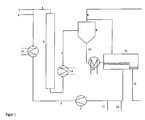
- the aldolization was carried out in a test apparatus which is shown schematically in FIG. 1.
- the continuous catalyst phase 2 is pumped into the circuit with a pump 1.
- the aldehyde or the aldehyde mixture becomes the catalyst through line 3 or Different aldehydes are mixed separately through lines 3 and 4.
- the starting materials were mixed in exclusively via line 3.
- the multiphase mixture 5 is in Examples 3 to 14 through the tubular reactor 6 with a Length of 3 m and a diameter of 17.3 mm pumped with static mixing elements was provided with a hydraulic diameter of 2 mm.
- the resulting one Mixture 7, consisting of the reaction product, unreacted starting material and the Catalyst can pass through volatile constituents in the gas separator 8 Removal in line 9 are exempt. For the examples below, except 2, this line was closed.
- phase separation container 11 headed.
- the aqueous catalyst phase 2 is separated off and the cycle again fed.
- the organic phase that has passed over a weir and contains the reaction product is taken from line 12.
- the heat of reaction can be via heat exchangers 13, 14 and 12 located outside the reactor 15 are dissipated.
- This example describes the process according to the invention for the aldol condensation of Acetone (Ac) and 3-methylbutanal (3-MBA) to 6-methyl-3-hepten-2-one (6-MH).
- the education the by-products 4-methyl-3-penten-2-one (4-MP), 3-methyl-2-isopropyl-2-butenal (3-MiPB), 5-methyl-2-isopropyl-2-hexenal (5-MiPH), 4-hydroxy-6-methylheptan-2-one (6-HMH) and the other high boilers (HS) are in the table below in% by weight specified.
- the reactor was flowed through with a catalyst load of 400 kg / h at a temperature of 80 ° C. at the autogenous pressure of the reactants.
- This example describes the process according to the invention for the aldol condensation of Acetone (Ac) and Pentanal (PAL) to 3-Octen-2-one (3-ON).
- the formation of the by-products 4-methyl-3-penten-2-one (4-MP), 4-hydroxy-4-methyl-3-pentan-2-one (4-HMP), 4-hydroxy-3-octen-2-one (4-HON), 2-propyl-2-heptenal (2-PHL) and other high boilers (HS) are given in the table below in% by weight.
- the reactor was flowed through with a catalyst load of 400 kg / h at a temperature of 80 ° C. at the autogenous pressure of the reactants.
Landscapes
- Chemical & Material Sciences (AREA)
- Organic Chemistry (AREA)
- Chemical Kinetics & Catalysis (AREA)
- Organic Low-Molecular-Weight Compounds And Preparation Thereof (AREA)
- Low-Molecular Organic Synthesis Reactions Using Catalysts (AREA)
- Phenolic Resins Or Amino Resins (AREA)
Applications Claiming Priority (2)
| Application Number | Priority Date | Filing Date | Title |
|---|---|---|---|
| DE2001106186 DE10106186A1 (de) | 2001-02-10 | 2001-02-10 | Verfahren zur Kondensation von Aldehyden mit Ketonen mittels Mehrphasenreaktion |
| DE10106186 | 2001-02-10 |
Publications (2)
| Publication Number | Publication Date |
|---|---|
| EP1231199A1 true EP1231199A1 (fr) | 2002-08-14 |
| EP1231199B1 EP1231199B1 (fr) | 2005-07-20 |
Family
ID=7673580
Family Applications (1)
| Application Number | Title | Priority Date | Filing Date |
|---|---|---|---|
| EP20020000633 Expired - Lifetime EP1231199B1 (fr) | 2001-02-10 | 2002-01-11 | Procédé pour la condensation d'aldéhydes avec des cétones par réaction multiphasique |
Country Status (18)
| Country | Link |
|---|---|
| US (1) | US6603047B2 (fr) |
| EP (1) | EP1231199B1 (fr) |
| JP (1) | JP2002284730A (fr) |
| KR (1) | KR20020066996A (fr) |
| CN (1) | CN1223569C (fr) |
| AT (1) | ATE299852T1 (fr) |
| AU (1) | AU781210B2 (fr) |
| BR (1) | BR0200319A (fr) |
| CA (1) | CA2370808A1 (fr) |
| CZ (1) | CZ2002455A3 (fr) |
| DE (2) | DE10106186A1 (fr) |
| HU (1) | HUP0200461A3 (fr) |
| MX (1) | MXPA02001350A (fr) |
| NO (1) | NO20020650L (fr) |
| NZ (1) | NZ516986A (fr) |
| RU (1) | RU2002103207A (fr) |
| TW (1) | TWI237633B (fr) |
| ZA (1) | ZA200201104B (fr) |
Families Citing this family (38)
| Publication number | Priority date | Publication date | Assignee | Title |
|---|---|---|---|---|
| US7713297B2 (en) | 1998-04-11 | 2010-05-11 | Boston Scientific Scimed, Inc. | Drug-releasing stent with ceramic-containing layer |
| DE10149348A1 (de) * | 2001-10-06 | 2003-04-10 | Oxeno Olefinchemie Gmbh | Verfahren zur Herstellung von 1-Olefin mit Palladiumcarbenverbindungen |
| DE10257499A1 (de) * | 2002-12-10 | 2004-07-01 | Oxeno Olefinchemie Gmbh | Verfahren zur Herstellung von 1-Olefinen durch katalytische Spaltung von 1-Alkoxyalkanen |
| US6979751B2 (en) * | 2002-12-23 | 2005-12-27 | Eastman Chemical Company | Processes for the preparation of higher molecular weight ketones |
| GB2399641B (en) * | 2003-03-18 | 2005-08-31 | Schlumberger Holdings | Method and apparatus for determining the gas flow rate of a gas-liquid mixture |
| DE10329042A1 (de) * | 2003-06-27 | 2005-01-13 | Oxeno Olefinchemie Gmbh | Verfahren zur Herstellung von 1-Octen aus Crack-C4 |
| US6960694B2 (en) * | 2003-07-01 | 2005-11-01 | Eastman Chemical Company | Processes for preparing β-hydroxy-ketones and α,β-unsaturated ketones |
| DE10359628A1 (de) * | 2003-12-18 | 2005-07-21 | Oxeno Olefinchemie Gmbh | Katalysator und Verfahren zur Herstellung von 1-Olefinen aus 2-Hydroxyalkanen |
| DE102004011081A1 (de) * | 2004-03-06 | 2005-09-22 | Oxeno Olefinchemie Gmbh | Verfahren zur Herstellung von tertiären Carbonsäuren |
| US7071361B2 (en) * | 2004-06-25 | 2006-07-04 | Fastman Chemical Company | Processes for the preparation of high molecular weight saturated ketones |
| US20070224235A1 (en) | 2006-03-24 | 2007-09-27 | Barron Tenney | Medical devices having nanoporous coatings for controlled therapeutic agent delivery |
| US8187620B2 (en) | 2006-03-27 | 2012-05-29 | Boston Scientific Scimed, Inc. | Medical devices comprising a porous metal oxide or metal material and a polymer coating for delivering therapeutic agents |
| US8815275B2 (en) | 2006-06-28 | 2014-08-26 | Boston Scientific Scimed, Inc. | Coatings for medical devices comprising a therapeutic agent and a metallic material |
| EP2032091A2 (fr) | 2006-06-29 | 2009-03-11 | Boston Scientific Limited | Dispositifs médicaux avec revêtement sélectif |
| JP2010503469A (ja) | 2006-09-14 | 2010-02-04 | ボストン サイエンティフィック リミテッド | 薬物溶出性皮膜を有する医療デバイス |
| US8070797B2 (en) | 2007-03-01 | 2011-12-06 | Boston Scientific Scimed, Inc. | Medical device with a porous surface for delivery of a therapeutic agent |
| US8431149B2 (en) | 2007-03-01 | 2013-04-30 | Boston Scientific Scimed, Inc. | Coated medical devices for abluminal drug delivery |
| US7976915B2 (en) | 2007-05-23 | 2011-07-12 | Boston Scientific Scimed, Inc. | Endoprosthesis with select ceramic morphology |
| EP1997796A1 (fr) * | 2007-06-01 | 2008-12-03 | DSMIP Assets B.V. | Réaction de condensation d'aldol et catalyseur correspondant |
| US8002823B2 (en) | 2007-07-11 | 2011-08-23 | Boston Scientific Scimed, Inc. | Endoprosthesis coating |
| EP2187988B1 (fr) | 2007-07-19 | 2013-08-21 | Boston Scientific Limited | Endoprothese pourvue d'une surface anti-encrassement |
| US8815273B2 (en) | 2007-07-27 | 2014-08-26 | Boston Scientific Scimed, Inc. | Drug eluting medical devices having porous layers |
| US7931683B2 (en) | 2007-07-27 | 2011-04-26 | Boston Scientific Scimed, Inc. | Articles having ceramic coated surfaces |
| WO2009018340A2 (fr) | 2007-07-31 | 2009-02-05 | Boston Scientific Scimed, Inc. | Revêtement de dispositif médical par placage au laser |
| WO2009020520A1 (fr) | 2007-08-03 | 2009-02-12 | Boston Scientific Scimed, Inc. | Revêtement pour un dispositif médical ayant une aire surfacique accrue |
| US8216632B2 (en) | 2007-11-02 | 2012-07-10 | Boston Scientific Scimed, Inc. | Endoprosthesis coating |
| US8029554B2 (en) | 2007-11-02 | 2011-10-04 | Boston Scientific Scimed, Inc. | Stent with embedded material |
| ES2423504T3 (es) | 2008-04-22 | 2013-09-20 | Boston Scientific Scimed, Inc. | Dispositivos médicos que tienen un recubrimiento de material inorgánico |
| US8932346B2 (en) | 2008-04-24 | 2015-01-13 | Boston Scientific Scimed, Inc. | Medical devices having inorganic particle layers |
| US8449603B2 (en) | 2008-06-18 | 2013-05-28 | Boston Scientific Scimed, Inc. | Endoprosthesis coating |
| US8231980B2 (en) | 2008-12-03 | 2012-07-31 | Boston Scientific Scimed, Inc. | Medical implants including iridium oxide |
| US8287937B2 (en) | 2009-04-24 | 2012-10-16 | Boston Scientific Scimed, Inc. | Endoprosthese |
| CN102584552B (zh) * | 2011-12-29 | 2014-05-14 | 浙江新和成股份有限公司 | 一种在超临界条件下制备苄叉丙酮的方法 |
| ES2693031T3 (es) * | 2013-05-21 | 2018-12-07 | International Flavors & Fragrances, Inc. | Proceso verde para la producción 3-metil-3-penten-2-ona |
| US9688599B2 (en) | 2014-04-18 | 2017-06-27 | Texmark Chemicals, Inc. | Production of mixed aldol products from the products of hydroformylation reactions |
| EP3430106A4 (fr) | 2016-03-18 | 2019-11-13 | General Electric Company | Procédés et compositions pour la prévention de l'encrassement dans des tours caustiques |
| CN116272690B (zh) * | 2023-03-27 | 2026-04-17 | 山东新和成精化科技有限公司 | 一种不饱和酮的合成方法 |
| CN118791371B (zh) * | 2024-09-12 | 2025-02-11 | 山东新和成药业有限公司 | 一种丁酮醇的合成方法 |
Citations (3)
| Publication number | Priority date | Publication date | Assignee | Title |
|---|---|---|---|---|
| EP1057525A2 (fr) * | 1999-06-02 | 2000-12-06 | Oxeno Olefinchemie GmbH | Procédé pour réaliser des réactions catalysées multiphasiques, specifiquement vinylations d'acides carboxyliques |
| EP1057524A2 (fr) * | 1999-06-02 | 2000-12-06 | Oxeno Olefinchemie GmbH | Procédé de réalisation des réactions catalysées multiphasiques, specifiquement hydroformylations |
| EP1106596A2 (fr) * | 1999-11-30 | 2001-06-13 | Oxeno Olefinchemie GmbH | Procédé pour la mise en oeuvre de condensations aldoliques à l'aide de réactions catalysées multiphasiques |
Family Cites Families (4)
| Publication number | Priority date | Publication date | Assignee | Title |
|---|---|---|---|---|
| JP2830211B2 (ja) | 1989-11-17 | 1998-12-02 | 日本曹達株式会社 | β−ヒドロキシケトン類の製造方法 |
| US5583263A (en) | 1995-08-30 | 1996-12-10 | Shell Oil Company | Process of making ketones |
| FR2745565B1 (fr) | 1996-02-29 | 1998-04-03 | Atochem Elf Sa | Procede d'obtention de composes carbonyles beta hydroxy et/ou alpha-beta insatures |
| US5955636A (en) | 1996-07-05 | 1999-09-21 | Kuraray Co., Ltd. | Process for producing 6-methyl-3-hepten-2-one and 6-methyl-2-heptanone analogues, and process for producing phyton or isophytol |
-
2001
- 2001-02-10 DE DE2001106186 patent/DE10106186A1/de not_active Withdrawn
-
2002
- 2002-01-11 AT AT02000633T patent/ATE299852T1/de not_active IP Right Cessation
- 2002-01-11 DE DE50203652T patent/DE50203652D1/de not_active Expired - Fee Related
- 2002-01-11 EP EP20020000633 patent/EP1231199B1/fr not_active Expired - Lifetime
- 2002-02-01 NZ NZ51698602A patent/NZ516986A/xx unknown
- 2002-02-04 BR BR0200319A patent/BR0200319A/pt not_active IP Right Cessation
- 2002-02-06 TW TW91102061A patent/TWI237633B/zh not_active IP Right Cessation
- 2002-02-06 CZ CZ2002455A patent/CZ2002455A3/cs unknown
- 2002-02-07 MX MXPA02001350A patent/MXPA02001350A/es unknown
- 2002-02-07 HU HU0200461A patent/HUP0200461A3/hu unknown
- 2002-02-08 AU AU15515/02A patent/AU781210B2/en not_active Ceased
- 2002-02-08 ZA ZA200201104A patent/ZA200201104B/xx unknown
- 2002-02-08 CA CA 2370808 patent/CA2370808A1/fr not_active Abandoned
- 2002-02-08 JP JP2002032317A patent/JP2002284730A/ja not_active Withdrawn
- 2002-02-08 KR KR1020020007462A patent/KR20020066996A/ko not_active Withdrawn
- 2002-02-08 NO NO20020650A patent/NO20020650L/no not_active Application Discontinuation
- 2002-02-08 RU RU2002103207/04A patent/RU2002103207A/ru not_active Application Discontinuation
- 2002-02-09 CN CNB021045976A patent/CN1223569C/zh not_active Expired - Fee Related
- 2002-02-11 US US10/068,955 patent/US6603047B2/en not_active Expired - Fee Related
Patent Citations (3)
| Publication number | Priority date | Publication date | Assignee | Title |
|---|---|---|---|---|
| EP1057525A2 (fr) * | 1999-06-02 | 2000-12-06 | Oxeno Olefinchemie GmbH | Procédé pour réaliser des réactions catalysées multiphasiques, specifiquement vinylations d'acides carboxyliques |
| EP1057524A2 (fr) * | 1999-06-02 | 2000-12-06 | Oxeno Olefinchemie GmbH | Procédé de réalisation des réactions catalysées multiphasiques, specifiquement hydroformylations |
| EP1106596A2 (fr) * | 1999-11-30 | 2001-06-13 | Oxeno Olefinchemie GmbH | Procédé pour la mise en oeuvre de condensations aldoliques à l'aide de réactions catalysées multiphasiques |
Also Published As
| Publication number | Publication date |
|---|---|
| HU0200461D0 (en) | 2002-04-29 |
| CN1369470A (zh) | 2002-09-18 |
| JP2002284730A (ja) | 2002-10-03 |
| AU781210B2 (en) | 2005-05-12 |
| ATE299852T1 (de) | 2005-08-15 |
| KR20020066996A (ko) | 2002-08-21 |
| NO20020650L (no) | 2002-08-12 |
| EP1231199B1 (fr) | 2005-07-20 |
| HUP0200461A3 (en) | 2002-12-28 |
| MXPA02001350A (es) | 2004-06-22 |
| TWI237633B (en) | 2005-08-11 |
| RU2002103207A (ru) | 2003-11-27 |
| AU1551502A (en) | 2002-08-15 |
| ZA200201104B (en) | 2002-08-22 |
| CZ2002455A3 (cs) | 2002-09-11 |
| CN1223569C (zh) | 2005-10-19 |
| US6603047B2 (en) | 2003-08-05 |
| US20020161264A1 (en) | 2002-10-31 |
| NO20020650D0 (no) | 2002-02-08 |
| BR0200319A (pt) | 2002-10-29 |
| HUP0200461A2 (en) | 2002-08-28 |
| CA2370808A1 (fr) | 2002-08-10 |
| NZ516986A (en) | 2002-09-27 |
| DE50203652D1 (de) | 2005-08-25 |
| DE10106186A1 (de) | 2002-08-14 |
Similar Documents
| Publication | Publication Date | Title |
|---|---|---|
| EP1231199B1 (fr) | Procédé pour la condensation d'aldéhydes avec des cétones par réaction multiphasique | |
| EP1106596B1 (fr) | Procédé pour la mise en oeuvre de condensations aldoliques à l'aide de réactions catalysées multiphasiques | |
| EP1106594B1 (fr) | Procédé d'hydroformylation d'oléfines | |
| EP1057524B1 (fr) | Procédé de réalisation des réactions catalysées d'hydroformylations | |
| EP1103538B1 (fr) | Procédé pour la mise en oeuvre de condensations aldoliques | |
| EP2483227A1 (fr) | Production d'aldéhydes alpha ,beta -insaturés au moyen d'une pompe de mélange réactionnelle | |
| EP1456158B1 (fr) | Procede d'isomerisation d'alcools allyliques | |
| EP1231198B1 (fr) | Hydroformylation | |
| DE102008007080A1 (de) | Verfahren zur Herstellung von C9-Alkohol aus C8-Olefinen | |
| EP2456745A2 (fr) | Procédé de préparation d'acides décane-carboxyliques | |
| EP2925714B1 (fr) | Procédé d'aldolisation catalytique d'aldéhydes | |
| DE102011012846B4 (de) | Verfahren zur Durchführung von mehrphasigen Aldolkondensationsreaktionen zu gemischten α,β-ungesättigten Aldehyden | |
| DE10044352A1 (de) | Kontinuierliches Verfahren zur Herstellung von Acetalen | |
| EP1440051A1 (fr) | Procede pour la production de 6-methylheptan-2-one et utilisation de cette derniere | |
| EP3315484B1 (fr) | Procédé de production couplée de polyols en présence d'une base anorganique | |
| DE1900015B (de) | Verfahren zur Herstellung eines beta Alkexyaldehyds | |
| DEB0026574MA (fr) |
Legal Events
| Date | Code | Title | Description |
|---|---|---|---|
| PUAI | Public reference made under article 153(3) epc to a published international application that has entered the european phase |
Free format text: ORIGINAL CODE: 0009012 |
|
| 17P | Request for examination filed |
Effective date: 20020111 |
|
| AK | Designated contracting states |
Kind code of ref document: A1 Designated state(s): AT BE CH CY DE DK ES FI FR GB GR IE IT LI LU MC NL PT SE TR |
|
| AX | Request for extension of the european patent |
Free format text: AL;LT;LV;MK;RO;SI |
|
| AKX | Designation fees paid |
Designated state(s): AT BE CH CY DE DK ES FI FR GB GR IE IT LI LU MC NL PT SE TR |
|
| 17Q | First examination report despatched |
Effective date: 20030821 |
|
| GRAP | Despatch of communication of intention to grant a patent |
Free format text: ORIGINAL CODE: EPIDOSNIGR1 |
|
| GRAS | Grant fee paid |
Free format text: ORIGINAL CODE: EPIDOSNIGR3 |
|
| GRAA | (expected) grant |
Free format text: ORIGINAL CODE: 0009210 |
|
| AK | Designated contracting states |
Kind code of ref document: B1 Designated state(s): AT BE CH CY DE DK ES FI FR GB GR IE IT LI LU MC NL PT SE TR |
|
| PG25 | Lapsed in a contracting state [announced via postgrant information from national office to epo] |
Ref country code: IE Free format text: LAPSE BECAUSE OF FAILURE TO SUBMIT A TRANSLATION OF THE DESCRIPTION OR TO PAY THE FEE WITHIN THE PRESCRIBED TIME-LIMIT Effective date: 20050720 Ref country code: FI Free format text: LAPSE BECAUSE OF FAILURE TO SUBMIT A TRANSLATION OF THE DESCRIPTION OR TO PAY THE FEE WITHIN THE PRESCRIBED TIME-LIMIT Effective date: 20050720 Ref country code: TR Free format text: LAPSE BECAUSE OF FAILURE TO SUBMIT A TRANSLATION OF THE DESCRIPTION OR TO PAY THE FEE WITHIN THE PRESCRIBED TIME-LIMIT Effective date: 20050720 |
|
| REG | Reference to a national code |
Ref country code: GB Ref legal event code: FG4D Free format text: NOT ENGLISH |
|
| REG | Reference to a national code |
Ref country code: CH Ref legal event code: EP |
|
| REG | Reference to a national code |
Ref country code: SE Ref legal event code: TRGR |
|
| REG | Reference to a national code |
Ref country code: IE Ref legal event code: FG4D Free format text: LANGUAGE OF EP DOCUMENT: GERMAN |
|
| REF | Corresponds to: |
Ref document number: 50203652 Country of ref document: DE Date of ref document: 20050825 Kind code of ref document: P |
|
| GBT | Gb: translation of ep patent filed (gb section 77(6)(a)/1977) |
Effective date: 20050819 |
|
| PG25 | Lapsed in a contracting state [announced via postgrant information from national office to epo] |
Ref country code: GR Free format text: LAPSE BECAUSE OF FAILURE TO SUBMIT A TRANSLATION OF THE DESCRIPTION OR TO PAY THE FEE WITHIN THE PRESCRIBED TIME-LIMIT Effective date: 20051020 Ref country code: DK Free format text: LAPSE BECAUSE OF FAILURE TO SUBMIT A TRANSLATION OF THE DESCRIPTION OR TO PAY THE FEE WITHIN THE PRESCRIBED TIME-LIMIT Effective date: 20051020 |
|
| PG25 | Lapsed in a contracting state [announced via postgrant information from national office to epo] |
Ref country code: ES Free format text: LAPSE BECAUSE OF FAILURE TO SUBMIT A TRANSLATION OF THE DESCRIPTION OR TO PAY THE FEE WITHIN THE PRESCRIBED TIME-LIMIT Effective date: 20051031 |
|
| PG25 | Lapsed in a contracting state [announced via postgrant information from national office to epo] |
Ref country code: PT Free format text: LAPSE BECAUSE OF FAILURE TO SUBMIT A TRANSLATION OF THE DESCRIPTION OR TO PAY THE FEE WITHIN THE PRESCRIBED TIME-LIMIT Effective date: 20051221 |
|
| PG25 | Lapsed in a contracting state [announced via postgrant information from national office to epo] |
Ref country code: AT Free format text: LAPSE BECAUSE OF NON-PAYMENT OF DUE FEES Effective date: 20060111 Ref country code: GB Free format text: LAPSE BECAUSE OF NON-PAYMENT OF DUE FEES Effective date: 20060111 |
|
| PG25 | Lapsed in a contracting state [announced via postgrant information from national office to epo] |
Ref country code: SE Free format text: LAPSE BECAUSE OF NON-PAYMENT OF DUE FEES Effective date: 20060112 |
|
| PG25 | Lapsed in a contracting state [announced via postgrant information from national office to epo] |
Ref country code: FR Free format text: LAPSE BECAUSE OF NON-PAYMENT OF DUE FEES Effective date: 20060131 Ref country code: LU Free format text: LAPSE BECAUSE OF NON-PAYMENT OF DUE FEES Effective date: 20060131 Ref country code: CH Free format text: LAPSE BECAUSE OF NON-PAYMENT OF DUE FEES Effective date: 20060131 Ref country code: BE Free format text: LAPSE BECAUSE OF NON-PAYMENT OF DUE FEES Effective date: 20060131 Ref country code: MC Free format text: LAPSE BECAUSE OF NON-PAYMENT OF DUE FEES Effective date: 20060131 Ref country code: LI Free format text: LAPSE BECAUSE OF NON-PAYMENT OF DUE FEES Effective date: 20060131 |
|
| PGFP | Annual fee paid to national office [announced via postgrant information from national office to epo] |
Ref country code: IT Payment date: 20060131 Year of fee payment: 5 |
|
| REG | Reference to a national code |
Ref country code: IE Ref legal event code: FD4D |
|
| ET | Fr: translation filed | ||
| PLBE | No opposition filed within time limit |
Free format text: ORIGINAL CODE: 0009261 |
|
| STAA | Information on the status of an ep patent application or granted ep patent |
Free format text: STATUS: NO OPPOSITION FILED WITHIN TIME LIMIT |
|
| 26N | No opposition filed |
Effective date: 20060421 |
|
| PG25 | Lapsed in a contracting state [announced via postgrant information from national office to epo] |
Ref country code: NL Free format text: LAPSE BECAUSE OF NON-PAYMENT OF DUE FEES Effective date: 20060801 Ref country code: DE Free format text: LAPSE BECAUSE OF NON-PAYMENT OF DUE FEES Effective date: 20060801 |
|
| REG | Reference to a national code |
Ref country code: CH Ref legal event code: PL |
|
| EUG | Se: european patent has lapsed | ||
| GBPC | Gb: european patent ceased through non-payment of renewal fee |
Effective date: 20060111 |
|
| NLV4 | Nl: lapsed or anulled due to non-payment of the annual fee |
Effective date: 20060801 |
|
| REG | Reference to a national code |
Ref country code: FR Ref legal event code: ST Effective date: 20060929 |
|
| BERE | Be: lapsed |
Owner name: *OXENO OLEFINCHEMIE G.M.B.H. Effective date: 20060131 |
|
| PG25 | Lapsed in a contracting state [announced via postgrant information from national office to epo] |
Ref country code: CY Free format text: LAPSE BECAUSE OF FAILURE TO SUBMIT A TRANSLATION OF THE DESCRIPTION OR TO PAY THE FEE WITHIN THE PRESCRIBED TIME-LIMIT Effective date: 20050720 |
|
| PG25 | Lapsed in a contracting state [announced via postgrant information from national office to epo] |
Ref country code: IT Free format text: LAPSE BECAUSE OF NON-PAYMENT OF DUE FEES Effective date: 20070111 |