EP1231778A2 - Verfahren und System zur digitalen Verarbeitung von bewegten Bildern - Google Patents
Verfahren und System zur digitalen Verarbeitung von bewegten Bildern Download PDFInfo
- Publication number
- EP1231778A2 EP1231778A2 EP02075382A EP02075382A EP1231778A2 EP 1231778 A2 EP1231778 A2 EP 1231778A2 EP 02075382 A EP02075382 A EP 02075382A EP 02075382 A EP02075382 A EP 02075382A EP 1231778 A2 EP1231778 A2 EP 1231778A2
- Authority
- EP
- European Patent Office
- Prior art keywords
- image signals
- noise
- motion image
- motion
- digital
- Prior art date
- Legal status (The legal status is an assumption and is not a legal conclusion. Google has not performed a legal analysis and makes no representation as to the accuracy of the status listed.)
- Withdrawn
Links
- 230000033001 locomotion Effects 0.000 title claims abstract description 67
- 238000000034 method Methods 0.000 title claims abstract description 47
- 238000012545 processing Methods 0.000 title claims abstract description 14
- 230000004044 response Effects 0.000 claims abstract description 44
- 238000012935 Averaging Methods 0.000 claims abstract description 16
- 230000009467 reduction Effects 0.000 claims description 13
- 230000003595 spectral effect Effects 0.000 claims description 8
- 230000000694 effects Effects 0.000 claims description 6
- 238000013461 design Methods 0.000 claims description 5
- 239000010408 film Substances 0.000 description 23
- 238000001914 filtration Methods 0.000 description 15
- 230000008569 process Effects 0.000 description 10
- 238000013459 approach Methods 0.000 description 6
- 238000005457 optimization Methods 0.000 description 6
- 230000002123 temporal effect Effects 0.000 description 5
- 238000004458 analytical method Methods 0.000 description 4
- 238000010586 diagram Methods 0.000 description 4
- 238000012986 modification Methods 0.000 description 4
- 230000004048 modification Effects 0.000 description 4
- 238000006243 chemical reaction Methods 0.000 description 3
- 230000009471 action Effects 0.000 description 2
- 238000012937 correction Methods 0.000 description 2
- 238000003384 imaging method Methods 0.000 description 2
- 238000001228 spectrum Methods 0.000 description 2
- 238000012360 testing method Methods 0.000 description 2
- 230000003044 adaptive effect Effects 0.000 description 1
- 230000005540 biological transmission Effects 0.000 description 1
- 239000006227 byproduct Substances 0.000 description 1
- 238000004364 calculation method Methods 0.000 description 1
- 230000008859 change Effects 0.000 description 1
- 238000004891 communication Methods 0.000 description 1
- 239000013078 crystal Substances 0.000 description 1
- 238000005315 distribution function Methods 0.000 description 1
- 239000000839 emulsion Substances 0.000 description 1
- 238000005516 engineering process Methods 0.000 description 1
- 238000011156 evaluation Methods 0.000 description 1
- 238000004519 manufacturing process Methods 0.000 description 1
- 239000000463 material Substances 0.000 description 1
- 239000012788 optical film Substances 0.000 description 1
- 238000003672 processing method Methods 0.000 description 1
- 238000009877 rendering Methods 0.000 description 1
- 238000012552 review Methods 0.000 description 1
- 238000005070 sampling Methods 0.000 description 1
- 229910052709 silver Inorganic materials 0.000 description 1
- 239000004332 silver Substances 0.000 description 1
- -1 silver halide Chemical class 0.000 description 1
- 238000003860 storage Methods 0.000 description 1
- 238000012546 transfer Methods 0.000 description 1
- 239000013598 vector Substances 0.000 description 1
Images



Classifications
-
- H—ELECTRICITY
- H04—ELECTRIC COMMUNICATION TECHNIQUE
- H04N—PICTORIAL COMMUNICATION, e.g. TELEVISION
- H04N23/00—Cameras or camera modules comprising electronic image sensors; Control thereof
- H04N23/80—Camera processing pipelines; Components thereof
- H04N23/81—Camera processing pipelines; Components thereof for suppressing or minimising disturbance in the image signal generation
-
- H—ELECTRICITY
- H04—ELECTRIC COMMUNICATION TECHNIQUE
- H04N—PICTORIAL COMMUNICATION, e.g. TELEVISION
- H04N5/00—Details of television systems
- H04N5/222—Studio circuitry; Studio devices; Studio equipment
- H04N5/253—Picture signal generating by scanning motion picture films or slide opaques, e.g. for telecine
Definitions
- the invention relates generally to the field of digital image processing, and in particular to techniques for processing motion images.
- a method for digitally processing motion image signals comprises the steps of: (a) obtaining digital motion image signals that originated from a sequence of motion picture frames; (b) using a frame averaging technique to reduce noise in the digital motion image signals, thereby producing noise-processed motion image signals; and (c) producing output digital motion image signals by sharpening the noise-processed motion image signals with a sharpening filter designed in the spatial domain with a 2D kernel that increases the noise in order to provide a desired grain response.
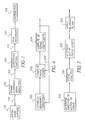
- the basic signal process flow which is shown in the block diagram of Figure 1, initially comprises the capture of an image using a digital image capture stage 101.
- This stage may employ either a photographic film, e.g., a negative film, or a digital camera.
- a full aperture 35-mm movie camera is used to capture a full aperture negative that is scanned by a 4K scanner, which is included in the stage 101.
- Shooting full aperture increases film area and therefore more detail is captured on the film.
- the conversion of a movie camera from standard aperture to full aperture is known to those of skill in these arts. (Specifically, it involves three steps. First, the size of the film gate must be changed.
- the lens is recentered to the center of the full aperture and finally the viewfinder must be able to accommodate the area of the full aperture.
- This modification may be performed on a variety of conventional cameras.
- grain reduction in a grain reduction stage 102 using frame-averaging techniques, thereby producing on a line 103 image data that is reduced in grain.
- noise is removed in the frame averaging grain reduction stage 102 by using motion compensated noise filtering.
- the principle of motion compensated noise removal is to digitally add, across a number of frames, the intensity of a same point in the scene. By thus determining the digital value of the scene at the same point across multiple frames, a more accurate representation is obtained of the original scene.
- the challenge is that because various elements of the scene move in different directions, the same point is in a different position in each frame. Accordingly, the movement of every point in the scene is tracked across multiple frames to identify corresponding scene points across a group of frames.
- Several distinct filtering approaches can be used for motion picture sequences.
- the different permutations of filters are obtained by answering two questions: "where are the samples collected from” and "how are the samples used to create a filtered pixel value".
- image scientists usually refer to the region of support of the filter, which defines the spatial and temporal domain from which samples are collected.
- the region of support is usually a rectangular window for a single frame or a series of windows for multiple frames.
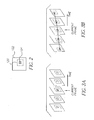
- a typical spatial region of support 120 is shown within a single frame 122.
- the region of support 120 is a graphical representation of the spatial region from which to collect samples for a given pixel. Every pixel within the dotted square is considered in the filtering operation of the current pixel 124 marked in gray.
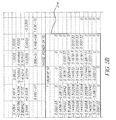
- Figures 3A and 3B show graphical representations of the spatiotemporal regions of support 120 as extended through a sequence of image frames, and in particular show two ways of extending that region temporally.
- Figure 3A shows a fixed-window temporal extension that does not account for image motion between the frames
- Figure 3B shows a motion-compensated temporal extension that accounts for image motion between frames.
- an image sequence can be treated as a stack of still images.
- Samples may be collected from the local spatial neighborhood in the current frame as well as from adjacent frames both ahead and behind the current frame. Because of the motion of objects in the scene, however, the windows in the adjacent frames may actually contain samples from some other object or the background.
- Motion compensated filtering attempts to move the windows (as shown in Figure 3B) in adjacent frames according to the underlying object's motion. If the motion is not known, then a fixed window is often used.
- a filtering method such as averaging is used to compute the filtered pixel values.
- Widely used filtering methods include k-nearest neighbors, sigma-filtering, and adaptive weighted averaging. Again, selection of one filter over another depends upon requirements such as speed and allowable filtering artifacts.
- a sharpening function 104 produces sharpened image data such that the grain noise on a line 105 is similar to the grain noise on line 106.
- the sharpening function is a digital sharpening module performing multiple filtering, e.g., with a 11 x 11 kernel, or aperture correction functions. Additional digital functions may also be performed including lateral inversion and anamorphic scaling. In particular, for embodiments involving digital capture, the depth of field may be digitally modified.
- the resulting data is written out on film using a high-speed high-resolution recorder 107. The film is then distributed in a distribution function 108 to the screen, TV, storage or transmission means.
- one way to do this is to analyze the scene in a scene analysis stage 300, determine scene edges that are slightly out of focus in an edge focus stage 302 and apply an adjustable blurring filter in a filtering stage 304 to those edges so that they appear further out of focus than when they were captured. Determining an edge that is slightly out of focus can be done by determining the rise distance of the edge or by performing a Fourier analysis or frequency analysis of the edge to identify either the frequency amplitude response, phase response of different harmonics, or both. Sometimes it may be necessary to know the out of focus characteristics of the lens that is being used so that the image processing may sense the degree of out of focus of the image.
- This step involves compensating in a directional determination stage 306 for the smear of edges that are moving due to the length of time of exposure of the camera.
- the grain reduction algorithms already discussed in connection with the grain reduction frame averaging stage 102 can produce as a by-product of their internal processes, motion vectors for all edges in the image. Thus it is possible to apply corrections to the edge due to motion and produce an edge whose sharpness loss due to motion has been removed. Another approach is to determine the direction of motion and select edges on the moving object that are parallel to the direction of motion.
Landscapes
- Engineering & Computer Science (AREA)
- Multimedia (AREA)
- Signal Processing (AREA)
- Image Processing (AREA)
- Picture Signal Circuits (AREA)
- Studio Devices (AREA)
Applications Claiming Priority (4)
| Application Number | Priority Date | Filing Date | Title |
|---|---|---|---|
| US11901 | 1979-02-13 | ||
| US26785201P | 2001-02-09 | 2001-02-09 | |
| US267852P | 2001-02-09 | ||
| US10/011,901 US7092016B2 (en) | 2001-02-09 | 2001-12-04 | Method and system for motion image digital processing |
Publications (2)
| Publication Number | Publication Date |
|---|---|
| EP1231778A2 true EP1231778A2 (de) | 2002-08-14 |
| EP1231778A3 EP1231778A3 (de) | 2004-10-27 |
Family
ID=26682919
Family Applications (1)
| Application Number | Title | Priority Date | Filing Date |
|---|---|---|---|
| EP02075382A Withdrawn EP1231778A3 (de) | 2001-02-09 | 2002-01-31 | Verfahren und System zur digitalen Verarbeitung von bewegten Bildern |
Country Status (3)
| Country | Link |
|---|---|
| US (1) | US7092016B2 (de) |
| EP (1) | EP1231778A3 (de) |
| JP (1) | JP4118059B2 (de) |
Cited By (1)
| Publication number | Priority date | Publication date | Assignee | Title |
|---|---|---|---|---|
| WO2023205144A1 (en) * | 2022-04-19 | 2023-10-26 | Dolby Laboratories Licensing Corporation | Metadata-aided removal of film grain |
Families Citing this family (26)
| Publication number | Priority date | Publication date | Assignee | Title |
|---|---|---|---|---|
| US6909491B2 (en) * | 2001-11-02 | 2005-06-21 | Eastman Kodak Company | Electronic and film theatrical quality |
| US7489350B2 (en) * | 2002-05-24 | 2009-02-10 | Koninklijke Philips Electronics N.V. | Unit for and method of sharpness enhancement |
| US20040041912A1 (en) * | 2002-09-03 | 2004-03-04 | Jiabin Zeng | Method and apparatus for video metrology |
| EP1627359B1 (de) * | 2003-05-15 | 2018-11-28 | Thomson Licensing | Verfahren und vorrichtung zum repräsentieren der bildgranularität durch einen oder mehrere parameter |
| BRPI0414647A (pt) * | 2003-09-23 | 2006-11-14 | Thomson Licensing | técnica para simular grão de filme usando filtração de freqüência |
| US7295616B2 (en) * | 2003-11-17 | 2007-11-13 | Eastman Kodak Company | Method and system for video filtering with joint motion and noise estimation |
| US20060050153A1 (en) * | 2004-09-07 | 2006-03-09 | Boll David W | Imaging system and method |
| CN101044510B (zh) * | 2004-10-18 | 2012-01-04 | 汤姆森特许公司 | 胶片颗粒模拟方法 |
| MX2007005653A (es) * | 2004-11-12 | 2007-06-05 | Thomson Licensing | Simulacion de grano para reproduccion normal y reproduccion de modo de truco para sistemas de reproduccion de video. |
| ES2381982T3 (es) | 2004-11-16 | 2012-06-04 | Thomson Licensing | Método de simulación del grano de película basado en coeficientes de transformación previamente generados por ordenador |
| US9117261B2 (en) | 2004-11-16 | 2015-08-25 | Thomson Licensing | Film grain SEI message insertion for bit-accurate simulation in a video system |
| CA2587117C (en) * | 2004-11-17 | 2014-02-11 | Thomson Licensing | Bit-accurate film grain simulation method based on pre-computed transformed coefficients |
| CA2587437C (en) * | 2004-11-22 | 2015-01-13 | Thomson Licensing | Methods, apparatus and system for film grain cache splitting for film grain simulation |
| EP1815688B1 (de) | 2004-11-23 | 2009-07-01 | Thomson Licensing | Filmkörnigkeitssimulationstechnik mit geringer komplexität |
| US7298451B2 (en) * | 2005-06-10 | 2007-11-20 | Thomson Licensing | Method for preservation of motion picture film |
| US20070014484A1 (en) * | 2005-07-18 | 2007-01-18 | Alexander Maclnnis | Method and system for adaptive film grain noise processing |
| EP2001220B1 (de) * | 2006-03-24 | 2015-01-14 | Nikon Corporation | Signalverarbeitungsverfahren, signalverarbeitungssystem, vorrichtung zur koeffizientengenerierung und digitalkamera |
| US7873210B2 (en) * | 2007-03-14 | 2011-01-18 | Autodesk, Inc. | Automatic film grain reproduction |
| US8237830B2 (en) | 2007-04-11 | 2012-08-07 | Red.Com, Inc. | Video camera |
| BRPI0809662A2 (pt) | 2007-04-11 | 2014-10-14 | Red Com Inc | Câmaras de vídeo e métodos de gravação de vídeo de movimento com câmara e de processamento de imagens |
| US10715834B2 (en) | 2007-05-10 | 2020-07-14 | Interdigital Vc Holdings, Inc. | Film grain simulation based on pre-computed transform coefficients |
| US8150196B2 (en) * | 2007-12-14 | 2012-04-03 | Intel Corporation | Reduction filter based on smart neighbor selection and weighting (NRF-SNSW) |
| WO2014127153A1 (en) | 2013-02-14 | 2014-08-21 | Red. Com, Inc. | Video camera |
| CN104000698B (zh) * | 2014-06-04 | 2016-07-06 | 西南交通大学 | 一种融合稀疏表示粒子滤波的电动助力车的避障方法 |
| US9836831B1 (en) | 2014-07-30 | 2017-12-05 | Google Inc. | Simulating long-exposure images |
| JP7313330B2 (ja) | 2017-07-05 | 2023-07-24 | レッド.コム,エルエルシー | 電子機器でのビデオ画像データ処理 |
Citations (1)
| Publication number | Priority date | Publication date | Assignee | Title |
|---|---|---|---|---|
| EP0851665A2 (de) | 1996-12-27 | 1998-07-01 | Hewlett-Packard Company | Verbessertes Verschärfungsfilter für Bilder |
Family Cites Families (9)
| Publication number | Priority date | Publication date | Assignee | Title |
|---|---|---|---|---|
| US5374954A (en) * | 1990-10-11 | 1994-12-20 | Harry E. Mowry | Video system for producing video image simulating the appearance of motion picture or other photographic film |
| US5335013A (en) * | 1992-01-16 | 1994-08-02 | Faber Robert A | Method and apparatus for video camera image film simulation |
| CA2160552C (en) * | 1993-04-15 | 2003-06-10 | Arpag Dadourian | Screen filtering boundary detection for image compositing |
| US5523849A (en) * | 1993-06-17 | 1996-06-04 | Eastman Kodak Company | Optimizing edge enhancement for electrographic color prints |
| US5512956A (en) * | 1994-02-04 | 1996-04-30 | At&T Corp. | Adaptive spatial-temporal postprocessing for low bit-rate coded image sequences |
| US5442407A (en) * | 1994-03-22 | 1995-08-15 | Matsushita Electric Corporation Of America | Video signal noise reduction system using time-varying filter coefficients |
| US5822453A (en) * | 1996-12-10 | 1998-10-13 | Eastman Kodak Company | Method for estimating and adjusting digital image contrast |
| US6207360B1 (en) * | 1997-05-12 | 2001-03-27 | Fuji Photo Film Co., Ltd. | Method for image formation and apparatus for development processing |
| US6208348B1 (en) * | 1998-05-27 | 2001-03-27 | In-Three, Inc. | System and method for dimensionalization processing of images in consideration of a pedetermined image projection format |
-
2001
- 2001-12-04 US US10/011,901 patent/US7092016B2/en not_active Expired - Lifetime
-
2002
- 2002-01-31 EP EP02075382A patent/EP1231778A3/de not_active Withdrawn
- 2002-02-05 JP JP2002027643A patent/JP4118059B2/ja not_active Expired - Fee Related
Patent Citations (1)
| Publication number | Priority date | Publication date | Assignee | Title |
|---|---|---|---|---|
| EP0851665A2 (de) | 1996-12-27 | 1998-07-01 | Hewlett-Packard Company | Verbessertes Verschärfungsfilter für Bilder |
Non-Patent Citations (2)
| Title |
|---|
| P. R. GIACCONE ET AL.: "Motion-compensated multichannel noise reduction of color film sequences", JOURNAL OF ELECTRONIC IMAGING, vol. 8, July 1999 (1999-07-01), pages 246 - 254 |
| S. J. HUANG: "Adaptive noise reduction and image sharpening for digital video compression", PROCEEDINGS OF THE 1997 IEEE INTERNATIONAL CONFERENCE HELD, pages 3142 - 3147 |
Cited By (1)
| Publication number | Priority date | Publication date | Assignee | Title |
|---|---|---|---|---|
| WO2023205144A1 (en) * | 2022-04-19 | 2023-10-26 | Dolby Laboratories Licensing Corporation | Metadata-aided removal of film grain |
Also Published As
| Publication number | Publication date |
|---|---|
| JP2002314845A (ja) | 2002-10-25 |
| US20020109788A1 (en) | 2002-08-15 |
| US7092016B2 (en) | 2006-08-15 |
| EP1231778A3 (de) | 2004-10-27 |
| JP4118059B2 (ja) | 2008-07-16 |
Similar Documents
| Publication | Publication Date | Title |
|---|---|---|
| US7092016B2 (en) | Method and system for motion image digital processing | |
| EP1828982B1 (de) | Bildprozessor und bildverarbeitungsprogramm | |
| US8275218B2 (en) | Forward and backward image resizing method | |
| US9307134B2 (en) | Automatic setting of zoom, aperture and shutter speed based on scene depth map | |
| JP4415188B2 (ja) | 画像撮影装置 | |
| US6959117B2 (en) | Method and apparatus for deblurring and re-blurring image segments | |
| JP2003524903A (ja) | 背景情報を挿入することによりリアルタイム安定化画像から空白領域を排除する装置と方法 | |
| WO2023273868A1 (zh) | 图像降噪方法、装置、终端、存储介质 | |
| KR20110078175A (ko) | 영상 데이터 생성 방법 및 장치 | |
| JPH0622135A (ja) | 画像処理方法 | |
| US7269300B2 (en) | Sharpening a digital image in accordance with magnification values | |
| KR20190089922A (ko) | 광학 시스템 수차들의 디지털 보정 | |
| US20120301012A1 (en) | Image signal processing device and image signal processing method | |
| US20080025628A1 (en) | Enhancement of Blurred Image Portions | |
| Rabie | Adaptive hybrid mean and median filtering of high-ISO long-exposure sensor noise for digital photography | |
| CN115631171A (zh) | 一种图片清晰度评价方法、系统及存储介质 | |
| JP5843599B2 (ja) | 画像処理装置および撮像装置並びにその方法 | |
| US6801339B1 (en) | Image processing method and apparatus | |
| JP7409604B2 (ja) | 画像処理装置、撮像装置、画像処理方法、プログラムおよび記録媒体 | |
| US6909491B2 (en) | Electronic and film theatrical quality | |
| US9401010B2 (en) | Enhancing perceived sharpness of images | |
| JP2009118434A (ja) | ぶれ補正装置及び撮像装置 | |
| JPH01215185A (ja) | 輪郭補償回路 | |
| US8078007B2 (en) | Enlarging a digital image | |
| Yu et al. | Continuous digital zooming of asymmetric dual camera images using registration and variational image restoration |
Legal Events
| Date | Code | Title | Description |
|---|---|---|---|
| PUAI | Public reference made under article 153(3) epc to a published international application that has entered the european phase |
Free format text: ORIGINAL CODE: 0009012 |
|
| AK | Designated contracting states |
Kind code of ref document: A2 Designated state(s): AT BE CH CY DE DK ES FI FR GB GR IE IT LI LU MC NL PT SE TR |
|
| AX | Request for extension of the european patent |
Free format text: AL;LT;LV;MK;RO;SI |
|
| PUAL | Search report despatched |
Free format text: ORIGINAL CODE: 0009013 |
|
| RIC1 | Information provided on ipc code assigned before grant |
Ipc: 7H 04N 5/208 B Ipc: 7H 04N 5/14 A |
|
| AK | Designated contracting states |
Kind code of ref document: A3 Designated state(s): AT BE CH CY DE DK ES FI FR GB GR IE IT LI LU MC NL PT SE TR |
|
| AX | Request for extension of the european patent |
Extension state: AL LT LV MK RO SI |
|
| 17P | Request for examination filed |
Effective date: 20050223 |
|
| AKX | Designation fees paid |
Designated state(s): DE FR GB |
|
| 17Q | First examination report despatched |
Effective date: 20090213 |
|
| RAP1 | Party data changed (applicant data changed or rights of an application transferred) |
Owner name: INTELLECTUAL VENTURES FUND 83 LLC |
|
| STAA | Information on the status of an ep patent application or granted ep patent |
Free format text: STATUS: THE APPLICATION IS DEEMED TO BE WITHDRAWN |
|
| 18D | Application deemed to be withdrawn |
Effective date: 20160726 |