EP1231802A1 - Rufzulassungskontrolgerät auf Basis der Sendeleistung der Basisstation - Google Patents
Rufzulassungskontrolgerät auf Basis der Sendeleistung der Basisstation Download PDFInfo
- Publication number
- EP1231802A1 EP1231802A1 EP02250841A EP02250841A EP1231802A1 EP 1231802 A1 EP1231802 A1 EP 1231802A1 EP 02250841 A EP02250841 A EP 02250841A EP 02250841 A EP02250841 A EP 02250841A EP 1231802 A1 EP1231802 A1 EP 1231802A1
- Authority
- EP
- European Patent Office
- Prior art keywords
- threshold
- call
- base station
- transmission power
- unit
- Prior art date
- Legal status (The legal status is an assumption and is not a legal conclusion. Google has not performed a legal analysis and makes no representation as to the accuracy of the status listed.)
- Granted
Links
Images



Classifications
-
- H—ELECTRICITY
- H04—ELECTRIC COMMUNICATION TECHNIQUE
- H04W—WIRELESS COMMUNICATION NETWORKS
- H04W72/00—Local resource management
- H04W72/50—Allocation or scheduling criteria for wireless resources
- H04W72/52—Allocation or scheduling criteria for wireless resources based on load
Definitions
- the present invention generally relates to a method of controlling calls in a mobile communication system, and particularly relates to a method of controlling calls when a base station receives calls from a plurality of mobile stations.
- the present invention further relates to a base station which attends to communication based on such a method of controlling calls.
- the number of simultaneously connectable users differs depending on employed wireless access schemes.
- capacity is determined by a frequency band occupied per user and a frequency band available to the system.
- TDMA time division multiple access
- capacity is determined by the number of timeslots that are the unit of division used for time division.
- code division multiple access such as CDMA
- capacity is determined by electric power occupied by each user and the amount of interference between users.
- Factors that determine the capacity of the CDMA scheme include the number of codes that can be allocated, the amount of interference on the uplink, and the transmission power on the downlink. The amount of interference differs depending on the characteristics of employed codes. In any event, the capacity basically corresponds to a point at which the total of user electric power exceeds a certain limit.
- a base station used in a mobile communication system accepts calls from mobile stations (i.e., from users) by taking into account the capacity that is determined as described above.
- the call admission operation performed by the base station is carried out by following a procedure as shown in Fig.9, for example. In this description relating to Fig.9, the base station is assumed to be employing the CDMA scheme.
- the base station upon receiving a call from a mobile station, the base station checks whether there are available codes that can be allocated (S2). If the check finds that there are available codes (YES at S2), a check is further made as to whether the amount of uplink interference stays below a predetermined amount (S4). If the check finds that the amount of uplink interference stays below the predetermined amount (YES at S4), a further check is made as to whether a sufficient transmission power is left in the base station, i.e., whether the transmission power of the base station stays below a threshold (S8). If the check finds that the transmission power of the base station stays below the threshold (YES at S8), a call setting process is performed for the call that has been received. If any one of the checks (S2, S4, S8) does not satisfy the required conditions, a call loss process is carried out (S9, S10, S11).
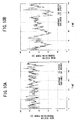
- Figs.10A and 10B are charts showing temporal shifts in the base station transmission power.
- Fig.10A shows a temporal shift of base station transmission power in a case where calls based on communication through circuit switching are exclusively connected to the base station.
- Fig.10B shows a temporal shift of the base station transmission power in a case in which calls of circuit switching and calls of packet switching are mixed and connected to the base station.
- a horizontal axis represents time
- a vertical axis represents a base station transmission power (%).
- the number of simultaneously connected calls is assumed to be 25, and the powers of all the connected users are added to the total.
- Fig.10A and Fig.10B an average and a variance of the base station transmission power computed over time 0 through time 250 are shown at the bottom right portion.
- the waveform of the base station transmission power does not exhibit extreme changes.
- the waveform of the base station transmission power exhibits volatile changes. This is because the transmission of packet switching calls is performed in a burst-like manner. That is, transmission is made when data is present, and stops when no data is present, such intermittent nature of transmission causing the volatile changes.
- the number of available codes that can be allocated is determined by the number of currently connected users. It is safe to assume that no mistake occurs in counting the number of available codes.
- the amount of uplink interference and the transmission power of a base station may exhibit volatile changes depending on the conditions of connected calls as shown in Figs.10A and 10B.
- an apparatus for controlling call admission includes a call admission check unit which determines whether to admit a call in response to reception of the call based on a threshold that reflect history of base station transmission power.
- the apparatus described above monitors history of changes of base station transmission power, thereby making it possible to estimate types of calls connected to the base station based on the monitored changes.
- the threshold providing a basis for a call admission check can then be determined by using such estimate. Use of the threshold obtained in this manner makes it possible to achieve proper call admission without degrading communication quality of currently connected calls.
- the apparatus as described above further includes an averaging unit which obtains an average of past samples of the base station transmission power, wherein said call admission check unit determines whether to admit the call by comparing a threshold with a sum of the average of past samples and transmission power required for the call.
- the past samples of the base station transmission power are averaged over a predetermined time period. This averaging process makes it possible to estimate the presence of potential packet switching calls.
- an averaged value is relatively high even though the instantaneous value of the current base station transmission power may be relatively low. In this case, therefore, it is ascertained that there are some packet switching calls currently on the line.
- the apparatus as described above further includes a packet-switching-call-proportion estimating unit which estimates a proportion of packet switching calls in a total number of calls based on past samples of the base station transmission power, wherein the threshold reflects the estimated proportion.
- the apparatus as described above obtains an estimate of a proportion of packet switching calls in a total number of calls currently connected to the base station by monitoring the past samples of the base station transmission power.
- the apparatus makes the threshold for a call admission check reflect this estimate, and will be less likely to admit further calls if the estimate indicates the presence of potential packet switching calls despite the presence of some margin of the base station transmission power. This makes it possible to avoid a situation in which an excessive number of calls are. accepted.
- the apparatus as described above is such that said packet-switching-call-proportion estimating unit measures a volatility of the base station transmission power as the estimated proportion over a predetermined time period.
- the apparatus described above measures the volatility of the base station transmission power, thereby making it possible to estimate a proportion of packet switching calls in a total number of calls currently connected to the base station. If the volatility of base station transmission power is large, it is ascertained that there are potential packet switching calls. If the volatility of base station transmission power is small, it is ascertained that stable circuit switching calls are predominant.
- the apparatus as described above further includes a threshold computation unit which computes the threshold concerning a present instant by adjusting the threshold concerning a previous instant in response to the measured volatility and by placing the threshold concerning the present instant within a tolerance range if the threshold concerning the present instant falls outside a tolerance range.
- the apparatus described above dynamically updates the threshold of the call admission check. If the variance (i.e., measured volatility) is larger than before, potential packet switching calls are expected to be present. In this case, the threshold is decreased to provide a new threshold. If the variance is smaller than before, it is estimated that circuit switching calls are predominant, with the number of potential packet switching calls being small. In this case, the threshold is increased from a previous threshold.
- the variance i.e., measured volatility
- the correction of a threshold is dynamically performed in response to measured volatility.
- Use of such threshold for the call admission check makes it possible to achieve efficient call admission that takes into account the presence of potential packet switching calls. Since provision is made to prevent the threshold from exceeding beyond the tolerance range, it is possible to avoid accepting calls that will result in overload.
- the apparatus as described above further includes a memory unit which stores therein a table of volatilities and associated thresholds, and a threshold computation unit which obtains the threshold by referring to the table and finding in the table a threshold associated with the volatility measured by said packet-switching-call-proportion estimating unit.
- volatilities and associated thresholds are stored in a table format.
- the apparatus will consult the table and readily find a threshold that corresponds to the measured volatility.
- the apparatus further includes a threshold computation unit which determines the threshold concerning a present instant by adjusting the threshold concerning a previous instant in response to whether compression is present or absent in multiplexing base-band signals.
- the threshold is dynamically updated in response to the detection of compression in the base-band signal multiplexing unit of the base station. If compression is detected in the base-band signal multiplexing unit, this means that only a small amount of transmission power remains. If this is the case, the threshold is decreased so as to reduce the possibility of accepting further calls. If no compression is detected in the base-band signal multiplexing unit, it is ascertained that there is still a margin of the transmission power. In this case, the threshold is increased. In this manner, the detection of compression in the base-band signal multiplexing unit allows an estimate to be made with respect to the calls currently connected to the base station.
- the apparatus as described above further includes a peak-hold unit which obtains a peak of the base station transmission power within a predetermined period, wherein said call admission check unit determines whether to admit the call by comparing a threshold with a sum of the peak and transmission power required for the call.
- Fig.1 is an illustrative drawing showing a mobile communication system to which an embodiment of a call control method according to the present invention is applied.
- the mobile communication system is based on the CDMA (code division multiple access) scheme, and includes mobile stations (e.g., portable telephone sets) 10-1 through 10-3, a base station 20, a radio network control apparatus 30, and a network apparatus (e.g., switch station apparatus) 40.
- the mobile stations 10-1 through 10-3 communicate with the base station 20 through radio, and can attend to audio communication or non-audio communications with other terminals (such as portable telephone sets) through the radio network control apparatus 30 and the network apparatus 40.
- CDMA code division multiple access
- Fig.2 is a block diagram showing an example configuration of the base station 20.
- the base station 20 includes an antenna 21 for receiving radio frequency signals, a dyplexer 22 for separating transmission signals and reception signals, a transmission unit 23 for modulating and amplifying transmission signals, a reception unit 24 for demodulating reception signals, a call admission control unit 25 for performing call control such as the admission of issued calls and the reception of calls with respect to the mobile stations 10-1 through 10-3, a memory unit 26 for storing information about a threshold for accepting calls, and a base-band signal multiplexing unit 27 for processing and multiplexing base-band signals.
- the call admission control unit 25 receives a call setting request from a user through the reception unit 24, and, then, performs a call admission check process that checks whether this call can be accepted.
- This call admission check process is carried out by comparing a predetermined reference value with a sum of the transmission power of the base station 20 and the transmission power required for the call to be accepted. If the check finds that the call can be admitted, the call admission control unit 25 sends a call setting admission message to the user, thereby setting up a link.
- the call admission control unit 25 of the base station 20 carries out a call admission check in response to reception of a call from a user.
- Fig.3 is a block diagram showing an example configuration of the call admission control unit 25.
- the call admission control unit 25 includes a call admission check unit 25-1 and an averaging unit 25-2.
- the averaging unit 25-2 performs a predetermined averaging process by use of an instantaneous value X of the transmission power of the base station 20.
- the call admission check unit 25-1 checks whether to accept the call by comparing a predetermined check reference Z (i.e., threshold) with a sum of an averaged transmission power X' obtained by the averaging unit 25-2 and a transmission power Y required for the received call. If X' + Y ⁇ Z, the call admission check unit 25-1 accepts the call. Otherwise, the call is rejected.
- a predetermined check reference Z i.e., threshold
- the call admission check unit 25-1 will be susceptible to the volatility of the base station transmission power X.
- the present invention provides the averaging unit 25-2 for averaging the transmission power X in order to alleviate the volatility.
- the averaging unit 25-2 is given an averaging time T as an operation parameter.
- the averaging unit 25-2 stores therein the record of transmission power of the base station 20 over the past time period T, and supplies an averaged value X' to the call admission check unit 25-1. Provision of the averaged value X' to the call admission check unit 25-1 can alleviate the effect of volatility of the base station transmission power X.
- the averaging time T for the averaging process needs to be set by taking into account the intervals of intermittent transmissions of packet switching calls when keeping record of the transmission history. For example, if an average of a transmission lasting length of a packet switching call is 10 seconds, and an average of a no-transmission interval period is 20 seconds, the period T may be set to about 30 seconds.
- the averaging unit 25-2 may obtain a median of the past samples rather than an average of the past samples, or may obtain a center of the past samples.
- Fig.4 is a block diagram showing another example configuration of the call admission control unit 25.
- the call admission control unit 25 includes a variance computation unit 25-3 and a threshold computation unit 25-4 in addition to the configuration of Fig.3. Further, a switch 25-5 is provided at a stage prior to the threshold computation unit 25-4. The switch 25-5 can switch between a line carrying the threshold Z of an initial state and a line for feeding back a value computed by the threshold computation unit 25-4.
- the call admission check unit 25-1 receives the value X' computed by the averaging unit 25-2, the transmission power Y required by the received call, and the output Z' of the threshold computation unit 25-4. How to check admission in the call admission check unit 25-1 is the same as in the previous case..
- the averaging unit 25-2 and the variance computation unit 25-3 are provided with the averaging time T as an operation parameter.
- the averaging unit 25-2 computes an average of the base station transmission power over the past time period T, and supplies the computed value to the call admission check unit 25-1 and the variance computation unit 25-3.
- the variance computation unit 25-3 uses the average value supplied from the averaging unit 25-2 to compute a variance of sampled values over the past time period T, and supplies the computed result to the threshold computation unit 25-4.
- the threshold computation unit 25-4 computes a new threshold based on the variance supplied from the variance computation unit 25-3.
- an average and variance of the base station transmission power are obtained, and a threshold used in the call admission check is computed based on the variance so as to be dynamically updated. If the call admission check is made by use of such a threshold, call admission should be made properly without overlooking the existence of potential packet switching calls.
- a standard deviation may be used in place of a variance, or any other measure of volatility regarding the past samples of base station transmission power may be used. Use of such measure of volatility is tantamount to estimation of the proportion of packet switching calls in all the calls.
- Fig.5 is a flowchart showing a method of computing a threshold by the threshold computation unit 25-4.
- the threshold computation unit 25-4 computes a threshold of the present instant based on a threshold P of a previous instant, a variance D of a previous instant, and a variance E of the present instant. For example, the variance D of the previous instant is compared with the variance E of the present (S1). If the variance E of the present is larger than the variance D of the previous instant (D ⁇ E at S1), the variance has increased from the previous instant so that the presence of potential packet switching call is expected. In this case, therefore, the call admission threshold Q is lowered. In this example, a process at step S2 subtracts ⁇ from the threshold P of the previous instant. Through this subtraction, the call admission threshold Q is lowered.
- the call admission threshold Q is raised.
- a process at step S3 adds ⁇ to the threshold P of the previous instant. Through this addition, the call admission threshold Q is raised.
- the threshold Q as computed above is checked as to whether the computed threshold Q falls within a predetermined tolerance range (S4). If the computed threshold Q falls within the tolerance range (YES at S4), this threshold Q is used as a threshold. If the computed threshold Q falls outside the tolerance range (NO at S4), a rounding process is performed to place the threshold Q within the tolerance range (S5), thereby generating a threshold Q'.
- the threshold Q or Q' is supplied to the call admission check unit 25-1.
- the method of computing the threshold Q as described above is only an example, and other methods may be used for the computation of the threshold Q.
- a table that lists variances and optimum thresholds is obtained in advance through experimentation, and is referred to in order to determine a new threshold.
- the call admission control unit 25 may read and refer to the table from the memory unit 26.
- the base station transmission power may be assumed to have a normal distribution.
- a test such as a one-sided test is then applied to an average and variance of the base station transmission power, and a threshold is set such that the possibility of the base station transmission power exceeding X% is adjusted to Y%.
- the computation methods described here may be combined to compute the threshold Q.
- the threshold is dynamically updated based on the variances.
- the updating of a threshold is an increase or a decrease depending on whether a variance is larger than a preceding variance. That is, the updating of a threshold is performed by taking into consideration the types of calls connected to the base station 20. Because of such consideration, use of this threshold for the call admission check achieves appropriate call admission. Since the threshold is updated constantly, call admission control that is accurate in real-time can be achieved.
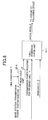
- Fig.6 is a block diagram showing another example configuration of the call admission control unit 25.
- the call admission control unit 25 includes a peak-hold unit 25-6 in addition to the call admission check unit 25-1 where the peak-hold unit 25-6 outputs a maximum value of instantaneous values of the base station transmission power.
- the peak-hold unit 25-6 is provided with a time constant T as an operation parameter.
- the peak-hold unit 25-6 finds the largest of the instantaneous samples of the base station transmission power during the past time period T, and supplies the largest sample to the call admission check unit 25-1.
- the call admission check unit 25-1 receives a peak of base station transmission power over the past time period T, and this peak will be significantly larger than the average of base station transmission power if the number of packet switching calls is large. This can avoid a situation in which the base station transmission power becomes insufficient after accepting a received call. If circuit switching calls are predominant, the peak will not be much different from the average, so that substantially the same operation as the first embodiment is performed.
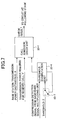
- Fig.7 is a block diagram showing another example configuration of the call admission control unit 25.
- the call admission control unit 25 includes the call admission check unit 25-1 and the threshold computation unit 25-4. Further, the threshold computation unit 25-4 can switch between a line carrying an initial threshold and a line that feeds back a threshold computed by the threshold computation unit 25-4. This switching is carried out by a switch unit 25-7. In this embodiment, the threshold computation unit 25-4 further receives a compression detection signal from the base-band signal multiplexing unit 27.
- the threshold computation unit 25-4 receives a signal from the base-band signal multiplexing unit 27. This signal indicates the presence/absence of compression that is detected by the base-band signal multiplexing unit 27. If this signal indicates the presence of compression, the threshold computation unit 25-4 raises the threshold. On the other hand, if the threshold computation unit 25-4 does not detect a signal indicative of the presence of compression for a predetermined time period, the threshold computation unit 25-4 lowers the threshold. The threshold obtained in this manner is then supplied to the call admission check unit 25-1.
- the fact that the threshold computation unit 25-4 detects a signal indicative of the presence of compression means that the base station transmission power has reached its limit. In this case, the threshold is raised in order not to accept further calls in addition to the currently connected calls. If the threshold computation unit 25-4 does not detect a signal indicative of the presence of compression, this means that the transmission power of the base station 20 has not yet reached its limit. In this case, the threshold computation unit 25-4 lowers the threshold so that it is more likely to accept calls.
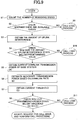
- Fig.8 is a flowchart showing a method of computing a threshold by the threshold computation unit 25-4.
- the threshold computation unit 25-4 receives a threshold P of a previous instant and a compression detection signal from the base-band signal multiplexing unit 27. If the compression detection signal from the base-band signal multiplexing unit 27 indicates the presence of detection (YES at S1), the threshold computation unit 25-4 decreases the threshold P of the previous instant by a predetermined amount ⁇ (S8), thereby producing a new threshold Q. If the compression detection signal from the base-band signal multiplexing unit 27 does not indicate the presence of compression (NO at S1), a time at which this compression detection signal has arrived is marked as a start of a time T, and this time T is incremented by a predetermined amount such as "1" (S2).
- the threshold Q as computed at step S5 or step S4 is checked as to whether the computed threshold Q falls within a predetermined tolerance range (S6). If the computed threshold Q falls within the tolerance range (YES at S6), this threshold Q is used as a threshold. If the computed threshold Q falls outside the tolerance range (NO at S6), a rounding process is performed to place the threshold Q within the tolerance range (S7), thereby generating a threshold Q'.
- the threshold Q or Q' is supplied to the call admission check unit 25-1.
- the threshold is increased or decreased depending on the presence/absence of compression detected by the base-band signal multiplexing unit 27. Namely, this embodiment can estimate the condition of calls currently connected to the base station 20 by detecting the presence/absence of compression in the base-band signal multiplexing unit 27.
- the present invention has been described with reference to the four embodiments.
- the call admission control unit 25 of the present invention may be implemented by combining any of these embodiments.
- the call admission control unit 25 may be configured such that a call is not admitted unless both the determination made by the first embodiment criteria and the determination made by the second embodiment criteria indicate admission of a call.
Landscapes
- Engineering & Computer Science (AREA)
- Computer Networks & Wireless Communication (AREA)
- Signal Processing (AREA)
- Mobile Radio Communication Systems (AREA)
Applications Claiming Priority (2)
| Application Number | Priority Date | Filing Date | Title |
|---|---|---|---|
| JP2001034304 | 2001-02-09 | ||
| JP2001034304A JP3682768B2 (ja) | 2001-02-09 | 2001-02-09 | 呼受付制御装置及び基地局 |
Publications (2)
| Publication Number | Publication Date |
|---|---|
| EP1231802A1 true EP1231802A1 (de) | 2002-08-14 |
| EP1231802B1 EP1231802B1 (de) | 2004-05-19 |
Family
ID=18897935
Family Applications (1)
| Application Number | Title | Priority Date | Filing Date |
|---|---|---|---|
| EP02250841A Expired - Lifetime EP1231802B1 (de) | 2001-02-09 | 2002-02-07 | Rufzulassungskontrolgerät auf Basis der Sendeleistung der Basisstation |
Country Status (5)
| Country | Link |
|---|---|
| US (1) | US6944439B2 (de) |
| EP (1) | EP1231802B1 (de) |
| JP (1) | JP3682768B2 (de) |
| CN (1) | CN100459747C (de) |
| DE (1) | DE60200486T2 (de) |
Families Citing this family (12)
| Publication number | Priority date | Publication date | Assignee | Title |
|---|---|---|---|---|
| JP3848145B2 (ja) * | 2001-12-10 | 2006-11-22 | 株式会社エヌ・ティ・ティ・ドコモ | 通信制御システム、通信制御方法及び基地局 |
| JP3728427B2 (ja) * | 2002-05-21 | 2005-12-21 | 松下電器産業株式会社 | データ送信装置及びデータ送信方法 |
| US6778812B1 (en) | 2002-05-24 | 2004-08-17 | Interdigital Technology Communication | System and method for call admission control |
| CN1172473C (zh) * | 2002-12-24 | 2004-10-20 | 大唐移动通信设备有限公司 | 码分多址移动通信系统中的一种接纳控制方法 |
| JP4024725B2 (ja) | 2003-07-18 | 2007-12-19 | 株式会社東芝 | 移動通信システム、同システムの無線制御局、同システムの基地局、同システムの移動局、および並列組み合わせスペクトラム拡散方式のパラメータ決定方法 |
| EP1598952A1 (de) * | 2004-05-19 | 2005-11-23 | NEC Corporation | Mobilkommunikationssystem, Basisstationssteuereinheit und Verfahren zur Änderung der Schwelle der kumulierten Übertragungsstärke |
| JP2006005906A (ja) * | 2004-05-19 | 2006-01-05 | Nec Corp | 移動通信システム、基地局制御装置及びそれに用いる下り送信電力積み上げ閾値変動方法 |
| US8379576B1 (en) * | 2004-12-03 | 2013-02-19 | Apple Inc. | Call admission control systems and methods for wireless networks |
| JP2007124048A (ja) * | 2005-10-25 | 2007-05-17 | Ntt Docomo Inc | 通信制御装置及び通信制御方法 |
| JP5145852B2 (ja) | 2007-10-15 | 2013-02-20 | 日本電気株式会社 | 係数決定装置、無線通信システム、係数決定方法及び係数決定プログラム |
| JP5346970B2 (ja) * | 2011-03-04 | 2013-11-20 | 株式会社エヌ・ティ・ティ・ドコモ | 移動端末装置、無線基地局装置及び無線通信方法 |
| US8965374B1 (en) * | 2013-02-19 | 2015-02-24 | Sprint Spectrum L.P. | Systems and methods for adjusting mobile-station hard-handoff thresholds based on call type |
Citations (7)
| Publication number | Priority date | Publication date | Assignee | Title |
|---|---|---|---|---|
| EP0817521A2 (de) * | 1996-06-28 | 1998-01-07 | Lucent Technologies Inc. | Auf Interferenz basierendes dynamisches Kanalzuweisungsverfahren |
| WO1998030047A1 (en) * | 1996-12-31 | 1998-07-09 | Arraycomm, Inc. | Channel assignment and call admission control for spatial division multiple access communication systems |
| GB2343331A (en) * | 1998-10-27 | 2000-05-03 | Roke Manor Research | Base station signals to switch mobile terminals out of a power saving mode to ensure that its own power budget is not exceeded |
| GB2347317A (en) * | 1999-02-25 | 2000-08-30 | Motorola Ltd | Determining a cost function from the actual resource impact of supporting a subscriber in a communications system |
| EP1100283A1 (de) * | 1999-11-10 | 2001-05-16 | Alcatel | Verfahren zur Einstellung der Rufzulassungssteuerungsschwelle(n) und Rufzulassungssteuerungsverfahren hierfür |
| WO2001035692A1 (en) * | 1999-11-10 | 2001-05-17 | Telefonaktiebolaget Lm Ericsson (Publ) | Admission control in a mobile radio communications system |
| WO2001093620A1 (en) * | 2000-05-30 | 2001-12-06 | Telefonaktiebolaget L M Ericsson (Publ) | Dynamic call admission |
Family Cites Families (8)
| Publication number | Priority date | Publication date | Assignee | Title |
|---|---|---|---|---|
| JP2921739B2 (ja) | 1995-01-06 | 1999-07-19 | エヌ・ティ・ティ移動通信網株式会社 | 呼受付制御方法および装置 |
| US5838671A (en) | 1995-06-23 | 1998-11-17 | Ntt Mobile Communications Network Inc. | Method and apparatus for call admission control in CDMA mobile communication system |
| JP2803626B2 (ja) * | 1996-04-05 | 1998-09-24 | 日本電気株式会社 | 移動無線端末の送信電力制御方式 |
| US6801515B1 (en) * | 1996-12-27 | 2004-10-05 | Ntt Mobile Communications Network Inc. | Call acceptance control method for CDMA mobile radio communication system and mobile station device |
| EP0939566B1 (de) | 1997-08-19 | 2008-05-28 | NTT DoCoMo, Inc. | Signal übertragungsverfahren und basisstation für mobile kommunikation |
| JP3180769B2 (ja) * | 1998-07-17 | 2001-06-25 | 日本電気株式会社 | 受信電力算出方法及び移動局 |
| CN1194581C (zh) | 1998-12-07 | 2005-03-23 | Ntt移动通信网株式会社 | 移动数据通信的通信业务量控制方法、移动台装置和基站装置 |
| US7453945B2 (en) * | 2003-09-05 | 2008-11-18 | Lucent Technologies Inc. | Methods and devices for controlling RF, multi-carrier amplifier signal power |
-
2001
- 2001-02-09 JP JP2001034304A patent/JP3682768B2/ja not_active Expired - Fee Related
-
2002
- 2002-02-07 EP EP02250841A patent/EP1231802B1/de not_active Expired - Lifetime
- 2002-02-07 DE DE60200486T patent/DE60200486T2/de not_active Expired - Lifetime
- 2002-02-08 US US10/067,945 patent/US6944439B2/en not_active Expired - Fee Related
- 2002-02-09 CN CNB021047227A patent/CN100459747C/zh not_active Expired - Fee Related
Patent Citations (7)
| Publication number | Priority date | Publication date | Assignee | Title |
|---|---|---|---|---|
| EP0817521A2 (de) * | 1996-06-28 | 1998-01-07 | Lucent Technologies Inc. | Auf Interferenz basierendes dynamisches Kanalzuweisungsverfahren |
| WO1998030047A1 (en) * | 1996-12-31 | 1998-07-09 | Arraycomm, Inc. | Channel assignment and call admission control for spatial division multiple access communication systems |
| GB2343331A (en) * | 1998-10-27 | 2000-05-03 | Roke Manor Research | Base station signals to switch mobile terminals out of a power saving mode to ensure that its own power budget is not exceeded |
| GB2347317A (en) * | 1999-02-25 | 2000-08-30 | Motorola Ltd | Determining a cost function from the actual resource impact of supporting a subscriber in a communications system |
| EP1100283A1 (de) * | 1999-11-10 | 2001-05-16 | Alcatel | Verfahren zur Einstellung der Rufzulassungssteuerungsschwelle(n) und Rufzulassungssteuerungsverfahren hierfür |
| WO2001035692A1 (en) * | 1999-11-10 | 2001-05-17 | Telefonaktiebolaget Lm Ericsson (Publ) | Admission control in a mobile radio communications system |
| WO2001093620A1 (en) * | 2000-05-30 | 2001-12-06 | Telefonaktiebolaget L M Ericsson (Publ) | Dynamic call admission |
Non-Patent Citations (2)
| Title |
|---|
| HJELM B: "ADMISSION CONTROL IN FUTURE MULTI-SERVICE WIDEBAND DIRECT-SEQUENCE CDMA SYSTEMS", VTC 2000-FALL. IEEE VTS 52ND. VEHICULAR TECHNOLOGY CONFERENCE. BOSTON, MA, SEPT. 24 - 28, 2000, IEEE VEHICULAR TECHNOLGY CONFERENCE, NEW YORK, NY: IEEE, US, vol. 3 OF 6. CONF. 52, 24 September 2000 (2000-09-24), pages 1086 - 1093, XP000988548, ISBN: 0-7803-6508-9 * |
| SONGSONG SUN ET AL: "Call admission policies and capacity analysis of a multi-service CDMA personal communication system with continuous and discontinuous transmission", VEHICULAR TECHNOLOGY CONFERENCE, 1998. VTC 98. 48TH IEEE OTTAWA, ONT., CANADA 18-21 MAY 1998, NEW YORK, NY, USA,IEEE, US, 18 May 1998 (1998-05-18), pages 218 - 223, XP010287805, ISBN: 0-7803-4320-4 * |
Also Published As
| Publication number | Publication date |
|---|---|
| CN100459747C (zh) | 2009-02-04 |
| DE60200486T2 (de) | 2005-06-02 |
| JP2002238073A (ja) | 2002-08-23 |
| US20020115427A1 (en) | 2002-08-22 |
| US6944439B2 (en) | 2005-09-13 |
| EP1231802B1 (de) | 2004-05-19 |
| JP3682768B2 (ja) | 2005-08-10 |
| DE60200486D1 (de) | 2004-06-24 |
| CN1371226A (zh) | 2002-09-25 |
Similar Documents
| Publication | Publication Date | Title |
|---|---|---|
| EP1501231B1 (de) | Verfahren zur Bestimmung der Übertragungsrate eines Signalisierungsrückkanals eines Funksystems | |
| US6687510B2 (en) | Methods and apparatus for power allocation on a reverse link power control channel of a communication system | |
| EP1168689B1 (de) | Verfahren zur Erkennung und Berechnung der Signalleistung eines äusseren Störers in Kommunikationssystemen | |
| EP1231802B1 (de) | Rufzulassungskontrolgerät auf Basis der Sendeleistung der Basisstation | |
| US7764654B2 (en) | System and method for balancing communication traffic loading between adjacent base stations in a mobile communications network | |
| KR100797501B1 (ko) | 액세스 포인트의 성능을 최적화하는 무선 통신 방법 및장치 | |
| EP1876725A2 (de) | Übertragungsleistungssteuerung | |
| US6487420B1 (en) | Adaptive rach power determination for mobile telecommunications user equipment unit | |
| EP1233641A2 (de) | Funkkanal-Zuteilungssteuerung in CDMA Kommunikationssysteme | |
| WO1998035522A2 (en) | Method of dynamically controlling the length of r_data messages on a random access channel | |
| EP1863309B1 (de) | Mobiles endgerät eines cdma-systems, verfahren zur mobilkommunikation mit einem cdma-system und verfahren zur schätzung der kommunikationsqualität | |
| US7764653B2 (en) | Method and apparatus for autonomously determining the coverage area of an access point in a wireless communication system | |
| EP1483927B1 (de) | Funkbetriebsmittelzuweisung in einem funkübertragungsnetwerk | |
| EP1087543A1 (de) | Verfahren zur Verbesserung der Leistung des Benutzerszugangs durch Anpassung der Leistung des Probesignals | |
| US6975861B2 (en) | Channel preselection method for a RF communication system | |
| EP1641146A1 (de) | Steuereinrichtung und funksteuerverfahren | |
| KR100937415B1 (ko) | 이동통신 시스템의 데이터율 제어 방법 | |
| KR100541877B1 (ko) | Ofdma시스템의 순방향 통신채널의 전력제어 방법 | |
| JPH11252634A (ja) | 移動通信基地局の制御チャネル送信方式 | |
| CN101112022A (zh) | 传输功率目标值可变控制设备和方法以及移动通信终端 |
Legal Events
| Date | Code | Title | Description |
|---|---|---|---|
| PUAI | Public reference made under article 153(3) epc to a published international application that has entered the european phase |
Free format text: ORIGINAL CODE: 0009012 |
|
| 17P | Request for examination filed |
Effective date: 20020305 |
|
| AK | Designated contracting states |
Kind code of ref document: A1 Designated state(s): AT BE CH CY DE DK ES FI FR GB GR IE IT LI LU MC NL PT SE TR |
|
| AX | Request for extension of the european patent |
Free format text: AL;LT;LV;MK;RO;SI |
|
| 17Q | First examination report despatched |
Effective date: 20021024 |
|
| AKX | Designation fees paid |
Designated state(s): DE GB |
|
| GRAP | Despatch of communication of intention to grant a patent |
Free format text: ORIGINAL CODE: EPIDOSNIGR1 |
|
| GRAS | Grant fee paid |
Free format text: ORIGINAL CODE: EPIDOSNIGR3 |
|
| GRAA | (expected) grant |
Free format text: ORIGINAL CODE: 0009210 |
|
| AK | Designated contracting states |
Kind code of ref document: B1 Designated state(s): DE GB |
|
| REG | Reference to a national code |
Ref country code: GB Ref legal event code: FG4D |
|
| REG | Reference to a national code |
Ref country code: IE Ref legal event code: FG4D |
|
| REF | Corresponds to: |
Ref document number: 60200486 Country of ref document: DE Date of ref document: 20040624 Kind code of ref document: P |
|
| PLBE | No opposition filed within time limit |
Free format text: ORIGINAL CODE: 0009261 |
|
| STAA | Information on the status of an ep patent application or granted ep patent |
Free format text: STATUS: NO OPPOSITION FILED WITHIN TIME LIMIT |
|
| 26N | No opposition filed |
Effective date: 20050222 |
|
| PGFP | Annual fee paid to national office [announced via postgrant information from national office to epo] |
Ref country code: DE Payment date: 20110208 Year of fee payment: 10 |
|
| PGFP | Annual fee paid to national office [announced via postgrant information from national office to epo] |
Ref country code: GB Payment date: 20110209 Year of fee payment: 10 |
|
| REG | Reference to a national code |
Ref country code: DE Ref legal event code: R082 Ref document number: 60200486 Country of ref document: DE Representative=s name: DE ANNA, PIER LUIGI, DR.-ING., DE Ref country code: DE Ref legal event code: R082 Ref document number: 60200486 Country of ref document: DE Representative=s name: PIER LUIGI DE ANNA, DE |
|
| GBPC | Gb: european patent ceased through non-payment of renewal fee |
Effective date: 20120207 |
|
| REG | Reference to a national code |
Ref country code: DE Ref legal event code: R119 Ref document number: 60200486 Country of ref document: DE Effective date: 20120901 |
|
| PG25 | Lapsed in a contracting state [announced via postgrant information from national office to epo] |
Ref country code: GB Free format text: LAPSE BECAUSE OF NON-PAYMENT OF DUE FEES Effective date: 20120207 |
|
| PG25 | Lapsed in a contracting state [announced via postgrant information from national office to epo] |
Ref country code: DE Free format text: LAPSE BECAUSE OF NON-PAYMENT OF DUE FEES Effective date: 20120901 |