EP1232691A1 - Vorrichtung zur Abnahme und Gewinning von Tierblut - Google Patents
Vorrichtung zur Abnahme und Gewinning von Tierblut Download PDFInfo
- Publication number
- EP1232691A1 EP1232691A1 EP02364010A EP02364010A EP1232691A1 EP 1232691 A1 EP1232691 A1 EP 1232691A1 EP 02364010 A EP02364010 A EP 02364010A EP 02364010 A EP02364010 A EP 02364010A EP 1232691 A1 EP1232691 A1 EP 1232691A1
- Authority
- EP
- European Patent Office
- Prior art keywords
- handle
- blood
- animal
- bag
- blade
- Prior art date
- Legal status (The legal status is an assumption and is not a legal conclusion. Google has not performed a legal analysis and makes no representation as to the accuracy of the status listed.)
- Granted
Links
- 239000008280 blood Substances 0.000 title claims abstract description 66
- 210000004369 blood Anatomy 0.000 title claims abstract description 66
- 241001465754 Metazoa Species 0.000 title claims abstract description 64
- OYPRJOBELJOOCE-UHFFFAOYSA-N Calcium Chemical compound [Ca] OYPRJOBELJOOCE-UHFFFAOYSA-N 0.000 claims abstract description 4
- 229910052791 calcium Inorganic materials 0.000 claims abstract description 4
- 239000011575 calcium Substances 0.000 claims abstract description 4
- 239000008139 complexing agent Substances 0.000 claims abstract description 4
- 229910001220 stainless steel Inorganic materials 0.000 claims abstract description 4
- 239000010935 stainless steel Substances 0.000 claims abstract description 4
- 230000000740 bleeding effect Effects 0.000 claims description 14
- 238000003307 slaughter Methods 0.000 claims description 14
- 238000000034 method Methods 0.000 claims description 13
- 210000000078 claw Anatomy 0.000 claims description 12
- 238000005070 sampling Methods 0.000 claims description 9
- 239000003146 anticoagulant agent Substances 0.000 claims description 7
- 239000000463 material Substances 0.000 claims description 5
- 229940127090 anticoagulant agent Drugs 0.000 claims description 3
- 238000005520 cutting process Methods 0.000 claims description 3
- 230000002250 progressing effect Effects 0.000 claims description 3
- 241000282887 Suidae Species 0.000 abstract description 4
- 239000011248 coating agent Substances 0.000 abstract 1
- 238000000576 coating method Methods 0.000 abstract 1
- 230000006378 damage Effects 0.000 description 5
- 229940127219 anticoagulant drug Drugs 0.000 description 4
- 238000011109 contamination Methods 0.000 description 4
- 239000000047 product Substances 0.000 description 4
- 238000003860 storage Methods 0.000 description 4
- 238000011282 treatment Methods 0.000 description 4
- 238000004140 cleaning Methods 0.000 description 3
- 235000013305 food Nutrition 0.000 description 3
- 238000003780 insertion Methods 0.000 description 3
- 230000037431 insertion Effects 0.000 description 3
- 238000003825 pressing Methods 0.000 description 3
- 244000052616 bacterial pathogen Species 0.000 description 2
- 230000000903 blocking effect Effects 0.000 description 2
- 230000000694 effects Effects 0.000 description 2
- 238000004519 manufacturing process Methods 0.000 description 2
- 235000013372 meat Nutrition 0.000 description 2
- BHPQYMZQTOCNFJ-UHFFFAOYSA-N Calcium cation Chemical compound [Ca+2] BHPQYMZQTOCNFJ-UHFFFAOYSA-N 0.000 description 1
- KRKNYBCHXYNGOX-UHFFFAOYSA-K Citrate Chemical compound [O-]C(=O)CC(O)(CC([O-])=O)C([O-])=O KRKNYBCHXYNGOX-UHFFFAOYSA-K 0.000 description 1
- 206010053567 Coagulopathies Diseases 0.000 description 1
- KCXVZYZYPLLWCC-UHFFFAOYSA-N EDTA Chemical compound OC(=O)CN(CC(O)=O)CCN(CC(O)=O)CC(O)=O KCXVZYZYPLLWCC-UHFFFAOYSA-N 0.000 description 1
- KRHYYFGTRYWZRS-UHFFFAOYSA-M Fluoride anion Chemical compound [F-] KRHYYFGTRYWZRS-UHFFFAOYSA-M 0.000 description 1
- 206010018910 Haemolysis Diseases 0.000 description 1
- MUBZPKHOEPUJKR-UHFFFAOYSA-N Oxalic acid Chemical compound OC(=O)C(O)=O MUBZPKHOEPUJKR-UHFFFAOYSA-N 0.000 description 1
- 208000010513 Stupor Diseases 0.000 description 1
- 239000002253 acid Substances 0.000 description 1
- 210000002376 aorta thoracic Anatomy 0.000 description 1
- 230000015572 biosynthetic process Effects 0.000 description 1
- 230000023555 blood coagulation Effects 0.000 description 1
- 239000006227 byproduct Substances 0.000 description 1
- 229910001424 calcium ion Inorganic materials 0.000 description 1
- 239000003795 chemical substances by application Substances 0.000 description 1
- 230000035602 clotting Effects 0.000 description 1
- 230000000295 complement effect Effects 0.000 description 1
- 230000000536 complexating effect Effects 0.000 description 1
- 230000007547 defect Effects 0.000 description 1
- 238000003912 environmental pollution Methods 0.000 description 1
- 230000002349 favourable effect Effects 0.000 description 1
- -1 for example Substances 0.000 description 1
- 230000005484 gravity Effects 0.000 description 1
- 230000008588 hemolysis Effects 0.000 description 1
- 230000008676 import Effects 0.000 description 1
- 239000007788 liquid Substances 0.000 description 1
- 230000035755 proliferation Effects 0.000 description 1
- 210000002966 serum Anatomy 0.000 description 1
- 230000001954 sterilising effect Effects 0.000 description 1
- 238000004659 sterilization and disinfection Methods 0.000 description 1
- 210000001562 sternum Anatomy 0.000 description 1
- 239000000725 suspension Substances 0.000 description 1
- 238000002604 ultrasonography Methods 0.000 description 1
- 210000001835 viscera Anatomy 0.000 description 1
Images




Classifications
-
- A—HUMAN NECESSITIES
- A22—BUTCHERING; MEAT TREATMENT; PROCESSING POULTRY OR FISH
- A22B—SLAUGHTERING
- A22B5/00—Accessories for use during or after slaughtering
- A22B5/04—Blood-collecting apparatus; Blood-stirring devices
Definitions
- the invention relates to a device and a method for collecting and collecting the blood of slaughter animals, especially pigs. She finds application especially in slaughter facilities that must obey conditions strict hygienic.
- the pigs are first anesthetized with CO 2 or by electro-narcosis then suspended by their hind legs from a bleeding carousel.
- a knife with a hollow handle or trocar is inserted into the aortic arch of the animal.
- This trocar is connected to a container by means of a flexible hose, a container generally being connected to several trocars.
- An example of a trocar commonly used for bleeding slaughter animals is schematically represented in FIG. 1.
- This device 100 comprises a double-edged blade 110 welded to a hollow handle 130.
- the base of the hollow handle is capable of being connected by a flexible pipe (not shown) to a container.
- the handle is provided at its upper part with a tube 120 for the arrival of an anti-coagulant product which prevents the blood from clotting inside the handle and the flexible hose.
- the blood taken by means of the trocar is recovered by gravity flow in a container.
- the container In order to speed up the bleeding, the container is kept in vacuum by means of a suction pump.
- the container is designed to have a sufficient capacity to be able to recover blood successively or simultaneously ten animals. After a certain period of time, the containers are emptied into a storage tank.
- FIG. 2 A bleeding station using this known method is illustrated in FIG. 2.
- the post includes a conveyor 250 to which the animals are suspended using slings 260.
- the trocars 200 are shown pressed into the bodies 270 of animals slaughtered. These trocars are connected to a container 280 by flexible pipes 240.
- the inlet pipes 220 are connected to a reservoir of anti-coagulant product (not represented).
- the container 280 is connected by means of a socket 251 to a pump suction (not shown).
- the animals are washed, scalded and dehaired, then skinned and eviscerated.
- Carcasses and viscera are checked by a checkpoint veterinary.
- veterinary control concludes that an animal is sick or unfit for consumption, the carcass is seized.
- the veterinary control post notifies the bloodletting station so that the blood of the sick animal is also seized.
- the blood collected remains stored in the containers for the time of transit in the slaughter line, so that the container having collected the blood of the sick animal is still available at the time the order for seizure arrives. Its contents cannot then be emptied into the storage tank and must be destroyed.
- the blood of healthy animals whose blood has been collected in the container having collected the blood of the animal seized is lost.
- the blood collection containers are, as we have seen, placed in vacuum by means of a suction pump, to accelerate the bleeding.
- the disadvantage of this system is that it releases the germs contained in the atmosphere in the blood of animals with the significant risks of contamination which arise. It is also very difficult to completely clean the containers as well as the piping used for the sampling. Leftover blood is a medium favorable to the proliferation of a wide variety of germs, which further increases the risk of contamination.
- the problem underlying the invention is to propose a device and a method for collecting and collecting blood from meat animals, including pigs which do not have the above drawbacks.
- the device and method according to the present invention allow in particular good blood collection and individual collection hygiene and minimal destruction of blood in the event of seizure.
- the invention is defined by a device for collecting the blood from an animal of butchery, in particular of a pig, comprising a tubular handle at a first end of which is fixed a blade as well as a quick fixing means adapted to attach to said sleeve a pocket intended to collect the blood of the animal.
- said fixing means comprises a blocking means as well as a ring which can slide freely on the latter, adapted to cooperate with said blocking means so as to form a substantially bond waterproof.
- the ring has an inner wall of shape frustoconical and that the locking means is formed by a ferrule of form cylindrical, the inner wall being able to come to rest on the upper edge of said ferrule.
- the ferrule can be an integral part of the handle.
- the device advantageously comprises a pocket consisting of a bag of blood collection, plastic, of sufficient capacity to collect the amount of blood from an animal, said bag having at its upper part an orifice for sufficient size to allow the second end of the handle to pass through and can be fixed to the latter by means of said fixing means.
- the upper edge of the bag can be wedged between the inner wall of the ring and said ferrule.
- said bag comprises means of identification and the material of the inner wall of the bag contains or is coated with an agent complexing calcium.
- the tubular handle has a guard formed of two articulated bases on which are fixed two claws, the guard can take a first position in which the claws are brought together and a second position in which the claws are moved away from the handle.
- the guard is fixed and the tubular handle is provided at its upper part with teeth pointing down.
- the handle and the blade are advantageously made of stainless steel electro-polished.
- the blade can be fixed to said handle by means of a stirrup, the arms of which are attached to the upper part of the handle.
- the blade does not include only one edge.
- the invention also relates to a method for drawing blood from a slaughter animal, in particular a pig, in which the sample exposed above, the animal lying on a training mat during the bleeding.
- a blood collection bag is attached to the handle of the sampling device by said fixing means and said pocket is also placed on said training mat or on a progressing training element substantially at the same speed as said mat.
- the invention also relates to a sampling method using the device above described according to which a bag of collecting blood from the handle of said device by said fixing means and injecting via the upper opening of the handle an anti-coagulant agent inside said poached.
- the general idea underlying the invention is to provide a fixing means quick to attach a blood collection bag to a trocar.
- the blood is collected individually, animal by animal, which allows, in carcass seizure, limit the amount of blood to be destroyed to the strict necessary.
- the trocar-pocket blood collection assembly forms a circuit closed which considerably reduces the risk of contamination.
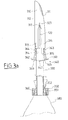
- FIG. 3a to 3d A blood collection device according to an embodiment of the invention is illustrated in Figs. 3a to 3d.
- Figs. 3a to 3c represent half-sections of the device in different configurations. The cuts are made in a axial plane and limited to the lower part of the device, up to the double line symbolizing the cut. The upper part of the device is shown in front view.
- Fig. 3d shows a top view of the device.
- the sampling device comprises a removable single blade 310 cutting edge 311, the blade being provided with teeth 313 at its lower part on the side of its non-sharp edge 312. These teeth have the function of preventing the exit untimely blade of the animal's body. The fact that the blade only has one single cutting edge allows it to be inserted into the animal's body without affecting the sternum.
- the blade At its base, the blade has a guide 314 intended to slide in a groove of guide and a locking pin 315.
- the blade is hollowed out in its central part 316, along its longitudinal axis, so as to allow the stirrup 320 to be there engage up to the notch 317.
- FIG. 3c shows on its left side a view of right of the stirrup.
- the stirrup 320 is welded by its two arms 321 and 322 to the handle tubular 330.
- the upper part of the stirrup has a U shape whose branches are directed in the axis of the blade and cover it on both sides in the extension of the notch 317.
- the hollow handle is provided with a groove parallel to the axis of the tube, arranged in the inner wall 335 thereof and opening at its upper end. This groove receives the guide 314 and to ensure the lateral rigidity of the handle-blade connection.
- a through hole is provided in the wall 335, in which the lug can be accommodated 315.
- the device further comprises two arms 341 and 342, armed at their ends upper claws 343 and 344 facing outwards from the handle.
- Arms 341 and 342 are fixed or welded on bases 345 and 346 articulated around the pivots 347 and 348 fixed or welded on either side of the tube, to its outer wall, so as not to not obstruct the flow of blood.
- Bases 345 and 346 have a complementary shape and are articulated like hinges around the pivots 347 and 348.
- the bases 345 and 346 form a guard in the insertion position shown in Figs. 3a and 3d.
- the arms 341 and 342 are the so-called spread position, shown in FIG. 3b.
- the claws 343 and 344 are then spread to the maximum and the bases abut on the handle.
- the clergy first presses bases 345 and 346 constituting the guard, which has the effect of bringing them the claws 343 and 344 in the insertion position (folded position). In this position, the inner edges 349 of the bases, ellipsoidal in shape, abut on the wall outside of the tube and follow its contour.
- the clergy can then dive without difficulty the trocar in the flesh of the animal.
- the claws tend to move apart and hold the trocar in the body of the animal.
- the guard is fixed and devoid of arms, as, for example, that illustrated by 140 in FIG. 1.
- the handle 130 is provided at its upper part with teeth (for example of a shape similar to 313), or claws (for example of a shape similar to 343 or 344) or of pins directed towards the bottom, so as to avoid that the trocar easily emerges from the animal's body.
- the blade, the tubular handle, the stirrup and the guard are preferably made of electro-polished stainless steel to facilitate cleaning.
- the device according to the invention has a quick fixing system comprising a ring 350 which can freely slide along the tubular handle.
- This ring has an inner surface 351 of frustoconical shape widening towards the bottom.
- the diameter of hole 352 on the upper surface of the ring is sufficient large to allow the upper edge of a pocket to pass easily 380 between the handle and the ring.
- the quick release system also includes a ferrule 360 located in the lower part of the handle and mounted integrally or welded with the latter.
- the ferrule is placed at the base of the handle.
- the outside diameter of the ferrule is between the diameter of the upper hole and the diameter of the lower hole of the movable ring, so that the latter can come engage on the ferrule without escaping from the bottom of the handle.
- Figs. 3a and 3b represent the ring in its low position where it comes to wedge the upper edge of pocket 380.
- the upper edge of the pocket is engaged between the ring and the handle, then the ring is lowered until the wall of the pocket is wedged between the ring and the upper edge of the ferrule.
- Fig. 3c represents the ring in high position.
- the ferrule may have, as shown, an annular shape, having a right angle between its side wall and its top wall or a shape different, including a semi-toric shape. It can be welded or screwed to the handle or else the handle may have been machined to present this shape. When the semi-toric shape is chosen, this can be achieved by a seal rubber O-ring engaged in a circular groove provided for this purpose.
- the pocket 380 advantageously consists of a plastic bag of food grade and sterile, strong enough to support the weight of the amount of blood from the bled animal. Pockets are not reused after the bleeding operation. On the other hand, the plastic material which constitutes them can be advantageously recycled.
- the inner wall of the pocket is constituted or is coated with a calcium complexing agent such as, for example, acid ethylenediaminetetraacetic acid or a citrate, oxalate or fluoride.
- a calcium complexing agent such as, for example, acid ethylenediaminetetraacetic acid or a citrate, oxalate or fluoride.
- the anti-coagulant product is injected in the form liquid in the pocket, once fixed on the hollow handle, via the part of the orifice upper part of the hollow handle 330 not obstructed by the blade 310, as can be seen in Fig. 3d.
- the plastic bag de contains no complexing agent and no anti-coagulant product is added.
- the clot forms in the bag.
- the serum can then be collected, possibly with an additional pressing step to extract the residue from the clot.
- the sampling device can be used for bleeding the animal in the suspended position.
- a additional suspension system for the trocar because it supports the weight of the blood collected.
- the blood will be drawn from the animal in the supine position, as shown in Fig. 4.
- the body of the animal 470 is lying on a horizontal drive belt 490 or slightly inclined. After fixing of the pocket 480 on the handle and insertion of the trocar 400, the pocket is placed in the immediate vicinity of the animal on the same training mat or on a drive element progressing substantially at the same speed as said belt.
- the sampling device allows blood collection in very good hygienic conditions since the trocar-pocket assembly isolates the blood of the environment.
- the collection bag is closed which minimizes the risk of subsequent contamination.
- the pockets do not requires cleaning because they are not reused. Plastic material constituting the pockets is recycled.
- the sampling device makes it possible to collect blood from individually, animal by animal.
- Each pocket includes a means identification, for example a barcode or a transponder.
- Each animal slaughtered also wearing a means of identification, for example by indelible inking or by adding a transponder.
- a means of identification for example by indelible inking or by adding a transponder.
- the blood bags samples are detached from the trocars.
- the pockets are then hung from a conveyor, pending the decision of the veterinary checkpoint.
- the trocars are, in turn, directed to a cleaning and sterilization station to be able to be reused.
- the veterinary checkpoint Whenever the veterinary checkpoint concludes that a animal is healthy, it validates the animal identification code. Blood bags suspended from the waiting conveyor, pass one by one in front of a reading device after a determined delay time, greater than the transit time in the chain slaughter. If the pocket identification code read by the reading device corresponds to the code of an animal that has been identified as healthy, the pocket is automatically referred to a drain and / or treatment station. Many different positions corresponding to different treatments can be provided, pockets are routed automatically from their codes Identification. If when passing in front of the reading device, the animal code partner is not validated, the pocket is automatically directed to a garage. Such a pocket may correspond to an animal declared unfit for consumption or an animal fallen from the slaughter line. Pockets on the siding undergoes special treatment. They can be possibly returned to the normal circuit if the animal was later found and declared healthy or else join the carcass of the animal seized for destruction by the competent services.
- the sampling method according to the invention therefore guarantees a minimum loss, destruction costs and particularly reduced environmental pollution.
Landscapes
- Health & Medical Sciences (AREA)
- General Health & Medical Sciences (AREA)
- Hematology (AREA)
- Life Sciences & Earth Sciences (AREA)
- Engineering & Computer Science (AREA)
- Food Science & Technology (AREA)
- Investigating Or Analysing Biological Materials (AREA)
- Sampling And Sample Adjustment (AREA)
- Processing Of Meat And Fish (AREA)
- Measurement Of The Respiration, Hearing Ability, Form, And Blood Characteristics Of Living Organisms (AREA)
- External Artificial Organs (AREA)
- Magnetic Resonance Imaging Apparatus (AREA)
Applications Claiming Priority (2)
| Application Number | Priority Date | Filing Date | Title |
|---|---|---|---|
| FR0102365 | 2001-02-20 | ||
| FR0102365A FR2820951B1 (fr) | 2001-02-20 | 2001-02-20 | Dispositif et procede pour prelever et collecter le sang d'un animal |
Publications (2)
| Publication Number | Publication Date |
|---|---|
| EP1232691A1 true EP1232691A1 (de) | 2002-08-21 |
| EP1232691B1 EP1232691B1 (de) | 2005-07-06 |
Family
ID=8860284
Family Applications (1)
| Application Number | Title | Priority Date | Filing Date |
|---|---|---|---|
| EP02364010A Expired - Lifetime EP1232691B1 (de) | 2001-02-20 | 2002-02-18 | Vorrichtung zur Abnahme und Gewinning von Tierblut |
Country Status (4)
| Country | Link |
|---|---|
| EP (1) | EP1232691B1 (de) |
| AT (1) | ATE298980T1 (de) |
| DE (1) | DE60204919T2 (de) |
| FR (1) | FR2820951B1 (de) |
Cited By (3)
| Publication number | Priority date | Publication date | Assignee | Title |
|---|---|---|---|---|
| FR2992521A1 (fr) * | 2012-06-28 | 2014-01-03 | Mecamatic | Installation automatique pour monter une poche collectrice de sang sur un trocart, utilisable dans une chaine d'abattage, en particulier pour porcs |
| CN113229312A (zh) * | 2021-06-20 | 2021-08-10 | 湖南金桂建设有限公司 | 一种能保持血液卫生的屠宰刀具 |
| CN114504013A (zh) * | 2022-03-04 | 2022-05-17 | 浙江大学 | 一种真空无菌采血回收装置 |
Families Citing this family (1)
| Publication number | Priority date | Publication date | Assignee | Title |
|---|---|---|---|---|
| FR2828377B1 (fr) | 2001-08-13 | 2003-10-31 | Bernard Sa | Installation et procede pour prelever et collecter le sang d'animaux |
Citations (6)
| Publication number | Priority date | Publication date | Assignee | Title |
|---|---|---|---|---|
| CH288711A (de) * | 1949-09-05 | 1953-02-15 | W Stohrer Maschinenfabrik Fa | Vorrichtung zur Einzelgewinnung des Blutes von Schlachttieren. |
| FR1327640A (fr) * | 1962-07-04 | 1963-05-17 | Trocart pour la saignée des animaux | |
| US3560028A (en) * | 1968-01-19 | 1971-02-02 | Mitsui Petrochemical Ind | Pipe joint device |
| US4004322A (en) * | 1975-12-17 | 1977-01-25 | Spendlove Laboratories | Aseptic serum collection method |
| US4326025A (en) * | 1979-12-19 | 1982-04-20 | Baxter Travenol Laboratories, Inc. | Anti-hemolytic agent emulsions and the use thereof |
| US5514106A (en) * | 1994-12-20 | 1996-05-07 | Baxter International Inc. | Bag including an identification system indicative of treatment of the bag |
Family Cites Families (1)
| Publication number | Priority date | Publication date | Assignee | Title |
|---|---|---|---|---|
| BR9405317A (pt) * | 1994-12-14 | 1996-12-03 | Walter Dimenstein | Conjunto (kit) esteril para sangria animal individualizada em circuito fechado |
-
2001
- 2001-02-20 FR FR0102365A patent/FR2820951B1/fr not_active Expired - Fee Related
-
2002
- 2002-02-18 EP EP02364010A patent/EP1232691B1/de not_active Expired - Lifetime
- 2002-02-18 DE DE60204919T patent/DE60204919T2/de not_active Expired - Fee Related
- 2002-02-18 AT AT02364010T patent/ATE298980T1/de not_active IP Right Cessation
Patent Citations (6)
| Publication number | Priority date | Publication date | Assignee | Title |
|---|---|---|---|---|
| CH288711A (de) * | 1949-09-05 | 1953-02-15 | W Stohrer Maschinenfabrik Fa | Vorrichtung zur Einzelgewinnung des Blutes von Schlachttieren. |
| FR1327640A (fr) * | 1962-07-04 | 1963-05-17 | Trocart pour la saignée des animaux | |
| US3560028A (en) * | 1968-01-19 | 1971-02-02 | Mitsui Petrochemical Ind | Pipe joint device |
| US4004322A (en) * | 1975-12-17 | 1977-01-25 | Spendlove Laboratories | Aseptic serum collection method |
| US4326025A (en) * | 1979-12-19 | 1982-04-20 | Baxter Travenol Laboratories, Inc. | Anti-hemolytic agent emulsions and the use thereof |
| US5514106A (en) * | 1994-12-20 | 1996-05-07 | Baxter International Inc. | Bag including an identification system indicative of treatment of the bag |
Non-Patent Citations (1)
| Title |
|---|
| DATABASE WPI Week 199703, Derwent World Patents Index; AN 1997-021798, XP002180285 * |
Cited By (3)
| Publication number | Priority date | Publication date | Assignee | Title |
|---|---|---|---|---|
| FR2992521A1 (fr) * | 2012-06-28 | 2014-01-03 | Mecamatic | Installation automatique pour monter une poche collectrice de sang sur un trocart, utilisable dans une chaine d'abattage, en particulier pour porcs |
| CN113229312A (zh) * | 2021-06-20 | 2021-08-10 | 湖南金桂建设有限公司 | 一种能保持血液卫生的屠宰刀具 |
| CN114504013A (zh) * | 2022-03-04 | 2022-05-17 | 浙江大学 | 一种真空无菌采血回收装置 |
Also Published As
| Publication number | Publication date |
|---|---|
| DE60204919D1 (de) | 2005-08-11 |
| DE60204919T2 (de) | 2006-08-17 |
| EP1232691B1 (de) | 2005-07-06 |
| ATE298980T1 (de) | 2005-07-15 |
| FR2820951A1 (fr) | 2002-08-23 |
| FR2820951B1 (fr) | 2004-06-11 |
Similar Documents
| Publication | Publication Date | Title |
|---|---|---|
| EP1143803B1 (de) | Verfahren und vorrichtung zum bearbeiten von geschlachteten tieren | |
| AU2012204103B2 (en) | Device for emptying a blood product bag | |
| EP0338886A1 (de) | Steriler Behälter zum Sammeln von biologischen Proben für Analysezwecke | |
| US5114380A (en) | Method for eviscerating animal carcasses, preferably pig carcasses, a plug and plant therefor | |
| EP3278670A1 (de) | Vorrichtung zur reinigung und aufbereitung des rektums und beckens geschlachteter schweine und betriebsverfahren für die besagte vorrichtung | |
| EP1232691B1 (de) | Vorrichtung zur Abnahme und Gewinning von Tierblut | |
| US20080242206A1 (en) | Method and system for washing intestines | |
| CA1264106A (fr) | Dispositif de contention de carcasses d'animaux | |
| US8961273B2 (en) | Poultry front half processing apparatus and method | |
| EP1815743A1 (de) | Fremdkörperdetektierung in einer Vorrichtung zum Freischneiden des Enddarms von Schlachttieren | |
| EP1285582B1 (de) | Anlage und Verfahren zur Abnahme und Gewinning von Tierblut | |
| NZ230991A (en) | Egg slicer with thumb engaging loop on upper arm thereof | |
| EP0940083B1 (de) | Den Schlund eines Schlachttierkörpers abschliessender Stöpsel und Vorrichtung zu dessen Positionierung | |
| NL1005157C2 (nl) | Werkwijze en inrichting voor het nemen van een bloedmonster van een slachtdier. | |
| FR2542574A1 (fr) | Procede et dispositif de prelevement et collecte hygienique de sang animal | |
| FR2571595A1 (fr) | Procede d'ecorchement et de desossement et dispositif a y utiliser | |
| EP1862073B1 (de) | Verfahren und Vorrichtung zum Durchtrennen des Zwerchfells und Brustkorbs eines Tieres | |
| FR2641671A1 (fr) | Dispositif pour l'arrachement des ailes et/ou des coracoides d'une volaille | |
| EP1151670B1 (de) | Verfahren zum Absaugen des Rückenmarks eines Viehkörpers | |
| FR2637482A1 (fr) | Pince pour l'ouverture des mollusques bivalves et, notamment, des huitres | |
| FR2931339A1 (fr) | Arrachage automatise de peaux d'animaux de boucherie. | |
| FR2745484A1 (fr) | Procede et dispositif pour facilite l'ouverture de coquillages | |
| CN205409368U (zh) | 中空采血刀 | |
| FR2809929A1 (fr) | Procede pour aspirer la moelle epiniere d'un bovin | |
| FR2565784A1 (fr) | Procede et dispositif pour le traitement des entrailles dans les abattoirs |
Legal Events
| Date | Code | Title | Description |
|---|---|---|---|
| PUAI | Public reference made under article 153(3) epc to a published international application that has entered the european phase |
Free format text: ORIGINAL CODE: 0009012 |
|
| AK | Designated contracting states |
Kind code of ref document: A1 Designated state(s): AT BE CH CY DE DK ES FI FR GB GR IE IT LI LU MC NL PT SE TR |
|
| AX | Request for extension of the european patent |
Free format text: AL;LT;LV;MK;RO;SI |
|
| 17P | Request for examination filed |
Effective date: 20021202 |
|
| 17Q | First examination report despatched |
Effective date: 20030226 |
|
| AKX | Designation fees paid |
Designated state(s): AT BE CH CY DE DK ES FI FR GB GR IE IT LI LU MC NL PT SE TR |
|
| GRAP | Despatch of communication of intention to grant a patent |
Free format text: ORIGINAL CODE: EPIDOSNIGR1 |
|
| GRAS | Grant fee paid |
Free format text: ORIGINAL CODE: EPIDOSNIGR3 |
|
| GRAA | (expected) grant |
Free format text: ORIGINAL CODE: 0009210 |
|
| AK | Designated contracting states |
Kind code of ref document: B1 Designated state(s): AT BE CH CY DE DK ES FI FR GB GR IE IT LI LU MC NL PT SE TR |
|
| PG25 | Lapsed in a contracting state [announced via postgrant information from national office to epo] |
Ref country code: NL Free format text: LAPSE BECAUSE OF FAILURE TO SUBMIT A TRANSLATION OF THE DESCRIPTION OR TO PAY THE FEE WITHIN THE PRESCRIBED TIME-LIMIT Effective date: 20050706 Ref country code: TR Free format text: LAPSE BECAUSE OF FAILURE TO SUBMIT A TRANSLATION OF THE DESCRIPTION OR TO PAY THE FEE WITHIN THE PRESCRIBED TIME-LIMIT Effective date: 20050706 Ref country code: AT Free format text: LAPSE BECAUSE OF FAILURE TO SUBMIT A TRANSLATION OF THE DESCRIPTION OR TO PAY THE FEE WITHIN THE PRESCRIBED TIME-LIMIT Effective date: 20050706 Ref country code: GB Free format text: LAPSE BECAUSE OF FAILURE TO SUBMIT A TRANSLATION OF THE DESCRIPTION OR TO PAY THE FEE WITHIN THE PRESCRIBED TIME-LIMIT Effective date: 20050706 Ref country code: IE Free format text: LAPSE BECAUSE OF FAILURE TO SUBMIT A TRANSLATION OF THE DESCRIPTION OR TO PAY THE FEE WITHIN THE PRESCRIBED TIME-LIMIT Effective date: 20050706 Ref country code: FI Free format text: LAPSE BECAUSE OF FAILURE TO SUBMIT A TRANSLATION OF THE DESCRIPTION OR TO PAY THE FEE WITHIN THE PRESCRIBED TIME-LIMIT Effective date: 20050706 |
|
| REG | Reference to a national code |
Ref country code: GB Ref legal event code: FG4D Free format text: NOT ENGLISH |
|
| REG | Reference to a national code |
Ref country code: CH Ref legal event code: EP |
|
| REG | Reference to a national code |
Ref country code: IE Ref legal event code: FG4D Free format text: LANGUAGE OF EP DOCUMENT: FRENCH |
|
| REF | Corresponds to: |
Ref document number: 60204919 Country of ref document: DE Date of ref document: 20050811 Kind code of ref document: P |
|
| PG25 | Lapsed in a contracting state [announced via postgrant information from national office to epo] |
Ref country code: GR Free format text: LAPSE BECAUSE OF FAILURE TO SUBMIT A TRANSLATION OF THE DESCRIPTION OR TO PAY THE FEE WITHIN THE PRESCRIBED TIME-LIMIT Effective date: 20051006 Ref country code: SE Free format text: LAPSE BECAUSE OF FAILURE TO SUBMIT A TRANSLATION OF THE DESCRIPTION OR TO PAY THE FEE WITHIN THE PRESCRIBED TIME-LIMIT Effective date: 20051006 Ref country code: DK Free format text: LAPSE BECAUSE OF FAILURE TO SUBMIT A TRANSLATION OF THE DESCRIPTION OR TO PAY THE FEE WITHIN THE PRESCRIBED TIME-LIMIT Effective date: 20051006 |
|
| PG25 | Lapsed in a contracting state [announced via postgrant information from national office to epo] |
Ref country code: ES Free format text: LAPSE BECAUSE OF FAILURE TO SUBMIT A TRANSLATION OF THE DESCRIPTION OR TO PAY THE FEE WITHIN THE PRESCRIBED TIME-LIMIT Effective date: 20051017 |
|
| PG25 | Lapsed in a contracting state [announced via postgrant information from national office to epo] |
Ref country code: PT Free format text: LAPSE BECAUSE OF FAILURE TO SUBMIT A TRANSLATION OF THE DESCRIPTION OR TO PAY THE FEE WITHIN THE PRESCRIBED TIME-LIMIT Effective date: 20051212 |
|
| NLV1 | Nl: lapsed or annulled due to failure to fulfill the requirements of art. 29p and 29m of the patents act | ||
| GBV | Gb: ep patent (uk) treated as always having been void in accordance with gb section 77(7)/1977 [no translation filed] |
Effective date: 20050706 |
|
| NLXE | Nl: other communications concerning ep-patents (part 3 heading xe) |
Free format text: A REQUEST FOR RESTORATION TO THE PRIOR STATE (ARTICLE 23 OF THE PATENTS ACT 1995) HAS BEEN FILED ON 20051216 |
|
| REG | Reference to a national code |
Ref country code: IE Ref legal event code: FD4D |
|
| PG25 | Lapsed in a contracting state [announced via postgrant information from national office to epo] |
Ref country code: LI Free format text: LAPSE BECAUSE OF NON-PAYMENT OF DUE FEES Effective date: 20060228 Ref country code: MC Free format text: LAPSE BECAUSE OF NON-PAYMENT OF DUE FEES Effective date: 20060228 Ref country code: LU Free format text: LAPSE BECAUSE OF NON-PAYMENT OF DUE FEES Effective date: 20060228 |
|
| PLBE | No opposition filed within time limit |
Free format text: ORIGINAL CODE: 0009261 |
|
| STAA | Information on the status of an ep patent application or granted ep patent |
Free format text: STATUS: NO OPPOSITION FILED WITHIN TIME LIMIT |
|
| 26N | No opposition filed |
Effective date: 20060407 |
|
| REG | Reference to a national code |
Ref country code: CH Ref legal event code: PL |
|
| PGFP | Annual fee paid to national office [announced via postgrant information from national office to epo] |
Ref country code: CH Payment date: 20061219 Year of fee payment: 6 |
|
| PGFP | Annual fee paid to national office [announced via postgrant information from national office to epo] |
Ref country code: DE Payment date: 20080219 Year of fee payment: 7 Ref country code: IT Payment date: 20080223 Year of fee payment: 7 |
|
| PGFP | Annual fee paid to national office [announced via postgrant information from national office to epo] |
Ref country code: BE Payment date: 20080313 Year of fee payment: 7 |
|
| REG | Reference to a national code |
Ref country code: CH Ref legal event code: PL |
|
| PG25 | Lapsed in a contracting state [announced via postgrant information from national office to epo] |
Ref country code: CH Free format text: LAPSE BECAUSE OF NON-PAYMENT OF DUE FEES Effective date: 20080229 Ref country code: LI Free format text: LAPSE BECAUSE OF NON-PAYMENT OF DUE FEES Effective date: 20080229 |
|
| PG25 | Lapsed in a contracting state [announced via postgrant information from national office to epo] |
Ref country code: CY Free format text: LAPSE BECAUSE OF FAILURE TO SUBMIT A TRANSLATION OF THE DESCRIPTION OR TO PAY THE FEE WITHIN THE PRESCRIBED TIME-LIMIT Effective date: 20050706 |
|
| BERE | Be: lapsed |
Owner name: DELAUNOY, JEAN-PIERRE Effective date: 20090228 Owner name: BERNARD S.A. Effective date: 20090228 |
|
| PG25 | Lapsed in a contracting state [announced via postgrant information from national office to epo] |
Ref country code: DE Free format text: LAPSE BECAUSE OF NON-PAYMENT OF DUE FEES Effective date: 20090901 |
|
| PG25 | Lapsed in a contracting state [announced via postgrant information from national office to epo] |
Ref country code: BE Free format text: LAPSE BECAUSE OF NON-PAYMENT OF DUE FEES Effective date: 20090228 |
|
| PG25 | Lapsed in a contracting state [announced via postgrant information from national office to epo] |
Ref country code: IT Free format text: LAPSE BECAUSE OF NON-PAYMENT OF DUE FEES Effective date: 20090218 |
|
| REG | Reference to a national code |
Ref country code: FR Ref legal event code: PLFP Year of fee payment: 15 |
|
| REG | Reference to a national code |
Ref country code: FR Ref legal event code: PLFP Year of fee payment: 16 |
|
| PGFP | Annual fee paid to national office [announced via postgrant information from national office to epo] |
Ref country code: FR Payment date: 20170222 Year of fee payment: 16 |
|
| REG | Reference to a national code |
Ref country code: FR Ref legal event code: ST Effective date: 20181031 |
|
| PG25 | Lapsed in a contracting state [announced via postgrant information from national office to epo] |
Ref country code: FR Free format text: LAPSE BECAUSE OF NON-PAYMENT OF DUE FEES Effective date: 20180228 |