EP1233343A2 - Verfahren und Funkschnittstellenschicht bestehend aus einer Menge von Anwendungsprogrammierungsschnittstellen (APIs) - Google Patents
Verfahren und Funkschnittstellenschicht bestehend aus einer Menge von Anwendungsprogrammierungsschnittstellen (APIs) Download PDFInfo
- Publication number
- EP1233343A2 EP1233343A2 EP02003607A EP02003607A EP1233343A2 EP 1233343 A2 EP1233343 A2 EP 1233343A2 EP 02003607 A EP02003607 A EP 02003607A EP 02003607 A EP02003607 A EP 02003607A EP 1233343 A2 EP1233343 A2 EP 1233343A2
- Authority
- EP
- European Patent Office
- Prior art keywords
- radio
- ril
- layer
- driver
- call
- Prior art date
- Legal status (The legal status is an assumption and is not a legal conclusion. Google has not performed a legal analysis and makes no representation as to the accuracy of the status listed.)
- Granted
Links
Images


Classifications
-
- H—ELECTRICITY
- H04—ELECTRIC COMMUNICATION TECHNIQUE
- H04L—TRANSMISSION OF DIGITAL INFORMATION, e.g. TELEGRAPHIC COMMUNICATION
- H04L67/00—Network arrangements or protocols for supporting network services or applications
-
- H—ELECTRICITY
- H04—ELECTRIC COMMUNICATION TECHNIQUE
- H04L—TRANSMISSION OF DIGITAL INFORMATION, e.g. TELEGRAPHIC COMMUNICATION
- H04L69/00—Network arrangements, protocols or services independent of the application payload and not provided for in the other groups of this subclass
- H04L69/30—Definitions, standards or architectural aspects of layered protocol stacks
- H04L69/32—Architecture of open systems interconnection [OSI] 7-layer type protocol stacks, e.g. the interfaces between the data link level and the physical level
- H04L69/322—Intralayer communication protocols among peer entities or protocol data unit [PDU] definitions
- H04L69/329—Intralayer communication protocols among peer entities or protocol data unit [PDU] definitions in the application layer [OSI layer 7]
Definitions
- the invention generally relates to application programming interfaces (APIs) and, even more particularly, relates to a Radio Interface Layer comprising a set of APIs.
- APIs application programming interfaces
- a hardware adaptation layer i.e. a layer that isolates the specifics of a particular cellular system/hardware from the bulk of the software system.
- a hardware adaptation layer i.e. a layer that isolates the specifics of a particular cellular system/hardware from the bulk of the software system.
- the layer should allow hardware manufacturers to replace/modify the implementation of the hardware interface to conform to their specific hardware.
- TAPI TAPI Service Providers
- the present invention meets the above-described needs by providing a Radio Interface Layer (RIL), which is an API set providing a level of abstraction between the radio on a cell phone and the software of the cell phone.
- the API set of RIL is roughly based on the GSM AT interface as defined in GSM specifications 07.05 and 07.07.
- the API set provides access to functionality contained within a cellular telephone, such as a GSM or CDMA compatible telephone.
- the present invention allows applications running on an operating system in the cellular telephone to issue commands without knowledge of the underlying radio structure of the cellular telephone and without specific knowledge of the GSM-type commands. For example, the present invention allows the applications to access phonebook entries, restrict access to data and functionality using passwords, access file and message storage, and perform many other functions.
- the RIL is divided into a hardware-independent proxy layer, called by various software components, and a driver layer that is hardware-specific. It should be understood that an OEM may replace the driver layer with their own layer containing implementation specific to their hardware.
- the cellular telephone may be a "smart phone” that, in addition to providing telephony services, also runs different software applications and performs different functions normally reserved for personal computers or PDAs.
- the telephone may be used as a personal information manager (PIM) for storing appointments, contacts, tasks, etc.
- PIM personal information manager
- FIG. 1 and the following discussion are intended to provide a brief, general description of an exemplary personal computer system for use with the above-described embodiments of the present invention.
- software products may include routines, programs, components, data structures, etc. that perform particular tasks or implement particular abstract data types.
- the invention may be practiced with other computer system configurations, including hand-held devices, multiprocessor systems, microprocessor-based or programmable consumer electronics, minicomputers, mainframe computers, and the like.
- the invention may also be practiced in distributed computing environments where tasks are performed by remote processing devices that are linked through a communications network.
- software products may be located in both local and remote memory storage devices.
- an exemplary system for implementing the invention includes a conventional personal computer 20, including a processing unit 21, a system memory 22, and a system bus 23 that couples the system memory to the processing unit 21.
- the system memory 22 includes read only memory (ROM) 24 and random access memory (RAM) 25.
- ROM read only memory
- RAM random access memory
- a video BIOS 60 may also be stored in ROM 24.
- the personal computer 20 further includes a hard disk drive 27, a magnetic disk drive 28, e.g., to read from or write to a removable disk 29, and an optical disk drive 30, e.g., for reading a CD-ROM disk 31 or to read from or write to other optical media.
- the hard disk drive 27, magnetic disk drive 28, and optical disk drive 30 are connected to the system bus 23 by a hard disk drive interface 32, a magnetic disk drive interface 33, and an optical drive interface 34, respectively.
- the drives and their associated computer-readable media provide nonvolatile storage for the personal computer 20.
- computer-readable media refers to a hard disk, a removable magnetic disk and a CD-ROM disk
- other types of media which are readable by a computer such as magnetic cassettes, flash memory cards, digital video disks, Bernoulli cartridges, and the like, may also be used in the exemplary operating environment.
- a number of software products may be stored in the drives and RAM 25, including an operating system 35, a software product 36, such as Microsoft's "OFFICE XP" suite of application program modules, other software products 37, and program data 38.
- a user may enter commands and information into the personal computer 20 through a keyboard 40 and pointing device, such as a mouse 42.
- Other input devices may include a microphone, joystick, game pad, satellite dish, scanner, or the like.
- These and other input devices are often connected to the processing unit 21 through a serial port interface 46 that is coupled to the system bus, but may be connected by other interfaces, such as a game port or a universal serial bus (USB).
- a monitor 47 or other type of display device is also connected to the system bus 23 via an interface, such as a video adapter 48.
- personal computers typically include other peripheral output devices (not shown), such as speakers or printers.
- the personal computer 20 may operate in a networked environment using logical connections to one or more remote computers, such as a remote computer 49.
- the remote computer 49 may be a server, a router, a peer device or other common network node, and typically includes many or all of the elements described relative to the personal computer 20, although only a memory storage device 50 has been illustrated in Fig. 1.
- the logical connections depicted in Fig. 1 include a local area network (LAN) 51 and a wide area network (WAN) 52.
- LAN local area network
- WAN wide area network
- the personal computer 20 When used in a LAN networking environment, the personal computer 20 is connected to the LAN 51 through a network interface 53. When used in a WAN networking environment, the personal computer 20 typically includes a modem 54 or other means for establishing communications over the WAN 52, such as the Internet.
- the modem 54 which may be internal or external, is connected to the system bus 23 via the serial port interface 46.
- program modules depicted relative to the personal computer 20, or portions thereof may be stored in the remote memory storage device. It will be appreciated that the network connections shown are exemplary and other means of establishing a communications link between the computers may be used.
- the present invention known as the Radio Interface Layer (RIL) comprises an API set which provides a level of abstraction between the radio on a cell phone and the software of the cell phone.
- the API set of RIL is based on the GSM AT interface as defined in GSM specifications 07.05 and 07.07.
- the API set provides access to functionality contained within a cellular telephone, such as a GSM or CDMA compatible telephone.
- the present invention allows applications running on an operating system in the cellular telephone to issue commands without knowledge of the underlying radio structure of the cellular telephone and specific knowledge of the GSM-type commands. For example, the present invention allows the applications to access phonebook entries, restrict access to data and functionality using passwords, access file and message storage, and perform many other functions.
- the RIL is divided into a hardware-independent proxy layer, called by various software components, and a driver layer that is hardware-specific. It should be understood that an original equipment manufacturer (OEM) may replace the driver layer with their own layer containing implementation specific to their hardware.
- OEM original equipment manufacturer
- the RIL is a core component of a cellular telephone marketed by Microsoft Corporation of Redmond, Washington.
- the Radio Interface Layer (RIL) driver layer is used to implement and roughly correspond to the commands, such as AT commands, specified by ETS 300 585, Digital cellular telecommunications system (Phase 2); Use of Data Terminal Equipment - Data Circuit terminating Equipment (DTE-DCE) interface for Short Messaging Service (SMS) and Cell Broadcast Service (CBS) (GSM 07.05), Fifth Edition, April 1997, and ETS 300 642, Digital cellular telecommunications system (Phase 2); AT command set for GSM Mobile Equipment (ME) (GSM 07.07 version 4.4.1), Fourth Edition, March 1999.
- the GSM specifications 07.05 and 07.07 are hereby incorporated by reference.
- the RIL driver may be used to implement and correspond to other command sets, such as CDMA commands, or a combination of several command sets.
- OEMs may use the RIL driver of the preferred embodiment or tweak it if they would rather talk with their radio over private APIs instead of via AT commands (most likely for performance reasons).
- the RIL driver layer receives an RIL API call and causes the radio (i.e. the receiver/transmitter of the cellphone, PDA, etc.) to perform the function defined by the RIL API.
- the RIL driver will receive the RIL API call from a RIL proxy layer (described below).
- the RIL driver layer also processes notifications received from the radio and transmits them to the RIL proxy layer.
- the RIL driver layer is a dynamic link library (DLL) that is running as a device driver inside the process space of a device manager (the standard module that manages device drivers on the "WINDOWS CE" operating system).
- DLL dynamic link library
- a Device Manager may be responsible for managing all the system drivers, including the RIL driver.
- the RIL proxy layer comprises a layer that is called by various other layers of the core architecture, such as a TSP layer, an ExTAPI layer, and a SIM Manager using the platform specific commands of these core architectures.
- the proxy layer is a "WINDOWS CE" dynamic link library (DLL) that manages callback notifications and inter-process function calls into the RIL driver layer. Modules that want to use the RIL simply link with this proxy DLL.
- DLL dynamic link library
- the RIL proxy layer converts the core architecture specific commands into RIL API calls that will be understood by the RIL driver layer.
- proxy and driver layers There are some important distinctions between the proxy and driver layers.
- a separate proxy instance is created for each module using the RIL proxy DLL.
- the RIL device driver is loaded only once and is shared amongst all proxy layer instances.
- a module using the RIL must be aware that only one radio module exists, even though it links to its own proxy DLL.
- the Device Manager's control of the RIL driver implies that the proxy and driver live in separate processes (i.e. different address spaces).
- the "WINDOWS CE" operating system exposes mechanisms allowing the proxy and driver layers to communicate without being concerned with the process boundaries.
- RIL Another important architectural property of the RIL is that almost all of the functions are asynchronous.
- a module When a module first registers with the RIL, it passes in two callback functions. One is used for unsolicited notifications, and the other is used for responses to function calls. For instance, when the phone receives a new incoming call, RIL will use the unsolicited notification callback to let each module know about the incoming call. Alternately, when a module calls RIL to obtain the signal strength, the function call immediately returns a response identifier. Shortly thereafter, RIL uses the function response callback to convey signal strength information to the module. To ensure that function response callbacks are correctly matched up with function calls, this callback structure also contains the same response identifier value returned by the original function call. This asynchronous architecture simplifies RIL implementation. If a module needs to call RIL functions in a synchronous manner, it will need to make the function call and block until it receives the function response callback.
- VSP virtual serial port
- an application When an application makes a data connection, it retrieves a handle to a virtual serial port (not the real data stream between the RIL and the radio). This allows RIL to buffer and flow control the data stream so that control commands can be interjected. For example, suppose an application has set up a data connection and is browsing on the Internet.
- the virtual serial port allows RIL to interject control commands to check for things like signal strength, new SMS messages, etc.
- the RIL will enter a dedicated data mode where the application has full control of the virtual serial port. That is, RIL will not attempt to interject any commands in the data stream.
- the VSP is similar to other communication ports and typically only one application can have the handle to the VSP at one time.
- the cellphone 200 comprises a SIM manager 205, an emergency application 210, a TAPI Service Provider (TSP) 215, a WAP layer 220, a SMS manager 225, a data stack 230 and a VSP 250.
- TSP TAPI Service Provider
- the cellphone 200 further comprises a plurality of instances of the RIL proxy layer 235.
- the RIL proxy layer 235 provides communications between applications (such as the SIM manager 205, emergency application 210, TSP 215, WAP layer 220, SMS manager 225, and ExTAPI, among others) and a RIL driver layer 240.
- the RIL driver layer 240 provides communications between the RIL proxy layer and the radio hardware 245.
- the proxy and driver layers each expose a set of functions.
- a program module to use the RIL it only needs to use functions specified in the proxy header file and then link with the proxy DLL.
- the proxy DLL is implemented by calling functions specified in the driver header file.
- the driver header file is provided to OEMs and defines the functions that an OEM must implement. In one embodiment, the implementation will be hardware specific, so each OEM will be responsible for its own driver implementation. However, one or more reference implementations of the driver (source code included) may be provided to OEMs to help them with this step. If an OEM uses radio hardware that is supported by one of these reference implementations, it may not need to revise the RIL code.
- FIG. 3 is a flow diagram illustrating a method 300 for processing of commands using the radio interface layer (RIL) in accordance with an embodiment of the present invention.
- the method 300 begins at step 305 when a user calls a RIL API in the proxy layer.
- step 310 it is determined whether the callee, i.e. the called process, is in the device.exe process space. If it is, then the method proceeds to step 315 where the driver APIs are called directly. If it is determined at decision step 310 that the callee is not in the device.exe process space then the method proceeds to step 320.
- IOCTL input/output control
- the RIL driver informs the radio to take the action specified by the command of the RIL API.
- the RIL driver informs the radio to take action using an AT command interface, as defined in GSM specs (most prominently 07.05 and 07.07).
- GSM specs most prominently 07.05 and 07.07.
- sending AT commands may not be ideal for a given radio-perhaps an OEM has a separate private API set that they can use to perform the same functionality as a given AT command. If this is the case, the OEM may change the RIL driver to suit their needs.
- the core architecture of the phone has been built on top of a set of RIL APIs that may be implemented via AT commands, it is not necessary for the OEM to substantially modify the RIL driver so long as the radio understands AT commands. However, due to different implementations of the AT interface, some minor modifications may be necessary.
- step 330 the RIL API returns with a unique ID generated by the RIL. It should be understood that after sending an AT command, a response from the radio unit is awaited. RIL APIs are designed to be asynchronous, so these APIs will return immediately, with a unique ID assigned to the call.
- step 335 a separate thread waits for responses from the radio unit.
- step 340 the RIL driver matches the response from the radio unit with the unique ID generated earlier and the RIL driver sends the response to the appropriate calling process via a callback function.
- radio units can also send unsolicited notifications (for example, when the phone switches cellular towers).
- the RIL driver receives a notification from the radio and will broadcast a message to all users of the RIL layer who are interested in this class of notification.
- RIL_ChangeLockingPassword is a RIL API that allows changing the password of a phone for various lock facilities. This API is modeled after the +CPWD AT command, defined in section 7.5 of GSM 07.07. The AT command to change a password requires a lock facility, the old password, and the new password. Accordingly, the API for RIL_ChangeLockingPassword appears as: HRESULT RIL_ChangeLockingPassword( HRIL hRil, DWORD dwFacility, LPCSTR lpszOldPassword, LPCSTR lpszNewPassword );
- the user application When the user application wants to change the locking password, it calls this API, typically indirectly via a TAPI layer or another layer. For example, the application may understand the TAPI command for changing a password and send this command to the TAPI layer. The TAPI layer will then make the appropriate RIL API call to the proxy layer.
- a RIL handle As part of the RIL API, a RIL handle must be provided (which is obtained from initializing RIL), a locking facility must be provided, the old password must be provided and the new password must be provided. For example, suppose a user application wishes to change the password used to lock the SIM card from "1234" to "5678". The user application (or an intermediate layer such as the TAPI layer) would make the following API call:
- the radio module After processing the command, the radio module will return a success or error code (in this case, there will be a success code or a possibly descriptive error code such as "wrong password").
- the radio gives this response to the RIL driver, which has a separate thread waiting for responses from the radio module. This response is then matched with the unique ID from the API call and sent via a callback function to the calling process. The calling process can then note whether the locking password was successfully changed or not and act accordingly.
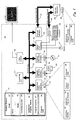
- FIG. 4 an example illustrating a method for an application to establish a voice call using RIL in accordance with an embodiment of the present invention will be described. It should be understood that establishing a voice call is only one of many functions that may be performed using the RIL APIs. The method outlined in Figure 4 is illustrative of one of these functions (establishing a voice call). The method is implemented in telephone 400 that includes an application layer 405, an ExTAPI layer 410, a TAPI layer 415, other core modules 420, a TSP 425, a radio interface layer (RIL) 430 in accordance with an embodiment of the invention, and OEM hardware 435. It should be understood that the method does not describe the IOCTLs which will be understood by those skilled in the art to be present in a preferred embodiment. It should be further understood that the present invention may be implemented without the use of IOCTLs.
- RIL radio interface layer
- the method begins when application 405 calls the TAPI function: lineMakeCall (step 452).
- the TAPI layer 415 calls the TSP 425 with the following function call: TSPI_lineMakeCall (step 454).
- the TSP 425 calls the RIL with the following RIL function: RIL_Dial (step 456).
- the RIL initiates the phone call by sending the corresponding command to the OEM hardware (e.g. radio): e.g. ATDT 555-1234 (step 458).
- the TSP returns asynchronously a reply message to the TAPI layer indicating that the call has been initiated: LINE_REPLY message (step 460).
- the TAPI layer forwards the reply message (LINE_REPLY) to the application (step 462).
- the OEM hardware detects that a connection to the number has been made, then it sends a CONNECT response to the RIL (step 464).
- the RIL sends a message (RIL_NOTIFY_CONNECT) to the TSP indicating that a connection has been made (step 466).
- the TSP sends a state change message (LINE_CALLSTATE) to the TAPI layer (step 468).
- the TAPI layer forwards the state change message (LINE_CALLSTATE) to the application 405 (step 470).
- the application 405 When the application 405 wishes to drop the telephone call, it calls the TAPI layer with a hang-up request: (lineDrop) (step 472).
- the TAPI layer forwards the TSP the hang-up request: (TSPI_lineDrop) (step 474).
- the TSP handler passes the hang-up request to the RIL: (RIL_Hangup) (step 476).
- the RIL passes the hang-up request to the OEM hardware (e.g. ATH) (step 478).
- the RIL proxy layer is hardware-independent.
- the RIL driver layer is hardware-specific.
- a sample GSM implementation of the RIL driver is provided to function with generic GSM hardware (although, in practice, some modifications will probably be needed for almost any GSM system currently in existence because the GSM specifications may be interpreted and implemented slightly differently by different OEMs).
- the present invention allows software applications to function on RIL-compatible phones independently of the hardware or the cellular network being used. For example, changing from a GSM to a CDMA network would only require replacing the RIL driver layer and the rest of the phone would work as it did in the GSM network.
- the purpose of the RIL is to provide access to cellular functionality for any component in the phone, PDA, etc. Without the RIL, each component (TAPI, SIM manager, SMS manager, etc.) of the phone would have to understand how to communicate to the radio directly. Because it would be difficult for hardware manufacturers to implement a TAPI driver, a SMS driver, a SIM driver, etc., the RIL was created to sit between the radio and the TAPI driver, the SMS driver, the SIM driver, etc.
- RIL proxy is hardware-independent
- RIL provides a platform for third party software developers.
- a third party software developer may write his code once and have it work on all devices containing an implementation of RIL, such as telephones, PDAs, etc.
- the software developer may use the well-defined telephony commands such as TAPI without worrying about whether the underlying device is using cellular technology, voice over IP, etc.
- RIL Radio-Integrated Circuit
- the present invention may be implemented as a single abstraction layer between a telephony radio and a computer.
- the applications on the computer may communicate with the abstraction layer using top-level APIs.
- the telephony radio would respond to commands received from the abstraction layer.
- the RIL the RIL itself
- the present invention eases the implementation difficulties radio manufacturers often have. Moreover, radio manufacturers no longer have to worry about receiving and keeping track of calls from multiple client applications because all of these functions are handled by the RIL.
- Software application developers do not need to worry about the underlying hardware of a mobile device.
- Software applications may be easily written to work with RIL because the applications use well-known top-level APIs which are sent to the RIL. The RIL will then perform appropriate processing of these top-level APIs and, if necessary, send the appropriate command to the radio to perform a specific action.
- the present invention may be used with cellular telephones as well as other devices, such as hand-held PDA devices. Some of these other devices may not have a permanent radio module(s). Certain changes known to those skilled in the art may be necessary to implement the invention in a device without a permanent radio module(s). Specifically, the invention must support Removable Compact Flash (CF)/PCMCIA radio modules that support circuit-switched cellular network connections.
- CF Removable Compact Flash
- PCMCIA radio modules that support circuit-switched cellular network connections.
- Configuration 1 Cellular telephone
- the device has a built in radio-module. It does not have any expansion slots that support CF or PCMCIA cards. Therefore the built-in radio module is guaranteed to be always present and no alternative form of cellular communications is permitted.
- the device does not have a built in radio-module. However, it does contain a CF and/or PCMCIA expansion slot(s). In a preferred embodiment, the invention requires that a supported Radio module be inserted into the CF or PCMCIA slot.
- the device has a built in radio module. It can be assumed that this radio module will always be present. Potentially, one can insert other devices (including radio modules) into any available expansion slot (PCMCIA, USB, Bluetooth, etc,).
- Attached as Appendix A is a list of the RIL APIs of a preferred embodiment of the present invention. These APIs are provided as examples only and should not limit the present invention.
Landscapes
- Engineering & Computer Science (AREA)
- Computer Networks & Wireless Communication (AREA)
- Signal Processing (AREA)
- Computer Security & Cryptography (AREA)
- Mobile Radio Communication Systems (AREA)
- Telephonic Communication Services (AREA)
- Telephone Function (AREA)
- Communication Control (AREA)
Applications Claiming Priority (2)
| Application Number | Priority Date | Filing Date | Title |
|---|---|---|---|
| US788317 | 2001-02-16 | ||
| US09/788,317 US6826762B2 (en) | 2001-02-16 | 2001-02-16 | Radio interface layer in a cell phone with a set of APIs having a hardware-independent proxy layer and a hardware-specific driver layer |
Publications (3)
| Publication Number | Publication Date |
|---|---|
| EP1233343A2 true EP1233343A2 (de) | 2002-08-21 |
| EP1233343A3 EP1233343A3 (de) | 2002-10-30 |
| EP1233343B1 EP1233343B1 (de) | 2006-08-23 |
Family
ID=25144114
Family Applications (1)
| Application Number | Title | Priority Date | Filing Date |
|---|---|---|---|
| EP02003607A Expired - Lifetime EP1233343B1 (de) | 2001-02-16 | 2002-02-15 | Verfahren und Funkschnittstellenschicht bestehend aus einer Menge von Anwendungsprogrammierungsschnittstellen (APIs) |
Country Status (4)
| Country | Link |
|---|---|
| US (1) | US6826762B2 (de) |
| EP (1) | EP1233343B1 (de) |
| AT (1) | ATE337584T1 (de) |
| DE (1) | DE60214059T2 (de) |
Cited By (5)
| Publication number | Priority date | Publication date | Assignee | Title |
|---|---|---|---|---|
| GB2411742A (en) * | 2004-03-02 | 2005-09-07 | Sendo Int Ltd | Method of running software code in a wireless communication unit |
| US20120174238A1 (en) * | 2004-07-30 | 2012-07-05 | Research In Motion Limited | Method and system for coordinating client and host security modules |
| CN101888711B (zh) * | 2009-05-15 | 2013-07-03 | 中兴通讯股份有限公司 | 一种移动终端及其联系人界面的快速刷新方法 |
| CN103376776A (zh) * | 2012-04-12 | 2013-10-30 | 财团法人精密机械研究发展中心 | 可与数厂牌加工机控制器同时连线的方法 |
| CN103676778A (zh) * | 2012-09-18 | 2014-03-26 | 财团法人精密机械研究发展中心 | 可同时对多台加工机进行热变形补偿的方法 |
Families Citing this family (28)
| Publication number | Priority date | Publication date | Assignee | Title |
|---|---|---|---|---|
| US6578054B1 (en) | 1999-10-04 | 2003-06-10 | Microsoft Corporation | Method and system for supporting off-line mode of operation and synchronization using resource state information |
| KR100744502B1 (ko) * | 2001-06-04 | 2007-08-01 | 엘지전자 주식회사 | 무선 단말기의 베이스 구조 및 그 방법 |
| US7251248B2 (en) * | 2001-07-31 | 2007-07-31 | Bridgeworks Ltd. | Connection device |
| US6909910B2 (en) | 2002-02-01 | 2005-06-21 | Microsoft Corporation | Method and system for managing changes to a contact database |
| US7133669B2 (en) * | 2002-08-02 | 2006-11-07 | Pctel, Inc. | Systems and methods for seamless roaming between wireless networks |
| US7519364B2 (en) * | 2002-08-02 | 2009-04-14 | Pctel, Inc. | System and method for seamless roaming between wireless networks |
| AU2004306776B2 (en) | 2003-10-10 | 2010-06-10 | Modeci, Inc. | Controlling the use of a wireless mobile communication device |
| US7644376B2 (en) | 2003-10-23 | 2010-01-05 | Microsoft Corporation | Flexible architecture for notifying applications of state changes |
| US8548429B2 (en) | 2004-03-08 | 2013-10-01 | Rafi Nehushtan | Cellular device security apparatus and method |
| US20060086569A1 (en) * | 2004-10-26 | 2006-04-27 | Jimmydeer Llc | Mobile hunting stand |
| US7821974B2 (en) * | 2005-03-29 | 2010-10-26 | Microsoft Corporation | UMTS RIL extension |
| US7886311B2 (en) * | 2005-03-29 | 2011-02-08 | Microsoft Corporation | Synchronous RIL proxy |
| US20070130396A1 (en) * | 2005-11-07 | 2007-06-07 | Sysgration Ltd. | A computer i/o device with a voice i/o unit |
| US7499724B2 (en) * | 2006-01-30 | 2009-03-03 | Harris Corporation | Event sequencer used for controlling the sequence and timing of events in software defined radio |
| US7872574B2 (en) * | 2006-02-01 | 2011-01-18 | Innovation Specialists, Llc | Sensory enhancement systems and methods in personal electronic devices |
| US7899078B1 (en) * | 2006-07-14 | 2011-03-01 | Nextel Communications Inc. | System and method for controlling power saving functions of a wireless communication station |
| CN101940030A (zh) * | 2007-10-29 | 2011-01-05 | 交互数字技术公司 | 将802.21媒介无关切换功能性集成到无线电接口层和电话通讯服务器 |
| US20100151850A1 (en) * | 2008-12-15 | 2010-06-17 | At&T Corp. | System and Method for Adapting Mobile Applications |
| US8291440B2 (en) * | 2009-03-16 | 2012-10-16 | Apple Inc. | Providing a proxy view for an application in a window manager |
| US8881268B2 (en) * | 2010-10-07 | 2014-11-04 | Loopmark Limited | Secure area for apps |
| US8446320B2 (en) | 2010-08-30 | 2013-05-21 | Microsoft Corporation | Reliable location information for a mobile station using a non-GPS location technique |
| US8694656B2 (en) | 2010-11-09 | 2014-04-08 | Sony Corporation | System and method for creating a viewing social network |
| CN102932531B (zh) | 2012-09-27 | 2015-05-27 | 华为技术有限公司 | 保持客户识别模块卡待机的方法和终端设备 |
| US8995966B2 (en) * | 2012-12-05 | 2015-03-31 | Google Technology Holdings LLC | Radio interface layer design for smartphones |
| US9159013B2 (en) | 2013-01-04 | 2015-10-13 | Google Technology Holdings LLC | Mobile device with RFID capability and corresponding boot sequence |
| US9058550B2 (en) | 2013-01-04 | 2015-06-16 | Google Technology Holdings LLC | Mobile devices with RFID capabilities and corresponding memory write methods |
| US9098789B2 (en) | 2013-02-05 | 2015-08-04 | Google Technology Holdings LLC | RFID communication circuit for an electronic device and corresponding methods |
| US10659523B1 (en) * | 2014-05-23 | 2020-05-19 | Amazon Technologies, Inc. | Isolating compute clusters created for a customer |
Family Cites Families (6)
| Publication number | Priority date | Publication date | Assignee | Title |
|---|---|---|---|---|
| AU3372095A (en) | 1994-08-24 | 1996-03-14 | Arcada Software, Inc. | Application program interface (api) for a medium changer |
| US6018571A (en) * | 1997-09-30 | 2000-01-25 | Mitel Corporation | System for interactive control of a computer and telephone |
| US6269254B1 (en) * | 1998-09-28 | 2001-07-31 | Motorola, Inc. | Radio communications device and method with API between user application program and telephony program and method |
| US6141564A (en) * | 1999-09-30 | 2000-10-31 | Motorola, Inc. | Method of sharing a SIM card between two masters |
| US6584185B1 (en) * | 2000-01-31 | 2003-06-24 | Microsoft Corporation | Telephone abstraction layer and system in a computer telephony system |
| US7003571B1 (en) * | 2000-01-31 | 2006-02-21 | Telecommunication Systems Corporation Of Maryland | System and method for re-directing requests from browsers for communication over non-IP based networks |
-
2001
- 2001-02-16 US US09/788,317 patent/US6826762B2/en not_active Expired - Lifetime
-
2002
- 2002-02-15 EP EP02003607A patent/EP1233343B1/de not_active Expired - Lifetime
- 2002-02-15 DE DE60214059T patent/DE60214059T2/de not_active Expired - Lifetime
- 2002-02-15 AT AT02003607T patent/ATE337584T1/de not_active IP Right Cessation
Cited By (7)
| Publication number | Priority date | Publication date | Assignee | Title |
|---|---|---|---|---|
| GB2411742A (en) * | 2004-03-02 | 2005-09-07 | Sendo Int Ltd | Method of running software code in a wireless communication unit |
| US20120174238A1 (en) * | 2004-07-30 | 2012-07-05 | Research In Motion Limited | Method and system for coordinating client and host security modules |
| US8713706B2 (en) * | 2004-07-30 | 2014-04-29 | Blackberry Limited | Method and system for coordinating client and host security modules |
| CN101888711B (zh) * | 2009-05-15 | 2013-07-03 | 中兴通讯股份有限公司 | 一种移动终端及其联系人界面的快速刷新方法 |
| CN103376776A (zh) * | 2012-04-12 | 2013-10-30 | 财团法人精密机械研究发展中心 | 可与数厂牌加工机控制器同时连线的方法 |
| CN103376776B (zh) * | 2012-04-12 | 2015-10-14 | 财团法人精密机械研究发展中心 | 可与数厂牌加工机控制器同时连线的方法 |
| CN103676778A (zh) * | 2012-09-18 | 2014-03-26 | 财团法人精密机械研究发展中心 | 可同时对多台加工机进行热变形补偿的方法 |
Also Published As
| Publication number | Publication date |
|---|---|
| US6826762B2 (en) | 2004-11-30 |
| EP1233343B1 (de) | 2006-08-23 |
| EP1233343A3 (de) | 2002-10-30 |
| DE60214059T2 (de) | 2006-12-07 |
| ATE337584T1 (de) | 2006-09-15 |
| DE60214059D1 (de) | 2006-10-05 |
| US20020184407A1 (en) | 2002-12-05 |
Similar Documents
| Publication | Publication Date | Title |
|---|---|---|
| EP1233343A2 (de) | Verfahren und Funkschnittstellenschicht bestehend aus einer Menge von Anwendungsprogrammierungsschnittstellen (APIs) | |
| US7478395B2 (en) | Middleware application message/event model | |
| US5625678A (en) | Method and system for allowing switched voice and data communication among multiple application programs | |
| US7305495B2 (en) | Dynamic loading of protocol stacks under signaling control | |
| US7181237B2 (en) | Control of a multi-mode, multi-band mobile telephone via a single hardware and software man machine interface | |
| CN109933442B (zh) | 小程序平台间的通讯方法、设备和计算机存储介质 | |
| KR100828736B1 (ko) | 주변 장치 및 무선 장치 사이에서 통신을 설정하기 위한시스템 및 방법 | |
| JP4362178B2 (ja) | ユーザ・アプリケーション・プログラムと電話プログラム間のapiを備える無線通信装置およびその方法 | |
| KR100728068B1 (ko) | 메시지 큐들을 이용하여 장치에서 메시지를 수신하기로 된어플리케이션을 식별하는 시스템 및 방법 | |
| KR101047278B1 (ko) | 미들웨어 어플리케이션 메시지/이벤트 모델 | |
| TWI228364B (en) | Communication system, relay device and communication control method | |
| JP2011205672A (ja) | 移動体端末用プラットフォーム・システム | |
| US20220245005A1 (en) | Methods, devices and computer storage media for inter-mini program platform discovery | |
| US20020112063A1 (en) | Methods, systems and computer program products for requesting wireless telephony application (WTA) protocol based actions | |
| US7886311B2 (en) | Synchronous RIL proxy | |
| US20060277535A1 (en) | Downloading software applications | |
| WO2025156801A1 (zh) | 卫星通话方法、终端和电子设备 | |
| CN112738329B (zh) | 一种数据交互方法、装置及存储介质 | |
| US20050005139A1 (en) | Terminal device and program | |
| US20070202863A1 (en) | System and method for establishing communication between wireless devices | |
| KR100216583B1 (ko) | 비음성 정보료 회수 대행 프로토콜 처리 방법 | |
| US8041013B2 (en) | Transferring multiple dialogs of a call | |
| JP2004070581A (ja) | 情報通信端末、情報通信装置、情報通信システム、情報通信方法、情報通信プログラム、及び、コンピュータ読取可能な記録媒体 | |
| WO2007021536A2 (en) | Method and policy execution engine for regulating an incoming call in a communication system | |
| MXPA99008863A (es) | Dispositivo y metodo de radiocomunicaciones con api entre el programa de aplicación de usuario y el programa y metodo de telefonia |
Legal Events
| Date | Code | Title | Description |
|---|---|---|---|
| PUAI | Public reference made under article 153(3) epc to a published international application that has entered the european phase |
Free format text: ORIGINAL CODE: 0009012 |
|
| 17P | Request for examination filed |
Effective date: 20020215 |
|
| AK | Designated contracting states |
Kind code of ref document: A2 Designated state(s): AT BE CH CY DE DK ES FI FR GB GR IE IT LI LU MC NL PT SE TR |
|
| AX | Request for extension of the european patent |
Free format text: AL;LT;LV;MK;RO;SI |
|
| PUAL | Search report despatched |
Free format text: ORIGINAL CODE: 0009013 |
|
| AK | Designated contracting states |
Kind code of ref document: A3 Designated state(s): AT BE CH CY DE DK ES FI FR GB GR IE IT LI LU MC NL PT SE TR |
|
| AX | Request for extension of the european patent |
Free format text: AL;LT;LV;MK;RO;SI |
|
| AKX | Designation fees paid |
Designated state(s): AT BE CH CY DE DK ES FI FR GB GR IE IT LI LU MC NL PT SE TR |
|
| 17Q | First examination report despatched |
Effective date: 20031114 |
|
| GRAP | Despatch of communication of intention to grant a patent |
Free format text: ORIGINAL CODE: EPIDOSNIGR1 |
|
| GRAS | Grant fee paid |
Free format text: ORIGINAL CODE: EPIDOSNIGR3 |
|
| GRAA | (expected) grant |
Free format text: ORIGINAL CODE: 0009210 |
|
| AK | Designated contracting states |
Kind code of ref document: B1 Designated state(s): AT BE CH CY DE DK ES FI FR GB GR IE IT LI LU MC NL PT SE TR |
|
| PG25 | Lapsed in a contracting state [announced via postgrant information from national office to epo] |
Ref country code: IT Free format text: LAPSE BECAUSE OF FAILURE TO SUBMIT A TRANSLATION OF THE DESCRIPTION OR TO PAY THE FEE WITHIN THE PRESCRIBED TIME-LIMIT;WARNING: LAPSES OF ITALIAN PATENTS WITH EFFECTIVE DATE BEFORE 2007 MAY HAVE OCCURRED AT ANY TIME BEFORE 2007. THE CORRECT EFFECTIVE DATE MAY BE DIFFERENT FROM THE ONE RECORDED. Effective date: 20060823 Ref country code: NL Free format text: LAPSE BECAUSE OF FAILURE TO SUBMIT A TRANSLATION OF THE DESCRIPTION OR TO PAY THE FEE WITHIN THE PRESCRIBED TIME-LIMIT Effective date: 20060823 Ref country code: FI Free format text: LAPSE BECAUSE OF FAILURE TO SUBMIT A TRANSLATION OF THE DESCRIPTION OR TO PAY THE FEE WITHIN THE PRESCRIBED TIME-LIMIT Effective date: 20060823 Ref country code: AT Free format text: LAPSE BECAUSE OF FAILURE TO SUBMIT A TRANSLATION OF THE DESCRIPTION OR TO PAY THE FEE WITHIN THE PRESCRIBED TIME-LIMIT Effective date: 20060823 Ref country code: LI Free format text: LAPSE BECAUSE OF FAILURE TO SUBMIT A TRANSLATION OF THE DESCRIPTION OR TO PAY THE FEE WITHIN THE PRESCRIBED TIME-LIMIT Effective date: 20060823 Ref country code: CH Free format text: LAPSE BECAUSE OF FAILURE TO SUBMIT A TRANSLATION OF THE DESCRIPTION OR TO PAY THE FEE WITHIN THE PRESCRIBED TIME-LIMIT Effective date: 20060823 Ref country code: BE Free format text: LAPSE BECAUSE OF FAILURE TO SUBMIT A TRANSLATION OF THE DESCRIPTION OR TO PAY THE FEE WITHIN THE PRESCRIBED TIME-LIMIT Effective date: 20060823 |
|
| REG | Reference to a national code |
Ref country code: GB Ref legal event code: FG4D |
|
| REG | Reference to a national code |
Ref country code: CH Ref legal event code: EP |
|
| REG | Reference to a national code |
Ref country code: IE Ref legal event code: FG4D |
|
| REF | Corresponds to: |
Ref document number: 60214059 Country of ref document: DE Date of ref document: 20061005 Kind code of ref document: P |
|
| PG25 | Lapsed in a contracting state [announced via postgrant information from national office to epo] |
Ref country code: SE Free format text: LAPSE BECAUSE OF FAILURE TO SUBMIT A TRANSLATION OF THE DESCRIPTION OR TO PAY THE FEE WITHIN THE PRESCRIBED TIME-LIMIT Effective date: 20061123 Ref country code: DK Free format text: LAPSE BECAUSE OF FAILURE TO SUBMIT A TRANSLATION OF THE DESCRIPTION OR TO PAY THE FEE WITHIN THE PRESCRIBED TIME-LIMIT Effective date: 20061123 |
|
| PG25 | Lapsed in a contracting state [announced via postgrant information from national office to epo] |
Ref country code: ES Free format text: LAPSE BECAUSE OF FAILURE TO SUBMIT A TRANSLATION OF THE DESCRIPTION OR TO PAY THE FEE WITHIN THE PRESCRIBED TIME-LIMIT Effective date: 20061204 |
|
| PG25 | Lapsed in a contracting state [announced via postgrant information from national office to epo] |
Ref country code: PT Free format text: LAPSE BECAUSE OF FAILURE TO SUBMIT A TRANSLATION OF THE DESCRIPTION OR TO PAY THE FEE WITHIN THE PRESCRIBED TIME-LIMIT Effective date: 20070124 |
|
| NLV1 | Nl: lapsed or annulled due to failure to fulfill the requirements of art. 29p and 29m of the patents act | ||
| PG25 | Lapsed in a contracting state [announced via postgrant information from national office to epo] |
Ref country code: MC Free format text: LAPSE BECAUSE OF NON-PAYMENT OF DUE FEES Effective date: 20070228 |
|
| REG | Reference to a national code |
Ref country code: CH Ref legal event code: PL |
|
| ET | Fr: translation filed | ||
| PLBE | No opposition filed within time limit |
Free format text: ORIGINAL CODE: 0009261 |
|
| STAA | Information on the status of an ep patent application or granted ep patent |
Free format text: STATUS: NO OPPOSITION FILED WITHIN TIME LIMIT |
|
| 26N | No opposition filed |
Effective date: 20070524 |
|
| PG25 | Lapsed in a contracting state [announced via postgrant information from national office to epo] |
Ref country code: IE Free format text: LAPSE BECAUSE OF NON-PAYMENT OF DUE FEES Effective date: 20070215 |
|
| PG25 | Lapsed in a contracting state [announced via postgrant information from national office to epo] |
Ref country code: GR Free format text: LAPSE BECAUSE OF FAILURE TO SUBMIT A TRANSLATION OF THE DESCRIPTION OR TO PAY THE FEE WITHIN THE PRESCRIBED TIME-LIMIT Effective date: 20061124 |
|
| PG25 | Lapsed in a contracting state [announced via postgrant information from national office to epo] |
Ref country code: CY Free format text: LAPSE BECAUSE OF FAILURE TO SUBMIT A TRANSLATION OF THE DESCRIPTION OR TO PAY THE FEE WITHIN THE PRESCRIBED TIME-LIMIT Effective date: 20060823 Ref country code: LU Free format text: LAPSE BECAUSE OF NON-PAYMENT OF DUE FEES Effective date: 20070215 |
|
| PG25 | Lapsed in a contracting state [announced via postgrant information from national office to epo] |
Ref country code: TR Free format text: LAPSE BECAUSE OF FAILURE TO SUBMIT A TRANSLATION OF THE DESCRIPTION OR TO PAY THE FEE WITHIN THE PRESCRIBED TIME-LIMIT Effective date: 20060823 |
|
| REG | Reference to a national code |
Ref country code: DE Ref legal event code: R082 Ref document number: 60214059 Country of ref document: DE Representative=s name: BOEHMERT & BOEHMERT, DE Ref country code: DE Ref legal event code: R082 Ref document number: 60214059 Country of ref document: DE Representative=s name: BOEHMERT & BOEHMERT ANWALTSPARTNERSCHAFT MBB -, DE |
|
| REG | Reference to a national code |
Ref country code: DE Ref legal event code: R008 Ref document number: 60214059 Country of ref document: DE |
|
| REG | Reference to a national code |
Ref country code: DE Ref legal event code: R039 Ref document number: 60214059 Country of ref document: DE Effective date: 20120327 |
|
| PGFP | Annual fee paid to national office [announced via postgrant information from national office to epo] |
Ref country code: DE Payment date: 20140228 Year of fee payment: 13 |
|
| REG | Reference to a national code |
Ref country code: DE Ref legal event code: R042 Ref document number: 60214059 Country of ref document: DE |
|
| REG | Reference to a national code |
Ref country code: DE Ref legal event code: R082 Ref document number: 60214059 Country of ref document: DE Representative=s name: BOEHMERT & BOEHMERT ANWALTSPARTNERSCHAFT MBB -, DE |
|
| REG | Reference to a national code |
Ref country code: GB Ref legal event code: 732E Free format text: REGISTERED BETWEEN 20150108 AND 20150114 |
|
| REG | Reference to a national code |
Ref country code: DE Ref legal event code: R081 Ref document number: 60214059 Country of ref document: DE Owner name: MICROSOFT TECHNOLOGY LICENSING, LLC, REDMOND, US Free format text: FORMER OWNER: MICROSOFT CORP., REDMOND, WASH., US Effective date: 20150126 Ref country code: DE Ref legal event code: R082 Ref document number: 60214059 Country of ref document: DE Representative=s name: BOEHMERT & BOEHMERT ANWALTSPARTNERSCHAFT MBB -, DE Effective date: 20150126 Ref country code: DE Ref legal event code: R082 Ref document number: 60214059 Country of ref document: DE Representative=s name: BOEHMERT & BOEHMERT ANWALTSPARTNERSCHAFT MBB -, DE Effective date: 20120302 |
|
| REG | Reference to a national code |
Ref country code: DE Ref legal event code: R042 Ref document number: 60214059 Country of ref document: DE Effective date: 20141127 |
|
| PG25 | Lapsed in a contracting state [announced via postgrant information from national office to epo] |
Ref country code: DE Free format text: THE PATENT HAS BEEN ANNULLED BY A DECISION OF A NATIONAL AUTHORITY Effective date: 20141127 |
|
| REG | Reference to a national code |
Ref country code: FR Ref legal event code: TP Owner name: MICROSOFT TECHNOLOGY LICENSING, LLC, US Effective date: 20150724 |
|
| REG | Reference to a national code |
Ref country code: FR Ref legal event code: PLFP Year of fee payment: 15 |
|
| REG | Reference to a national code |
Ref country code: FR Ref legal event code: PLFP Year of fee payment: 16 |
|
| REG | Reference to a national code |
Ref country code: FR Ref legal event code: PLFP Year of fee payment: 17 |
|
| PGFP | Annual fee paid to national office [announced via postgrant information from national office to epo] |
Ref country code: GB Payment date: 20180214 Year of fee payment: 17 |
|
| PGFP | Annual fee paid to national office [announced via postgrant information from national office to epo] |
Ref country code: FR Payment date: 20180111 Year of fee payment: 17 |
|
| GBPC | Gb: european patent ceased through non-payment of renewal fee |
Effective date: 20190215 |
|
| PG25 | Lapsed in a contracting state [announced via postgrant information from national office to epo] |
Ref country code: GB Free format text: LAPSE BECAUSE OF NON-PAYMENT OF DUE FEES Effective date: 20190215 |
|
| PG25 | Lapsed in a contracting state [announced via postgrant information from national office to epo] |
Ref country code: FR Free format text: LAPSE BECAUSE OF NON-PAYMENT OF DUE FEES Effective date: 20190228 |