EP1233504A2 - Circuit de puissance exempt de blocage - Google Patents
Circuit de puissance exempt de blocage Download PDFInfo
- Publication number
- EP1233504A2 EP1233504A2 EP02002206A EP02002206A EP1233504A2 EP 1233504 A2 EP1233504 A2 EP 1233504A2 EP 02002206 A EP02002206 A EP 02002206A EP 02002206 A EP02002206 A EP 02002206A EP 1233504 A2 EP1233504 A2 EP 1233504A2
- Authority
- EP
- European Patent Office
- Prior art keywords
- field effect
- voltage
- effect transistor
- circuit
- switching
- Prior art date
- Legal status (The legal status is an assumption and is not a legal conclusion. Google has not performed a legal analysis and makes no representation as to the accuracy of the status listed.)
- Withdrawn
Links
Images




Classifications
-
- G—PHYSICS
- G05—CONTROLLING; REGULATING
- G05F—SYSTEMS FOR REGULATING ELECTRIC OR MAGNETIC VARIABLES
- G05F1/00—Automatic systems in which deviations of an electric quantity from one or more predetermined values are detected at the output of the system and fed back to a device within the system to restore the detected quantity to its predetermined value or values, i.e. retroactive systems
- G05F1/10—Regulating voltage or current
- G05F1/46—Regulating voltage or current wherein the variable actually regulated by the final control device is DC
- G05F1/56—Regulating voltage or current wherein the variable actually regulated by the final control device is DC using semiconductor devices in series with the load as final control devices
-
- H—ELECTRICITY
- H02—GENERATION; CONVERSION OR DISTRIBUTION OF ELECTRIC POWER
- H02M—APPARATUS FOR CONVERSION BETWEEN AC AND AC, BETWEEN AC AND DC, OR BETWEEN DC AND DC, AND FOR USE WITH MAINS OR SIMILAR POWER SUPPLY SYSTEMS; CONVERSION OF DC OR AC INPUT POWER INTO SURGE OUTPUT POWER; CONTROL OR REGULATION THEREOF
- H02M3/00—Conversion of DC power input into DC power output
- H02M3/02—Conversion of DC power input into DC power output without intermediate conversion into AC
- H02M3/04—Conversion of DC power input into DC power output without intermediate conversion into AC by static converters
- H02M3/06—Conversion of DC power input into DC power output without intermediate conversion into AC by static converters using resistors or capacitors, e.g. potential divider
- H02M3/07—Conversion of DC power input into DC power output without intermediate conversion into AC by static converters using resistors or capacitors, e.g. potential divider using capacitors charged and discharged alternately by semiconductor devices with control electrode, e.g. charge pumps
Definitions
- This invention relates to a power circuit and, more particularly, to a power circuit such as, for example, a booster for increasing the potential level of electric power.
- An electronic device usually requires plural electric power sources different in potential level from one another.
- a handy-phone is, by way of example, provided with a liquid crystal display panel, and a driving circuit produces pictures and character images on the liquid crystal display panel.
- the driving circuit forms a part of a built-in microcomputer system, and requires a power voltage different in potential level from the power voltage distributed to other components of the built-in microcomputer system.
- the power voltage for the other components is from 3 volts to 5 volts.
- the power voltage between 8 volts and 15 volts is required for the driving circuit of the liquid crystal display panel.
- the power voltage for the driving circuit is higher in potential level than the power voltage distributed to the other components.
- the high power voltage is generated inside the handy-phone.
- a booster is incorporated in the handy-phone, and the low power voltage is internally boosted to the high power voltage.
- Low power consumption is an important technical goal of the handy-phone.
- the other components of the microcomputer system are presently powered with 1.5 volts.
- the high power voltage is to be boosted from 1.5 volts.
- Figure 1 shows the circuit configuration of the prior art booster. Although the low power voltage VDD at 1.5 volts is boosted to the high power voltage VLCD in the above potential range, the high power voltage VLCD is assumed to be 3 volts in the following description for the sake of simplicity.
- the prior art booster largely comprises a pulse generator 11, a level shifter 12 and a charge-pump circuit 93.
- the low power voltage VDD is supplied to the pulse generator 11 and the charge-pump circuit 93.
- the pulse generator 11 is connected to the level shifter 12, and supplies pulse trains CK91 ⁇ CK93 to the input nodes of the level shifter 12.
- the pulse trains CK91 ⁇ CK93 are as high in potential level as the low power voltage VDD.
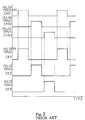
- the pulse trains CK91- CK93 are different in phase from one another (see figure 2).
- the pulse train CK92 rises after the pulse train CK91 is decayed, and the next pulse train CK93 rises after the pulse train CK92 is decayed.
- the pulse train CK91 rises after the pulse train CK93 is decayed.
- the pulse trains CK91 - CK93 are never overlapped with one another.
- the output nodes of the level shifter 12 is connected to the control nodes of the charge pump circuit 93, and the output node of the charge pump circuit 93 is connected to another input node of the level shifter 12.
- the charge pump circuit 93 boosts the low power voltage VDD to the high power voltage VLCD under the control with pulse trains CK1 ⁇ CK3 supplied from the level shifter 12.
- the high power voltage VLCD is supplied to the driver circuit (not shown), and is fed back to the level shifter 12.
- the level shifter 12 changes the high level of the pulse trains CK91 ⁇ CK93 from 1.5 volts to 3 volts, and produces the pulse trains CK1 ⁇ CK3.
- the pulse trains CK1 ⁇ CK3 are also different in phase from one another, and are never overlapped as shown in figure 2.
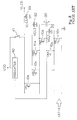
- FIG. 3 shows the circuit configuration of the charge pump circuit 93.
- the charge pump circuit 93 comprises a regulator 40, a switching unit 41, switching field effect transistors 10 1 ⁇ 10 6 and condensers 30 ⁇ 33.
- the low power voltage VDD is supplied to the regulator 40 and the switching unit 41.
- the regulator 40 produces a constant voltage from the low power voltage VDD. In this instance, the constant voltage is 1 volt.
- the switching field effect transistors 10 1 ⁇ 10 6 forms a switching network, and the condensers 30 ⁇ 33 are selectively connected through the switching network.
- the switching unit 41 turns on at the initiation of the boosting operation, and the condenser 33 is charged to the low power voltage VDD.
- the pulse trains CK1 ⁇ CK3 are selectively supplied to the gate electrodes of the switching field effect transistors 10 1 ⁇ 10 6 .
- the pulse trains CK1 ⁇ CK3 rise to the high level, the associated switching field effect transistors 10 1 ⁇ 10 6 turn on, and relay the potential level between the source nodes and the drain nodes.
- the switching field effect transistors 10 1 ⁇ 10 6 turn off at the pulse decay of the associated pulse trains CK1 ⁇ CK3.
- the switching field effect transistors 10 1 ⁇ 10 6 are selectively changed between the on-state and off-state in response to the pulse trains CK1 - ⁇ CK3 so as to connect and disconnect the condensers 30 ⁇ 33, and high voltages VCL1, VCL2 and VCL3 are generated through the boosting operation as will be described hereinafter in detail.
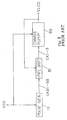
- Figure 4 shows the switching field effect transistors 10 1 ⁇ 10 6 .
- An n-channel enhancement type field effect transistor 52 stands for each of the switching field effect transistors 10 1 ⁇ 10 6 .
- the n-channel enhancement type field effect transistor 52 has a gate electrode G, a drain node D and a source node S.
- the pulse train CK1, CK2 or CK3 is supplied to the gate electrode G, and voltage lines A and B are connected to the drain node D and the source node S, respectively.
- the pulse train CK1 causes the n-channel enhancement type field effect transistor 52 to produce a conductive channel between the source node S and the drain node D
- the voltage lines B is electrically connected to the voltage line A
- the potential level on the voltage line B is propagated through the conductive channel to the voltage line A.
- the pulse train CK1, CK2 or CK3 vacates the conductive channel from between the source node S and the drain node D
- the voltage line A is electrically isolated from the voltage line B.
- the n-channel enhancement type field effect transistor 52 serves as a switch.
- the switching unit 41 turns on. Then, the low power voltage VDD is propagated through the switching unit 41 to the upper electrode of the condenser 33, and the upper electrode of the condenser 33 is charged to the low power voltage VDD (see figure 5). The low voltage level VDD is fed back to the level shifter 12. The switching field effect transistors 10 1 to 10 6 are still turned off, and the regulator 40 keeps the output voltage at 1 volt.
- the switching unit 41 turns off, and the pulse train CK1 is changed to the high level. Then, the switching field effect transistors 10 1 to 10 2 turn on, and the switching field effect transistors 10 1 to 10 2 propagate the ground level and the output voltage of the regulator 40 to the lower electrode b and the upper electrode a of the condenser 30. As a result, the condenser 31 raises the potential level at the upper electrode toward 1 volt as shown in figure 5. The pulse train CK1 is decayed, and the switching field effect transistors 10 1 to 10 2 turn off. Thus, the output voltage of the regulator 40 is stored in the condenser 30.
- the pulse train CK2 rises to the high level. Then, switching field effect transistors 10 3 to 10 4 turn on. The output voltage of the regulator 40 is propagated through the switching field effect transistor 10 3 , and the regulator 40 raises the lower electrode b from ground level to the output voltage thereof. Then, the potential level at the upper electrode a is boosted, and the boosted voltage is propagated through the switching field effect transistor 10 4 to the upper electrode of the condenser 32. The condenser 32 starts to raise the potential level VCL2 to the boosted potential level. The pulse train CK2 is decayed, and the switching field effect transistors 10 3 to 10 4 turn off. The boosted potential level is stored in the condenser 32.
- the clock train CK3 is changed to the high level, and the switching field effect transistors 10 5 to 10 6 turn on.
- the boosted potential level is propagated from the upper electrode of the condenser 32 through the switching field effect transistor 10 5 to the lower electrode b of the condenser 30, and the condenser 30 boosts the potential level at the upper electrode a, again.
- the still boosted potential level is propagated from the upper electrode a through the switching field effect transistor 10 6 to the upper electrode of the condenser 33, and the upper electrode of the condenser 33 rises from the low power voltage VDD to the still boosted potential level.
- the potential level at the upper electrode i.e., the still boosted potential level is fed back to the level shifter 12, and the level shifter 12 raises the high level of the pulse trains CK1 to CK3.
- the pulse train Ck3 is decayed, and the switching field effect transistors 10 5 and 10 6 turn off. Then, the still boosted potential level is stored in the condenser 33.
- the level shifter 12 produces the pulse train Ck1 to CK3 from the pulse train CK91 to CK93, and adjusts the high level of the pulse train CK1 to CK3 to the still boosted potential level, i.e., VLC3 and VLCD.
- the level shifter 12 stops the pulse trains CK1 to CK3, and enters the deadlock.
- the critical level is, by way of example, 1.2 volts.
- Figure 6 illustrates the deadlock.
- the potential level VLCD becomes lower than the critical level before 80 ⁇ s, and the deadlock takes place in the level shifter 12.
- the pulse trains CK91 to CK93 are continuously supplied to the level shifter 12, the level shifter 12 stops the pulse trains CK1 to CK3.
- One of the causes of the deadlock is external noise on the power supply line for the high power voltage VLCD, and another cause is leakage of electric charge from the condenser 33. If the boosting operation starts before reaching the stable output level, i.e., 1 volt, the deadlock takes place, because the low power voltage VDD is discharged from the upper electrode of the condenser 33 through the switching field effect transistor 10 6 at the pulse rise of the pulse train CK3. When the deadlock takes place, the prior art booster is to restart the boosting operation. In case, where the prior art booster is incorporated in the driving circuit for the liquid crystal display panel, the liquid crystal display panel can not produce the picture and character images.
- the manufacturers concentrate the efforts on the liquid crystal display units driven with a lower power voltage VLCD.
- the lower the power voltage VLCD the smaller the margin to the critical level. This means that the deadlock is much liable to take place in the level shifter 12.
- the manufacturers keep the margin between the power voltage VLCD and the critical level large, the manufacturers still suffer from the great power consumption of the liquid crystal display unit.
- the present invention proposes to parallelize an auxiliary switching circuit to a regular switching circuit in a charge pump circuit so as to make a level shifter recovered from the deadlock with a high power voltage produced in response to an auxiliary set of pulse trains.
- a power circuit for producing a first voltage from a second voltage more stable than the first voltage comprising a source of pulse trains for producing a first multi-phase pulse signal, a level shifter connected to the source of pulse trains, supplied with the first voltage and producing a second multi-phase pulse signal changed between a first level and a second level approximately equal to the first voltage from the first multi-phase pulse signal and a charge pump circuit supplied with the second voltage and including a boosting condenser, plural accumulating condensers and a first switching circuit connected between the boosting condenser and the accumulating condensers and responsive to the second multi-phase pulse signal for selectively connecting the boosting condenser to the accumulating condenser so that the first voltage is produced from the second voltage; the power circuit further comprises a delay circuit connected to the source of pulse trains and introducing a time lag for producing a third multi-phase pulse signal in-phase to the second multi-phase pulse signal, and the charge-pump
- a booster embodying the present invention largely comprises a pulse generator 11, a level shifter 12, an auxiliary level shifter 14 and a charge pump circuit 13.
- the low power voltage VDD is supplied to the auxiliary level shifter 14 as well as the pulse generator 11 and charge pump circuit 13, and the level shifter 12 is powered with a high power voltage VLCD.
- the low power voltage VDD is, by way of example, generated from the domestic electric power, and is much more stable than the high power voltage VLCD.
- the pulse generator 11 generates pulse trains CK91 to CK93 from the low power voltage VDD, and supplies the pulse trains Ck91 to CK93 to both of the level shifter 12 and the auxiliary level shifter 14.
- the pulse generator 11 changes the potential levels of the pulse trains CK91 to CK93 between a low level and a high level, and the high level is approximately equal to the low power voltage VDD.
- the pulse trains CK91 to CK93 are never overlapped with one another. In this instance, the pulse trains CK91 to CK93 have a pulse height of 1.5 volts.
- the level shifter 12 is similar to that incorporated in the prior art booster.
- the level shifter 12 is responsive to the pulse trains CK91 to CK93 so as to produce pulse trains CK1 to CK3.
- the level shifter 12 changes the high level of the pulse trains Ck1 to CK3 from the low power voltage VDD to the high power voltage VLCD, and supplies the pulse trains CK1 to CK3 to the charge pump circuit 13.
- a time lag is introduced between the pulse trains CK91 to CK93 and the pulse trains CK1 to CK3.
- the pulse trains Ck1 to CK3 are never overlapped with one another.
- the auxiliary level shifter 14 is also responsive to the pulse trains Ck91 to CK93 so as to produce auxiliary pulse trains CK21 to CK23.
- the pulse trains Ck21 to CK23 have the high level approximately equal to the low power voltage level VDD. Accordingly, the pulse trains CK21 to CK23 have the pulse height approximately equal to 1.5 volts.
- the auxiliary level shifter 14 is expected to introduce the time lag into the propagation of the pulse trains, i.e., between the pulse trains CK91 to CK93 and the pulse trains CK21 to CK23. In other words, the auxiliary level shifter 14 introduces the time lag as long as the time lag unavoidably introduced by the level shifter 12.
- the auxiliary level shifter 14 makes the pulse trains CK21 to CK23 in-phase to the pulse trains CK1 to CK3.
- the auxiliary level shifter 14 is incorporated in the booster for the sake of synchronism between the pulse trains CK1 to CK3 and the pulse trains CK21 to CK23.
- the auxiliary level shifter 14 is similar in circuit configuration to the level shifter 12 so that the time lag introduced by the auxiliary level shifter 14 is approximately equal to the time lag unavoidably introduced by the level shifter 12.
- the auxiliary level shifter 14 is replaceable with a delay circuit.
- the pulse trains CK91 to CK93 are delayed by the delay circuit, and the delayed pulse trains are supplied from the delay circuit to the charge pump circuit 13 as the pulse trains Ck21 to CK23.
- the delay circuit is designed to introduce the time lag as long as the time lag unavoidably introduced by the level shifter 12.
- the two sets of pulse trains CK1 to CK3 and CK21 to CK23 are supplied to the charge pump circuit 13, and the charge pump circuit 13 boosts the low power voltage VDD to the high power voltage VLCD in response to the pulse trains CK1 to CK3 or CK21 to CK23.
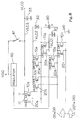
- FIG. 8 shows the circuit configuration of the charge pump circuit 13.
- the charge pump circuit 13 includes a boosting condenser 30, accumulating condensers 31, 32 and 33, a regular switching circuit 10 connected between the boosting condenser 30 and the accumulating condensers 31, 32 and 3, an auxiliary switching circuit 20 also connected between the boosting condenser 30 and the accumulating condensers 31, 32 and 33, a regulator 40 and a switching unit 41.
- the set of pulse trains CK1 to CK3 is supplied to the regular switching circuit 10
- the other set of pulse trains CK21 to CK23 is supplied to the auxiliary switching circuit 20.
- the auxiliary switching circuit 20 is the difference between the charge pump circuit 93 and the charge pump circuit 13.
- the low power voltage VDD is supplied to the regulator 40 and the switching unit 41.
- the regulator 40 produces a stable output voltage from the low power voltage VDD, and the stable output voltage is lower than the low power voltage VDD.
- the accumulating condensers 31, 32 and 33 have respective accumulating electrodes and respective counter electrodes. The counter electrodes are grounded, and the accumulating electrodes are connected to voltage lines VLC1, VLC2 and VLC3, respectively.
- the voltage line VLC1 is connected to the output node of the regulator 40, and the accumulating condenser 31 is charged with the stable output voltage of the regulator 40.
- the boosting condenser 30 has two electrodes a and b, which are selectively connected to the accumulating electrodes of the accumulating condensers 31, 32 and 33.
- the two electrodes a/ b are selectively connected through the regular switching circuit 10 or auxiliary switching circuit 20 to the voltage lines VLC1/ VLC2/ VLC3 and the ground line GND.
- the regular switching circuit 10 is implemented by switching field effect transistors 10 1 to 10 6 .
- the switching field effect transistors 10 1 to 10 6 are similar to those of the prior art booster (see figure 4).
- the switching field effect transistors 10 1 to 10 6 are connected between the electrode b and the ground line GND, between the voltage line VLCD1 and the electrode a, between the voltage line VLC1 and the electrode b, between the electrode a and the voltage line VLC2, between the electrode b and the voltage line VLC2 and between the electrode a and the voltage line VLC3, respectively.
- the pulse trains Ck1, Ck2 and CK3 are supplied to the gate electrodes of the switching field effect transistors 10 1 and 10 2 , the gate electrodes of the switching field effect transistors 10 3 and 10 4 and the gate electrodes of the switching field effect transistors 10 5 and 10 6 , respectively.
- the auxiliary switching circuit 20 is also implemented by switching field effect transistors 20 1 to 20 6 , and the switching transistors 20 1 to 20 6 are of the n-channel enhancement type shown in figure 4.
- the switching field effect transistors 20 1 to 20 6 are connected in parallel to the switching field effect transistors 10 1 to 10 6 . Namely, the switching field effect transistors 20 1 to 20 6 are connected between the electrode b and the ground line GND, between the voltage line VLCD1 and the electrode a, between the voltage line VLC1 and the electrode b, between the electrode a and the voltage line VLC2, between the electrode b and the voltage line VLC2 and between the electrode a and the voltage line VLC3, respectively.
- the pulse trains Ck21, Ck22 and CK23 are supplied to the gate electrodes of the switching field effect transistors 20 1 and 20 2 , the gate electrodes of the switching field effect transistors 20 3 and 20 4 and the gate electrodes of the switching field effect transistors 20 5 and 20 6 , respectively.
- the pulse trains CK21 to CK23 are in-phase to the pulse trains CK1 to CK3, respectively.
- the pulse trains CK21 to Ck23 and CK1 to CK3 cause the switching field effect transistors 20 1 and 20 2 to turn on and off concurrently with the switching field effect transistors 10 1 and 10 2 , respectively.
- the switching unit 41 is connected between the source of low power voltage VDD and the voltage line VLC3, and is momentarily closed at the initiation of the boosting operation.
- the regulator 40 is assumed to charge the accumulating condenser 31 with the stable output voltage.
- the switching unit 41 turns on.
- the low power voltage VDD is propagated through the switching unit 41 to the accumulating electrode of the condenser 33, and the low power voltage VDD is stored in the accumulating condenser 33.
- the switching field effect transistors 10 1 to 10 6 and 20 1 to 20 6 are turned off, and the low voltage level VDD is fed back to the level shifter 12.
- the switching unit 41 turns off, and the pulse trains CK1 and CK21 are changed to the respective high levels. Then, the switching field effect transistors 10 1 and 10 2 and 20 1 and 20 2 turn on, and the switching field effect transistors 10 1 , 20 1 and 10 2 , 20 2 propagate the ground level and the stable output voltage to the electrode b and the electrode a of the boosting condenser 30. As a result, the accumulating condenser 31 raises the potential level at the electrode a toward the stable output voltage. The pulse trains CK1 and CK21 are decayed, and the switching field effect transistors 10 1 and 10 2 and the switching field effect transistors 20 1 and 20 2 turn off. The stable output voltage is stored in the accumulating condenser 30.
- the pulse trains CK2 and CK22 rise to the respective high levels.
- switching field effect transistors 10 3 and 10 4 and the switching field effect transistors 20 3 and 20 4 turn on.
- the stable output voltage is propagated from the voltage line VLC1 through the switching field effect transistors 10 3 and 20 3 to the electrode b, and raises the potential level at the electrode b from ground level to the stable output voltage.
- the potential level at the electrode a is boosted, and the boosted voltage is propagated through the switching field effect transistors 10 4 and 20 4 and the voltage line VLC2 to the accumulating electrode of the condenser 32.
- the pulse trains CK2 and CK22 are decayed, and the switching field effect transistors 10 3 /10 4 and 20 3 / 20 4 turn off.
- the boosted potential level is stored in the condenser 32.
- the clock trains CK3 and CK23 are changed to the respective high levels, and the switching field effect transistors 10 5 / 10 6 and switching field effect transistors 20 5 / 20 6 turn on.
- the boosted potential level is propagated from the accumulating electrode of the condenser 32 through the switching field effect transistors 10 5 and 20 5 to the electrode b of the boosting condenser 30, and the boosting condenser 30 boosts the potential level at the other electrode a, again.
- the still boosted potential level is propagated from the electrode a through the switching field effect transistors 10 6 and 20 6 to the accumulating electrode of the condenser 33, and the boosting condenser 30 raises the potential level at the accumulating electrode of the condenser 33 from the low power voltage VDD to the still boosted potential level.
- the potential level at the accumulating electrode i.e., the still boosted potential level is fed back to the level shifter 12, and the level shifter 12 raises the high level of the pulse trains CK1 to CK3.
- the pulse trains Ck3 and CK23 are decayed, and the switching field effect transistors 10 5 and 10 6 and the switching transistors 20 1 and 20 6 turn off. Then, the still boosted potential level is stored in the condenser 33.
- the booster produces the high power voltage VLCD from the low power voltage VDD in the absence of the undesirable potential drop.
- the high power voltage VLCD is undesirably dropped to 1.1 volts
- the high power voltage VLCD is lower than the critical level of the level shifter 12, i.e., 1.2 volts, and the deadlock takes place.
- the potential drop does not have any influence on the auxiliary level shifter 14.
- the auxiliary level shifter 14 still generates the pulse trains CK21 to CK23, and supplies them to the auxiliary switching circuit 20.
- the switching field effect transistors 20 1 and 20 2 turn on, and replays the ground level and the stable output voltage to the electrodes b/ a of the boosting condenser 30, respectively, and, thereafter, the electric charges are replayed between the accumulating condensers 32/ 33 and the boosting condenser 30 in response to the pulse trains CK22 and CK23.
- the boosting operation is repeated, and the boosting condenser 30 gradually raises the potential levels on the voltage lines VLC1/ VLC2/ VLC3.
- the level shifter 12 restarts the generation of the pulse trains CK1 to CK3, and supplies them to the regular switching circuit 10.
- the switching field effect transistors 10 1 to 10 6 participate the boosting operation, again, and the electric charges are replayed between the boosting condenser 30 to the accumulating condensers 32/ 33 through the switching field effect transistors 10 1 to 10 6 as well as the switching field effect transistors 20 1 to 20 6 .
- the potential level on the voltage lines VLC2/ VLC3 and the electrode b exceed the certain potential level higher than the high level of the pulse trains CK21 to CK23 by the threshold. Then, the switching field effect transistors 20 1 to 20 6 do not respond to the pulse trains CK21 to CK23, and only the switching field effect transistors 10 1 to 10 6 participate the boosting operation.
- Figure 9 shows the recovery from the deadlock.
- the low power voltage VDD, the high power voltage VLCD and the stable output voltage of the regulator 40 are assumed to be 1.5 volts, 3 volts and 1 volt, respectively.
- the level shifter 12 stops the pulse trains CK1 to CK3, and the potential level on the voltage line VLC3 is decayed.
- the auxiliary switching circuit 20 keeps the boosting operation.
- the potential levels on the voltage lines VLC2/ VLC3 are recovered from the potential drop.
- the two sets of pulse trains CK1 to CK3 and CK21 to CK23 are supplied from the level shifters 12/14 to the associated switching circuits 10/ 20 for the boosting operation in the charge pump 13. While the charge pump circuit 13 is supplying the high power voltage over the critical level to the level shifter 12, the auxiliary level shifter 14 and the associated switching circuit 20 are redundant. However, even when the level shifter 12 stops the pulse trains Ck1 to CK3 due to the deadlock, the auxiliary level shifter 14 continuously supplies the pulse trains CK21 to CK23 to the switching circuit 20, and the boosting condenser 30 and the accumulating condensers 31 to 33 continues the boosting operation.
- the level shifter 12 is recovered from the deadlock so as to restart the pulse trains CK1 to CK3.
- the auxiliary level shifter 14 and the switching circuit 20 enhances the stability of the high power voltage VLCD. Even though the manufacturers reduces the margin between the high power voltage VLCD and the critical level, the booster according to the present invention stably continues the generation of the high power voltage VLCD.
- the stability is achieved by adding only the delay circuit, i.e., the auxiliary level shifter 14 and the switching circuit 20 to the prior art booster.
- the auxiliary level shifter 14 and the switching circuit 20 merely occupy narrow area on a semiconductor chip, and the increased area is ignoreable. Thus, the manufacturers enhance the stability of the booster without sacrifice of the semiconductor chip.
- Another booster embodying the present invention also largely comprises a pulse generator, a level shifter, a delay circuit, i.e., an auxiliary level shifter and a charge pump circuit.
- the pulse generator, the level shifter and the delay circuit are similar to the pulse generator 11, the level shifter 12 and the auxiliary level shifter 14, respectively, and no further description is incorporated hereinbelow.
- the charge pump circuit is similar in circuit configuration to the charge pump circuit 13, and includes a boosting condenser, accumulating condensers and two switching circuits arranged in parallel to each other.
- the two switching circuits are implemented by transfer gates, parallel combinations of a p-channel enhancement type field effect transistor 51 and an n-channel enhancement type field effect transistor 52 accompanied with an inverter 53 shown in figure 10 except the switching field effect transistor 20 6 .
- the switching field effect transistor 20 6 is implemented by the n-channel enhancement type field effect transistor. This is because of the fact that the high power voltage VLCD on the voltage line VLC3 does not permit the p-channel enhancement type field effect transistor 51 to turn off in the presence of the complementary pulse train of the high level.
- the n-channel enhancement type field effect transistors may be used as the switching field effect transistors 20 1 to 20 5 .
- the transfer gates are used for the switching field effect transistors in so far as the transfer gates are surely changed between the on-state and the off-state.
- the p-channel enhancement type field effect transistor 51 may be replaced with two p-channel enhancement type field effect transistors 51 coupled in series in the switching field effect transistor 20 4 , by way of example.
- the back gate or the n-type well is to be connected to the source or drain region higher in potential level than the other.
- the switching field effect transistor 20 4 is connected between the voltage line VLC2 and the electrode a.
- the electrode a is selectively connected to the voltage line VLC1 and the voltage line VLC3, and the source region becomes higher or lower than the drain region. In other words, it is impossible to determine which region is higher than the other region.
- the back gates of the p-channel enhancement type field effect transistors are respectively connected to the regions opposite to the common region shared therebetween. Any malfunction does not take place in the series of p-channel enhancement type field effect transistors. Thus, there are several limitations on the usage of the p-channel enhancement type field effect transistor 51.
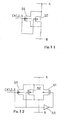
- the parallel combination is connected between voltage lines A and B, and the pulse train CK1/ CK2/ CK3 or CK21/ CK22/ CK23 and the complementary pulse trains are supplied from the level shifter 12 and the inverter 53 to the gate electrode of the n-channel enhancement type field effect transistor 52 and the gate electrode of the p-channel enhancement type field effect transistor 51, respectively.
- the pulse train rises to the high level, the complementary pulse train is decayed, and both of the n-channel enhancement type field effect transistor 52 and the p-channel enhancement type field effect transistor 51 concurrently turn on.
- the voltage lines A and B stand for the voltage lines VLC1/ VCL2/ VCL3, the ground line GND and the voltage lines connected to the electrodes a/ b.
- the booster implementing the second embodiment behaves similar to the booster shown in figures 7 and 8, and achieves all the advantages of the first embodiment.
- the transfer gate is lower in channel resistance than the n-channel enhancement type field effect transistor, and, accordingly, relays the potential level between the boosting condenser 30 and the accumulating condensers 31/ 32/ 33 without potential drop.
- Yet another booster embodying the present invention also largely comprises a pulse generator, a level shifter, a delay circuit, i.e., an auxiliary level shifter and a charge pump circuit.
- the pulse generator, the level shifter and the delay circuit are similar to the pulse generator 11, the level shifter 12 and the auxiliary level shifter 14, respectively, and no further description is incorporated hereinbelow.
- the charge pump circuit is similar in circuit configuration to the charge pump circuit 13, and includes a boosting condenser, accumulating condensers and two switching circuits arranged in parallel to each other.
- the two switching circuits are implemented by parallel circuits shown in figure 11 except the switching field effect transistors 10 1 and 20 1 .
- the parallel circuit consists of an n-channel enhancement type field effect transistor 52 and an n-channel non-doped field effect transistor 54 coupled in parallel to each other.
- the parallel circuit 52/ 54 is connected between the voltage lines A and B, and the pulse train CK1/ CK2/ CK3 or CK21/ CK22/ CK23 is supplied to the gate electrode of the n-channel non-doped field effect transistor 54 as well as the gate electrode of the n-channel enhancement type field effect transistor 52.
- the n-channel enhancement type field effect transistor 52 is fabricated through a process including a channel doping with n-type dopant impurity.
- the n-channel enhancement type field effect transistor has a certain threshold greater than zero.
- the n-channel non-doped field effect transistors are fabricated through a process without the channel doping. For this reason, the n-channel non-doped field effect transistors have a threshold of the order of zero.
- the n-channel non-doped field effect transistor reduces the channel resistance of the parallel circuit.
- the switching transistors 10 1 and 20 1 are implemented by the n-channel enhancement type field effect transistors.
- the voltage line connected to the electrode b is electrically connected through the n-channel non-doped field effect transistors to the ground line GND at all times, and the boosting condenser 30 can not boosts the potential level.
- the booster implementing the third embodiment behaves as similar to the first embodiment, and achieves all the advantages.
- the parallel circuits 52/54 reduces the resistance between the voltage lines A and B, and accelerates the boosting operation.
- Still another booster embodying the present invention also largely comprises a pulse generator, a level shifter, a delay circuit, i.e., an auxiliary level shifter and a charge pump circuit.
- the pulse generator, the level shifter and the delay circuit are similar to the pulse generator 11, the level shifter 12 and the auxiliary level shifter 14, respectively, and no further description is incorporated hereinbelow.
- the charge pump circuit is similar in circuit configuration to the charge pump circuit 13, and includes a boosting condenser, accumulating condensers and two switching circuits arranged in parallel to each other.
- the two switching circuits are implemented by parallel circuits shown in figure 12 except the switching field effect transistors 10 1 , 20 1 and 20 6 .
- the parallel circuit consists of the transfer gate, i.e., the parallel combination of the p-channel enhancement type field effect transistor 51, the n-channel enhancement type field effect transistor 52 and the inverter 53 and an n-channel non-doped field effect transistor 54 coupled in parallel to the transfer gate.
- the p-channel enhancement type field effect transistors 51 are also under the limitations described hereinbefore.
- the parallel circuit 51/ 52/ 54 is connected between the voltage lines A and B, and the pulse train CK1/ CK2/ CK3 or CK21/ CK22/ CK23 and the complementary pulse train are supplied to the gate electrodes of the n-channel non-doped/ n-channel enhancement type field effect transistors 54/ 52 and the gate electrode of the as well as the gate electrode of the p-channel enhancement type field effect transistor 51.
- the booster implementing the fourth embodiment behaves as similar to the first embodiment, and achieves the advantages of the third embodiment.
- Yet another booster embodying the present invention also largely comprises a pulse generator, a level shifter, a delay circuit, i.e., an auxiliary level shifter and a charge pump circuit.
- the pulse generator, the level shifter and the delay circuit are similar to the pulse generator 11, the level shifter 12 and the auxiliary level shifter 14, respectively, and no further description is incorporated hereinbelow.
- the charge pump circuit is similar in circuit configuration to the charge pump circuit 13, and includes a boosting condenser, accumulating condensers and two switching circuits arranged in parallel to each other.
- the two switching circuits are implemented by n-channel non-doped field effect transistors 54 shown in figure 13 except the switching field effect transistors 10 1 and 20 1 .
- the booster behaves as similar to the first embodiment.
- the n-channel non-doped field effect transistors 54 achieves a high-speed switching action without sacrifice of the simple circuit configuration of the switching circuits 10/ 20.
- Still another booster embodying the present invention also largely comprises a pulse generator, a level shifter, a delay circuit, i.e., an auxiliary level shifter and a charge pump circuit.
- the pulse generator, the level shifter and the delay circuit are similar to the pulse generator 11, the level shifter 12 and the auxiliary level shifter 14, respectively, and no further description is incorporated hereinbelow.
- the charge pump circuit is similar in circuit configuration to the charge pump circuit 13, and includes a boosting condenser, accumulating condensers and two switching circuits arranged in parallel to each other.
- the two switching circuits are implemented by parallel circuits shown in figure 14 except the switching field effect transistors 10 1 , 20 1 and 20 6 .
- the parallel circuit consists of a p-channel enhancement type field effect transistor 51, an n-channel non-doped field effect transistor 54 and an inverter 53.
- the p-channel enhancement type field effect transistor 51 is also under the limitations described hereinbefore.
- the p-channel enhancement type field effect transistor 51 and the n-channel non-doped field effect transistor 54 are in parallel to each other, and are connected between the voltage lines A and B.
- the pulse train CK1/ CK2/ CK3 or CK21/ CK22/ CK23 is supplied to the gate electrode of the n-channel non-doped field effect transistor 54 and the inverter 53, and the inverter 53 supplies the complementary pulse train to the gate electrode of the p-channel enhancement type field effect transistor 51.
- the booster implementing the sixth embodiment behaves as similar to the first embodiment, and achieves the advantages of the third embodiment.
- the auxiliary switching circuit 20 is connected in parallel to the regular switching circuit between the boosting condenser 30 and the accumulating condensers 31/ 32/ 33, and the switching transistors of the auxiliary switching circuit are gated by the pulse trains Ck21 to CK23 produced from the stable power voltage. Even when the level shifter 12 stops the pulse trains CK1/ CK2/ CK3 due to the deadlock, the auxiliary switching circuit continuously relays the electric charges between the boosting condenser 30 and the accumulating condensers 31/ 32/ 33 so that the charge pump circuit 13 makes the high power voltage VLCD recovered from the undesirable potential drop.
- the level shifter 12 is immediately recovered from the deadlock, and the booster according to the present invention stably supplies the high power voltage to a destination such as the driver circuit of the liquid crystal display panel. Even when the manufacturers lower the high power voltage, the booster according to the present invention is stable and free from the deadlock.
- the charge pump circuit 13 may have more than three stages, i.e., more than three accumulating condensers.
- the regular switching circuit and the auxiliary switching circuit consist of switching field effect transistors greater than those of the first embodiment.
- the low power voltage VDD and the high power voltage VLCD are never limited to 1.5 volts and 3 volts.
- the present invention is applicable to any booster for producing a high voltage from a low voltage.
- the booster according to the present invention is applicable to any kind of electric or electronic system.
- the application field is not limited to the liquid crystal display unit.
- the regulator may selectively supply plural stable voltages to the accumulating condenser.
- the charge pump circuit may step up or step down the voltage depending upon the stable voltage supplied thereto.
- the booster according to the present invention may produce a stable voltage as high as the power voltage supplied thereto.
- Selected ones of the switching field effect transistors may be implemented by p-channel enhancement type field effect transistors.
- any kind of delay circuit is available for the booster or power circuit in so far as the output pulse trains are in-phase to the pulse trains of the level shifter.
Landscapes
- Engineering & Computer Science (AREA)
- Power Engineering (AREA)
- Physics & Mathematics (AREA)
- Electromagnetism (AREA)
- General Physics & Mathematics (AREA)
- Radar, Positioning & Navigation (AREA)
- Automation & Control Theory (AREA)
- Dc-Dc Converters (AREA)
- Liquid Crystal Display Device Control (AREA)
- Control Of Indicators Other Than Cathode Ray Tubes (AREA)
- Power Conversion In General (AREA)
Applications Claiming Priority (2)
| Application Number | Priority Date | Filing Date | Title |
|---|---|---|---|
| JP2001023995A JP3430155B2 (ja) | 2001-01-31 | 2001-01-31 | 電源昇圧回路 |
| JP2001023995 | 2001-01-31 |
Publications (2)
| Publication Number | Publication Date |
|---|---|
| EP1233504A2 true EP1233504A2 (fr) | 2002-08-21 |
| EP1233504A3 EP1233504A3 (fr) | 2005-01-26 |
Family
ID=18889203
Family Applications (1)
| Application Number | Title | Priority Date | Filing Date |
|---|---|---|---|
| EP02002206A Withdrawn EP1233504A3 (fr) | 2001-01-31 | 2002-01-29 | Circuit de puissance exempt de blocage |
Country Status (4)
| Country | Link |
|---|---|
| EP (1) | EP1233504A3 (fr) |
| JP (1) | JP3430155B2 (fr) |
| KR (1) | KR100450479B1 (fr) |
| CN (1) | CN1369952A (fr) |
Cited By (2)
| Publication number | Priority date | Publication date | Assignee | Title |
|---|---|---|---|---|
| WO2004105221A1 (fr) * | 2003-05-20 | 2004-12-02 | Sony Corporation | Circuit de conversion de tension d'alimentation, methode pour commander ce circuit, dispositif d'affichage et terminal mobile |
| TWI588638B (zh) * | 2015-11-09 | 2017-06-21 | 智原科技股份有限公司 | 電壓調整器的防鎖死電路及其相關電源系統 |
Families Citing this family (6)
| Publication number | Priority date | Publication date | Assignee | Title |
|---|---|---|---|---|
| KR100959780B1 (ko) * | 2003-09-08 | 2010-05-27 | 삼성전자주식회사 | 액정 표시 장치와, 이의 구동 장치 및 방법 |
| JP4265631B2 (ja) * | 2006-08-10 | 2009-05-20 | ソニー株式会社 | 電源回路、表示装置、および携帯端末 |
| JP5198163B2 (ja) * | 2008-06-19 | 2013-05-15 | ラピスセミコンダクタ株式会社 | 昇圧回路 |
| CN102035414B (zh) * | 2010-12-13 | 2013-03-20 | 成都成电硅海科技股份有限公司 | 多电压等级的开关电源控制系统 |
| CN105810171B (zh) * | 2016-05-31 | 2018-04-20 | 昆山龙腾光电有限公司 | 放大反向电路及液晶显示装置 |
| CN108226812A (zh) * | 2018-01-17 | 2018-06-29 | 环胜电子(深圳)有限公司 | 自动式电源测试系统 |
Family Cites Families (3)
| Publication number | Priority date | Publication date | Assignee | Title |
|---|---|---|---|---|
| US5397931A (en) * | 1993-03-31 | 1995-03-14 | Texas Instruments Deutschland Gmbh | Voltage multiplier |
| KR0149220B1 (ko) * | 1994-12-27 | 1998-12-01 | 김주용 | 챠지 펌프 회로 |
| GB2324423B (en) * | 1997-04-16 | 1999-07-21 | Lsi Logic Corp | Charge pump |
-
2001
- 2001-01-31 JP JP2001023995A patent/JP3430155B2/ja not_active Expired - Fee Related
-
2002
- 2002-01-29 EP EP02002206A patent/EP1233504A3/fr not_active Withdrawn
- 2002-01-31 CN CN02103125A patent/CN1369952A/zh active Pending
- 2002-01-31 KR KR10-2002-0005720A patent/KR100450479B1/ko not_active Expired - Fee Related
Cited By (4)
| Publication number | Priority date | Publication date | Assignee | Title |
|---|---|---|---|---|
| WO2004105221A1 (fr) * | 2003-05-20 | 2004-12-02 | Sony Corporation | Circuit de conversion de tension d'alimentation, methode pour commander ce circuit, dispositif d'affichage et terminal mobile |
| EP1626486A4 (fr) * | 2003-05-20 | 2009-02-25 | Sony Corp | Circuit de conversion de tension d'alimentation, methode pour commander ce circuit, dispositif d'affichage et terminal mobile |
| US7821511B2 (en) | 2003-05-20 | 2010-10-26 | Sony Corporation | Power supply voltage converting circuit, method for controlling the same, display device, and mobile terminal |
| TWI588638B (zh) * | 2015-11-09 | 2017-06-21 | 智原科技股份有限公司 | 電壓調整器的防鎖死電路及其相關電源系統 |
Also Published As
| Publication number | Publication date |
|---|---|
| JP3430155B2 (ja) | 2003-07-28 |
| CN1369952A (zh) | 2002-09-18 |
| JP2002233133A (ja) | 2002-08-16 |
| KR20020064211A (ko) | 2002-08-07 |
| KR100450479B1 (ko) | 2004-10-01 |
| EP1233504A3 (fr) | 2005-01-26 |
Similar Documents
| Publication | Publication Date | Title |
|---|---|---|
| US5499183A (en) | Constant voltage generating circuit having step-up circuit | |
| US5410583A (en) | Shift register useful as a select line scanner for a liquid crystal display | |
| US6278318B1 (en) | Booster circuit associated with low-voltage power source | |
| US5438290A (en) | Low power driver circuit for an AC plasma display panel | |
| JP2011133907A (ja) | 表示装置用パワーダウンショート回路 | |
| CN109658888B (zh) | 移位寄存器单元、驱动方法、栅极驱动电路及显示装置 | |
| US20070258557A1 (en) | Shift register circuit and pull high element thereof | |
| US5247208A (en) | Substrate bias generating device and operating method thereof | |
| US5650671A (en) | Charge pump circuit | |
| US7071765B2 (en) | Boost clock generation circuit and semiconductor device | |
| CN102610206A (zh) | 显示器的闸极驱动电路 | |
| CN118694169A (zh) | 电荷泵电路、显示驱动器以及显示装置 | |
| EP1233504A2 (fr) | Circuit de puissance exempt de blocage | |
| WO2018077022A1 (fr) | Circuit d'unité de registre à décalage et procédé de commande, registre à décalage, circuit d'attaque de grille et appareil d'affichage | |
| US7466187B2 (en) | Booster circuit | |
| US8072257B2 (en) | Charge pump-type voltage booster circuit and semiconductor integrated circuit device | |
| CN100413193C (zh) | 升压电路、电源电路以及液晶驱动装置 | |
| CN1841935B (zh) | 用于变换信号振幅的振幅变换电路 | |
| US10135444B2 (en) | Semiconductor device with booster part, and booster | |
| JP2000021179A (ja) | ブースト回路及びこれを用いた半導体装置 | |
| KR20030074331A (ko) | 신호의 진폭을 변환하기 위한 진폭 변환 회로 | |
| US6738273B2 (en) | Charge pump drive signal recovery circuit | |
| US20040041613A1 (en) | Boosted clock generator having an NMOSFET pass gate transistor | |
| JP3190940B2 (ja) | 昇圧回路 | |
| JPH05101685A (ja) | 高電圧電荷ポンプ |
Legal Events
| Date | Code | Title | Description |
|---|---|---|---|
| PUAI | Public reference made under article 153(3) epc to a published international application that has entered the european phase |
Free format text: ORIGINAL CODE: 0009012 |
|
| AK | Designated contracting states |
Kind code of ref document: A2 Designated state(s): AT BE CH CY DE DK ES FI FR GB GR IE IT LI LU MC NL PT SE TR |
|
| AX | Request for extension of the european patent |
Free format text: AL;LT;LV;MK;RO;SI |
|
| RAP1 | Party data changed (applicant data changed or rights of an application transferred) |
Owner name: NEC ELECTRONICS CORPORATION |
|
| PUAL | Search report despatched |
Free format text: ORIGINAL CODE: 0009013 |
|
| AK | Designated contracting states |
Kind code of ref document: A3 Designated state(s): AT BE CH CY DE DK ES FI FR GB GR IE IT LI LU MC NL PT SE TR |
|
| AX | Request for extension of the european patent |
Extension state: AL LT LV MK RO SI |
|
| 17P | Request for examination filed |
Effective date: 20041221 |
|
| AKX | Designation fees paid |
Designated state(s): DE FR NL |
|
| STAA | Information on the status of an ep patent application or granted ep patent |
Free format text: STATUS: THE APPLICATION HAS BEEN WITHDRAWN |
|
| 18W | Application withdrawn |
Effective date: 20060427 |