EP1234258B1 - Procede et systeme d'attribution dynamique de zone en fonction de localite pour un reseau de communication sans fil - Google Patents
Procede et systeme d'attribution dynamique de zone en fonction de localite pour un reseau de communication sans fil Download PDFInfo
- Publication number
- EP1234258B1 EP1234258B1 EP00992956A EP00992956A EP1234258B1 EP 1234258 B1 EP1234258 B1 EP 1234258B1 EP 00992956 A EP00992956 A EP 00992956A EP 00992956 A EP00992956 A EP 00992956A EP 1234258 B1 EP1234258 B1 EP 1234258B1
- Authority
- EP
- European Patent Office
- Prior art keywords
- data
- tree
- fragmentation
- index
- fragments
- Prior art date
- Legal status (The legal status is an assumption and is not a legal conclusion. Google has not performed a legal analysis and makes no representation as to the accuracy of the status listed.)
- Expired - Lifetime
Links
Images






Classifications
-
- G—PHYSICS
- G06—COMPUTING OR CALCULATING; COUNTING
- G06F—ELECTRIC DIGITAL DATA PROCESSING
- G06F16/00—Information retrieval; Database structures therefor; File system structures therefor
- G06F16/20—Information retrieval; Database structures therefor; File system structures therefor of structured data, e.g. relational data
- G06F16/27—Replication, distribution or synchronisation of data between databases or within a distributed database system; Distributed database system architectures therefor
- G06F16/278—Data partitioning, e.g. horizontal or vertical partitioning
-
- G—PHYSICS
- G06—COMPUTING OR CALCULATING; COUNTING
- G06F—ELECTRIC DIGITAL DATA PROCESSING
- G06F16/00—Information retrieval; Database structures therefor; File system structures therefor
- G06F16/20—Information retrieval; Database structures therefor; File system structures therefor of structured data, e.g. relational data
- G06F16/22—Indexing; Data structures therefor; Storage structures
- G06F16/2228—Indexing structures
- G06F16/2246—Trees, e.g. B+trees
-
- G—PHYSICS
- G06—COMPUTING OR CALCULATING; COUNTING
- G06F—ELECTRIC DIGITAL DATA PROCESSING
- G06F16/00—Information retrieval; Database structures therefor; File system structures therefor
- G06F16/20—Information retrieval; Database structures therefor; File system structures therefor of structured data, e.g. relational data
- G06F16/22—Indexing; Data structures therefor; Storage structures
- G06F16/2228—Indexing structures
- G06F16/2264—Multidimensional index structures
-
- G—PHYSICS
- G06—COMPUTING OR CALCULATING; COUNTING
- G06F—ELECTRIC DIGITAL DATA PROCESSING
- G06F16/00—Information retrieval; Database structures therefor; File system structures therefor
- G06F16/20—Information retrieval; Database structures therefor; File system structures therefor of structured data, e.g. relational data
- G06F16/24—Querying
- G06F16/245—Query processing
- G06F16/2452—Query translation
-
- Y—GENERAL TAGGING OF NEW TECHNOLOGICAL DEVELOPMENTS; GENERAL TAGGING OF CROSS-SECTIONAL TECHNOLOGIES SPANNING OVER SEVERAL SECTIONS OF THE IPC; TECHNICAL SUBJECTS COVERED BY FORMER USPC CROSS-REFERENCE ART COLLECTIONS [XRACs] AND DIGESTS
- Y10—TECHNICAL SUBJECTS COVERED BY FORMER USPC
- Y10S—TECHNICAL SUBJECTS COVERED BY FORMER USPC CROSS-REFERENCE ART COLLECTIONS [XRACs] AND DIGESTS
- Y10S707/00—Data processing: database and file management or data structures
- Y10S707/953—Organization of data
- Y10S707/957—Multidimensional
-
- Y—GENERAL TAGGING OF NEW TECHNOLOGICAL DEVELOPMENTS; GENERAL TAGGING OF CROSS-SECTIONAL TECHNOLOGIES SPANNING OVER SEVERAL SECTIONS OF THE IPC; TECHNICAL SUBJECTS COVERED BY FORMER USPC CROSS-REFERENCE ART COLLECTIONS [XRACs] AND DIGESTS
- Y10—TECHNICAL SUBJECTS COVERED BY FORMER USPC
- Y10S—TECHNICAL SUBJECTS COVERED BY FORMER USPC CROSS-REFERENCE ART COLLECTIONS [XRACs] AND DIGESTS
- Y10S707/00—Data processing: database and file management or data structures
- Y10S707/99931—Database or file accessing
- Y10S707/99932—Access augmentation or optimizing
-
- Y—GENERAL TAGGING OF NEW TECHNOLOGICAL DEVELOPMENTS; GENERAL TAGGING OF CROSS-SECTIONAL TECHNOLOGIES SPANNING OVER SEVERAL SECTIONS OF THE IPC; TECHNICAL SUBJECTS COVERED BY FORMER USPC CROSS-REFERENCE ART COLLECTIONS [XRACs] AND DIGESTS
- Y10—TECHNICAL SUBJECTS COVERED BY FORMER USPC
- Y10S—TECHNICAL SUBJECTS COVERED BY FORMER USPC CROSS-REFERENCE ART COLLECTIONS [XRACs] AND DIGESTS
- Y10S707/00—Data processing: database and file management or data structures
- Y10S707/99931—Database or file accessing
- Y10S707/99933—Query processing, i.e. searching
-
- Y—GENERAL TAGGING OF NEW TECHNOLOGICAL DEVELOPMENTS; GENERAL TAGGING OF CROSS-SECTIONAL TECHNOLOGIES SPANNING OVER SEVERAL SECTIONS OF THE IPC; TECHNICAL SUBJECTS COVERED BY FORMER USPC CROSS-REFERENCE ART COLLECTIONS [XRACs] AND DIGESTS
- Y10—TECHNICAL SUBJECTS COVERED BY FORMER USPC
- Y10S—TECHNICAL SUBJECTS COVERED BY FORMER USPC CROSS-REFERENCE ART COLLECTIONS [XRACs] AND DIGESTS
- Y10S707/00—Data processing: database and file management or data structures
- Y10S707/99931—Database or file accessing
- Y10S707/99933—Query processing, i.e. searching
- Y10S707/99934—Query formulation, input preparation, or translation
-
- Y—GENERAL TAGGING OF NEW TECHNOLOGICAL DEVELOPMENTS; GENERAL TAGGING OF CROSS-SECTIONAL TECHNOLOGIES SPANNING OVER SEVERAL SECTIONS OF THE IPC; TECHNICAL SUBJECTS COVERED BY FORMER USPC CROSS-REFERENCE ART COLLECTIONS [XRACs] AND DIGESTS
- Y10—TECHNICAL SUBJECTS COVERED BY FORMER USPC
- Y10S—TECHNICAL SUBJECTS COVERED BY FORMER USPC CROSS-REFERENCE ART COLLECTIONS [XRACs] AND DIGESTS
- Y10S707/00—Data processing: database and file management or data structures
- Y10S707/99941—Database schema or data structure
- Y10S707/99943—Generating database or data structure, e.g. via user interface
Definitions
- the present invention relates to indexing and managing data using fragmentation in relational databases.
- a database is a collection of information.
- a relational database is a database that is perceived by its users as a collection of tables. Each table arranges items and attributes of the items in rows and columns, respectively. Each table row corresponds to an item (also referred to as a record or tuple), and each table column corresponds to an attribute of the item (referred to as a field or, more correctly, as an attribute type or field type).
- Fragmentation is a technique used to increase database performance.
- a system supports data fragmentation if a given relation can be divided up into pieces or fragments. Data can be stored at the location where it is used most frequently.
- two types of fragmentation can be used: horizontal fragmentation and vertical fragmentation, corresponding to relational operations of restriction and projection.
- the rules assigning a row to a fragment are defined by a database user or administrator and are part of a "fragmentation scheme". It is possible for a fragment of a given table to be empty if none of the rows of the table satisfy the fragmentation scheme's assignment rules for that fragment.
- "Fragment elimination" is a process by which a database system identifies fragments from a table that cannot participate in the result of a query and removes those fragments from consideration in processing the query, thus improving the performance of the database system.
- fragments may be stored independently on separate disks or on separate nodes in a computer cluster or network architecture. Logically, all fragments may be scanned simultaneously, thereby increasing the overall rate at which the complete table can be read, subject to the limitations of the physical storage of the data.
- the invention provides a method as claimed in claim 1, a a system as claimed in claim 9 and a computer program as claimed in claim 10.
- the integer range representation can be independent of Structured Query Language (SQL) data types.
- the tree data structure can update the data fragment.
- the tree data structure can insert data into a data fragment.
- the tree data structure can select data in a data set.
- the tree data structure can be used during internal database operation.
- the data can be selected using an SQL select statement.
- the data tree structure can be used to locate the data fragment.
- the data set can partition into even segments to balance the tree data structure which can be used to populate the tree data structure.
- the tree data structure can also map all data types into an integer space. Collecting data points can be used in one or more fragmentation expressions; and the data points stored in a multi-dimensional array.
- the first index can also be used into the array as an index point for a NULL value and also an upper bound of the array can be used as an index point of positive infinity.
- the intermediate range representation is sorted.
- the mapping step also may include using a binary search to convert the intermediate range representation into the integer range representation.
- the index tree data structure represents a multi-dimensional search space.
- the index tree data structure can be a binary tree, and can be searched with an O(log(N)) search complexity.
- the data fragments can overlap.
- the invention provides high performance for managing data fragments in a database.
- the invention can manage fragmentation schema of arbitrary number of columns. This property allows the invention to manage large databases where the number of columns used for fragmentation can become quite large.
- an integer array is used to represent the range structure associated with the fragments.
- the index of the array is used to do the search. This is both simple and efficient, because integer comparisons are computationally "cheaper" than SQL type comparisons.
- the modelling and mapping from SQL data-type to integer contribute to the simplicity and efficiency of the invention in performing operations with data fragmentation. Overlapping fragments are pruned from the tree, thus improving search performance.
- the height of the tree generated by the invention is minimized. Thus, searching the tree will be fast and efficient. This will make insertion into the database and query optimization (eliminating unnecessary fragments) operations more efficient. Also, the system has a low data storage requirement. Due to these advantages, the invention can efficiently manage data fragments in a database.
- Fig. 1 is a diagram illustrating a database engine in accordance with a preferred embodiment of the present invention.
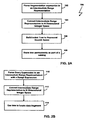
- Fig. 2A is a flowchart illustrating a process for creating a tree data structure.
- Fig. 2B is a flowchart illustrating a process for applying the tree data structure in response to a query.
- Fig. 3 is a flowchart illustrating a process for partitioning a dataset in the data fragmentation process of Fig. 2.
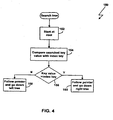
- Fig. 4 is a flowchart illustrating a process for searching a tree created in Figs. 2A and 2B.
- Fig. 5 is a flowchart illustrating a process for building the tree in accordance with Figs. 2A and 2B.
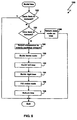
- Fig. 6 is a flowchart illustrating a process for optimizing data fragmentation in accordance with a preferred embodiment of the present invention.
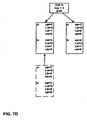
- Figs. 7A-7E are diagrams illustrating exemplary operations of the system of Fig. 1.
- Fig. 8 is a block diagram of a computer system platform suitable for implementing an embodiment of a database system in accordance with a preferred embodiment of the present invention.
- Fig. 9 is a block diagram of a computer and computer elements suitable for use in the database engine of Fig. 1.
- Fig. 1 represents an embodiment of a database engine 30 in accordance with the present invention.
- the database engine 30 has a user application 32 that communications with a client application programming interface (API) 34.
- the client API 34 in turn communicates with an SQL parser 38 that parses an SQL query with one or more SQL expressions into its constituencies, which may be stored in a binary tree data structure representing the components of the query.
- the output of the SQL parser 38 is provided to a code generator 40 that outputs intermediate code from the SQL expression.
- the intermediate code represents an execution plan for satisfying the SQL query.
- the code generator 40 also eliminates redundant data and performs error-checking, such as confirming the validity of table and column names.
- This code is then optimized by an optimizer 42, which optimizes the code using a cost-based analysis for formulating a query execution plan.
- the resulting optimized code associated with the execution plan is provided to a fragment manager 44 that handles references to fragmented tables in accordance with a predetermined fragmentation scheme.
- the fragment manager 44 deploys an index tree, whose creation and operation are discussed in more detail below.
- the output of the fragment manager 44 is provided to an RSAM 46 for executing the execution plan.
- the RSAM 46 controls one or more data storage device managers such as disk managers, for example.
- the client API 34, SQL parser 38, code generator 40, optimizer 42, fragment manager 44 and RSAM 46 reference a library 48 and call various low-level routines such as access methods that will be executed by a processor.
- the result of the execution plan is provided to the user application 32.
- Figs. 2A and 2B are flowcharts of processes for creating and managing data fragments in accordance with a preferred embodiment of the invention.
- a query fragmentation expression as generated by the user application 32, is parsed into an intermediate range representation with a range representation (step 102).
- the intermediate range representation is converted into an N-dimensional integer space, where N is the number of columns in the fragmentation expression or scheme (step 104).
- An index tree is then generated to represent the search space (step 106) .
- the tree is stored permanently as part of a database catalog (step 108) . Once the tree has been constructed, the tree can be used to locate the data fragment, as discussed in more detail below.
- the query fragmentation expression is parsed into an intermediate range representation with a range representation (step 110).
- the intermediate range representation is converted into an N-dimensional integer space, where N is the number of columns in the fragmentation expression or scheme (step 112).
- the tree can then be used to locate data fragments (step 114).
- the embodiment maps different SQL data types to integer values. In this process, all data points (SQL data values) used in the fragmentation expressions are collected and stored as a multi-dimensional array. Each column's data points are stored in an array.
- the embodiment of Figs. 2A and 2B uses the array index 0 as the index point for a NULL value. This models the ISNULL expression as a minimal point. The system also use the upper bound of the array as the index point of "positive" infinity.
- index node two kinds of node are used in the tree: index node and data node.
- Data nodes are leaf nodes of the tree, which contains only data items.
- a data item in the tree is represented by an array of ranges (low, up) that describe the space. Each pair of (low, up) describes a range in one dimension of the space.
- Index nodes are internal (non-leaf) nodes of the tree. Each index node contains the following fields:
- Each data item of S describes a subspace in the m-dimensional space and is of the form:
- the data set is then evenly partitioned with a chosen index key value so that a balanced tree can be built. This is achieved by first selecting the dimension that has the most variance -- the most points -- as the indexing dimension. The median point of that dimension is then used as the index key value to partition the data set.
- the data set is partitioned based on that key.
- the index key value is K
- its associated Equal flag is E
- the following operations are performed.
- a partitioning routine is executed.
- Figure 3 shows the partition algorithm.
- the process of Fig. 3 partitions the data set into two parts, the left part L, and the right part R.
- the process 120 calls a routine append to add a data item into a data set, and a routine split to split a data item.
- splitting a data item copies of the data item are made, and the data item is partitioned according to the partitioning dimension and key by modifying the corresponding columns' range in the new data items.
- the new data items need to have the right flags in the partitioning dimension.
- the data items in the leaf nodes of the tree should not overlap with each other. This is achieved by adding an overlapping checking when a data item is added into a partition. If the subspace represented by the data item is already completely covered by some data item in the partition, then that data item is not added to the partition. This effectively eliminates the overlapping subspaces in the leaf nodes of the tree.
- a process 120 for partitioning a dataset is shown. This process is needed in managing the fragmentation scheme since each record can only reside in one fragment. Hence, the dataset has to be partitioned.
- the process 120 for each data item D of the form (low,up,flag) in the dataset, the process 120 is executed.
- the process 120 partitions the dataset into two parts, a left part L and a right part R.
- the process 120 determines whether an equal flag E has been set to indicate the left partition (step 130). If so, the data item is placed in the left partition (step 132) . From step 130, if E is not equal to left partition, the process 120 sets E to the right partition and places the data into the partition using an append call (step 134). From step 123, 126, 132 or 134, the process 120 exits.
- step 1208 if the low attribute is not equal to the up attribute, or if the low attribute is not equal to K, the process 120 splits the data item (step 136) and adds the data item to both the left and right partitions, respectively using an append function (step 138) and exits.
- Each data node contains only one data item in an implementation of the tree for managing fragmentation. As such, each record can only reside in one fragment.
- the data set needs to be further partitioned.
- the point count is less than 2, only certain index key values can be used. For example, ranges (x1, x2) and (x1, x2] can not be partitioned using the process 120 (The "]" represents the condition where the upper boundary is included). In this case, additional rules for further partitioning need to be applied. In this case, an appropriate right column needs to be selected. The column on which the ranges of different data items have different flags should be chosen as the indexing column.
- a process 150 for searching the tree created in Fig. 2A and 2B is detailed.
- the process 150 starts at the root of the tree (step 152).
- the process 150 compares a search key value with an index key (step 154).
- the process 150 compares the key value against the index key (step 156). If the key value is greater than the index key, the process 150 follows a pointer and proceeds down the right tree (step 160). Alternatively, if the key value is less than or equal to the index key, the process 150 follows the pointer and goes down the left tree (step 158).
- the process starts from the root of the tree, compares the searched key value with the index key, and follows the pointer according to the result of the comparison.
- the search point is tested to see if it is covered by the subspace in that node.
- the process when searching a particular range, the process first compares the subspace searched with the space covered by an index node (starting from the root). If the searched subspace covers the space described by the index node, all fragments covered by the index node are activated using a bitmap field in the index node. Range searches may have to do partitioning, as described in Fig. 3, and thus may follow multiple paths in the tree. If the search space is not completely covered by the nodes in the tree after the process has searched down to the leaf level, if a remainder fragment exists, the remainder fragment is activated.
- a process 180 for building the tree used in Figs. 2A and 2B is detailed.
- the basic assumption in the process 180 is that the data set is relatively static with few insertions, deletions and updates on the data set.
- the most common operation on the data set is look-up (search) .
- the process selects a partition value (the index key value) so that data sets are evenly partitioned.
- the process 180 determines whether the dataset contains no (zero) items (step 182). If so, the process 180 simply exits. Alternatively, if the dataset contains more than zero items, the process 180 checks whether the dataset contains only one item (step 184). If so, the item is returned at the data node of the tree (step 186) and the process 180 exits. Alternatively, if more than one item exists in the dataset, the process 180 selects a predetermined dimension to evenly partition the dataset, as previously described (step 188). Next, it builds the index node (step 190). The process 180 then builds a left tree (step 192) and also builds a right tree (step 194). The index node is then filled (step 196) by constructing a bitmap in one embodiment. The completed tree is then returned (step 198) before the process of Fig. 5 exits.
- Fig. 6 an optimization process 200 is shown.
- the process 200 maps a user query space into an integer space (step 202).
- the process 200 determines fragments associated with the overlapping integer space (step 204).
- the process 200 looks up the fragments that overlap the integer space (step 206).
- the mapping of the user query space into integer space is advantageous since only integer operations need to be performed.
- the conventional user query space may include a variety of data types that can be complex.
- performance is also improved due to the realization that, if the search space covers the space described by an index node, all fragments described by the index node using the bitmap in the index node are activated. This short-cut saves considerable search cost.
- the invention will not be optimal under a worst case scenario where all ranges overlap each other on all the dimensions, but no one is covered by the other. In this scenario, the construction of the tree will generate more splits, thus adversely affecting the performance. As this is an unlikely situation, the tree should provide good performance overall.
- Each subspace is an array of dimension_t.
- Each subspace represents a fragment.
- skdtree_t is the tree data structure. It has a flag to indicate whether the node is an index node or a data node.
- skd_internal_t is the index node data structure.
- skd_data_t is the data structure for data node.
- all point values are converted to an integer value.
- the integer value is an index in the colarr_t->col_pts array.
- keyarr_t is the data structure used during construction of the tree. It records the base_key of a key array and the number of keys in the array. This is used during partitioning, both the base_key and the cnt variables are modifed according to the partitioning.
- Figs. 7A-7D exemplary operations on a simplified expression with a logical operator is discussed next.
- the simplified expression is:
- a table is created using the following command:
- the column a is of character type (char) and can store a maximum of ten characters
- column b stores data type of information.
- the database is fragmented by the following expressions for first, second and third database fragments db1, db2 and db3, respectively:
- Fig. 7A the above expressions are converted into an intermediate representation.
- the representation is shown as a list of a two-dimensional array describing the range structure of the expressions. Note that, at this point, the two dimensional data point array is unsorted.
- Fig. 7B the operation to map the intermediate representation to an integer space representation is performed.
- the fragment data point array is sorted. Further, location 0 of the array is reserved for a NULL value and the data points are stored thereafter.
- the upper bound value up stores the index value to the data point array. Since 'ff' is the third element in the sorted data point array, up stores a value of 3.
- the mapping operation is performed for the remaining elements in the dimension_t array.
- Figs. 7C and 7D illustrate the step of building the tree in this example.
- the system picks a column that has the maximum number of data points.
- a and b have the same number of data points.
- the system picks a as a default selection.
- Fig. 7C the system splits the dimension_t array with the index being set to column a, the key being 2 and Equal set to Right.
- the system picks column b since it now has the most data points.
- the tree After splitting with the index being set to column b the key being 2, and Equal set to Right, the tree has one left partition and two right partitions. Again, the left partition is left alone since it has one node.
- the right partitions are split again with the index being set to column a, the key being 3, and Equal set to Right.
- Fig. 7D shows the result of the split of the right columns in step 3.
- the split results in another left partition and a right partition.
- the partition at the bottom of Fig. 7D contains an overlapped partition.
- the bottom partition is then discarded. In this manner, overlapping fragments are pruned from the tree, thus improving search performance.
- the height of the tree generated by the preferred embodiment of the invention is minimized.
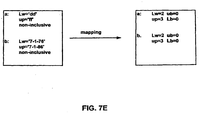
- a user may execute a query such as:
- This query is resolved into an intermediate form of Fig. 7E.
- the mapping process maps the intermediate representation to the integer value of 3 to represent the value of '7-1-86'.
- the SKD tree can then be rapidly searched using integer comparison operations on the index of the array rather than SQL comparison operations. This is both simple and efficient as compared to SQL type comparisons.
- the tree thus provides high performance for managing data fragments in a database.
- the fragmentation schema represents only two columns in this example, the tree can manage large databases where the number of columns used for fragmentation can become quite large.
- the modelling and mapping from SQL data-type to integer contribute to the simplicity and efficiency of the system in performing operations with data fragmentation.
- Fig. 8 illustrates a computer system 400 that is a suitable platform for supporting a relational database system and storing relational database tables, which will be referred to simply as tables.
- the computer system 400 includes one or more computers 402 (individually, computers 402a and 402b). Multiple computers may be connected by a link 404, which may be a high-speed backbone that creates a cluster of computers, or a local or wide-area network connection linking the computers.
- the computers have one or more persistent data stores 406a-406e.
- each data store is a storage subsystem including one or more disk drives that operate independently of the disk drives of every other data store, which are controlled through disk controllers installed in the associated computer and operated under the ultimate control of the database system.
- a database definition initially resides in one database storage space in which the database is placed by operation of a "create database” command to the database system.
- a database initially includes a set of relational tables called the system catalogs (not shown).
- the system catalogs describe all aspects of the database, including the definitions of all tables and the fragmentation of all tables. As new tables are created, with "create table” commands, for example, new data is added to the system catalogs to describe the new tables.
- the system catalogs include a system fragments table for persistently storing information about the fragmentation of the database. Each fragment may be represented by an individual row in the system fragments table. When the system needs to refer to fragments, it can run queries against the system fragments table to obtain the necessary fragmentation information for any given table.
- One attribute of the system fragments table is the fragmentation method: a table that is fragmented using a referential fragmentation scheme, will have an attribute value such as "reference" that identifies the fragment as one that was created with a referential fragmentation scheme.
- the referential key information that is used by a referential fragmentation scheme is also stored in a table in the system catalogs.
- Each data store may store one or more fragments 408a-408i of one or more tables managed by the database system. It is generally advantageous not to split fragments across data storage subsystems that can be operated in parallel.
- FIG. 9 Shown in Fig. 9 is a block diagram of a computer 200 suitable for use in the computer system platform described earlier with reference to Fig. 1.
- the invention may be implemented in digital electronic circuitry or in computer hardware, firmware, software, or in combinations of them.
- the invention may be implemented in a computer program product tangibly embodied in a machine-readable storage device for execution by a computer processor; and method steps of the invention may be performed by a computer processor executing a program to perform functions of the invention by operating on input data and generating output.
- Suitable processors 1020 include, by way of example, both general and special purpose microprocessors. Generally, a processor will receive instructions and data from a read-only memory 1022 and/or a random access memory 1021.
- Storage devices suitable for tangibly embodying computer program instructions include all forms of non-volatile memory, including by way of example semiconductor memory devices, such as EPROM, EEPROM, and flash memory devices; magnetic tapes; magnetic disks such as internal hard disks and removable disks 1040; magneto-optical disks; and CD-ROM disks. Any of the foregoing may be supplemented by, or incorporated in, specially-designed ASICs (application-specific integrated circuits).
- ASICs application-specific integrated circuits
Landscapes
- Engineering & Computer Science (AREA)
- Theoretical Computer Science (AREA)
- Databases & Information Systems (AREA)
- General Physics & Mathematics (AREA)
- Physics & Mathematics (AREA)
- General Engineering & Computer Science (AREA)
- Data Mining & Analysis (AREA)
- Software Systems (AREA)
- Computing Systems (AREA)
- Computational Linguistics (AREA)
- Information Retrieval, Db Structures And Fs Structures Therefor (AREA)
- Electrotherapy Devices (AREA)
- Computer And Data Communications (AREA)
Claims (10)
- Un procédé, mis en oeuvre sur ordinateur, exécuté dans un système de base de données relationnelle, pour gérer des fragments de données dans une base de données, dans lequel des fragments de données sont le résultat de fragmentation de données qui divise une relation donnée d'une base de données relationnelle en des éléments ou fragments, de manière que les fragments puissent être stockés là où ils sont utilisés le plus fréquemment, le procédé comprenant :la conversion (102) d'expressions de fragmentation en une représentation de plages intermédiaires multidimensionnelles, qui est une liste d'une matrice bidimensionnelle décrivant la structure de plage des expressions de fragmentation ;le mappage (104) de la représentation de plages intermédiaires multidimensionnelles en un espace d'entiers de dimension N, dans lequel N est le nombre de colonnes dans l'expression de fragmentation pour, de cette manière, créer une représentation de plage d'entiers ;la construction (106) d'une structure en arbre de données d'index, pour représenter un espace de recherche associé aux fragments de données, en utilisant la représentation de plage d'entiers ; etl'utilisation (114) de la structure en arbre de données d'index, pour localiser un fragment de données souhaité.
- Le procédé selon la revendication 1, dans lequel la représentation de plage d'entiers est indépendante de types de données Structured Query Language (SQL).
- Le procédé selon l'une quelconque des revendications précédentes, comprenant en outre la subdivision d'un jeu de données en des segments pairs, pour équilibrer la structure en arbre de données.
- Le procédé selon l'une quelconque des revendications précédentes, comprenant en outre :la collecte de points de données, utilisée dans une ou plusieurs expressions de fragmentation; et le stockage des points de données dans une matrice multidimensionnelle.
- Le procédé selon l'une quelconque des revendications précédentes, comprenant en outre l'utilisation d'une limite supérieure de la matrice en tant que point d'index d'infinité positive.
- Le procédé selon l'une quelconque des revendications précédentes, dans lequel l'étape de mappage comprend en outre l'utilisation d'une recherche binaire pour convertir la représentation de plage intermédiaire en la représentation de plage d'entiers.
- Le procédé selon l'une quelconque des revendications précédentes, dans lequel la structure en arbre de données d'index représente un espace de recherche multidimensionnel.
- Le procédé selon l'une quelconque des revendications précédentes, dans lequel l'étape d'utilisation comprend en outre la recherche de la structure en arbre de données d'index, avec une complexité de recherche 0(log(N).
- Un système de base de données relationnelle, mettant en oeuvre le procédé selon l'une quelconque des revendications précédentes.
- Un produit de programme pour ordinateur, stocké sur un support de stockage lisible par ordinateur, pour, lorsqu'il fonctionne sur un système informatique, mettre en oeuvre le procédé selon l'une quelconque des revendications précédentes.
Applications Claiming Priority (3)
| Application Number | Priority Date | Filing Date | Title |
|---|---|---|---|
| US09/434,849 US6681218B1 (en) | 1999-11-04 | 1999-11-04 | System for managing RDBM fragmentations |
| US434849 | 1999-11-04 | ||
| PCT/US2000/030638 WO2001033436A1 (fr) | 1999-11-04 | 2000-11-06 | Procede et systeme d'attribution dynamique de zone en fonction de localite pour un reseau de communication sans fil |
Publications (3)
| Publication Number | Publication Date |
|---|---|
| EP1234258A1 EP1234258A1 (fr) | 2002-08-28 |
| EP1234258A4 EP1234258A4 (fr) | 2005-08-10 |
| EP1234258B1 true EP1234258B1 (fr) | 2007-07-04 |
Family
ID=23725934
Family Applications (1)
| Application Number | Title | Priority Date | Filing Date |
|---|---|---|---|
| EP00992956A Expired - Lifetime EP1234258B1 (fr) | 1999-11-04 | 2000-11-06 | Procede et systeme d'attribution dynamique de zone en fonction de localite pour un reseau de communication sans fil |
Country Status (8)
| Country | Link |
|---|---|
| US (1) | US6681218B1 (fr) |
| EP (1) | EP1234258B1 (fr) |
| JP (1) | JP3813089B2 (fr) |
| AT (1) | ATE366442T1 (fr) |
| AU (1) | AU777792B2 (fr) |
| CA (1) | CA2388515C (fr) |
| DE (1) | DE60035432T2 (fr) |
| WO (1) | WO2001033436A1 (fr) |
Families Citing this family (28)
| Publication number | Priority date | Publication date | Assignee | Title |
|---|---|---|---|---|
| GB2406678B (en) * | 2000-11-30 | 2005-05-18 | Coppereye Ltd | Database |
| US7523218B1 (en) * | 2002-04-30 | 2009-04-21 | University Of Florida Research Foundation, Inc. | O(log n) dynamic router tables for prefixes and ranges |
| US7444318B2 (en) * | 2002-07-03 | 2008-10-28 | University Of Florida Research Foundation, Inc. | Prefix partitioning methods for dynamic router tables |
| EP3726396A3 (fr) * | 2003-05-19 | 2020-12-09 | Huawei Technologies Co., Ltd. | Limitation de balayages de relations mal groupees et/ou ordonnees au moyen d'applications presque ordonnees |
| US9514181B2 (en) * | 2004-03-23 | 2016-12-06 | Linguaversal, SL | Calculation expression management |
| EP1674382A1 (fr) | 2004-12-22 | 2006-06-28 | Prinoth A.G. | Crampon pour chenilles |
| JP4933222B2 (ja) * | 2006-11-15 | 2012-05-16 | 株式会社日立製作所 | インデックス処理方法及び計算機システム |
| US20080155574A1 (en) * | 2006-12-20 | 2008-06-26 | Gohel Nilesh R | Meta-data driven data access system |
| WO2008093400A1 (fr) * | 2007-01-30 | 2008-08-07 | Fujitsu Limited | Procédé de collecte d'informations de vérification de configuration, dispositif de collecte d'informations de vérification de configuration, et programme de collecte d'informations de vérification de configuration |
| US20090240661A1 (en) * | 2008-03-18 | 2009-09-24 | Morgan Christopher B | Integration for intelligence data systems |
| US20100185672A1 (en) * | 2009-01-21 | 2010-07-22 | Rising Iii Hawley K | Techniques for spatial representation of data and browsing based on similarity |
| US8983989B2 (en) * | 2010-02-05 | 2015-03-17 | Microsoft Technology Licensing, Llc | Contextual queries |
| US8903794B2 (en) * | 2010-02-05 | 2014-12-02 | Microsoft Corporation | Generating and presenting lateral concepts |
| US20110231395A1 (en) * | 2010-03-19 | 2011-09-22 | Microsoft Corporation | Presenting answers |
| US8412701B2 (en) * | 2010-09-27 | 2013-04-02 | Computer Associates Think, Inc. | Multi-dataset global index |
| US9760609B2 (en) * | 2013-11-22 | 2017-09-12 | Here Global B.V. | Graph-based recommendations service systems and methods |
| CN105224536A (zh) | 2014-05-29 | 2016-01-06 | 国际商业机器公司 | 划分数据库的方法和装置 |
| US10089357B2 (en) | 2014-09-26 | 2018-10-02 | Oracle International Corporation | System and method for generating partition-based splits in a massively parallel or distributed database environment |
| US10089377B2 (en) | 2014-09-26 | 2018-10-02 | Oracle International Corporation | System and method for data transfer from JDBC to a data warehouse layer in a massively parallel or distributed database environment |
| US10394818B2 (en) | 2014-09-26 | 2019-08-27 | Oracle International Corporation | System and method for dynamic database split generation in a massively parallel or distributed database environment |
| US10078684B2 (en) | 2014-09-26 | 2018-09-18 | Oracle International Corporation | System and method for query processing with table-level predicate pushdown in a massively parallel or distributed database environment |
| US10387421B2 (en) | 2014-09-26 | 2019-08-20 | Oracle International Corporation | System and method for generating size-based splits in a massively parallel or distributed database environment |
| US10180973B2 (en) | 2014-09-26 | 2019-01-15 | Oracle International Corporation | System and method for efficient connection management in a massively parallel or distributed database environment |
| US10380114B2 (en) * | 2014-09-26 | 2019-08-13 | Oracle International Corporation | System and method for generating rowid range-based splits in a massively parallel or distributed database environment |
| US10528596B2 (en) | 2014-09-26 | 2020-01-07 | Oracle International Corporation | System and method for consistent reads between tasks in a massively parallel or distributed database environment |
| US20160188643A1 (en) * | 2014-12-31 | 2016-06-30 | Futurewei Technologies, Inc. | Method and apparatus for scalable sorting of a data set |
| US9916359B2 (en) * | 2015-06-01 | 2018-03-13 | Sap Se | Indexing dynamic hierarchical data |
| US10713232B2 (en) * | 2018-04-16 | 2020-07-14 | Computational Systems, Inc. | Efficient data processing |
Family Cites Families (10)
| Publication number | Priority date | Publication date | Assignee | Title |
|---|---|---|---|---|
| US5128860A (en) * | 1989-04-25 | 1992-07-07 | Motorola, Inc. | Manufacturing or service system allocating resources to associated demands by comparing time ordered arrays of data |
| US5319777A (en) * | 1990-10-16 | 1994-06-07 | Sinper Corporation | System and method for storing and retrieving information from a multidimensional array |
| US5822749A (en) | 1994-07-12 | 1998-10-13 | Sybase, Inc. | Database system with methods for improving query performance with cache optimization strategies |
| CA2167790A1 (fr) * | 1995-01-23 | 1996-07-24 | Donald S. Maier | Systeme informatique a base de donnees relationnelles a grande disponibilite des donnees durant la restructuration des donnees des tables |
| US5829004A (en) * | 1996-05-20 | 1998-10-27 | Au; Lawrence | Device for storage and retrieval of compact contiguous tree index records |
| US5893104A (en) | 1996-07-09 | 1999-04-06 | Oracle Corporation | Method and system for processing queries in a database system using index structures that are not native to the database system |
| US5974411A (en) * | 1997-02-18 | 1999-10-26 | Sand Technology Systems International, Inc. | N-way processing of bit strings in a dataflow architecture |
| US5875445A (en) | 1997-05-29 | 1999-02-23 | Oracle Corporation | Performance-related estimation using pseudo-ranked trees |
| US5943668A (en) * | 1997-06-30 | 1999-08-24 | International Business Machines Corporation | Relational emulation of a multi-dimensional database |
| US5960426A (en) | 1997-06-30 | 1999-09-28 | International Business Machines Corporation | Database system and method for supporting current of cursor updates and deletes from a select query from one or more updatable tables in single node and mpp environments |
-
1999
- 1999-11-04 US US09/434,849 patent/US6681218B1/en not_active Expired - Lifetime
-
2000
- 2000-11-06 DE DE60035432T patent/DE60035432T2/de not_active Expired - Lifetime
- 2000-11-06 AU AU14729/01A patent/AU777792B2/en not_active Ceased
- 2000-11-06 JP JP2001535859A patent/JP3813089B2/ja not_active Expired - Fee Related
- 2000-11-06 EP EP00992956A patent/EP1234258B1/fr not_active Expired - Lifetime
- 2000-11-06 AT AT00992956T patent/ATE366442T1/de not_active IP Right Cessation
- 2000-11-06 CA CA2388515A patent/CA2388515C/fr not_active Expired - Fee Related
- 2000-11-06 WO PCT/US2000/030638 patent/WO2001033436A1/fr not_active Ceased
Non-Patent Citations (1)
| Title |
|---|
| None * |
Also Published As
| Publication number | Publication date |
|---|---|
| DE60035432T2 (de) | 2008-03-06 |
| JP2003517165A (ja) | 2003-05-20 |
| CA2388515C (fr) | 2010-05-25 |
| CA2388515A1 (fr) | 2001-05-10 |
| EP1234258A4 (fr) | 2005-08-10 |
| AU1472901A (en) | 2001-05-14 |
| EP1234258A1 (fr) | 2002-08-28 |
| WO2001033436A1 (fr) | 2001-05-10 |
| US6681218B1 (en) | 2004-01-20 |
| DE60035432D1 (de) | 2007-08-16 |
| ATE366442T1 (de) | 2007-07-15 |
| JP3813089B2 (ja) | 2006-08-23 |
| AU777792B2 (en) | 2004-10-28 |
Similar Documents
| Publication | Publication Date | Title |
|---|---|---|
| CA2388515C (fr) | Procede et systeme d'attribution dynamique de zone en fonction de localite pour un reseau de communication sans fil | |
| US5257365A (en) | Database system with multi-dimensional summary search tree nodes for reducing the necessity to access records | |
| US7171427B2 (en) | Methods of navigating a cube that is implemented as a relational object | |
| US8868544B2 (en) | Using relational structures to create and support a cube within a relational database system | |
| EP2901313B1 (fr) | Élagage de blocs de disque d'une table classifiée dans un système de gestion de base de données relationnelle | |
| US5832475A (en) | Database system and method employing data cube operator for group-by operations | |
| Beckmann et al. | A revised R*-tree in comparison with related index structures | |
| US7158996B2 (en) | Method, system, and program for managing database operations with respect to a database table | |
| US5899992A (en) | Scalable set oriented classifier | |
| US8037059B2 (en) | Implementing aggregation combination using aggregate depth lists and cube aggregation conversion to rollup aggregation for optimizing query processing | |
| US6141655A (en) | Method and apparatus for optimizing and structuring data by designing a cube forest data structure for hierarchically split cube forest template | |
| US20100082654A1 (en) | Methods And Apparatus Using Range Queries For Multi-dimensional Data In A Database | |
| US20140095502A1 (en) | Clustering a table in a relational database management system | |
| ZA200100187B (en) | Value-instance-connectivity computer-implemented database. | |
| US8108431B1 (en) | Two-dimensional data storage system | |
| WO2002044952A1 (fr) | Base de donnees informatique de valeurs-instances-connectivite | |
| US20030182272A1 (en) | Efficient implementation of an index structure for multi-column bi-directional searches | |
| KR102351846B1 (ko) | 분산형 데이터베이스상의 인덱스 병합을 활용한 질의 최적화 방법 | |
| US6826563B1 (en) | Supporting bitmap indexes on primary B+tree like structures | |
| Černjeka et al. | NoSQL document store translation to data vault based EDW | |
| Ghanem et al. | Bulk operations for space-partitioning trees | |
| WO2001025962A1 (fr) | Organisation de base de donnees permettant d'augmenter les performances par la division de tables | |
| EP4535185A2 (fr) | Métadonnées de résumé d'ensemble de données fournissant une performance d'interrogation améliorée | |
| Durneková et al. | Optimization of the SELECT statement containing window functions | |
| Shanthi et al. | On the sd-tree construction for optimal signature operations |
Legal Events
| Date | Code | Title | Description |
|---|---|---|---|
| PUAI | Public reference made under article 153(3) epc to a published international application that has entered the european phase |
Free format text: ORIGINAL CODE: 0009012 |
|
| 17P | Request for examination filed |
Effective date: 20020504 |
|
| AK | Designated contracting states |
Kind code of ref document: A1 Designated state(s): AT BE CH CY DE DK ES FI FR GB GR IE IT LI LU MC NL PT SE TR |
|
| RIN1 | Information on inventor provided before grant (corrected) |
Inventor name: ZOU, CHENDONG C/O IBM UK LTD. |
|
| A4 | Supplementary search report drawn up and despatched |
Effective date: 20050629 |
|
| RAP1 | Party data changed (applicant data changed or rights of an application transferred) |
Owner name: INTERNATIONAL BUSINESS MACHINES CORPORATION |
|
| 17Q | First examination report despatched |
Effective date: 20050803 |
|
| GRAP | Despatch of communication of intention to grant a patent |
Free format text: ORIGINAL CODE: EPIDOSNIGR1 |
|
| GRAS | Grant fee paid |
Free format text: ORIGINAL CODE: EPIDOSNIGR3 |
|
| GRAA | (expected) grant |
Free format text: ORIGINAL CODE: 0009210 |
|
| AK | Designated contracting states |
Kind code of ref document: B1 Designated state(s): AT BE CH CY DE DK ES FI FR GB GR IE IT LI LU MC NL PT SE TR |
|
| REG | Reference to a national code |
Ref country code: GB Ref legal event code: FG4D |
|
| REG | Reference to a national code |
Ref country code: CH Ref legal event code: EP Ref country code: CH Ref legal event code: NV Representative=s name: PETER M. KLETT |
|
| REG | Reference to a national code |
Ref country code: IE Ref legal event code: FG4D |
|
| REF | Corresponds to: |
Ref document number: 60035432 Country of ref document: DE Date of ref document: 20070816 Kind code of ref document: P |
|
| ET | Fr: translation filed | ||
| NLV1 | Nl: lapsed or annulled due to failure to fulfill the requirements of art. 29p and 29m of the patents act | ||
| REG | Reference to a national code |
Ref country code: CH Ref legal event code: PL |
|
| PG25 | Lapsed in a contracting state [announced via postgrant information from national office to epo] |
Ref country code: ES Free format text: LAPSE BECAUSE OF FAILURE TO SUBMIT A TRANSLATION OF THE DESCRIPTION OR TO PAY THE FEE WITHIN THE PRESCRIBED TIME-LIMIT Effective date: 20071015 Ref country code: NL Free format text: LAPSE BECAUSE OF FAILURE TO SUBMIT A TRANSLATION OF THE DESCRIPTION OR TO PAY THE FEE WITHIN THE PRESCRIBED TIME-LIMIT Effective date: 20070704 Ref country code: FI Free format text: LAPSE BECAUSE OF FAILURE TO SUBMIT A TRANSLATION OF THE DESCRIPTION OR TO PAY THE FEE WITHIN THE PRESCRIBED TIME-LIMIT Effective date: 20070704 Ref country code: PT Free format text: LAPSE BECAUSE OF FAILURE TO SUBMIT A TRANSLATION OF THE DESCRIPTION OR TO PAY THE FEE WITHIN THE PRESCRIBED TIME-LIMIT Effective date: 20071204 |
|
| PG25 | Lapsed in a contracting state [announced via postgrant information from national office to epo] |
Ref country code: CH Free format text: LAPSE BECAUSE OF FAILURE TO SUBMIT A TRANSLATION OF THE DESCRIPTION OR TO PAY THE FEE WITHIN THE PRESCRIBED TIME-LIMIT Effective date: 20070704 Ref country code: AT Free format text: LAPSE BECAUSE OF FAILURE TO SUBMIT A TRANSLATION OF THE DESCRIPTION OR TO PAY THE FEE WITHIN THE PRESCRIBED TIME-LIMIT Effective date: 20070704 Ref country code: LI Free format text: LAPSE BECAUSE OF FAILURE TO SUBMIT A TRANSLATION OF THE DESCRIPTION OR TO PAY THE FEE WITHIN THE PRESCRIBED TIME-LIMIT Effective date: 20070704 |
|
| PG25 | Lapsed in a contracting state [announced via postgrant information from national office to epo] |
Ref country code: BE Free format text: LAPSE BECAUSE OF FAILURE TO SUBMIT A TRANSLATION OF THE DESCRIPTION OR TO PAY THE FEE WITHIN THE PRESCRIBED TIME-LIMIT Effective date: 20070704 |
|
| PG25 | Lapsed in a contracting state [announced via postgrant information from national office to epo] |
Ref country code: GR Free format text: LAPSE BECAUSE OF FAILURE TO SUBMIT A TRANSLATION OF THE DESCRIPTION OR TO PAY THE FEE WITHIN THE PRESCRIBED TIME-LIMIT Effective date: 20071005 Ref country code: DK Free format text: LAPSE BECAUSE OF FAILURE TO SUBMIT A TRANSLATION OF THE DESCRIPTION OR TO PAY THE FEE WITHIN THE PRESCRIBED TIME-LIMIT Effective date: 20070704 |
|
| PLBE | No opposition filed within time limit |
Free format text: ORIGINAL CODE: 0009261 |
|
| STAA | Information on the status of an ep patent application or granted ep patent |
Free format text: STATUS: NO OPPOSITION FILED WITHIN TIME LIMIT |
|
| 26N | No opposition filed |
Effective date: 20080407 |
|
| PG25 | Lapsed in a contracting state [announced via postgrant information from national office to epo] |
Ref country code: SE Free format text: LAPSE BECAUSE OF FAILURE TO SUBMIT A TRANSLATION OF THE DESCRIPTION OR TO PAY THE FEE WITHIN THE PRESCRIBED TIME-LIMIT Effective date: 20071004 Ref country code: MC Free format text: LAPSE BECAUSE OF NON-PAYMENT OF DUE FEES Effective date: 20071130 |
|
| PG25 | Lapsed in a contracting state [announced via postgrant information from national office to epo] |
Ref country code: IE Free format text: LAPSE BECAUSE OF NON-PAYMENT OF DUE FEES Effective date: 20071106 |
|
| REG | Reference to a national code |
Ref country code: GB Ref legal event code: 746 Effective date: 20081017 |
|
| PG25 | Lapsed in a contracting state [announced via postgrant information from national office to epo] |
Ref country code: CY Free format text: LAPSE BECAUSE OF FAILURE TO SUBMIT A TRANSLATION OF THE DESCRIPTION OR TO PAY THE FEE WITHIN THE PRESCRIBED TIME-LIMIT Effective date: 20070704 |
|
| PG25 | Lapsed in a contracting state [announced via postgrant information from national office to epo] |
Ref country code: LU Free format text: LAPSE BECAUSE OF NON-PAYMENT OF DUE FEES Effective date: 20071106 |
|
| PG25 | Lapsed in a contracting state [announced via postgrant information from national office to epo] |
Ref country code: TR Free format text: LAPSE BECAUSE OF FAILURE TO SUBMIT A TRANSLATION OF THE DESCRIPTION OR TO PAY THE FEE WITHIN THE PRESCRIBED TIME-LIMIT Effective date: 20070704 |
|
| PG25 | Lapsed in a contracting state [announced via postgrant information from national office to epo] |
Ref country code: IT Free format text: LAPSE BECAUSE OF NON-PAYMENT OF DUE FEES Effective date: 20071130 |
|
| PGFP | Annual fee paid to national office [announced via postgrant information from national office to epo] |
Ref country code: FR Payment date: 20121206 Year of fee payment: 13 |
|
| REG | Reference to a national code |
Ref country code: FR Ref legal event code: ST Effective date: 20140731 |
|
| PG25 | Lapsed in a contracting state [announced via postgrant information from national office to epo] |
Ref country code: FR Free format text: LAPSE BECAUSE OF NON-PAYMENT OF DUE FEES Effective date: 20131202 |
|
| REG | Reference to a national code |
Ref country code: DE Ref legal event code: R079 Ref document number: 60035432 Country of ref document: DE Free format text: PREVIOUS MAIN CLASS: G06F0017300000 Ipc: G06F0016000000 |
|
| PGFP | Annual fee paid to national office [announced via postgrant information from national office to epo] |
Ref country code: DE Payment date: 20191108 Year of fee payment: 20 |
|
| PGFP | Annual fee paid to national office [announced via postgrant information from national office to epo] |
Ref country code: GB Payment date: 20191127 Year of fee payment: 20 |
|
| REG | Reference to a national code |
Ref country code: DE Ref legal event code: R071 Ref document number: 60035432 Country of ref document: DE |
|
| REG | Reference to a national code |
Ref country code: GB Ref legal event code: PE20 Expiry date: 20201105 |
|
| PG25 | Lapsed in a contracting state [announced via postgrant information from national office to epo] |
Ref country code: GB Free format text: LAPSE BECAUSE OF EXPIRATION OF PROTECTION Effective date: 20201105 |