EP1235286A2 - Elément galvanique comportant au moins une électrode capable d'intercaler le lithium - Google Patents
Elément galvanique comportant au moins une électrode capable d'intercaler le lithium Download PDFInfo
- Publication number
- EP1235286A2 EP1235286A2 EP02001556A EP02001556A EP1235286A2 EP 1235286 A2 EP1235286 A2 EP 1235286A2 EP 02001556 A EP02001556 A EP 02001556A EP 02001556 A EP02001556 A EP 02001556A EP 1235286 A2 EP1235286 A2 EP 1235286A2
- Authority
- EP
- European Patent Office
- Prior art keywords
- galvanic element
- element according
- electrode
- foil
- lithium
- Prior art date
- Legal status (The legal status is an assumption and is not a legal conclusion. Google has not performed a legal analysis and makes no representation as to the accuracy of the status listed.)
- Withdrawn
Links
Images
Classifications
-
- H—ELECTRICITY
- H01—ELECTRIC ELEMENTS
- H01M—PROCESSES OR MEANS, e.g. BATTERIES, FOR THE DIRECT CONVERSION OF CHEMICAL ENERGY INTO ELECTRICAL ENERGY
- H01M4/00—Electrodes
- H01M4/02—Electrodes composed of, or comprising, active material
- H01M4/36—Selection of substances as active materials, active masses, active liquids
- H01M4/38—Selection of substances as active materials, active masses, active liquids of elements or alloys
-
- H—ELECTRICITY
- H01—ELECTRIC ELEMENTS
- H01M—PROCESSES OR MEANS, e.g. BATTERIES, FOR THE DIRECT CONVERSION OF CHEMICAL ENERGY INTO ELECTRICAL ENERGY
- H01M4/00—Electrodes
- H01M4/02—Electrodes composed of, or comprising, active material
- H01M4/13—Electrodes for accumulators with non-aqueous electrolyte, e.g. for lithium-accumulators; Processes of manufacture thereof
-
- H—ELECTRICITY
- H01—ELECTRIC ELEMENTS
- H01M—PROCESSES OR MEANS, e.g. BATTERIES, FOR THE DIRECT CONVERSION OF CHEMICAL ENERGY INTO ELECTRICAL ENERGY
- H01M4/00—Electrodes
- H01M4/02—Electrodes composed of, or comprising, active material
- H01M4/64—Carriers or collectors
- H01M4/66—Selection of materials
- H01M4/661—Metal or alloys, e.g. alloy coatings
-
- H—ELECTRICITY
- H01—ELECTRIC ELEMENTS
- H01M—PROCESSES OR MEANS, e.g. BATTERIES, FOR THE DIRECT CONVERSION OF CHEMICAL ENERGY INTO ELECTRICAL ENERGY
- H01M4/00—Electrodes
- H01M4/02—Electrodes composed of, or comprising, active material
- H01M4/64—Carriers or collectors
- H01M4/66—Selection of materials
- H01M4/661—Metal or alloys, e.g. alloy coatings
- H01M4/662—Alloys
-
- H—ELECTRICITY
- H01—ELECTRIC ELEMENTS
- H01M—PROCESSES OR MEANS, e.g. BATTERIES, FOR THE DIRECT CONVERSION OF CHEMICAL ENERGY INTO ELECTRICAL ENERGY
- H01M4/00—Electrodes
- H01M4/02—Electrodes composed of, or comprising, active material
- H01M4/64—Carriers or collectors
- H01M4/66—Selection of materials
- H01M4/665—Composites
- H01M4/667—Composites in the form of layers, e.g. coatings
-
- Y—GENERAL TAGGING OF NEW TECHNOLOGICAL DEVELOPMENTS; GENERAL TAGGING OF CROSS-SECTIONAL TECHNOLOGIES SPANNING OVER SEVERAL SECTIONS OF THE IPC; TECHNICAL SUBJECTS COVERED BY FORMER USPC CROSS-REFERENCE ART COLLECTIONS [XRACs] AND DIGESTS
- Y02—TECHNOLOGIES OR APPLICATIONS FOR MITIGATION OR ADAPTATION AGAINST CLIMATE CHANGE
- Y02E—REDUCTION OF GREENHOUSE GAS [GHG] EMISSIONS, RELATED TO ENERGY GENERATION, TRANSMISSION OR DISTRIBUTION
- Y02E60/00—Enabling technologies; Technologies with a potential or indirect contribution to GHG emissions mitigation
- Y02E60/10—Energy storage using batteries
Definitions
- the invention relates to a galvanic element with at least one lithium intercalating Electrode whose electrochemically active material is placed on a foil metallic arrester is applied.
- the electrical connection of the arrester electrodes determines in galvanic elements the electrochemically active masses significantly determine the functionality of the cell. decontactings purely mechanical in nature or decontacting caused by the electrochemical Buildup of passivation layers are among the most common Reasons for cell failure.
- WO 98/20566 shows drain grids made of copper or aluminum that have been cleaned, chemically etched and then provided with an adhesion promoter.
- a copper foil preferably in the form of an expanded metal, in Diluted sulfuric acid is freed from an oxide layer, then rinsed several times, dried and then provided with a thin layer of polyvinylidene-hexafluoropropylene, which is pyrolyzed at 350 ° C for a few seconds.
- a positive discharge electrode instead of copper, aluminum is used, which is cleaned in acetone, etched with sodium hydroxide solution and is then provided with a carbon-based primer. The so obtained Discharge electrodes are connected to the active electrodes using a hot lamination process connected.
- the invention has for its object in galvanic elements with lithium intercalating Electrodes the electrical connection of the active materials to the arrester foil improve.
- the carrier material is selected from Al, Cu, V, Ti, Cr, Fe, Ni, Co or alloys thereof Metals or from a corrosion-resistant stainless steel and the deposited metal is is selected from Cu, V, Ti, Cr, Fe, Ni, Co, Zn, Sn, In, Sb, Bi, Ag or alloys thereof Metals.
- the crystallite size of the electrochemically deposited material should be between 1 and 25 ⁇ m, preferably between 1 and 10 ⁇ m.
- the thickness of the carrier film is between 5 and 50 ⁇ m, preferably between 8 and 25 ⁇ m, a maximum of 10 crystallite layers, preferably 1 to 3 crystallite layers, being deposited on the film are.
- the crystallite layer is with a corrosion layer provided, the benzotriazole or a Chromatization is.
- the active electrode material is preferably in foil form thereon Arrester foil laminated on.
- the films according to the invention can advantageously be used in known Li-ion cells, for example in cells in which the electrodes have the shape of a coil, but especially in flat cells laminated from several layers.
- bi-cell it has a so-called bi-cell, as can be found in US Pat. No. 5,460,404 A1 the general structure of negative electrode / expanded copper / negative electrode, separator, Positive electrode / AI expanded metal / positive electrode, separator, negative electrode / Cu expanded metal / negative Electrode.
- the structure chosen in this way is of improved safety justified by short circuit and improper opening of such a cell. builds If you only use one expanded aluminum instead of two, the load currents double, and these can obviously suffice in critical condition, the aluminum locally to melt and thus interrupt the contact.
- the structure can be designed inversely , This has the advantage that the kinetically slower positive electrode and the aluminum, which is less conductive than copper, are now doubled in area.
- Electrode used without a possible plasticizer extraction step as well to prevent subsequent penetration of a liquid electrolyte.
- the primer can be omitted. Since the primers are generally organically based, wear they usually contribute most to fading a cell. This is especially true at the negative side, where high lithium activity over time organic compounds in particular degrading gradually at high temperatures.
- the primer on the Cu side for polymer cells previously produced in a very complex pyrolysis step on the Al side with a simple application. In terms of production technology, it is easier to pour and laminate onto a film. Production costs, such as punching processes and waste in the expanded metal, are eliminated, so that the costs for surge arrester materials are significantly reduced.
- foils according to the invention in particular copper foils, in a method for producing electrode foils, in which at least two different fluorinated polymers are dissolved in a solvent and without the addition of plasticizers, swelling agents or electrolyte, only with a highly conductive carbon black, the BET surface of which is between that is from surface-minimized graphite and activated carbon and mixed with an electrochemically active material with a two-dimensional layer structure and an electronic conductivity of at least 10 -4 S / cm, in which lithium can be reversibly installed and removed, and the paste-like mass obtained in this way an electrode conductor or a carrier film is applied and dried.
- Positive electrode foils and negative electrode foils produced in this way are laminated onto a separator, the stack is impregnated with a liquid organic electrolyte and a galvanic element is thus formed.
- vinylidene fluoride and hexafluoropropylene are used as polymers and as solvent N-methylpyrolidin-2-one or acetone.
- a material is used as the electrochemically active material for a positive electrode foil the group of ternary (Li-Me1-O) or quaternary (Li-Me1-Me2-O) lithium transition metal oxides, where Me 1 and Me 2 are selected from a group Ti, V, Cr, Fe, Mn, Ni, Co, used, and the compound optionally contains up to 15 atomic percent Mg, Al, N or F to stabilize the structure.
- ternary (Li-Me1-O) or quaternary (Li-Me1-Me2-O) lithium transition metal oxides where Me 1 and Me 2 are selected from a group Ti, V, Cr, Fe, Mn, Ni, Co, used, and the compound optionally contains up to 15 atomic percent Mg, Al, N or F to stabilize the structure.
- Li-Me1-O ternary lithium transition metal oxides
- Me 1 and Me 2 are selected from a group Ti, V, Cr, Fe, Mn, Ni, Co, used, and the compound optional
- Negative electrodes and positive electrodes are manufactured with a basis weight of 19-21 g / cm 2 by means of tape casting.
- Mylar polyyester film
- the negative electrode is then laminated onto a surface treated according to the invention (surface treatment by electrochemical deposition of copper crystallites) and chromated copper foil at a temperature of 160 ° C.
- the positive electrode foil is laminated onto expanded aluminum. Negative electrodes and positive electrodes are punched out from the laminated strips and these into bi-cells (positive electrode / Al expanded metal / positive electrode, separator, negative electrode / Cu foil / negative electrode, positive electrode / Al expanded metal / positive electrode ) laminated.
- the separator is, for example, three layers (PP / PE / PP) and provided with a thin PVDF-HFP layer.
- the separator is laminated on both sides to the negative electrode at 130 ° C., and then the upper and lower positive electrodes are laminated on in a second lamination step with the same parameters.
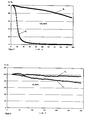
- FIG. 1 shows the dependence of the capacitance C as a function of the number of cycles n for the bi-cells according to the invention with Cu foil as an arrester ( CF ) and for bi-cells according to US Pat. No. 5,460,904 with expanded copper metal as an arrester (C. s ).
- the measurements were carried out at 60 ° C and a load of C / 2 (charge 1C / 3 h / 60 ° C to 4.2 V, discharge 0.5 C / 60 ° C to 3.0 V).
- a mass for the negative electrode is produced according to Example 1 and this instead of Polyester film directly on the Cu lead electrode surface-treated according to the invention (Surface treatment by electrochemical deposition of copper crystallites) knife.
- the solvent is allowed to evaporate and the electrode sticks in the dry Condition very good on the lead electrode.
- the variant produced in this way exists instead of six from a bi-cell.
- Negative electrodes and positive electrodes are manufactured with a basis weight of 19-21 g / cm 2 by means of tape casting.
- Mylar polyyester film
- the negative electrode is then laminated onto a surface treated according to the invention (surface treatment by electrochemical deposition of copper crystallites) and chromated copper foil at a temperature of 130 ° C.
- the positive electrode foil is laminated onto expanded aluminum. Negative electrodes and positive electrodes are punched out from the laminated strips and these into bi-cells (positive electrode / Al expanded metal / positive electrode, separator, negative electrode / Cu foil / negative electrode, positive electrode / Al expanded metal / positive electrode ) laminated.
- the separator is, for example, three layers (PP / PE / PP) and provided with a thin PVDF-HFP layer.
- the separator is laminated on both sides to the negative electrode at 120 ° C., and then the upper and lower positive electrodes are laminated in a second lamination step with the same parameters.
- the dibuthyl phthalate is extracted three times with n-hexane before the cells are partially packaged, vacuum dried at 80 ° C. for 16 h and then activated with a liquid electrolyte. Diethyl ether can also be used to extract the dibuthyl phthalate.
- Ni foil As an alternative to the Cu foil, a Ni foil can also be used, which is particularly advantageous For the connection there is deposition of silver crystallites instead of copper or nickel crystallites proved.
- FIG. 2 shows a direct comparison of the capacitance C in% as a function of the number of cycles n under a 1 C load and room temperature;
- C c for negative electrode mass applied directly to Cu foil (Example 2)
- C L for electrode foils laminated to Cu foil (Example 3) (charge 1C / 3h / 20 ° C to 4.2 V, discharge 1C / 20 ° C up to 3.0 V).
Landscapes
- Chemical & Material Sciences (AREA)
- Chemical Kinetics & Catalysis (AREA)
- Electrochemistry (AREA)
- General Chemical & Material Sciences (AREA)
- Engineering & Computer Science (AREA)
- Materials Engineering (AREA)
- Composite Materials (AREA)
- Cell Electrode Carriers And Collectors (AREA)
- Battery Electrode And Active Subsutance (AREA)
- Primary Cells (AREA)
- Secondary Cells (AREA)
Applications Claiming Priority (2)
| Application Number | Priority Date | Filing Date | Title |
|---|---|---|---|
| DE10108695A DE10108695A1 (de) | 2001-02-23 | 2001-02-23 | Galvanisches Element mit mindestens einer lithiuminterkalierenden Elektrode |
| DE10108695 | 2001-02-23 |
Publications (2)
| Publication Number | Publication Date |
|---|---|
| EP1235286A2 true EP1235286A2 (fr) | 2002-08-28 |
| EP1235286A3 EP1235286A3 (fr) | 2004-03-03 |
Family
ID=7675208
Family Applications (1)
| Application Number | Title | Priority Date | Filing Date |
|---|---|---|---|
| EP02001556A Withdrawn EP1235286A3 (fr) | 2001-02-23 | 2002-01-23 | Elément galvanique comportant au moins une électrode capable d'intercaler le lithium |
Country Status (6)
| Country | Link |
|---|---|
| US (1) | US20020119376A1 (fr) |
| EP (1) | EP1235286A3 (fr) |
| JP (1) | JP2002304998A (fr) |
| KR (1) | KR20020069099A (fr) |
| CN (1) | CN1372342A (fr) |
| DE (1) | DE10108695A1 (fr) |
Cited By (3)
| Publication number | Priority date | Publication date | Assignee | Title |
|---|---|---|---|---|
| DE10354524A1 (de) * | 2003-11-14 | 2005-06-23 | Varta Microbattery Gmbh | Galvanisches Element |
| EP1617498A3 (fr) * | 2004-07-13 | 2006-11-02 | VARTA Microbattery GmbH | Elément galvanique |
| WO2009124696A1 (fr) * | 2008-04-09 | 2009-10-15 | Li-Tec Battery Gmbh | Cellule galvanique à durée de service améliorée |
Families Citing this family (8)
| Publication number | Priority date | Publication date | Assignee | Title |
|---|---|---|---|---|
| DE10162832A1 (de) * | 2001-12-20 | 2003-07-03 | Varta Microbattery Gmbh | Galvanisches Element mit dünnem, flachem und flexiblem metallischem Gehäuse |
| US7432014B2 (en) * | 2003-11-05 | 2008-10-07 | Sony Corporation | Anode and battery |
| DE102004018350B4 (de) * | 2004-04-06 | 2014-10-02 | Varta Microbattery Gmbh | Galvanisches Element |
| CN100407477C (zh) * | 2005-04-22 | 2008-07-30 | 中南大学 | 全钒氧化还原液流电池用电极及其制备方法 |
| CN100353595C (zh) * | 2005-12-15 | 2007-12-05 | 北京科技大学 | 一种高容量锡锑镍合金复合物锂离子电池负极材料的制备方法 |
| US20100104942A1 (en) * | 2007-03-26 | 2010-04-29 | Nv Bekaert Sa | Substrate for lithium thin film battery |
| CN102122709A (zh) * | 2011-01-25 | 2011-07-13 | 天津中能锂业有限公司 | 加有锂粉的锂离子电池电极及其制备方法和锂离子电池 |
| CN112768254A (zh) * | 2020-12-23 | 2021-05-07 | 广东风华高新科技股份有限公司 | 一种具有Ag过渡层的锂离子电容器负极极片及其制备方法与应用 |
Family Cites Families (10)
| Publication number | Priority date | Publication date | Assignee | Title |
|---|---|---|---|---|
| BE373800A (fr) * | 1932-05-18 | |||
| EP0183053B1 (fr) * | 1984-11-29 | 1990-02-07 | VARTA Batterie Aktiengesellschaft | Elément galvanique à électrode polymérique |
| JPS61287155A (ja) * | 1985-06-14 | 1986-12-17 | Hitachi Ltd | 半導体装置及び半導体装置の製造方法 |
| JPH0697615B2 (ja) * | 1989-03-09 | 1994-11-30 | エヌ・イーケムキャット株式会社 | 白金合金電極触媒 |
| US5120707A (en) * | 1989-05-22 | 1992-06-09 | Allied-Signal, Inc. | Superconducting ceramics by electrodeposition of metals with embedment of particulate matter, followed by oxidation |
| US5110696A (en) * | 1990-11-09 | 1992-05-05 | Bell Communications Research | Rechargeable lithiated thin film intercalation electrode battery |
| US6048646A (en) * | 1998-07-21 | 2000-04-11 | Ga-Tek Inc. | Method for treating copper current collectors for Li-ion and/or Li-ion polymer batteries |
| FR2796496A1 (fr) * | 1999-07-15 | 2001-01-19 | Cit Alcatel | Electrode au zinc pour generateur electrochimique a electrolyte alcalin |
| CN1277330C (zh) * | 1999-08-10 | 2006-09-27 | 三洋电机株式会社 | 非水电解液二次蓄电池及其制造方法 |
| DE10162832A1 (de) * | 2001-12-20 | 2003-07-03 | Varta Microbattery Gmbh | Galvanisches Element mit dünnem, flachem und flexiblem metallischem Gehäuse |
-
2001
- 2001-02-23 DE DE10108695A patent/DE10108695A1/de not_active Withdrawn
- 2001-12-13 KR KR1020010078732A patent/KR20020069099A/ko not_active Withdrawn
-
2002
- 2002-01-23 EP EP02001556A patent/EP1235286A3/fr not_active Withdrawn
- 2002-02-20 US US10/079,003 patent/US20020119376A1/en not_active Abandoned
- 2002-02-20 JP JP2002043644A patent/JP2002304998A/ja not_active Abandoned
- 2002-02-22 CN CN02105123A patent/CN1372342A/zh active Pending
Cited By (3)
| Publication number | Priority date | Publication date | Assignee | Title |
|---|---|---|---|---|
| DE10354524A1 (de) * | 2003-11-14 | 2005-06-23 | Varta Microbattery Gmbh | Galvanisches Element |
| EP1617498A3 (fr) * | 2004-07-13 | 2006-11-02 | VARTA Microbattery GmbH | Elément galvanique |
| WO2009124696A1 (fr) * | 2008-04-09 | 2009-10-15 | Li-Tec Battery Gmbh | Cellule galvanique à durée de service améliorée |
Also Published As
| Publication number | Publication date |
|---|---|
| DE10108695A1 (de) | 2002-09-05 |
| US20020119376A1 (en) | 2002-08-29 |
| CN1372342A (zh) | 2002-10-02 |
| KR20020069099A (ko) | 2002-08-29 |
| EP1235286A3 (fr) | 2004-03-03 |
| JP2002304998A (ja) | 2002-10-18 |
Similar Documents
| Publication | Publication Date | Title |
|---|---|---|
| EP2534719B1 (fr) | Cellule électrochimique rechargeable | |
| DE102017105307A1 (de) | Primer-oberflächenbeschichtung für silicium-basierte hochleistungselektroden | |
| EP2490284B1 (fr) | Electrodes pour batteries, notamment pour batteries lithium-ion et leur fabrication | |
| EP3573144B1 (fr) | Cellule lithium-ion et son procédé de fabrication | |
| EP1415359A2 (fr) | Element de batterie pouvant fonctionner et etre recharge a temperature ambiante | |
| DE10242911A1 (de) | Elektrodenkatalysator für Brennstoffzelle und Verfahren zu dessen Herstellung | |
| DE3635257A1 (de) | Galvanisches element | |
| DE102018221164A1 (de) | Schutzschicht für eine Lithium-Metall-Anode einer Festkörperbatterie | |
| DE10104988A1 (de) | Verfahren zur Herstellung von Elektrodenfolien | |
| EP1235286A2 (fr) | Elément galvanique comportant au moins une électrode capable d'intercaler le lithium | |
| DE102017201233A1 (de) | Verfahren zur Herstellung eines Elektrodenlaminats für eine Festkörperbatterie | |
| DE102019211857B3 (de) | Lithium-sekundärbatterie, verwendung einer lithium-sekundärbatterie und verfahren zur herstellung einer lithium-sekundärbatterie | |
| DE102023121567A1 (de) | Anodenlose festkörper-batterie, welche eine verbundstrukturschicht aufweist, und herstellungsverfahren dafür | |
| EP1058327A2 (fr) | Electrode négative pour cellule lithium ion à énergie élevée et procédé de fabrication | |
| EP1302993A2 (fr) | Procédé de fabrication d'une unité électrodes-séparateurs pour éléments galvaniques | |
| EP3573141B1 (fr) | Anode au lithium et son procédé de fabrication | |
| EP3905388A1 (fr) | Élément électrochimique secondaire au lithium-ion | |
| WO2012032120A1 (fr) | Conducteur de courant pour cellules électrochimiques | |
| WO2006008012A2 (fr) | Procede pour produire des surfaces d'oxyde de nickel a conductivite accrue | |
| EP4343879A2 (fr) | Procédé de fabrication d'un demi-produit d'une batterie tout solide, demi-produit d'une batterie tout solide et batterie tout solide | |
| EP2866285A1 (fr) | Batteries lithium-ion et leur procédé de fabrication | |
| DE19757381A1 (de) | Reinigungsverfahren für Lithiumbatterie-Elektrolyte | |
| EP3573143B1 (fr) | Anode au lithium et son procédé de fabrication | |
| CH636483A5 (en) | Substance which is suitable as the active substance for positive electrodes of accumulators | |
| WO2006013044A1 (fr) | Element galvanique |
Legal Events
| Date | Code | Title | Description |
|---|---|---|---|
| PUAI | Public reference made under article 153(3) epc to a published international application that has entered the european phase |
Free format text: ORIGINAL CODE: 0009012 |
|
| AK | Designated contracting states |
Kind code of ref document: A2 Designated state(s): AT BE CH CY DE DK ES FI FR GB GR IE IT LI LU MC NL PT SE TR |
|
| AX | Request for extension of the european patent |
Free format text: AL;LT;LV;MK;RO;SI |
|
| RAP1 | Party data changed (applicant data changed or rights of an application transferred) |
Owner name: VARTA MICROBATTERY GMBH |
|
| PUAL | Search report despatched |
Free format text: ORIGINAL CODE: 0009013 |
|
| AK | Designated contracting states |
Kind code of ref document: A3 Designated state(s): AT BE CH CY DE DK ES FI FR GB GR IE IT LI LU MC NL PT SE TR |
|
| AX | Request for extension of the european patent |
Extension state: AL LT LV MK RO SI |
|
| 17P | Request for examination filed |
Effective date: 20040804 |
|
| AKX | Designation fees paid |
Designated state(s): AT BE CH CY DE DK ES FI FR GB GR IE IT LI LU MC NL PT SE TR |
|
| STAA | Information on the status of an ep patent application or granted ep patent |
Free format text: STATUS: THE APPLICATION IS DEEMED TO BE WITHDRAWN |
|
| 18D | Application deemed to be withdrawn |
Effective date: 20060801 |