EP1235743B1 - Herstellung zweier alkalimetallsalze durch ein kombiniertes ionenaustausch- und kristallisationsverfahren - Google Patents
Herstellung zweier alkalimetallsalze durch ein kombiniertes ionenaustausch- und kristallisationsverfahren Download PDFInfo
- Publication number
- EP1235743B1 EP1235743B1 EP00985294A EP00985294A EP1235743B1 EP 1235743 B1 EP1235743 B1 EP 1235743B1 EP 00985294 A EP00985294 A EP 00985294A EP 00985294 A EP00985294 A EP 00985294A EP 1235743 B1 EP1235743 B1 EP 1235743B1
- Authority
- EP
- European Patent Office
- Prior art keywords
- alkali metal
- phosphate
- ion exchange
- nitrate
- crystallisation
- Prior art date
- Legal status (The legal status is an assumption and is not a legal conclusion. Google has not performed a legal analysis and makes no representation as to the accuracy of the status listed.)
- Expired - Lifetime
Links
- 238000000034 method Methods 0.000 title claims description 57
- 238000005342 ion exchange Methods 0.000 title claims description 56
- 238000002425 crystallisation Methods 0.000 title claims description 38
- 229910052783 alkali metal Inorganic materials 0.000 title claims description 11
- -1 alkali metal salts Chemical class 0.000 title claims description 5
- 238000004519 manufacturing process Methods 0.000 title description 13
- FGIUAXJPYTZDNR-UHFFFAOYSA-N potassium nitrate Chemical compound [K+].[O-][N+]([O-])=O FGIUAXJPYTZDNR-UHFFFAOYSA-N 0.000 claims description 58
- LWIHDJKSTIGBAC-UHFFFAOYSA-K potassium phosphate Substances [K+].[K+].[K+].[O-]P([O-])([O-])=O LWIHDJKSTIGBAC-UHFFFAOYSA-K 0.000 claims description 38
- 239000002994 raw material Substances 0.000 claims description 29
- 235000010333 potassium nitrate Nutrition 0.000 claims description 28
- 239000004323 potassium nitrate Substances 0.000 claims description 28
- KWYUFKZDYYNOTN-UHFFFAOYSA-M Potassium hydroxide Chemical compound [OH-].[K+] KWYUFKZDYYNOTN-UHFFFAOYSA-M 0.000 claims description 21
- NBIIXXVUZAFLBC-UHFFFAOYSA-K phosphate Chemical compound [O-]P([O-])([O-])=O NBIIXXVUZAFLBC-UHFFFAOYSA-K 0.000 claims description 21
- 235000021317 phosphate Nutrition 0.000 claims description 20
- 239000011575 calcium Substances 0.000 claims description 19
- 239000012452 mother liquor Substances 0.000 claims description 19
- 239000010452 phosphate Substances 0.000 claims description 19
- 229910019142 PO4 Inorganic materials 0.000 claims description 18
- NBIIXXVUZAFLBC-UHFFFAOYSA-N Phosphoric acid Chemical compound OP(O)(O)=O NBIIXXVUZAFLBC-UHFFFAOYSA-N 0.000 claims description 18
- OYPRJOBELJOOCE-UHFFFAOYSA-N Calcium Chemical compound [Ca] OYPRJOBELJOOCE-UHFFFAOYSA-N 0.000 claims description 17
- 229910052791 calcium Inorganic materials 0.000 claims description 17
- 239000011347 resin Substances 0.000 claims description 17
- 229920005989 resin Polymers 0.000 claims description 17
- 239000001506 calcium phosphate Substances 0.000 claims description 12
- 229910000402 monopotassium phosphate Inorganic materials 0.000 claims description 12
- GNSKLFRGEWLPPA-UHFFFAOYSA-M potassium dihydrogen phosphate Chemical compound [K+].OP(O)([O-])=O GNSKLFRGEWLPPA-UHFFFAOYSA-M 0.000 claims description 12
- 229910002651 NO3 Inorganic materials 0.000 claims description 11
- NHNBFGGVMKEFGY-UHFFFAOYSA-N Nitrate Chemical compound [O-][N+]([O-])=O NHNBFGGVMKEFGY-UHFFFAOYSA-N 0.000 claims description 11
- GRYLNZFGIOXLOG-UHFFFAOYSA-N Nitric acid Chemical compound O[N+]([O-])=O GRYLNZFGIOXLOG-UHFFFAOYSA-N 0.000 claims description 11
- 235000019796 monopotassium phosphate Nutrition 0.000 claims description 11
- 229910017604 nitric acid Inorganic materials 0.000 claims description 11
- 229910001963 alkali metal nitrate Inorganic materials 0.000 claims description 10
- 125000002091 cationic group Chemical group 0.000 claims description 10
- ZLMJMSJWJFRBEC-UHFFFAOYSA-N Potassium Chemical compound [K] ZLMJMSJWJFRBEC-UHFFFAOYSA-N 0.000 claims description 9
- 229910000147 aluminium phosphate Inorganic materials 0.000 claims description 9
- 239000002367 phosphate rock Substances 0.000 claims description 9
- 229910052700 potassium Inorganic materials 0.000 claims description 9
- 239000011591 potassium Substances 0.000 claims description 9
- 229910001413 alkali metal ion Inorganic materials 0.000 claims description 8
- 229910000318 alkali metal phosphate Inorganic materials 0.000 claims description 8
- 150000001340 alkali metals Chemical class 0.000 claims description 8
- ZCCIPPOKBCJFDN-UHFFFAOYSA-N calcium nitrate Chemical compound [Ca+2].[O-][N+]([O-])=O.[O-][N+]([O-])=O ZCCIPPOKBCJFDN-UHFFFAOYSA-N 0.000 claims description 8
- 238000000926 separation method Methods 0.000 claims description 8
- 150000001768 cations Chemical class 0.000 claims description 6
- 239000012535 impurity Substances 0.000 claims description 6
- 235000011010 calcium phosphates Nutrition 0.000 claims description 5
- YYRMJZQKEFZXMX-UHFFFAOYSA-L calcium bis(dihydrogenphosphate) Chemical compound [Ca+2].OP(O)([O-])=O.OP(O)([O-])=O YYRMJZQKEFZXMX-UHFFFAOYSA-L 0.000 claims description 4
- GVALZJMUIHGIMD-UHFFFAOYSA-H magnesium phosphate Chemical class [Mg+2].[Mg+2].[Mg+2].[O-]P([O-])([O-])=O.[O-]P([O-])([O-])=O GVALZJMUIHGIMD-UHFFFAOYSA-H 0.000 claims description 4
- 239000004137 magnesium phosphate Substances 0.000 claims description 4
- 235000010994 magnesium phosphates Nutrition 0.000 claims description 4
- 229910000150 monocalcium phosphate Inorganic materials 0.000 claims description 4
- 235000019691 monocalcium phosphate Nutrition 0.000 claims description 4
- 235000019739 Dicalciumphosphate Nutrition 0.000 claims description 3
- JLVVSXFLKOJNIY-UHFFFAOYSA-N Magnesium ion Chemical compound [Mg+2] JLVVSXFLKOJNIY-UHFFFAOYSA-N 0.000 claims description 3
- NEFBYIFKOOEVPA-UHFFFAOYSA-K dicalcium phosphate Chemical compound [Ca+2].[Ca+2].[O-]P([O-])([O-])=O NEFBYIFKOOEVPA-UHFFFAOYSA-K 0.000 claims description 3
- 229910000390 dicalcium phosphate Inorganic materials 0.000 claims description 3
- 229940038472 dicalcium phosphate Drugs 0.000 claims description 3
- 239000003456 ion exchange resin Substances 0.000 claims description 3
- 229920003303 ion-exchange polymer Polymers 0.000 claims description 3
- 229910001425 magnesium ion Inorganic materials 0.000 claims description 3
- 239000011343 solid material Substances 0.000 claims description 2
- 230000003247 decreasing effect Effects 0.000 claims 1
- 239000000463 material Substances 0.000 claims 1
- 239000000243 solution Substances 0.000 description 23
- VEXZGXHMUGYJMC-UHFFFAOYSA-N Hydrochloric acid Chemical compound Cl VEXZGXHMUGYJMC-UHFFFAOYSA-N 0.000 description 20
- WCUXLLCKKVVCTQ-UHFFFAOYSA-M Potassium chloride Chemical compound [Cl-].[K+] WCUXLLCKKVVCTQ-UHFFFAOYSA-M 0.000 description 20
- 239000000203 mixture Substances 0.000 description 17
- 239000000047 product Substances 0.000 description 16
- 235000011009 potassium phosphates Nutrition 0.000 description 13
- 229910000160 potassium phosphate Inorganic materials 0.000 description 12
- 239000001103 potassium chloride Substances 0.000 description 10
- 235000011164 potassium chloride Nutrition 0.000 description 10
- 239000013078 crystal Substances 0.000 description 6
- 239000007787 solid Substances 0.000 description 6
- XLYOFNOQVPJJNP-UHFFFAOYSA-N water Substances O XLYOFNOQVPJJNP-UHFFFAOYSA-N 0.000 description 6
- 239000002699 waste material Substances 0.000 description 5
- 239000003960 organic solvent Substances 0.000 description 4
- 150000003013 phosphoric acid derivatives Chemical class 0.000 description 4
- VEXZGXHMUGYJMC-UHFFFAOYSA-M Chloride anion Chemical compound [Cl-] VEXZGXHMUGYJMC-UHFFFAOYSA-M 0.000 description 3
- 239000000460 chlorine Substances 0.000 description 3
- 230000029087 digestion Effects 0.000 description 3
- 238000005516 engineering process Methods 0.000 description 3
- 238000001704 evaporation Methods 0.000 description 3
- 230000008020 evaporation Effects 0.000 description 3
- 238000002474 experimental method Methods 0.000 description 3
- 239000012527 feed solution Substances 0.000 description 3
- 238000001914 filtration Methods 0.000 description 3
- 239000010440 gypsum Substances 0.000 description 3
- 229910052602 gypsum Inorganic materials 0.000 description 3
- 238000002156 mixing Methods 0.000 description 3
- 238000001556 precipitation Methods 0.000 description 3
- 230000008929 regeneration Effects 0.000 description 3
- 238000011069 regeneration method Methods 0.000 description 3
- 239000002002 slurry Substances 0.000 description 3
- 239000002904 solvent Substances 0.000 description 3
- 239000000126 substance Substances 0.000 description 3
- IJGRMHOSHXDMSA-UHFFFAOYSA-N Atomic nitrogen Chemical compound N#N IJGRMHOSHXDMSA-UHFFFAOYSA-N 0.000 description 2
- BHPQYMZQTOCNFJ-UHFFFAOYSA-N Calcium cation Chemical compound [Ca+2] BHPQYMZQTOCNFJ-UHFFFAOYSA-N 0.000 description 2
- UXVMQQNJUSDDNG-UHFFFAOYSA-L Calcium chloride Chemical compound [Cl-].[Cl-].[Ca+2] UXVMQQNJUSDDNG-UHFFFAOYSA-L 0.000 description 2
- ZAMOUSCENKQFHK-UHFFFAOYSA-N Chlorine atom Chemical compound [Cl] ZAMOUSCENKQFHK-UHFFFAOYSA-N 0.000 description 2
- QAOWNCQODCNURD-UHFFFAOYSA-N Sulfuric acid Chemical compound OS(O)(=O)=O QAOWNCQODCNURD-UHFFFAOYSA-N 0.000 description 2
- 239000002585 base Substances 0.000 description 2
- WUKWITHWXAAZEY-UHFFFAOYSA-L calcium difluoride Chemical compound [F-].[F-].[Ca+2] WUKWITHWXAAZEY-UHFFFAOYSA-L 0.000 description 2
- 229910001634 calcium fluoride Inorganic materials 0.000 description 2
- 229910001424 calcium ion Inorganic materials 0.000 description 2
- 229910000389 calcium phosphate Inorganic materials 0.000 description 2
- 229910052801 chlorine Inorganic materials 0.000 description 2
- 239000004035 construction material Substances 0.000 description 2
- 238000010790 dilution Methods 0.000 description 2
- 239000012895 dilution Substances 0.000 description 2
- 239000012530 fluid Substances 0.000 description 2
- 150000002222 fluorine compounds Chemical class 0.000 description 2
- 238000003898 horticulture Methods 0.000 description 2
- 229910001463 metal phosphate Inorganic materials 0.000 description 2
- 238000006386 neutralization reaction Methods 0.000 description 2
- XLYOFNOQVPJJNP-UHFFFAOYSA-O oxonium Chemical compound [OH3+] XLYOFNOQVPJJNP-UHFFFAOYSA-O 0.000 description 2
- CHKVPAROMQMJNQ-UHFFFAOYSA-M potassium bisulfate Chemical compound [K+].OS([O-])(=O)=O CHKVPAROMQMJNQ-UHFFFAOYSA-M 0.000 description 2
- 239000002244 precipitate Substances 0.000 description 2
- 238000002360 preparation method Methods 0.000 description 2
- 150000003839 salts Chemical class 0.000 description 2
- VWDWKYIASSYTQR-UHFFFAOYSA-N sodium nitrate Chemical compound [Na+].[O-][N+]([O-])=O VWDWKYIASSYTQR-UHFFFAOYSA-N 0.000 description 2
- 238000000638 solvent extraction Methods 0.000 description 2
- 239000001117 sulphuric acid Substances 0.000 description 2
- 235000011149 sulphuric acid Nutrition 0.000 description 2
- QORWJWZARLRLPR-UHFFFAOYSA-H tricalcium bis(phosphate) Chemical compound [Ca+2].[Ca+2].[Ca+2].[O-]P([O-])([O-])=O.[O-]P([O-])([O-])=O QORWJWZARLRLPR-UHFFFAOYSA-H 0.000 description 2
- 238000010977 unit operation Methods 0.000 description 2
- 238000005406 washing Methods 0.000 description 2
- NWUYHJFMYQTDRP-UHFFFAOYSA-N 1,2-bis(ethenyl)benzene;1-ethenyl-2-ethylbenzene;styrene Chemical compound C=CC1=CC=CC=C1.CCC1=CC=CC=C1C=C.C=CC1=CC=CC=C1C=C NWUYHJFMYQTDRP-UHFFFAOYSA-N 0.000 description 1
- BVKZGUZCCUSVTD-UHFFFAOYSA-L Carbonate Chemical compound [O-]C([O-])=O BVKZGUZCCUSVTD-UHFFFAOYSA-L 0.000 description 1
- KRHYYFGTRYWZRS-UHFFFAOYSA-M Fluoride anion Chemical compound [F-] KRHYYFGTRYWZRS-UHFFFAOYSA-M 0.000 description 1
- DGAQECJNVWCQMB-PUAWFVPOSA-M Ilexoside XXIX Chemical compound C[C@@H]1CC[C@@]2(CC[C@@]3(C(=CC[C@H]4[C@]3(CC[C@@H]5[C@@]4(CC[C@@H](C5(C)C)OS(=O)(=O)[O-])C)C)[C@@H]2[C@]1(C)O)C)C(=O)O[C@H]6[C@@H]([C@H]([C@@H]([C@H](O6)CO)O)O)O.[Na+] DGAQECJNVWCQMB-PUAWFVPOSA-M 0.000 description 1
- 239000007836 KH2PO4 Substances 0.000 description 1
- FYYHWMGAXLPEAU-UHFFFAOYSA-N Magnesium Chemical compound [Mg] FYYHWMGAXLPEAU-UHFFFAOYSA-N 0.000 description 1
- QAOWNCQODCNURD-UHFFFAOYSA-L Sulfate Chemical compound [O-]S([O-])(=O)=O QAOWNCQODCNURD-UHFFFAOYSA-L 0.000 description 1
- 238000009825 accumulation Methods 0.000 description 1
- 239000003929 acidic solution Substances 0.000 description 1
- 125000000129 anionic group Chemical group 0.000 description 1
- 150000001450 anions Chemical class 0.000 description 1
- QZPSXPBJTPJTSZ-UHFFFAOYSA-N aqua regia Chemical compound Cl.O[N+]([O-])=O QZPSXPBJTPJTSZ-UHFFFAOYSA-N 0.000 description 1
- 230000015572 biosynthetic process Effects 0.000 description 1
- 239000006227 byproduct Substances 0.000 description 1
- 239000001110 calcium chloride Substances 0.000 description 1
- 229910001628 calcium chloride Inorganic materials 0.000 description 1
- 229940043430 calcium compound Drugs 0.000 description 1
- 150000001674 calcium compounds Chemical class 0.000 description 1
- BRPQOXSCLDDYGP-UHFFFAOYSA-N calcium oxide Chemical compound [O-2].[Ca+2] BRPQOXSCLDDYGP-UHFFFAOYSA-N 0.000 description 1
- 239000000292 calcium oxide Substances 0.000 description 1
- ODINCKMPIJJUCX-UHFFFAOYSA-N calcium oxide Inorganic materials [Ca]=O ODINCKMPIJJUCX-UHFFFAOYSA-N 0.000 description 1
- 238000006243 chemical reaction Methods 0.000 description 1
- 150000001805 chlorine compounds Chemical class 0.000 description 1
- 239000000470 constituent Substances 0.000 description 1
- 238000010924 continuous production Methods 0.000 description 1
- 239000011549 crystallization solution Substances 0.000 description 1
- 238000010586 diagram Methods 0.000 description 1
- 239000003814 drug Substances 0.000 description 1
- 238000000605 extraction Methods 0.000 description 1
- 231100001261 hazardous Toxicity 0.000 description 1
- 235000011167 hydrochloric acid Nutrition 0.000 description 1
- 229910000398 iron phosphate Inorganic materials 0.000 description 1
- WBJZTOZJJYAKHQ-UHFFFAOYSA-K iron(3+) phosphate Chemical compound [Fe+3].[O-]P([O-])([O-])=O WBJZTOZJJYAKHQ-UHFFFAOYSA-K 0.000 description 1
- 230000002262 irrigation Effects 0.000 description 1
- 238000003973 irrigation Methods 0.000 description 1
- 239000007791 liquid phase Substances 0.000 description 1
- 239000011777 magnesium Substances 0.000 description 1
- 229910052749 magnesium Inorganic materials 0.000 description 1
- 229910000157 magnesium phosphate Inorganic materials 0.000 description 1
- 229960002261 magnesium phosphate Drugs 0.000 description 1
- 229910052757 nitrogen Inorganic materials 0.000 description 1
- 239000011368 organic material Substances 0.000 description 1
- 235000011007 phosphoric acid Nutrition 0.000 description 1
- XAEFZNCEHLXOMS-UHFFFAOYSA-M potassium benzoate Chemical compound [K+].[O-]C(=O)C1=CC=CC=C1 XAEFZNCEHLXOMS-UHFFFAOYSA-M 0.000 description 1
- BWHMMNNQKKPAPP-UHFFFAOYSA-L potassium carbonate Substances [K+].[K+].[O-]C([O-])=O BWHMMNNQKKPAPP-UHFFFAOYSA-L 0.000 description 1
- 229910000027 potassium carbonate Inorganic materials 0.000 description 1
- 229910001414 potassium ion Inorganic materials 0.000 description 1
- 159000000001 potassium salts Chemical class 0.000 description 1
- OTYBMLCTZGSZBG-UHFFFAOYSA-L potassium sulfate Chemical compound [K+].[K+].[O-]S([O-])(=O)=O OTYBMLCTZGSZBG-UHFFFAOYSA-L 0.000 description 1
- 229910052939 potassium sulfate Inorganic materials 0.000 description 1
- 239000001120 potassium sulphate Substances 0.000 description 1
- 235000011151 potassium sulphates Nutrition 0.000 description 1
- 238000011084 recovery Methods 0.000 description 1
- 239000011435 rock Substances 0.000 description 1
- 239000012266 salt solution Substances 0.000 description 1
- 229910052708 sodium Inorganic materials 0.000 description 1
- 239000011734 sodium Substances 0.000 description 1
- 235000010344 sodium nitrate Nutrition 0.000 description 1
- 239000004317 sodium nitrate Substances 0.000 description 1
- 150000003467 sulfuric acid derivatives Chemical class 0.000 description 1
- 229910021653 sulphate ion Inorganic materials 0.000 description 1
Images
Classifications
-
- C—CHEMISTRY; METALLURGY
- C01—INORGANIC CHEMISTRY
- C01D—COMPOUNDS OF ALKALI METALS, i.e. LITHIUM, SODIUM, POTASSIUM, RUBIDIUM, CAESIUM, OR FRANCIUM
- C01D9/00—Nitrates of sodium, potassium or alkali metals in general
-
- C—CHEMISTRY; METALLURGY
- C01—INORGANIC CHEMISTRY
- C01B—NON-METALLIC ELEMENTS; COMPOUNDS THEREOF; METALLOIDS OR COMPOUNDS THEREOF NOT COVERED BY SUBCLASS C01C
- C01B25/00—Phosphorus; Compounds thereof
- C01B25/16—Oxyacids of phosphorus; Salts thereof
- C01B25/26—Phosphates
- C01B25/30—Alkali metal phosphates
Definitions
- the present invention relates to a process for producing an alkali metal nitrate and phosphate such as potassium nitrate and phosphate in the same process comprising ion exchange and crystallisation steps.
- the produced salts are especially useful as fertilisers in horticulture where fertilisers are frequently applied through irrigation.
- the inventive process comprises the following unit operations: digestion, ion exchange, neutralisation, separation of solids, concentration and crystallisation.
- High-purity, fully water-soluble alkali metal nitrates or phosphates are particularly useful in horticulture and have wide application in various industries such as in the manufacture of pharmaceuticals, food or feed. While various methods have been proposed in past for their production only few have been commercialised.
- Potassium nitrate the third most widely used potassium salt in agriculture is traditionally produced from an ore containing sodium nitrate, potassium nitrate, some chlorides, and sulphates.
- the application of this technology is, however, limited by the availability of the nitrate ore.
- Potassium nitrate can also be produced synthetically in a low temperature reaction of potassium chloride with nitric acid followed by extraction of the coproduct hydrochloric acid with an organic solvent. Bringing a volatile organic substance in contact with nitrate may be hazardous, and recovering the solvent will have an impact on the performance and economy of the process. Hydrochloric acid, especially together with nitric acid, is highly corrosive and introduces serious limitations to the equipment construction materials. Furthermore, in the absence of a local need hydrochloric acid must be considered as a waste.
- Ion exchange technology has also been proposed for potassium nitrate production.
- the hydronium ions from nitric acid are exchanged with potassium ions from potassium chloride, giving a potassium nitrate solution and a hydrochloric acid solution, see U.S. Patent No. 5 110 578.
- a drawback with this "direct" ion exchange process is the risk for mixing potassium chloride and nitric acid whereby a very corrosive fluid will be formed (aqua regia).
- potassium phosphate salts used in industry and agriculture are produced from pure raw materials, potassium hydroxide or carbonate and purified phosphoric acid.
- Potassium phosphates are excellent fertilisers and much research is done in an effort to find an economical production process based on cheap raw materials and obtain an acceptable product quality.
- Ion exchange technology has also been considered in the production of fertilisers and especially in connection with the production of chlorine-free potassium salts, see U.S. Patents No. 3 993 466, 4 008 307, and 4 704 263.
- the raw materials are phosphoric acid and potassium sulphate.
- the ion exchange process can be either cationic or anionic. In both cases the output will be a potassium phosphate solution and a sulphuric acid solution. An organic solvent is needed to extract potassium phosphate from a sulphate containing solution.
- the ion exchange feed streams are a metal phosphate salt solution and a potassium chloride solution.
- the metal phosphate salt may be calcium phosphate, magnesium phosphate or iron phosphate, and more particularly, a monocalcium phosphate.
- a drawback of using monocalcium phosphate is the need of phosphoric acid and the low concentration of calcium ions in the solution. necessitating a calcium enrichment step in the continuous ion exchange carousel system (ISEP).
- the present invention provides a process for producing an alkali metal nitrate and an alkali metal phosphate in the same process from a phosphate raw material and a nitrate raw material comprising the steps of:
- the process of the present invention is a combined ion exchange and crystallisation process comprising two ion exchange steps and two crystallisation steps.
- the process is a continuous process.
- the cationic exchange resins of both the first ion exchange step and the second ion exchange step are part of the same ion exchange system, which comprises a multiple column system operating as a continuous simulated moving bed, wherein the column are filled with said cationic exchange resins.
- the alkali metal is potassium or sodium, preferably potassium.
- the two produced products arc preferably potassium nitrate and a potassium phosphate such as monopotassium phosphate.
- the ion exchange resins can be regenerated with a solution of an alkali metal salt such as potassium chloride.
- Said cations to be exchanged and present in the feeds introduced into the first and second ion exchange steps comprise at least calcium, hydronium and optionally, depending on the phosphate raw material, minor amounts of magnesium ions.
- the phosphate raw material comprises preferably phosphate rock but also other suitable phosphate raw materials e.g. mono- or dicalcium phosphate or phosphoric acid or mixtures thereof can be used.
- the nitrate raw material comprises preferably nitric acid but also other suitable nitrate raw materials e.g. calcium nitrate or a mixture of nitric acid and calcium nitrate can be used.
- suitable nitrate raw materials e.g. calcium nitrate or a mixture of nitric acid and calcium nitrate can be used.
- the most preferred raw material are rock phosphate and nitric acid.
- the first crystallisation is preferably effected by concentration at a temperature between -30°C and 80°C, preferably between -10°C and 10°C.
- step (d) it is possible to increase the pH of the stream from the second ion exchange step (d) to a value between 3 and 6 in order to precipitate impurities such as calcium and magnesium phosphates which can be recycled to step (a) as part of the phosphate raw material.
- a base preferably potassium hydroxide, is used.
- the second crystallisation is preferably effected by adjusting the pH to a value between 4 and 5 and by concentration at a temperature between 0°C and 100°C, preferably between 30°C and 80°C.
- a base preferably potassium hydroxide, is used.
- the phosphate raw material contains fluorides it is possible to remove the same either before the first crystallisation step or before the second crystallisation by increasing the pH resulting in the precipitation of calcium fluoride which subsequently is separated.
- the present invention provides a multi-stage process as defined above.
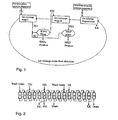
- this combined ion exchange and crystallisation process adapted for producing pure potassium nitrate and potassium phosphate will be described in more detail.
- the ion exchange can be carried out in one multiple column system such as a commercially available simulated moving bed.
- Phosphate rock or an other suitable phosphate raw material is reacted with nitric acid in a conventional rock digestion process to obtain a nitrophosphate slurry.
- Part of the phosphate rock can be substituted by a phosphate salt or by phosphoric acid, substituting also a part of the nitric acid.
- the ratio of the two products can be adjusted within quite a broad range. If a slurry is obtained, water is added to it in a countercurrent settler system, and the solid fraction is separated.
- Ion exchange stage I The calcium rich nitrophosphate solution TS1 is fed to a system of columns filled with an ion exchange resin, in this case a strong cationic macroporous resin with a high oxidising stability.
- the ion exchange columns are operated in a countercurrent way, which can be described as a simulated moving bed unit.
- the calcium in the nitrophosphate solution is exchanged with potassium from the potassium loaded resin.
- the potassium enriched effluent FS1 can be regarded as a mixture of calcium nitrate and potassium nitrate in phosphoric acid.
- Potassium nitrate crystallisation Potassium nitrate crystallisation. Potassium nitrate is precipitated after concentration of the effluent from the first ion exchange step. Crystallisation can be performed by any conventional crystallisation technique. The crystallisation of potassium nitrate can be done at temperatures from 80 to - 30°C and preferably from -10 to 10°C.
- Ion exchange regeneration The calcium, hydronium, and magnesium ions on the resin are exchanged with potassium by adding a solution of potassium chloride, TK.
- the effluent is an acidic solution of calcium chloride, KK.
- Monopotassium phosphate crystallisation The effluent FS2 with lowered calcium content from the second ion exchange step is concentrated, and e.g. potassium hydroxide is added to adjust the pH value to between 3 and 6. Increasing the pH will precipitate calcium and magnesium phosphates, which are separated from the fluid and either discharged or recycled as a phosphate source to the digestion reactor.
- the liquid phase can be regarded as a mixture of potassium phosphate and potassium nitrate.
- the crystallisation temperature water content and the ratio between nitrate and phosphate ions in the crystallisation solution a pure monopotassium phosphate product can be produced.
- Monopotassium phosphate can be crystallised at temperatures between 0 and 100°C, preferably between 30 and 80°C, at a pH range of 4 to 5.
- the mother liquor RC1 which now consists mainly of potassium nitrate, is recycled back to potassium nitrate crystallisation.
- Fluoride removal Fluorides originating from phosphate rock can easily be removed before either crystallisation step by increasing the pH and by subsequent separation of the precipitated calcium fluoride.
- the output streams of the above outlined process are solid potassium nitrate and solid monopotassium phosphate, and a calcium chloride solution, which can be upgraded to a saleable product.
- Raw materials which can be used in the process, include rock phosphate or other suitable phosphate sources, potassium chloride, potassium hydroxide or an other alkaline substance, and optionally an alkaline calcium compound such as calcium oxide for neutralisation and precipitation.
- An advantage of the process according to the invention is that pure products can be produced from cheap basic raw materials. Two valuable products are produced in the same process.
- the process design offers a flexible choice of the salts produced as well as the relative amounts thereof.
- the present process gives a high efficiency and a high resin utilisation at the ion exchange unit and taken as a whole the utilisation of raw materials is maximised while the amount of waste generated is kept at a minimum. No gypsum or corrosive gaseous substances are formed, and no organic solvents are needed.
- the present invention is more energy efficient than manufacturing the two products in separate processes, where the total degree of dilution is higher.
- the ion exchange process was operated according to the configuration, presented in Figure 2, consisting of 16 columns.
- a nitrophosphate slurry was prepared by mixing phosphate rock with nitric acid. After the separation of solids by settling a solution here designated by TS1 was obtained.
- the other feed solution, TS2 was obtained from crystallisation of potassium nitrate after the first ion exchange step.
- the resin was regenerated with a potassium chloride solution, TK.
- the compositions of TS1, TS2 and TK are presented in Table 1.
- the feeds were arranged in a sequential fashion: TS2 followed by TS 1 and washing in the production stage; TK followed by washing in the regeneration stage.
- the temperature was kept between 30 and 60°C throughout the multi-stage ion exchange process.
- compositions of ion exchange feed solutions TS1, TS2 and TK Component TS1%w/w TS2%w/w TK % w/w Ca 9.05 4.20 - K 0.24 4.65 13.3 NO 3 -N 6.97 3.84 - PO 4 -P 4.11 8.57 -
- the product streams are named after the feed streams, which means that TS1 becomes FS1, TS2 becomes FS2 and TK becomes KK, after passing the ion exchange column.
- Compositions of ion exchange outlet solutions FS1, FS2 and KK Component FS1 % w/w FS2 % w/w KK % w/w Ca 2.22 0.46 3.28 K 8.73 5.97 0.85 NO 3 -N 4.64 1.45 - PO 4 -P 3.70 3.83 -
- compositions of ion exchange feed solutions TS1, TS2 and TK Component TS1 % w/w TS2 % w/w TK % w/w Ca 9.4 3.3 - K 0.2 3.9 13.3 NO 3 -N 6.2 1.8 - PO 4 -P 3.9 6.1 - Compositions of ion exchange outlet solutions FS1, FS2 and KK Component FS1 % w/w FS2 % w/w KK % w/w Ca 2.0 0.5 3.6 K 7.8 6.3 1.0 NO 3 -N 3.8 0.8 - PO 4 -P 3.1 3.9 -
- Example 2 In another experiment the ion exchange was operated as in Example 1.
- the outlet solution FS1 was concentrated by evaporation to give a water content of 60% in the mother liquor, TS2, after crystallisation of potassium nitrate. After separation of insolubles, potassium nitrate was crystallised at 5°C. The crystals were separated from the mother liquor by filtration, washed with water and dried. The mother liquor was reintroduced to the ion exchange system as TS2.
- Table 5 The compositions of the inlet and outlet streams as well as that of the potassium nitrate crystals obtained are presented in Table 5.
- compositions of potassium nitrate crystals and of crystallisation inlet solutions FS1 and RC1 and outlet solution TS2 [% w/w] Stream Ca K NO 3 -N PO 4 -P Cl F Mg Fe H 2 O FS1 1.7 8.0 3.7 3.1 0.45 0.03 0.10 n.m. n.m RC1 0.08 17.9 4.0 1.8 4.1 n.m. n.m. n.m. TS2 3.3 4.8 2.1 6.5 3.1 0.01 0.18 0.053 58.3 KNO 3 0.015 38.7 13.8 ⁇ 0.05 0.02 0.05 ⁇ 0.005 ⁇ 0.002 0.13
- Example 1 In another experiment the ion exchange was operated as in Example 1.
- the outlet solution FS2 was neutralised with potassium hydroxide to a pH value of 4.2 to precipitate impurities containing calcium and magnesium.
- the precipitates were separated by filtration, and monopotassium phosphate was crystallised from the solution CFS at 50°C by vacuum crystallisation.
- the crystals were separated from the mother liquor by filtration, washed with water and dried.
- the crystallisation mother liquor RC1 was mixed with FS1 and concentrated as described in the potassium nitrate crystallisation process.
- compositions of the inlet and outlet streams as well as that of the potassium phosphate crystals obtained are presented in Table 6.
- Compositions of potassium phosphate crystals and of crystallisation inlet and outlet solutions CFS and RC1 Component CFS % w/w RC1 % w/w KH 2 PO 4 % w/w Ca 0.04 0.1 - K 10.1 16 28.9 NO 3 -N 1.1 2.8 0.03 PO 4 -P 3.8 1.6 22.7 Cl 2.4 6.12 0.09
- chloride was added to simulate the accumulation of possible impurities where chloride will be the most probably impurity because it can not be removed by precipitation. As can be seen from the composition of the two products, the chloride has not given rise to any problems.
Landscapes
- Chemical & Material Sciences (AREA)
- Organic Chemistry (AREA)
- Inorganic Chemistry (AREA)
- Engineering & Computer Science (AREA)
- Materials Engineering (AREA)
- Life Sciences & Earth Sciences (AREA)
- Agronomy & Crop Science (AREA)
- Treatment Of Water By Ion Exchange (AREA)
- Organic Low-Molecular-Weight Compounds And Preparation Thereof (AREA)
- Removal Of Specific Substances (AREA)
- Fertilizers (AREA)
- Peptides Or Proteins (AREA)
- Non-Alcoholic Beverages (AREA)
Claims (15)
- Verfahren zur Herstellung eines Alkalimetallnitrates und eines Alkalimetallphosphates in demselben Verfahren aus einem Phosphatrohmaterial und einem Nitratrohmaterial, umfassend die Stufen von:a) Umsetzen des Phosphatrohmaterials mit dem Nitratrohmaterial zur Lieferung einer wässrigen Nitrophosphateinspeisung, wahlweise gefolgt von der Abtrennung von festem Material,b) Einführen der wässrigen Nitrophosphateinspeisung in eine erste Ionenaustauscherstufe, umfassend ein mit Alkalimetall beladenes kationisches Austauscherharz zum Austausch von in der Einspeisung vorhandenen Kationen gegen auf dem Harz vorhandene Alkalimetallionen zum Erhalt einer an Alkalimetallionen angereicherten Strömung,c) Unterziehen der Strömung aus Stufe (b) einer ersten Kristallisation unter solchen Bedingungen, daß ein Alkalimetallnitrat kristallisiert wird, und Abtrennen des kristallisierten Alkalimetallnitrates von der Mutterlauge,d) Einführen der Mutterlauge aus Stufe (c) in eine zweite Ionenaustauscherstufe, umfassend ein mit Alkalimetall beladenes kationisches Austauscherharz zum Austausch von in der Mutterlauge vorhandenen Kationen gegen auf dem Harz vorhandene Alkalimetallionen zum Erhalt einer an Alkalimmetallionen angereicherten, Phosphat enthaltenden Strömung, unde) Unterziehen der Strömung aus Stufe (d) einer zweiten Kristallisation unter solchen Bedingungen, daß ein Alkalimetallphosphat kristallisiert wird, und Abtrennen des kristallisierten Alkalimetallphosphates von der Mutterlauge.
- Verfahren nach Anspruch 1, weiter umfassend die Stufe von:f) Einführen der Mutterlauge aus Stufe (e) in die erste Kristallisationsstufe (c).
- Verfahren nach Anspruch 1 oder 2, bei welchem die kationischen Austauscherharze von sowohl der ersten Ionenaustauscherstufe als auch der zweiten Ionenaustauscherstufe Teil desselben Ionenaustauschersystems sind.
- Verfahren nach Anspruch 3, bei welchem das Ionenaustauschersystem ein Mehrfach-Kolonnensystem umfaßt, das als ein kontinuierliches simuliertes sich bewegendes Bett arbeitet.
- Verfahren nach irgendeinem der Ansprüche 1 bis 4, bei welchem die Ionenaustauscherharze mit einer lösung eines Alkalimetallsalzes regeneriert werden.
- Verfahren nach irgendeinem der Ansprüche 1 bis 5, bei welchem das Alkalimetall Kalium ist.
- Verfahren nach irgendeinem der Ansprüche 1 bis 6, bei welchem das kristallisierte Alkalimetallnitrat Kaliumnitrat umfaßt, und das kristallisierte Alkalimetallphosphat Monokaliumphosphat umfaßt.
- Verfahren nach irgendeinem der Ansprüche 1 bis 7, bei welchem diese auszutauschenden Kationen, die in den in die erste und zweite Ionenaustauscherstufe eingeführten Einspeisungen vorhanden sind, Calcium-, Hydroniumionen und wahlweise Magnesiumionen umfassen.
- Verfahren nach irgendeinem der Ansprüche 1 bis 8, bei welchem das Phosphatrohmaterial Phosphatgestein, Mono- oder Dicalciumphosphat und/oder Phosphorsäure ist.
- Verfahren nach irgendeinem der Ansprüche 1 bis 9, bei welchem das Nitratrohmaterial Salpetersäure und/oder Calciumnitrat umfaßt.
- Verfahren nach irgendeinem der Ansprüche 1 bis 10, bei welchem die erste Kristallisation durch Erniedrigung der Temperatur und durch Konzentration herbeigeführt wird.
- Verfahren nach irgendeinem der Ansprüche 1 bis 11, bei welchem der pH der Strömung aus Stufe (d) auf einen Wert zwischen 3 und 6 erhöht wird, um Verunreinigungen auszufällen, die abgetrennt werden.
- Verfahren nach Anspruch 12, bei welchem die ausgefällten und abgetrennten Verunreinigungen Calcium- und Magnesiumphosphate umfassen, die zu Stufe (a) als ein Teil des Phosphatrohmaterials rückgeführt werden.
- Verfahren nach irgendeinem der Ansprüche 1 bis 13, bei welchem die zweite Kristallisation durch Einstellen des pH auf einen Wert zwischen 4 und 5 und durch Konzentration herbeigeführt wird.
- Verfahren nach Anspruch 12 oder 14, bei welchem Kaliumhydroxid oder ein anderes alkalisches Material zur Erhöhung des pH auf den gewünschten Wert zugesetzt wird.
Applications Claiming Priority (3)
| Application Number | Priority Date | Filing Date | Title |
|---|---|---|---|
| FI992606 | 1999-12-03 | ||
| FI992606A FI107330B (fi) | 1999-12-03 | 1999-12-03 | Kahden alkalimetallisuolan valmistaminen yhdistetyllä ioninvaihto- ja kiteytysmenetelmällä |
| PCT/FI2000/001056 WO2001040112A1 (en) | 1999-12-03 | 2000-12-01 | Production of two alkali metal salts by a combined ion exchange and crystallisation process |
Publications (2)
| Publication Number | Publication Date |
|---|---|
| EP1235743A1 EP1235743A1 (de) | 2002-09-04 |
| EP1235743B1 true EP1235743B1 (de) | 2003-09-24 |
Family
ID=8555695
Family Applications (1)
| Application Number | Title | Priority Date | Filing Date |
|---|---|---|---|
| EP00985294A Expired - Lifetime EP1235743B1 (de) | 1999-12-03 | 2000-12-01 | Herstellung zweier alkalimetallsalze durch ein kombiniertes ionenaustausch- und kristallisationsverfahren |
Country Status (21)
| Country | Link |
|---|---|
| US (1) | US6911188B2 (de) |
| EP (1) | EP1235743B1 (de) |
| AR (1) | AR026668A1 (de) |
| AT (1) | ATE250557T1 (de) |
| AU (1) | AU775840B2 (de) |
| CA (1) | CA2393324A1 (de) |
| DE (1) | DE60005555T2 (de) |
| DK (1) | DK1235743T3 (de) |
| EE (1) | EE200200285A (de) |
| EG (1) | EG22534A (de) |
| ES (1) | ES2207565T3 (de) |
| FI (1) | FI107330B (de) |
| HU (1) | HUP0203592A3 (de) |
| JO (1) | JO2174B1 (de) |
| MY (1) | MY120642A (de) |
| NZ (1) | NZ519150A (de) |
| PL (1) | PL355676A1 (de) |
| RU (1) | RU2238906C2 (de) |
| TR (1) | TR200201423T2 (de) |
| WO (1) | WO2001040112A1 (de) |
| ZA (1) | ZA200204720B (de) |
Families Citing this family (7)
| Publication number | Priority date | Publication date | Assignee | Title |
|---|---|---|---|---|
| CN102532214B (zh) * | 2010-12-28 | 2014-12-10 | 三达膜科技(厦门)有限公司 | 一种巴龙霉素的脱色提纯方法 |
| CZ2013234A3 (cs) | 2013-03-28 | 2014-06-04 | Membrain S.R.O. | Způsob výroby dusičnanu draselného metodou elektrodialýzy a zařízení k provádění tohoto způsobu |
| RU2616061C1 (ru) * | 2016-04-04 | 2017-04-12 | Акционерное общество "Минерально-химическая компания "ЕвроХим" | Установка для комбинированного получения фосфатных солей и сульфата калия |
| CN111170796B (zh) * | 2020-02-22 | 2022-09-16 | 太尔化工(南京)有限公司 | 粉状氨基树脂再生制备农用缓释氮肥工艺 |
| CN113845123A (zh) * | 2021-11-01 | 2021-12-28 | 石药集团中诺药业(石家庄)有限公司 | 一种从唑林中间体废水中回收氟硼酸钾的方法 |
| EP4253314A1 (de) | 2022-03-28 | 2023-10-04 | Saudi Arabian Mining Company (Ma'aden) | Integriertes verfahren zur aufwertung von minderwertigem kalkhaltigem phosphaterz mit geringem co2-ausstoss und geringem phosphorgipsabfall |
| CN117756228B (zh) * | 2023-12-25 | 2026-02-27 | 诸城市浩天药业有限公司 | 一种固定化酶生产中磷酸盐废液处理工艺 |
Family Cites Families (16)
| Publication number | Priority date | Publication date | Assignee | Title |
|---|---|---|---|---|
| FR1496160A (fr) * | 1966-07-05 | 1967-09-29 | Azote Office Nat Ind | Procédé de fabrication d'acide phosphorique par extraction au moyen de solvants organiques à partir du produit de l'attaque nitrique des phosphates naturels |
| US3993466A (en) * | 1967-06-23 | 1976-11-23 | Aktieselskabet Dansk Svovlsyre-Og Superphosphat-Fabrik | Fertilizer production |
| DE1812403A1 (de) * | 1968-12-03 | 1970-06-18 | Dynamit Nobel Ag | Verfahren zur Herstellung von Kaliumnitrat im Ionenaustauschverfahren |
| NL7007079A (de) * | 1969-05-22 | 1970-11-24 | ||
| US3645673A (en) * | 1969-12-01 | 1972-02-29 | Dynamit Nobel Ag | Process for the production of potassium nitrate by the ion exchange method |
| US3840640A (en) * | 1972-08-28 | 1974-10-08 | Pennzoil Co | Production of fluoride-free nitrates |
| US4008307A (en) * | 1975-06-02 | 1977-02-15 | Southwire Company | Production of monobasic potassium phosphate by ion exchange |
| US4704263A (en) * | 1985-06-24 | 1987-11-03 | Advanced Separation Technologies Incorporated | Production of potassium phosphates by ion exchange |
| IL75767A (en) * | 1985-07-10 | 1988-09-30 | Negev Phosphates Ltd | Process for the manufacture of pure monopotassium phosphate |
| IL79020A0 (en) * | 1986-06-04 | 1986-09-30 | Haifa Chemicals Ltd | Process for the manufacture of monopotassium phosphate |
| US4885148A (en) * | 1988-09-06 | 1989-12-05 | Phosphate Engineering & Construction Co., Inc. | Production of monobasic potassium phosphate with low chloride content from potassium chloride and phosphoric acid produced from the commercial wet process |
| US5114460A (en) * | 1988-10-31 | 1992-05-19 | Alpine Plant Foods Limited | Production of low-chloride alkali metal phosphates |
| US5110578A (en) * | 1989-10-05 | 1992-05-05 | Monomeros Colombo Venezolanos, S.A. (E.M.A.) | Continuous production of potassium nitrate via ion exchange |
| US5098461A (en) * | 1989-12-28 | 1992-03-24 | Tennessee Valley Authority | Phosphatic and nitrogen fertilizers via HNO3 processing |
| FI112646B (fi) | 1996-06-13 | 2003-12-31 | Kemira Growhow Oy | Menetelmä erittäin puhtaiden kaliumsuolojen tuottamiseksi |
| RU2105713C1 (ru) * | 1997-05-14 | 1998-02-27 | Открытое акционерное общество "РЕАТЭКС" | Способ получения фосфатов калия |
-
1999
- 1999-12-03 FI FI992606A patent/FI107330B/fi active
-
2000
- 2000-11-29 EG EG20001493A patent/EG22534A/xx active
- 2000-11-30 AR ARP000106322A patent/AR026668A1/es unknown
- 2000-12-01 ES ES00985294T patent/ES2207565T3/es not_active Expired - Lifetime
- 2000-12-01 EP EP00985294A patent/EP1235743B1/de not_active Expired - Lifetime
- 2000-12-01 HU HU0203592A patent/HUP0203592A3/hu unknown
- 2000-12-01 TR TR2002/01423T patent/TR200201423T2/xx unknown
- 2000-12-01 AT AT00985294T patent/ATE250557T1/de not_active IP Right Cessation
- 2000-12-01 CA CA002393324A patent/CA2393324A1/en not_active Abandoned
- 2000-12-01 NZ NZ519150A patent/NZ519150A/en unknown
- 2000-12-01 AU AU21756/01A patent/AU775840B2/en not_active Ceased
- 2000-12-01 US US10/148,569 patent/US6911188B2/en not_active Expired - Fee Related
- 2000-12-01 RU RU2002118314/15A patent/RU2238906C2/ru not_active IP Right Cessation
- 2000-12-01 EE EEP200200285A patent/EE200200285A/xx unknown
- 2000-12-01 MY MYPI20005636A patent/MY120642A/en unknown
- 2000-12-01 WO PCT/FI2000/001056 patent/WO2001040112A1/en not_active Ceased
- 2000-12-01 PL PL00355676A patent/PL355676A1/xx not_active IP Right Cessation
- 2000-12-01 DK DK00985294T patent/DK1235743T3/da active
- 2000-12-01 DE DE60005555T patent/DE60005555T2/de not_active Expired - Fee Related
- 2000-12-03 JO JO2000192A patent/JO2174B1/en active
-
2002
- 2002-06-12 ZA ZA200204720A patent/ZA200204720B/en unknown
Also Published As
| Publication number | Publication date |
|---|---|
| RU2238906C2 (ru) | 2004-10-27 |
| US6911188B2 (en) | 2005-06-28 |
| DE60005555D1 (de) | 2003-10-30 |
| HUP0203592A3 (en) | 2003-04-28 |
| ZA200204720B (en) | 2004-02-24 |
| AU775840B2 (en) | 2004-08-19 |
| ATE250557T1 (de) | 2003-10-15 |
| CA2393324A1 (en) | 2001-06-07 |
| HUP0203592A2 (hu) | 2003-03-28 |
| EP1235743A1 (de) | 2002-09-04 |
| AU2175601A (en) | 2001-06-12 |
| RU2002118314A (ru) | 2004-01-27 |
| EE200200285A (et) | 2003-08-15 |
| AR026668A1 (es) | 2003-02-19 |
| DK1235743T3 (da) | 2004-01-26 |
| NZ519150A (en) | 2003-08-29 |
| PL355676A1 (en) | 2004-05-04 |
| ES2207565T3 (es) | 2004-06-01 |
| FI107330B (fi) | 2001-07-13 |
| JO2174B1 (en) | 2003-04-23 |
| EG22534A (en) | 2003-03-31 |
| US20030133862A1 (en) | 2003-07-17 |
| WO2001040112A1 (en) | 2001-06-07 |
| DE60005555T2 (de) | 2004-07-01 |
| TR200201423T2 (tr) | 2002-12-23 |
| MY120642A (en) | 2005-11-30 |
Similar Documents
| Publication | Publication Date | Title |
|---|---|---|
| US2769686A (en) | Recovery of mineral values from leached zone material overlying florida pebble phosphate deposits | |
| CA2343952C (en) | Process for producing potassium sulfate from potash and sodium sulfate | |
| EP0208422B1 (de) | Verfahren zur Herstellung von Kaliumdihydrogenphosphat | |
| US6911188B2 (en) | Production of two alkali metal salts by a combined ion exchange and crystallization process | |
| US8388916B2 (en) | Process for production of commercial quality potassium nitrate from polyhalite | |
| US4504458A (en) | Gypsum conversion | |
| US4007030A (en) | Process for the simultaneous manufacture of phosphoric acid or the salts thereof and a complex multi-component mineral fertilizer | |
| US3661513A (en) | Manufacture of alkali metal phosphates | |
| US4062929A (en) | Production of hydrogen fluoride | |
| US3595610A (en) | Manufacture of ammonium phosphates | |
| US3803884A (en) | Production of fertilizers | |
| US4759920A (en) | Process for the manufacture of disodium phosphate | |
| US4275038A (en) | Process for treating loaded extractant from purification of phosphoric acid by extraction and recovering nutrients | |
| US4256716A (en) | Process for treating loaded extractant from purification of phosphoric acid by extraction | |
| US3978196A (en) | Phosphoric acid purification | |
| US4008307A (en) | Production of monobasic potassium phosphate by ion exchange | |
| US4324774A (en) | Method for the manufacture of defluorinated phosphatic products | |
| MXPA02005500A (en) | Production of two alkali metal salts by a combined ion exchange and crystallisation process | |
| US4610862A (en) | Process for producing purified diammonium phosphate from wet process phosphoric acid | |
| US3726660A (en) | Nitrophosphate fertilizer production | |
| US3518071A (en) | Production of nitrophosphate fertilizer and ammonium nitrate-calcium carbonate fertilizers | |
| US3993729A (en) | Process for the manufacture of potassium phosphates | |
| RU2855576C1 (ru) | Способ извлечения карбоната лития из сподуменового концентрата | |
| RU2716048C1 (ru) | Способ переработки отходов солевых растворов, содержащих смесь сульфатов и нитратов аммония и натрия | |
| PL248273B1 (pl) | Sposób wytwarzania siarczanu(VI) magnezu |
Legal Events
| Date | Code | Title | Description |
|---|---|---|---|
| PUAI | Public reference made under article 153(3) epc to a published international application that has entered the european phase |
Free format text: ORIGINAL CODE: 0009012 |
|
| 17P | Request for examination filed |
Effective date: 20020522 |
|
| AK | Designated contracting states |
Kind code of ref document: A1 Designated state(s): AT BE CH CY DE DK ES FI FR GB GR IE IT LI LU MC NL PT SE TR |
|
| AX | Request for extension of the european patent |
Free format text: AL;LT PAYMENT 20020522;LV PAYMENT 20020522;MK PAYMENT 20020522;RO PAYMENT 20020522;SI PAYMENT 20020522 |
|
| GRAH | Despatch of communication of intention to grant a patent |
Free format text: ORIGINAL CODE: EPIDOS IGRA |
|
| RAP1 | Party data changed (applicant data changed or rights of an application transferred) |
Owner name: KEMIRA GROWHOW OY |
|
| GRAS | Grant fee paid |
Free format text: ORIGINAL CODE: EPIDOSNIGR3 |
|
| GRAA | (expected) grant |
Free format text: ORIGINAL CODE: 0009210 |
|
| AK | Designated contracting states |
Kind code of ref document: B1 Designated state(s): AT BE CH CY DE DK ES FI FR GB GR IE IT LI LU MC NL PT SE TR |
|
| AX | Request for extension of the european patent |
Extension state: LT LV MK RO SI |
|
| PG25 | Lapsed in a contracting state [announced via postgrant information from national office to epo] |
Ref country code: TR Free format text: LAPSE BECAUSE OF FAILURE TO SUBMIT A TRANSLATION OF THE DESCRIPTION OR TO PAY THE FEE WITHIN THE PRESCRIBED TIME-LIMIT Effective date: 20030924 Ref country code: LI Free format text: LAPSE BECAUSE OF FAILURE TO SUBMIT A TRANSLATION OF THE DESCRIPTION OR TO PAY THE FEE WITHIN THE PRESCRIBED TIME-LIMIT Effective date: 20030924 Ref country code: FI Free format text: LAPSE BECAUSE OF FAILURE TO SUBMIT A TRANSLATION OF THE DESCRIPTION OR TO PAY THE FEE WITHIN THE PRESCRIBED TIME-LIMIT Effective date: 20030924 Ref country code: AT Free format text: LAPSE BECAUSE OF FAILURE TO SUBMIT A TRANSLATION OF THE DESCRIPTION OR TO PAY THE FEE WITHIN THE PRESCRIBED TIME-LIMIT Effective date: 20030924 Ref country code: CH Free format text: LAPSE BECAUSE OF FAILURE TO SUBMIT A TRANSLATION OF THE DESCRIPTION OR TO PAY THE FEE WITHIN THE PRESCRIBED TIME-LIMIT Effective date: 20030924 |
|
| REG | Reference to a national code |
Ref country code: GB Ref legal event code: FG4D |
|
| REG | Reference to a national code |
Ref country code: CH Ref legal event code: EP |
|
| REG | Reference to a national code |
Ref country code: IE Ref legal event code: FG4D |
|
| REF | Corresponds to: |
Ref document number: 60005555 Country of ref document: DE Date of ref document: 20031030 Kind code of ref document: P |
|
| PG25 | Lapsed in a contracting state [announced via postgrant information from national office to epo] |
Ref country code: LU Free format text: LAPSE BECAUSE OF NON-PAYMENT OF DUE FEES Effective date: 20031201 Ref country code: CY Free format text: LAPSE BECAUSE OF FAILURE TO SUBMIT A TRANSLATION OF THE DESCRIPTION OR TO PAY THE FEE WITHIN THE PRESCRIBED TIME-LIMIT Effective date: 20031201 Ref country code: IE Free format text: LAPSE BECAUSE OF NON-PAYMENT OF DUE FEES Effective date: 20031201 |
|
| PG25 | Lapsed in a contracting state [announced via postgrant information from national office to epo] |
Ref country code: SE Free format text: LAPSE BECAUSE OF FAILURE TO SUBMIT A TRANSLATION OF THE DESCRIPTION OR TO PAY THE FEE WITHIN THE PRESCRIBED TIME-LIMIT Effective date: 20031224 Ref country code: GR Free format text: LAPSE BECAUSE OF FAILURE TO SUBMIT A TRANSLATION OF THE DESCRIPTION OR TO PAY THE FEE WITHIN THE PRESCRIBED TIME-LIMIT Effective date: 20031224 |
|
| PG25 | Lapsed in a contracting state [announced via postgrant information from national office to epo] |
Ref country code: MC Free format text: LAPSE BECAUSE OF NON-PAYMENT OF DUE FEES Effective date: 20031231 |
|
| REG | Reference to a national code |
Ref country code: DK Ref legal event code: T3 |
|
| LTIE | Lt: invalidation of european patent or patent extension |
Effective date: 20030924 |
|
| REG | Reference to a national code |
Ref country code: CH Ref legal event code: PL |
|
| REG | Reference to a national code |
Ref country code: ES Ref legal event code: FG2A Ref document number: 2207565 Country of ref document: ES Kind code of ref document: T3 |
|
| ET | Fr: translation filed | ||
| PLBE | No opposition filed within time limit |
Free format text: ORIGINAL CODE: 0009261 |
|
| STAA | Information on the status of an ep patent application or granted ep patent |
Free format text: STATUS: NO OPPOSITION FILED WITHIN TIME LIMIT |
|
| 26N | No opposition filed |
Effective date: 20040625 |
|
| REG | Reference to a national code |
Ref country code: IE Ref legal event code: MM4A |
|
| PGFP | Annual fee paid to national office [announced via postgrant information from national office to epo] |
Ref country code: FR Payment date: 20061113 Year of fee payment: 7 |
|
| PGFP | Annual fee paid to national office [announced via postgrant information from national office to epo] |
Ref country code: DK Payment date: 20061114 Year of fee payment: 7 Ref country code: GB Payment date: 20061114 Year of fee payment: 7 |
|
| PGFP | Annual fee paid to national office [announced via postgrant information from national office to epo] |
Ref country code: NL Payment date: 20061117 Year of fee payment: 7 |
|
| PGFP | Annual fee paid to national office [announced via postgrant information from national office to epo] |
Ref country code: DE Payment date: 20061124 Year of fee payment: 7 |
|
| PGFP | Annual fee paid to national office [announced via postgrant information from national office to epo] |
Ref country code: BE Payment date: 20061204 Year of fee payment: 7 |
|
| PGFP | Annual fee paid to national office [announced via postgrant information from national office to epo] |
Ref country code: ES Payment date: 20061213 Year of fee payment: 7 |
|
| PGFP | Annual fee paid to national office [announced via postgrant information from national office to epo] |
Ref country code: IT Payment date: 20061231 Year of fee payment: 7 |
|
| PG25 | Lapsed in a contracting state [announced via postgrant information from national office to epo] |
Ref country code: PT Free format text: LAPSE BECAUSE OF NON-PAYMENT OF DUE FEES Effective date: 20040224 |
|
| BERE | Be: lapsed |
Owner name: *KEMIRA GROWHOW OY Effective date: 20071231 |
|
| REG | Reference to a national code |
Ref country code: DK Ref legal event code: EBP |
|
| GBPC | Gb: european patent ceased through non-payment of renewal fee |
Effective date: 20071201 |
|
| NLV4 | Nl: lapsed or anulled due to non-payment of the annual fee |
Effective date: 20080701 |
|
| PG25 | Lapsed in a contracting state [announced via postgrant information from national office to epo] |
Ref country code: BE Free format text: LAPSE BECAUSE OF NON-PAYMENT OF DUE FEES Effective date: 20071231 |
|
| PG25 | Lapsed in a contracting state [announced via postgrant information from national office to epo] |
Ref country code: DE Free format text: LAPSE BECAUSE OF NON-PAYMENT OF DUE FEES Effective date: 20080701 |
|
| REG | Reference to a national code |
Ref country code: FR Ref legal event code: ST Effective date: 20081020 |
|
| PG25 | Lapsed in a contracting state [announced via postgrant information from national office to epo] |
Ref country code: NL Free format text: LAPSE BECAUSE OF NON-PAYMENT OF DUE FEES Effective date: 20080701 |
|
| PG25 | Lapsed in a contracting state [announced via postgrant information from national office to epo] |
Ref country code: GB Free format text: LAPSE BECAUSE OF NON-PAYMENT OF DUE FEES Effective date: 20071201 |
|
| PG25 | Lapsed in a contracting state [announced via postgrant information from national office to epo] |
Ref country code: DK Free format text: LAPSE BECAUSE OF NON-PAYMENT OF DUE FEES Effective date: 20080102 |
|
| REG | Reference to a national code |
Ref country code: ES Ref legal event code: FD2A Effective date: 20071203 |
|
| PG25 | Lapsed in a contracting state [announced via postgrant information from national office to epo] |
Ref country code: FR Free format text: LAPSE BECAUSE OF NON-PAYMENT OF DUE FEES Effective date: 20071231 Ref country code: ES Free format text: LAPSE BECAUSE OF NON-PAYMENT OF DUE FEES Effective date: 20071203 |
|
| PG25 | Lapsed in a contracting state [announced via postgrant information from national office to epo] |
Ref country code: IT Free format text: LAPSE BECAUSE OF NON-PAYMENT OF DUE FEES Effective date: 20071201 |