EP1235768B2 - Geruchsunterdrücker enthaltende kohlenwasserstoffhaltige zubereitung - Google Patents
Geruchsunterdrücker enthaltende kohlenwasserstoffhaltige zubereitung Download PDFInfo
- Publication number
- EP1235768B2 EP1235768B2 EP00968648A EP00968648A EP1235768B2 EP 1235768 B2 EP1235768 B2 EP 1235768B2 EP 00968648 A EP00968648 A EP 00968648A EP 00968648 A EP00968648 A EP 00968648A EP 1235768 B2 EP1235768 B2 EP 1235768B2
- Authority
- EP
- European Patent Office
- Prior art keywords
- asphalt
- composition
- formula
- carbon atoms
- aldehyde
- Prior art date
- Legal status (The legal status is an assumption and is not a legal conclusion. Google has not performed a legal analysis and makes no representation as to the accuracy of the status listed.)
- Expired - Lifetime
Links
Classifications
-
- C—CHEMISTRY; METALLURGY
- C08—ORGANIC MACROMOLECULAR COMPOUNDS; THEIR PREPARATION OR CHEMICAL WORKING-UP; COMPOSITIONS BASED THEREON
- C08L—COMPOSITIONS OF MACROMOLECULAR COMPOUNDS
- C08L95/00—Compositions of bituminous materials, e.g. asphalt, tar, pitch
-
- C—CHEMISTRY; METALLURGY
- C09—DYES; PAINTS; POLISHES; NATURAL RESINS; ADHESIVES; COMPOSITIONS NOT OTHERWISE PROVIDED FOR; APPLICATIONS OF MATERIALS NOT OTHERWISE PROVIDED FOR
- C09D—COATING COMPOSITIONS, e.g. PAINTS, VARNISHES OR LACQUERS; FILLING PASTES; CHEMICAL PAINT OR INK REMOVERS; INKS; CORRECTING FLUIDS; WOODSTAINS; PASTES OR SOLIDS FOR COLOURING OR PRINTING; USE OF MATERIALS THEREFOR
- C09D195/00—Coating compositions based on bituminous materials, e.g. asphalt, tar, pitch
-
- C—CHEMISTRY; METALLURGY
- C10—PETROLEUM, GAS OR COKE INDUSTRIES; TECHNICAL GASES CONTAINING CARBON MONOXIDE; FUELS; LUBRICANTS; PEAT
- C10L—FUELS NOT OTHERWISE PROVIDED FOR; NATURAL GAS; SYNTHETIC NATURAL GAS OBTAINED BY PROCESSES NOT COVERED BY SUBCLASSES C10G OR C10K; LIQUIFIED PETROLEUM GAS; USE OF ADDITIVES TO FUELS OR FIRES; FIRE-LIGHTERS
- C10L1/00—Liquid carbonaceous fuels
- C10L1/10—Liquid carbonaceous fuels containing additives
- C10L1/14—Organic compounds
- C10L1/18—Organic compounds containing oxygen
Definitions
- This invention relates to hydrocarbonaceous compositions containing odor suppressants, and, more particularly, to a composition comprised of an odor-emitting asphalt and an odor-suppressing amount of a mixture of an aldehyde or a ketone and a carboxylic acid ester.
- U.S. Patent 5,271,767 discloses an odor-free hot-mix asphalt composition which consists essentially of liquid asphalt, or a hot-mix asphalt or a hot mix, cold lay asphalt, or a rubberized hot mix asphalt or a hot mix asphalt with added latex, containing an effective amount of an additive comprising a citrus terpene (4-isopropyl-1-methylcyclohexene) D-limonene mixed with a vegetable oil such as cottonseed oil, soya oil, rapeseed (canola) oil, peanut oil, corn oil, sunflower oil, palm oil, coconut oil, and palm kernal oil. etc., and an effective amount of a silicone oil dispersant.
- a citrus terpene (4-isopropyl-1-methylcyclohexene) D-limonene mixed with a vegetable oil such as cottonseed oil, soya oil, rapeseed (canola) oil, peanut oil, corn oil, sunflower oil, palm oil, coconut oil, and
- a preferred additive composition consists essentially of 10-15 parts citrus terpene (D-limonene) and 85-90 parts vegetable oil, and an effective amount up to about 2 parts silicone oil, the parts in the composition totaling 100.
- the reference also indicates that when 0.5-1.0 parts of this composition are mixed with 99.0-99.5 parts liquid asphalt the resulting liquid asphalt composition is substantially free of characteristic asphalt odors, and other objectionable odors.
- the reference indicates that when 4-8 parts of the mixture are mixed with 99-96 parts of aggregate, the resulting hot-mix asphalt composition is substantially free of characteristic asphalt odor, and other objectionable odors.
- hot-mix asphalt plants are also free of characteristic asphalt odor, and other objectionable odors.
- This invention relates to a composition, comprising: (A) an odor-emitting asphalt; and (B) an odor-suppressing amount of an aldehyde or a ketone, and a carboxylic acid ester represented by the formula wherein in formula (III), R 1 and R 2 independently are hydrocarbyl groups of 1 to 25 carbon atoms.
- asphalt refers to any of a variety of solid or semi-solid materials at room temperature which gradually liquify when heated, and in which the predominant constituents are naturally occurring bitumens of which are obtained as residue in petroleum refining.
- Asphalt is further defined by Kirk-Othmer, Encyclopedia of Chemical Technology, Vol. 3, Third Ed. (1978) pp. 284-327, John Wiley & Sons, New York . An additional discussion appears in the publication entitled “ A Brief Introduction to Asphalt and some of its Uses", Manual Series No. 5 (MS-5), The Asphalt Institute, 7th Ed., September, 1974 .
- the asphalts which may be treated in accordance with this invention include natural asphalts and petroleum asphalts which are generally known for roofing and paving applications.
- the natural asphalts include, for example, asphaltite such as gilsonite, grahamite and glance pitch; lake asphalt such as trinidad asphalt; and rock asphalt.
- the petroleum asphalts include straight asphalt obtained by distillation of a crude oil (unblown and substantially unoxidized), blown asphalt produced by blowing an oxygen-containing gas into a straight asphalt in the presence or absence of a catalyst, solvent-extracted asphalt obtained when asphaltic material is separated from the petroleum fraction containing it by the use of propane or other solvents, and cut-back asphalt which is a mixture of straight asphalt and a light petroleum solvent.
- the asphalts include petroleum tar and asphalt cement.
- the petroleum tars include oil gas tar obtained as a by-product when gases are produced from petroleum fractions, such tar in refined form, cut-back tar obtained by mixing a light petroleum fraction with such tar, and tar pitch obtained as a residue by removing the volatile fraction from such tar. Any of these kinds of asphalt may be used singly or jointly. Straight asphalt is useful for paving applications, and oxidized and blown asphalts are useful for roofing applications.
- the asphalt cements that are useful may be characterized by a penetration (PEN, measured in tenths of a millimeter, dmm) of less than 400 at 25°C, and a typical penetration is between 40 and 300 (ASTM Standard, Method D-5).
- PEN penetration
- ASTM Standard, Method D-5 ASTM Standard, Method D-5.
- the viscosity of asphalt cement at 60°C is typically more than about 65 poise.
- Asphalt cements are often defined in terms specified by the American Association of State Highway Transportation Officials (AASHTO) AR viscosity system. Two sets of typical specifications are as follows: TEST AC 2.5 AC 5 AC 10 AC 20 AC 30 AC 40 Viscosity @ 140° F., poise (AASHTO T-202) 250 ⁇ 50 500 ⁇ 100 1000 ⁇ 200 2000 ⁇ 400 3000 ⁇ 600 4000 ⁇ 800 Viscosity @ 275° F., cSt. minimum (AASHTO T-201) 125 175 250 300 350 400 Pen. @ 77° minimum (AASHTO T-49) 220 140 80 60 50 40 Hash Point.
- AASHTO American Association of State Highway Transportation Officials
- the asphalt compositions of the present invention are particularly useful for preparing asphalt coating compositions. These include aggregate-containing asphalts such as employed in the paving of roads, bridges, airport runways, sidewalks, etc.
- the asphalt compositions of the present invention may be mixed with aggregate while in a fluid or molten condition.
- the asphalt composition is mixed with preheated, predried aggregates to form a homogeneous mixture of uniformly coated aggregates which may be used to form a paving composition.
- This mixing procedure is typically performed at an asphalt mixing plant.
- the aggregate may be heated under conditions of time and temperature that are sufficient to drive off essentially all free moisture prior to mixing.
- both the aggregate and the inventive asphalt composition are typically at temperatures of 100°C to 160°C.
- the resulting composition Before the resulting composition is cooled to a temperature at which it loses its workability, it may be spread on a road bed, for example, and then compacted and permitted to cure. After curing, the resulting paving composition comprises aggregate bound by a matrix of asphalt binder.
- the asphalt compositions of the present invention may also be useful for preparing improved seal coats.
- a seal coat is generally applied as a hot asphalt, cutback asphalt, or emulsified asphalt.
- the seat coat is generally applied at a rate of 0.05 to 0.8 gallons per square yard of surface. In one embodiment, the application rate is about 0.35 gallons per square yard of surface.
- the molten or fluid asphalt is generally sprayed from a truck. The aggregate is placed on top of the asphalt. Rolling or compacting the aggregate into the asphalt finishes the application.
- the asphalt compositions of the present invention after formation, may be handled by conventional techniques to maintain them in fluid or molten form under, for example, road-building conditions.
- the asphalts may be formed into a cutback by fluxing the asphalt with a suitable volatile solvent or distillate.
- the asphalt cutback may then be directly mixed with aggregate and applied as a paving composition in fluid form, possibly at ambient temperatures.
- Another conventional technique for fluidizing the asphalt prior to mixing with aggregate and forming into a paving composition is to emulsify the asphalt by known techniques.
- An advantage of this method of fluidizing is that after mixing with the aggregate, it may be applied as a paving composition at ambient temperature.
- aggregate as used herein is intended to include solid particles having a range of sizes including fine particles such as sand to relatively coarse particles such as crushed stone, gravel or slag.
- the breakdown of Texas pea gravel aggregate is as follows: Gradation (% Passing) 1 ⁇ 2" 100 3/8" 98 #4 71 #10 46 #40 30 #80 7.8 #200 1.0
- the above aggregate has a composition of 52.5% Pea Gravel, 14.3% screenings and 28.6% sand.
- the ratio of aggregate to asphalt depends upon their properties and the desired end use.
- the paving composition will comprise a minimum of 85% by weight of aggregate, and generally between 90% to 96% by weight of the total paving composition will be aggregate.
- the aldehydes that are useful include compounds represented by the formula wherein in formula (I), R is hydrogen, a hydrocarbyl group or a hydroxy substituted hydrocarbyl group.
- R is hydrogen, a hydrocarbyl group or a hydroxy substituted hydrocarbyl group.
- the hydrocarbyl groups and the hydroxy substituted hydrocarbyl groups may contain from 1 to 25 carbon atoms, and in one embodiment 6 to 18 carbon atoms, and in one embodiment 6 to 12 carbon atoms.
- hydrocarbyl group is used to refer to a group having one or more carbon atoms directly attached to the remainder of a molecule and having a hydrocarbon or predominantly hydrocarbon character. Examples include:
- aldehydes examples include formaldehyde, acetaldehyde, propionaldehyde, n-butyraldehyde, n-valeraldehyde, caproaldehyde, acrolein, tran-2-cis-6-nonadienal, n-heptylafdehyde, trans-2-hexenal, hexadeconal, phenylacetaldehyde, o-tolualdehyde, m-totualdehyde, p-tolualdehyde, salicylaldehyde, p-hydroxybenzaldehyde, anisaldehyde, piperonal, vanillin, benzaldehyde, and mixtures of two or more thereof. Benzaldehyde and vanillin are useful.
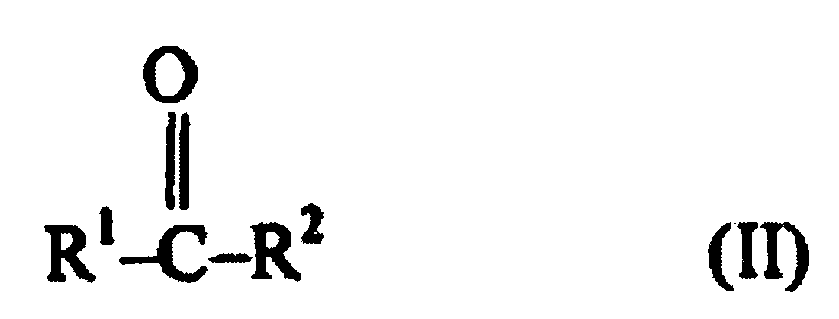
- ketones that are useful include compounds represented by the formula wherein in formula (III), R 1 and R 2 , independently are hydrocarbyl groups or hydroxy substituted hydrocarbyl groups, or R 1 and R 2 are linked together to form a cyclic group or a hydroxy-substituted cyclic group.
- R 1 and R 2 independently contain from 1 to 25 carbon atoms.
- R 1 contains 6 to 18 carbon atoms
- R 2 contains 1 to 25 carbon atoms.
- ketones examples include acetone, methyl ethyl ketone, diethyl ketone, 2-pentanone, 3-pentanone, 2-hexanone, 3-hexanone, methyl, isobutyl ketone, t-butyl methyl ketone, cyclopentanone, cyclohexanone, methyl vinyl ketone, mesityl oxide, biacetyl, acetylacetone, acetophenone, propiophenone, n-butyrophenone, benzophenone, hydroxymethylpyrone, and mixtures of two or more thereof.
- R 1 and R 2 independently are hydrocarbyl groups of 1 to 25 carbon atoms.
- R 1 and R 2 independently contain from 1 to 18 carbon atoms, and in one embodiment from 1 to 12 carbon atoms, and in one embodiment from 1 to 6 carbon atoms.
- Examples of useful carboxylic acid esters include methyl acetate, erthylacetate, propylacetate, butyl acetate, n-pentyl acetate, amyl acetate, benzyl acetate, phenyl acetate, ethyl formate, ethyl acetate, ethyl propionate, ethyl butyrate, ethyl valerate ethyl stearate, ethylphenyl acetate, ethyl benzoate, allyl caproate, amyl butyrate, or a mixiture of two or more thereof.
- Component (B) typically contains from 10% to 90% by weight, and in one embodiment 20% to 80% by weight, and in one embodiment 50% to 80% by weight of the aldehyde or ketone.
- Component (B) typically contains from 90% to 10% by weight, and in one embodiment 80% to 20% by weight, and in one embodiment 50% to 20% by weight of the carboxylic acid ester.
- the inventive compositions may be comprised of an odor-emitting asphalt (A), and an odor-suppressing amount of component (B).
- the concentration of component (B) in the asphalt (A) is from 0.1 to 20 gallons of component (B) per 12,000 gallons of asphalt (A). In one embodiment, this concentration is from 0.5 to 10 gallons of component (B) per 12,000 gallons of asphalt (A), and in one embodiment from 0.5 to 5 gallons of (B) per 12,000 gallons of (A). In one embodiment, the concentration is from 0.7 to 3 gallons of component (B) pet 12,000 gallons of component (A), and in one embodiment from 0.9 to 2 gallons of component (B) per 12,000 gallons of component (A).
- Component (B) may be blended into the asphalt (A) using mixing procedures known in the art.
- the asphalt is in a fluid or molten condition during mixing.
- the mixing temperature may be in the range of 250°F (121°C) to 340°F (171°C), and in one embodiment 280°F (138°C) to 320°F (160°C).
- An advantage of the present invention is that by virtue of the use of component (B) in the inventive compositions, the odor that is characteristic of odor-emittting asphalt such as hot or molten asphalt, is significantly reduced or eliminated. This may be evidenced by smell. While not wishing to be bound by theory, it is believed that in one embodiment, the odor reduction or elimination results from a reduction or elimination in the emissions of volatile hydrocarbon materials in the asphalt. In one embodiment, it is believed that the light ends of the inventive asphalt compositions do not burn off during heating (or their loss is significantly reduced) as a result of the incorporation of component (B) into such compositions.
- the mixture from Example 1 is mixed with a performance grade 52-28 asphalt at a concentration of 1 gallon of the mixture per 12,000 gallons of asphalt, the temperature of the asphalt being 150°C, with the result being a substantial reduction in odor being given off by the asphalt as evidenced by smell.
- the mixture from Example 1 is mixed with a performance grade 58-28 asphalt at a concentration of 1 gallon of the mixture per 12,000 gallons of asphalt, the temperature of the asphalt being 150°C, with the result being a substantial reduction in odor being given off by the asphalt as evidenced by smell.
- the mixture from Example 1 is mixed with a performance grade 64-22 asphalt at a concentration of 1 gallon of the mixture per 12,000 gallons of asphalt, the temperature of the asphalt being 150°C, with the result being a substantial reduction in odor being given off by the asphalt as evidenced by smell.
- the mixture from Example 1 is mixed with a performance grade 70-22 asphalt at a concentration of 1 gallon of the mixture per 12,000 gallons of asphalt, the temperature of the asphalt being 150°C, with the result being a substantial reduction in odor being given off by the asphalt as evidenced by smell.
- the mixture from Example 1 is mixed with a performance grade 70-28 asphalt at a concentration of 1 gallon of the mixture per 12,000 gallons of asphalt, the temperature of the asphalt being 150°C, with the result being a substantial reduction in odor being given off by the asphalt as evidenced by smell.
Landscapes
- Chemical & Material Sciences (AREA)
- Organic Chemistry (AREA)
- Engineering & Computer Science (AREA)
- Health & Medical Sciences (AREA)
- Chemical Kinetics & Catalysis (AREA)
- Materials Engineering (AREA)
- Oil, Petroleum & Natural Gas (AREA)
- Structural Engineering (AREA)
- Wood Science & Technology (AREA)
- General Chemical & Material Sciences (AREA)
- Emergency Medicine (AREA)
- Medicinal Chemistry (AREA)
- Polymers & Plastics (AREA)
- Life Sciences & Earth Sciences (AREA)
- Civil Engineering (AREA)
- Compositions Of Macromolecular Compounds (AREA)
- Road Paving Structures (AREA)
- Fats And Perfumes (AREA)
- Disinfection, Sterilisation Or Deodorisation Of Air (AREA)
- Working-Up Tar And Pitch (AREA)
- Cosmetics (AREA)
Claims (6)
- Zusammensetzung umfassend:A) einen geruchabgebenden Asphalt undB) eine geruchunterdrückende Menge eines Aldehyds oder Ketons und einen Carbonsäureester, wobei der Carbonsäureester eine Verbindung der Formel

- Zusammensetzung nach Anspruch 1, bei der dieser Asphalt ein Dachbelagasphalt, ein Pflasterungsasphalt, ein natürlicher Asphalt, ein Erdölasphalt, ein Asphaltit, ein Seeasphalt, ein Gesteinsasphalt, ein Rohasphalt, den man durch Destillation eines Rohöls erhält, ein geblasener Asphalt, der durch Blasen eines sauerstoffhaltigen Gases in einen Rohasphalt erzeugt wurde, ein mit Lösungsmittel extrahierter Asphalt, der aus einer Erdölfraktion erhalten wurde, ein Cutback-Asphalt, ein Erdölteer oder ein Asphaltzement ist.
- Zusammensetzung nach Anspruch 1, worin der Aldehyd eine Verbindung der Formel

- Zusammensetzung nach Anspruch 1, bei der das Keton eine durch die Formel
- Zusammensetzung nach Anspruch 1, worin (B) trans-2-cis-Nonadienal, n-Heptylaldehyd, Hydroxymethylpyron, trans-2-Hexenal, Allylcaproat, Hexadecanal, Vanillin, Amylbutyrat, Ethylbutyrat, Amylacetat und Benzaldehyd umfaßt.
- Pflasterungszusammensetzung, umfassend einen Zuschlagstoff und die Zusammensetzung nach Anspruch 1.
Applications Claiming Priority (5)
| Application Number | Priority Date | Filing Date | Title |
|---|---|---|---|
| US44097699A | 1999-11-16 | 1999-11-16 | |
| US440976 | 1999-11-16 | ||
| US541125 | 2000-03-31 | ||
| US09/541,125 US6461421B1 (en) | 1999-11-16 | 2000-03-31 | Hydrocarbonaceous composition containing odor suppressant |
| PCT/US2000/027315 WO2001036354A1 (en) | 1999-11-16 | 2000-10-04 | Hydrocarbonaceous composition containing odor suppressant |
Publications (4)
| Publication Number | Publication Date |
|---|---|
| EP1235768A1 EP1235768A1 (de) | 2002-09-04 |
| EP1235768A4 EP1235768A4 (de) | 2003-01-08 |
| EP1235768B1 EP1235768B1 (de) | 2005-03-16 |
| EP1235768B2 true EP1235768B2 (de) | 2008-07-30 |
Family
ID=27032629
Family Applications (1)
| Application Number | Title | Priority Date | Filing Date |
|---|---|---|---|
| EP00968648A Expired - Lifetime EP1235768B2 (de) | 1999-11-16 | 2000-10-04 | Geruchsunterdrücker enthaltende kohlenwasserstoffhaltige zubereitung |
Country Status (8)
| Country | Link |
|---|---|
| US (1) | US6461421B1 (de) |
| EP (1) | EP1235768B2 (de) |
| AT (1) | ATE291002T1 (de) |
| AU (1) | AU7853100A (de) |
| CA (1) | CA2391172C (de) |
| DE (1) | DE60018793T3 (de) |
| ES (1) | ES2239619T5 (de) |
| WO (1) | WO2001036354A1 (de) |
Families Citing this family (28)
| Publication number | Priority date | Publication date | Assignee | Title |
|---|---|---|---|---|
| US6824600B2 (en) * | 2000-05-23 | 2004-11-30 | Shell Canada Limited | Paving binders and manufacturing methods |
| US7214831B2 (en) | 2002-05-22 | 2007-05-08 | Errant Gene Therapeutics, Llc | Histone deacetylase inhibitors based on alpha-chalcogenmethylcarbonyl compounds |
| US6863724B2 (en) | 2001-08-09 | 2005-03-08 | Shell Canada Limited | Sulfur additives for paving binders and manufacturing methods |
| US20040185212A1 (en) * | 2003-03-20 | 2004-09-23 | Bogrett Blake Boyd | Fungi resistant sheet, facing and faced insulation assembly |
| US20040192132A1 (en) * | 2003-03-20 | 2004-09-30 | Fay Ralph Michael | Fungi resistant asphalt and asphalt sheet materials |
| US7037955B2 (en) * | 2003-05-02 | 2006-05-02 | Odor Managements, Inc. | Additives and methods for reducing odor |
| US7556849B2 (en) * | 2004-03-25 | 2009-07-07 | Johns Manville | Low odor faced insulation assembly |
| US6935387B1 (en) | 2004-07-19 | 2005-08-30 | Marathon Ashland Petroleum Llc | Odor control assembly |
| US6987207B1 (en) | 2005-03-03 | 2006-01-17 | Alan Jeffrey Ronyak | Hydrocarbonaceous composition |
| US20060215483A1 (en) * | 2005-03-25 | 2006-09-28 | Gary Helf | Asphalt pavement recycling method and compositions |
| MY157988A (en) * | 2005-11-28 | 2016-08-30 | Malaysian Palm Oil Board Mpob | Aviation fuel composition |
| DE102007037534A1 (de) | 2007-08-09 | 2009-02-12 | Air & D - Sarl | Verfahren zu Geruchsverminderung bei Bitumen |
| DE102007062314A1 (de) * | 2007-12-21 | 2009-06-25 | Air & D - Sarl | Verfahren zum Reduzieren von übelriechenden Substanzen in Tankbehältern |
| US8425678B2 (en) * | 2008-06-18 | 2013-04-23 | Owens Corning Intellectual Capital, Llc | Low odor asphalt compositions and low odor asphalt produced therefrom |
| US20090313890A1 (en) * | 2008-06-19 | 2009-12-24 | Chevron U.S.A. Inc. | Diesel composition and method of making the same |
| EP2304000B1 (de) * | 2008-07-02 | 2020-08-05 | Shell International Research Maatschappij B.V. | Benzinzusammensetzungen |
| EP2338526A1 (de) | 2009-12-08 | 2011-06-29 | Biothys S.A. | Desodorierende Formulierung |
| WO2011070027A1 (en) * | 2009-12-08 | 2011-06-16 | Shell Internationale Research Maatschappij B.V. | Bituminous composition and process for manufacturing the same |
| US20110146531A1 (en) * | 2009-12-17 | 2011-06-23 | 3M Innovative Properties Company | Bituminous compositions and methods |
| CN102373100B (zh) * | 2010-08-13 | 2014-12-03 | 中国石油化工股份有限公司 | 一种生物柴油的制备方法以及由该方法制备的生物柴油 |
| FR2971254B1 (fr) * | 2011-02-08 | 2014-05-30 | Total Raffinage Marketing | Compositions liquides pour marquer les carburants et combustibles hydrocarbones liquides, carburants et combustibles les contenant et procede de detection des marqueurs |
| IN2012DE00299A (de) | 2011-02-15 | 2015-04-10 | Flow Polymers Llc | |
| NL2007304C2 (en) | 2011-08-26 | 2013-02-27 | Progression Industry B V | Use of perfume composition as fuel for internal combustion engines. |
| CA2798041C (en) | 2011-12-07 | 2021-08-03 | Owens Corning Intellectual Capital, Llc | Methods for reducing odors in asphalt |
| WO2018057764A1 (en) * | 2016-09-23 | 2018-03-29 | Evonik Corporation | (meth)acrylate based resin binder composition |
| AR109910A1 (es) * | 2016-10-12 | 2019-02-06 | Shell Int Research | Reducción de los olores del betún y crmb |
| AR109911A1 (es) | 2016-10-12 | 2019-02-06 | Shell Int Research | Reducción de olores en asfalto modificado con caucho pulverizado |
| WO2019104617A1 (zh) * | 2017-11-30 | 2019-06-06 | 深圳市海川实业股份有限公司 | 一种净味沥青组合物及其制备方法 |
Family Cites Families (2)
| Publication number | Priority date | Publication date | Assignee | Title |
|---|---|---|---|---|
| US5271767A (en) * | 1991-10-07 | 1993-12-21 | Asphalt Control Systems Inc. | Odor-free hot-mix asphalt composition |
| US5362316A (en) * | 1993-02-05 | 1994-11-08 | Imperbel America Corporation | Resinous cut-back compositions and methods of preparing the same |
-
2000
- 2000-03-31 US US09/541,125 patent/US6461421B1/en not_active Expired - Lifetime
- 2000-10-04 CA CA002391172A patent/CA2391172C/en not_active Expired - Lifetime
- 2000-10-04 AT AT00968648T patent/ATE291002T1/de not_active IP Right Cessation
- 2000-10-04 AU AU78531/00A patent/AU7853100A/en not_active Abandoned
- 2000-10-04 ES ES00968648T patent/ES2239619T5/es not_active Expired - Lifetime
- 2000-10-04 WO PCT/US2000/027315 patent/WO2001036354A1/en not_active Ceased
- 2000-10-04 DE DE60018793T patent/DE60018793T3/de not_active Expired - Fee Related
- 2000-10-04 EP EP00968648A patent/EP1235768B2/de not_active Expired - Lifetime
Also Published As
| Publication number | Publication date |
|---|---|
| CA2391172C (en) | 2009-04-07 |
| US6461421B1 (en) | 2002-10-08 |
| DE60018793T3 (de) | 2008-12-24 |
| ES2239619T3 (es) | 2005-10-01 |
| EP1235768A1 (de) | 2002-09-04 |
| CA2391172A1 (en) | 2001-05-25 |
| EP1235768B1 (de) | 2005-03-16 |
| ATE291002T1 (de) | 2005-04-15 |
| EP1235768A4 (de) | 2003-01-08 |
| AU7853100A (en) | 2001-05-30 |
| DE60018793D1 (de) | 2005-04-21 |
| WO2001036354A1 (en) | 2001-05-25 |
| DE60018793T2 (de) | 2006-04-06 |
| ES2239619T5 (es) | 2009-02-16 |
Similar Documents
| Publication | Publication Date | Title |
|---|---|---|
| EP1235768B2 (de) | Geruchsunterdrücker enthaltende kohlenwasserstoffhaltige zubereitung | |
| EP2593509B1 (de) | Verfahren zur herstellung von agglomeraten, die gummi und wachs aufweisen, danach hergestellte agglomerate und ihre verwendung in asphalten oder bitumenmassen | |
| EP2539402B1 (de) | Bitumenhaltige zusammensetzungen | |
| KR101313642B1 (ko) | 비투멘 조성물 | |
| CA2584877C (en) | Use of inorganic acids with crosslinking agents in polymer modified asphalts | |
| US5023282A (en) | Asphalt containing gilsonite, reactive oil and elastomer | |
| US6802897B1 (en) | Biodiesel sulfur slurry | |
| EP2576911B1 (de) | Verfahren zur herstellung von kalten bituminösen gemischen, kalte bituminöse gemische mit kontrollierter bearbeitbarkeit und ihre verwendung zur herstellung von strassenpflasterungen | |
| US6987207B1 (en) | Hydrocarbonaceous composition | |
| EP3057809B1 (de) | Vorgeblähter gemahlener reifengummi und verfahren zur herstellung und verwendung davon | |
| EP2062941A1 (de) | Heißschmelzbindemittel auf Asphalt- oder Bitumenbasis mit niedriger Herstellungstemperatur, das ein Triglyzerid von gesättigten Fettsäuren umfasst | |
| US20160096960A1 (en) | Storage stabilized devulcanized tire rubber modified asphalt composition and the process for its preparation | |
| FR2580658A1 (fr) | Composition pour revetement, a base de bitume et de poudre de caoutchouc de recuperation | |
| CN1449430A (zh) | 沥青/蜡组合物的用途 | |
| KR102034560B1 (ko) | 개질 아스팔트를 이용한 구스 아스팔트 조성물 | |
| EP2276803A1 (de) | Kalte asphaltbeschichtungen | |
| JPS63118371A (ja) | 高強度変性アスファルト舗装用組成物 | |
| KR101249968B1 (ko) | 폐아스팔트 콘크리트를 재활용하기 위한 첨가제 조성물 및 그의 제조방법 | |
| EP1696002A1 (de) | Bitumenmassen umfassend Öle und/oder Fette sowie Wachse | |
| FR2721936A1 (fr) | Liant organique thermofusible pour produits asphaltiques correspondants et utilisations de ces liants | |
| WO1987002373A1 (en) | High strength asphalt cement paving composition | |
| US20060241217A1 (en) | Crosslinking with metal oxides other than zinc oxide | |
| CH634098A5 (fr) | Procede pour ameliorer les proprietes physico-chimiques des produits bitumineux et ses applications. | |
| EP3898805B1 (de) | Petrolkoks enthaltende beschichtung | |
| KR100963068B1 (ko) | 광경화성 아스팔트 조성물 및 그 제조방법 |
Legal Events
| Date | Code | Title | Description |
|---|---|---|---|
| PUAI | Public reference made under article 153(3) epc to a published international application that has entered the european phase |
Free format text: ORIGINAL CODE: 0009012 |
|
| 17P | Request for examination filed |
Effective date: 20020607 |
|
| AK | Designated contracting states |
Kind code of ref document: A1 Designated state(s): AT BE CH CY DE DK ES FI FR GB GR IE IT LI LU MC NL PT SE |
|
| AX | Request for extension of the european patent |
Free format text: AL;LT;LV;MK;RO;SI |
|
| A4 | Supplementary search report drawn up and despatched |
Effective date: 20021126 |
|
| AK | Designated contracting states |
Kind code of ref document: A4 Designated state(s): AT BE CH CY DE DK ES FI FR GB GR IE IT LI LU MC NL PT SE |
|
| RIC1 | Information provided on ipc code assigned before grant |
Free format text: 7C 07C 7/20 A, 7C 09D 7/12 B, 7C 09D 195/00 B, 7C 10L 1/10 B, 7C 08L 95/00 B, 7C 10L 1/00 B, 7C 08K 5/07 B, 7C 08K 5/101 B |
|
| 17Q | First examination report despatched |
Effective date: 20031104 |
|
| GRAP | Despatch of communication of intention to grant a patent |
Free format text: ORIGINAL CODE: EPIDOSNIGR1 |
|
| GRAS | Grant fee paid |
Free format text: ORIGINAL CODE: EPIDOSNIGR3 |
|
| GRAA | (expected) grant |
Free format text: ORIGINAL CODE: 0009210 |
|
| AK | Designated contracting states |
Kind code of ref document: B1 Designated state(s): AT BE CH CY DE DK ES FI FR GB GR IE IT LI LU MC NL PT SE |
|
| PG25 | Lapsed in a contracting state [announced via postgrant information from national office to epo] |
Ref country code: LI Free format text: LAPSE BECAUSE OF FAILURE TO SUBMIT A TRANSLATION OF THE DESCRIPTION OR TO PAY THE FEE WITHIN THE PRESCRIBED TIME-LIMIT Effective date: 20050316 Ref country code: CH Free format text: LAPSE BECAUSE OF FAILURE TO SUBMIT A TRANSLATION OF THE DESCRIPTION OR TO PAY THE FEE WITHIN THE PRESCRIBED TIME-LIMIT Effective date: 20050316 Ref country code: AT Free format text: LAPSE BECAUSE OF FAILURE TO SUBMIT A TRANSLATION OF THE DESCRIPTION OR TO PAY THE FEE WITHIN THE PRESCRIBED TIME-LIMIT Effective date: 20050316 Ref country code: FI Free format text: LAPSE BECAUSE OF FAILURE TO SUBMIT A TRANSLATION OF THE DESCRIPTION OR TO PAY THE FEE WITHIN THE PRESCRIBED TIME-LIMIT Effective date: 20050316 Ref country code: NL Free format text: LAPSE BECAUSE OF FAILURE TO SUBMIT A TRANSLATION OF THE DESCRIPTION OR TO PAY THE FEE WITHIN THE PRESCRIBED TIME-LIMIT Effective date: 20050316 |
|
| REG | Reference to a national code |
Ref country code: GB Ref legal event code: FG4D |
|
| REG | Reference to a national code |
Ref country code: CH Ref legal event code: EP |
|
| REG | Reference to a national code |
Ref country code: IE Ref legal event code: FG4D |
|
| REF | Corresponds to: |
Ref document number: 60018793 Country of ref document: DE Date of ref document: 20050421 Kind code of ref document: P |
|
| PG25 | Lapsed in a contracting state [announced via postgrant information from national office to epo] |
Ref country code: DK Free format text: LAPSE BECAUSE OF FAILURE TO SUBMIT A TRANSLATION OF THE DESCRIPTION OR TO PAY THE FEE WITHIN THE PRESCRIBED TIME-LIMIT Effective date: 20050616 Ref country code: GR Free format text: LAPSE BECAUSE OF FAILURE TO SUBMIT A TRANSLATION OF THE DESCRIPTION OR TO PAY THE FEE WITHIN THE PRESCRIBED TIME-LIMIT Effective date: 20050616 |
|
| NLV1 | Nl: lapsed or annulled due to failure to fulfill the requirements of art. 29p and 29m of the patents act | ||
| PG25 | Lapsed in a contracting state [announced via postgrant information from national office to epo] |
Ref country code: PT Free format text: LAPSE BECAUSE OF FAILURE TO SUBMIT A TRANSLATION OF THE DESCRIPTION OR TO PAY THE FEE WITHIN THE PRESCRIBED TIME-LIMIT Effective date: 20050907 |
|
| REG | Reference to a national code |
Ref country code: CH Ref legal event code: PL |
|
| REG | Reference to a national code |
Ref country code: ES Ref legal event code: FG2A Ref document number: 2239619 Country of ref document: ES Kind code of ref document: T3 |
|
| PG25 | Lapsed in a contracting state [announced via postgrant information from national office to epo] |
Ref country code: CY Free format text: LAPSE BECAUSE OF FAILURE TO SUBMIT A TRANSLATION OF THE DESCRIPTION OR TO PAY THE FEE WITHIN THE PRESCRIBED TIME-LIMIT Effective date: 20051004 Ref country code: IE Free format text: LAPSE BECAUSE OF NON-PAYMENT OF DUE FEES Effective date: 20051004 |
|
| PG25 | Lapsed in a contracting state [announced via postgrant information from national office to epo] |
Ref country code: LU Free format text: LAPSE BECAUSE OF NON-PAYMENT OF DUE FEES Effective date: 20051031 Ref country code: MC Free format text: LAPSE BECAUSE OF NON-PAYMENT OF DUE FEES Effective date: 20051031 |
|
| PLBI | Opposition filed |
Free format text: ORIGINAL CODE: 0009260 |
|
| PLAX | Notice of opposition and request to file observation + time limit sent |
Free format text: ORIGINAL CODE: EPIDOSNOBS2 |
|
| 26 | Opposition filed |
Opponent name: BP OIL INTERNATIONAL LIMITED Effective date: 20051214 |
|
| ET | Fr: translation filed | ||
| PLBB | Reply of patent proprietor to notice(s) of opposition received |
Free format text: ORIGINAL CODE: EPIDOSNOBS3 |
|
| REG | Reference to a national code |
Ref country code: IE Ref legal event code: MM4A |
|
| PG25 | Lapsed in a contracting state [announced via postgrant information from national office to epo] |
Ref country code: SE Free format text: LAPSE BECAUSE OF FAILURE TO SUBMIT A TRANSLATION OF THE DESCRIPTION OR TO PAY THE FEE WITHIN THE PRESCRIBED TIME-LIMIT Effective date: 20050616 |
|
| PGFP | Annual fee paid to national office [announced via postgrant information from national office to epo] |
Ref country code: DE Payment date: 20071029 Year of fee payment: 8 Ref country code: ES Payment date: 20071120 Year of fee payment: 8 |
|
| PGFP | Annual fee paid to national office [announced via postgrant information from national office to epo] |
Ref country code: IT Payment date: 20071022 Year of fee payment: 8 |
|
| PGFP | Annual fee paid to national office [announced via postgrant information from national office to epo] |
Ref country code: BE Payment date: 20071122 Year of fee payment: 8 |
|
| PGFP | Annual fee paid to national office [announced via postgrant information from national office to epo] |
Ref country code: FR Payment date: 20071011 Year of fee payment: 8 Ref country code: GB Payment date: 20071018 Year of fee payment: 8 |
|
| PUAH | Patent maintained in amended form |
Free format text: ORIGINAL CODE: 0009272 |
|
| STAA | Information on the status of an ep patent application or granted ep patent |
Free format text: STATUS: PATENT MAINTAINED AS AMENDED |
|
| 27A | Patent maintained in amended form |
Effective date: 20080730 |
|
| AK | Designated contracting states |
Kind code of ref document: B2 Designated state(s): AT BE CH CY DE DK ES FI FR GB GR IE IT LI LU MC NL PT SE |
|
| REG | Reference to a national code |
Ref country code: ES Ref legal event code: DC2A Date of ref document: 20081021 Kind code of ref document: T5 |
|
| BERE | Be: lapsed |
Owner name: *RONYAK ALAN JEFFREY Effective date: 20081031 |
|
| GBPC | Gb: european patent ceased through non-payment of renewal fee |
Effective date: 20081004 |
|
| PG25 | Lapsed in a contracting state [announced via postgrant information from national office to epo] |
Ref country code: IT Free format text: LAPSE BECAUSE OF NON-PAYMENT OF DUE FEES Effective date: 20081004 Ref country code: DE Free format text: LAPSE BECAUSE OF NON-PAYMENT OF DUE FEES Effective date: 20090501 |
|
| PG25 | Lapsed in a contracting state [announced via postgrant information from national office to epo] |
Ref country code: BE Free format text: LAPSE BECAUSE OF NON-PAYMENT OF DUE FEES Effective date: 20081031 |
|
| PG25 | Lapsed in a contracting state [announced via postgrant information from national office to epo] |
Ref country code: GB Free format text: LAPSE BECAUSE OF NON-PAYMENT OF DUE FEES Effective date: 20081004 |
|
| REG | Reference to a national code |
Ref country code: ES Ref legal event code: FD2A Effective date: 20081006 |
|
| PG25 | Lapsed in a contracting state [announced via postgrant information from national office to epo] |
Ref country code: ES Free format text: LAPSE BECAUSE OF NON-PAYMENT OF DUE FEES Effective date: 20081006 |
|
| REG | Reference to a national code |
Ref country code: FR Ref legal event code: ST Effective date: 20110923 |
|
| PG25 | Lapsed in a contracting state [announced via postgrant information from national office to epo] |
Ref country code: FR Free format text: LAPSE BECAUSE OF NON-PAYMENT OF DUE FEES Effective date: 20081031 |