EP1237391B1 - Mobile communication system - Google Patents
Mobile communication system Download PDFInfo
- Publication number
- EP1237391B1 EP1237391B1 EP02251354A EP02251354A EP1237391B1 EP 1237391 B1 EP1237391 B1 EP 1237391B1 EP 02251354 A EP02251354 A EP 02251354A EP 02251354 A EP02251354 A EP 02251354A EP 1237391 B1 EP1237391 B1 EP 1237391B1
- Authority
- EP
- European Patent Office
- Prior art keywords
- communication
- bandwidth
- communication quality
- quality
- request
- Prior art date
- Legal status (The legal status is an assumption and is not a legal conclusion. Google has not performed a legal analysis and makes no representation as to the accuracy of the status listed.)
- Expired - Lifetime
Links
- 238000010295 mobile communication Methods 0.000 title claims description 8
- 238000004891 communication Methods 0.000 claims description 256
- 238000005259 measurement Methods 0.000 claims description 16
- 238000000034 method Methods 0.000 claims description 4
- 230000007423 decrease Effects 0.000 claims description 3
- 230000003247 decreasing effect Effects 0.000 claims description 3
- 230000001276 controlling effect Effects 0.000 description 4
- 238000003908 quality control method Methods 0.000 description 3
- 239000003795 chemical substances by application Substances 0.000 description 2
- 238000010586 diagram Methods 0.000 description 2
- 239000008186 active pharmaceutical agent Substances 0.000 description 1
- 230000001105 regulatory effect Effects 0.000 description 1
Images
Classifications
-
- H—ELECTRICITY
- H04—ELECTRIC COMMUNICATION TECHNIQUE
- H04W—WIRELESS COMMUNICATION NETWORKS
- H04W28/00—Network traffic management; Network resource management
- H04W28/16—Central resource management; Negotiation of resources or communication parameters, e.g. negotiating bandwidth or QoS [Quality of Service]
- H04W28/18—Negotiating wireless communication parameters
- H04W28/20—Negotiating bandwidth
Definitions
- the present invention relates to a mobile communication system having a radio network controller for controlling the communication quality between a mobile terminal and a radio base station.
- EP-A-1 059 792 discloses a wireless quality of service agent for an all-Internet Protocol network.
- the agent is able to seamlessly extend quality of service support for multimedia applications from wireline to wireless.
- US-A-5 857 147 discloses a method and apparatus for controlling the data rates for communications to and from a base station and a plurality of remote users. The measured usage value is compared against a threshold value and the data rates are modified accordingly.
- the communication quality requested by users cannot be satisfied only by priority control (as Diffserv) or bandwidth reservation (as RSVP).
- the communication quality in a mobile communication system largely depends on the error rate in a radio zone.
- retransmission control or an error correcting code is used as a method of reducing the error rate in the radio zone.
- the necessary bandwidth widens.
- the necessary bandwidth is ensured as a predetermined width in the communication bandwidth of a radio channel, the utilization efficiency of the radio channel cannot be improved.
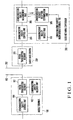
- Fig. 1 shows the system configuration of a mobile communication system according to an embodiment of the present invention.
- reference numeral 100 denotes a mobile terminal; 200, a radio base station connected to the mobile terminal 100 through a radio channel; and 300, a radio network controller connected to the radio base station to control the communication quality between the mobile terminal 100 and the radio base station 200.
- the mobile terminal 100 has a radio transmitter/receiver 101 for transmitting/receiving a radio signal through an antenna 102, a communication quality request unit 103 for requesting a communication quality of the radio base station 200 in requesting communication, and a communication quality control unit 104 for controlling the communication quality in accordance with that requested by the radio network controller 300.
- the radio base station 200 has a radio transmitter/receiver 201 for transmitting/receiving a radio signal to/from the mobile terminal 100 through an antenna 202.
- the radio network controller 300 has a communication quality request unit 303 for requesting a communication quality of the mobile terminal 100, a communication quality control unit 304 for controlling the communication quality in accordance with that requested by the mobile terminal 100, a communication quality measurement unit 305 for measuring the communication quality of communication which requests without communication quality, and a communication request reception determination unit 306 for determining on the basis of the measurement result from the communication quality measurement unit 305 whether a communication request is to be received. Only components relevant to an understanding of the invention are shown.
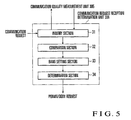
- the communication request reception determination unit 306 has an inquiry section 31 for, upon receiving a communication request, inquiring of the communication quality measurement unit 305 about a communication quality Q provided to communication which requests without communication quality, a comparison section 32 for comparing the communication quality Q output from the communication quality measurement unit 305 in response to the inquiry with first and second threshold values QH and QL, a bandwidth setting section 33 for re-setting an allowable communication bandwidth on the basis of the comparison result from the comparison section, and a determination section 34 for determining whether the communication request is to be received, on the basis of the bandwidth required by the received communication request and the allowable communication bandwidth re-set by the bandwidth setting section 33.
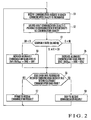
- the inquiry section 31 in the communication request reception determination unit 306 inquires of the communication quality measurement unit 305 about the communication quality Q provided to communication which requests without communication quality (step S2). In response to the inquiry, the communication quality measurement unit 305 measures the communication quality Q of communication which requests without communication quality and outputs the communication quality Q to the communication request reception determination unit 306.
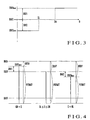
- Fig. 3 shows the setting situation of the allowable communication bandwidth BW0.
- the abscissa represents the communication quality Q
- the ordinate represents the allowable communication bandwidth BW0.
- the current allowable communication bandwidth BW0 is kept unchanged.
- QH ⁇ Q the value (BW0 + BW1) obtained by adding the predetermined value BW1 to the current allowable communication bandwidth BW0 is set as the new allowable communication bandwidth BW0 new .
- Q ⁇ QL the value (BW0 - BW2) obtained by subtracting the predetermined value BW2 from the current allowable communication bandwidth BW0 is set as the new allowable communication bandwidth BW0 new .
- the determination section in the communication request reception determination unit 306 determines whether a bandwidth (bandwidth required by user data) BWU required by the communication request received in step S1 falls within the allowable communication bandwidth BW0 (including the new allowable communication bandwidth BW0 new ) (step S6). If the bandwidth BWU falls within the allowable communication bandwidth BW0, the communication request is received (step S7). If the bandwidth BWU falls outside the allowable communication bandwidth BW0, the communication request is denied (step S8).
- a bandwidth (bandwidth required by user data) BWU required by the communication request received in step S1 falls within the allowable communication bandwidth BW0 (including the new allowable communication bandwidth BW0 new )
- the error rate in the radio channel between the mobile terminal 100 and the radio base station 200 is higher than in a wired line. For this reason, retransmission control or an error correcting code is often used in the communication quality control units 104 and 304. In this case, a difference is generated between the bandwidth BWU required by user data and the bandwidth for actual use of the radio channel.
- a necessary bandwidth when retransmission control or an error correcting code is used is narrow.
- the communication quality Q provided to communication which requests without communication quality is low, a necessary bandwidth when retransmission control or an error correcting code is used is wide. If the necessary bandwidth is ensured as a predetermined width in a communication bandwidth BWh of the radio channel, i.e., a predetermined allowable communication bandwidth BW0 is set, the utilization efficiency of the radio channel cannot be improved.
- the allowable communication bandwidth BW0 is widened by BW1.
- the allowable communication bandwidth BW0 is narrowed by BW2.
- the allowable communication bandwidth BW0 exceeds the communication bandwidth BWh of the radio channel, the allowable communication bandwidth BW0 is set to BWh. If the newly set allowable communication bandwidth BW0 is lower than the communication bandwidth BW1 of the radio channel, the allowable communication bandwidth BW0 is set to BW1. That is, the upper and lower limits of the allowable communication bandwidth BW0 are regulated by the communication bandwidths BWh and BW1.
- the allowable communication bandwidth BW0 when QH ⁇ Q, the allowable communication bandwidth BW0 is widened (the ensured amount of the necessary bandwidth when retransmission control or an error correcting code is used is decreased), and the bandwidth BWU of a receivable communication request becomes wide.
- Q ⁇ QL when Q ⁇ QL, the allowable communication bandwidth BW0 is narrowed (the ensured amount of the necessary bandwidth when retransmission control or an error correcting code is used is increased), and the bandwidth BWU of a receivable communication request becomes narrow. With this operation, the allowable communication bandwidth BW0 changes. The communication quality for a communication request permitted to receive is guaranteed, and the utilization efficiency of the radio channel is improved.
- the mobile terminal 100 requests a data error rate or delay time of the radio network controller 300.
- the radio network controller when a communication request which designates the communication quality is received, it is determined whether the received communication request is to be received in accordance with the value of the communication quality provided to communication which requests without communication quality. If the communication quality is high, the allowable communication bandwidth is widened. If the communication quality is low, the allowable communication bandwidth is narrowed. With this processing, the utilization efficiency of a radio channel can be improved while ensuring the necessary bandwidth when retransmission control or an error correcting code is used.
Landscapes
- Engineering & Computer Science (AREA)
- Quality & Reliability (AREA)
- Computer Networks & Wireless Communication (AREA)
- Signal Processing (AREA)
- Mobile Radio Communication Systems (AREA)
- Telephonic Communication Services (AREA)
Description
- The present invention relates to a mobile communication system having a radio network controller for controlling the communication quality between a mobile terminal and a radio base station.
- Along with popularization of the Internet, the number of users who access the Internet using mobile terminals is increasing. Conventionally, for a fixed network, Diffserv for priority control (K. Nichols, et al., "Definition of the Differentiated Services Field (DS Field) in the IPv4 and IPv6 Headers", IETF RFC2474, Dec. 1998) or RSVP for bandwidth reservation (R. Ed, et al., "Resource ReSerVation Protocol (RSVP)
Version 1 Functional Specification", IETF RFC2205, Sept. 1997) has been examined to satisfy the communication quality requested by users. - EP-A-1 059 792 discloses a wireless quality of service agent for an all-Internet Protocol network. The agent is able to seamlessly extend quality of service support for multimedia applications from wireline to wireless.
- US-A-5 857 147 discloses a method and apparatus for controlling the data rates for communications to and from a base station and a plurality of remote users. The measured usage value is compared against a threshold value and the data rates are modified accordingly.
- In a mobile communication system, however, the communication quality requested by users cannot be satisfied only by priority control (as Diffserv) or bandwidth reservation (as RSVP). The communication quality in a mobile communication system largely depends on the error rate in a radio zone. As a method of reducing the error rate in the radio zone, retransmission control or an error correcting code is used. When retransmission control or an error correcting code is used, the necessary bandwidth widens. When the necessary bandwidth is ensured as a predetermined width in the communication bandwidth of a radio channel, the utilization efficiency of the radio channel cannot be improved.
- The invention in its various aspects is defined in the independent claims below, to which reference should now be made. Advantageous features are set forth in the appendant claims.
-
- Fig. 1 is a block diagram of a mobile communication system according to an embodiment of the present invention;
- Fig. 2 is a flow chart showing the processing operation of a communication request reception determination unit in a radio network controller shown in Fig. 1;
- Fig. 3 is a view showing the setting situation of an allowable communication bandwidth BW0 in the communication request reception determination operation shown in Fig. 2;
- Fig. 4 is a view showing reception permission and reception denial situations when a communication request which designates a communication quality is received; and
- Fig. 5 is a block diagram of the communication request reception determination unit shown in Fig. 1.
-
- The present invention will be described below by way of example with reference to the accompanying drawings.
- Fig. 1 shows the system configuration of a mobile communication system according to an embodiment of the present invention. Referring to Fig. 1,
reference numeral 100 denotes a mobile terminal; 200, a radio base station connected to themobile terminal 100 through a radio channel; and 300, a radio network controller connected to the radio base station to control the communication quality between themobile terminal 100 and theradio base station 200. - The
mobile terminal 100 has a radio transmitter/receiver 101 for transmitting/receiving a radio signal through anantenna 102, a communicationquality request unit 103 for requesting a communication quality of theradio base station 200 in requesting communication, and a communicationquality control unit 104 for controlling the communication quality in accordance with that requested by theradio network controller 300. Theradio base station 200 has a radio transmitter/receiver 201 for transmitting/receiving a radio signal to/from themobile terminal 100 through anantenna 202. Theradio network controller 300 has a communicationquality request unit 303 for requesting a communication quality of themobile terminal 100, a communicationquality control unit 304 for controlling the communication quality in accordance with that requested by themobile terminal 100, a communicationquality measurement unit 305 for measuring the communication quality of communication which requests without communication quality, and a communication requestreception determination unit 306 for determining on the basis of the measurement result from the communicationquality measurement unit 305 whether a communication request is to be received. Only components relevant to an understanding of the invention are shown. - As shown in Fig. 5, the communication request
reception determination unit 306 has aninquiry section 31 for, upon receiving a communication request, inquiring of the communicationquality measurement unit 305 about a communication quality Q provided to communication which requests without communication quality, acomparison section 32 for comparing the communication quality Q output from the communicationquality measurement unit 305 in response to the inquiry with first and second threshold values QH and QL, abandwidth setting section 33 for re-setting an allowable communication bandwidth on the basis of the comparison result from the comparison section, and adetermination section 34 for determining whether the communication request is to be received, on the basis of the bandwidth required by the received communication request and the allowable communication bandwidth re-set by thebandwidth setting section 33. - The operation of the communication request
reception determination unit 306 in theradio network controller 300 will be described next with reference to Fig. 2. - Upon receiving from the mobile terminal 100 (or a device externally connected to the mobile terminal 100) a communication request which designates a communication quality to be provided (step S1), the
inquiry section 31 in the communication requestreception determination unit 306 inquires of the communicationquality measurement unit 305 about the communication quality Q provided to communication which requests without communication quality (step S2). In response to the inquiry, the communicationquality measurement unit 305 measures the communication quality Q of communication which requests without communication quality and outputs the communication quality Q to the communication requestreception determination unit 306. - The
comparison section 32 compares the measured communication quality Q output from the communicationquality measurement unit 305 with the first and second threshold values QH and QL (QL < QH) (step S3). As a result of comparison, if the measured communication quality Q is higher than the first threshold value QH (QH < Q), thebandwidth setting section 33 increases a current allowable communication bandwidth BW0 by a predetermined value BW1 to set a new allowable communication bandwidth BW0 (= BW0new) (step S4). If the measured communication quality Q is lower than the second threshold value QL (Q < QL), thebandwidth setting section 33 decreases the current allowable communication bandwidth BW0 by a predetermined value BW2 to set the new allowable communication bandwidth BW0 (= BW0new) (step S5). If the measured communication quality Q is between the first threshold value QH and the second threshold value QL (QL ≦ Q ≦ QH), the current allowable communication bandwidth BW0 is maintained, i.e., neither increased nor decreased. - Fig. 3 shows the setting situation of the allowable communication bandwidth BW0. The abscissa represents the communication quality Q, and the ordinate represents the allowable communication bandwidth BW0. As shown in Fig. 3, when QL ≦ Q ≦ QH, the current allowable communication bandwidth BW0 is kept unchanged. If QH < Q, the value (BW0 + BW1) obtained by adding the predetermined value BW1 to the current allowable communication bandwidth BW0 is set as the new allowable communication bandwidth BW0new. If Q < QL, the value (BW0 - BW2) obtained by subtracting the predetermined value BW2 from the current allowable communication bandwidth BW0 is set as the new allowable communication bandwidth BW0new.
- Next, the determination section in the communication request
reception determination unit 306 determines whether a bandwidth (bandwidth required by user data) BWU required by the communication request received in step S1 falls within the allowable communication bandwidth BW0 (including the new allowable communication bandwidth BW0new) (step S6). If the bandwidth BWU falls within the allowable communication bandwidth BW0, the communication request is received (step S7). If the bandwidth BWU falls outside the allowable communication bandwidth BW0, the communication request is denied (step S8). - The error rate in the radio channel between the
mobile terminal 100 and theradio base station 200 is higher than in a wired line. For this reason, retransmission control or an error correcting code is often used in the communicationquality control units - In this embodiment, when the communication quality Q is higher than the threshold value QH, and the necessary bandwidth when retransmission control or an error correcting code is used is probably narrow, the allowable communication bandwidth BW0 is widened by BW1. On the other hand, when the communication quality Q is lower than the threshold value QL, and the necessary bandwidth when retransmission control or an error correcting code is used is probably wide, the allowable communication bandwidth BW0 is narrowed by BW2.
- If the newly set allowable communication bandwidth BW0 exceeds the communication bandwidth BWh of the radio channel, the allowable communication bandwidth BW0 is set to BWh. If the newly set allowable communication bandwidth BW0 is lower than the communication bandwidth BW1 of the radio channel, the allowable communication bandwidth BW0 is set to BW1. That is, the upper and lower limits of the allowable communication bandwidth BW0 are regulated by the communication bandwidths BWh and BW1.
- Hence, as shown in Fig. 4, when QH < Q, the allowable communication bandwidth BW0 is widened (the ensured amount of the necessary bandwidth when retransmission control or an error correcting code is used is decreased), and the bandwidth BWU of a receivable communication request becomes wide. On the other hand, when Q < QL, the allowable communication bandwidth BW0 is narrowed (the ensured amount of the necessary bandwidth when retransmission control or an error correcting code is used is increased), and the bandwidth BWU of a receivable communication request becomes narrow. With this operation, the allowable communication bandwidth BW0 changes. The communication quality for a communication request permitted to receive is guaranteed, and the utilization efficiency of the radio channel is improved.
- As the communication quality, the
mobile terminal 100 requests a data error rate or delay time of theradio network controller 300. - As has been described above, according to the present system, in the radio network controller, when a communication request which designates the communication quality is received, it is determined whether the received communication request is to be received in accordance with the value of the communication quality provided to communication which requests without communication quality. If the communication quality is high, the allowable communication bandwidth is widened. If the communication quality is low, the allowable communication bandwidth is narrowed. With this processing, the utilization efficiency of a radio channel can be improved while ensuring the necessary bandwidth when retransmission control or an error correcting code is used.
Claims (5)
- A mobile communication system comprising:wherein said radio network controller (300) comprises:a mobile terminal (100) capable of designating a communication quality in a requested communication;a radio base station (200) connected to said mobile terminal (100) through a radio channel; anda radio network controller (300) connected to said radio base station (200) to control the communication quality between said mobile terminal (100) and said radio base station (200);wherein said communication request reception determination unit (306) comprises comparison means (32) for, upon receiving the communication request which designates said communication quality, comparing said measured communication quality Q output from said communication quality measurement unit (305) with at least one predetermined threshold value (QH, QL);a communication quality measurement unit (305) for measuring a communication quality Q; anda communication request reception determination unit (306) for, upon receiving a communication request which designates a communication quality from said mobile terminal (100), determining whether the received communication request is to be accepted;
characterised in that said communication quality measurement unit (305) measures communication quality Q provided to communications requested without communication quality;
and by the communication request reception determination unit (306) further comprising:bandwidth setting means (33) for re-setting, on the basis of a comparison result from said comparison means (32), a communication bandwidth to be assigned to communications to which the communication quality Q is not designated; anddetermination means (34) for determining whether the communication request which designates communication quality is to be accepted, on the basis of the bandwidth required by the received communication request, and on the basis of said communication quality Q provided to communications requested without communication quality and of the communication bandwidth re-set by said bandwidth setting means (33) whereinthere are two predetermined threshold values (QH, QL), and when said measured communication quality Q is higher than said first threshold value QH, said bandwidth setting means (33) increases said communication bandwidth (BW0) by a first predetermined value (BW1) to re-set to a new communication bandwidth, and when said measured communication quality Q is lower than said second threshold value QL (Q < QL), said bandwidth setting means (33) decreases said communication bandwidth by a second predetermined value (BW2) to re-set to a new communication bandwidth;when said measured communication quality Q has a value between said first threshold value QH and said second threshold value QL, said bandwidth setting means (33) maintains said communication bandwidth; andwhen the bandwidth required by said received communication request which designates communication quality falls within said re-set communication bandwidth, said determination means (34) accepts said communication request, and when the bandwidth required by said received communication request which designates communication quality falls outside said re-set communication bandwidth, said determination means (34) does not accept said communication request which designates a communication quality. - A system according to claim 1, wherein
said communication request reception determination unit (306) further comprises inquiry means (31) for, upon receiving a communication request which designates the communication quality, inquiring of said communication quality measurement unit (305) of said communication quality Q provided to communications requested without communication quality, and
said communication quality measurement unit (305) measuring said measured communication quality and outputting said measured communication quality to said determination means (34) in response to said inquiry from said inquiry means (31). - A system according to claim 1, wherein when the new communication bandwidth exceeds a communication bandwidth (BWh) of the radio channel, the communication bandwidth is set to the communication bandwidth (BWh) of the radio channel, and when the new communication bandwidth is lower than the communication bandwidth of the radio channel, the communication bandwidth is set to the first predetermined value (BW1).
- A radio network controller for use in a system according to claim 1 for controlling the communication quality between a mobile terminal and a radio base station, said radio network controller comprising:wherein said communication request reception determination unit (306) comprises comparison means (32) for, upon receiving the communication request which designates said communication quality, comparing said measured communication quality Q output from said communication quality measurement unit (305) with at least one predetermined threshold value (QH, QL);a communication quality measurement unit (305) for measuring a communication quality; anda communication request reception determination unit (306) for, upon receiving a communication request which designates a communication quality from said mobile terminal (100), determining whether the received communication request is to be accepted;
characterised in that said communication quality measurement unit (305) measures communication quality Q provided to communications requested without communication quality;
and by the communication request reception determination unit (306) further comprising:bandwidth setting means (33) for re-setting, on the basis of a comparison result from said comparison means (32), a communication bandwidth to be assigned to communication Q to which the communication quality is not designated; anddetermination means (34) for determining whether the communication request is to be accepted, on the basis of the bandwidth required by the received communication request, and on the basis of said communication quality Q provided to communications requested without communication quality and the communication bandwidth re-set by said bandwidth setting means (33) whereinthere are two predetermined threshold values (QH, QL), and when said measured communication quality Q is higher than said first threshold value QH, said bandwidth setting means (33) increases said communication bandwidth (BW0) by a first predetermined value (BW1) to re-set to a new communication bandwidth, and when said measured communication quality Q is lower than said second threshold value QL (Q < QL), said bandwidth setting means (33) decreases said communication bandwidth by a second predetermined value (BW2) to re-set to a new communication bandwidth;when said measured communication quality Q has a value between said first threshold value QH and said second threshold value QL, said bandwidth setting means (33) maintains said communication bandwidth; andwhen the bandwidth required by said received communication request which designates communication quality falls within said re-set communication bandwidth, said determination means (34) accepts said communication request, and when the bandwidth required by said received communication request which designates communication quality falls outside said re-set communication bandwidth, said determination means (34) does not accept said communication request which designates a communication quality. - A method of controlling a mobile communication system, the method comprising the steps of:characterised by measuring the communication quality Q provided to communications requested without communication quality;receiving a communication request which designates the communication quality from a mobile terminal unit (100);determining whether the received communication request is to be accepted;comparing said measured communication quality with at least one predetermined threshold value (QH,QL) to give a comparison result;
re-setting a communication bandwidth to be assigned to communications to which said communication quality is not designated on the basis of the comparison result; and
determining whether the communication request is to be accepted, on the basis of the bandwidth required by the received communication request, or on the basis of a communication quality Q provided to communications requested without communication quality and of the re-set communication bandwidth wherein
there are two predetermined threshold values (QH, QL), and when said measured communication quality is higher than said first threshold value QH, increasing said communication bandwidth (BW0) by a first predetermined value (BW1 to reset to a new communication bandwidth, and when said measured communication quality is lower than said second threshold value QL (Q<QL), decreasing said communication bandwidth by a second predetermined value (BW2) to re-set to a new communication bandwidth;
when said measured communication quality has a value between said first threshold value QH and said second threshold value QL, maintaining said communication bandwidth; and
when the bandwidth required by said received communication request falls within said re-set communication bandwidth, accepting said communication request, and when the bandwidth required by said received communication request falls outside said re-set communication bandwidth, not accepting said communication request.
Applications Claiming Priority (2)
| Application Number | Priority Date | Filing Date | Title |
|---|---|---|---|
| JP2001053814 | 2001-02-28 | ||
| JP2001053814A JP3608518B2 (en) | 2001-02-28 | 2001-02-28 | Mobile communication system |
Publications (3)
| Publication Number | Publication Date |
|---|---|
| EP1237391A2 EP1237391A2 (en) | 2002-09-04 |
| EP1237391A3 EP1237391A3 (en) | 2003-02-05 |
| EP1237391B1 true EP1237391B1 (en) | 2005-09-07 |
Family
ID=18914239
Family Applications (1)
| Application Number | Title | Priority Date | Filing Date |
|---|---|---|---|
| EP02251354A Expired - Lifetime EP1237391B1 (en) | 2001-02-28 | 2002-02-27 | Mobile communication system |
Country Status (3)
| Country | Link |
|---|---|
| US (1) | US7096028B2 (en) |
| EP (1) | EP1237391B1 (en) |
| JP (1) | JP3608518B2 (en) |
Families Citing this family (4)
| Publication number | Priority date | Publication date | Assignee | Title |
|---|---|---|---|---|
| JP4454320B2 (en) * | 2004-01-09 | 2010-04-21 | 富士通株式会社 | Transmission apparatus, transmission control program, and transmission method |
| US8036665B2 (en) * | 2004-10-28 | 2011-10-11 | At&T Mobility Ii Llc | Wireless mobile station call handoff |
| WO2006080238A1 (en) * | 2005-01-31 | 2006-08-03 | Matsushita Electric Industrial Co., Ltd. | Resource allocation system, mobile station, and base station |
| JP7121470B2 (en) * | 2017-05-12 | 2022-08-18 | キヤノン株式会社 | Image processing system, control method, and program |
Family Cites Families (28)
| Publication number | Priority date | Publication date | Assignee | Title |
|---|---|---|---|---|
| EP0388951A3 (en) * | 1989-03-23 | 1992-07-22 | Nec Corporation | Call control with transmission priority in a packet communication network of an atm type |
| ZA946674B (en) * | 1993-09-08 | 1995-05-02 | Qualcomm Inc | Method and apparatus for determining the transmission data rate in a multi-user communication system |
| US5432790A (en) * | 1993-09-17 | 1995-07-11 | Motorola, Inc. | Method for allocating internodal link bandwidth in a packet oriented communication network to guarantee delay quality-of-service |
| US5594782A (en) * | 1994-02-24 | 1997-01-14 | Gte Mobile Communications Service Corporation | Multiple mode personal wireless communications system |
| FI96558C (en) * | 1994-09-27 | 1996-07-10 | Nokia Telecommunications Oy | Method for data transmission in a TDMA mobile radio system and a mobile radio system for carrying out the method |
| US5826169A (en) * | 1995-09-25 | 1998-10-20 | Motorola, Inc. | Admission control system and method in space-based mobile telecommunication system |
| US5734646A (en) * | 1995-10-05 | 1998-03-31 | Lucent Technologies Inc. | Code division multiple access system providing load and interference based demand assignment service to users |
| US5740537A (en) * | 1996-01-30 | 1998-04-14 | Telefonaktiebolaget L M Ericsson (Publ) | Method and circuitry for selectively permitting communication in a multi-user communication system |
| JPH10108260A (en) | 1996-09-30 | 1998-04-24 | Toshiba Corp | Call admission control device |
| US5982748A (en) * | 1996-10-03 | 1999-11-09 | Nortel Networks Corporation | Method and apparatus for controlling admission of connection requests |
| JPH1169A (en) | 1997-06-11 | 1999-01-06 | Mitsubishi Heavy Ind Ltd | Spacer for water culture |
| EP0935369B1 (en) * | 1997-07-23 | 2012-05-02 | NTT DoCoMo, Inc. | Multiplex transmission system and band control method |
| EP0939566B1 (en) * | 1997-08-19 | 2008-05-28 | NTT DoCoMo, Inc. | Signal transmission method and base station device for mobile communications |
| JP2991167B2 (en) | 1997-08-27 | 1999-12-20 | 三菱電機株式会社 | TDMA variable slot allocation method |
| US6377548B1 (en) * | 1997-10-14 | 2002-04-23 | Lucent Technologies Inc. | Method for admitting new connections based on measured quantities in a multiple access system for communications networks |
| US6181684B1 (en) * | 1998-02-02 | 2001-01-30 | Motorola, Inc. | Air interface statistical multiplexing in communication systems |
| US6373855B1 (en) * | 1998-03-05 | 2002-04-16 | Intel Corporation | System and method for using audio performance to control video bandwidth |
| US6201971B1 (en) * | 1998-03-26 | 2001-03-13 | Nokia Mobile Phones Ltd. | Apparatus, and associated method for controlling service degradation performance of communications in a radio communication system |
| US6222824B1 (en) * | 1998-04-24 | 2001-04-24 | International Business Machines Corporation | Statistical call admission control |
| JP2000078146A (en) | 1998-08-28 | 2000-03-14 | Nippon Telegr & Teleph Corp <Ntt> | Radio channel control method for ABR service, radio base station and mobile terminal using the method |
| JP2000091985A (en) | 1998-09-08 | 2000-03-31 | Hitachi Ltd | Power control method for communication system |
| US6459681B1 (en) * | 1998-11-13 | 2002-10-01 | Sprint Communications Company L.P. | Method and system for connection admission control |
| JP2000165927A (en) | 1998-11-24 | 2000-06-16 | Toshiba Corp | Wireless communication system, communication control device, wireless base station, and wireless communication method |
| US6647265B1 (en) * | 1999-01-04 | 2003-11-11 | Telefonaktiebolaget Lm Ericsson (Publ) | Admission control of multiple adaptive and elastic applications |
| US6631122B1 (en) * | 1999-06-11 | 2003-10-07 | Nortel Networks Limited | Method and system for wireless QOS agent for all-IP network |
| KR20010056722A (en) * | 1999-12-16 | 2001-07-04 | 서평원 | Frame Relay Channel Assign Method For Data Call In Mobile Switching System |
| US20030003960A1 (en) * | 2000-12-01 | 2003-01-02 | Takahiro Shoji | Base station apparatus and channel access control method |
| US6631269B1 (en) * | 2002-05-23 | 2003-10-07 | Interdigital Technology Corporation | Signaling connection admission control in a wireless network |
-
2001
- 2001-02-28 JP JP2001053814A patent/JP3608518B2/en not_active Expired - Fee Related
-
2002
- 2002-02-27 US US10/083,302 patent/US7096028B2/en not_active Expired - Fee Related
- 2002-02-27 EP EP02251354A patent/EP1237391B1/en not_active Expired - Lifetime
Also Published As
| Publication number | Publication date |
|---|---|
| JP3608518B2 (en) | 2005-01-12 |
| JP2002262325A (en) | 2002-09-13 |
| US20020119755A1 (en) | 2002-08-29 |
| EP1237391A2 (en) | 2002-09-04 |
| EP1237391A3 (en) | 2003-02-05 |
| US7096028B2 (en) | 2006-08-22 |
Similar Documents
| Publication | Publication Date | Title |
|---|---|---|
| EP1314332B1 (en) | Class based bandwidth scheduling for cdma air interfaces | |
| US6374117B1 (en) | Queue based power control scheduling | |
| US7027392B2 (en) | Method and apparatus for scheduling packet data transmissions in a wireless communication system | |
| US20060045050A1 (en) | Method and system for a quality of service mechanism for a wireless network | |
| US6216006B1 (en) | Method for an admission control function for a wireless data network | |
| US8537875B2 (en) | Methods and apparatus for adjusting forward link signal to interference and noise ratio estimates | |
| US20050063389A1 (en) | Scheduling of wireless packet data transmissions | |
| US6982969B1 (en) | Method and system for frequency spectrum resource allocation | |
| EP1423934B1 (en) | Method and system for bit rate adaptation | |
| US7012904B2 (en) | Method for controlling transmission capacity and mobile communication system | |
| CA2552783A1 (en) | Wireless local area network radio resource management admission control | |
| EP1397875A1 (en) | Method and apparatus for congestion control in a wireless communication system | |
| EP1393510A1 (en) | Method and apparatus for reduction of congestion through data rate adjustment in a wireless communication system | |
| EP2206298A1 (en) | Wireless transmission rate control method | |
| US7072961B1 (en) | Data session service initialization for wireless devices | |
| US7623496B2 (en) | Managing bandwidth in network supporting variable bit rate | |
| US7672308B2 (en) | Admission control for data connections | |
| US20260006499A1 (en) | Method and apparatus for processing new service | |
| US7801043B2 (en) | Method and apparatus for admission control and resource tracking in a wireless communication system | |
| US7747242B2 (en) | Wireless communication system, base station, packet control function apparatus, node apparatus and accounting server | |
| EP1237391B1 (en) | Mobile communication system | |
| US7480488B2 (en) | Providing optimal uplink data rates to mobile stations when mobile networks send parameters controlling the data rates | |
| US6944461B2 (en) | Communication system and method for quality-based call admission control and scheduling | |
| US20060187835A1 (en) | Apparatus and method for adjusting adaptive service bandwidth in quality of service guaranteed network | |
| US7693057B2 (en) | Method, network element and terminal device for marking data packets |
Legal Events
| Date | Code | Title | Description |
|---|---|---|---|
| PUAI | Public reference made under article 153(3) epc to a published international application that has entered the european phase |
Free format text: ORIGINAL CODE: 0009012 |
|
| AK | Designated contracting states |
Kind code of ref document: A2 Designated state(s): AT BE CH CY DE DK ES FI FR GB GR IE IT LI LU MC NL PT SE TR |
|
| AX | Request for extension of the european patent |
Free format text: AL;LT;LV;MK;RO;SI |
|
| PUAL | Search report despatched |
Free format text: ORIGINAL CODE: 0009013 |
|
| AK | Designated contracting states |
Designated state(s): AT BE CH CY DE DK ES FI FR GB GR IE IT LI LU MC NL PT SE TR |
|
| AX | Request for extension of the european patent |
Extension state: AL LT LV MK RO SI |
|
| 17P | Request for examination filed |
Effective date: 20021223 |
|
| 17Q | First examination report despatched |
Effective date: 20030506 |
|
| AKX | Designation fees paid |
Designated state(s): GB SE |
|
| REG | Reference to a national code |
Ref country code: DE Ref legal event code: 8566 |
|
| GRAP | Despatch of communication of intention to grant a patent |
Free format text: ORIGINAL CODE: EPIDOSNIGR1 |
|
| GRAS | Grant fee paid |
Free format text: ORIGINAL CODE: EPIDOSNIGR3 |
|
| GRAA | (expected) grant |
Free format text: ORIGINAL CODE: 0009210 |
|
| AK | Designated contracting states |
Kind code of ref document: B1 Designated state(s): GB SE |
|
| REG | Reference to a national code |
Ref country code: GB Ref legal event code: FG4D |
|
| REG | Reference to a national code |
Ref country code: SE Ref legal event code: TRGR |
|
| PLBE | No opposition filed within time limit |
Free format text: ORIGINAL CODE: 0009261 |
|
| STAA | Information on the status of an ep patent application or granted ep patent |
Free format text: STATUS: NO OPPOSITION FILED WITHIN TIME LIMIT |
|
| 26N | No opposition filed |
Effective date: 20060608 |
|
| PGFP | Annual fee paid to national office [announced via postgrant information from national office to epo] |
Ref country code: GB Payment date: 20180221 Year of fee payment: 17 |
|
| PGFP | Annual fee paid to national office [announced via postgrant information from national office to epo] |
Ref country code: SE Payment date: 20180213 Year of fee payment: 17 |
|
| REG | Reference to a national code |
Ref country code: SE Ref legal event code: EUG |
|
| GBPC | Gb: european patent ceased through non-payment of renewal fee |
Effective date: 20190227 |
|
| PG25 | Lapsed in a contracting state [announced via postgrant information from national office to epo] |
Ref country code: SE Free format text: LAPSE BECAUSE OF NON-PAYMENT OF DUE FEES Effective date: 20190228 |
|
| PG25 | Lapsed in a contracting state [announced via postgrant information from national office to epo] |
Ref country code: GB Free format text: LAPSE BECAUSE OF NON-PAYMENT OF DUE FEES Effective date: 20190227 |