EP1237818B1 - Materiau zeolitique mesoporeux ayant des parois de mesopore cristallines microporeuses - Google Patents
Materiau zeolitique mesoporeux ayant des parois de mesopore cristallines microporeuses Download PDFInfo
- Publication number
- EP1237818B1 EP1237818B1 EP00979294A EP00979294A EP1237818B1 EP 1237818 B1 EP1237818 B1 EP 1237818B1 EP 00979294 A EP00979294 A EP 00979294A EP 00979294 A EP00979294 A EP 00979294A EP 1237818 B1 EP1237818 B1 EP 1237818B1
- Authority
- EP
- European Patent Office
- Prior art keywords
- mesoporous
- zeolite
- walls
- silica
- zeolitic material
- Prior art date
- Legal status (The legal status is an assumption and is not a legal conclusion. Google has not performed a legal analysis and makes no representation as to the accuracy of the status listed.)
- Expired - Lifetime
Links
- 239000000463 material Substances 0.000 title claims abstract description 67
- 239000010457 zeolite Substances 0.000 claims abstract description 27
- VYPSYNLAJGMNEJ-UHFFFAOYSA-N Silicium dioxide Chemical compound O=[Si]=O VYPSYNLAJGMNEJ-UHFFFAOYSA-N 0.000 claims description 80
- 238000000034 method Methods 0.000 claims description 40
- 239000000377 silicon dioxide Substances 0.000 claims description 38
- 239000004094 surface-active agent Substances 0.000 claims description 19
- 239000010936 titanium Substances 0.000 claims description 18
- 150000001875 compounds Chemical class 0.000 claims description 17
- 229910021536 Zeolite Inorganic materials 0.000 claims description 16
- 229910052719 titanium Inorganic materials 0.000 claims description 13
- RTAQQCXQSZGOHL-UHFFFAOYSA-N Titanium Chemical compound [Ti] RTAQQCXQSZGOHL-UHFFFAOYSA-N 0.000 claims description 12
- HNPSIPDUKPIQMN-UHFFFAOYSA-N dioxosilane;oxo(oxoalumanyloxy)alumane Chemical compound O=[Si]=O.O=[Al]O[Al]=O HNPSIPDUKPIQMN-UHFFFAOYSA-N 0.000 claims description 12
- XLYOFNOQVPJJNP-UHFFFAOYSA-N water Chemical compound O XLYOFNOQVPJJNP-UHFFFAOYSA-N 0.000 claims description 11
- 239000002243 precursor Substances 0.000 claims description 10
- 229910052782 aluminium Inorganic materials 0.000 claims description 8
- XAGFODPZIPBFFR-UHFFFAOYSA-N aluminium Chemical compound [Al] XAGFODPZIPBFFR-UHFFFAOYSA-N 0.000 claims description 8
- 239000000693 micelle Substances 0.000 claims description 8
- 239000000243 solution Substances 0.000 claims description 8
- LPSKDVINWQNWFE-UHFFFAOYSA-M tetrapropylazanium;hydroxide Chemical compound [OH-].CCC[N+](CCC)(CCC)CCC LPSKDVINWQNWFE-UHFFFAOYSA-M 0.000 claims description 8
- 238000010438 heat treatment Methods 0.000 claims description 7
- LRGJRHZIDJQFCL-UHFFFAOYSA-M tetraethylazanium;hydroxide Chemical compound [OH-].CC[N+](CC)(CC)CC LRGJRHZIDJQFCL-UHFFFAOYSA-M 0.000 claims description 7
- 230000015572 biosynthetic process Effects 0.000 claims description 6
- 239000000203 mixture Substances 0.000 claims description 6
- 229920001400 block copolymer Polymers 0.000 claims description 5
- 238000001354 calcination Methods 0.000 claims description 5
- 229920000233 poly(alkylene oxides) Polymers 0.000 claims description 5
- 230000009466 transformation Effects 0.000 claims description 5
- 239000002798 polar solvent Substances 0.000 claims description 4
- 238000001556 precipitation Methods 0.000 claims description 4
- 239000002904 solvent Substances 0.000 claims description 4
- 239000007864 aqueous solution Substances 0.000 claims description 3
- 238000001035 drying Methods 0.000 claims description 2
- 238000002156 mixing Methods 0.000 claims description 2
- 239000002736 nonionic surfactant Substances 0.000 claims 1
- 239000002808 molecular sieve Substances 0.000 abstract description 9
- URGAHOPLAPQHLN-UHFFFAOYSA-N sodium aluminosilicate Chemical compound [Na+].[Al+3].[O-][Si]([O-])=O.[O-][Si]([O-])=O URGAHOPLAPQHLN-UHFFFAOYSA-N 0.000 abstract description 9
- 230000003197 catalytic effect Effects 0.000 abstract description 7
- 239000002253 acid Substances 0.000 abstract description 3
- 238000002425 crystallisation Methods 0.000 description 29
- 230000008025 crystallization Effects 0.000 description 29
- 239000011148 porous material Substances 0.000 description 25
- 239000007858 starting material Substances 0.000 description 23
- 238000002441 X-ray diffraction Methods 0.000 description 15
- 238000004400 29Si cross polarisation magic angle spinning Methods 0.000 description 11
- VSCWAEJMTAWNJL-UHFFFAOYSA-K aluminium trichloride Chemical compound Cl[Al](Cl)Cl VSCWAEJMTAWNJL-UHFFFAOYSA-K 0.000 description 10
- 238000002360 preparation method Methods 0.000 description 10
- 238000002336 sorption--desorption measurement Methods 0.000 description 10
- 238000009826 distribution Methods 0.000 description 9
- 239000007787 solid Substances 0.000 description 9
- VXEGSRKPIUDPQT-UHFFFAOYSA-N 4-[4-(4-methoxyphenyl)piperazin-1-yl]aniline Chemical compound C1=CC(OC)=CC=C1N1CCN(C=2C=CC(N)=CC=2)CC1 VXEGSRKPIUDPQT-UHFFFAOYSA-N 0.000 description 8
- LFQSCWFLJHTTHZ-UHFFFAOYSA-N Ethanol Chemical compound CCO LFQSCWFLJHTTHZ-UHFFFAOYSA-N 0.000 description 8
- 239000005049 silicon tetrachloride Substances 0.000 description 8
- 238000003917 TEM image Methods 0.000 description 7
- 239000013335 mesoporous material Substances 0.000 description 6
- 229940073455 tetraethylammonium hydroxide Drugs 0.000 description 6
- 238000005033 Fourier transform infrared spectroscopy Methods 0.000 description 5
- BOTDANWDWHJENH-UHFFFAOYSA-N Tetraethyl orthosilicate Chemical compound CCO[Si](OCC)(OCC)OCC BOTDANWDWHJENH-UHFFFAOYSA-N 0.000 description 5
- 239000002159 nanocrystal Substances 0.000 description 5
- 239000000126 substance Substances 0.000 description 5
- 238000001157 Fourier transform infrared spectrum Methods 0.000 description 4
- 229920002415 Pluronic P-123 Polymers 0.000 description 4
- 238000001228 spectrum Methods 0.000 description 4
- 238000010521 absorption reaction Methods 0.000 description 3
- 239000003513 alkali Substances 0.000 description 3
- 239000003054 catalyst Substances 0.000 description 3
- 238000003795 desorption Methods 0.000 description 3
- 235000019441 ethanol Nutrition 0.000 description 3
- 238000011049 filling Methods 0.000 description 3
- 239000002105 nanoparticle Substances 0.000 description 3
- 239000002245 particle Substances 0.000 description 3
- 230000008569 process Effects 0.000 description 3
- 238000001179 sorption measurement Methods 0.000 description 3
- 238000003756 stirring Methods 0.000 description 3
- IJGRMHOSHXDMSA-UHFFFAOYSA-N Atomic nitrogen Chemical compound N#N IJGRMHOSHXDMSA-UHFFFAOYSA-N 0.000 description 2
- 229920006362 Teflon® Polymers 0.000 description 2
- GWEVSGVZZGPLCZ-UHFFFAOYSA-N Titan oxide Chemical compound O=[Ti]=O GWEVSGVZZGPLCZ-UHFFFAOYSA-N 0.000 description 2
- 230000002378 acidificating effect Effects 0.000 description 2
- 238000001116 aluminium-27 magic angle spinning nuclear magnetic resonance spectrum Methods 0.000 description 2
- 229910052681 coesite Inorganic materials 0.000 description 2
- 229910052906 cristobalite Inorganic materials 0.000 description 2
- 239000013078 crystal Substances 0.000 description 2
- 238000000867 diffuse reflectance ultraviolet--visible spectrophotometry Methods 0.000 description 2
- 125000002887 hydroxy group Chemical group [H]O* 0.000 description 2
- 238000004519 manufacturing process Methods 0.000 description 2
- 239000000047 product Substances 0.000 description 2
- 229910052710 silicon Inorganic materials 0.000 description 2
- 239000010703 silicon Substances 0.000 description 2
- 241000894007 species Species 0.000 description 2
- 229910052682 stishovite Inorganic materials 0.000 description 2
- 238000003786 synthesis reaction Methods 0.000 description 2
- 238000004627 transmission electron microscopy Methods 0.000 description 2
- 229910052905 tridymite Inorganic materials 0.000 description 2
- HNUQMTZUNUBOLQ-UHFFFAOYSA-N 2-[2-[2-[2-[2-[2-[2-[2-[2-(2-octadecoxyethoxy)ethoxy]ethoxy]ethoxy]ethoxy]ethoxy]ethoxy]ethoxy]ethoxy]ethanol Chemical compound CCCCCCCCCCCCCCCCCCOCCOCCOCCOCCOCCOCCOCCOCCOCCOCCO HNUQMTZUNUBOLQ-UHFFFAOYSA-N 0.000 description 1
- NLMKTBGFQGKQEV-UHFFFAOYSA-N 2-[2-[2-[2-[2-[2-[2-[2-[2-[2-[2-[2-[2-[2-[2-[2-[2-[2-[2-(2-hexadecoxyethoxy)ethoxy]ethoxy]ethoxy]ethoxy]ethoxy]ethoxy]ethoxy]ethoxy]ethoxy]ethoxy]ethoxy]ethoxy]ethoxy]ethoxy]ethoxy]ethoxy]ethoxy]ethoxy]ethanol Chemical compound CCCCCCCCCCCCCCCCOCCOCCOCCOCCOCCOCCOCCOCCOCCOCCOCCOCCOCCOCCOCCOCCOCCOCCOCCOCCO NLMKTBGFQGKQEV-UHFFFAOYSA-N 0.000 description 1
- 229910017119 AlPO Inorganic materials 0.000 description 1
- 238000004566 IR spectroscopy Methods 0.000 description 1
- 102220500397 Neutral and basic amino acid transport protein rBAT_M41T_mutation Human genes 0.000 description 1
- 241000287181 Sturnus vulgaris Species 0.000 description 1
- 239000004809 Teflon Substances 0.000 description 1
- 239000003463 adsorbent Substances 0.000 description 1
- PNEYBMLMFCGWSK-UHFFFAOYSA-N aluminium oxide Inorganic materials [O-2].[O-2].[O-2].[Al+3].[Al+3] PNEYBMLMFCGWSK-UHFFFAOYSA-N 0.000 description 1
- 229910021486 amorphous silicon dioxide Inorganic materials 0.000 description 1
- 238000004458 analytical method Methods 0.000 description 1
- 230000002902 bimodal effect Effects 0.000 description 1
- 230000005540 biological transmission Effects 0.000 description 1
- 238000004523 catalytic cracking Methods 0.000 description 1
- 230000008859 change Effects 0.000 description 1
- 238000006243 chemical reaction Methods 0.000 description 1
- 239000007795 chemical reaction product Substances 0.000 description 1
- 239000003795 chemical substances by application Substances 0.000 description 1
- 238000009833 condensation Methods 0.000 description 1
- 230000005494 condensation Effects 0.000 description 1
- 229910052593 corundum Inorganic materials 0.000 description 1
- 238000009792 diffusion process Methods 0.000 description 1
- IJKVHSBPTUYDLN-UHFFFAOYSA-N dihydroxy(oxo)silane Chemical compound O[Si](O)=O IJKVHSBPTUYDLN-UHFFFAOYSA-N 0.000 description 1
- 239000012153 distilled water Substances 0.000 description 1
- 238000001704 evaporation Methods 0.000 description 1
- 238000001914 filtration Methods 0.000 description 1
- 230000005660 hydrophilic surface Effects 0.000 description 1
- 230000002209 hydrophobic effect Effects 0.000 description 1
- 150000002605 large molecules Chemical class 0.000 description 1
- 229920002521 macromolecule Polymers 0.000 description 1
- 239000011159 matrix material Substances 0.000 description 1
- 229910052751 metal Inorganic materials 0.000 description 1
- 239000002184 metal Substances 0.000 description 1
- 239000012229 microporous material Substances 0.000 description 1
- 230000005012 migration Effects 0.000 description 1
- 238000013508 migration Methods 0.000 description 1
- 230000004048 modification Effects 0.000 description 1
- 238000012986 modification Methods 0.000 description 1
- 229910052757 nitrogen Inorganic materials 0.000 description 1
- 238000010899 nucleation Methods 0.000 description 1
- 230000006911 nucleation Effects 0.000 description 1
- 239000003921 oil Substances 0.000 description 1
- 230000037361 pathway Effects 0.000 description 1
- 229920001992 poloxamer 407 Polymers 0.000 description 1
- HKJYVRJHDIPMQB-UHFFFAOYSA-N propan-1-olate;titanium(4+) Chemical compound CCCO[Ti](OCCC)(OCCC)OCCC HKJYVRJHDIPMQB-UHFFFAOYSA-N 0.000 description 1
- 239000000376 reactant Substances 0.000 description 1
- 238000007670 refining Methods 0.000 description 1
- 150000003839 salts Chemical class 0.000 description 1
- 238000010517 secondary reaction Methods 0.000 description 1
- 125000005372 silanol group Chemical group 0.000 description 1
- 150000003377 silicon compounds Chemical class 0.000 description 1
- 238000004611 spectroscopical analysis Methods 0.000 description 1
- BFKJFAAPBSQJPD-UHFFFAOYSA-N tetrafluoroethene Chemical compound FC(F)=C(F)F BFKJFAAPBSQJPD-UHFFFAOYSA-N 0.000 description 1
- -1 titanium ions Chemical class 0.000 description 1
- 238000002371 ultraviolet--visible spectrum Methods 0.000 description 1
- 229910001845 yogo sapphire Inorganic materials 0.000 description 1
Images






Classifications
-
- C—CHEMISTRY; METALLURGY
- C01—INORGANIC CHEMISTRY
- C01B—NON-METALLIC ELEMENTS; COMPOUNDS THEREOF; METALLOIDS OR COMPOUNDS THEREOF NOT COVERED BY SUBCLASS C01C
- C01B39/00—Compounds having molecular sieve and base-exchange properties, e.g. crystalline zeolites; Their preparation; After-treatment, e.g. ion-exchange or dealumination
- C01B39/02—Crystalline aluminosilicate zeolites; Isomorphous compounds thereof; Direct preparation thereof; Preparation thereof starting from a reaction mixture containing a crystalline zeolite of another type, or from preformed reactants; After-treatment thereof
- C01B39/36—Pentasil type, e.g. types ZSM-5, ZSM-8 or ZSM-11
- C01B39/38—Type ZSM-5
-
- B—PERFORMING OPERATIONS; TRANSPORTING
- B01—PHYSICAL OR CHEMICAL PROCESSES OR APPARATUS IN GENERAL
- B01J—CHEMICAL OR PHYSICAL PROCESSES, e.g. CATALYSIS OR COLLOID CHEMISTRY; THEIR RELEVANT APPARATUS
- B01J29/00—Catalysts comprising molecular sieves
- B01J29/005—Mixtures of molecular sieves comprising at least one molecular sieve which is not an aluminosilicate zeolite, e.g. from groups B01J29/03 - B01J29/049 or B01J29/82 - B01J29/89
-
- B—PERFORMING OPERATIONS; TRANSPORTING
- B01—PHYSICAL OR CHEMICAL PROCESSES OR APPARATUS IN GENERAL
- B01J—CHEMICAL OR PHYSICAL PROCESSES, e.g. CATALYSIS OR COLLOID CHEMISTRY; THEIR RELEVANT APPARATUS
- B01J29/00—Catalysts comprising molecular sieves
- B01J29/04—Catalysts comprising molecular sieves having base-exchange properties, e.g. crystalline zeolites
- B01J29/041—Mesoporous materials having base exchange properties, e.g. Si/Al-MCM-41
-
- C—CHEMISTRY; METALLURGY
- C01—INORGANIC CHEMISTRY
- C01B—NON-METALLIC ELEMENTS; COMPOUNDS THEREOF; METALLOIDS OR COMPOUNDS THEREOF NOT COVERED BY SUBCLASS C01C
- C01B37/00—Compounds having molecular sieve properties but not having base-exchange properties
- C01B37/005—Silicates, i.e. so-called metallosilicalites or metallozeosilites
-
- C—CHEMISTRY; METALLURGY
- C01—INORGANIC CHEMISTRY
- C01B—NON-METALLIC ELEMENTS; COMPOUNDS THEREOF; METALLOIDS OR COMPOUNDS THEREOF NOT COVERED BY SUBCLASS C01C
- C01B37/00—Compounds having molecular sieve properties but not having base-exchange properties
- C01B37/02—Crystalline silica-polymorphs, e.g. silicalites dealuminated aluminosilicate zeolites
-
- C—CHEMISTRY; METALLURGY
- C01—INORGANIC CHEMISTRY
- C01B—NON-METALLIC ELEMENTS; COMPOUNDS THEREOF; METALLOIDS OR COMPOUNDS THEREOF NOT COVERED BY SUBCLASS C01C
- C01B39/00—Compounds having molecular sieve and base-exchange properties, e.g. crystalline zeolites; Their preparation; After-treatment, e.g. ion-exchange or dealumination
-
- C—CHEMISTRY; METALLURGY
- C01—INORGANIC CHEMISTRY
- C01B—NON-METALLIC ELEMENTS; COMPOUNDS THEREOF; METALLOIDS OR COMPOUNDS THEREOF NOT COVERED BY SUBCLASS C01C
- C01B39/00—Compounds having molecular sieve and base-exchange properties, e.g. crystalline zeolites; Their preparation; After-treatment, e.g. ion-exchange or dealumination
- C01B39/02—Crystalline aluminosilicate zeolites; Isomorphous compounds thereof; Direct preparation thereof; Preparation thereof starting from a reaction mixture containing a crystalline zeolite of another type, or from preformed reactants; After-treatment thereof
- C01B39/04—Crystalline aluminosilicate zeolites; Isomorphous compounds thereof; Direct preparation thereof; Preparation thereof starting from a reaction mixture containing a crystalline zeolite of another type, or from preformed reactants; After-treatment thereof using at least one organic template directing agent, e.g. an ionic quaternary ammonium compound or an aminated compound
-
- C—CHEMISTRY; METALLURGY
- C01—INORGANIC CHEMISTRY
- C01B—NON-METALLIC ELEMENTS; COMPOUNDS THEREOF; METALLOIDS OR COMPOUNDS THEREOF NOT COVERED BY SUBCLASS C01C
- C01B39/00—Compounds having molecular sieve and base-exchange properties, e.g. crystalline zeolites; Their preparation; After-treatment, e.g. ion-exchange or dealumination
- C01B39/02—Crystalline aluminosilicate zeolites; Isomorphous compounds thereof; Direct preparation thereof; Preparation thereof starting from a reaction mixture containing a crystalline zeolite of another type, or from preformed reactants; After-treatment thereof
- C01B39/46—Other types characterised by their X-ray diffraction pattern and their defined composition
-
- B—PERFORMING OPERATIONS; TRANSPORTING
- B01—PHYSICAL OR CHEMICAL PROCESSES OR APPARATUS IN GENERAL
- B01J—CHEMICAL OR PHYSICAL PROCESSES, e.g. CATALYSIS OR COLLOID CHEMISTRY; THEIR RELEVANT APPARATUS
- B01J2229/00—Aspects of molecular sieve catalysts not covered by B01J29/00
- B01J2229/60—Synthesis on support
- B01J2229/62—Synthesis on support in or on other molecular sieves
-
- B—PERFORMING OPERATIONS; TRANSPORTING
- B01—PHYSICAL OR CHEMICAL PROCESSES OR APPARATUS IN GENERAL
- B01J—CHEMICAL OR PHYSICAL PROCESSES, e.g. CATALYSIS OR COLLOID CHEMISTRY; THEIR RELEVANT APPARATUS
- B01J29/00—Catalysts comprising molecular sieves
- B01J29/03—Catalysts comprising molecular sieves not having base-exchange properties
- B01J29/035—Microporous crystalline materials not having base exchange properties, such as silica polymorphs, e.g. silicalites
-
- B—PERFORMING OPERATIONS; TRANSPORTING
- B01—PHYSICAL OR CHEMICAL PROCESSES OR APPARATUS IN GENERAL
- B01J—CHEMICAL OR PHYSICAL PROCESSES, e.g. CATALYSIS OR COLLOID CHEMISTRY; THEIR RELEVANT APPARATUS
- B01J29/00—Catalysts comprising molecular sieves
- B01J29/04—Catalysts comprising molecular sieves having base-exchange properties, e.g. crystalline zeolites
- B01J29/06—Crystalline aluminosilicate zeolites; Isomorphous compounds thereof
-
- B—PERFORMING OPERATIONS; TRANSPORTING
- B01—PHYSICAL OR CHEMICAL PROCESSES OR APPARATUS IN GENERAL
- B01J—CHEMICAL OR PHYSICAL PROCESSES, e.g. CATALYSIS OR COLLOID CHEMISTRY; THEIR RELEVANT APPARATUS
- B01J29/00—Catalysts comprising molecular sieves
- B01J29/04—Catalysts comprising molecular sieves having base-exchange properties, e.g. crystalline zeolites
- B01J29/06—Crystalline aluminosilicate zeolites; Isomorphous compounds thereof
- B01J29/40—Crystalline aluminosilicate zeolites; Isomorphous compounds thereof of the pentasil type, e.g. types ZSM-5, ZSM-8 or ZSM-11, as exemplified by patent documents US3702886, GB1334243 and US3709979, respectively
-
- B—PERFORMING OPERATIONS; TRANSPORTING
- B01—PHYSICAL OR CHEMICAL PROCESSES OR APPARATUS IN GENERAL
- B01J—CHEMICAL OR PHYSICAL PROCESSES, e.g. CATALYSIS OR COLLOID CHEMISTRY; THEIR RELEVANT APPARATUS
- B01J29/00—Catalysts comprising molecular sieves
- B01J29/04—Catalysts comprising molecular sieves having base-exchange properties, e.g. crystalline zeolites
- B01J29/06—Crystalline aluminosilicate zeolites; Isomorphous compounds thereof
- B01J29/70—Crystalline aluminosilicate zeolites; Isomorphous compounds thereof of types characterised by their specific structure not provided for in groups B01J29/08 - B01J29/65
- B01J29/7007—Zeolite Beta
-
- B—PERFORMING OPERATIONS; TRANSPORTING
- B01—PHYSICAL OR CHEMICAL PROCESSES OR APPARATUS IN GENERAL
- B01J—CHEMICAL OR PHYSICAL PROCESSES, e.g. CATALYSIS OR COLLOID CHEMISTRY; THEIR RELEVANT APPARATUS
- B01J29/00—Catalysts comprising molecular sieves
- B01J29/89—Silicates, aluminosilicates or borosilicates of titanium, zirconium or hafnium
-
- Y—GENERAL TAGGING OF NEW TECHNOLOGICAL DEVELOPMENTS; GENERAL TAGGING OF CROSS-SECTIONAL TECHNOLOGIES SPANNING OVER SEVERAL SECTIONS OF THE IPC; TECHNICAL SUBJECTS COVERED BY FORMER USPC CROSS-REFERENCE ART COLLECTIONS [XRACs] AND DIGESTS
- Y10—TECHNICAL SUBJECTS COVERED BY FORMER USPC
- Y10S—TECHNICAL SUBJECTS COVERED BY FORMER USPC CROSS-REFERENCE ART COLLECTIONS [XRACs] AND DIGESTS
- Y10S423/00—Chemistry of inorganic compounds
- Y10S423/22—MFI, e.g. ZSM-5. silicalite, LZ-241
-
- Y—GENERAL TAGGING OF NEW TECHNOLOGICAL DEVELOPMENTS; GENERAL TAGGING OF CROSS-SECTIONAL TECHNOLOGIES SPANNING OVER SEVERAL SECTIONS OF THE IPC; TECHNICAL SUBJECTS COVERED BY FORMER USPC CROSS-REFERENCE ART COLLECTIONS [XRACs] AND DIGESTS
- Y10—TECHNICAL SUBJECTS COVERED BY FORMER USPC
- Y10S—TECHNICAL SUBJECTS COVERED BY FORMER USPC CROSS-REFERENCE ART COLLECTIONS [XRACs] AND DIGESTS
- Y10S423/00—Chemistry of inorganic compounds
- Y10S423/27—Beta, e.g. NU-2
-
- Y—GENERAL TAGGING OF NEW TECHNOLOGICAL DEVELOPMENTS; GENERAL TAGGING OF CROSS-SECTIONAL TECHNOLOGIES SPANNING OVER SEVERAL SECTIONS OF THE IPC; TECHNICAL SUBJECTS COVERED BY FORMER USPC CROSS-REFERENCE ART COLLECTIONS [XRACs] AND DIGESTS
- Y10—TECHNICAL SUBJECTS COVERED BY FORMER USPC
- Y10S—TECHNICAL SUBJECTS COVERED BY FORMER USPC CROSS-REFERENCE ART COLLECTIONS [XRACs] AND DIGESTS
- Y10S977/00—Nanotechnology
- Y10S977/70—Nanostructure
- Y10S977/773—Nanoparticle, i.e. structure having three dimensions of 100 nm or less
- Y10S977/775—Nanosized powder or flake, e.g. nanosized catalyst
-
- Y—GENERAL TAGGING OF NEW TECHNOLOGICAL DEVELOPMENTS; GENERAL TAGGING OF CROSS-SECTIONAL TECHNOLOGIES SPANNING OVER SEVERAL SECTIONS OF THE IPC; TECHNICAL SUBJECTS COVERED BY FORMER USPC CROSS-REFERENCE ART COLLECTIONS [XRACs] AND DIGESTS
- Y10—TECHNICAL SUBJECTS COVERED BY FORMER USPC
- Y10S—TECHNICAL SUBJECTS COVERED BY FORMER USPC CROSS-REFERENCE ART COLLECTIONS [XRACs] AND DIGESTS
- Y10S977/00—Nanotechnology
- Y10S977/70—Nanostructure
- Y10S977/773—Nanoparticle, i.e. structure having three dimensions of 100 nm or less
- Y10S977/775—Nanosized powder or flake, e.g. nanosized catalyst
- Y10S977/776—Ceramic powder or flake
Definitions
- the present invention pertains to improvements in the field of catalytic materials. More particularly, the invention relates to a mesoporous zeolitic material having microporous crystalline mesopore walls, and to a method of preparing same.
- Zeolites and related crystalline molecular sieves are widely used as catalysts in the industry since they possess catalytically active sites as well as uniformly sized and shaped micropores, that allow for their use as shaped selective catalysts in, for instance, oil refining, petrochemistry and organic synthesis.
- the unique catalytic properties of zeolites are limited to reactant molecules having kinetic diameters below 10 ⁇ .
- M41S series mesoporous molecular sieves
- M41S series mesoporous molecular sieves with mesopore diameters of 15-100 ⁇ overcome the limitation of microporous zeolites and allow the diffusion of larger molecules.
- These materials are amorphous solids.
- Amorphous silica-aluminas have much weaker acid sites than zeolites and thus do not exhibit the spectacular catalytic properties of acidic zeolites.
- hydrothermal stability is low and, as a consequence, their industrial use as catalysts is very limited.
- a mesoporous zeolitic material having a stereoregular arrangement of uniformly-sized mesopores with diameters ranging from 20 to 500 ⁇ and walls having a microporous nanocrystalline structure.
- the mesopore walls have a thickness of at least 40 ⁇ and a stereoregular arrangement of uniformly-sized micropores with diameters less than 15 ⁇ .
- the present invention also provides, in another aspect thereof, a method of preparing a mesoporous zeolitic material as defined above.
- the method according to the invention comprises the steps of:
- nanocrystalline structure refers to a structure comprising crystals with sizes of the order of 10 nanometers or less.
- the mesoporous zeolitic material according to the invention has a stereoregular arrangement of uniformly-sized mesopores with diameters of 20 to 500 ⁇ , preferably 30 to 200 ⁇ .
- the mesopore walls have a stereoregular arrangement of uniformly-sized micropores with diameters less than 15 ⁇ , preferably 3 to 12 ⁇ .
- the mesopore walls each have a thickness of at least 40 ⁇ , preferably 40 to 50 ⁇ .
- the mesoporous silica which is used as starting material for preparing the mesoporous zeolitic material according to the invention can be prepared by the method described for example in US Patent No. 5,942,208 or 5,958,368. It is also possible to employ the methods described by D. Zhao et al in Science, Vol. 279, p. 548 (1998) or by P. Yang et al in Nature, Vol. 396, p. 152 (1998). A particularly preferred method of preparing the desired starting material includes the steps of:
- a non-ionic micelle-forming surfactant such as a poly(alkylene oxide) block copolymer.
- suitable poly(alkylene oxide) block copolymers include those sold under the trademarks BRIJ 56 (C 16 H 33 (OCH 2 CH 2 ) 10 OH), BRIJ 58 (C 16 H 33 (OCH 2 CH 2 ) 20 OH), BRIJ 76 (C 18 H 37 (OCH 2 CH 2 ) 10 OH), PLURONIC P-123 (HO(CH 2 CH 2 O) 20 (CH 2 CH(CH 3 )O) 70 (CH 2 CH 2 O) 20 H) and PLURONIC F-127 (HO(CH 2 CH 2 O) 106 (CH 2 CH(CH 3 )O) 70 (CH 2 CH 2 O) 106 H).
- a non-ionic micelle-forming surfactant enables one to obtain a mesoporous silica with mesopore walls each having a thickness of at least 40 ⁇ .
- the polar solvent used for dissolving the micelle-forming surfactant can be water, a lower alkanol or a mixture thereof. Ethanol is preferred.
- the silica precursor can be any suitable compound which gives silica as a result of a physical or chemical treatment. Examples are hydrolyzable organic silicon compounds, such as alcoholates or chelates. In addition, the silica precursor can be used in the form of a soluble salt, such as SiCl 4 . When a mesoporous silica containing aluminum or titanium is desired, the silica precursor is used in combination with an aluminum or titanium source.
- step (iii) the mixture resulting from step (ii) is heated to cause simultaneous formation of tubular micelles and precipitation of amorphous silica thereonto.
- This step is preferably carried out at a temperature ranging from 40 to 150°C.
- the tubular micelles with the amorphous silica thereon are thereafter separated from the solvent, for example, by filtration or by evaporating the solvent.
- the resulting surfactant-containing mesoporous silica can be used directly in step (b) of the method according to the invention.
- the surfactant can be removed prior to step (b), for example, by calcination. If a surfactant-containing mesoporous silica is used as starting material, removal of the surfactant is generally effected during removal of the zeolite-templating compound in step (d), for example, by calcining the mesoporous zeolitic material obtained in step (c).
- tetraethylammonium hydroxide enables one to obtain a mesoporous zeolitic material with mesopore walls formed of beta-zeolite.
- the zeolite-templating compound is preferably used in the form of an aqueous solution.
- the mesoporous silica can be treated under vacuum at a temperature ranging from 25 to 100°C, preferably 60°C, in order to control the amount of physisorbed water left in the impregnated mesoporous silica during step (b).
- the heat treatment to which the impregnated mesoporous silica is subjected in step (c) is generally carried out at a temperature of 80 to 180°C, preferably 120 to 130°C, and for a period of time of 1 hour to 10 days, preferably 24 to 48 hours, This causes transformation of the aforesaid amorphous structure into a microporous nanocrystalline structure, resulting in the desired mesoporous zeolitic material.
- removal of the zeolite-templating compound in step (d) can be effected by calcining the mesoporous zeolitic material obtained in step (c).
- the mesoporous zeolitic material obtained in step (c) is subjected to a drying treatment.
- the mesoporous zeolite material according to the invention displays both the catalytic properties associated with zeolites containing strong Brönsted acid sites and the large mesopore surface area associated with mesoporous molecular sieves.
- a large zeolite surface area is accessible through large pores in the mesoporous range, which allows the catalytic conversion of large molecules.
- the method of the invention allows for the production of a zeolite phase in the form of nanocrystals, the external surface of which constitutes the mesopore wall surface.
- a zeolite phase in the form of nanocrystals, the external surface of which constitutes the mesopore wall surface.
- the mesoporous zeolitic material according to the invention can also be used as adsorbent, in particular for water adsorption. Because of the very short micropore diffusional pathways, both adsorption and desorption are much faster than with conventional zeolites, even though the overall capacity of adsorption is higher. Thus, the mesoporous zeolitic materials of the invention can be used in several commercial adsorption/desorption processes.
- the method according to the invention is applicable to the preparation of a very large series of mesoporous zeolitic materials since there are more than 140 zeolite crystal structures and about 30 related AlPO materials.
- SiCl 4 silicon tetrachloride
- AlCl 3 aluminum chloride
- TPAOH tetrapropylammonium hydroxide
- Step 1 Preparation of mesoporous starting material
- Step 2 Preparation of mesoporous zeolitic material
- the surfactant-containing mesoporous starling material was first dried under vacuum at 60°C for 24 hours. Then 20 g of the mesoporous starting material were impregnated with 40 g of a 10 wt.% aqueous solution of TPAOH (free from inorganic alkali). The impregnated solid was heated at 60°C for 24 hours in order to eliminate water and left over night at room temperature before being dried under vacuum for about 24 hours at room temperature. The dried, impregnated solid was thereafter transferred into a TEFLON (trademark) lined autoclave and heated at 130°C for 24 hours to cause transformation of its amorphous structure into a microporous nanocrystalline structure.
- TPAOH free from inorganic alkali
- the partly crystalline solid was further crystallized at the same temperature (130°C) for a given period of time after introducing a small amount of water. Because the solid state crystallization continues in the presence of this small amount of water, the method permits to control the crystallinity and the mesopore size of the mesoporous zeolitic material obtained.
- the product was washed with distilled water, dried in air at 80°C and finally calcined at 500°C for 6 hours to remove the surfactant and the zeolite-templating compound, the product being heated from room temperature to 500°C at a heating rate of 1 °C/min.
- the UL-ZSM-5 materials were analyzed by X-ray diffraction (XRD), transmission electron microscopy (TEM) and infrared spectroscopy, and their physico-chemical properties are reported in Table 1 hereinbelow.
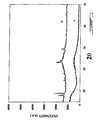
- the XRD patterns of the mesoporous starting material and of UL-ZSM-5 are shown in Fig. 1.
- the mesoporous starting material having mesopore walls with an amorphous structure constitutes a starting material from which nanocrystalline domains can nucleate within the mesopore walls.
- the XRD pattern of UL-ZSM-5 (Fig. 1b) shows broad peaks which match those of ZSM-5 zeolite. These peaks grow in intensity as the crystallization time is increased. These data indicate that the mesopore walls comprise nanocrystals of this zeolite.
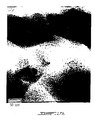
- Figs. 2A and 2B show bright-field and dark-held TEM images recorded on the same area of UL-ZSM-5. As shown in the dark-field image (Fig. 2B), the nanocrystals are uniformly embedded in a continuous amorphous inorganic matrix to form semicrystalline wall structures while preserving the tnesoporous structure.
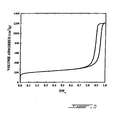
- the N 2 adsorption/desorption isotherms shown in Fig. 3 and obtained for different UL-ZSM-5 samples indicate that the UL-ZSM-5 samples have the typical behavior of a mesoporous molecular sieve with a mesopore volume saturation capacity of 1.86 cm 3 /g (Table 1). These N 2 adsorption/desorption isotherms are representative of micro/mesoporous materials. Barrett-Joyner-Halenda (BJH) analyses show that the UL-ZSM-5 samples exhibit mesopore diameters of 90, 150 and 220 ⁇ . The pore diameters of the UL-ZSM-5 samples are substantially larger than that of the mesoporous starting material (Fig. 4 and Table 1).
- the UL-ZSM-5 samples exhibit a Fourier transform infrared (FTIR) absorption band at 561/547 (doublet) which is not present in the mesoporous starting material.
- FTIR Fourier transform infrared
- the band around 550 cm -1 has been assigned to the asymmetric stretching mode in five-membered ring blocks. Splitting of this lattice-sensitive band into a doublet at 561-547 cm -1 is characteristic of a nanophase of ZSM-5 structure.
- a mesoporous zeolitic material designated UL-silicalite and having mesopore walls formed of silicalite was prepared according to the same procedure as described in Example 1 and under the same operating conditions, with the exception that no aluminum source was added to the solution during the first step.
- the impregnated solid was transferred into a TEFLON lined autoclave and heated at 130°C for 48 hours without being dried under vacuum for about 24 hours at room temperature. In this case, a small amount of water was still physisorbed in the solid.
- the XRD pattern of the UL-silicalite is shown in Fig. 5. This pattern is similar overall to the typical XRD pattern of silicalite.
- Fig. 6 shows a FTIR absorption band at 561/547 cm -1 (doublet) which is characteristic of nanophase silicalite.
- TEM image (not shown) of the material exhibits uniform nanocrystals with a diameter of 80-100 nm. These data indicate that most of the amorphous phase was transformed to a nanocrystalline phase.
- the adsorption/desorption isotherm (Fig.7) is also indicative of micro/mesoporosity in the material.
- a flat curve at low relative pressures corresponds to filling of micropores.
- the upward turn of the isotherm at higher relative pressure indicates filling of mesopores.
- This sample exhibits a mesopore diameter of ⁇ 180 ⁇ and a micropore diameter of 6 ⁇ .
- the total surface area of the UL-silicalite sample is 420 m 2 /g: 310 m 2 /g is due to micropores and 110 m 2 /g due to mesopores (Table 1).
- the 29 Si MAS NMR spectrum (Fig. 8A) of the UL-silicalite sample shows a main resonance centered at -113 ppm, which is attributed to Q 4 silicon of the silicalite framework. Only a weak resonance ( ⁇ 5%), attributable to Q 3 silicon from surface hydroxyl groups or to an amorphous component, is observed at 104 ppm.
- the mesoporous starting material has a 29 Si MAS NMR spectrum (Fig. 8B) typical of amorphous materials.
- a mesoporous zeolitic material designated UL-beta and having mesopore walls formed of beta-zeolite was prepared using an alkali (Na + , K + ) containing tetraethylammonium hydroxide (TEAOH) as zeolite-templating compound and a Al/Si atomic ratio of 1%.
- alkali Na + , K +
- TEAOH tetraethylammonium hydroxide
- the XRD pattern (Fig. 9) of the sample indicates that the material contains a crystalline beta-zeolite compared to the standard highly crystalline beta-zeolite.
- the 27 Al MAS NMR spectrum (Fig. 10) of this sample exhibits a single resonance centered at 53 ppm which is characteristic of tetrahedral aluminum. This indicates that most of aluminum species is incorporated into the material framework.
- the sample also shows a typical 29 Si MAS NMR spectrum (Fig. 11) of beta-zeolite: a main Q 4 peak at -113 ppm and weak Q 3 peak at -104 ppm.
- a series of mesoporous zeoixtie materials designated UL-TS1 and having mesopore walls formed of titanium-containing silicalite was prepared using PLURONIC P-123 and TPAOH as micelle-forming surfactant and zeolite-templating compound, respectively.
- Step 1 Preparation of mesoporous starting material
- TEOS tetraethyl orthosilicate
- Step 2 Preparation of mesoporous zeolitic material
- This step was carried out according to the same procedure as in step 2 of Example 1 and under the same operating conditions, with the exception that the heat treatment was effected at 120°C for several days.
- UL-TS1 materials Two series of UL-TS1 materials were prepared, one via route I using SiCl 4 and the other via route II using TEOS as the silica precursors. They are respectively designated as I[x]UL-TS1[y] and II[x]UL-TS1[y], where x and y are the crystallization time in days and the percentage of Ti/Si atomic ratio. Their physico-chemical properties are reported in Table 2 hereinbelow.
- Figs. 12 and 13 show N 2 adsorption/desorption isotherms of I-[5]UL-TS1[1.5] and II-[5]UL-TS1[1.5] samples after 5 days of crystallization at 120°C.
- the isotherms exhibit a typical type IV, as defined by IUPAC.
- IUPAC International Mobile Network Security
- the P/P 0 position of the inflection point is clearly related to a diameter in the mesopore range and the sharpness of these steps indicates the uniformity of the pore size distribution.
- All UL-TS1 samples gave typical type IV adsorption/desorption isotherms with a H 1 hysteresis loop and steep rises at low relative P/P 0 pressure indicating the presence of both mesopores and micropores in UL-TS1, even in the calcined [0]UL-TS1 sample. With increasing crystallization time, the UL-TS1 materials gave isotherms with similar inflection, but with reduced sharpness and a shift toward higher P/P 0 values over a larger P/P 0 range (not shown).
- the BJH pore radius distribution can be calculated from the Kelvin equation and has been widely used for mesoporous materials. Average BJH values of the pore radius are given in Table 2. The pore size distribution is more clearly shown in Figs. 14A and 14B. A significant increase in the pore diameter and a broader pore size distribution were observed, as a function of crystallization time. This indicates some modification of the tubular channels of these materials during crystallization.
- the total specific surface area S BET of both series of samples is reported in Table 2. As the crystallization time is increased, S BET varies from 820 to 580 m 2 /g for I[x]UL-TS1[1.5] and from 790 to 520 m 2 /g for II[x]UL-TS1[1.5].
- the mesopore surface area S BJH of the same materials varies from 645 to 180 m 2 /g and 710 to 145 m 2 /g, respectively. Simultaneously, the micropore volume increases from 0.045 to 1.159 cm 3 /g and from 0.025 to 0.149 cm 3 /g for the same series of samples. The mesopore volume and radius are reported on Table 2.
- the crystalline phase in UL-TSI materials upon czystallization was characterized by wide-angle XRD diffractograms, as shown in Figs. 15A and 15B for the I-UL-TS1[1.5] and II-UL-TS1[1.5] samples, respectively.
- the mesoporous starting matezial with amorphous walls (only the broad feature of amorphous phase appears, Figs. 15A,a and 15B,a) provides a starting material from which nano-crystalline domains can nucleate within the walls.
- the XRD diffractograms of the UL-TS1[1.5] samples in Figs. 15A,b and 15B,b show broad peaks, which match those of ZSM-5.
- the pore structure of mesoporous materials is directly visible by transmission electron microscopy.
- the mesoporous starting material prepared from SiCl 4 (route I) appears to be of a uniform pore size with a highly disordered pore structure. This is pronounced of MSU-1 and KIT-1 mesoporous materials described by S.A, Bagshaw et al in Science, Vol. 269, p. 1242 (1995) and by R. Ryoo et al in J. Phys. Chem., Vol. 100, p. 17718 (1996), which have wormhole-like pore frameworks (Fig. 16A). In contrast, a well-ordered pore structure (Fig.
- Figs. 17A and 17B show the TEM images of the I-[10]UL-TS1[1.5] and II-[10]UL-TS1[1.5] samples after 10 days of crystallization.
- Fig. 17A shows that after crystallization in the presence of TPAOH, the mesopores of the MSU type starting material (Fig. 16A) retains their size and morphology. The wormhole pore lattice is however still present and microdomains of the order of ⁇ 10 nm are observed. The size of MFI microdomains calculated using the Scherrer formula from the line broadening in the XRD spectrum of this sample is ⁇ 20 nm, which is consistent with these observations.
- the specific surface calculated for an average UL-TS1 particle diameter of 20 nm is 200 m 2 /g which matches the S BJH value calculated from BET data (Table 2). From Fig. 17B, it can be seen that the hexagonal structure of the starting material SBA phase (Fig. 16B) is transformed after the crystallization step. The diameter of the regularly arranged pores is significantly enlarged from 5 nm to 10 nm which matches the measured BJH pore diameter of 6.6 and 12.8 nm, respectively (Table 2). Fig. 17B also shows nanoparticles of UL-TS1 having grown to 10 nm size and being slightly agglomerated. The pore walls themselves show a discontinuous structure compared to the precursor suggesting that nucleation of UL-TS1 begins in these walls.
- UV-visible spectroscopy has been extensively used to characterize the nature and coordination of titanium ions in titanium substituted molecular sieves.
- the ultraviolet absorption wavelength of titanium is sensitive to its coordination and to TiO 2 particle size.
- Figs. 18A and 18B show UV-visible spectra of two series of UL-TS1[1.5] samples prepared by route I and route II, with different crystallization times. Only a single intense large band at 230 nm was observed with all samples. This band was attributed to ligand-to-metal charge transfer associated with isolated Ti 4+ framework sites in tetrahedral coordination. No band at 330 nm characteristic of octahedral extra-framework titanium was observed. This suggests that all titanium is essentially incorporated in the UL-TS1 framework.
- Fig. 19 shows the FTIR spectra of a series of II[x]UL-TS1[1.5] samples with various times of crystallization.
- the pure SBA silica sample exhibits spectroscopic features similar to those of amorphous mesoporous silica, a broad bands at 985 cm -1 assigned to silanol groups on the wall surface is present (Fig. 19a).
- a band at 965 cm -1 which is characteristic of framework titanium is shown and no band at 550 cm -1 was observed.
- the band at 985 cm -1 disappears progressively, while the bands at 550 and 965 cm -1 develop with increasing crystallization time.
- Fig. 20 shows the 29 Si MAS NMR spectra of the amorphous mesoporous Ti-material, I[0]UL-TS1[1.5], and of the sample obtained after 10 days of crystallization, I[10]UL-TS1[1.5].
- the mesoporous titania-silica exhibits a 29 Si MAS NMR spectrum typical of amorphous materials; two main resonances at -114 and 104 ppm, and a very weak peak at 98 ppm corresponding to Si(OSi) 4 (Q 4 ), Si(OSi) 3 (Q 3 ) and Si(OSi) 2 (Q 2 ) silicate species, respectively.
- the ratio of the relative peak areas of the deconvoluted peaks, Q 4 /Q 3 was 1.8. This ratio was comparable with other calcined amorphous mesoporous silicas.
- the 29 Si MAS NMR spectrum showed the main resonance (Q 4 ) at -114 ppm along with the only weak resonance (Q 3 ) at 104 ppm from surface hydroxyl groups and the resonance (Q 2 ) at 98 ppm had disappeared.
- the 29 Si MAS NMR spectra of series II[x]UL-TS1[1.5] show the same trends and are therefore not reported herein.
- the increase in the intensity of the Q 4 resonance and concomitant decrease in the intensity of the Q 3 resonance reflect the crystallization process and the transformation of the hydrophilic surface into a hydrophobic one.
- the mesopore volume and pore radius increase with crystallinity until ⁇ 35%. It is believed that in these conditions, the pore walls shrink due to the change in density associated with the formation of the crystalline silicalite phase. At higher crystallinity, the mesopore volume begins to decrease even though the mesopore size is little affected. This corresponds to the migration of the material constituting the walls which contributes to the extra-walls growth of silicalite nanoparticles (Fig. 17B). This process results in an important damage to the initial regularity of the mesopore network, but a significant fraction of the initial mesopore surface is preserved in the end product.
Landscapes
- Chemical & Material Sciences (AREA)
- Organic Chemistry (AREA)
- Life Sciences & Earth Sciences (AREA)
- General Life Sciences & Earth Sciences (AREA)
- Geology (AREA)
- Engineering & Computer Science (AREA)
- Chemical Kinetics & Catalysis (AREA)
- Materials Engineering (AREA)
- Inorganic Chemistry (AREA)
- Dispersion Chemistry (AREA)
- Crystallography & Structural Chemistry (AREA)
- Silicates, Zeolites, And Molecular Sieves (AREA)
Claims (31)
- Matériau zéolithique mésoporeux, comportant, en une disposition stéréorégulière, des mésopores de taille uniforme dont le diamètre vaut de 20 à 500 Å et dont les parois présentent une structure nanocristalline et microporeuse et sont épaisses d'au moins 40 Å, les parois des mésopores comportant, en une disposition stéréorégulière, des micropores de taille uniforme dont le diamètre vaut moins de 15 Å.
- Matériau conforme à la revendication 1, dans lequel le diamètre des mésopores vaut de 30 à 200 Å.
- Matériau conforme à la revendication 1, dans lequel le diamètre des micropores vaut de 3 à 12 Å.
- Matériau conforme à la revendication 1, dans lequel l'épaisseur des parois des mésopores vaut de 40 à 50 Å.
- Matériau conforme à la revendication 1, dans lequel les parois des mésopores sont constituées de silicalite.
- Matériau conforme à la revendication 1, dans lequel les parois des mésopores sont constituées d'une silicalite au titane.
- Matériau conforme à la revendication 1, dans lequel les parois des mésopores sont constituées d'une zéolithe de type ZSM.
- Matériau conforme à la revendication 7, dans lequel ladite zéolithe de type ZSM est de la zéolithe ZSM-5.
- Matériau conforme à la revendication 1, dans lequel les parois des mésopores sont constituées d'une zéolithe bêta.
- Procédé de préparation d'un matériau zéolithique mésoporeux conforme à la revendication 1, qui comporte les étapes suivantes :a) prendre une silice mésoporeuse comportant, en une disposition stéréorégulière, des mésopores de taille uniforme dont le diamètre vaut de 20 à 500 Å et dont les parois sont épaisses d'au moins 40 Å et présentent une structure amorphe ;b) imprégner cette silice mésoporeuse d'un composé de structuration de zéolithe ;c) soumettre la silice mésoporeuse imprégnée obtenue lors de l'étape (b) à un traitement thermique, à une température et pendant un laps de temps suffisants pour provoquer la transformation de ladite structure amorphe en une structure nanocristalline microporeuse, ce qui donne un matériau zéolithique mésoporeux où les parois des mésopores comportent, en une disposition stéréorégulière, des micropores de taille uniforme et de moins de 15 Å de diamètre ;d) et éliminer du matériau zéolithique mésoporeux obtenu lors de l'étape (c) ledit composé de structuration de zéolithe.
- Procédé conforme à la revendication 10, dans lequel ladite silice mésoporeuse contient de l'aluminium ou du titane.
- Procédé conforme à la revendication 10, dans lequel, avant l'étape (b), on soumet ladite silice mésoporeuse à un traitement sous vide à une température de 25 à 100 °C.
- Procédé conforme à la revendication 10, dans lequel on utilise ledit composé de structuration de zéolithe à l'état de solution aqueuse.
- Procédé conforme à la revendication 13, dans lequel ledit composé de structuration de zéolithe est de l'hydroxyde de tétraéthylammonium ou de l'hydroxyde de tétrapropylammonium.
- Procédé conforme à la revendication 13, dans lequel, avant l'étape (c), on fait sécher sous vide ladite silice mésoporeuse imprégnée.
- Procédé conforme à la revendication 13, dans lequel on effectue l'étape (c) en présence de vapeur d'eau.
- Procédé conforme à la revendication 10, dans lequel on effectue l'étape (c) à une température de 80 à 180 °C.
- Procédé conforme à la revendication 17, dans lequel on fait durer l'étape (c) de 1 heure à 10 jours.
- Procédé conforme à la revendication 18, dans lequel on effectue l'étape (c) à une température de 120 à 130 °C et on la fait durer de 24 à 48 heures.
- Procédé conforme à la revendication 10, dans lequel on effectue l'étape (d) en calcinant le matériau zéolithique mésoporeux obtenu lors de l'étape (c).
- Procédé conforme à la revendication 20, dans lequel, avant l'étape (d), on fait subir un traitement de séchage au matériau zéolithique mésoporeux obtenu lors de l'étape (c).
- Procédé conforme à la revendication 10, dans lequel la silice mésoporeuse employée dans l'étape (a) est obtenue comme suit :i) on dissout un tensioactif formant des micelles dans un solvant polaire, ce qui donne une solution ;ii) on mélange la solution obtenue lors de l'étape (i) avec un précurseur de silice ;iii) on chauffe le mélange résultant de l'étape (ii) pour provoquer la formation de micelles tubulaires et la précipitation simultanée de silice amorphe sur ces micelles ;iv) et l'on sépare d'avec le solvant les micelles tubulaires et la silice amorphe qui s'est déposée dessus.
- Procédé conforme à la revendication 22, dans lequel le tensioactif formant des micelles est un tensioactif non-ionique.
- Procédé conforme à la revendication 23, dans lequel le tensioactif non-ionique formant des micelles est un copolymère à blocs de type poly(oxyalkylène).
- Procédé conforme à la revendication 24, dans lequel le copolymère à blocs de type poly(oxyalkylène) est choisi dans l'ensemble formé par les suivants :HO(CH2CH2O)20(CH2CH(CH3)O)70(CH2CH2O)20H,HO(CH2CH2O)106(CH2CH(CH3)O)70(CH2CH2O)106R,C16H33(OCH2CH2)10OH,C16H33(OCH2CH2)20OH,et C18H37(OCH2CH2)10OH.
- Procédé conforme à la revendication 22, dans lequel le solvant polaire est de l'eau ou un alcanol inférieur, ou l'un de leurs mélanges.
- Procédé conforme à la revendication 22, dans lequel, dans l'étape (ii), on mélange la solution obtenue dans l'étape (i) avec ledit précurseur de silice et une source d'aluminium ou de titane.
- Procédé conforme à la revendication 22, dans lequel on effectue l'étape (iii) à une température de 40 à 150 °C.
- Procédé conforme à la revendication 22, qui comporte en outre une étape où l'on élimine ledit tensioactif des micelles séparées.
- Procédé conforme à la revendication 29, dans lequel on élimine ledit tensioactif pendant l'étape (d) d'élimination dudit composé de structuration de zéolithe.
- Procédé conforme à la revendication 30, dans lequel on effectue l'élimination dudit tensioactif et dudit composé de structuration de zéolithe en calcinant le matériau zéolithique mésoporeux obtenu lors de l'étape (c).
Applications Claiming Priority (3)
| Application Number | Priority Date | Filing Date | Title |
|---|---|---|---|
| US16699699P | 1999-11-23 | 1999-11-23 | |
| US166996P | 1999-11-23 | ||
| PCT/CA2000/001375 WO2001038223A1 (fr) | 1999-11-23 | 2000-11-23 | Materiau zeolitique mesoporeux ayant des parois de mesopore cristallines microporeuses |
Publications (2)
| Publication Number | Publication Date |
|---|---|
| EP1237818A1 EP1237818A1 (fr) | 2002-09-11 |
| EP1237818B1 true EP1237818B1 (fr) | 2003-06-18 |
Family
ID=22605517
Family Applications (1)
| Application Number | Title | Priority Date | Filing Date |
|---|---|---|---|
| EP00979294A Expired - Lifetime EP1237818B1 (fr) | 1999-11-23 | 2000-11-23 | Materiau zeolitique mesoporeux ayant des parois de mesopore cristallines microporeuses |
Country Status (7)
| Country | Link |
|---|---|
| US (1) | US6669924B1 (fr) |
| EP (1) | EP1237818B1 (fr) |
| AT (1) | ATE243165T1 (fr) |
| AU (1) | AU1684101A (fr) |
| CA (1) | CA2392296C (fr) |
| DE (1) | DE60003461T2 (fr) |
| WO (1) | WO2001038223A1 (fr) |
Cited By (1)
| Publication number | Priority date | Publication date | Assignee | Title |
|---|---|---|---|---|
| CN102464336A (zh) * | 2010-11-05 | 2012-05-23 | 中国石油化工股份有限公司 | 一种zsm-5沸石的改性处理方法 |
Families Citing this family (68)
| Publication number | Priority date | Publication date | Assignee | Title |
|---|---|---|---|---|
| US6346140B2 (en) * | 2000-03-31 | 2002-02-12 | Kabushiki Kaisha Toyota Chuo Kenkyusho | Porous solid for gas adsorption separation and gas adsorption separation process employing it |
| US6749628B1 (en) | 2001-05-17 | 2004-06-15 | Advanced Cardiovascular Systems, Inc. | Stent and catheter assembly and method for treating bifurcations |
| JPWO2003002458A1 (ja) * | 2001-06-29 | 2004-10-14 | 独立行政法人 科学技術振興機構 | 無機系多孔質体の製造方法 |
| US6897175B2 (en) | 2001-10-09 | 2005-05-24 | General Electric | Catalyst and method for the alkylation of hydroxyaromatic compounds |
| CN100335567C (zh) * | 2002-03-20 | 2007-09-05 | 新加坡纳米材料科技有限公司 | CaCO3/SiO2·nH2O纳米复合颗粒和空心SiO2·nH2O纳米材料及其制备方法 |
| ES2206064B1 (es) * | 2002-10-31 | 2005-08-01 | Consejo Sup. De Investig. Cientificas. | Estructuras mesoporosas con elevada actividad catalitica en reacciones de catalisis acida y su procedimiento de preparacion. |
| US8273371B2 (en) * | 2003-06-27 | 2012-09-25 | Johan Adriaan Martens | Crystalline mesoporous oxide based materials useful for the fixation and controlled release of drugs |
| GB0315012D0 (en) * | 2003-06-27 | 2003-07-30 | Leuven K U Res & Dev | Zeotiles |
| US7081432B2 (en) | 2003-07-10 | 2006-07-25 | General Electric Company | Alkylation catalyst and method for making alkylated phenols |
| JP2005053728A (ja) * | 2003-08-01 | 2005-03-03 | Dsl Japan Co Ltd | 高吸油性および高い構造性を有する非晶質シリカ粒子 |
| CN100427393C (zh) * | 2003-08-07 | 2008-10-22 | 复旦大学 | 含y沸石次级结构单元的介孔分子筛及其制备方法 |
| ES2228271B1 (es) * | 2003-09-18 | 2006-06-01 | Universidad Rey Juan Carlos | Metodo para la preparacion de nanozeolita zsm-5 de elevada superficie externa por cristalizacion de nucleos sililados. |
| US8439047B2 (en) | 2003-12-22 | 2013-05-14 | Philip Morris Usa Inc. | Composite mesoporous/microporous materials and their use in smoking articles for removing certain gas phase constituents from tobacco smoke |
| US7087705B2 (en) | 2004-03-31 | 2006-08-08 | General Electric Company | Process for the monoalkylation of dihydroxy aromatic compounds |
| US20050234136A1 (en) | 2004-04-19 | 2005-10-20 | Holland Brian T | Colloidal compositions and methods of preparing same |
| US7589041B2 (en) * | 2004-04-23 | 2009-09-15 | Massachusetts Institute Of Technology | Mesostructured zeolitic materials, and methods of making and using the same |
| GB0420016D0 (en) | 2004-09-09 | 2004-10-13 | Leuven K U Res & Dev | Controlled release oral delivery system |
| CN1325375C (zh) * | 2004-10-29 | 2007-07-11 | 中国石油化工股份有限公司 | 具有多级孔道的β沸石颗粒及其制备方法 |
| US20060182681A1 (en) * | 2004-12-28 | 2006-08-17 | Fortum Oyj | Catalytic materials and method for the preparation thereof |
| FR2886637B1 (fr) * | 2005-06-02 | 2007-08-03 | Inst Francais Du Petrole | Materiau mesostructure a forte teneur en aluminium |
| FR2886636B1 (fr) * | 2005-06-02 | 2007-08-03 | Inst Francais Du Petrole | Materiau inorganique presentant des nanoparticules metalliques piegees dans une matrice mesostructuree |
| US20070104643A1 (en) * | 2005-08-05 | 2007-05-10 | Holland Brian T | Mesoporous nanocrystaline zeolite composition and preparation from amorphous colloidal metalosilicates |
| CN100439246C (zh) * | 2005-08-26 | 2008-12-03 | 吉林大学 | 硬模板或复合模板合成复合孔沸石分子筛的方法 |
| CN100453460C (zh) * | 2005-08-26 | 2009-01-21 | 吉林大学 | 高分子聚合物模板合成的复合孔沸石分子筛的制备方法 |
| KR100727288B1 (ko) | 2005-10-14 | 2007-06-13 | 한국과학기술원 | 메조다공성 골격을 갖는 미세다공성 결정성 분자체의제조방법 |
| US7288237B2 (en) * | 2005-11-17 | 2007-10-30 | Lyondell Chemical Technology, L.P. | Epoxidation catalyst |
| FR2909012B1 (fr) * | 2006-11-23 | 2009-05-08 | Inst Francais Du Petrole | Catalyseur a base d'un materiau a porosite hierarchisee comprenant du silicium et procede d'hydrocraquage/ hydroconversion et d'hydrotraitement de charges hydrocarbonees. |
| ES2319007B1 (es) | 2006-12-07 | 2010-02-16 | Rive Technology, Inc. | Metodos para fabricar materiales zeoliticos mesoestructurados. |
| US20080214882A1 (en) * | 2007-02-16 | 2008-09-04 | Board Of Trustees Of Michigan State University | Acidic mesostructured aluminosilicates assembled from surfactant-mediated zeolite hydrolysis products |
| DE102007042286A1 (de) | 2007-09-06 | 2009-03-12 | Henkel Ag & Co. Kgaa | Färbemittel mit Naturfarbstoffen und 1,3-Dihydroxyaceton |
| FR2920757B1 (fr) * | 2007-09-07 | 2009-11-13 | Inst Francais Du Petrole | Materiau cristallise comprenant du silicium a porosite hierarchisee et organisee |
| US8206498B2 (en) | 2007-10-25 | 2012-06-26 | Rive Technology, Inc. | Methods of recovery of pore-forming agents for mesostructured materials |
| US8258137B2 (en) * | 2008-01-29 | 2012-09-04 | Katholieke Universiteit Leuven | Process for release of biologically active species from mesoporous oxide systems |
| FR2929264B1 (fr) | 2008-03-31 | 2010-03-19 | Inst Francais Du Petrole | Materiau inorganique forme de particules spheriques de taille specifique et presentant des nanoparticules metalliques piegees dans une matrice mesostructuree |
| FR2929266B1 (fr) | 2008-03-31 | 2010-03-19 | Inst Francais Du Petrole | Materiau mesostructure a forte teneur en aluminium et constitue de particules spheriques de taille specifique |
| FR2931708B1 (fr) * | 2008-05-28 | 2014-03-14 | Inst Francais Du Petrole | Catalyseur a base d'un materiau cristallise a porosite hierarchisee et organisee et son utilisation en oligomerisation des olefines legeres |
| FR2931705B1 (fr) | 2008-05-28 | 2010-09-03 | Inst Francais Du Petrole | Catalyseur a base d'un materiau amorphe comprenant du silicium a porosite hierarchisee et organisee et procede ameliore de traitement de charges hydrocarbonees |
| FR2931706B1 (fr) * | 2008-05-28 | 2010-12-24 | Inst Francais Du Petrole | Catalyseur a base d'un materiau cristallise comprenant du silicium a porosite hierarchisee et organisee et procede ameliore de traitement de charges hydrocarbonees |
| EP2192807B1 (fr) * | 2008-12-01 | 2012-10-03 | Vodafone Holding GmbH | Contrôle d'accès de dispositifs M2M ("machine-to-machine") dans un réseau de communication mobile |
| US8524625B2 (en) | 2009-01-19 | 2013-09-03 | Rive Technology, Inc. | Compositions and methods for improving the hydrothermal stability of mesostructured zeolites by rare earth ion exchange |
| WO2010083488A2 (fr) | 2009-01-19 | 2010-07-22 | Rive Technologies, Inc. | Introduction de mésoporosité dans des zéolites de rapport si/ai faible |
| RU2393992C1 (ru) * | 2009-03-17 | 2010-07-10 | Общество с ограниченной ответственностью "УНИСИТ" | Микромезопористый кристаллический материал и способ его получения |
| US8685875B2 (en) | 2009-10-20 | 2014-04-01 | Rive Technology, Inc. | Methods for enhancing the mesoporosity of zeolite-containing materials |
| KR101147669B1 (ko) * | 2010-07-05 | 2012-05-21 | 한국과학기술원 | 규칙적 또는 불규칙적으로 배열된 메조기공을 포함하는 제올라이트 또는 유사 제올라이트 물질 및 그의 제조 방법 |
| US8951498B2 (en) | 2010-07-30 | 2015-02-10 | University Of Iowa Research Foundation | Synthesis of hierarchical nanocrystalline zeolites with controlled particle size and mesoporosity |
| WO2012138910A2 (fr) | 2011-04-08 | 2012-10-11 | Rive Technology, Inc. | Zéolithes à squelette modifié, mésoporeuses |
| US9174849B2 (en) | 2011-08-25 | 2015-11-03 | Basf Corporation | Molecular sieve precursors and synthesis of molecular sieves |
| US9376324B2 (en) | 2012-01-13 | 2016-06-28 | Rive Technology, Inc. | Introduction of mesoporosity into zeolite materials with sequential acid, surfactant, and base treatment |
| WO2013106816A1 (fr) | 2012-01-13 | 2013-07-18 | Rive Technology, Inc. | Introduction de mésoporosité dans des zéolites pauvres en silice |
| US10752526B2 (en) | 2012-02-12 | 2020-08-25 | Bluflow Technologies, Inc. | Method for destruction of reducible contaminants in waste or ground water |
| CN104245584A (zh) | 2012-03-26 | 2014-12-24 | 东曹株式会社 | 具有均匀的中孔的mfi型沸石和用于制造其的方法 |
| KR101384479B1 (ko) | 2012-08-24 | 2014-04-10 | 한국화학연구원 | 중형 세공을 갖는 제올라이트의 제조방법 |
| WO2014049621A1 (fr) | 2012-09-28 | 2014-04-03 | Council Of Scientific & Industrial Research | Procédé catalytique pour convertir une charge de départ renouvelable en carburant d'aviation riche en composés aromatiques |
| US8765660B1 (en) | 2013-03-08 | 2014-07-01 | Rive Technology, Inc. | Separation of surfactants from polar solids |
| CN104556085B (zh) * | 2013-10-29 | 2017-01-04 | 中国石油化工股份有限公司 | 一种合成全硅微介孔复合材料的方法 |
| JP6591740B2 (ja) * | 2013-10-29 | 2019-10-16 | 中国石油化工股▲ふん▼有限公司 | 完全Si分子篩、および、その合成方法 |
| CN104556087B (zh) * | 2013-10-29 | 2017-11-28 | 中国石油化工股份有限公司 | 一种全硅分子筛及其合成方法 |
| US9662640B2 (en) | 2013-12-27 | 2017-05-30 | Rive Technology, Inc. | Introducing mesoporosity into zeolite materials with a modified acid pre-treatment step |
| EP3129138B1 (fr) * | 2014-04-10 | 2020-07-01 | Danmarks Tekniske Universitet | Procédé général d'incorporation de nanoparticules de métal dans des zéolites et des zéotypes |
| WO2016005277A1 (fr) * | 2014-07-11 | 2016-01-14 | Total Research & Technology Feluy | Procédé de préparation de matériaux cristallins microporeux mésoporeux impliquant un agent de modélisation de mésopores recyclable |
| US9963349B2 (en) | 2014-12-11 | 2018-05-08 | Rive Technology, Inc. | Preparation of mesoporous zeolites with reduced processing |
| US10626019B2 (en) | 2014-12-30 | 2020-04-21 | W. R. Grace & Co.-Conn. | Methods for preparing zeolites with surfactant-templated mesoporosity and tunable aluminum content |
| CN107954438B (zh) * | 2016-10-14 | 2020-09-04 | 中国石油化工股份有限公司 | 直通介孔fau分子筛及其制备方法 |
| KR101922614B1 (ko) * | 2017-05-24 | 2018-11-27 | 재단법인 탄소순환형 차세대 바이오매스 생산전환 기술연구단 | 위계다공성 베타 제올라이트 기반 수첨분해반응 촉매 및 이의 제조방법 및 상기 수첨분해반응 촉매를 활용한 트리글리세라이드를 포함하는 바이오매스로부터 바이오항공유 생산방법 |
| US10350585B1 (en) | 2018-08-14 | 2019-07-16 | Saudi Arabian Oil Company | Methods for synthesizing hierarchical zeolites for catalytic cracking |
| CN110982154A (zh) * | 2019-12-23 | 2020-04-10 | 安徽国登管业科技有限公司 | 一种抗菌pe给水管的制备方法 |
| CN111530493B (zh) * | 2020-05-27 | 2021-11-02 | 清华大学 | 一种将烷烃转化为芳烃的催化剂、制备方法及使用方法 |
| CN113307284A (zh) * | 2021-07-09 | 2021-08-27 | 山东亮剑环保新材料有限公司 | 一种纳米尺度复合分子筛的制备方法 |
Family Cites Families (27)
| Publication number | Priority date | Publication date | Assignee | Title |
|---|---|---|---|---|
| US4367342A (en) | 1969-04-02 | 1983-01-04 | Shell Oil Company | Olefin epoxidation |
| IT1127311B (it) | 1979-12-21 | 1986-05-21 | Anic Spa | Materiale sintetico,cristallino,poroso costituito da ossidi di silicio e titanio,metodo per la sua preparazione e suoi usi |
| US4673559A (en) | 1983-12-19 | 1987-06-16 | Mobil Oil Corporation | Silicoaluminophosphate crystallization using hydrolysis |
| US4880611A (en) | 1983-12-19 | 1989-11-14 | Mobil Oil Corp. | Crystalline composition |
| US4650655A (en) | 1984-07-26 | 1987-03-17 | Mobil Oil Corporation | Crystallization of ZSM-5 from reaction mixtures containing zeolite beta |
| US4859648A (en) | 1984-12-28 | 1989-08-22 | Mobil Oil Corporation | Layered metal chalcogenides containing interspathic polymeric chalcogenides |
| EP0987220A1 (fr) * | 1998-09-17 | 2000-03-22 | Technische Universiteit Delft | Matériaux silicatés mésoporeux amorphes et leur procédé de préparation |
| US5304363A (en) | 1990-01-25 | 1994-04-19 | Mobil Oil Corp. | Porous materials |
| US5102643A (en) | 1990-01-25 | 1992-04-07 | Mobil Oil Corp. | Composition of synthetic porous crystalline material, its synthesis |
| US5057296A (en) | 1990-12-10 | 1991-10-15 | Mobil Oil Corp. | Method for synthesizing mesoporous crystalline material |
| US5134242A (en) | 1991-06-21 | 1992-07-28 | Mobil Oil Corporation | Catalytic olefin upgrading process using synthetic mesoporous crystalline material |
| US5134243A (en) | 1991-06-21 | 1992-07-28 | Mobil Oil Corporation | Catalytic oligomerization process using synthetic mesoporous crystalline material |
| IT1270069B (it) * | 1994-07-06 | 1997-04-28 | Eniricerche Spa | Gel micro-mesoporoso e procedimento per la sua preparazione |
| US5672556A (en) | 1994-08-22 | 1997-09-30 | Board Of Trustees Operating Michigan State University | Crystalline silicate compositions and method of preparation |
| US5712402A (en) | 1994-08-22 | 1998-01-27 | Board Of Trustees Operating Michigan State University | Catalytic applications of mesoporous metallosilicate molecular sieves and methods for their preparation |
| US5538710A (en) * | 1994-12-14 | 1996-07-23 | Energy Mines And Resources-Canada | Synthesis of mesoporous catalytic materials |
| WO1996031434A1 (fr) | 1995-04-03 | 1996-10-10 | Massachusetts Institute Of Technology | Composition et procede permettant de produire un oxyde metallique mesoporeux a empilement hexagonal |
| US5622684A (en) | 1995-06-06 | 1997-04-22 | Board Of Trustees Operating Michigan State University | Porous inorganic oxide materials prepared by non-ionic surfactant templating route |
| JP3577681B2 (ja) | 1995-08-29 | 2004-10-13 | 日本化学工業株式会社 | メソポーラスメタロシリケートの製造方法 |
| US5726113A (en) | 1996-03-19 | 1998-03-10 | Board Of Trustees Operating Michigan State University | Porous clay heterostructures prepared by gallery templated synthesis |
| US5849258A (en) * | 1996-06-06 | 1998-12-15 | Intevep, S.A. | Material with microporous crystalline walls defining a narrow size distribution of mesopores, and process for preparing same |
| DE19639016A1 (de) | 1996-09-23 | 1998-03-26 | Basf Ag | Mesoporöses Siliciumdioxid, Verfahren zu seiner Herstellung und seiner Verwendung |
| JPH10139419A (ja) | 1996-11-11 | 1998-05-26 | Yukong Ltd | 非結晶性中間細孔モレキュラーシーブの製造方法及びそのモレキュラーシーブ |
| DE19705497C2 (de) * | 1997-02-13 | 1999-01-28 | Max Planck Gesellschaft | Verfahren zur Herstellung mesoporöser Feststoffe, durch das Verfahren erhältliche Feststoffe und deren Verwendung |
| US5942208A (en) | 1997-06-20 | 1999-08-24 | Yu Kong Limited | Mesoporous molecular sieve substance and method for preparing the same |
| CN1101339C (zh) * | 1998-07-01 | 2003-02-12 | 复旦大学 | 复合中微孔分子筛及其合成方法 |
| FR2802120B1 (fr) * | 1999-12-14 | 2002-02-01 | Inst Francais Du Petrole | Solide silicoaluminate micro et mesoporeux, procede de preparation, utilisation comme catalyseur et en conversion d'hydrocarbures |
-
2000
- 2000-11-23 EP EP00979294A patent/EP1237818B1/fr not_active Expired - Lifetime
- 2000-11-23 AU AU16841/01A patent/AU1684101A/en not_active Abandoned
- 2000-11-23 AT AT00979294T patent/ATE243165T1/de not_active IP Right Cessation
- 2000-11-23 DE DE60003461T patent/DE60003461T2/de not_active Expired - Fee Related
- 2000-11-23 CA CA002392296A patent/CA2392296C/fr not_active Expired - Fee Related
- 2000-11-23 WO PCT/CA2000/001375 patent/WO2001038223A1/fr not_active Ceased
- 2000-11-24 US US09/728,494 patent/US6669924B1/en not_active Expired - Fee Related
Cited By (2)
| Publication number | Priority date | Publication date | Assignee | Title |
|---|---|---|---|---|
| CN102464336A (zh) * | 2010-11-05 | 2012-05-23 | 中国石油化工股份有限公司 | 一种zsm-5沸石的改性处理方法 |
| CN102464336B (zh) * | 2010-11-05 | 2013-10-09 | 中国石油化工股份有限公司 | 一种zsm-5沸石的改性处理方法 |
Also Published As
| Publication number | Publication date |
|---|---|
| ATE243165T1 (de) | 2003-07-15 |
| US6669924B1 (en) | 2003-12-30 |
| CA2392296A1 (fr) | 2001-05-31 |
| CA2392296C (fr) | 2008-03-11 |
| DE60003461T2 (de) | 2004-05-06 |
| EP1237818A1 (fr) | 2002-09-11 |
| AU1684101A (en) | 2001-06-04 |
| DE60003461D1 (de) | 2003-07-24 |
| WO2001038223A1 (fr) | 2001-05-31 |
Similar Documents
| Publication | Publication Date | Title |
|---|---|---|
| EP1237818B1 (fr) | Materiau zeolitique mesoporeux ayant des parois de mesopore cristallines microporeuses | |
| CN100522810C (zh) | 具有分层次孔隙度的含硅材料 | |
| Serrano et al. | Crystallization mechanism of all-silica zeolite beta in fluoride medium | |
| Serrano et al. | Heterogenous events in the crystallization of zeolites | |
| On et al. | An example of mesostructured zeolitic material: UL-TS-1 | |
| KR101147669B1 (ko) | 규칙적 또는 불규칙적으로 배열된 메조기공을 포함하는 제올라이트 또는 유사 제올라이트 물질 및 그의 제조 방법 | |
| Gontier et al. | Synthesis and characterization of Ti-containing mesoporous silicas | |
| US20120165558A1 (en) | Regularly stacked multilamellar and randomly aligned unilamellar zeolite nanosheets, and their analogue materials whose framework thickness were corresponding to one unit cell size or less than 10 unit cell size | |
| CN101795968B (zh) | 具有分级的并组织化的孔隙性的结晶含硅材料 | |
| US20080014140A1 (en) | Fabrication of hierarchical zeolites | |
| JP2003508333A (ja) | 中間細孔あるいは中間及び微小細孔を併有する無機酸化物及びその製造方法 | |
| CN101189187B (zh) | 具有高铝含量的中孔结构化材料 | |
| Koekkoek et al. | Hierarchical zeolites prepared by organosilane templating: A study of the synthesis mechanism and catalytic activity | |
| KR20170046712A (ko) | 특유의 단결정 대공극률을 갖는 제올라이트 물질 및 그 제조 방법 | |
| US7052665B2 (en) | Method of preparing highly ordered mesoporous molecular sieves | |
| Mirfendereski et al. | Effects of synthesis parameters on the characteristics of NaA type zeolite nanoparticles | |
| Uguina et al. | TS-2 synthesis from wetness-impregnated SiO2-TiO2 xerogels | |
| JP2025518481A (ja) | アルミニウム含有cit-13及びcit-15モレキュラーシーブの合成 | |
| Zhang et al. | Synthesis of hierarchical MFI zeolites with a micro–macroporous core@ mesoporous shell structure | |
| CN113184877B (zh) | 一种中空八面体NaP分子筛及其制备方法 | |
| Serrano et al. | Crystallization mechanism of Al–Ti-beta zeolite synthesized from amorphous wetness impregnated xerogels | |
| EA000013B1 (ru) | Способ получения микромезопористого геля | |
| US12297117B2 (en) | Aluminosilicate structure body having novel structure and skein-shaped morphology, method for preparing same, and HPLC column filled with same as static bed | |
| CN110372002B (zh) | 一种核壳mfi型沸石及其制备方法 | |
| TW202136150A (zh) | 多孔質材料之製造方法、藉此所獲得之多孔質材料、及用以製造多孔質材料之Si源組合物 |
Legal Events
| Date | Code | Title | Description |
|---|---|---|---|
| PUAI | Public reference made under article 153(3) epc to a published international application that has entered the european phase |
Free format text: ORIGINAL CODE: 0009012 |
|
| 17P | Request for examination filed |
Effective date: 20020624 |
|
| AK | Designated contracting states |
Kind code of ref document: A1 Designated state(s): AT BE CH CY DE DK ES FI FR GB GR IE IT LI LU MC NL PT |
|
| AX | Request for extension of the european patent |
Free format text: AL;LT;LV;MK;RO;SI |
|
| GRAH | Despatch of communication of intention to grant a patent |
Free format text: ORIGINAL CODE: EPIDOS IGRA |
|
| GRAH | Despatch of communication of intention to grant a patent |
Free format text: ORIGINAL CODE: EPIDOS IGRA |
|
| GRAA | (expected) grant |
Free format text: ORIGINAL CODE: 0009210 |
|
| AK | Designated contracting states |
Designated state(s): AT BE CH CY DE DK ES FI FR GB GR IE IT LI LU MC NL PT |
|
| PG25 | Lapsed in a contracting state [announced via postgrant information from national office to epo] |
Ref country code: FI Free format text: LAPSE BECAUSE OF FAILURE TO SUBMIT A TRANSLATION OF THE DESCRIPTION OR TO PAY THE FEE WITHIN THE PRESCRIBED TIME-LIMIT Effective date: 20030618 Ref country code: BE Free format text: LAPSE BECAUSE OF FAILURE TO SUBMIT A TRANSLATION OF THE DESCRIPTION OR TO PAY THE FEE WITHIN THE PRESCRIBED TIME-LIMIT Effective date: 20030618 Ref country code: AT Free format text: LAPSE BECAUSE OF FAILURE TO SUBMIT A TRANSLATION OF THE DESCRIPTION OR TO PAY THE FEE WITHIN THE PRESCRIBED TIME-LIMIT Effective date: 20030618 Ref country code: NL Free format text: LAPSE BECAUSE OF FAILURE TO SUBMIT A TRANSLATION OF THE DESCRIPTION OR TO PAY THE FEE WITHIN THE PRESCRIBED TIME-LIMIT Effective date: 20030618 Ref country code: IT Free format text: LAPSE BECAUSE OF FAILURE TO SUBMIT A TRANSLATION OF THE DESCRIPTION OR TO PAY THE FEE WITHIN THE PRESCRIBED TIME-LIMIT;WARNING: LAPSES OF ITALIAN PATENTS WITH EFFECTIVE DATE BEFORE 2007 MAY HAVE OCCURRED AT ANY TIME BEFORE 2007. THE CORRECT EFFECTIVE DATE MAY BE DIFFERENT FROM THE ONE RECORDED. Effective date: 20030618 |
|
| REG | Reference to a national code |
Ref country code: GB Ref legal event code: FG4D |
|
| REG | Reference to a national code |
Ref country code: CH Ref legal event code: EP |
|
| REG | Reference to a national code |
Ref country code: IE Ref legal event code: FG4D |
|
| REF | Corresponds to: |
Ref document number: 60003461 Country of ref document: DE Date of ref document: 20030724 Kind code of ref document: P |
|
| PG25 | Lapsed in a contracting state [announced via postgrant information from national office to epo] |
Ref country code: DK Free format text: LAPSE BECAUSE OF FAILURE TO SUBMIT A TRANSLATION OF THE DESCRIPTION OR TO PAY THE FEE WITHIN THE PRESCRIBED TIME-LIMIT Effective date: 20030918 Ref country code: GR Free format text: LAPSE BECAUSE OF FAILURE TO SUBMIT A TRANSLATION OF THE DESCRIPTION OR TO PAY THE FEE WITHIN THE PRESCRIBED TIME-LIMIT Effective date: 20030918 Ref country code: PT Free format text: LAPSE BECAUSE OF FAILURE TO SUBMIT A TRANSLATION OF THE DESCRIPTION OR TO PAY THE FEE WITHIN THE PRESCRIBED TIME-LIMIT Effective date: 20030918 |
|
| PG25 | Lapsed in a contracting state [announced via postgrant information from national office to epo] |
Ref country code: ES Free format text: LAPSE BECAUSE OF FAILURE TO SUBMIT A TRANSLATION OF THE DESCRIPTION OR TO PAY THE FEE WITHIN THE PRESCRIBED TIME-LIMIT Effective date: 20030929 |
|
| PG25 | Lapsed in a contracting state [announced via postgrant information from national office to epo] |
Ref country code: CY Free format text: LAPSE BECAUSE OF FAILURE TO SUBMIT A TRANSLATION OF THE DESCRIPTION OR TO PAY THE FEE WITHIN THE PRESCRIBED TIME-LIMIT Effective date: 20031123 Ref country code: LU Free format text: LAPSE BECAUSE OF NON-PAYMENT OF DUE FEES Effective date: 20031123 |
|
| PG25 | Lapsed in a contracting state [announced via postgrant information from national office to epo] |
Ref country code: IE Free format text: LAPSE BECAUSE OF NON-PAYMENT OF DUE FEES Effective date: 20031124 |
|
| LTIE | Lt: invalidation of european patent or patent extension |
Effective date: 20030618 |
|
| REG | Reference to a national code |
Ref country code: CH Ref legal event code: NV Representative=s name: BOVARD AG PATENTANWAELTE |
|
| PG25 | Lapsed in a contracting state [announced via postgrant information from national office to epo] |
Ref country code: MC Free format text: LAPSE BECAUSE OF NON-PAYMENT OF DUE FEES Effective date: 20031130 |
|
| NLV1 | Nl: lapsed or annulled due to failure to fulfill the requirements of art. 29p and 29m of the patents act | ||
| ET | Fr: translation filed | ||
| PLBE | No opposition filed within time limit |
Free format text: ORIGINAL CODE: 0009261 |
|
| STAA | Information on the status of an ep patent application or granted ep patent |
Free format text: STATUS: NO OPPOSITION FILED WITHIN TIME LIMIT |
|
| 26N | No opposition filed |
Effective date: 20040319 |
|
| REG | Reference to a national code |
Ref country code: IE Ref legal event code: MM4A |
|
| PGFP | Annual fee paid to national office [announced via postgrant information from national office to epo] |
Ref country code: GB Payment date: 20051118 Year of fee payment: 6 |
|
| PGFP | Annual fee paid to national office [announced via postgrant information from national office to epo] |
Ref country code: FR Payment date: 20051125 Year of fee payment: 6 |
|
| PGFP | Annual fee paid to national office [announced via postgrant information from national office to epo] |
Ref country code: DE Payment date: 20051129 Year of fee payment: 6 |
|
| PGFP | Annual fee paid to national office [announced via postgrant information from national office to epo] |
Ref country code: CH Payment date: 20051130 Year of fee payment: 6 |
|
| PG25 | Lapsed in a contracting state [announced via postgrant information from national office to epo] |
Ref country code: LI Free format text: LAPSE BECAUSE OF NON-PAYMENT OF DUE FEES Effective date: 20061130 Ref country code: CH Free format text: LAPSE BECAUSE OF NON-PAYMENT OF DUE FEES Effective date: 20061130 |
|
| PG25 | Lapsed in a contracting state [announced via postgrant information from national office to epo] |
Ref country code: DE Free format text: LAPSE BECAUSE OF NON-PAYMENT OF DUE FEES Effective date: 20070601 |
|
| REG | Reference to a national code |
Ref country code: CH Ref legal event code: PL |
|
| GBPC | Gb: european patent ceased through non-payment of renewal fee |
Effective date: 20061123 |
|
| REG | Reference to a national code |
Ref country code: FR Ref legal event code: ST Effective date: 20070731 |
|
| PG25 | Lapsed in a contracting state [announced via postgrant information from national office to epo] |
Ref country code: GB Free format text: LAPSE BECAUSE OF NON-PAYMENT OF DUE FEES Effective date: 20061123 |
|
| PG25 | Lapsed in a contracting state [announced via postgrant information from national office to epo] |
Ref country code: FR Free format text: LAPSE BECAUSE OF NON-PAYMENT OF DUE FEES Effective date: 20061130 |