EP1238031B1 - Compositions de revetement durcissables contenant des additifs reactifs a groupe fonctionnel carbamate - Google Patents
Compositions de revetement durcissables contenant des additifs reactifs a groupe fonctionnel carbamate Download PDFInfo
- Publication number
- EP1238031B1 EP1238031B1 EP00968573A EP00968573A EP1238031B1 EP 1238031 B1 EP1238031 B1 EP 1238031B1 EP 00968573 A EP00968573 A EP 00968573A EP 00968573 A EP00968573 A EP 00968573A EP 1238031 B1 EP1238031 B1 EP 1238031B1
- Authority
- EP
- European Patent Office
- Prior art keywords
- group
- groups
- carbons
- compound
- reactive
- Prior art date
- Legal status (The legal status is an assumption and is not a legal conclusion. Google has not performed a legal analysis and makes no representation as to the accuracy of the status listed.)
- Expired - Lifetime
Links
- 239000000654 additive Substances 0.000 title claims abstract 14
- 239000008199 coating composition Substances 0.000 title claims abstract 14
- KXDHJXZQYSOELW-UHFFFAOYSA-M Carbamate Chemical compound NC([O-])=O KXDHJXZQYSOELW-UHFFFAOYSA-M 0.000 title claims abstract 5
- 125000000217 alkyl group Chemical group 0.000 claims abstract 21
- 230000000996 additive effect Effects 0.000 claims abstract 13
- 150000001875 compounds Chemical class 0.000 claims abstract 13
- QGZKDVFQNNGYKY-UHFFFAOYSA-N Ammonia Chemical compound N QGZKDVFQNNGYKY-UHFFFAOYSA-N 0.000 claims abstract 8
- KXDHJXZQYSOELW-UHFFFAOYSA-N Carbamic acid Chemical group NC(O)=O KXDHJXZQYSOELW-UHFFFAOYSA-N 0.000 claims abstract 6
- CURLTUGMZLYLDI-UHFFFAOYSA-N Carbon dioxide Chemical compound O=C=O CURLTUGMZLYLDI-UHFFFAOYSA-N 0.000 claims abstract 6
- 229910021529 ammonia Inorganic materials 0.000 claims abstract 4
- BVKZGUZCCUSVTD-UHFFFAOYSA-L Carbonate Chemical compound [O-]C([O-])=O BVKZGUZCCUSVTD-UHFFFAOYSA-L 0.000 claims abstract 3
- UFHFLCQGNIYNRP-UHFFFAOYSA-N Hydrogen Chemical compound [H][H] UFHFLCQGNIYNRP-UHFFFAOYSA-N 0.000 claims abstract 3
- 239000001569 carbon dioxide Substances 0.000 claims abstract 3
- 229910002092 carbon dioxide Inorganic materials 0.000 claims abstract 3
- 239000003795 chemical substances by application Substances 0.000 claims abstract 3
- 125000003700 epoxy group Chemical group 0.000 claims abstract 3
- 229910052739 hydrogen Inorganic materials 0.000 claims abstract 3
- 239000001257 hydrogen Substances 0.000 claims abstract 3
- 125000000524 functional group Chemical group 0.000 claims 4
- 239000000203 mixture Substances 0.000 claims 4
- 125000005587 carbonate group Chemical group 0.000 claims 2
- VHUUQVKOLVNVRT-UHFFFAOYSA-N Ammonium hydroxide Chemical compound [NH4+].[OH-] VHUUQVKOLVNVRT-UHFFFAOYSA-N 0.000 claims 1
- YGYAWVDWMABLBF-UHFFFAOYSA-N Phosgene Chemical compound ClC(Cl)=O YGYAWVDWMABLBF-UHFFFAOYSA-N 0.000 claims 1
- 239000000908 ammonium hydroxide Substances 0.000 claims 1
- 125000004432 carbon atom Chemical group C* 0.000 claims 1
- 239000011248 coating agent Substances 0.000 claims 1
- 238000000576 coating method Methods 0.000 claims 1
- LYCAIKOWRPUZTN-UHFFFAOYSA-N ethylene glycol Natural products OCCO LYCAIKOWRPUZTN-UHFFFAOYSA-N 0.000 claims 1
- -1 glycol diol Chemical class 0.000 claims 1
- WGCNASOHLSPBMP-UHFFFAOYSA-N hydroxyacetaldehyde Natural products OCC=O WGCNASOHLSPBMP-UHFFFAOYSA-N 0.000 claims 1
- 238000000034 method Methods 0.000 claims 1
- 239000002952 polymeric resin Substances 0.000 claims 1
- 229920003002 synthetic resin Polymers 0.000 claims 1
- UCPYLLCMEDAXFR-UHFFFAOYSA-N triphosgene Chemical compound ClC(Cl)(Cl)OC(=O)OC(Cl)(Cl)Cl UCPYLLCMEDAXFR-UHFFFAOYSA-N 0.000 claims 1
- 229920000642 polymer Polymers 0.000 abstract 3
Classifications
-
- C—CHEMISTRY; METALLURGY
- C08—ORGANIC MACROMOLECULAR COMPOUNDS; THEIR PREPARATION OR CHEMICAL WORKING-UP; COMPOSITIONS BASED THEREON
- C08G—MACROMOLECULAR COMPOUNDS OBTAINED OTHERWISE THAN BY REACTIONS ONLY INVOLVING UNSATURATED CARBON-TO-CARBON BONDS
- C08G18/00—Polymeric products of isocyanates or isothiocyanates
- C08G18/06—Polymeric products of isocyanates or isothiocyanates with compounds having active hydrogen
- C08G18/28—Polymeric products of isocyanates or isothiocyanates with compounds having active hydrogen characterised by the compounds used containing active hydrogen
- C08G18/30—Low-molecular-weight compounds
- C08G18/38—Low-molecular-weight compounds having heteroatoms other than oxygen
- C08G18/3819—Low-molecular-weight compounds having heteroatoms other than oxygen having nitrogen
- C08G18/3823—Low-molecular-weight compounds having heteroatoms other than oxygen having nitrogen containing -N-C=O groups
-
- C—CHEMISTRY; METALLURGY
- C07—ORGANIC CHEMISTRY
- C07C—ACYCLIC OR CARBOCYCLIC COMPOUNDS
- C07C271/00—Derivatives of carbamic acids, i.e. compounds containing any of the groups, the nitrogen atom not being part of nitro or nitroso groups
- C07C271/06—Esters of carbamic acids
- C07C271/08—Esters of carbamic acids having oxygen atoms of carbamate groups bound to acyclic carbon atoms
- C07C271/10—Esters of carbamic acids having oxygen atoms of carbamate groups bound to acyclic carbon atoms with the nitrogen atoms of the carbamate groups bound to hydrogen atoms or to acyclic carbon atoms
- C07C271/12—Esters of carbamic acids having oxygen atoms of carbamate groups bound to acyclic carbon atoms with the nitrogen atoms of the carbamate groups bound to hydrogen atoms or to acyclic carbon atoms to hydrogen atoms or to carbon atoms of unsubstituted hydrocarbon radicals
-
- C—CHEMISTRY; METALLURGY
- C08—ORGANIC MACROMOLECULAR COMPOUNDS; THEIR PREPARATION OR CHEMICAL WORKING-UP; COMPOSITIONS BASED THEREON
- C08G—MACROMOLECULAR COMPOUNDS OBTAINED OTHERWISE THAN BY REACTIONS ONLY INVOLVING UNSATURATED CARBON-TO-CARBON BONDS
- C08G71/00—Macromolecular compounds obtained by reactions forming a ureide or urethane link, otherwise, than from isocyanate radicals in the main chain of the macromolecule
- C08G71/04—Polyurethanes
-
- C—CHEMISTRY; METALLURGY
- C09—DYES; PAINTS; POLISHES; NATURAL RESINS; ADHESIVES; COMPOSITIONS NOT OTHERWISE PROVIDED FOR; APPLICATIONS OF MATERIALS NOT OTHERWISE PROVIDED FOR
- C09D—COATING COMPOSITIONS, e.g. PAINTS, VARNISHES OR LACQUERS; FILLING PASTES; CHEMICAL PAINT OR INK REMOVERS; INKS; CORRECTING FLUIDS; WOODSTAINS; PASTES OR SOLIDS FOR COLOURING OR PRINTING; USE OF MATERIALS THEREFOR
- C09D201/00—Coating compositions based on unspecified macromolecular compounds
- C09D201/02—Coating compositions based on unspecified macromolecular compounds characterised by the presence of specified groups, e.g. terminal or pendant functional groups
- C09D201/025—Coating compositions based on unspecified macromolecular compounds characterised by the presence of specified groups, e.g. terminal or pendant functional groups containing nitrogen atoms
Definitions
- the instant invention relates to coating compositions comprising reactive additives.
- the invention provides coating compositions comprising a reactive additive comprising at least one compound having a molecular weight of from 131 to 2000 and at least one primary carbamate group and at least one alkyl group selected from the group consisting of straight chain alkyl groups of more than 10 carbons, branched alkyl group of from 5 to 30 carbons, and mixtures thereof.
- Curable coating compositions such as thermoset coatings are widely used in the coatings art. They are often used for topcoats in the automotive and industrial coatings industry. Color-plus-clear composite coatings are particularly useful as topcoats where exceptional gloss, depth of color, distinctness of image, or special metallic effects are desired. The automotive industry has made extensive use of these coatings for automotive body panels. Color-plus-clear composite coatings, however, require an extremely high degree of clarity in the clearcoat to achieve the desired visual effect. High-gloss coatings also require a low degree of visual aberrations at the surface of the coating in order to achieve the desired visual effect such as high distinctness of image (DOI).
- DOI high distinctness of image
- these coatings are especially susceptible to a phenomenon known as environmental etch.
- Environmental etch manifests itself as spots or marks on or in the finish of the coating that often cannot be rubbed out.
- compositions have been proposed for use as the clearcoat of a color-plus-clear composite coating, such as polyurethanes, acid-epoxy systems and the like.
- many prior art systems suffer from disadvantages such as coatability problems, compatibility problems with the pigmented basecoat, solubility problems.
- very few one-pack coating compositions have been found that provide satisfactory resistance to environmental etch, especially in the demanding environment of automotive coatings.
- curable coating compositions utilize a hydroxy-functional polymer resin such as a hydroxy-functional acrylic and a curing agent such as an aminoplast. These coating compositions suffer from environmental etch in certain topcoat applications. In spite of this, it is often desirable to use coatings based on hydroxy-functional or other active hydrogen-functional resins, as there exists a great deal of experience with these coatings, and many multilayer coating systems have incorporated this chemistry into one or more of the layers. It is also desirable to use such coatings for various applications such as basecoat and primer to provide durable coatings. It is especially desirable to utilize such coating compositions in high gloss topcoats, such as the clearcoat of a color-plus-clear composite coating, while also providing resistance to environmental etch.
- a hydroxy-functional polymer resin such as a hydroxy-functional acrylic and a curing agent such as an aminoplast.
- WO 87/00851 describes the use of certain reactive carbamate derivatives in an effort to minimize the emission of volatile organic compounds (VOC).
- U.S. Patent 5,744,550 describes the use of primary carbamate additives. However, further reductions in VOC are desirable without loss of desirable performance properties such as etch resistance and the like.
- the reactive additive comprises at least one compound having a molecular weight of from 131 to 2000 and comprising at least one primary carbamate group and at least one alkyl group selected from the group consisting of straight chain alkyl groups of more than 10 carbons, branched alkyl groups of from 5 to 30 carbons, and mixtures thereof.
- the invention thus provides a curable coating composition
- a curable coating composition comprising (A) a polymer resin comprising active hydrogen-containing functional group other than carbamate, (B) a curing agent having groups that are reactive with said functional groups on (A), and (C) a reactive additive comprising at least one compound having a molecular weight of from 131 to 2000 and comprising at least one primary carbamate group and at least one alkyl group selected from the group consisting of straight chain alkyl groups of more than 10 carbons, branched alkyl groups of from 5 to 30 carbons, and mixtures thereof, wherein one or both of (A) and (B) comprise groups that are reactive with the primary carbamate group of (C) and wherein the reactive additive (C) is a compound obtainable either providing a compound comprising at least one epoxy group and at least one at least one alkyl group selected from the group consisting of straight chain alkyl groups of more than 10 carbons, branched alkyl groups of from 5 to 30 carbons and mixtures thereof
- the composition according to the present invention comprises a polymer resin (A) having active hydrogen-containing functional groups other than carbamate.
- polymer resins include, for example, acrylic polymers, modified acrylic polymers, polyesters, polyepoxides, polycarbonates, polyurethanes, polyamides, polyimides, and polysiloxanes, all of which are well known in the art.
- the polymer is an acrylic, modified acrylic or polyester. More preferably, the polymer is an acrylic polymer.
- Active hydrogen-containing functional groups on polymer resins are well known in the art. Such groups include, for example, hydroxyl groups, amino groups, thiol groups, hydrazide groups, and activated methylene groups.
- the polymer is an acrylic.
- the acrylic polymer preferably has a molecular weight of 500 to 1,000,000, and more preferably of 1500 to 50,000.
- molecular weight refers to number average molecular weight, which may be determined by the GPC method using a polystyrene standard.
- Such polymers are well-known in the art, and can be prepared from monomers such as methyl acrylate, acrylic acid, methacrylic acid, methyl methacrylate, butyl methacrylate, cyclohexyl methacrylate, and the like.
- the active hydrogen functional group e.g., hydroxyl, can be incorporated into the ester portion of the acrylic monomer.
- hydroxy-functional acrylic monomers that can be used to form such polymers include hydroxyethyl acrylate, hydroxybutyl acrylate, hydroxybutyl methacrylate, hydroxypropyl acrylate, and the like.
- Amino-functional acrylic monomers would include t-butylaminoethyl methacrylate and t-butylamino-ethylacrylate.
- Other acrylic monomers having active hydrogen functional groups in the ester portion of the monomer are also within the skill of the art.
- Modified acrylics can also be used as the polymer (A) according to the invention.
- Such acrylics may be polyester-modified acrylics or polyurethane-modified acrylics, as is well known in the art.
- Polyester-modified acrylics modified with ⁇ -caprolactone are described in U.S. Patent 4,546,046 of Etzell et al .
- Polyurethane-modified acrylics are also well known in the art. They are described, for example, in U.S. Patent 4,584,354 .
- Polyesters having active hydrogen groups such as hydroxyl groups can also be used as the polymer in the composition according to the invention.
- Such polyesters are well-known in the art, and may be prepared by the polyesterification or organic polycarboxylic acids (e.g., phthalic acid, hexahydrophthalic acid, adipic acid, maleic acid) or their anhydrides with organic polyols containing primary or secondary hydroxyl groups (e.g., ethylene glycol, butylene glycol, neopentyl glycol).
- Polyurethanes having active hydrogen functional groups are also well known in the art. They are prepared by a chain extension reaction of a polyisocyanate (e.g., hexamethylene diisocyanate, isophorone diisocyanate, MDI, etc.) and a polyol (e.g., 1,6-hexanediol, 1,4-butanediol, neopentyl glycol, trimethylol propane). They can be provided with active hydrogen functional groups by capping the polyurethane chain with an excess of diol, polyamine, amino alcohol, or the like.
- a polyisocyanate e.g., hexamethylene diisocyanate, isophorone diisocyanate, MDI, etc.
- a polyol e.g., 1,6-hexanediol, 1,4-butanediol, neopentyl glycol, trimethylol propane.
- composition of the invention is cured by a reaction of the active hydrogen-functional compound (A) with a component (B) having a plurality of functional groups that are reactive with the active hydrogen groups on component (A).
- reactive groups include active methylol or methylalkoxy groups on aminoplast crosslinking agents or on other compounds such as phenol/formaldehyde adducts, isocyanate groups, siloxane groups, cyclic carbonate groups, and anhydride groups.
- Examples of (B) compounds include melamine formaldehyde resin (including monomeric or polymeric melamine resin and partially or fully alkylated melamine resin), blocked or unblocked polyisocyanates (e.g., TDI, MDI, isophorone diisocyanate, hexamethylene diisocyanate, and isocyanurate trimers of these, which may be blocked for example with alcohols or oximes), urea resins (e.g., methylol ureas such as urea formaldehyde resin, alkoxy ureas such as butylated urea formaldehyde resin), polyanhydrides (e.g., polysuccinic anhydride), and polysiloxanes (e.g., trimethoxy siloxane).
- Aminoplast resin such as melamine formaldehyde resin or urea formaldehyde resin are especially preferred.
- Compounds suitable for use as reactive additive (C) are those having at least one primary carbamate group and at least one alkyl radical selected from the group consisting of straight chain alkyl groups of more than 10 carbons, branched alkyl groups of from 5 to 30 carbons, and mixtures thereof.
- primary carbamate group refers to the functional group having the structure
- the primary carbamate group of the invention may be defined as a terminal or pendent carbamate group.
- compounds suitable for use as reactive additive (C) may comprise more than one primary carbamate group, it is most preferred that such compounds have one primary carbamate group.
- compounds suitable for use as reactive additive (C) will further comprise at least one alkyl group selected from the group consisting of branched alkyl groups having from 5 to 30 total carbons, straight chain alkyl groups of more than 10 carbons, and mixtures thereof.
- branched refers to both lateral branches and forked branches. Lateral refers to a branch of two small chains at the end atom of a carbon chain. Forked refers to a branch of two small chains in the middle of a carbon chain.
- a carbon chain may be from 1 to 15 carbons, more preferably from 1 to 8 and most preferably from 1 to 3.
- the total number of carbon atoms in the branched alkyl group is obtained by adding the total number of carbons in the main carbon chain + the number of carbons in all alkyl chains extending from the main carbon chain.
- the main carbon chain may be from 1 to 25 carbons, preferably from 1 to 10, most preferably from 1 to 4. Most preferably, the main chain will be an aliphatic carbon chain free of unsaturation. Although the at least one branched alkyl group may comprise from 5 to 30 total carbons, more preferably, it will have from 5 to 15 carbons and most preferably from 8 to 12 carbons.
- suitable "at least one alkyl groups" for use in reactive additive (C) will be substantially free of functional groups that are reactive with one or more of components (A) and (B).
- the at least one alkyl group selected from the group consisting of branched alkyl groups having from 5 to 30 total carbons, straight chain alkyl groups of more than 10 carbons, and mixtures thereof, will be free of hydroxyl groups and the like.
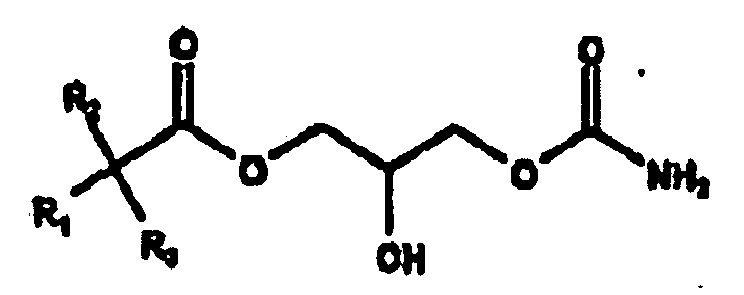
- R 1 , R 2 , and R 3 are alkyl groups of from 1 to 10 carbons each, preferably aliphatic groups of from 1 to 10 carbons. Most preferably, R 1 , R 2 , and R 3 will total from 8 to 12 carbons with at least one of R 1 , R 2 , and R 3 being a methyl group.
- one of R 1 , R 2 , and R 3 may be hydrogen, with the other substituent groups being alkyl groups of from 1-10 carbons, preferably aliphatic groups of from 1 to 10.
- alkyl groups of from 1-10 carbons preferably aliphatic groups of from 1 to 10.
- An example of such a group is In this instance, the above structure is understood to be an example of lateral branching.
- the compound suitable for use as reactive additive (C) may include a straight chain alkyl group of more than 10 carbons, preferably more than 15 carbons and most preferably more than 18.
- suitable straight chain, aliphatic alkyl groups include 1-eicosanyl, 1-octadecyl, 1-arachidyl, 1-dodecyl, 1-decal, and 1-octyl, and the like. It is most preferred that compounds suitable for use as reactive additive (C) include at least one group which is a branched alkyl group such as described above.
- Compounds suitable for use as reactive additive (C) may further include heteratoms such as O and N, most preferably O.
- Such heteratoms may be incorporated in the form of groups such as esters, hydroxyls, ether, carboxyls, mixtures thereof and the like. Preferred are esters, hydroxyls, and mixtures thereof.
- a compound will comprise at least one hydroxyl group and one ester group in addition to the carbamate functional group and the at least one alkyl group. As indicated above, such heteratoms may not be present in the branched alkyl group nor in the.
- Particularly suitable compounds for use as reactive additive (C) are those having the formula: wherein X is a branched alkyl radical of from 5 to 30 total carbons, more preferably from 5 to 15 total carbons and most preferably from 8 to 12 total carbons.
- a more preferred compound for use as reactive additive (C) is that having the formula: wherein R 1 , R 2 , and R 3 are each alkyl groups of from 1 to 10 carbons, especially compounds wherein R 1 , R 2 , and R 3 total from 8 to 12 carbons with at least one of R 1 , R 2 , and R 3 being a methyl group.
- the most preferred reactive additive of the invention can be made by providing a compound having at least one epoxy group and at least one alkyl group selected from the group consisting of branched alkyl groups of from 5 to 30 total carbons, straight chain alkyl groups of more than 10 carbons, and mixtures thereof. It is preferred that the compound provided will comprise at lest one branched alkyl group of from 5 to 30 total carbons. More preferably the epoxy functional compound will have one epoxy group and a branched alkyl group of from 5 to 15 total carbons and most preferably from 8 to 12 total carbons.
- Examples of preferred epoxy functional/branched alkyl group containing compounds are glycidyl ethers, glycidyl esters, and epoxies based on alpha olefins, 2-ethyl hexyl glycidyl ether, and glycidyl esters of the formula: wherein X is a branched alkyl hydrocarbon radical containing from about 5 to 30 total carbons. More preferably, X is a tertiary aliphatic group of from about 5 to 15 carbons and most preferably from 8 to 12 carbons, such as neopentanoate, neoheptanoate, and neodecanoate.
- Glycidyl esters of commercially available mixtures of tertiary aliphatic carboxylic acids such as those available from Shell Chemical Company as VERSATIC ACID 911 are particularly preferred as the epoxy group and branched alkyl group containing compound.
- the glycidyl esters are commercially available from Shell Chemical Company as CARDURA E or GLYDEXX N-10 from Exxon Chemical Company.
- the epoxy group and branched alkyl group containing compound is then reacted with carbon dioxide so as to produce a carbonate functional compound.
- a ring opening catalyst such as triphenyl phosphene or tertiary ammonium salt is normally employed. While the reaction will go under atmospheric pressure, positive pressures are usually used to reduce reaction time.
- the resulting carbonate functional compound is subsequently reacted with ammonia or ammonium hydroxide to provide a the primary carbamate functional reactive additive of the invention.
- the epoxy could be reacted with water to form alcohols, with subsequent conversion of the alcohols into carbamates via transesterification, urea decomposition and the like.
- glycol diols having the same structures of the epoxy functional compounds listed above can be used as a starting material.
- Such glycol diols must have at least one alkyl group selected from the group consisting of branched alkyl groups of from 5 to 30 total carbons, straight chain alkyl groups of more than 10 carbons, and mixtures thereof.
- Glycol diol as used herein refers to a diol wherein the two hydroxy groups are on adjacent carbons. Suitable glycol diols may contain other heteroatom groups as discussed above.
- glycol diols are reacted with phosgene or similar materials such as triphosgene.
- phosgene or similar materials such as triphosgene.
- the resulting cyclic carbonate is then reacted as described above to form the primary carbamate functional reactive additive.
- glycol diols can be directly converted into primary carbamates using techniques such as reaction with urea, HNCO gas, or transesterification with carbamate ester such as methyl carbamate.
- the compound (C) will generally have a molecular weight of 131-2000, and preferably from 131-1000 and most preferably from 131 to 500.
- the glass transition temperature, Tg, of components (A), (B), and (C) can be adjusted to achieve a cured coating having the desired Tg for the particular application involved.
- the compound (C) is preferably used at levels between 3 to 50 percent (based on total resin solids of the coating composition), and more preferably between 5 to 25 percent.
- At least one of components (A) and (B), or both components (A) and (B) must have at least one group thereon that is reactive with the carbamate group(s) on component (C). This is preferably accomplished through the selection of an aminoplast as component (B). Depending on the cure conditions, other compounds identified above as component (B) may also be reactive with the carbamate group(s) on component (C).
- Component (A) may also contain groups that are reactive with carbamate, such as an acrylic polymer containing isobutoxymethyl acrylamide groups.
- a solvent may optionally be utilized in the coating composition used in the practice of the present invention.
- the composition used according to the present invention may be utilized, for example, in the form of substantially solid powder, or a dispersion, it is often desirable that the composition is in a substantially liquid state, which can be accomplished with the use of a solvent.
- This solvent should act as a solvent with respect to both the carbamate-functional compound (A) as well as the component (B).
- the solvent can be any organic solvent and/or water.
- the solvent is a polar organic solvent. More preferably, the solvent is a polar aliphatic solvents or polar aromatic solvents.
- the solvent is a ketone, ester, acetate, aprotic amide, aprotic sulfoxide, or aprotic amine.
- useful solvents include methyl ethyl ketone, methyl isobutyl ketone, m-amyl acetate, ethylene glycol butyl ether-acetate, propylene glycol monomethyl ether acetate, xylene, N-methylpyrrolidone, or blends of aromatic hydrocarbons.
- the solvent is water or a mixture of water with small amounts of co-solvents.
- the coating composition used in the practice of the invention may include a catalyst to enhance the cure reaction.
- a catalyst to enhance the cure reaction.
- a strong acid catalyst may be utilized to enhance the cure reaction.
- catalysts are well known in the art and include, for example, p -toluenesulfonic acid, dinonylnaphthalene disulfonic acid, dodecylbenzenesulfonic acid, phenyl acid phosphate, monobutyl maleate, butyl phosphate, and hydroxy phosphate ester. Strong acid catalysts are often blocked, e.g. with an amine.
- Other catalysts that may be useful in the composition of the invention include Lewis acids, zinc salts, and tin salts.
- the solvent is present in the coating composition in an amount of from about 0.01 weight percent to about 99 weight percent, preferably from about 10 weight percent to about 60 weight percent, and more preferably from about 30 weight percent to about 50 weight percent.
- Coating compositions can be coated on the article by any of a number of techniques well known in the art. These include, for example, spray coating, dip coating, roll coating, curtain coating, and the like. For automotive body panels, spray coating is preferred.
- any additional agent used for example, surfactants, fillers, stabilizers, wetting agents, dispersing agents, adhesion promoters, UV absorbers, HALS, etc. may be incorporated into the coating composition. While the agents are well known in the prior art, the amount used must be controlled to avoid adversely affecting the coating characteristics.
- the coating composition according to the invention is preferably utilized in a high-gloss coating and/or as the clearcoat of a composite color-plus-clear coating.
- High-gloss coatings as used herein are coatings having a 20° gloss (ASTM D523-89) or a DOI (ASTM E430-91) of at least 80.
- the pigment may be any organic or inorganic compounds or colored materials, fillers, metallic or other inorganic flake materials such as mica or aluminum flake, and other materials of kind that the art normally names as pigments.
- Pigments are usually used in the composition in an amount of 1% to 100%, based on the total solid weight of components A, B and C (i.e., a P:B ratio of 0.1 to 1).
- the pigmented basecoat composition may any of a number of types well known in the art, and does not require explanation in detail herein.
- Polymers known in the art to be useful in basecoat compositions include acrylics, vinyls, polyurethanes, polycarbonates, polyesters, alkyds, and polysiloxanes.
- Preferred polymers include acrylics and polyurethanes.
- the basecoat composition also utilizes a carbamate-functional acrylic polymer.
- Basecoat polymers may be thermoplastic, but are preferably crosslinkable and comprise one or more type of cross-linkable functional groups.
- Such groups include, for example, hydroxy, isocyanate, amine, epoxy, acrylate, vinyl, silane, and acetoacetate groups. These groups may be masked or blocked in such a way so that they are unblocked and available for the cross-linking reaction under the desired curing conditions, generally elevated temperatures.
- Useful cross-linkable functional groups include hydroxy, epoxy, acid, anhydride, silane, and acetoacetate groups.
- Preferred cross-linkable functional groups include hydroxy functional groups and amino functional groups.
- Basecoat polymers may be thermoplastic, self-cross-linkable, or may require a separate cross-linking agent that is reactive with the functional groups of the polymer.
- the cross-linking agent may be an aminoplast resin, isocyanate and blocked isocyanates (including isocyanurates), and acid or anhydride functional cross-linking agents.
- the coating compositions described herein are preferably subjected to conditions so as to cure the coating layers.
- heat curing is preferred.
- heat curing is effected by exposing the coated article to elevated temperatures provided primarily by radiative heat sources. Curing temperatures will vary depending on the particular blocking groups used in the cross-linking agents, however they generally range between 93°C and 177°C.
- the compounds (C) according to the present invention are reactive even at relatively low cure temperatures.
- the cure temperature is preferably between 115°C and 150°C, and more preferably at temperatures between 115°C and 138°C for a blocked acid catalyzed system.
- the cure temperature is preferably between 82°C and 99°C
- the curing time will vary depending on the particular components used, and physical parameters such as the thickness of the layers, however, typical curing times range from 15 to 60 minutes, and preferably 15-25 minutes for blocked acid catalyzed systems and 10-20 minutes for unblocked acid catalyzed systems.
- Ammonia gas was added to a mixture of 24290 parts of the product of Part (A) and 16192 parts of methanol. When the ring opening of the cyclic carbonate was complete, the methanol and excess ammonia was removed by vacuum.
- a solution of 1121 parts of deionized water and 25.5 parts of ABEX EP110 (commercially available from Rhodia Inc.) was heated to 82°C under an inert atmosphere.
- the resulting reaction mixture was held at 82°C for two hours.
- the reaction mixture was then cooled to less than 40°C and 7.6 parts of aminopropanol, 6.4 parts of Nuosept® 95 (commercially available from Creanova Inc.) and 32.4 parts of deionized water was added.
- the final resin emulsion was free of coagulum and had a nonvolatile of 39.1, and a pH of 5.61.
- Clearcoat coating compositions with (Coating A) and without (Coating B) the reactive additive (C) were prepared according to the following table.
- UV Absorber 2 1.00 1.00 UV Absorber 3 15.71 15.71 HALS 4 6.00 6.00 Flow Agent 5 0.80 0.80 DDBSA 6 4.00 4.00 EXXATE 1000 7 7.00 7.00 MIAK 8 5.01 10.01 1 Resimene 747, commercially available from Solutia of St Louis, MO. 2
- a GUV absorber commercially available from Ciba Geigy.
- a UV absorber commercially available from Ciba Geigy. 4
- a hindered amine light stabilizer commercially available from Ciba Geigy. 5
- a polysiloxane flow additive commercially available from Byk Chemie. 6
- a blocked dodecylbenzenesulfonic acid commercially available from Exxon Chemical Co.. 8 Methyl iso amyl ketone.
- the viscosity of Coating A was 34 seconds on a #4 Ford cup @ 80°F.
- the theoretical weight percent nonvolatile of Coating A was 64.91%.
- the viscosity of Coating B was 34 seconds on a #4 Ford cup @ 80°F.
- the theoretical weight percent nonvolatile of Coating B was 51.80%.
- the actual weight percent nonvolatile of Coating B was 55.65%.
Landscapes
- Chemical & Material Sciences (AREA)
- Organic Chemistry (AREA)
- Health & Medical Sciences (AREA)
- Chemical Kinetics & Catalysis (AREA)
- Medicinal Chemistry (AREA)
- Polymers & Plastics (AREA)
- Life Sciences & Earth Sciences (AREA)
- Engineering & Computer Science (AREA)
- Materials Engineering (AREA)
- Wood Science & Technology (AREA)
- Paints Or Removers (AREA)
- Polyurethanes Or Polyureas (AREA)
Claims (12)
- Composition aqueuse de revêtement durcissable, comprenant :(A) une résine polymère comprenant un groupement fonctionnel contenant de l'hydrogène actif différent du carbamate,(B) un agent durcissant ayant des groupements qui sont réactifs avec lesdits groupements fonctionnels du composant (A), et(C) un additif réactif comprenant au moins un composé ayant un poids moléculaire de 131 à 2000 et comprenant au moins un groupement carbamate primaire et au moins un groupement alkyle choisi dans le groupe constitué de groupements alkyle ramifié ayant 5 à 30 atomes de carbone, de groupements alkyle à chaîne droite ayant plus de 10 atomes de carbone et de leurs mélanges,dans laquelle l'un des deux composants ou les deux composants (A) et (B) comprennent des groupements qui sont réactifs avec le groupement carbamate primaire du composant (C),
dans laquelle l'additif réactif (C) est un composé que l'on peut obtenir en mettant en oeuvre un composé comprenant au moins un groupement époxy et au moins un groupement alkyle choisi dans le groupe constitué de groupements alkyle à chaîne droite ayant plus de 10 atomes de carbone, de groupements alkyle ramifié ayant 5 à 30 atomes de carbone et de leurs mélanges, en faisant réagir ledit composé avec du dioxyde de carbone et en faisant réagir ledit groupement à fonction carbonate avec de l'ammoniac, ou
en mettant en oeuvre un composé comprenant au moins un diol de type glycol et au moins un groupement alkyle choisi dans le groupe constitué de groupements alkyle à chaîne droite ayant plus de 10 atomes de carbone, de groupements alkyle ramifié ayant 5 à 30 atomes de carbone et de leurs mélanges, en faisant réagir ledit composé avec du phosgène ou du triphosgène et en faisant réagir ledit groupement à fonction carbonate avec de l'ammoniac ou de l'hydroxyde d'ammonium. - Revêtement durcissable selon la revendication 1, dans lequel le au moins un groupement alkyle de l'additif réactif (C) est exempt de groupements fonctionnels réactifs avec un ou plusieurs des composants (A) et (B).
- Composition de revêtement durcissable selon la revendication 1, dans laquelle le au moins un groupement alkyle est exempt d'insaturation.
- Composition de revêtement durcissable selon la revendication 1, dans laquelle l'additif réactif (C) ne présente qu'un seul groupement carbamate.
- Composition de revêtement durcissable selon la revendication 1, dans laquelle le au moins un groupement alkyle est un groupement alkyle ramifié ayant 8 à 12 atomes de carbone.
- Composition de revêtement durcissable selon la revendication 5, dans laquelle le au moins un groupement alkyle est un groupement alkyle ramifié ayant au moins 10 atomes de carbone.
- Composition de revêtement durcissable selon la revendication 1, dans laquelle l'additif réactif (c) a pour formule

- Composition de revêtement durcissable selon la revendication 7, dans laquelle le au moins un groupement alkyle de l'additif réactif (C) est exempt de groupements fonctionnels réactifs avec un ou plusieurs des composants (A) et (B).
- Composition de revêtement durcissable selon la revendication 7, dans laquelle le au moins un groupement alkyle est exempt d'insaturation.
- Composition de revêtement durcissable selon la revendication 7, dans laquelle l'additif réactif (C) ne présente qu'un seul groupement carbamate.
- Procédé pour fabriquer un additif réactif à fonction carbamate, consistant à mettre en oeuvre un composé comprenant au moins un groupement époxy et au moins un groupement alkyle ramifié ayant 5 à 30 atomes de carbone,
à faire réagir ledit composé avec du dioxyde de carbone de manière à produire un composé à fonction carbonate, et
à faire réagir ledit composé à fonction carbonate avec de l'ammoniac, de manière à produire un additif réactif à fonction carbamate. - Additif réactif pour une composition de revêtement comprenant un ou plusieurs composés ayant pour formule :
Applications Claiming Priority (3)
| Application Number | Priority Date | Filing Date | Title |
|---|---|---|---|
| US09/464,309 US6362285B1 (en) | 1999-12-15 | 1999-12-15 | Curable coating compositions containing carbamate functional reactive additives |
| US464309 | 1999-12-15 | ||
| PCT/US2000/027128 WO2001044391A1 (fr) | 1999-12-15 | 2000-10-02 | Compositions de revetement durcissables contenant des additifs reactifs a groupe fonctionnel carbamate |
Publications (2)
| Publication Number | Publication Date |
|---|---|
| EP1238031A1 EP1238031A1 (fr) | 2002-09-11 |
| EP1238031B1 true EP1238031B1 (fr) | 2008-04-16 |
Family
ID=23843403
Family Applications (1)
| Application Number | Title | Priority Date | Filing Date |
|---|---|---|---|
| EP00968573A Expired - Lifetime EP1238031B1 (fr) | 1999-12-15 | 2000-10-02 | Compositions de revetement durcissables contenant des additifs reactifs a groupe fonctionnel carbamate |
Country Status (8)
| Country | Link |
|---|---|
| US (4) | US6362285B1 (fr) |
| EP (1) | EP1238031B1 (fr) |
| AT (1) | ATE392454T1 (fr) |
| AU (1) | AU7846600A (fr) |
| CA (1) | CA2394333A1 (fr) |
| DE (1) | DE60038628T2 (fr) |
| MX (1) | MXPA02004102A (fr) |
| WO (1) | WO2001044391A1 (fr) |
Families Citing this family (16)
| Publication number | Priority date | Publication date | Assignee | Title |
|---|---|---|---|---|
| US6624279B2 (en) * | 1999-05-21 | 2003-09-23 | Basf Corporation | Water-soluble carbamate materials |
| US6624241B2 (en) | 1999-05-21 | 2003-09-23 | Basf Corporation | Waterborne coating compositions containing materials dispersed with water-soluble carbamate materials |
| DE10004498A1 (de) * | 2000-02-02 | 2001-08-09 | Basf Coatings Ag | Diethyloctandioldicarbamate und Diethyloctandioldiallophanate, Verfahren zu ihrer Herstellung und ihre Verwendung |
| US6541577B2 (en) * | 2000-12-06 | 2003-04-01 | Basf Corporation | Carbamate functional polymers and oligomers |
| US20040030176A1 (en) * | 2001-09-05 | 2004-02-12 | Ohrbom Walter H. | Gamma hydroxy carbamate compounds and method of making and using the same |
| US6858674B2 (en) | 2002-10-31 | 2005-02-22 | Basf Corporation | Carbamate functional materials, a method of making said materials, and curable coating compositions containing said materials |
| US6977309B2 (en) | 2002-10-31 | 2005-12-20 | Basf Corporation | Compounds having a secondary or tertiary hydroxy of halide group separated from a primary carbamate group by three or more carbon atoms and a method of making the same |
| US6900270B2 (en) | 2002-10-31 | 2005-05-31 | Basf Corporation | Curable coating compositions with carbamate compounds |
| US6890994B2 (en) * | 2002-10-31 | 2005-05-10 | Basf Corporation | Curable coating compositions with carbamate-containing acrylic polymers |
| US20070059451A1 (en) * | 2005-09-15 | 2007-03-15 | Basf Corporation | Clearcoat paint composition |
| EP2384358B1 (fr) | 2008-12-29 | 2017-05-24 | BASF Coatings GmbH | Composition d'électrorevêtement et procédé remplaçant un prétraitement au phosphate |
| US20100163423A1 (en) | 2008-12-29 | 2010-07-01 | Basf Corporation | Electrocoat composition and process replacing phosphate pretreatment |
| US8153733B2 (en) | 2008-12-29 | 2012-04-10 | Basf Coatings Gmbh | Electrocoat compositions with amine ligand |
| WO2012115691A1 (fr) | 2011-02-22 | 2012-08-30 | Basf Coatings Gmbh | Électrorevêtement à faible brillance |
| MX376612B (es) | 2012-11-09 | 2025-03-07 | Basf Coatings Gmbh | Metodo para mejorar el curado del revestimiento para articulo revestido en composicion de revestimiento para electrorrevestimiento, contaminada con fosfato, y composicion de revestimiento para electrorrevestimiento. |
| US9487662B1 (en) * | 2014-01-21 | 2016-11-08 | Nanotech Industries, Inc. | Radiation-curable biobased flooring compositions with nonreactive additives |
Family Cites Families (32)
| Publication number | Priority date | Publication date | Assignee | Title |
|---|---|---|---|---|
| US2979514A (en) | 1957-07-16 | 1961-04-11 | Rohm & Haas | Process for preparing carbonatoalkyl acrylates and methacrylates |
| US3479328A (en) | 1966-11-18 | 1969-11-18 | Ashland Oil Inc | Novel monomers and polymers |
| US3674838A (en) | 1969-06-05 | 1972-07-04 | Ashland Oil Inc | Vinyl carbamyloxy carboxylates |
| US4126747A (en) | 1976-12-28 | 1978-11-21 | Union Carbide Corporation | Carbamoyloxy acrylate compounds |
| US4279833A (en) | 1979-12-17 | 1981-07-21 | Ashland Chemical Company | Acrylic monomers containing carbamate functionality |
| US4340497A (en) | 1980-03-21 | 1982-07-20 | Union Carbide Corporation | (N-Substituted carbamoyloxy) alkanoyloxyalkyl acrylate esters |
| DE3013408A1 (de) | 1980-04-05 | 1981-10-08 | Peka-Fahrzeugbau Gmbh + Co Kg, 7500 Karlsruhe | Abnehmbare kugelstange mit halterung |
| US4371751A (en) | 1980-04-07 | 1983-02-01 | Newart Electronic Sciences, Inc. | Automatic telephonic user emergency message transmitting apparatus |
| US4520167A (en) | 1984-02-17 | 1985-05-28 | American Cyanamid Co. | Hydroxyalkyl carbamate diluent for coating compositions and compositions containing the same |
| US4484994A (en) | 1984-02-17 | 1984-11-27 | American Cyanamid Company | Hydroxyalkyl carbamate-containing resins for cathodic electrodeposition and method of making the same |
| US4758632A (en) | 1984-02-17 | 1988-07-19 | American Cyanamid Company | Self-cross-linkable acrylic polymer containing hydroxyalkyl carbamate groups and coating compositions containing the same |
| EP0680988A3 (fr) | 1984-02-17 | 1996-05-22 | Cytec Tech Corp | Dérivés à fonction carbamate et compositions de revêtement contenant ces dérivés. |
| US5158808A (en) | 1985-08-01 | 1992-10-27 | Union Carbide Chemicals & Plastics Technology Corporation | Method of coating with a water borne composition |
| EP0233253A1 (fr) | 1985-08-09 | 1987-08-26 | Union Carbide Corporation | Compositions de revetement a base de carbamate |
| US4814382A (en) | 1986-10-07 | 1989-03-21 | Union Carbide Corporation | Solvent borne high solids coating compositions |
| US5115015A (en) | 1987-08-04 | 1992-05-19 | Union Carbide Chemicals & Plastics Technology Corporation | High solids coating compositions |
| US4977231A (en) | 1989-04-13 | 1990-12-11 | Georgia-Pacific Corporation | Phenolic resin containing a latent hardening agent comprising the carbamate reaction product of a cyclic |
| US5574103A (en) | 1992-12-29 | 1996-11-12 | Cytec Technology Corp. | Aminoresin based coatings containing 1,3,5-triazine tris-carbamate co-crosslinkers |
| US5336566A (en) | 1993-04-30 | 1994-08-09 | Basf Corporation | Tri-carbamate-functional crosslinking agents |
| US5872195A (en) | 1996-07-01 | 1999-02-16 | Basf Corporation | Curable coating compositions containing carbamate additive |
| US5827930A (en) | 1995-10-06 | 1998-10-27 | Basf Corporation | Curable coating composition |
| US5512639A (en) | 1993-07-28 | 1996-04-30 | Basf Corporation | Curable compositions containing carbamate-modified polyisocyanates |
| US5744550A (en) | 1994-11-03 | 1998-04-28 | Basf Corporation | Curable coating compositions containing carbamate additives |
| US5596047A (en) | 1994-11-16 | 1997-01-21 | Cytec Technology Corp. | Water-dispersible and curable waterborne compositions containing 1,3,5-triazine carbamates |
| US5552497A (en) | 1994-12-29 | 1996-09-03 | Basf Corporation | Method of preparing carbamate-functional polymer |
| ATE245669T1 (de) | 1995-04-21 | 2003-08-15 | Basf Corp | Vernetzbare beschichtungszusammensetzung |
| US5593733A (en) | 1995-11-21 | 1997-01-14 | Ppg Industries, Inc. | Coating composition containing polyester polymers with terminal carbamate groups and polymeric polyol derived from ethylenically unsaturated monomers |
| CA2192231C (fr) | 1995-12-20 | 2003-12-02 | Youssef Moussa | Revetement |
| US5912382A (en) | 1997-05-29 | 1999-06-15 | Huntsman Pertochemical Corporation | Hydroxyalkyl carbamate compositions and processes for manufacturing same |
| US5866259A (en) | 1997-06-30 | 1999-02-02 | Basf Corporation | Primer coating compositions containing carbamate-functional acrylic polymers |
| US5902473A (en) | 1997-06-30 | 1999-05-11 | Basf Corporation | Cathodic electrodeposition coating with carbamate-functional crosslinking agents |
| US5965670A (en) | 1997-12-24 | 1999-10-12 | Ppg Industries Ohio, Inc. | Curable-film forming compositions having improved mar and acid etch resistance |
-
1999
- 1999-12-15 US US09/464,309 patent/US6362285B1/en not_active Expired - Fee Related
-
2000
- 2000-10-02 MX MXPA02004102A patent/MXPA02004102A/es unknown
- 2000-10-02 AT AT00968573T patent/ATE392454T1/de not_active IP Right Cessation
- 2000-10-02 AU AU78466/00A patent/AU7846600A/en not_active Abandoned
- 2000-10-02 CA CA002394333A patent/CA2394333A1/fr not_active Abandoned
- 2000-10-02 DE DE60038628T patent/DE60038628T2/de not_active Expired - Lifetime
- 2000-10-02 EP EP00968573A patent/EP1238031B1/fr not_active Expired - Lifetime
- 2000-10-02 WO PCT/US2000/027128 patent/WO2001044391A1/fr not_active Ceased
-
2002
- 2002-01-23 US US10/055,515 patent/US20020082355A1/en not_active Abandoned
- 2002-01-23 US US10/055,516 patent/US20020082356A1/en not_active Abandoned
-
2003
- 2003-10-28 US US10/695,183 patent/US6914096B2/en not_active Expired - Fee Related
Also Published As
| Publication number | Publication date |
|---|---|
| AU7846600A (en) | 2001-06-25 |
| US20040087731A1 (en) | 2004-05-06 |
| MXPA02004102A (es) | 2002-10-17 |
| DE60038628D1 (de) | 2008-05-29 |
| US6914096B2 (en) | 2005-07-05 |
| US20020082355A1 (en) | 2002-06-27 |
| EP1238031A1 (fr) | 2002-09-11 |
| WO2001044391A1 (fr) | 2001-06-21 |
| CA2394333A1 (fr) | 2001-06-21 |
| US6362285B1 (en) | 2002-03-26 |
| US20020082356A1 (en) | 2002-06-27 |
| ATE392454T1 (de) | 2008-05-15 |
| DE60038628T2 (de) | 2009-05-20 |
Similar Documents
| Publication | Publication Date | Title |
|---|---|---|
| EP0710707B1 (fr) | Compositions de revêtement durcissables contenant des additifs carbamiques | |
| US5719237A (en) | Coating composition utilizing non-polymeric carbamate-functional compound | |
| US6541594B2 (en) | Coating compositions containing crosslinkable monomeric difunctional compounds having at least thirty carbon atoms | |
| US6362285B1 (en) | Curable coating compositions containing carbamate functional reactive additives | |
| EP1124909B1 (fr) | Compositions de revetement durcissables contenant des melanges de composes a fonctionnalite carbamate | |
| EP1456311B1 (fr) | Polymeres d'urethane reduisant l'effet des liaisons polylactone | |
| EP1362074B1 (fr) | Polymeres et/ou oligomeres fonctionnels de carbamate | |
| US20030125501A1 (en) | Asymmetric diisocyanate monomers in urethane polymers and oligomers to reduce crystallinity | |
| US6391968B1 (en) | Curable coating compositions containing carbamate functional polymers and carbamate functional reactive additives | |
| US6900270B2 (en) | Curable coating compositions with carbamate compounds | |
| AU736397B2 (en) | Coating composition including alkoxy methyl urea compounds having good exterior durability | |
| WO1999057213A1 (fr) | Procede pour ameliorer l'aspect dans des revetements composites colores et transparents, et compositions a cet effet | |
| EP0992553A1 (fr) | Procédé pour améliorer l'adhésion d'un revêtement de réparation sur un substrat préalablement revêtu |
Legal Events
| Date | Code | Title | Description |
|---|---|---|---|
| PUAI | Public reference made under article 153(3) epc to a published international application that has entered the european phase |
Free format text: ORIGINAL CODE: 0009012 |
|
| 17P | Request for examination filed |
Effective date: 20020517 |
|
| AK | Designated contracting states |
Kind code of ref document: A1 Designated state(s): AT BE CH CY DE DK ES FI FR GB GR IE IT LI LU MC NL PT SE |
|
| AX | Request for extension of the european patent |
Free format text: AL;LT;LV;MK;RO;SI |
|
| 17Q | First examination report despatched |
Effective date: 20041206 |
|
| 17Q | First examination report despatched |
Effective date: 20041206 |
|
| GRAP | Despatch of communication of intention to grant a patent |
Free format text: ORIGINAL CODE: EPIDOSNIGR1 |
|
| GRAS | Grant fee paid |
Free format text: ORIGINAL CODE: EPIDOSNIGR3 |
|
| GRAA | (expected) grant |
Free format text: ORIGINAL CODE: 0009210 |
|
| AK | Designated contracting states |
Kind code of ref document: B1 Designated state(s): AT BE CH CY DE DK ES FI FR GB GR IE IT LI LU MC NL PT SE |
|
| REG | Reference to a national code |
Ref country code: CH Ref legal event code: EP |
|
| REG | Reference to a national code |
Ref country code: IE Ref legal event code: FG4D |
|
| REF | Corresponds to: |
Ref document number: 60038628 Country of ref document: DE Date of ref document: 20080529 Kind code of ref document: P |
|
| NLV1 | Nl: lapsed or annulled due to failure to fulfill the requirements of art. 29p and 29m of the patents act | ||
| PG25 | Lapsed in a contracting state [announced via postgrant information from national office to epo] |
Ref country code: ES Free format text: LAPSE BECAUSE OF FAILURE TO SUBMIT A TRANSLATION OF THE DESCRIPTION OR TO PAY THE FEE WITHIN THE PRESCRIBED TIME-LIMIT Effective date: 20080727 Ref country code: PT Free format text: LAPSE BECAUSE OF FAILURE TO SUBMIT A TRANSLATION OF THE DESCRIPTION OR TO PAY THE FEE WITHIN THE PRESCRIBED TIME-LIMIT Effective date: 20080916 Ref country code: FI Free format text: LAPSE BECAUSE OF FAILURE TO SUBMIT A TRANSLATION OF THE DESCRIPTION OR TO PAY THE FEE WITHIN THE PRESCRIBED TIME-LIMIT Effective date: 20080416 Ref country code: NL Free format text: LAPSE BECAUSE OF FAILURE TO SUBMIT A TRANSLATION OF THE DESCRIPTION OR TO PAY THE FEE WITHIN THE PRESCRIBED TIME-LIMIT Effective date: 20080416 |
|
| PG25 | Lapsed in a contracting state [announced via postgrant information from national office to epo] |
Ref country code: AT Free format text: LAPSE BECAUSE OF FAILURE TO SUBMIT A TRANSLATION OF THE DESCRIPTION OR TO PAY THE FEE WITHIN THE PRESCRIBED TIME-LIMIT Effective date: 20080416 |
|
| PG25 | Lapsed in a contracting state [announced via postgrant information from national office to epo] |
Ref country code: DK Free format text: LAPSE BECAUSE OF FAILURE TO SUBMIT A TRANSLATION OF THE DESCRIPTION OR TO PAY THE FEE WITHIN THE PRESCRIBED TIME-LIMIT Effective date: 20080416 Ref country code: SE Free format text: LAPSE BECAUSE OF FAILURE TO SUBMIT A TRANSLATION OF THE DESCRIPTION OR TO PAY THE FEE WITHIN THE PRESCRIBED TIME-LIMIT Effective date: 20080716 |
|
| PLBE | No opposition filed within time limit |
Free format text: ORIGINAL CODE: 0009261 |
|
| STAA | Information on the status of an ep patent application or granted ep patent |
Free format text: STATUS: NO OPPOSITION FILED WITHIN TIME LIMIT |
|
| EN | Fr: translation not filed | ||
| PG25 | Lapsed in a contracting state [announced via postgrant information from national office to epo] |
Ref country code: BE Free format text: LAPSE BECAUSE OF FAILURE TO SUBMIT A TRANSLATION OF THE DESCRIPTION OR TO PAY THE FEE WITHIN THE PRESCRIBED TIME-LIMIT Effective date: 20080416 |
|
| 26N | No opposition filed |
Effective date: 20090119 |
|
| PG25 | Lapsed in a contracting state [announced via postgrant information from national office to epo] |
Ref country code: MC Free format text: LAPSE BECAUSE OF NON-PAYMENT OF DUE FEES Effective date: 20081031 |
|
| REG | Reference to a national code |
Ref country code: CH Ref legal event code: PL |
|
| GBPC | Gb: european patent ceased through non-payment of renewal fee |
Effective date: 20081002 |
|
| PG25 | Lapsed in a contracting state [announced via postgrant information from national office to epo] |
Ref country code: IT Free format text: LAPSE BECAUSE OF FAILURE TO SUBMIT A TRANSLATION OF THE DESCRIPTION OR TO PAY THE FEE WITHIN THE PRESCRIBED TIME-LIMIT Effective date: 20080416 |
|
| PG25 | Lapsed in a contracting state [announced via postgrant information from national office to epo] |
Ref country code: CY Free format text: LAPSE BECAUSE OF FAILURE TO SUBMIT A TRANSLATION OF THE DESCRIPTION OR TO PAY THE FEE WITHIN THE PRESCRIBED TIME-LIMIT Effective date: 20080416 |
|
| PG25 | Lapsed in a contracting state [announced via postgrant information from national office to epo] |
Ref country code: CH Free format text: LAPSE BECAUSE OF NON-PAYMENT OF DUE FEES Effective date: 20081031 Ref country code: LI Free format text: LAPSE BECAUSE OF NON-PAYMENT OF DUE FEES Effective date: 20081031 Ref country code: IE Free format text: LAPSE BECAUSE OF NON-PAYMENT OF DUE FEES Effective date: 20081002 |
|
| PG25 | Lapsed in a contracting state [announced via postgrant information from national office to epo] |
Ref country code: GB Free format text: LAPSE BECAUSE OF NON-PAYMENT OF DUE FEES Effective date: 20081002 |
|
| PG25 | Lapsed in a contracting state [announced via postgrant information from national office to epo] |
Ref country code: LU Free format text: LAPSE BECAUSE OF NON-PAYMENT OF DUE FEES Effective date: 20081002 |
|
| PG25 | Lapsed in a contracting state [announced via postgrant information from national office to epo] |
Ref country code: GR Free format text: LAPSE BECAUSE OF FAILURE TO SUBMIT A TRANSLATION OF THE DESCRIPTION OR TO PAY THE FEE WITHIN THE PRESCRIBED TIME-LIMIT Effective date: 20080717 |
|
| PGFP | Annual fee paid to national office [announced via postgrant information from national office to epo] |
Ref country code: DE Payment date: 20120102 Year of fee payment: 12 |
|
| PG25 | Lapsed in a contracting state [announced via postgrant information from national office to epo] |
Ref country code: FR Free format text: LAPSE BECAUSE OF FAILURE TO SUBMIT A TRANSLATION OF THE DESCRIPTION OR TO PAY THE FEE WITHIN THE PRESCRIBED TIME-LIMIT Effective date: 20090227 |
|
| PG25 | Lapsed in a contracting state [announced via postgrant information from national office to epo] |
Ref country code: DE Free format text: LAPSE BECAUSE OF NON-PAYMENT OF DUE FEES Effective date: 20130501 |
|
| REG | Reference to a national code |
Ref country code: DE Ref legal event code: R119 Ref document number: 60038628 Country of ref document: DE Effective date: 20130501 |