EP1240941A2 - Kupfer-Aluminium Mischoxid Katalysator, seine Herstellung und seine Verwendungen - Google Patents
Kupfer-Aluminium Mischoxid Katalysator, seine Herstellung und seine Verwendungen Download PDFInfo
- Publication number
- EP1240941A2 EP1240941A2 EP02076414A EP02076414A EP1240941A2 EP 1240941 A2 EP1240941 A2 EP 1240941A2 EP 02076414 A EP02076414 A EP 02076414A EP 02076414 A EP02076414 A EP 02076414A EP 1240941 A2 EP1240941 A2 EP 1240941A2
- Authority
- EP
- European Patent Office
- Prior art keywords
- catalyst
- hydrogenation
- reaction
- copper
- anyone
- Prior art date
- Legal status (The legal status is an assumption and is not a legal conclusion. Google has not performed a legal analysis and makes no representation as to the accuracy of the status listed.)
- Granted
Links
Images


Classifications
-
- C—CHEMISTRY; METALLURGY
- C07—ORGANIC CHEMISTRY
- C07C—ACYCLIC OR CARBOCYCLIC COMPOUNDS
- C07C29/00—Preparation of compounds having hydroxy or O-metal groups bound to a carbon atom not belonging to a six-membered aromatic ring
- C07C29/15—Preparation of compounds having hydroxy or O-metal groups bound to a carbon atom not belonging to a six-membered aromatic ring by reduction of oxides of carbon exclusively
- C07C29/151—Preparation of compounds having hydroxy or O-metal groups bound to a carbon atom not belonging to a six-membered aromatic ring by reduction of oxides of carbon exclusively with hydrogen or hydrogen-containing gases
- C07C29/153—Preparation of compounds having hydroxy or O-metal groups bound to a carbon atom not belonging to a six-membered aromatic ring by reduction of oxides of carbon exclusively with hydrogen or hydrogen-containing gases characterised by the catalyst used
- C07C29/154—Preparation of compounds having hydroxy or O-metal groups bound to a carbon atom not belonging to a six-membered aromatic ring by reduction of oxides of carbon exclusively with hydrogen or hydrogen-containing gases characterised by the catalyst used containing copper, silver, gold, or compounds thereof
-
- B—PERFORMING OPERATIONS; TRANSPORTING
- B01—PHYSICAL OR CHEMICAL PROCESSES OR APPARATUS IN GENERAL
- B01D—SEPARATION
- B01D53/00—Separation of gases or vapours; Recovering vapours of volatile solvents from gases; Chemical or biological purification of waste gases, e.g. engine exhaust gases, smoke, fumes, flue gases, aerosols
- B01D53/34—Chemical or biological purification of waste gases
- B01D53/74—General processes for purification of waste gases; Apparatus or devices specially adapted therefor
- B01D53/86—Catalytic processes
-
- B—PERFORMING OPERATIONS; TRANSPORTING
- B01—PHYSICAL OR CHEMICAL PROCESSES OR APPARATUS IN GENERAL
- B01J—CHEMICAL OR PHYSICAL PROCESSES, e.g. CATALYSIS OR COLLOID CHEMISTRY; THEIR RELEVANT APPARATUS
- B01J21/00—Catalysts comprising the elements, oxides, or hydroxides of magnesium, boron, aluminium, carbon, silicon, titanium, zirconium, or hafnium
- B01J21/02—Boron or aluminium; Oxides or hydroxides thereof
- B01J21/04—Alumina
-
- B—PERFORMING OPERATIONS; TRANSPORTING
- B01—PHYSICAL OR CHEMICAL PROCESSES OR APPARATUS IN GENERAL
- B01J—CHEMICAL OR PHYSICAL PROCESSES, e.g. CATALYSIS OR COLLOID CHEMISTRY; THEIR RELEVANT APPARATUS
- B01J23/00—Catalysts comprising metals or metal oxides or hydroxides, not provided for in group B01J21/00
- B01J23/002—Mixed oxides other than spinels, e.g. perovskite
-
- B—PERFORMING OPERATIONS; TRANSPORTING
- B01—PHYSICAL OR CHEMICAL PROCESSES OR APPARATUS IN GENERAL
- B01J—CHEMICAL OR PHYSICAL PROCESSES, e.g. CATALYSIS OR COLLOID CHEMISTRY; THEIR RELEVANT APPARATUS
- B01J23/00—Catalysts comprising metals or metal oxides or hydroxides, not provided for in group B01J21/00
- B01J23/005—Spinels
-
- B—PERFORMING OPERATIONS; TRANSPORTING
- B01—PHYSICAL OR CHEMICAL PROCESSES OR APPARATUS IN GENERAL
- B01J—CHEMICAL OR PHYSICAL PROCESSES, e.g. CATALYSIS OR COLLOID CHEMISTRY; THEIR RELEVANT APPARATUS
- B01J23/00—Catalysts comprising metals or metal oxides or hydroxides, not provided for in group B01J21/00
- B01J23/70—Catalysts comprising metals or metal oxides or hydroxides, not provided for in group B01J21/00 of the iron group metals or copper
- B01J23/72—Copper
-
- B—PERFORMING OPERATIONS; TRANSPORTING
- B01—PHYSICAL OR CHEMICAL PROCESSES OR APPARATUS IN GENERAL
- B01J—CHEMICAL OR PHYSICAL PROCESSES, e.g. CATALYSIS OR COLLOID CHEMISTRY; THEIR RELEVANT APPARATUS
- B01J23/00—Catalysts comprising metals or metal oxides or hydroxides, not provided for in group B01J21/00
- B01J23/70—Catalysts comprising metals or metal oxides or hydroxides, not provided for in group B01J21/00 of the iron group metals or copper
- B01J23/74—Iron group metals
- B01J23/755—Nickel
-
- B—PERFORMING OPERATIONS; TRANSPORTING
- B01—PHYSICAL OR CHEMICAL PROCESSES OR APPARATUS IN GENERAL
- B01J—CHEMICAL OR PHYSICAL PROCESSES, e.g. CATALYSIS OR COLLOID CHEMISTRY; THEIR RELEVANT APPARATUS
- B01J23/00—Catalysts comprising metals or metal oxides or hydroxides, not provided for in group B01J21/00
- B01J23/70—Catalysts comprising metals or metal oxides or hydroxides, not provided for in group B01J21/00 of the iron group metals or copper
- B01J23/76—Catalysts comprising metals or metal oxides or hydroxides, not provided for in group B01J21/00 of the iron group metals or copper combined with metals, oxides or hydroxides provided for in groups B01J23/02 - B01J23/36
- B01J23/78—Catalysts comprising metals or metal oxides or hydroxides, not provided for in group B01J21/00 of the iron group metals or copper combined with metals, oxides or hydroxides provided for in groups B01J23/02 - B01J23/36 with alkali- or alkaline earth metals
-
- B—PERFORMING OPERATIONS; TRANSPORTING
- B01—PHYSICAL OR CHEMICAL PROCESSES OR APPARATUS IN GENERAL
- B01J—CHEMICAL OR PHYSICAL PROCESSES, e.g. CATALYSIS OR COLLOID CHEMISTRY; THEIR RELEVANT APPARATUS
- B01J23/00—Catalysts comprising metals or metal oxides or hydroxides, not provided for in group B01J21/00
- B01J23/70—Catalysts comprising metals or metal oxides or hydroxides, not provided for in group B01J21/00 of the iron group metals or copper
- B01J23/76—Catalysts comprising metals or metal oxides or hydroxides, not provided for in group B01J21/00 of the iron group metals or copper combined with metals, oxides or hydroxides provided for in groups B01J23/02 - B01J23/36
- B01J23/83—Catalysts comprising metals or metal oxides or hydroxides, not provided for in group B01J21/00 of the iron group metals or copper combined with metals, oxides or hydroxides provided for in groups B01J23/02 - B01J23/36 with rare earths or actinides
-
- B—PERFORMING OPERATIONS; TRANSPORTING
- B01—PHYSICAL OR CHEMICAL PROCESSES OR APPARATUS IN GENERAL
- B01J—CHEMICAL OR PHYSICAL PROCESSES, e.g. CATALYSIS OR COLLOID CHEMISTRY; THEIR RELEVANT APPARATUS
- B01J23/00—Catalysts comprising metals or metal oxides or hydroxides, not provided for in group B01J21/00
- B01J23/70—Catalysts comprising metals or metal oxides or hydroxides, not provided for in group B01J21/00 of the iron group metals or copper
- B01J23/76—Catalysts comprising metals or metal oxides or hydroxides, not provided for in group B01J21/00 of the iron group metals or copper combined with metals, oxides or hydroxides provided for in groups B01J23/02 - B01J23/36
- B01J23/84—Catalysts comprising metals or metal oxides or hydroxides, not provided for in group B01J21/00 of the iron group metals or copper combined with metals, oxides or hydroxides provided for in groups B01J23/02 - B01J23/36 with arsenic, antimony, bismuth, vanadium, niobium, tantalum, polonium, chromium, molybdenum, tungsten, manganese, technetium or rhenium
- B01J23/889—Manganese, technetium or rhenium
- B01J23/8892—Manganese
-
- B—PERFORMING OPERATIONS; TRANSPORTING
- B01—PHYSICAL OR CHEMICAL PROCESSES OR APPARATUS IN GENERAL
- B01J—CHEMICAL OR PHYSICAL PROCESSES, e.g. CATALYSIS OR COLLOID CHEMISTRY; THEIR RELEVANT APPARATUS
- B01J35/00—Catalysts, in general, characterised by their form or physical properties
- B01J35/60—Catalysts, in general, characterised by their form or physical properties characterised by their surface properties or porosity
-
- B—PERFORMING OPERATIONS; TRANSPORTING
- B01—PHYSICAL OR CHEMICAL PROCESSES OR APPARATUS IN GENERAL
- B01J—CHEMICAL OR PHYSICAL PROCESSES, e.g. CATALYSIS OR COLLOID CHEMISTRY; THEIR RELEVANT APPARATUS
- B01J35/00—Catalysts, in general, characterised by their form or physical properties
- B01J35/60—Catalysts, in general, characterised by their form or physical properties characterised by their surface properties or porosity
- B01J35/61—Surface area
- B01J35/613—10-100 m2/g
-
- B—PERFORMING OPERATIONS; TRANSPORTING
- B01—PHYSICAL OR CHEMICAL PROCESSES OR APPARATUS IN GENERAL
- B01J—CHEMICAL OR PHYSICAL PROCESSES, e.g. CATALYSIS OR COLLOID CHEMISTRY; THEIR RELEVANT APPARATUS
- B01J35/00—Catalysts, in general, characterised by their form or physical properties
- B01J35/60—Catalysts, in general, characterised by their form or physical properties characterised by their surface properties or porosity
- B01J35/63—Pore volume
- B01J35/633—Pore volume less than 0.5 ml/g
-
- B—PERFORMING OPERATIONS; TRANSPORTING
- B01—PHYSICAL OR CHEMICAL PROCESSES OR APPARATUS IN GENERAL
- B01J—CHEMICAL OR PHYSICAL PROCESSES, e.g. CATALYSIS OR COLLOID CHEMISTRY; THEIR RELEVANT APPARATUS
- B01J35/00—Catalysts, in general, characterised by their form or physical properties
- B01J35/60—Catalysts, in general, characterised by their form or physical properties characterised by their surface properties or porosity
- B01J35/63—Pore volume
- B01J35/635—0.5-1.0 ml/g
-
- B—PERFORMING OPERATIONS; TRANSPORTING
- B01—PHYSICAL OR CHEMICAL PROCESSES OR APPARATUS IN GENERAL
- B01J—CHEMICAL OR PHYSICAL PROCESSES, e.g. CATALYSIS OR COLLOID CHEMISTRY; THEIR RELEVANT APPARATUS
- B01J35/00—Catalysts, in general, characterised by their form or physical properties
- B01J35/60—Catalysts, in general, characterised by their form or physical properties characterised by their surface properties or porosity
- B01J35/64—Pore diameter
- B01J35/647—2-50 nm
-
- B—PERFORMING OPERATIONS; TRANSPORTING
- B01—PHYSICAL OR CHEMICAL PROCESSES OR APPARATUS IN GENERAL
- B01J—CHEMICAL OR PHYSICAL PROCESSES, e.g. CATALYSIS OR COLLOID CHEMISTRY; THEIR RELEVANT APPARATUS
- B01J35/00—Catalysts, in general, characterised by their form or physical properties
- B01J35/60—Catalysts, in general, characterised by their form or physical properties characterised by their surface properties or porosity
- B01J35/64—Pore diameter
- B01J35/651—50-500 nm
-
- B—PERFORMING OPERATIONS; TRANSPORTING
- B01—PHYSICAL OR CHEMICAL PROCESSES OR APPARATUS IN GENERAL
- B01J—CHEMICAL OR PHYSICAL PROCESSES, e.g. CATALYSIS OR COLLOID CHEMISTRY; THEIR RELEVANT APPARATUS
- B01J35/00—Catalysts, in general, characterised by their form or physical properties
- B01J35/60—Catalysts, in general, characterised by their form or physical properties characterised by their surface properties or porosity
- B01J35/66—Pore distribution
- B01J35/69—Pore distribution bimodal
-
- B—PERFORMING OPERATIONS; TRANSPORTING
- B01—PHYSICAL OR CHEMICAL PROCESSES OR APPARATUS IN GENERAL
- B01J—CHEMICAL OR PHYSICAL PROCESSES, e.g. CATALYSIS OR COLLOID CHEMISTRY; THEIR RELEVANT APPARATUS
- B01J37/00—Processes, in general, for preparing catalysts; Processes, in general, for activation of catalysts
- B01J37/02—Impregnation, coating or precipitation
- B01J37/03—Precipitation; Co-precipitation
-
- B—PERFORMING OPERATIONS; TRANSPORTING
- B01—PHYSICAL OR CHEMICAL PROCESSES OR APPARATUS IN GENERAL
- B01J—CHEMICAL OR PHYSICAL PROCESSES, e.g. CATALYSIS OR COLLOID CHEMISTRY; THEIR RELEVANT APPARATUS
- B01J37/00—Processes, in general, for preparing catalysts; Processes, in general, for activation of catalysts
- B01J37/02—Impregnation, coating or precipitation
- B01J37/03—Precipitation; Co-precipitation
- B01J37/031—Precipitation
-
- B—PERFORMING OPERATIONS; TRANSPORTING
- B01—PHYSICAL OR CHEMICAL PROCESSES OR APPARATUS IN GENERAL
- B01J—CHEMICAL OR PHYSICAL PROCESSES, e.g. CATALYSIS OR COLLOID CHEMISTRY; THEIR RELEVANT APPARATUS
- B01J37/00—Processes, in general, for preparing catalysts; Processes, in general, for activation of catalysts
- B01J37/02—Impregnation, coating or precipitation
- B01J37/03—Precipitation; Co-precipitation
- B01J37/038—Precipitation; Co-precipitation to form slurries or suspensions, e.g. a washcoat
-
- C—CHEMISTRY; METALLURGY
- C01—INORGANIC CHEMISTRY
- C01B—NON-METALLIC ELEMENTS; COMPOUNDS THEREOF; METALLOIDS OR COMPOUNDS THEREOF NOT COVERED BY SUBCLASS C01C
- C01B17/00—Sulfur; Compounds thereof
- C01B17/69—Sulfur trioxide; Sulfuric acid
- C01B17/74—Preparation
- C01B17/76—Preparation by contact processes
- C01B17/78—Preparation by contact processes characterised by the catalyst used
-
- C—CHEMISTRY; METALLURGY
- C07—ORGANIC CHEMISTRY
- C07C—ACYCLIC OR CARBOCYCLIC COMPOUNDS
- C07C1/00—Preparation of hydrocarbons from one or more compounds, none of them being a hydrocarbon
- C07C1/20—Preparation of hydrocarbons from one or more compounds, none of them being a hydrocarbon starting from organic compounds containing only oxygen atoms as heteroatoms
- C07C1/22—Preparation of hydrocarbons from one or more compounds, none of them being a hydrocarbon starting from organic compounds containing only oxygen atoms as heteroatoms by reduction
-
- C—CHEMISTRY; METALLURGY
- C07—ORGANIC CHEMISTRY
- C07C—ACYCLIC OR CARBOCYCLIC COMPOUNDS
- C07C209/00—Preparation of compounds containing amino groups bound to a carbon skeleton
- C07C209/30—Preparation of compounds containing amino groups bound to a carbon skeleton by reduction of nitrogen-to-oxygen or nitrogen-to-nitrogen bonds
- C07C209/32—Preparation of compounds containing amino groups bound to a carbon skeleton by reduction of nitrogen-to-oxygen or nitrogen-to-nitrogen bonds by reduction of nitro groups
- C07C209/36—Preparation of compounds containing amino groups bound to a carbon skeleton by reduction of nitrogen-to-oxygen or nitrogen-to-nitrogen bonds by reduction of nitro groups by reduction of nitro groups bound to carbon atoms of six-membered aromatic rings in presence of hydrogen-containing gases and a catalyst
-
- C—CHEMISTRY; METALLURGY
- C07—ORGANIC CHEMISTRY
- C07C—ACYCLIC OR CARBOCYCLIC COMPOUNDS
- C07C209/00—Preparation of compounds containing amino groups bound to a carbon skeleton
- C07C209/44—Preparation of compounds containing amino groups bound to a carbon skeleton by reduction of carboxylic acids or esters thereof in presence of ammonia or amines, or by reduction of nitriles, carboxylic acid amides, imines or imino-ethers
- C07C209/48—Preparation of compounds containing amino groups bound to a carbon skeleton by reduction of carboxylic acids or esters thereof in presence of ammonia or amines, or by reduction of nitriles, carboxylic acid amides, imines or imino-ethers by reduction of nitriles
-
- C—CHEMISTRY; METALLURGY
- C07—ORGANIC CHEMISTRY
- C07C—ACYCLIC OR CARBOCYCLIC COMPOUNDS
- C07C209/00—Preparation of compounds containing amino groups bound to a carbon skeleton
- C07C209/60—Preparation of compounds containing amino groups bound to a carbon skeleton by condensation or addition reactions, e.g. Mannich reaction, addition of ammonia or amines to alkenes or to alkynes or addition of compounds containing an active hydrogen atom to Schiff's bases, quinone imines, or aziranes
-
- C—CHEMISTRY; METALLURGY
- C07—ORGANIC CHEMISTRY
- C07C—ACYCLIC OR CARBOCYCLIC COMPOUNDS
- C07C231/00—Preparation of carboxylic acid amides
- C07C231/06—Preparation of carboxylic acid amides from nitriles by transformation of cyano groups into carboxamide groups
- C07C231/065—By hydration using metals or metallic ions as catalyst
-
- C—CHEMISTRY; METALLURGY
- C07—ORGANIC CHEMISTRY
- C07C—ACYCLIC OR CARBOCYCLIC COMPOUNDS
- C07C29/00—Preparation of compounds having hydroxy or O-metal groups bound to a carbon atom not belonging to a six-membered aromatic ring
- C07C29/132—Preparation of compounds having hydroxy or O-metal groups bound to a carbon atom not belonging to a six-membered aromatic ring by reduction of an oxygen containing functional group
- C07C29/136—Preparation of compounds having hydroxy or O-metal groups bound to a carbon atom not belonging to a six-membered aromatic ring by reduction of an oxygen containing functional group of >C=O containing groups, e.g. —COOH
- C07C29/147—Preparation of compounds having hydroxy or O-metal groups bound to a carbon atom not belonging to a six-membered aromatic ring by reduction of an oxygen containing functional group of >C=O containing groups, e.g. —COOH of carboxylic acids or derivatives thereof
- C07C29/149—Preparation of compounds having hydroxy or O-metal groups bound to a carbon atom not belonging to a six-membered aromatic ring by reduction of an oxygen containing functional group of >C=O containing groups, e.g. —COOH of carboxylic acids or derivatives thereof with hydrogen or hydrogen-containing gases
-
- C—CHEMISTRY; METALLURGY
- C07—ORGANIC CHEMISTRY
- C07C—ACYCLIC OR CARBOCYCLIC COMPOUNDS
- C07C37/00—Preparation of compounds having hydroxy or O-metal groups bound to a carbon atom of a six-membered aromatic ring
- C07C37/11—Preparation of compounds having hydroxy or O-metal groups bound to a carbon atom of a six-membered aromatic ring by reactions increasing the number of carbon atoms
- C07C37/16—Preparation of compounds having hydroxy or O-metal groups bound to a carbon atom of a six-membered aromatic ring by reactions increasing the number of carbon atoms by condensation involving hydroxy groups of phenols or alcohols or the ether or mineral ester group derived therefrom
-
- C—CHEMISTRY; METALLURGY
- C07—ORGANIC CHEMISTRY
- C07D—HETEROCYCLIC COMPOUNDS
- C07D301/00—Preparation of oxiranes
- C07D301/32—Separation; Purification
-
- B—PERFORMING OPERATIONS; TRANSPORTING
- B01—PHYSICAL OR CHEMICAL PROCESSES OR APPARATUS IN GENERAL
- B01J—CHEMICAL OR PHYSICAL PROCESSES, e.g. CATALYSIS OR COLLOID CHEMISTRY; THEIR RELEVANT APPARATUS
- B01J2523/00—Constitutive chemical elements of heterogeneous catalysts
-
- B—PERFORMING OPERATIONS; TRANSPORTING
- B01—PHYSICAL OR CHEMICAL PROCESSES OR APPARATUS IN GENERAL
- B01J—CHEMICAL OR PHYSICAL PROCESSES, e.g. CATALYSIS OR COLLOID CHEMISTRY; THEIR RELEVANT APPARATUS
- B01J37/00—Processes, in general, for preparing catalysts; Processes, in general, for activation of catalysts
- B01J37/0009—Use of binding agents; Moulding; Pressing; Powdering; Granulating; Addition of materials ameliorating the mechanical properties of the product catalyst
-
- C—CHEMISTRY; METALLURGY
- C07—ORGANIC CHEMISTRY
- C07C—ACYCLIC OR CARBOCYCLIC COMPOUNDS
- C07C2521/00—Catalysts comprising the elements, oxides or hydroxides of magnesium, boron, aluminium, carbon, silicon, titanium, zirconium or hafnium
- C07C2521/02—Boron or aluminium; Oxides or hydroxides thereof
- C07C2521/04—Alumina
-
- C—CHEMISTRY; METALLURGY
- C07—ORGANIC CHEMISTRY
- C07C—ACYCLIC OR CARBOCYCLIC COMPOUNDS
- C07C2523/00—Catalysts comprising metals or metal oxides or hydroxides, not provided for in group C07C2521/00
- C07C2523/70—Catalysts comprising metals or metal oxides or hydroxides, not provided for in group C07C2521/00 of the iron group metals or copper
- C07C2523/72—Copper
-
- Y—GENERAL TAGGING OF NEW TECHNOLOGICAL DEVELOPMENTS; GENERAL TAGGING OF CROSS-SECTIONAL TECHNOLOGIES SPANNING OVER SEVERAL SECTIONS OF THE IPC; TECHNICAL SUBJECTS COVERED BY FORMER USPC CROSS-REFERENCE ART COLLECTIONS [XRACs] AND DIGESTS
- Y02—TECHNOLOGIES OR APPLICATIONS FOR MITIGATION OR ADAPTATION AGAINST CLIMATE CHANGE
- Y02P—CLIMATE CHANGE MITIGATION TECHNOLOGIES IN THE PRODUCTION OR PROCESSING OF GOODS
- Y02P20/00—Technologies relating to chemical industry
- Y02P20/50—Improvements relating to the production of bulk chemicals
- Y02P20/52—Improvements relating to the production of bulk chemicals using catalysts, e.g. selective catalysts
Definitions
- This invention relates generally to a Cu-Al-O catalyst having a homogeneous bulk to replace Cu/Cr catalysts in specific applications. It also relates to a catalytic reaction of a type previously catalyzed by a copper-chrome catalyst, a method of making a catalyst and a method of preparing a Cu-Al-O catalyst powder.
- Adkins' catalyst is a complex mixture of primarily copper oxide and copper chromite.
- the catalyst is used in hydrogenolysis reactions, for example the catalytic hydrogenolysis of an ester to alcohols, illustrated generally by the following reaction:
- the catalyst reduces to a mixture of metal copper, cuprous oxide and copper chromite.
- One of the crucial roles of chrome in Cu/Cr catalysts is that it behaves as a structural promoter.
- the Cu/Cr catalysts have widespread commercial and industrial application in such diverse processes as hydrogenation of aldehyde in oxoalcohol finishing, hydration of acrylonitrile, fatty acid hydrogenolysis, hydrogenolysis of methyl esters, reductive amination, and a myriad of other hydrogenation and oxidation reactions such as are listed below.
- US-A- 3,935,128, to Fein et al provides a process for producing a copper chromite catalyst.
- US-A-4,982,020 to Carduck et al. discloses a process for direct hydrogenation of glyceride oils where the reaction is carried out over a catalyst containing copper, chromium, barium and/or other transition metals in the form of oxides which, after calcination, form the catalyst mass.
- US-A- 4,450,245 to Adair et al. provides a catalyst support wherein the catalyst is employed in the low temperature oxidation of carbon monoxide, another important application of such catalysts.
- US-A- 4,252,689 to Bunji Miya describes a method of preparing a copper-iron-alumina catalyst used in hydrogenation.
- US-A- 4,278,567 to Bunji Miya et al. discloses a similar process for making a copper-iron-aluminum catalyst.
- US-A- 4,551,444 to Fan-Nan Lin et al. provides a five-component catalyst wherein the essential components are copper, an iron group component, a component of elements 23-26, an alkali metal compound and a precious metal compound.
- US-A- 4,977,123 to Maria Flytzani Stephanopoulos et al. discloses extruded sorbent compositions having mixed oxide components of copper oxide, iron oxide, and alumina.
- US-A- 3,865,753, to Broecker et al provides a process for preparing a nickel magnesium aluminum catalyst used for the cracking of hydrocarbons.
- the prior art, non-chrome containing catalysts have several disadvantages that limit the industrial applicability of the catalysts.
- SU-A-629 621 discloses a process of the production of acrylamide by hydration of acrylonitrile at 80°C-160°C in the presence of an oxide catalyst using oxide copper-zinc-aluminum catalyst.
- EP-A-0 695 579 disclosed the obtention of a copper catalyst by reducing a precursor containing copper and aluminum for the hydration of nitriles and the preparation thereof.
- EP-A-0 042 471 discloses a catalyst and a method for producing said catalyst wherein at least 60% by weight consists of copper oxide, aluminum oxide - spinel and 60-100% of the copper present is bound to aluminum oxide as copper oxide, aluminum oxide-spinel.
- EP-A-0 434 061 discloses a process for hydrogenating bound oxygen-containing organic feeds into their corresponding alcohols by contact with a coprecipitated copper-aluminum catalyst that has been activated by contact with reducing gas at a temperature that gradually increases.
- DE-A-4 301 470 discloses a process for a catalytic decomposition of pure or gaseous mixture of N 2 O by using a catalyst which is produced by incorporation of CuAl 2 O 4 .
- An ideal catalyst should be both chemically and physically stable. Chemical stability is demonstrated by consistent catalyst activity in an acceptable time period. Physical stability is demonstrated by maintaining a stable particle size or physical form during the chemical reaction. Moreover, an ideal catalyst would have narrow particle distribution since particle size affects filtration speed in a commercial process employing the catalysts. The stability is further demonstrated by resistance to common poisons such as sulfur compounds, organic chlorines, bromine and iodine compounds. Generally, stability is tested using Cu/Cr catalyst as the standard catalyst.
- An ideal catalyst also would have a low percentage of leachable cations. This ensures the maintenance of catalyst activity and a good product quality.
- the catalyst function well in commercial applications.
- the hydration of acrylonitrile to acrylamide over a copper-containing catalyst is an important industrial application.
- the catalysts include copper/chrome, copper/silica, copper on kieselguhr, Raney copper, ion exchange copper on silica and copper on alumina catalysts.
- Most of the prior art catalysts used in this application have the problem of deactivation.
- the catalyst is deactivated by the accumulation of polyacrylamide on the surface or by the oxidation of surface copper. Selectivity is also important. Normally, hydration of C-N bonds is favored by acidic oxides while hydrolysis of C-C bonds is favored by basic oxides. Therefore, the surface acidity of the catalyst is crucial to this application.
- alkaline metal or alkaline metal compounds should be remained or added to the catalyst matrix.
- Another object of the present invention is to provide a non-chrome, copper-containing catalyst having a spinel crystal structure analogous to the spinel crystal structure of conventional Cu/Cr catalysts.
- Still another object of the invention to provide a non-chrome, copper-containing catalyst that contains an optimal ratio of copper to alumina.
- Yet another object of the present invention is to provide a non-chrome, copper-containing catalyst thereby eliminating the environmental issues associated with the disposal of chrome-containing catalysts.
- a still further object of the invention is to provide a non-chrome, copper-containing catalyst that is relatively stable, and has a low percentage of leachable cations.
- Still another object of the present invention is to provide a non-chrome, copper-containing catalyst that is efficient to prepare, functions well as a Cu/Cr catalyst in new or conventional chemical reactions, has good selectivity and is not easily deactivated.
- a non-chrome, copper-based catalyst, Cu-Al-O, and a method of preparing the same are provided wherein the catalyst is prepared by co-precipitation from a solution consisting essentially of a soluble copper salt and a soluble aluminum compound in the presence of a precipitating agent.
- the copper salt is illustratively cupric nitrate, Cu(NO 3 ) 2
- the aluminum compound is preferably a basic aluminum salt, most preferably an aluminate such as sodium aluminate, Na 2 Al 2 O 4 .
- the copper salt and the aluminum compound are preferably dissolved separately and the solutions are slowly mixed in an aqueous precipitation mixture in approximately 5 minutes to 12 hours, more preferably in approximately 0.5 to 2 hours.
- the precipitant is preferably added to the precipitation mixture to maintain a pH of about 6.5 to 8.5, most preferably 7.4 ⁇ 0.5.
- the precipitant is illustratively sodium carbonate, Na 2 CO 3 .
- the precipitate is filtered, washed to removed excess sodium, and dried, preferably at a temperature of from room temperature to about 150°C, most preferably between about 100°C and 150°C.
- the dried product is then calcined at a temperature ranging from about 300°C to about 1000°C, the temperature of calcining being chosen to give the catalyst desired properties.
- the dried product to be used in a powder form, is calcined at a preferred temperature of approximately 700°C to 900°C for approximately 0.5 to 4 hours.
- the dry powder, to be extrudated, after drying is then mixed with water to a desired water content.
- the dry powder, to be tableted, is calcined at a temperature of approximately 400° to 700°C.
- the preferred catalysts of the present invention are generally homogeneous compositions having an aluminum content expressed as Al 2 O 3 greater than about 20% by weight, preferably about 25% to about 70% by weight, and more preferably about 30% to about 60%.
- the copper content expressed as CuO is les than about 80% by weight, preferably about 40% to about 70% by weight. This convention is used throughout this patent, unless noted otherwise.
- the catalysts are generally homogeneous, rather than being supported by a heterologous matrix.
- the catalysts show a spinel structure when calcined above about 700°C. Although the catalysts calcined at lower temperatures show no x-ray diffraction patterns characteristic of a spinel, and although they have different characteristics, such as higher leachable cations, they nonetheless show remarkable catalytic activity and selectivity in numerous reactions.
- the Cu-Al-O catalyst produced by the method of the invention has been found to be comparable with or favorable to commercial Cu/Cr catalysts widely used in numerous hydrogenation and hydrogenolysis reactions, in terms of the most important characteristics of a commercial catalyst. In many reactions it has been found to have a far greater activity than commercially available Cu/Cr catalysts, and a remarkable selectivity. In extruded or tableted form, they have high side crush strength. They have high pore volumes, typically exceeding 0.25 ml/g. The powder form catalyst has high filtration rates. They resist poisoning. They have low cation extractability.
- the solid catalyst formed as an extrudate of the catalyst of the present invention is preferably formed from a Cu-Al-O powder with LOD of thirty to fifty percent, the extrudate being formed with and without binder or lubricant.
- the extrudate has a pore volume of approximately 0.15 ml/mg to approximately 0.7 ml/g, preferably greater than 0.3 ml/g.
- the extrudate has a bulk density of approximately 0.6 g/ml to approximately 1.0 g/ml and a surface area of from 15 m 2 /g to 250 m 2 /g.
- the preferred extrudate has a bimodal pore size distribution centering around 100 ⁇ and around 1000 ⁇ to 2000 ⁇ .
- the catalyst When formed as a tablet, the catalyst has a pore volume greater than about 0.25 ml/g and a bulk density of approximately 0.8 g/ml to approximately 1.5 g/ml.
- the activity of the Cu-Al-O catalysts of the present invention can be increased in hydrogenolysis and other applications by the addition of promoters such as Ce, Mn, Ba, Zn, Co, and Ni compounds in amounts less than 50% by weight, preferably less than 25% by weight.
- promoters such as Ce, Mn, Ba, Zn, Co, and Ni compounds in amounts less than 50% by weight, preferably less than 25% by weight.
- the promoter is preferably less than 5% by weight, and most preferably between 0.1% and 2.5% by weight.
- the presence of alkaline metal compounds will improve selectivity in some applications.
- the Cu-Al-O catalyst of the present invention is described in claims 1 and 2.
- the catalytic reaction of the present invention is disclosed in claim 19.
- the method of making a catalyst of the present invention is disclosed in claim 26.
- the method of preparing a Cu-Al-Of catalyst powder of the present invention is disclosed in claim 27.
- the present invention contemplates a catalyst, Cu-Al-O, the method of preparing the Cu-Al-O catalyst by the co-precipitation of copper nitrate and sodium aluminate using soda ash (sodium carbonate) as a precipitant, and applications employing the Cu-Al-O catalyst.
- the preparation of the catalyst is best illustrated by the following examples:
- the Cu-Al-O catalyst of the present invention was prepared as follows:
- the leachable cations measurements are performed by reacting 100 ml 10% acetic acid with 10 g of powder catalyst for one hour with continuous stirring. The solution is separated, filtered and washed. The cation content in the solution is quantitatively analyzed.
- Table 1 illustrates the leachable copper (Cu) and aluminum (A1) in catalyst prepared at different calcination temperatures. A commercially available Cu/Cr catalyst was also tested for comparison. Effect of Calcination Temperatures on Cu-Al-O Catalysts Properties Ex. No. Catalyst ID Calcination Temp.
- the leachable Cu is 27%.
- the leachable Cu dropped to ⁇ 5% if the catalyst is calcined at a temperature higher than 700°C (Example 5-7). Therefore, the leachable Cu content can be controlled by calcination temperature.
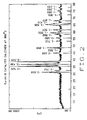
- Figs. 1 and 2 are XRD analyses of the Cu-Al-O catalysts of the present invention calcined at different temperatures. XRD analysis results illustrate that the catalysts are nearly amorphous when calcined at temperatures below 500°C (Examples 1-2). Fig. 1 shows that at 600°C (Example 3), the diffraction pattern corresponding to CuO phase appears. At this temperature, CuO is the only crystalline phase detected.
- TGA thermal gravimetric analysis
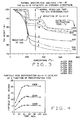
- the percentage of weight loss from the first weight loss decreases while the percentage of weight loss from the second weight loss (350°C to 400°C) increases. It will be noted that the percentage of weight loss at each of the two weight loss stages are approximately the same for catalyst calcined at 900° (Example 6) and 1000°C (Example 7). That is, the copper content of the CuO and CuAl 2 O 4 are about the same.
- the fingerprint characteristics of the TGA in H 2 as illustrated in Fig. 3, provide a convenient and reliable method for identifying and quantifying the formation of spinel copper aluminate.
- Figure 4 illustrates the precipitate particle size at different time periods in Example 1. It should be noted that the particle size becomes larger as the precipitation time goes on in the first hour of the precipitation procedure described in Example 1. The particle size remains constant after the first hour. Therefore, at a constant temperature, pH value and agitation speed, the precipitate particle size can be controlled by adjusting the slurry concentration.
- the particle size decreased marginally as the calcination temperature increased.
- the particle size is within the range of commercial Cu/Cr catalysts.
- the Cu-Al-O catalyst preparation as provided in Example 1, was scaled-up to a 30 gallon tank.
- the particle size distribution and surface area are similar to the small scale preparation.
- the particle size distribution versus precipitation time of catalyst ID # 009 is illustrated below in Table 2.
- Particle Size Distribution of 114 Liters (30 Gallon) precipitation (Catalyst ID #009) Time (min.) D-10% D-50% D-90% 10 3.0 8.3 19.9 20 3.3 9.1 22.8 30 3.9 9.9 23.0 40 3.9 9.5 21.2 50 4.2 10.4 23.3 60 4.1 10.4 24.9 70 4.2 10.2 24.3 83 4.1 10.2 25.3
- the leachable copper is less than 2% and the leachable aluminum is less than 1%.
- the catalyst of the present invention was made on a larger scale and the chemical and physical properties were analyzed.
- the scale up factor is 190 times of Example 1.
- the analytical results of powder made from the pilot plant scale-up also is listed in Table 3, above.
- the catalyst calcined at 800°C had particle size distributions of D-10% 4.3 ⁇ m, D-50% 10.7 ⁇ m, and D-90% 21.8 ⁇ m. These distributions are approximately the same values as found in the laboratory preparation.
- the surface area, leachable cations and loss on ignition (LOI) are similar to the lab preparations.
- the calcined powder particle size and distribution of the Example 13 are similar to Example 5.
- the slurry particle size remains almost constant as the feed pump rates increased from 15 ml/min to 73 ml/min.
- Table 6 illustrates the chemical and physical properties of the Cu-Al-O catalyst of the present invention with different sodium content.
- the precipitation details are the same as Example 1, except the washing. All of these catalyst were calcined at 800°C for 2 hours. Physical/Chemical Properties of Cu-Al-O Catalysts with Different Sodium Content Catalyst I.D.
- Catalyst ID# 011 is a catalyst prepared without washing.
- Catalysts ID#'s 012 through 016 are catalysts prepared with one, two, three , four and five washes respectively. Each wash uses 3000 ml distilled water. Table 6 above showed that the preferred number of washings, i.e. four, reduces the Na 2 O content to ⁇ 1% in the catalyst.
- the leachable Cu in catalysts ID# 011 is unexpectedly low, e.g. 2.04, as is the surface area, e.g. 24. There is not a clear relationship between the surface area and sodium content.
- Example 10 TGA in H 2 can be used as a quick method for identifying the spinel structure formation in the Cu-Al-O catalyst.
- the weight lost in the region of 150° to 200°C is the reduction of CuO and the weight lost in the region of 350° to 400°C corresponds to the reduction of spinel copper aluminate.
- a series of five Cu-Al-O catalysts, all calcined at 800°C, each having a different sodium content were characterized by TGA in hydrogen. For simplicity, the results from only three of the catalysts were shown in Fig. 5.
- Curves A, B and C are the hydrogen reduction profiles of catalysts washed one, two and three times respectively to remove sodium. As illustrated, curves A, B and C have different profiles when heated in hydrogen. As shown in curve A there is almost no weight loss corresponding to reduction of spinel copper aluminate. Further, the reduction temperature for CuO was shifted to a higher temperature. Curve B indicates that the reduction of copper aluminate appears at approximately 350° to 400°C and the reduction temperature for the CuO is lower than curve A. Curve C represents the catalyst washed three times. The weight loss of this catalyst corresponding to the reduction of copper aluminate was further increased and the CuO reduction temperature was decreased. This indicates that residual sodium in the catalyst not only retards copper aluminate formation, but also increases CuO reduction temperature.
- the Cu-Al-O catalyst of the present invention typically contains ⁇ 60% CuO.
- a series of catalysts with different CuO loadings were prepared. All of the catalysts were tested for filterability. The initial results indicated that the catalyst particle sizes have wider distribution as the CuO content increases. The wider distribution basically is caused by an increase in the number of smaller particles. Therefore, filtration speed decreases as the particles size distribution broadens.
- Table 7 shows the filtration speed test of Cu-Al-O catalysts of the present invention along with commercially available Cu/Al or Cu/Cr catalysts, # 017 and # 001.
- the filtration speed tests were performed by the following procedures: 15 g of powder catalyst was dispersed in 100 ml deionized water by stirring 5 minutes. Filtration speed was tested under 18 inches vacuum with 5.5 cm diameter #42 Whatman filter paper. The time in Table 7 was recorded when solid first appeared in the funnel.
- Catalyst powders for tablet formation were prepared according to Example 1 with different calcination temperatures ranging from 300° to 800°C.
- the calcination temperatures and Scott densities of each sample of calcined powders are listed below in Table 8. Properties of the Powders for Slugging Powder I.D. # Calcination Temp. °C Scott Density, g/ml 021 300 0.26 022 500 0.26 023 600 0.34 024 700 0.32 025 800 0.32
- Tablets were made from the powders after the powder was mixed with 5% graphite powder, slugged and granulated. Powder #025 had good flow characteristics. The tablets made from Powder #025 had a good overall appearance. However, the side crush strength was only approximately 3 to 4 pounds for 1/8" by 1/8" tablet.
- the tablets may be formed in numerous standard sizes, such as 3,2mm (1/8") by 3,2mm (1/8"), 4,8mm (3/16") by 4,8mm (3/16"), 6,35mm (1/4") by 6,35mm (1/4"), 4,8mm (3/16") by 6,35mm (1/4") or 6,35mm (1/4") by 1,6mm (1/16"), as is known in the art.
- the side crush strength was relatively high, e.g. from 5,576 kg (12,3 lb) to 12,208 kg (26,9 lb) while the bulk density is relatively low, e.g. from 0,91 g/ml to 1,08 g/ml.
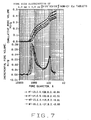
- the Hg pore size distribution of Tablet T-1 and Tablet T-3 are shown in Fig. 6. It is clear from Fig. 6 that the tablet density has a strong effect on the pore size distribution in the range of 900 ⁇ to 1100 ⁇ . The difference in total pore volume between Tablet T-1 and Tablet T-3 is due to the difference in pore volume at this region (900 ⁇ to 1100 ⁇ ). There is no obvious effects of tablet density on the pore size smaller than 900 ⁇ .
- catalysts ID # 023 was calcined at 600°C and had a Scott density of 0.34 g/ml.
- the tablets were given catalyst identification numbers of T-5 and T-6.
- the physical properties of the tablets are illustrated in Table 10.
- Pill Density g/ml 1.60 1.73 Side Crush Strength, kg(lb) 10,716 (23,7) 14,418 (31,7) Bulk Density, g/ml 0.989 1.13 Pore Volume, ml/g 0.41 0.34
- the tablets have a good side crush strength (> 9,7kg)(> 20 lb.) while the bulk density (B.D.) remains relatively low, 0.989 g/ml and 1.13 g/ml. and the pore volume (>0.34 ml/g) remains relatively high.
- the crush strength increases dramatically with tablet density. Since there is a correlation between crush strength and tablet density, and if all the other factors are equal, the targeted crush strength can be reached by selecting the appropriate tablet density. It can be seen from Table 12 that a target pore volume can be obtained by controlling tablet density.
- catalyst density only affects macro-pore volume, i.e. pore diameter from 0.07 ⁇ m (micron) to 0,3 ⁇ m (micron) (700 ⁇ to 3000 ⁇ ), with almost no effect on pore sizes small that 0.02 ⁇ m (micron) (200 ⁇ )
- Normally monovalent acids such as HCI, HNO 3 , acetic acid or formic acid are used for controlling rheology.
- Organic acids are preferred because of no chloride corrosion and no NO x emission when the acid decomposes.
- the extrudate samples were prepared without using any binder or peptizer.
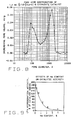
- the final extrudate pore volume and pore size can be controlled by mulling time. As shown in Fig. 8, the prepared sample has bimodal pore size distribution centered at ⁇ 100 ⁇ and 1500 ⁇ and has a pore volume and pore size distribution similar to the 3.2 mm (1/8 inch) tablet form.
- Table 14 shows that after 180 hours test, T-3 has similar activity with commercial Cu/Cr catalyst T-17, but T-1 has 5% lower conversion on carbonyl conversion. However, for more porous table catalyst, T-3 of this invention, Table 14 clearly shows that T-3 has a higher activity than T-17 and T-1. Ester and acid conversion are significantly greater than T-17. Further, the results indicated that under given reaction conditions, oxoalcohol finishing reaction on catalyst T-1 is diffusion limited.
- catalyst powder ID # 022 was made into tablets (ID # T-18) of a similar size 4,8mm by 4,8mm (3/16 inch by 3/16 inch) to a commercial Cu/Cr catalyst, T-19. These catalysts were pre-reduced and stabilized in isodecyl alcohol (TRL). The catalyst activity was tested compared to commercial Cu/Cr catalyst designated as T-19. The results are shown in Table 15. Oxoalcohol Activity Test of 4,8mm x 4,8mm (3/16" x 3/16") Cu-Al-O TRL vs.
- the catalyst activities were tested for four days. The results shown in Table 15 indicate that the activities for acid and ester conversion are not significantly different between the two catalysts.
- the tests show that the catalyst activity for the novel Cu-Al-O catalyst in oxoalcohol finishing is approximately equivalent to that of commercial chromium containing catalyst.
- the Cu-Al-O catalyst is free of environmentally toxic chromium.
- the Cu-Al-O catalyst has a much lower bulk density than the Cr/Cu catalyst and, therefore, weighs 1/2 to 2/3 of the commercial available Cr/Cu catalyst.
- Table 16 illustrates the catalytic activity of various Cu-Al-O catalysts of the present invention calcined at different temperatures.
- Catalyst ID# 001 is the standard commercially available Cu/Cr catalyst.
- Example 1 to Example 7 The catalyst samples prepared from Example 1 to Example 7 are tested for the activity and selectivity of hydrogenolysis of coconut fatty acid to fatty alcohol. Effects of Calcination Temperatures on Cu-Al-O Catalysts Activity Example Number Catalyst ID# Calcination Temp °C Relative Activity Selectivity % Cu/Cr Standard 001 440 100 0.11-0.18 1 002 400 155 0.13 2 003 500 198 3 004 600 152 4 005 700 151 0.17 5 006 800 177 0.11 6 007 900 127 0.12 7 008 1000 62 0.25
- catalyst ID # 003 which was calcined at 500°C, had a relative activity of 198% for hydrogenolysis of coconut fatty acid as compared to the standard, catalyst ID # 001. As seen, there are two calcination temperature ranges corresponding to greater catalytic activity. The high catalytic activity of the catalyst calcined at 500°C, Example # 2 may be explained. Example # 2 (catalyst ID # 003), as shown in Table 1, had a higher percentage of leachable copper. The unusually high activity of that catalyst may be due to soluble copper in the reaction slurry. It is further noted from Table 16 that the catalyst activity was maximized where the catalyst was calcined at approximately 800°C and decreased as the temperature increased beyond 800°C.
- Cerium oxide (Ce 2 O 3 ) was tested as a promoter for the Cu-Al-O catalyst.
- Table 17 shows the catalytic activity of a series of catalysts with different doping amounts of Ce 2 O 3 . It should be noted that the selectivity of the Cu-Al-O catalyst for hydrogenolysis of coconut fatty acid is expressed as dodecane made at 1.5% ester remaining. Effects of Ce 2 O 3 on the Catalytic Activity and Selectivity of Cu-Al-O Catalyst ID # Ce 2 O 3 % Calcination Temp °C S. A.
- Table 17 shows that Ce 2 O 3 is an activity and selectivity promoter for fatty acid/ester hydrogenolysis when used with the Cu-Al-O catalyst in this invention. Further, it appears from the data that a 2.5% Ce 2 O 3 doped catalyst gives a better activity and selectivity than 10% Ce 2 O 3. MnO, BaO and Ni promoted Cu-Al-O catalysts in this invention have similar effects on the catalyst activity and selectivity.
- Catalyst ID #031 gives the highest activity, 177% of the standard Cu/Cr catalyst #001. As the CuO content increases, the activity for CFA conversion drops. However, Table 18 shows that CuO content from 40% to 80% in the Cu-Al-O catalysts in this invention exhibits higher or equal (Catalyst ID #033) activity to the catalyst ID # 001, the standard Cu/Cr catalyst.
- Table 19 shows the chemical and physical properties of Cu-Al-O catalysts of the present invention having different sodium contents. All of the catalysts were prepared from the same batch. However, the sodium content varied due to the amount of washing. As stated above with reference to Table 3, proper washing, i.e. four washes can reduce the sodium content to ⁇ 1%.
- Catalyst # 011 was not washed.
- Catalysts # 012, # 013, # 014, # 015 and # 016 were subjected to 1, 2, 3, 4 and 5 washings, respectively. Each washing use the same volume of de-ionized water.
- catalytic activity tests indicated that catalyst calcined at 1000°C (catalyst ID # 008) had reduced catalytic activity. The decreased activity originally was assumed to be due to difficulty in achieving catalyst reduction at that temperature. To determine if additional reduction would improve catalyst activity, catalyst ID #008 was further reduced an additional hour at 300°C and 4400 psi hydrogen . The results are shown in Table 20.
- catalyst ID # 034 calcined at 800°C, (similar composition to catalyst ID # 16 and # 31) was tested for hydrogenolysis activity at normal reduction and one hour extended reduction at 300°C and 6,702 Mpa (830 psig) hydrogen.
- the results are shown in Table 21. Effects of Reduction on Catalyst ID # 034 Hydrogenolysis Activity Catalyst Reduction Condition Activity, % of Standard Catalyst # 001 Rate of Dodecane Formation, K*1,000 Dodecane % at 1.5% Ester remaining 3,44 MPa (500 Psi) H 2 , heated from room temp. to 300°C, final Pressure was 6,702MPa (830 Psig) 182 3.44 0.11 above + hold at 300°C and 31,317 MPa (4400 Psig) for one hour 186 4.25 0.13
- Catalyst ID # T-3 of the present invention was tested for methyl laurate hydrogenolysis activity. The results are listed in Table 22.
- the novel Cu-Al-O catalysts of the present invention may be employed in a large number of applications not specifically discussed herein.
- the Cu-Al-O catalyst may be substituted for prior art catalysts disclosed above.
- the Cu-Al-O catalyst of the present invention can be used in the hydrogenation applications disclosed in US-A- 5,243,095 to Roberts et al. These reactions may include, but are not limited to, a number of alkylation reactions, dehydrogenation reactions, hydrogenation reactions, reductive amination, hydrogenation of nitriles to unsaturated secondary amines, oxidation and reduction reactions.
Landscapes
- Chemical & Material Sciences (AREA)
- Organic Chemistry (AREA)
- Chemical Kinetics & Catalysis (AREA)
- Engineering & Computer Science (AREA)
- Materials Engineering (AREA)
- Environmental & Geological Engineering (AREA)
- Health & Medical Sciences (AREA)
- Biomedical Technology (AREA)
- Analytical Chemistry (AREA)
- General Chemical & Material Sciences (AREA)
- Oil, Petroleum & Natural Gas (AREA)
- Inorganic Chemistry (AREA)
- Catalysts (AREA)
- Organic Low-Molecular-Weight Compounds And Preparation Thereof (AREA)
- Low-Molecular Organic Synthesis Reactions Using Catalysts (AREA)
Applications Claiming Priority (3)
| Application Number | Priority Date | Filing Date | Title |
|---|---|---|---|
| US1382496P | 1996-03-21 | 1996-03-21 | |
| US13824P | 1996-03-21 | ||
| EP97917586A EP0888185B1 (de) | 1996-03-21 | 1997-03-21 | ZUBEREITUNG VON Cu/Al KATALYSATOREN |
Related Parent Applications (2)
| Application Number | Title | Priority Date | Filing Date |
|---|---|---|---|
| EP97917586A Division EP0888185B1 (de) | 1996-03-21 | 1997-03-21 | ZUBEREITUNG VON Cu/Al KATALYSATOREN |
| EP97917586A Division-Into EP0888185B1 (de) | 1996-03-21 | 1997-03-21 | ZUBEREITUNG VON Cu/Al KATALYSATOREN |
Publications (3)
| Publication Number | Publication Date |
|---|---|
| EP1240941A2 true EP1240941A2 (de) | 2002-09-18 |
| EP1240941A3 EP1240941A3 (de) | 2003-01-22 |
| EP1240941B1 EP1240941B1 (de) | 2009-07-15 |
Family
ID=21761952
Family Applications (4)
| Application Number | Title | Priority Date | Filing Date |
|---|---|---|---|
| EP97917586A Revoked EP0888185B1 (de) | 1996-03-21 | 1997-03-21 | ZUBEREITUNG VON Cu/Al KATALYSATOREN |
| EP08155700A Pending EP2165760A3 (de) | 1996-03-21 | 1997-03-21 | Kupfer-Aluminium Mischoxid Katalysator, seine Herstellung und seine Verwendungen |
| EP02076414A Revoked EP1240941B1 (de) | 1996-03-21 | 1997-03-21 | Verwendung von Kupfer-Aluminium Mischoxidkatalysatoren in Hydrierungen |
| EP13157586.2A Ceased EP2650048A3 (de) | 1996-03-21 | 1997-03-21 | Nichtchromkatalysatoren für Cu/Cr Katalysatoranwendungen |
Family Applications Before (2)
| Application Number | Title | Priority Date | Filing Date |
|---|---|---|---|
| EP97917586A Revoked EP0888185B1 (de) | 1996-03-21 | 1997-03-21 | ZUBEREITUNG VON Cu/Al KATALYSATOREN |
| EP08155700A Pending EP2165760A3 (de) | 1996-03-21 | 1997-03-21 | Kupfer-Aluminium Mischoxid Katalysator, seine Herstellung und seine Verwendungen |
Family Applications After (1)
| Application Number | Title | Priority Date | Filing Date |
|---|---|---|---|
| EP13157586.2A Ceased EP2650048A3 (de) | 1996-03-21 | 1997-03-21 | Nichtchromkatalysatoren für Cu/Cr Katalysatoranwendungen |
Country Status (11)
| Country | Link |
|---|---|
| US (2) | US6455464B1 (de) |
| EP (4) | EP0888185B1 (de) |
| JP (1) | JP4183752B2 (de) |
| KR (1) | KR100453095B1 (de) |
| AU (1) | AU733025B2 (de) |
| CA (1) | CA2250132A1 (de) |
| DE (1) | DE69739495D1 (de) |
| DK (1) | DK1240941T3 (de) |
| ES (2) | ES2329658T3 (de) |
| PT (1) | PT1240941E (de) |
| WO (1) | WO1997034694A1 (de) |
Cited By (5)
| Publication number | Priority date | Publication date | Assignee | Title |
|---|---|---|---|---|
| US6696700B2 (en) * | 2001-03-09 | 2004-02-24 | National University Of Singapore | P-type transparent copper-aluminum-oxide semiconductor |
| EP2165760A2 (de) | 1996-03-21 | 2010-03-24 | Basf Catalysts Llc | Kupfer-Aluminium Mischoxid Katalysator, seine Herstellung und seine Verwendungen |
| WO2011125036A1 (en) | 2010-04-06 | 2011-10-13 | Faculdade De Ciências E Tecnologia Da Universidade Nova De Lisboa | P-type oxide alloys based on copper oxides, tin oxides, tin-copper alloy oxides and metal alloy thereof, and nickel oxide, with embedded metals thereof, fabrication process and use thereof |
| WO2013064610A1 (en) * | 2011-11-03 | 2013-05-10 | Haldor Topsøe A/S | Process for the production of hydrocarbons |
| CN108654618A (zh) * | 2017-03-28 | 2018-10-16 | 锦湖石油化学株式会社 | 金属氧化物催化剂、其制备方法及使用其的醇的制备方法 |
Families Citing this family (47)
| Publication number | Priority date | Publication date | Assignee | Title |
|---|---|---|---|---|
| DE19839459A1 (de) * | 1998-08-29 | 2000-03-02 | Basf Ag | Katalysator und Verfahren zur Selektivhydrierung ungesättigter Verbindungen in Kohlenwasserstoffströmen |
| US20070066480A1 (en) * | 1999-10-25 | 2007-03-22 | Moser William R | Method of preparing compounds using cavitation and compounds formed therefrom |
| US20020009414A1 (en) * | 1999-10-25 | 2002-01-24 | Moser William R. | Method of preparing compounds using cavitation and compounds formed therefrom |
| DE10061553A1 (de) * | 2000-12-11 | 2002-06-13 | Basf Ag | Poröser Katalysator für die Hydrierung von Maleinsäureanhydrid zu Tetrahydrofuran |
| DE10207443A1 (de) * | 2002-02-22 | 2003-09-04 | Bayer Ag | Verfahren und Katalysator zur Herstellung von Alkoholen |
| US6580000B1 (en) | 2002-06-06 | 2003-06-17 | Ak Research Company | Process for the manufacture of alkoxysilanes and alkoxy orthosilicates |
| US6890877B2 (en) * | 2002-07-09 | 2005-05-10 | Conocophillips Company | Enhanced fluid/solids contacting in a fluidization reactor |
| US6903050B2 (en) * | 2002-10-28 | 2005-06-07 | Engelhard Corporation | Method of preparation of non-pyrophoric copper-alumina catalysts |
| DE10313702A1 (de) * | 2003-03-27 | 2004-10-07 | Basf Ag | Katalysator und Verfahren zur Hydrierung von Carbonylverbindungen |
| DE10357716A1 (de) * | 2003-12-09 | 2005-07-14 | Basf Ag | Verbesserter Katalysator für die Hydrierung von Maleinsäureanhydrid zu γ-Butyrolacton und Tetrahydrofuran |
| DE10357717A1 (de) | 2003-12-09 | 2005-07-14 | Basf Ag | Katalysatorextrudate auf Basis Kupferoxid und ihre Verwendung zur Hydrierung von Carbonylverbindungen |
| US7977274B2 (en) | 2006-09-29 | 2011-07-12 | Sd Lizenzverwertungsgesellschaft Mbh & Co. Kg | Catalyst with bimodal pore size distribution and the use thereof |
| JP2008168228A (ja) * | 2007-01-12 | 2008-07-24 | Okayama Univ | 未燃カーボンを用いてディーゼルエンジン排ガス中の窒素酸化物を浄化するための触媒と方法 |
| JP5179107B2 (ja) * | 2007-07-24 | 2013-04-10 | 花王株式会社 | 水素添加用触媒 |
| EP2128227A1 (de) | 2008-05-19 | 2009-12-02 | Furanix Technologies B.V | Monosubstituierte Furanderivate mit Decarboxylisierung und Verwendung davon als (Flugzeug-) Kraftstoff |
| EP2128226A1 (de) * | 2008-05-19 | 2009-12-02 | Furanix Technologies B.V | Kraftstoffzusammensetzung |
| EP2294002A4 (de) * | 2008-06-25 | 2012-12-26 | Hydrogen Generation Inc | Verbessertes verfahren zur herstellung von wasserstoff |
| US9174201B2 (en) | 2008-09-19 | 2015-11-03 | Basf Se | Method for the continuous production of an amine using an aluminum—copper catalyst |
| US8828903B2 (en) * | 2008-11-10 | 2014-09-09 | Basf Corporation | Copper catalyst for dehydrogenation application |
| EP2357037A1 (de) | 2010-02-17 | 2011-08-17 | LANXESS Deutschland GmbH | Verfahren zur Herstellung von mechanisch stabilen Katalysatorformkörpern |
| US9109174B2 (en) | 2011-09-20 | 2015-08-18 | Phillips 66 Company | Advanced cellulosic renewable fuels |
| US20130296585A1 (en) | 2012-03-30 | 2013-11-07 | Basf Corporation | Catalyst For Tetrahydrofuran Synthesis |
| DE102012019123B4 (de) | 2012-09-28 | 2021-10-21 | Clariant International Ltd. | Hydrierkatalysator und Verfahren zu dessen Herstellung durch die Verwendung von unkalziniertem Ausgangsmaterial |
| US20150004709A1 (en) * | 2013-06-26 | 2015-01-01 | Cdti | Methods for Identification of Materials Causing Corrosion on Metallic Substrates within ZPGM Catalyst Systems |
| CN103464155B (zh) * | 2013-09-10 | 2015-01-14 | 太原理工大学 | 一种超微孔高比表面积脱硝催化剂材料的制备方法 |
| JP2015054312A (ja) * | 2013-09-13 | 2015-03-23 | 堺化学工業株式会社 | 水素添加用触媒粒子の製造方法及び水素添加用触媒粒子 |
| FR3013609B1 (fr) * | 2013-11-27 | 2017-08-11 | Ifp Energies Now | Procede de conversion de composes organiques carbonyles et/ou alcools en presence d'un catalyseur aluminate de cuivre |
| WO2015104056A1 (en) * | 2014-01-09 | 2015-07-16 | Statoil Petroleum As | Catalyst support and catalyst for fischer-tropsch synthesis |
| DE102014004413A1 (de) | 2014-03-26 | 2015-10-01 | Clariant International Ltd. | Hydrierkatalysator und Verfahren zu dessen Herstellung |
| DE102014004391A1 (de) | 2014-03-26 | 2015-10-15 | Clariant International Ltd. | Verfahren zur Herstellung von Katalysatoren mit erhöhter Festigkeit und verringertem Volumenschwund |
| DE102014013530A1 (de) * | 2014-09-12 | 2016-03-17 | Clariant International Ltd. | Extrudierter Cu-Al-Mn-Hydrierkatalysator |
| JP6732431B2 (ja) * | 2014-11-20 | 2020-07-29 | 花王株式会社 | 脂肪族アルコールの製造方法 |
| BR112017020321B1 (pt) | 2015-03-26 | 2021-01-26 | Basf Corporation | catalisador, método para fazer um catalisador, e, processo |
| JP6741666B2 (ja) * | 2016-06-06 | 2020-08-19 | 本田技研工業株式会社 | 排気ガス浄化触媒 |
| CN108178725A (zh) * | 2016-12-08 | 2018-06-19 | Ptt全球化学股份有限公司 | 由糠醛生产乙酰丙酸的方法 |
| MY199921A (en) | 2017-05-16 | 2023-11-29 | Basf Se | Hydroformylation method for the large-scale production of aldehydes and/or alcohols |
| WO2021141122A1 (ja) * | 2020-01-08 | 2021-07-15 | 三菱ケミカル株式会社 | メタクリル酸製造用触媒の製造方法、メタクリル酸の製造方法およびメタクリル酸エステルの製造方法、並びにメタクリル酸製造用触媒の製造装置 |
| DE102020106964A1 (de) * | 2020-03-13 | 2021-09-16 | Clariant International Ltd | Chromfreier hydrierkatalysator mit erhoehter wasser- und saeurestabilitaet |
| WO2022005872A1 (en) * | 2020-06-30 | 2022-01-06 | Basf Corporation | Chrome-free copper catalysts for fatty ester hydrogenolysis/hydrogenation |
| CN112169836A (zh) * | 2020-09-28 | 2021-01-05 | 广东石油化工学院 | 一种多孔离子聚合物多相催化剂及其催化合成n-甲酰胺的方法 |
| CN112382769B (zh) * | 2020-11-04 | 2021-10-15 | 江苏科技大学 | 一种高性能金属-空气电池正极催化剂及其制备方法 |
| US20240001341A1 (en) | 2020-11-24 | 2024-01-04 | Topsoe A/S | Improved water gas shift catalyst |
| WO2022112328A1 (en) | 2020-11-24 | 2022-06-02 | Topsoe A/S | Process and catalyst for the catalytic hydrogenation of organic carbonyl compounds |
| CN112892537A (zh) * | 2021-01-25 | 2021-06-04 | 大连理工大学 | 一种易回收的高选择性糠醛加氢催化剂的制备方法及应用 |
| WO2023163899A1 (en) * | 2022-02-24 | 2023-08-31 | Basf Corporation | Nickel promoted copper alumina catalyst for slurry phase process for producing fatty alcohol |
| US20250276307A1 (en) * | 2022-04-25 | 2025-09-04 | Basf Corporation | Catalyst compositions and methods of preparation and use thereof |
| WO2025078586A1 (en) | 2023-10-13 | 2025-04-17 | Basf Se | Process for preparing a product mixture comprising hydroxyacetone |
Family Cites Families (42)
| Publication number | Priority date | Publication date | Assignee | Title |
|---|---|---|---|---|
| US2091800A (en) | 1931-09-15 | 1937-08-31 | Rohm & Haas | Method of hydrogenating esters |
| FR2054524A1 (de) * | 1969-07-25 | 1971-04-23 | Inst Francais Du Petrole | |
| US3859372A (en) * | 1969-12-03 | 1975-01-07 | Hooker Chemicals Plastics Corp | Process for the preparation of organic fluorine compounds |
| US3865753A (en) | 1972-06-27 | 1975-02-11 | Basf Ag | Process for the preparation of a nickel magnesium aluminum catalyst |
| JPS5343918B2 (de) * | 1973-02-02 | 1978-11-24 | ||
| US3894084A (en) * | 1974-04-05 | 1975-07-08 | Nalco Chemical Co | Process for making acrylamide |
| US3988263A (en) * | 1974-10-02 | 1976-10-26 | Union Oil Company Of California | Thermally stable coprecipitated catalysts useful for methanation and other reactions |
| US3935128A (en) | 1974-12-30 | 1976-01-27 | Dart Industries Inc. | Copper chromite catalyst and the process for producing it |
| IT1043441B (it) * | 1975-10-17 | 1980-02-20 | Snam Progetti | Procedimento per la idratazione di nitrili ad ammidi catalizzatore ivi impiegato e procedimento per la sua preparazione |
| JPS595013B2 (ja) | 1978-07-03 | 1984-02-02 | 花王株式会社 | 銅−鉄−アルミニウム触媒の製造方法 |
| SU829621A1 (ru) * | 1979-03-05 | 1981-05-15 | Предприятие П/Я Г-4647 | Способ получени акриламида |
| JPS5850775B2 (ja) | 1979-03-30 | 1983-11-12 | 花王株式会社 | 銅−鉄−アルミニウム触媒の製法 |
| JPS5610334A (en) * | 1979-07-06 | 1981-02-02 | Toyota Motor Corp | Catalyst for cleaning up exhaust gas and manufacture of said catalyst |
| JPS5610333A (en) * | 1979-07-06 | 1981-02-02 | Toyota Motor Corp | Catalyst for cleaning up exhaust gas and manufacture of said catalyst |
| NO146046L (de) | 1980-03-28 | |||
| DE3027890A1 (de) * | 1980-07-23 | 1982-03-04 | Basf Ag, 6700 Ludwigshafen | Hydrierkatalysatoren fuer die herstellung von propandiolen und verfahren zur herstellung von propandiolen mit solchen katalysatoren |
| DE3267865D1 (en) | 1981-03-26 | 1986-01-23 | Gallaher Ltd | Catalysts and their production |
| DE3125662A1 (de) * | 1981-06-30 | 1983-01-13 | Basf Ag, 6700 Ludwigshafen | Verfahren und katalysator zur herstellung von cyclischen iminen |
| CA1201699A (en) * | 1982-11-29 | 1986-03-11 | Jin S. Yoo | Preparative process for alkaline earth metal, aluminum-containing spinels |
| IT1163160B (it) * | 1983-03-22 | 1987-04-08 | Montepolimeri Spa | Catalizzatori supportati per la sintesi di 1-2 dicloroetano per ossiclorurazione di etilene in letto fluidizzato |
| US4551444A (en) | 1984-02-28 | 1985-11-05 | Phillips Petroleum Company | Catalyst for alcohol synthesis |
| NO154486C (no) * | 1984-04-12 | 1986-10-01 | Norsk Hydro As | Katalysator og dens anvendelse for spalting av metanol. |
| EP0219538A1 (de) * | 1985-04-18 | 1987-04-29 | Katalistiks, Inc. | Erdalkali und aluminium enthaltende spinellzusammensetzungen und methoden für ihre anwendung |
| US4790982A (en) * | 1986-04-07 | 1988-12-13 | Katalistiks International, Inc. | Metal-containing spinel composition and process of using same |
| DE3776997D1 (de) | 1986-07-23 | 1992-04-09 | Henkel Kgaa | Verfahren zur direkthydrierung von glyceridoelen. |
| US4977123A (en) * | 1988-06-17 | 1990-12-11 | Massachusetts Institute Of Technology | Preparation of extrusions of bulk mixed oxide compounds with high macroporosity and mechanical strength |
| CA2026275C (en) * | 1989-10-17 | 2000-12-05 | Deepak S. Thakur | Hydrogenation catalyst, process for preparing and process of using said catalyst |
| US5053380A (en) | 1989-12-21 | 1991-10-01 | Union Carbide Chemicals And Plastics Technology Corporation | Cu-al catalyst for hydrogenation |
| RO106848B1 (ro) * | 1990-04-25 | 1993-07-30 | Combinatul Chimic Victoria Ora | Procedeu- pentru obținerea unui catalizator pe bază de cupru, pentru hidrogenarea furfurolului Ia alcool furfurilic |
| DE4116367A1 (de) * | 1991-05-18 | 1992-11-19 | Basf Ag | Verfahren zur herstellung von aminen |
| US5243095A (en) | 1992-04-24 | 1993-09-07 | Engelhard Corporation | Hydrogenation catalyst, process for preparing and process for using said catalyst |
| DE4233431A1 (de) * | 1992-10-05 | 1994-04-07 | Basf Ag | Verfahren zur Hydrierung von Zitronensäure |
| DE4301470A1 (de) * | 1993-01-21 | 1994-07-28 | Basf Ag | Verfahren zur katalytischen Zersetzung von reinem oder in Gasgemischen enthaltenem Distickstoffmonoxid |
| DE4419486C2 (de) * | 1994-06-03 | 1996-09-05 | Daimler Benz Ag | Katalysator, Verfahren zu dessen Herstellung sowie Verwendung des Katalysators |
| DE4420932A1 (de) * | 1994-06-16 | 1996-01-11 | Basf Ag | Material zur katalytischen Reduktion von Stickoxiden |
| DE4423346A1 (de) * | 1994-07-04 | 1996-01-11 | Basf Ag | Kupferoxid/Zirkonoxid-Katalysator |
| TW316852B (de) * | 1994-08-02 | 1997-10-01 | Mitsui Toatsu Chemicals | |
| DE19546476A1 (de) * | 1995-12-13 | 1997-06-19 | Daimler Benz Ag | Katalysator, Verfahren zu dessen Herstellung und Verwendung desselben |
| DE19546481C2 (de) * | 1995-12-13 | 1998-08-13 | Daimler Benz Ag | Katalysator und Verfahren zu dessen Herstellung und Verwendung desselben |
| DE19546612A1 (de) * | 1995-12-13 | 1997-06-19 | Basf Ag | Verfahren zur Reduktion von NOx aus Abgasen |
| US5763353A (en) * | 1996-02-15 | 1998-06-09 | Kao Corporation | Hydrogenation catalyst precursor, hydrogenation catalyst and production process for alcohols |
| US6455464B1 (en) | 1996-03-21 | 2002-09-24 | Engelhard Corporation | Preparation and use of non-chrome catalysts for Cu/Cr catalyst applications |
-
1997
- 1997-03-21 US US09/142,987 patent/US6455464B1/en not_active Expired - Lifetime
- 1997-03-21 KR KR19980708188A patent/KR100453095B1/ko not_active Expired - Lifetime
- 1997-03-21 PT PT02076414T patent/PT1240941E/pt unknown
- 1997-03-21 EP EP97917586A patent/EP0888185B1/de not_active Revoked
- 1997-03-21 DK DK02076414T patent/DK1240941T3/da active
- 1997-03-21 EP EP08155700A patent/EP2165760A3/de active Pending
- 1997-03-21 ES ES02076414T patent/ES2329658T3/es not_active Expired - Lifetime
- 1997-03-21 JP JP53377197A patent/JP4183752B2/ja not_active Expired - Lifetime
- 1997-03-21 AU AU25867/97A patent/AU733025B2/en not_active Expired
- 1997-03-21 CA CA002250132A patent/CA2250132A1/en not_active Abandoned
- 1997-03-21 EP EP02076414A patent/EP1240941B1/de not_active Revoked
- 1997-03-21 EP EP13157586.2A patent/EP2650048A3/de not_active Ceased
- 1997-03-21 WO PCT/US1997/004678 patent/WO1997034694A1/en not_active Ceased
- 1997-03-21 ES ES97917586T patent/ES2395319T3/es not_active Expired - Lifetime
- 1997-03-21 DE DE69739495T patent/DE69739495D1/de not_active Expired - Lifetime
-
2002
- 2002-07-16 US US10/196,443 patent/US6916457B2/en not_active Expired - Lifetime
Cited By (8)
| Publication number | Priority date | Publication date | Assignee | Title |
|---|---|---|---|---|
| EP2165760A2 (de) | 1996-03-21 | 2010-03-24 | Basf Catalysts Llc | Kupfer-Aluminium Mischoxid Katalysator, seine Herstellung und seine Verwendungen |
| US6696700B2 (en) * | 2001-03-09 | 2004-02-24 | National University Of Singapore | P-type transparent copper-aluminum-oxide semiconductor |
| WO2011125036A1 (en) | 2010-04-06 | 2011-10-13 | Faculdade De Ciências E Tecnologia Da Universidade Nova De Lisboa | P-type oxide alloys based on copper oxides, tin oxides, tin-copper alloy oxides and metal alloy thereof, and nickel oxide, with embedded metals thereof, fabrication process and use thereof |
| WO2013064610A1 (en) * | 2011-11-03 | 2013-05-10 | Haldor Topsøe A/S | Process for the production of hydrocarbons |
| CN103917532A (zh) * | 2011-11-03 | 2014-07-09 | 赫多特普索化工设备公司 | 用于生产烃的方法 |
| CN108654618A (zh) * | 2017-03-28 | 2018-10-16 | 锦湖石油化学株式会社 | 金属氧化物催化剂、其制备方法及使用其的醇的制备方法 |
| EP3603801B1 (de) | 2017-03-28 | 2022-01-05 | Korea Kumho Petrochemical Co., Ltd. | Methode zur herstellung eines alkohols bei hydrierung von ketonen in gegenwart eines metalloxidkatalysators |
| EP3603801B2 (de) † | 2017-03-28 | 2025-07-23 | Korea Kumho Petrochemical Co., Ltd. | Methode zur herstellung eines alkohols bei hydrierung von ketonen in gegenwart eines metalloxidkatalysators |
Also Published As
| Publication number | Publication date |
|---|---|
| JP2000507155A (ja) | 2000-06-13 |
| WO1997034694A1 (en) | 1997-09-25 |
| EP2165760A3 (de) | 2010-05-12 |
| EP0888185B1 (de) | 2012-09-12 |
| EP1240941B1 (de) | 2009-07-15 |
| ES2329658T3 (es) | 2009-11-30 |
| EP0888185A1 (de) | 1999-01-07 |
| EP2650048A3 (de) | 2014-01-08 |
| DK1240941T3 (da) | 2009-11-09 |
| EP1240941A3 (de) | 2003-01-22 |
| KR100453095B1 (ko) | 2005-05-03 |
| KR20000048863A (ko) | 2000-07-25 |
| AU733025B2 (en) | 2001-05-03 |
| DE69739495D1 (de) | 2009-08-27 |
| CA2250132A1 (en) | 1997-09-25 |
| ES2395319T3 (es) | 2013-02-11 |
| PT1240941E (pt) | 2009-09-29 |
| EP2650048A2 (de) | 2013-10-16 |
| US20030069457A1 (en) | 2003-04-10 |
| AU2586797A (en) | 1997-10-10 |
| US6916457B2 (en) | 2005-07-12 |
| EP2165760A2 (de) | 2010-03-24 |
| JP4183752B2 (ja) | 2008-11-19 |
| US6455464B1 (en) | 2002-09-24 |
Similar Documents
| Publication | Publication Date | Title |
|---|---|---|
| EP0888185B1 (de) | ZUBEREITUNG VON Cu/Al KATALYSATOREN | |
| US5302569A (en) | Copper/zinc oxide/aluminum oxide-containing catalysts | |
| US5569792A (en) | Hydrogenation of aldehydes, ketones, carboxylic acids and esters | |
| EP0092878B1 (de) | Nickel an Übergangsaluminiumoxid-Katalysatoren | |
| JP3271969B2 (ja) | 水素化触媒、該触媒の製造方法及び使用方法 | |
| US7468342B2 (en) | Catalysts and process for producing aromatic amines | |
| JP4295406B2 (ja) | 銅含有触媒およびその製造方法 | |
| AU1377300A (en) | Catalyst and process for preparing 1,3-propanediol | |
| US4307248A (en) | Process for hydrogenating organic compounds by use of non-ferrous group VIII aluminum coprecipitated catalysts | |
| KR20010041595A (ko) | 카르보닐 화합물의 수소화 방법 | |
| JPH0336571B2 (de) | ||
| JP4661676B2 (ja) | 水素化触媒とその利用とその製造方法 | |
| EP2648842B1 (de) | Beschleunigter kupfer/zink-katalysator zur hydrierung von aldehyden zu alkoholen | |
| KR100457066B1 (ko) | 수소화 반응촉매 및 그의 제조방법, 및 이 촉매를이용하여 무수말레인산으로부터 감마-부티로락톤을제조하는 방법 | |
| EP0029675B1 (de) | Hydrierkatalysatoren, hergestellt durch gemeinsame Fällung eines Elements der Gruppe VIII, ausgenommen Eisen mit Aluminium, Verfahren zur Herstellung dieser Katalysatoren und ihre Verwendung bei Hydrierverfahren | |
| KR100821566B1 (ko) | 디에틸렌글리콜의 탈수소 반응에 사용되는 구리/실리카계나노복합체 촉매의 제조방법 | |
| CN111151261A (zh) | 一种醋酸酯加氢制乙醇的催化剂及其应用 | |
| AU2485601A (en) | Preparation and use of non-chrome catalysts for Cu/Cr catalyst applications | |
| US5663445A (en) | Process for the preparation of alcohols or amines | |
| CN117258794B (zh) | 一种用于丙酮气相加氢制异丙醇的催化剂及其制备方法 |
Legal Events
| Date | Code | Title | Description |
|---|---|---|---|
| PUAI | Public reference made under article 153(3) epc to a published international application that has entered the european phase |
Free format text: ORIGINAL CODE: 0009012 |
|
| AC | Divisional application: reference to earlier application |
Ref document number: 888185 Country of ref document: EP |
|
| AK | Designated contracting states |
Kind code of ref document: A2 Designated state(s): AT BE CH DE DK ES FI FR GB GR IE IT LI LU MC NL PT SE |
|
| PUAL | Search report despatched |
Free format text: ORIGINAL CODE: 0009013 |
|
| AK | Designated contracting states |
Kind code of ref document: A3 Designated state(s): AT BE CH DE DK ES FI FR GB GR IE IT LI LU MC NL PT SE |
|
| 17P | Request for examination filed |
Effective date: 20030506 |
|
| 17Q | First examination report despatched |
Effective date: 20030718 |
|
| AKX | Designation fees paid |
Designated state(s): AT BE CH DE DK ES FI FR GB GR IE IT LI LU MC NL PT SE |
|
| RTI1 | Title (correction) |
Free format text: USE OF COPPER-ALUMINIUM MIXED OXIDE CATALYSTS IN HYDROGENATION REACTIONS |
|
| GRAP | Despatch of communication of intention to grant a patent |
Free format text: ORIGINAL CODE: EPIDOSNIGR1 |
|
| GRAS | Grant fee paid |
Free format text: ORIGINAL CODE: EPIDOSNIGR3 |
|
| GRAA | (expected) grant |
Free format text: ORIGINAL CODE: 0009210 |
|
| AC | Divisional application: reference to earlier application |
Ref document number: 0888185 Country of ref document: EP Kind code of ref document: P |
|
| AK | Designated contracting states |
Kind code of ref document: B1 Designated state(s): AT BE CH DE DK ES FI FR GB GR IE IT LI LU MC NL PT SE |
|
| REG | Reference to a national code |
Ref country code: CH Ref legal event code: EP Ref country code: GB Ref legal event code: FG4D |
|
| RAP2 | Party data changed (patent owner data changed or rights of a patent transferred) |
Owner name: BASF CATALYSTS LLC |
|
| REG | Reference to a national code |
Ref country code: IE Ref legal event code: FG4D |
|
| REF | Corresponds to: |
Ref document number: 69739495 Country of ref document: DE Date of ref document: 20090827 Kind code of ref document: P |
|
| REG | Reference to a national code |
Ref country code: PT Ref legal event code: SC4A Free format text: AVAILABILITY OF NATIONAL TRANSLATION Effective date: 20090921 |
|
| NLT2 | Nl: modifications (of names), taken from the european patent patent bulletin |
Owner name: BASF CATALYSTS LLC Effective date: 20090805 |
|
| REG | Reference to a national code |
Ref country code: DK Ref legal event code: T3 |
|
| REG | Reference to a national code |
Ref country code: SE Ref legal event code: TRGR |
|
| REG | Reference to a national code |
Ref country code: ES Ref legal event code: FG2A Ref document number: 2329658 Country of ref document: ES Kind code of ref document: T3 |
|
| PG25 | Lapsed in a contracting state [announced via postgrant information from national office to epo] |
Ref country code: AT Free format text: LAPSE BECAUSE OF FAILURE TO SUBMIT A TRANSLATION OF THE DESCRIPTION OR TO PAY THE FEE WITHIN THE PRESCRIBED TIME-LIMIT Effective date: 20090715 |
|
| PLBI | Opposition filed |
Free format text: ORIGINAL CODE: 0009260 |
|
| PLAX | Notice of opposition and request to file observation + time limit sent |
Free format text: ORIGINAL CODE: EPIDOSNOBS2 |
|
| 26 | Opposition filed |
Opponent name: SUED-CHEMIE AG Effective date: 20100415 |
|
| PLAF | Information modified related to communication of a notice of opposition and request to file observations + time limit |
Free format text: ORIGINAL CODE: EPIDOSCOBS2 |
|
| PG25 | Lapsed in a contracting state [announced via postgrant information from national office to epo] |
Ref country code: GR Free format text: LAPSE BECAUSE OF FAILURE TO SUBMIT A TRANSLATION OF THE DESCRIPTION OR TO PAY THE FEE WITHIN THE PRESCRIBED TIME-LIMIT Effective date: 20091016 Ref country code: MC Free format text: LAPSE BECAUSE OF NON-PAYMENT OF DUE FEES Effective date: 20100331 |
|
| REG | Reference to a national code |
Ref country code: CH Ref legal event code: PL |
|
| PLBB | Reply of patent proprietor to notice(s) of opposition received |
Free format text: ORIGINAL CODE: EPIDOSNOBS3 |
|
| PG25 | Lapsed in a contracting state [announced via postgrant information from national office to epo] |
Ref country code: IE Free format text: LAPSE BECAUSE OF NON-PAYMENT OF DUE FEES Effective date: 20100321 |
|
| PLAY | Examination report in opposition despatched + time limit |
Free format text: ORIGINAL CODE: EPIDOSNORE2 |
|
| PG25 | Lapsed in a contracting state [announced via postgrant information from national office to epo] |
Ref country code: CH Free format text: LAPSE BECAUSE OF NON-PAYMENT OF DUE FEES Effective date: 20100331 Ref country code: LI Free format text: LAPSE BECAUSE OF NON-PAYMENT OF DUE FEES Effective date: 20100331 |
|
| PLAH | Information related to despatch of examination report in opposition + time limit modified |
Free format text: ORIGINAL CODE: EPIDOSCORE2 |
|
| PLAH | Information related to despatch of examination report in opposition + time limit modified |
Free format text: ORIGINAL CODE: EPIDOSCORE2 |
|
| PLAB | Opposition data, opponent's data or that of the opponent's representative modified |
Free format text: ORIGINAL CODE: 0009299OPPO |
|
| PG25 | Lapsed in a contracting state [announced via postgrant information from national office to epo] |
Ref country code: LU Free format text: LAPSE BECAUSE OF NON-PAYMENT OF DUE FEES Effective date: 20100321 Ref country code: FI Free format text: LAPSE BECAUSE OF FAILURE TO SUBMIT A TRANSLATION OF THE DESCRIPTION OR TO PAY THE FEE WITHIN THE PRESCRIBED TIME-LIMIT Effective date: 20090715 |
|
| RDAF | Communication despatched that patent is revoked |
Free format text: ORIGINAL CODE: EPIDOSNREV1 |
|
| R26 | Opposition filed (corrected) |
Opponent name: CLARIANT PRODUKTE (DEUTSCHLAND) GMBH Effective date: 20100415 |
|
| APBM | Appeal reference recorded |
Free format text: ORIGINAL CODE: EPIDOSNREFNO |
|
| APBP | Date of receipt of notice of appeal recorded |
Free format text: ORIGINAL CODE: EPIDOSNNOA2O |
|
| APAH | Appeal reference modified |
Free format text: ORIGINAL CODE: EPIDOSCREFNO |
|
| APBQ | Date of receipt of statement of grounds of appeal recorded |
Free format text: ORIGINAL CODE: EPIDOSNNOA3O |
|
| APAH | Appeal reference modified |
Free format text: ORIGINAL CODE: EPIDOSCREFNO |
|
| PGFP | Annual fee paid to national office [announced via postgrant information from national office to epo] |
Ref country code: IT Payment date: 20150326 Year of fee payment: 19 |
|
| PGFP | Annual fee paid to national office [announced via postgrant information from national office to epo] |
Ref country code: DE Payment date: 20150601 Year of fee payment: 19 |
|
| REG | Reference to a national code |
Ref country code: DE Ref legal event code: R103 Ref document number: 69739495 Country of ref document: DE Ref country code: DE Ref legal event code: R064 Ref document number: 69739495 Country of ref document: DE |
|
| APBU | Appeal procedure closed |
Free format text: ORIGINAL CODE: EPIDOSNNOA9O |
|
| REG | Reference to a national code |
Ref country code: FR Ref legal event code: PLFP Year of fee payment: 20 |
|
| RDAG | Patent revoked |
Free format text: ORIGINAL CODE: 0009271 |
|
| STAA | Information on the status of an ep patent application or granted ep patent |
Free format text: STATUS: PATENT REVOKED |
|
| PGFP | Annual fee paid to national office [announced via postgrant information from national office to epo] |
Ref country code: NL Payment date: 20160324 Year of fee payment: 20 Ref country code: DK Payment date: 20160329 Year of fee payment: 20 |
|
| 27W | Patent revoked |
Effective date: 20150804 |
|
| GBPR | Gb: patent revoked under art. 102 of the ep convention designating the uk as contracting state |
Effective date: 20150804 |
|
| REG | Reference to a national code |
Ref country code: PT Ref legal event code: MP4A Effective date: 20160504 |
|
| PGFP | Annual fee paid to national office [announced via postgrant information from national office to epo] |
Ref country code: BE Payment date: 20160324 Year of fee payment: 20 Ref country code: FR Payment date: 20160330 Year of fee payment: 20 Ref country code: GB Payment date: 20160331 Year of fee payment: 20 Ref country code: SE Payment date: 20160329 Year of fee payment: 20 Ref country code: PT Payment date: 20160307 Year of fee payment: 20 |
|
| PGFP | Annual fee paid to national office [announced via postgrant information from national office to epo] |
Ref country code: ES Payment date: 20160422 Year of fee payment: 20 |
|
| REG | Reference to a national code |
Ref country code: SE Ref legal event code: ECNC |