EP1241135A2 - Fällungskieselsäuren mit hoher Struktur - Google Patents
Fällungskieselsäuren mit hoher Struktur Download PDFInfo
- Publication number
- EP1241135A2 EP1241135A2 EP01123611A EP01123611A EP1241135A2 EP 1241135 A2 EP1241135 A2 EP 1241135A2 EP 01123611 A EP01123611 A EP 01123611A EP 01123611 A EP01123611 A EP 01123611A EP 1241135 A2 EP1241135 A2 EP 1241135A2
- Authority
- EP
- European Patent Office
- Prior art keywords
- iso
- precipitated silica
- din
- silica according
- water
- Prior art date
- Legal status (The legal status is an assumption and is not a legal conclusion. Google has not performed a legal analysis and makes no representation as to the accuracy of the status listed.)
- Granted
Links
- VYPSYNLAJGMNEJ-UHFFFAOYSA-N Silicium dioxide Chemical compound O=[Si]=O VYPSYNLAJGMNEJ-UHFFFAOYSA-N 0.000 title claims description 73
- 239000000377 silicon dioxide Substances 0.000 title claims description 36
- XLYOFNOQVPJJNP-UHFFFAOYSA-N water Substances O XLYOFNOQVPJJNP-UHFFFAOYSA-N 0.000 claims abstract description 23
- 238000000034 method Methods 0.000 claims abstract description 17
- 239000000126 substance Substances 0.000 claims abstract description 13
- 238000010521 absorption reaction Methods 0.000 claims abstract description 8
- 238000004519 manufacturing process Methods 0.000 claims abstract description 6
- QAOWNCQODCNURD-UHFFFAOYSA-N Sulfuric acid Chemical compound OS(O)(=O)=O QAOWNCQODCNURD-UHFFFAOYSA-N 0.000 claims description 39
- 239000007787 solid Substances 0.000 claims description 25
- 239000000725 suspension Substances 0.000 claims description 24
- 239000012065 filter cake Substances 0.000 claims description 14
- 238000001035 drying Methods 0.000 claims description 10
- QGZKDVFQNNGYKY-UHFFFAOYSA-N Ammonia Chemical compound N QGZKDVFQNNGYKY-UHFFFAOYSA-N 0.000 claims description 8
- 238000001694 spray drying Methods 0.000 claims description 5
- 238000002360 preparation method Methods 0.000 claims description 4
- 239000003054 catalyst Substances 0.000 claims description 3
- 239000007788 liquid Substances 0.000 claims description 3
- 239000000843 powder Substances 0.000 claims description 3
- 238000003756 stirring Methods 0.000 claims description 3
- 239000003795 chemical substances by application Substances 0.000 claims description 2
- 229920001971 elastomer Polymers 0.000 claims description 2
- 239000000806 elastomer Substances 0.000 claims description 2
- 238000010008 shearing Methods 0.000 claims description 2
- 239000011782 vitamin Substances 0.000 claims description 2
- 235000013343 vitamin Nutrition 0.000 claims description 2
- 229940088594 vitamin Drugs 0.000 claims description 2
- 229930003231 vitamin Natural products 0.000 claims description 2
- 239000000203 mixture Substances 0.000 claims 1
- DOIRQSBPFJWKBE-UHFFFAOYSA-N dibutyl phthalate Chemical compound CCCCOC(=O)C1=CC=CC=C1C(=O)OCCCC DOIRQSBPFJWKBE-UHFFFAOYSA-N 0.000 description 26
- 238000001556 precipitation Methods 0.000 description 20
- 229960002380 dibutyl phthalate Drugs 0.000 description 13
- 239000007921 spray Substances 0.000 description 10
- 239000002253 acid Substances 0.000 description 9
- 239000000047 product Substances 0.000 description 9
- 235000019353 potassium silicate Nutrition 0.000 description 8
- NTHWMYGWWRZVTN-UHFFFAOYSA-N sodium silicate Chemical compound [Na+].[Na+].[O-][Si]([O-])=O NTHWMYGWWRZVTN-UHFFFAOYSA-N 0.000 description 8
- 239000012528 membrane Substances 0.000 description 4
- 230000000052 comparative effect Effects 0.000 description 3
- 239000000463 material Substances 0.000 description 3
- 239000002245 particle Substances 0.000 description 3
- 238000005406 washing Methods 0.000 description 3
- 229910004298 SiO 2 Inorganic materials 0.000 description 2
- 238000009826 distribution Methods 0.000 description 2
- 239000001763 2-hydroxyethyl(trimethyl)azanium Substances 0.000 description 1
- 235000019743 Choline chloride Nutrition 0.000 description 1
- FAPWRFPIFSIZLT-UHFFFAOYSA-M Sodium chloride Chemical compound [Na+].[Cl-] FAPWRFPIFSIZLT-UHFFFAOYSA-M 0.000 description 1
- 241000607479 Yersinia pestis Species 0.000 description 1
- 230000002378 acidificating effect Effects 0.000 description 1
- 150000007513 acids Chemical class 0.000 description 1
- 239000000654 additive Substances 0.000 description 1
- 230000000996 additive effect Effects 0.000 description 1
- 238000004220 aggregation Methods 0.000 description 1
- 230000002776 aggregation Effects 0.000 description 1
- 239000000969 carrier Substances 0.000 description 1
- 239000012876 carrier material Substances 0.000 description 1
- 239000000919 ceramic Substances 0.000 description 1
- 239000007795 chemical reaction product Substances 0.000 description 1
- 229960003178 choline chloride Drugs 0.000 description 1
- SGMZJAMFUVOLNK-UHFFFAOYSA-M choline chloride Chemical compound [Cl-].C[N+](C)(C)CCO SGMZJAMFUVOLNK-UHFFFAOYSA-M 0.000 description 1
- 238000005520 cutting process Methods 0.000 description 1
- 239000012467 final product Substances 0.000 description 1
- 238000012423 maintenance Methods 0.000 description 1
- 230000007935 neutral effect Effects 0.000 description 1
- 238000010979 pH adjustment Methods 0.000 description 1
- 239000011164 primary particle Substances 0.000 description 1
- 235000015504 ready meals Nutrition 0.000 description 1
- 239000011163 secondary particle Substances 0.000 description 1
- 235000002639 sodium chloride Nutrition 0.000 description 1
- 239000011780 sodium chloride Substances 0.000 description 1
- 238000005507 spraying Methods 0.000 description 1
- 239000001117 sulphuric acid Substances 0.000 description 1
- 235000019155 vitamin A Nutrition 0.000 description 1
- 239000011719 vitamin A Substances 0.000 description 1
- 235000019165 vitamin E Nutrition 0.000 description 1
- 239000011709 vitamin E Substances 0.000 description 1
Classifications
-
- C—CHEMISTRY; METALLURGY
- C08—ORGANIC MACROMOLECULAR COMPOUNDS; THEIR PREPARATION OR CHEMICAL WORKING-UP; COMPOSITIONS BASED THEREON
- C08K—Use of inorganic or non-macromolecular organic substances as compounding ingredients
- C08K3/00—Use of inorganic substances as compounding ingredients
- C08K3/34—Silicon-containing compounds
- C08K3/36—Silica
-
- A—HUMAN NECESSITIES
- A23—FOODS OR FOODSTUFFS; TREATMENT THEREOF, NOT COVERED BY OTHER CLASSES
- A23K—FODDER
- A23K20/00—Accessory food factors for animal feeding-stuffs
- A23K20/20—Inorganic substances, e.g. oligoelements
- A23K20/28—Silicates, e.g. perlites, zeolites or bentonites
-
- B—PERFORMING OPERATIONS; TRANSPORTING
- B01—PHYSICAL OR CHEMICAL PROCESSES OR APPARATUS IN GENERAL
- B01J—CHEMICAL OR PHYSICAL PROCESSES, e.g. CATALYSIS OR COLLOID CHEMISTRY; THEIR RELEVANT APPARATUS
- B01J21/00—Catalysts comprising the elements, oxides, or hydroxides of magnesium, boron, aluminium, carbon, silicon, titanium, zirconium, or hafnium
- B01J21/06—Silicon, titanium, zirconium or hafnium; Oxides or hydroxides thereof
- B01J21/08—Silica
-
- C—CHEMISTRY; METALLURGY
- C01—INORGANIC CHEMISTRY
- C01B—NON-METALLIC ELEMENTS; COMPOUNDS THEREOF; METALLOIDS OR COMPOUNDS THEREOF NOT COVERED BY SUBCLASS C01C
- C01B33/00—Silicon; Compounds thereof
- C01B33/113—Silicon oxides; Hydrates thereof
- C01B33/12—Silica; Hydrates thereof, e.g. lepidoic silicic acid
- C01B33/18—Preparation of finely divided silica neither in sol nor in gel form; After-treatment thereof
- C01B33/187—Preparation of finely divided silica neither in sol nor in gel form; After-treatment thereof by acidic treatment of silicates
- C01B33/193—Preparation of finely divided silica neither in sol nor in gel form; After-treatment thereof by acidic treatment of silicates of aqueous solutions of silicates
-
- B—PERFORMING OPERATIONS; TRANSPORTING
- B01—PHYSICAL OR CHEMICAL PROCESSES OR APPARATUS IN GENERAL
- B01J—CHEMICAL OR PHYSICAL PROCESSES, e.g. CATALYSIS OR COLLOID CHEMISTRY; THEIR RELEVANT APPARATUS
- B01J35/00—Catalysts, in general, characterised by their form or physical properties
- B01J35/60—Catalysts, in general, characterised by their form or physical properties characterised by their surface properties or porosity
- B01J35/61—Surface area
- B01J35/615—100-500 m2/g
-
- B—PERFORMING OPERATIONS; TRANSPORTING
- B01—PHYSICAL OR CHEMICAL PROCESSES OR APPARATUS IN GENERAL
- B01J—CHEMICAL OR PHYSICAL PROCESSES, e.g. CATALYSIS OR COLLOID CHEMISTRY; THEIR RELEVANT APPARATUS
- B01J35/00—Catalysts, in general, characterised by their form or physical properties
- B01J35/60—Catalysts, in general, characterised by their form or physical properties characterised by their surface properties or porosity
- B01J35/61—Surface area
- B01J35/617—500-1000 m2/g
-
- C—CHEMISTRY; METALLURGY
- C01—INORGANIC CHEMISTRY
- C01P—INDEXING SCHEME RELATING TO STRUCTURAL AND PHYSICAL ASPECTS OF SOLID INORGANIC COMPOUNDS
- C01P2004/00—Particle morphology
- C01P2004/60—Particles characterised by their size
- C01P2004/61—Micrometer sized, i.e. from 1-100 micrometer
-
- C—CHEMISTRY; METALLURGY
- C01—INORGANIC CHEMISTRY
- C01P—INDEXING SCHEME RELATING TO STRUCTURAL AND PHYSICAL ASPECTS OF SOLID INORGANIC COMPOUNDS
- C01P2006/00—Physical properties of inorganic compounds
- C01P2006/11—Powder tap density
-
- C—CHEMISTRY; METALLURGY
- C01—INORGANIC CHEMISTRY
- C01P—INDEXING SCHEME RELATING TO STRUCTURAL AND PHYSICAL ASPECTS OF SOLID INORGANIC COMPOUNDS
- C01P2006/00—Physical properties of inorganic compounds
- C01P2006/12—Surface area
-
- C—CHEMISTRY; METALLURGY
- C01—INORGANIC CHEMISTRY
- C01P—INDEXING SCHEME RELATING TO STRUCTURAL AND PHYSICAL ASPECTS OF SOLID INORGANIC COMPOUNDS
- C01P2006/00—Physical properties of inorganic compounds
- C01P2006/19—Oil-absorption capacity, e.g. DBP values
-
- C—CHEMISTRY; METALLURGY
- C01—INORGANIC CHEMISTRY
- C01P—INDEXING SCHEME RELATING TO STRUCTURAL AND PHYSICAL ASPECTS OF SOLID INORGANIC COMPOUNDS
- C01P2006/00—Physical properties of inorganic compounds
- C01P2006/90—Other properties not specified above
Definitions
- the invention relates to precipitated silica with a high structure, to processes for its production and the use of these silicas.
- the structure of a silica is the extent of the aggregation of its primary particles to understand secondary particles or tertiary aggregates. As a measure of the structure the Brabender Dibutylphthalate (DBP) absorptine number method was used.
- DBP Dibutylphthalate
- Spray-dried precipitated silicas are known and e.g. B. under the name Sipernat® in trade.
- the silicas are made in the usual way with the precipitation of water glass Sulfuric acid produced, the entire range of possible precipitation variants for Use can be such.
- the solid is filtered off and the filter cake - if necessary, below Redispersed acid additive - and then spray dried. Spray drying enables the production of almost spherical, solid particles with a narrow Size distribution.
- silicas with DBP up to 380 g / 100 g are known.
- Example 5 of this application when spraying a 16% by weight containing silica suspension received a DBP uptake of 346 g / 100 g.
- the known spray-dried precipitated silicas are with regard to the DBP uptake improvement.
- the invention relates to precipitated silicas which are characterized by the following physicochemical data: pH value (5% in water) (ISO 787-9) 3 - 8 BET surface (DIN 66131) m 2 / g 400-600 DBP absorption (DIN 53601, based on dried substance) g / 100 g 380-420 Tamped density (ISO 787-11) g / l 100-200 ALPINE sieve residue> 63 ⁇ (ISO 8130-1) % 0.1 - 40
- the precipitated silicas have the following physicochemical data: variant II III IV pH value (5% in water) (ISO 787-9) 3 - 8 3 - 8 3 - 8 BET surface (DIN 66131) m 2 / g 400-600 400-600 400-600 DBP absorption (DIN 53601, based on dried substance) g / 100 g 380-420 380-420 380-420 Tamped density (ISO 787-11) g / l 140-200 120-180 100-130 ALPINE sieve residue> 63 ⁇ m (ISO 8130-1) % 10 - 40 1 - 10 0.1 - 1
- a special variant of the method is characterized in that with stirring in a heated to 35-45, preferably 36-40 ° C template from water Maintenance of pH 6 - 7 by simultaneous addition of water glass and Sulfuric acid, under scissors by means of an additional one installed to the stirrer Disc stirrer during the entire cutting time, by interrupting the 90 minutes Precipitation from the 13th to the 103rd minute after a total of 137 minutes Final silica concentration in the precipitation suspension between 38 and 42 g / l, the Precipitation suspension filtered, washed out, the filter cake dried or with the addition of Liquefied water and / or acid to a suspension with 8-16% solid, and spray-drying.
- the short-term drying in process step c) can be carried out by the Filter cake liquefied to a solids content of less than 18 wt .-% and this Suspension is spray dried.
- the short-term drying can by means of spin-flash drying of the washed filter cake from process step b) be performed.
- the pH of the final product is for many uses of the silica vitally important. So is for use as a carrier material for vitamins neutral to slightly acidic pH of the end product required.
- the change in pH can be done either by subsequent treatment of the spray-dried silica Bases such as ammonia gas or appropriate pH adjustment of the resuspended Filter cake done.
- the pH value of the silica is determined on a 5% by weight suspension of spray-dried silica according to ISO 787-9.
- the method of the invention can be carried out so that either the pH of the Precipitation suspension not changed after precipitation or by adding acid (e.g. Sulfuric acid) to pH 2-5, preferably about 3.
- acid e.g. Sulfuric acid
- the solid is separated from the suspension by known filter operations such as B. a filter press (membrane filter press).
- the filter cake thus obtained can be dried, e.g. B. using a spin flash dryer. It is also possible that Liquefy filter cake with the addition of water and / or acid.
- acids e.g. dilute sulfuric acid
- the pH of the suspension is ⁇ 5, preferably 2-4 set.
- the short-term dried product aftertreated with ammonia gas or drying takes place in the presence of Ammonia gas instead.
- ammonia gas increases the pH value of the silica and enables higher ones DBP shots.
- a certain one Grain size distribution can be set. This can be done by selecting the dryer type (Single-component nozzle, 2-component nozzles, gas / liquid nozzle, atomizing disc) and the applied one Spray pressure can be set. Typically, a dryer with a Atomizer disc used.
- Silicas according to the invention can be used as carriers for transferring liquids into Powder form, e.g. B. in the crop protection, pest control or feed industry (e.g. vitamins A and E, choline chloride), as a free-flow or anticaking agent, e.g. B. for Table salt or ready meals, as well as used in elastomers such as tires.
- Powder form e.g. B. in the crop protection, pest control or feed industry (e.g. vitamins A and E, choline chloride), as a free-flow or anticaking agent, e.g. B. for Table salt or ready meals, as well as used in elastomers such as tires.
- the silicas according to the invention can be used to produce catalyst supports be used.
- the precipitation was carried out according to EP 0 078 909, Example 1.
- 60 m 3 of water at a temperature of 40 ° C. is placed in a precipitation container which is equipped with an EKATO MIG stirrer and an additional EKATO shear turbine.
- Commercial water glass 26.8% SiO 2 ; 8.0% Na 2 O; density 1.346
- sulfuric acid 96%) flow simultaneously into this template at a rate of 10.0 m 3 / h at a rate of 0. 9 m 3 / h.
- the addition of water glass and acid is interrupted for 90 minutes. During this time, both agitators continue to run. From the 103rd minute, the addition of water glass and sulfuric acid is continued until the 146th minute while maintaining the above-mentioned addition rate.
- the solids content of the precipitation suspension is 47 g / l.
- the suspension is filtered in filter presses, washed and the press batter obtained liquefied under the influence of shear forces.
- the solids content is 11.0%, the pH 5.
- the silica suspension is then spray dried. That way manufactured product, a DBP uptake of 355 g / 100 g was determined. The characteristics of the unmilled product can be found in the table.
- the preparation of the precipitated silica was carried out in accordance with EP 0 078 909, example 5 and differs from comparative example 1 only in the preparation of the silica suspension for spray drying.
- the press batter is brought to a solids content of 16% by weight and a pH of 4.5 with shear by adding water and sulfuric acid.
- the DBP intake is 349 g / 100 g. The characteristics of the unmilled product can be found in the table.
- the addition of water glass and sulfuric acid is then continued for a further 34 minutes while maintaining the above-mentioned addition rates and the pH.
- the suspension is then acidified to pH 3 with further addition of sulfuric acid.
- the solids content in the precipitation suspension is 40 g / l.
- the suspension is then filtered using filter presses and washed.
- the press batter is liquefied with shears and the addition of water and small amounts of sulfuric acid.
- the pH is 5.0 and the solids content is 12.0%.
- the silica suspension is then spray dried. To neutralize the free sulfuric acid, the material behind the spray dryer is neutralized with ammonia gas. The characteristics of the unmilled product can be found in the table.
- Precipitated silica is prepared according to Example 1. Deviating from this the press batter obtained after working up in membrane filter presses under scissors and Addition of water and small amounts of sulfuric acid liquefied. The pH is 5.0, the solids content 11.0%. This is followed by the silica suspension spray dried.
- the precipitated silica is prepared according to Example 1.
- the press batter produced by washing in the filter press is liquefied only with the addition of water.
- the solids content is 8%.
- the characteristics of the unmilled product can be found in the table.
- the precipitated silica is prepared according to Example 1.
- the press batter obtained after working up in membrane filter presses is dried with 18.0% solids for further processing in a spin-flash dryer (OT KRAGH, Ceramic Journal, Vol. 30, No. 7, p 369-370, 1978; T. HOEPFFNER, Informations Chemie, Vol. 342, pp. 141-145, 1992).
- the characteristics of the unmilled product can be found in the table.
- the precipitated silica is prepared in accordance with Example 1.
- the precipitation suspension is not acidified after the precipitation has ended.
- the suspension is then filtered in membrane filter presses and washed with heavily diluted sulfuric acid from Ph 1.6-1.8.
- the filter cake is dried with 18.0% solids in a spin flash dryer.
- the free sulfuric acid contained in the solid in the washing process is neutralized by the addition of ammonia gas or the pH in the powder is further increased to 7.7.
- the characteristics of the unmilled products can be found in the table.
- the precipitation silica is prepared and the suspension is worked up, including acid washing, in accordance with Example 4.
- the filter cake is liquefied with shears and water.
- the pH is 3.2, the solids content 11%.
- the material behind the spray dryer is neutralized with ammonia gas. The characteristics of the unmilled product can be found in the table.
Landscapes
- Chemical & Material Sciences (AREA)
- Organic Chemistry (AREA)
- Polymers & Plastics (AREA)
- Inorganic Chemistry (AREA)
- Chemical Kinetics & Catalysis (AREA)
- Engineering & Computer Science (AREA)
- Life Sciences & Earth Sciences (AREA)
- Medicinal Chemistry (AREA)
- Materials Engineering (AREA)
- Health & Medical Sciences (AREA)
- Animal Husbandry (AREA)
- Zoology (AREA)
- Food Science & Technology (AREA)
- Silicon Compounds (AREA)
- Catalysts (AREA)
- Compositions Of Macromolecular Compounds (AREA)
Abstract
Description
| pH-Wert (5%ig in Wasser) (ISO 787-9) | 3 - 8 | |
| BET-Oberfläche (DIN 66131) | m2/g | 400 - 600 |
| DBP-Absorption (DIN 53601, bezogen auf getrocknete Substanz) | g/100 g | 380 - 420 |
| Stampfdichte (ISO 787-11) | g/l | 100 - 200 |
| ALPINE-Siebrückstand > 63µ (ISO 8130-1) | % | 0,1 - 40 |
| Variante | II | III | IV | |
| pH-Wert (5%ig in Wasser) (ISO 787-9) | 3 - 8 | 3 - 8 | 3 - 8 | |
| BET-Oberfläche (DIN 66131) | m2/g | 400 - 600 | 400 - 600 | 400 - 600 |
| DBP-Absorption (DIN 53601,bezogen auf getrocknete Substanz) | g/100 g | 380 - 420 | 380 - 420 | 380 - 420 |
| Stampfdichte (ISO 787-11) | g/l | 140 - 200 | 120 - 180 | 100 - 130 |
| ALPINE-Siebrückstand > 63 µm (ISO 8130- 1) | % | 10 - 40 | 1 - 10 | 0,1 - 1 |
| Variante | I | II | III | IV | |
| pH-Wert (5%ig in Wasser) (ISO 787-9) | 3 - 8 | 3 - 8 | 3 - 8 | 3 - 8 | |
| BET-Oberfläche (DIN 66131) | m2/g | 400 - 600 | 400 - 600 | 400 - 600 | 400 - 600 |
| DBP-Absorption (DIN 53601, bezogen auf getrocknete Substanz) | g/100 g | 380 - 420 | 380 - 420 | 380 - 420 | 380 - 420 |
| Stampfdichte (ISO 787-11) | g/l | 100 - 200 | 140 - 200 | 120 - 180 | 100 - 130 |
| ALPINE-Siebrückstand > 63µ (ISO 8130-1) | % | 0,1 - 40 | 10 - 40 | 1 - 10 | 0,1 - 1 |
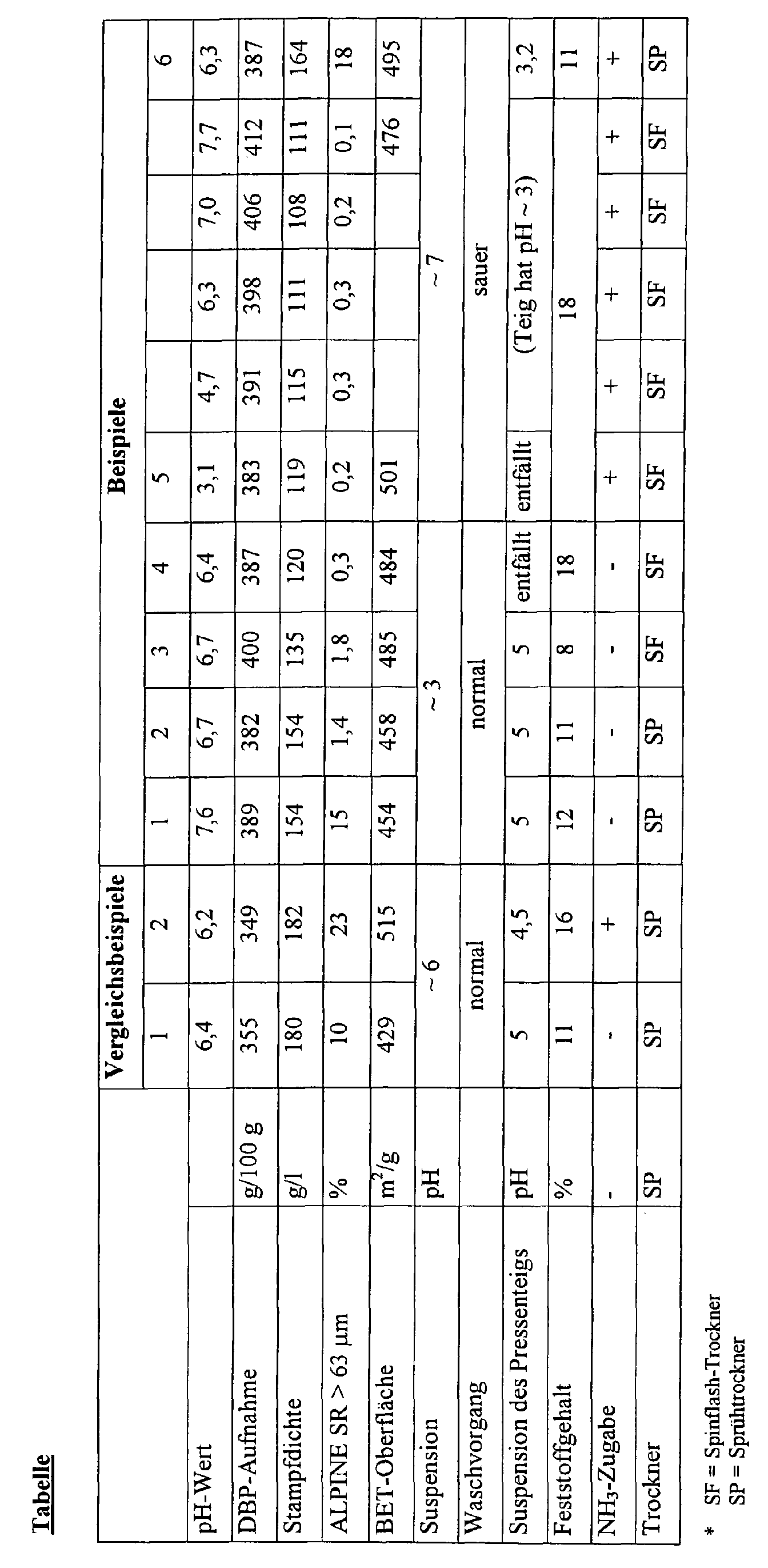
Die Kenndaten des unvermahlenen Produktes finden sich in der Tabelle.
Die Kenndaten des unvermahlenen Produktes finden sich in der Tabelle.
Die Kenndaten des unvermahlenen Produktes finden sich in der Tabelle.
Die Kenndaten des unvermahlenen Produktes finden sich in der Tabelle.
Die Kenndaten der unvermahlenen Produkte finden sich in der Tabelle.
Die Kenndaten des unvermahlenen Produktes finden sich in der Tabelle.
Claims (14)
- Fällungskieselsäure, gekennzeichnet durch die folgenden physikalisch-chemischen Kenndaten:
pH-Wert (5%ig in Wasser) (ISO 787-9) 3 - 8 BET-Oberfläche (DIN 66131) m2/g 400 - 600 DBP-Absorption (DIN 53601, bezogen auf getrocknete Substanz) g/100g 380 - 420 Stampfdichte (ISO 787-11) g/l 100 - 200 ALPINE-Siebrückstand > 63 µm (ISO 8130-1) % 0,1 - 40 - Fällungskieselsäure nach Anspruch 1, gekennzeichnet durch die folgenden physikalisch-chemischen Kenndaten:
pH-Wert (5%ig in Wasser) (ISO 787-9) 3 - 8 BET-Oberfläche (DIN 66131) m2/g 400 - 600 DBP-Absorption (DIN 53601, g/100g 380 - 420 bezogen auf getrocknete Substanz) Stampfdichte (ISO 787-11) g/l 140 - 200 ALPINE-Siebrückstand> 63 µm (ISO 8130-1) % 10 - 40 - Fällungskieselsäure nach Anspruch 1, gekennzeichnet durch die folgenden physikalisch-chemischen Kenndaten:
pH-Wert (5%ig in Wasser) (ISO 787-9) · 3 - 8 BET-Oberfläche (DIN 66131) m2/g 400 - 600 DBP-Absorption (DIN 53601, g/100 g 380 - 420 bezogen auf getrocknete Substanz) Stampfdichte (ISO 787-11) g/l 140 - 180 ALPINE-Siebrückstand > 63 µm (ISO 8130-1) % 1 - 10 - Fällungskieselsäure nach Anspruch 1, gekennzeichnet durch die folgenden physikalisch-chemischen Kenndaten:
pH-Wert (5%ig in Wasser) (ISO 787-9) 3 - 8 BET-Oberfläche (DIN 66131) m2/g 400 - 600 DBP-Absorption (DIN 53601, g/100g 380 - 420 bezogen auf getrocknete Substanz) Stampfdichte (ISO 787-11) g/l 100 - 130 ALPINE-Siebrückstand > 63 µm % 0,1 - 1 (ISO 8130-1) - Verfahren zur Herstellung einer Fällungskieselsäure gemäß einem der Ansprüche 1 bis 4, dadurch gekennzeichnet, dass man unter Rühren und Scheren in eine auf 35- 45 °C erwärmte Vorlage aus Wassera) innerhalb von mindestens 100 Minuten gleichzeitig Wasser und Schwefelsäure unter Aufrechterhaltung von pH 6-7 gibt, wobei die Zugabe für 60 - 120 Minuten unterbrochen wird und sich nach beendeter Zugabe eine Feststoffkonzentration von 36 - 42 g/l einstelltb) den Feststoff abfiltriert und den Filterkuchen auswäscht undc) den Feststoff einer Kurzzeit-Trocknung unterwirft.
- Verfahren zur Herstellung einer Fällungskieselsäure nach Anspruch 4,
dadurch gekennzeichnet, dass die Kurzzeit-Trocknung in Verfahrensschritt c) durchgeführt wird, indem der Filterkuchen auf einen Feststoffgehalt von weniger als 18 Gew.-% verflüssigt und diese Suspension sprühgetrocknet wird. - Verfahren zur Herstellung einer Fällungskieselsäure nach Anspruch 4,
dadurch gekennzeichnet, dass die Kurzzeit-Trocknung in Verfahrensschritt c) durchgeführt wird, indem der Filterkuchen mittels eines Spin-Flash-Trockners getrocknet wird. - Verfahren nach einem der Ansprüche 5 bis 7,
dadurch gekennzeichnet, dass die nach der Kurzzeit-Trocknung erhaltene Kieselsäure mit Ammoniakgas auf ein pH von 7 bis 8 eingestellt wird. - Verfahren nach einem der Ansprüche 5 bis 9,
dadurch gekennzeichnet, dass man den Filterkuchen mit verdünnter Schwefelsäure auswäscht. - Verwendung der Fällungskieselsäure nach einem der Ansprüche 1 bis 4 als Träger für Futtermittel, Vitamine oder Katalysatoren.
- Verwendung der Fällungskieselsäure nach einem der Ansprüche 1 bis 4 als free-flow oder anticaking-Mittel.
- Verwendung der Fällungskieselsäure nach einem der Ansprüche 1 bis 4 als Hilfsmittel zur Überführung von Flüssigkeiten in Pulverform.
- Verwendung der Fällungskieselsäure nach einem der Ansprüche 1 bis 4 in Elastomerenmischungen.
- Verwendung der Fällungskieselsäure nach einem der Ansprüche 1 bis 4 zur Herstellung von Katalysatorenträgern.
Applications Claiming Priority (2)
| Application Number | Priority Date | Filing Date | Title |
|---|---|---|---|
| DE10058616A DE10058616A1 (de) | 2000-11-25 | 2000-11-25 | Fällungskieselsäuren mit hoher Struktur |
| DE10058616 | 2000-11-25 |
Publications (3)
| Publication Number | Publication Date |
|---|---|
| EP1241135A2 true EP1241135A2 (de) | 2002-09-18 |
| EP1241135A3 EP1241135A3 (de) | 2002-12-11 |
| EP1241135B1 EP1241135B1 (de) | 2012-07-11 |
Family
ID=7664678
Family Applications (1)
| Application Number | Title | Priority Date | Filing Date |
|---|---|---|---|
| EP01123611A Expired - Lifetime EP1241135B1 (de) | 2000-11-25 | 2001-10-02 | Fällungskieselsäuren mit hoher Struktur |
Country Status (13)
| Country | Link |
|---|---|
| US (1) | US7204969B2 (de) |
| EP (1) | EP1241135B1 (de) |
| JP (1) | JP4318879B2 (de) |
| CA (1) | CA2363701A1 (de) |
| DE (1) | DE10058616A1 (de) |
| DK (1) | DK1241135T3 (de) |
| ES (1) | ES2389896T3 (de) |
| HU (1) | HUP0105126A2 (de) |
| MX (1) | MXPA01011394A (de) |
| PL (1) | PL200276B1 (de) |
| TR (1) | TR200103348A2 (de) |
| TW (1) | TWI228491B (de) |
| ZA (1) | ZA200109653B (de) |
Cited By (4)
| Publication number | Priority date | Publication date | Assignee | Title |
|---|---|---|---|---|
| EP2281855A1 (de) | 2009-08-05 | 2011-02-09 | Evonik Degussa GmbH | Bewuchshemmende Beschichtungszusatzstoffe für Beschichtungssysteme in Wasseranwendungen |
| DE102009036767A1 (de) | 2009-08-08 | 2011-02-10 | Evonik Degussa Gmbh | Kompositpartikel für den Einsatz in der Mundhygiene |
| DE102012210294A1 (de) | 2012-06-19 | 2013-12-19 | Evonik Industries Ag | Bewuchsmindernde-Additive, Verfahren zu deren Herstellung und deren Verwendung in Beschichtungen |
| US9199211B2 (en) | 2008-02-13 | 2015-12-01 | Evonik Degussa Gmbh | Storage-stable product systems for premix formulations |
Families Citing this family (21)
| Publication number | Priority date | Publication date | Assignee | Title |
|---|---|---|---|---|
| DE10112441A1 (de) * | 2001-03-15 | 2002-09-19 | Degussa | Kieselsäure durch Fällung mit konstanter Alkalizahl und deren Verwendung |
| DE10142736A1 (de) * | 2001-08-31 | 2003-03-27 | Degussa | Adsorptionsmittel, Verfahren zu deren Herstellung und deren Verwendung |
| FR2843894B1 (fr) * | 2002-08-30 | 2004-11-12 | Rhodia Chimie Sa | Compose forme de silice precipitee et de phosphate et son utilisation comme support de liquide a apport nutritionnel et comme agent antimottant a apport nutritionnel |
| DE10241273A1 (de) * | 2002-09-06 | 2004-03-18 | Degussa Ag | Effiziente Mattierungsmittel basierend auf Fällungskieselsäuren |
| JP2005053728A (ja) * | 2003-08-01 | 2005-03-03 | Dsl Japan Co Ltd | 高吸油性および高い構造性を有する非晶質シリカ粒子 |
| JP2005053744A (ja) * | 2003-08-05 | 2005-03-03 | Dsl Japan Co Ltd | 高吸油性非晶質シリカ粒子 |
| DE102004005411A1 (de) * | 2004-02-03 | 2005-08-18 | Degussa Ag | Hydrophobe Fällungskieselsäure für Entschäumerformulierungen |
| DE102004005409A1 (de) * | 2004-02-03 | 2005-08-18 | Degussa Ag | Hydrophile Fällungskieselsäure für Entschäumerformulierungen |
| DE102004029069A1 (de) | 2004-06-16 | 2005-12-29 | Degussa Ag | Oberflächenmodifizierte Silicagele |
| US7276156B2 (en) * | 2005-05-26 | 2007-10-02 | Tony Mason Lockerman | Storm drain filter |
| DE102006024590A1 (de) * | 2006-05-26 | 2007-11-29 | Degussa Gmbh | Hydrophile Kieselsäure für Dichtungsmassen |
| US7767180B2 (en) | 2006-05-26 | 2010-08-03 | Degussa Gmbh | Precipitated silicas having special surface properties |
| DE102006048850A1 (de) * | 2006-10-16 | 2008-04-17 | Evonik Degussa Gmbh | Amorphe submicron Partikel |
| DE102007052269A1 (de) * | 2007-11-02 | 2009-05-07 | Evonik Degussa Gmbh | Fällungskieselsäuren für lagerstabile RTV-1 Siliconkautschukformulierungen ohne Stabilisator |
| US7985292B2 (en) | 2007-11-26 | 2011-07-26 | Evonik Degussa Corporation | Precipitated silica for thickening and creating thixotropic behavior in liquid systems |
| DE102009045104A1 (de) | 2009-09-29 | 2011-03-31 | Evonik Degussa Gmbh | Neuartige Mattierungsmittel für UV-Lacke |
| JP5990162B2 (ja) * | 2010-05-21 | 2016-09-07 | グレース・ゲーエムベーハー・ウント・コムパニー・カーゲー | 多孔質無機酸化物粒子、並びにその製造及び使用方法 |
| DE102011004532A1 (de) * | 2011-02-22 | 2012-08-23 | Evonik Degussa Gmbh | Hochreines Siliciumdioxidgranulat für Quarzglasanwendungen |
| KR102191476B1 (ko) * | 2019-04-12 | 2020-12-15 | 주식회사 세일에프에이 | 유해가스 제거용 촉매의 제조방법 및 이로부터 제조된 유해가스 제거용 촉매 |
| EP3954743A1 (de) | 2020-08-12 | 2022-02-16 | Evonik Operations GmbH | Verwendung von siliziumdioxid zur verbesserung der leitfähigkeit von beschichtungen |
| CN115316508A (zh) * | 2022-10-13 | 2022-11-11 | 天津冶建特种材料有限公司 | 一种含有二氧化硅的饲料添加剂及其制备方法 |
Family Cites Families (9)
| Publication number | Priority date | Publication date | Assignee | Title |
|---|---|---|---|---|
| DE1299617B (de) * | 1965-01-13 | 1969-07-24 | Degussa | Verfahren zur Herstellung von feinverteiltem gefaelltem Siliciumdioxid |
| US4094771A (en) | 1976-01-13 | 1978-06-13 | Deutsche Gold- Und Silber-Scheideanstalt Vormals Roessler | Process for preparation of a sprayable precipitated silicic acid suspension |
| DE2829045A1 (de) * | 1978-07-01 | 1980-01-10 | Degussa | Borhaltige faellungskieselsaeure |
| FR2453880A1 (fr) | 1979-04-13 | 1980-11-07 | Rhone Poulenc Ind | Nouveau pigment a base de silice sous forme de bille, procede pour l'obtenir et application, notamment comme charge renforcante dans les elastomeres |
| DE3114492A1 (de) * | 1981-04-10 | 1982-10-28 | Degussa Ag, 6000 Frankfurt | Zahnpflegemittel |
| DE3144299A1 (de) * | 1981-11-07 | 1983-05-19 | Degussa Ag, 6000 Frankfurt | Faellungskieselsaeuren mit hoher struktur und verfahren zu ihrer herstellung |
| IN188702B (de) * | 1995-06-01 | 2002-10-26 | Degussa | |
| DE19740440A1 (de) * | 1997-09-15 | 1999-03-18 | Degussa | Leicht dispergierbare Fällungskieselsäure |
| US6395247B1 (en) * | 1997-12-12 | 2002-05-28 | Degussa Ag | Precipitated silica |
-
2000
- 2000-11-25 DE DE10058616A patent/DE10058616A1/de not_active Ceased
-
2001
- 2001-10-02 ES ES01123611T patent/ES2389896T3/es not_active Expired - Lifetime
- 2001-10-02 EP EP01123611A patent/EP1241135B1/de not_active Expired - Lifetime
- 2001-10-02 DK DK01123611.4T patent/DK1241135T3/da active
- 2001-10-22 TW TW090126033A patent/TWI228491B/zh not_active IP Right Cessation
- 2001-11-08 MX MXPA01011394A patent/MXPA01011394A/es active IP Right Grant
- 2001-11-22 JP JP2001358187A patent/JP4318879B2/ja not_active Expired - Fee Related
- 2001-11-22 TR TR2001/03348A patent/TR200103348A2/xx unknown
- 2001-11-23 ZA ZA200109653A patent/ZA200109653B/xx unknown
- 2001-11-23 HU HU0105126A patent/HUP0105126A2/hu unknown
- 2001-11-23 CA CA002363701A patent/CA2363701A1/en not_active Abandoned
- 2001-11-23 PL PL350841A patent/PL200276B1/pl unknown
- 2001-11-26 US US09/991,640 patent/US7204969B2/en not_active Expired - Lifetime
Cited By (9)
| Publication number | Priority date | Publication date | Assignee | Title |
|---|---|---|---|---|
| US9199211B2 (en) | 2008-02-13 | 2015-12-01 | Evonik Degussa Gmbh | Storage-stable product systems for premix formulations |
| EP2281855A1 (de) | 2009-08-05 | 2011-02-09 | Evonik Degussa GmbH | Bewuchshemmende Beschichtungszusatzstoffe für Beschichtungssysteme in Wasseranwendungen |
| DE102009028255A1 (de) | 2009-08-05 | 2011-02-10 | Evonik Degussa Gmbh | Mikrostrukturierte multifunktionale anorganische Coating-Additive zur Vermeidung von Fouling (Biofilmbewuchs) bei aquatischen Anwendungen |
| US8597789B2 (en) | 2009-08-05 | 2013-12-03 | Evonik Degussa Gmbh | Microstructured multifunctional inorganic coating additives for preventing fouling (growth of biofilm) in aquatic applications |
| DE102009036767A1 (de) | 2009-08-08 | 2011-02-10 | Evonik Degussa Gmbh | Kompositpartikel für den Einsatz in der Mundhygiene |
| EP2347796A2 (de) | 2009-08-08 | 2011-07-27 | Evonik Degussa GmbH | Verbundstoffpartikel zur Verwendung bei der Mundhygiene |
| US9248319B2 (en) | 2009-08-08 | 2016-02-02 | Evonik Degussa | Composite particles for use in oral hygiene |
| DE102012210294A1 (de) | 2012-06-19 | 2013-12-19 | Evonik Industries Ag | Bewuchsmindernde-Additive, Verfahren zu deren Herstellung und deren Verwendung in Beschichtungen |
| WO2013189699A1 (de) | 2012-06-19 | 2013-12-27 | Evonik Industries Ag | Bewuchsmindernde-additive, verfahren zu deren herstellung und deren verwendung in beschichtungen |
Also Published As
| Publication number | Publication date |
|---|---|
| EP1241135B1 (de) | 2012-07-11 |
| ZA200109653B (en) | 2002-06-25 |
| PL350841A1 (en) | 2002-06-03 |
| TR200103348A2 (tr) | 2002-06-21 |
| ES2389896T3 (es) | 2012-11-02 |
| HUP0105126A2 (hu) | 2002-07-29 |
| TWI228491B (en) | 2005-03-01 |
| DE10058616A1 (de) | 2002-05-29 |
| EP1241135A3 (de) | 2002-12-11 |
| CA2363701A1 (en) | 2002-05-25 |
| JP4318879B2 (ja) | 2009-08-26 |
| PL200276B1 (pl) | 2008-12-31 |
| DK1241135T3 (da) | 2012-10-08 |
| MXPA01011394A (es) | 2004-05-21 |
| HU0105126D0 (en) | 2002-01-28 |
| JP2002255534A (ja) | 2002-09-11 |
| US7204969B2 (en) | 2007-04-17 |
| US20020102198A1 (en) | 2002-08-01 |
Similar Documents
| Publication | Publication Date | Title |
|---|---|---|
| EP1241135B1 (de) | Fällungskieselsäuren mit hoher Struktur | |
| EP0062749B1 (de) | Verfahren zur Herstellung von Fällungskieselsäuren | |
| DE69833279T2 (de) | Kieselsäure enthaltende Gummimischung für Reifen für Automobile mit einem verbesserten Rollwiderstand | |
| EP0078909B1 (de) | Fällungskieselsäure mit hoher Struktur und Verfahren zu ihrer Herstellung | |
| EP0643015B1 (de) | Verfahren zur Herstellung einer Fällungskieselsäure | |
| DE69432248T2 (de) | Fällungskieselsäure | |
| DE19826570C2 (de) | Verfahren zur Herstellung von Harnstoff und Ammonsulfat enthaltenden Düngemittel-Granulaten | |
| DE60127691T2 (de) | Abrasive zubereitung und verfahren zu deren herstellung | |
| EP2802531B1 (de) | Kondensierte eisen (iiii) phosphate | |
| EP0158120B2 (de) | Verfahren zur Herstellung von fliessfähigen Cholinchlorid-Kieselsäure-Pulvern | |
| EP0690825B1 (de) | Verfahren zur katalytischen behandlung von organische und anorganische verbindungen enthaltenden abwässern, vorzugsweise aus der epichlorhydrinproduktion | |
| DE60116264T2 (de) | Bor enthaltende amorphe kieselsäureteilchen | |
| EP0354609B1 (de) | Verfahren zur Herstellung von ultrafeinem Bariumsulfat | |
| DE2824342B2 (de) | Verfahren zur Herstellung von feinkörnigem kristallinem Natriumalumosilicat vom Typ 4A | |
| EP0113796A1 (de) | Wasserhaltiges Aluminiumoxid enthaltend im wesentlichen Pseudoböhmit, Verfahren zu seiner Herstellung und Verwendung | |
| DE3226204C2 (de) | ||
| DE2917313C2 (de) | ||
| DE3904083A1 (de) | Kobaltkatalysatoren | |
| EP0392400B1 (de) | Verfahren zur Herstellung eines feinteiligen, kristallinen Zeolithpulvers vom Typ 4A mit vorherbestimmbarer Korngrössenverteilung | |
| DE3628120A1 (de) | Verfahren zur herstellung von rieselfaehigen, mit kieselsaeure gefuellten kautschukpulvern | |
| DE2520219C3 (de) | Verfahren zur Herstellung von Formaldehyd | |
| EP1215249B1 (de) | Perlruss | |
| EP0031428A1 (de) | Verfahren zur Herstellung feindisperser, schwerlöslicher Salze von Sauerstoffsäuren des Phosphors | |
| DE2044830C3 (de) | Verfahren zur Herstellung eines eisenhaltigen Wismuthphosphormolybdat-Katalysators | |
| DE3150555A1 (de) | Verbessertes herstellungsverfahren fuer phosphor-vanadium-sauerstoff-katalysatoren |
Legal Events
| Date | Code | Title | Description |
|---|---|---|---|
| PUAI | Public reference made under article 153(3) epc to a published international application that has entered the european phase |
Free format text: ORIGINAL CODE: 0009012 |
|
| 17P | Request for examination filed |
Effective date: 20011002 |
|
| AK | Designated contracting states |
Kind code of ref document: A2 Designated state(s): AT BE CH CY DE DK ES FI FR GB GR IE IT LI LU MC NL PT SE TR |
|
| AX | Request for extension of the european patent |
Free format text: AL;LT;LV;MK;RO;SI |
|
| PUAL | Search report despatched |
Free format text: ORIGINAL CODE: 0009013 |
|
| AK | Designated contracting states |
Kind code of ref document: A3 Designated state(s): AT BE CH CY DE DK ES FI FR GB GR IE IT LI LU MC NL PT SE TR |
|
| AX | Request for extension of the european patent |
Free format text: AL;LT;LV;MK;RO;SI |
|
| AKX | Designation fees paid |
Designated state(s): AT BE CH CY DE DK ES FI FR GB GR IE IT LI LU MC NL PT SE TR |
|
| 17Q | First examination report despatched |
Effective date: 20040805 |
|
| RAP1 | Party data changed (applicant data changed or rights of an application transferred) |
Owner name: DEGUSSA GMBH |
|
| 17Q | First examination report despatched |
Effective date: 20040805 |
|
| RAP1 | Party data changed (applicant data changed or rights of an application transferred) |
Owner name: EVONIK DEGUSSA GMBH |
|
| RAP1 | Party data changed (applicant data changed or rights of an application transferred) |
Owner name: EVONIK DEGUSSA GMBH |
|
| GRAP | Despatch of communication of intention to grant a patent |
Free format text: ORIGINAL CODE: EPIDOSNIGR1 |
|
| GRAS | Grant fee paid |
Free format text: ORIGINAL CODE: EPIDOSNIGR3 |
|
| GRAA | (expected) grant |
Free format text: ORIGINAL CODE: 0009210 |
|
| AK | Designated contracting states |
Kind code of ref document: B1 Designated state(s): AT BE CH CY DE DK ES FI FR GB GR IE IT LI LU MC NL PT SE TR |
|
| REG | Reference to a national code |
Ref country code: GB Ref legal event code: FG4D Free format text: NOT ENGLISH |
|
| REG | Reference to a national code |
Ref country code: CH Ref legal event code: EP |
|
| REG | Reference to a national code |
Ref country code: AT Ref legal event code: REF Ref document number: 566040 Country of ref document: AT Kind code of ref document: T Effective date: 20120715 |
|
| REG | Reference to a national code |
Ref country code: IE Ref legal event code: FG4D Free format text: LANGUAGE OF EP DOCUMENT: GERMAN |
|
| REG | Reference to a national code |
Ref country code: DE Ref legal event code: R096 Ref document number: 50116137 Country of ref document: DE Effective date: 20120830 |
|
| REG | Reference to a national code |
Ref country code: DK Ref legal event code: T3 |
|
| REG | Reference to a national code |
Ref country code: NL Ref legal event code: T3 |
|
| REG | Reference to a national code |
Ref country code: ES Ref legal event code: FG2A Ref document number: 2389896 Country of ref document: ES Kind code of ref document: T3 Effective date: 20121102 |
|
| PGFP | Annual fee paid to national office [announced via postgrant information from national office to epo] |
Ref country code: LU Payment date: 20121023 Year of fee payment: 12 |
|
| PGFP | Annual fee paid to national office [announced via postgrant information from national office to epo] |
Ref country code: DK Payment date: 20121022 Year of fee payment: 12 |
|
| PG25 | Lapsed in a contracting state [announced via postgrant information from national office to epo] |
Ref country code: CY Free format text: LAPSE BECAUSE OF FAILURE TO SUBMIT A TRANSLATION OF THE DESCRIPTION OR TO PAY THE FEE WITHIN THE PRESCRIBED TIME-LIMIT Effective date: 20120711 |
|
| PGFP | Annual fee paid to national office [announced via postgrant information from national office to epo] |
Ref country code: CH Payment date: 20121023 Year of fee payment: 12 Ref country code: IE Payment date: 20121019 Year of fee payment: 12 |
|
| PG25 | Lapsed in a contracting state [announced via postgrant information from national office to epo] |
Ref country code: GR Free format text: LAPSE BECAUSE OF FAILURE TO SUBMIT A TRANSLATION OF THE DESCRIPTION OR TO PAY THE FEE WITHIN THE PRESCRIBED TIME-LIMIT Effective date: 20121012 Ref country code: SE Free format text: LAPSE BECAUSE OF FAILURE TO SUBMIT A TRANSLATION OF THE DESCRIPTION OR TO PAY THE FEE WITHIN THE PRESCRIBED TIME-LIMIT Effective date: 20120711 Ref country code: PT Free format text: LAPSE BECAUSE OF FAILURE TO SUBMIT A TRANSLATION OF THE DESCRIPTION OR TO PAY THE FEE WITHIN THE PRESCRIBED TIME-LIMIT Effective date: 20121112 |
|
| PGFP | Annual fee paid to national office [announced via postgrant information from national office to epo] |
Ref country code: AT Payment date: 20121011 Year of fee payment: 12 |
|
| PLBE | No opposition filed within time limit |
Free format text: ORIGINAL CODE: 0009261 |
|
| STAA | Information on the status of an ep patent application or granted ep patent |
Free format text: STATUS: NO OPPOSITION FILED WITHIN TIME LIMIT |
|
| PG25 | Lapsed in a contracting state [announced via postgrant information from national office to epo] |
Ref country code: MC Free format text: LAPSE BECAUSE OF NON-PAYMENT OF DUE FEES Effective date: 20121031 |
|
| 26N | No opposition filed |
Effective date: 20130412 |
|
| REG | Reference to a national code |
Ref country code: DE Ref legal event code: R097 Ref document number: 50116137 Country of ref document: DE Effective date: 20130412 |
|
| PG25 | Lapsed in a contracting state [announced via postgrant information from national office to epo] |
Ref country code: TR Free format text: LAPSE BECAUSE OF FAILURE TO SUBMIT A TRANSLATION OF THE DESCRIPTION OR TO PAY THE FEE WITHIN THE PRESCRIBED TIME-LIMIT Effective date: 20120711 |
|
| REG | Reference to a national code |
Ref country code: DK Ref legal event code: EBP Effective date: 20131031 |
|
| REG | Reference to a national code |
Ref country code: CH Ref legal event code: PL |
|
| REG | Reference to a national code |
Ref country code: AT Ref legal event code: MM01 Ref document number: 566040 Country of ref document: AT Kind code of ref document: T Effective date: 20131002 |
|
| REG | Reference to a national code |
Ref country code: IE Ref legal event code: MM4A |
|
| PG25 | Lapsed in a contracting state [announced via postgrant information from national office to epo] |
Ref country code: CH Free format text: LAPSE BECAUSE OF NON-PAYMENT OF DUE FEES Effective date: 20131031 Ref country code: LI Free format text: LAPSE BECAUSE OF NON-PAYMENT OF DUE FEES Effective date: 20131031 |
|
| PG25 | Lapsed in a contracting state [announced via postgrant information from national office to epo] |
Ref country code: AT Free format text: LAPSE BECAUSE OF NON-PAYMENT OF DUE FEES Effective date: 20131002 |
|
| PG25 | Lapsed in a contracting state [announced via postgrant information from national office to epo] |
Ref country code: IE Free format text: LAPSE BECAUSE OF NON-PAYMENT OF DUE FEES Effective date: 20131002 Ref country code: DK Free format text: LAPSE BECAUSE OF NON-PAYMENT OF DUE FEES Effective date: 20131031 |
|
| PG25 | Lapsed in a contracting state [announced via postgrant information from national office to epo] |
Ref country code: LU Free format text: LAPSE BECAUSE OF NON-PAYMENT OF DUE FEES Effective date: 20131002 |
|
| REG | Reference to a national code |
Ref country code: FR Ref legal event code: PLFP Year of fee payment: 15 |
|
| REG | Reference to a national code |
Ref country code: FR Ref legal event code: PLFP Year of fee payment: 16 |
|
| REG | Reference to a national code |
Ref country code: FR Ref legal event code: PLFP Year of fee payment: 17 |
|
| REG | Reference to a national code |
Ref country code: FR Ref legal event code: PLFP Year of fee payment: 18 |
|
| REG | Reference to a national code |
Ref country code: BE Ref legal event code: HC Owner name: EVONIK OPERATIONS GMBH; DE Free format text: DETAILS ASSIGNMENT: CHANGE OF OWNER(S), CHANGEMENT DE NOM DU PROPRIETAIRE; FORMER OWNER NAME: EVONIK DEGUSSA GMBH Effective date: 20191122 |
|
| PGFP | Annual fee paid to national office [announced via postgrant information from national office to epo] |
Ref country code: DE Payment date: 20191021 Year of fee payment: 19 Ref country code: FI Payment date: 20191022 Year of fee payment: 19 Ref country code: NL Payment date: 20191021 Year of fee payment: 19 |
|
| PGFP | Annual fee paid to national office [announced via postgrant information from national office to epo] |
Ref country code: ES Payment date: 20191122 Year of fee payment: 19 Ref country code: FR Payment date: 20191028 Year of fee payment: 19 Ref country code: BE Payment date: 20191021 Year of fee payment: 19 Ref country code: IT Payment date: 20191028 Year of fee payment: 19 |
|
| PGFP | Annual fee paid to national office [announced via postgrant information from national office to epo] |
Ref country code: GB Payment date: 20191021 Year of fee payment: 19 |
|
| REG | Reference to a national code |
Ref country code: DE Ref legal event code: R119 Ref document number: 50116137 Country of ref document: DE |
|
| REG | Reference to a national code |
Ref country code: FI Ref legal event code: MAE |
|
| REG | Reference to a national code |
Ref country code: NL Ref legal event code: MM Effective date: 20201101 |
|
| GBPC | Gb: european patent ceased through non-payment of renewal fee |
Effective date: 20201002 |
|
| REG | Reference to a national code |
Ref country code: BE Ref legal event code: MM Effective date: 20201031 |
|
| PG25 | Lapsed in a contracting state [announced via postgrant information from national office to epo] |
Ref country code: DE Free format text: LAPSE BECAUSE OF NON-PAYMENT OF DUE FEES Effective date: 20210501 Ref country code: NL Free format text: LAPSE BECAUSE OF NON-PAYMENT OF DUE FEES Effective date: 20201101 Ref country code: FR Free format text: LAPSE BECAUSE OF NON-PAYMENT OF DUE FEES Effective date: 20201031 Ref country code: FI Free format text: LAPSE BECAUSE OF NON-PAYMENT OF DUE FEES Effective date: 20201002 |
|
| PG25 | Lapsed in a contracting state [announced via postgrant information from national office to epo] |
Ref country code: GB Free format text: LAPSE BECAUSE OF NON-PAYMENT OF DUE FEES Effective date: 20201002 Ref country code: BE Free format text: LAPSE BECAUSE OF NON-PAYMENT OF DUE FEES Effective date: 20201031 |
|
| PG25 | Lapsed in a contracting state [announced via postgrant information from national office to epo] |
Ref country code: IT Free format text: LAPSE BECAUSE OF NON-PAYMENT OF DUE FEES Effective date: 20201002 |
|
| REG | Reference to a national code |
Ref country code: ES Ref legal event code: FD2A Effective date: 20220119 |
|
| PG25 | Lapsed in a contracting state [announced via postgrant information from national office to epo] |
Ref country code: ES Free format text: LAPSE BECAUSE OF NON-PAYMENT OF DUE FEES Effective date: 20201003 |