EP1243552B1 - Particules d'oxydes revetus contenant un dopant - Google Patents
Particules d'oxydes revetus contenant un dopant Download PDFInfo
- Publication number
- EP1243552B1 EP1243552B1 EP01107334A EP01107334A EP1243552B1 EP 1243552 B1 EP1243552 B1 EP 1243552B1 EP 01107334 A EP01107334 A EP 01107334A EP 01107334 A EP01107334 A EP 01107334A EP 1243552 B1 EP1243552 B1 EP 1243552B1
- Authority
- EP
- European Patent Office
- Prior art keywords
- oxide
- core
- doped
- oxide particles
- particles according
- Prior art date
- Legal status (The legal status is an assumption and is not a legal conclusion. Google has not performed a legal analysis and makes no representation as to the accuracy of the status listed.)
- Expired - Lifetime
Links
- 239000002245 particle Substances 0.000 title claims abstract description 38
- 239000002019 doping agent Substances 0.000 title abstract description 6
- 239000000203 mixture Substances 0.000 claims abstract description 18
- 239000011248 coating agent Substances 0.000 claims abstract description 7
- 238000000576 coating method Methods 0.000 claims abstract description 7
- 238000002360 preparation method Methods 0.000 claims abstract description 7
- 239000000126 substance Substances 0.000 claims abstract description 7
- VYPSYNLAJGMNEJ-UHFFFAOYSA-N Silicium dioxide Chemical compound O=[Si]=O VYPSYNLAJGMNEJ-UHFFFAOYSA-N 0.000 claims description 34
- 229910052751 metal Inorganic materials 0.000 claims description 31
- 239000002184 metal Substances 0.000 claims description 31
- 229910052752 metalloid Inorganic materials 0.000 claims description 21
- 238000005498 polishing Methods 0.000 claims description 18
- 239000000243 solution Substances 0.000 claims description 18
- 239000000443 aerosol Substances 0.000 claims description 17
- 150000002738 metalloids Chemical class 0.000 claims description 16
- 239000006185 dispersion Substances 0.000 claims description 12
- XEEYBQQBJWHFJM-UHFFFAOYSA-N iron Substances [Fe] XEEYBQQBJWHFJM-UHFFFAOYSA-N 0.000 claims description 11
- 230000003647 oxidation Effects 0.000 claims description 11
- 238000007254 oxidation reaction Methods 0.000 claims description 11
- 229910052782 aluminium Inorganic materials 0.000 claims description 10
- 229910052719 titanium Inorganic materials 0.000 claims description 10
- 239000010936 titanium Substances 0.000 claims description 10
- 229910052726 zirconium Inorganic materials 0.000 claims description 10
- PNEYBMLMFCGWSK-UHFFFAOYSA-N Alumina Chemical compound [O-2].[O-2].[O-2].[Al+3].[Al+3] PNEYBMLMFCGWSK-UHFFFAOYSA-N 0.000 claims description 9
- 229910052742 iron Inorganic materials 0.000 claims description 9
- 238000000034 method Methods 0.000 claims description 9
- 229910052718 tin Inorganic materials 0.000 claims description 9
- 239000011135 tin Substances 0.000 claims description 9
- 229910052720 vanadium Inorganic materials 0.000 claims description 9
- 229910052725 zinc Inorganic materials 0.000 claims description 9
- 239000011701 zinc Substances 0.000 claims description 9
- 229910052748 manganese Inorganic materials 0.000 claims description 8
- 230000000737 periodic effect Effects 0.000 claims description 8
- 229910052710 silicon Inorganic materials 0.000 claims description 8
- 229910052804 chromium Inorganic materials 0.000 claims description 7
- 229910052802 copper Inorganic materials 0.000 claims description 7
- -1 metalloid salt Chemical class 0.000 claims description 7
- 229910052759 nickel Inorganic materials 0.000 claims description 7
- 229910052700 potassium Inorganic materials 0.000 claims description 7
- 150000003839 salts Chemical class 0.000 claims description 7
- 229910052721 tungsten Inorganic materials 0.000 claims description 7
- 238000006243 chemical reaction Methods 0.000 claims description 6
- 229910052732 germanium Inorganic materials 0.000 claims description 6
- 150000002739 metals Chemical class 0.000 claims description 6
- 238000002156 mixing Methods 0.000 claims description 6
- 229910052684 Cerium Inorganic materials 0.000 claims description 5
- XLOMVQKBTHCTTD-UHFFFAOYSA-N Zinc monoxide Chemical compound [Zn]=O XLOMVQKBTHCTTD-UHFFFAOYSA-N 0.000 claims description 5
- 230000007062 hydrolysis Effects 0.000 claims description 5
- 238000006460 hydrolysis reaction Methods 0.000 claims description 5
- 229910052749 magnesium Inorganic materials 0.000 claims description 5
- 230000001698 pyrogenic effect Effects 0.000 claims description 5
- UQSXHKLRYXJYBZ-UHFFFAOYSA-N Iron oxide Chemical compound [Fe]=O UQSXHKLRYXJYBZ-UHFFFAOYSA-N 0.000 claims description 4
- 229910000420 cerium oxide Inorganic materials 0.000 claims description 4
- 239000003795 chemical substances by application Substances 0.000 claims description 4
- 239000000945 filler Substances 0.000 claims description 4
- 239000007788 liquid Substances 0.000 claims description 4
- 150000002736 metal compounds Chemical class 0.000 claims description 4
- 150000002737 metalloid compounds Chemical class 0.000 claims description 4
- BMMGVYCKOGBVEV-UHFFFAOYSA-N oxo(oxoceriooxy)cerium Chemical compound [Ce]=O.O=[Ce]=O BMMGVYCKOGBVEV-UHFFFAOYSA-N 0.000 claims description 4
- 239000000843 powder Substances 0.000 claims description 4
- 239000011541 reaction mixture Substances 0.000 claims description 4
- 239000004065 semiconductor Substances 0.000 claims description 4
- XUIMIQQOPSSXEZ-UHFFFAOYSA-N Silicon Chemical compound [Si] XUIMIQQOPSSXEZ-UHFFFAOYSA-N 0.000 claims description 3
- GWEVSGVZZGPLCZ-UHFFFAOYSA-N Titan oxide Chemical compound O=[Ti]=O GWEVSGVZZGPLCZ-UHFFFAOYSA-N 0.000 claims description 3
- RTAQQCXQSZGOHL-UHFFFAOYSA-N Titanium Chemical compound [Ti] RTAQQCXQSZGOHL-UHFFFAOYSA-N 0.000 claims description 3
- QCWXUUIWCKQGHC-UHFFFAOYSA-N Zirconium Chemical compound [Zr] QCWXUUIWCKQGHC-UHFFFAOYSA-N 0.000 claims description 3
- XAGFODPZIPBFFR-UHFFFAOYSA-N aluminium Chemical compound [Al] XAGFODPZIPBFFR-UHFFFAOYSA-N 0.000 claims description 3
- YBMRDBCBODYGJE-UHFFFAOYSA-N germanium oxide Inorganic materials O=[Ge]=O YBMRDBCBODYGJE-UHFFFAOYSA-N 0.000 claims description 3
- 229910052746 lanthanum Inorganic materials 0.000 claims description 3
- 239000002243 precursor Substances 0.000 claims description 3
- 239000010703 silicon Substances 0.000 claims description 3
- 239000007858 starting material Substances 0.000 claims description 3
- 239000000758 substrate Substances 0.000 claims description 3
- 239000000725 suspension Substances 0.000 claims description 3
- 229920002799 BoPET Polymers 0.000 claims description 2
- ATJFFYVFTNAWJD-UHFFFAOYSA-N Tin Chemical compound [Sn] ATJFFYVFTNAWJD-UHFFFAOYSA-N 0.000 claims description 2
- HCHKCACWOHOZIP-UHFFFAOYSA-N Zinc Chemical compound [Zn] HCHKCACWOHOZIP-UHFFFAOYSA-N 0.000 claims description 2
- XHCLAFWTIXFWPH-UHFFFAOYSA-N [O-2].[O-2].[O-2].[O-2].[O-2].[V+5].[V+5] Chemical compound [O-2].[O-2].[O-2].[O-2].[O-2].[V+5].[V+5] XHCLAFWTIXFWPH-UHFFFAOYSA-N 0.000 claims description 2
- 239000006096 absorbing agent Substances 0.000 claims description 2
- 239000013543 active substance Substances 0.000 claims description 2
- 239000000654 additive Substances 0.000 claims description 2
- 230000000996 additive effect Effects 0.000 claims description 2
- 230000001476 alcoholic effect Effects 0.000 claims description 2
- 239000007864 aqueous solution Substances 0.000 claims description 2
- 239000012876 carrier material Substances 0.000 claims description 2
- 239000000919 ceramic Substances 0.000 claims description 2
- 239000002537 cosmetic Substances 0.000 claims description 2
- 238000001035 drying Methods 0.000 claims description 2
- GNPVGFCGXDBREM-UHFFFAOYSA-N germanium atom Chemical compound [Ge] GNPVGFCGXDBREM-UHFFFAOYSA-N 0.000 claims description 2
- 239000000976 ink Substances 0.000 claims description 2
- 239000012774 insulation material Substances 0.000 claims description 2
- 239000000463 material Substances 0.000 claims description 2
- PVADDRMAFCOOPC-UHFFFAOYSA-N oxogermanium Chemical compound [Ge]=O PVADDRMAFCOOPC-UHFFFAOYSA-N 0.000 claims description 2
- 239000003973 paint Substances 0.000 claims description 2
- 229920001296 polysiloxane Polymers 0.000 claims description 2
- 239000011164 primary particle Substances 0.000 claims description 2
- 238000000518 rheometry Methods 0.000 claims description 2
- 230000006641 stabilisation Effects 0.000 claims description 2
- 238000011105 stabilization Methods 0.000 claims description 2
- XOLBLPGZBRYERU-UHFFFAOYSA-N tin dioxide Chemical compound O=[Sn]=O XOLBLPGZBRYERU-UHFFFAOYSA-N 0.000 claims description 2
- 229910001887 tin oxide Inorganic materials 0.000 claims description 2
- 229910001935 vanadium oxide Inorganic materials 0.000 claims description 2
- 239000011787 zinc oxide Substances 0.000 claims description 2
- 239000004411 aluminium Substances 0.000 claims 1
- 238000001354 calcination Methods 0.000 claims 1
- GWXLDORMOJMVQZ-UHFFFAOYSA-N cerium Chemical compound [Ce] GWXLDORMOJMVQZ-UHFFFAOYSA-N 0.000 claims 1
- 239000003814 drug Substances 0.000 claims 1
- 229910044991 metal oxide Inorganic materials 0.000 claims 1
- 150000004706 metal oxides Chemical class 0.000 claims 1
- RVTZCBVAJQQJTK-UHFFFAOYSA-N oxygen(2-);zirconium(4+) Chemical compound [O-2].[O-2].[Zr+4] RVTZCBVAJQQJTK-UHFFFAOYSA-N 0.000 claims 1
- 229910052814 silicon oxide Inorganic materials 0.000 claims 1
- OGIDPMRJRNCKJF-UHFFFAOYSA-N titanium oxide Inorganic materials [Ti]=O OGIDPMRJRNCKJF-UHFFFAOYSA-N 0.000 claims 1
- LEONUFNNVUYDNQ-UHFFFAOYSA-N vanadium atom Chemical compound [V] LEONUFNNVUYDNQ-UHFFFAOYSA-N 0.000 claims 1
- 229910001928 zirconium oxide Inorganic materials 0.000 claims 1
- XLYOFNOQVPJJNP-UHFFFAOYSA-N water Substances O XLYOFNOQVPJJNP-UHFFFAOYSA-N 0.000 description 21
- 239000007789 gas Substances 0.000 description 19
- 229910021485 fumed silica Inorganic materials 0.000 description 11
- 239000000377 silicon dioxide Substances 0.000 description 11
- 229910052741 iridium Inorganic materials 0.000 description 8
- 229910052762 osmium Inorganic materials 0.000 description 8
- 229910052763 palladium Inorganic materials 0.000 description 8
- 229910052697 platinum Inorganic materials 0.000 description 8
- 229910052702 rhenium Inorganic materials 0.000 description 8
- 229910052703 rhodium Inorganic materials 0.000 description 8
- 229910052707 ruthenium Inorganic materials 0.000 description 8
- 229910052709 silver Inorganic materials 0.000 description 8
- ODPUKHWKHYKMRK-UHFFFAOYSA-N cerium;nitric acid Chemical compound [Ce].O[N+]([O-])=O ODPUKHWKHYKMRK-UHFFFAOYSA-N 0.000 description 7
- 239000011572 manganese Substances 0.000 description 7
- 229910052737 gold Inorganic materials 0.000 description 6
- 229910052739 hydrogen Inorganic materials 0.000 description 6
- 239000001257 hydrogen Substances 0.000 description 6
- AMWRITDGCCNYAT-UHFFFAOYSA-L hydroxy(oxo)manganese;manganese Chemical compound [Mn].O[Mn]=O.O[Mn]=O AMWRITDGCCNYAT-UHFFFAOYSA-L 0.000 description 6
- 229910003902 SiCl 4 Inorganic materials 0.000 description 5
- 150000001875 compounds Chemical class 0.000 description 5
- 229910052727 yttrium Inorganic materials 0.000 description 5
- UFHFLCQGNIYNRP-UHFFFAOYSA-N Hydrogen Chemical compound [H][H] UFHFLCQGNIYNRP-UHFFFAOYSA-N 0.000 description 4
- 229910052768 actinide Inorganic materials 0.000 description 4
- 150000001255 actinides Chemical class 0.000 description 4
- AZDRQVAHHNSJOQ-UHFFFAOYSA-N alumane Chemical class [AlH3] AZDRQVAHHNSJOQ-UHFFFAOYSA-N 0.000 description 4
- 229910052787 antimony Inorganic materials 0.000 description 4
- 229910052785 arsenic Inorganic materials 0.000 description 4
- 229910052790 beryllium Inorganic materials 0.000 description 4
- 229910052796 boron Inorganic materials 0.000 description 4
- 229910052793 cadmium Inorganic materials 0.000 description 4
- 229910052792 caesium Inorganic materials 0.000 description 4
- 229910052791 calcium Inorganic materials 0.000 description 4
- 229910052733 gallium Inorganic materials 0.000 description 4
- 229910052735 hafnium Inorganic materials 0.000 description 4
- 229910052738 indium Inorganic materials 0.000 description 4
- 229910052747 lanthanoid Inorganic materials 0.000 description 4
- 150000002602 lanthanoids Chemical class 0.000 description 4
- 229910052745 lead Inorganic materials 0.000 description 4
- 229910052744 lithium Inorganic materials 0.000 description 4
- 150000002696 manganese Chemical class 0.000 description 4
- 238000004519 manufacturing process Methods 0.000 description 4
- 238000012986 modification Methods 0.000 description 4
- 230000004048 modification Effects 0.000 description 4
- 229910052750 molybdenum Inorganic materials 0.000 description 4
- 229910052758 niobium Inorganic materials 0.000 description 4
- 239000010970 precious metal Substances 0.000 description 4
- 229910052701 rubidium Inorganic materials 0.000 description 4
- 239000012266 salt solution Substances 0.000 description 4
- 229910052706 scandium Inorganic materials 0.000 description 4
- 229910052711 selenium Inorganic materials 0.000 description 4
- 229910052708 sodium Inorganic materials 0.000 description 4
- 229910052712 strontium Inorganic materials 0.000 description 4
- 229910052713 technetium Inorganic materials 0.000 description 4
- 229910052714 tellurium Inorganic materials 0.000 description 4
- 229910052716 thallium Inorganic materials 0.000 description 4
- 229910018072 Al 2 O 3 Inorganic materials 0.000 description 3
- VSCWAEJMTAWNJL-UHFFFAOYSA-K aluminium trichloride Chemical compound Cl[Al](Cl)Cl VSCWAEJMTAWNJL-UHFFFAOYSA-K 0.000 description 3
- 241001156002 Anthonomus pomorum Species 0.000 description 2
- VEXZGXHMUGYJMC-UHFFFAOYSA-N Hydrochloric acid Chemical group Cl VEXZGXHMUGYJMC-UHFFFAOYSA-N 0.000 description 2
- 229910004298 SiO 2 Inorganic materials 0.000 description 2
- 238000003917 TEM image Methods 0.000 description 2
- MCMNRKCIXSYSNV-UHFFFAOYSA-N Zirconium dioxide Chemical compound O=[Zr]=O MCMNRKCIXSYSNV-UHFFFAOYSA-N 0.000 description 2
- 229910052797 bismuth Inorganic materials 0.000 description 2
- 239000012159 carrier gas Substances 0.000 description 2
- CETPSERCERDGAM-UHFFFAOYSA-N ceric oxide Chemical compound O=[Ce]=O CETPSERCERDGAM-UHFFFAOYSA-N 0.000 description 2
- 229910000422 cerium(IV) oxide Inorganic materials 0.000 description 2
- 238000001816 cooling Methods 0.000 description 2
- 239000013078 crystal Substances 0.000 description 2
- 229910052753 mercury Inorganic materials 0.000 description 2
- 239000003595 mist Substances 0.000 description 2
- 239000007787 solid Substances 0.000 description 2
- 229910052715 tantalum Inorganic materials 0.000 description 2
- VXEGSRKPIUDPQT-UHFFFAOYSA-N 4-[4-(4-methoxyphenyl)piperazin-1-yl]aniline Chemical compound C1=CC(OC)=CC=C1N1CCN(C=2C=CC(N)=CC=2)CC1 VXEGSRKPIUDPQT-UHFFFAOYSA-N 0.000 description 1
- PWHULOQIROXLJO-UHFFFAOYSA-N Manganese Chemical compound [Mn] PWHULOQIROXLJO-UHFFFAOYSA-N 0.000 description 1
- 229910021380 Manganese Chloride Inorganic materials 0.000 description 1
- GLFNIEUTAYBVOC-UHFFFAOYSA-L Manganese chloride Chemical compound Cl[Mn]Cl GLFNIEUTAYBVOC-UHFFFAOYSA-L 0.000 description 1
- 238000000889 atomisation Methods 0.000 description 1
- 239000002585 base Substances 0.000 description 1
- ZMIGMASIKSOYAM-UHFFFAOYSA-N cerium Chemical compound [Ce][Ce][Ce][Ce][Ce][Ce][Ce][Ce][Ce][Ce][Ce][Ce][Ce][Ce][Ce][Ce][Ce][Ce][Ce][Ce][Ce][Ce][Ce][Ce][Ce][Ce][Ce][Ce][Ce][Ce][Ce][Ce][Ce][Ce][Ce][Ce][Ce][Ce] ZMIGMASIKSOYAM-UHFFFAOYSA-N 0.000 description 1
- VYLVYHXQOHJDJL-UHFFFAOYSA-K cerium trichloride Chemical compound Cl[Ce](Cl)Cl VYLVYHXQOHJDJL-UHFFFAOYSA-K 0.000 description 1
- VGBWDOLBWVJTRZ-UHFFFAOYSA-K cerium(3+);triacetate Chemical compound [Ce+3].CC([O-])=O.CC([O-])=O.CC([O-])=O VGBWDOLBWVJTRZ-UHFFFAOYSA-K 0.000 description 1
- 239000011651 chromium Substances 0.000 description 1
- 238000010276 construction Methods 0.000 description 1
- 238000000724 energy-dispersive X-ray spectrum Methods 0.000 description 1
- 238000005516 engineering process Methods 0.000 description 1
- 239000003112 inhibitor Substances 0.000 description 1
- JEIPFZHSYJVQDO-UHFFFAOYSA-N iron(III) oxide Inorganic materials O=[Fe]O[Fe]=O JEIPFZHSYJVQDO-UHFFFAOYSA-N 0.000 description 1
- 239000006193 liquid solution Substances 0.000 description 1
- 239000011565 manganese chloride Substances 0.000 description 1
- 235000002867 manganese chloride Nutrition 0.000 description 1
- 229910001507 metal halide Inorganic materials 0.000 description 1
- 150000005309 metal halides Chemical class 0.000 description 1
- 238000002663 nebulization Methods 0.000 description 1
- TWNQGVIAIRXVLR-UHFFFAOYSA-N oxo(oxoalumanyloxy)alumane Chemical compound O=[Al]O[Al]=O TWNQGVIAIRXVLR-UHFFFAOYSA-N 0.000 description 1
- 239000000546 pharmaceutical excipient Substances 0.000 description 1
- 238000007517 polishing process Methods 0.000 description 1
- 239000002244 precipitate Substances 0.000 description 1
- 235000012239 silicon dioxide Nutrition 0.000 description 1
- 239000005049 silicon tetrachloride Substances 0.000 description 1
- 238000005507 spraying Methods 0.000 description 1
- 239000013589 supplement Substances 0.000 description 1
- XJDNKRIXUMDJCW-UHFFFAOYSA-J titanium tetrachloride Chemical compound Cl[Ti](Cl)(Cl)Cl XJDNKRIXUMDJCW-UHFFFAOYSA-J 0.000 description 1
- GPPXJZIENCGNKB-UHFFFAOYSA-N vanadium Chemical compound [V]#[V] GPPXJZIENCGNKB-UHFFFAOYSA-N 0.000 description 1
Images



Classifications
-
- C—CHEMISTRY; METALLURGY
- C01—INORGANIC CHEMISTRY
- C01B—NON-METALLIC ELEMENTS; COMPOUNDS THEREOF; METALLOIDS OR COMPOUNDS THEREOF NOT COVERED BY SUBCLASS C01C
- C01B13/00—Oxygen; Ozone; Oxides or hydroxides in general
- C01B13/14—Methods for preparing oxides or hydroxides in general
-
- B—PERFORMING OPERATIONS; TRANSPORTING
- B82—NANOTECHNOLOGY
- B82Y—SPECIFIC USES OR APPLICATIONS OF NANOSTRUCTURES; MEASUREMENT OR ANALYSIS OF NANOSTRUCTURES; MANUFACTURE OR TREATMENT OF NANOSTRUCTURES
- B82Y30/00—Nanotechnology for materials or surface science, e.g. nanocomposites
-
- C—CHEMISTRY; METALLURGY
- C01—INORGANIC CHEMISTRY
- C01B—NON-METALLIC ELEMENTS; COMPOUNDS THEREOF; METALLOIDS OR COMPOUNDS THEREOF NOT COVERED BY SUBCLASS C01C
- C01B13/00—Oxygen; Ozone; Oxides or hydroxides in general
- C01B13/14—Methods for preparing oxides or hydroxides in general
- C01B13/18—Methods for preparing oxides or hydroxides in general by thermal decomposition of compounds, e.g. of salts or hydroxides
- C01B13/185—Preparing mixtures of oxides
-
- C—CHEMISTRY; METALLURGY
- C01—INORGANIC CHEMISTRY
- C01B—NON-METALLIC ELEMENTS; COMPOUNDS THEREOF; METALLOIDS OR COMPOUNDS THEREOF NOT COVERED BY SUBCLASS C01C
- C01B13/00—Oxygen; Ozone; Oxides or hydroxides in general
- C01B13/14—Methods for preparing oxides or hydroxides in general
- C01B13/20—Methods for preparing oxides or hydroxides in general by oxidation of elements in the gaseous state; by oxidation or hydrolysis of compounds in the gaseous state
- C01B13/22—Methods for preparing oxides or hydroxides in general by oxidation of elements in the gaseous state; by oxidation or hydrolysis of compounds in the gaseous state of halides or oxyhalides
- C01B13/24—Methods for preparing oxides or hydroxides in general by oxidation of elements in the gaseous state; by oxidation or hydrolysis of compounds in the gaseous state of halides or oxyhalides in the presence of hot combustion gases
-
- C—CHEMISTRY; METALLURGY
- C09—DYES; PAINTS; POLISHES; NATURAL RESINS; ADHESIVES; COMPOSITIONS NOT OTHERWISE PROVIDED FOR; APPLICATIONS OF MATERIALS NOT OTHERWISE PROVIDED FOR
- C09K—MATERIALS FOR MISCELLANEOUS APPLICATIONS, NOT PROVIDED FOR ELSEWHERE
- C09K3/00—Materials not provided for elsewhere
- C09K3/14—Anti-slip materials; Abrasives
- C09K3/1436—Composite particles, e.g. coated particles
-
- C—CHEMISTRY; METALLURGY
- C09—DYES; PAINTS; POLISHES; NATURAL RESINS; ADHESIVES; COMPOSITIONS NOT OTHERWISE PROVIDED FOR; APPLICATIONS OF MATERIALS NOT OTHERWISE PROVIDED FOR
- C09K—MATERIALS FOR MISCELLANEOUS APPLICATIONS, NOT PROVIDED FOR ELSEWHERE
- C09K3/00—Materials not provided for elsewhere
- C09K3/14—Anti-slip materials; Abrasives
- C09K3/1436—Composite particles, e.g. coated particles
- C09K3/1445—Composite particles, e.g. coated particles the coating consisting exclusively of metals
-
- C—CHEMISTRY; METALLURGY
- C01—INORGANIC CHEMISTRY
- C01P—INDEXING SCHEME RELATING TO STRUCTURAL AND PHYSICAL ASPECTS OF SOLID INORGANIC COMPOUNDS
- C01P2002/00—Crystal-structural characteristics
- C01P2002/01—Crystal-structural characteristics depicted by a TEM-image
-
- C—CHEMISTRY; METALLURGY
- C01—INORGANIC CHEMISTRY
- C01P—INDEXING SCHEME RELATING TO STRUCTURAL AND PHYSICAL ASPECTS OF SOLID INORGANIC COMPOUNDS
- C01P2002/00—Crystal-structural characteristics
- C01P2002/50—Solid solutions
- C01P2002/52—Solid solutions containing elements as dopants
-
- C—CHEMISTRY; METALLURGY
- C01—INORGANIC CHEMISTRY
- C01P—INDEXING SCHEME RELATING TO STRUCTURAL AND PHYSICAL ASPECTS OF SOLID INORGANIC COMPOUNDS
- C01P2002/00—Crystal-structural characteristics
- C01P2002/70—Crystal-structural characteristics defined by measured X-ray, neutron or electron diffraction data
- C01P2002/72—Crystal-structural characteristics defined by measured X-ray, neutron or electron diffraction data by d-values or two theta-values, e.g. as X-ray diagram
-
- C—CHEMISTRY; METALLURGY
- C01—INORGANIC CHEMISTRY
- C01P—INDEXING SCHEME RELATING TO STRUCTURAL AND PHYSICAL ASPECTS OF SOLID INORGANIC COMPOUNDS
- C01P2002/00—Crystal-structural characteristics
- C01P2002/80—Crystal-structural characteristics defined by measured data other than those specified in group C01P2002/70
- C01P2002/85—Crystal-structural characteristics defined by measured data other than those specified in group C01P2002/70 by XPS, EDX or EDAX data
-
- C—CHEMISTRY; METALLURGY
- C01—INORGANIC CHEMISTRY
- C01P—INDEXING SCHEME RELATING TO STRUCTURAL AND PHYSICAL ASPECTS OF SOLID INORGANIC COMPOUNDS
- C01P2004/00—Particle morphology
- C01P2004/01—Particle morphology depicted by an image
- C01P2004/04—Particle morphology depicted by an image obtained by TEM, STEM, STM or AFM
-
- C—CHEMISTRY; METALLURGY
- C01—INORGANIC CHEMISTRY
- C01P—INDEXING SCHEME RELATING TO STRUCTURAL AND PHYSICAL ASPECTS OF SOLID INORGANIC COMPOUNDS
- C01P2004/00—Particle morphology
- C01P2004/50—Agglomerated particles
-
- C—CHEMISTRY; METALLURGY
- C01—INORGANIC CHEMISTRY
- C01P—INDEXING SCHEME RELATING TO STRUCTURAL AND PHYSICAL ASPECTS OF SOLID INORGANIC COMPOUNDS
- C01P2004/00—Particle morphology
- C01P2004/60—Particles characterised by their size
- C01P2004/64—Nanometer sized, i.e. from 1-100 nanometer
-
- C—CHEMISTRY; METALLURGY
- C01—INORGANIC CHEMISTRY
- C01P—INDEXING SCHEME RELATING TO STRUCTURAL AND PHYSICAL ASPECTS OF SOLID INORGANIC COMPOUNDS
- C01P2006/00—Physical properties of inorganic compounds
- C01P2006/12—Surface area
Definitions
- the invention relates to oxide particles having a core of a metal or metalloid oxide, a dopant component distributed in the core and a shell surrounding the core.
- a method for producing such mixed oxides is, for example, in EP-A-1048617 described.
- a SiCl 4 / AlCl 3 mixture is brought together in an oxyhydrogen flame and, in a hydrolysis step, a mixed oxide of silicon dioxide and aluminum oxide is obtained.
- the term "uniform" is understood to mean that a mixed oxide particle consists of the two molecular types SiO 2 and Al 2 O 3 .
- doped pyrogenic oxides described extend the range of abrasive particles for chemical mechanical polishing.
- the dopant component which is distributed throughout the particle, alters the structure and properties of the respective particle and thus the polishing properties, such as removal rate and selectivity.
- the polishing selectivity is not sufficient.
- the object of the invention is therefore to provide tailor-made for the respective polishing mixed oxide particles for the chemical-mechanical polishing of semiconductor substrates and deposited on them layers whose composition can be varied in a commercially reasonable manner over a wide range and the disadvantages of the described prior Avoid technology.
- the core may be in various modifications or mixtures of modifications of an oxide.
- alumina may be in amorphous or crystalline form, the crystalline forms comprising the alpha, gamma, delta, theta and kappa modifications, as well as the pyrogenic alumina named after its manufacturing process and mixtures of the aforementioned aluminas.
- Silica may also be in the form of its fumed oxide, or in the known modifications of silica.
- the oxide particles according to the invention may preferably be doped with a metal or an oxide of a metal or metalloid, in each case in any oxidation state from the Periodic Table Groups I; IA; IB, comprising Cu, Ag, Au; II, comprising Be, Mg; IIA containing Ca, Sr, Ba, Ra; IIB comprising Zn, Cd, Hg; III, comprising B, Al; IIIA, comprising Sc, Y, the lanthanides, the actinides; IIIB, comprising Ga, In, Tl; IV; IVA; IVB, comprising Ge, Sn, Pb; VA; VB, comprising As, Sb, Bi; VIA; VIB; VIIA or VIII included.
- These may preferably be the metals or metalloids Li, Na, K, Rb, Cs, Si, Ti, Zr, Hf, V, Nb, Ta, Cr, Mo, W, Se, Te, Mn, Tc, Re, Fe, Co , Ni, Ru, Rh, Pd, Os, Ir, Pt.
- the doped precious metals (Au, Ag, Re, Ru, Rh, Pd, Os, Ir, Pt) are generally elemental or have oxidic surface areas.
- doping are the oxides of the metals and metalloids of K, Mg, Al, Si, Ti, V, Cr, Mn, Fe, Co, Ni, Cu, Sn, Zn, W, La, Ce and Zr.
- the doping can be varied within wide limits, 1 ppm and 30 wt .-%, based on the core. A range between 300 ppm and 10 wt.% Is preferred.
- the shell according to the invention comprises a metal or an oxide of a metal or metalloid, in each case in any oxidation state, from the periodic table groups I; IA; IB, comprising Cu, Ag, Au; II, comprising Be, Mg; IIA containing Ca, Sr, Ba, Ra; IIB comprising Zn, Cd, Hg; III, comprising B, Al; IIIA, comprising Sc, Y, the lanthanides, the actinides; IIIB, comprising Ga, In, Tl; IV; IVA; IVB, comprising Ge, Sn, Pb; VA; VB, comprising As, Sb, Bi; VIA; VIB; VIIA or VIII included.
- These may preferably be the metals or metalloids Li, Na, K, Rb, Cs, Si, Ti, Zr, Hf, V, Nb, Ta, Cr, Mo, W, Se, Te, Mn, Tc, Re, Fe, Co , Ni, Ru, Rh, Pd, Os, Ir, Pt.
- the doped precious metals (Au, Ag, Re, Ru, Rh, Pd, Os, Ir, Pt) are generally elemental or have oxidic surface areas.
- a shell particularly preferred as a shell are the oxides of cerium, zirconium, aluminum, silicon, titanium, iron, tin, zinc, germanium and vanadium.
- the shell oxides can be present in amorphous and / or crystalline form on the doped core, and envelop this wholly or partially.
- the shell oxides can also be varied within wide limits, 10 ppm and 65% by weight, based on the doped core. Preferably, a range between 5 and 40 wt.%.
- the BET surface area of the coated and doped metal or metalloid oxide may be between 5 and 1000 m 2 / g, the average primary particle size between 1 nm and 1 ⁇ m.
- the precursors of the core used are preferably the compounds of the metalloids / metals aluminum, titanium, zirconium and silicon, which are converted into the oxides under the reaction conditions.
- metal halides such as aluminum chloride, titanium tetrachloride and silicon tetrachloride.
- doping component metals and / or metalloids and their compounds insofar as they are soluble or suspendable in a liquid solution can be used. These are converted into the oxides under the reaction conditions.
- the precious metals Au, Ag, Re, Ru, Rh, Pd, Os, Ir, Pt
- the precious metals are generally elemental or have oxidic surface areas.
- Preferred doping compounds are salts of the metal and metalloid compounds of the periodic table groups I, preferably Li, Na, IA, preferably K, Rb, Cs, IB, containing Cu, Ag, Au, II, containing Be, Mg, IIA, containing Ca, Sr , Ba, Ra, IIB, containing Zn, Cd, Hg, III, containing B, Al, IIIA, containing Sc, Y, the lanthanides, the actinides, IIIB, containing Ga, In, Tl, IV, preferably Si, IVA, preferably Ti, Zr, Hf, IVB, containing Ge, Sn, Pb, VA, preferably V, Nb, Ta, VB, containing As, Sb, Bi, VIA, preferably Cr, Mo, W, VIB, preferably Se, Te, VIIA, preferably Mn, Tc, Re, VIII, preferably Fe, Co, Ni, Ru, Rh, Pd, Os, Ir, Pt, in each case in the various oxidation
- metal or metalloid salts of K, Mg, Al, Si, Ti, V, Cr, Ce, Mn, Fe, Co, Ni, Cu, Zn, Sn, W, La, Y, Zr in the various Be oxidation states are particularly preferred.
- Preferred as compounds for the preparation of the shell are salts of the metal and metalloid compounds of the Periodic Table Group I, preferably Li, Na, IA, preferably K, Rb, Cs, IB, containing Cu, Ag, Au, II, containing Be, Mg, IIA, containing Ca, Sr, Ba, Ra, IIB, containing Zn, Cd, Hg, III, containing B, Al, IIIA, containing Sc, Y, the lanthanides, the actinides, IIIB, containing Ga, In, Tl, IV, preferably Si, IVA, preferably Ti, Zr, Hf, IVB, containing Ge, Sn, Pb, VA, preferably V, Nb, Ta, VB, containing As, Sb, Bi, VIA, preferably Cr, Mo, W, VIB, preferably Se, Te, VIIA, preferably Mn, Tc, Re, VIII, preferably Fe, Co, Ni, Ru, Rh, Pd, Os, Ir, Pt, in each case in
- doped oxide particles are used as a polishing agent in the chemical-mechanical polishing of semiconductor substrates and deposited on them layers.
- a filler for adjusting the rheology of liquid systems, as Carrier material, as a catalytically active substance, as a starting material for the preparation of dispersions, as a ceramic base, in the electronics industry, in the cosmetics industry, as an absorber material, as an additive in the silicone and rubber industry, for heat protection stabilization, as a thermal insulation material, as a flow aid, as a filler in the dental industry, as an excipient in the pharmaceutical industry, in the paint industry, in PET film applications, in toner powders, as rust inhibitors, in inks, in battery separators.
- Examples A describe the doping of silica
- examples B describe the coating of doped silicas with cerium oxide. Analytical values of the samples can be found in the table.
- Example A-1 Alumina doped silica
- the second gas component flows into the central tube.
- the second gas stream consists of an aerosol loaded with an aluminum salt.
- This aluminum salt aerosol is produced by nebulization from a 2.3% aqueous aluminum (III) chloride solution in the aerosol generator. 460 g / h of aluminum salt solution are nebulized.
- This nebulized aluminum salt solution is passed through heated lines with the aid of a carrier gas of 0.5 Nm3 / h of air, wherein the salt vapor mist passes at temperatures of about 180 ° C in gas and salt crystal aerosol.
- the temperature of the gas mixture SiCl 4 -air-hydrogen, aerosol
- the reaction gases and the resulting aluminum-doped fumed silica are sucked by applying a negative pressure through a cooling system and thereby the particle gas stream to about 100 to 160 ° C cooled.
- the solid is separated from the exhaust gas stream.
- the alumina doped silica precipitates as a white particulate powder.
- adhering hydrochloric acid residues are removed from the silica at elevated temperature by treatment with water vapor-containing air
- Example A-2 Manganese oxide doped silica
- the second gas stream consists of an aerosol loaded with a manganese salt.
- This manganese salt aerosol is produced by atomization from a 20% aqueous manganese (II) chloride solution in the aerosol generator. There are nebulized 225 g / h manganese salt solution.
- This atomized manganese salt solution is passed through heated pipes with the aid of a carrier gas of 0.5 Nm 3 / h of air, the salt vapor mist changing into gas and salt-crystal aerosol at temperatures of approximately 180 ° C.
- the temperature of the gas mixture SiCl 4 -air-hydrogen, aerosol
- the reaction gases and the resulting manganese-doped fumed silica by applying a negative pressure by sucked a cooling system while the particle gas stream cooled to about 100 to 160 ° C.
- the solid is separated from the exhaust gas stream.
- the manganese oxide-doped silica occurs as a white finely divided powder.
- adhering hydrochloric acid residues are removed from the silica at elevated temperature by treatment with water vapor-containing air.
- 300 g of fumed silica doped with MnO 2 are dispersed in 10 l of water in a solution of 250 g of cerium nitrate (Ce (NO 3 ) 3 ). The water is allowed to dry at 90 ° C. Subsequently, a temperature treatment at 500 ° C for 3 h.
- Ce (NO 3 ) 3 cerium nitrate
- 300 g of fumed silica doped with MnO 2 are dispersed in 10 l of water in a solution of 500 g of cerium nitrate (Ce (NO 3 ) 3 ). The water is allowed to dry at 90 ° C. Subsequently, a temperature treatment at 500 ° C for 3 h.
- Ce (NO 3 ) 3 cerium nitrate
- 300 g of MnO 2 doped fumed silica are dispersed in a solution of 1.2 kg of cerium nitrate (Ce (NO 3 ) 3 ) in 10 l of water. The water is allowed to dry at 90 ° C. Subsequently, a temperature treatment at 500 ° C for 3 h.
- Ce (NO 3 ) 3 cerium nitrate
- 300 g of fumed silica doped with Al 2 O 3 are dispersed in 10 l of water in a solution of 250 g of cerium acetate (Ce (O 2 C 2 H 3 ) 2 ). The water is allowed to dry at 90 ° C. Subsequently, a temperature treatment at 500 ° C for 3 h.
- 300 g of fumed silica doped with MnO 2 are dispersed in 10 l of water in a solution of 250 g of cerium nitrate (Ce (NO 3 ) 3 ). The water is allowed to dry at 90 ° C. Subsequently, a temperature treatment at 300 ° C for 3 h.
- Ce (NO 3 ) 3 cerium nitrate
- 300 g of fumed silica doped with MnO 2 are dispersed in 10 l of water in a solution of 250 g of cerium nitrate (Ce (NO 3 ) 3 ). The water is allowed to dry at 90 ° C. Subsequently, a temperature treatment at 400 ° C for 3 h.
- Ce (NO 3 ) 3 cerium nitrate
- 300 g of fumed silica doped with MnO 2 are dispersed in 10 l of water in a solution of 250 g of cerium nitrate (Ce (NO 3 ) 3 ). The water is allowed to dry at 90 ° C. Subsequently, a temperature treatment at 600 ° C for 3 h.
- Ce (NO 3 ) 3 cerium nitrate
- 300 g of MnO 2 doped fumed silica are dispersed in a solution of 250 g of cerium nitrate (Ce (NO 3 ) 3 ) in 2.5 l of water. The water is allowed to dry at 90 ° C.
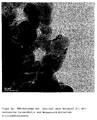
- FIG. 1a shows a TEM image
- FIG. 1b the associated X-ray diffractogram of the doped cerium oxide of the particles prepared according to Example 1.
- FIG. 2a shows a TEM image of the particles of Example 1 with the areas A (doping) and 1 (Coating). Clearly, manganese oxide (doping component, region A) and cerium oxide (coating) can be seen.
- the EDX spectrum of area A shows manganese oxide as doping component, the region 1 ( FIG. 2b above) shows ceria as a coating component.
Landscapes
- Chemical & Material Sciences (AREA)
- Organic Chemistry (AREA)
- Engineering & Computer Science (AREA)
- Composite Materials (AREA)
- Inorganic Chemistry (AREA)
- Materials Engineering (AREA)
- Nanotechnology (AREA)
- General Physics & Mathematics (AREA)
- Crystallography & Structural Chemistry (AREA)
- Physics & Mathematics (AREA)
- Condensed Matter Physics & Semiconductors (AREA)
- Combustion & Propulsion (AREA)
- Silicon Compounds (AREA)
- Oxygen, Ozone, And Oxides In General (AREA)
- Inorganic Compounds Of Heavy Metals (AREA)
- Developing Agents For Electrophotography (AREA)
- Mechanical Treatment Of Semiconductor (AREA)
- Glanulating (AREA)
- Catalysts (AREA)
- Cosmetics (AREA)
- Saccharide Compounds (AREA)
Claims (12)
- Particule d'oxyde ayant un noyau, un composant de dopage réparti dans le noyau et une enveloppe entourant le noyau, dans laquelle :le noyau, le composant de dopage et l'enveloppe présentent, respectivement, une composition chimique différente,le noyau étant un oxyde de métal ou un oxyde de métalloïde, choisi dans le groupe comprenant l'oxyde d'aluminium, l'oxyde de titane, l'oxyde de zirconium, l'oxyde de silicium, l'oxyde de fer, l'oxyde de cérium, l'oxyde d'étain, l'oxyde de zinc, l'oxyde de germanium et l'oxyde de vanadium,le composant de dopage étant un métal ou un oxyde d'un métal ou d'un métalloïde, respectivement, à un degré d'oxydation quelconque, choisi dans les groupes I, IA, IB, II, IIA, IIB, III, IIIA, IIIB, IV, IVA, IVB, VA, VB, VIA, VIB, VIIA ou VIII du système périodique,le noyau, ainsi que le composant de dopage contenu dans ce dernier, étant obtenu par un procédé pyrogène,l'enveloppe étant un métal ou un oxyde d'un métal ou d'un métalloïde, respectivement, à un degré d'oxydation quelconque, choisi parmi les groupes I, IA, IB, II, IIA, IIB, III, IIIA, IIIB, IV, IVA, IVB, VA, VB, VIA, VIB, VIIA ou VIII du système périodique.
- Particule d'oxyde selon la revendication 1, caractérisée en ce que le composant de dopage comprend les oxydes des métaux ou des métalloïdes choisis parmi les éléments K, Mg, Al, Si, Ti, V, Cr, Mn, Fe, Co, Ni, Cu, Sn, Zn, W, La, Ce et Zr.
- Particule d'oxyde selon la revendication 1 ou 2, caractérisée en ce que la proportion du composant de dopage se situe entre 1 ppm et 30 % en poids par rapport au noyau.
- Particule d'oxyde selon les revendications 1 à 3, caractérisée en ce que l'enveloppe comprend les oxydes des éléments cérium, zirconium, aluminium, silicium, titane, fer, étain, zinc, germanium et vanadium.
- Particule d'oxyde selon les revendications 1 à 4, caractérisée en ce que l'enveloppe se présente sous une forme amorphe et/ou cristalline autour du noyau dopé.
- Particule d'oxyde selon les revendications 1 à 5, caractérisée en ce que l'enveloppe englobe totalement ou partiellement le noyau dopé.
- Particule d'oxyde selon les revendications 1 à 6, caractérisée en ce que la proportion de l'enveloppe se situe entre 10 ppm et 65 % en poids par rapport au noyau dopé.
- Particule d'oxyde selon les revendications 1 à 7, caractérisée en ce que la surface spécifique BET de la particule dopée et revêtue, se situe entre 5 et 1000 m2/g.
- Particule d'oxyde selon les revendications 1 à 8, caractérisée en ce que la taille particulaire primaire moyenne de la particule revêtue et dopée, se situe entre 1 nm et 1 µm.
- Procédé de fabrication de la particule d'oxyde selon les revendications 1 à 9, caractérisé en ce que :- on réalise d'abord le dopage du noyau en injectant dans une flamme, telle qu'elle est utilisée pour la fabrication d'oxydes pyrogènes, un aérosol qui contient, comme composant de dopage, un composé de métal ou de métalloïde dissous ou mis en suspension dans une solution, en mélangeant ensuite cet aérosol jusqu'à homogénéité avant d'effectuer la réaction d'oxydation à la flamme ou d'hydrolyse à la flamme avec le mélange gazeux qui contient un précurseur du noyau, puis en laissant réagir le mélange gaz-aérosol dans une flamme et en séparant de manière connue le noyau dopé obtenu du courant gazeux.- on procède ensuite au revêtement du noyau dopé en ajoutant à une dispersion aqueuse et/ou alcoolique, qui contient 1 à 60 % en poids, par rapport à la dispersion, d'un noyau dopé fabriqué dans la première étape du procédé, une solution ou une suspension qui contient 0,001 à 75 % en poids, par rapport au noyau dopé, d'un sel de métal ou de métalloïde, on sèche le mélange réactionnel et, éventuellement, on le calcine, ou- on pulvérise le noyau dopé dans un récipient de mélange approprié, tout en mélangeant de manière intensive, éventuellement, d'abord avec un liquide aqueux, puis avec une solution ou une dispersion aqueuse d'un sel de métal ou de métalloïde, on poursuit, éventuellement, le malaxage du mélange réactionnel et on procède à un traitement thermique à une température de 100 à 900 °C sur une période de temps de 1 min à 8 heures.
- Utilisation de la particule d'oxyde selon les revendications 1 à 9, comme agent de polissage dans le polissage chimico-mécanique de substrats semiconducteurs et de couches appliquées sur ces derniers.
- Utilisation de la particule d'oxyde selon les revendications 1 à 9, comme charge, dans le but de régler la rhéologie de systèmes liquides, comme matériau de support, comme substance active sur le plan catalytique, comme matériau de départ pour la fabrication de dispersions, comme substance de base céramique, dans l'industrie électronique, dans l'industrie des cosmétiques, comme matériau absorbant, comme additif dans l'industrie de la silicone et du caoutchouc, pour la stabilisation de protections thermiques, comme matériau isolant, comme adjuvant d'écoulement, comme matériau de colmatage dans l'industrie dentaire, comme produit auxiliaire dans l'industrie pharmaceutique, dans l'industrie des peintures et des vernis, dans les applications de films de PET, dans les poudres de toner, comme agent antirouille, dans les encres, dans les séparateurs de batterie.
Priority Applications (5)
| Application Number | Priority Date | Filing Date | Title |
|---|---|---|---|
| DE50114065T DE50114065D1 (de) | 2001-03-24 | 2001-03-24 | Mit einer Hülle umgebene, dotierte Oxidpartikeln |
| EP01107334A EP1243552B1 (fr) | 2001-03-24 | 2001-03-24 | Particules d'oxydes revetus contenant un dopant |
| AT01107334T ATE399740T1 (de) | 2001-03-24 | 2001-03-24 | Mit einer hülle umgebene, dotierte oxidpartikeln |
| US10/101,942 US6855635B2 (en) | 2001-03-24 | 2002-03-21 | Coated doped oxides |
| JP2002081308A JP2002356312A (ja) | 2001-03-24 | 2002-03-22 | コア、ドーピング成分およびシェルを有する酸化物粒子、その製法およびその使用 |
Applications Claiming Priority (1)
| Application Number | Priority Date | Filing Date | Title |
|---|---|---|---|
| EP01107334A EP1243552B1 (fr) | 2001-03-24 | 2001-03-24 | Particules d'oxydes revetus contenant un dopant |
Publications (2)
| Publication Number | Publication Date |
|---|---|
| EP1243552A1 EP1243552A1 (fr) | 2002-09-25 |
| EP1243552B1 true EP1243552B1 (fr) | 2008-07-02 |
Family
ID=8176922
Family Applications (1)
| Application Number | Title | Priority Date | Filing Date |
|---|---|---|---|
| EP01107334A Expired - Lifetime EP1243552B1 (fr) | 2001-03-24 | 2001-03-24 | Particules d'oxydes revetus contenant un dopant |
Country Status (5)
| Country | Link |
|---|---|
| US (1) | US6855635B2 (fr) |
| EP (1) | EP1243552B1 (fr) |
| JP (1) | JP2002356312A (fr) |
| AT (1) | ATE399740T1 (fr) |
| DE (1) | DE50114065D1 (fr) |
Families Citing this family (60)
| Publication number | Priority date | Publication date | Assignee | Title |
|---|---|---|---|---|
| DE10123950A1 (de) * | 2001-05-17 | 2002-11-28 | Degussa | Granulate auf Basis von mittels Aerosol mit Aluminiumoxid dotiertem, pyrogen hergestelltem Siliziumdioxid, Verfahren zu ihrer Herstellung und ihre Verwendung |
| JP3965497B2 (ja) * | 2001-12-28 | 2007-08-29 | 日本アエロジル株式会社 | 低増粘性フュームドシリカおよびそのスラリー |
| EP1476397A4 (fr) * | 2002-02-19 | 2008-03-05 | Tal Materials | Particules d'oxydes metalliques mixtes produites par pyrolyse avec projection a la flamme d'une charge liquide de precurseurs d'oxyde dans des solvants oxygenes |
| US6645265B1 (en) * | 2002-07-19 | 2003-11-11 | Saint-Gobain Ceramics And Plastics, Inc. | Polishing formulations for SiO2-based substrates |
| DE10242798A1 (de) * | 2002-09-14 | 2004-04-01 | Degussa Ag | Silikonkautschuk |
| WO2004053456A2 (fr) * | 2002-12-09 | 2004-06-24 | Corning Incorporated | Procede reposant sur l'utilisation d'abrasifs colloidaux a constituants multiples pour le traitement cmp de materiaux semi-conducteurs et optiques |
| US6913634B2 (en) * | 2003-02-14 | 2005-07-05 | J. M. Huber Corporation | Abrasives for copper CMP and methods for making |
| DE102004004147A1 (de) * | 2004-01-28 | 2005-08-18 | Degussa Ag | Oberflächenmodifizierte, mit Siliziumdioxid umhüllte Metalloid/Metalloxide |
| US7335250B2 (en) * | 2004-02-06 | 2008-02-26 | Ivoclar Vivadent Ag | Dental composites based on X-ray-opaque mixed oxides prepared by flame spraying |
| CN101065325B (zh) * | 2004-10-14 | 2010-08-11 | 托库森美国股份有限公司 | 纳米尺寸二氧化钛颗粒的合成方法 |
| WO2006049831A1 (fr) * | 2004-10-14 | 2006-05-11 | Tokusen U.S.A., Inc. | Procede de production de particules d'argent de haute purete |
| DE102005001410A1 (de) * | 2005-01-12 | 2006-07-20 | Degussa Ag | Pyrogen hergestelltes Siliciumdioxidpulver und Dispersion hiervon |
| US20060165898A1 (en) * | 2005-01-21 | 2006-07-27 | Cabot Corporation | Controlling flame temperature in a flame spray reaction process |
| CA2598558C (fr) | 2005-02-14 | 2013-04-02 | Australian Nuclear Science & Technology Organisation | Nanoparticules en couches |
| EP1717285A1 (fr) * | 2005-04-26 | 2006-11-02 | Basf Aktiengesellschaft | Compositions CMP auto-stabilisées pour des couches en métal |
| US7731110B2 (en) * | 2005-06-29 | 2010-06-08 | J.M. Huber Corporation | Method for making precipitated silica compositions and products thereof |
| JP4756996B2 (ja) * | 2005-11-02 | 2011-08-24 | 三井金属鉱業株式会社 | セリウム系研摩材 |
| DE102005061897A1 (de) * | 2005-12-23 | 2007-06-28 | Degussa Gmbh | Verfahren zur Herstellung von pulverförmigen Feststoffen |
| DE102006027302A1 (de) * | 2006-06-13 | 2008-01-10 | Evonik Degussa Gmbh | Verfahren zur Herstellung von Mischoxidpulvern |
| US8883865B2 (en) | 2006-09-05 | 2014-11-11 | Cerion Technology, Inc. | Cerium-containing nanoparticles |
| US10435639B2 (en) | 2006-09-05 | 2019-10-08 | Cerion, Llc | Fuel additive containing lattice engineered cerium dioxide nanoparticles |
| WO2008030815A2 (fr) * | 2006-09-05 | 2008-03-13 | Cerion Technology, Inc. | Procédé de préparation de nanoparticules de dioxyde de cérium |
| JP2010504272A (ja) * | 2006-09-21 | 2010-02-12 | トクセン ユー.エス.エー.、インコーポレイテッド | ナノサイズ二酸化チタン粒子製造のための低温方法 |
| DE102007010212A1 (de) * | 2007-02-28 | 2008-09-04 | Evonik Degussa Gmbh | Polymere |
| US7727506B2 (en) * | 2007-03-05 | 2010-06-01 | Northwestern University | Semiconducting aerogels from cahacogenido clusters with broad applications |
| CN101451049A (zh) * | 2007-11-30 | 2009-06-10 | 安集微电子(上海)有限公司 | 一种化学机械抛光液 |
| US9018122B2 (en) * | 2009-03-12 | 2015-04-28 | The Regents Of The University Of California | Nanostructures having crystalline and amorphous phases |
| WO2010118553A1 (fr) * | 2009-04-15 | 2010-10-21 | Rhodia (China) Co., Ltd. | Composition particulaire à base de cérium et sa préparation |
| US20120077419A1 (en) * | 2009-06-05 | 2012-03-29 | Basf Se | Raspberry-type metal oxide nanostructures coated with ceo2 nanoparticles for chemical mechanical planarization (cmp) |
| CN102612493B (zh) | 2009-11-10 | 2015-03-11 | 纳幕尔杜邦公司 | 在二氧化钛的制备中用于原位形成硅和铝的氯化物的方法 |
| US8734755B2 (en) | 2010-02-22 | 2014-05-27 | E I Du Pont De Nemours And Company | Process for in-situ formation of chlorides of silicon, aluminum and titanium in the preparation of titanium dioxide |
| EP2545147B1 (fr) * | 2010-03-08 | 2017-09-27 | Cerion LLC | Nanoparticules catalytiques structurées et leur procédé de préparation |
| AU2010361149B2 (en) | 2010-09-21 | 2015-07-16 | The Chemours Company Fc,Llc | Process for in-situ formation of chlorides in the preparation of titanium dioxide |
| US20130014671A1 (en) * | 2011-07-11 | 2013-01-17 | Yu-Hong Tzeng | Antimicrobial dental material |
| JP5881394B2 (ja) * | 2011-12-06 | 2016-03-09 | 日揮触媒化成株式会社 | シリカ系複合粒子およびその製造方法 |
| US20150174734A1 (en) * | 2012-06-13 | 2015-06-25 | Konica Minolta, Inc. | Polishing Material Composition And Production Method Therefor |
| JP6102922B2 (ja) * | 2012-06-13 | 2017-03-29 | コニカミノルタ株式会社 | 研磨材粒子及びその製造方法 |
| JP5935531B2 (ja) * | 2012-06-14 | 2016-06-15 | 富士通株式会社 | 研磨剤及び研磨剤の製造方法 |
| DE102012213986A1 (de) * | 2012-08-07 | 2014-05-15 | Evonik Industries Ag | Eisen-Silicium-Oxidpartikel mit verbesserter Aufheizgeschwindigkeit |
| US10011752B2 (en) | 2012-09-05 | 2018-07-03 | Konica Minolta, Inc. | Production method for polishing-material particles |
| US20150252237A1 (en) * | 2012-09-19 | 2015-09-10 | Konica Minolta, Inc. | Method for Producing Polishing Material Particles |
| JP2016055352A (ja) * | 2013-02-05 | 2016-04-21 | コニカミノルタ株式会社 | 研磨材スラリー |
| JP2016056215A (ja) * | 2013-02-05 | 2016-04-21 | コニカミノルタ株式会社 | 研磨材の製造方法 |
| JP2016055351A (ja) * | 2013-02-05 | 2016-04-21 | コニカミノルタ株式会社 | 研磨材スラリー |
| JP6237650B2 (ja) * | 2013-02-05 | 2017-11-29 | コニカミノルタ株式会社 | コア・シェル型無機粒子 |
| DE102013215498A1 (de) * | 2013-08-07 | 2015-02-12 | Evonik Industries Ag | Eisenoxid und Siliciumdioxid enthaltende Kern-Hülle-Partikel mit verbesserter Aufheizgeschwindigkeit |
| JP2016175949A (ja) * | 2013-08-09 | 2016-10-06 | コニカミノルタ株式会社 | Cmp用研磨液 |
| JP2016175948A (ja) * | 2013-08-09 | 2016-10-06 | コニカミノルタ株式会社 | Cmp用研磨液 |
| US10143661B2 (en) | 2013-10-17 | 2018-12-04 | Cerion, Llc | Malic acid stabilized nanoceria particles |
| US10730755B2 (en) | 2015-03-31 | 2020-08-04 | Jgc Catalysts And Chemicals Ltd. | Silica-based composite fine-particle dispersion, method for producing same, and polishing slurry including silica-based composite fine-particle dispersion |
| US9969621B2 (en) | 2016-05-04 | 2018-05-15 | Saudi Arabian Oil Company | Methods for processing fumed metallic oxides |
| KR20200039769A (ko) | 2017-08-17 | 2020-04-16 | 사우디 아라비안 오일 컴퍼니 | 촉매를 생성하기 위한 표면 종의 제어된 코팅을 위한 에어로졸 처리 방법 |
| KR102000828B1 (ko) * | 2017-09-06 | 2019-07-16 | 주식회사 케이씨씨 | 코어/다중쉘 입자 및 이의 제조방법 |
| KR102479603B1 (ko) * | 2017-12-27 | 2022-12-22 | 주식회사 케이씨텍 | 표면개질된 산화 세륨 연마입자의 제조방법 및 이를 포함하는 연마 슬러리 조성물 |
| US11369950B2 (en) | 2018-02-21 | 2022-06-28 | Saudi Arabian Oil Company | Multi-functional composite catalyst materials and methods of synthesizing the catalyst materials |
| US11033892B2 (en) | 2019-01-24 | 2021-06-15 | Saudi Arabian Oil Company | Methods for reacting chemical streams with catalysts comprising silica, alumina, and tungsten |
| JP6595137B1 (ja) * | 2019-02-27 | 2019-10-23 | 株式会社アドマテックス | 金属酸化物粒子材料の製造方法 |
| KR102399810B1 (ko) * | 2019-10-28 | 2022-05-18 | 주식회사 케이씨텍 | 코어-쉘 구조의 연마입자, 그의 제조방법 및 그를 포함하는 연마 슬러리 조성물 |
| EP4065658B1 (fr) | 2019-11-26 | 2026-04-29 | Rhodia Operations | Dispersion liquide et poudre de particules de type c ur-enveloppe à base de cérium, leur procédé de production et leurs utilisations dans le polissage |
| KR20230080836A (ko) | 2021-11-30 | 2023-06-07 | 삼성전자주식회사 | 세륨 산화물 나노 입자, 그의 제조 방법 및 그를 이용한 반도체 소자의 제조 방법 |
Family Cites Families (10)
| Publication number | Priority date | Publication date | Assignee | Title |
|---|---|---|---|---|
| EP0088905B1 (fr) * | 1982-02-25 | 1987-10-07 | Pall Corporation | Installation de fractionnement pour gaz adsorbés avec commande automatique du cycle par mesure de température et procédé |
| US4832711A (en) | 1982-02-25 | 1989-05-23 | Pall Corporation | Adsorbent fractionator with automatic temperature-sensing cycle control and process |
| US6126855A (en) * | 1987-07-27 | 2000-10-03 | Elliott; Stanley B. | Reaction products of lyotropic liquid crystal salt complexes |
| US5833877A (en) * | 1987-07-27 | 1998-11-10 | Elliott; Stanley B. | Reaction products of lyotropic liquid crystal salt complexes |
| JPH0867893A (ja) * | 1994-08-19 | 1996-03-12 | Lubrizol Corp:The | 極性固体および有機半導体の電気流動性流体 |
| DE19650500A1 (de) | 1996-12-05 | 1998-06-10 | Degussa | Dotierte, pyrogen hergestellte Oxide |
| US6268014B1 (en) * | 1997-10-02 | 2001-07-31 | Chris Eberspacher | Method for forming solar cell materials from particulars |
| US6967183B2 (en) * | 1998-08-27 | 2005-11-22 | Cabot Corporation | Electrocatalyst powders, methods for producing powders and devices fabricated from same |
| DE19815698A1 (de) * | 1998-04-08 | 1999-10-14 | Karlsruhe Forschzent | Beschichtete Partikel, Verfahren zu deren Herstellung und deren Verwendung |
| DE19847161A1 (de) * | 1998-10-14 | 2000-04-20 | Degussa | Mittels Aerosol dotiertes pyrogen hergestelltes Siliciumdioxid |
-
2001
- 2001-03-24 DE DE50114065T patent/DE50114065D1/de not_active Expired - Lifetime
- 2001-03-24 AT AT01107334T patent/ATE399740T1/de not_active IP Right Cessation
- 2001-03-24 EP EP01107334A patent/EP1243552B1/fr not_active Expired - Lifetime
-
2002
- 2002-03-21 US US10/101,942 patent/US6855635B2/en not_active Expired - Fee Related
- 2002-03-22 JP JP2002081308A patent/JP2002356312A/ja not_active Withdrawn
Also Published As
| Publication number | Publication date |
|---|---|
| US6855635B2 (en) | 2005-02-15 |
| US20020177311A1 (en) | 2002-11-28 |
| EP1243552A1 (fr) | 2002-09-25 |
| JP2002356312A (ja) | 2002-12-13 |
| DE50114065D1 (de) | 2008-08-14 |
| ATE399740T1 (de) | 2008-07-15 |
Similar Documents
| Publication | Publication Date | Title |
|---|---|---|
| EP1243552B1 (fr) | Particules d'oxydes revetus contenant un dopant | |
| EP0850876B1 (fr) | Préparation pyrogénique d'oxydes dopés utilisant un aérosol | |
| EP1236773B1 (fr) | Traitement de surface d'oxydes dopés préparés par voie pyrogénique | |
| EP2069439B1 (fr) | Particule nanocomposite et son processus de préparation | |
| EP0595078B1 (fr) | Oxyde mixte à base de dioxyde de titane préparé hydrolyse à la flamme, procédé pour sa préparation et son utilisation | |
| DE3611449A1 (de) | Grundstoff zur herstellung von keramischen werkstoffen | |
| EP1370486A2 (fr) | Procede de production de poudres d'oxyde metallique multicomposants dans un reacteur pulse | |
| EP1142830A1 (fr) | Oxides pyrogeniques de l'ordre du nanometre, procédé de leur preparation et leur utilisation | |
| EP0357959B1 (fr) | Matière première frittable à base de titanate d'aluminium, son procédé de préparation et articles réfractaires préparés à partir de cette matière et leur utilisation | |
| EP1083146A1 (fr) | Silice bactéricide dopée à l'argent | |
| EP1270511B9 (fr) | Oxydes d'etain et d'indium | |
| EP1785395B1 (fr) | Procédé de préparation de particules d'oxyde métallique dopé | |
| DE19919635A1 (de) | Silicium-Aluminium-Mischoxid | |
| EP1321444B1 (fr) | Couche obtenue d'une dispersion aqueuse contenant d'une poudre d'oxyde mixte de silicium et de titane produit par hydrolyse à la flamme | |
| DE10044986A1 (de) | Nanokristallines Metalloxidpulver, Verfahren zu seiner Herstellung und Verwendung | |
| EP1216956A2 (fr) | Oxide pyrogénique dopé de potassium | |
| DE10134382B4 (de) | Mit Erbiumoxid dotierte pyrogene Oxide | |
| DE102006057903A1 (de) | Titandioxid enthaltende Dispersion | |
| EP1700927B1 (fr) | Couches d'alumine déposées par jet de plasma | |
| EP0648710B1 (fr) | Procédé de préparation de poudres fines monodispersées d'oxydes | |
| EP1097964A1 (fr) | Polyester | |
| EP1752215A1 (fr) | Photocatalyseur | |
| EP0814057A1 (fr) | Oxyde mixte oxyde borique-dioxyde de silicium | |
| DE20222020U1 (de) | Vorsinterzusammensetzung und optische Vorrichtung aus Glas mit optischer Qualität | |
| DE10163940A1 (de) | Silicium-Tantal- und Silicium-Niobium-Mischoxidpulver, deren Herstellung und Verwendung |
Legal Events
| Date | Code | Title | Description |
|---|---|---|---|
| PUAI | Public reference made under article 153(3) epc to a published international application that has entered the european phase |
Free format text: ORIGINAL CODE: 0009012 |
|
| 17P | Request for examination filed |
Effective date: 20010327 |
|
| AK | Designated contracting states |
Kind code of ref document: A1 Designated state(s): AT BE CH CY DE DK ES FI FR GB GR IE IT LI LU MC NL PT SE TR |
|
| AX | Request for extension of the european patent |
Free format text: AL;LT;LV;MK;RO;SI |
|
| AKX | Designation fees paid |
Designated state(s): AT BE CH CY DE DK ES FI FR GB GR IE IT LI LU MC NL PT SE TR |
|
| 17Q | First examination report despatched |
Effective date: 20040608 |
|
| RAP1 | Party data changed (applicant data changed or rights of an application transferred) |
Owner name: DEGUSSA GMBH |
|
| RAP1 | Party data changed (applicant data changed or rights of an application transferred) |
Owner name: EVONIK DEGUSSA GMBH |
|
| GRAP | Despatch of communication of intention to grant a patent |
Free format text: ORIGINAL CODE: EPIDOSNIGR1 |
|
| GRAS | Grant fee paid |
Free format text: ORIGINAL CODE: EPIDOSNIGR3 |
|
| GRAA | (expected) grant |
Free format text: ORIGINAL CODE: 0009210 |
|
| AK | Designated contracting states |
Kind code of ref document: B1 Designated state(s): AT BE CH CY DE DK ES FI FR GB GR IE IT LI LU MC NL PT SE TR |
|
| REG | Reference to a national code |
Ref country code: GB Ref legal event code: FG4D Free format text: NOT ENGLISH |
|
| REG | Reference to a national code |
Ref country code: CH Ref legal event code: EP |
|
| RAP2 | Party data changed (patent owner data changed or rights of a patent transferred) |
Owner name: EVONIK DEGUSSA GMBH |
|
| REF | Corresponds to: |
Ref document number: 50114065 Country of ref document: DE Date of ref document: 20080814 Kind code of ref document: P |
|
| REG | Reference to a national code |
Ref country code: IE Ref legal event code: FG4D Free format text: LANGUAGE OF EP DOCUMENT: GERMAN |
|
| NLT2 | Nl: modifications (of names), taken from the european patent patent bulletin |
Owner name: EVONIK DEGUSSA GMBH Effective date: 20080806 |
|
| PG25 | Lapsed in a contracting state [announced via postgrant information from national office to epo] |
Ref country code: NL Free format text: LAPSE BECAUSE OF FAILURE TO SUBMIT A TRANSLATION OF THE DESCRIPTION OR TO PAY THE FEE WITHIN THE PRESCRIBED TIME-LIMIT Effective date: 20080702 |
|
| NLV1 | Nl: lapsed or annulled due to failure to fulfill the requirements of art. 29p and 29m of the patents act | ||
| PG25 | Lapsed in a contracting state [announced via postgrant information from national office to epo] |
Ref country code: ES Free format text: LAPSE BECAUSE OF FAILURE TO SUBMIT A TRANSLATION OF THE DESCRIPTION OR TO PAY THE FEE WITHIN THE PRESCRIBED TIME-LIMIT Effective date: 20081013 Ref country code: PT Free format text: LAPSE BECAUSE OF FAILURE TO SUBMIT A TRANSLATION OF THE DESCRIPTION OR TO PAY THE FEE WITHIN THE PRESCRIBED TIME-LIMIT Effective date: 20081202 |
|
| REG | Reference to a national code |
Ref country code: IE Ref legal event code: FD4D |
|
| PG25 | Lapsed in a contracting state [announced via postgrant information from national office to epo] |
Ref country code: FI Free format text: LAPSE BECAUSE OF FAILURE TO SUBMIT A TRANSLATION OF THE DESCRIPTION OR TO PAY THE FEE WITHIN THE PRESCRIBED TIME-LIMIT Effective date: 20080702 |
|
| PG25 | Lapsed in a contracting state [announced via postgrant information from national office to epo] |
Ref country code: IE Free format text: LAPSE BECAUSE OF FAILURE TO SUBMIT A TRANSLATION OF THE DESCRIPTION OR TO PAY THE FEE WITHIN THE PRESCRIBED TIME-LIMIT Effective date: 20080702 Ref country code: DK Free format text: LAPSE BECAUSE OF FAILURE TO SUBMIT A TRANSLATION OF THE DESCRIPTION OR TO PAY THE FEE WITHIN THE PRESCRIBED TIME-LIMIT Effective date: 20080702 |
|
| PLBE | No opposition filed within time limit |
Free format text: ORIGINAL CODE: 0009261 |
|
| STAA | Information on the status of an ep patent application or granted ep patent |
Free format text: STATUS: NO OPPOSITION FILED WITHIN TIME LIMIT |
|
| 26N | No opposition filed |
Effective date: 20090403 |
|
| PG25 | Lapsed in a contracting state [announced via postgrant information from national office to epo] |
Ref country code: IT Free format text: LAPSE BECAUSE OF FAILURE TO SUBMIT A TRANSLATION OF THE DESCRIPTION OR TO PAY THE FEE WITHIN THE PRESCRIBED TIME-LIMIT Effective date: 20080702 |
|
| BERE | Be: lapsed |
Owner name: EVONIK DEGUSSA G.M.B.H. Effective date: 20090331 |
|
| PG25 | Lapsed in a contracting state [announced via postgrant information from national office to epo] |
Ref country code: MC Free format text: LAPSE BECAUSE OF NON-PAYMENT OF DUE FEES Effective date: 20090331 |
|
| REG | Reference to a national code |
Ref country code: CH Ref legal event code: PL |
|
| PG25 | Lapsed in a contracting state [announced via postgrant information from national office to epo] |
Ref country code: SE Free format text: LAPSE BECAUSE OF FAILURE TO SUBMIT A TRANSLATION OF THE DESCRIPTION OR TO PAY THE FEE WITHIN THE PRESCRIBED TIME-LIMIT Effective date: 20081002 Ref country code: LI Free format text: LAPSE BECAUSE OF NON-PAYMENT OF DUE FEES Effective date: 20090331 Ref country code: CH Free format text: LAPSE BECAUSE OF NON-PAYMENT OF DUE FEES Effective date: 20090331 |
|
| PG25 | Lapsed in a contracting state [announced via postgrant information from national office to epo] |
Ref country code: BE Free format text: LAPSE BECAUSE OF NON-PAYMENT OF DUE FEES Effective date: 20090331 |
|
| PG25 | Lapsed in a contracting state [announced via postgrant information from national office to epo] |
Ref country code: AT Free format text: LAPSE BECAUSE OF NON-PAYMENT OF DUE FEES Effective date: 20090324 |
|
| PG25 | Lapsed in a contracting state [announced via postgrant information from national office to epo] |
Ref country code: GR Free format text: LAPSE BECAUSE OF FAILURE TO SUBMIT A TRANSLATION OF THE DESCRIPTION OR TO PAY THE FEE WITHIN THE PRESCRIBED TIME-LIMIT Effective date: 20081003 |
|
| PG25 | Lapsed in a contracting state [announced via postgrant information from national office to epo] |
Ref country code: LU Free format text: LAPSE BECAUSE OF NON-PAYMENT OF DUE FEES Effective date: 20090324 |
|
| PG25 | Lapsed in a contracting state [announced via postgrant information from national office to epo] |
Ref country code: TR Free format text: LAPSE BECAUSE OF FAILURE TO SUBMIT A TRANSLATION OF THE DESCRIPTION OR TO PAY THE FEE WITHIN THE PRESCRIBED TIME-LIMIT Effective date: 20080702 |
|
| PG25 | Lapsed in a contracting state [announced via postgrant information from national office to epo] |
Ref country code: CY Free format text: LAPSE BECAUSE OF FAILURE TO SUBMIT A TRANSLATION OF THE DESCRIPTION OR TO PAY THE FEE WITHIN THE PRESCRIBED TIME-LIMIT Effective date: 20080702 |
|
| REG | Reference to a national code |
Ref country code: FR Ref legal event code: PLFP Year of fee payment: 16 |
|
| REG | Reference to a national code |
Ref country code: FR Ref legal event code: PLFP Year of fee payment: 17 |
|
| REG | Reference to a national code |
Ref country code: FR Ref legal event code: PLFP Year of fee payment: 18 |
|
| REG | Reference to a national code |
Ref country code: DE Ref legal event code: R081 Ref document number: 50114065 Country of ref document: DE Owner name: EVONIK OPERATIONS GMBH, DE Free format text: FORMER OWNER: EVONIK DEGUSSA GMBH, 45128 ESSEN, DE |
|
| PGFP | Annual fee paid to national office [announced via postgrant information from national office to epo] |
Ref country code: DE Payment date: 20200320 Year of fee payment: 20 Ref country code: GB Payment date: 20200323 Year of fee payment: 20 |
|
| PGFP | Annual fee paid to national office [announced via postgrant information from national office to epo] |
Ref country code: FR Payment date: 20200319 Year of fee payment: 20 |
|
| REG | Reference to a national code |
Ref country code: DE Ref legal event code: R071 Ref document number: 50114065 Country of ref document: DE |
|
| REG | Reference to a national code |
Ref country code: GB Ref legal event code: PE20 Expiry date: 20210323 |
|
| PG25 | Lapsed in a contracting state [announced via postgrant information from national office to epo] |
Ref country code: GB Free format text: LAPSE BECAUSE OF EXPIRATION OF PROTECTION Effective date: 20210323 |