EP1245280A2 - Adaptateur destiné à être utilisé avec une cartouche de test lors de l'administration de soins - Google Patents
Adaptateur destiné à être utilisé avec une cartouche de test lors de l'administration de soins Download PDFInfo
- Publication number
- EP1245280A2 EP1245280A2 EP02007456A EP02007456A EP1245280A2 EP 1245280 A2 EP1245280 A2 EP 1245280A2 EP 02007456 A EP02007456 A EP 02007456A EP 02007456 A EP02007456 A EP 02007456A EP 1245280 A2 EP1245280 A2 EP 1245280A2
- Authority
- EP
- European Patent Office
- Prior art keywords
- adaptor
- locator
- nose
- syringe
- entry port
- Prior art date
- Legal status (The legal status is an assumption and is not a legal conclusion. Google has not performed a legal analysis and makes no representation as to the accuracy of the status listed.)
- Withdrawn
Links
- 238000012123 point-of-care testing Methods 0.000 title abstract description 14
- 238000012360 testing method Methods 0.000 claims abstract description 81
- 230000013011 mating Effects 0.000 claims abstract description 7
- 238000013022 venting Methods 0.000 claims abstract description 6
- 238000003780 insertion Methods 0.000 claims abstract description 5
- 230000037431 insertion Effects 0.000 claims abstract description 5
- 230000000007 visual effect Effects 0.000 claims description 5
- 239000000463 material Substances 0.000 claims description 3
- 239000012530 fluid Substances 0.000 abstract description 64
- 239000007788 liquid Substances 0.000 abstract description 5
- 238000004891 communication Methods 0.000 description 10
- 239000008280 blood Substances 0.000 description 9
- 210000004369 blood Anatomy 0.000 description 9
- 238000002405 diagnostic procedure Methods 0.000 description 6
- 210000001124 body fluid Anatomy 0.000 description 5
- 238000012546 transfer Methods 0.000 description 4
- 238000013459 approach Methods 0.000 description 2
- 210000004204 blood vessel Anatomy 0.000 description 2
- 238000000151 deposition Methods 0.000 description 2
- 230000001681 protective effect Effects 0.000 description 2
- 241001631457 Cannula Species 0.000 description 1
- 230000004323 axial length Effects 0.000 description 1
- 230000015572 biosynthetic process Effects 0.000 description 1
- 230000008021 deposition Effects 0.000 description 1
- 230000005541 medical transmission Effects 0.000 description 1
- 238000000034 method Methods 0.000 description 1
- 238000007789 sealing Methods 0.000 description 1
- 230000000472 traumatic effect Effects 0.000 description 1
Images


Classifications
-
- G—PHYSICS
- G01—MEASURING; TESTING
- G01N—INVESTIGATING OR ANALYSING MATERIALS BY DETERMINING THEIR CHEMICAL OR PHYSICAL PROPERTIES
- G01N35/00—Automatic analysis not limited to methods or materials provided for in any single one of groups G01N1/00 - G01N33/00; Handling materials therefor
- G01N35/10—Devices for transferring samples or any liquids to, in, or from, the analysis apparatus, e.g. suction devices, injection devices
- G01N35/1079—Devices for transferring samples or any liquids to, in, or from, the analysis apparatus, e.g. suction devices, injection devices with means for piercing stoppers or septums
-
- A—HUMAN NECESSITIES
- A61—MEDICAL OR VETERINARY SCIENCE; HYGIENE
- A61B—DIAGNOSIS; SURGERY; IDENTIFICATION
- A61B5/00—Measuring for diagnostic purposes; Identification of persons
- A61B5/15—Devices for taking samples of blood
- A61B5/150007—Details
- A61B5/150015—Source of blood
- A61B5/15003—Source of blood for venous or arterial blood
-
- A—HUMAN NECESSITIES
- A61—MEDICAL OR VETERINARY SCIENCE; HYGIENE
- A61B—DIAGNOSIS; SURGERY; IDENTIFICATION
- A61B5/00—Measuring for diagnostic purposes; Identification of persons
- A61B5/15—Devices for taking samples of blood
- A61B5/150007—Details
- A61B5/150206—Construction or design features not otherwise provided for; manufacturing or production; packages; sterilisation of piercing element, piercing device or sampling device
- A61B5/150213—Venting means
-
- A—HUMAN NECESSITIES
- A61—MEDICAL OR VETERINARY SCIENCE; HYGIENE
- A61B—DIAGNOSIS; SURGERY; IDENTIFICATION
- A61B5/00—Measuring for diagnostic purposes; Identification of persons
- A61B5/15—Devices for taking samples of blood
- A61B5/150007—Details
- A61B5/150206—Construction or design features not otherwise provided for; manufacturing or production; packages; sterilisation of piercing element, piercing device or sampling device
- A61B5/150236—Pistons, i.e. cylindrical bodies that sit inside the syringe barrel, typically with an air tight seal, and slide in the barrel to create a vacuum or to expel blood
-
- A—HUMAN NECESSITIES
- A61—MEDICAL OR VETERINARY SCIENCE; HYGIENE
- A61B—DIAGNOSIS; SURGERY; IDENTIFICATION
- A61B5/00—Measuring for diagnostic purposes; Identification of persons
- A61B5/15—Devices for taking samples of blood
- A61B5/150007—Details
- A61B5/150206—Construction or design features not otherwise provided for; manufacturing or production; packages; sterilisation of piercing element, piercing device or sampling device
- A61B5/150244—Rods for actuating or driving the piston, i.e. the cylindrical body that sits inside the syringe barrel, typically with an air tight seal, and slides in the barrel to create a vacuum or to expel blood
-
- A—HUMAN NECESSITIES
- A61—MEDICAL OR VETERINARY SCIENCE; HYGIENE
- A61B—DIAGNOSIS; SURGERY; IDENTIFICATION
- A61B5/00—Measuring for diagnostic purposes; Identification of persons
- A61B5/15—Devices for taking samples of blood
- A61B5/150007—Details
- A61B5/150351—Caps, stoppers or lids for sealing or closing a blood collection vessel or container, e.g. a test-tube or syringe barrel
-
- A—HUMAN NECESSITIES
- A61—MEDICAL OR VETERINARY SCIENCE; HYGIENE
- A61B—DIAGNOSIS; SURGERY; IDENTIFICATION
- A61B5/00—Measuring for diagnostic purposes; Identification of persons
- A61B5/15—Devices for taking samples of blood
- A61B5/150007—Details
- A61B5/150374—Details of piercing elements or protective means for preventing accidental injuries by such piercing elements
- A61B5/150381—Design of piercing elements
- A61B5/150389—Hollow piercing elements, e.g. canulas, needles, for piercing the skin
-
- A—HUMAN NECESSITIES
- A61—MEDICAL OR VETERINARY SCIENCE; HYGIENE
- A61B—DIAGNOSIS; SURGERY; IDENTIFICATION
- A61B5/00—Measuring for diagnostic purposes; Identification of persons
- A61B5/15—Devices for taking samples of blood
- A61B5/150007—Details
- A61B5/150374—Details of piercing elements or protective means for preventing accidental injuries by such piercing elements
- A61B5/150381—Design of piercing elements
- A61B5/150503—Single-ended needles
-
- A—HUMAN NECESSITIES
- A61—MEDICAL OR VETERINARY SCIENCE; HYGIENE
- A61B—DIAGNOSIS; SURGERY; IDENTIFICATION
- A61B5/00—Measuring for diagnostic purposes; Identification of persons
- A61B5/15—Devices for taking samples of blood
- A61B5/150007—Details
- A61B5/150374—Details of piercing elements or protective means for preventing accidental injuries by such piercing elements
- A61B5/150534—Design of protective means for piercing elements for preventing accidental needle sticks, e.g. shields, caps, protectors, axially extensible sleeves, pivotable protective sleeves
- A61B5/150694—Procedure for removing protection means at the time of piercing
- A61B5/150717—Procedure for removing protection means at the time of piercing manually removed
-
- A—HUMAN NECESSITIES
- A61—MEDICAL OR VETERINARY SCIENCE; HYGIENE
- A61B—DIAGNOSIS; SURGERY; IDENTIFICATION
- A61B5/00—Measuring for diagnostic purposes; Identification of persons
- A61B5/15—Devices for taking samples of blood
- A61B5/150007—Details
- A61B5/150847—Communication to or from blood sampling device
- A61B5/15087—Communication to or from blood sampling device short range, e.g. between console and disposable
-
- A—HUMAN NECESSITIES
- A61—MEDICAL OR VETERINARY SCIENCE; HYGIENE
- A61B—DIAGNOSIS; SURGERY; IDENTIFICATION
- A61B5/00—Measuring for diagnostic purposes; Identification of persons
- A61B5/15—Devices for taking samples of blood
- A61B5/150992—Blood sampling from a fluid line external to a patient, such as a catheter line, combined with an infusion line; Blood sampling from indwelling needle sets, e.g. sealable ports, luer couplings or valves
-
- A—HUMAN NECESSITIES
- A61—MEDICAL OR VETERINARY SCIENCE; HYGIENE
- A61B—DIAGNOSIS; SURGERY; IDENTIFICATION
- A61B5/00—Measuring for diagnostic purposes; Identification of persons
- A61B5/15—Devices for taking samples of blood
- A61B5/153—Devices specially adapted for taking samples of venous or arterial blood, e.g. with syringes
-
- B—PERFORMING OPERATIONS; TRANSPORTING
- B01—PHYSICAL OR CHEMICAL PROCESSES OR APPARATUS IN GENERAL
- B01L—CHEMICAL OR PHYSICAL LABORATORY APPARATUS FOR GENERAL USE
- B01L3/00—Containers or dishes for laboratory use, e.g. laboratory glassware; Droppers
- B01L3/02—Burettes; Pipettes
- B01L3/0275—Interchangeable or disposable dispensing tips
-
- B—PERFORMING OPERATIONS; TRANSPORTING
- B01—PHYSICAL OR CHEMICAL PROCESSES OR APPARATUS IN GENERAL
- B01L—CHEMICAL OR PHYSICAL LABORATORY APPARATUS FOR GENERAL USE
- B01L3/00—Containers or dishes for laboratory use, e.g. laboratory glassware; Droppers
- B01L3/50—Containers for the purpose of retaining a material to be analysed, e.g. test tubes
- B01L3/502—Containers for the purpose of retaining a material to be analysed, e.g. test tubes with fluid transport, e.g. in multi-compartment structures
- B01L3/5027—Containers for the purpose of retaining a material to be analysed, e.g. test tubes with fluid transport, e.g. in multi-compartment structures by integrated microfluidic structures, i.e. dimensions of channels and chambers are such that surface tension forces are important, e.g. lab-on-a-chip
- B01L3/502715—Containers for the purpose of retaining a material to be analysed, e.g. test tubes with fluid transport, e.g. in multi-compartment structures by integrated microfluidic structures, i.e. dimensions of channels and chambers are such that surface tension forces are important, e.g. lab-on-a-chip characterised by interfacing components, e.g. fluidic, electrical, optical or mechanical interfaces
-
- B—PERFORMING OPERATIONS; TRANSPORTING
- B01—PHYSICAL OR CHEMICAL PROCESSES OR APPARATUS IN GENERAL
- B01L—CHEMICAL OR PHYSICAL LABORATORY APPARATUS FOR GENERAL USE
- B01L3/00—Containers or dishes for laboratory use, e.g. laboratory glassware; Droppers
- B01L3/50—Containers for the purpose of retaining a material to be analysed, e.g. test tubes
- B01L3/502—Containers for the purpose of retaining a material to be analysed, e.g. test tubes with fluid transport, e.g. in multi-compartment structures
- B01L3/5027—Containers for the purpose of retaining a material to be analysed, e.g. test tubes with fluid transport, e.g. in multi-compartment structures by integrated microfluidic structures, i.e. dimensions of channels and chambers are such that surface tension forces are important, e.g. lab-on-a-chip
- B01L3/502723—Containers for the purpose of retaining a material to be analysed, e.g. test tubes with fluid transport, e.g. in multi-compartment structures by integrated microfluidic structures, i.e. dimensions of channels and chambers are such that surface tension forces are important, e.g. lab-on-a-chip characterised by venting arrangements
-
- B—PERFORMING OPERATIONS; TRANSPORTING
- B01—PHYSICAL OR CHEMICAL PROCESSES OR APPARATUS IN GENERAL
- B01L—CHEMICAL OR PHYSICAL LABORATORY APPARATUS FOR GENERAL USE
- B01L2200/00—Solutions for specific problems relating to chemical or physical laboratory apparatus
- B01L2200/02—Adapting objects or devices to another
- B01L2200/026—Fluid interfacing between devices or objects, e.g. connectors, inlet details
- B01L2200/027—Fluid interfacing between devices or objects, e.g. connectors, inlet details for microfluidic devices
-
- B—PERFORMING OPERATIONS; TRANSPORTING
- B01—PHYSICAL OR CHEMICAL PROCESSES OR APPARATUS IN GENERAL
- B01L—CHEMICAL OR PHYSICAL LABORATORY APPARATUS FOR GENERAL USE
- B01L2400/00—Moving or stopping fluids
- B01L2400/04—Moving fluids with specific forces or mechanical means
- B01L2400/0403—Moving fluids with specific forces or mechanical means specific forces
- B01L2400/0406—Moving fluids with specific forces or mechanical means specific forces capillary forces
-
- B—PERFORMING OPERATIONS; TRANSPORTING
- B01—PHYSICAL OR CHEMICAL PROCESSES OR APPARATUS IN GENERAL
- B01L—CHEMICAL OR PHYSICAL LABORATORY APPARATUS FOR GENERAL USE
- B01L2400/00—Moving or stopping fluids
- B01L2400/04—Moving fluids with specific forces or mechanical means
- B01L2400/0475—Moving fluids with specific forces or mechanical means specific mechanical means and fluid pressure
- B01L2400/0478—Moving fluids with specific forces or mechanical means specific mechanical means and fluid pressure pistons
-
- B—PERFORMING OPERATIONS; TRANSPORTING
- B01—PHYSICAL OR CHEMICAL PROCESSES OR APPARATUS IN GENERAL
- B01L—CHEMICAL OR PHYSICAL LABORATORY APPARATUS FOR GENERAL USE
- B01L3/00—Containers or dishes for laboratory use, e.g. laboratory glassware; Droppers
- B01L3/02—Burettes; Pipettes
- B01L3/021—Pipettes, i.e. with only one conduit for withdrawing and redistributing liquids
- B01L3/0217—Pipettes, i.e. with only one conduit for withdrawing and redistributing liquids of the plunger pump type
Definitions
- the subject invention relates to an adaptor mounted to a syringe to facilitate alignment of the syringe with the entry port to a point-of-care testing cartridge and to facilitate transfer of a fluid specimen from a syringe.
- Fluid often is collected from a patient by employing a needle holder assembly and one or more evacuated tubes. Fluid also can be collected in a syringe.
- a syringe may be used with a metallic needle to obtain a fluid sample from a patient.
- syringes often are connected directly to an established arterial or venous line to obtain a fluid sample.
- the fluid collected in the syringe then may be transferred to a tube.
- the tubes are labeled carefully and shipped to a laboratory for analysis. The results of the laboratory analysis then are reported back to the health care provider. The results, of course, could be rushed in emergency situations, but absent an emergency would require more then one day between the time the sample is drawn from the patient to the time that the laboratory analysis is reported to the health care provider.
- the point-of-care diagnostic equipment includes a syringe for receiving a sample of fluid from a patient, a small disposable testing cartridge for receiving a portion of the fluid from the syringe and a portable clinical analyzer for analyzing the fluid and outputting the results.
- Combinations of testing cartridges and portable clinical analyzers are marketed in the United States by i-STAT Corporation, AVL Scientific Corporation and Diametrics Medical, Inc. The systems produced by these and other companies share certain common features.
- the testing cartridge of each system typically has a small rectangular housing about 1" x 2" and about .25" thick.
- the housing includes an internal reservoir with a volume of between about 40 ⁇ l and 125 ⁇ l.
- An inlet port extends through an external wall of the testing cartridge and communicates with the internal reservoir.
- the cartridge further includes contact pads and sensors that can be placed in communication with the portable clinical analyzer.
- An example of an i-STAT point-of-care testing cartridge is shown in U.S. Patent No. 5,638,828.
- the prior art point-of-care testing systems are employed with a syringe that is used to draw a sample of fluid from a patient.
- the syringe then may be used to eject a portion of the fluid sample into the inlet port of the point-of-care testing cartridge.
- some testing cartridges are operative to automatically draw fluid from the syringe.
- the inlet port of the cartridge then is closed and the cartridge is placed in communication with the portable clinical analyzer for performing certain specified diagnostic tests on the sample of fluid in the cartridge.
- the analyzer then provides a very quick output of the test results without the need for sending the fluid sample to the laboratory.
- Point-of-care testing systems provide several efficiencies over systems that require virtually all diagnostic tests to be performed at a location remote from the point-of-care.
- the small size of the testing cartridge facilitates storage and shipment of the cartridges while also contributing to the portability of the system.
- the small cartridges can be very difficult to use. For example, alignment of the distal end of the syringe with the inlet port of the testing cartridge can be complicated and difficult. A misalignment or imprecise mating of the syringe with the inlet port of the testing cartridge can lead to a loss of a portion of the collected fluid sample. Additionally, it is difficult to use a syringe for accurately dispensing the proper volume of liquid.
- Too small a volume may prevent proper testing by the cartridge and the associated portable clinical analyzer. Too large a volume can cause splattering or spillage. Similarly an overfill can result in splatter when the cover of the point-of-care testing cartridge is closed. Fluid that is not delivered efficiently from the syringe into the inlet port of the testing cartridge create the potential for disease transmission. Similarly, a loss of fluid during the transfer from the syringe to the testing cartridge can leave an insufficient volume of fluid for performing the required diagnostic tests. An insufficient volume of fluid to perform the required tests can require the health care worker to return to the patient for a second sample of fluid. This is time consuming for the health care worker and traumatic for the patient. Additionally, some testing cartridges may require an insufficiently filled cartridge to be discarded and a new cartridge to be employed with the new sample of fluid. Thus, inefficiencies in the transfer of fluid from the syringe to the testing cartridge can generate excess costs for additional testing cartridges.
- the direct transfer of fluid from a syringe to a testing cartridge can cause the syringe tip to close off the entry port and prevent venting of air from the testing cartridge. Thus bubbles are created. Bubbles reduce the volume of fluid and can affect test results
- the subject invention is directed to a locator adaptor for use with a point-of-care testing cartridge and with a syringe assembly.
- the point-of-care testing cartridge may be a prior art testing cartridge as described above, or any yet-to-be developed testing cartridge for performing point-of-care diagnostic analysis on a collected specimen of blood or other bodily fluid.
- the testing cartridge comprises a housing having an internal reservoir for receiving a specimen to be tested.
- the housing may be substantially rectangular, with opposed top and bottom walls and a plurality of side walls.
- An entry port extends through the top wall and that communicates with the internal reservoir of the testing cartridge.
- the testing cartridge may further include contact pads and sensors that can be placed in communication with a portable clinical analyzer for performing point-of-care analysis of the collected specimen.
- the syringe assembly that is used with the snap on adaptor may be a conventional prior art syringe assembly.
- the syringe assembly includes a body with opposed proximal and distal ends.
- a barrel extends distally from the proximal end of the body and defines a fluid receiving chamber that is widely open at the proximal end.
- a Luer tip projects from the barrel to the distal end of the syringe body and includes a passage that communicates with the fluid receiving chamber.
- the Luer tip includes a conically tapered outer surface that is dimensioned and configured for mating with the tapered proximal entry to the hub of a needle assembly or with the base of a blunt plastic cannula.
- the distal end of the syringe body may further have an internally threaded Luer collar that projects from the distal end of the barrel and concentrically around the Luer tip.
- the threads of the Luer collar can be threadedly engaged with projections at the proximal end of the hub of a needle assembly or with comparable projections at the proximal end of a blunt plastic cannula. Luer tips, Luer collars and mating structures on needles or cannulas are known in the art.
- the syringe assembly further includes a plunger that is slidably received in the open proximal end of the fluid receiving chamber defined by the syringe barrel. Distal movement of the plunger in the fluid receiving chamber will expel a fluid from the chamber and through the Luer tip. Proximal movement of the plunger in the chamber will draw fluid through the Luer tip and into the chamber.
- the syringe assembly with which the walled adaptor is used may further include a needle assembly, a plastic Luer fitting or a blunt plastic cannula for accessing blood or other bodily fluid to be tested.
- a conventional prior art needle assembly includes an elongate metallic needle cannula having a proximal end, a pointed distal end and a lumen extending between the ends.
- the prior art needle assembly further includes the plastic hub having opposed proximal and distal ends. The distal end of the hub is securely mounted to the proximal end of the needle cannula. The proximal end of the hub is configured for fluid-tight engagement with the Luer tip.
- the proximal end of the hub may include lugs for threaded engagement with the internal threads on a Luer collar that may be present on the syringe.
- a plastic Luer fitting or blunt plastic cannula typically is unitarily molded from a plastic material and has opposite proximal and distal ends and a lumen extending between the ends.
- the proximal end of the plastic Luer fitting blunt plastic cannula may have the same shape as the proximal end of the hub for the above-described needle assembly.
- the distal end of the blunt plastic cannula may be tapered sufficiently to pierce a septum across a fitting on an IV access system or blood collection set.
- the locator adaptor of the subject invention may be unitarily molded from a plastic material. More particularly, the locator adaptor is substantially tubular with opposed proximal and distal ends and a passage extending therebetween. Portions of the passage adjacent the proximal end of the locator adaptor are substantially conically generated and are dimensioned for fluid-tight engagement over the Luer tip of a conventional prior art syringe. Exterior portions of the locator adaptor adjacent the proximal end may be provided with a pair of diametrically opposite lugs for threaded engagement with threads of a Luer collar on a prior art syringe.
- the distal end of the locator adaptor includes a small diameter nose through which the passage of the locator adaptor extends. Portions of the passage in the nose of the locator adaptor are much smaller than cross-sectional dimensions of the passage adjacent the proximal end of the adaptor. More particularly, the cross-sectional dimensions of the passage through the nose of the adaptor are sufficiently small to control the volume of transferred fluid precisely and to produce droplets of a specimen flowing through the adaptor that are sufficiently small to prevent overfill or spillage of the specimen adjacent the entry port to the testing cartridge.
- the external cross-sectional dimensions of the nose of the adaptor also are much smaller than the external cross-sectional dimensions adjacent the proximal end of the locator adaptor.
- the exterior of the nose of the locator adaptor is dimensioned cross-sectionally for easy insertion into the entry port of the testing cartridge.
- the length of the nose is sufficiently long to facilitate visual alignment of the nose with the entry port.
- the nose is not so long as to contact interior surfaces of the testing cartridge directly opposite the entry port in a way that would impede fluid flow through the nose.
- the locator adaptor further includes a plurality of radially aligned fins extending outwardly substantially adjacent the nose of the locator adaptor.
- the fins may be stepped to define smaller dimensions closer to the nose and larger dimensions at locations spaced from the nose.
- the stepped configuration facilitates visual alignment of the locator adaptor with the entry port of the testing cartridge.
- the fins also provide channels between adjacent fins to facilitate venting of air adjacent the entry port to the testing cartridge.
- the ability to vent air contributes to a smooth flow of blood or other liquid specimen from the syringe to the reservoir of the testing cartridge.
- efficient venting minimizes the formation of bubbles in the fluid specimen. As noted above, bubbles reduce the volume of liquid in the testing cartridge and can affect test results.
- the ability of the locator adaptor to provide small droplets and to vent air adjacent the entry port substantially reduces the probability of overfill or spillage that might otherwise be achieved with a large diameter cylindrical or conical structure for feeding a liquid specimen into the testing cartridge, such as the conventional Luer tip of a prior art syringe.
- the adaptor can be used by first drawing a specimen of blood or other bodily fluid with a syringe assembly substantially in a conventional manner.
- a syringe assembly substantially in a conventional manner.
- the Luer tip of the syringe body or the blunt plastic cannula mounted to the Luer tip may be placed in communication with the fitting of an IV access system or fluid collection set.
- a conventional needle assembly may be mounted to the Luer tip of the syringe body and the distal tip of the needle cannula can be inserted into a blood vessel of the patient or other source of bodily fluid to obtain the required specimen.
- fluid is drawn through the passage of the Luer tip and into the fluid receiving chamber of the syringe body by pulling the plunger of the syringe assembly in a proximal direction.
- Most point-of-care testing cartridges require between 40 ⁇ l and 125 ⁇ l to complete a test.
- the plunger of the syringe assembly is moved proximally to obtain a volume of fluid slightly in excess of the amount required by the particular testing cartridge that will be employed.
- the distal end of the syringe then is placed in communication with the proximal end of the locator adaptor.
- This may involve mere slidable insertion of a Luer tip into the conically tapered portions of the passage at the proximal end of the locator adaptor to achieve a fluid-tight frictional engagement.
- lugs at the proximal end of the locator adaptor can be threaded into engagement with a conventional Luer collar to achieve both a fluid-tight communication and a secure mechanical engagement.
- a protective cap that may be mounted over the distal end of the locator adaptor then may be removed.
- the point-of-care testing cartridge then is removed from the manufacturer's package.
- Many manufacturers of testing cartridges provide a cover for the inlet port that is hinged into a covering disposition over the inlet port both prior to and after deposition of blood sample into the testing cartridge.
- a cover if present on the testing cartridge, must be rotated away from the inlet port of the testing cartridge.
- the nose at the distal end of the locator adaptor then is guided into the entry port of the testing cartridge. This guiding of the nose is facilitated by the relatively small external diameter of the nose and by the stepped configuration of the fins disposed proximally of the nose.
- the nose is inserted into the entry port of the testing cartridge until distal ends of the fins engage portions of the top wall of the testing cartridge adjacent the entry port.
- the channels between the fins define vents that extend from the interior of the reservoir and entry port to the ambient surroundings. Additionally, the distal ends of the fins perform a depth control function to prevent over insertion of the nose into the entry port.
- the plunger of the syringe assembly then is moved distally to urge a selected volume of the specimen from the fluid receiving chamber of the syringe body, through the adaptor and into the testing cartridge.
- the syringe assembly and the locator adaptor then are removed from the testing cartridge and are discarded in a conventional safe manner.
- the cap of the testing cartridge then is sealingly engaged over the entry port of the testing cartridge, and the testing cartridge is presented to a portable clinical analyzer substantially in the conventional manner. Alternatively the testing cartridge can be mounted to the portable clinical analyzer before depositing the specimen in the testing cartridge.
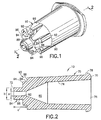
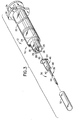
- a locator adaptor in accordance with the subject invention is identified generally by the numeral 10 in FIGS. 1-4.
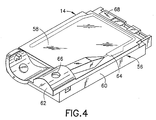
- Adaptor 10 is used with a syringe assembly 12, as shown most clearly in FIG. 3, and with a point-of-care testing cartridge 14, as shown most clearly in FIG. 4.
- Syringe assembly 12 as shown in FIG. 3, includes a syringe body 16 having a proximal end 18 and a distal end 20.
- a barrel 22 extends distally from proximal end 18 and defines a cylindrical fluid receiving chamber 24 that is widely open at proximal end 18.
- a frustoconically tapered tip 26 extends from barrel 22 to distal end 20 of syringe body 16. Tip 26 is provided with a narrow cylindrical passage 28 that communicates with fluid receiving chamber 24 of barrel 22.
- An optional Luer collar 30 projects distally from barrel 22 and concentrically surrounds tip 26. Luer collar 30 is provided with an internal array of threads 32.
- Syringe assembly 12 further includes a plunger 34 slidably disposed in fluid receiving chamber 24 and in fluid-tight engagement with the cylindrical walls of chamber 22. Plunger 34 can be moved alternately in proximal or distal directions for urging fluid through passage 28 in tip 26 and into or out of fluid receiving chamber 24.
- Syringe assembly 12 optionally includes a needle assembly 36.
- Needle assembly 36 includes a metallic needle cannula 38 having a proximal end 40, a sharply pointed distal end 42 and a lumen 44 extending between the ends.
- Needle assembly 36 further includes a hub 46 that has a proximal end 48, a distal end 50 and a passage extending therebetween.
- Distal end 50 of hub 46 is securely mounted to proximal end 40 of needle cannula 38 such that the passage through hub 46 communicates with lumen 44 through needle cannula 38.
- the passage of hub 46 defines a taper that substantially matches tapered distal tip 26 on syringe body 16.
- tapered tip 26 of syringe body 16 can be placed in fluid-tight frictional engagement with the passage in proximal end 48 of hub 46.
- Proximal end 48 of hub 46 is further characterized by a pair of diametrically opposite lugs 54 that are dimensioned and configured for engagement with threads 32 of Luer collar 30.
- lumen 44 through needle cannula 38 can be placed in communication with passage 28 in tip 26 and with fluid receiving chamber 24 of syringe body 16.
- Needle assembly 36 further includes a protective cap 55 removably engaged over needle cannula 38.
- Point-of-care testing cartridge 14 is shown in FIG. 4 and may be of any of several prior art designs, including those manufactured by i-STAT Corporation, Diametrics Medical, Inc., AVL Scientific Corporation or any other such testing cartridges that are available or become available.
- One such testing cartridge is disclosed in U.S. Patent No. 5,638,828, the disclosure of which is incorporated herein by reference.
- Testing cartridge 14 includes a generally rectangular body 56 with a top wall 58 that has a length of approximately 1.5-2.0 inches and a width of about 1.0 inches. Body 56 further has side walls 60 and end walls 62 that define a thickness for body 56 of about 0.25 inches. A fluid reservoir 64 is formed inside body 56 of cartridge 14 and has a volume in the range of 65 ⁇ l and 110 ⁇ l. Body 56 further includes an entry port 66 that extends through top wall 64 and communicates with reservoir 64. Entry port 66 is slightly tapered from a relatively large diameter portion externally on housing 56 to a relatively smaller cross-section closer to reservoir 58.
- Testing cartridge 14 further includes contact pads and sensors 68 that can be placed in communication with a portable clinical analyzer for performing various point-of-care diagnostic tests on the sample of blood in the reservoir 64 and for providing various readout data that can be used by a health care technician at the point-of-care and/or at a remote location.
- Adaptor 10 includes a proximal end 70, a distal end 72 and a passage 74 extending between ends 70 and 72. Portions of adaptor 10 adjacent proximal end 70 define a Luer fitting 75 for mating with distal end of syringe assembly 12 as explained herein. More particularly, a portion of passage 74 in Luer fitting 75 and adjacent proximal end 70 is widely open and defines a Luer receptacle 76 with a slight conical taper configured for fluid tight engagement over Luer tip 26 of syringe assembly 12.
- external portions of Luer fitting 75 of adaptor 10 adjacent proximal end 70 include a pair of diametrically opposite lugs 78 that are configured for mating with internal threads 32 of Luer collar 30 on syringe assembly 12.
- lugs 78 are not required if adaptor 10 is dedicated for use with a syringe that has no Luer collar.
- Passage 74 includes a sharply tapered section 80 distally of Luer receptacle 76.
- Passage 74 further includes a small diameter cylindrical outlet passage 82 that extends from the distal end of sharply tapered section 80 of passage 74 to distal end 72 of adaptor 10.
- Outlet passage 82 defines an inside diameter a that is sufficiently small to produce small droplets of the fluid specimen that will be delivered from syringe assembly 12. The small droplets improve the ease of fill of testing cartridge 14 and substantially avoid spillage or overfill that often occurs in efforts to deliver large drops of fluid into the small entry port 66 of testing cartridge 14.
- inside diameter a of outlet passage 82 is approximately equal to 0.03-0.04 inches.
- Adaptor 10 further includes a nose 84 adjacent distal end 72.
- Nose 84 includes a cylindrical outer surface 86 that is substantially concentric with outlet passage 82. Cylindrical outer surface 86 defines an outside diameter b that is smaller than the inside diameter defined by entry port 66 of testing cartridge 14. In a preferred embodiment, outside diameter b is approximately equal to 0.065-0.075 inches.
- Nose 84 further defines an axial length c which is approximately equal to outside diameter b in the illustrated embodiment. The length c of nose 84 is sufficiently long to facilitate visual guiding of nose 84 into entry port 66 of testing cartridge 14. However, nose 84 is sufficiently short to ensure that outlet passage 82 is not blocked by surfaces of testing cartridge 14 in proximity to entry port 66.
- locator adaptor 10 Exterior regions of locator adaptor 10 include a small annular shoulder 98 extending radially outwardly from cylindrical outer surface 96 of nose 84. Annular shoulder 98 defines an outside diameter less than the inside diameter of entry port 66 of testing cartridge 14.
- Adaptor 10 further includes a conically generated surface 90 that extends outwardly from shoulder 88 to Luer fitting 75 at proximal end 70 of adaptor 10.
- Conical surface 90 is interrupted by a plurality of radially aligned fins 92 that project radially outwardly from conical surface 90 and that extend from shoulder 88 to Luer fitting 75.
- Each fin 92 is of stepped configuration and includes a distal face 94 aligned in substantially coplanar relationship with annular shoulder 88.
- Each fin 92 then further includes an outer circumferential face 96 extending proximally from distal face 94. Outer faces 96 of fins 92 are arranged to define portions of a cylindrical surface.
- Each fin 92 further includes an offset face 98 which is spaced proximally from distal face 94.
- portions of locator adaptor 10 disposed distally of Luer fitting 75 define a conical or stepped taper that facilitates visual alignment of nose 84 with entry port 66 of testing cartridge 14.
- Conically generated surface regions 90 between fins 92 function as channels to facilitate venting when portions of a blood specimen are urged into entry port 66 of testing cartridge 14.
- Syringe assembly 12 is used in a conventional manner to draw a sample of fluid from a patient. More particularly, needle assembly 36 can be mounted to Luer tip 26 of syringe body 16, and needle cannula 38 of needle assembly 36 can be inserted into a blood vessel of a patient or other source of bodily fluid for drawing a sample of blood or other such fluid. Alternatively, a blunt plastic cannula or other plastic Luer fitting can be mounted to Luer tip 26, and the distal end of the blunt plastic cannula or other fitting can be urged through the septum that seals a fitting of a fluid collection set. Still further, syringe assembly 12 can be connected directly to an arterial or venous line that had already been placed in communication with a patient.
- plunger 34 is moved proximally after accessing the supply of fluid. Proximal movement of plunger 34 draws fluid into fluid receiving chamber 24 of syringe barrel 22. The volume of fluid drawn into fluid receiving chamber 24 is in excess of the volume of fluid required for testing cartridge 14, which typically is in the range of 40 ⁇ l - 125 ⁇ l. Needle assembly 36 or the blunt plastic cannula, if used, then is removed from syringe body 16 substantially in a conventional manner and is disposed of in a sharps receptacle.
- Luer tip 26 of syringe assembly 12 then is placed in communication with Luer receptacle 76 of passage 74 at proximal end of locator adaptor 10. This may involve threadedly engaging projection 78 at proximal end 70 of adaptor 10 with internal threads 32 of Luer collar 30 if such a Luer collar is provided on the syringe.
- Nose 84 of adaptor 10 then is guided into entry port 66 of testing cartridge 14.
- the stepped and tapered configuration of portions of adaptor 10 distally of Luer fitting 75 facilitate location and alignment of nose 84 with entry port 66.
- Shoulder 88 of adaptor 10 defines an outside diameter that is less than the inside diameter of entry port 66. Accordingly, shoulder 88 does not create an air lock within testing cartridge 14. Rather, sections of adaptor 10 between fins 92 define vent channels that facilitate and enable escape of air from testing cartridge 14.
- testing cartridge 14 proceeds merely by urging plunger 34 distally in syringe body 16. Movement of plunger 34 causes fluid in fluid receiving chamber 24 to be urged through Luer tip 26 of syringe body 16, through passage 96 of adaptor 10 and into reservoir 64 of testing cartridge 14. The relatively small inside diameter a of outlet passage 82 of adaptor 10 produce very small droplets of the fluid that can be deposited easily into entry port 66 of testing cartridge 14. After a sufficient volume of fluid has been deposited into testing cartridge 14, syringe assembly 12 and adaptor 10 can be separated from testing cartridge 14 and disposed of in an appropriate and safe manner. The cover of testing cartridge 14 then can be rotated into sealing engagement over entry port 66, and testing cartridge 14 then can be presented to a portable clinical analyzer.
Landscapes
- Health & Medical Sciences (AREA)
- Life Sciences & Earth Sciences (AREA)
- General Health & Medical Sciences (AREA)
- Engineering & Computer Science (AREA)
- Hematology (AREA)
- Pathology (AREA)
- Physics & Mathematics (AREA)
- Veterinary Medicine (AREA)
- Biomedical Technology (AREA)
- Heart & Thoracic Surgery (AREA)
- Medical Informatics (AREA)
- Molecular Biology (AREA)
- Surgery (AREA)
- Animal Behavior & Ethology (AREA)
- Public Health (AREA)
- Biophysics (AREA)
- Chemical & Material Sciences (AREA)
- Analytical Chemistry (AREA)
- Manufacturing & Machinery (AREA)
- Clinical Laboratory Science (AREA)
- Chemical Kinetics & Catalysis (AREA)
- Dispersion Chemistry (AREA)
- Biochemistry (AREA)
- General Physics & Mathematics (AREA)
- Immunology (AREA)
- Measurement Of The Respiration, Hearing Ability, Form, And Blood Characteristics Of Living Organisms (AREA)
- Investigating Or Analysing Biological Materials (AREA)
- Sampling And Sample Adjustment (AREA)
Applications Claiming Priority (2)
| Application Number | Priority Date | Filing Date | Title |
|---|---|---|---|
| US28043201P | 2001-03-30 | 2001-03-30 | |
| US280432P | 2001-03-30 |
Publications (1)
| Publication Number | Publication Date |
|---|---|
| EP1245280A2 true EP1245280A2 (fr) | 2002-10-02 |
Family
ID=23073059
Family Applications (1)
| Application Number | Title | Priority Date | Filing Date |
|---|---|---|---|
| EP02007456A Withdrawn EP1245280A2 (fr) | 2001-03-30 | 2002-03-30 | Adaptateur destiné à être utilisé avec une cartouche de test lors de l'administration de soins |
Country Status (6)
| Country | Link |
|---|---|
| US (1) | US20020143293A1 (fr) |
| EP (1) | EP1245280A2 (fr) |
| JP (1) | JP2002345792A (fr) |
| CN (1) | CN1382967A (fr) |
| AU (1) | AU2935902A (fr) |
| CA (1) | CA2379542A1 (fr) |
Families Citing this family (13)
| Publication number | Priority date | Publication date | Assignee | Title |
|---|---|---|---|---|
| US6485460B2 (en) * | 2001-01-12 | 2002-11-26 | Bracco Diagnostics, Inc. | Tamper evident syringe barrel |
| JP3648487B2 (ja) | 2002-03-01 | 2005-05-18 | アロカ株式会社 | 分注装置用ノズルチップ |
| EP1881870A1 (fr) * | 2005-05-17 | 2008-01-30 | LIEPOLD, Gerhard | Aiguille |
| DE202006020469U1 (de) * | 2006-03-06 | 2008-10-16 | Directif Gmbh | Vorrichtung zum Nachweis biochemischer Zielmoleküle |
| US20110301500A1 (en) * | 2008-10-29 | 2011-12-08 | Tim Maguire | Automated vessel puncture device using three-dimensional(3d) near infrared (nir) imaging and a robotically driven needle |
| US20120024416A1 (en) * | 2010-07-29 | 2012-02-02 | Helena Laboratories Corporation | System and method for dispensing fluid from a container and into a fluid receptacle |
| KR20120063294A (ko) * | 2010-12-07 | 2012-06-15 | 주식회사 탑 엔지니어링 | 노즐 팁 |
| US9554736B2 (en) * | 2011-11-29 | 2017-01-31 | Teleflex Medical Incorporated | Device with integrated allergy testing |
| CN107803227B (zh) | 2012-09-18 | 2019-11-19 | 珠海圣美生物诊断技术有限公司 | 流体储存器 |
| US11065093B2 (en) | 2015-01-23 | 2021-07-20 | Spinal Singularity, Inc. | Catheter mating devices |
| WO2018065106A2 (fr) * | 2016-10-07 | 2018-04-12 | Boehringer Ingelheim Vetmedica Gmbh | Cartouche permettant de tester un échantillon |
| US12569650B2 (en) | 2019-06-10 | 2026-03-10 | Uroflow Technology, Llc | Urinary catheter with retention features |
| EP4091713A1 (fr) * | 2021-05-18 | 2022-11-23 | Bacteromic Sp.z.o.o. | Couvercle avec chambre à piston et cartouche d'analyse avec la même |
-
2002
- 2002-03-27 US US10/108,711 patent/US20020143293A1/en not_active Abandoned
- 2002-03-28 CA CA002379542A patent/CA2379542A1/fr not_active Abandoned
- 2002-03-28 CN CN02121865A patent/CN1382967A/zh active Pending
- 2002-03-30 EP EP02007456A patent/EP1245280A2/fr not_active Withdrawn
- 2002-04-01 JP JP2002099038A patent/JP2002345792A/ja active Pending
- 2002-04-02 AU AU29359/02A patent/AU2935902A/en not_active Abandoned
Also Published As
| Publication number | Publication date |
|---|---|
| JP2002345792A (ja) | 2002-12-03 |
| CN1382967A (zh) | 2002-12-04 |
| CA2379542A1 (fr) | 2002-09-30 |
| AU2935902A (en) | 2002-10-03 |
| US20020143293A1 (en) | 2002-10-03 |
Similar Documents
| Publication | Publication Date | Title |
|---|---|---|
| US20020143297A1 (en) | Adaptor for use with point-of-care testing cartridge | |
| US6902534B2 (en) | Method and kit of components for delivering blood to a portable clinical analyzer | |
| US5611782A (en) | Method of delivering a blood sample to an evacuated receptacle | |
| EP0820783B1 (fr) | Dispositif pour placer un cathéter avec aiguille protégée, moyens de prélèvement | |
| US5078970A (en) | Apparatus for withdrawing a liquid sample from a sample vessel and transferring it | |
| EP1245280A2 (fr) | Adaptateur destiné à être utilisé avec une cartouche de test lors de l'administration de soins | |
| CN103957795B (zh) | 用于动脉血液气体样本收集的、具有可移除柱塞的注射器 | |
| EP1245943A2 (fr) | Canule émoussée, ensemble de filtrage et procédé d'utilisation avec cartouche s'utilisant sur le lieu des soins | |
| US20040176704A1 (en) | Collection device adapted to accept cartridge for point of care system | |
| US9636090B2 (en) | Multifunction aspiration biopsy device and methods of use | |
| CN111683598B (zh) | 生物流体采集和稳定系统 | |
| US6890310B2 (en) | Adaptor for use with point-of-care testing cartridge | |
| EP1245282A2 (fr) | Adaptateur à parois pour kit d'analyse in-situ | |
| US6866640B2 (en) | Adaptor for use with point-of-care testing cartridge |
Legal Events
| Date | Code | Title | Description |
|---|---|---|---|
| PUAI | Public reference made under article 153(3) epc to a published international application that has entered the european phase |
Free format text: ORIGINAL CODE: 0009012 |
|
| AK | Designated contracting states |
Kind code of ref document: A2 Designated state(s): AT BE CH CY DE DK ES FI FR GB GR IE IT LI LU MC NL PT SE TR |
|
| AX | Request for extension of the european patent |
Free format text: AL;LT;LV;MK;RO;SI |
|
| STAA | Information on the status of an ep patent application or granted ep patent |
Free format text: STATUS: THE APPLICATION HAS BEEN WITHDRAWN |
|
| 18W | Application withdrawn |
Effective date: 20050607 |