EP1245551B1 - 1,2-bis(methyl(1,1,3,3-tetramethylbutyl)-phosphino)ethane, son procede de preparation, complexes de metaux de transition le contenant en tant que ligand et leurs utilisations - Google Patents
1,2-bis(methyl(1,1,3,3-tetramethylbutyl)-phosphino)ethane, son procede de preparation, complexes de metaux de transition le contenant en tant que ligand et leurs utilisations Download PDFInfo
- Publication number
- EP1245551B1 EP1245551B1 EP99959925A EP99959925A EP1245551B1 EP 1245551 B1 EP1245551 B1 EP 1245551B1 EP 99959925 A EP99959925 A EP 99959925A EP 99959925 A EP99959925 A EP 99959925A EP 1245551 B1 EP1245551 B1 EP 1245551B1
- Authority
- EP
- European Patent Office
- Prior art keywords
- methyl
- tetramethylbutyl
- bis
- ethane
- general formula
- Prior art date
- Legal status (The legal status is an assumption and is not a legal conclusion. Google has not performed a legal analysis and makes no representation as to the accuracy of the status listed.)
- Expired - Lifetime
Links
Classifications
-
- C—CHEMISTRY; METALLURGY
- C07—ORGANIC CHEMISTRY
- C07F—ACYCLIC, CARBOCYCLIC OR HETEROCYCLIC COMPOUNDS CONTAINING ELEMENTS OTHER THAN CARBON, HYDROGEN, HALOGEN, OXYGEN, NITROGEN, SULFUR, SELENIUM OR TELLURIUM
- C07F9/00—Compounds containing elements of Groups 5 or 15 of the Periodic Table
- C07F9/02—Phosphorus compounds
- C07F9/28—Phosphorus compounds with one or more P—C bonds
- C07F9/50—Organo-phosphines
- C07F9/5027—Polyphosphines
-
- B—PERFORMING OPERATIONS; TRANSPORTING
- B01—PHYSICAL OR CHEMICAL PROCESSES OR APPARATUS IN GENERAL
- B01J—CHEMICAL OR PHYSICAL PROCESSES, e.g. CATALYSIS OR COLLOID CHEMISTRY; THEIR RELEVANT APPARATUS
- B01J31/00—Catalysts comprising hydrides, coordination complexes or organic compounds
- B01J31/16—Catalysts comprising hydrides, coordination complexes or organic compounds containing coordination complexes
- B01J31/24—Phosphines, i.e. phosphorus bonded to only carbon atoms, or to both carbon and hydrogen atoms, including e.g. sp2-hybridised phosphorus compounds such as phosphabenzene, phosphole or anionic phospholide ligands
-
- C—CHEMISTRY; METALLURGY
- C07—ORGANIC CHEMISTRY
- C07B—GENERAL METHODS OF ORGANIC CHEMISTRY; APPARATUS THEREFOR
- C07B53/00—Asymmetric syntheses
-
- B—PERFORMING OPERATIONS; TRANSPORTING
- B01—PHYSICAL OR CHEMICAL PROCESSES OR APPARATUS IN GENERAL
- B01J—CHEMICAL OR PHYSICAL PROCESSES, e.g. CATALYSIS OR COLLOID CHEMISTRY; THEIR RELEVANT APPARATUS
- B01J2231/00—Catalytic reactions performed with catalysts classified in B01J31/00
- B01J2231/60—Reduction reactions, e.g. hydrogenation
- B01J2231/64—Reductions in general of organic substrates, e.g. hydride reductions or hydrogenations
- B01J2231/641—Hydrogenation of organic substrates, i.e. H2 or H-transfer hydrogenations, e.g. Fischer-Tropsch processes
- B01J2231/645—Hydrogenation of organic substrates, i.e. H2 or H-transfer hydrogenations, e.g. Fischer-Tropsch processes of C=C or C-C triple bonds
-
- B—PERFORMING OPERATIONS; TRANSPORTING
- B01—PHYSICAL OR CHEMICAL PROCESSES OR APPARATUS IN GENERAL
- B01J—CHEMICAL OR PHYSICAL PROCESSES, e.g. CATALYSIS OR COLLOID CHEMISTRY; THEIR RELEVANT APPARATUS
- B01J2531/00—Additional information regarding catalytic systems classified in B01J31/00
- B01J2531/80—Complexes comprising metals of Group VIII as the central metal
- B01J2531/82—Metals of the platinum group
- B01J2531/822—Rhodium
Definitions
- the present invention relates to a novel bisphosphine compound having a chiral center on the phosphorus atom, which is useful as a ligand for asymmetric catalysts for use in asymmetric hydrogenation, and a process for the production of this bisphosphine compound, and further to a transition metal complex having this bisphosphine compound as a ligand, and a process for the asymmetric hydrogenation of an unsaturated carboxylic acid and its ester using this transition metal complex as an asymmetric catalyst for asymmetric hydrogenation.
- Asymmetric catalytic synthesis is of great importance as the method for producing optically active fine chemicals that include agricultural products, pharmaceutical preparations and so on.
- An optically active phosphine ligand has played a major role as the ligand for transition metal complexes, and hence, a wide variety of related ligands have been reported to date. They are disclosed, for instance, in "Asymmetric Synthesis", Vol. 5, authored by J. D. Morrison (published in 1985 by Academic Press Inc.), “Fundamentals and Applications of Chiral Technology” authored by Kazuo Achinami (published in 1999 by IBC) and "Asymmetric Catalysis in Organic Synthesis” authored by Ryoji Noyori.
- the 1,2-bis(phosphino)ethane-structured bisphosphine is known to be important as a chiral ligand.
- a substituent-containing aromatic group or a bulky alkyl group needs to be essentially existent on the chiral center, i.e., on the phosphorus atom.
- the bulky alkyl group known to be possibly attached to the P atom of such a 1,2-bis(phosphine)ethane structure is limited only to a lower alkyl group such as 1,1-diethylpropyl or t-butyl, and a cycloalkyl group such as cyclopentyl, cyclohexyl or 1-adamantyl.
- a chain alkyl group is usually used which has 2 to 4 carbon atoms and is typified by a t-butyl group and that as the alkyl group having a much larger number of carbon atoms, a cycloalkyl group is usually used which is typified by a cyclopentyl or cyclohexyl group.
- a chain alkyl group a bulky alkyl group having 8 or more carbon atoms stands wholly unknown. Therefore, the 1,1,3,3-tetramethylbutyl group-containing bisphosphine compound according to the present invention can be said to be absolutely novel as far as the present inventors know.
- the method disclosed in Japanese Unexamined Patent Application Publication No. 11-80179 involves stereoselective deprotonation of (-)-sparteine in an equimolar amount with S-butylithium at a cryogenic temperature of -78°C, thereby obtaining an optically active bisphosphine-borane complex.
- a cryogenic temperature is generally extremely difficult to carry out industrially and hence is far from being practically applicable.
- the S-butylithium is a compound that is vigorously active with respect to oxygen and moisture in the air and is difficult to handle on an industrial scale.
- an optically active form that can be obtained is limited only to a (S, S) form as an absolute configuration, and therefore, this is less advantageous to industrialization.
- Optically active bisphosphine ligands have been thus far developed as mentioned above, but they cannot be said to be sufficient in respect of selectivity, catalytic activity and so on. Providing a phosphine ligand not yet known is crucial when the substrates, asymmetry conditions and the like are considered.
- the objects of the invention are to provide a novel bisphosphine compound that is useful as a ligand capable of yielding a higher asymmetric catalytic activity than conventional catalysts, a process for producing the above bisphosphine compound, a transition metal complex having as a ligand the above bisphosphine compound capable of yielding a higher asymmetric catalytic activity than conventional catalysts, and a process for asymmetrically hydrogenating an unsaturated carboxylic acid and its ester using the above transition metal complex as a catalyst.
- novel bisphosphine compound intended to be provided by the present invention is a 1,2-bis(methyl(1,1,3,3-tetramethylbutyl)-phosphino)ethane represented by the following general formula (1): (where t-C 8 H 17 denotes 1,1,3,3-tetramethylbutyl).
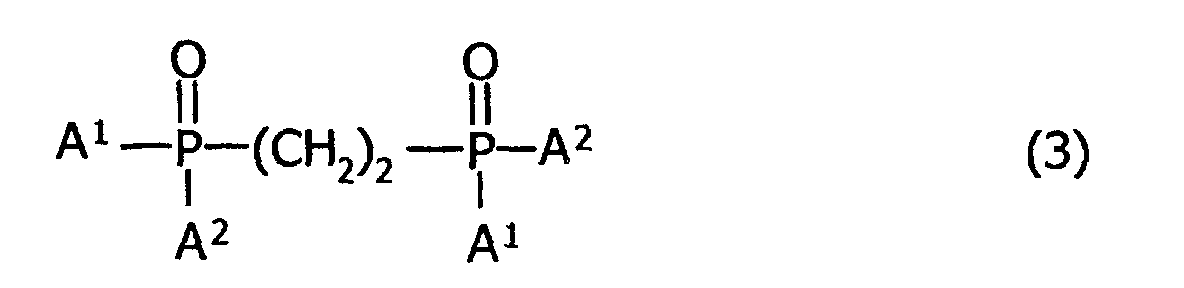
- the process for producing the above-mentioned bisphosphine compound comprises the steps of subjecting a phosphine oxide carboxylate represented by the following general formula (2): (where A 1 and A 2 denote a methyl group and a 1,1,3,3-tetramethyl-butyl group, respectively, and A 1 and A 2 denote their respective different groups) to Kolbe's electrolytic coupling reaction, thereby obtaining 1,2-bis(methyl(1,1,3,3-tetramethylbutyl)phosphinoyl)-ethane represented by the following general formula (3): (where A 1 and A 2 have the same meanings as defined above, and A 1 and A 2 denote their respective different groups), and then reducing the resultant 1,2-bis(methyl(1,1,3,3-tetramethylbutyl)phosphinoyl)-ethane with a reducing agent.
- a phosphine oxide carboxylate represented by the following general formula (2): (where A 1 and A 2 denote a methyl group and a 1,
- the use of the above-mentioned bisphosphine compound is implemented in such a manner that a transition metal complex composed of the bisphosphine compound as a ligand is used as a catalyst to asymmetrically hydrogenate an unsaturated carboxylic acid and its ester.
- the 1,2-bis(methyl(1,1,3,3-tetramethylbutyl)phosphino)-ethane of the invention represented by the foregoing general formula (1) can be easily produced, in essence, by performing a first step in which a phosphine oxide carboxylate represented by the foregoing general formula (2) is subjected to Kolbe's electrolytic coupling reaction, whereby 1,2-bis(methyl-(1,1,3,3-tetramethyl-butyl)phosphinoyl)ethane represented by the foregoing general formula (3) is obtained, and then a first step in which the resultant 1,2-bis(methyl(1,1,3,3-tetramethylbutyl)phosphinoyl)-ethane is reduced with a reducing agent.
- the first step permits a phosphine oxide carboxylate of the foregoing general formula (2) to undergo Kolbe's electrolytic coupling reaction, thereby obtaining 1,2-bis(methyl(1,1,3,3-tetra-methylbutyl)phosphinoyl)ethane of the foregoing general formula (3).
- a 1 and A 2 denote a methyl group and a 1,1,3,3-tetramethylbutyl group, respectively, and A 1 and A 2 denote their respective different groups.
- Kolbe' electrolytic coupling reaction can be effected in accordance with the method previously proposed by the present inventors in Japanese Unexamined Patent Application Publication No. 11-228586. Specifically, this reaction employs a solvent in accomplishing electrolysis, which solvent includes methanol and hydrous methanol. When the hydrous methanol is used, the water content is preferably not more than 4%. Aqueous solution or aprotic polar solvent such as acetonitrile is not very desirable since the starting material is likely to give a by-product derived abnormally by Kolbe's reaction, such as olefin or alcohol (Hofer-Moest Reaction).
- a solvent in accomplishing electrolysis which solvent includes methanol and hydrous methanol.
- the water content is preferably not more than 4%.
- Aqueous solution or aprotic polar solvent such as acetonitrile is not very desirable since the starting material is likely to give a by-product derived abnormally by Kolbe's reaction, such as olef
- the pH of the electrolytic liquid is preferably neutral or acidulous.
- a support salt may be added, where desired, in stabilizing power distribution. Suitable support salts include sodium salts such as sodium perchlorate, sodium methylate and so on, and lithium salts such as lithium perchlorate and so on. Desirably, however, the use of a support salt should be avoided because the yield of the intended bisphosphine oxide decreases with increases in the amount of the salt. If such a support salt is anyway used, the amount of the salt to be added is preferably below 5 wt% based on 1 part by weight of the starting material.
- a platinum electrode is preferred to increase the concentration of radicals to be generated per unit area so that electrolysis can be effected at a high current density (at a high potential).
- An electrode made by plating platinum on a titanium plate can also be employed on an industrial scale.
- An electrode made of iridium, gold, palladium, lead dioxide or the like may be used in place of the platinum electrode.
- the electrolytic liquid is maintained at a constant temperature by being immersed in a water bath. This is because the liquid temperature rises as the electrolysis volume increases.
- the electrolysis temperature is preferably relatively low, and the range of 0 to 20°C is particularly desirable.
- the electrolytic liquid is preferably stirred to maintain its temperature uniform.
- the electrolysis is performed usually by constant-current, electrolysis, and the current capacity is in the range of 0.1 to 3 A, preferably 0.5 to 2 A.
- the electrode-to-electrode distance is usually in the range of about 1 to 5 mm to ensure that the current density be in the range of 10 to 100 mA/cm 2 .
- the current distribution time is variable with the starting material and electrolysis conditions used, but is usually in the range of 0.5 to 36 hours, preferably about 1 to 10 hours.
- the solvent is removed by distillation to give a 1,2-bis(methyl(1,1,3,3-tetramethylbutyl)-phosphinoyl)ethane represented by the foregoing general formula (3).
- the resultant compound can be purified by conventional means such as recrystallization and so on.
- an optically active form of the 1,2-bis(methyl(1,1,3,3-tetramethybutyl)phosphino)-ethane of the foregoing general formula (1) can be easily produced, with axial asymmetry held on the P atom, by subjecting a reactant material, i.e., a phosphine oxide carboxylate of the foregoing general formula (2), to Kolbe's electrolytic coupling reaction stated earlier, wherein the reactant material has been optically resolved in advance, and subsequently by carrying out a second step that will be described later.
- a reactant material i.e., a phosphine oxide carboxylate of the foregoing general formula (2)
- the second step permits the 1,2-bis(methyl(1,1,3,3-tetra-methylbutyl)phosphinoyl)ethane of the foregoing general formula (3), which has been obtained as mentioned above, to be reduced with a reducing agent, thereby obtaining the intended 1,2-bis(methyl-(1,1,3,3-tetramethylbutyl)phosphino)ethane of the foregoing general formula (1).
- the reducing agent for use in reducing the 1,2-bis(methyl-(1,1,3,3-tetramethylbutyl)phosphinoyl)ethane of the foregoing general formula (3) is not particularly restricted, but a silane compound may be generally employed.
- the silane compound includes, for example, trichlorosilane, dichlorosilane, methyl-dichlorosilane, dimethylchlorosilane, phenyldichlorosilane, phenylmethylchloro-silane, diphenylchlorosilane, phenylsilane and so on. Of these compounds, phenylsilane is preferred.
- the amount of the reducing agent to be added is usually in the range of 1 to 100 mol, preferably 5 to 50 mol, based on 1 mol of the 1,2-bis(methyl(1,1,3,3-tetramethylbutyl)phosphinoyl)ethane of the foregoing general formula (3).
- the reaction temperature is usually in the range of room temperature to 150°C, preferably 50 to 120°C, whereas the reaction time is usually in the range of 1 to 48, preferably 5 to 24 hours.
- the 1,2-bis(methyl(1,1,3,3-tetramethylbutyl)-phosphino)ethane of the foregoing general formula (1) is obtained in a racemic or optically active form.
- the optically active form depends on the (S) and (R) forms of the starting material, i.e., the phosphine oxide carboxylate of the foregoing general formula (2).
- the 1,2-bis(methyl-(1,1,3,3-tetramethylbutyl)phosphino)ethane of the foregoing general formula (1) can be synthesized in an optically active form chosen arbitrarily from (S, S), (R, R) and meso forms.
- the 1,2-bis(methyl(1,1,3,3-tetramethylbutyl)phosphino)-ethane of the foregoing general formula (1) according to the present invention can cooperate as a ligand with a transition metal in forming the corresponding complex.
- the transition metal that can form a complex includes, for example, rhodium, ruthenium, iridium, palladium, nickel and so on. A rhodium metal is preferable.
- the optically active 1,2-bis(methyl(1,1,3,3-tetramethyl-butyl)-phosphino)ethane of the foregoing general formula (1) may be reacted, for example, with a bis-(cycloocta-1,5-diene)rhodium (I) tetrafluoroborate salt by a method disclosed, for example, in Courses in Experimental Chemistry, 4th Edition (edited by the Chemical Society of Japan, published by Maruzen Co., Ltd., Vol. 18, pp. 327-353).
- a palladium complex can be prepared by a method disclosed by Uozumi and Hayashi (Y. Uozumi and T. Hayashi, J. Am. Chem. Soc., 1991, 113, 9887), wherein L is reacted, for example, with ⁇ -allylpalladium chloride. Specific examples of the resulting compound are enumerated below. PdCl 2 (L), ( ⁇ -allyl)Pd(L), [Pd(L)]ClO 4 , [Pd(L)]PF 6 and [Pd(L)]BF 4 .
- a ruthenium complex can be prepared by a method disclosed by Mashima et al. (K. Mashima, K. Kusano, T. Ohta, R. Noyori and H. Takaya, J. Chem. Soc., Chem. Commun., 1208 (1989)), wherein L and, for example, [Ru(p-cymene)I 2 ] 2 are stirred with heating in methylene chloride and ethanol. Specific examples of the resulting compounds are enumerated below.
- An iridium complex can be prepared by a method disclosed by Mashima et al. (K. Mashima, T. Akutagawa, X. Zhang, T. Taketomi and H. Kumobayashi, J. Organomet. Chem., 1992, 428, 213), wherein L is reacted, for example, with [Ir(cod)(CH 3 CN) 2 ]BF 4 with stirring in tetrahydrofuran. Specific examples of the resulting compounds are enumerated below.
- the transition metal complex preferably the rhodium metal complex, derived from the optically active 1,2-bis(methyl(1,1,3,3-tetramethylbutyl)phosphino)ethane of the foregoing general formula (1) according to the present invention and a transition metal compound can be utilized as a catalyst for asymmetric synthesis.
- An unsaturated carboxylic acid of the foregoing general formula (4) : or its ester is hydrogenated using the transition metal complex of the invention as a catalyst, whereby a saturated carboxylic acid of the foregoing general formula (5): or its ester is obtained.
- the step for doing so can be performed in a conventional fashion. Namely, the unsaturated carboxylic acid of the foregoing general formula (4) or its ester is placed, together with the transition metal complex catalyst of the invention, in a pressure tight case under a nitrogen atmosphere, and reaction is effected with hydrogen gas filled.
- R 1 , R 2 and R 3 denote hydrogen, a straight- or branded-chain alkyl group having 1 to 10 carbon atoms, an aryl group having 6 to 12 carbon atoms, an aryl group having 6 to 12 carbon atoms which possesses an alkyl substituent having 1 to 6 carbon atoms, or an aralkyl group.
- R 4 denotes a hydrogen, a straight- or branched-chain alkyl group having 1 to 10 carbon atoms, an aryl group having 6 to 12 carbon atoms, an aryl group having 6 to 12 carbon atoms which possesses an alkyl group substituent having 1 to 6 carbon atoms, an aralkyl group or -NHCOCH 3 .
- alkyl groups defined in R 1 to R 4 are methyl, ethyl, propyl, isopropyl, butyl, octyl, decyl and so on of C1 to C10.
- aryl group is phenyl, naphthyl and so on of C6 to C12.
- aralkyl group is benzyl, phenethyl, naphtylmethyl and so on.
- the alkyl, aryl and aralkyl groups noted here may have substituents which are inert to hydrogenation, such as alkyl, halogen, alkoxy and ester.
- the amount of the transition metal complex of the present invention to be used as a catalyst is usually in the range of 0.02 to 0.00001 mol, preferably 0.005 to 0.0001 mol, based on 1 mol of the carboxylic acid of the foregoing general formula (4) or its ester.
- the solvent is not particularly restricted on condition that it is inert to the reactant material used and reaction product obtained.
- alcohols such as methanol, ethanol, isopropyl alcohol and the like, THF, benzene, toluene and so on can be used alone or as a mixed solvent.
- the amount of the solvent to be used is usually in the range of 0.5 to 200 mol, preferably 5 to 100 mol, based on 1 mol of the unsaturated carboxylic acid of the foregoing general formula (3) or its ester.
- the hydrogen gas pressure can be in the range of 0.1 to 100 atm, but is preferably in the range of 0.1 to 5 atm. This is because as the gas pressure becomes higher, asymmetric hydrogenation generally tends to be less selective, eventually causing a decline in asymmetry yield.
- the reaction temperature is in the range of 0 to 100°C, preferably 20 to 50°C.
- a 1-liter stainless autoclave was charged at room temperature with 300 ml of n-hexane as a solvent, 112.2 g (1.0 mol) of isobutylenes (a mixture of 2,4,4-trimethyl-1-pentene 75% and 2,4,4-trimethyl-2-pentene 22%) and 34.0 g (1.0 mol) of phosphine.
- the reaction temperature was elevated to 80°C, and 96.1 g (1.0 mol) of methane sulfonate was added over about 3 hours with a pressure pump.
- the pressure in the autoclave dropped from 12.5 atm to 4.5 atm.
- the reaction mixture was further matured for 4 hours with the temperature maintained at 80°C.
- a 1,000-ml four-neck flask was charged at room temperature with 73.1 g (0.5 mol) of the 1,1,3,3-tetramethylbutyl phosphine and 212.9 g (1.5 mol) of methyl iodide.
- the reaction mixture clouded and deposited crystals, and heating was continued until stirring became difficult to perform.
- the crystals were filtered after the addition of 300 ml of n-hexane and further washed with hexane.
- the resultant crystals were dissolved in 300 ml of pure water, and the solution was mixed with 400 ml of hexane as a solvent to be used for extraction to effect.
- reaction mixture was cooled with ice water to maintain the temperature substantially constant and stirred to make the same homogeneous. After power distribution was performed for 3 hours, the reaction liquid was analyzed by high-speed liquid chromatography to find that the starting material was decreased by 98.7%.
- the solvent was removed by distillation using an evaporator, and the unreacted starting material was dissolved in 100 ml of dichloromethane and extracted with a 1 N aqueous solution of sodium hydroxide, followed by washing of the organic phase with pure water. This phase was dehydrated overnight with sodium sulfate anhydride, and the solvent was removed with an evaporator, whereby 0.54 g of white crystals was obtained (crude yield: 70.4%).
- the crystals were further purified by recrystallization with acetone to give 0.47 g of white crystals having a melting point of 117 to 119°C (crystallization yield: 61.0%).
- a mother liquid abundant in (+)-(R)-[methyl(1,1,3,3-tetramethybutyl)phosphinoyl]acetate i.e., a mother liquid left after separating the (-)-(S)-[methyl(1,1,3,3-tetramethybutyl)-phosphinoyl]acetate in Example 1, was let to stand overnight at room temperature to deposit crystals.
- the crystals were collected by filtration and dried in vacuo so that 2.6 g of white crystals was obtained.
- the white crystals were further recrystallized with 100 ml of acetone to give 1.5 g of white crystals which were then liberated with hydrochloric acid and extracted with dichloromethane, whereby 1.5 g of white crystals was obtained.
- the solvent was removed by distillation using an evaporator, and the unreacted starting material was dissolved in 100 ml of dichloromethane and extracted with a 1N aqueous solution of sodium hydroxide, followed by washing of the organic phase with pure water. This phase was dehydrated overnight with sodium sulfate anhydride, and the solvent was removed with an evaporator, whereby 0.57 g of white crystals was obtained (crude yield: 70.4%).
- the crystals were further purified by recrystallization with acetone to give 0.47 g of white crystals having a melting point of 118 to 119°C (crystallization yield: 59.0%).
- a 100-ml glass autoclave was charged with 143.1 mg (1.0 mmol) of a methyl ester of 2-acetamide acrylate and 1.3 mg (0.002 mmol) of the rhodium complex obtained in Example 1, and the system was evacuated three times with nitrogen. Then, 5 ml of dehydrated methanol was added while the system was being cooled with ice water, and hydrogen gas was blown under pressure into the system up to 2 atm. Stirring was conducted at room temperature for 70 minutes. The reaction liquid was discharged out of the autoclave and analyzed using an optically active column (Chrome Pack, Chiral-L-Val, 25 m x 0.25 mm ID, 120°C). It was confirmed that a hydrogenated product, i.e., a (R)-N-acetylalanine methyl ester, had been obtained with an optical purity of 96.3% ee.
- Example 3 The same reaction as in Example 3 was run except that the rhodium complex catalyst was changed to that obtained in Example 2. It was confirmed that a hydrogenated product, i.e., a (S)-N-acetylalanine methyl ester, had been obtained with an optical purity of 97.3% ee.
- Example 3 The same reaction as in Example 3 was run except that 205.2 mg (1.0 mmol) of ⁇ -acetamide cinnamate was used in place of the methyl ester.
- the reaction liquid was discharged out of the autoclave and methyl-esterified by adding 1 ml of trimethylsilyl diazomethane and by stirring the reaction mixture at room temperature for 30 minutes.
- the ester was analyzed using an optically active HPLC column (Chiral Cell OD-H, 10 ml/minute, 10% 2-isopropanol/hexane). It was confirmed that a hydrogenated product, i.e., a (R)-N-acetylalanine methyl ester, had been obtained with an optical purity of 95.9% ee.
- Example 4 The same reaction as in Example 4 was run except that the rhodium complex catalyst was changed to that obtained in Example 2. It was confirmed that a hydrogenated product, i.e., a (S)-N-acetylalanine methyl ester, had been obtained with an optical purity of 96.4% ee.
- the present invention provides a rhodium complex having as a ligand 1,2-bis[methyl(1,1,3,3-tetramethybutyl)phosphinoyl]-ethane.
- the rhodium complex of the invention is useful as a catalyst for asymmetric hydrogenation and is capable of achieving both forms of (R, R) and (S, S) as absolute configurations.
- this rhodium complex permits, with good efficiency and high selectivity, amino acids and the like to be produced to have a (S)-form absolute configuration as well as a (R)-form absolute configuration.
- the alkyl group in the phosphine compound of the invention has 8 carbon atoms and exhibits properties markedly resembling a lipophilic group.
Landscapes
- Chemical & Material Sciences (AREA)
- Organic Chemistry (AREA)
- Biochemistry (AREA)
- Health & Medical Sciences (AREA)
- General Health & Medical Sciences (AREA)
- Molecular Biology (AREA)
- Life Sciences & Earth Sciences (AREA)
- Inorganic Chemistry (AREA)
- Engineering & Computer Science (AREA)
- Materials Engineering (AREA)
- Chemical Kinetics & Catalysis (AREA)
- Organic Low-Molecular-Weight Compounds And Preparation Thereof (AREA)
- Low-Molecular Organic Synthesis Reactions Using Catalysts (AREA)
- Catalysts (AREA)
Claims (7)



où lesdits groupes alkyle, aryle et aralkyle peuvent avoir des substituants qui sont inertes à l'hydrogénation)
lequel procédé comprend l'hydrogénation asymétrique d'un acide carboxylique insaturé ou d'un ester de celui-ci représenté par la formule générale (4) suivante :

Applications Claiming Priority (1)
| Application Number | Priority Date | Filing Date | Title |
|---|---|---|---|
| PCT/JP1999/007156 WO2001046098A1 (fr) | 1999-12-20 | 1999-12-20 | 1,2-bis(methyl(1,1,3,3-tetramethylbutyl)-phosphino)ethane, son procede de preparation, complexes de metaux de transition le contenant en tant que ligand et leurs utilisations |
Publications (3)
| Publication Number | Publication Date |
|---|---|
| EP1245551A1 EP1245551A1 (fr) | 2002-10-02 |
| EP1245551A4 EP1245551A4 (fr) | 2003-03-05 |
| EP1245551B1 true EP1245551B1 (fr) | 2003-11-19 |
Family
ID=14237622
Family Applications (1)
| Application Number | Title | Priority Date | Filing Date |
|---|---|---|---|
| EP99959925A Expired - Lifetime EP1245551B1 (fr) | 1999-12-20 | 1999-12-20 | 1,2-bis(methyl(1,1,3,3-tetramethylbutyl)-phosphino)ethane, son procede de preparation, complexes de metaux de transition le contenant en tant que ligand et leurs utilisations |
Country Status (5)
| Country | Link |
|---|---|
| US (1) | US6603032B1 (fr) |
| EP (1) | EP1245551B1 (fr) |
| JP (1) | JP4066139B2 (fr) |
| DE (1) | DE69913003T2 (fr) |
| WO (1) | WO2001046098A1 (fr) |
Family Cites Families (5)
| Publication number | Priority date | Publication date | Assignee | Title |
|---|---|---|---|---|
| US3518312A (en) * | 1965-03-12 | 1970-06-30 | Monsanto Co | Methylene bis(dialkyl phosphines) |
| JP3830986B2 (ja) * | 1995-03-07 | 2006-10-11 | 日本化学工業株式会社 | ジ(1,1,3,3−テトラメチルブチル)ホスフィン及びその製造方法 |
| DE19516968A1 (de) * | 1995-05-12 | 1996-11-14 | Basf Ag | Optisch aktive Phosphine, deren Herstellung, deren Metallkomplexe und Anwendung in der asymmetrischen Synthese |
| JP4028625B2 (ja) * | 1997-09-11 | 2007-12-26 | 小川香料株式会社 | ホスフィン化合物およびそれを配位子とするロジウム錯体 |
| JP4164141B2 (ja) * | 1998-02-12 | 2008-10-08 | 日本化学工業株式会社 | ビスホスフィンオキシドの製造方法 |
-
1999
- 1999-12-20 US US10/148,895 patent/US6603032B1/en not_active Expired - Fee Related
- 1999-12-20 DE DE69913003T patent/DE69913003T2/de not_active Expired - Lifetime
- 1999-12-20 EP EP99959925A patent/EP1245551B1/fr not_active Expired - Lifetime
- 1999-12-20 WO PCT/JP1999/007156 patent/WO2001046098A1/fr not_active Ceased
- 1999-12-20 JP JP2001546612A patent/JP4066139B2/ja not_active Expired - Fee Related
Also Published As
| Publication number | Publication date |
|---|---|
| JP4066139B2 (ja) | 2008-03-26 |
| WO2001046098A1 (fr) | 2001-06-28 |
| EP1245551A1 (fr) | 2002-10-02 |
| DE69913003T2 (de) | 2004-08-12 |
| DE69913003D1 (de) | 2003-12-24 |
| US6603032B1 (en) | 2003-08-05 |
| EP1245551A4 (fr) | 2003-03-05 |
Similar Documents
| Publication | Publication Date | Title |
|---|---|---|
| AU652756B2 (en) | Chiral phospholane transition metal catalysts | |
| EP0036741A2 (fr) | Dérivés de phosphine, leurs complexes avec des métaux de transition et l'utilisation de ces derniers comme catalyseurs d'hydrogénation chirale | |
| JPH10513402A (ja) | ルテニウム触媒及びシクロペンテノン類の不斉水素化に於けるその使用 | |
| US5206399A (en) | 2,2'-bis(diphenylphosphino)-5,5',6,6',7,7',8,8'-octahydro-1,1'-binaphthyl and transition metal complex containing the same as ligand | |
| US6683208B2 (en) | Optically active diphosphines, preparation thereof according to a process for the resolution of the racemic mixture and use thereof | |
| JP2736947B2 (ja) | 水溶性なスルホン酸アルカリ金属塩置換ビナフチルホスフイン遷移金属錯体及びこれを用いた不斉水素化法 | |
| US5202493A (en) | Chiral tridentate bis(phospholane) ligands | |
| US5847222A (en) | Optically active diphosphine compound, method for making the compound, transition metal complex having the compound as ligand and method for making optically active substance by use of the complex | |
| EP0444930B1 (fr) | Composés contenant du 2,2'-bis-(diphénylphosphino)-1,1'-binaphtyle et complexes catalytiques | |
| RU2086532C1 (ru) | СПОСОБ ПОЛУЧЕНИЯ α АРИЛПРОПИОНОВЫХ КИСЛОТ | |
| JP4427109B2 (ja) | ホスホラン及びジホスホラン、その金属錯体、その使用及び不斉水素化の方法 | |
| US6043380A (en) | Ruthenium-I0D0-optically active phosphine complex | |
| EP1805194A1 (fr) | Nouveaux catalyseurs de bisphosphane | |
| JP2972887B1 (ja) | 光学活性ビスホスフィノメタン並びにそれらのロジウム又は銅錯体を用いる不斉合成 | |
| EP1245551B1 (fr) | 1,2-bis(methyl(1,1,3,3-tetramethylbutyl)-phosphino)ethane, son procede de preparation, complexes de metaux de transition le contenant en tant que ligand et leurs utilisations | |
| EP0673911A1 (fr) | Procédé de préparation d'acides carboxyliques optiquement actifs et ligands chiraux pour se faire | |
| JP4028625B2 (ja) | ホスフィン化合物およびそれを配位子とするロジウム錯体 | |
| JP3441605B2 (ja) | 新規光学活性ジホスフィン及び該化合物より得られる遷移金属錯体及び該錯体の存在下にて光学活性体を得る方法 | |
| US6521795B2 (en) | 6,6′-bis-(1-phosphanorbornadiene) diphosphines, their preparation and their uses | |
| US5723642A (en) | Optically activate phosphines,their preparation and their metal complexes, and use in asymmetric synthesis | |
| JP5009613B2 (ja) | 不斉合成における使用のためのキラル配位子 | |
| JPWO2001046098A1 (ja) | 1,2−ビス(メチル(1,1,3,3−テトラメチルブチル)ホスフィノ)エタンおよびその製造方法、それを配位子とする遷移金属錯体並びにその用途 |
Legal Events
| Date | Code | Title | Description |
|---|---|---|---|
| PUAI | Public reference made under article 153(3) epc to a published international application that has entered the european phase |
Free format text: ORIGINAL CODE: 0009012 |
|
| 17P | Request for examination filed |
Effective date: 20020718 |
|
| AK | Designated contracting states |
Kind code of ref document: A1 Designated state(s): AT BE CH CY DE DK ES FI FR GB GR IE IT LI LU MC NL PT SE |
|
| A4 | Supplementary search report drawn up and despatched |
Effective date: 20030122 |
|
| RIC1 | Information provided on ipc code assigned before grant |
Ipc: 7C 07F 9/50 B Ipc: 7C 07C 1/00 A |
|
| GRAH | Despatch of communication of intention to grant a patent |
Free format text: ORIGINAL CODE: EPIDOS IGRA |
|
| GRAS | Grant fee paid |
Free format text: ORIGINAL CODE: EPIDOSNIGR3 |
|
| GRAA | (expected) grant |
Free format text: ORIGINAL CODE: 0009210 |
|
| AK | Designated contracting states |
Kind code of ref document: B1 Designated state(s): DE FR GB |
|
| PG25 | Lapsed in a contracting state [announced via postgrant information from national office to epo] |
Ref country code: FR Free format text: LAPSE BECAUSE OF FAILURE TO SUBMIT A TRANSLATION OF THE DESCRIPTION OR TO PAY THE FEE WITHIN THE PRESCRIBED TIME-LIMIT Effective date: 20031119 |
|
| REG | Reference to a national code |
Ref country code: GB Ref legal event code: FG4D |
|
| REF | Corresponds to: |
Ref document number: 69913003 Country of ref document: DE Date of ref document: 20031224 Kind code of ref document: P |
|
| REG | Reference to a national code |
Ref country code: IE Ref legal event code: FG4D |
|
| REG | Reference to a national code |
Ref country code: IE Ref legal event code: MM4A |
|
| PLBE | No opposition filed within time limit |
Free format text: ORIGINAL CODE: 0009261 |
|
| STAA | Information on the status of an ep patent application or granted ep patent |
Free format text: STATUS: NO OPPOSITION FILED WITHIN TIME LIMIT |
|
| 26N | No opposition filed |
Effective date: 20040820 |
|
| EN | Fr: translation not filed | ||
| PGFP | Annual fee paid to national office [announced via postgrant information from national office to epo] |
Ref country code: GB Payment date: 20131218 Year of fee payment: 15 Ref country code: DE Payment date: 20131218 Year of fee payment: 15 |
|
| REG | Reference to a national code |
Ref country code: DE Ref legal event code: R119 Ref document number: 69913003 Country of ref document: DE |
|
| GBPC | Gb: european patent ceased through non-payment of renewal fee |
Effective date: 20141220 |
|
| PG25 | Lapsed in a contracting state [announced via postgrant information from national office to epo] |
Ref country code: GB Free format text: LAPSE BECAUSE OF NON-PAYMENT OF DUE FEES Effective date: 20141220 Ref country code: DE Free format text: LAPSE BECAUSE OF NON-PAYMENT OF DUE FEES Effective date: 20150701 |