EP1245691A2 - Mask material - Google Patents
Mask material Download PDFInfo
- Publication number
- EP1245691A2 EP1245691A2 EP02010908A EP02010908A EP1245691A2 EP 1245691 A2 EP1245691 A2 EP 1245691A2 EP 02010908 A EP02010908 A EP 02010908A EP 02010908 A EP02010908 A EP 02010908A EP 1245691 A2 EP1245691 A2 EP 1245691A2
- Authority
- EP
- European Patent Office
- Prior art keywords
- mask material
- component
- cooling holes
- coating
- holes
- Prior art date
- Legal status (The legal status is an assumption and is not a legal conclusion. Google has not performed a legal analysis and makes no representation as to the accuracy of the status listed.)
- Withdrawn
Links
- 0 CC(C1)C(C)C1SC1CC(*)CC1 Chemical compound CC(C1)C(C)C1SC1CC(*)CC1 0.000 description 1
Images

Classifications
-
- F—MECHANICAL ENGINEERING; LIGHTING; HEATING; WEAPONS; BLASTING
- F01—MACHINES OR ENGINES IN GENERAL; ENGINE PLANTS IN GENERAL; STEAM ENGINES
- F01D—NON-POSITIVE DISPLACEMENT MACHINES OR ENGINES, e.g. STEAM TURBINES
- F01D5/00—Blades; Blade-carrying members; Heating, heat-insulating, cooling or antivibration means on the blades or the members
- F01D5/12—Blades
- F01D5/28—Selecting particular materials; Particular measures relating thereto; Measures against erosion or corrosion
-
- B—PERFORMING OPERATIONS; TRANSPORTING
- B23—MACHINE TOOLS; METAL-WORKING NOT OTHERWISE PROVIDED FOR
- B23K—SOLDERING OR UNSOLDERING; WELDING; CLADDING OR PLATING BY SOLDERING OR WELDING; CUTTING BY APPLYING HEAT LOCALLY, e.g. FLAME CUTTING; WORKING BY LASER BEAM
- B23K26/00—Working by laser beam, e.g. welding, cutting or boring
- B23K26/36—Removing material
- B23K26/38—Removing material by boring or cutting
- B23K26/382—Removing material by boring or cutting by boring
- B23K26/389—Removing material by boring or cutting by boring of fluid openings, e.g. nozzles, jets
-
- B—PERFORMING OPERATIONS; TRANSPORTING
- B23—MACHINE TOOLS; METAL-WORKING NOT OTHERWISE PROVIDED FOR
- B23K—SOLDERING OR UNSOLDERING; WELDING; CLADDING OR PLATING BY SOLDERING OR WELDING; CUTTING BY APPLYING HEAT LOCALLY, e.g. FLAME CUTTING; WORKING BY LASER BEAM
- B23K26/00—Working by laser beam, e.g. welding, cutting or boring
- B23K26/36—Removing material
- B23K26/40—Removing material taking account of the properties of the material involved
-
- C—CHEMISTRY; METALLURGY
- C23—COATING METALLIC MATERIAL; COATING MATERIAL WITH METALLIC MATERIAL; CHEMICAL SURFACE TREATMENT; DIFFUSION TREATMENT OF METALLIC MATERIAL; COATING BY VACUUM EVAPORATION, BY SPUTTERING, BY ION IMPLANTATION OR BY CHEMICAL VAPOUR DEPOSITION, IN GENERAL; INHIBITING CORROSION OF METALLIC MATERIAL OR INCRUSTATION IN GENERAL
- C23C—COATING METALLIC MATERIAL; COATING MATERIAL WITH METALLIC MATERIAL; SURFACE TREATMENT OF METALLIC MATERIAL BY DIFFUSION INTO THE SURFACE, BY CHEMICAL CONVERSION OR SUBSTITUTION; COATING BY VACUUM EVAPORATION, BY SPUTTERING, BY ION IMPLANTATION OR BY CHEMICAL VAPOUR DEPOSITION, IN GENERAL
- C23C10/00—Solid state diffusion of only metal elements or silicon into metallic material surfaces
- C23C10/04—Diffusion into selected surface areas, e.g. using masks
-
- C—CHEMISTRY; METALLURGY
- C23—COATING METALLIC MATERIAL; COATING MATERIAL WITH METALLIC MATERIAL; CHEMICAL SURFACE TREATMENT; DIFFUSION TREATMENT OF METALLIC MATERIAL; COATING BY VACUUM EVAPORATION, BY SPUTTERING, BY ION IMPLANTATION OR BY CHEMICAL VAPOUR DEPOSITION, IN GENERAL; INHIBITING CORROSION OF METALLIC MATERIAL OR INCRUSTATION IN GENERAL
- C23C—COATING METALLIC MATERIAL; COATING MATERIAL WITH METALLIC MATERIAL; SURFACE TREATMENT OF METALLIC MATERIAL BY DIFFUSION INTO THE SURFACE, BY CHEMICAL CONVERSION OR SUBSTITUTION; COATING BY VACUUM EVAPORATION, BY SPUTTERING, BY ION IMPLANTATION OR BY CHEMICAL VAPOUR DEPOSITION, IN GENERAL
- C23C14/00—Coating by vacuum evaporation, by sputtering or by ion implantation of the coating forming material
- C23C14/04—Coating on selected surface areas, e.g. using masks
- C23C14/042—Coating on selected surface areas, e.g. using masks using masks
-
- C—CHEMISTRY; METALLURGY
- C23—COATING METALLIC MATERIAL; COATING MATERIAL WITH METALLIC MATERIAL; CHEMICAL SURFACE TREATMENT; DIFFUSION TREATMENT OF METALLIC MATERIAL; COATING BY VACUUM EVAPORATION, BY SPUTTERING, BY ION IMPLANTATION OR BY CHEMICAL VAPOUR DEPOSITION, IN GENERAL; INHIBITING CORROSION OF METALLIC MATERIAL OR INCRUSTATION IN GENERAL
- C23C—COATING METALLIC MATERIAL; COATING MATERIAL WITH METALLIC MATERIAL; SURFACE TREATMENT OF METALLIC MATERIAL BY DIFFUSION INTO THE SURFACE, BY CHEMICAL CONVERSION OR SUBSTITUTION; COATING BY VACUUM EVAPORATION, BY SPUTTERING, BY ION IMPLANTATION OR BY CHEMICAL VAPOUR DEPOSITION, IN GENERAL
- C23C4/00—Coating by spraying the coating material in the molten state, e.g. by flame, plasma or electric discharge
- C23C4/01—Selective coating, e.g. pattern coating, without pre-treatment of the material to be coated
-
- C—CHEMISTRY; METALLURGY
- C23—COATING METALLIC MATERIAL; COATING MATERIAL WITH METALLIC MATERIAL; CHEMICAL SURFACE TREATMENT; DIFFUSION TREATMENT OF METALLIC MATERIAL; COATING BY VACUUM EVAPORATION, BY SPUTTERING, BY ION IMPLANTATION OR BY CHEMICAL VAPOUR DEPOSITION, IN GENERAL; INHIBITING CORROSION OF METALLIC MATERIAL OR INCRUSTATION IN GENERAL
- C23C—COATING METALLIC MATERIAL; COATING MATERIAL WITH METALLIC MATERIAL; SURFACE TREATMENT OF METALLIC MATERIAL BY DIFFUSION INTO THE SURFACE, BY CHEMICAL CONVERSION OR SUBSTITUTION; COATING BY VACUUM EVAPORATION, BY SPUTTERING, BY ION IMPLANTATION OR BY CHEMICAL VAPOUR DEPOSITION, IN GENERAL
- C23C8/00—Solid state diffusion of only non-metal elements into metallic material surfaces; Chemical surface treatment of metallic material by reaction of the surface with a reactive gas, leaving reaction products of surface material in the coating, e.g. conversion coatings, passivation of metals
- C23C8/04—Treatment of selected surface areas, e.g. using masks
-
- B—PERFORMING OPERATIONS; TRANSPORTING
- B23—MACHINE TOOLS; METAL-WORKING NOT OTHERWISE PROVIDED FOR
- B23K—SOLDERING OR UNSOLDERING; WELDING; CLADDING OR PLATING BY SOLDERING OR WELDING; CUTTING BY APPLYING HEAT LOCALLY, e.g. FLAME CUTTING; WORKING BY LASER BEAM
- B23K2101/00—Articles made by soldering, welding or cutting
- B23K2101/001—Turbines
-
- B—PERFORMING OPERATIONS; TRANSPORTING
- B23—MACHINE TOOLS; METAL-WORKING NOT OTHERWISE PROVIDED FOR
- B23K—SOLDERING OR UNSOLDERING; WELDING; CLADDING OR PLATING BY SOLDERING OR WELDING; CUTTING BY APPLYING HEAT LOCALLY, e.g. FLAME CUTTING; WORKING BY LASER BEAM
- B23K2101/00—Articles made by soldering, welding or cutting
- B23K2101/34—Coated articles ; Surface treated articles
- B23K2101/35—Surface treated articles
-
- B—PERFORMING OPERATIONS; TRANSPORTING
- B23—MACHINE TOOLS; METAL-WORKING NOT OTHERWISE PROVIDED FOR
- B23K—SOLDERING OR UNSOLDERING; WELDING; CLADDING OR PLATING BY SOLDERING OR WELDING; CUTTING BY APPLYING HEAT LOCALLY, e.g. FLAME CUTTING; WORKING BY LASER BEAM
- B23K2103/00—Materials to be soldered, welded or cut
- B23K2103/30—Organic materials
- B23K2103/42—Plastics other than composite materials
-
- B—PERFORMING OPERATIONS; TRANSPORTING
- B23—MACHINE TOOLS; METAL-WORKING NOT OTHERWISE PROVIDED FOR
- B23K—SOLDERING OR UNSOLDERING; WELDING; CLADDING OR PLATING BY SOLDERING OR WELDING; CUTTING BY APPLYING HEAT LOCALLY, e.g. FLAME CUTTING; WORKING BY LASER BEAM
- B23K2103/00—Materials to be soldered, welded or cut
- B23K2103/50—Inorganic materials other than metals or composite materials
-
- B—PERFORMING OPERATIONS; TRANSPORTING
- B23—MACHINE TOOLS; METAL-WORKING NOT OTHERWISE PROVIDED FOR
- B23P—METAL-WORKING NOT OTHERWISE PROVIDED FOR; COMBINED OPERATIONS; UNIVERSAL MACHINE TOOLS
- B23P2700/00—Indexing scheme relating to the articles being treated, e.g. manufactured, repaired, assembled, connected or other operations covered in the subgroups
- B23P2700/06—Cooling passages of turbine components, e.g. unblocking or preventing blocking of cooling passages of turbine components
Definitions
- the invention relates to a mask material according to the claim 1.
- Components such as gas turbine blades, vanes and other cooled parts often contain cavities that distribute cooling air to a plurality of holes in the wall of the part that lead to the outer surface.
- Most turbine components are coated for protection from oxidation and/or corrosion with, for example, a MCrAIY coating (base coat) and some are also coated with a thermal barrier coating (TBC) for thermal insulation.
- base coat MCrAIY coating
- TBC thermal barrier coating
- the re-application of the coatings can be very problematic for parts with a large number of cooling holes.
- the base coat can reach thicknesses of 150-300 ⁇ m, and the TBC may be another 200 - 500 ⁇ m in thickness.
- the combined thicknesses of these coatings would have a very significant (and negative) influence on the effectiveness of the cooling holes if the coatings were deposited into these holes, especially considering that some holes are 1 mm or less in diameter.
- Specially shaped cooling holes are particularly susceptible to this as their effectiveness depends heavily on the accuracy of the shape of the hole.
- a further disadvantage of the method disclosed in US 4,743,462 is that the plugs must all be placed individually into the cooling holes.
- small simple aero-engine parts such as the one illustrated in the disclosure (containing only several rows of cooling holes at the leading edge) this is feasible, however for large turbine components of land-based gas turbines which may contain several hundred cooling holes, it is no longer feasible to individually place plugs into each hole.
- each component may be manufactured with several different types of cooling hole - including conical, straight cylindrical and holes with changing wall angles. Each type of cooling hole would require its own specially designed plug.
- a further disclosure in which all holes are plugged at once is given in US 5,800,695.
- a masking agent is placed into the cooling configuration and forced through until it fills the cooling holes from the inside, but only up to the level of the exterior surface of the component.
- a coating is then applied, in this case electrolytically applied platinum. Due to the non-conductivity of the plastic maskant cited in the disclosure, no Pt would deposit on the masking agent in the cooling holes. However, if the coating were deposited using thermal spraying techniques, it would coat over the maskant in the cooling holes, forming a layer that would remain after maskant removal. This layer would have to be removed. No solution is offered for this problem - in particular, how to remove the layer of coating material in such a way that the intended cooling hole design is maintained through the thickness of the coating material.
- a process was found of masking cooling holes of a gas turbine component with an external surface, comprising a cavity and a plurality of cooling holes, before coating the gas turbine component, characterised in that Process of masking cooling holes of a gas turbine component with an external surface, comprising a cavity and a plurality of cooling holes before coating the gas turbine component, characterised in that masking of both the external surface of the component and the cooling holes with a mask material, exposing the cooling holes to at least one energy source from the cavity of the component and thereby thickening the mask material within the cooling holes and along the line-of-sight through the cooling holes beyond the external surface of the component, removing mask material unaffected by the energy source from the external surface of the component, coating the component and the masked cooling holes and removing the thickened mask material from the cooling holes.
- the cooling holes are re-formed during the coating deposition processes to their originally intended design, even through the thickness of the applied coating.
- the "line-of-sight" concept is a novel and very important part of the process. Due to the manufacturing process with which the cooling holes are produced, which will be normally laser drilling, the "line-of-sight" of energy along the cooling holes from within the cavity of the component will very closely re-produce the original hole design above the external surface of the part through thickness of the coatings to be applied. Different energy sources and different mask materials may be used with special advantage for the process of the invention.
- the mask material may contain particles of solid material so that after thickening and with the proper heat treatment to volatilize part of the mask material, a porous solid form is left which can withstand the high temperatures of the diffusion heat treatment necessary for the bonding between base material of the component and the MCrAlY coating, before applying the thermal barrier coating (TBC).
- TBC thermal barrier coating
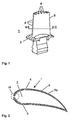
- Figure 1 shows a component 1 such as blades or vanes of gas turbine engines comprising a cavity 2, not visible in figure 1, and cooling holes 4, which are on the external surface 6 of the component 1 as well as on the platform 3 of the component 1.
- the present invention relates to a process of masking cooling holes 4 in the component 1 before the deposition of coating material on the external surface 6 of the component 1 will take place.
- FIG. 1 shows a section through the component 1.
- the component 1 comprising a cavity 2 and three cooling holes 4.
- the number of the cooling holes 4 is given only as an example and may vary on the purpose the component 1 is used for.
- the component 1 has an external surface 6 and an internal surface 6a.
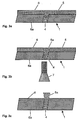
- the figure 3a shows the first step of the process according the invention.
- the external surface 6 and the cooling holes 4 are masked with the mask material 5. It will be coated with, sprayed with, or immersed in a material which is at least partially liquid, the mask material 5, and which thickens, which means to become more viscous or solid when exposed to an energy source 7.
- a way it may be done is to inject the mask material 5 into the cooling cavity 2 of the component 1 and force it through the cooling holes 4. Excess mask material 5 may be removed afterwards from the internal surface 6a (which can be the cavity 2 or one side of the platform 3 not to be coated) of the component 1 before the application of an energy source 7.
- mask material 5 different substances may be used:
- the mask material 5 may contain particles or fibres of metal or oxide material such as silica, magnesia, calcia, alumina, zirconia, yttria or a mixture there of.
- the mask material 5a thickened from the energy source 7 containing the metal or oxide particles may further be heated so as to volatilize or otherwise remove the organic portion of the thickened mask material 5a before the coating 8 are deposited on external surface 6 of the component 1.
- Figures 3b shows the second step of the process according the invention.
- the desired energy source 7 will be placed on the side of the internal surface 6a so that the energy impinges directly on said mask material 5 which is in the cooling holes 4 and that portion of the mask material 5 which lies outside of the cooling holes 4 but is located essentially along a line-of-sight from inside the component 1 through the cooling holes 4.
- Figures 3b shows the thickened material 5a as well. In this way, the mask material 5 may be thickened to a desired length extending beyond the external surface 6 of the component 1 but along the line-of-sight through the cooling holes 4 of the component 1.
- the mask material 5 which lies on the external surface 6 of the component 1 and not in the aforementioned line-of-sight will not be thickened by the energy source 7, or will be thickened to a much lesser extent, and will be preferentially removed before the deposition of the coating material 8 as shown in figures 3d.
- Different energy sources 7 may be used in order to obtain the desirable result:
- Figure 3c shows the component 1 after the removal of the liquid mask material 5.
- the thickened mask material 5a in the cooling holes 4 and extending beyond the cooling holes 4, but along the line-of-sight through the cooling holes 4, will be left in place to prevent blocking of the cooling holes 4 during deposition of the coating material(s) 8, which can be as an example MCrAIY and TBC.
- Other coating materials 8 are possible.
- the mask material 5 will be thickened to a length beyond the external surface 6 of the component that is at least equal to the thickness of the coating(s) 8 to be deposited, with a preferred length of 200% to 300% of the intended coating thickness.
- the mask material 5 may contain particles of solid material so that after thickening and with the proper heat treatment to volatilize part of the mask material 5, a porous solid form is left which can withstand the high temperatures of the diffusion heat treatment necessary for the bonding between base material of the component 1 and the MCrAIY coating, before applying the thermal barrier coating TBC.
- some may "grow" thickened mask material 5a outside of surface 6 of the cooling hole 4 faster than other cooling holes 4. It may therefore be appropriate to remove residual thickened mask material 5a (above the desired length beyond the external surface 6 of the component) from some cooling holes 4 prior to the deposition of the coating material(s) 8. This may be done, for example, by mechanical means.
- the thickened mask material 5a will be removed to reveal cooling holes 4 essentially free of coating material 8 and with walls that run consistently through the newly deposited coating material 8. This is shown in figure 3e.
- the removal of the thickening organic mask material can be accomplished by heating the part to 600°C in a vacuum furnace for 2 hours.
- the insert 9 is essentially transparent to the type of energy used or the insert re-distributes or re-directs the energy from the energy source 7.
- the insert 9 itself is the source of the energy 7, being specially shaped to fit into the cavity 2 of the component 1 to avoid excessive mask material 5 from thickening in the cavity 2.
- the insert 9 may have a special coating which allows the easy withdrawal from the component cavity 2 once the mask material 5 has been thickened.
- the component 1 is heated or cooled before or during processing to facilitate the polymerisation process.
- the cooling holes 4 are re-formed during the coating deposition processes to their originally intended design, even through the thickness of the applied coating 8.
- the "line-of-sight" concept is a novel and very important part of the process. Due to the manufacturing process with which the cooling holes 4 are produced, which will be normally laser drilling, the "line-of-sight" of energy along the cooling holes 4 from within the cavity 2 of the component 1 will very closely re-produce the original hole design above the external surface 6 of the part through thickness of the coatings 8 to be applied.
Landscapes
- Chemical & Material Sciences (AREA)
- Engineering & Computer Science (AREA)
- Mechanical Engineering (AREA)
- Materials Engineering (AREA)
- Chemical Kinetics & Catalysis (AREA)
- Physics & Mathematics (AREA)
- Metallurgy (AREA)
- Organic Chemistry (AREA)
- Plasma & Fusion (AREA)
- Optics & Photonics (AREA)
- General Engineering & Computer Science (AREA)
- Turbine Rotor Nozzle Sealing (AREA)
- Respiratory Apparatuses And Protective Means (AREA)
- Physical Vapour Deposition (AREA)
Abstract
Description
- Fig. 1
- gas turbine blade with cooling configuration,
- Fig. 2
- section by line II-II through the turbine blade shown in figure 1, comprising a cavity and a plurality cooling holes,
- Fig. 3a
- first step of the process of the invention, applying mask material the external surface of the component and the cooling holes of the component, shown as an example at one cooling hole,
- Fig. 3b
- second step of the process of the invention, thickening the mask material in the cooling holes and line-of-sight through the cooling holes beyond the external surface of the component by means of an energy source from the cavity of the component,
- Fig. 3c
- third step of the process of the invention, removing remaining liquid mask material from the external surface of the component,
- Fig. 3d
- fourth step of the process of the invention, depositing the coating on the external surface of both the component and the masked cooling holes,
- Fig. 3e
- fifth step of the process of the invention, the component after the removing the thickened mask material from the cooling holes and
- Fig. 4
- a component with an insert within the cavity to avoid excessive mask material coming through the cooling with the insert usable as energy source at the same time.
- 1
- Component, e.g. blades or vanes for gas turbines
- 2
- Cavity
- 3
- Platform
- 4
- Cooling holes
- 5
- Mask material
- 5a
- Thickened mask material
- 6
- External surface
- 6a
- Internal surface
- 7
- Energy source
- 8
- Coating
- 9
- Insert
Claims (7)
- A mask material (6) for masking holes in a component, the mask material (6) is made from a resin of a plastic containing particles or fibres of metal or oxide material.
- The mask material (6) according to claim 1,
characterised in that
the plastic is a polyurethane, a polyurethane oligomer mixture, poly(isobutyl methacrylate), poly(vinyl toluene), polypropylene or a polypropylene / polyurethane oligomer mixture, the class of polymers vetones or silicones, or any photo-polymerizing resin or mix of resins. - The mask material (6) according to claim 1,
characterised in that
the particles or fibres of oxide material are silica, magnesia, calcia, alumina, zirconia, yttria or a mixture thereof. - The mask material (6) according to any of the claims 1 to 3,
characterised in that
the mask material (6) can be thickened by means of an energy source. - The mask material (6) according to claims 4,
characterised in that
the mask material (6) can be thickened by means of an ultra violet or infrared light. - The mask material (6) according to any of the claims 1 to 5,
characterised in that
the mask material (6) includes binding agents which are effective in holding together the solid particles of metal or oxide after an organic portion of the mask material (6) is removed. - The use of the mask material (6) according to any of the claims 1 to 6 for masking cooling holes of a gas turbine component during a coating application.
Priority Applications (1)
| Application Number | Priority Date | Filing Date | Title |
|---|---|---|---|
| EP02010908A EP1245691A3 (en) | 1999-08-09 | 1999-08-09 | Mask material |
Applications Claiming Priority (2)
| Application Number | Priority Date | Filing Date | Title |
|---|---|---|---|
| EP99810714A EP1076106B1 (en) | 1999-08-09 | 1999-08-09 | Process for masking cooling holes of a gas turbine component |
| EP02010908A EP1245691A3 (en) | 1999-08-09 | 1999-08-09 | Mask material |
Related Parent Applications (1)
| Application Number | Title | Priority Date | Filing Date |
|---|---|---|---|
| EP99810714A Division EP1076106B1 (en) | 1999-08-09 | 1999-08-09 | Process for masking cooling holes of a gas turbine component |
Publications (2)
| Publication Number | Publication Date |
|---|---|
| EP1245691A2 true EP1245691A2 (en) | 2002-10-02 |
| EP1245691A3 EP1245691A3 (en) | 2002-11-13 |
Family
ID=8242970
Family Applications (2)
| Application Number | Title | Priority Date | Filing Date |
|---|---|---|---|
| EP02010908A Withdrawn EP1245691A3 (en) | 1999-08-09 | 1999-08-09 | Mask material |
| EP99810714A Expired - Lifetime EP1076106B1 (en) | 1999-08-09 | 1999-08-09 | Process for masking cooling holes of a gas turbine component |
Family Applications After (1)
| Application Number | Title | Priority Date | Filing Date |
|---|---|---|---|
| EP99810714A Expired - Lifetime EP1076106B1 (en) | 1999-08-09 | 1999-08-09 | Process for masking cooling holes of a gas turbine component |
Country Status (2)
| Country | Link |
|---|---|
| EP (2) | EP1245691A3 (en) |
| DE (1) | DE69911947T2 (en) |
Cited By (6)
| Publication number | Priority date | Publication date | Assignee | Title |
|---|---|---|---|---|
| EP1835045A1 (en) * | 2006-03-15 | 2007-09-19 | Siemens Aktiengesellschaft | Process for obtaining a coated part |
| US7329832B2 (en) | 2003-08-27 | 2008-02-12 | Alstom Technology Ltd. | Automated adaptive machining of obstructed passages |
| US9416667B2 (en) | 2013-11-22 | 2016-08-16 | General Electric Company | Modified turbine components with internally cooled supplemental elements and methods for making the same |
| JP2017106055A (en) * | 2015-12-08 | 2017-06-15 | トヨタ自動車株式会社 | Flame spray masking jig, and masking method in flame spray using the same |
| US9765623B2 (en) | 2013-07-23 | 2017-09-19 | General Electric Company | Methods for modifying cooling holes with recess-shaped modifications |
| US20170297054A1 (en) * | 2014-12-03 | 2017-10-19 | Mitsubishi Hitachi Power Systems, Ltd. | Method of forming sprayed coating, high-temperature component for turbine, turbine, masking pin for forming sprayed coating, and masking member |
Families Citing this family (14)
| Publication number | Priority date | Publication date | Assignee | Title |
|---|---|---|---|---|
| EP1350860A1 (en) * | 2002-04-04 | 2003-10-08 | ALSTOM (Switzerland) Ltd | Process of masking cooling holes of a gas turbine component |
| EP1365039A1 (en) * | 2002-05-24 | 2003-11-26 | ALSTOM (Switzerland) Ltd | Process of masking colling holes of a gas turbine component |
| DE60310168T2 (en) | 2002-08-02 | 2007-09-13 | Alstom Technology Ltd. | Method for protecting partial surfaces of a workpiece |
| EP1387040B1 (en) * | 2002-08-02 | 2006-12-06 | ALSTOM Technology Ltd | Method of protecting partial areas of a component |
| DE10392994C5 (en) | 2002-08-02 | 2013-08-14 | Mitsubishi Heavy Industries, Ltd. | Thermal barrier coating method and its use |
| US6875476B2 (en) * | 2003-01-15 | 2005-04-05 | General Electric Company | Methods and apparatus for manufacturing turbine engine components |
| US9303517B2 (en) * | 2012-06-15 | 2016-04-05 | General Electric Company | Channel marker and related methods |
| MX2014004923A (en) | 2012-07-27 | 2014-10-17 | Rtr En S L | Three-phase capacitor formed by two aligned cylinders with overpressure disconnection. |
| US9664111B2 (en) * | 2012-12-19 | 2017-05-30 | United Technologies Corporation | Closure of cooling holes with a filing agent |
| US9884343B2 (en) * | 2012-12-20 | 2018-02-06 | United Technologies Corporation | Closure of cooling holes with a filling agent |
| DE102013211047B4 (en) | 2013-06-13 | 2015-04-30 | MTU Aero Engines AG | Method for closing cooling air holes |
| DE102013224103A1 (en) * | 2013-11-26 | 2015-06-11 | Siemens Aktiengesellschaft | Safe plug closure by diffusion coating and process |
| US9551058B2 (en) * | 2013-12-06 | 2017-01-24 | General Electric Company | Coating methods and a coated substrate |
| US9845703B2 (en) | 2014-12-12 | 2017-12-19 | General Electric Company | Turbine component surface treatment processes and systems |
Family Cites Families (9)
| Publication number | Priority date | Publication date | Assignee | Title |
|---|---|---|---|---|
| GB2008621A (en) * | 1977-09-01 | 1979-06-06 | Ramsden & Co Ltd C E | Masking a Substrate During Pack Aluminising |
| US4978558A (en) * | 1988-06-10 | 1990-12-18 | United Technologies Corporation | Method for applying diffusion coating masks |
| JP2863171B2 (en) * | 1988-07-08 | 1999-03-03 | 名古屋油化株式会社 | Masking material |
| EP0419675B1 (en) * | 1989-04-01 | 1999-03-17 | Kabushiki Kaisha Nard Kenkyusho | Method of preventing carburization or nitridation, and patch for preventing carburization, nitridation or oxidation |
| US5702288A (en) * | 1995-08-30 | 1997-12-30 | United Technologies Corporation | Method of removing excess overlay coating from within cooling holes of aluminide coated gas turbine engine components |
| US5800695A (en) * | 1996-10-16 | 1998-09-01 | Chromalloy Gas Turbine Corporation | Plating turbine engine components |
| US5902647A (en) * | 1996-12-03 | 1999-05-11 | General Electric Company | Method for protecting passage holes in a metal-based substrate from becoming obstructed, and related compositions |
| EP0851098A3 (en) * | 1996-12-23 | 2000-09-13 | General Electric Company | A method for improving the cooling effectiveness of film cooling holes |
| JP3145330B2 (en) * | 1997-03-28 | 2001-03-12 | 株式会社ナード研究所 | Carburizing or nitriding prevention method |
-
1999
- 1999-08-09 DE DE69911947T patent/DE69911947T2/en not_active Expired - Lifetime
- 1999-08-09 EP EP02010908A patent/EP1245691A3/en not_active Withdrawn
- 1999-08-09 EP EP99810714A patent/EP1076106B1/en not_active Expired - Lifetime
Cited By (7)
| Publication number | Priority date | Publication date | Assignee | Title |
|---|---|---|---|---|
| US7329832B2 (en) | 2003-08-27 | 2008-02-12 | Alstom Technology Ltd. | Automated adaptive machining of obstructed passages |
| EP1835045A1 (en) * | 2006-03-15 | 2007-09-19 | Siemens Aktiengesellschaft | Process for obtaining a coated part |
| US9765623B2 (en) | 2013-07-23 | 2017-09-19 | General Electric Company | Methods for modifying cooling holes with recess-shaped modifications |
| US9416667B2 (en) | 2013-11-22 | 2016-08-16 | General Electric Company | Modified turbine components with internally cooled supplemental elements and methods for making the same |
| US20170297054A1 (en) * | 2014-12-03 | 2017-10-19 | Mitsubishi Hitachi Power Systems, Ltd. | Method of forming sprayed coating, high-temperature component for turbine, turbine, masking pin for forming sprayed coating, and masking member |
| US11148169B2 (en) * | 2014-12-03 | 2021-10-19 | Mitsubishi Power, Ltd. | Method of forming sprayed coating, high-temperature component for turbine, turbine, masking pin for forming sprayed coating, and masking member |
| JP2017106055A (en) * | 2015-12-08 | 2017-06-15 | トヨタ自動車株式会社 | Flame spray masking jig, and masking method in flame spray using the same |
Also Published As
| Publication number | Publication date |
|---|---|
| EP1076106B1 (en) | 2003-10-08 |
| EP1245691A3 (en) | 2002-11-13 |
| EP1076106A1 (en) | 2001-02-14 |
| DE69911947T2 (en) | 2004-11-04 |
| DE69911947D1 (en) | 2003-11-13 |
Similar Documents
| Publication | Publication Date | Title |
|---|---|---|
| EP1076107B1 (en) | Process of plugging cooling holes of a gas turbine component | |
| EP1076106B1 (en) | Process for masking cooling holes of a gas turbine component | |
| EP1497476B1 (en) | Process of masking cooling holes of a gas turbine component | |
| US7772314B2 (en) | Masking material for holes of a component | |
| US7083824B2 (en) | Method of protecting a local area of a component | |
| EP1387040B1 (en) | Method of protecting partial areas of a component | |
| US6234755B1 (en) | Method for improving the cooling effectiveness of a gaseous coolant stream, and related articles of manufacture | |
| CA2217843C (en) | Plating turbine engine components | |
| US4726104A (en) | Methods for weld repairing hollow, air cooled turbine blades and vanes | |
| EP0998593B1 (en) | Method for preparing an apertured article to be recoated | |
| EP0510740B1 (en) | Porous laminate surface coating method | |
| EP3156513B1 (en) | Method of coating an article, water soluble plug for preventing hole blockage during coating | |
| WO2016133982A1 (en) | Forming cooling passages in thermal barrier coated, combustion turbine superalloy components | |
| EP1318273B1 (en) | Turbine blade, manufacturing method of turbine blade, and strip judging method of a thermal barrier coat | |
| CN110129859B (en) | Method for masking holes in and treating components | |
| EP2770082B1 (en) | Method of masking a surface | |
| CN102869812B (en) | For the blade of turbine engine or the removable mask of the platform of nozzle segment | |
| US20160032736A1 (en) | Coating process and coated article | |
| JP2005194560A (en) | Thermal shielding film forming method, and combustor tail pipe |
Legal Events
| Date | Code | Title | Description |
|---|---|---|---|
| PUAI | Public reference made under article 153(3) epc to a published international application that has entered the european phase |
Free format text: ORIGINAL CODE: 0009012 |
|
| PUAL | Search report despatched |
Free format text: ORIGINAL CODE: 0009013 |
|
| AC | Divisional application: reference to earlier application |
Ref document number: 1076106 Country of ref document: EP |
|
| AK | Designated contracting states |
Kind code of ref document: A2 Designated state(s): DE GB NL |
|
| AK | Designated contracting states |
Kind code of ref document: A3 Designated state(s): DE GB NL |
|
| RIC1 | Information provided on ipc code assigned before grant |
Free format text: 7C 23C 4/00 A, 7C 23C 14/04 B, 7C 23C 16/04 B, 7C 23C 10/04 B, 7C 23C 8/04 B |
|
| RAP1 | Party data changed (applicant data changed or rights of an application transferred) |
Owner name: ALSTOM (SWITZERLAND) LTD |
|
| AKX | Designation fees paid | ||
| REG | Reference to a national code |
Ref country code: DE Ref legal event code: 8566 |
|
| STAA | Information on the status of an ep patent application or granted ep patent |
Free format text: STATUS: THE APPLICATION IS DEEMED TO BE WITHDRAWN |
|
| 18D | Application deemed to be withdrawn |
Effective date: 20030403 |