EP1246031A2 - Aufzeichnungsmaterial für Hologramme, Verfahren zum Aufzeichnen und Wiedergeben von Hologrammen und Vorrichtung zum Aufzeichnen und Wiedergeben von Hologrammen - Google Patents
Aufzeichnungsmaterial für Hologramme, Verfahren zum Aufzeichnen und Wiedergeben von Hologrammen und Vorrichtung zum Aufzeichnen und Wiedergeben von Hologrammen Download PDFInfo
- Publication number
- EP1246031A2 EP1246031A2 EP02006943A EP02006943A EP1246031A2 EP 1246031 A2 EP1246031 A2 EP 1246031A2 EP 02006943 A EP02006943 A EP 02006943A EP 02006943 A EP02006943 A EP 02006943A EP 1246031 A2 EP1246031 A2 EP 1246031A2
- Authority
- EP
- European Patent Office
- Prior art keywords
- light beam
- recording medium
- recording
- refractive index
- index grating
- Prior art date
- Legal status (The legal status is an assumption and is not a legal conclusion. Google has not performed a legal analysis and makes no representation as to the accuracy of the status listed.)
- Withdrawn
Links
Images





Classifications
-
- G—PHYSICS
- G11—INFORMATION STORAGE
- G11C—STATIC STORES
- G11C13/00—Digital stores characterised by the use of storage elements not covered by groups G11C11/00, G11C23/00, or G11C25/00
- G11C13/04—Digital stores characterised by the use of storage elements not covered by groups G11C11/00, G11C23/00, or G11C25/00 using optical elements ; using other beam accessed elements, e.g. electron or ion beam
- G11C13/042—Digital stores characterised by the use of storage elements not covered by groups G11C11/00, G11C23/00, or G11C25/00 using optical elements ; using other beam accessed elements, e.g. electron or ion beam using information stored in the form of interference pattern
- G11C13/046—Digital stores characterised by the use of storage elements not covered by groups G11C11/00, G11C23/00, or G11C25/00 using optical elements ; using other beam accessed elements, e.g. electron or ion beam using information stored in the form of interference pattern using other storage elements storing information in the form of an interference pattern
-
- G—PHYSICS
- G03—PHOTOGRAPHY; CINEMATOGRAPHY; ANALOGOUS TECHNIQUES USING WAVES OTHER THAN OPTICAL WAVES; ELECTROGRAPHY; HOLOGRAPHY
- G03H—HOLOGRAPHIC PROCESSES OR APPARATUS
- G03H1/00—Holographic processes or apparatus using light, infrared or ultraviolet waves for obtaining holograms or for obtaining an image from them; Details peculiar thereto
- G03H1/04—Processes or apparatus for producing holograms
- G03H1/16—Processes or apparatus for producing holograms using Fourier transform
-
- G—PHYSICS
- G03—PHOTOGRAPHY; CINEMATOGRAPHY; ANALOGOUS TECHNIQUES USING WAVES OTHER THAN OPTICAL WAVES; ELECTROGRAPHY; HOLOGRAPHY
- G03H—HOLOGRAPHIC PROCESSES OR APPARATUS
- G03H1/00—Holographic processes or apparatus using light, infrared or ultraviolet waves for obtaining holograms or for obtaining an image from them; Details peculiar thereto
- G03H1/26—Processes or apparatus specially adapted to produce multiple sub- holograms or to obtain images from them, e.g. multicolour technique
-
- G—PHYSICS
- G03—PHOTOGRAPHY; CINEMATOGRAPHY; ANALOGOUS TECHNIQUES USING WAVES OTHER THAN OPTICAL WAVES; ELECTROGRAPHY; HOLOGRAPHY
- G03H—HOLOGRAPHIC PROCESSES OR APPARATUS
- G03H1/00—Holographic processes or apparatus using light, infrared or ultraviolet waves for obtaining holograms or for obtaining an image from them; Details peculiar thereto
- G03H1/26—Processes or apparatus specially adapted to produce multiple sub- holograms or to obtain images from them, e.g. multicolour technique
- G03H1/2645—Multiplexing processes, e.g. aperture, shift, or wavefront multiplexing
- G03H1/265—Angle multiplexing; Multichannel holograms
-
- G—PHYSICS
- G03—PHOTOGRAPHY; CINEMATOGRAPHY; ANALOGOUS TECHNIQUES USING WAVES OTHER THAN OPTICAL WAVES; ELECTROGRAPHY; HOLOGRAPHY
- G03H—HOLOGRAPHIC PROCESSES OR APPARATUS
- G03H1/00—Holographic processes or apparatus using light, infrared or ultraviolet waves for obtaining holograms or for obtaining an image from them; Details peculiar thereto
- G03H1/02—Details of features involved during the holographic process; Replication of holograms without interference recording
- G03H2001/026—Recording materials or recording processes
- G03H2001/0268—Inorganic recording material, e.g. photorefractive crystal [PRC]
Definitions
- the present invention relates to a hologram recording medium made of a photo refractive material, a so-called holographic memory, and also relates to a recording and reproducing method using a hologram and an optical information recording and reproducing apparatus utilizing the holographic memory.
- a volume holographic recording system is known as a digital information recording system utilizing the principle of the hologram. This system is characterized in that an information signal is recorded in a recording medium as a change in refractive index.
- a photo refractive material such as a lithium niobate monocrystal is used in the recording medium.
- a recording and reproducing method using a Fourier transformation is one of conventional implementations of the hologram recording and reproduction.
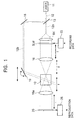
- a laser beam 12 emitted from a laser beam source 11 is divided into signal light beam 12a and recording reference light beam 12b in a beam splitter 13.
- the diameter of the signal light beam 12a is enlarged by a beam expander BX, and is irradiated as parallel light to a spatial light modulator SLM such as a panel of a TFT liquid crystal display (LCD) of a transmission type.
- the spatial light modulator SLM receives recording data converted to a signal by an encoder as an electric signal, and forms a light and dark dot pattern on a plane.
- the signal light beam 12a When the signal light beam 12a is transmitted through the spatial light modulator SLM, the signal light beam 12a is optically modulated and includes a data signal component.
- the signal light beam 12a including the dot pattern signal component is transmitted through a Fourier transformation lens 16 separated by its focal length f from the spatial light modulator SLM so that the dot pattern signal component is Fourier-transformed and is converged into a recording medium 10.
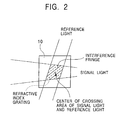
- the recording reference light beam 12b divided in the beam splitter 13 is guided into the recording medium 10 by mirrors 18, 19, and crosses an optical path of the signal light beam 12a within the recording medium 10 so that a light interference pattern is formed.
- the entire light interference pattern is recorded as a change in refractive index (refractive index grating).
- diffracted light from data of an image irradiated by coherent parallel light is focused and formed as an image by the Fourier transformation lens, and is transformed to a distribution on a focal plane of the Fourier transformation lens, i.e., on a Fourier plane.
- the distribution as a result of the Fourier transformation interferes with the coherent reference light, and its interference fringe is recorded to the recording medium in the vicinity of a focal point.
- a dot pattern image is reproduced by performing a reverse Fourier transformation in the reproduction time.
- the optical path of the signal light beam 12a is interrupted by the spatial light modulator SLM, and only the recording reference light beam 12b is irradiated to the recording medium 10.
- a position and an angle of the mirror are changed and controlled in combination with the rotation and the linear movement of the mirror so as to provide the same incident angle as the recording reference light at the recording time of a reproduced page.
- Reproducing light reproducing the recorded light interference pattern appears on an opposite side of the recording medium 10 irradiated by the recording reference light beam 12b.
- the dot pattern signal can be reproduced. Further, after this dot pattern signal is received by a photo detector 20 such as a charge coupled device CCD in a focal length position and is reconverted to an electric digital data signal and is then sent to a decoder, the original data are reproduced.
- a photo detector 20 such as a charge coupled device CCD in a focal length position and is reconverted to an electric digital data signal and is then sent to a decoder, the original data are reproduced.
- the multiple record was conventionally made within the volume of about several mm in square using angle multiplex and wavelength multiplex to record information at high density within a certain volume within the recording medium. Therefore, coherent lengths of the signal light and the reference light are set to be long and wide to secure an angle selecting property and a wavelength selecting property. This leads to the reduction in intensity per light unit used in the recording, and the recording medium of high sensitivity has been required. Further, since the multiplex record is required to realize a high density recording, a recording medium having a large erasing time constant and able to be easily multiplexed has been required. The recording medium having a large erasing time constant is generally low in recording sensitivity, and resulted in a limited recording speed as a whole system.
- the multiplex record is performed in one portion of the recording medium.
- the changes in refractive index of the recording medium due to the multiplex recording are added and a wave front of the reference light after the medium transmission is gradually changed. Therefore, the number of multiplexing is limited when adopting the arrangement that the reference light is reflected so that it is used as reproduction reference light.
- an object of the present invention is to provide a hologram recording medium, a hologram recording-reproducing method and a hologram recording and reproducing apparatus capable of performing a high density recording and at the same time able to be made compact.
- a hologram recording medium is made of a photo refractive crystal of a uniaxial crystal having a shape of parallel flat plates, and has a plurality of areas of a refractive index grating corresponding to one portion of a three-dimensional light interference pattern of a coherent signal light beam and coherent reference light of a first wavelength modulated in accordance with information data, wherein the areas of the refractive index grating respectively have a spatially independent columnar shape and are juxtaposed in parallel with each other, and lattice vectors of the refractive index grating in the adjacent areas of the refractive index grating exist in directions different from each other.
- the photo refractive crystal may be a crystal increased in recording sensitivity at the first wavelength when a gate light beam of a second wavelength is simultaneously irradiated in addition to the reference light and the signal light of the first wavelength.
- the photo refractive crystal may be a crystal whose recording sensitivity at the first wavelength increases when a gate light beam of a second wavelength is simultaneously irradiated in addition to the reference light and the signal light of the first wavelength.
- the photo refractive crystal may be an optical crystal axis approximately parallel or perpendicular to a main face of the recording medium.
- information data of one screen may be stored for each area of the refractive index grating.
- each of the areas of the refractive index grating may have a columnar shape extended approximately perpendicularly to the main face of the hologram recording medium.
- each of the areas of the refractive index grating of the columnar shape approximately may have a cylindrical shape.
- a maximum inside diameter of the areas of the refractive index grating may be made smaller than the distance between peaks of zeroth-order and primary diffracted lights of a light intensity distribution of the signal light beam.
- a hologram recording method is adapted for forming a plurality of areas of a refractive index grating corresponding to one portion of a three-dimensional light interference pattern of a coherent signal light beam and coherent reference light of a first wavelength modulated in accordance with information data within a recording medium made of a photo refractive crystal of a uniaxial crystal having a shape of parallel flat plates, wherein the signal light beam and the recording reference light beam cross each other within the recording medium, and a gate light beam having a second wavelength for revealing recording sensitivity of the recording medium is simultaneously irradiated to the recording medium so as to pass through a portion of the recording medium for crossing the signal light beam and the recording reference light beam and demarcate a volume smaller than that of this crossing portion, and the signal light beam is irradiated to the gate light beam from a different direction such that lattice vectors of the refractive index grating in adjacent areas of the refractive index grating exist in directions different from each other for
- the gate light beam may be converged and the recording medium may be arranged in a waist of this gate light beam and its vicinity, and the areas of the refractive index grating may be formed in a columnar shape and are juxtaposed in parallel with each other.
- the recording medium may have an optical crystal axis approximately parallel or perpendicular to a main face of the recording medium.
- the recording reference light beam and the gate light beam may be irradiated coaxially.
- the recording reference light beam may be converged.
- the recording reference light beam and the gate light beam may be approximately perpendicularly irradiated to a main face of the recording medium, and the areas of the refractive index grating of a columnar shape may be approximately perpendicularly extended to the main face of the recording medium.
- the gate light beam and the signal light beam may be respectively irradiated such that a cross sectional area of the gate light beam on the surface of the recording medium is smaller than that of the signal light beam.
- a maximum inside diameter of the areas of the refractive index grating may be made smaller than the distance between peaks of zeroth-order and primary diffracted lights of a light intensity distribution of the signal light beam.
- a hologram reproducing method is apapted for reproducing information data from a hologram recording medium in which the hologram recording medium is made of a photo refractive crystal of a uniaxial crystal having a shape of parallel flat plates, and has a plurality of areas of a refractive index grating respectively corresponding to one portion of a three-dimensional light interference pattern of a coherent signal light beam and coherent reference light modulated in accordance with the information data, and respectively having a spatially independent columnar shape, and juxtaposed in parallel with each other, and lattice vectors of the refractive index grating in the respective adjacent areas of the refractive index grating exist in directions different from each other, wherein the coherent reference light is incident to each of the areas of the refractive index grating of the hologram recording medium at a predetermined incident angle, and an image is formed in a spatially independent different direction from at least the adjacent areas of the refractive index grating.
- the position of a detecting part for receiving the image formed spatially independently in the different direction from the adjacent areas of the refractive index grating may be switched when the reference light beam is incident to each of the areas of the refractive index grating at the predetermined incident angle.
- a hologram recording and reproducing apparatus is adapted for forming a plurality of areas of a refractive index grating corresponding to one portion of a three-dimensional light interference pattern of a coherent signal light beam and coherent reference light of a first wavelength modulated in accordance with information data within a recording medium made of a photo refractive crystal of a uniaxial crystal having a shape of parallel flat plates, the hologram recording and reproducing apparatus comprising:
- the apparatus may further comprise a part for switching between positions of the detecting part for receiving imaged formed spatially independently in different directions from the adjacent areas of the refractive index grating when the reference light beam is incident to each of the areas of the refractive index grating at a predetermined incident angle.
- the detecting part may have a plurality of photo detector arrays, and the reproduction is performed by switching between a plurality of convergent lenses having different incident directions to the recording medium.
- the signal light part may have a plurality of optical modulators, and the recording may be performed by switching between a plurality of convergent lenses having different incident directions to the recording medium.
- the apparatus may further comprise a part for converging the gate light beam and the recording medium is arranged in a waist of the gate light beam and its vicinity, and the areas of the refractive index grating may be formed in a columnar shape and are juxtaposed in parallel with each other.
- the apparatus may further comprise a part for coaxially irradiating the recording reference light beam and the gate light beam.
- the apparatus may further comprise a part for converging the recording reference light beam.
- the recording reference light beam and the gate light beam may be irradiated approximately perpendicularly to the main face of the recording medium, and the areas of the refractive index grating of a columnar shape may be extended approximately perpendicularly to the main face of the recording medium.
- the gate light beam and the signal light beam may be respectively irradiated such that a cross sectional area of the gate light beam on the surface of the recording medium is smaller than that of the signal light beam.
- a maximum inside diameter of the areas of the refractive index grating may be made smaller than the distance between peaks of zeroth-order and primary diffracted lights of a light intensity distribution of the signal light beam.
- a reproducing method using a phase conjugate wave is considered as one of methods for making a hologram memory system compact.
- Phase conjugate reference light hereinafter called reproducing reference light
- recording reference light reference light
- the phase conjugate wave reproducing method at the recording time is the same as the conventional case.
- the phase conjugate light of signal light is generated in an incident direction of the signal light by using the phase conjugate reproducing reference light having a symmetrical property opposed to that of the reference light at the recording time so that a Fourier transformation lens can be also used as a reverse Fourier transformation lens.
- the recording and reproducing apparatus can be made of a simple lens without requiring any high performance in the lens by this nature. Therefore, the recording and reproducing method is very effective to make the recording and reproducing apparatus compact.
- the recording reference light and the reproducing reference light it is necessary to set the recording reference light and the reproducing reference light to have the symmetrical properties. Therefore, symmetrically opposed plane waves are generally used. However, since the plane wave is formed even in the vicinity of a converging point of the converged reference light, the symmetrical property is realized by perpendicularly reflecting the plane wave on a plane mirror. In this embodiment, the density of light power is increased and a high speed recording operation is achieved even in a small light amount by converging the recording light (recording reference light and signal light) to a very small area.
- the reference light is perpendicularly incident to a main face of the recording medium, and the plane mirror is arranged in a beam waist of the reference light, and the reference light is perpendicularly reflected on the plane mirror.
- the signal light is incident to the recording medium at an acute angle with respect to the reference light.
- Gate light is coaxial with respect to the reference light and is beam-shaped by a converging method similar to that of the reference light, and is incident to the recording medium.
- this embodiment uses a sector having an approximately cylindrical shape produced by a reference light approximately in the form of a plane wave that is gently converged by means of a lens having a long focal length, or a recording sector having a truncated conical shape produced by a reference light of a spherical wave.
- the plane mirror is arranged in the position of the beam waist of the recording reference light and the recording reference light is reflected and directed to an opposite direction to obtain the reproducing reference light by utilizing the reflection of the recording reference light.
- the reproducing reference light similar to the recording reference light is obtained so that the wave fronts of both the lights can be made conform to each other.
- a DBR (Distributed Bragg Reflector) laser of a long first wavelength, e.g., 850 nm is used as a near infrared laser beam source in a laser beam source 11 for generating the signal light and the reference light.
- a laser beam 12 emitted from the laser beam source 11 is divided into signal light beam 12a and recording reference light beam 12b by a beam splitter 13.
- a shutter SHs, a beam expander BX, a spatial light modulator SLM and a rotating mirror 14 are arranged on an optical path of the signal light beam 12a.
- a half mirror 15, a phase modulating plate 17 and a Fourier transformation lens 16 are arranged on a straight line as a first signal light path SP1 downstream from the rotating mirror 14.
- a mirror 18, a shutter SHr and a dichroic mirror 19 are arranged on an optical path of the recording reference light beam 12b divided by the beam splitter 13.
- the signal light beam 12a and the recording reference light beam 12b are irradiated to a crossing position P within the recording medium 10 of a shape of parallel flat plates supported by a movable stage 60 along the different optical paths.
- a beam of the signal light beam 12a supplied to the half mirror 15 of the first signal light path SP1 by the rotating mirror 14 is slantingly irradiated to a main face of the recording medium at a predetermined incident angle ⁇ , and a beam of the recording reference light beam 12b is approximately perpendicularly irradiated to the main face of the recording medium by a perpendicular incident mirror 23 through the dichroic mirror 19 and a convergent lens L.
- these beams interfere with each other within the recording medium 10.
- the recording medium 10 when a lithium niobate having a composition close to a constant ratio composition obtained by adding 100 ppm of terbium (Tb) and 5 ppm of iron (Fe) is used as the recording medium 10, the recording medium 10 has no sensitivity to near infrared light without any action on the lithium niobate. Therefore, the recording sensitivity is revealed by simultaneously irradiating gate light to the recording medium 10. The recording sensitivity is revealed only in the recording medium in a passing portion of the gate light within a crossing portion of the signal light and the reference light. Accordingly, when the gate light is converged by the convergent lens and is incident to the recording medium, for example, the hologram of a cylindrical passing portion is recorded.
- Tb terbium
- Fe iron
- the density of recording light intensity can be raised by diametrically narrowing the recording reference light until a beam diameter equivalent to that of the gate light so that a high speed recording operation can be also performed in the recording medium of low recording sensitivity and the light source of a low output.
- the photo refractive material such as LiNbO 3 adding Tb thereto is normally colorless and transparent, but visible light absorption is revealed by irradiating an ultraviolet ray, etc. to this photo refractive material so that an irradiating portion is colored. In this case time, when the visible light is irradiated to the material in the coloring portion, induced absorption (recording sensitivity) is caused in a near infrared area.
- the recording sensitivity with respect to the near infrared light is extremely reduced when the ultraviolet ray is not irradiated to the material. Accordingly, the hologram record is made by using the ultraviolet ray as the gate light and using the near infrared ray as the signal light and the reference light. Therefore,this record mode is called a two-color hologram.
- a He-Cd laser of a second wavelength, e.g., 325 nm in wavelength in a band of the ultraviolet ray or the visible light of a short wavelength is used in the light source 21 for generating the gate light.
- the light source 21 for generating the gate light is a light source having power sufficient to reveal the light induced absorption of the recording medium 10, that is, coloring of the recording medium 10 by the irradiation of light from the light source.
- both the beams of the recording reference light and the gate light are made coaxial and irradiated by the dichroic mirror 19.
- the convergent lens L converges both the light beams 12b, 22 and irradiates beam spots by reducing the beam diameter so as to form a columnar passing area in the crossing position P within the recording medium 10.
- the recording medium 10 is arranged in the vicinity of a beam waist of the gate light 22.
- the shutters SHs, SHr and SHg are arranged to open and close the optical paths of the light beams 12a, 12b and 22. Each of the shutters is opened and closed by a signal sent by a controller 32 through a driver.
- a rotatable plane mirror 45 is arranged just near the recording medium 10 on an opposite side of the recording medium 10 on the optical path of the recording reference light beam 12b.
- the plane mirror 45 is used to generate a phase conjugate wave in the reproducing time.
- the plane mirror 45 is fixed such that the plane mirror 45 is opposed to the recording reference light beam 12b passing through the recording medium 10, i.e., the recording reference light beam 12b is perpendicularly incident to the plane mirror 45. Accordingly, phase conjugate reproduction is performed from the recorded hologram by arranging the plane mirror 45 in a position of the beam waist of the recording reference light beam 12b.
- the recording reference light beam 12b When the recording reference light beam 12b is irradiated in the reproducing time, the recording reference light beam 12b passes through the recording medium 10 and is regularly reflected on the plane mirror 45 and is changed to reproducing reference light beam 12c. This reproducing reference light beam 12c is again incident to the recording medium 10 so that diffracted light (phase conjugate light as the reproducing light) is obtained by the recording medium 10.
- the plane mirror 45 is rotated by control of the controller 32 to prevent stray light and is fixed such that the recording reference light beam 12b is guided to a light absorber 50 such as a charcoal plate close to e.g., a perfect black body.
- the light transmitted through the recording medium is converged by a lens on the optical path of the signal light beam 12a so as to provide a predetermined beam diameter to reduce the stray light of the signal light. Thereafter, the converged light is guided to the light absorber 50 or a light absorber of the same kind arranged separately from the light absorber 50.
- the beam expander BX enlarges the beam diameter of the signal light beam 12a passing through the shutter SHs upstream from the first signal light path SP1 of the signal light beam 12a inclined with respect to the recording medium, and changes the signal light beam 12a to parallel light.
- the beam expander BX then irradiates the parallel light such that this parallel light is perpendicularly incident to the spacial light modulator SLM.
- the spatial light modulator SLM receives electric data of a unit page series corresponding to a two-dimensional plane page received from an encoder 25, and displays a light and dark dot matrix signal.
- the signal light beam 12a is optically modulated by passing through the spatial light modulator SLM so that the signal light beam 12a includes the data as a dot matrix component.
- the modulated beam is sent to the half mirror 15 by the rotating mirror 14 of the first signal light path SP1, and the Fourier transformation lens 16 Fourier-transforms the signal light beam 12a and converges the signal light beam 12a so as to form a focal point in the position P of the recording medium 10 or behind the position P.
- the half mirror 15 supplies a phase conjugate wave described later to a photo detector 20 such as an image pickup element of a photo detector array, e.g., a CCD.
- the spatial light modulator SLM and the photo detector 20 are arranged at a focal length of the Fourier transformation lens 16.
- the photo detector 20 branched from the half mirror 15 on the same line is arranged in the first signal light path SP1 in addition to the half mirror 15, the phase modulating plate 17 and the Fourier transformation lens 16.
- the half mirror 15 is arranged in a position able to send the phase conjugate wave to the photo detector 20.
- a decoder 26 is connected to the photo detector 20.
- the decoder 26 is connected to the controller 32. When a mark corresponding to the kind of a photo refractive crystal is formed on the recording medium 10 in advance and the recording medium 10 is mounted onto the movable stage 60 as a supporting means for moving this recording medium 10, the controller 32 automatically reads this mark by a suitable sensor, and can control the movement of the recording medium.
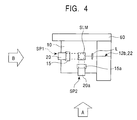
- a second signal light path SP2 is arranged in addition to the first signal light path SP1.
- the second signal light path SP2 is constructed by a half mirror 15a, a photo detector 20a, a phase modulating plate 17a described later and a Fourier transformation lens 16a described later.
- first and second signal light paths SP1 and SP2 make the signal light incident to the recording medium 10 at an incident angle ⁇ , but rotate the plane of incidence e.g., 90 degrees around optical axes of the reference light and the gate light and make the signal light incident from different directions.
- the area of a refractive index grating can be recorded or formed in a way that lattice vectors of the refractive index grating in adjacent areas of the diffractive index grating exist in directions different from each other for each area of each refractive index grating.
- the signal light beam 12a is supplied to the signal light paths of two systems or more by the rotating mirror 14, and switching and recording operations are performed by the controller 32 every recording position such that an angle ⁇ formed between the signal light and each of the reference light and the gate light is constant and incident directions to the recording medium 10 are different from each other.
- a two-color hologram recording stroke procedure for recording a hologram by simultaneously irradiating the reference light and the gate light coaxially adjusted with respect to the reference light in synchronization with the signal light at each recording time will be described in detail.
- the plane mirror 45 is rotated to a stray light preventing state and is fixed such that the recording reference light beam 12b and the gate light 22 are not regularly reflected, i.e., are not returned to the recording medium.
- a recording signal is sent from the encoder 25 to the spatial light modulator SLM, and a predetermined pattern is displayed.
- the shutter SHg is opened and a portion already recorded by preceding irradiation of the gate light is erased and the recording operation is started by opening the shutters SHs, SHr together with the irradiation of the gate light.
- the recording operation is performed for a predetermined time controlled by the controller 32, i.e., the lights interfere with each other.
- the shutters SHg, SHr, SHs are closed.
- the plane mirror 45 is rotated and returned to a regular reflecting state and is fixed. The recording operation is thus completed and a light interference pattern of the reference light and the signal light is formed within the recording medium 10, and the recording medium is partially excited by the gate light so that information is recorded as a change in refractive index.
- the recording medium 10 is moved by a predetermined amount and the position of the recording reference light beam 12b with respect to the recording medium is changed and the recording operation on a second page is performed by the same procedure.
- the supply of the signal light to the first signal light path SP1 is switched to the second signal light path SP2 by control of the rotating mirror 14 using the controller 32, and a sequential record is made.
- Fig. 8 shows an incident state example of the gate light, the recording reference light and the signal light to the recording medium.
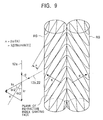
- Each of areas RG of a refractive index grating approximately having a cylindrical shape is approximately perpendicularly extended to the main face of the hologram recording medium 10.
- the population grating of an atomic number distribution relative to upper and lower levels within the recording medium according to light interference distributions of the recording reference light beam 12b and the signal light beam 12a is formed.
- the diffraction grating i.e., the diffractive index grating can be formed by causing a change in refractive index proportional to this population grating.
- a space modulating depth at this time depends on light intensity. Accordingly, the direction in which the plane of refractive index grating, that is an interference fringe, enlarges is a direction in which an angle formed by advancing directions of the recording reference light beam 12b and the signal light beam 12a is equally divided. In this case, it can be regarded that the recording reference light beam 12b is reflected on the recording medium and is converted to phase conjugate light. Accordingly, a reflection type diffraction grating is also formed.
- ⁇ [2Nsin( ⁇ /2)].
- ⁇ is an angle of the signal light beam 12a formed within the recording medium with respect to the reference light beam 12b
- N is a refractive index of the recording medium.
- ⁇ is very small, the grating interval in the transmission type is wider than that in the reflection type.
- the lattice vectors of the transmission type and the reflection type are approximately perpendicular to each other. Accordingly, if the contribution of one diffraction grating is superior, contribution of the other diffraction grating is relatively weakened so that practically only one diffraction grating works strongly.
- each of the areas of the diffractive index grating has a columnar shape and the areas of the diffraction grating are juxtaposed in parallel with each other.
- the lattice vectors K in the areas RG of the refractive index grating juxtaposed in parallel with each other exist in directions different from each other. This can be confirmed by a phase difference microscope.
- the optical system of an embodiment device is a 1000 x 1000 optical space modulator of a TFT crystal and a pixel pitch a is 10 ⁇ m and a signal light wavelength is 530 nm and a focal length is 14 mm
- the Fourier spectrum distance (d1) corresponding to this case becomes about 750 ⁇ m from the above formula.
- a large part of information of the signal light exists in a range of about ⁇ 750 ⁇ m from an optical axis.
- two-dimensional data appearing in the optical space modulator are scattered within the space of a grid type constructed by this primary diffracted light and the zeroth-order light. Therefore, a large part of a fundamental wave component important in the record is concentrated on the periphery of the zeroth-order light. Accordingly, information of a higher harmonic wave component near the primary diffracted light of the pixels becomes relatively less important.
- the diameter (d2) of the gate light is set to d1>d2 with respect to the Fourier spectrum distance (d1) even when the Fourier spectra of the signal light adjacent to each other in the recording are overlapped with each other. Further, areas limited and recorded by the gate light are set such that these areas are adjacent to each other without overlapping, i.e., a gate light pitch PG is set to PG ⁇ d2. Thus, information can be multiplexed and recorded in closest packing by a periodic spatial arrangement.
- a beam of the signal light approximately having a zero incident angle to the recording medium and a beam of the recording reference light at an incident angle ⁇ in Fig. 3 generate an interference fringe at an angle of ⁇ /2 with respect to an optical coaxis of these beams.
- recording sensitivity is high in a direction in which the direction of the generated diffraction grating is perpendicular to its optical crystal axis.
- the recording medium for setting the optical crystal axis extended at an angle of 90- ⁇ /2 with respect to the optical axis is preferable.
- the signal light and the incident angle ⁇ are reduced, a pickup device can be made compact. Accordingly, in the hologram recording medium, it is also preferable to arrange the optical crystal axis approximately in parallel with its main face.
- the optical crystal axis of the recording medium is set to be approximately parallel to a main face direction of its parallel flat plate.
- the diffraction grating is formed in the direction of a bisector of a forming angle of the recording reference light and the signal light.
- recording sensitivity is used at its maximum when the direction of this diffraction grating is perpendicular to the optical crystal axis of the recording medium.
- the recording sensitivity is reduced in a trigonometric function as the direction of the diffraction grating is shifted from the perpendicular direction.
- the diffraction grating formed by the recording reference light and the signal light is close to the direction perpendicular to the optical crystal axis, and the transmission type hologram is easily recorded.
- the diffraction grating (reflection type hologram) constructed by the reference light and the signal light reflected on the plane mirror 45 is close to a direction parallel to the optical axis of the recording medium so that the recording sensitivity is very small and no hologram is easily recorded.
- the light reflected on the plane mirror 45 acts as reproducing reference light so that diffracted light (reproduction conjugate light) is obtained from the recording medium.
- the normal hologram is naturally reproduced by the incident light, but has no influence on the phase conjugate reproduction since diffracting directions are different from each other.
- the position of the n-axis movable stage 60 holding the recording medium 10 is controlled by the controller 32 so that the recording medium 10 as an object is moved to a predetermined position.
- the shutter SHr is opened and the reproduction is started.
- the reproduction is performed for a predetermined time controlled by the controller 32.
- the shutter SHr is closed.
- the reproduction is completed.
- the plane mirror 45 is arranged such that a reflecting face of the plane mirror 45 is located in a beam waist of the recording reference light beam 12b and a normal line of this reflecting face is conformed to an incident optical path of the recording reference light beam 12b.
- the recording reference light beam 12b passes through the recording medium 10, and is regularly reflected on the plane mirror 45, and is changed to reproducing reference light beam 12c and is again incident to the recording medium 10.
- diffracted light phase conjugate light as reproducing light
- the phase conjugate reproduction can be achieved from the recorded refractive index grating.
- This light becomes a divergent spherical wave from a spherical wave converged in the beam waist via a plane wave. Accordingly, if the plane mirror is arranged in parallel with the wave front of this plane wave in the beam waist position, phase conjugate lights having this convergent spherical wave and the divergent spherical wave similar to each other and advancing directions coaxially opposed to each other are obtained.
- the normal hologram is also reproduced by the recording reference light beam 12b, but exerts substantially no influence on a reproduction detecting system since the normal hologram is reproduced in an opposite direction not concerned in the reproduction detecting system.
- the plane mirror 45 is arranged so as to be opposed to the recording reference light beam 12b, light obtained by transmitting the recording reference light beam 12b through the recording medium 10 and reflecting the recording reference light beam 12b on the plane mirror 45 is set to reproducing reference light beam 12c.
- the recording reference light beam 12b and the reproducing reference light beam 12c pass through the same optical path every time.
- the reproducing reference light beam 12c is coaxial with respect to the recording reference light beam 12b at any time and is propagated in the opposite direction and is incident to the recording medium 10.
- diffracted light phase conjugate wave
- the Fourier transformation lens 16 guides this diffracted light to the half mirror 15, and this dot pattern signal is received by a light receiver of the photo detector 20 and is reconverted to an electric digital data signal. Thereafter, when the electric digital data signal is sent to the decoder 26, original data are reproduced.
- the recording medium 10 is moved by a predetermined amount so that the position of the recording reference light beam 12b with respect to the recording medium is changed and the reproduction on a second page is performed in the same procedure.
- the photo detector 20 is switched to the photo detector 20a and light is received.
- Cross talk can be reduced since the diffraction grating (refractive index grating) is spatially reproduced mutually independently between adjacent portions in a recording portion of the recording medium.
- three sets of Fourier transformation lenses having incident faces mutually rotated by 120 degrees around the optical axes of the reference light and the gate light are used by the recording reproduction to the recording medium in the above procedure.
- a first signal light path SP1 a second signal light path SP2 and a third signal light path SP3
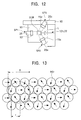
- a reference light spot diameter at a reading time can be allowed until 2.46r at its maximum.
- An arrow shown within each area RG of Fig. 13 shows a main face direction component of the lattice vector K.
- the diffracted light when the reference light is incident to the recording portion of the recording medium, the diffracted light according to a recording signal is transmitted through the Fourier transformation lens and the phase modulating plate through which the diffracted light passes as the phase conjugate light at the recording time.
- the diffracted light is focused and formed as an image by a predetermined photo detector array, and is photoelectrically converted so that a signal is modulated.
- the position of the recording medium is controlled by the controller 32 such that the sum of outputs of the photo detectors 20 of the respective signal light paths is observed and only a predetermined desirable photo detector output becomes a maximum value and the other photo detector outputs are minimized.
- the recording signal light is switched by the rotating mirror 14 commonly using one set of the beam expander BX and the spatial light modulator SLM.
- the hologram recording and reproducing apparatus can be also constructed by a plurality of spatial light modulators such that the beam expander BX and the spatial light modulator SLM are independently arranged in the respective signal light paths, and light branched from the light source by the shutter is supplied to each of the spatial light modulators SLM.
- the photo detector array is arranged for each signal light path and a plurality of detecting lines are arranged.
- an arrangement using one common photo detector array can be adopted by a construction that allows selection of an incident path to the photo detector array from an area of the refractive index grating as a target of the reading by means of a shutter, and the like.
- the hologram recording is realized in a transmission type diffraction grating.
- equivalent effects can be also obtaied by using a reflection type diffraction grating.
- the optical axis of the recording medium is approximately perpendicular to the main face, and the recording and reproduction is performed while fixing the plane mirror 45 of Fig. 3 which is rotated to prevent the stray light in recording.
- the diffraction grating is formed in the directions of bisector angles of the recording reference light and the signal light, and the recording sensitivity becomes maximum when this direction is perpendicular to the optical axis of the recording medium.
- the recording sensitivity reduces in the form of a trigonometric function as this direction is shifted from the perpendicular direction.
- the strength of recording and reproduction reference light beams are reduced reversely to the above embodiment, and the diffraction grating constructed by the reference light and the signal light reflected on the plane mirror 45 is close to a direction perpendicular to the optical axis of the recording medium. Therefore, the recording sensitivity is large and the reflection type hologram is formed.
- the diffraction grating (transmission type hologram) constructed by the incident reference and signal lights is close to a direction parallel to the optical axis of the recording medium so that the recording sensitivity is very small and this hologram is not easily recorded.
- the incident reference light acts as reproducing reference light for the phase conjugate reproduction, and diffracted light (reproducing conjugate light) from the recording medium is obtained.
- the normal hologram is similarly reproduced by the reflected light, but has no influence on the phase conjugate reproduction since diffracting directions are different from each other.
- the two-color hologram is recorded by the gate light reduced in diameter
- a recording portion formed in the recording medium is formed in a needle elongated shape so that a spatial multiplex record can be efficiently made.
- the density of recording light intensity is improved by reducing the diameter of the reference light in the recording, a high speed recording operation can be also performed in the recording medium of low recording sensitivity and the light source of a low output.
- a 1/4 wavelength plate is arranged between the recording medium 10 and the plane mirror 45, the recording reference light beam 12b passes through the 1/4 wavelength plate twice after the recording reference light beam 12b is transmitted through the recording medium 10.
- a polarizing direction of the reproducing reference light beam 12c incident to the recording medium 10 can be changed by 90 degrees.
- a separating optical system for guiding all the signal light to the recording medium 10 and guiding all the diffracted light to a CCD side can be constructed by using a polarizing beam splitter in an optical system for separating the signal light beam 12a from the spatial light modulator SLM and the diffracted light (phase conjugate light as reproducing light) transmitted to the photo detector 20.
- light amount can be effectively used.
- the signal light beam and the recording reference light beam cross each other within the recording medium, and the gate light beam for revealing recording sensitivity of the recording medium is simultaneously irradiated to the recording medium so as to pass through a portion of the recording medium in which the signal light beam and the recording reference light beam cross each other and demarcate a volume smaller than that of this crossing portion. Accordingly, a recording area is formed in an elongated, needle-like shape so that a spatial multiplex record can be efficiently made. Furthermore, in accordance with the present invention, a reproduction image from the area of the refractive index grating of the recording medium is formed in a position spatially independent of a reproduction image from the area of an adjacent refractive index grating.
- the area of the refractive index grating can be formed by generating a modulation signal or modulation signals by using one or a plurality of spatial light modulators in the recording time, and controlling the direction of the modulation signal incident into the recording medium.
- a closest packing-type recording can be achieved by employing three or more kinds of directions of incident, of the signal light.
- the spatially independent reproduction image can be detected by arranging one or a plurality of photo detecting arrays in the reproduction time.
- a recording time is shortened by increasing light power density by converging the recording light (recording reference light and signal light) to a very small area, and a high speed record and an increase in recording density can be achieved by effectively utilizing recordable capacity of the recording medium by overlapping columnar recording areas.
- phase conjugate reproduction in which wave fronts of the recording reference light beam and signal light beams are conformed to each other can be realized by an arrangment that reflection occurs in the beam waist of the recording and reproduction light beams. Accordingly, a recording and reproducing optical system is simplified so that a memory system can be made compact.
- the change in refractive index of the recording medium due to the recording is hardly added and the difference in wave front between transmission light of the recording medium and incident light is made small even when the transmission light of the recording medium is used as reference light.
- This is quite advantageous in the signal reproduction.
- it is possible to avoid the overlapping of influences due to the formation of diffraction grating in a direction in which the recording sensitivity is small in the recording medium. Therefore, influences on the reproduction can be kept small even when no measure is taken to shield the reflected light.
Landscapes
- Physics & Mathematics (AREA)
- Mathematical Physics (AREA)
- General Physics & Mathematics (AREA)
- Holo Graphy (AREA)
Applications Claiming Priority (2)
| Application Number | Priority Date | Filing Date | Title |
|---|---|---|---|
| JP2001101890A JP2002297008A (ja) | 2001-03-30 | 2001-03-30 | ホログラム記録媒体、ホログラム記録再生方法及びホログラム記録再生装置 |
| JP2001101890 | 2001-03-30 |
Publications (1)
| Publication Number | Publication Date |
|---|---|
| EP1246031A2 true EP1246031A2 (de) | 2002-10-02 |
Family
ID=18955149
Family Applications (1)
| Application Number | Title | Priority Date | Filing Date |
|---|---|---|---|
| EP02006943A Withdrawn EP1246031A2 (de) | 2001-03-30 | 2002-03-26 | Aufzeichnungsmaterial für Hologramme, Verfahren zum Aufzeichnen und Wiedergeben von Hologrammen und Vorrichtung zum Aufzeichnen und Wiedergeben von Hologrammen |
Country Status (3)
| Country | Link |
|---|---|
| US (1) | US20020154589A1 (de) |
| EP (1) | EP1246031A2 (de) |
| JP (1) | JP2002297008A (de) |
Families Citing this family (18)
| Publication number | Priority date | Publication date | Assignee | Title |
|---|---|---|---|---|
| JP3844460B2 (ja) * | 2002-08-05 | 2006-11-15 | パイオニア株式会社 | 空間光変調器 |
| US20050036182A1 (en) * | 2002-11-22 | 2005-02-17 | Curtis Kevin R. | Methods for implementing page based holographic ROM recording and reading |
| JP2004191683A (ja) * | 2002-12-11 | 2004-07-08 | Sony Corp | ホログラム記録再生装置、およびホログラム記録の再生装置 |
| US7706233B2 (en) * | 2003-03-20 | 2010-04-27 | Optware Corporation | Optical-disk recording method, recording apparatus and reproducing apparatus |
| EP1659439A4 (de) | 2003-08-07 | 2009-03-04 | Rohm Co Ltd | Optische steuerungsvorrichtung |
| JPWO2005015292A1 (ja) | 2003-08-07 | 2007-09-27 | ローム株式会社 | 光変調膜を備える構造体およびそれを用いた光制御素子 |
| US7852538B2 (en) | 2004-07-07 | 2010-12-14 | Sony Corporation | Hologram recording apparatus and hologram recording method |
| KR20070097404A (ko) | 2005-01-20 | 2007-10-04 | 로무 가부시키가이샤 | 광 변조막을 갖는 광 제어 장치 |
| US8125423B2 (en) | 2005-02-07 | 2012-02-28 | Rohm Co., Ltd. | Voltage control circuit, voltage control method and light control apparatus utilizing the same |
| JP2006293022A (ja) | 2005-04-11 | 2006-10-26 | Rohm Co Ltd | 光変調装置の製造方法、光変調装置および光変調システム |
| JP2007147934A (ja) | 2005-11-28 | 2007-06-14 | Rohm Co Ltd | 光制御装置およびそれを用いた光制御システム |
| JP2008170606A (ja) * | 2007-01-10 | 2008-07-24 | Canon Inc | ホログラフィック情報記録再生装置 |
| US7759620B2 (en) * | 2007-07-03 | 2010-07-20 | Micronic Laser Systems Ab | Fourier plane analysis and refinement of SLM calibration |
| TWI384475B (zh) * | 2009-06-06 | 2013-02-01 | Univ Nat Central | 全像光碟讀寫機構與全像光碟讀取機構 |
| EP2668465A1 (de) * | 2011-01-25 | 2013-12-04 | Massachusetts Institute Of Technology | Monoshot-vollfeld-reflexionsphasen-mikroskopie |
| US8605562B2 (en) * | 2011-08-09 | 2013-12-10 | Samsung Electronics Co., Ltd. | Apparatus and method for recording micro-hologram |
| US9291997B2 (en) * | 2012-05-17 | 2016-03-22 | Samsung Electronics Co., Ltd. | High speed hologram recording apparatus and method |
| JP2020060690A (ja) * | 2018-10-10 | 2020-04-16 | ウシオ電機株式会社 | 光照射方法、機能素子の製造方法および光照射装置 |
Family Cites Families (3)
| Publication number | Priority date | Publication date | Assignee | Title |
|---|---|---|---|---|
| US5696613A (en) * | 1993-08-20 | 1997-12-09 | Tamarack Storage Devices | Method and apparatus for multiplexing data in different planes of incidence of a thin holographic storage media |
| US5703705A (en) * | 1995-05-05 | 1997-12-30 | Lucent Technologies Inc. | Tilt multiplex holography |
| US6322933B1 (en) * | 1999-01-12 | 2001-11-27 | Siros Technologies, Inc. | Volumetric track definition for data storage media used to record data by selective alteration of a format hologram |
-
2001
- 2001-03-30 JP JP2001101890A patent/JP2002297008A/ja active Pending
-
2002
- 2002-03-26 EP EP02006943A patent/EP1246031A2/de not_active Withdrawn
- 2002-03-27 US US10/106,867 patent/US20020154589A1/en not_active Abandoned
Also Published As
| Publication number | Publication date |
|---|---|
| US20020154589A1 (en) | 2002-10-24 |
| JP2002297008A (ja) | 2002-10-09 |
Similar Documents
| Publication | Publication Date | Title |
|---|---|---|
| EP1246031A2 (de) | Aufzeichnungsmaterial für Hologramme, Verfahren zum Aufzeichnen und Wiedergeben von Hologrammen und Vorrichtung zum Aufzeichnen und Wiedergeben von Hologrammen | |
| JP3521113B2 (ja) | 体積ホログラフィックメモリ光情報記録再生装置 | |
| US6490061B1 (en) | Optical information recording and reproducing apparatus having volume holographic memory | |
| US7023786B2 (en) | Hologram recording and reproducing apparatus | |
| JP3547610B2 (ja) | 体積ホログラフィックメモリ光情報記録再生装置 | |
| JP4815944B2 (ja) | ホログラム記録方法及び装置 | |
| US6862120B2 (en) | Hologram recording medium, hologram recording method and hologram recording and reproducing apparatus | |
| US20100054103A1 (en) | Optical information recording/reproducing apparatus and method | |
| US8270278B2 (en) | Optical recording apparatus, optical recording method, recording medium, and reproducing method | |
| JPWO2004013706A1 (ja) | ホログラム記録再生方法及びホログラム記録再生装置 | |
| US6707585B2 (en) | Holographic recording and reproducing apparatus and holographic recording and reproducing method | |
| KR101075351B1 (ko) | 홀로그램 기록 장치 | |
| US6301028B1 (en) | Holographic memory and optical information recording and reproducing apparatus using the same | |
| JP4214601B2 (ja) | ホログラム記録再生装置及びホログラム記録再生方法 | |
| EP1708182A2 (de) | Hologrammaufzeichnungsgerät | |
| US6504810B2 (en) | Optical information recording/reproducing system | |
| JP2009104037A (ja) | ホログラム記録装置およびホログラム記録方法 | |
| US20080123506A1 (en) | Optical information recording/reproducing apparatus | |
| US7796313B2 (en) | Holographic information recording-reproducing process and apparatus therefor | |
| JP2002304109A (ja) | ホログラム記録再生方法及びホログラム記録再生装置 | |
| EP2015295A1 (de) | Hologrammelement, Vorrichtung zur Herstellung eines Hologrammelements, Verfahren zur Herstellung eines Hologrammelements und Hologrammrekonstruktionsvorrichtung zur Wiederherstellung von Informationen | |
| JPWO2007043451A1 (ja) | ホログラム記録再生システム | |
| JP2002279644A (ja) | ホログラム記録媒体、ホログラム記録方法及びホログラム記録再生装置 | |
| KR101568766B1 (ko) | 3차원 칼라 표시 장치 및 3차원 칼라 영상 표시 방법 | |
| JP2005004829A (ja) | 光メモリ装置 |
Legal Events
| Date | Code | Title | Description |
|---|---|---|---|
| PUAI | Public reference made under article 153(3) epc to a published international application that has entered the european phase |
Free format text: ORIGINAL CODE: 0009012 |
|
| AK | Designated contracting states |
Kind code of ref document: A2 Designated state(s): AT BE CH CY DE DK ES FI FR GB GR IE IT LI LU MC NL PT SE TR |
|
| AX | Request for extension of the european patent |
Free format text: AL;LT;LV;MK;RO;SI |
|
| STAA | Information on the status of an ep patent application or granted ep patent |
Free format text: STATUS: THE APPLICATION IS DEEMED TO BE WITHDRAWN |
|
| 18D | Application deemed to be withdrawn |
Effective date: 20061003 |