EP1246853B1 - Procede de polimerisation et de copolymerisation en phase gazeuse de monomeres olefiniques - Google Patents
Procede de polimerisation et de copolymerisation en phase gazeuse de monomeres olefiniques Download PDFInfo
- Publication number
- EP1246853B1 EP1246853B1 EP00984663A EP00984663A EP1246853B1 EP 1246853 B1 EP1246853 B1 EP 1246853B1 EP 00984663 A EP00984663 A EP 00984663A EP 00984663 A EP00984663 A EP 00984663A EP 1246853 B1 EP1246853 B1 EP 1246853B1
- Authority
- EP
- European Patent Office
- Prior art keywords
- process according
- catalysts
- recycle stream
- reactor
- dew point
- Prior art date
- Legal status (The legal status is an assumption and is not a legal conclusion. Google has not performed a legal analysis and makes no representation as to the accuracy of the status listed.)
- Revoked
Links
- 238000000034 method Methods 0.000 title claims abstract description 79
- 230000008569 process Effects 0.000 title claims abstract description 74
- 239000000178 monomer Substances 0.000 title claims abstract description 46
- 150000001336 alkenes Chemical class 0.000 title claims description 20
- JRZJOMJEPLMPRA-UHFFFAOYSA-N olefin Natural products CCCCCCCC=C JRZJOMJEPLMPRA-UHFFFAOYSA-N 0.000 title claims description 12
- 238000007334 copolymerization reaction Methods 0.000 title description 13
- 238000012685 gas phase polymerization Methods 0.000 title description 5
- 239000000203 mixture Substances 0.000 claims abstract description 40
- 230000000379 polymerizing effect Effects 0.000 claims abstract description 12
- 239000003701 inert diluent Substances 0.000 claims abstract description 11
- 239000003054 catalyst Substances 0.000 claims description 73
- 239000007789 gas Substances 0.000 claims description 66
- ATUOYWHBWRKTHZ-UHFFFAOYSA-N Propane Chemical compound CCC ATUOYWHBWRKTHZ-UHFFFAOYSA-N 0.000 claims description 64
- IJGRMHOSHXDMSA-UHFFFAOYSA-N Atomic nitrogen Chemical compound N#N IJGRMHOSHXDMSA-UHFFFAOYSA-N 0.000 claims description 48
- 229920000642 polymer Polymers 0.000 claims description 46
- OTMSDBZUPAUEDD-UHFFFAOYSA-N Ethane Chemical compound CC OTMSDBZUPAUEDD-UHFFFAOYSA-N 0.000 claims description 34
- 230000005494 condensation Effects 0.000 claims description 34
- 238000009833 condensation Methods 0.000 claims description 34
- 239000001294 propane Substances 0.000 claims description 33
- 239000005977 Ethylene Substances 0.000 claims description 28
- 238000006116 polymerization reaction Methods 0.000 claims description 28
- VGGSQFUCUMXWEO-UHFFFAOYSA-N Ethene Chemical compound C=C VGGSQFUCUMXWEO-UHFFFAOYSA-N 0.000 claims description 27
- LIKMAJRDDDTEIG-UHFFFAOYSA-N 1-hexene Chemical compound CCCCC=C LIKMAJRDDDTEIG-UHFFFAOYSA-N 0.000 claims description 24
- 229910052757 nitrogen Inorganic materials 0.000 claims description 24
- 230000000694 effects Effects 0.000 claims description 22
- VXNZUUAINFGPBY-UHFFFAOYSA-N 1-Butene Chemical compound CCC=C VXNZUUAINFGPBY-UHFFFAOYSA-N 0.000 claims description 18
- 150000001875 compounds Chemical class 0.000 claims description 17
- QWTDNUCVQCZILF-UHFFFAOYSA-N isopentane Chemical compound CCC(C)C QWTDNUCVQCZILF-UHFFFAOYSA-N 0.000 claims description 16
- 125000004432 carbon atom Chemical group C* 0.000 claims description 15
- NNPPMTNAJDCUHE-UHFFFAOYSA-N isobutane Chemical compound CC(C)C NNPPMTNAJDCUHE-UHFFFAOYSA-N 0.000 claims description 15
- QQONPFPTGQHPMA-UHFFFAOYSA-N Propene Chemical compound CC=C QQONPFPTGQHPMA-UHFFFAOYSA-N 0.000 claims description 12
- KWKAKUADMBZCLK-UHFFFAOYSA-N 1-octene Chemical compound CCCCCCC=C KWKAKUADMBZCLK-UHFFFAOYSA-N 0.000 claims description 10
- CRSOQBOWXPBRES-UHFFFAOYSA-N neopentane Chemical compound CC(C)(C)C CRSOQBOWXPBRES-UHFFFAOYSA-N 0.000 claims description 10
- 150000001335 aliphatic alkanes Chemical class 0.000 claims description 9
- XKRFYHLGVUSROY-UHFFFAOYSA-N Argon Chemical compound [Ar] XKRFYHLGVUSROY-UHFFFAOYSA-N 0.000 claims description 8
- AFABGHUZZDYHJO-UHFFFAOYSA-N dimethyl butane Natural products CCCC(C)C AFABGHUZZDYHJO-UHFFFAOYSA-N 0.000 claims description 8
- 239000001282 iso-butane Substances 0.000 claims description 8
- 235000013847 iso-butane Nutrition 0.000 claims description 8
- RGSFGYAAUTVSQA-UHFFFAOYSA-N Cyclopentane Chemical compound C1CCCC1 RGSFGYAAUTVSQA-UHFFFAOYSA-N 0.000 claims description 6
- YWAKXRMUMFPDSH-UHFFFAOYSA-N pentene Chemical compound CCCC=C YWAKXRMUMFPDSH-UHFFFAOYSA-N 0.000 claims description 6
- 239000012809 cooling fluid Substances 0.000 claims description 5
- TVMXDCGIABBOFY-UHFFFAOYSA-N n-Octanol Natural products CCCCCCCC TVMXDCGIABBOFY-UHFFFAOYSA-N 0.000 claims description 5
- WSSSPWUEQFSQQG-UHFFFAOYSA-N 4-methyl-1-pentene Chemical compound CC(C)CC=C WSSSPWUEQFSQQG-UHFFFAOYSA-N 0.000 claims description 4
- OFBQJSOFQDEBGM-UHFFFAOYSA-N Pentane Chemical compound CCCCC OFBQJSOFQDEBGM-UHFFFAOYSA-N 0.000 claims description 4
- VYPSYNLAJGMNEJ-UHFFFAOYSA-N Silicium dioxide Chemical compound O=[Si]=O VYPSYNLAJGMNEJ-UHFFFAOYSA-N 0.000 claims description 4
- PPBRXRYQALVLMV-UHFFFAOYSA-N Styrene Chemical compound C=CC1=CC=CC=C1 PPBRXRYQALVLMV-UHFFFAOYSA-N 0.000 claims description 4
- 229910052786 argon Inorganic materials 0.000 claims description 4
- 239000002685 polymerization catalyst Substances 0.000 claims description 4
- 239000004711 α-olefin Substances 0.000 claims description 4
- QMMOXUPEWRXHJS-HYXAFXHYSA-N (z)-pent-2-ene Chemical compound CC\C=C/C QMMOXUPEWRXHJS-HYXAFXHYSA-N 0.000 claims description 3
- DMEGYFMYUHOHGS-UHFFFAOYSA-N heptamethylene Natural products C1CCCCCC1 DMEGYFMYUHOHGS-UHFFFAOYSA-N 0.000 claims description 3
- 239000012968 metallocene catalyst Substances 0.000 claims description 3
- IJDNQMDRQITEOD-UHFFFAOYSA-N n-butane Chemical compound CCCC IJDNQMDRQITEOD-UHFFFAOYSA-N 0.000 claims description 3
- 125000000217 alkyl group Chemical group 0.000 claims description 2
- HSFWRNGVRCDJHI-UHFFFAOYSA-N alpha-acetylene Natural products C#C HSFWRNGVRCDJHI-UHFFFAOYSA-N 0.000 claims description 2
- 239000011951 cationic catalyst Substances 0.000 claims description 2
- 150000001844 chromium Chemical class 0.000 claims description 2
- IAQRGUVFOMOMEM-ARJAWSKDSA-N cis-but-2-ene Chemical compound C\C=C/C IAQRGUVFOMOMEM-ARJAWSKDSA-N 0.000 claims description 2
- 150000001993 dienes Chemical class 0.000 claims description 2
- 150000002148 esters Chemical class 0.000 claims description 2
- 125000002534 ethynyl group Chemical group [H]C#C* 0.000 claims description 2
- 125000002485 formyl group Chemical class [H]C(*)=O 0.000 claims description 2
- 239000011953 free-radical catalyst Substances 0.000 claims description 2
- 150000008040 ionic compounds Chemical class 0.000 claims description 2
- 150000001282 organosilanes Chemical class 0.000 claims description 2
- 230000001105 regulatory effect Effects 0.000 claims description 2
- 239000000377 silicon dioxide Substances 0.000 claims description 2
- XJDNKRIXUMDJCW-UHFFFAOYSA-J titanium tetrachloride Chemical compound Cl[Ti](Cl)(Cl)Cl XJDNKRIXUMDJCW-UHFFFAOYSA-J 0.000 claims description 2
- IAQRGUVFOMOMEM-ONEGZZNKSA-N trans-but-2-ene Chemical compound C\C=C\C IAQRGUVFOMOMEM-ONEGZZNKSA-N 0.000 claims description 2
- 229910052723 transition metal Inorganic materials 0.000 claims description 2
- 150000003624 transition metals Chemical class 0.000 claims description 2
- 125000000391 vinyl group Chemical group [H]C([*])=C([H])[H] 0.000 claims description 2
- 229920002554 vinyl polymer Polymers 0.000 claims description 2
- RTZKZFJDLAIYFH-UHFFFAOYSA-N Diethyl ether Chemical compound CCOCC RTZKZFJDLAIYFH-UHFFFAOYSA-N 0.000 claims 2
- TWRXJAOTZQYOKJ-UHFFFAOYSA-L Magnesium chloride Chemical compound [Mg+2].[Cl-].[Cl-] TWRXJAOTZQYOKJ-UHFFFAOYSA-L 0.000 claims 2
- QMMOXUPEWRXHJS-HWKANZROSA-N (e)-pent-2-ene Chemical compound CC\C=C\C QMMOXUPEWRXHJS-HWKANZROSA-N 0.000 claims 1
- 239000004411 aluminium Substances 0.000 claims 1
- 229910052782 aluminium Inorganic materials 0.000 claims 1
- 125000000129 anionic group Chemical group 0.000 claims 1
- 239000012967 coordination catalyst Substances 0.000 claims 1
- 229910001629 magnesium chloride Inorganic materials 0.000 claims 1
- 229910052751 metal Inorganic materials 0.000 claims 1
- 239000002184 metal Substances 0.000 claims 1
- QMMOXUPEWRXHJS-UHFFFAOYSA-N pentene-2 Natural products CCC=CC QMMOXUPEWRXHJS-UHFFFAOYSA-N 0.000 claims 1
- 238000004519 manufacturing process Methods 0.000 abstract description 44
- 238000001816 cooling Methods 0.000 description 31
- 238000006243 chemical reaction Methods 0.000 description 22
- 239000007788 liquid Substances 0.000 description 20
- VLKZOEOYAKHREP-UHFFFAOYSA-N n-Hexane Chemical compound CCCCCC VLKZOEOYAKHREP-UHFFFAOYSA-N 0.000 description 15
- 239000002245 particle Substances 0.000 description 15
- 239000011347 resin Substances 0.000 description 14
- 229920005989 resin Polymers 0.000 description 14
- 239000001257 hydrogen Substances 0.000 description 13
- 229910052739 hydrogen Inorganic materials 0.000 description 13
- 150000002431 hydrogen Chemical class 0.000 description 12
- VNWKTOKETHGBQD-UHFFFAOYSA-N methane Chemical compound C VNWKTOKETHGBQD-UHFFFAOYSA-N 0.000 description 12
- 230000003134 recirculating effect Effects 0.000 description 12
- 238000005057 refrigeration Methods 0.000 description 12
- 239000012530 fluid Substances 0.000 description 10
- 241000282326 Felis catus Species 0.000 description 8
- 230000008901 benefit Effects 0.000 description 8
- 229920001577 copolymer Polymers 0.000 description 8
- 239000003085 diluting agent Substances 0.000 description 5
- 239000000470 constituent Substances 0.000 description 4
- 229930195733 hydrocarbon Natural products 0.000 description 4
- 150000002430 hydrocarbons Chemical class 0.000 description 4
- 238000012423 maintenance Methods 0.000 description 4
- -1 polyethylene Polymers 0.000 description 4
- 230000009467 reduction Effects 0.000 description 4
- 230000008961 swelling Effects 0.000 description 4
- 239000004215 Carbon black (E152) Substances 0.000 description 3
- 238000010420 art technique Methods 0.000 description 3
- 230000015572 biosynthetic process Effects 0.000 description 3
- 238000010574 gas phase reaction Methods 0.000 description 3
- 230000006872 improvement Effects 0.000 description 3
- 229920000573 polyethylene Polymers 0.000 description 3
- 238000011112 process operation Methods 0.000 description 3
- 239000000047 product Substances 0.000 description 3
- AFFLGGQVNFXPEV-UHFFFAOYSA-N 1-decene Chemical compound CCCCCCCCC=C AFFLGGQVNFXPEV-UHFFFAOYSA-N 0.000 description 2
- 239000004698 Polyethylene Substances 0.000 description 2
- 239000004743 Polypropylene Substances 0.000 description 2
- 238000005054 agglomeration Methods 0.000 description 2
- 230000002776 aggregation Effects 0.000 description 2
- 239000003795 chemical substances by application Substances 0.000 description 2
- 238000007906 compression Methods 0.000 description 2
- 230000006835 compression Effects 0.000 description 2
- 239000000498 cooling water Substances 0.000 description 2
- 238000000465 moulding Methods 0.000 description 2
- 229920001155 polypropylene Polymers 0.000 description 2
- 125000004805 propylene group Chemical group [H]C([H])([H])C([H])([*:1])C([H])([H])[*:2] 0.000 description 2
- 229920006395 saturated elastomer Polymers 0.000 description 2
- AZUYLZMQTIKGSC-UHFFFAOYSA-N 1-[6-[4-(5-chloro-6-methyl-1H-indazol-4-yl)-5-methyl-3-(1-methylindazol-5-yl)pyrazol-1-yl]-2-azaspiro[3.3]heptan-2-yl]prop-2-en-1-one Chemical compound ClC=1C(=C2C=NNC2=CC=1C)C=1C(=NN(C=1C)C1CC2(CN(C2)C(C=C)=O)C1)C=1C=C2C=NN(C2=CC=1)C AZUYLZMQTIKGSC-UHFFFAOYSA-N 0.000 description 1
- VEXZGXHMUGYJMC-UHFFFAOYSA-M Chloride anion Chemical compound [Cl-] VEXZGXHMUGYJMC-UHFFFAOYSA-M 0.000 description 1
- UFHFLCQGNIYNRP-UHFFFAOYSA-N Hydrogen Chemical compound [H][H] UFHFLCQGNIYNRP-UHFFFAOYSA-N 0.000 description 1
- 238000010521 absorption reaction Methods 0.000 description 1
- 125000005234 alkyl aluminium group Chemical group 0.000 description 1
- 239000011952 anionic catalyst Substances 0.000 description 1
- 238000013459 approach Methods 0.000 description 1
- 230000003190 augmentative effect Effects 0.000 description 1
- 230000009286 beneficial effect Effects 0.000 description 1
- 238000009835 boiling Methods 0.000 description 1
- 239000007795 chemical reaction product Substances 0.000 description 1
- 239000003426 co-catalyst Substances 0.000 description 1
- 230000000052 comparative effect Effects 0.000 description 1
- 230000003750 conditioning effect Effects 0.000 description 1
- 238000011161 development Methods 0.000 description 1
- WDNQRCVBPNOTNV-UHFFFAOYSA-N dinonylnaphthylsulfonic acid Chemical compound C1=CC=C2C(S(O)(=O)=O)=C(CCCCCCCCC)C(CCCCCCCCC)=CC2=C1 WDNQRCVBPNOTNV-UHFFFAOYSA-N 0.000 description 1
- 238000009826 distribution Methods 0.000 description 1
- 150000002170 ethers Chemical class 0.000 description 1
- 229920001038 ethylene copolymer Polymers 0.000 description 1
- 238000005243 fluidization Methods 0.000 description 1
- 239000008246 gaseous mixture Substances 0.000 description 1
- 230000005484 gravity Effects 0.000 description 1
- 239000001307 helium Substances 0.000 description 1
- 229910052734 helium Inorganic materials 0.000 description 1
- SWQJXJOGLNCZEY-UHFFFAOYSA-N helium atom Chemical compound [He] SWQJXJOGLNCZEY-UHFFFAOYSA-N 0.000 description 1
- 229920001903 high density polyethylene Polymers 0.000 description 1
- 239000004700 high-density polyethylene Substances 0.000 description 1
- 230000001771 impaired effect Effects 0.000 description 1
- 239000011261 inert gas Substances 0.000 description 1
- 239000000463 material Substances 0.000 description 1
- 150000002736 metal compounds Chemical class 0.000 description 1
- 238000012986 modification Methods 0.000 description 1
- 230000004048 modification Effects 0.000 description 1
- 238000011020 pilot scale process Methods 0.000 description 1
- 229920000098 polyolefin Polymers 0.000 description 1
- 239000002243 precursor Substances 0.000 description 1
- 238000012545 processing Methods 0.000 description 1
- 238000011084 recovery Methods 0.000 description 1
- 238000004088 simulation Methods 0.000 description 1
- 239000007787 solid Substances 0.000 description 1
- 238000007711 solidification Methods 0.000 description 1
- 230000008023 solidification Effects 0.000 description 1
- 239000000126 substance Substances 0.000 description 1
- 238000012360 testing method Methods 0.000 description 1
- 238000012546 transfer Methods 0.000 description 1
- 239000003039 volatile agent Substances 0.000 description 1
- XLYOFNOQVPJJNP-UHFFFAOYSA-N water Substances O XLYOFNOQVPJJNP-UHFFFAOYSA-N 0.000 description 1
Images
Classifications
-
- C—CHEMISTRY; METALLURGY
- C08—ORGANIC MACROMOLECULAR COMPOUNDS; THEIR PREPARATION OR CHEMICAL WORKING-UP; COMPOSITIONS BASED THEREON
- C08F—MACROMOLECULAR COMPOUNDS OBTAINED BY REACTIONS ONLY INVOLVING CARBON-TO-CARBON UNSATURATED BONDS
- C08F10/00—Homopolymers and copolymers of unsaturated aliphatic hydrocarbons having only one carbon-to-carbon double bond
- C08F10/02—Ethene
-
- C—CHEMISTRY; METALLURGY
- C08—ORGANIC MACROMOLECULAR COMPOUNDS; THEIR PREPARATION OR CHEMICAL WORKING-UP; COMPOSITIONS BASED THEREON
- C08F—MACROMOLECULAR COMPOUNDS OBTAINED BY REACTIONS ONLY INVOLVING CARBON-TO-CARBON UNSATURATED BONDS
- C08F10/00—Homopolymers and copolymers of unsaturated aliphatic hydrocarbons having only one carbon-to-carbon double bond
-
- C—CHEMISTRY; METALLURGY
- C08—ORGANIC MACROMOLECULAR COMPOUNDS; THEIR PREPARATION OR CHEMICAL WORKING-UP; COMPOSITIONS BASED THEREON
- C08F—MACROMOLECULAR COMPOUNDS OBTAINED BY REACTIONS ONLY INVOLVING CARBON-TO-CARBON UNSATURATED BONDS
- C08F110/00—Homopolymers of unsaturated aliphatic hydrocarbons having only one carbon-to-carbon double bond
- C08F110/02—Ethene
-
- C—CHEMISTRY; METALLURGY
- C08—ORGANIC MACROMOLECULAR COMPOUNDS; THEIR PREPARATION OR CHEMICAL WORKING-UP; COMPOSITIONS BASED THEREON
- C08F—MACROMOLECULAR COMPOUNDS OBTAINED BY REACTIONS ONLY INVOLVING CARBON-TO-CARBON UNSATURATED BONDS
- C08F110/00—Homopolymers of unsaturated aliphatic hydrocarbons having only one carbon-to-carbon double bond
- C08F110/04—Monomers containing three or four carbon atoms
- C08F110/06—Propene
-
- C—CHEMISTRY; METALLURGY
- C08—ORGANIC MACROMOLECULAR COMPOUNDS; THEIR PREPARATION OR CHEMICAL WORKING-UP; COMPOSITIONS BASED THEREON
- C08F—MACROMOLECULAR COMPOUNDS OBTAINED BY REACTIONS ONLY INVOLVING CARBON-TO-CARBON UNSATURATED BONDS
- C08F210/00—Copolymers of unsaturated aliphatic hydrocarbons having only one carbon-to-carbon double bond
- C08F210/16—Copolymers of ethene with alpha-alkenes, e.g. EP rubbers
Definitions
- the present invention refers to a process for the polymerization of olefin monomers in gas phase reactors. More specifically, the present invention refers to a process for the polymerization and copolymerization of olefin monomers in the gas phase, in fluidized bed reactors, in the presence of a mixture of inert diluents having a composition that leads to the adjustment of the dew point, this making possible to attain high production rates and stable operation in the non condensed mode.
- a limiting factor in the polymer production rate in a gas phase reactor is the maximum rate at which the exothermic heat of the reaction may be removed from the reactor.
- heat removal in gas phase processes is effected through the compression, cooling and reintroduction of a fluid medium in the recycle, usually a gas, which belongs to the reaction system, so that such fluid not only works as the fluidizing medium of the reactor, but also serves as a dispersing heat medium for removing the heat generated within the reactor.
- the flow rate of gas be the highest possible.
- the linear speed of the gaseous stream related to the cross section of the reactor should not exceed certain limits.
- a stable operation condition of such kind of reactor is characterized by a bed of moving suspended particles which are thoroughly mixed and in a stable state, even when under reactive conditions, without formation of significant amounts of agglomerated particles that may harm the operation of the reactor or of the process steps ahead.
- US patent 4,469,855 teaches a process for the copolymerization of ethylene in gas phase reactors, where the diluents used are inert gases such as helium, argon, nitrogen or especially ethane. This process is favorably applied for the copolymerization of comonomers having 6 or 8 carbon atoms.
- US patent 4,525,547 teaches a process for producing copolymers of ethylene and olefins having of from 4 to 10 carbon atoms in gas phase reactors, the process comprising re-circulating and cooling without liquefying the gaseous stream exiting the reactor.
- the composition of the gas phase contains, as a replacement to nitrogen, a saturated gaseous hydrocarbon, in an amount higher than 1 mole per mole of ethylene, so as to promote a uniform copolymerization while avoiding the condensation of monomers during the cooling of the recycle stream.
- the saturated gaseous hydrocarbon has between 3 and 6 carbon atoms.
- US patent 5,733,987 teaches a three-stage process for obtaining ethylene polymers and copolymers. Catalyst contact and pre-polymerization steps precede the gas phase step.
- the mole composition of the re-circulation stream contains of between 20 and 90% alkanes based on the total gases.
- the alkanes used have between 3 and 6 carbon atoms. Such modification allows a better reaction control and prevents the formation of aggregated particles.
- the present invention relates to a polymerization process for monomers in the gas phase reactors, in a regimen where the production rates are:
- the process according to the present invention for polymerization/copolymerization comprises polymerizing/copolymerizing a feed of gaseous olefin monomers under polymerization conditions, in gas phase reactors, in the non condensed mode, where a certain mole fraction of the recycle stream is made up of inert diluents, admixed in certain amounts, said composition being suitable for maintaining the recycle stream completely volatilized while are maximized the heat transport properties.
- the recycle stream is made up of inert diluents, which comprise:
- the present invention provides a polymerization process in gas phase reactors, in the non condensed mode, having high production rates while maintaining the reactor stability, where the composition of the inert diluents of the recycle stream is made up of at least one light component, which is designed to regulate the dew point and at least one component of intermediate volatility.
- the present invention provides further a polymerization process in the gas phase, in the non condensed mode, having high production rates, wherein the heat removal of the recycle stream is maximized for a certain temperature of the fluid used in the refrigeration and where at the same time is minimized the agglomeration of polymer particles in the interior of the reactor.
- the present invention provides further a process for polymerizing monomers in gas phase reactors associated to an outer thermal exchange system, refrigerated by a cooling fluid at a certain temperature, where a certain portion of the gaseous recycle stream is made up of inert components, so that the heat removal ability in the non condensed mode is equal or higher than the heat removal ability in the condensed mode corresponding to a 3% by weight condensation for a same set of process conditions.
- the present invention provides still a polymerization process in gas phase reactors, having high production rates in the non condensed mode in which the dew point of the recycle stream is reduced in a controlled way by the presence of at least one inert volatile compound and at least one compound of intermediate volatility, so as to allow the lowering of the temperature of said stream up to the limit imposed by the temperature of the refrigeration fluid, without any condensation of the stream components.
- the present invention comprises a process for the polymerization of olefin monomers in gas phase reactors in the non condensed mode in the presence of inert diluents, admixed in certain amounts, so as to lead to the lowering of the recycle stream up to the limit imposed by the temperature of the refrigeration fluid.
- the present invention is not limited to any particular type of olefin polymerization reaction in the gas phase, but is particularly suitable to the polymerization reactions which involve olefin monomers, specially the homopolymerizations and copolymerizations of ethylene and propylene with other alpha-olefins such as 1-butene, 1-pentene, 1-hexene, 4-methyl-1-pentene, 1- octene, 1-decene, other linear or branched alpha-olefins having of from 4 to 12 carbon atoms, and styrene.
- Other monomers may include polar vinyl's, conjugated and non-conjugated dienes, aldehyde monomers and acetylene.
- Polymerization catalysts useful in the present invention are high activity catalysts such as coordination anionic catalysts, cationic catalysts, free radical catalysts, catalysts employing a transition metal, metallocenes reacted with an alkyl or alcoxy metal compound, or with an ionic compound.
- catalysts include precursor compositions that are partially or completely activated and those catalysts modified by pre-polymerization or any similar technique for the catalyst conditioning.
- an improved process for the polymerization in gas phase reactors advantageously suitable for producing polyethylene and its copolymers and polypropylene and its copolymers, is performed under conditions where polymerization catalysts of inherently high activities are employed.
- the reaction is performed under an operation mode where the fraction of the recycle stream should be made up of non-reactive gaseous compounds.
- Such fraction is made up of selected components, among which there are at least one light component designed to regulate the dew point and at least one component of intermediate volatility, the concentrations of which are specified so that the ability of heat removal of the reaction circuit is augmented to a level that is at least equivalent to the ability of heat removal in the condensed mode corresponding to 3% by weight of liquid in the recycle stream for a normal set of process conditions.
- the preferred gas phase reactors are the vertical fluidized beds or horizontal fluidized bed reactors, such as is known from state-of-the-art documents. Analogously, other types of gas phase reactors such as mechanically stirred horizontal or vertical bed reactors may be used employing the principles of the present invention.
- the dew point of the mixture of the recycle gas may be somehow reduced so that the temperature differential of the recycle gas between the reactor inlet and exit may be maximized, while still keeping the temperature at the reactor inlet above the dew point of the stream.
- this point is secured this will not suffice for the maximization of the ability of heat removal in the non condensed mode.
- the resulting improvement in the heat removal ability is not significant because the means that is used to reduce the dew point may also cause simultaneously certain drawbacks to other properties of the gas that are critical for the improvement in the heat removal ability, such as the specific heat, the specific weight and the thermal conductivity.
- a non-volatile, non-reactive component of the recycle stream such as iso-pentane
- is partially or completely replaced by another one, highly volatile and non-reactive such as nitrogen in a certain operating condition without obtaining any improvement in the productivity of the system.
- the temperature of the refrigeration fluid limits the reduction of the temperature of the recycle stream.
- Such fluid usually water
- the minimum temperature that it may reach depends on external factors such as the ambient temperature and the relative humidity of the air.
- the practical limits for refrigerating said fluid are situated between 15°C and 35°C, this corresponding to a possible minimum cooling temperature of the recycle stream between 20°C and 50°C.
- the composition of the recycle gas stream should be such that the dew point of the mixture is reduced up to the maximum cooling limit of the recycle stream that is allowed by the ambient conditions, while the critical thermo-physical properties of the stream are kept as such or improved.
- the present invention demonstrates that in the recycle stream, besides the monomers present in the reaction, the presence of two kinds of non-reactive compounds is required.
- the first kind is made up of light components designed to regulate the dew point, aiming at the maximum reduction of the temperature of the condensed phase of the recycle stream, while the limit imposed by the temperature of the refrigeration fluid is respected.
- said light components comprise nitrogen, argon and, preferably, ethane isolated or admixed, wherein at least one of them is a mandatory portion of the recycle stream.
- propane may also be utilized as the regulating agent of the dew point when combined to another light component.
- the second kind is made up of components of intermediate volatility, aiming at maximizing the value of certain properties of the gaseous stream, such as specific heat, specific weight and thermal conductivity.
- said intermediate volatility components comprise alkanes of 3 to 6 carbon atoms and non-reactive olefins of 4 to 6 carbon atoms.
- Exemplary of said components are propane, n-butane, iso-butane, iso-pentane, neo-pentane, cyclo-pentane, cis-2-butene, trans-2-butene and cis-2-pentene, isolated or admixed, where at least one of them is a mandatory portion of the recycle stream.
- the applicability of said non-reactive compounds occurs at any concentration; preferably, the molar concentration of each of said compounds based on the main monomer is below 6:1.
- the present invention may yield abilities of heat removal that are equivalent or higher than those of the condensed mode, even under conditions where the limiting factor is the outer system of thermal exchange and not the thermodynamical conditions of the reactor.
- a high activity catalyst is used, more specifically having average activity higher than 500 grams of polymer per gram of catalyst per hour per bar of monomer partial pressure.
- such catalyst is employed in low ratios between the main monomer and the inert components, preferably the molar ratio between the main monomer and the inert components being between 1:1 and 1:6. Said arrangement makes possible to reduce the comonomer concentration in the recycle stream for a certain end product and consequently, obtain a reduction in the dew point of the recycle stream without sacrificing the required product specifications, particularly as regards the specific weight of the polymer.
- the aim when using an intrinsically high activity catalyst is to secure that, in spite of employing an artificially low monomer concentration, it is possible to generate a polymer amount per catalyst unit such that the catalyst residue in the polymer obeys to accepted specifications.
- the process is operated in a manner such that the catalyst productivity attains at least 2,000 grams of polymer per gram of catalyst on a continuous basis and preferably this figure attains 3,000 grams of polymer per gram of catalyst.
- the catalysts useful to that aim are the catalysts based on organic and inorganic chromium salts, the metallocene catalysts and the titanium chloride catalysts of the Ziegler-Natta type.
- those catalysts contain one or more electron donor compounds such esters, ethers and organo-silanes.
- Said catalysts may be activated by alkyl-aluminum compounds and supported on maghesium chloride or silica.
- the catalysts may be pre-polymerized.
- the state-of-the-art knowledge is that intrinsic high activity catalysts, however efficient in many ways, are harmful to the process operation under conditions that require a great deal of heat removal, especially in a non condensed operation mode.
- the present invention allows the use of intrinsic high activity catalysts without the usual drawbacks, by operating the process under a new mode, which comprises the increase in the heat removal ability in a non condensed operation mode.
- the ability to operate under conditions of economical production avoiding the formation of liquid in the recycle stream renders the process of the invention more advantageous if compared to the condensed mode operation, in terms of operation flexibility, process stability and product quality, as a consequence of the swelling and the adherence of the polymer particles caused by the partial absorption of the formed liquid.
- the amount and the nature of the non-reactive compounds chosen in the practice of the present invention depend on many parameters. In the absence of limits for the heat transfer imposed by the outer refrigeration system, it will be typically advantageous to operate with smaller amounts of intermediate volatility components and larger amounts of light components designed to regulate the dew point in the non-reactive fraction of the recycle stream. If, however, there are limits from the outer refrigeration system such as those that might occur, for example, in climates where the temperature of the cooling water is high, or when the heat exchanger is in bad shape, then it will be advantageous to use higher amounts of intermediate volatility components while reducing the concentration of light components designed to regulate the dew point.
- the present invention utilizes in the composition of the gaseous recycle stream a mixture containing between 3% and 97% molar, preferably between 10% and 90% molar, of light components designed to regulate the dew point, said amount being based on the total amount of non-reactive components.
- the ability of heat removal in the resulting non condensed mode may be equivalent to the level of the ability of heat removal corresponding to high condensation levels in the condensed mode operation. It was found that, in general, the present invention may lead to abilities of removal of sensible heat higher than the removal in the form of latent heat in a condensed mode operation that contains more than 3% by weight liquid and, in certain cases, even more than 15% by weight liquid.
- the advantages of the improved process of the invention may be applied to any exothermic, olefin polymerization reaction, in a gas phase reaction system.
- the advantages of said process are the broader as is larger the distance of the temperature of the cooling water and, consequently, of the dew point of the recycle stream relative to the reaction temperature in the interior of the bed, this being obtained and controlled by introducing in the recycle stream a mixture of inert components having a typical composition, as taught in the specification of the present invention.
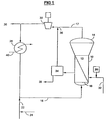
- FIGURE 1 A reaction system in a gas fluidized bed is illustrated in FIGURE 1 attached. It should be borne in mind that the reaction system shown in FIGURE 1 is a non-limiting example, the present invention being adequate to any conventional system of gas phase reaction.
- reactor 10 includes the reaction zone 12 and a desengagement zone 14 where the speed of the gas is reduced.
- the relationship between the height and the diameter in the reaction zone 12 varies as a function of the desired residence time in the process and of the maximum height beyond which excessively large gas bubbles will form in higher heights in the interior of the reaction zone 12.
- the bed of polymer particles in reaction zone 12 is kept in a fluidized state by recycle stream 16 that works for fluidizing the medium as well as for dissipating heat for absorbing the exothermic heat generated inside the reaction zone 12.
- the bed of polymer particles in reaction zone 12 is kept in fluidized state by recycle stream 16 that works as a fluidizing medium as well as a dissipating heat agent for absorbing the exothermal heat generated within reaction zone 12.
- Recycle stream 16 after entering reaction zone 12 through distributing plate 18, is distributed so as to promote the maintenance of adequate fluidization.
- the superficial velocity of the gas, resulting from the flow rate of recycle stream 16 within reactor 10, typically should not exceed 1.0 m/s so as to avoid excessive entrainment of polymer particles beyond the freeing zone 14.
- Stream 17, which contains the gas discharged from freeing zone 14, said gas having a low monomer content, is fed to the suction of compressor 30 of the recycle gas, so as to provide the driving force for the flow of stream 17.
- the combined reaction and compression heat are then removed from recycle stream 17 in external heat exchange system 28 that is typically a heat exchanger refrigerated by a cooling fluid 40.
- the composition of stream 17 is periodically tested with the aid of an analyzer 26 from the gaseous sample obtained from stream 17.
- make-up fluids are fed to the system at spot 22 so as to make up the composition of recycle stream 16.
- make-up stream 22 will include the compounds and the co-catalysts that directly participate in the reaction as well as the selected non-reactive compounds required for the practice of the present invention, those being added at spot 24.
- spot 24 other spots of the gas recycle system, are equally suitable for introducing said streams, according to the practice of the invention.
- the polymerization catalyst is introduced into reactor 10 in a site within the reaction zone 12, at a vertical distance from distributing plate 18, chosen so as to promote the maintenance of an ideal distribution in the residence time of the catalyst.
- a mixture of non-reactive compounds 32 may be used to aid in the flow of catalyst into the reactor.
- the mixture of non-reactive compounds 32 is chosen so that, together with the similar compounds that are being introduced in the system through spot 24, allows that the improved process of the invention may be practiced under the desired advantages.
- the catalyst material is stored and fed from the catalyst feeding system 20.
- the produced polymer is discharged from the reaction zone through a discharge system 34 that promotes the recovery of the reactive and non-reactive gases, feeds said gases back to the recycle stream 16 at spot 36 and lowers the pressure of the discharged mixture of polymer and gases at an adequate pressure for later conveying of the produced polymer particles 38 for downward processing.
- a polymerization process in fluidized bed was used to carry out the polymerization of ethylene and 1-butene in the non condensed mode, subject to the following common parameters: Reactor diameter: 4.75 meters Height of the bed 13.3 meters Absolute pressure of the reactor 2.4 bar Reactor temperature: 88°C Specific activity of the catalyst 1,030 g polymer/g catalyst/ h/bar of monomer pressure Superficial velocity of the recirculation gas: 0.75 m/s Minimum limit temperature for cooling the recirculation gas: 35°C
- Example 1c Data of this Example demonstrate that through the practice of the present invention, herein called super-dry (Example 1c), it is possible to increase the production proportionally to the heat removal ability of the recycle stream, when compared to the normal mode of dry operation using a nitrogen-rich (Example 1a) or ethane-rich (Example 1b) inert diluent, without the presence of intermediate volatility alkanes.
- the data illustrate the heat removal ability in the non condensed mode for a limiting cooling temperature of 35°C.
- the reactor variables that are kept constant are the temperature of the reactor bed, the concentrations of hydrogen, monomer and comonomer in the recycle stream, the inlet temperature of the recycle stream in the reactor and the reactor pressure.
- Example 2d-2e Data of this Example illustrate that by the practice of the present invention (Examples 2d-2e) where the best composition of the gaseous mixture designed for the control of the dew point is worked, it is possible to increase production proportionally to the ability of heat removal of the recycle stream, when compared to the normal dry operation mode using an isolated ethane-rich (2a) or propane-rich (2b) inertdiluent.
- item 2a of the dry mode illustrates the heat removal ability in the non condensed mode for a limiting cooling temperature of 35°C
- item 2b of the dry mode illustrates the ability of heat removal in the non condensed mode by cooling the recycle stream in the reactor inlet at a temperature that is 3°C higher than the dew point of said stream.
- the limiting temperature in the non condensed mode (2c) and in the super-dry mode of the example 2e was reduced to 25.8°C.
- condensation is induced through the usually practiced method for copolymerizing ethylene and 1-butene, keeping all other relevant reactor variables as constant as possible, while introducing iso-pentane in the recycle system until the desired level of the heat removal ability is attained. Even in this case it is possible to attain heat removal and production rates equivalent to the condensed mode with 10% condensation (Example 2c) even when the cooling temperature of the super-dry mode (Example 2d) is limited. By leveling the cooling of the recycle stream at the same temperature (25.8°C) with the mode at 10% condensation, the rates of heat removal and production of the super-dry mode (Example 2e) are higher.
- the reactor variables kept constant in this Example are the temperature of the reactor bed, the ratio between the concentrations of hydrogen, monomer and comonomer in the recycle stream and the reactor pressure.
- the catalyst productivity is approximately 5,500 g/g in Example 2d where the preferred mode of the invention is practiced, this being higher than the minimum recommended range of from 2,000 to 3,000 g/g.
- Example Number 2a 2b 2c 2d 2e Nominal Melt Flow Rate Resin (dg/10min) 1.0 1.0 1.0 1.0 1.0 1.0 1.0 Nominal Specific Weight of Resin (g/cc) 0.918 0.918 0.918 0.918 0.918 Typical Composition-Recycle Stream (mole%): Hydrogen 1.88 1.88 5.63 1.88 1.88 Nitrogen - -- 28.54 -- -- Methane 0.50 0.50 0.50 0.50 0.50 Ethylene 15.00 15.00 45.00 15.00 15.00 Ethane 77.67 -- 3.00 45.67 60.30 Propane -- 77.67 -- 32.00 17.37 1-butene 4.95 4.95 14.85 4.95 4.95 iso-pentane -- -- 2.48 -- -- Dew Point of the Recycle Stream (°C) 9.3 55.0 35.7 32.0 22.8 Inlet Reactor Temperature (°C) 35.0 58.0 25.8 35.0 25.8 Operation Mode (dry/condens) 1.0 1.0 1.0 1.0
- Example 3e which represents the preferred practice of the present invention, the productivity of the catalyst is higher than 3,000 g polymer/g catalyst.
- Example 3e super-dry, also evidences the higher ability of heat removal as compared to other examples of the non condensed mode (3a, 3b and 3c).
- the condensation is induced by reducing the inlet temperature of the recycle stream, this being the practice when 1-hexene is used as comonomer and when the outer heat exchange system is able to suitably remove heat to reduce the temperature as desired in the recycle stream.
- the limit temperature in the non condensed mode (3d) was reduced to 26.9°C.
- the reactor variables kept constant in this Example are the reactor bed temperature, the ratio between the concentrations of hydrogen, monomer and comonomer in the recycle stream, the inlet temperature of the recycle stream into the reactor and the reactor pressure.
- Example Number 3a 3b 3c 3d 3e Nominal Melt Flow Rate - Resin (dg/10min) 1.0 1.0 1.0 1.0 1.0 1.0 1.0 Nominal Specific Weight of Resin (g/cc) 0.918 0.918 0.918 0.918 0.918 Typical Composition-Recycle Stream (mole%): Hydrogen 5.63 5.63 1.88 5.63 1.88 Nitrogen 40.92 -- -- 40.92 -- Methane 0.50 0.50 0.50 0.50 0.50 0.50 Ethylene 45.00 45.00 15.00 45.00 15.00 Ethane 3.00 43.92 80.97 3.00 71.47 Propane -- -- - -- 9.50 1-Hexene 4.95 4.95 1.65 4.95 1.65 Dew Point of the Recycle Stream (°C) 55.0 55.2 27.8 55.0 32.0 Inlet Temperature in the Reactor (°C) 58.0 58.2 35.0 26.9 35.0 Operation Mode dry/condensation dry N 2 dry ethanethanethanethane
- the dry and super-dry modes (4a, 4b, 4c and 4d) evidence the thermodynamically possible heat removal ability of the process.
- the cooling limit until the dew point cannot be met since the maximum cooling limit is the temperature of 30°C.
- the minimum limit operating temperature of 30°C is not reached, since the dew point of the stream is 41.7°C and the operating temperature is set at 3°C beyond this value.
- the diluent used s a mixture having an adequate ratio between ethane and propane aiming at adjusting the volatility, so that the dew point would be 27°C, allowing the operation at 30°C.
- n-hexane was used as a condensation promoter.
- the limiting cooling temperature of 30°C was not respected in order to make possible to represent the operation with 13% condensation of said stream.
- the limiting temperature of the condensed mode (4e) was reduced to 12.5°C.
- the minimum concentration of ethylene in the recycle stream is 20 mole %, corresponding approximately to a partial pressure in ethylene of 4.5 bar.
- the operation below such level makes difficult to keep a suitable catalyst productivity as a consequence of the relatively low activity, 700 g polymer/g catalyst/h/bar monomer pressure, caused by the effect of the considerable hydrogen concentration present in the system.
- Example Number 4a 4b 4c 4d 4e Nominal Melt Flow Rate - Resin (dg/10min) 20.0 20.0 20.0 20.0 20.0 20.0 20.0 Nominal Specific Weight of Resin (g/cc) 0.955 0.955 0.955 0.955 0.955 0.955 Typical Composition-Recycle Stream (mole%): Hydrogen 26.00 13.00 13.00 13.00 26.00 Nitrogen 30.10 -- -- 26.52 Methane 0.50 0.50 0.50 0.50 0.50 Ethylene 40.00 20.00 20.00 20.00 40.00 Ethane 3.00 66.30 -- 26.33 3.00 Propane -- -- 66.30 39.97 --- 1-Hexene 0.4 0.2 0.2 0.2 0.4 n-hexane -- -- -- -- --- 3.58 Dew Point of the Recycle Stream (°C) -5.1 -6.1 41.7 27.0 55.2 Inlet Temperature in the Reactor (°C) 30.0 30.0 44.7 30.0 12.5 Operation Mode
- the cases in the dry, super-dry and condensed modes evidence the heat removal ability for a refrigeration up to 30°C.
- the recycle stream was refrigerated up to 19°C, temperature at which the thermal charge of the two examples are even.
- the mixture used asdiluent shows an appropriate ratio between ethane, propane and iso-butane aiming at adjusting the volatility so that the dew point is 27°C and 16°C, making possible to operate at 30°C and 19°C, respectively.
- the condensation promoter is n-hexane.
- the super-dry mode shows a reactor production rate 86% higher than that obtained by the use of the dry mode with nitrogen.
- the production rate attained was lower than that of the super-dry mode.
- the super-dry and condensed cases are cooled to 19°C (5d and 5e)
- the thermal charge of both is made even and the production in the super-dry mode attains a level equivalent to the production with 18% liquid in the condensed mode.
- the cases in the dry and super dry mode (6a, 6b, 6c and 6d) evidence the heat removal ability for a refrigeration up to 45°C.
- the cooling limit up to the dew point cannot be met, since the maximum possible cooling is up to the temperature of 45°C.
- the cooling was limited to 57.1°C, being kept 3°C above the dew point.
- Example Number 6a 6b 6c 6d Nominal Melt Flow Rate - Resin (dg/10min) 1 1 1 1 1 Nominal Specific Weight of Resin (g/cc) 0.924 0.924 0.924 0.924 Typical Composition - Recycle Stream (mole%): Hydrogen 4.80 4.80 4.80 4.80 Nitrogen 73.36 - -- -- Ethylene 21.60 21.60 21.60 21.60 Ethane -- 73.36 -- 33.76 Propane -- -- 73.36 39.60 Octene-1 0.24 0.24 0.24 0.24 Dew Point of the Recycle Stream (°C) 31.6 29.3 29.3 42.0 Inlet Temperature in the Reactor (°C) 45.0 45.0 45.0 45.0 Operation Mode (dry/condensation) dry N2 dry ethane dry propane super-dry Liquid Content -Recycle Stream (%weight) -- - -- -- Heat removed in the cooler of the recycle stream
- the cases in the dry and super-dry mode (7a, 7b, 7c and 7d) demonstrate the heat removal ability where the refrigeration was carried until the temperature of 35°C.
- the dry and nitrogen case (7a) as well as in the case dry and ethane (7b) the limiting cooling until the dew point cannot be met, since the maximum possible cooling is up to the temperature of 35°C.
- the diluents used comprised i) a mixture of suitable ratio among ethane, propane and iso-butane (7c) and ii) a mixture having adjusted concentrations of ethane and neopentane (7d), aiming at adjusting the volatility so that the dew point could reach 32°C, and the operation could be effected at 35°C.
- Example 7a 7b 7c 7d Nominal Melt Flow Rate -Resin (dg/10min) 50 50 50 50 50 50 Nominal Specific Weight - Resin (g/cc) 0.960 0.960 0.960 0.960 Typical Composition- Recycle Stream (mole%): Hydrogen 27.00 27.00 27.00 27.00 Nitrogen 35.50 -- -- -- Methane 0.50 0.50 0.50 0.50 Ethylene 35.00 35.00 35.00 Ethane 2.00 37.50 3.75 26.47 Propane -- -- 19.05 -- iso-butane -- -- 14.70 Neo-pentane -- -- -- 11.03 Dew Point of the Recycle Stream (°C) -62.4 -29.5 32.0 32.0 32.0 32.0 32.0 32.0 32.0 32.0 32.0 32.0 32.0 32.0 32.0 32.0 32.0 32.0 32.0 32.0 32.0 32.0 32.0 32.0 32.0 32.0 32.0 32.0 32.0 32.0 32.0 Inlet Temperature of Reactor (°C) 35.0 35.0 35.0 35.0 Operation Mode (dry
- the cases in the dry and super-dry mode (8a, 8b, 8c and 8d) demonstrate the heat removal ability where the refrigeration was carried until the temperature of 35°C, exception made to case 8b and propane, where the refrigeration was limited to 3°C above the dew point of the stream.
- the limiting cooling until the dew point cannot be met, since the maximum possible cooling is up to the temperature of 35°C.
- the diluents used comprised a mixture of suitable ratio between ethane and propane (8c) and between nitrogen and propane (8d), aiming at adjusting the volatility so that the dew point could reach 32°C, and the operation could be effected at 35°C.
- Example Number 8a 8b 8c 8d Typical Composition- Recycle stream (mole%): Hydrogen 6.40 6.40 6.40 6.40 Nitrogen 45.10 -- -- 25.05 Methane 0.50 0.50 0.50 0.50 Ethane -- -- 37.10 -- Propane -- 45.10 8.00 20.05 Propene 48.00 48.00 48.00 48.00 Dew Point of the Recycle stream (°C) 14.7 50.9 32.0 32.0 Inlet Temperature in the Reactor (°C) 35.0 53.9 35.0 35.0 Operation Mode (dry/condensation) dry N 2 dry propane super-dry super-dry Liquid Content - Recycle Stream (%weight) -- -- -- -- -- Heat removed in the cooler of the recycle stream (10 7 kJ/h) 1.502 1.694 2.326 1.995 Production Rate of Reactor (t/h) 6.8 7.7 10.6 9.1 Catalyst Productivity (g polymer/g cat) 4,620 4,080 2,960 3,450
Landscapes
- Chemical & Material Sciences (AREA)
- Health & Medical Sciences (AREA)
- Chemical Kinetics & Catalysis (AREA)
- Medicinal Chemistry (AREA)
- Polymers & Plastics (AREA)
- Organic Chemistry (AREA)
- Polymerisation Methods In General (AREA)
- Addition Polymer Or Copolymer, Post-Treatments, Or Chemical Modifications (AREA)
- Transition And Organic Metals Composition Catalysts For Addition Polymerization (AREA)
Claims (19)
- Procédé de polymérisation et de copolymérisation de monomères oléfiniques dans un réacteur à phase gazeuse, dans des conditions de polymérisation et en présence de catalyseurs à haute activité, employant un flux de gaz de recyclage refroidi dans un échangeur de chaleur à l'aide d'un fluide de refroidissement, procédé dans lequel les diluants inertes dudit flux de recyclage comprennent un mélange de :et dans lequel le point de rosée du flux de gaz de recyclage est régulé au moyen de la composition relative entre ledit composant léger, au nombre d'au moins un, et ledit composant à volatilité intermédiaire, au nombre d'au moins un, de façon à éviter la condensation des composants à l'intérieur du réacteur, et dans lequel le flux de recyclage est complètement volatilisé.au moins un composant léger destiné à réguler le point de rosée, lesdits composants légers étant choisis dans l'ensemble constitué de l'azote, l'argon, l'éthane et le propane, isolés ou combinés ;au moins un composant ayant une volatilité intermédiaire, lesdits composants à volatilité intermédiaire étant choisis dans l'ensemble constitué des alcanes ayant de 3 à 6 atomes de carbone et d'oléfines non réactives ayant de 4 à 6 atomes de carbone, isolés ou combinés ;
- Procédé selon la revendication 1, dans lequel on effectue l'ajustement du point de rosée du flux de recyclage en fonction de la température du fluide de refroidissement utilisé pour refroidir ledit flux.
- Procédé selon l'une quelconque des revendications précédentes, dans lequel les monomères sont l'éthylène, le propène, le 1-butène, le 1-pentène, le 4-méthyl-1-pentène, le 1-hexène, le 1-octène, des oléfines ayant jusqu'à 12 atomes de carbone, le styrène, des composés vinyliques polaires, des diènes conjugués et des diènes non conjugués, des monomères aldéhyde et acétylène, isolés ou copolymérisés.
- Procédé selon l'une quelconque des revendications précédentes, dans lequel de l'éthylène est homopolymérisé ou copolymérisé avec du propène, du 1-butène, du 1-hexène, du 1-octène ou d'autres alpha-oléfines linéaires ou ramifiées ayant de 4 à 12 atomes de carbone.
- Procédé selon l'une quelconque des revendications 1 à 4, dans lequel du propène est homopolymérisé ou copolymérisé avec de l'éthylène, du 1-butène, du 1-hexène, du 1-octène ou d'autres alpha-oléfines linéaires ou ramifiées ayant de 4 à 12 atomes de carbone.
- Procédé selon l'une quelconque des revendications précédentes, dans lequel les composants à volatilité intermédiaire sont les propane, n-butane, isobutane, isopentane, néopentane, n-pentane, cyclopentane, cis-2-butène, trans-2-butène, cis-2-pentène et trans-2-pentène, isolés ou combinés.
- Procédé selon l'une quelconque des revendications précédentes, dans lequel le composant léger destiné à réguler le point de rosée est de l'éthane et le composant à volatilité intermédiaire est du propane.
- Procédé selon l'une quelconque des revendications 1 à 6, dans lequel le composant léger destiné à réguler le point de rosée est du propane et le composant à volatilité intermédiaire est de l'isobutane.
- Procédé selon l'une quelconque des revendications précédentes, dans lequel le rapport entre les composants légers destinés à réguler le point de rosée et la quantité totale des composants non réactifs présents dans la composition du flux gazeux de recyclage est compris entre 3 % et 97 % en moles, de préférence entre 10 % et 90 % en moles.
- Procédé selon l'une quelconque des revendications précédentes, dans lequel le rapport entre chaque composant non réactif et le principal monomère est inférieur à 6:1.
- Procédé selon l'une quelconque des revendications précédentes, dans lequel les réacteurs à phase gazeuse sont des réacteurs verticaux à lit fluidisé, des réacteurs horizontaux à lit fluidisé, des réacteurs horizontaux à lit sous agitation et des réacteurs verticaux à lit sous agitation.
- Procédé selon l'une quelconque des revendications précédentes, dans lequel l'activité spécifique en temps dudit catalyseur de polymérisation est d'au moins 500 g de polymère/g de catalyseur/h/bar de pression de monomères.
- Procédé selon l'une quelconque des revendications précédentes, dans lequel le rendement du catalyseur est supérieur à 2000 grammes de polymère par gramme de catalyseur, de préférence supérieur à 3000 grammes de polymère par gramme de catalyseur, sur une base continue.
- Procédé selon l'une quelconque des revendications précédentes, dans lequel les catalyseurs utilisés comprennent des catalyseurs anioniques de coordination, des catalyseurs cationiques, des catalyseurs radicalaires, des catalyseurs utilisant un catalyseur à base de métal de transition et des catalyseurs de type métallocène mis en réaction avec un alkyl-métal ou un alkoxy-métal ou avec un composé ionique.
- Procédé selon l'une quelconque des revendications précédentes, dans lequel les catalyseurs sont à base de sels de chrome organiques ou inorganiques, de catalyseurs de type métallocène et de catalyseurs à base de chlorure de titane de la classe de Ziegler-Natta.
- Procédé selon l'une quelconque des revendications précédentes, dans lequel les catalyseurs contiennent un ou plusieurs composés donneurs d'électrons des classes esters, éthers et organosilanes.
- Procédé selon l'une quelconque des revendications précédentes, dans lequel les catalyseurs sont activés avec des aluminium-alkyle.
- Procédé selon l'une quelconque des revendications précédentes, dans lequel les catalyseurs sont déposés sur des supports à base de chlorure de magnésium ou de silice.
- Procédé selon l'une quelconque des revendications précédentes, dans lequel les catalyseurs sont prépolymérisés.
Applications Claiming Priority (3)
| Application Number | Priority Date | Filing Date | Title |
|---|---|---|---|
| BR9906019 | 1999-12-30 | ||
| BRPI9906019-1A BR9906019B1 (pt) | 1999-12-30 | 1999-12-30 | processo para a polimerização e copolimerização de monÈmeros olefìnicos em reatores fase gás. |
| PCT/BR2000/000156 WO2001049750A1 (fr) | 1999-12-30 | 2000-12-29 | Procede de polimerisation et de copolymerisation en phase gazeuse de monomeres olefiniques |
Publications (2)
| Publication Number | Publication Date |
|---|---|
| EP1246853A1 EP1246853A1 (fr) | 2002-10-09 |
| EP1246853B1 true EP1246853B1 (fr) | 2004-11-10 |
Family
ID=4074281
Family Applications (1)
| Application Number | Title | Priority Date | Filing Date |
|---|---|---|---|
| EP00984663A Revoked EP1246853B1 (fr) | 1999-12-30 | 2000-12-29 | Procede de polimerisation et de copolymerisation en phase gazeuse de monomeres olefiniques |
Country Status (8)
| Country | Link |
|---|---|
| US (1) | US6864332B2 (fr) |
| EP (1) | EP1246853B1 (fr) |
| JP (1) | JP2003519254A (fr) |
| AT (1) | ATE282051T1 (fr) |
| BR (1) | BR9906019B1 (fr) |
| CA (1) | CA2396107C (fr) |
| DE (1) | DE60015801T2 (fr) |
| WO (1) | WO2001049750A1 (fr) |
Families Citing this family (29)
| Publication number | Priority date | Publication date | Assignee | Title |
|---|---|---|---|---|
| US6639020B1 (en) * | 1999-09-03 | 2003-10-28 | Exxon Mobil Chemical Patents Inc. | Plasticized polypropylene thermoplastics |
| DE60120345T2 (de) * | 2001-03-01 | 2007-06-06 | Borealis Technology Oy | Polyethylen-Mischungen zum Rotationsgiessen |
| US7528198B2 (en) * | 2001-09-11 | 2009-05-05 | Daikin Industries, Ltd. | Fluororesin composition, process for preparing the same and cable coated with the same |
| JP4606671B2 (ja) * | 2001-09-25 | 2011-01-05 | 三井化学株式会社 | エチレン・α−オレフィン共重合体の製造方法 |
| GB0319467D0 (en) * | 2003-08-19 | 2003-09-17 | Bp Chem Int Ltd | Polymer blends |
| DE102005005506A1 (de) * | 2005-02-04 | 2006-08-10 | Basell Polyolefine Gmbh | Verfahren und Vorrichtung zur Polymerisation von Ethylen |
| US20070060724A1 (en) * | 2005-09-13 | 2007-03-15 | Nova Chemicals Corporation And Innovene Europe Ltd. | Enhanced catalyst productivity |
| US7714082B2 (en) * | 2005-10-04 | 2010-05-11 | Univation Technologies, Llc | Gas-phase polymerization process to achieve a high particle density |
| US7329720B2 (en) * | 2005-11-29 | 2008-02-12 | General Electric Company | Methods for increasing the mean particle size of 2-hydrocarbyl-3,3-bis(hydroxyaryl)phthalimidines |
| US7579498B2 (en) | 2005-11-29 | 2009-08-25 | E. I. Du Pont De Nemours And Company | Process for preparing fluorinated alkyl carboxylate esters |
| US7696289B2 (en) * | 2006-05-12 | 2010-04-13 | Exxonmobil Chemical Patents Inc. | Low molecular weight induced condensing agents |
| US7754834B2 (en) * | 2007-04-12 | 2010-07-13 | Univation Technologies, Llc | Bulk density promoting agents in a gas-phase polymerization process to achieve a bulk particle density |
| EP2103632A1 (fr) * | 2008-03-20 | 2009-09-23 | Ineos Europe Limited | Procédé de polymérisation |
| EP2172262A1 (fr) * | 2008-10-03 | 2010-04-07 | Ineos Europe Limited | Procédé |
| US8841391B2 (en) | 2008-10-03 | 2014-09-23 | Ineos Sales (Uk) Limited | Process for the introduction of a polymerisation catalyst into a gas-phase fluidised bed |
| WO2011147539A1 (fr) * | 2010-05-27 | 2011-12-01 | Saudi Basic Industries Corporation (Sabic) | Polymérisation d'oléfines en phase gazeuse |
| US10377841B2 (en) | 2015-05-08 | 2019-08-13 | Exxonmobil Chemical Patents Inc. | Polymerization process |
| CN109996818B (zh) | 2016-09-27 | 2021-08-06 | 埃克森美孚化学专利公司 | 聚合方法 |
| CN110023346B (zh) * | 2016-09-27 | 2021-10-29 | 埃克森美孚化学专利公司 | 聚合方法 |
| WO2018063765A1 (fr) * | 2016-09-27 | 2018-04-05 | Exxonmobil Chemical Patents Inc. | Procédé de polymérisation |
| RU2720995C1 (ru) * | 2016-09-27 | 2020-05-15 | Эксонмобил Кемикэл Пейтентс Инк. | Способ полимеризации |
| WO2018063767A1 (fr) * | 2016-09-27 | 2018-04-05 | Exxonmobil Chemical Patents Inc. | Processus de polymérisation |
| EP3559051B1 (fr) | 2016-12-20 | 2021-03-24 | ExxonMobil Chemical Patents Inc. | Procédé de polymérisation |
| ES2806646T3 (es) * | 2017-11-17 | 2021-02-18 | Borealis Ag | Procedimiento para mejorar la capacidad de enfriamiento de un reactor de polimerización de olefinas de gas-sólidos |
| EP3486260B1 (fr) * | 2017-11-17 | 2020-04-01 | Borealis AG | Procédé de séparation du gaz de fluidisation de retour dans un réacteur de polymérisation d'oléfines de solides gazeux |
| CN111100226B (zh) * | 2018-10-25 | 2023-03-28 | 中国石油化工股份有限公司 | 一种可调节抗冲聚丙烯刚韧平衡的生产方法 |
| CN114832736A (zh) * | 2022-05-13 | 2022-08-02 | 中国成达工程有限公司 | 一种聚乙烯弹性体聚合撤热方法 |
| US12600803B2 (en) * | 2022-12-20 | 2026-04-14 | Chevron Phillips Chemical Company Lp | Systems and techniques for heat removal in gas phase polymerization |
| CN118994460B (zh) * | 2024-10-24 | 2025-07-04 | 新疆独山子石油化工有限公司 | 一种双峰茂金属聚乙烯产品转产单峰茂金属聚乙烯产品的生产方法 |
Family Cites Families (2)
| Publication number | Priority date | Publication date | Assignee | Title |
|---|---|---|---|---|
| US3969470A (en) * | 1975-04-21 | 1976-07-13 | E. I. Du Pont De Nemours And Company | Process for recycling hydrogen when making blends of olefin copolymers |
| US5681908A (en) * | 1995-03-03 | 1997-10-28 | Advanced Extraction Technologies, Inc. | Absorption process for rejection of reactor byproducts and recovery of monomers from waste gas streams in olefin polymerization processes |
-
1999
- 1999-12-30 BR BRPI9906019-1A patent/BR9906019B1/pt not_active IP Right Cessation
-
2000
- 2000-12-29 EP EP00984663A patent/EP1246853B1/fr not_active Revoked
- 2000-12-29 AT AT00984663T patent/ATE282051T1/de not_active IP Right Cessation
- 2000-12-29 JP JP2001550290A patent/JP2003519254A/ja active Pending
- 2000-12-29 US US10/149,004 patent/US6864332B2/en not_active Expired - Fee Related
- 2000-12-29 CA CA2396107A patent/CA2396107C/fr not_active Expired - Fee Related
- 2000-12-29 WO PCT/BR2000/000156 patent/WO2001049750A1/fr not_active Ceased
- 2000-12-29 DE DE60015801T patent/DE60015801T2/de not_active Revoked
Also Published As
| Publication number | Publication date |
|---|---|
| EP1246853A1 (fr) | 2002-10-09 |
| CA2396107C (fr) | 2010-05-25 |
| WO2001049750A1 (fr) | 2001-07-12 |
| BR9906019A (pt) | 2001-09-25 |
| US20030153695A1 (en) | 2003-08-14 |
| DE60015801T2 (de) | 2006-03-02 |
| JP2003519254A (ja) | 2003-06-17 |
| BR9906019B1 (pt) | 2012-02-22 |
| DE60015801D1 (de) | 2004-12-16 |
| US6864332B2 (en) | 2005-03-08 |
| CA2396107A1 (fr) | 2001-07-12 |
| ATE282051T1 (de) | 2004-11-15 |
Similar Documents
| Publication | Publication Date | Title |
|---|---|---|
| EP1246853B1 (fr) | Procede de polimerisation et de copolymerisation en phase gazeuse de monomeres olefiniques | |
| EP1919965B1 (fr) | Procédé de polymérisation d'oléfines en présence d'un catalyseur de polymérisation d'oléfines | |
| CN1149233C (zh) | 流化床中单体的聚合方法 | |
| KR101582792B1 (ko) | 올레핀의 기상 중합을 위한 공정 | |
| TWI245049B (en) | Polymerisation process | |
| EP3331924B1 (fr) | Procédé pour la polymérisation d'oléfines | |
| EP3331923B1 (fr) | Procédé pour la polymérisation d'oléfines | |
| WO2011147539A1 (fr) | Polymérisation d'oléfines en phase gazeuse | |
| EA021091B1 (ru) | Способ получения полиолефинов | |
| EP1720913B1 (fr) | Procede de controle de fluidite de polymere dans un traitement de polymerisation | |
| EP3331925B1 (fr) | Procédé pour la polymérisation d'oléfines | |
| US10696756B2 (en) | Process for the polymerization of olefins | |
| US7652109B2 (en) | Use of an additivie for improving the flowability of fines and their reintroduction into a continuous gas-phase (co-) polymerisation of olefins reactor | |
| JP5501384B2 (ja) | 水平撹拌気相反応器で製造されるポリオレフィン材料の分子量分布の拡大法 | |
| JP5092260B2 (ja) | オレフィン重合体の製造方法 | |
| JP3295640B2 (ja) | 改良された気体流動層重合方法 | |
| KR20250162586A (ko) | 올레핀의 기상 중합을 위한 유동층 반응기 | |
| JPH029047B2 (fr) | ||
| WO2010026091A1 (fr) | Procédé de polymérisation d'oléfines en phase gazeuse | |
| KR20040019350A (ko) | 에틸렌 및 그의 상호중합체의 중합 방법 |
Legal Events
| Date | Code | Title | Description |
|---|---|---|---|
| PUAI | Public reference made under article 153(3) epc to a published international application that has entered the european phase |
Free format text: ORIGINAL CODE: 0009012 |
|
| 17P | Request for examination filed |
Effective date: 20020717 |
|
| AK | Designated contracting states |
Kind code of ref document: A1 Designated state(s): AT BE CH CY DE DK ES FI FR GB GR IE IT LI LU MC NL PT SE TR |
|
| RIN1 | Information on inventor provided before grant (corrected) |
Inventor name: RIBEIRO DE CASTRO MORSCHBACKER, ANTONIO LUIZ Inventor name: MUKHERJEE, ARJ Inventor name: DUARTE BRAGANCA, ANTONIO LUIZ Inventor name: RUBBO, ENIO Inventor name: CID MIRO, NETO Inventor name: BARLEM, TAMARA |
|
| 17Q | First examination report despatched |
Effective date: 20031201 |
|
| GRAP | Despatch of communication of intention to grant a patent |
Free format text: ORIGINAL CODE: EPIDOSNIGR1 |
|
| GRAS | Grant fee paid |
Free format text: ORIGINAL CODE: EPIDOSNIGR3 |
|
| GRAA | (expected) grant |
Free format text: ORIGINAL CODE: 0009210 |
|
| AK | Designated contracting states |
Kind code of ref document: B1 Designated state(s): AT BE CH CY DE DK ES FI FR GB GR IE IT LI LU MC NL PT SE TR |
|
| PG25 | Lapsed in a contracting state [announced via postgrant information from national office to epo] |
Ref country code: BE Free format text: LAPSE BECAUSE OF FAILURE TO SUBMIT A TRANSLATION OF THE DESCRIPTION OR TO PAY THE FEE WITHIN THE PRESCRIBED TIME-LIMIT Effective date: 20041110 Ref country code: LI Free format text: LAPSE BECAUSE OF FAILURE TO SUBMIT A TRANSLATION OF THE DESCRIPTION OR TO PAY THE FEE WITHIN THE PRESCRIBED TIME-LIMIT Effective date: 20041110 Ref country code: CH Free format text: LAPSE BECAUSE OF FAILURE TO SUBMIT A TRANSLATION OF THE DESCRIPTION OR TO PAY THE FEE WITHIN THE PRESCRIBED TIME-LIMIT Effective date: 20041110 Ref country code: TR Free format text: LAPSE BECAUSE OF FAILURE TO SUBMIT A TRANSLATION OF THE DESCRIPTION OR TO PAY THE FEE WITHIN THE PRESCRIBED TIME-LIMIT Effective date: 20041110 Ref country code: CY Free format text: LAPSE BECAUSE OF FAILURE TO SUBMIT A TRANSLATION OF THE DESCRIPTION OR TO PAY THE FEE WITHIN THE PRESCRIBED TIME-LIMIT Effective date: 20041110 Ref country code: FI Free format text: LAPSE BECAUSE OF FAILURE TO SUBMIT A TRANSLATION OF THE DESCRIPTION OR TO PAY THE FEE WITHIN THE PRESCRIBED TIME-LIMIT Effective date: 20041110 Ref country code: AT Free format text: LAPSE BECAUSE OF FAILURE TO SUBMIT A TRANSLATION OF THE DESCRIPTION OR TO PAY THE FEE WITHIN THE PRESCRIBED TIME-LIMIT Effective date: 20041110 Ref country code: NL Free format text: LAPSE BECAUSE OF FAILURE TO SUBMIT A TRANSLATION OF THE DESCRIPTION OR TO PAY THE FEE WITHIN THE PRESCRIBED TIME-LIMIT Effective date: 20041110 Ref country code: SE Free format text: LAPSE BECAUSE OF FAILURE TO SUBMIT A TRANSLATION OF THE DESCRIPTION OR TO PAY THE FEE WITHIN THE PRESCRIBED TIME-LIMIT Effective date: 20041110 |
|
| REG | Reference to a national code |
Ref country code: GB Ref legal event code: FG4D |
|
| REG | Reference to a national code |
Ref country code: CH Ref legal event code: EP |
|
| REG | Reference to a national code |
Ref country code: IE Ref legal event code: FG4D |
|
| REF | Corresponds to: |
Ref document number: 60015801 Country of ref document: DE Date of ref document: 20041216 Kind code of ref document: P |
|
| PG25 | Lapsed in a contracting state [announced via postgrant information from national office to epo] |
Ref country code: IE Free format text: LAPSE BECAUSE OF NON-PAYMENT OF DUE FEES Effective date: 20041230 |
|
| PG25 | Lapsed in a contracting state [announced via postgrant information from national office to epo] |
Ref country code: MC Free format text: LAPSE BECAUSE OF NON-PAYMENT OF DUE FEES Effective date: 20041231 |
|
| PG25 | Lapsed in a contracting state [announced via postgrant information from national office to epo] |
Ref country code: LU Free format text: LAPSE BECAUSE OF NON-PAYMENT OF DUE FEES Effective date: 20050110 |
|
| REG | Reference to a national code |
Ref country code: GB Ref legal event code: 732E |
|
| PG25 | Lapsed in a contracting state [announced via postgrant information from national office to epo] |
Ref country code: GR Free format text: LAPSE BECAUSE OF FAILURE TO SUBMIT A TRANSLATION OF THE DESCRIPTION OR TO PAY THE FEE WITHIN THE PRESCRIBED TIME-LIMIT Effective date: 20050210 Ref country code: DK Free format text: LAPSE BECAUSE OF FAILURE TO SUBMIT A TRANSLATION OF THE DESCRIPTION OR TO PAY THE FEE WITHIN THE PRESCRIBED TIME-LIMIT Effective date: 20050210 |
|
| PG25 | Lapsed in a contracting state [announced via postgrant information from national office to epo] |
Ref country code: ES Free format text: LAPSE BECAUSE OF FAILURE TO SUBMIT A TRANSLATION OF THE DESCRIPTION OR TO PAY THE FEE WITHIN THE PRESCRIBED TIME-LIMIT Effective date: 20050221 |
|
| NLV1 | Nl: lapsed or annulled due to failure to fulfill the requirements of art. 29p and 29m of the patents act | ||
| REG | Reference to a national code |
Ref country code: CH Ref legal event code: PL |
|
| PLBI | Opposition filed |
Free format text: ORIGINAL CODE: 0009260 |
|
| REG | Reference to a national code |
Ref country code: IE Ref legal event code: MM4A |
|
| ET | Fr: translation filed | ||
| 26 | Opposition filed |
Opponent name: BASELL POLYOLEFINE GMBH Effective date: 20050808 |
|
| PLAX | Notice of opposition and request to file observation + time limit sent |
Free format text: ORIGINAL CODE: EPIDOSNOBS2 |
|
| RAP2 | Party data changed (patent owner data changed or rights of a patent transferred) |
Owner name: BRASKEM S.A. Owner name: CONVEX INTERNATIONAL |
|
| REG | Reference to a national code |
Ref country code: FR Ref legal event code: TQ |
|
| PLBB | Reply of patent proprietor to notice(s) of opposition received |
Free format text: ORIGINAL CODE: EPIDOSNOBS3 |
|
| PLAB | Opposition data, opponent's data or that of the opponent's representative modified |
Free format text: ORIGINAL CODE: 0009299OPPO |
|
| R26 | Opposition filed (corrected) |
Opponent name: BASELL POLYOLEFINE GMBH Effective date: 20050808 |
|
| RDAF | Communication despatched that patent is revoked |
Free format text: ORIGINAL CODE: EPIDOSNREV1 |
|
| APAH | Appeal reference modified |
Free format text: ORIGINAL CODE: EPIDOSCREFNO |
|
| APBP | Date of receipt of notice of appeal recorded |
Free format text: ORIGINAL CODE: EPIDOSNNOA2O |
|
| APBQ | Date of receipt of statement of grounds of appeal recorded |
Free format text: ORIGINAL CODE: EPIDOSNNOA3O |
|
| PG25 | Lapsed in a contracting state [announced via postgrant information from national office to epo] |
Ref country code: PT Free format text: LAPSE BECAUSE OF NON-PAYMENT OF DUE FEES Effective date: 20050410 |
|
| PGFP | Annual fee paid to national office [announced via postgrant information from national office to epo] |
Ref country code: IT Payment date: 20081210 Year of fee payment: 9 |
|
| PGFP | Annual fee paid to national office [announced via postgrant information from national office to epo] |
Ref country code: FR Payment date: 20081120 Year of fee payment: 9 |
|
| PGFP | Annual fee paid to national office [announced via postgrant information from national office to epo] |
Ref country code: DE Payment date: 20081219 Year of fee payment: 9 |
|
| PGFP | Annual fee paid to national office [announced via postgrant information from national office to epo] |
Ref country code: GB Payment date: 20081023 Year of fee payment: 9 |
|
| APBU | Appeal procedure closed |
Free format text: ORIGINAL CODE: EPIDOSNNOA9O |
|
| RDAG | Patent revoked |
Free format text: ORIGINAL CODE: 0009271 |
|
| STAA | Information on the status of an ep patent application or granted ep patent |
Free format text: STATUS: PATENT REVOKED |
|
| 27W | Patent revoked |
Effective date: 20091001 |
|
| GBPR | Gb: patent revoked under art. 102 of the ep convention designating the uk as contracting state |
Effective date: 20091001 |