EP1246894B1 - Treibstoffzusatz, diesen zusatz enthaltende treibstoffzusammensetzungen und verfahren zu deren herstellung - Google Patents
Treibstoffzusatz, diesen zusatz enthaltende treibstoffzusammensetzungen und verfahren zu deren herstellung Download PDFInfo
- Publication number
- EP1246894B1 EP1246894B1 EP00982221A EP00982221A EP1246894B1 EP 1246894 B1 EP1246894 B1 EP 1246894B1 EP 00982221 A EP00982221 A EP 00982221A EP 00982221 A EP00982221 A EP 00982221A EP 1246894 B1 EP1246894 B1 EP 1246894B1
- Authority
- EP
- European Patent Office
- Prior art keywords
- composition
- fuel
- weight
- additive
- urea
- Prior art date
- Legal status (The legal status is an assumption and is not a legal conclusion. Google has not performed a legal analysis and makes no representation as to the accuracy of the status listed.)
- Expired - Lifetime
Links
Images




Classifications
-
- C—CHEMISTRY; METALLURGY
- C10—PETROLEUM, GAS OR COKE INDUSTRIES; TECHNICAL GASES CONTAINING CARBON MONOXIDE; FUELS; LUBRICANTS; PEAT
- C10L—FUELS NOT OTHERWISE PROVIDED FOR; NATURAL GAS; SYNTHETIC NATURAL GAS OBTAINED BY PROCESSES NOT COVERED BY SUBCLASSES C10G OR C10K; LIQUIFIED PETROLEUM GAS; USE OF ADDITIVES TO FUELS OR FIRES; FIRE-LIGHTERS
- C10L10/00—Use of additives to fuels or fires for particular purposes
- C10L10/04—Use of additives to fuels or fires for particular purposes for minimising corrosion or incrustation
-
- C—CHEMISTRY; METALLURGY
- C10—PETROLEUM, GAS OR COKE INDUSTRIES; TECHNICAL GASES CONTAINING CARBON MONOXIDE; FUELS; LUBRICANTS; PEAT
- C10L—FUELS NOT OTHERWISE PROVIDED FOR; NATURAL GAS; SYNTHETIC NATURAL GAS OBTAINED BY PROCESSES NOT COVERED BY SUBCLASSES C10G OR C10K; LIQUIFIED PETROLEUM GAS; USE OF ADDITIVES TO FUELS OR FIRES; FIRE-LIGHTERS
- C10L1/00—Liquid carbonaceous fuels
- C10L1/10—Liquid carbonaceous fuels containing additives
-
- C—CHEMISTRY; METALLURGY
- C10—PETROLEUM, GAS OR COKE INDUSTRIES; TECHNICAL GASES CONTAINING CARBON MONOXIDE; FUELS; LUBRICANTS; PEAT
- C10L—FUELS NOT OTHERWISE PROVIDED FOR; NATURAL GAS; SYNTHETIC NATURAL GAS OBTAINED BY PROCESSES NOT COVERED BY SUBCLASSES C10G OR C10K; LIQUIFIED PETROLEUM GAS; USE OF ADDITIVES TO FUELS OR FIRES; FIRE-LIGHTERS
- C10L1/00—Liquid carbonaceous fuels
- C10L1/10—Liquid carbonaceous fuels containing additives
- C10L1/106—Liquid carbonaceous fuels containing additives mixtures of inorganic compounds with organic macromolecular compounds
-
- C—CHEMISTRY; METALLURGY
- C10—PETROLEUM, GAS OR COKE INDUSTRIES; TECHNICAL GASES CONTAINING CARBON MONOXIDE; FUELS; LUBRICANTS; PEAT
- C10L—FUELS NOT OTHERWISE PROVIDED FOR; NATURAL GAS; SYNTHETIC NATURAL GAS OBTAINED BY PROCESSES NOT COVERED BY SUBCLASSES C10G OR C10K; LIQUIFIED PETROLEUM GAS; USE OF ADDITIVES TO FUELS OR FIRES; FIRE-LIGHTERS
- C10L1/00—Liquid carbonaceous fuels
- C10L1/10—Liquid carbonaceous fuels containing additives
- C10L1/14—Organic compounds
- C10L1/143—Organic compounds mixtures of organic macromolecular compounds with organic non-macromolecular compounds
-
- C—CHEMISTRY; METALLURGY
- C10—PETROLEUM, GAS OR COKE INDUSTRIES; TECHNICAL GASES CONTAINING CARBON MONOXIDE; FUELS; LUBRICANTS; PEAT
- C10L—FUELS NOT OTHERWISE PROVIDED FOR; NATURAL GAS; SYNTHETIC NATURAL GAS OBTAINED BY PROCESSES NOT COVERED BY SUBCLASSES C10G OR C10K; LIQUIFIED PETROLEUM GAS; USE OF ADDITIVES TO FUELS OR FIRES; FIRE-LIGHTERS
- C10L10/00—Use of additives to fuels or fires for particular purposes
- C10L10/02—Use of additives to fuels or fires for particular purposes for reducing smoke development
-
- C—CHEMISTRY; METALLURGY
- C10—PETROLEUM, GAS OR COKE INDUSTRIES; TECHNICAL GASES CONTAINING CARBON MONOXIDE; FUELS; LUBRICANTS; PEAT
- C10L—FUELS NOT OTHERWISE PROVIDED FOR; NATURAL GAS; SYNTHETIC NATURAL GAS OBTAINED BY PROCESSES NOT COVERED BY SUBCLASSES C10G OR C10K; LIQUIFIED PETROLEUM GAS; USE OF ADDITIVES TO FUELS OR FIRES; FIRE-LIGHTERS
- C10L10/00—Use of additives to fuels or fires for particular purposes
- C10L10/08—Use of additives to fuels or fires for particular purposes for improving lubricity; for reducing wear
-
- C—CHEMISTRY; METALLURGY
- C10—PETROLEUM, GAS OR COKE INDUSTRIES; TECHNICAL GASES CONTAINING CARBON MONOXIDE; FUELS; LUBRICANTS; PEAT
- C10L—FUELS NOT OTHERWISE PROVIDED FOR; NATURAL GAS; SYNTHETIC NATURAL GAS OBTAINED BY PROCESSES NOT COVERED BY SUBCLASSES C10G OR C10K; LIQUIFIED PETROLEUM GAS; USE OF ADDITIVES TO FUELS OR FIRES; FIRE-LIGHTERS
- C10L1/00—Liquid carbonaceous fuels
- C10L1/10—Liquid carbonaceous fuels containing additives
- C10L1/12—Inorganic compounds
- C10L1/1266—Inorganic compounds nitrogen containing compounds, (e.g. NH3)
-
- C—CHEMISTRY; METALLURGY
- C10—PETROLEUM, GAS OR COKE INDUSTRIES; TECHNICAL GASES CONTAINING CARBON MONOXIDE; FUELS; LUBRICANTS; PEAT
- C10L—FUELS NOT OTHERWISE PROVIDED FOR; NATURAL GAS; SYNTHETIC NATURAL GAS OBTAINED BY PROCESSES NOT COVERED BY SUBCLASSES C10G OR C10K; LIQUIFIED PETROLEUM GAS; USE OF ADDITIVES TO FUELS OR FIRES; FIRE-LIGHTERS
- C10L1/00—Liquid carbonaceous fuels
- C10L1/10—Liquid carbonaceous fuels containing additives
- C10L1/14—Organic compounds
- C10L1/18—Organic compounds containing oxygen
- C10L1/192—Macromolecular compounds
- C10L1/198—Macromolecular compounds obtained otherwise than by reactions involving only carbon-to-carbon unsaturated bonds homo- or copolymers of compounds having one or more unsaturated aliphatic radicals, each having only one carbon to carbon double bond, and at least one being terminated by an acyloxy radical of a saturated carboxylic acid, of carbonic acid
- C10L1/1985—Macromolecular compounds obtained otherwise than by reactions involving only carbon-to-carbon unsaturated bonds homo- or copolymers of compounds having one or more unsaturated aliphatic radicals, each having only one carbon to carbon double bond, and at least one being terminated by an acyloxy radical of a saturated carboxylic acid, of carbonic acid polyethers, e.g. di- polygylcols and derivatives; ethers - esters
-
- C—CHEMISTRY; METALLURGY
- C10—PETROLEUM, GAS OR COKE INDUSTRIES; TECHNICAL GASES CONTAINING CARBON MONOXIDE; FUELS; LUBRICANTS; PEAT
- C10L—FUELS NOT OTHERWISE PROVIDED FOR; NATURAL GAS; SYNTHETIC NATURAL GAS OBTAINED BY PROCESSES NOT COVERED BY SUBCLASSES C10G OR C10K; LIQUIFIED PETROLEUM GAS; USE OF ADDITIVES TO FUELS OR FIRES; FIRE-LIGHTERS
- C10L1/00—Liquid carbonaceous fuels
- C10L1/10—Liquid carbonaceous fuels containing additives
- C10L1/14—Organic compounds
- C10L1/22—Organic compounds containing nitrogen
- C10L1/222—Organic compounds containing nitrogen containing at least one carbon-to-nitrogen single bond
- C10L1/2227—Organic compounds containing nitrogen containing at least one carbon-to-nitrogen single bond urea; derivatives thereof; urethane
-
- C—CHEMISTRY; METALLURGY
- C10—PETROLEUM, GAS OR COKE INDUSTRIES; TECHNICAL GASES CONTAINING CARBON MONOXIDE; FUELS; LUBRICANTS; PEAT
- C10L—FUELS NOT OTHERWISE PROVIDED FOR; NATURAL GAS; SYNTHETIC NATURAL GAS OBTAINED BY PROCESSES NOT COVERED BY SUBCLASSES C10G OR C10K; LIQUIFIED PETROLEUM GAS; USE OF ADDITIVES TO FUELS OR FIRES; FIRE-LIGHTERS
- C10L1/00—Liquid carbonaceous fuels
- C10L1/10—Liquid carbonaceous fuels containing additives
- C10L1/14—Organic compounds
- C10L1/22—Organic compounds containing nitrogen
- C10L1/222—Organic compounds containing nitrogen containing at least one carbon-to-nitrogen single bond
- C10L1/224—Amides; Imides carboxylic acid amides, imides
-
- C—CHEMISTRY; METALLURGY
- C10—PETROLEUM, GAS OR COKE INDUSTRIES; TECHNICAL GASES CONTAINING CARBON MONOXIDE; FUELS; LUBRICANTS; PEAT
- C10L—FUELS NOT OTHERWISE PROVIDED FOR; NATURAL GAS; SYNTHETIC NATURAL GAS OBTAINED BY PROCESSES NOT COVERED BY SUBCLASSES C10G OR C10K; LIQUIFIED PETROLEUM GAS; USE OF ADDITIVES TO FUELS OR FIRES; FIRE-LIGHTERS
- C10L1/00—Liquid carbonaceous fuels
- C10L1/10—Liquid carbonaceous fuels containing additives
- C10L1/14—Organic compounds
- C10L1/22—Organic compounds containing nitrogen
- C10L1/228—Organic compounds containing nitrogen containing at least one carbon-to-nitrogen double bond, e.g. guanidines, hydrazones, semicarbazones, imines; containing at least one carbon-to-nitrogen triple bond, e.g. nitriles
- C10L1/2283—Organic compounds containing nitrogen containing at least one carbon-to-nitrogen double bond, e.g. guanidines, hydrazones, semicarbazones, imines; containing at least one carbon-to-nitrogen triple bond, e.g. nitriles containing one or more carbon to nitrogen double bonds, e.g. guanidine, hydrazone, semi-carbazone, azomethine
-
- C—CHEMISTRY; METALLURGY
- C10—PETROLEUM, GAS OR COKE INDUSTRIES; TECHNICAL GASES CONTAINING CARBON MONOXIDE; FUELS; LUBRICANTS; PEAT
- C10L—FUELS NOT OTHERWISE PROVIDED FOR; NATURAL GAS; SYNTHETIC NATURAL GAS OBTAINED BY PROCESSES NOT COVERED BY SUBCLASSES C10G OR C10K; LIQUIFIED PETROLEUM GAS; USE OF ADDITIVES TO FUELS OR FIRES; FIRE-LIGHTERS
- C10L1/00—Liquid carbonaceous fuels
- C10L1/10—Liquid carbonaceous fuels containing additives
- C10L1/14—Organic compounds
- C10L1/22—Organic compounds containing nitrogen
- C10L1/232—Organic compounds containing nitrogen containing nitrogen in a heterocyclic ring
Definitions
- This invention is related generally to fuel additives and to fuels formulated with the additives and a method of manufacture.
- NO x emissions are a class of engine exhaust emissions which are coming under increasingly strict regulatory scrutiny because of their asserted affect on the environment. NO x emissions from internal combustion engines are, for example, asserted to be precursors in the formation of ozone and are further asserted to be responsible for the formation of other types of air pollution, such as smog.
- Diesel engines present a further problem for the automotive and transportation industry in that the exhaust emissions from these type of engines typically include large amounts of particulates together with NO x .
- the particulate emissions are present in the black smoke discharged from the engine.
- diesel engine particulate emissions can be controlled by the use of filters or catalytic converters. While these emission-control devices are effective in decreasing particulate emissions, they do not appear to be effective in reducing NO x emissions.
- PCT patent publication WO 98/22209A1 discloses the use of selective catalytic reduction (SCR) in which an aqueous urea solution is introduced from a tank into the engine exhaust manifold. The urea-containing exhaust gas is then directed to a foraminous structure that traps any water or urea that has not been gasified. Subsequently, the exhaust gas is directed through an NO x -reducing catalyst structure.
- SCR selective catalytic reduction
- PCT patent publication WO 99/01205 discloses a further type of SCR in which gaseous ammonia is introduced to the post combustion exhaust gas followed by treatment with a reduction catalyst.
- U.S. Patent Nos. 5,783,160 (Kinugasa et al. ), 5,992,141 (Berriman et al. ) and 5,609,026 (Berriman et al. ) also disclose a type of engine exhaust treatment in which gaseous ammonia is introduced to the post combustion exhaust gas followed by treatment with a catalyst.
- Other publications disclosing apparatus for treating engine exhaust to reduce NO x emissions, such as catalytic converters include U.S. Patent No. 5,522,218 (Lane et al. ) and 5,791,139 (Takeshi et al. ).
- EGR exhaust gas recirculation
- Rao a selective reducing agent such as ammonia, hydrazine, or cyanuric acid is injected into the interior of the piston-cylinder assembly with a mechanical material-feed apparatus.
- the reducing agent is stored in a tank within the vehicle.
- the reducing agent reacts during combustion to produce an exhaust stream with a reduced concentration of NO x .
- the system of the Rao patent disadvantageously requires the use of complex and costly mechanical apparatus in order to introduce the correct amount of reducing agent into the combustion chamber.
- U.S. Patent No. 6,017,369 discloses a solubilized diesel fuel composition including diesel fuel, ethanol, an alkyl ester of a fatty acid, a stabilizing additive and an optional co-solvent.
- the stabilizing additive is reportedly provided to homogenize the constituents of the fuel composition.
- the stabilizing agent is reported to be either (1) a mixture of ethoxylated alcohols, a cetane booster and a demulsifier or (2) a mixture of ethoxylated alcohols, an amide and an ethoxylated fatty acid. While reportedly effective in reducing diesel fuel emissions generally (as a result of reducing the percentage of diesel fuel in the composition), the Ahmed composition does not disclose any specific assertion of NO x or particulate emission reduction.
- U.S. Patent No. 5,746,783 discloses a microemulsion of urea or a triazine which, when added to a base diesel fuel composition, is said to decrease the amount of NO x emissions from diesel engines.
- the microemulsion comprises the urea or triazine mixed with t-butyl alcohol, water, oleic acid and ethanolamine.
- the composition of the Compere patent is disadvantageous because it requires higher levels of urea than are needed to reduce NOx. Moreover, the composition requires higher levels of solubilizing agent to maintain the urea in the composition than are practical or economical.
- a fuel additive or formulated fuel should be useful in overcoming other problems associated with fuel technology.
- the additive should be such that the fuel formulation is a stable, homogenous mixture across a broad temperature range.
- low sulfur and ultra low sulfur diesel fuels presently being manufactured lack lubricity as a result of the low sulfur content of the fuels. Reduced lubricity contributes to engine wear and reduces the distance that the vehicle can travel per unit volume of fuel. It would be desirable for the fuel additive or formulated fuel to improve lubricity in these low and ultra low sulfur fuels.
- non-ionic surfactants in fuel compositions
- a significant material-handling issue confronting the possible use of non-ionic surfactants in fuel compositions involves the lack of liquidity of many non-ionic surfactants.
- such non-ionic surfactants are present in a gel state when blended with water.
- Solvents are required to impart the desired viscosity to such surfactant compositions.
- the addition of solvents adds to the cost of transport and, potentially, may create difficulties in mixing the additive with the fuel.
- the surfactant should be selected so that the host fuel itself could be used as the solvent. This would permit formulation of a fuel additive concentrate which could be delivered and easily cold splash blended with the host fuel.
- An improved fuel additive which, when blended with fuels, would reduce levels of fuel NO x and particulate emissions when the fuel is burned in an internal combustion engine without materially affecting the BTU content of the fuel, which could be used without mechanical modification of the vehicle, which improves lubricity of the fuel and is easy to formulate and handle would represent an important advance in the art.
- Another object of this invention is to provide improved fuel additives which, when blended with fuels, provide fuel formulations which produce reduced levels of NO x emissions when burned in an internal combustion engine.
- Still another object of this invention is to provide improved fuel additives which, when blended with fuels, do not materially affect fuel BTU retention.
- a further object of the invention is to provide improved fuel additives which, when blended with fuels, provide improved fuel lubricity, particularly in low sulfur and ultra low sulfur fuels.
- One other object of this invention is to provide improved fuel additives which, when blended with fuels, permit a vehicle using the fuel to travel further distances per unit volume of fuel.
- Another object of the invention of the invention is to provide fuel additives which can be supplied in different physical states including, for example, as separate constituents, as an additive, as a concentrate or as a blended finished-form fuel.
- One object is to provide an additive which can be formulated to solubilize in the host fuel at any required dilution without phase separation.
- An object of the invention is to provide fuel additives which can be added to a wide range of fuels, can be used in spark ignition and diesel engines and can be used in 4-stroke as well as 2-stroke engines.
- Yet a further object of the invention is to provide improved fuel additives which are useful in avoiding fuel phase separation, particularly when water is present in the fuel.
- Still another object of the invention is to provide improved fuel additives which, when blended with fuels, provide an efficient, cost-effective manner of introducing NO x -reducing compounds to the engine combustion chamber.
- An additional object of the invention is to provide improved fuel additives which, when blended with fuels, avoids the need for costly mechanical devices to either introduce NO x -reducing agents to the engine combustion chamber or to treat the post-combustion exhaust stream.
- It is an object of the invention is to provide improved fuel additives which are economical to transport.
- a further object of the invention is to provide improved fuel additives which can be easily formulated and easily admixed with fuel.
- the purpose of this invention is to provide a fuel additive which, when admixed with fuel, provides a manner of delivering a nitrogen-containing compound to the point of combustion in an internal combustion engine as an integral part of the fuel.
- the additive reduces NO x emissions from the engine exhaust stream (with or without a trap device), reduces particulate emissions and provides the usual benefits associated with cleaner burning fuels without detriment to performance.
- Fuel containing the additive is a clear homogenous mixture which advantageously can be introduced directly to the point of combustion through the normal fuel delivery lines thereby avoiding any need for costly mechanical material-feed devices to feed nitrogen-containing compounds to the engine as is typical of the prior art.
- the NO x reducing reagents have utility in many types of fuels including diesel, gasoline, kerosene, alcohol and aqueous-fuel blends.
- the inventive additive beneficially modifies the boiling point of the fuel in a way expected to improve fuel efficiency.
- the invention not only reduces NO x emissions from the exhaust stream but also enhances the lubricity of the fuel, reducing engine wear and increasing the distance which the vehicle can travel per unit volume of fuel.
- the invention relates to a fuel additive, a concentrate and a final fuel which are stable and single phase and methods for producing these.
- the composition can be prepared in different forms based on the needs of the user. These forms include as an additive, concentrate and as a finished form fuel including the additive or concentrate.
- Preferred forms of the additive include about 3-35 % by weight of a nitrogen-containing compound selected from the group consisting of urea, cyanuric acid, triazine, ammonia and mixtures thereof.
- Urea is the most highly preferred nitrogen-containing compound because of its abundance, low cost and ease of mixing with water. It is preferred that the urea comprises 10-32 % by weight of the additive composition and most highly preferred forms of the invention include 12-28% by weight of urea in the additive form of the invention.
- the preferred additive composition further includes 0.0025-25 % by weight of water.
- the urea is preferably admixed with the water as described herein.
- the preferred additive further includes 30-97 % by weight of a carrier blend of non-ionic surfactants provided to solubilize the nitrogen-containing compound in the additive.
- the preferred carrier blend comprises 30-75 % by weight of an alkoxylated alcohol composition having the following general structure: wherein R 1 is C 6 -C 16 , R 2 is H or CH 3 , and x is 1-7. It is preferred that R 1 is C 9 -C 11 and x is 2.5.
- Highly preferred forms of the inventive carrier blend useful in practicing the invention include 33-55% by weight of the alkoxylated alcohol constituent. Mixtures of more than one type of alkoxylated alcohol may be used in a given carrier blend.
- the novel carrier blend further includes 10-60 % by weight of a polyalkylene glycol ester composition having the following general structure: wherein R 3 is C 11 -C 19 , R 4 is H or CH 3 , y is 1-20,R 5 is H or COR 3 . Preferably, R 3 is C 17 and R 5 is COR 3 .
- Polyethylene glycol diesters of oleic acid are highly preferred as are polyethylene glycol ditallates.
- the preferred polyalkylene glycol ester constituent may include blends of more than one type of polyalkylene glycol ester. More preferred forms of the inventive carrier blend include 25-40 % by weight of the polyalkylene glycol ester constituent while still more preferred embodiments comprise 25-33 % by weight of the polyalkylene glycol ester constituent.
- the preferred carrier blend further includes 10-60 % by weight of an alkanolamide composition having the following general structure: wherein R 6 is C 12 -C 18 , R 7 is H or CH 2 CH 2 OH. R 6 is preferably C 17 and R 7 is CH 2 CH 2 OH.
- Oleic acid diethanolamides are highly preferred alkanolamides for use in practicing the invention.
- the alkanolamide constituent may be provided as a blend of more than one type of alkanolamide. Preferred forms of the invention include 25-40 % by weight of the ethanolamide while 25-33 % by weight of the ethanolamide constituent is most highly preferred.
- the composition includes 80-20 % by weight of the above-described additive together with 20-80 % by weight of a solvent. It is highly preferred that the solvent comprise the host fuel. Highly preferred solvents suitable for use in making the concentrate include diesel, gasoline and kerosene fuels.
- the invention includes 97- 99.99 % by weight of a hydrocarbon-containing fuel and 0.01-3 % by weight of the above-described fuel additive.
- the invention includes the compositions of matter and the method of making each form of the compositions as will be described in more detail below.
- the invention provides a fuel additive for use in internal combustion engines, including diesel and spark ignition engines.
- the invention may be prepared in various forms including as an additive, concentrate or as a final form fuel.
- the invention includes the method of making the composition including a fuel including the composition.
- the inventive composition is highly effective in solubilizing nitrogen-containing compounds in the fuel.
- the nitrogen-containing matter enters the engine combustion chamber as part of the fuel and reacts during combustion to reduce NO x emissions.
- the invention is powerfully efficacious versus prior art compositions, such as U.S. Patent No. 5,746,783 (Compere et al. ), because less nitrogen is required in the fuel and because far less constituents are required to keep the nitrogen in the fuel, a benefit which provides important cost-savings benefits.
- the fuel additive of the invention is effective in producing a stable, single phase additive, concentrate and final form fuel in large part because of the nature of the carrier blend.
- the nonionic carrier blend is highly efficacious in solubilizing low molecular weight polar nitrogen-containing compounds into non-polar matrices, such as hydrocarbon-containing fuels.
- the nitrogen-containing composition can include urea, cyanuric acid, triazine, ammonia and mixtures thereof.
- the nitrogen-containing constituent of the additive comprises 3-35 % by weight of the additive. A weight percent range of 10-32 % by weight of the composition is preferred when urea is to be used.
- the most highly preferred urea is readily available from distributors such as Ashland Distribution Company, Industrial Chemicals and Solvents and Van Waters & Rogers Inc. Manufacturers of urea include Air Products and Chemicals, Inc. and Allied Signal, Inc., Specialty Chemicals. Triazine is manufactured by Arch Chemicals, Inc. Norwalk, CT. Cyanuric acid is manufactured by GAS Chemicals, Inc. Powell, OH. Van Waters & Rogers is a commercial source of ammonia.
- the surfactant is provided to form an emulsion in which the nitrogen-containing composition is fully solubilzed in the final fuel formulation.
- the carrier blend comprises three main surfactant constituents which are broadly described as an alkoxylated alcohol constituent, a polyalkylene glycol ester constituent and an alkanolamide constituent.
- the alkoxylated alcohol constituent comprises 30-75 % by weight of the carrier blend composition and preferably comprises 33-55% of such constituent.
- Alcohol ethoxylate, and any other alcohol alkoxylated are prepared by the alkoxylation of any linear or branched alcohol with any commercially available alkaline oxide, for example, ethylene oxide (“EO”) or propylene oxide (“PO”) or mixtures thereof.
- EO ethylene oxide
- PO propylene oxide
- Alkoxylated alcohols suitable for use in the invention are available from Tomah Products, Inc. of 337 Vincent Street, Milton, Wisconsin 53563 under the trade name TomadolTM.
- Illustrative Tomadol products include Tomadol 91-2.5 and Tomadol 1-3.
- Tomadol 91-2.5 is a mixture of C9, C10, and C11 alcohols with an average of 2.5 moles of ethylene oxide per mole of alcohol.
- the average molecular weight of Tomadol 91-2.5 is reported as 281 and the HLB value (Hydrophyllic/ Lipophyllic Balance) is reported as 8.5.
- Tomadol 1-3 is an ethoxylated C11 (major proportion) alcohol with an average of 3 moles of ethylene oxide per mole of alcohol.
- the average molecular weight of Tomadol 1-3 is reported as 305 and the HLB value is reported as 8.7.
- Other alcohol alkoxylates having an HLB of about 8-9 would also be suitable for use in the invention.
- alkoxylated alcohols include Huntsman Corp., 500 Huntsman Way, Salt Lake City, UT 84108, Condea Vista Company, 900 Threadneedle St., Houston, TX 77079 and Rhodia, Inc., CN 7500, Cranbury, NJ 08512.
- the polyalkylene glycol ester constituent comprises 10-60 % by weight of the carrier blend. More preferred forms of the inventive carrier blend include 25-40 % by weight of the polyalkylene glycol ester constituent while still more preferred embodiments comprise 25-33 % by weight of the polyalkylene glycol ester constituent.
- the monoester is manufactured through the alkoxylation of a fatty acid (such as oleic acid, linoleic acid, lauric acid, coco fatty acid, tallow fatty acid, myristic acid) with EO, PO or mixtures thereof.
- the diesters are prepared by the reaction of a polyethylene glycol with 2 equivalents of a fatty acid (for example, oleic acid, linoleic acid, lauric acid, coco fatty acid, tallow fatty acid, myristic acid).
- a fatty acid for example, oleic acid, linoleic acid, lauric acid, coco fatty acid, tallow fatty acid, myristic acid.
- Representative polyalkylene glycol esters useful in practicing the invention include Lumulse brand 62-O, Polyethylene Glycol 600 dioleate and Lumulse 40-O, Polyethylene Glycol 400 monooleate available from Lambent Technologies Inc. of 7247 N. Central Park Ave., Skokie, IL 60076.
- Another polyalkylene glycol ester suitable for use in the invention includes Mapeg brand 600-DOT, Polyethylene glycol 600 ditallate from BASF Corporation, Specialty Chemicals, 300 Continental Dr., Mt. Olive, NJ 17828.
- Other suppliers of these and related chemicals are Stepan Co., Lonza, Inc. and Goldschmidt, AG 914 Randolph Rd., Hopewell, VA 23860.
- the alkanolamide constituent also comprises 10-60 % by weight of the carrier blend. More preferred forms of the inventive carrier blend include 25-40 % by weight of the alkanolamide constituent while still more preferred embodiments comprise 25-33 % by weight of the alkanolamide constituent.
- the alkanolamides are generally the reaction products of a mono or diethanolamide with a fatty acid ester.
- Alkanolamides suitable for use in the invention are available from McIntyre Group, 24601 Governors Highway, University park, IL 60466 with the trade name of Mackamide. Examples are Mackamide MO, "Oleamide DEA” and LAM. "Lauramide MEA.” Other commercial sources of alkanolamides are Rhodia, Inc. and Goldschmidt AG.
- the method of making the fuel additive composition may preferably include making an aqueous nitrogen-containing composition by admixing 40-50 % by weight of the nitrogen-containing compound with 50-60 % by weight of water.
- Urea is the most preferred type of nitrogen-containing compound for use in the method.
- a carrier blend is prepared by admixing, in any order, 30-75 wt. % alkoxylated alcohol, 10-60 wt. % polyalkylene glycol ester and 10-60 wt. % alkanolamide constituents.
- the additive is prepared by admixing 50-35 wt. % of the aqueous urea composition with 50-65 wt. % of the carrier blend.
- the method of making the fuel additive concentrate includes admixing 80-20% by weight of the additive form of the composition with 20-80% of a solvent which is preferably the host fuel.
- the fuel composition of the invention includes admixing 0.01 - 3 % by weight of the fuel additive concentrate with 97 - 99.99 % by weight of fuel.
- An exemplary fuel additive according to the invention was prepared.
- the constituents listed in the following table were mixed with a spatula to prepare a 100 gram (50/25/25 wt.%) carrier blend composition: Table 1 Carrier blend Constituents of Example 1 Constituent Product I.D. Amount Alcohol ethoxylate Tomadol 91-2.5 50 grams Polyethylene glycol diester of oleic acid Lumulse 62-O 25 grams Oleic acid diethanolamide Comperlan OD 25 grams
- the additive was added to #2 diesel fuel to obtain a fuel formulation with an additive concentration of 0.225 % by weight and a urea concentration of 1 gram/gallon. 7.14 grams of additive were added to 1 gallon (3160 grams) of diesel fuel to achieve the desired 1 gram/gallon urea concentration.
- the diesel fuel additive solution was stirred vigorously with a mechanical stirrer for 1-1/2 hours at which time complete solubilization was achieved. This process produced a clear stable diesel fuel including the additive.
- An exemplary fuel additive concentrate according to the invention was prepared. 35 grams of fuel additive of Example 1 were admixed with 65 grams (77.7 ml) of #2 diesel fuel with a spatula in a 250 ml beaker. The gelatinous additive composition was stirred into the diesel fuel and allowed to stand for one hour at which time all the gel particles had dissolved. The resulting concentrate was a clear fluid with a specific gravity of 0.8914. The concentrate contained approximately 4.9% urea and 65% diesel fuel by weight.
- the concentrate of this Example was then added to a #2 diesel host fuel to obtain a fuel formulation with an additive concentration of 0.64 % by weight and a urea concentration of 1 gram/gallon such as could be used in an internal combustion engine. 20.4 grams of concentrate were added to 1 gallon (3160 grams) of the diesel fuel to achieve the desired 1 gram/gallon urea concentration.
- the concentrate was a liquid and was not viscous. The concentrate dissolved in the diesel fuel spontaneously without vigorous mixing.
- This "splash blending" characteristic of this example of the invention represents a significant advantage in that the concentrate mixes easily with the host fuel. As a consequence, the concentrate can be efficiently shipped from the point of manufacture to the refinery for ready mixture with the host fuel.
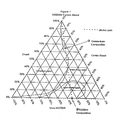
- Figure 1 is a ternary phase diagram directed to the fuel additive of Example 1 and the concentrate of Example 2.
- Figure 1 also illustrates a final form fuel utilizing the compositions of Examples I and 2.
- Figure 1 graphically illustrates the concentrations at which the compositions of Examples 1 and 2 can be expected to be stable homogenous single phase compositions which would represent ideal fuel additives.
- Figure 1 also demonstrates those concentrations at which the compositions can be expected to be unstable multi-phase compositions not suitable for use as a fuel additive.
- a ternary diagram is a representation of every possible combination of three components.
- the three components are: diesel fuel (at the top vertex), the carrier (on the lower right vertex), and 40% urea solution (on the lower left vertex).
- diesel fuel at the top vertex
- the carrier on the lower right vertex
- 40% urea solution on the lower left vertex.
- a point on the edge halfway between the "carrier” vertex, and the "diesel" vertex would be a 50/50 blend of those two components.
- a point in the middle of the diagram would be 33.3% of each component.
- Lines on the ternary chart show phase boundaries between homogeneous and cloudy compositions.
- phase boundaries for such a diagram, a small sample is weighed of a known combination of two of the three components. For example, 0.2 grams of carrier and 0.8 grams of diesel. The test tube is then tared and 40% urea solution is added dropwise with vigorous mixing, until the solution just becomes cloudy. The tube is weighed and the amount of urea solution is calculated. The point in the triangle which corresponds to the known percentage of each of the 3 components is plotted. This process is repeated as many times as necessary, changing the ratio of the first two components each time. The result is a family of points which outline the boundary between single-phase and multi-phase regions of the ternary system.
- Liquid crystal regions are found by noting whether the sample becomes viscous and whether it rotates polarized light (by holding the test tube between crossed polarizers). Liquid crystals rotate polarized light.
- Figure 1 represents an analysis of selected combinations of the urea/water, carrier blend and diesel fuel constituents provided in Examples 1 and 2.
- Each point along the curve represents an actual combination of urea/water, carrier blend and diesel fuel constituents which was tested as part of this invention to determine the boundry between the single phase and multi-phase compositions.
- All points to the right side of the curve are single phase compositions useful in practicing the invention while compositions to the left side of the curve were determined to be unstable cloudy or multi-phase compositions. The further the curve is to the left, the greater the number of single phase compositions which can be created.
- the liquid crystal region represents a region where the additive is a stable single phase composition but is more gelatinous.
- compositions useful in practicing the invention can be identified by drawing a straight line from the graph apex (representing 100% fuel) to a point generally tangent to, or to the right side of the curve. Compositions along this line represent optimal maximum levels of nitrogen which can be held in a single phase composition. As shown by the line in Figure 1 , an optimal additive is as described in Example 1 and has a urea/water concentration of about 35% and a carrier blend concentration of about 65%. The ideal concentrate range can be identified at fuel concentrations of about 65%. Example 2 is represented by the 65% fuel concentration. Ideal fuel final form fuel compositions are at 94% or greater amounts of fuel.
- a further exemplary fuel additive concentrate according to the invention was prepared.
- the constituents listed in following table were admixed with a spatula to prepare a 100 gram (34/33/33 wt. %) carrier blend composition: Table 2 Carrier Blend Constituents of Example 3 Constituent Product I.D. Amount Alcohol ethoxylate Tomadol 91-2.5 34 grams Polyethylene glycol ditallate Mapeg 600-OT 33 grams Oleic acid diethanolamide Mackamide MO 33 grams
- the 100 grams of carrier blend were admixed with 71.5 grams of #2 diesel fuel.
- the carrier blend dissolved readily in the diesel fuel.
- the resulting fuel additive concentrate had a viscosity of 435 centipoise at 22 °C as determined with a Brookfield Viscometer with a #3 spindle at 20 rpm. The specific gravity of the concentrate at 20 °C was 0.9632. The concentrate contained 11.2 % urea and 30% diesel by weight. Although somewhat viscous, the concentrate is pumpable making the concentrate useful for purposes of handling and transportation.
- Example 3 The concentrate of Example 3 was next added to host diesel fuel to make a final fuel formulation suitable for use in an internal combustion engine.
- 1 gram per gallon of urea in host diesel fuel 8.9 grams of the concentrate form of Example 3 were added to 1 gallon (3160 grams) of diesel fuel (0.28% concentrate by weight).
- the concentrate although somewhat viscous, completely dissolved in the diesel after mixing to become a clear and homogeneous solution.
- Example 3 Another fuel additive concentrate according to the invention was prepared. As in Example 3, the constituents listed in following table were admixed with a spatula in a 400 ml beaker to prepare a 100 gram carrier blend composition: Table 3 Carrier Blend Constituents of Example 4 Constituent Product I.D. Amount Alcohol ethoxylate Tomadol 91-2.5 34 grams Polyethylene glycol ditallate Mapeg 600-OT 33 grams Oleic acid diethanolamide Mackamide MO 33 grams
- aqueous urea solution 40 grams of water and 26.7 grams of urea were admixed to make an aqueous urea solution.
- the aqueous urea solution was added to the carrier blend/diesel fuel mixture.
- the aqueous urea solution dissolved quickly in the carrier blend/diesel solution to produce a clear, homogeneous fuel additive concentrate with a viscosity of less than 40 cps at 22 °C and a specific gravity of 0.9085.
- the concentrate contained 6.4% urea and 60% diesel by weight.
- Example 4 The concentrate of Example 4 was added to host diesel fuel to make a final fuel formulation suitable for use in an internal combustion engine.
- 15.6 grams of the concentrate were added to 1 gallon (3160 grams) of diesel fuel to reach an additive concentration of 0.49% concentrate by weight.
- the fluid concentrate advantageously dissolved quickly in the diesel fuel with almost no mixing.
- the ease of blending of the concentrate with the host fuel makes it possible to manufacture the concentrate at a site remote from the refinery and to easily transport the composition to the refinery for splash blending with the host fuel to form a final form fuel.
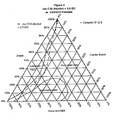
- Figure 2 represents an analysis of selected combinations of the urea/water, carrier blend and diesel fuel constituents provided in Examples 3 and 4. Each point along the curve and along the dilution path represents an actual combination of urea/water, carrier blend and diesel fuel constituents which was tested as part of this invention to determine the point at which the composition was a multi-phase or single-phase composition. All points to the right side of the curve are single phase compositions useful in practicing the invention.
- Figure 2 demonstrates that there are many optimal stable and homogenous additive, concentrate and final form fuel combinations which may be prepared using the novel composition. Further, the data show that the composition of the invention is highly efficacious in solubilizing large amounts of the nitrogen-containing compound per unit volume of carrier blend.
- Figure 3 represents the upper portion of Figure 2 and shows in greater detail the properties of the composition of Examples 3 and 4 including 80% or greater amounts of the diesel fuel.
- Figure 3 demonstrates that the composition is stable and homogenous in final form fuel compositions having fuel concentrations of between 80 - 99.99.%.
- a fuel additive composition incorporating a C 11 alcohol ethoxylate with 3 moles of EO was prepared.
- the constituents listed in following table were admixed with a spatula in a 400 ml beaker to prepare a 100 gram (34/33/33 wt.%) carrier blend composition: Table 4 Carrier Blend Constituents of Example 5 Constituent Product I.D. Amount Alcohol ethoxylate Tomadol 1-3 34 grams Polyethylene glycol ditallate Mapeg 600-OT 33 grams Oleic acid diethanolamide Mackamide MO 33 grams
- the 100 gram carrier blend composition was admixed with 250 grams of # 2 diesel fuel whereupon the carrier blend was observed to dissolve readily in the diesel fuel.
- aqueous 40 wt.% urea solution 40 grams of water and 26.7 grams of urea were admixed to make an aqueous 40 wt.% urea solution.
- the aqueous urea solution was added to the carrier blend/diesel fuel mixture.
- the aqueous urea solution dissolved quickly in the carrier blend/diesel solution to produce a clear, homogeneous fuel additive concentrate with a viscosity of less than 40 cps at 22 °C and a specific gravity of about 0.9085.
- the concentrate contained 6.4% urea and 60% diesel by weight.
- Example 5 The concentrate of Example 5 was added to host diesel fuel to make a final fuel formulation suitable for use in an internal combustion engine. 15.6 grams of the concentrate were added to 1 gallon (3160 grams) of diesel fuel to reach an additive concentration of 0.49% concentrate by weight and 1 gram of urea per gallon of diesel fuel. The fluid concentrate advantageously dissolved quickly in the diesel fuel with almost no mixing. The composition of Example 4 would be easily pumpable.
- Figure 4 is the ternary phase diagram showing the constituent concentrations at which the composition of Example 5 is a stable homogenous single phase composition.
- the composition of Examples 3 and 4 is also shown on Figure 4 by the solid line as a basis of comparison.
- Figure 4 demonstrates that the composition of Example 5 is stable when the additive form of the invention has a urea/water concentration of less than 56%.
- the concentrate is stable at 30-70% fuel and about 52%.
- An exemplary fuel additive composition according to the invention was prepared.
- the exemplary composition was prepared using a branched alcohol ethoxylate.
- Table shows the constituents used to prepare the carrier blend of Example 6.
- Table 5 Carrier Blend Constituents of Example 6 Constituent Product I.D. Amount Iso C10 alcohol + 2.5 Moles EO. Not applicable 34 grams Polyethylene glycol ditallate Mapeg 600-OT 33 grams Oleic acid diethanolamide Mackamide MO 33 grams
- the alcohol ethoxylate for Example 6 was prepared using Exxal-10 which is an Iso C 10 alcohol available from Exxon-Mobil.
- the branched alcohol was alkoxylated with 2.5 moles of EO per mole of alcohol.
- Example 6 The composition of Example 6 was prepared in the same manner as Examples 3-5. The three constituents listed in Table 5 were admixed with a spatula in a 400 ml beaker to prepare a 100 gram (34/33/33 wt. %) carrier blend composition. 250 grams of #2 diesel fuel were then added to the carrier blend. The carrier blend dissolved readily in the diesel fuel.
- aqueous 40 wt. % urea solution 40 grams of water and 26.7 grams of urea were admixed to make an aqueous 40 wt. % urea solution.
- the aqueous urea solution was added to the carrier blend/diesel fuel mixture.
- the aqueous urea solution dissolved quickly in the carrier blend/diesel solution to produce a clear, homogeneous fuel additive concentrate with a viscosity of less than 40 cps at 22 °C and a specific gravity of 0.9085.
- the concentrate contained 6.4% urea and 60% diesel by weight.
- Example 6 The concentrate of Example 6 was added to host diesel fuel to make a final fuel formulation suitable for use in an internal combustion engine. In order to supply 1 gram per gallon of urea in diesel fuel, 15.6 grams of the concentrate were added to 1 gallon (3160 grams) of diesel fuel to reach an additive concentration of 0.49% concentrate by weight. The fuel appeared to be homogenous without any phase separation.
- Figure 5 is a ternary phase diagram showing data points representing actual compositions of Example 6 which were evaluated to determine those compositions which were stable homogenous single phase composition.
- the composition of Examples 3 and 4 is also shown on Figure 4 by the dotted line.
- Figure 5 demonstrates that the additive composition of Example 6 is stable at urea/water concentrations of 76% or less.
- the concentrate is stable at fuel concentrations of 20-80 wt. % with between about 4-28 wt. % of urea.
- Example 7 was prepared to demonstrate the efficacy of the invention in gasoline.
- the composition was prepared according to Example 4 including a carrier blend made up of the constituents shown in Table 6 below: Table 6 Carrier Blend Constituents of Example 7 Constituent Product I.D. Amount Alcohol ethoxylate Tomadol 91-2.5 34 grams Polyethylene glycol ditallate Mapeg 600-OT 33 grams Oleic acid diethanolamide Mackamide MO 33 grams
- carrier blend constituents were admixed with a spatula in a 400 ml beaker to prepare a 100 gram (34/33/33 wt. %) carrier blend composition.
- 250 grams of 87 octane commercial regular grade Mobil gasoline were then added to the carrier blend.
- the carrier blend dissolved readily in the gasoline.
- aqueous urea solution 40 grams of water and 26.7 grams of urea were admixed to make an aqueous urea solution.
- the aqueous urea solution was added to the carrier blend/gasoline mixture.
- the aqueous urea solution dissolved quickly in the carrier blend/gasoline solution to produce a clear, homogeneous fuel additive concentrate.
- the composition was observed to have a low viscosity and would be easy to pump and handle.
- the concentrate contained 6.4% urea and 60% gasoline by weight.
- Figure 6 represents an analysis of selected combinations of the urea/water, carrier blend and gasoline of Example 6.
- the data points represent actual compositions of Example 6 which were prepared and evaluated at the fuel, urea/water and carrier blend concentrations shown on the drawing.
- the data show that the formulation of the invention and the gasoline forms a stable, homogenous composition across a wide range of concentrations.
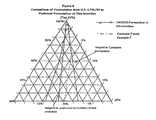
- Figures 7 and 8 are ternary phase diagrams of the Compere composition plotted in order to relate it to the compositions of our invention.
- Figure 8 is an enlarged drawing of the upper portion of Figure 7 .
- the formulation from Compere Example 7 does not permit dilution below 0.5% additive.
- the tangent to the phase boundary at low concentrations shows that the maximum fraction of urea solution in the additive is 7/20.
- Compere et al. use even higher amounts of urea per gallon of diesel fuel, without any data to substantiate better performance in the engine.
- the present invention efficaciously requires less carrier blend to keep more nitrogen-containing compound in solution than is the case with Compere.
- the calorific content of the inventive fuel and the air/fuel ratio required for the inventive fuel will be closer to the manufacturer's specification.
- a blend of urea and water was heated to above 40°C to produce a clear solution. This solution was then added to an ethoxylated fatty acid and added to a combination of diethanolamide and a higher alcohol ethoxylate. The resulting composition was a stable clear solution when added to diesel.
- the composition was temperature tolerant from -10°C to 90°C.
- Additive lubricity is an important property because ultra low sulfur gasoline presently used in many areas disadvantageously has reduced lubricity because of the reduced sulfur content. Decreased fuel lubricity results in increased wear on engine parts and reduces engine efficiency decreasing the distance that the vehicle can travel per unit volume of fuel. Any measurable increase in lubricity provided by a fuel additive would represent an advantage.
- the concentrate for use in the lubricity evaluations was prepared on a volume percent basis.
- the carrier blend (50/25/25 vol. %) consisted of the following constituents prepared according to the volume percentages shown in Table 7 below: Table 7 Carrier blend Constituents of Example 10 Constituent Volume % Alcohol ethoxylate C9-C11 (Shell Chemical Co.) alcohol + 2.5 moles EO 50 Polyethylene glycol (7 mole ethoxylate) mono & dioleate blend (1:1 vol. % ratio) 25 Lauric diethanolamide 25
- a solution of 60.% water and 40% urea was prepared and admixed with the carrier blend on a 1:1 volume basis to form the additive for use in the lubricity evaluation.
- the resulting gel was dispersed in gasoline.
- Ultra low sulfur European reference gasoline (RF08A85) was utilized for the lubricity evaluation. Each fuel sample was blended with the weight percentage of additive shown in Table 8 below.
- the fuel samples were then tested for lubricity according to ASTM standard D6079-99 Standard Test Method for Evaluating Lubricity of Diesel Fuels by the HighFrequency Reciprocating Rig (HFRR).
- the HFRR test measures wear on a reference part coated with the fuel. The greater the amount of wear on the part, the less lubricity provided by the fuel.
- the lubricity data is as follows: Table 8 Lubricity Data -- RF08A85 Gasoline Formulations Sample # 1 2 3 Additive (wt. %) 0.000 0.093 0.375 Lubricity (Part wear in ⁇ ) 670 276 234
- inventive composition provides a significant reduction in wear and increase in lubricity versus unmodified reference fuel. It is believed that this improvement in lubricity will cause an increase in engine efficiency and a resultant reduction in emissions and increase in the distance that the vehicle can travel per unit volume of fuel.
- the inventive fuel additive was next evaluated to determine the effect of the additive on the distillation of ultra low sulfur European reference gasoline (RF08A85). Reduction of the gasoline fuel boiling range is an indication that the composition will bum more completely in the engine. More complete combustion produces fewer emissions (having decreased NO x emissions) and results in more efficient operation of the engine. See e.g. , U.S. Patent No. 6,030,521 (Croudace et al. ) which asserts that a reduction in distillation temperature increases engine efficiency.
- the three gasoline samples were distilled according to British Institute of Petroleum Standard IP 123. According to the IP 123 standard, the fuels were heated at atmospheric pressure to a final temperature of approximately 200 °C. The temperature at which predetermined fractions of the fuel were recovered was measured and recorded. A greater recovery of distilled fuel at lower temperatures is an indication that the fuel boiling point has been reduced and is a further indication that the fuel will burn at a lower temperature with the resultant emission-reduction and efficiency benefits. A small temperature difference represents a potentially significant improvement in fuel efficiency.
- the fuel distillation data is as follows: Table 9 Distillation Data -- RF08A85 Gasoline Formulations Sample # 1 2 3 Additive (wt. %) 0 0.093 0.375 Initial B.P.
- the gasoline distillation data demonstrates that an exemplary additive according to the invention reduces the fuel boiling point and increases the percent fuel recovered at a lower temperature. It is expected that this property of the additive will result in better combustion characteristics and in reduced emission production.
- the inventive fuel additive was next evaluated for lubricity in ultra low sulfur European reference diesel fuel (RF73A93) according to ASTM standard D6079-99.
- An additive composition according to Example 10 was prepared. The additive was added to five of six diesel fuel samples in the weight percent amounts shown in Table 10. The diesel fuels were then evaluated for lubricity according to the ASTM standard. The lubricity results are as follow: Table 10 Lubricity Data -- RF73A93 Diesel Formulations Sample # 1 2 3 4 5 6 Additive (wt.%) 0 0.436 0.435 0.855 0.927 0.691 Lubricity (wear in ⁇ ) 376 306 269 307 296 288
- Part wear is decreased in all samples including the additive of the invention.
- the data demonstrate that the additive composition is useful in increasing fuel lubricity with the resultant engine and vehicle operation benefits.
- the inventive fuel additive was next evaluated to determine the effect of the additive on the distillation of the European reference low sulfur diesel fuel (RF73A93).
- Six diesel fuel compositions were prepared as in Example 12.
- the fuel additive for use in Example 13 was prepared as in Example 10.
- the weight percent of fuel additive added to each diesel fuel sample is shown in Table 11 below.
- the diesel fuel samples were distilled according to British Institute of Petroleum Standard IP 123.
- the six 1 L diesel fuel samples were heated to a final temperature of approximately 367 °C.
- the temperatures at which predetermined fractions of the diesel fuels were recovered were measured and recorded in Table 11 below.
- the diesel fuel distillation data is as follows: Table 11 Distillation Data -- RF73A93 Diesel Formulations Sample # 1 2 3 4 5 6 Additive (wt. %) 0 0.436 0.415 0.855 0.927 0.691 Initial B.P.
- the inventive fuel additive was next evaluated to determine the effect of the additive on reduction of NO x and particulate emissions and on the overall efficiency of the fuel in terms of the vehicle travel distance per unit volume of fuel.
- the evaluation was conducted by evaluating the performance of an engine operated using fuel compositions including varying concentrations of the inventive additive and against reference fuels not including the additive.
- a Cummins engine was subjected to a dynamometer test at four different operation modes to evaluate base fuel against various fuels including an exemplary additive of the invention.
- the engine used for the example was a Cummins 855 CI 4 stroke turbo charged, intercooled diesel engine.
- the engine was coupled to a SuperFlow Engine Dynamometer Model SF3100 rated at 1500HP.
- a SuperFlow Advanced Test Console was used to record the dynamometer data.
- a Sierra Micro Dilution Test Stand System Model BG-2 for Particulate Matter was utilized to measure particulate emissions.
- This fully computerized Micro-Dilution system is used to evaluate any size engine for particulate emissions and produces repeatable values that correlate with full dilution Systems over a wide variety of steady state conditions as defined by ISO 8178-4 or by CARB.
- the test apparatus measured emissions at varying engine speeds (in RPM) and torque.
- NO x emissions were determined with a Model 951 Beckman Chemiluminescence NO/NO x Analyzer and a Model 3400 Milton Roy Nondispersive Infrared CO & CO 2 Gas Analyzer was used to measure CO emissions.
- a J.U.M. Engineering Heated Flame Ionization Total Hydrocarbon Analyzer Model VE 7 was used to measure hydrocarbon emissions and oxygen emissions were taken with a Teledyne Analytical Instruments Oxygen Detector.
- a Wager Light Extinction Opacity Meter Model 650 A was used to measure particulate emissions.
- the particulate emissions referred to are typically pm 10-designated components which reside in the black smoke discharged as the diesel engine exhaust.
- the four engine modes used for the engine dynamometer tests each represented a different operation condition of a motor vehicle.
- the modes are as follows: Table 12 Engine Dynamometer Modes Mode Torque Engine Speed (RPM) Mode 1 Idle Idle Mode 2 Maximum Int. Speed Mode 3 Rated Rated Mode 4 50% Rated Rated
- RPM Engine Dynamometer Modes Mode Torque Engine Speed
- Mode 1 represents an engine which is in an idle condition.
- Mode 1 is an important mode with respect to production of emissions because a significant amount of engine operation occurs in the idle mode, particularly with respect to buses and heavy duty trucks. It is estimated, for example that approximately 30% of bus engine operation is conducted in the idle mode.
- Mode 2 simulates conditions of heavy vehicle load.
- Modes 3 and 4 represent driving conditions.
- the fuel additive for use in the engine tests was again prepared according to Example 10.
- the fuel additive was then blended with the CARB spec. number 2 diesel fuel to form 8 fuel formulations for use in the engine evaluation.
- the fuel additive was added to the reference fuel to achieve the weight percent fuel additive concentrations shown in Table 13 below.
- Table 13 “HC” and “CO” refer to hydrocarbon and carbon monoxide emissions respectively and “PM” refers to the engine particulate emissions.
- Fuel formulations including the additive showed advantageous reductions in NO x and other particulate emissions in all four test modes.
- mode 1 the idle mode, the fuel formulations including the additive of the invention produced, on average, 21.54% fewer NO x emissions versus the reference fuels.
- At least one fuel formulation (sample 4) achieved a 38.78% decrease in NO x emissions versus the unmodified fuel. There was no measurable difference in particulate emissions between samples 3 and 5.
- fuel formulations including the inventive additive produced, on average, 15.31 % fewer NO x emissions.
- Sample 4 achieved a 20.51 % reduction in NO x emissions versus unmodified fuel. Particulate emissions were reduced about 37% in this high-torque mode.
Landscapes
- Chemical & Material Sciences (AREA)
- Oil, Petroleum & Natural Gas (AREA)
- Engineering & Computer Science (AREA)
- Organic Chemistry (AREA)
- Chemical Kinetics & Catalysis (AREA)
- General Chemical & Material Sciences (AREA)
- Combustion & Propulsion (AREA)
- Inorganic Chemistry (AREA)
- Solid Fuels And Fuel-Associated Substances (AREA)
- Liquid Carbonaceous Fuels (AREA)
Claims (33)
- Treibstoffzusatz-Zusammensetzung mit3 bis 35 Gew.-% einer Stickstoff enthaltenden Verbindung, die aus der aus Harnstoff, Cyanursäure, Triazin, Ammoniak und deren Gemischen bestehenden Gruppe ausgewählt ist,30 bis 97 Gew.-% eines Trägergemisches bestehend aus
30 bis 75 Gew.-% einer alkoxylierten Alkoholzusammensetzung mit der folgenden allgemeinen Struktur: - R1 C6-C16 ist,- R2 H oder CH3 ist und- x 1 bis 7 ist,10 bis 60 Gew.-% einer Polyalkylenglykolesterzusammensetzung mit der folgenden allgemeinen Struktur:
 - R3 C11-C19 ist,- R4 H oder CH3 ist, -y 1 bis 20 ist,10 bis 60 Gew.-% einer Alkanolamidzusammensetzung mit der folgenden allgemeinen Struktur:
R5 H oder COR3 ist, und - R6 C12-C18 ist,- R7 H oder CH2CH2OH istund deren Mischungen, und0,0025 bis 25 Gew.-% Wasser,wobei die Treibstoffzusatzzusammensetzung ein beständiger, einphasiger Zusatz ist.
 - Zusammensetzung des Anspruchs 1, bei der die Stickstoff enthaltende Verbindung Harnstoff ist.
- Zusammensetzung des Anspruchs 2, bei der der Harnstoff 10 bis 32 Gew.-% der Zusammensetzung ausmacht.
- Zusammensetzung des Anspruchs 3, bei der der Harnstoff 12 bis 28 Gew.-% der Zusammensetzung ausmacht.
- Zusammensetzung des Anspruchs 2, bei der der alkoxylierte Alkohol 33 bis 55 Gew.-% der Zusammensetzung ausmacht.
- Zusammensetzung des Anspruchs 2, bei der R1 C9-C11 ist und x 2,5 ist.
- Zusammensetzung des Anspruchs 2, bei der der Polyalkylenglykolester 25 bis 40 Gew.-% der Zusammensetzung ausmacht.
- Zusammensetzung des Anspruchs 7, bei der der Polyalkylenglykolester 25 bis 33 Gew.-% Zusammensetzung ausmacht
- Zusammensetzung Anspruchs 2, bei der R3 C17 ist und R5 COR3 ist.
- Zusammensetzung des Anspruchs 2, bei der das Alkanolamid 25 bis 40 Gew.-% der Zusammensetzung ausmacht.
- Zusammensetzung des Anspruchs 10, bei der das Alkanolamid 25 bis 33 Gew.-% der Zusammensetzung ausmacht.
- Zusammensetzung des Anspruchs 2, bei der R6 C17 ist und R7 CH2CH2OH ist.
- Treibstoffzusatzkonzentratzusammensetzung mit80 bis 20 Gew.-% der Treibstoffzusatzzusammensetzung nach einem der Ansprüche 1 bis 12 und20 bis 80 Gew.-% eines Lösungsmittels,wobei die Treibstoffzusatzzusammensetzung ein beständiges, einphasiges Konzentrat ist.
- Zusammensetzung des Anspruchs 13, bei der das Lösungsmittel ein Treibstoff ist, der aus der aus Diesel, Benzin, Kerosin und deren Gemischen bestehenden Gruppe ausgewählt ist.
- Zusammensetzung des Anspruchs 13, bei der die Zusatzkonzentratzusammensetzung aus 70 bis 30 Gew.-% der Treibstoffzusatzzusammensetzung und 30 bis 70 Gew.-% des Lösungsmittels besteht.
- Zusammensetzung des Anspruchs 15, bei der die Zusatzkonzentratzusammensetzung aus 60 bis 40 Gew.-% der Treibstoffzusatzzusammensetzung und 40 bis 60 Gew.-% des Lösungsmittels besteht.
- Treibstoffzusammensetzung, die bei Verbrennung in einer Verbrennungskraftm chine zur Bildung reduzierter NOx-Emissionen formuliert ist, mit97 bis 99,99 Gew.-% eines Kohlenwasserstoff enthaltenden Treibstoffs und0,01 bis 3 Gew.-% eines Treibstoffzusatzkonzentrats nach einem der Ansprüche 13 bis 16,wobei die Treibstoffzusammensetzung eine beständige, einphasige Treibstoffzusammensetzung ist.
- Verfahren der Herstellung einer Treibstoffzusatzzusammensetzung mit den Stufen in jeder beliebigen Reihenfolge:- Herstellung einer wässrigen Harnstoffzusammensetzung durch Mischen von 40 bis 50 Gew.-% Harnstoff mit 60 bis 50 Gew.-% Wasser,- zu beliebiger Zeit Herstellung eines Trägergemisches durch Mischen in beliebiger Reihenfolge von30 bis 75 Gew.-% einer alkoxylierten Alkoholzusammensetzung mit der folgenden allgemeinen Struktur:
 - R1 C6-C16 ist,- R2 H oder CH3 ist und- x 1 bis 7 ist,10 bis 60 Gew.-% einer Polyalkylenglykolesterzusammensetzung mit der folgenden allgemeinen Struktur:
 - R3 C11-C19 ist,- R4 H oder CH3 ist,- y 1 bis 20 ist,
R5 H oder COR3 ist, und10 bis 60 Gew.-% einer Alkanolamidzusammensetzung mit der folgenden allgemeinen Struktur: - R6 C12-C18 ist,- R7 H oder CH2CH2OH istund deren Mischungen, und- Mischung von 50 bis 35 Gew.-% der wässrigen, Harnstoff enthaltenden Zusammensetzung mit 50 bis 65 Gew.-% Trägergemisches,wobei die Treibstoffzusatzzusammensetzung eine beständige, einphasige Zusammensetzung ist.
 - Verfahren des Anspruchs 18, bei dem die Stufe der Herstellung der wässrigen Harnstoffzusammensetzung aus dem Mischen von 40 bis 45 Gew.-% Harnstoff mit 60 bis 55 Gew.-% Wasser besteht.
- Verfahren des Anspruchs 19, bei dem die Stufe der Herstellung der wässrigen Harnstoffzusammensetzung aus dem Mischen vom 40 Gew.-% Harnstoff mit 60 Gew.-% Wasser besteht.
- Verfahren des Anspruchs 18, bei dem die Stufe der Herstellung des Trägergemisches das Zumischen von 33 bis 55 Gew.-% des alkoxylierten Alkohols umfaßt.
- Verfahren des Anspruchs 18, bei dem R1 C9-C11 ist und x 2,5 ist.
- Verfahren des Anspruchs 18, bei dem die Stufe der Herstellung des Trägergemisches das Zumischen von 25 bis 40 Gew.-% des Polyalkylenglykolesters umfaßt.
- Verfahren des Anspruchs 23, bei dem die Stufe der Herstellung des Trägergemisches das Zumischen von 25 bis 33 Gew.-% des Polyalkylenglykolesters umfaßt.
- Verfahren des anspruchs 18, bei dem R3 C17 ist und R5 COR3 ist.
- Verfahren des Anspruchs 18, bei dem die Stufe der Herstellung des Trägergemisches das Zumischen von 25 bis 40 Gew.-% des Alkanolamids umfaßt.
- Verfahren des Anspruchs 26, bei dem die Stufe der Herstellung des Trägergemisches das Zumischen von 25 bis 33 Gew.-% alkanolamins umfaßt.
- Verfahren des Anspruchs 18, bei dem R6 C17 ist und R7 CH2CH2OH ist.
- Verfahren der Herstellung einer Treibstoffzusatzkonzentratzusammensetzung mit den Stufen in jeder beliebigen Reihenfolge:- Herstellung eines Zusatzes nach einem der Ansprüche 18 bis 28 und- Mischen von 80 bis 20 Gew.-% des Zusatzes mit 20 bis 80 Gew.-% eines Lösungsmittels,wobei die Treibstoffzusatzzusammensetzung ein beständiges, einphasiges Konzentrat ist.
- Verfahren des Anspruchs 29, bei dem das Lösungsmittel ein Treibstoff ist, der aus der aus Diesel, Benzin und Kerosin bestehenden Gruppe ausgewählt ist.
- Verfahren des Anspruchs 29, bei dem die Stufe der Herstellung der Konzentratzusammensetzung die Stufe der Mischung von 70 bis 30 Gew.-% des Zusatzes mit 30 bis 70 Gew.-% des Lösungsmittels umfaßt.
- Verfahren des Anspruchs 31, bei dem die Stufe der Herstellung der Konzentratzusammensetzung die Stufe der Mischung von 60 bis 40 Gew.-% des Zusatzes mit 40 bis 60 Gew.-% des Lösungsmittels umfaßt.
- Verfahren der Herstellung einer Treibstoffzusammensetzung, die bei Verbrennung in einer Verbrennungskraftmaschine zur Bildung reduzierter NOx-Emissionen formuliert ist, mit den Stufen der- Herstellung einer Treibstoffzusatzkonzentratzusammensetzung nach einem der Ansprüche 29 bis 33,- Mischen von 97 bis 99,99 Gew.-% eines Kohlenwasserstoff enthaltenden Treibstoffs mit 0,01 bis 3 Gew.-% des Treibstoffzusatzkonzentrats,wobei die Treibstoffzusammensetzung eine beständige, einphasige Treibstoffzusammensetzung ist.
Applications Claiming Priority (5)
| Application Number | Priority Date | Filing Date | Title |
|---|---|---|---|
| GBGB9927563.8A GB9927563D0 (en) | 1999-11-23 | 1999-11-23 | A process and method for blending a fuel containing a high molecular weight compound |
| GB9927563 | 1999-11-23 | ||
| GB0010575A GB2361931B (en) | 1999-11-23 | 2000-05-02 | Fuel combustion |
| GB0010575 | 2000-05-02 | ||
| PCT/US2000/032226 WO2001038464A1 (en) | 1999-11-23 | 2000-11-22 | Fuel additive, additive-containing fuel compositions and method of manufacture |
Publications (3)
| Publication Number | Publication Date |
|---|---|
| EP1246894A1 EP1246894A1 (de) | 2002-10-09 |
| EP1246894A4 EP1246894A4 (de) | 2004-10-13 |
| EP1246894B1 true EP1246894B1 (de) | 2012-01-11 |
Family
ID=26244202
Family Applications (1)
| Application Number | Title | Priority Date | Filing Date |
|---|---|---|---|
| EP00982221A Expired - Lifetime EP1246894B1 (de) | 1999-11-23 | 2000-11-22 | Treibstoffzusatz, diesen zusatz enthaltende treibstoffzusammensetzungen und verfahren zu deren herstellung |
Country Status (6)
| Country | Link |
|---|---|
| US (1) | US20040123515A1 (de) |
| EP (1) | EP1246894B1 (de) |
| AU (1) | AU1927901A (de) |
| CA (1) | CA2393157A1 (de) |
| GB (1) | GB2361932B (de) |
| WO (1) | WO2001038464A1 (de) |
Families Citing this family (12)
| Publication number | Priority date | Publication date | Assignee | Title |
|---|---|---|---|---|
| GB9927563D0 (en) | 1999-11-23 | 2000-01-19 | Williamson Ian | A process and method for blending a fuel containing a high molecular weight compound |
| WO2001083649A1 (en) * | 2000-05-02 | 2001-11-08 | Interfacial Technologies (Uk) Limited | Fuel combustion |
| EP1525290A1 (de) * | 2001-11-05 | 2005-04-27 | International Fuel Technology, Inc. | Schwerfraktion enthaltende treibstoffzusammensetzung |
| US6803350B2 (en) * | 2002-05-22 | 2004-10-12 | Chevron Oronite Company Llc | Lubricating compositions for friction material interfaces |
| KR20060081658A (ko) | 2003-06-23 | 2006-07-13 | 엔바이로퓨얼즈 엘.피. | 탄화수소계 연료용 첨가제 및 관련 방법 |
| EP1670881A1 (de) * | 2003-09-09 | 2006-06-21 | Ivan Raisz | Kraftstoffzusatz mit verringerter emission |
| WO2007036678A1 (en) * | 2005-09-30 | 2007-04-05 | International Fuel Technology, Inc. | Fuel compositions containing fuel additive |
| CN102176956B (zh) * | 2008-10-14 | 2013-11-06 | 亚拉国际有限公司 | 通过使用烷氧基化化合物的表面活性剂混合物最小化脲溶液液滴直径的方法 |
| US20100107476A1 (en) * | 2008-10-31 | 2010-05-06 | Afton Chemical Corporation | Compositions and Methods Including Hexahydrotriazines Useful as Direct Injection Fuel Additives |
| US8426218B2 (en) | 2010-10-19 | 2013-04-23 | Mclane Research Laboratories, Inc. | Fixation filter assembly |
| MY173652A (en) * | 2013-10-24 | 2020-02-13 | Shell Int Research | Liquid fuel compositions |
| US11732628B1 (en) | 2020-08-12 | 2023-08-22 | Old World Industries, Llc | Diesel exhaust fluid |
Family Cites Families (20)
| Publication number | Priority date | Publication date | Assignee | Title |
|---|---|---|---|---|
| GB2217229B (en) * | 1988-04-25 | 1992-07-29 | Enersolve Chemical Company Lim | Solubilising composition |
| US5288393A (en) * | 1990-12-13 | 1994-02-22 | Union Oil Company Of California | Gasoline fuel |
| US5609026A (en) * | 1991-05-16 | 1997-03-11 | Kleenair Systems, Inc. | Engine NOx reduction |
| DE4423003C2 (de) * | 1993-07-06 | 1999-01-21 | Ford Werke Ag | Verfahren und Vorrichtung zum Reduzieren von NO¶x¶ in den Abgasen von Kraftfahrzeugverbrennungsmotoren |
| US5404841A (en) * | 1993-08-30 | 1995-04-11 | Valentine; James M. | Reduction of nitrogen oxides emissions from diesel engines |
| JP3624429B2 (ja) * | 1994-02-28 | 2005-03-02 | 株式会社日立製作所 | 内燃機関の制御装置 |
| US5746783A (en) * | 1994-03-30 | 1998-05-05 | Martin Marietta Energy Systems, Inc. | Low emissions diesel fuel |
| US5522218A (en) * | 1994-08-23 | 1996-06-04 | Caterpillar Inc. | Combustion exhaust purification system and method |
| US5783160A (en) * | 1995-01-27 | 1998-07-21 | Toyota Jidosha Kabushiki Kaisha | Method for purifying combustion exhaust gas |
| US5992141A (en) * | 1996-04-02 | 1999-11-30 | Kleen Air Systems, Inc. | Ammonia injection in NOx control |
| GB9621753D0 (en) * | 1996-10-18 | 1996-12-11 | Williamson Ian V | Fuel composition |
| US5752989A (en) * | 1996-11-21 | 1998-05-19 | Ethyl Corporation | Diesel fuel and dispersant compositions and methods for making and using same |
| US6218353B1 (en) * | 1997-08-27 | 2001-04-17 | Micell Technologies, Inc. | Solid particulate propellant systems and aerosol containers employing the same |
| US6074445A (en) * | 1997-10-20 | 2000-06-13 | Pure Energy Corporation | Polymeric fuel additive and method of making the same, and fuel containing the additive |
| AU761457B2 (en) * | 1998-01-12 | 2003-06-05 | Deborah Wenzel | An additive composition also used as a fuel composition comprising water soluble alcohols |
| GB2336120A (en) * | 1998-04-09 | 1999-10-13 | Coval Technologies Limited | Solubilising water and fuel oil |
| US6648929B1 (en) * | 1998-09-14 | 2003-11-18 | The Lubrizol Corporation | Emulsified water-blended fuel compositions |
| CN1216969C (zh) * | 1998-11-23 | 2005-08-31 | 纯能源公司 | 柴油机燃料组合物 |
| US6017369A (en) * | 1998-11-23 | 2000-01-25 | Pure Energy Corporation | Diesel fuel composition |
| GB9929622D0 (en) * | 1999-12-15 | 2000-02-09 | Aae Holdings Plc | Compositions |
-
2000
- 2000-11-22 AU AU19279/01A patent/AU1927901A/en not_active Abandoned
- 2000-11-22 EP EP00982221A patent/EP1246894B1/de not_active Expired - Lifetime
- 2000-11-22 CA CA002393157A patent/CA2393157A1/en not_active Abandoned
- 2000-11-22 WO PCT/US2000/032226 patent/WO2001038464A1/en not_active Ceased
-
2001
- 2001-02-02 GB GB0102698A patent/GB2361932B/en not_active Expired - Fee Related
-
2003
- 2003-02-26 US US10/374,687 patent/US20040123515A1/en not_active Abandoned
Also Published As
| Publication number | Publication date |
|---|---|
| GB2361932B (en) | 2005-01-12 |
| EP1246894A4 (de) | 2004-10-13 |
| US20040123515A1 (en) | 2004-07-01 |
| GB2361932A (en) | 2001-11-07 |
| CA2393157A1 (en) | 2001-05-31 |
| GB0102698D0 (en) | 2001-03-21 |
| EP1246894A1 (de) | 2002-10-09 |
| WO2001038464A1 (en) | 2001-05-31 |
| AU1927901A (en) | 2001-06-04 |
Similar Documents
| Publication | Publication Date | Title |
|---|---|---|
| US7172635B2 (en) | Fuel additives | |
| EP1334170B1 (de) | Brennstoffzusammensetzung | |
| CN103194282B (zh) | 一种柴油复合添加剂 | |
| EP1246894B1 (de) | Treibstoffzusatz, diesen zusatz enthaltende treibstoffzusammensetzungen und verfahren zu deren herstellung | |
| JP4216591B2 (ja) | 燃料組成物 | |
| AU2316299A (en) | An additive composition also used as a fuel composition comprising water soluble alcohols | |
| CA2430854A1 (en) | A concentrated emulsion for making an aqueous hydrocarbon fuel | |
| US8147566B2 (en) | Fuel additive, additive-containing fuel compositions and method of manufacture | |
| AU2002223787A1 (en) | Fuel composition | |
| US5538522A (en) | Fuel additives and method | |
| CZ298632B6 (cs) | Palivový aditivní prostredek, palivový prostredekpro použití ve spalovacích motorech a zpusob úpravy kapalných paliv obsahujících uhlovodíky | |
| EP1227143B1 (de) | Brennstoffzusätze | |
| WO2001044413A2 (en) | Fuel additives | |
| CA2400946A1 (en) | Fuel additive | |
| US7374588B2 (en) | Fuel combustion | |
| US20030163952A1 (en) | Compositions | |
| AU2002308016B2 (en) | Fuel additives | |
| WO2010077161A2 (en) | Synergistic octane booster additives containing aromatics amines and manganese and gasoline resulted from their usage | |
| US20030159339A1 (en) | Fuel additive | |
| AU2002308016A1 (en) | Fuel additives | |
| EP1130081A1 (de) | Brennstoffzusatz | |
| HK1059631B (en) | Fuel composition | |
| HK1059797B (en) | Fuel composition |
Legal Events
| Date | Code | Title | Description |
|---|---|---|---|
| PUAI | Public reference made under article 153(3) epc to a published international application that has entered the european phase |
Free format text: ORIGINAL CODE: 0009012 |
|
| 17P | Request for examination filed |
Effective date: 20020611 |
|
| AK | Designated contracting states |
Kind code of ref document: A1 Designated state(s): AT BE CH CY DE DK ES FI FR GB GR IE IT LI LU MC NL PT SE TR |
|
| AX | Request for extension of the european patent |
Free format text: AL PAYMENT 20020611;LT PAYMENT 20020611;LV PAYMENT 20020611;MK PAYMENT 20020611;RO PAYMENT 20020611;SI PAYMENT 20020611 |
|
| A4 | Supplementary search report drawn up and despatched |
Effective date: 20040830 |
|
| RIC1 | Information provided on ipc code assigned before grant |
Ipc: 7C 10L 1/10 B Ipc: 7C 10L 1/32 B Ipc: 7C 10L 1/18 B Ipc: 7C 10L 10/04 B Ipc: 7C 10L 10/02 B Ipc: 7C 10L 1/22 A |
|
| RAP1 | Party data changed (applicant data changed or rights of an application transferred) |
Owner name: TOMAH PRODUCTS, INC. Owner name: INTERFACIAL TECHNOLOGIES (UK) LIMITED |
|
| 17Q | First examination report despatched |
Effective date: 20090805 |
|
| GRAP | Despatch of communication of intention to grant a patent |
Free format text: ORIGINAL CODE: EPIDOSNIGR1 |
|
| GRAS | Grant fee paid |
Free format text: ORIGINAL CODE: EPIDOSNIGR3 |
|
| GRAA | (expected) grant |
Free format text: ORIGINAL CODE: 0009210 |
|
| AK | Designated contracting states |
Kind code of ref document: B1 Designated state(s): AT BE CH CY DE DK ES FI FR GB GR IE IT LI LU MC NL PT SE TR |
|
| AX | Request for extension of the european patent |
Extension state: AL LT LV MK RO SI |
|
| REG | Reference to a national code |
Ref country code: GB Ref legal event code: FG4D |
|
| REG | Reference to a national code |
Ref country code: CH Ref legal event code: EP |
|
| REG | Reference to a national code |
Ref country code: AT Ref legal event code: REF Ref document number: 541026 Country of ref document: AT Kind code of ref document: T Effective date: 20120115 |
|
| REG | Reference to a national code |
Ref country code: IE Ref legal event code: FG4D |
|
| REG | Reference to a national code |
Ref country code: DE Ref legal event code: R096 Ref document number: 60046840 Country of ref document: DE Effective date: 20120315 |
|
| REG | Reference to a national code |
Ref country code: NL Ref legal event code: VDEP Effective date: 20120111 |
|
| LTLA | Lt: lapse of european patent or patent extension | ||
| PG25 | Lapsed in a contracting state [announced via postgrant information from national office to epo] |
Ref country code: NL Free format text: LAPSE BECAUSE OF FAILURE TO SUBMIT A TRANSLATION OF THE DESCRIPTION OR TO PAY THE FEE WITHIN THE PRESCRIBED TIME-LIMIT Effective date: 20120111 Ref country code: BE Free format text: LAPSE BECAUSE OF FAILURE TO SUBMIT A TRANSLATION OF THE DESCRIPTION OR TO PAY THE FEE WITHIN THE PRESCRIBED TIME-LIMIT Effective date: 20120111 |
|
| PG25 | Lapsed in a contracting state [announced via postgrant information from national office to epo] |
Ref country code: FI Free format text: LAPSE BECAUSE OF FAILURE TO SUBMIT A TRANSLATION OF THE DESCRIPTION OR TO PAY THE FEE WITHIN THE PRESCRIBED TIME-LIMIT Effective date: 20120111 Ref country code: PT Free format text: LAPSE BECAUSE OF FAILURE TO SUBMIT A TRANSLATION OF THE DESCRIPTION OR TO PAY THE FEE WITHIN THE PRESCRIBED TIME-LIMIT Effective date: 20120511 Ref country code: GR Free format text: LAPSE BECAUSE OF FAILURE TO SUBMIT A TRANSLATION OF THE DESCRIPTION OR TO PAY THE FEE WITHIN THE PRESCRIBED TIME-LIMIT Effective date: 20120412 |
|
| REG | Reference to a national code |
Ref country code: AT Ref legal event code: MK05 Ref document number: 541026 Country of ref document: AT Kind code of ref document: T Effective date: 20120111 |
|
| PG25 | Lapsed in a contracting state [announced via postgrant information from national office to epo] |
Ref country code: CY Free format text: LAPSE BECAUSE OF FAILURE TO SUBMIT A TRANSLATION OF THE DESCRIPTION OR TO PAY THE FEE WITHIN THE PRESCRIBED TIME-LIMIT Effective date: 20120111 |
|
| PLBI | Opposition filed |
Free format text: ORIGINAL CODE: 0009260 |
|
| PG25 | Lapsed in a contracting state [announced via postgrant information from national office to epo] |
Ref country code: DK Free format text: LAPSE BECAUSE OF FAILURE TO SUBMIT A TRANSLATION OF THE DESCRIPTION OR TO PAY THE FEE WITHIN THE PRESCRIBED TIME-LIMIT Effective date: 20120111 Ref country code: SE Free format text: LAPSE BECAUSE OF FAILURE TO SUBMIT A TRANSLATION OF THE DESCRIPTION OR TO PAY THE FEE WITHIN THE PRESCRIBED TIME-LIMIT Effective date: 20120111 |
|
| 26 | Opposition filed |
Opponent name: HAMILTON, ALISTAIR Effective date: 20121004 |
|
| PLAX | Notice of opposition and request to file observation + time limit sent |
Free format text: ORIGINAL CODE: EPIDOSNOBS2 |
|
| PG25 | Lapsed in a contracting state [announced via postgrant information from national office to epo] |
Ref country code: IT Free format text: LAPSE BECAUSE OF FAILURE TO SUBMIT A TRANSLATION OF THE DESCRIPTION OR TO PAY THE FEE WITHIN THE PRESCRIBED TIME-LIMIT Effective date: 20120111 |
|
| REG | Reference to a national code |
Ref country code: DE Ref legal event code: R026 Ref document number: 60046840 Country of ref document: DE Effective date: 20121004 |
|
| PG25 | Lapsed in a contracting state [announced via postgrant information from national office to epo] |
Ref country code: AT Free format text: LAPSE BECAUSE OF FAILURE TO SUBMIT A TRANSLATION OF THE DESCRIPTION OR TO PAY THE FEE WITHIN THE PRESCRIBED TIME-LIMIT Effective date: 20120111 |
|
| PLAF | Information modified related to communication of a notice of opposition and request to file observations + time limit |
Free format text: ORIGINAL CODE: EPIDOSCOBS2 |
|
| PG25 | Lapsed in a contracting state [announced via postgrant information from national office to epo] |
Ref country code: ES Free format text: LAPSE BECAUSE OF FAILURE TO SUBMIT A TRANSLATION OF THE DESCRIPTION OR TO PAY THE FEE WITHIN THE PRESCRIBED TIME-LIMIT Effective date: 20120422 |
|
| REG | Reference to a national code |
Ref country code: CH Ref legal event code: PL |
|
| PLBB | Reply of patent proprietor to notice(s) of opposition received |
Free format text: ORIGINAL CODE: EPIDOSNOBS3 |
|
| PG25 | Lapsed in a contracting state [announced via postgrant information from national office to epo] |
Ref country code: CH Free format text: LAPSE BECAUSE OF NON-PAYMENT OF DUE FEES Effective date: 20121130 Ref country code: LI Free format text: LAPSE BECAUSE OF NON-PAYMENT OF DUE FEES Effective date: 20121130 |
|
| REG | Reference to a national code |
Ref country code: IE Ref legal event code: MM4A |
|
| PG25 | Lapsed in a contracting state [announced via postgrant information from national office to epo] |
Ref country code: IE Free format text: LAPSE BECAUSE OF NON-PAYMENT OF DUE FEES Effective date: 20121122 |
|
| PG25 | Lapsed in a contracting state [announced via postgrant information from national office to epo] |
Ref country code: TR Free format text: LAPSE BECAUSE OF FAILURE TO SUBMIT A TRANSLATION OF THE DESCRIPTION OR TO PAY THE FEE WITHIN THE PRESCRIBED TIME-LIMIT Effective date: 20120111 Ref country code: MC Free format text: LAPSE BECAUSE OF NON-PAYMENT OF DUE FEES Effective date: 20121130 |
|
| PG25 | Lapsed in a contracting state [announced via postgrant information from national office to epo] |
Ref country code: LU Free format text: LAPSE BECAUSE OF NON-PAYMENT OF DUE FEES Effective date: 20121122 |
|
| REG | Reference to a national code |
Ref country code: FR Ref legal event code: ST Effective date: 20140731 |
|
| REG | Reference to a national code |
Ref country code: DE Ref legal event code: R100 Ref document number: 60046840 Country of ref document: DE |
|
| PLCK | Communication despatched that opposition was rejected |
Free format text: ORIGINAL CODE: EPIDOSNREJ1 |
|
| REG | Reference to a national code |
Ref country code: FR Ref legal event code: RN Effective date: 20140826 |
|
| REG | Reference to a national code |
Ref country code: FR Ref legal event code: D3 Effective date: 20140902 |
|
| PGRI | Patent reinstated in contracting state [announced from national office to epo] |
Ref country code: FR Effective date: 20140902 |
|
| PLBN | Opposition rejected |
Free format text: ORIGINAL CODE: 0009273 |
|
| STAA | Information on the status of an ep patent application or granted ep patent |
Free format text: STATUS: OPPOSITION REJECTED |
|
| 27O | Opposition rejected |
Effective date: 20140904 |
|
| REG | Reference to a national code |
Ref country code: DE Ref legal event code: R100 Ref document number: 60046840 Country of ref document: DE Effective date: 20140904 |
|
| REG | Reference to a national code |
Ref country code: FR Ref legal event code: PLFP Year of fee payment: 15 |
|
| PGFP | Annual fee paid to national office [announced via postgrant information from national office to epo] |
Ref country code: DE Payment date: 20150529 Year of fee payment: 15 Ref country code: GB Payment date: 20150506 Year of fee payment: 15 |
|
| PGFP | Annual fee paid to national office [announced via postgrant information from national office to epo] |
Ref country code: FR Payment date: 20150527 Year of fee payment: 15 |
|
| REG | Reference to a national code |
Ref country code: DE Ref legal event code: R119 Ref document number: 60046840 Country of ref document: DE |
|
| GBPC | Gb: european patent ceased through non-payment of renewal fee |
Effective date: 20151122 |
|
| REG | Reference to a national code |
Ref country code: FR Ref legal event code: ST Effective date: 20160729 |
|
| PG25 | Lapsed in a contracting state [announced via postgrant information from national office to epo] |
Ref country code: DE Free format text: LAPSE BECAUSE OF NON-PAYMENT OF DUE FEES Effective date: 20160601 Ref country code: GB Free format text: LAPSE BECAUSE OF NON-PAYMENT OF DUE FEES Effective date: 20151122 |
|
| PG25 | Lapsed in a contracting state [announced via postgrant information from national office to epo] |
Ref country code: FR Free format text: LAPSE BECAUSE OF NON-PAYMENT OF DUE FEES Effective date: 20151130 |