EP1247963A2 - Procédé de commande d'un mode de fonctionnement d'un moteur à combustion interne à mélange pauvre - Google Patents
Procédé de commande d'un mode de fonctionnement d'un moteur à combustion interne à mélange pauvre Download PDFInfo
- Publication number
- EP1247963A2 EP1247963A2 EP02090054A EP02090054A EP1247963A2 EP 1247963 A2 EP1247963 A2 EP 1247963A2 EP 02090054 A EP02090054 A EP 02090054A EP 02090054 A EP02090054 A EP 02090054A EP 1247963 A2 EP1247963 A2 EP 1247963A2
- Authority
- EP
- European Patent Office
- Prior art keywords
- catalytic converter
- storage
- internal combustion
- combustion engine
- temperature
- Prior art date
- Legal status (The legal status is an assumption and is not a legal conclusion. Google has not performed a legal analysis and makes no representation as to the accuracy of the status listed.)
- Granted
Links
Images
Classifications
-
- F—MECHANICAL ENGINEERING; LIGHTING; HEATING; WEAPONS; BLASTING
- F02—COMBUSTION ENGINES; HOT-GAS OR COMBUSTION-PRODUCT ENGINE PLANTS
- F02D—CONTROLLING COMBUSTION ENGINES
- F02D41/00—Electrical control of supply of combustible mixture or its constituents
- F02D41/30—Controlling fuel injection
- F02D41/3011—Controlling fuel injection according to or using specific or several modes of combustion
- F02D41/3076—Controlling fuel injection according to or using specific or several modes of combustion with special conditions for selecting a mode of combustion, e.g. for starting, for diagnosing
-
- F—MECHANICAL ENGINEERING; LIGHTING; HEATING; WEAPONS; BLASTING
- F01—MACHINES OR ENGINES IN GENERAL; ENGINE PLANTS IN GENERAL; STEAM ENGINES
- F01N—GAS-FLOW SILENCERS OR EXHAUST APPARATUS FOR MACHINES OR ENGINES IN GENERAL; GAS-FLOW SILENCERS OR EXHAUST APPARATUS FOR INTERNAL-COMBUSTION ENGINES
- F01N3/00—Exhaust or silencing apparatus having means for purifying, rendering innocuous, or otherwise treating exhaust
- F01N3/08—Exhaust or silencing apparatus having means for purifying, rendering innocuous, or otherwise treating exhaust for rendering innocuous
- F01N3/0807—Exhaust or silencing apparatus having means for purifying, rendering innocuous, or otherwise treating exhaust for rendering innocuous by using absorbents or adsorbents
- F01N3/0828—Exhaust or silencing apparatus having means for purifying, rendering innocuous, or otherwise treating exhaust for rendering innocuous by using absorbents or adsorbents characterised by the absorbed or adsorbed substances
- F01N3/0842—Nitrogen oxides
-
- F—MECHANICAL ENGINEERING; LIGHTING; HEATING; WEAPONS; BLASTING
- F02—COMBUSTION ENGINES; HOT-GAS OR COMBUSTION-PRODUCT ENGINE PLANTS
- F02D—CONTROLLING COMBUSTION ENGINES
- F02D41/00—Electrical control of supply of combustible mixture or its constituents
- F02D41/02—Circuit arrangements for generating control signals
- F02D41/021—Introducing corrections for particular conditions exterior to the engine
- F02D41/0235—Introducing corrections for particular conditions exterior to the engine in relation with the state of the exhaust gas treating apparatus
- F02D41/027—Introducing corrections for particular conditions exterior to the engine in relation with the state of the exhaust gas treating apparatus to purge or regenerate the exhaust gas treating apparatus
- F02D41/0275—Introducing corrections for particular conditions exterior to the engine in relation with the state of the exhaust gas treating apparatus to purge or regenerate the exhaust gas treating apparatus the exhaust gas treating apparatus being a NOx trap or adsorbent
-
- F—MECHANICAL ENGINEERING; LIGHTING; HEATING; WEAPONS; BLASTING
- F02—COMBUSTION ENGINES; HOT-GAS OR COMBUSTION-PRODUCT ENGINE PLANTS
- F02D—CONTROLLING COMBUSTION ENGINES
- F02D41/00—Electrical control of supply of combustible mixture or its constituents
- F02D41/02—Circuit arrangements for generating control signals
- F02D41/14—Introducing closed-loop corrections
- F02D41/1438—Introducing closed-loop corrections using means for determining characteristics of the combustion gases; Sensors therefor
- F02D41/1444—Introducing closed-loop corrections using means for determining characteristics of the combustion gases; Sensors therefor characterised by the characteristics of the combustion gases
- F02D41/146—Introducing closed-loop corrections using means for determining characteristics of the combustion gases; Sensors therefor characterised by the characteristics of the combustion gases the characteristics being an NOx content or concentration
- F02D41/1461—Introducing closed-loop corrections using means for determining characteristics of the combustion gases; Sensors therefor characterised by the characteristics of the combustion gases the characteristics being an NOx content or concentration of the exhaust gases emitted by the engine
- F02D41/1462—Introducing closed-loop corrections using means for determining characteristics of the combustion gases; Sensors therefor characterised by the characteristics of the combustion gases the characteristics being an NOx content or concentration of the exhaust gases emitted by the engine with determination means using an estimation
-
- F—MECHANICAL ENGINEERING; LIGHTING; HEATING; WEAPONS; BLASTING
- F02—COMBUSTION ENGINES; HOT-GAS OR COMBUSTION-PRODUCT ENGINE PLANTS
- F02D—CONTROLLING COMBUSTION ENGINES
- F02D41/00—Electrical control of supply of combustible mixture or its constituents
- F02D41/02—Circuit arrangements for generating control signals
- F02D41/14—Introducing closed-loop corrections
- F02D41/1438—Introducing closed-loop corrections using means for determining characteristics of the combustion gases; Sensors therefor
- F02D41/1444—Introducing closed-loop corrections using means for determining characteristics of the combustion gases; Sensors therefor characterised by the characteristics of the combustion gases
- F02D41/146—Introducing closed-loop corrections using means for determining characteristics of the combustion gases; Sensors therefor characterised by the characteristics of the combustion gases the characteristics being an NOx content or concentration
- F02D41/1463—Introducing closed-loop corrections using means for determining characteristics of the combustion gases; Sensors therefor characterised by the characteristics of the combustion gases the characteristics being an NOx content or concentration of the exhaust gases downstream of exhaust gas treatment apparatus
-
- F—MECHANICAL ENGINEERING; LIGHTING; HEATING; WEAPONS; BLASTING
- F02—COMBUSTION ENGINES; HOT-GAS OR COMBUSTION-PRODUCT ENGINE PLANTS
- F02D—CONTROLLING COMBUSTION ENGINES
- F02D2200/00—Input parameters for engine control
- F02D2200/02—Input parameters for engine control the parameters being related to the engine
- F02D2200/08—Exhaust gas treatment apparatus parameters
- F02D2200/0802—Temperature of the exhaust gas treatment apparatus
-
- F—MECHANICAL ENGINEERING; LIGHTING; HEATING; WEAPONS; BLASTING
- F02—COMBUSTION ENGINES; HOT-GAS OR COMBUSTION-PRODUCT ENGINE PLANTS
- F02D—CONTROLLING COMBUSTION ENGINES
- F02D2200/00—Input parameters for engine control
- F02D2200/02—Input parameters for engine control the parameters being related to the engine
- F02D2200/08—Exhaust gas treatment apparatus parameters
- F02D2200/0811—NOx storage efficiency
-
- F—MECHANICAL ENGINEERING; LIGHTING; HEATING; WEAPONS; BLASTING
- F02—COMBUSTION ENGINES; HOT-GAS OR COMBUSTION-PRODUCT ENGINE PLANTS
- F02D—CONTROLLING COMBUSTION ENGINES
- F02D41/00—Electrical control of supply of combustible mixture or its constituents
- F02D41/02—Circuit arrangements for generating control signals
- F02D41/14—Introducing closed-loop corrections
- F02D41/1401—Introducing closed-loop corrections characterised by the control or regulation method
- F02D41/1402—Adaptive control
Definitions
- the invention relates to a method for controlling an operating mode lean-burn internal combustion engine with the features of the preamble of Claim 1.
- NO x storage catalysts which, in addition to a 3-way catalytic component, have a NO x storage component for the absorption of NO x in the lean exhaust gas.
- NO x regeneration lean and rich exhaust gas are alternately applied to the NO x storage catalytic converters in discontinuous operation, with the NO x stored in lean operation being released and reduced in the rich intervals.
- these rich operating intervals which are necessary due to a finite NO x storage capacity of a storage catalytic converter, lead to a partial compensation of the consumption advantage achieved in lean operation.
- a NO x storage and convertibility of the storage catalytic converter depends on various operating parameters and also changes with aging of the catalytic converter. In particular, there is sufficient storage capacity only in a certain temperature range of the NO x storage catalytic converter. It is therefore known, for example from DE 199 32 290 A1 and DE 199 29 292 A1, to make approval for lean operation of the internal combustion engine dependent on the catalytic converter temperature of the NO x storage catalytic converter and to specify a lower and upper temperature threshold for the permissible lean operating range in order to specify NO Avoid X breakthroughs.
- DE 198 50 786 A1 also discloses a method according to which these upper and lower temperature thresholds are adapted to the NO x storage capacity of the catalytic converter, which is monitored on the basis of a duration of a previous lean interval or NO x regeneration interval.
- the catalytic converter temperature alone is not a sufficient criterion for the NO x storage and convertibility of the catalytic converter and thus for the approval of the lean operating mode. Rather, the NO X storage behavior of the catalyst depends on other influencing variables. For example, an aged storage catalytic converter with an average catalytic converter temperature of 350 ° C in operating points with low raw NO x emissions can still have sufficient NO x storage and conversion capacity, whereas with high NO x raw emissions the storage capacity can decrease to such an extent that it is caused by it high regeneration frequency completely consumes the consumption advantage gained through lean operation. In such a case, the adjustment of the temperature thresholds does not show the desired success.
- the object of the present invention is to provide a method for controlling an operating mode of a lean-running internal combustion engine, which overcomes the deficiencies of the prior art and allows a lean operating mode of the internal combustion engine to be adjusted more precisely to a current operating point and to a state of the NO x storage catalytic converter.
- the lean operating mode is made dependent on a raw NO x emission of the internal combustion engine, since this decisively influences a NO x storage rate of the storage catalytic converter.
- Raw emissions of further exhaust gas components in particular of unburned hydrocarbons HC and / or carbon dioxide CO 2 and / or carbon monoxide CO, can also be taken into account. In high concentrations, these hinder the incorporation of NO x into the catalyst. Accordingly, an upper threshold value can be specified for the raw emission of each of these components or a sum of the components, the lean operating mode of which is blocked when exceeded.
- Raw emission is understood to mean a concentration and / or a mass flow of the respective exhaust gas component upstream of a first catalytic converter connected downstream of the internal combustion engine.
- the raw emission of NO x or the further exhaust gas components can either be measured by means of gas sensors arranged in the exhaust tract or preferably modeled as a function of a current operating point of the internal combustion engine, in particular a current engine speed and / or engine load. If the internal combustion engine is currently in a stoichiometric or rich operating mode with ⁇ 1 1, a lean operating mode is assumed for the modeling.
- Such modeling of raw emissions for example on the basis of stored characteristic maps, is sufficiently known and is not explained in more detail here.
- a local temperature of a coating of the catalytic converter and / or a catalytic converter support and / or a temperature distribution over the entire catalytic converter length can be considered.
- the catalytic converter temperature can be determined from an exhaust gas temperature measured upstream and / or downstream of the storage catalytic converter and / or measured by means of a temperature measuring point arranged in the catalytic converter itself.
- At least one threshold value is varied when the NO x storage and / or conversion capacity of the catalytic converter falls below a predetermined limit value, that is to say behind a threshold value for a fresh NO x - Storage catalytic converter derived performance or matched to an already irreversibly partially damaged catalytic converter performance performance remains.
- a predetermined limit value that is to say behind a threshold value for a fresh NO x - Storage catalytic converter derived performance or matched to an already irreversibly partially damaged catalytic converter performance remains.
- the lean operation can vary over a downstream of the NO X storage catalytic converter, for example by means of a NOx sensor measured NO x content controlled in the exhaust gas and terminated when a temporary or accumulated on the lean operating phase NO x content exhaustion of the storage capacity of the catalyst displays.
- the duration of a lean operating phase controlled in this way can be used as a measure of an embedded NO x mass and thus of the storage and conversion capacity of the catalytic converter.
- the measured, in particular the accumulated, NO x content or its course can be used to assess the ability to store and / or convert NO x .
- a duration of at least one previous NO X regeneration phase can also be used as a criterion for the storage and / or convertibility of the catalyst if the regeneration is controlled depending on an oxygen content measured downstream of the catalyst, for example by means of a lambda probe.
- the measured oxygen content or its course can serve as a criterion.
- the NO x storage and / or conversion capability of the storage catalytic converter can be determined on the basis of fuel consumption and / or on the basis of a frequency of NO x regeneration.
- the behavior of the NO x storage catalytic converter is always compared with that of a fresh, undamaged catalytic converter or - if irreversible damage has already been found - with a behavior that can be expected at best.
- That threshold value of an operating parameter is preferably always the Internal combustion engine and / or the exhaust tract varies, in the area of which Operating state was during the previous lean phase or at least prevailing, with appropriate limits to be specified for the area. lag the possibly averaged operating status in the observation period in the limit range several threshold values, all the threshold values concerned are preferably varied.
- At least one threshold value can advantageously be varied.
- it is provided to lower an upper threshold value for a raw emission permissible in the lean operating mode if, during the previous lean operating phase, the mean raw NO x emission of the internal combustion engine was in the range of this upper threshold value and the NO x storage and / or conversion capacity was within the specified range Falls below the limit.
- this threshold can be raised if there is sufficient storage and conversion capacity.
- the internal combustion engine preferably has direct fuel injection and is capable of stratified loading in lean operating mode.
- particularly lean air-fuel ratios can be achieved in stratified charge mode and thus realize a particularly low fuel consumption.
- the Training of the stratified charge cloud and its transport to the spark plug can be done in a known manner Way through wall-guiding measures, for example by a trough-shaped Design of a piston crown are supported.
- air leading Measures known and useful such as in the form of a suction pipe of the Cylinder-arranged charge movement flap can be realized and special Cause air currents in the combustion chamber.
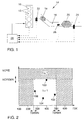
- the lean-running internal combustion engine 10 shown in FIG. 1 has four cylinders 12, each of which has a direct fuel injection system (not shown).
- the internal combustion engine 10 can also be operated in a stratified charge mode by means of a wall and air-guided mixture preparation method.
- An exhaust gas generated by the internal combustion engine 10 is aftertreated in an exhaust tract designated overall by 14.
- the exhaust section 14 consists essentially of a installed in an exhaust passage 16 catalyst system with a small volume and close-coupled pre-catalyst 18, for example a 3-way or oxidizing catalyst, and a typically arranged on an underbody position NO X storing catalyst 20, the NO X -
- storage catalytic converter 20 includes a NO x absorber for storing nitrogen oxides NO x which are not fully convertible in the lean operating mode.
- a lambda probe 22 arranged downstream of the internal combustion engine 10 measures an oxygen content of the exhaust gas and thus enables regulation of an air-fuel ratio to be supplied to the cylinders 12.
- a further gas sensor 24, which is preferably a NO x sensor, is installed downstream of the storage catalytic converter 20.
- the NO x sensor 24 detects, for example, a NO x breakthrough during a lean operation and thus regulates a discontinuous lean / fat loading of the storage catalytic converter 20 for the purpose of its NO x regeneration.
- a temperature measuring point 26 measures an exhaust gas temperature upstream of the NO x storage catalytic converter 20 and permits conclusions to be drawn about the temperature of the storage catalytic converter 20.
- the catalytic converter temperature can also be modeled in a manner known per se using selected operating parameters of the internal combustion engine 10. All sensor signals and operating parameters of the internal combustion engine 10 and the exhaust tract 14 are transmitted to an engine control 28. Here, the signals and data are evaluated and the internal combustion engine 10 is controlled using stored algorithms and maps.
- the ability of the NO x storage catalytic converter 20 to store nitrogen oxides is not sufficient at every operating point to ensure NO x emission in accordance with permissible limit values.
- the NO x storage catalytic converter 20 has sufficient NO x storage and conversion capability only in a certain temperature window, which is why an upper and a lower threshold value are usually specified for a catalytic converter temperature that is permissible in the lean operating mode. If the catalyst temperature lies outside the range limited by the threshold values, the lean operation is blocked and the internal combustion engine 10 is operated in a stoichiometric or rich operation.
- additional threshold values for at least one further operating parameter of the internal combustion engine 10 or the exhaust tract 14 are specified, in particular for a maximum permissible NO x raw emission of the internal combustion engine 10. Furthermore, all specified threshold values can preferably be adapted if the NO x storage and / or conversion capacity of the storage catalytic converter 20 is below a requested value.
- FIG. 2 shows the dependency of an admissibility range for the lean operating mode on a catalytic converter temperature TSK of the NO x storage catalytic converter 20 and on a raw NO x emission NORE of the internal combustion engine 10.
- the area permitted for the lean mode with ⁇ > 1 is shown in white and the area hatched in which the internal combustion engine 10 must be operated with a rich or stoichiometric mixture with ⁇ institution 1.
- the lean operating range is limited by a lower temperature threshold TSKMN and an upper temperature threshold TSKMX for the catalyst temperature TSK.
- the lean operation is blocked when the NO X raw emission NORE is above a maximum threshold value NOREMX.
- a specification of further threshold values is conceivable. For example, an upper threshold value for a raw emission of exhaust gas components such as HC, CO 2 and CO could be provided in a third dimension, not shown, which hinder the incorporation of NO x into the catalytic converter.
- All predefined threshold values are designed to be variable and can be varied within predefinable limits depending on a current NO x storage and / or conversion capacity of the storage catalytic converter 20.
- that threshold value is preferably changed, in the border area of which an operating point was in the period under consideration of a previous lean operating phase. For example, as shown in point 100, if the possibly averaged raw NO x emission of the previous lean operating phase was close to the upper threshold value NOREMX, this threshold value NOREMX is reduced if there is insufficient NO x storage capacity or conversion capacity, for example based on a length of the lean operating phase or a NO x emission measured downstream of the storage catalytic converter 20 is detected.
- the point NOREMX can be raised under point 100 under certain conditions to be explained, if there is sufficient NO X storage capacity.
- the operating point was within the limit range of the upper temperature threshold TSKMX (point 102) in the interval under consideration, this temperature threshold is lowered if the storage capacity is insufficient and if necessary increased if the storage capacity is sufficient.
- the operating point is in the vicinity of several threshold values, all of the threshold values concerned can also be adapted. If, as shown in point 104, the operating point is not in the limit range of a threshold value, several, but at least one threshold value can be varied if the NO x storage and / or NO x conversion capability is insufficient.
- the threshold value TSKMN is increased if the NO x storage and NO x conversion capability is insufficient. In this case, however, provision is preferably made for the position of the threshold value TSKMN to also be dependent on an aging condition (irreversible damage) determined using a diagnostic method, since the threshold value TSKMN corresponding to a light-off temperature of the catalytic converter mainly depends on the aging condition.
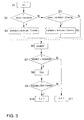
- FIG. 3 shows a flowchart of the method according to the invention according to operating point 100 of FIG. 2.
- the process flow can be divided into two main sections, namely checking the NO x storage and NO x conversion capability of the storage catalytic converter 20 and determining the threshold values of the lean operating range on the one hand (steps S1 to S5) and approval or blocking of lean operation at a current operating point on the other hand (S6 to S11).
- initialization takes place in S1, in which, among other things, the threshold values for the lean operating range and a limit value for NO x storage and NO x conversion capability of the NO x storage catalytic converter 20 are specified. These specifications are based on empirical values of an undamaged and fully regenerated storage catalytic converter.
- a first query in S2 the storage and conversion capability of the storage catalytic converter 20 is checked.
- this check is made 20 measured with reference to a downstream in the preceding lean phase by means of the NOx sensor 24 of the NO X storage catalytic converter and NO x emissions aufintegr thinking NOHK. If this NO X emission NOHK is above a limit value NOHKGW specified in S1, the upper threshold value NOREMX for the NO X raw emission of the internal combustion engine 10 is lowered by the increment ⁇ NORE in S3. It is assumed here that the threshold value NOREMX was set too high and that the NO x storage catalytic converter 20 did not have sufficient storage capacity due to the high raw NO x emission (see point 100 in FIG. 2).
- the method goes to query S4, where it is checked whether the NO x raw emission NORE of the previous lean phase is very close to the upper emission threshold was NOREMX. If this query is answered in the affirmative, the NO X emission threshold NOREMX is increased in S5 by the increment ⁇ NORE. The loop in steps S4 and S5 ensures that the permissible lean range is not unnecessarily restricted. If the query in S4 is negated, there is no variation of the NOREMX emission threshold, but rather it is retained.
- a current NO X raw emission NOREF is determined by measuring the NO X concentration upstream of the catalyst system 18, 20 or by calculation based on current operating parameters of the internal combustion engine 10. If the internal combustion engine 10 is currently in a stoichiometric or lean operating mode, a lean operating mode is assumed for this calculation. The calculation can be carried out, for example, on the basis of stored characteristic diagrams which contain information about the expected NO x raw emission as a function of a current engine speed and / or engine load and / or other operationally relevant variables. To avoid dynamic effects, the NO X raw emission NOREF determined in this way can be averaged over a minimum time.
- a query S7 checks whether the raw emission NOREF determined in S6 is below the emission threshold value NOREMX defined in S2 to S5. If this is the case, the current catalytic converter temperature TSK of the NO x storage catalytic converter 20 is determined in S8 by measurement or modeling. S9 then queries whether this current catalyst temperature TSK is in the permissible temperature range, that is to say is greater than the lower temperature threshold TSKMN and less than the upper temperature threshold TSKMX. If this query is also answered in the affirmative, the current operating point of the internal combustion engine 10 and of the exhaust system 14 is in the range permissible for the lean operating mode. As a result, the lean operating mode is permitted in S10.
- At least one operating parameter lies outside the permissible range, so that the lean operating range is blocked in S11 and the internal combustion engine 10 is charged with a stoichiometric or rich air / fuel mixture.
Landscapes
- Engineering & Computer Science (AREA)
- Chemical & Material Sciences (AREA)
- Combustion & Propulsion (AREA)
- Mechanical Engineering (AREA)
- General Engineering & Computer Science (AREA)
- Exhaust Gas After Treatment (AREA)
- Electrical Control Of Air Or Fuel Supplied To Internal-Combustion Engine (AREA)
Applications Claiming Priority (2)
| Application Number | Priority Date | Filing Date | Title |
|---|---|---|---|
| DE2001117434 DE10117434A1 (de) | 2001-04-03 | 2001-04-03 | Verfahren zur Steuerung eines Betriebsmodus einer magerlauffähigen Verbrennungskraftmaschine |
| DE10117434 | 2001-04-03 |
Publications (3)
| Publication Number | Publication Date |
|---|---|
| EP1247963A2 true EP1247963A2 (fr) | 2002-10-09 |
| EP1247963A3 EP1247963A3 (fr) | 2003-09-17 |
| EP1247963B1 EP1247963B1 (fr) | 2006-04-12 |
Family
ID=7680797
Family Applications (1)
| Application Number | Title | Priority Date | Filing Date |
|---|---|---|---|
| EP20020090054 Expired - Lifetime EP1247963B1 (fr) | 2001-04-03 | 2002-02-13 | Procédé de commande d'un mode de fonctionnement d'un moteur à combustion interne à mélange pauvre |
Country Status (2)
| Country | Link |
|---|---|
| EP (1) | EP1247963B1 (fr) |
| DE (2) | DE10117434A1 (fr) |
Cited By (6)
| Publication number | Priority date | Publication date | Assignee | Title |
|---|---|---|---|---|
| EP1300572A3 (fr) * | 2001-10-05 | 2003-09-17 | Volkswagen Aktiengesellschaft | Procédé et dispositif de commande d'un moteur pouvant fonctionner avec un mélange pauvre |
| FR2863664A1 (fr) * | 2003-12-12 | 2005-06-17 | Bosch Gmbh Robert | Procede pour optimiser la consommation de carburant d'un moteur a combustion interne |
| EP1411231A3 (fr) * | 2002-10-14 | 2007-03-07 | Volkswagen Aktiengesellschaft | Procédé et dispositif de commande d'un moteur pouvant fonctionner avec un mélange pauvre |
| CN114183263A (zh) * | 2021-10-29 | 2022-03-15 | 东风商用车有限公司 | 一种多种控制模式的发动机控制方法 |
| CN114607515A (zh) * | 2022-03-17 | 2022-06-10 | 潍柴动力股份有限公司 | 发动机喷油控制方法、装置、设备、存储介质及程序产品 |
| CN114810396A (zh) * | 2021-06-04 | 2022-07-29 | 长城汽车股份有限公司 | 一种surp控制装置及调节氮氧化物转化率的方法、汽车 |
Families Citing this family (3)
| Publication number | Priority date | Publication date | Assignee | Title |
|---|---|---|---|---|
| DE10249610B4 (de) * | 2002-10-18 | 2010-10-07 | Volkswagen Ag | Verfahren und Vorrichtung zur Steuerung eines NOx-Speicherkatalysators |
| DE10249609B4 (de) * | 2002-10-18 | 2011-08-11 | Volkswagen AG, 38440 | Verfahren zur Steuerung eines NOx-Speicherkatalysators |
| DE10302700B4 (de) * | 2002-12-31 | 2013-01-17 | Volkswagen Ag | Verfahren und Vorrichtung zur Diagnose eines NOx-Speicherkatalysators im Abgastrakt eines Verbrennungsmotors |
Citations (3)
| Publication number | Priority date | Publication date | Assignee | Title |
|---|---|---|---|---|
| DE19850786A1 (de) | 1998-08-05 | 2000-02-17 | Volkswagen Ag | Regelung eines NOx-Speicher-Katalysators |
| DE19929292A1 (de) | 1999-06-25 | 2000-12-28 | Volkswagen Ag | Verfahren zur Steuerung eines Arbeitsmodus einer Verbrennungskraftmaschine |
| DE19932290A1 (de) | 1999-07-10 | 2001-01-11 | Volkswagen Ag | Verfahren zur Regelung eines Arbeitsmodus einer Verbrennungskraftmaschine |
Family Cites Families (3)
| Publication number | Priority date | Publication date | Assignee | Title |
|---|---|---|---|---|
| DE19543219C1 (de) * | 1995-11-20 | 1996-12-05 | Daimler Benz Ag | Verfahren zum Betreiben eines Dieselmotors |
| DE59800195D1 (de) * | 1998-01-09 | 2000-08-17 | Ford Global Tech Inc | Verfahren zur Regeneration einer Stickoxidfalle im Abgassystem eines Verbrennungsmotors |
| DE19933712A1 (de) * | 1999-07-19 | 2001-05-17 | Volkswagen Ag | Verfahren zur Regelung eines Arbeitsmodus einer Verbrennungskraftmaschine |
-
2001
- 2001-04-03 DE DE2001117434 patent/DE10117434A1/de not_active Withdrawn
-
2002
- 2002-02-13 EP EP20020090054 patent/EP1247963B1/fr not_active Expired - Lifetime
- 2002-02-13 DE DE50206351T patent/DE50206351D1/de not_active Expired - Lifetime
Patent Citations (3)
| Publication number | Priority date | Publication date | Assignee | Title |
|---|---|---|---|---|
| DE19850786A1 (de) | 1998-08-05 | 2000-02-17 | Volkswagen Ag | Regelung eines NOx-Speicher-Katalysators |
| DE19929292A1 (de) | 1999-06-25 | 2000-12-28 | Volkswagen Ag | Verfahren zur Steuerung eines Arbeitsmodus einer Verbrennungskraftmaschine |
| DE19932290A1 (de) | 1999-07-10 | 2001-01-11 | Volkswagen Ag | Verfahren zur Regelung eines Arbeitsmodus einer Verbrennungskraftmaschine |
Cited By (8)
| Publication number | Priority date | Publication date | Assignee | Title |
|---|---|---|---|---|
| EP1300572A3 (fr) * | 2001-10-05 | 2003-09-17 | Volkswagen Aktiengesellschaft | Procédé et dispositif de commande d'un moteur pouvant fonctionner avec un mélange pauvre |
| EP1411231A3 (fr) * | 2002-10-14 | 2007-03-07 | Volkswagen Aktiengesellschaft | Procédé et dispositif de commande d'un moteur pouvant fonctionner avec un mélange pauvre |
| FR2863664A1 (fr) * | 2003-12-12 | 2005-06-17 | Bosch Gmbh Robert | Procede pour optimiser la consommation de carburant d'un moteur a combustion interne |
| CN114810396A (zh) * | 2021-06-04 | 2022-07-29 | 长城汽车股份有限公司 | 一种surp控制装置及调节氮氧化物转化率的方法、汽车 |
| CN114183263A (zh) * | 2021-10-29 | 2022-03-15 | 东风商用车有限公司 | 一种多种控制模式的发动机控制方法 |
| CN114183263B (zh) * | 2021-10-29 | 2024-03-05 | 东风商用车有限公司 | 一种多种控制模式的发动机控制方法 |
| CN114607515A (zh) * | 2022-03-17 | 2022-06-10 | 潍柴动力股份有限公司 | 发动机喷油控制方法、装置、设备、存储介质及程序产品 |
| CN114607515B (zh) * | 2022-03-17 | 2023-01-06 | 潍柴动力股份有限公司 | 发动机喷油控制方法、装置、设备及存储介质 |
Also Published As
| Publication number | Publication date |
|---|---|
| DE10117434A1 (de) | 2002-10-10 |
| EP1247963B1 (fr) | 2006-04-12 |
| EP1247963A3 (fr) | 2003-09-17 |
| DE50206351D1 (de) | 2006-05-24 |
Similar Documents
| Publication | Publication Date | Title |
|---|---|---|
| EP1660764B1 (fr) | Vehicule hybride et procede pour faire fonctionner un vehicule hybride | |
| DE60127013T2 (de) | Steuerung zur Verbesserung des Verhaltens eines Fahrzeuges | |
| EP1228301A2 (fr) | Procede pour controler le pot catalytique de gaz d'echappement d'un moteur a combustion interne | |
| WO2002077430A1 (fr) | Procede de regulation d'un mode de travail d'un moteur a combustion interne | |
| WO2001061162A1 (fr) | Dispositif et procede pour determiner la necessite de regeneration d'un catalyseur accumulateur de no¿x? | |
| EP1247963B1 (fr) | Procédé de commande d'un mode de fonctionnement d'un moteur à combustion interne à mélange pauvre | |
| EP1180201A1 (fr) | Procede de desulfuration d'au moins un catalyseur de stockage de nox dispose dans le tuyau d'echappement d'un moteur a combustion interne | |
| DE10153901B4 (de) | Verfahren und Vorrichtung zur Entschwefelung eines einem Dieselmotor nachgeschalteten NOx-Speicherkatalysators | |
| DE10148128A1 (de) | Verfahren und Vorrichtung zur Reduzierung einer Schadstoffendemission einer Verbrennungskraftmaschine | |
| EP1183454B1 (fr) | PROCEDE DE COMMANDE DE LA REGENERATION D'UN CATALYSEUR ACCUMULATEUR DE NOx | |
| DE19935341A1 (de) | Verfahren zur Regelung einer Abgastemperatur einer Magerbrennkraftmaschine während einer Entschwefelung eines Katalysators | |
| DE10154041A1 (de) | Verfahren und Vorrichtung zur Reduzierung einer Schadstoffendemission | |
| EP1391592B1 (fr) | Procédé de commande d'un moteur à combustion interne avec un système de purification de gaz d'échappement | |
| DE10261618B4 (de) | Laufunruheauswertungsverfahren | |
| EP1241336B1 (fr) | Procédé et dispositif pour régler le débit du gaz d'échappement recirculé | |
| DE102010047415A1 (de) | Verfahren zum Betreiben einer Verbrennungskraftmaschine sowie zur Ausführung des Verfahrens eingerichtetes Steuergerät | |
| DE10102132B4 (de) | Verfahren und Vorrichtung zur Entschwefelung eines NOx-Speicherkatalysators | |
| DE10112938A1 (de) | Verfahren zur Steuerung eines Warmlaufs eines Katalysatorsystems | |
| EP1300572B1 (fr) | Procédé et dispositif de commande d'un moteur pouvant fonctionner avec un mélange pauvre | |
| WO2004022953A1 (fr) | Procede pour commander le fonctionnement a melange pauvre d'un moteur a combustion interne presentant un catalyseur accumulateur d'oxyde d'azote, notamment d'une automobile | |
| DE10001310A1 (de) | Vorrichtung und Verfahren zur Steuerung einer NOx-Regeneration eines NOx-Speicherkatalysators | |
| EP1435444A2 (fr) | Procédé pour faire fonctionner un moteur à combustion interne à émissions stables et véhicule à émissions stables | |
| DE10202935A1 (de) | Verfahren und Vorrichtung zur Entschwefelung eines Vorkatalysators | |
| EP1200715B1 (fr) | Procede de reglage de la regeneration d'un catalyseur a accumulation place dans un canal de gaz d'echappement d'un moteur a combustion interne | |
| EP1199457A2 (fr) | Méthode de commande d'un moteur à combustion interne à mélange pauvre |
Legal Events
| Date | Code | Title | Description |
|---|---|---|---|
| PUAI | Public reference made under article 153(3) epc to a published international application that has entered the european phase |
Free format text: ORIGINAL CODE: 0009012 |
|
| AK | Designated contracting states |
Kind code of ref document: A2 Designated state(s): AT BE CH CY DE DK ES FI FR GB GR IE IT LI LU MC NL PT SE TR |
|
| AX | Request for extension of the european patent |
Free format text: AL;LT;LV;MK;RO;SI |
|
| PUAL | Search report despatched |
Free format text: ORIGINAL CODE: 0009013 |
|
| AK | Designated contracting states |
Kind code of ref document: A3 Designated state(s): AT BE CH CY DE DK ES FI FR GB GR IE IT LI LU MC NL PT SE TR |
|
| AX | Request for extension of the european patent |
Extension state: AL LT LV MK RO SI |
|
| 17P | Request for examination filed |
Effective date: 20040317 |
|
| AKX | Designation fees paid |
Designated state(s): DE ES FR GB IT |
|
| 17Q | First examination report despatched |
Effective date: 20040517 |
|
| GRAP | Despatch of communication of intention to grant a patent |
Free format text: ORIGINAL CODE: EPIDOSNIGR1 |
|
| GRAS | Grant fee paid |
Free format text: ORIGINAL CODE: EPIDOSNIGR3 |
|
| GRAA | (expected) grant |
Free format text: ORIGINAL CODE: 0009210 |
|
| RIN1 | Information on inventor provided before grant (corrected) |
Inventor name: HAHN, HERMANN, DR. |
|
| AK | Designated contracting states |
Kind code of ref document: B1 Designated state(s): DE ES FR GB IT |
|
| PG25 | Lapsed in a contracting state [announced via postgrant information from national office to epo] |
Ref country code: IT Free format text: LAPSE BECAUSE OF FAILURE TO SUBMIT A TRANSLATION OF THE DESCRIPTION OR TO PAY THE FEE WITHIN THE PRESCRIBED TIME-LIMIT;WARNING: LAPSES OF ITALIAN PATENTS WITH EFFECTIVE DATE BEFORE 2007 MAY HAVE OCCURRED AT ANY TIME BEFORE 2007. THE CORRECT EFFECTIVE DATE MAY BE DIFFERENT FROM THE ONE RECORDED. Effective date: 20060412 |
|
| REG | Reference to a national code |
Ref country code: GB Ref legal event code: FG4D Free format text: NOT ENGLISH |
|
| REF | Corresponds to: |
Ref document number: 50206351 Country of ref document: DE Date of ref document: 20060524 Kind code of ref document: P |
|
| PG25 | Lapsed in a contracting state [announced via postgrant information from national office to epo] |
Ref country code: ES Free format text: LAPSE BECAUSE OF FAILURE TO SUBMIT A TRANSLATION OF THE DESCRIPTION OR TO PAY THE FEE WITHIN THE PRESCRIBED TIME-LIMIT Effective date: 20060723 |
|
| GBT | Gb: translation of ep patent filed (gb section 77(6)(a)/1977) |
Effective date: 20060727 |
|
| PLBE | No opposition filed within time limit |
Free format text: ORIGINAL CODE: 0009261 |
|
| STAA | Information on the status of an ep patent application or granted ep patent |
Free format text: STATUS: NO OPPOSITION FILED WITHIN TIME LIMIT |
|
| 26N | No opposition filed |
Effective date: 20070115 |
|
| EN | Fr: translation not filed | ||
| PG25 | Lapsed in a contracting state [announced via postgrant information from national office to epo] |
Ref country code: FR Free format text: LAPSE BECAUSE OF FAILURE TO SUBMIT A TRANSLATION OF THE DESCRIPTION OR TO PAY THE FEE WITHIN THE PRESCRIBED TIME-LIMIT Effective date: 20070309 |
|
| PG25 | Lapsed in a contracting state [announced via postgrant information from national office to epo] |
Ref country code: FR Free format text: LAPSE BECAUSE OF FAILURE TO SUBMIT A TRANSLATION OF THE DESCRIPTION OR TO PAY THE FEE WITHIN THE PRESCRIBED TIME-LIMIT Effective date: 20060412 |
|
| REG | Reference to a national code |
Ref country code: DE Ref legal event code: R084 Ref document number: 50206351 Country of ref document: DE Effective date: 20110716 |
|
| REG | Reference to a national code |
Ref country code: DE Ref legal event code: R082 Ref document number: 50206351 Country of ref document: DE |
|
| PGFP | Annual fee paid to national office [announced via postgrant information from national office to epo] |
Ref country code: DE Payment date: 20160229 Year of fee payment: 15 |
|
| PGFP | Annual fee paid to national office [announced via postgrant information from national office to epo] |
Ref country code: GB Payment date: 20160226 Year of fee payment: 15 |
|
| REG | Reference to a national code |
Ref country code: DE Ref legal event code: R119 Ref document number: 50206351 Country of ref document: DE |
|
| GBPC | Gb: european patent ceased through non-payment of renewal fee |
Effective date: 20170213 |
|
| PG25 | Lapsed in a contracting state [announced via postgrant information from national office to epo] |
Ref country code: DE Free format text: LAPSE BECAUSE OF NON-PAYMENT OF DUE FEES Effective date: 20170901 |
|
| PG25 | Lapsed in a contracting state [announced via postgrant information from national office to epo] |
Ref country code: GB Free format text: LAPSE BECAUSE OF NON-PAYMENT OF DUE FEES Effective date: 20170213 |