EP1248095A2 - Procédé pour la détermination de la relation contrainte-allongement sur la base de points caractéristiques et l'utilisation de réseaux neuronaux - Google Patents
Procédé pour la détermination de la relation contrainte-allongement sur la base de points caractéristiques et l'utilisation de réseaux neuronaux Download PDFInfo
- Publication number
- EP1248095A2 EP1248095A2 EP02006597A EP02006597A EP1248095A2 EP 1248095 A2 EP1248095 A2 EP 1248095A2 EP 02006597 A EP02006597 A EP 02006597A EP 02006597 A EP02006597 A EP 02006597A EP 1248095 A2 EP1248095 A2 EP 1248095A2
- Authority
- EP
- European Patent Office
- Prior art keywords
- stress
- neural network
- characteristic points
- strain
- curve
- Prior art date
- Legal status (The legal status is an assumption and is not a legal conclusion. Google has not performed a legal analysis and makes no representation as to the accuracy of the status listed.)
- Granted
Links
Images




Classifications
-
- G—PHYSICS
- G01—MEASURING; TESTING
- G01N—INVESTIGATING OR ANALYSING MATERIALS BY DETERMINING THEIR CHEMICAL OR PHYSICAL PROPERTIES
- G01N3/00—Investigating strength properties of solid materials by application of mechanical stress
- G01N3/08—Investigating strength properties of solid materials by application of mechanical stress by applying steady tensile or compressive forces
-
- G—PHYSICS
- G06—COMPUTING OR CALCULATING; COUNTING
- G06N—COMPUTING ARRANGEMENTS BASED ON SPECIFIC COMPUTATIONAL MODELS
- G06N3/00—Computing arrangements based on biological models
- G06N3/02—Neural networks
- G06N3/04—Architecture, e.g. interconnection topology
- G06N3/045—Combinations of networks
-
- G—PHYSICS
- G06—COMPUTING OR CALCULATING; COUNTING
- G06N—COMPUTING ARRANGEMENTS BASED ON SPECIFIC COMPUTATIONAL MODELS
- G06N3/00—Computing arrangements based on biological models
- G06N3/02—Neural networks
- G06N3/04—Architecture, e.g. interconnection topology
- G06N3/0499—Feedforward networks
-
- G—PHYSICS
- G06—COMPUTING OR CALCULATING; COUNTING
- G06N—COMPUTING ARRANGEMENTS BASED ON SPECIFIC COMPUTATIONAL MODELS
- G06N3/00—Computing arrangements based on biological models
- G06N3/02—Neural networks
- G06N3/08—Learning methods
- G06N3/09—Supervised learning
-
- G—PHYSICS
- G01—MEASURING; TESTING
- G01N—INVESTIGATING OR ANALYSING MATERIALS BY DETERMINING THEIR CHEMICAL OR PHYSICAL PROPERTIES
- G01N2203/00—Investigating strength properties of solid materials by application of mechanical stress
- G01N2203/0014—Type of force applied
- G01N2203/0016—Tensile or compressive
- G01N2203/0017—Tensile
-
- G—PHYSICS
- G01—MEASURING; TESTING
- G01N—INVESTIGATING OR ANALYSING MATERIALS BY DETERMINING THEIR CHEMICAL OR PHYSICAL PROPERTIES
- G01N2203/00—Investigating strength properties of solid materials by application of mechanical stress
- G01N2203/0058—Kind of property studied
- G01N2203/006—Crack, flaws, fracture or rupture
- G01N2203/0067—Fracture or rupture
-
- G—PHYSICS
- G01—MEASURING; TESTING
- G01N—INVESTIGATING OR ANALYSING MATERIALS BY DETERMINING THEIR CHEMICAL OR PHYSICAL PROPERTIES
- G01N2203/00—Investigating strength properties of solid materials by application of mechanical stress
- G01N2203/0058—Kind of property studied
- G01N2203/0069—Fatigue, creep, strain-stress relations or elastic constants
- G01N2203/0075—Strain-stress relations or elastic constants
-
- G—PHYSICS
- G01—MEASURING; TESTING
- G01N—INVESTIGATING OR ANALYSING MATERIALS BY DETERMINING THEIR CHEMICAL OR PHYSICAL PROPERTIES
- G01N2203/00—Investigating strength properties of solid materials by application of mechanical stress
- G01N2203/02—Details not specific for a particular testing method
- G01N2203/0202—Control of the test
- G01N2203/0212—Theories, calculations
- G01N2203/0218—Calculations based on experimental data
Definitions
- the invention relates to a method for determining a stress-strain curve as well as a corresponding computer program product and a neural one Network.
- the sequence of tensile tests for plastics is in the international standard ISO 527 or defined in the European standard DIN EN 20527. With such a tensile test becomes a test specimen with regard to its tensile forming behavior, its Strength, its tensile modulus and other characteristics of the tension-strain relationship examined. Multipurpose test specimens are preferred for a tensile test used according to DIN EN 23167.
- Important parameters for the tensile test are the measuring length and the test speed.
- the typical mechanical parameters are the yield stress, the Tensile strength at break, the tensile strength at a certain elongation, the Elongation at break, the elongation at break, the tensile strength, the nominal Elongation at break, the nominal tensile strength and the tensile modulus.
- Curve 1 shows an example of such a typed curve.
- the Curve a occurs with tough or brittle materials without a yield point, with tough materials is relatively flat, while steep for brittle materials increases.
- Curve b occurs with tough materials with a yield point. tensile strenght and breaking stress are greater than the yield stress.
- the curve c occurs also for tough materials with a yield point. The tensile strength is Yield point and is greater than the breaking stress.
- a disadvantage when determining mechanical material properties due to The measurement of stress-strain curves is that the determination of such Stress-strain curves in a variety of different tensile tests different parameter selection required and thus very time and cost intensive is. Due to the large number of parameters that can be varied in practice only a small part of the possible variations through stress-strain tensile tests be covered.
- the invention is therefore based on the object of an improved method for determining a stress-strain curve and a corresponding neural one Network and to create a computer program product.
- the invention allows a relatively limited number of stress-strain tensile tests train one or more neural networks.
- the neural Networks are then used to determine any stress-strain curves Variations in the parameters without actually performing further tensile tests are.
- Neural networks usually consist of two or more layers of neurons that are in the Generally simulated by appropriate computer programs or by special Computer chips are represented in hardware form. You are characterized by it from that an input signal which results from a different activity of the First level neurons, the activity of second level neurons affected.
- the type of influence is initially not precisely defined, but is formed in the Gradual progress of learning processes. For example, from DE 198 41 820 A1 a neural network based on fractal mapping functions known.
- the neural network first a number of characteristic points from the measured Stress-strain curve profiles determined.
- the characteristic Points then become a transformation, preferably a factor analysis or undergo a major component transformation.
- the neural network then becomes trained by means of the characteristic points thus transformed.
- the one with the transformed neural network trained points compared to one with not transformed points trained network a more stable behavior.
- a separate neural network for each stress-strain curve type trained a separate neural network. Furthermore, a neural network for determining the type of a stress-strain curve trained based on input parameters; if necessary, a main component transformation can also be carried out here of the type probabilities are used. This neural network then allows one of the separate neural networks accordingly the current type.
- FIG. 2 shows a flowchart for generating neural networks for the determination stress-strain curves.
- step 20 the implementation takes place first tensile tests to determine stress-strain curves Variations of various parameters.
- the recipe that is the material composition can be varied, as can the color and the component geometry.
- the processing conditions during the production of the test specimen can be varied. For a plastic injection molded part, this is about the melt temperature, the tool temperature and the holding pressure. Furthermore, the conditions under which the tensile test is carried out can be varied, such as the Temperature to which the test specimen is exposed when the tensile test is carried out is.
- the stress-strain curves determined in such a series of measurements are shown in assigned a specific type to step 21. For example the typing according to FIG. 1 are used.
- step 22 there is one for each of the typified stress-strain curves Number of characteristic points selected.
- the number and location of the characteristic points may vary depending on the type. For example in the case of a stress-strain curve of curve type a (see FIG. 1) a single one or a few characteristic points may be sufficient since the curve is essentially runs in the linear range.
- a stress-strain curve of type b at least three are characteristic Points for the detection of the curve profile may be necessary, namely the stretch point, the tear point and that between the stretch point and the tear point Minimum stress-strain curve. Corresponding characteristic points can also be defined for a curve of type c and for other curve types become.
- step 23 the characteristic points of the stress-strain curves undergo a major component transformation.
- the main component transformation is a mathematical method known as such.
- a corresponding main component transformation can also be carried out with regard to the Curve types are carried out.
- the transformation rule Before carrying out the respective main component transformation the transformation rule must first be determined. This is done by arrangement the previously determined characteristic points of curves of the same curve type in a matrix and determination of the parameters of the main component transformation, to bring the matrix to its main component shape. Corresponding can also with regard to the transformation rule for the main component transformation proceed with regard to the curve type.
- step 25 the parameters varied in step 20 are different parallel neural networks entered.
- Each of the parallel neural networks are assigned to a specific curve type.
- the parameters for a tensile test in which a stress-strain curve is entered of a certain type the output of the evaluated according to this type of curve according to the neural network.
- the one from that The neural network of the type in question are transformed with the main components characteristic points that in step 23 for the considered tensile test have been determined, compared. Because of a Difference between the values output by the neural network and the actually determined by the main component transformation in step 23 A feedback takes place in the neural network in order to weight the Adapt neurons according to the difference in value.
- a neural network for determining the Curve types trained from the parameters For this, the corresponding parameters entered into a neural network, the output of which is the probabilities for the presence of a certain curve type. The exit of this neural network is in each case determined by means of the actually existing curve type or with the main component transformation of the actual curve type adjusted and the weighting of the neurons adjusted accordingly.
- This too neural network for determining the type of curve is created by creating the different Parameters and the subsequent comparison with the actual Curve type trained step by step.
- Steps 25 and 26 can run in parallel since the input vector, that is to say a specific one Set of parameters per stress-strain curve, for the different neural networks can be the same in each case.
- step 27 the type-specific neural networks and the neural Network for determining the curve type, which is determined in steps 25 and 26 have been connected in parallel.
- step 28 a function becomes available for selection generated one of the type-specific neural networks.
- the function receives the output of the neural network for determining the Curve type, that means the respective probabilities for the existence of a certain curve types.
- the function determines the maximum of the different Type probabilities and selects the neural network that the most likely type of curve. This allows the operation of the so interconnected overall neural network based on the input parameters First, the curve type must be determined to match the corresponding type select neural network.
- step 20 there is first a stress-strain curve if certain parameters are present, that is to say for a certain Material composition, color of the material, geometry of the test specimen, Processing parameters in the plastic injection molding process and one certain temperature, test speed and / or other parameters at the Carrying out the tensile test, measured. Such measurements are repeated for different variations of the parameters, i.e. for different material compositions, Colors, component geometries etc. performed.
- step 21 the measured curve shape is assigned to a certain type.
- step 22 the selection is then made more characteristic Points depending on the type of curve.
- the stress-strain curve is involved around a curve of type b (see FIG. 1), so that accordingly at least the stretch point 30, the tear point 31 and that between the stretch point 30 and the break point 31 lying point 32 can be selected. Between these Points can automatically add further measuring points, for example in equidistant Strain distances can be selected as characteristic points.
- step 23 the stress-strain curves are measured in this way of the same type obtained characteristic points of a main component transformation subjected to first the parameters for carrying out the To determine the main component transformation.
- the calculation rule determined in this way then becomes the main component transformation of the characteristic values of the individual curves used.
- the main components transformed to determine the type probability Types can be determined.
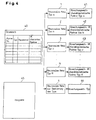
- the computer system has a database 40 which is measured for each Stress-strain curve contains a data set.
- the record for one Stress-strain curve includes the type of curve (e.g. type a, b or c - cf. Fig. 1) and / or the corresponding main components and the Main components (HK) of the transformed characteristic points. Also includes the data set for each curve the varied parameters.
- the database is connected to neural networks 1 through N. Furthermore, the Database 40 connected to the neural network 4 for determining the type of curve. Each of the neural networks 1 to N or 4 has a corresponding output 41 to 43 or 44.
- the computer system also has a program 45 for reading out certain data from the data records stored in the database and for training the neural Networks 1 to N or 4.
- the program 45 first reads the parameters of the data set of the first curve of the database 40. The parameters read out are then to the inputs of the neural networks 1 to N and the neural Network 4 created.
- the program 45 also reads the curve type of the current curve from the database 40 out. Depending on the curve type, the output of the corresponding one is then neural network read. If the first curve is of type c, for example, the Issue 43 read.
- the values stored in the output 43 are with the actual main components of the characteristic points compared. From the difference of calculated and the actual main components of the characteristic points the weighting of the neural network for curve type c is corresponding customized.
- the neural network 4 is also trained by the expected value or whose HK is read from issue 44.
- the one from the neural network 4 determined probabilities for the existence of a certain curve type with the actual curve type or the corresponding HK, as it is in the Database 40 for the curve under consideration is stored - in the example under consideration the curve type c - compared. From the deviation of the probabilities determined with the actual curve type, the neural network becomes here adjusted accordingly.
- the system has an input 50 for entering the parameters.
- the Input 50 is connected to the inputs of the neural networks 1 to N and to the Input of the neural network 4 connected.
- the system also has an exit 51 with the memories 52, 53, 54 .... each for the neural networks 1 to N. Die Memory 52, 53, 54 .... are each with an output of the corresponding neural network 1, 2, 3 .... connected.
- the neural network 4 has an output 55 for output of the type probabilities or from their HK.
- the program module 56 the selection of the Curve types based on the type probability, possibly after a corresponding one Inverse transformation.
- the program module 56 selects a corresponding memory, of the memories 52, 53, 54 .... contained in the output 51.
- the content of this Memory is read from the corresponding memory by the program module 57 and in the program module 58 a back transformation of the main components subjected.
- the stress-strain curve generator is then used 59 generates a stress-strain curve.
- the stress-strain curve generated in this way can, for example, be displayed on a screen 46 displayed or printed out on a printer 47.
- FIG. 6 shows the selection of characteristic points by a user. 6, for example, the characteristic ones are selected Points 60 and 61 by the user. The intermediate points 62 to 68 are then automatically set equidistant and as further characteristic Points selected automatically.
- the characteristic points 60 to 68 selected in this way are fed into the generator 59 fed in and the result of the stress-strain curve calculation the generator 59 is displayed to the user for control purposes in the same representation.
- the user has the option of both the manually set characteristic Points (any) as well as the automatically set intermediate points (only vertically) to optimize the curve determined by the generator 59.
- a spline polynomial becomes of the third degree per subinterval, the approximation being the respective characteristic points can be used.
- FIG. 7 shows further boundary conditions for the generation of a stress-strain curve from the selected characteristic points.
- the beginning of the stress-strain curve calculated by the generator 59 lies at the origin.
- the second derivative of the calculated curve S is 0 in the origin - what corresponds to the so-called Hook's range.
- the stress-strain curve may be a curve with an artificial one Parameterize "time" to prevent overshoot.
- generator 59 may also include a sorting function. Physically can the elongation of the test specimen only increases with increasing tension. at a calculated curve contradicting this physical condition the curve can be corrected by sorting the strain values become.
- the stress-strain curve 80 has a very steep course in its initial area.
- the linear starting range is particularly relevant in practice, it is recommended therefore expand it with a suitable transformation:
- the stress-strain curve 81 emerges from the stress-strain curve 80 in that the curve area after the characteristic point 84 is logarithmic Scaling the strain D is used. This will make it Curvature behavior of the transformed curve is evened out and the spline interpolation method stabilized.
Landscapes
- Engineering & Computer Science (AREA)
- Physics & Mathematics (AREA)
- Theoretical Computer Science (AREA)
- General Health & Medical Sciences (AREA)
- Health & Medical Sciences (AREA)
- Life Sciences & Earth Sciences (AREA)
- General Physics & Mathematics (AREA)
- Computing Systems (AREA)
- Software Systems (AREA)
- Evolutionary Computation (AREA)
- Computational Linguistics (AREA)
- Molecular Biology (AREA)
- Biophysics (AREA)
- General Engineering & Computer Science (AREA)
- Biomedical Technology (AREA)
- Mathematical Physics (AREA)
- Data Mining & Analysis (AREA)
- Artificial Intelligence (AREA)
- Chemical & Material Sciences (AREA)
- Analytical Chemistry (AREA)
- Biochemistry (AREA)
- Immunology (AREA)
- Pathology (AREA)
- Investigating Strength Of Materials By Application Of Mechanical Stress (AREA)
- Complex Calculations (AREA)
Applications Claiming Priority (2)
| Application Number | Priority Date | Filing Date | Title |
|---|---|---|---|
| DE10116773A DE10116773A1 (de) | 2001-04-04 | 2001-04-04 | Verfahren zur Ermittlung von Spannungs-Dehnungskurven mittels Splineinterpolation auf Basis charakteristischer Punkte und unter dem Einsatz neuronaler Netze |
| DE10116773 | 2001-04-04 |
Publications (3)
| Publication Number | Publication Date |
|---|---|
| EP1248095A2 true EP1248095A2 (fr) | 2002-10-09 |
| EP1248095A3 EP1248095A3 (fr) | 2003-01-22 |
| EP1248095B1 EP1248095B1 (fr) | 2011-11-02 |
Family
ID=7680356
Family Applications (1)
| Application Number | Title | Priority Date | Filing Date |
|---|---|---|---|
| EP02006597A Expired - Lifetime EP1248095B1 (fr) | 2001-04-04 | 2002-03-22 | Procédé pour la détermination de la relation contrainte-allongement sur la base de points caractéristiques et l'utilisation de réseaux neuronaux |
Country Status (5)
| Country | Link |
|---|---|
| US (1) | US7058618B2 (fr) |
| EP (1) | EP1248095B1 (fr) |
| AT (1) | ATE532050T1 (fr) |
| DE (1) | DE10116773A1 (fr) |
| PT (1) | PT1248095E (fr) |
Cited By (2)
| Publication number | Priority date | Publication date | Assignee | Title |
|---|---|---|---|---|
| CN109164372A (zh) * | 2018-07-25 | 2019-01-08 | 清华大学 | 集成电路元器件特性数据预测方法及装置 |
| CN119575224A (zh) * | 2025-01-26 | 2025-03-07 | 湖北工业大学 | 一种锂离子电池健康状态估算方法、装置及电子设备 |
Families Citing this family (7)
| Publication number | Priority date | Publication date | Assignee | Title |
|---|---|---|---|---|
| US7934049B2 (en) * | 2005-09-14 | 2011-04-26 | Sandisk Corporation | Methods used in a secure yet flexible system architecture for secure devices with flash mass storage memory |
| US20110054840A1 (en) * | 2009-08-26 | 2011-03-03 | Hively Lee M | Failure prediction of complex structures under arbitrary time-serial loading condition |
| JP5582211B1 (ja) * | 2013-03-14 | 2014-09-03 | Jfeスチール株式会社 | 応力−ひずみ関係シミュレート方法、スプリングバック量予測方法およびスプリングバック解析装置 |
| DE102016116259B4 (de) * | 2015-09-11 | 2025-01-09 | Schott Ag | Vorrichtung und Verfahren zur Stabilisierung von Scheiben eines sprödharten Materials |
| US11347910B1 (en) * | 2018-07-25 | 2022-05-31 | Hexagon Manufacturing Intelligence, Inc. | Computerized prediction for determining composite material strength |
| CN113031524B (zh) * | 2021-02-07 | 2022-06-17 | 南京航空航天大学 | 一种基于三次样条的压装力包络线生成方法 |
| JP2023013676A (ja) * | 2021-07-16 | 2023-01-26 | 日新電機株式会社 | 軟質材に負荷される引張力の評価方法、軟質材に負荷される引張力の評価システム、制御装置及びプログラム |
Family Cites Families (6)
| Publication number | Priority date | Publication date | Assignee | Title |
|---|---|---|---|---|
| DE69424321T2 (de) * | 1993-08-06 | 2000-10-19 | Toyota Jidosha K.K., Toyota | Verfahren zur Selektion der Farbe eines Lackes |
| DE19601858C1 (de) * | 1996-01-19 | 1997-08-28 | Siemens Ag | Verfahren und Einrichtung zur Bestimmung der Formänderungsfestigkeit eines Stahls |
| DE69924464T2 (de) * | 1998-09-07 | 2006-03-16 | Bridgestone Corp. | Methode zur voraussage der leistungsfähigkeit eines reifens |
| DE19841820A1 (de) | 1998-09-12 | 2000-03-23 | Thomas Kromer | Neuronale Netze auf der Grundlage fraktaler Abbildungsfunktionen |
| US6485872B1 (en) * | 1999-12-03 | 2002-11-26 | Mks Instruments, Inc. | Method and apparatus for measuring the composition and other properties of thin films utilizing infrared radiation |
| DE10119853A1 (de) * | 2001-04-24 | 2003-01-09 | Bayer Ag | Hybridmodell und Verfahren zur Bestimmung von mechanischen Eigenschaften und von Verarbeitungseigenschaften eines Spritzgiessformteils |
-
2001
- 2001-04-04 DE DE10116773A patent/DE10116773A1/de not_active Ceased
-
2002
- 2002-03-22 AT AT02006597T patent/ATE532050T1/de active
- 2002-03-22 EP EP02006597A patent/EP1248095B1/fr not_active Expired - Lifetime
- 2002-03-22 PT PT02006597T patent/PT1248095E/pt unknown
- 2002-03-27 US US10/107,762 patent/US7058618B2/en not_active Expired - Lifetime
Cited By (3)
| Publication number | Priority date | Publication date | Assignee | Title |
|---|---|---|---|---|
| CN109164372A (zh) * | 2018-07-25 | 2019-01-08 | 清华大学 | 集成电路元器件特性数据预测方法及装置 |
| CN109164372B (zh) * | 2018-07-25 | 2020-06-19 | 清华大学 | 集成电路元器件特性数据预测方法及装置 |
| CN119575224A (zh) * | 2025-01-26 | 2025-03-07 | 湖北工业大学 | 一种锂离子电池健康状态估算方法、装置及电子设备 |
Also Published As
| Publication number | Publication date |
|---|---|
| PT1248095E (pt) | 2012-02-13 |
| US20020152426A1 (en) | 2002-10-17 |
| US7058618B2 (en) | 2006-06-06 |
| ATE532050T1 (de) | 2011-11-15 |
| EP1248095B1 (fr) | 2011-11-02 |
| DE10116773A1 (de) | 2002-10-17 |
| EP1248095A3 (fr) | 2003-01-22 |
Similar Documents
| Publication | Publication Date | Title |
|---|---|---|
| DE102017004374B4 (de) | Abriebgrössen-Schätzvorrichtung und Abriebgrössen-Schätzverfahren für das Rückschlagventil einer Spritzgiessmaschine | |
| DE102022106892A1 (de) | Optische senderabstimmung durch maschinelles lernen und referenzparameter | |
| DE112019001512T5 (de) | EINSPRITZGIEßMASCHINENSYSTEM | |
| DE10316381A1 (de) | Verfahren zum Training von neuronalen Netzen | |
| DE112016006546T5 (de) | Qualitätskontrollvorrichtung, qualitätskontrollverfahren und qualitätskontrollprogramm | |
| DE10241746B4 (de) | Verfahren zur zyklischen Qualitätsbewertung und Prozessüberwachung bei periodischen Produktionsprozessen | |
| DE19781103B4 (de) | Verfahren und Einrichtung zur Identifikation bzw. Vorausberechnung von Prozeßparametern eines industriellen zeitvarianten Prozesses | |
| EP1623287B1 (fr) | Conception d'outils et de processus pour technique de formage | |
| EP0875808A2 (fr) | Système et méthode pour la modélisation de processus d'une installation technique | |
| EP1248095B1 (fr) | Procédé pour la détermination de la relation contrainte-allongement sur la base de points caractéristiques et l'utilisation de réseaux neuronaux | |
| DE102007006616B3 (de) | Verfahren zur Optimierung eines elektronisch gesteuerten automatisch schaltenden Getriebes für ein Kraftfahrzeug | |
| EP4295202B1 (fr) | Procédé et système de mesure de composants, ainsi que programme | |
| DE112018007522T5 (de) | Arbeitsanalyseeinrichtung | |
| EP2433185B1 (fr) | Dispositif et procédé pour le traitement d'une base de données de simulation d'un processus | |
| DE4121453C2 (de) | Näherungsschlußfolgerungsvorrichtung | |
| EP0534181B2 (fr) | Méthode pour détecter des déviations inadmissibles de paramètres d'un procédé | |
| DE102018006035A1 (de) | Verfahren zur automatisierten Erzeugung von Einstellmarametern und zur Prozessüberwachung bei zyklischen Produktionsprozessen | |
| DE102022209080A1 (de) | Verfahren zum Kalibrieren eines Sensors, Recheneinheit und Sensorsystem | |
| DE102021210393A1 (de) | Verfahren und Vorrichtung zum Betreiben eines technischen Systems | |
| DE102020205962B3 (de) | Vorrichtung und Verfahren zum Betreiben eines Prüfstands | |
| DE102022127260A1 (de) | Prozesskennzahlermittlung | |
| DE102020006071A1 (de) | Verfahren zur verbesserten Ermittlung von Material- bzw. Werkstoffmodellen | |
| DE102020116178A1 (de) | Verfahren zum Erkennen einer Amplifikationsphase in einer Amplifikation | |
| DE102020213889A1 (de) | Verfahren zum Validieren von Simulationsmodellen | |
| DE102023205657B3 (de) | Verfahren zur Korrektur einer alterungsbedingten Abweichung eines Sensorwerts eines Sensorsystems |
Legal Events
| Date | Code | Title | Description |
|---|---|---|---|
| PUAI | Public reference made under article 153(3) epc to a published international application that has entered the european phase |
Free format text: ORIGINAL CODE: 0009012 |
|
| AK | Designated contracting states |
Kind code of ref document: A2 Designated state(s): AT BE CH CY DE DK ES FI FR GB GR IE IT LI LU MC NL PT SE TR |
|
| AX | Request for extension of the european patent |
Free format text: AL;LT;LV;MK;RO;SI |
|
| PUAL | Search report despatched |
Free format text: ORIGINAL CODE: 0009013 |
|
| RIC1 | Information provided on ipc code assigned before grant |
Free format text: 7G 01N 3/08 A, 7G 06F 15/18 B, 7G 06F 17/17 B |
|
| AK | Designated contracting states |
Kind code of ref document: A3 Designated state(s): AT BE CH CY DE DK ES FI FR GB GR IE IT LI LU MC NL PT SE TR |
|
| AX | Request for extension of the european patent |
Free format text: AL;LT;LV;MK;RO;SI |
|
| 17P | Request for examination filed |
Effective date: 20030722 |
|
| AKX | Designation fees paid |
Designated state(s): AT BE CH CY DE DK ES FI FR GB GR IE IT LI LU MC NL PT SE TR |
|
| RAP1 | Party data changed (applicant data changed or rights of an application transferred) |
Owner name: BAYER MATERIALSCIENCE AG |
|
| RAP1 | Party data changed (applicant data changed or rights of an application transferred) |
Owner name: UL INTERNATIONAL TTC GMBH |
|
| RAP1 | Party data changed (applicant data changed or rights of an application transferred) |
Owner name: UNDERWRITERS LABORATORIES INC |
|
| GRAP | Despatch of communication of intention to grant a patent |
Free format text: ORIGINAL CODE: EPIDOSNIGR1 |
|
| GRAS | Grant fee paid |
Free format text: ORIGINAL CODE: EPIDOSNIGR3 |
|
| GRAA | (expected) grant |
Free format text: ORIGINAL CODE: 0009210 |
|
| AK | Designated contracting states |
Kind code of ref document: B1 Designated state(s): AT BE CH CY DE DK ES FI FR GB GR IE IT LI LU MC NL PT SE TR |
|
| REG | Reference to a national code |
Ref country code: GB Ref legal event code: FG4D Free format text: NOT ENGLISH |
|
| REG | Reference to a national code |
Ref country code: CH Ref legal event code: EP |
|
| REG | Reference to a national code |
Ref country code: IE Ref legal event code: FG4D |
|
| REG | Reference to a national code |
Ref country code: DE Ref legal event code: R096 Ref document number: 50215267 Country of ref document: DE Effective date: 20120202 |
|
| REG | Reference to a national code |
Ref country code: PT Ref legal event code: SC4A Free format text: AVAILABILITY OF NATIONAL TRANSLATION Effective date: 20120201 |
|
| REG | Reference to a national code |
Ref country code: NL Ref legal event code: T3 |
|
| PG25 | Lapsed in a contracting state [announced via postgrant information from national office to epo] |
Ref country code: SE Free format text: LAPSE BECAUSE OF FAILURE TO SUBMIT A TRANSLATION OF THE DESCRIPTION OR TO PAY THE FEE WITHIN THE PRESCRIBED TIME-LIMIT Effective date: 20111102 Ref country code: GR Free format text: LAPSE BECAUSE OF FAILURE TO SUBMIT A TRANSLATION OF THE DESCRIPTION OR TO PAY THE FEE WITHIN THE PRESCRIBED TIME-LIMIT Effective date: 20120203 |
|
| REG | Reference to a national code |
Ref country code: IE Ref legal event code: FD4D |
|
| PG25 | Lapsed in a contracting state [announced via postgrant information from national office to epo] |
Ref country code: CY Free format text: LAPSE BECAUSE OF FAILURE TO SUBMIT A TRANSLATION OF THE DESCRIPTION OR TO PAY THE FEE WITHIN THE PRESCRIBED TIME-LIMIT Effective date: 20111102 |
|
| PG25 | Lapsed in a contracting state [announced via postgrant information from national office to epo] |
Ref country code: DK Free format text: LAPSE BECAUSE OF FAILURE TO SUBMIT A TRANSLATION OF THE DESCRIPTION OR TO PAY THE FEE WITHIN THE PRESCRIBED TIME-LIMIT Effective date: 20111102 Ref country code: IE Free format text: LAPSE BECAUSE OF FAILURE TO SUBMIT A TRANSLATION OF THE DESCRIPTION OR TO PAY THE FEE WITHIN THE PRESCRIBED TIME-LIMIT Effective date: 20111102 |
|
| PLBE | No opposition filed within time limit |
Free format text: ORIGINAL CODE: 0009261 |
|
| STAA | Information on the status of an ep patent application or granted ep patent |
Free format text: STATUS: NO OPPOSITION FILED WITHIN TIME LIMIT |
|
| BERE | Be: lapsed |
Owner name: UNDERWRITERS LABORATORIES INC Effective date: 20120331 |
|
| 26N | No opposition filed |
Effective date: 20120803 |
|
| PG25 | Lapsed in a contracting state [announced via postgrant information from national office to epo] |
Ref country code: MC Free format text: LAPSE BECAUSE OF NON-PAYMENT OF DUE FEES Effective date: 20120331 |
|
| REG | Reference to a national code |
Ref country code: CH Ref legal event code: PL |
|
| GBPC | Gb: european patent ceased through non-payment of renewal fee |
Effective date: 20120322 |
|
| REG | Reference to a national code |
Ref country code: DE Ref legal event code: R097 Ref document number: 50215267 Country of ref document: DE Effective date: 20120803 |
|
| PG25 | Lapsed in a contracting state [announced via postgrant information from national office to epo] |
Ref country code: BE Free format text: LAPSE BECAUSE OF NON-PAYMENT OF DUE FEES Effective date: 20120331 Ref country code: GB Free format text: LAPSE BECAUSE OF NON-PAYMENT OF DUE FEES Effective date: 20120322 Ref country code: LI Free format text: LAPSE BECAUSE OF NON-PAYMENT OF DUE FEES Effective date: 20120331 Ref country code: CH Free format text: LAPSE BECAUSE OF NON-PAYMENT OF DUE FEES Effective date: 20120331 |
|
| REG | Reference to a national code |
Ref country code: AT Ref legal event code: MM01 Ref document number: 532050 Country of ref document: AT Kind code of ref document: T Effective date: 20120322 |
|
| PG25 | Lapsed in a contracting state [announced via postgrant information from national office to epo] |
Ref country code: FI Free format text: LAPSE BECAUSE OF FAILURE TO SUBMIT A TRANSLATION OF THE DESCRIPTION OR TO PAY THE FEE WITHIN THE PRESCRIBED TIME-LIMIT Effective date: 20111102 |
|
| PG25 | Lapsed in a contracting state [announced via postgrant information from national office to epo] |
Ref country code: AT Free format text: LAPSE BECAUSE OF NON-PAYMENT OF DUE FEES Effective date: 20120322 |
|
| PG25 | Lapsed in a contracting state [announced via postgrant information from national office to epo] |
Ref country code: ES Free format text: LAPSE BECAUSE OF FAILURE TO SUBMIT A TRANSLATION OF THE DESCRIPTION OR TO PAY THE FEE WITHIN THE PRESCRIBED TIME-LIMIT Effective date: 20120213 |
|
| REG | Reference to a national code |
Ref country code: GB Ref legal event code: S28 Free format text: APPLICATION FILED |
|
| REG | Reference to a national code |
Ref country code: GB Ref legal event code: S28 Free format text: RESTORATION ALLOWED Effective date: 20131219 |
|
| PG25 | Lapsed in a contracting state [announced via postgrant information from national office to epo] |
Ref country code: LU Free format text: LAPSE BECAUSE OF NON-PAYMENT OF DUE FEES Effective date: 20120322 |
|
| PGFP | Annual fee paid to national office [announced via postgrant information from national office to epo] |
Ref country code: PT Payment date: 20140310 Year of fee payment: 13 |
|
| REG | Reference to a national code |
Ref country code: PT Ref legal event code: MM4A Free format text: LAPSE DUE TO NON-PAYMENT OF FEES Effective date: 20150922 |
|
| PG25 | Lapsed in a contracting state [announced via postgrant information from national office to epo] |
Ref country code: PT Free format text: LAPSE BECAUSE OF NON-PAYMENT OF DUE FEES Effective date: 20150922 |
|
| REG | Reference to a national code |
Ref country code: FR Ref legal event code: PLFP Year of fee payment: 15 |
|
| PG25 | Lapsed in a contracting state [announced via postgrant information from national office to epo] |
Ref country code: GB Free format text: THE PATENT HAS BEEN ANNULLED BY A DECISION OF A NATIONAL AUTHORITY Effective date: 20120322 |
|
| REG | Reference to a national code |
Ref country code: FR Ref legal event code: PLFP Year of fee payment: 16 |
|
| PGFP | Annual fee paid to national office [announced via postgrant information from national office to epo] |
Ref country code: NL Payment date: 20170326 Year of fee payment: 16 Ref country code: FR Payment date: 20170327 Year of fee payment: 16 |
|
| PGFP | Annual fee paid to national office [announced via postgrant information from national office to epo] |
Ref country code: GB Payment date: 20170327 Year of fee payment: 16 |
|
| PGFP | Annual fee paid to national office [announced via postgrant information from national office to epo] |
Ref country code: TR Payment date: 20170307 Year of fee payment: 16 Ref country code: IT Payment date: 20170324 Year of fee payment: 16 |
|
| PGFP | Annual fee paid to national office [announced via postgrant information from national office to epo] |
Ref country code: DE Payment date: 20170329 Year of fee payment: 16 |
|
| REG | Reference to a national code |
Ref country code: DE Ref legal event code: R119 Ref document number: 50215267 Country of ref document: DE |
|
| REG | Reference to a national code |
Ref country code: NL Ref legal event code: MM Effective date: 20180401 |
|
| GBPC | Gb: european patent ceased through non-payment of renewal fee |
Effective date: 20180322 |
|
| PG25 | Lapsed in a contracting state [announced via postgrant information from national office to epo] |
Ref country code: NL Free format text: LAPSE BECAUSE OF NON-PAYMENT OF DUE FEES Effective date: 20180401 |
|
| PG25 | Lapsed in a contracting state [announced via postgrant information from national office to epo] |
Ref country code: DE Free format text: LAPSE BECAUSE OF NON-PAYMENT OF DUE FEES Effective date: 20181002 |
|
| PG25 | Lapsed in a contracting state [announced via postgrant information from national office to epo] |
Ref country code: IT Free format text: LAPSE BECAUSE OF NON-PAYMENT OF DUE FEES Effective date: 20180322 Ref country code: GB Free format text: THE PATENT HAS BEEN ANNULLED BY A DECISION OF A NATIONAL AUTHORITY Effective date: 20180322 |
|
| PG25 | Lapsed in a contracting state [announced via postgrant information from national office to epo] |
Ref country code: FR Free format text: LAPSE BECAUSE OF NON-PAYMENT OF DUE FEES Effective date: 20180331 |
|
| PG25 | Lapsed in a contracting state [announced via postgrant information from national office to epo] |
Ref country code: TR Free format text: LAPSE BECAUSE OF NON-PAYMENT OF DUE FEES Effective date: 20180322 |