EP1248456A2 - Teilweise Auslese von Röntgenstrahlungsdetektoren - Google Patents
Teilweise Auslese von Röntgenstrahlungsdetektoren Download PDFInfo
- Publication number
- EP1248456A2 EP1248456A2 EP02251786A EP02251786A EP1248456A2 EP 1248456 A2 EP1248456 A2 EP 1248456A2 EP 02251786 A EP02251786 A EP 02251786A EP 02251786 A EP02251786 A EP 02251786A EP 1248456 A2 EP1248456 A2 EP 1248456A2
- Authority
- EP
- European Patent Office
- Prior art keywords
- rows
- edge
- detector
- time period
- data
- Prior art date
- Legal status (The legal status is an assumption and is not a legal conclusion. Google has not performed a legal analysis and makes no representation as to the accuracy of the status listed.)
- Withdrawn
Links
Images


Classifications
-
- A—HUMAN NECESSITIES
- A61—MEDICAL OR VETERINARY SCIENCE; HYGIENE
- A61B—DIAGNOSIS; SURGERY; IDENTIFICATION
- A61B6/00—Apparatus or devices for radiation diagnosis; Apparatus or devices for radiation diagnosis combined with radiation therapy equipment
-
- A—HUMAN NECESSITIES
- A61—MEDICAL OR VETERINARY SCIENCE; HYGIENE
- A61B—DIAGNOSIS; SURGERY; IDENTIFICATION
- A61B6/00—Apparatus or devices for radiation diagnosis; Apparatus or devices for radiation diagnosis combined with radiation therapy equipment
- A61B6/42—Arrangements for detecting radiation specially adapted for radiation diagnosis
- A61B6/4208—Arrangements for detecting radiation specially adapted for radiation diagnosis characterised by using a particular type of detector
- A61B6/4233—Arrangements for detecting radiation specially adapted for radiation diagnosis characterised by using a particular type of detector using matrix detectors
-
- A—HUMAN NECESSITIES
- A61—MEDICAL OR VETERINARY SCIENCE; HYGIENE
- A61B—DIAGNOSIS; SURGERY; IDENTIFICATION
- A61B6/00—Apparatus or devices for radiation diagnosis; Apparatus or devices for radiation diagnosis combined with radiation therapy equipment
- A61B6/46—Arrangements for interfacing with the operator or the patient
- A61B6/467—Arrangements for interfacing with the operator or the patient characterised by special input means
- A61B6/469—Arrangements for interfacing with the operator or the patient characterised by special input means for selecting a region of interest [ROI]
-
- A—HUMAN NECESSITIES
- A61—MEDICAL OR VETERINARY SCIENCE; HYGIENE
- A61B—DIAGNOSIS; SURGERY; IDENTIFICATION
- A61B6/00—Apparatus or devices for radiation diagnosis; Apparatus or devices for radiation diagnosis combined with radiation therapy equipment
- A61B6/54—Control of apparatus or devices for radiation diagnosis
- A61B6/542—Control of apparatus or devices for radiation diagnosis involving control of exposure
-
- G—PHYSICS
- G01—MEASURING; TESTING
- G01T—MEASUREMENT OF NUCLEAR OR X-RADIATION
- G01T1/00—Measuring X-radiation, gamma radiation, corpuscular radiation, or cosmic radiation
- G01T1/16—Measuring radiation intensity
- G01T1/20—Measuring radiation intensity with scintillation detectors
- G01T1/203—Measuring radiation intensity with scintillation detectors the detector being made of plastics
-
- H—ELECTRICITY
- H04—ELECTRIC COMMUNICATION TECHNIQUE
- H04N—PICTORIAL COMMUNICATION, e.g. TELEVISION
- H04N23/00—Cameras or camera modules comprising electronic image sensors; Control thereof
- H04N23/30—Cameras or camera modules comprising electronic image sensors; Control thereof for generating image signals from X-rays
-
- H—ELECTRICITY
- H04—ELECTRIC COMMUNICATION TECHNIQUE
- H04N—PICTORIAL COMMUNICATION, e.g. TELEVISION
- H04N25/00—Circuitry of solid-state image sensors [SSIS]; Control thereof
- H04N25/40—Extracting pixel data from image sensors by controlling scanning circuits, e.g. by modifying the number of pixels sampled or to be sampled
- H04N25/44—Extracting pixel data from image sensors by controlling scanning circuits, e.g. by modifying the number of pixels sampled or to be sampled by partially reading an SSIS array
- H04N25/443—Extracting pixel data from image sensors by controlling scanning circuits, e.g. by modifying the number of pixels sampled or to be sampled by partially reading an SSIS array by reading pixels from selected two-dimensional [2D] regions of the array, e.g. for windowing or digital zooming
-
- H—ELECTRICITY
- H05—ELECTRIC TECHNIQUES NOT OTHERWISE PROVIDED FOR
- H05G—X-RAY TECHNIQUE
- H05G1/00—X-ray apparatus involving X-ray tubes; Circuits therefor
- H05G1/08—Electrical details
- H05G1/26—Measuring, controlling or protecting
- H05G1/30—Controlling
Definitions
- This invention relates to x-ray systems employing a solid state detector and more particularly relates to such systems in which data of interest occupies less than all elements of the detector.
- a common set of modular electronics may support three different detectors, such as a 41 cm square Radiographic detector, a 20 cm square Cardiographic detector, both consisting of square 0.2 mm pixels; and a Mammographic detector that is 23 cm X 19.2 cm, consisting of square 0.1 mm pixels.
- the support electronics consisting of drive modules to control the detector's field effect transistor (FET) switches and sense modules to read and convert the signal, may be 256 channel subsystems, designed to support detectors with 0.2 mm pixel pitch. Both the Cardiographic and Radiographic detectors may require an exact integer number of modules.
- the Mammographic detector is different in a number of respects.
- the pixel pitch is 0.1 mm.
- the smaller pitch is accommodated by sensing alternate channels from opposite sides, reducing the effective pitch of the sense electronics from 0.2 mm to 0.1 mm.
- the drive modules are similarly attached, although from two sets of (alternating) contacts that are on the same side in order to allow patient access to one edge of the detector. At first glance it would appear that both a non-integer number of drive and sense modules would be required. However, an exact multiple of 256 sense channels is required across the 19.2 cm dimension. The drive modules however would support 2560 channels, while only 2304 are required.
- the drive module consists of a custom Application Specific Integrated Circuit (ASIC), designed to function like a serial shift register with high voltage outputs, at least the first 128 uncommitted driver channels will require consideration during read out of the detector. The last 128 channels can be ignored due to the operation of module reset, which allows asynchronous reset of the shift register.
- ASIC Application Specific Integrated Circuit
- One current FFDM x-ray detector is operated as if it consisted of 2432 scan lines. That is, the first 128 uncommitted drive channels are operated just like the following 2304 drive channels that are attached to detector scan lines, with the exception that the corresponding "image" data is not transferred out of the detector. This is because this data does not contain any X-Ray exposure information. However, operating the drive electronics in this manner imposes more than 5% of useless overhead (time).
- the scan lines not in the field of view will require scrubbing (that is the detector is read to restore the charge for each pixel, but the data is discarded). If the FETs are not scrubbed or read for long periods of time, the threshold voltage shifts (in an irreversible fashion) and the FETs no longer provide the necessary isolation when they are off, or conversely, may not provide low enough impedance when on to allow the pixel charge to be quickly and thoroughly restored, resulting in erroneous signal conversion in either case.
- U.S. Patent No. 4,996,413 discloses a split image x-ray detector that is read from the middle to the outside. Although this reading technique was an improvement in the art, subsequent research has shown that it is desirable for at least some applications to read the detector from the outside toward the middle.
- the present invention provides a technique for reading detectors that is an improvement on the teaching of U.S. Patent No. 4,996,413.
- the present invention addresses the foregoing problems and provides a solution.
- the preferred embodiment of the present invention is useful in an x-ray system for reading data from a detector array comprising detector elements arranged in rows and columns.
- the rows typically comprise a first plurality of rows including unneeded data and a second plurality of rows including data of interest.
- apparatus for coordinating the activation of the detector elements in relation to the exposure of a patient to x-rays to improve the efficiency with which the data of interest is read preferably comprises an x-ray tube generating x-rays.
- An exposure control is arranged to activate the x-ray tube to expose the detector to x-rays during a predetermined first time period.
- a detector controller is arranged to activate the first plurality of rows at least partially before or during the first time period and to activate the second plurality of rows after the first time period.
- An image processor is arranged to read the data in the second plurality of rows after the first time period.
- Another embodiment includes a method analogous to the above-described apparatus.
- the overhead associated with scrubbing or partial read out of solid-state x-ray detectors can be substantially reduced.
- read out of any of the detectors is initiated by the X-Ray system and is accomplished by releasing driver reset, initializing the drive ASIC, and alternating between enabling (the output of the shift register storing a "1") and clocking (the shift register to advance the stored "1" to the next bit).
- Uncommitted driver outputs are not operated any differently than driver outputs attached to detector scan lines. The operation of the uncommitted driver outputs take time that has no benefit and may impede faster acquisition rates that different applications may demand. A similar statement could be made about scan lines outside the field of view.
- a different readout sequence is adopted by the detector. Specifically, the operation of uncommitted drive outputs or scan lines outside the field of view can be accomplished during the exposure time, masking the time required to do so in a manner that is transparent to the rest of the system.
- an X-ray system 14 made in accordance with the preferred embodiment includes an X ray tube 15 which, when excited by a power supply 16, emits an X-ray beam 17. As illustrated, the X-ray beam is directed toward a patient 18 lying on an X-ray transmissive table 20. The portion of the beam which is transmitted through the table and the patient impinges upon an X-ray detector designated 22.
- the X-ray detector 22 comprises a scintillator 24 that converts the X-ray photons to lower energy photons in the visible spectrum. Contiguous with the scintillator 24 is a photo detector array 26, which converts the light photons into an electrical signal.
- a detector controller 27 contains electronics for operating the detector array to acquire an image and to read out the signal from each photo detector element.
- the output signal from the photo detector array 26 is coupled to an image processor 28 that includes circuitry for processing and enhancing the X ray image signal.
- the processed image then is displayed on a video monitor 32 and may be archived in an image storage device 30.
- the image processor 28 additionally produces a brightness control signal which is applied to an exposure control circuit 34 to regulate the power supply 16 and thereby the X-ray exposure.
- the overall operation of the x-ray apparatus 14 is governed by a system controller 36 that receives commands from the X-ray technician via an operator interface panel 38. Through panel 38, the operator can control the portion of the detector within a field of view by well-known means.
- Figure 2 depicts detector 22 in order to illustrate the operation of both uncommitted driver outputs as well as scan lines outside a desired field of view.
- Detector 22 defines edges E1-E4 and a midline M.
- Detector controller 27 includes drive modules 61-66. Each drive module has 256 outputs OP for a total of 1536 outputs. However, along edge E3, detector 22 has only 1280 elements. As a result, 256 of outputs OP are uncommitted to the detector. 128 of the uncommitted outputs are adjacent edge E1, and 128 of the uncommitted outputs are adjacent edge E2. Due to modularity, six drive modules 61-66, capable of driving a total of 1536 scan lines, are required to operate a detector consisting of 1280 scan lines.
- Detector 22 includes rows R1-R1280 and columns C1-C1365.
- Image processor 28 includes sense circuits 71-76. Each sense circuit has 256 inputs or sense lines IP for a total of 1536 inputs. However, along edge E1, detector 22 has only 1365 elements. As a result, 171 inputs are uncommitted to detector 22. Detector 22 is split across the sense lines in the middle along a midline M. Because of the split in the sense lines, an additional bank of sense electronics (not shown for the sake of simplicity) is located adjacent edge E2 to accomplish readout of the detector. Due to the effects of charge retention, detector 22 is read from the outside in (i.e., in the directions of arrows D1 and D2).
- Charge retention offsets have higher variation at the beginning of scan (due to the temporal factor in charge retention current decay during what may be a variable expose, or time between frames) and are more predictable at the end. Reading the center (i.e., adjacent line M) last means that charge retention will less likely corrupt the image.
- an operator enters a field of view through interface 38.
- the field of view in 1024 by 1024 pixels or elements of detector 22.
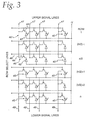
- FIG. 3 illustrates the circuitry of the photo detector array 26, which is formed by a matrix of detector elements 40.
- the detector elements 40 are arranged on an amorphous silicon wafer in a conventional two-dimensional array of m columns and n rows, where m and n are integers.
- a typical high resolution X ray detector is a square array of 1,000 to 4,000 rows and columns of elements.
- the example of Figure 2 has 1280 rows and 1365 columns.
- Each detector element 40 includes a photo diode 42 and a thin film transistor 44.
- the photo diodes 42 are fabricated from a large wafer area ensuring that the photo diode will intercept a sizeable portion of the light produced by the scintillator 24.
- Each photo diode 42 also has a relatively large capacitance that allows it to store electrical charge which is affected by the photon excitation.
- the cathode of the photo diodes 42 in each column of the array is connected by the source-drain conduction path of the associated transistor 44 to a common column signal line (47 or 49) for the column.
- the anodes of the diodes in each row are connected in common to a source of a negative bias voltage (-v).
- the gate electrodes of the transistors 44 in each row are connected to a common row select line 46.
- the row select lines are coupled to the detector controller 27 and the column signal lines are connected to the image processor 28.
- each column of photo detector elements 40 is divided in half with the upper group of photo elements being connected to upper sense lines 47 and the lower group of detector elements being connected to lower sense lines 49.
- the upper group includes rows R1-R640 and the lower group includes rows R641-R1280.
- the first four lines are on a time frame different from the rest of the lines.
- controller 36 takes the initiative to apply the row reset signal RS1, release it, and initialize the drive modules and advance the "1" bit in the shift register of the drive modules as if read out of the detector had begun.
- 128 outputs OP are activated corresponding to the 128 uncommitted outputs adjacent edge E1 of detector 22.
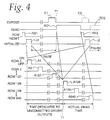
- the first 128 rows of detector 22, R1-R128, are activated by generating pulses A1 - A128, which are transmitted to the row select lines shown in Figure 3.
- Rows R1-R128 include unneeded data because they lie outside the field of view.
- Initialize signal I1 indicates that the initialize period begins with the activation of the first uncommitted drive module output adjacent edge E1 and continues through the activation of row R1 through the activation of row R128.
- the detector pauses, waiting for the "read" command RD1 (shown in Figure 4 as a composite of several more detailed signals) from the system controller 36.
- the detector resumes operating the driver modules as it had before, only the next driver output to be operated will be part of the desired field of view (i.e., row 129 in this example).
- controller 36 When readout is complete, controller 36 again applies a row reset signal RS2 for a short while, initializes the drive modules, and again begins to operate the uncommitted drive outputs adjacent edge E1 as if read out had begun, pausing before the first output in the desired field of view until the "read" command RD2 is received from controller 36.
- the time period indicated by the "read" signal RD1 illustrates the time period required to scan the part of the detector that contains image data of interest (i.e., rows R129-R1152), regardless of the number of uncommitted driver outputs, or number of scan lines outside the field of view requiring scrubbing.
- the initialize period, indicated by the initialize signal I1 is the time during which the uncommitted driver module outputs adjacent edge E1 are activated and the time during which the driver module outputs adjacent edge E1 including unneeded data outside the field of view are activated.
- Initialize period I1 occurs prior to or during exposure period E1, and initialize period I2 occurs after a "read" period (i.e., RD1) during an exposure period E2.
- Exposure period E2 is shown as a phantom exposure in order to illustrate how exposure period E2 overlaps with initialize period I2.
- Period I2 is followed by the beginning of a second phantom read period RD2. If an exposure does not immediately follow the conclusion of a read period RD1, system controller 36 executes the reset and initialize periods as indicated and simply pauses (also shown in phantom), waiting for the next exposure.
- rows R641-R1280 is the same as the above-described operation for rows R1-R640, except that rows R641-R1280 are activated in direction D2 ( Figure 2).
Landscapes
- Health & Medical Sciences (AREA)
- Life Sciences & Earth Sciences (AREA)
- Engineering & Computer Science (AREA)
- Medical Informatics (AREA)
- Physics & Mathematics (AREA)
- General Health & Medical Sciences (AREA)
- Molecular Biology (AREA)
- High Energy & Nuclear Physics (AREA)
- Heart & Thoracic Surgery (AREA)
- Public Health (AREA)
- Optics & Photonics (AREA)
- Pathology (AREA)
- Radiology & Medical Imaging (AREA)
- Biomedical Technology (AREA)
- Biophysics (AREA)
- Veterinary Medicine (AREA)
- Surgery (AREA)
- Animal Behavior & Ethology (AREA)
- Nuclear Medicine, Radiotherapy & Molecular Imaging (AREA)
- Multimedia (AREA)
- Signal Processing (AREA)
- General Physics & Mathematics (AREA)
- Spectroscopy & Molecular Physics (AREA)
- Toxicology (AREA)
- Mathematical Physics (AREA)
- Human Computer Interaction (AREA)
- Apparatus For Radiation Diagnosis (AREA)
- Measurement Of Radiation (AREA)
- Transforming Light Signals Into Electric Signals (AREA)
- Closed-Circuit Television Systems (AREA)
Applications Claiming Priority (2)
| Application Number | Priority Date | Filing Date | Title |
|---|---|---|---|
| US681300 | 2001-03-15 | ||
| US09/681,300 US6404852B1 (en) | 2001-03-15 | 2001-03-15 | Overhead reduction due to scrubbing or partial readout of x-ray detectors |
Publications (2)
| Publication Number | Publication Date |
|---|---|
| EP1248456A2 true EP1248456A2 (de) | 2002-10-09 |
| EP1248456A3 EP1248456A3 (de) | 2010-02-24 |
Family
ID=24734686
Family Applications (1)
| Application Number | Title | Priority Date | Filing Date |
|---|---|---|---|
| EP02251786A Withdrawn EP1248456A3 (de) | 2001-03-15 | 2002-03-13 | Teilweise Auslese von Röntgenstrahlungsdetektoren |
Country Status (3)
| Country | Link |
|---|---|
| US (1) | US6404852B1 (de) |
| EP (1) | EP1248456A3 (de) |
| JP (1) | JP4204239B2 (de) |
Cited By (1)
| Publication number | Priority date | Publication date | Assignee | Title |
|---|---|---|---|---|
| WO2025111080A1 (en) * | 2023-11-21 | 2025-05-30 | Varex Imaging Corporation | Symmetric image data capture from an asymmetric image detector |
Families Citing this family (20)
| Publication number | Priority date | Publication date | Assignee | Title |
|---|---|---|---|---|
| US6031892A (en) * | 1989-12-05 | 2000-02-29 | University Of Massachusetts Medical Center | System for quantitative radiographic imaging |
| CN1866378B (zh) * | 1996-02-28 | 2010-09-29 | 松下电器产业株式会社 | 光盘重放装置 |
| US6931098B2 (en) * | 2002-03-08 | 2005-08-16 | Ge Medical Systems Global Technology Company, Llc | Method and system for dual or multiple energy imaging |
| JP3647440B2 (ja) * | 2002-05-28 | 2005-05-11 | キヤノン株式会社 | X線撮影装置 |
| US6718010B2 (en) * | 2002-06-11 | 2004-04-06 | Ge Medical Systems Global Technology Company, Llc | Method and apparatus for acquiring a series of images utilizing a solid state detector with alternating scan lines |
| US7248671B2 (en) * | 2002-06-26 | 2007-07-24 | Kabushiki Kaisha Toshiba | X-ray diagnosis apparatus |
| JP4570614B2 (ja) * | 2003-03-24 | 2010-10-27 | カルテンバッハ ウント ホイクト ゲゼルシャフト ミット ベシュレンクテル ハフツング | 電子センサを有するx線システム |
| JP2005109269A (ja) * | 2003-09-30 | 2005-04-21 | Hitachi Ltd | 半導体放射線検出器及び半導体放射線撮像装置 |
| US7119341B2 (en) * | 2003-12-08 | 2006-10-10 | General Electric Company | Split scan line and combined data line x-ray detectors |
| US20050147203A1 (en) * | 2003-12-31 | 2005-07-07 | Ross William R. | Reading imaging data |
| DE102004052613B4 (de) * | 2004-10-29 | 2016-03-03 | Siemens Aktiengesellschaft | Mammographie-Röntgengerät mit einem digitalen Festkörper-Flachdetektor |
| JP2007144064A (ja) * | 2005-11-30 | 2007-06-14 | Shimadzu Corp | 撮像センサおよびそれを用いた撮像装置 |
| WO2007096968A1 (ja) * | 2006-02-23 | 2007-08-30 | Shimadzu Corporation | 放射線撮像装置および放射線検出信号処理方法 |
| JP2008098391A (ja) * | 2006-10-12 | 2008-04-24 | Fujifilm Corp | 放射線画像検出器 |
| US7601962B2 (en) | 2007-01-12 | 2009-10-13 | General Electric Company | Systems and methods for reading data |
| JP5361152B2 (ja) * | 2007-07-09 | 2013-12-04 | キヤノン株式会社 | 撮影制御装置及びその制御方法、撮影装置、並びに、プログラム |
| KR101599028B1 (ko) * | 2009-07-23 | 2016-03-03 | 삼성전자주식회사 | 산란 감소를 위한 x-선 촬영 장치 및 방법 |
| KR101829777B1 (ko) * | 2011-03-09 | 2018-02-20 | 삼성디스플레이 주식회사 | 광 감지 센서 |
| JP5627748B2 (ja) * | 2013-09-03 | 2014-11-19 | キヤノン株式会社 | 撮影制御装置及びその制御方法、撮影装置、並びに、プログラム |
| JP2018014555A (ja) * | 2016-07-19 | 2018-01-25 | 東芝電子管デバイス株式会社 | 放射線検出器、および放射線画像撮影装置 |
Citations (2)
| Publication number | Priority date | Publication date | Assignee | Title |
|---|---|---|---|---|
| US4996413A (en) | 1990-02-27 | 1991-02-26 | General Electric Company | Apparatus and method for reading data from an image detector |
| EP0792062A2 (de) | 1996-02-22 | 1997-08-27 | Canon Kabushiki Kaisha | Photoelektrische Umwandlungsvorrichtung und Steuerverfahren dafür |
Family Cites Families (3)
| Publication number | Priority date | Publication date | Assignee | Title |
|---|---|---|---|---|
| US5668375A (en) * | 1996-08-26 | 1997-09-16 | General Electric Company | Fast scan reset for a large area x-ray detector |
| US5970115A (en) * | 1996-11-29 | 1999-10-19 | Varian Medical Systems, Inc. | Multiple mode digital X-ray imaging system |
| EP0958696A2 (de) * | 1997-12-10 | 1999-11-24 | Koninklijke Philips Electronics N.V. | Röntgenuntersuchungsvorrichtung |
-
2001
- 2001-03-15 US US09/681,300 patent/US6404852B1/en not_active Expired - Lifetime
-
2002
- 2002-03-13 EP EP02251786A patent/EP1248456A3/de not_active Withdrawn
- 2002-03-15 JP JP2002071535A patent/JP4204239B2/ja not_active Expired - Fee Related
Patent Citations (2)
| Publication number | Priority date | Publication date | Assignee | Title |
|---|---|---|---|---|
| US4996413A (en) | 1990-02-27 | 1991-02-26 | General Electric Company | Apparatus and method for reading data from an image detector |
| EP0792062A2 (de) | 1996-02-22 | 1997-08-27 | Canon Kabushiki Kaisha | Photoelektrische Umwandlungsvorrichtung und Steuerverfahren dafür |
Cited By (1)
| Publication number | Priority date | Publication date | Assignee | Title |
|---|---|---|---|---|
| WO2025111080A1 (en) * | 2023-11-21 | 2025-05-30 | Varex Imaging Corporation | Symmetric image data capture from an asymmetric image detector |
Also Published As
| Publication number | Publication date |
|---|---|
| US6404852B1 (en) | 2002-06-11 |
| JP4204239B2 (ja) | 2009-01-07 |
| JP2002345798A (ja) | 2002-12-03 |
| EP1248456A3 (de) | 2010-02-24 |
Similar Documents
| Publication | Publication Date | Title |
|---|---|---|
| US6404852B1 (en) | Overhead reduction due to scrubbing or partial readout of x-ray detectors | |
| US7683337B2 (en) | Radiographic apparatus and control method therefor | |
| EP0444869B1 (de) | Verfahren und Vorrichtung zur Bilderfassung | |
| US7514663B2 (en) | Imaging apparatus having a read out circuit unit with dual readout operation and method of improving a frame rate | |
| US7154099B2 (en) | Radiation image pick-up device and radiation image pick-up method | |
| US7170042B2 (en) | Photoelectric converter and X-ray image pick-up device | |
| US20020167061A1 (en) | Photoelectric converter, its driving method, and system including the photoelectric converter | |
| US6818899B2 (en) | Radiographic image pickup apparatus and method of driving the apparatus | |
| US7042980B2 (en) | Radiographic apparatus | |
| US6535576B2 (en) | Enhanced digital detector and system and method incorporating same | |
| US20120006993A1 (en) | Solid-state imaging apparatus and imaging system | |
| US8822939B2 (en) | Matrix substrate, detection device, detection system, and method for driving detection device | |
| US7119341B2 (en) | Split scan line and combined data line x-ray detectors | |
| EP3275176B1 (de) | Vorrichtung und verfahren mit einer doppelgate-tft-struktur | |
| US6718010B2 (en) | Method and apparatus for acquiring a series of images utilizing a solid state detector with alternating scan lines | |
| US20120105665A1 (en) | Digital image pickup apparatus, radiation imaging apparatus, and radiation imaging system | |
| JP4652074B2 (ja) | 固体デジタルx線検出器を使用する改良されたデータ収集のための方法及びシステム | |
| US7122802B2 (en) | Method and apparatus for increasing the data acquisition rate in a digital detector | |
| JPH0784055A (ja) | 放射線2次元検出器 | |
| US6160260A (en) | Photoelectric conversion device, and system and image reading method using the device | |
| US10695015B2 (en) | Solid-state image capturing device, radiation image capturing system, and method of controlling solid-state image capturing device | |
| US6901134B2 (en) | Arrangement comprising electrical elements | |
| JP2023064459A (ja) | 放射線撮像装置、放射線撮像システム、および放射線撮像装置の制御方法 | |
| JP2013069864A (ja) | 検出装置及び検出システム |
Legal Events
| Date | Code | Title | Description |
|---|---|---|---|
| PUAI | Public reference made under article 153(3) epc to a published international application that has entered the european phase |
Free format text: ORIGINAL CODE: 0009012 |
|
| AK | Designated contracting states |
Kind code of ref document: A2 Designated state(s): AT BE CH CY DE DK ES FI FR GB GR IE IT LI LU MC NL PT SE TR |
|
| AX | Request for extension of the european patent |
Free format text: AL;LT;LV;MK;RO;SI |
|
| PUAL | Search report despatched |
Free format text: ORIGINAL CODE: 0009013 |
|
| AK | Designated contracting states |
Kind code of ref document: A3 Designated state(s): AT BE CH CY DE DK ES FI FR GB GR IE IT LI LU MC NL PT SE TR |
|
| AX | Request for extension of the european patent |
Extension state: AL LT LV MK RO SI |
|
| 17P | Request for examination filed |
Effective date: 20100824 |
|
| 17Q | First examination report despatched |
Effective date: 20100917 |
|
| AKX | Designation fees paid |
Designated state(s): DE FR |
|
| GRAP | Despatch of communication of intention to grant a patent |
Free format text: ORIGINAL CODE: EPIDOSNIGR1 |
|
| RIC1 | Information provided on ipc code assigned before grant |
Ipc: H05G 1/30 20060101ALI20180205BHEP Ipc: G01T 1/203 20060101ALI20180205BHEP Ipc: H04N 5/32 20060101ALI20180205BHEP Ipc: A61B 6/00 20060101AFI20180205BHEP Ipc: H04N 5/345 20110101ALI20180205BHEP |
|
| INTG | Intention to grant announced |
Effective date: 20180227 |
|
| STAA | Information on the status of an ep patent application or granted ep patent |
Free format text: STATUS: THE APPLICATION IS DEEMED TO BE WITHDRAWN |
|
| 18D | Application deemed to be withdrawn |
Effective date: 20180710 |
|
| RIC1 | Information provided on ipc code assigned before grant |
Ipc: G01T 1/203 20060101ALI20180205BHEP Ipc: H04N 5/345 20110101ALI20180205BHEP Ipc: H05G 1/30 20060101ALI20180205BHEP Ipc: H04N 5/32 20060101ALI20180205BHEP Ipc: A61B 6/00 20060101AFI20180205BHEP |