EP1248778B1 - Substituierte photochromische 2h-naphtho[1,2-b]pyran verbindungen - Google Patents
Substituierte photochromische 2h-naphtho[1,2-b]pyran verbindungen Download PDFInfo
- Publication number
- EP1248778B1 EP1248778B1 EP20010942362 EP01942362A EP1248778B1 EP 1248778 B1 EP1248778 B1 EP 1248778B1 EP 20010942362 EP20010942362 EP 20010942362 EP 01942362 A EP01942362 A EP 01942362A EP 1248778 B1 EP1248778 B1 EP 1248778B1
- Authority
- EP
- European Patent Office
- Prior art keywords
- alkyl
- mono
- phenyl
- alkoxy
- substituted
- Prior art date
- Legal status (The legal status is an assumption and is not a legal conclusion. Google has not performed a legal analysis and makes no representation as to the accuracy of the status listed.)
- Expired - Lifetime
Links
- 125000004309 pyranyl group Chemical class O1C(C=CC=C1)* 0.000 title abstract description 14
- -1 e.g. Substances 0.000 claims abstract description 131
- 150000001875 compounds Chemical class 0.000 claims abstract description 94
- 239000000463 material Substances 0.000 claims abstract description 44
- 239000000758 substrate Substances 0.000 claims abstract description 29
- 125000001424 substituent group Chemical group 0.000 claims abstract description 20
- VCMLCMCXCRBSQO-UHFFFAOYSA-N 3h-benzo[f]chromene Chemical class C1=CC=CC2=C(C=CCO3)C3=CC=C21 VCMLCMCXCRBSQO-UHFFFAOYSA-N 0.000 claims abstract description 18
- 239000011521 glass Substances 0.000 claims abstract description 4
- 125000001997 phenyl group Chemical group [H]C1=C([H])C([H])=C(*)C([H])=C1[H] 0.000 claims description 69
- 125000004169 (C1-C6) alkyl group Chemical group 0.000 claims description 46
- 125000006273 (C1-C3) alkyl group Chemical group 0.000 claims description 45
- 239000001257 hydrogen Substances 0.000 claims description 40
- 229910052739 hydrogen Inorganic materials 0.000 claims description 40
- 239000000178 monomer Substances 0.000 claims description 39
- 125000004191 (C1-C6) alkoxy group Chemical group 0.000 claims description 37
- 125000000753 cycloalkyl group Chemical group 0.000 claims description 29
- 125000004178 (C1-C4) alkyl group Chemical group 0.000 claims description 26
- 238000000576 coating method Methods 0.000 claims description 24
- 125000006274 (C1-C3)alkoxy group Chemical group 0.000 claims description 22
- 150000002431 hydrogen Chemical group 0.000 claims description 21
- 230000003287 optical effect Effects 0.000 claims description 21
- 125000003118 aryl group Chemical group 0.000 claims description 19
- 125000001153 fluoro group Chemical group F* 0.000 claims description 18
- 229920001577 copolymer Chemical compound 0.000 claims description 17
- 125000001309 chloro group Chemical group Cl* 0.000 claims description 16
- 239000008199 coating composition Substances 0.000 claims description 16
- 229910052736 halogen Inorganic materials 0.000 claims description 16
- 150000002367 halogens Chemical class 0.000 claims description 16
- 239000011248 coating agent Substances 0.000 claims description 13
- UFHFLCQGNIYNRP-UHFFFAOYSA-N Hydrogen Chemical compound [H][H] UFHFLCQGNIYNRP-UHFFFAOYSA-N 0.000 claims description 12
- 229920005989 resin Polymers 0.000 claims description 12
- 239000011347 resin Substances 0.000 claims description 12
- 229920006395 saturated elastomer Polymers 0.000 claims description 12
- 125000001624 naphthyl group Chemical group 0.000 claims description 11
- 229920000642 polymer Polymers 0.000 claims description 10
- 125000000229 (C1-C4)alkoxy group Chemical group 0.000 claims description 9
- 125000004104 aryloxy group Chemical group 0.000 claims description 9
- 125000005843 halogen group Chemical group 0.000 claims description 9
- 125000000171 (C1-C6) haloalkyl group Chemical group 0.000 claims description 8
- 125000006652 (C3-C12) cycloalkyl group Chemical group 0.000 claims description 8
- JHQVCQDWGSXTFE-UHFFFAOYSA-N 2-(2-prop-2-enoxycarbonyloxyethoxy)ethyl prop-2-enyl carbonate Chemical compound C=CCOC(=O)OCCOCCOC(=O)OCC=C JHQVCQDWGSXTFE-UHFFFAOYSA-N 0.000 claims description 8
- XFCMNSHQOZQILR-UHFFFAOYSA-N 2-[2-(2-methylprop-2-enoyloxy)ethoxy]ethyl 2-methylprop-2-enoate Chemical compound CC(=C)C(=O)OCCOCCOC(=O)C(C)=C XFCMNSHQOZQILR-UHFFFAOYSA-N 0.000 claims description 8
- 125000004171 alkoxy aryl group Chemical group 0.000 claims description 8
- 125000002877 alkyl aryl group Chemical group 0.000 claims description 8
- QVGXLLKOCUKJST-UHFFFAOYSA-N atomic oxygen Chemical group [O] QVGXLLKOCUKJST-UHFFFAOYSA-N 0.000 claims description 8
- 125000002541 furyl group Chemical group 0.000 claims description 8
- 125000000325 methylidene group Chemical group [H]C([H])=* 0.000 claims description 8
- 239000001301 oxygen Chemical group 0.000 claims description 8
- 229910052760 oxygen Chemical group 0.000 claims description 8
- 239000000126 substance Substances 0.000 claims description 8
- 125000001544 thienyl group Chemical group 0.000 claims description 8
- 125000004435 hydrogen atom Chemical group [H]* 0.000 claims description 7
- 229920002635 polyurethane Polymers 0.000 claims description 7
- 239000004814 polyurethane Substances 0.000 claims description 7
- 125000004890 (C1-C6) alkylamino group Chemical group 0.000 claims description 6
- 125000000217 alkyl group Chemical group 0.000 claims description 6
- 125000002490 anilino group Chemical group [H]N(*)C1=C([H])C([H])=C([H])C([H])=C1[H] 0.000 claims description 6
- 125000004244 benzofuran-2-yl group Chemical group [H]C1=C(*)OC2=C([H])C([H])=C([H])C([H])=C12 0.000 claims description 6
- 125000004534 benzothien-2-yl group Chemical group S1C(=CC2=C1C=CC=C2)* 0.000 claims description 6
- 125000001246 bromo group Chemical group Br* 0.000 claims description 6
- 125000000000 cycloalkoxy group Chemical group 0.000 claims description 6
- 125000001072 heteroaryl group Chemical group 0.000 claims description 6
- 125000002346 iodo group Chemical group I* 0.000 claims description 6
- 125000000951 phenoxy group Chemical group [H]C1=C([H])C([H])=C(O*)C([H])=C1[H] 0.000 claims description 6
- 125000003903 2-propenyl group Chemical group [H]C([*])([H])C([H])=C([H])[H] 0.000 claims description 5
- VCDAWCBLCCVSKE-UHFFFAOYSA-N 2h-benzo[h]chromene Chemical group C1=CC2=CC=CC=C2C2=C1C=CCO2 VCDAWCBLCCVSKE-UHFFFAOYSA-N 0.000 claims description 5
- 238000010521 absorption reaction Methods 0.000 claims description 5
- IJGRMHOSHXDMSA-UHFFFAOYSA-N nitrogen Substances N#N IJGRMHOSHXDMSA-UHFFFAOYSA-N 0.000 claims description 5
- 229910052757 nitrogen Inorganic materials 0.000 claims description 5
- 229920001169 thermoplastic Polymers 0.000 claims description 5
- 239000004416 thermosoftening plastic Substances 0.000 claims description 5
- 125000006526 (C1-C2) alkyl group Chemical group 0.000 claims description 4
- 125000006559 (C1-C3) alkylamino group Chemical group 0.000 claims description 4
- HIACAHMKXQESOV-UHFFFAOYSA-N 1,2-bis(prop-1-en-2-yl)benzene Chemical compound CC(=C)C1=CC=CC=C1C(C)=C HIACAHMKXQESOV-UHFFFAOYSA-N 0.000 claims description 4
- NIXOWILDQLNWCW-UHFFFAOYSA-M Acrylate Chemical compound [O-]C(=O)C=C NIXOWILDQLNWCW-UHFFFAOYSA-M 0.000 claims description 4
- QUZSUMLPWDHKCJ-UHFFFAOYSA-N bisphenol A dimethacrylate Polymers C1=CC(OC(=O)C(=C)C)=CC=C1C(C)(C)C1=CC=C(OC(=O)C(C)=C)C=C1 QUZSUMLPWDHKCJ-UHFFFAOYSA-N 0.000 claims description 4
- 125000002496 methyl group Chemical group [H]C([H])([H])* 0.000 claims description 4
- 150000002829 nitrogen Chemical class 0.000 claims description 4
- 229920002037 poly(vinyl butyral) polymer Polymers 0.000 claims description 4
- 239000004926 polymethyl methacrylate Substances 0.000 claims description 4
- 229920005862 polyol Polymers 0.000 claims description 4
- 150000003077 polyols Chemical class 0.000 claims description 4
- 229920002578 polythiourethane polymer Polymers 0.000 claims description 4
- 229920002689 polyvinyl acetate Polymers 0.000 claims description 4
- 239000011118 polyvinyl acetate Substances 0.000 claims description 4
- 125000002924 primary amino group Chemical group [H]N([H])* 0.000 claims description 4
- 125000004076 pyridyl group Chemical group 0.000 claims description 4
- 239000004753 textile Substances 0.000 claims description 4
- GTELLNMUWNJXMQ-UHFFFAOYSA-N 2-ethyl-2-(hydroxymethyl)propane-1,3-diol;prop-2-enoic acid Chemical class OC(=O)C=C.OC(=O)C=C.OC(=O)C=C.CCC(CO)(CO)CO GTELLNMUWNJXMQ-UHFFFAOYSA-N 0.000 claims description 3
- SKESERDUDQOXKM-UHFFFAOYSA-N 2-methylprop-2-enoic acid;phenol Chemical class CC(=C)C(O)=O.CC(=C)C(O)=O.OC1=CC=CC=C1 SKESERDUDQOXKM-UHFFFAOYSA-N 0.000 claims description 3
- 239000004793 Polystyrene Substances 0.000 claims description 3
- 229920002301 cellulose acetate Polymers 0.000 claims description 3
- 229920006217 cellulose acetate butyrate Polymers 0.000 claims description 3
- HHELFJOZOOEAFZ-UHFFFAOYSA-N cyclohexyl 2-dibenzofuran-2-yl-8-methyl-2-phenylbenzo[h]chromene-5-carboxylate Chemical compound C=1C2=CC(C)=CC=C2C=2OC(C=3C=C4C5=CC=CC=C5OC4=CC=3)(C=3C=CC=CC=3)C=CC=2C=1C(=O)OC1CCCCC1 HHELFJOZOOEAFZ-UHFFFAOYSA-N 0.000 claims description 3
- YEJIRSGCEJSSQM-UHFFFAOYSA-N cyclohexyl 8-methoxy-2,2-diphenylbenzo[h]chromene-5-carboxylate Chemical compound C=1C2=CC(OC)=CC=C2C=2OC(C=3C=CC=CC=3)(C=3C=CC=CC=3)C=CC=2C=1C(=O)OC1CCCCC1 YEJIRSGCEJSSQM-UHFFFAOYSA-N 0.000 claims description 3
- OWOZIVQOESOLNS-UHFFFAOYSA-N cyclohexyl 8-methoxy-2-(4-methylphenyl)-2-phenylbenzo[h]chromene-5-carboxylate Chemical compound C=1C2=CC(OC)=CC=C2C=2OC(C=3C=CC(C)=CC=3)(C=3C=CC=CC=3)C=CC=2C=1C(=O)OC1CCCCC1 OWOZIVQOESOLNS-UHFFFAOYSA-N 0.000 claims description 3
- ODCJUAXDUDTQGF-UHFFFAOYSA-N cyclohexyl 8-methyl-2,2-diphenylbenzo[h]chromene-5-carboxylate Chemical compound C=1C2=CC(C)=CC=C2C=2OC(C=3C=CC=CC=3)(C=3C=CC=CC=3)C=CC=2C=1C(=O)OC1CCCCC1 ODCJUAXDUDTQGF-UHFFFAOYSA-N 0.000 claims description 3
- 125000003106 haloaryl group Chemical group 0.000 claims description 3
- 239000011368 organic material Substances 0.000 claims description 3
- 239000003973 paint Substances 0.000 claims description 3
- 229920003229 poly(methyl methacrylate) Polymers 0.000 claims description 3
- 229920000515 polycarbonate Polymers 0.000 claims description 3
- 239000004417 polycarbonate Substances 0.000 claims description 3
- 229920000728 polyester Polymers 0.000 claims description 3
- 229920002223 polystyrene Polymers 0.000 claims description 3
- 229920002451 polyvinyl alcohol Polymers 0.000 claims description 3
- 125000004765 (C1-C4) haloalkyl group Chemical group 0.000 claims description 2
- 125000006376 (C3-C10) cycloalkyl group Chemical group 0.000 claims description 2
- GFSXWQUSLTVUBW-UHFFFAOYSA-N 10bh-benzo[h]chromene Chemical compound C1=CC=C2C3OC=CC=C3C=CC2=C1 GFSXWQUSLTVUBW-UHFFFAOYSA-N 0.000 claims description 2
- OOXMQACSWCZQLX-UHFFFAOYSA-N 3,9-bis(ethenyl)-2,4,8,10-tetraoxaspiro[5.5]undecane Chemical compound C1OC(C=C)OCC21COC(C=C)OC2 OOXMQACSWCZQLX-UHFFFAOYSA-N 0.000 claims description 2
- WIFWCSTVYGGLAE-UHFFFAOYSA-N 4ah-benzo[f]chromene Chemical compound C1=CC=C2C3=CC=COC3C=CC2=C1 WIFWCSTVYGGLAE-UHFFFAOYSA-N 0.000 claims description 2
- BVKZGUZCCUSVTD-UHFFFAOYSA-L Carbonate Chemical compound [O-]C([O-])=O BVKZGUZCCUSVTD-UHFFFAOYSA-L 0.000 claims description 2
- 229920008347 Cellulose acetate propionate Polymers 0.000 claims description 2
- 229920002284 Cellulose triacetate Polymers 0.000 claims description 2
- CERQOIWHTDAKMF-UHFFFAOYSA-M Methacrylate Chemical compound CC(=C)C([O-])=O CERQOIWHTDAKMF-UHFFFAOYSA-M 0.000 claims description 2
- 229920001328 Polyvinylidene chloride Polymers 0.000 claims description 2
- NNLVGZFZQQXQNW-ADJNRHBOSA-N [(2r,3r,4s,5r,6s)-4,5-diacetyloxy-3-[(2s,3r,4s,5r,6r)-3,4,5-triacetyloxy-6-(acetyloxymethyl)oxan-2-yl]oxy-6-[(2r,3r,4s,5r,6s)-4,5,6-triacetyloxy-2-(acetyloxymethyl)oxan-3-yl]oxyoxan-2-yl]methyl acetate Chemical compound O([C@@H]1O[C@@H]([C@H]([C@H](OC(C)=O)[C@H]1OC(C)=O)O[C@H]1[C@@H]([C@@H](OC(C)=O)[C@H](OC(C)=O)[C@@H](COC(C)=O)O1)OC(C)=O)COC(=O)C)[C@@H]1[C@@H](COC(C)=O)O[C@@H](OC(C)=O)[C@H](OC(C)=O)[C@H]1OC(C)=O NNLVGZFZQQXQNW-ADJNRHBOSA-N 0.000 claims description 2
- 125000000641 acridinyl group Chemical group C1(=CC=CC2=NC3=CC=CC=C3C=C12)* 0.000 claims description 2
- 125000002252 acyl group Chemical group 0.000 claims description 2
- 125000004532 benzofuran-3-yl group Chemical group O1C=C(C2=C1C=CC=C2)* 0.000 claims description 2
- 125000004197 benzothien-3-yl group Chemical group [H]C1=C(*)C2=C([H])C([H])=C([H])C([H])=C2S1 0.000 claims description 2
- 150000001602 bicycloalkyls Chemical group 0.000 claims description 2
- 125000000609 carbazolyl group Chemical group C1(=CC=CC=2C3=CC=CC=C3NC12)* 0.000 claims description 2
- 239000000919 ceramic Substances 0.000 claims description 2
- 125000004965 chloroalkyl group Chemical group 0.000 claims description 2
- 125000004367 cycloalkylaryl group Chemical group 0.000 claims description 2
- HAKLYPOKPMNBJI-UHFFFAOYSA-N cyclobutyl 6-(2-ethoxy-2-oxoethoxy)-2-(4-methoxyphenyl)-2-(2-methyl-2,3-dihydro-1-benzofuran-5-yl)benzo[h]chromene-5-carboxylate Chemical compound C1=2C=CC(C=3C=C4CC(C)OC4=CC=3)(C=3C=CC(OC)=CC=3)OC=2C2=CC=CC=C2C(OCC(=O)OCC)=C1C(=O)OC1CCC1 HAKLYPOKPMNBJI-UHFFFAOYSA-N 0.000 claims description 2
- UVLLZMZLHGCURQ-UHFFFAOYSA-N cycloheptyl 9-methoxy-2,2-bis(4-methoxyphenyl)-6-methylbenzo[h]chromene-5-carboxylate Chemical compound C1=CC(OC)=CC=C1C1(C=2C=CC(OC)=CC=2)C=CC(C(C(=O)OC2CCCCCC2)=C(C)C=2C3=CC(OC)=CC=2)=C3O1 UVLLZMZLHGCURQ-UHFFFAOYSA-N 0.000 claims description 2
- MGXISSGVBILXMI-UHFFFAOYSA-N cyclohexyl 8-methoxy-2-(4-methoxyphenyl)-2-phenylbenzo[h]chromene-5-carboxylate Chemical compound C1=CC(OC)=CC=C1C1(C=2C=CC=CC=2)C=CC(C(=CC=2C3=CC=C(OC)C=2)C(=O)OC2CCCCC2)=C3O1 MGXISSGVBILXMI-UHFFFAOYSA-N 0.000 claims description 2
- ILYMOEMUFVNPGB-UHFFFAOYSA-N cyclooctyl 2,2-bis(4-methoxyphenyl)-6-methylbenzo[h]chromene-5-carboxylate Chemical compound C1=CC(OC)=CC=C1C1(C=2C=CC(OC)=CC=2)C=CC(C(C(=O)OC2CCCCCCC2)=C(C)C=2C3=CC=CC=2)=C3O1 ILYMOEMUFVNPGB-UHFFFAOYSA-N 0.000 claims description 2
- VXPBWWGTMLGBSE-UHFFFAOYSA-N cyclooctyl 6-(2-ethoxy-2-oxoethoxy)-2,2-bis(4-methoxyphenyl)benzo[h]chromene-5-carboxylate Chemical compound C1=2C=CC(C=3C=CC(OC)=CC=3)(C=3C=CC(OC)=CC=3)OC=2C2=CC=CC=C2C(OCC(=O)OCC)=C1C(=O)OC1CCCCCCC1 VXPBWWGTMLGBSE-UHFFFAOYSA-N 0.000 claims description 2
- KKHXLUNCCAFHFB-UHFFFAOYSA-N cyclopropyl 6-acetyloxy-2,2-diphenylbenzo[h]chromene-5-carboxylate Chemical compound C1=2C=CC(C=3C=CC=CC=3)(C=3C=CC=CC=3)OC=2C2=CC=CC=C2C(OC(=O)C)=C1C(=O)OC1CC1 KKHXLUNCCAFHFB-UHFFFAOYSA-N 0.000 claims description 2
- 125000004986 diarylamino group Chemical group 0.000 claims description 2
- 125000004988 dibenzothienyl group Chemical group C1(=CC=CC=2SC3=C(C21)C=CC=C3)* 0.000 claims description 2
- 125000003983 fluorenyl group Chemical group C1(=CC=CC=2C3=CC=CC=C3CC12)* 0.000 claims description 2
- 125000003709 fluoroalkyl group Chemical group 0.000 claims description 2
- 125000002636 imidazolinyl group Chemical group 0.000 claims description 2
- 125000002883 imidazolyl group Chemical group 0.000 claims description 2
- 239000000976 ink Substances 0.000 claims description 2
- 125000005647 linker group Chemical group 0.000 claims description 2
- 229910052751 metal Inorganic materials 0.000 claims description 2
- 239000002184 metal Substances 0.000 claims description 2
- 150000002739 metals Chemical class 0.000 claims description 2
- QJGQUHMNIGDVPM-UHFFFAOYSA-N nitrogen group Chemical group [N] QJGQUHMNIGDVPM-UHFFFAOYSA-N 0.000 claims description 2
- 239000000123 paper Substances 0.000 claims description 2
- 125000001791 phenazinyl group Chemical group C1(=CC=CC2=NC3=CC=CC=C3N=C12)* 0.000 claims description 2
- 125000001484 phenothiazinyl group Chemical group C1(=CC=CC=2SC3=CC=CC=C3NC12)* 0.000 claims description 2
- 125000001644 phenoxazinyl group Chemical group C1(=CC=CC=2OC3=CC=CC=C3NC12)* 0.000 claims description 2
- QIWKUEJZZCOPFV-UHFFFAOYSA-N phenyl 2-methylprop-2-enoate Chemical class CC(=C)C(=O)OC1=CC=CC=C1 QIWKUEJZZCOPFV-UHFFFAOYSA-N 0.000 claims description 2
- 125000000587 piperidin-1-yl group Chemical group [H]C1([H])N(*)C([H])([H])C([H])([H])C([H])([H])C1([H])[H] 0.000 claims description 2
- 229920003251 poly(α-methylstyrene) Polymers 0.000 claims description 2
- 229920000058 polyacrylate Polymers 0.000 claims description 2
- 229920000139 polyethylene terephthalate Polymers 0.000 claims description 2
- 239000005020 polyethylene terephthalate Substances 0.000 claims description 2
- 229920000193 polymethacrylate Polymers 0.000 claims description 2
- 229920000915 polyvinyl chloride Polymers 0.000 claims description 2
- 239000004800 polyvinyl chloride Substances 0.000 claims description 2
- 125000002755 pyrazolinyl group Chemical group 0.000 claims description 2
- 125000003226 pyrazolyl group Chemical group 0.000 claims description 2
- 125000001422 pyrrolinyl group Chemical group 0.000 claims description 2
- 239000007787 solid Substances 0.000 claims description 2
- 150000005846 sugar alcohols Polymers 0.000 claims description 2
- 239000002023 wood Substances 0.000 claims description 2
- 125000001183 hydrocarbyl group Chemical group 0.000 claims 6
- 125000002887 hydroxy group Chemical group [H]O* 0.000 claims 4
- WVGVSKMBEYOLEP-UHFFFAOYSA-N cyclohexyl 6-methoxycarbonyloxy-2,2-bis(4-methylphenyl)benzo[h]chromene-5-carboxylate Chemical compound C1=2C=CC(C=3C=CC(C)=CC=3)(C=3C=CC(C)=CC=3)OC=2C2=CC=CC=C2C(OC(=O)OC)=C1C(=O)OC1CCCCC1 WVGVSKMBEYOLEP-UHFFFAOYSA-N 0.000 claims 1
- QPVIELWGILBJNT-UHFFFAOYSA-N cyclopropyl 6-methoxy-2,2-bis(4-methoxyphenyl)benzo[h]chromene-5-carboxylate Chemical compound C1=CC(OC)=CC=C1C1(C=2C=CC(OC)=CC=2)C=CC(C(C(=O)OC2CC2)=C(OC)C=2C3=CC=CC=2)=C3O1 QPVIELWGILBJNT-UHFFFAOYSA-N 0.000 claims 1
- 229920003023 plastic Polymers 0.000 abstract description 7
- 239000004033 plastic Substances 0.000 abstract description 7
- 125000004432 carbon atom Chemical group C* 0.000 abstract description 5
- 230000000295 complement effect Effects 0.000 abstract description 5
- 230000002441 reversible effect Effects 0.000 abstract description 5
- 150000001562 benzopyrans Chemical class 0.000 abstract description 4
- 229910052799 carbon Inorganic materials 0.000 abstract description 4
- 238000000034 method Methods 0.000 description 29
- 239000000203 mixture Substances 0.000 description 25
- 238000005213 imbibition Methods 0.000 description 22
- 238000006243 chemical reaction Methods 0.000 description 19
- 230000007547 defect Effects 0.000 description 18
- 238000012360 testing method Methods 0.000 description 17
- 230000000052 comparative effect Effects 0.000 description 15
- 230000007935 neutral effect Effects 0.000 description 11
- 125000003003 spiro group Chemical group 0.000 description 10
- ZMXDDKWLCZADIW-UHFFFAOYSA-N N,N-Dimethylformamide Chemical compound CN(C)C=O ZMXDDKWLCZADIW-UHFFFAOYSA-N 0.000 description 9
- 239000002904 solvent Substances 0.000 description 9
- 230000008859 change Effects 0.000 description 8
- 239000003086 colorant Substances 0.000 description 8
- 239000003381 stabilizer Substances 0.000 description 8
- SIKJAQJRHWYJAI-UHFFFAOYSA-N Indole Chemical compound C1=CC=C2NC=CC2=C1 SIKJAQJRHWYJAI-UHFFFAOYSA-N 0.000 description 7
- 239000002537 cosmetic Substances 0.000 description 7
- 239000013078 crystal Substances 0.000 description 7
- 230000008569 process Effects 0.000 description 7
- YMWUJEATGCHHMB-UHFFFAOYSA-N Dichloromethane Chemical compound ClCCl YMWUJEATGCHHMB-UHFFFAOYSA-N 0.000 description 6
- YXFVVABEGXRONW-UHFFFAOYSA-N Toluene Chemical compound CC1=CC=CC=C1 YXFVVABEGXRONW-UHFFFAOYSA-N 0.000 description 6
- 150000002430 hydrocarbons Chemical group 0.000 description 6
- BWHMMNNQKKPAPP-UHFFFAOYSA-L potassium carbonate Chemical compound [K+].[K+].[O-]C([O-])=O BWHMMNNQKKPAPP-UHFFFAOYSA-L 0.000 description 6
- 0 CC(*1CC1)=CN Chemical compound CC(*1CC1)=CN 0.000 description 5
- RTZKZFJDLAIYFH-UHFFFAOYSA-N Diethyl ether Chemical compound CCOCC RTZKZFJDLAIYFH-UHFFFAOYSA-N 0.000 description 5
- PPBRXRYQALVLMV-UHFFFAOYSA-N Styrene Chemical compound C=CC1=CC=CC=C1 PPBRXRYQALVLMV-UHFFFAOYSA-N 0.000 description 5
- JKJWYKGYGWOAHT-UHFFFAOYSA-N bis(prop-2-enyl) carbonate Chemical compound C=CCOC(=O)OCC=C JKJWYKGYGWOAHT-UHFFFAOYSA-N 0.000 description 5
- IZBZZOUEOAFPDF-UHFFFAOYSA-N cyclohexyl 4-hydroxy-7-methylnaphthalene-2-carboxylate Chemical compound C=1C2=CC(C)=CC=C2C(O)=CC=1C(=O)OC1CCCCC1 IZBZZOUEOAFPDF-UHFFFAOYSA-N 0.000 description 5
- 230000005855 radiation Effects 0.000 description 5
- SMCLTAARQYTXLW-UHFFFAOYSA-N 1,1-diphenylprop-2-yn-1-ol Chemical compound C=1C=CC=CC=1C(C#C)(O)C1=CC=CC=C1 SMCLTAARQYTXLW-UHFFFAOYSA-N 0.000 description 4
- CSCPPACGZOOCGX-UHFFFAOYSA-N Acetone Chemical compound CC(C)=O CSCPPACGZOOCGX-UHFFFAOYSA-N 0.000 description 4
- 238000005481 NMR spectroscopy Methods 0.000 description 4
- WYURNTSHIVDZCO-UHFFFAOYSA-N Tetrahydrofuran Chemical compound C1CCOC1 WYURNTSHIVDZCO-UHFFFAOYSA-N 0.000 description 4
- XTXRWKRVRITETP-UHFFFAOYSA-N Vinyl acetate Chemical compound CC(=O)OC=C XTXRWKRVRITETP-UHFFFAOYSA-N 0.000 description 4
- 239000002585 base Substances 0.000 description 4
- 239000007844 bleaching agent Substances 0.000 description 4
- 238000005516 engineering process Methods 0.000 description 4
- 125000004356 hydroxy functional group Chemical group O* 0.000 description 4
- UHOVQNZJYSORNB-UHFFFAOYSA-N monobenzene Natural products C1=CC=CC=C1 UHOVQNZJYSORNB-UHFFFAOYSA-N 0.000 description 4
- 238000000655 nuclear magnetic resonance spectrum Methods 0.000 description 4
- 230000035945 sensitivity Effects 0.000 description 4
- XLYOFNOQVPJJNP-UHFFFAOYSA-N water Substances O XLYOFNOQVPJJNP-UHFFFAOYSA-N 0.000 description 4
- FAQVDANXTSFXGA-UHFFFAOYSA-N 2,3-dihydro-1h-benzo[g]indole Chemical compound C1=CC=CC2=C(NCC3)C3=CC=C21 FAQVDANXTSFXGA-UHFFFAOYSA-N 0.000 description 3
- WFDIJRYMOXRFFG-UHFFFAOYSA-N Acetic anhydride Chemical compound CC(=O)OC(C)=O WFDIJRYMOXRFFG-UHFFFAOYSA-N 0.000 description 3
- QGJOPFRUJISHPQ-UHFFFAOYSA-N Carbon disulfide Chemical compound S=C=S QGJOPFRUJISHPQ-UHFFFAOYSA-N 0.000 description 3
- LFQSCWFLJHTTHZ-UHFFFAOYSA-N Ethanol Chemical compound CCO LFQSCWFLJHTTHZ-UHFFFAOYSA-N 0.000 description 3
- XEKOWRVHYACXOJ-UHFFFAOYSA-N Ethyl acetate Chemical compound CCOC(C)=O XEKOWRVHYACXOJ-UHFFFAOYSA-N 0.000 description 3
- KWYUFKZDYYNOTN-UHFFFAOYSA-M Potassium hydroxide Chemical compound [OH-].[K+] KWYUFKZDYYNOTN-UHFFFAOYSA-M 0.000 description 3
- VYPSYNLAJGMNEJ-UHFFFAOYSA-N Silicium dioxide Chemical compound O=[Si]=O VYPSYNLAJGMNEJ-UHFFFAOYSA-N 0.000 description 3
- ZMANZCXQSJIPKH-UHFFFAOYSA-N Triethylamine Chemical compound CCN(CC)CC ZMANZCXQSJIPKH-UHFFFAOYSA-N 0.000 description 3
- IISBACLAFKSPIT-UHFFFAOYSA-N bisphenol A Chemical compound C=1C=C(O)C=CC=1C(C)(C)C1=CC=C(O)C=C1 IISBACLAFKSPIT-UHFFFAOYSA-N 0.000 description 3
- YLDSGUQUOBPSLE-UHFFFAOYSA-N cyclohexyl 4-hydroxy-7-methoxynaphthalene-2-carboxylate Chemical compound C=1C2=CC(OC)=CC=C2C(O)=CC=1C(=O)OC1CCCCC1 YLDSGUQUOBPSLE-UHFFFAOYSA-N 0.000 description 3
- 230000000694 effects Effects 0.000 description 3
- 229920001519 homopolymer Polymers 0.000 description 3
- 150000002576 ketones Chemical class 0.000 description 3
- 239000007788 liquid Substances 0.000 description 3
- VLKZOEOYAKHREP-UHFFFAOYSA-N n-Hexane Chemical compound CCCCCC VLKZOEOYAKHREP-UHFFFAOYSA-N 0.000 description 3
- 229920001223 polyethylene glycol Polymers 0.000 description 3
- 229910000027 potassium carbonate Inorganic materials 0.000 description 3
- 238000010992 reflux Methods 0.000 description 3
- 238000001228 spectrum Methods 0.000 description 3
- 238000003786 synthesis reaction Methods 0.000 description 3
- 238000012546 transfer Methods 0.000 description 3
- 238000002834 transmittance Methods 0.000 description 3
- LBUJPTNKIBCYBY-UHFFFAOYSA-N 1,2,3,4-tetrahydroquinoline Chemical compound C1=CC=C2CCCNC2=C1 LBUJPTNKIBCYBY-UHFFFAOYSA-N 0.000 description 2
- OZAIFHULBGXAKX-UHFFFAOYSA-N 2-(2-cyanopropan-2-yldiazenyl)-2-methylpropanenitrile Chemical compound N#CC(C)(C)N=NC(C)(C)C#N OZAIFHULBGXAKX-UHFFFAOYSA-N 0.000 description 2
- NIOAVQYSSKOCQP-UHFFFAOYSA-N 4-hydroxynaphthalene-2-carboxylic acid Chemical group C1=CC=CC2=CC(C(=O)O)=CC(O)=C21 NIOAVQYSSKOCQP-UHFFFAOYSA-N 0.000 description 2
- OKTJSMMVPCPJKN-UHFFFAOYSA-N Carbon Chemical compound [C] OKTJSMMVPCPJKN-UHFFFAOYSA-N 0.000 description 2
- HEDRZPFGACZZDS-UHFFFAOYSA-N Chloroform Chemical compound ClC(Cl)Cl HEDRZPFGACZZDS-UHFFFAOYSA-N 0.000 description 2
- 238000005727 Friedel-Crafts reaction Methods 0.000 description 2
- 229920002153 Hydroxypropyl cellulose Polymers 0.000 description 2
- UFWIBTONFRDIAS-UHFFFAOYSA-N Naphthalene Chemical compound C1=CC=CC2=CC=CC=C21 UFWIBTONFRDIAS-UHFFFAOYSA-N 0.000 description 2
- 239000012963 UV stabilizer Substances 0.000 description 2
- 238000002835 absorbance Methods 0.000 description 2
- 239000002253 acid Substances 0.000 description 2
- 230000004913 activation Effects 0.000 description 2
- 229940100198 alkylating agent Drugs 0.000 description 2
- 239000002168 alkylating agent Substances 0.000 description 2
- VSCWAEJMTAWNJL-UHFFFAOYSA-K aluminium trichloride Chemical compound Cl[Al](Cl)Cl VSCWAEJMTAWNJL-UHFFFAOYSA-K 0.000 description 2
- HUMNYLRZRPPJDN-UHFFFAOYSA-N benzaldehyde Chemical compound O=CC1=CC=CC=C1 HUMNYLRZRPPJDN-UHFFFAOYSA-N 0.000 description 2
- 239000012965 benzophenone Substances 0.000 description 2
- 230000015572 biosynthetic process Effects 0.000 description 2
- 239000000969 carrier Substances 0.000 description 2
- 229940125890 compound Ia Drugs 0.000 description 2
- 239000003822 epoxy resin Substances 0.000 description 2
- STVZJERGLQHEKB-UHFFFAOYSA-N ethylene glycol dimethacrylate Chemical compound CC(=C)C(=O)OCCOC(=O)C(C)=C STVZJERGLQHEKB-UHFFFAOYSA-N 0.000 description 2
- LNEPOXFFQSENCJ-UHFFFAOYSA-N haloperidol Chemical compound C1CC(O)(C=2C=CC(Cl)=CC=2)CCN1CCCC(=O)C1=CC=C(F)C=C1 LNEPOXFFQSENCJ-UHFFFAOYSA-N 0.000 description 2
- 239000001863 hydroxypropyl cellulose Substances 0.000 description 2
- 235000010977 hydroxypropyl cellulose Nutrition 0.000 description 2
- FUCOMWZKWIEKRK-UHFFFAOYSA-N iodocyclohexane Chemical compound IC1CCCCC1 FUCOMWZKWIEKRK-UHFFFAOYSA-N 0.000 description 2
- 238000002844 melting Methods 0.000 description 2
- 230000008018 melting Effects 0.000 description 2
- QSHDDOUJBYECFT-UHFFFAOYSA-N mercury Chemical compound [Hg] QSHDDOUJBYECFT-UHFFFAOYSA-N 0.000 description 2
- 229910052753 mercury Inorganic materials 0.000 description 2
- 239000002985 plastic film Substances 0.000 description 2
- 229920000647 polyepoxide Polymers 0.000 description 2
- 229920001451 polypropylene glycol Polymers 0.000 description 2
- 238000002360 preparation method Methods 0.000 description 2
- TVDSBUOJIPERQY-UHFFFAOYSA-N prop-2-yn-1-ol Chemical compound OCC#C TVDSBUOJIPERQY-UHFFFAOYSA-N 0.000 description 2
- 238000004528 spin coating Methods 0.000 description 2
- 229910052715 tantalum Inorganic materials 0.000 description 2
- YLQBMQCUIZJEEH-UHFFFAOYSA-N tetrahydrofuran Natural products C=1C=COC=1 YLQBMQCUIZJEEH-UHFFFAOYSA-N 0.000 description 2
- JOXIMZWYDAKGHI-UHFFFAOYSA-N toluene-4-sulfonic acid Chemical compound CC1=CC=C(S(O)(=O)=O)C=C1 JOXIMZWYDAKGHI-UHFFFAOYSA-N 0.000 description 2
- WFKWXMTUELFFGS-UHFFFAOYSA-N tungsten Chemical compound [W] WFKWXMTUELFFGS-UHFFFAOYSA-N 0.000 description 2
- 229910052721 tungsten Inorganic materials 0.000 description 2
- 239000010937 tungsten Substances 0.000 description 2
- 238000012795 verification Methods 0.000 description 2
- 238000001429 visible spectrum Methods 0.000 description 2
- 230000000007 visual effect Effects 0.000 description 2
- 229910052724 xenon Inorganic materials 0.000 description 2
- FHNFHKCVQCLJFQ-UHFFFAOYSA-N xenon atom Chemical compound [Xe] FHNFHKCVQCLJFQ-UHFFFAOYSA-N 0.000 description 2
- DTGKSKDOIYIVQL-WEDXCCLWSA-N (+)-borneol Chemical group C1C[C@@]2(C)[C@@H](O)C[C@@H]1C2(C)C DTGKSKDOIYIVQL-WEDXCCLWSA-N 0.000 description 1
- GFXPTJXRUZIADA-UHFFFAOYSA-N 1-(4-methoxyphenyl)-1-phenylprop-2-yn-1-ol Chemical compound C1=CC(OC)=CC=C1C(O)(C#C)C1=CC=CC=C1 GFXPTJXRUZIADA-UHFFFAOYSA-N 0.000 description 1
- OPCBSHSQSDBHGU-UHFFFAOYSA-N 1-(4-methylphenyl)-1-phenylprop-2-yn-1-ol Chemical compound C1=CC(C)=CC=C1C(O)(C#C)C1=CC=CC=C1 OPCBSHSQSDBHGU-UHFFFAOYSA-N 0.000 description 1
- HZXWDSZPEDMROV-UHFFFAOYSA-N 1-dibenzofuran-2-yl-1-phenylprop-2-yn-1-ol Chemical compound C=1C=C2OC3=CC=CC=C3C2=CC=1C(C#C)(O)C1=CC=CC=C1 HZXWDSZPEDMROV-UHFFFAOYSA-N 0.000 description 1
- RRQYJINTUHWNHW-UHFFFAOYSA-N 1-ethoxy-2-(2-ethoxyethoxy)ethane Chemical compound CCOCCOCCOCC RRQYJINTUHWNHW-UHFFFAOYSA-N 0.000 description 1
- KJCVRFUGPWSIIH-UHFFFAOYSA-N 1-naphthol Chemical compound C1=CC=C2C(O)=CC=CC2=C1 KJCVRFUGPWSIIH-UHFFFAOYSA-N 0.000 description 1
- VPEYJONLDLPGCG-UHFFFAOYSA-N 2-(9-bicyclo[3.3.1]nonanylidene)-3-(2-bicyclo[3.2.1]octanylidene)bicyclo[4.3.2]undecane Chemical compound C1CC2CC1CCC2=C(C1=C2C3CCCC2CCC3)CCC2CCCC1CC2 VPEYJONLDLPGCG-UHFFFAOYSA-N 0.000 description 1
- GKQMUVJVSLZRDE-UHFFFAOYSA-N 4-hydroxy-7-methylnaphthalene-2-carboxylic acid Chemical compound OC1=CC(C(O)=O)=CC2=CC(C)=CC=C21 GKQMUVJVSLZRDE-UHFFFAOYSA-N 0.000 description 1
- KWOLFJPFCHCOCG-UHFFFAOYSA-N Acetophenone Natural products CC(=O)C1=CC=CC=C1 KWOLFJPFCHCOCG-UHFFFAOYSA-N 0.000 description 1
- NLHHRLWOUZZQLW-UHFFFAOYSA-N Acrylonitrile Chemical compound C=CC#N NLHHRLWOUZZQLW-UHFFFAOYSA-N 0.000 description 1
- 229920002799 BoPET Polymers 0.000 description 1
- UESNXAIEJVPNDR-ARJAWSKDSA-N C/C(/[IH]C)=C/N Chemical compound C/C(/[IH]C)=C/N UESNXAIEJVPNDR-ARJAWSKDSA-N 0.000 description 1
- PYFWCXDWBSHRLD-UHFFFAOYSA-N C[N-]([NH+](P)I)[IH]I Chemical compound C[N-]([NH+](P)I)[IH]I PYFWCXDWBSHRLD-UHFFFAOYSA-N 0.000 description 1
- DQEFEBPAPFSJLV-UHFFFAOYSA-N Cellulose propionate Chemical compound CCC(=O)OCC1OC(OC(=O)CC)C(OC(=O)CC)C(OC(=O)CC)C1OC1C(OC(=O)CC)C(OC(=O)CC)C(OC(=O)CC)C(COC(=O)CC)O1 DQEFEBPAPFSJLV-UHFFFAOYSA-N 0.000 description 1
- DKMROQRQHGEIOW-UHFFFAOYSA-N Diethyl succinate Chemical compound CCOC(=O)CCC(=O)OCC DKMROQRQHGEIOW-UHFFFAOYSA-N 0.000 description 1
- MUXOBHXGJLMRAB-UHFFFAOYSA-N Dimethyl succinate Chemical compound COC(=O)CCC(=O)OC MUXOBHXGJLMRAB-UHFFFAOYSA-N 0.000 description 1
- SNRUBQQJIBEYMU-UHFFFAOYSA-N Dodecane Natural products CCCCCCCCCCCC SNRUBQQJIBEYMU-UHFFFAOYSA-N 0.000 description 1
- JIGUQPWFLRLWPJ-UHFFFAOYSA-N Ethyl acrylate Chemical compound CCOC(=O)C=C JIGUQPWFLRLWPJ-UHFFFAOYSA-N 0.000 description 1
- 238000005863 Friedel-Crafts acylation reaction Methods 0.000 description 1
- 229920004142 LEXAN™ Polymers 0.000 description 1
- 239000002841 Lewis acid Substances 0.000 description 1
- 239000004418 Lexan Substances 0.000 description 1
- 229920000877 Melamine resin Polymers 0.000 description 1
- VVQNEPGJFQJSBK-UHFFFAOYSA-N Methyl methacrylate Chemical compound COC(=O)C(C)=C VVQNEPGJFQJSBK-UHFFFAOYSA-N 0.000 description 1
- 239000005041 Mylar™ Substances 0.000 description 1
- SECXISVLQFMRJM-UHFFFAOYSA-N N-Methylpyrrolidone Chemical compound CN1CCCC1=O SECXISVLQFMRJM-UHFFFAOYSA-N 0.000 description 1
- YGYAWVDWMABLBF-UHFFFAOYSA-N Phosgene Chemical compound ClC(Cl)=O YGYAWVDWMABLBF-UHFFFAOYSA-N 0.000 description 1
- 229920005372 Plexiglas® Polymers 0.000 description 1
- 239000004372 Polyvinyl alcohol Substances 0.000 description 1
- KEAYESYHFKHZAL-UHFFFAOYSA-N Sodium Chemical compound [Na] KEAYESYHFKHZAL-UHFFFAOYSA-N 0.000 description 1
- VMHLLURERBWHNL-UHFFFAOYSA-M Sodium acetate Chemical compound [Na+].CC([O-])=O VMHLLURERBWHNL-UHFFFAOYSA-M 0.000 description 1
- KDYFGRWQOYBRFD-UHFFFAOYSA-N Succinic acid Natural products OC(=O)CCC(O)=O KDYFGRWQOYBRFD-UHFFFAOYSA-N 0.000 description 1
- 229910021627 Tin(IV) chloride Inorganic materials 0.000 description 1
- 239000001089 [(2R)-oxolan-2-yl]methanol Substances 0.000 description 1
- 150000001242 acetic acid derivatives Chemical class 0.000 description 1
- 150000008062 acetophenones Chemical class 0.000 description 1
- WETWJCDKMRHUPV-UHFFFAOYSA-N acetyl chloride Chemical compound CC(Cl)=O WETWJCDKMRHUPV-UHFFFAOYSA-N 0.000 description 1
- 239000012346 acetyl chloride Substances 0.000 description 1
- 125000003668 acetyloxy group Chemical group [H]C([H])([H])C(=O)O[*] 0.000 description 1
- 230000003213 activating effect Effects 0.000 description 1
- 150000001266 acyl halides Chemical class 0.000 description 1
- 125000005073 adamantyl group Chemical group C12(CC3CC(CC(C1)C3)C2)* 0.000 description 1
- DCBMHXCACVDWJZ-UHFFFAOYSA-N adamantylidene Chemical group C1C(C2)CC3[C]C1CC2C3 DCBMHXCACVDWJZ-UHFFFAOYSA-N 0.000 description 1
- 239000000654 additive Substances 0.000 description 1
- 125000003545 alkoxy group Chemical group 0.000 description 1
- 230000002152 alkylating effect Effects 0.000 description 1
- 150000001412 amines Chemical class 0.000 description 1
- 229940040526 anhydrous sodium acetate Drugs 0.000 description 1
- 150000008365 aromatic ketones Chemical class 0.000 description 1
- 230000008901 benefit Effects 0.000 description 1
- 150000001555 benzenes Chemical class 0.000 description 1
- RWCCWEUUXYIKHB-UHFFFAOYSA-N benzophenone Chemical compound C=1C=CC=CC=1C(=O)C1=CC=CC=C1 RWCCWEUUXYIKHB-UHFFFAOYSA-N 0.000 description 1
- 150000008366 benzophenones Chemical class 0.000 description 1
- 150000005130 benzoxazines Chemical class 0.000 description 1
- PASDCCFISLVPSO-UHFFFAOYSA-N benzoyl chloride Chemical class ClC(=O)C1=CC=CC=C1 PASDCCFISLVPSO-UHFFFAOYSA-N 0.000 description 1
- CQEYYJKEWSMYFG-UHFFFAOYSA-N butyl acrylate Chemical compound CCCCOC(=O)C=C CQEYYJKEWSMYFG-UHFFFAOYSA-N 0.000 description 1
- 238000005266 casting Methods 0.000 description 1
- 230000003197 catalytic effect Effects 0.000 description 1
- 229920001727 cellulose butyrate Polymers 0.000 description 1
- 229920006218 cellulose propionate Polymers 0.000 description 1
- 239000003795 chemical substances by application Substances 0.000 description 1
- QZHPTGXQGDFGEN-UHFFFAOYSA-N chromene Chemical compound C1=CC=C2C=C[CH]OC2=C1 QZHPTGXQGDFGEN-UHFFFAOYSA-N 0.000 description 1
- 230000001143 conditioned effect Effects 0.000 description 1
- 238000007796 conventional method Methods 0.000 description 1
- 238000001816 cooling Methods 0.000 description 1
- 229910000365 copper sulfate Inorganic materials 0.000 description 1
- ARUVKPQLZAKDPS-UHFFFAOYSA-L copper(II) sulfate Chemical compound [Cu+2].[O-][S+2]([O-])([O-])[O-] ARUVKPQLZAKDPS-UHFFFAOYSA-L 0.000 description 1
- 238000007766 curtain coating Methods 0.000 description 1
- 125000001995 cyclobutyl group Chemical group [H]C1([H])C([H])([H])C([H])(*)C1([H])[H] 0.000 description 1
- 125000000582 cycloheptyl group Chemical group [H]C1([H])C([H])([H])C([H])([H])C([H])([H])C([H])(*)C([H])([H])C1([H])[H] 0.000 description 1
- 125000000113 cyclohexyl group Chemical group [H]C1([H])C([H])([H])C([H])([H])C([H])(*)C([H])([H])C1([H])[H] 0.000 description 1
- 125000006547 cyclononyl group Chemical group [H]C1([H])C([H])([H])C([H])([H])C([H])([H])C([H])([H])C([H])(*)C([H])([H])C([H])([H])C1([H])[H] 0.000 description 1
- 125000000640 cyclooctyl group Chemical group [H]C1([H])C([H])([H])C([H])([H])C([H])([H])C([H])(*)C([H])([H])C([H])([H])C1([H])[H] 0.000 description 1
- 125000001511 cyclopentyl group Chemical group [H]C1([H])C([H])([H])C([H])([H])C([H])(*)C1([H])[H] 0.000 description 1
- 125000001559 cyclopropyl group Chemical group [H]C1([H])C([H])([H])C1([H])* 0.000 description 1
- 238000005034 decoration Methods 0.000 description 1
- 230000003247 decreasing effect Effects 0.000 description 1
- 125000002704 decyl group Chemical group [H]C([H])([H])C([H])([H])C([H])([H])C([H])([H])C([H])([H])C([H])([H])C([H])([H])C([H])([H])C([H])([H])C([H])([H])* 0.000 description 1
- 230000001419 dependent effect Effects 0.000 description 1
- 238000000151 deposition Methods 0.000 description 1
- 125000004386 diacrylate group Chemical group 0.000 description 1
- 229910003460 diamond Inorganic materials 0.000 description 1
- 239000010432 diamond Substances 0.000 description 1
- 238000003618 dip coating Methods 0.000 description 1
- 239000006185 dispersion Substances 0.000 description 1
- 125000003438 dodecyl group Chemical group [H]C([H])([H])C([H])([H])C([H])([H])C([H])([H])C([H])([H])C([H])([H])C([H])([H])C([H])([H])C([H])([H])C([H])([H])C([H])([H])C([H])([H])* 0.000 description 1
- 229940093499 ethyl acetate Drugs 0.000 description 1
- 235000019439 ethyl acetate Nutrition 0.000 description 1
- UHESRSKEBRADOO-UHFFFAOYSA-N ethyl carbamate;prop-2-enoic acid Chemical compound OC(=O)C=C.CCOC(N)=O UHESRSKEBRADOO-UHFFFAOYSA-N 0.000 description 1
- 238000009472 formulation Methods 0.000 description 1
- 125000000524 functional group Chemical group 0.000 description 1
- 238000010438 heat treatment Methods 0.000 description 1
- 125000003187 heptyl group Chemical group [H]C([*])([H])C([H])([H])C([H])([H])C([H])([H])C([H])([H])C([H])([H])C([H])([H])[H] 0.000 description 1
- 150000002390 heteroarenes Chemical class 0.000 description 1
- 238000007654 immersion Methods 0.000 description 1
- 238000010348 incorporation Methods 0.000 description 1
- 239000004615 ingredient Substances 0.000 description 1
- INQOMBQAUSQDDS-UHFFFAOYSA-N iodomethane Chemical compound IC INQOMBQAUSQDDS-UHFFFAOYSA-N 0.000 description 1
- 150000007517 lewis acids Chemical class 0.000 description 1
- 238000004519 manufacturing process Methods 0.000 description 1
- 239000011159 matrix material Substances 0.000 description 1
- 238000005259 measurement Methods 0.000 description 1
- 230000007246 mechanism Effects 0.000 description 1
- 125000000956 methoxy group Chemical group [H]C([H])([H])O* 0.000 description 1
- SSSGDAPQCQPDER-UHFFFAOYSA-N methyl 8-methyl-2,2-diphenylbenzo[h]chromene-5-carboxylate Chemical compound C1=CC=2C(C(=O)OC)=CC3=CC(C)=CC=C3C=2OC1(C=1C=CC=CC=1)C1=CC=CC=C1 SSSGDAPQCQPDER-UHFFFAOYSA-N 0.000 description 1
- 125000006431 methyl cyclopropyl group Chemical group 0.000 description 1
- 150000004702 methyl esters Chemical group 0.000 description 1
- 230000004048 modification Effects 0.000 description 1
- 238000012986 modification Methods 0.000 description 1
- 238000012544 monitoring process Methods 0.000 description 1
- SFDZETWZUCDYMD-UHFFFAOYSA-N monosodium acetylide Chemical compound [Na+].[C-]#C SFDZETWZUCDYMD-UHFFFAOYSA-N 0.000 description 1
- 238000000465 moulding Methods 0.000 description 1
- 150000005209 naphthoic acids Chemical class 0.000 description 1
- 125000002868 norbornyl group Chemical group C12(CCC(CC1)C2)* 0.000 description 1
- 238000006053 organic reaction Methods 0.000 description 1
- QNGNSVIICDLXHT-UHFFFAOYSA-N para-ethylbenzaldehyde Natural products CCC1=CC=C(C=O)C=C1 QNGNSVIICDLXHT-UHFFFAOYSA-N 0.000 description 1
- PNJWIWWMYCMZRO-UHFFFAOYSA-N pent‐4‐en‐2‐one Natural products CC(=O)CC=C PNJWIWWMYCMZRO-UHFFFAOYSA-N 0.000 description 1
- 229920006255 plastic film Polymers 0.000 description 1
- 229920006122 polyamide resin Polymers 0.000 description 1
- 229920005668 polycarbonate resin Polymers 0.000 description 1
- 239000004431 polycarbonate resin Substances 0.000 description 1
- LPNYRYFBWFDTMA-UHFFFAOYSA-N potassium tert-butoxide Chemical compound [K+].CC(C)(C)[O-] LPNYRYFBWFDTMA-UHFFFAOYSA-N 0.000 description 1
- 238000007639 printing Methods 0.000 description 1
- GLFAZWFQSLHAFR-UHFFFAOYSA-N propan-2-yl 8-methyl-2,2-diphenylbenzo[h]chromene-5-carboxylate Chemical compound C1=CC=2C(C(=O)OC(C)C)=CC3=CC(C)=CC=C3C=2OC1(C=1C=CC=CC=1)C1=CC=CC=C1 GLFAZWFQSLHAFR-UHFFFAOYSA-N 0.000 description 1
- 125000006239 protecting group Chemical group 0.000 description 1
- 239000011541 reaction mixture Substances 0.000 description 1
- 230000004044 response Effects 0.000 description 1
- 230000025600 response to UV Effects 0.000 description 1
- 125000006413 ring segment Chemical group 0.000 description 1
- 239000000741 silica gel Substances 0.000 description 1
- 229910002027 silica gel Inorganic materials 0.000 description 1
- 239000000377 silicon dioxide Substances 0.000 description 1
- 239000012312 sodium hydride Substances 0.000 description 1
- 229910000104 sodium hydride Inorganic materials 0.000 description 1
- 230000003595 spectral effect Effects 0.000 description 1
- 238000005507 spraying Methods 0.000 description 1
- 238000003756 stirring Methods 0.000 description 1
- 150000003900 succinic acid esters Chemical class 0.000 description 1
- 229920001059 synthetic polymer Polymers 0.000 description 1
- BSYVTEYKTMYBMK-UHFFFAOYSA-N tetrahydrofurfuryl alcohol Chemical compound OCC1CCCO1 BSYVTEYKTMYBMK-UHFFFAOYSA-N 0.000 description 1
- 229920001187 thermosetting polymer Polymers 0.000 description 1
- HPGGPRDJHPYFRM-UHFFFAOYSA-J tin(iv) chloride Chemical compound Cl[Sn](Cl)(Cl)Cl HPGGPRDJHPYFRM-UHFFFAOYSA-J 0.000 description 1
- 239000012808 vapor phase Substances 0.000 description 1
Classifications
-
- C—CHEMISTRY; METALLURGY
- C07—ORGANIC CHEMISTRY
- C07D—HETEROCYCLIC COMPOUNDS
- C07D311/00—Heterocyclic compounds containing six-membered rings having one oxygen atom as the only hetero atom, condensed with other rings
- C07D311/02—Heterocyclic compounds containing six-membered rings having one oxygen atom as the only hetero atom, condensed with other rings ortho- or peri-condensed with carbocyclic rings or ring systems
- C07D311/78—Ring systems having three or more relevant rings
- C07D311/92—Naphthopyrans; Hydrogenated naphthopyrans
-
- G—PHYSICS
- G02—OPTICS
- G02B—OPTICAL ELEMENTS, SYSTEMS OR APPARATUS
- G02B5/00—Optical elements other than lenses
- G02B5/20—Filters
- G02B5/22—Absorbing filters
- G02B5/23—Photochromic filters
-
- Y—GENERAL TAGGING OF NEW TECHNOLOGICAL DEVELOPMENTS; GENERAL TAGGING OF CROSS-SECTIONAL TECHNOLOGIES SPANNING OVER SEVERAL SECTIONS OF THE IPC; TECHNICAL SUBJECTS COVERED BY FORMER USPC CROSS-REFERENCE ART COLLECTIONS [XRACs] AND DIGESTS
- Y10—TECHNICAL SUBJECTS COVERED BY FORMER USPC
- Y10T—TECHNICAL SUBJECTS COVERED BY FORMER US CLASSIFICATION
- Y10T428/00—Stock material or miscellaneous articles
- Y10T428/31504—Composite [nonstructural laminate]
- Y10T428/31855—Of addition polymer from unsaturated monomers
Definitions
- the present invention relates to substituted 2H-naphtho[1,2-b]pyran compounds and to compositions and articles containing such naphthopyran compounds.
- light radiation involving ultraviolet rays such as the ultraviolet radiation in sunlight or the light of a mercury lamp
- many photochromic compounds exhibit a reversible change in color.
- the ultraviolet radiation is discontinued, such a photochromic compound will return to its original color or colorless state.
- U.S. Patent 5,066,818 describes various 3,3-diaryl-3H-naphtho[2,1-b]pyrans as having desirable photochromic properties, i.e., high colorability and acceptable fade, for ophthalmic and other applications. Also disclosed by way of comparative example in the '818 patent are the isomeric 2,2-diaryl-2H-naphtho[1,2-b]pyrans, which are reported to require unacceptably long periods of time to fade after activation.
- U.S. Patent 3,627,690 describes photochromic 2,2-di-substituted-2H-naphtho[1,2-b]pyran compositions containing minor amounts of either a base or weak-to-moderate strength acid.
- the addition of either an acid or base to the naphthopyran composition is reported to increase the fade rate of the colored naphthopyrans, thereby making them useful in eye protection applications such as sunglasses. It is reported therein further that the fade rate of 2H-naphtho-[1,2-b]pyrans without the aforementioned additives ranges from several hours to many days to reach complete reversion.
- U.S. Patents 5,458,814, 5,573,712, 5,650,098, 5,656,206 and 5,658,500 disclose 2H-naphtho[1,2-b)pyrans substituted in the 5- and 6-positions that possess a reasonable rate of fade as well as high colorability. The compounds exhibit activated colors ranging from yellow to red/purple.
- International Patent Application Publication No. WO 98/04937 describes 2H-naphtho[1,2-b]pyrans having alkoxy groups as substituents at the 7- or 9- positions of the naphthopyran ring.
- Photochromic compounds may be incorporated into plastic substrates, such as ophthalmic lenses, by various methods described in the art. Such methods include dissolving or dispersing the compound within the surface of a substrate, e.g., imbibition of the photochromic compound into the substrate by immersion of the substrate in a hot solution of the photochromic compound or by depositing the photochromic compound on the surface of the substrate and thermally transferring the photochromic compound from a carrier into the substrate.
- imbibition or “imbibe” is intended to mean and include permeation of the photochromic compound into the substrate, solvent assisted transfer absorption of the photochromic compound into the substrate, vapor phase transfer and other such transfer mechanisms.
- the extent to which the photochromic compounds penetrate the polymeric substrate generally increases with increasing temperature, increasing concentration of photochromic compounds at the surface of the polymeric substrate and increasing period of contact with the polymeric substrate.
- the ease with which the photochromic compounds are incorporated is also dependent upon the characteristics of the photochromic compounds and of the polymeric substrate.
- the molecular size, melting point, and carrier matrix solubility of the photochromic compounds as well as the receptivity of the polymeric substrate all affect the ease of incorporation of the photochromic compounds.
- photochromic compounds may not be incorporated into the plastic substrate with sufficient uniformity and to a sufficient depth. This can result in poor performance of the photochromic compound, e.g., inadequate reversible color change of the photochromic article and non-neutral color formation. Depending on the solubility of the photochromic compound in the inbibition composition, crystals may form and cause cosmetic defects on the surface of the photochromic article.
- 2H-naphtho[1,2-b]pyran compounds having a cycloalkyl ester-substituent in the 5-position are more soluble in polymeric matrices used in imbibition processes than 2H-naphtho[1,2-b]pyrans having similar photochromic properties that are substituted with a non-cycloalkyl ester.
- the cycloalkyl ester-substituted 2H-naphtho[1,2-b]pyran compounds may be used individually or in combination with other complementary photochromic compounds to produce photochromic articles.
- photochromic plastic materials particularly plastic materials for optical applications
- photochromic ophthalmic plastic lenses have been investigated because of the weight advantage they offer, vis-a-vis, glass lenses.
- photochromic transparencies for vehicles such as cars and airplanes, have been of interest because of the potential safety features that such transparencies offer.
- 2H-naphtho[1,2-b]pyrans having a cycloalkyl ester substituent at the 5-position may be prepared.
- These naphthopyran compounds demonstrate improved solubility in polymeric matrices used as carriers in imbibition processes.
- Use of the compounds of the present invention in place of non-cycloalkyl ester-substituted 2H-naphtho[1,2-b]pyrans in imbibition processes makes possible the preparation of photochromic articles of neutral color having a reduced occurrence of cosmetic defects.
- the types of cosmetic defects that can occur on the polymer surface during the imbibition process from the use of a photochromic compound that is not compatible, e.g., soluble, in the imbibition composition include pits, dimples, spots, orange peel, uneven patterns and distortions of reflected light.
- the terms used to describe these cosmetic defects are also used to describe defects in coatings. Definitions of these and other such surface defect terms are found in the Paint/Coating Dictionary by the Federation of Societies for Coating Technology, Philadelphia.
- photochromic articles prepared by the imbibition of photochromic compounds of the present invention into polymeric organic substrates have a negligible occurrence of cosmetic defects.
- negligible it is meant that the number of cosmetic defects is so small and of so little consequence as to warrant little or no attention.
- the compounds of the present invention may be described as naphthopyrans having substituents at the 2 position of the pyran ring, at the number 5 position and optionally at the 6 carbon atoms of the naphtho-portion of the naphthopyran ring. Substituents may also be present at the 7, 8, 9 or 10 carbon atoms of the naphtho portion of the naphthopyran ring. These compounds are represented by the following graphic formula I in which the internal numbers 1 through 10 identify the ring atoms of the naphthopyran:
- R 1 is C 3 -C 12 cycloalkyl, e.g., cyclopropyl, cyclobutyl, cyclopentyl, cyclohexyl, cycloheptyl, cyclooctyl, cyclononyl, cyclodecyl, cycloundecyl and cyclododecyl; mono(C 1 -C 6 )alkyl substituted C 3 -C 12 cycloalkyl, e.g., methylcyclopropyl, ethylcyclopentyl, propylcyclohexyl, etc.; mono(C 1 -C 6 )alkoxy substituted C 3 -C 12 cycloalkyl, halo(C 3 -C 12 )cycloalkyl; C 4 -C 12 bicycloalkyl, e.g., bicyclo[2.2.1]heptyl (norbornyl
- R 1 is C 3 -C 10 cycloalkyl, mono(C 1 -C 3 )alkyl substituted C 3 -C 10 cycloalkyl, mono(C 1 -C 3 )alkoxy substituted C 3 -C 10 cycloalkyl, halo(C 3 -C 10 ) cycloalkyl, C 7 -C 10 bicycloalkyl or C 7 -C 10 tricycloalkyl, wherein the halo substituents are chloro or fluoro.
- R 1 is C 3 -C 7 cycloalkyl.
- R 2 in graphic formula I may be hydrogen, C 1 -C 6 alkyl, C 3 -C 7 cycloalkyl, phenyl, mono-, di- or tri-substituted phenyl, the group -OR 4 , wherein R 4 is hydrogen, C 1 -C 6 alkyl, phenyl(C 1 -C 3 )alkyl, mono(C 1 -C 6 )alkyl substituted phenyl(C 1 -C 3 )alkyl, mono(C 1 -C 6 )alkoxy substituted phenyl(C 1 -C 3 )alkyl, (C 1 -C 6 )alkoxy(C 2 -C 4 )alkyl, C 3 -C 7 cycloalkyl, mono(C 1 -C 4 )alkyl substituted C 3 -C 7 cycloalkyl, C 1 -C 6 haloalkyl, allyl or the group, -CH(R 5
- R 2 is hydrogen, C 1 -C 3 alkyl, C 3 -C 5 cycloalkyl, phenyl, mono- or di-substituted phenyl or -OR 4 , wherein R 4 is hydrogen, C 1 -C 3 alkyl, or the group, -CH(R 5 )X, wherein X is CN or -C(O)W wherein W is -OR 9 or -N(R 10 )R 11 , R 5 is hydrogen or methyl, R 9 is hydrogen, C 1 -C 4 alkyl, phenyl, mono(C 1 -C 4 )alkyl substituted phenyl, mono(C 1 -C 4 )alkoxy substituted phenyl, phenyl(C 1 -C 2 )alkyl, mono(C 1 -C 4 )alkyl substituted phenyl(C 1 -C 2 )alkyl, mono (C 1 -C 4 )alkyl substituted
- Each R 3 in graphic formula I may be independently selected from the aforementioned substituents assigned to R 2 , and n is selected from the integers 0, 1, 2, and 3.
- each R 3 is hydrogen, C 1 -C 4 alkyl, C 3 -C 10 cycloalkyl, phenyl, mono- or di- substituted phenyl, said phenyl substituents being C 1 -C 3 alkyl or C 1 -C 3 alkoxy, and n is the integer 0, 1 or 2.
- R 3 is hydrogen or C 1 -C 3 alkyl and n is 0 or 1.
- B and B' may each be selected from the group consisting of:
- B and B' taken together may form fluoren-9-ylidene, mono-, or di-substituted fluoren-9-ylidene or form a member selected from the group consisting of saturated C 3 -C 12 spiro-monocyclic hydrocarbon rings, e.g., cyclopropylidene, cyclobutylidene, cyclopentylidene, cyclohexylidene, cycloheptylidene, cyclooctylidene, cyclononylidene, cyclodecylidene cycloundecylidene, and cyclododecylidene; saturated C 4 -C 12 spiro-bicyclic hydrocarbon rings, e.g., bicyclo[2.2.1]heptylidene (norbornylidene), 1,7,7-trimethyl bicyclo[2.2.1]heptylidene (bornylidene), bi
- B and B' are each selected from the group consisting of:
- B and B' are each selected from the group consisting of:
- Compounds represented by graphic formula I may be prepared by the following steps.
- Reaction A compounds represented by graphic formula V or VA are either purchased or prepared by Friedel-Crafts methods using an appropriately substituted or unsubstituted benzoyl chloride of graphic formula IV with a commercially available substituted or unsubstituted benzene compound of graphic formula III. See the publication Friedel-Crafts and Related Reactions, George A. Olah, Interscience Publishers, 1964, Vol.
- Reaction A the compounds represented by graphic formulae III and IV are dissolved in a solvent, such as carbon disulfide or methylene chloride, and reacted in the presence of a Lewis acid, such as aluminum chloride or tin tetrachloride, to form the corresponding substituted benzophenone represented by graphic formula V (or VA in Reaction B).
- a solvent such as carbon disulfide or methylene chloride
- a Lewis acid such as aluminum chloride or tin tetrachloride
- the substituted or unsubstituted ketone is represented by graphic formula VA, in which B and B' may represent groups other than substituted or unsubstituted phenyl, is reacted with sodium acetylide in a suitable solvent, such as anhydrous tetrahydrofuran (THF), to form the corresponding propargyl alcohol represented by graphic formula VI.
- a suitable solvent such as anhydrous tetrahydrofuran (THF)
- Propargyl alcohols having B or B' groups other than substituted and unsubstituted phenyl may be prepared from commercially available ketones or ketones prepared via reaction of an acyl halide with a substituted or unsubstituted benzene, naphthalene or heteroaromatic compound.
- Propargyl alcohols having a B or B' group represented by graphic formula IIC may be prepared by the methods described in U.S. Patent 5,274,132, column 2, lines 40 to 68.
- Reaction C a method for making the compounds represented by graphic formula XI that may not be commercially available is disclosed.
- a substituted or unsubstituted acetophenone, benzophenone, or benzaldehyde represented by graphic formula VII is reacted with dimethyl succinate (graphic formula VIII) in the presence of a base such as sodium hydride or a potassium t-butoxide in a suitable solvent such as toluene to form the appropriate substituted monoester of an ⁇ -arylidene succinic acid, represented by graphic formula IX.
- a base such as sodium hydride or a potassium t-butoxide
- a suitable solvent such as toluene
- Other substituents on the compound represented by graphic formula IX may be prepared by using different succinate esters, such as diethyl succinate.
- Compound IX is heated with acetic anhydride and anhydrous sodium acetate to form the corresponding acetate derivative represented by the graphic formula X.
- Compound X is reacted with potassium hydroxide in an aqueous alcohol mixture such as ethanol in water to form the corresponding substituted naphthoic acid, represented by graphic formula XI.
- Reaction C is further described in the text Organic Reactions, Vol. VI, Chapter 1, pages 1-73, John Wiley & Sons, Inc., New York.
- Reaction D 4-hydroxy-2-naphthoic acid substituted with (R 3 ) n and R 2 at the 1-position, represented by graphic formula XI, is reacted with R 1 -halide, e.g., cyclohexyl iodide, in the presence of potassium carbonate in a suitable solvent such as anhydrous dimethylformamide (DMF), to form the corresponding 4-hydroxy-2-naphthoate substituted with (R 3 ) n and R 2 at the 1-position, which is represented by graphic formula XII.
- R 1 -halide e.g., cyclohexyl iodide
- DMF dimethylformamide
- This reaction is further described in The Journal of Organic Chemistry, 46 (17), 1981, page 3477.
- the compound represented by graphic formula XI may be prepared by following the scheme of Reaction C disclosed in U.S. Patent 6,106,744.
- R 2 in graphic formula I when R 2 in graphic formula I is -OH, this substituent can be converted to a variety of different groups by reacting such compounds, as represented by graphic formula IA, with acylating or alkylating agents.
- Compound IA may be reacted with methyl iodide (or other alkylating agent) in the presence of anhydrous potassium carbonate in a suitable solvent such as anhydrous acetone to form compounds represented by graphic formula IB, in which R 2 is a methoxy substitutent.
- Alkylating reactions are further described in "Organic Synthesis," Vol. 31, pages 90-93, John Wiley & Sons, Inc., New York, NY.
- Compound IA may be reacted with acetyl chloride (or other acylating agent) in the presence of triethylamine in an appropriate solvent, such as methylene chloride, to form compounds represented by the graphic formula IC, in which R 2 is an acetoxy substitutent.
- acetyl chloride or other acylating agent
- triethylamine in an appropriate solvent, such as methylene chloride
- Compounds represented by graphic formula I may be used in those applications in which organic photochromic substances may be employed, such as optical lenses, e.g., vision correcting ophthalmic lenses, contact lenses and plano lenses, face shields, goggles, visors, camera lenses, windows, automotive windshields, aircraft and automotive transparencies, e.g., T-roofs, sidelights and backlights, plastic films and sheets, textiles and coatings, e.g., coating compositions.
- optical lenses e.g., vision correcting ophthalmic lenses, contact lenses and plano lenses, face shields, goggles, visors, camera lenses, windows, automotive windshields, aircraft and automotive transparencies, e.g., T-roofs, sidelights and backlights, plastic films and sheets, textiles and coatings, e.g., coating compositions.
- optical lenses e.g., vision correcting ophthalmic lenses, contact lenses and plano lenses, face shields, goggles, visor
- coating compositions are defined herein to include polymeric coating compositions prepared from materials such as polyurethanes, epoxy resins and other resins used to produce synthetic polymers; paints, i.e., a pigmented liquid or paste used for the decoration, protection and/or the identification of a substrate; and inks, i.e., a pigmented liquid or paste used for writing and printing on substrates.
- paints i.e., a pigmented liquid or paste used for the decoration, protection and/or the identification of a substrate
- inks i.e., a pigmented liquid or paste used for writing and printing on substrates.
- Potential substrates for coating compositions containing the compounds of the present invention include paper, glass, ceramics, wood, masonry, textiles, metals and polymeric organic materials.
- Coating compositions may be used to produce coatings on optical elements, verification marks on security documents, e.g., documents such as banknotes, passport and drivers' licenses, for which authentication or verification of authenticity may be desired.
- security documents e.g., documents such as banknotes, passport and drivers' licenses, for which authentication or verification of authenticity may be desired.
- the 2H-naphtho-[1,2-b]pyrans represented by graphic formula I exhibit color changes from colorless to colors ranging from yellow to red/purple.
- naphthopyrans and contemplated naphthopyrans that have or are expected to have desirable photochromic properties and that are within the scope of the invention are the following:
- the photochromic naphthopyrans of the present invention may each be used alone or in combination with other naphthopyrans of the present invention.
- the photochromic naphthopyrans of the present invention may be used in combination with one or more other appropriate complementary organic photochromic materials, i.e., organic photochromic compounds having at least one activated absorption maxima within the range of between 400 and 700 nanometers, or substances containing the same.
- the photochromic compounds may be incorporated, e.g., dissolved or dispersed, in a polymeric organic host material used to prepare photochromic articles which color when activated to an appropriate hue.
- the complementary organic photochromic materials may include other naphthopyrans, benzopyrans, indenonaphthopyrans, phenanthorpyrans, spiro(benzindoline)naphthopyrans, spiro(indoline)benzopyrans, spiro(indoline)naphthopyrans, spiro(indoline)quinopyrans, spiro(indoline)pyrans, spiro(indoline)naphthoxazines, spiro(indoline)pyridobenzoxazines, spiro(benzindoline)pyridobenzoxazines, spiro(benzindoline)naphthoxazines, spiro(indoline)benzoxazines, mercury dithizonates, fulgides, fulgimides and mixtures of such photochromic compounds.
- the photochromic compounds of the present invention may be associated with a polymeric organic host material or other substrate by various means. They may be incorporated, i.e., dissolved and/or dispersed, into the host material, polymerized with other components of the host material, and/or incorporated into a coating applied to a substrate, e.g., a polymeric coating applied to one surface of the polymeric organic host material.
- Each of the photochromic substances described herein may be used in amounts (or in a ratio) such that an organic host material or substrate to which the photochromic compounds or mixture of compounds is associated, exhibits a desired resultant color, e.g., a substantially neutral color when activated with unfiltered sunlight, i.e., as near a neutral color as possible given the colors of the activated photochromic compounds.
- a desired resultant color e.g., a substantially neutral color when activated with unfiltered sunlight, i.e., as near a neutral color as possible given the colors of the activated photochromic compounds.
- Neutral gray and neutral brown colors are preferred. Further discussion of neutral colors and ways to describe colors may be found in U.S. Patent 5,645,767 column 12, line 66 to column 13, line 19.
- the amount of the photochromic naphthopyrans to be applied to or incorporated into a coating composition or host material is not critical provided that a sufficient amount is used to produce a photochromic effect discernible to the naked eye upon activation. Generally such amount can be described as a photochromic amount. The particular amount used depends often upon the intensity of color desired upon irradiation thereof and upon the method used to incorporate or apply the photochromic compounds. Typically, the more photochromic compound applied or incorporated, the greater is the color intensity up to a certain limit.
- the relative amounts of the aforesaid photochromic compounds used will vary and depend in part upon the relative intensities of the color of the activated species of such compounds, the ultimate color desired and the method of application to the host material or substrate.
- the amount of total photochromic compound incorporated into or applied to a photochromic optical host material may range from 0.05 to 2.0, e.g., from 0.2 to 1.0, milligrams per square centimeter of surface to which the photochromic compound is incorporated or applied.
- the amount of photochromic material incorporated into a coating composition may range from 0.1 to 40 weight percent based on the weight of the liquid coating composition.
- the photochromic naphthopyrans of the present invention may be associated with the host material by various methods described in the art. See, for example, column 13, lines.40 to 58 of U.S. Patent 5,645,767.
- Aqueous or organic solutions or dispersions of the photochromic compounds may be used to incorporate the photochromic compounds into a polymeric organic host material or other materials such as textiles and coating compositions.
- Coating compositions may be applied to the substrate using a coating process such as that described in U.S. Patent 3,971,872.
- Application of the polymeric coating may be by any of the methods used in coating technology such as, for example, spray coating, spin coating, spread coating, curtain coating, dip coating, casting or roll-coating and methods used in preparing overlays, such as the method of the type described in U.S. Patent 4,873,029.
- the application method selected also depends on the thickness of the cured coating. Coatings having a thickness ranging from 1 to 50 microns may be applied by conventional methods used in coating technology. Coatings of a thickness greater than 50 microns may require molding methods typically used for overlays.
- the polymeric coating composition includes compositions resulting in thermoplastic or thermosetting coatings, which are described in the Kirk-Othmer Encyclopedia of Chemical Technology, Fourth Edition, Volume 6, pages 669 to 760.
- the coating may comprise at least one polymer selected from the group consisting of polyurethanes, melamine resins, polyvinyl alcohol, polyacrylates, polymethacrylates, polyamide resins and epoxy resins.
- polyurethanes melamine resins
- polyvinyl alcohol polyacrylates
- polymethacrylates polyamide resins
- epoxy resins epoxy resins
- the host material will usually be transparent, but may be translucent or even opaque.
- the host material need only be pervious to that portion of the electromagnetic spectrum, which activates the photochromic substance, i.e., that wavelength of ultraviolet (UV) light that produces the open or colored form of the substance and that portion of the visible spectrum that includes the absorption maximum wavelength of the substance in its UV activated form, i.e., the open form.
- the host color should not be such that it masks the color of the activated form of the photochromic compounds, i.e., so the change in color is readily apparent to the observer.
- Compatible tints may be applied to the host material as described in U.S. Patent 5,645,767 in column 13, line 59 to column 14, line 3.
- the polymeric organic host material is a solid transparent or optically clear material, e.g., materials suitable for optical applications, such as plano, ophthalmic and contact lenses, windows, automotive transparencies, e.g., windshields, aircraft transparencies, plastic sheeting, polymeric films, etc.
- polymeric organic host materials which may be used with the photochromic compounds described herein include: polymers, i.e., homopolymers and copolymers, of the bis(allyl carbonate) monomers, diethylene glycol dimethacrylate monomers, diisopropenyl benzene monomers, ethoxylated bisphenol A dimethacrylate monomers, ethylene glycol bismethacrylate monomers, poly(ethylene glycol) bismethacrylate monomers, ethoxylated phenol bismethacrylate monomers, alkoxylated polyhydric alcohol acrylate monomers, such as ethoxylated trimethylol propane triacrylate monomers, urethane acrylate monomers, such as those described in U.S.
- Patent 5,373,033, and vinylbenzene monomers such as those described in U.S. Patent 5,475,074 and styrene; polymers, i.e., homopolymers and copolymers, mono- or polyfunctional, e.g., di- or multi-functional, acrylate and/or methacrylate monomers, poly(C 1 -C 12 alkyl methacrylates), such as poly(methyl methacrylate), poly(oxyalkylene)dimethacrylate, poly(alkoxylated phenol methacrylates), cellulose acetate, cellulose triacetate, cellulose acetate propionate, cellulose acetate butyrate, poly(vinyl acetate), poly(vinyl alcohol), poly(vinyl chloride), poly(vinylidene chloride), polyurethanes, polythiourethanes, thermoplastic polycarbonates, polyesters, poly(ethylene terephthalate), polystyrene, poly(alpha methylstyrene
- the host material or substrate for the photochromic polymeric coating composition is an optically clear polymerized organic material prepared from a thermoplastic polycarbonate resin, such as the carbonate-linked resin derived from bisphenol A and phosgene, which is sold under the trademark, LEXAN; a polyester, such as the material sold under the trademark, MYLAR; a poly(methyl methacrylate), such as the material sold under the trademark, PLEXIGLAS; polymerizates of a polyol(allyl carbonate) monomer, especially diethylene glycol bis(allyl carbonate), which monomer is sold under the trademark CR-39, and polymerizates of copolymers of a polyol (allyl carbonate), e.g., diethylene glycol bis(allyl carbonate), with other copolymerizable monomeric materials, such as copolymers with vinyl acetate, e.g., copolymers of from 80-90
- optically clear polymerizates i.e., materials suitable for optical applications, such as for example plano and ophthalmic lenses, windows, and automotive transparencies.
- optically clear polymerizates may have a refractive index that may range from 1.48 to 1.75, e.g., from 1.495 to 1.66.
- the resulting residue was purified using a silica gel column and 15 weight percent ethylacetate in hexane as the eluant.
- the photochromic fractions were combined and the solvent was removed under vacuum.
- the resulting product was induced to crystallize from a 1:1 toluene/ether mixture to yield 1.5 grams of bright yellow crystals.
- the recovered product had a melting point of 188-189°C.
- a nuclear magnetic resonance (NMR) spectrum showed the product to have a structure consistent with 2,2-diphenyl-5-cyclohexyloxycarbonyl-8-methyl-[2H]-naphtho[1,2-b]pyran.
- Example 1 The procedure of Example 1 was followed except that in Step 2, 1-phenyl-1-(2-dibenzofuryl)-2-propyn-1-ol was used in place of 1,1-diphenyl-2-propyn-1-ol.
- the NMR spectrum showed the structure to be consistent with 2-phenyl-2-(2-dibenzofuryl)-5-cyclohexyloxycarbonyl-8-methyl-[2H]-naphtho[1,2-b]pyran.
- Example 1 The procedure of Example 1 was followed except that in Step 2, 7-methoxy-4-hydroxy-2-cyclohexyloxycarbonyl naphthalene was used in place of 7-methyl-4-hydroxy-2-cyclohexyloxycarbonyl naphthalene.
- the NMR spectrum showed the structure to be consistent with 2,2-diphenyl-5-cyclohexyloxycarbonyl-8-methoxy-[2H]-naphtho[1,2-b]pyran.
- Example 1 The procedure of Example 1 was followed except that in Step 2, 7-methoxy-4-hydroxy-2-cyclohexyloxycarbonyl naphthalene was used in place of 7-methyl-4-hydroxy-2-cyclohexyloxycarbonyl naphthalene and 1-phenyl-1-(4-methoxyphenyl)-2-propyn-1-ol was used in place of 1,1-diphenyl-2-propyn-1-ol.
- the NMR spectrum showed the structure to be consistent with 2-phenyl-2-(4-methoxyphenyl)-5-cyclohexyloxycarbonyl-8-methoxy-[2H]-naphtho[1,2-b)pyran.
- Example 1 The procedure of Example 1 was followed except that in Step 2, 7-methoxy-4-hydroxy-2-cyclohexyloxycarbonyl naphthalene was used in place of 7-methyl-4-hydroxy-2-cyclohexyloxycarbonyl naphthalene and 1-phenyl-1-(4-methylphenyl)-2-propyn-1-ol was used in place of 1,1-diphenyl-2-propyn-1-ol.
- the NMR spectrum showed the structure to be consistent with 2-phenyl-2-(4-methylphenyl)-5-cyclohexyloxycarbonyl-8-methoxy-[2H]-naphtho[1,2-b]pyran.
- Photochromic compounds described in Examples 1-5 and Comparative Examples (CE) 1 and 2 were tested with the photochromic compounds described in Examples 1-5 and Comparative Examples (CE) 1 and 2 in the following manner.
- a quantity of photochromic compound calculated to yield a 1.5 x 10 -3 molal solution was added to a flask containing 50 grams of a monomer blend of 4 parts ethoxylated bisphenol A dimethacrylate (BPA 2EO DMA), 1 part poly(ethylene glycol) 600 dimethacrylate, and 0.033 weight percent 2,2'-azobis(2-methyl propionitrile) (AIBN).
- BPA 2EO DMA ethoxylated bisphenol A dimethacrylate
- AIBN 2,2'-azobis(2-methyl propionitrile)
- the photochromic test squares prepared in Part A were tested for photochromic response on an optical bench. Prior to testing on the optical bench, the photochromic test squares were conditioned, i.e., exposed to 365 nanometer ultraviolet light for about 15 minutes to activate the photochromic compounds and then placed in a 76°C oven for about 15 minutes to bleach or inactivate the photochromic compounds. The test squares were then cooled to room temperature, exposed to fluorescent room lighting for at least 2 hours and then kept covered for at least 2 hours prior to testing on an optical bench maintained at 72°F (22.2°C).
- the bench was fitted with a 250 watt Xenon arc lamp, a remote controlled shutter, a copper sulfate bath acting as a heat sink for the arc lamp, a Schott WG-320 nm cut-off filter which removes short wavelength radiation; neutral density filter(s) and a sample holder in which the square to be tested was inserted.
- the power output of the optical bench i.e., the dosage of light that the sample lens would be exposed to, was calibrated with a photochromic test square used as a reference standard. This resulted in a power output ranging from 0.15 to 0.20 milliwatts per square centimeter (mW/cm 2 ).
- Measurement of the power output was made using a GRASEBY Optronics Model S-371 portable photometer (Serial #21536) with a UV-A detector (Serial #22411) or comparable equipment.
- the UV-A detector was placed into the sample holder and the light output was measured. Adjustments to the power output were made by increasing or decreasing the lamp wattage or by adding or removing neutral density filters in the light path.
- a monitoring, collimated beam of light from a tungsten lamp was passed through the square at a small angle (approximately 30°) normal to the square. After passing through the square, the light from the tungsten lamp was directed to a detector through Spectral Energy Corp. GM-200 monochromator set at the previously determined visible lambda max of the photochromic compound being measured. The output signals from the detector were processed by a radiometer.
- the optical properties of the photochromic compound in the test squares are reported in Table 1.
- the ⁇ OD/Min which represents the sensitivity of the photochromic compound's response to UV light, was measured over the first five (5) seconds of UV exposure, then expressed on a per minute basis.
- the saturation optical density ( ⁇ OD@ Saturation) was taken under identical conditions as the ⁇ OD/Min, except UV exposure was continued for 15 minutes.
- the lambda max (Vis) is the wavelength in nanometers (nm) in the visible spectrum at which the maximum absorption of the activated (colored) form of the photochromic compound in a test square occurs.
- the lambda max (Vis) wavelength was determined by testing the photochromic test square polymerizates of Part A in a Varian Cary 3 UV-Visible spectrophotometer.
- the Bleach Rate (T 1/2) is the time interval in seconds for the absorbance of the activated form of the photochromic compound in the test squares to reach one half the highest absorbance at room temperature (72°F, 22.2°C) after removal of the source of activating light.
- Table 1 show that the compounds of the present invention demonstrate a range of photochromic properties, e.g., lambda max values from 460 to 493 nanometers, sensitivity levels from 0.22 to 0.40, values for ⁇ OD @ Saturation from 0.19 to 0.52 and Bleach Rates from 44 to 79 seconds.
- Comparative Examples 1 and 2 having a methyl ester substituent and an isopropyl ester substituent, respectively, at the 5-position of the naphtho portion of the naphthopyran, demonstrate photochromic properties similar to Example 1.
- the photochromic compounds of Example 1, Comparative Examples 1 and 2 were individually added with TINUVIN® 144 UV stabilizer, reported to be a hindered amine available from Ciba-Geigy, to 10 ml aliquots of the homogenate to make the imbibition compositions.
- the weight percent, based on the total weight of the imbibition composition, of the photochromic compound and stabilizer for the two different concentrations tested (A and B) is listed in the following table.
- the lenses were then heated in a hot-air oven at 135-140°C for 3 hours and one of each pair of duplicate lenses was examined visually.
- the visual examination was done by moving the coated lens surface from a position parallel to a fluorescent light to a position that is perpendicular while observing any defects in the coating.
- the fluorescent light was a 34 Watt 4 feet (122 centimeters) long light positioned at a distance of about 6 feet (183 centimeters) above the lens.
- the appearance of each lens coated with the solutions of concentration A or B samples is described in Table 2.
- the resin film was removed from the other duplicate test samples by rinsing with water and wiping with an acetone soaked tissue. The lenses were examined visually in the same manner as described above.
- the results of Table 2 show the improved compatibility, i.e., solubility, of the Example 1 compound in the imbibition resin film as compared to the compounds of Comparative Examples 1 and 2.
- the imbibition resin film containing the compound of Example 1 demonstrates no observable defects when used at 2.4 weight percent and a few observable defects when used at 4.7 weight percent of the imbibition composition.
- the imbibition resin films containing Comparative Examples 1 and 2 demonstrate numerous defects at the lower concentration and additionally had unevenly coated surface patterns at the higher concentration.
- the results of Table 3 show the effects of the imbibition compositions containing photochromic compounds of Example 1 and Comparative Examples 1 and 2 on the surface of the polymeric host.
- the lens imbibed with the composition containing Example 1 at 2.4 weight percent demonstrate no defects and only rare defects are observed with the composition containing 4.7 weight percent.
- the lenses imbibed with Comparative Examples 1 and 2 show dimple defects and some distortion of reflected light at the lower concentration and orange peel and severe distortion of reflected light at the higher concentrations.
Landscapes
- Chemical & Material Sciences (AREA)
- Organic Chemistry (AREA)
- Pyrane Compounds (AREA)
- Plural Heterocyclic Compounds (AREA)
- Eyeglasses (AREA)
- Non-Silver Salt Photosensitive Materials And Non-Silver Salt Photography (AREA)
- Compositions Of Macromolecular Compounds (AREA)
- Nitrogen And Oxygen Or Sulfur-Condensed Heterocyclic Ring Systems (AREA)
- Optical Filters (AREA)
Claims (16)
- Naphthopyranverbindung der 2H-Naphtho[1,2-b]pyranstruktur, wobei dieses Naphthopyran durch die folgende graphische Formel wiedergegeben ist:worin:
 (a) R1 gleich C3-C12-Cycloalkyl, mono(C1-C6)alkylsubstituiertes C3-C12-Cycloalkyl, mono(C1-C6)alkoxysubstituiertes C3-C12-Cycloalkyl, Halogen(C3-C12)cycloalkyl, C4-C12-Bicycloalkyl oder C7-C12-Tricycloalkyl ist,(b) R2 gleich Wasserstoff, C1-C6-Alkyl, C3-C7-Cycloalkyl, Phenyl, mono-, di- oder trisubstituiertes Phenyl, die Gruppe -OR4 ist, worin R4 gleich Wasserstoff, C1-C6-Alkyl, Phenyl(C1-C3)alkyl, mono(C1-C6)alkylsubstituiertes Phenyl(C1-C3)alkyl, mono(C1-C6)alkoxysubstituiertes Phenyl(C1-C3)alkyl, (C1-C6)Alkoxy(C2-C4)alkyl, C3-C7-Cycloalkyl, mono(C1-C4)alkylsubstituiertes C3-C7-Cycloalkyl, C1-C6-Halogenalkyl, Allyl, die Gruppe -CH(R5)X ist, worin X gleich CN, CF3, Halogen oder -C(O)W ist, worin W gleich -OR9 oder -N(R10) R11 ist, R5 gleich Wasserstoff oder C1-C6-Alkyl ist, R9 gleich Wasserstoff, Allyl, C1-C6-Alkyl, Phenyl, mono(C1-C6)alkylsubstituiertes Phenyl, mono(C1-C6)alkoxysubstituiertes Phenyl, Phenyl(C1-C3)alkyl, mono(C1-C6)alkylsubstituiertes Phenyl(C1-C3)alkyl, mono(C1-C6)alkoxysubstituiertes Phenyl(C1-C3)alkyl, C1-C6-Alkoxy(C2-C4)alkyl, C1-C6-Halogenalkyl oder R1 ist und R10 und R11 jeweils ausgewählt sind aus der Gruppe bestehend aus Wasserstoff, C1-C6-Alkyl, C3-C7-Cycloalkyl, Phenyl, monosubstituiertem Phenyl und disubstituiertem Phenyl oder R4 die Gruppe -C(O)Y ist, worin Y gleich Wasserstoff, C1-C6-Alkyl, C1-C6-Alkoxy, die mono- oder disubstituierten oder unsubstituierten Arylgruppen Phenyl oder Naphthyl, Phenoxy, C1-C6-mono- oder dialkylsubstituiertes Phenoxy, C1-C6-mono- oder dialkoxysubstituiertes Phenoxy, C1-C6-Alkylamino, Phenylamino, C1-C6-mono- oder dialkylsubstituiertes Phenylamino oder C1-C6-mono- oder dialkoxysubstituiertes Phenylamino ist, wobei diese Substituenten der Arylgruppen ausgewählt sind aus C1-C6-Alkyl oder C1-C6-Alkoxy, diese Halogen- oder Halosubstituenten Brom, Chlor, Fluor oder Jod sind,(c) jedes R3 gleich R2 ist und n eine ganze Zahl ist, die ausgewählt ist aus 0, 1, 2 oder 3, und(d) B und B' jeweils ausgewählt sind aus der Gruppe bestehend aus:(i) den unsubstituierten mono-, di- und trisubstituierten Arylgruppen Phenyl und Naphthyl,(ii) 9-Julolidinyl und den unsubstituierten mono- und disubstituiertens heteroaromatischen Gruppen Pyridyl, Furanyl, Benzofuran-2-yl, Benzofuran-3-yl, Thienyl, Benzothien-2-yl, Benzothien-3-yl, Dibenzofuranyl, Dibenzothienyl, Carbazolyl und Fluorenyl, wobei jeder dieser Substituenten der Aryl- and heteroaromatischen Gruppen in (d)(i) und (ii) ausgewählt ist aus der Gruppe bestehend aus Hydroxy, Aryl, Mono(C1-C6)alkoxyaryl, Di(C1-C6)alkoxyaryl, Mono(C1-C6)alkylaryl, Di(C1-C6)alkylaryl, Halogenaryl, C3-C7-Cycloalkylaryl, C3-C7-Cycloalkyl, C3-C7-Cycloalkyloxy, C3-C7-Cycloalkyloxy(C1-C6)alkyl, C3-C7-Cycloalkyloxy(C1-C6)alkoxy, Aryl(C1-C6)alkyl, Aryl(C1-C6)alkoxy, Aryloxy, Aryloxy(C1-C6)alkyl, Aryloxy(C1-C6)alkoxy, Mono- und Di(C1-C6)alkylaryl(C1-C6)alkyl, Mono- und Di(C1-C6)alkoxyaryl(C1-C6)-alkyl, Mono- und Di(C1-C6)alkylaryl(C1-C6)alkoxy, Monound Di(C1-C6)alkoxyaryl(C1-C6)alkoxy, Amino, Mono(C1-C6)alkylamino, Di(C1-C6)alkylamino, Diarylamino, N-(C1-C6)Alkylpiperazino, N-Arylpiperazino, Aziridino, Indolino, Piperidino, Arylpiperidino, Morpholino, Thiomorpholino, Tetrahydrochinolino, Tetrahydroisochinolino, Pyrryl, C1-C6-Alkyl, C1-C6-Halogenalkyl, C1-C6-Alkoxy, Mono(C1-C6)alkoxy(C1-C4)alkyl, Acryloxy, Methacryloxy und Halogen, wobei dieses Aryl gleich Phenyl oder Naphthyl ist und dieses Halo und Halogen gleich Brom, Chlor, Fluor oder Jod ist,(iii) den unsubstituierten oder monosubstituierten Gruppen Pyrazolyl, Imidazolyl, Pyridyl, Pyrazolinyl, Imidazolinyl, Pyrrolinyl, Phenothiazinyl. Phenoxazinyl, Phenazinyl oder Acridinyl, wobei jeder dieser Substituenten ausgewählt ist aus der Gruppe bestehend aus C1-C6-Alkyl, C1-C4-Alkoxy, Phenyl und Halogen,(iv) monosubstituiertem Phenyl mit einem Substituenten in der para-Position, der eine Verbindungsgruppe -(CH2)toder -O-(CH2)t- ist, worin t die ganze Zahl 1, 2, 3, 4, 5 oder 6 ist, die an eine Arylgruppe, z.B. Phenyl oder Naphthyl, gebunden ist, die ein Bestandteil eines anderen photochromen Naphthopyrans, wie etwa Naphtho[2,1-b]pyran oder Naphtho[1,2-b]pyran, ist,(v) der Gruppe, die durch die folgende graphische Formel wiedergegeben ist:worin E gleich Methylen oder Sauerstoff ist und G gleich Sauerstoff oder substituierter Stickstoff ist, unter der Voraussetzung, dass, wenn G substituierter Stickstoff ist, E gleich Methylen ist, wobei diese Substituenten des Stickstoffs ausgewählt sind aus der Gruppe bestehend aus Wasserstoff, C1-C6-Alkyl und C2-C6-Acyl, jedes R6 gleich C1-C6-Alkyl, C1-C6-Alkoxy, Hydroxy oder Halogen ist, R7 und R8 jeweils Wasserstoff oder C1-C6-Alkyl sind und q die ganze Zahl 0, 1 oder 2 ist,
 (vi) C1-C6-Alkyl, C1-C6-Halogenalkyl, C1-C6-Alkoxy(C1-C4)-alkyl, C3-C12-Cycloalkyl, Mono(C1-C6)alkoxy(C3-C12)-cycloalkyl, Mono(C1-C6)alkyl(C3-C12)cycloalkyl, Halogen(C3-C12)cycloalkyl und C4-C12-Bicycloalkyl und(vii) der Gruppe, die durch die folgende graphische Formel wiedergegeben ist:worin L gleich Wasserstoff oder C1-C4-Alkyl ist und M ausgewählt ist aus den unsubstituierten, mono- und disubstituierten Mitgliedern der Gruppe bestehend aus Naphthyl, Phenyl, Furanyl und Thienyl, wobei jeder dieser Substituenten der Gruppe C1-C4-Alkyl, C1-C4-Alkoxy oder Halogen ist, oder
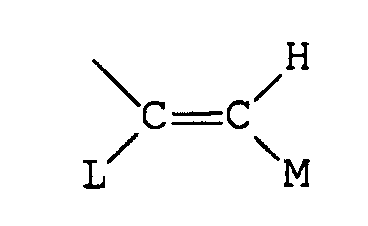 (e) B und B' zusammengenommen Fluoren-9-yliden, mono- oder disubstituiertes Fluoren-9-ylidene oder ein Mitglied, ausgewählt aus der Gruppe bestehend aus gesättigten C3-C12spiromonocyclischen Kohlenwasserstoffringen, gesättigten C4-C12-spirobicyclischen Kohlenwasserstoffringen und gesättigten C7-C12-spirotricyclischen Kohlenwasserstoffringen, bilden, wobei jeder dieser Substituenten des Fluoren-9-ylidens ausgewählt ist aus der Gruppe bestehend aus C1-C4-Alkyl, C1-C4-Alkoxy und Halogen.
 - Naphthopyran nach Anspruch 1, worin:(a) R1 gleich C3-C10-Cycloalkyl, mono(C1-C3)alkylsubstituiertes C3-C10-Cycloalkyl, mono(C1-C3)alkoxysubstituiertes C3-C10-Cycloalkyl, Chlor(C3-C10)cycloalkyl, Fluor(C1-C3)cycloalkyl, C4-C10-Bicycloalkyl oder C7-C10-Tricycloalkyl ist,(b) R2 gleich Wasserstoff, C1-C3-Alkyl, C3-C5-Cycloalkyl, Phenyl, mono- oder disubstituiertes Phenyl oder -OR4 ist, worin R4 gleich Wasserstoff, C1-C3-Alkyl oder die Gruppe -CH(R5)X ist, worin X gleich CN oder -C(O)W ist, worin W gleich -OR9 oder -N(R10)R11 ist, R5 gleich Wasserstoff oder Methyl ist, R9 gleich Wasserstoff, C1-C4-Alkyl, Phenyl, mono(C1-C4)alkylsubstituiertes Phenyl, mono(C1-C4)alkoxysubstituiertes Phenyl, Phenyl(C1-C2)alkyl, mono(C1-C4)-al kyl substituiertes Phenyl(C1-C2)alkyl, Mono(C1-C4)-alkoxy(C2-C3)alkyl, C1-C4-Halogenalkyl oder R1 ist und R10 und R11 jeweils ausgewählt sind aus der Gruppe bestehend aus Wasserstoff, C1-C4-Alkyl, C5-C7-Cycloalkyl, Phenyl, monosubstituiertem Phenyl und disubstituiertem Phenyl, oder R4 die Gruppe -C(O)Y ist, worin Y gleich C1-C3-Alkyl oder C1-C3-Alkoxy ist, wobei diese Substituenten des Phenyls C1-C3-Alkyl oder C1-C3-Alkoxy sind und dieses Halogen Chlor oder Fluor ist,(c) jedes R3 gleich Wasserstoff, C1-C4-Alkyl, C3-C10-Cycloalky, Phenyl, mono- oder disubstituiertes Phenyl ist, wobei diese Substituenten des Phenyls C1-C3-Alkyl oder C1-C3-Alkoxy sind und n die ganze Zahl 0, 1 oder 2 ist,(d) B und B' jeweils ausgewählt sind aus der Gruppe bestehend aus:(i) Phenyl, monosubstituiertem und disubstituiertem Phenyl,(ii) den unsubstituierten, mono- und disubstituierten heteroaromatischen Gruppen Furanyl, Benzofuran-2-yl, Thienyl, Benzothien-2-yl, Dibenzofuran-2-yl und Dibenzothien-2-yl, wobei jeder dieser Substituenten der Phenyl- und heteroaromatischen Gruppen in (d)(i) und (ii) ausgewählt ist aus der Gruppe bestehend aus Hydroxy, Aryl, Aryloxy, Aryl(C1-C3)alkyl, Amino, Mono(C1-C3)alkylamino, Di(C1-C3)alkylamino, N-(C1-C3)-Alkylpiperazino, Indolino, Piperidino, Morpholino, Pyrryl, C1-C3-Alkyl, C1-C3-Chloralkyl, C1-C3-Fluoralkyl, C1-C3-Alkoxy, Mono(C1-C3)alkoxy(C1-C3)-alkyl, Chlor und Fluor,(iii) der Gruppe, die durch die folgende graphische Formel wiedergegeben ist:worin E gleich Methylen ist und G Sauerstoff ist, R6 gleich C1-C3-Alkyl oder C1-C3-Alkoxy ist, R7 und R8 jeweils Wasserstoff oder C1-C4-Alkyl sind und q gleich 0 oder 1 ist,
 (iv) C1-C4-Alkyl und(v) der Gruppe, die durch die folgende graphische Formel wiedergegeben ist:worin L gleich Wasserstoff oder Methyl ist, M gleich Phenyl oder monosubstituiertes Phenyl ist, wobei dieser Phenylsubstituent gleich C1-C3-Alkyl, C1-C3-Alkoxy oder Fluor ist, oder
 (e) B und B' zusammengenommen Fluoren-9-yliden, monosubstituiertes Fluoren-9-yliden oder ein Mitglied, ausgewählt aus der Gruppe bestehend aus gesättigten C3-C8-spiromonocyclischen Kohlenwasserstoffringen, gesättigten C7-C10spirobicyclischen Kohlenwasserstoffringen und gesättigten C7-C10-spirotricyclischen Kohlenwasserstoffringen, bilden, wobei dieser Substituent des Fluoren-9-ylidens ausgewählt ist aus der Gruppe bestehend aus C1-C3-Alkyl, C1-C3-Alkoxy, Fluor und Chlor.
 - Naphthopyran nach Anspruch 2, worin:(a) R1 gleich C3-C1-Cycloalkyl ist,(b) R2 gleich Wasserstoff oder C1-C3-Alkyl ist,(c) R3 gleich Wasserstoff oder C1-C3-Alkyl ist und n die ganze Zahl 0 oder 1 ist,(d) B und B' jeweils ausgewählt sind aus der Gruppe bestehend aus:(i) Phenyl, mono- und disubstituiertem Phenyl,(ii) den unsubstituierten, mono- und disubstituierten heteroaromatischen Gruppen Furanyl, Benzofuran-2-yl, Thienyl und Benzothien-2-yl, wobei jeder dieser Substituenten der Phenyl- and heteroaromatischen Gruppen in (d)(i) und (ii) ausgewählt ist aus der Gruppe bestehend aus Hydroxy, C1-C3-Alkyl, C1-C3-Alkoxy, Phenyl, Indolino, Fluor und Chlor,(iii) der Gruppe, die durch die folgende grafische Formel wiedergegeben ist:worin E gleich Methylen ist und G gleich Sauerstoff ist, R6 gleich C1-C3-Alkyl oder C1-C3-Alkoxy ist, R7 und R8 jeweils gleich Wasserstoff oder C1-C3-Alkyl sind und q gleich 0 oder 1 ist, oder
 (e) B und B' zusammengenommen Fluoren-9-yliden, Adamantyliden, Bornyliden, Norbornyliden oder Bicyclo[3.3.1]nonan-9-yliden bilden.
 - Naphthopyranverbindung nach einem der vorstehenden Ansprüche, ausgewählt aus der Gruppe bestehend aus:(a) 2,2-Diphenyl-5-cyclohexyloxycarbonyl-8-methyl-[2H]-naphtho[1,2-b]pyran;(b) 2,2-Bis(4-methoxyphenyl)-5-cyclopropyloxycarbonyl-6-methoxy-[2H]-naphtho[1,2-b]pyran;(c) 2,2-Bis(4-methoxyphenyl)-5-cyclooctyloxycarbonyl-6-(ethoxycarbonyl)methoxy-[2H]-naphtho[1,2-b]pyran;(d) 2,2-Bis(4-methylphenyl)-5-cyclohexyloxycarbonyl-6-(methoxycarbonyloxy)-[2H]-naphtho[1,2-b]pyran;(e) 2,2-Diphenyl-5-cyclopropyloxycarbonyl-6-acetoxy-[2H]-naphtho[1,2-b]pyran;(f) 2,2-Bis(4-methoxyphenyl)-5-cyclooctyloxycarbonyl-6-methyl-[2H]-naphtho[1,2-b]pyran;(g) 2,2-Bis(4-methoxyphenyl)-5-cycloheptyloxycarbonyl-6-methyl-9-methoxy-[2H]-naphtho[1,2-b]pyran;(h) 2-(4-Methoxyphenyl)-2-(2-methyl,2,3-dihydrobenzofuran-5-yl)-5-cyclobutyloxycarbonyl-6-(ethoxycarbonyl)methoxy-[2H]-naphtho[1,2-b]pyran;(i) 2-Phenyl-2-(2-dibenzofuryl)-5-cyclohexyloxycarbonyl-8-methyl-[2H]-naphtho[1,2-b]pyran;(j) 2,2-Diphenyl-5-cyclohexyloxycarbonyl-8-methoxy-[2H]-naphtho[1,2-b]pyran;(k) 2-Phenyl-2-(4-methoxyphenyl)-5-cyclohexyloxycarbonyl-8-methoxy-[2H]-naphtho[1,2-b]pyran und(l) 2-Phenyl-2-(4-methylphenyl)-5-cyclohexyloxycarbonyl-8-methoxy-[2H]-naphtho[1.2-b]pyran.
- Photochromer Gegenstand, enthaltend in Kombination ein polymeres organisches Wirtsmaterial und eine photochrome Menge einer Naphthopyranverbindung nach einem der Ansprüche 1-4.
- Photochromer Gegenstand nach Anspruch 5, enthaltend in Kombination eine photochrome Menge von jeweils (a) wenigstens einer Naphthopyranverbindung nach den Ansprüche 1-5 und (b) wenigstens einer anderen photochromen Verbindung mit wenigstens einem aktivierten Absorptionsmaximum innerhalb des Bereichs zwischen 400 und 700 nm.
- Photochromer Gegenstand nach Anspruch 5 oder 6, wobei die Gesamtmenge an photochromer/en Verbindung(en) 0,05 bis 2,0 mg/cm2 an polymerer organischer Wirtsmaterialoberfläche beträgt, auf die die photochrome Substanz(en) eingebracht oder aufgebracht ist(sind).
- Photochromer Gegenstand nach einem der Ansprüche 5-7, wobei das polymere organische Wirtsmaterial ausgewählt ist aus der Gruppe bestehend aus Polyacrylaten, Polymethacrylaten, Poly(C1-C12)alkylmethacrylaten, Polyoxy(alkylenmethacrylaten), poly(alkoxylierten Phenolmethacrylaten), Celluloseacetat, Celluloseriacetat, Celluloseacetatpropionat, Celluloseacetatbutyrat, Poly(vinylacetat), Poly(vinylalkohol), Poly(vinylchlorid), Poly(vinylidenchlorid), thermoplastischen Polycarbonaten, Polyestern, Polyurethanen, Polythiourethanen, Poly(ethylenterephthalat), Polystyrol, Poly(α-methylstyrol), Copoly(styrol-methylmethacrylat), Copoly(styrol-acrylnitril), Polyvinylbutyral und Polymeren der Mitglieder der Gruppe bestehend aus Polyol(allylcarbonat)monomeren, polyfunktionellen Acrylatmonomeren, polyfunktionellen Methacrylatmonomern, Diethylenglykoldimethacrylatmonomeren, Diisopropenylbenzolmonomeren, alkoxylierten mehrwertigen Alkoholmonomeren und Diallylidenpentaerythritolmonomeren.
- Photochromer Gegenstand nach Anspruch 8, wobei das polymere organische Wirtsmaterial ausgewählt ist aus der Gruppe bestehend aus Poly(methylmethacrylat), Poly(ethylenglykolbismethacrylat), poly(ethoxyliertem Bisphenol-A-dimethacrylat), thermoplastischem Polycarbonat, Poly(vinylacetat), Polyvinylbutyral, Polyurethan, Polythiourethan und Polymeren von Mitgliedern der Gruppe bestehend aus Diethylenglykolbis(allylcarbonat)monomeren, Diethylenglykoldimethacrylatmonomeren, ethoxylierten Phenolbismethacrylatmonomeren, Diisopropenylbenzolmonomeren und ethoxylierten Trimethylolpropantriacrylatmonomeren.
- Photochromer Gegenstand nach Anspruch 5, wobei das Wirtsmaterial ein Polymerisat eines optischen organischen Harzmonomers ist.
- Photochromer Gegenstand nach Anspruch 10, wobei der Brechungsindex des Polymerisats ungefähr 1,48 bis ungefähr 1,75 beträgt.
- Photochromer Gegenstand nach einem der Ansprüche 5-11, der ein optisches Element ist.
- Photochromer Gegenstand nach Anspruch 12, wobei dieses optische Element eine Linse ist.
- Photochromer Gegenstand, enthaltend in Kombination ein festes Substrat und auf wenigstens einer Oberfläche davon eine gehärtete Beschichtung einer Beschichtungszusammensetzung mit einer photochromen Menge der Naphthopyranverbindung nach einem der Ansprüche 1-4.
- Photochromer Gegenstand nach Anspruch 14, wobei diese Beschichtungszusammensetzung ausgewählt ist aus der Gruppe bestehend aus einer polymeren Beschichtungszusammensetzung, Farbe und Tinte.
- Photochromer Gegenstand nach Anspruch 15, wobei das Substrat ausgewählt ist aus der Gruppe bestehend aus Glas, Mauerwerk, Textilien, keramischen Werkstoffen, Metallen, Holz, Papier und polymeren organischen Materialien.
Applications Claiming Priority (5)
| Application Number | Priority Date | Filing Date | Title |
|---|---|---|---|
| US17564000P | 2000-01-12 | 2000-01-12 | |
| US175640P | 2000-01-12 | ||
| US09/738,175 US6340766B1 (en) | 2000-01-12 | 2000-12-15 | Substituted napthopyrans |
| US738175 | 2000-12-15 | ||
| PCT/US2001/001141 WO2001051483A1 (en) | 2000-01-12 | 2001-01-12 | Substituted photochromic 2h-naphtho [1,2-b] pyran compounds |
Publications (2)
| Publication Number | Publication Date |
|---|---|
| EP1248778A1 EP1248778A1 (de) | 2002-10-16 |
| EP1248778B1 true EP1248778B1 (de) | 2004-06-16 |
Family
ID=26871421
Family Applications (1)
| Application Number | Title | Priority Date | Filing Date |
|---|---|---|---|
| EP20010942362 Expired - Lifetime EP1248778B1 (de) | 2000-01-12 | 2001-01-12 | Substituierte photochromische 2h-naphtho[1,2-b]pyran verbindungen |
Country Status (9)
| Country | Link |
|---|---|
| US (1) | US6340766B1 (de) |
| EP (1) | EP1248778B1 (de) |
| JP (1) | JP4891509B2 (de) |
| AT (1) | ATE269318T1 (de) |
| AU (1) | AU777540B2 (de) |
| BR (1) | BRPI0107781B8 (de) |
| DE (1) | DE60103847T2 (de) |
| ES (1) | ES2223876T3 (de) |
| WO (1) | WO2001051483A1 (de) |
Cited By (1)
| Publication number | Priority date | Publication date | Assignee | Title |
|---|---|---|---|---|
| US7544315B2 (en) | 2004-10-21 | 2009-06-09 | Rodenstock Gmbh | Photochromic h-annellated benzo[f]chromene compounds |
Families Citing this family (12)
| Publication number | Priority date | Publication date | Assignee | Title |
|---|---|---|---|---|
| US6478989B1 (en) * | 1997-09-19 | 2002-11-12 | Transitions Optical, Inc. | Aromatic substituted naphthopyrans |
| US7306809B2 (en) * | 2002-09-13 | 2007-12-11 | Lipo Chemicals, Inc. | Optically activated particles for use in cosmetic compositions |
| US8698117B2 (en) | 2003-07-01 | 2014-04-15 | Transitions Optical, Inc. | Indeno-fused ring compounds |
| US8518546B2 (en) | 2003-07-01 | 2013-08-27 | Transitions Optical, Inc. | Photochromic compounds and compositions |
| US8211338B2 (en) | 2003-07-01 | 2012-07-03 | Transitions Optical, Inc | Photochromic compounds |
| US8545984B2 (en) | 2003-07-01 | 2013-10-01 | Transitions Optical, Inc. | Photochromic compounds and compositions |
| US9076208B2 (en) * | 2006-02-28 | 2015-07-07 | The Invention Science Fund I, Llc | Imagery processing |
| US8110127B2 (en) | 2008-06-19 | 2012-02-07 | Essilor International (Compagnie Generale D'optique) | Photochromic coating exhibiting improved performance |
| US8691915B2 (en) | 2012-04-23 | 2014-04-08 | Sabic Innovative Plastics Ip B.V. | Copolymers and polymer blends having improved refractive indices |
| JP2022151088A (ja) * | 2021-03-26 | 2022-10-07 | ホヤ レンズ タイランド リミテッド | インデノ縮合ナフトピラン化合物の粒子、重合性組成物の製造方法及びフォトクロミック物品の製造方法 |
| JP7721297B2 (ja) * | 2021-03-26 | 2025-08-12 | ホヤ レンズ タイランド リミテッド | 重合性組成物の製造方法及びフォトクロミック物品の製造方法 |
| WO2023034402A1 (en) | 2021-08-31 | 2023-03-09 | Quadratic 3D, Inc. | Photoinitiators, photohardenable compositions, and methods for forming an object in a volume |
Family Cites Families (30)
| Publication number | Priority date | Publication date | Assignee | Title |
|---|---|---|---|---|
| US3567605A (en) | 1966-03-30 | 1971-03-02 | Ralph S Becker | Photochemical process |
| US3627690A (en) | 1969-10-01 | 1971-12-14 | Itek Corp | Photochromic naphthopyran compositions |
| US4286957A (en) | 1979-01-10 | 1981-09-01 | Essilor International "Cie Generale D'optique" | Process of integrating a photochromic substance into an ophthalmic lens and a photochromic lens of organic material |
| US4880667A (en) | 1985-09-24 | 1989-11-14 | Ppg Industries, Inc. | Photochromic plastic article and method for preparing same |
| US5066818A (en) | 1990-03-07 | 1991-11-19 | Ppg Industries, Inc. | Photochromic naphthopyran compounds |
| US5185390A (en) | 1990-03-07 | 1993-02-09 | Ppg Industries, Inc. | Water strippable photochromic resin composition |
| DE69327410T2 (de) | 1992-09-25 | 2000-05-11 | Ppg Industries Ohio, Inc. | Photochrome zusammensetzungen mit verbesserter lichtermüdungsbeständigkeit |
| US5274132A (en) | 1992-09-30 | 1993-12-28 | Transitions Optical, Inc. | Photochromic naphthopyran compounds |
| US5458814A (en) | 1993-12-09 | 1995-10-17 | Transitions Optical, Inc. | Substituted naphthopyrans |
| US5651923A (en) * | 1993-12-09 | 1997-07-29 | Transitions Optical, Inc. | Substituted naphthopyrans |
| US5650098A (en) | 1993-12-09 | 1997-07-22 | Transitions Optical, Inc. | Substituted naphthopyrans |
| FR2723218A1 (fr) | 1994-07-29 | 1996-02-02 | Essilor Internal Cie Gle Optique | Composes photochromiques de structure spiro (indoline-(2,3')-benzoxazine) a groupement cyano en 6', et leur utilisation dans le domaine de l'optique ophtalmique |
| US5645767A (en) | 1994-11-03 | 1997-07-08 | Transitions Optical, Inc. | Photochromic indeno-fused naphthopyrans |
| JPH08176139A (ja) * | 1994-12-20 | 1996-07-09 | Tokuyama Corp | クロメン化合物 |
| US5658500A (en) | 1995-06-14 | 1997-08-19 | Transitions Optical, Inc. | Substituted naphthopyrans |
| US5656206A (en) | 1995-06-14 | 1997-08-12 | Transitions Optical, Inc. | Substituted naphthopyrans |
| EP1000025B1 (de) * | 1995-10-13 | 2007-02-21 | Transitions Optical, Inc. | Substituierte naphthopyrane |
| US5753146A (en) | 1996-03-29 | 1998-05-19 | Transitions Optical, Inc. | Photochromic naphthopyran compositions of neutral color |
| US5770115A (en) | 1996-04-19 | 1998-06-23 | Ppg Industries, Inc. | Photochromic naphthopyran compositions of improved fatigue resistance |
| US5789015A (en) | 1996-06-26 | 1998-08-04 | Innotech, Inc. | Impregnation of plastic substrates with photochromic additives |
| WO1998004937A1 (en) | 1996-07-25 | 1998-02-05 | Corning Incorporated | Naphthopyrans, compositions and articles containing them |
| GB9706939D0 (en) * | 1997-04-04 | 1997-05-21 | James Robinson Ltd | Red colouring hyperchromic 3H-naptho[2,1-6]pyrans |
| US6211374B1 (en) * | 1997-04-23 | 2001-04-03 | Joseph Thomas Ippoliti | Water soluble, pyran-based photochromic compounds having carboxylate functionality |
| US5975696A (en) | 1997-05-12 | 1999-11-02 | Kohan; George | Process for rendering plastic substrate photochromic |
| EP0926146B1 (de) * | 1997-06-19 | 2003-02-12 | Tokuyama Corporation | Chromenverbindungen |
| US6106744A (en) | 1997-12-03 | 2000-08-22 | Ppg Industries Ohio, Inc. | Photochromic pyrano-fused naphthopyrans |
| JPH11322739A (ja) * | 1998-05-14 | 1999-11-24 | Tokuyama Corp | クロメン化合物 |
| WO2000002883A2 (en) | 1998-07-10 | 2000-01-20 | Transitions Optical, Inc. | Photochromic six-membered heterocyclic-fused naphthopyrans |
| CA2343310C (en) * | 1998-09-11 | 2008-04-15 | Ppg Industries Ohio, Inc. | Polymerizable polyalkoxylated naphthopyrans |
| US6281366B1 (en) * | 2000-02-29 | 2001-08-28 | Essilor International Compagnie Generale D'optique | Photochromic [3H]naphtho[2,1-b]pyran compounds containing an acetylenic substituent, process for their manufacture, and photochromic materials and articles obtained |
-
2000
- 2000-12-15 US US09/738,175 patent/US6340766B1/en not_active Expired - Lifetime
-
2001
- 2001-01-12 JP JP2001551865A patent/JP4891509B2/ja not_active Expired - Fee Related
- 2001-01-12 ES ES01942362T patent/ES2223876T3/es not_active Expired - Lifetime
- 2001-01-12 AT AT01942362T patent/ATE269318T1/de not_active IP Right Cessation
- 2001-01-12 EP EP20010942362 patent/EP1248778B1/de not_active Expired - Lifetime
- 2001-01-12 AU AU29430/01A patent/AU777540B2/en not_active Expired
- 2001-01-12 WO PCT/US2001/001141 patent/WO2001051483A1/en not_active Ceased
- 2001-01-12 BR BRPI0107781 patent/BRPI0107781B8/pt not_active IP Right Cessation
- 2001-01-12 DE DE2001603847 patent/DE60103847T2/de not_active Expired - Lifetime
Cited By (1)
| Publication number | Priority date | Publication date | Assignee | Title |
|---|---|---|---|---|
| US7544315B2 (en) | 2004-10-21 | 2009-06-09 | Rodenstock Gmbh | Photochromic h-annellated benzo[f]chromene compounds |
Also Published As
| Publication number | Publication date |
|---|---|
| BRPI0107781B1 (pt) | 2013-04-24 |
| AU777540B2 (en) | 2004-10-21 |
| DE60103847D1 (de) | 2004-07-22 |
| EP1248778A1 (de) | 2002-10-16 |
| ES2223876T3 (es) | 2005-03-01 |
| US6340766B1 (en) | 2002-01-22 |
| US20020007078A1 (en) | 2002-01-17 |
| DE60103847T2 (de) | 2005-07-07 |
| BRPI0107781B8 (pt) | 2021-07-06 |
| WO2001051483A1 (en) | 2001-07-19 |
| ATE269318T1 (de) | 2004-07-15 |
| JP4891509B2 (ja) | 2012-03-07 |
| JP2003519694A (ja) | 2003-06-24 |
| BRPI0107781A (pt) | 2003-02-11 |
| AU2943001A (en) | 2001-07-24 |
Similar Documents
| Publication | Publication Date | Title |
|---|---|---|
| EP0958514B1 (de) | Neuartige photochrome heterozyklische geschmolzene indenonaphthopyrane | |
| US5651923A (en) | Substituted naphthopyrans | |
| US5458814A (en) | Substituted naphthopyrans | |
| US6022495A (en) | Photochromic benzopyrano-fused naphthopyrans | |
| US5656206A (en) | Substituted naphthopyrans | |
| US5645767A (en) | Photochromic indeno-fused naphthopyrans | |
| EP1360183B1 (de) | Neue photochrome indenonaphthopyranverbindungen | |
| EP1027346B1 (de) | Photochrome, carbocyclisch kondensierte naphthopyranderivate | |
| US5658500A (en) | Substituted naphthopyrans | |
| US5811034A (en) | 7-methylidene-5-oxo-furo fused naphthopyrans | |
| US5891368A (en) | Fluoranthenopyrans | |
| US6340766B1 (en) | Substituted napthopyrans | |
| US6478989B1 (en) | Aromatic substituted naphthopyrans | |
| WO1998055457A1 (en) | Substituted naphthopyrans |
Legal Events
| Date | Code | Title | Description |
|---|---|---|---|
| PUAI | Public reference made under article 153(3) epc to a published international application that has entered the european phase |
Free format text: ORIGINAL CODE: 0009012 |
|
| 17P | Request for examination filed |
Effective date: 20020731 |
|
| AK | Designated contracting states |
Kind code of ref document: A1 Designated state(s): AT BE CH CY DE DK ES FI FR GB GR IE IT LI LU MC NL PT SE TR |
|
| AX | Request for extension of the european patent |
Free format text: AL;LT;LV;MK;RO;SI |
|
| 17Q | First examination report despatched |
Effective date: 20030207 |
|
| GRAP | Despatch of communication of intention to grant a patent |
Free format text: ORIGINAL CODE: EPIDOSNIGR1 |
|
| GRAS | Grant fee paid |
Free format text: ORIGINAL CODE: EPIDOSNIGR3 |
|
| GRAA | (expected) grant |
Free format text: ORIGINAL CODE: 0009210 |
|
| AK | Designated contracting states |
Kind code of ref document: B1 Designated state(s): AT BE CH CY DE DK ES FI FR GB GR IE IT LI LU MC NL PT SE TR |
|
| PG25 | Lapsed in a contracting state [announced via postgrant information from national office to epo] |
Ref country code: FI Free format text: LAPSE BECAUSE OF FAILURE TO SUBMIT A TRANSLATION OF THE DESCRIPTION OR TO PAY THE FEE WITHIN THE PRESCRIBED TIME-LIMIT Effective date: 20040616 Ref country code: NL Free format text: LAPSE BECAUSE OF FAILURE TO SUBMIT A TRANSLATION OF THE DESCRIPTION OR TO PAY THE FEE WITHIN THE PRESCRIBED TIME-LIMIT Effective date: 20040616 Ref country code: TR Free format text: LAPSE BECAUSE OF FAILURE TO SUBMIT A TRANSLATION OF THE DESCRIPTION OR TO PAY THE FEE WITHIN THE PRESCRIBED TIME-LIMIT Effective date: 20040616 Ref country code: AT Free format text: LAPSE BECAUSE OF FAILURE TO SUBMIT A TRANSLATION OF THE DESCRIPTION OR TO PAY THE FEE WITHIN THE PRESCRIBED TIME-LIMIT Effective date: 20040616 Ref country code: BE Free format text: LAPSE BECAUSE OF FAILURE TO SUBMIT A TRANSLATION OF THE DESCRIPTION OR TO PAY THE FEE WITHIN THE PRESCRIBED TIME-LIMIT Effective date: 20040616 Ref country code: LI Free format text: LAPSE BECAUSE OF FAILURE TO SUBMIT A TRANSLATION OF THE DESCRIPTION OR TO PAY THE FEE WITHIN THE PRESCRIBED TIME-LIMIT Effective date: 20040616 Ref country code: CH Free format text: LAPSE BECAUSE OF FAILURE TO SUBMIT A TRANSLATION OF THE DESCRIPTION OR TO PAY THE FEE WITHIN THE PRESCRIBED TIME-LIMIT Effective date: 20040616 |
|
| REG | Reference to a national code |
Ref country code: GB Ref legal event code: FG4D |
|
| REG | Reference to a national code |
Ref country code: CH Ref legal event code: EP |
|
| REF | Corresponds to: |
Ref document number: 60103847 Country of ref document: DE Date of ref document: 20040722 Kind code of ref document: P |
|
| REG | Reference to a national code |
Ref country code: IE Ref legal event code: FG4D |
|
| PG25 | Lapsed in a contracting state [announced via postgrant information from national office to epo] |
Ref country code: DK Free format text: LAPSE BECAUSE OF FAILURE TO SUBMIT A TRANSLATION OF THE DESCRIPTION OR TO PAY THE FEE WITHIN THE PRESCRIBED TIME-LIMIT Effective date: 20040916 Ref country code: SE Free format text: LAPSE BECAUSE OF FAILURE TO SUBMIT A TRANSLATION OF THE DESCRIPTION OR TO PAY THE FEE WITHIN THE PRESCRIBED TIME-LIMIT Effective date: 20040916 Ref country code: GR Free format text: LAPSE BECAUSE OF FAILURE TO SUBMIT A TRANSLATION OF THE DESCRIPTION OR TO PAY THE FEE WITHIN THE PRESCRIBED TIME-LIMIT Effective date: 20040916 |
|
| LTIE | Lt: invalidation of european patent or patent extension |
Effective date: 20040616 |
|
| NLV1 | Nl: lapsed or annulled due to failure to fulfill the requirements of art. 29p and 29m of the patents act | ||
| REG | Reference to a national code |
Ref country code: CH Ref legal event code: PL |
|
| PG25 | Lapsed in a contracting state [announced via postgrant information from national office to epo] |
Ref country code: IE Free format text: LAPSE BECAUSE OF NON-PAYMENT OF DUE FEES Effective date: 20050112 Ref country code: LU Free format text: LAPSE BECAUSE OF NON-PAYMENT OF DUE FEES Effective date: 20050112 Ref country code: CY Free format text: LAPSE BECAUSE OF FAILURE TO SUBMIT A TRANSLATION OF THE DESCRIPTION OR TO PAY THE FEE WITHIN THE PRESCRIBED TIME-LIMIT Effective date: 20050112 |
|
| PG25 | Lapsed in a contracting state [announced via postgrant information from national office to epo] |
Ref country code: MC Free format text: LAPSE BECAUSE OF NON-PAYMENT OF DUE FEES Effective date: 20050131 |
|
| REG | Reference to a national code |
Ref country code: ES Ref legal event code: FG2A Ref document number: 2223876 Country of ref document: ES Kind code of ref document: T3 |
|
| ET | Fr: translation filed | ||
| PLBE | No opposition filed within time limit |
Free format text: ORIGINAL CODE: 0009261 |
|
| STAA | Information on the status of an ep patent application or granted ep patent |
Free format text: STATUS: NO OPPOSITION FILED WITHIN TIME LIMIT |
|
| 26N | No opposition filed |
Effective date: 20050317 |
|
| REG | Reference to a national code |
Ref country code: IE Ref legal event code: MM4A |
|
| REG | Reference to a national code |
Ref country code: FR Ref legal event code: TP |
|
| REG | Reference to a national code |
Ref country code: ES Ref legal event code: PC2A |
|
| PG25 | Lapsed in a contracting state [announced via postgrant information from national office to epo] |
Ref country code: PT Free format text: LAPSE BECAUSE OF NON-PAYMENT OF DUE FEES Effective date: 20041116 |
|
| REG | Reference to a national code |
Ref country code: DE Ref legal event code: R082 Ref document number: 60103847 Country of ref document: DE Representative=s name: FLEISCHER, ENGELS & PARTNER MBB, PATENTANWAELT, DE |
|
| REG | Reference to a national code |
Ref country code: FR Ref legal event code: PLFP Year of fee payment: 16 |
|
| REG | Reference to a national code |
Ref country code: GB Ref legal event code: 732E Free format text: REGISTERED BETWEEN 20160421 AND 20160428 |
|
| REG | Reference to a national code |
Ref country code: FR Ref legal event code: CL Name of requester: TRANSITIONS OPTICAL LIMITED, IE Effective date: 20160729 |
|
| REG | Reference to a national code |
Ref country code: FR Ref legal event code: PLFP Year of fee payment: 17 |
|
| REG | Reference to a national code |
Ref country code: FR Ref legal event code: PLFP Year of fee payment: 18 |
|
| PGFP | Annual fee paid to national office [announced via postgrant information from national office to epo] |
Ref country code: GB Payment date: 20200127 Year of fee payment: 20 Ref country code: ES Payment date: 20200205 Year of fee payment: 20 Ref country code: DE Payment date: 20200129 Year of fee payment: 20 Ref country code: IT Payment date: 20200123 Year of fee payment: 20 |
|
| PGFP | Annual fee paid to national office [announced via postgrant information from national office to epo] |
Ref country code: FR Payment date: 20200127 Year of fee payment: 20 |
|
| REG | Reference to a national code |
Ref country code: DE Ref legal event code: R071 Ref document number: 60103847 Country of ref document: DE |
|
| REG | Reference to a national code |
Ref country code: GB Ref legal event code: PE20 Expiry date: 20210111 |
|
| PG25 | Lapsed in a contracting state [announced via postgrant information from national office to epo] |
Ref country code: GB Free format text: LAPSE BECAUSE OF EXPIRATION OF PROTECTION Effective date: 20210111 |
|
| REG | Reference to a national code |
Ref country code: ES Ref legal event code: FD2A Effective date: 20210806 |
|
| PG25 | Lapsed in a contracting state [announced via postgrant information from national office to epo] |
Ref country code: ES Free format text: LAPSE BECAUSE OF EXPIRATION OF PROTECTION Effective date: 20210113 |