EP1249202B1 - Gerät zur messung von physikalischen eigenschaften von elektrischen körpern - Google Patents
Gerät zur messung von physikalischen eigenschaften von elektrischen körpern Download PDFInfo
- Publication number
- EP1249202B1 EP1249202B1 EP01901426A EP01901426A EP1249202B1 EP 1249202 B1 EP1249202 B1 EP 1249202B1 EP 01901426 A EP01901426 A EP 01901426A EP 01901426 A EP01901426 A EP 01901426A EP 1249202 B1 EP1249202 B1 EP 1249202B1
- Authority
- EP
- European Patent Office
- Prior art keywords
- contacts
- mechanical properties
- section
- elastic body
- contact
- Prior art date
- Legal status (The legal status is an assumption and is not a legal conclusion. Google has not performed a legal analysis and makes no representation as to the accuracy of the status listed.)
- Expired - Lifetime
Links
- 230000000704 physical effect Effects 0.000 title abstract 2
- 230000009471 action Effects 0.000 claims abstract description 30
- 238000012545 processing Methods 0.000 claims abstract description 18
- 239000000523 sample Substances 0.000 claims description 17
- 238000005259 measurement Methods 0.000 abstract description 46
- 210000003491 skin Anatomy 0.000 description 41
- 230000035882 stress Effects 0.000 description 27
- 239000011543 agarose gel Substances 0.000 description 10
- 210000000245 forearm Anatomy 0.000 description 8
- 229920002379 silicone rubber Polymers 0.000 description 8
- 239000004945 silicone rubber Substances 0.000 description 8
- 230000037373 wrinkle formation Effects 0.000 description 8
- 230000032683 aging Effects 0.000 description 7
- 230000037303 wrinkles Effects 0.000 description 7
- 229920001296 polysiloxane Polymers 0.000 description 5
- 206010051246 Photodermatosis Diseases 0.000 description 4
- 230000008859 change Effects 0.000 description 4
- 238000012423 maintenance Methods 0.000 description 4
- 230000008845 photoaging Effects 0.000 description 4
- 102000008186 Collagen Human genes 0.000 description 3
- 108010035532 Collagen Proteins 0.000 description 3
- 229920001436 collagen Polymers 0.000 description 3
- 230000008602 contraction Effects 0.000 description 3
- 238000011156 evaluation Methods 0.000 description 3
- 239000000835 fiber Substances 0.000 description 3
- 230000002265 prevention Effects 0.000 description 3
- 238000004458 analytical method Methods 0.000 description 2
- 230000003247 decreasing effect Effects 0.000 description 2
- 239000002184 metal Substances 0.000 description 2
- 230000009467 reduction Effects 0.000 description 2
- 230000001464 adherent effect Effects 0.000 description 1
- 239000000853 adhesive Substances 0.000 description 1
- 230000001070 adhesive effect Effects 0.000 description 1
- 238000013459 approach Methods 0.000 description 1
- 210000004207 dermis Anatomy 0.000 description 1
- 230000000694 effects Effects 0.000 description 1
- 230000001815 facial effect Effects 0.000 description 1
- 238000010191 image analysis Methods 0.000 description 1
- 238000012544 monitoring process Methods 0.000 description 1
- 238000007427 paired t-test Methods 0.000 description 1
- 238000011160 research Methods 0.000 description 1
- 230000004044 response Effects 0.000 description 1
- 230000008685 targeting Effects 0.000 description 1
- 238000012360 testing method Methods 0.000 description 1
- 239000011345 viscous material Substances 0.000 description 1
- 210000000707 wrist Anatomy 0.000 description 1
Images



Classifications
-
- A—HUMAN NECESSITIES
- A61—MEDICAL OR VETERINARY SCIENCE; HYGIENE
- A61B—DIAGNOSIS; SURGERY; IDENTIFICATION
- A61B5/00—Measuring for diagnostic purposes; Identification of persons
- A61B5/0048—Detecting, measuring or recording by applying mechanical forces or stimuli
- A61B5/0053—Detecting, measuring or recording by applying mechanical forces or stimuli by applying pressure, e.g. compression, indentation, palpation, grasping, gauging
-
- A—HUMAN NECESSITIES
- A61—MEDICAL OR VETERINARY SCIENCE; HYGIENE
- A61B—DIAGNOSIS; SURGERY; IDENTIFICATION
- A61B5/00—Measuring for diagnostic purposes; Identification of persons
- A61B5/44—Detecting, measuring or recording for evaluating the integumentary system, e.g. skin, hair or nails
- A61B5/441—Skin evaluation, e.g. for skin disorder diagnosis
- A61B5/442—Evaluating skin mechanical properties, e.g. elasticity, hardness, texture, wrinkle assessment
-
- G—PHYSICS
- G01—MEASURING; TESTING
- G01N—INVESTIGATING OR ANALYSING MATERIALS BY DETERMINING THEIR CHEMICAL OR PHYSICAL PROPERTIES
- G01N3/00—Investigating strength properties of solid materials by application of mechanical stress
Definitions
- the present invention relates to a device for appropriately measuring mechanical properties of elastic bodies such as mechanical properties of a skin.
- a device for measuring mechanical properties of elastic bodies such as a skin there are known devices, such as a so-called Cutometer for bringing an adherent probe into close contact with the skin and sucking and exhausting a gas therefrom to measure a degree of deformation of the surface of the skin caused thereby, and a Twistometer for rotating a contact on a surface of the skin to measure a stress generated from the skin side in response to the rotation.
- a force applied to the skin by these devices is not a force applied to the skin in a daily life.
- Document DE 197 19 336 A1 discloses a device measuring the extending ability, with features according to the prEamble of claim 1.
- the inventors have found that a collagen fiber structure exists in dermis of the skin and, therefore, there is a significant difference of mechanical properties according to directions. Therefore, meaningful mechanical property values cannot be measured in the skin unless directivity of measurement is controlled strictly. Moreover, the extensometer for pulling the skin to measure its extending ability is not regarded as an optimum machine for measuring mechanical properties in examining relationship between mechanical properties and wrinkle formation.
- the present invention has been devised under such circumstances, and it is an object of the present invention to provide a device for measuring mechanical properties of elastic bodies that is capable of strictly controlling a direction of measurement and measuring mechanical properties or the like that are more related to wrinkle formation on a surface of an elastic body such as a skin.
- the inventors concentrated their efforts on researches and, as a result, found that such measurement is possible by using a device for measuring mechanical properties of elastic bodies that is capable of analyzing deformation of the skin due to an external force imitating a force that a facial skin of a human is actually subjected to in a daily life, that is, measuring and analyzing a stress of the skin when the skin is contracted. That is, the present invention relates to the following technology.
- the device for measuring mechanical properties of elastic bodies of the present invention is characterized by having at least two contacts, at least one of which is movable. This is because a distance between the contacts is changed, whereby an elastic body on which the contacts are placed is deformed and a change in a stress caused in accordance with the deformation shows characteristics of mechanical properties of the elastic body.
- one of the contacts may be stationary and the other may be movable or both of the contacts may be movable. In the case in which both the contacts are movable, analysis of a change in a stress becomes more complicated than the former case.
- a device having three or more contacts to measure and analyze a change in a stress with respect to a more complicated deformation pattern also belongs to the technical scope of the device for measuring mechanical properties of elastic bodies of the present invention.
- both the movable and unmovable contacts are preferably fixed on the elastic body by adhesive or a viscous material during measurement.
- the contacts can be used with their contacting parts made in a shape having a large coefficient of friction instead of being fixed if evaluation of sliding resistance on the elastic body is taken into account.
- the device for measuring mechanical properties of elastic bodies of the present invention has a drive section.
- the drive section functions as a power source for moving the above-described movable contact.
- a motor or the like can be preferably mentioned.
- rotational motion generated by a motor is converted to linear motion by a cam, a pulley and the like to cause the movable contact to move linearly.
- An amount of movement of the movable contact driven by the drive section is monitored according to motion characteristics of a movable portion such as position coordinates and the number of rotations of the contact.
- Kinetic energy generated by the drive section causes the contact to move, for example, linearly.
- Such movement is controlled by a control section. This is because the surface of the elastic body may be destroyed if an excessive amount of movement is applied to the contact or reliability of a measurement value may be damaged if motion control is not performed properly.
- Such control is preferably performed based on results of the above-described monitoring of an amount of movement.
- control is managed by a computer or the like and becomes means for specifying a motion pattern (action) of the movable contact.
- a computer a commercially available personal computer can be used.
- the motion pattern of the movable contact in the device for measuring mechanical properties of the present invention is set such that the action of the contact making contact with the surface of the elastic body includes a closing action of the two of the contacts and a stationarily holding action after the closing action.
- a motion pattern is used in which a basic cycle consisting of the closing action for reducing a distance between the contacts, the stationarily holding action for maintaining the distance between the contacts and a restoring action for restoring the distance between the contacts is repeated, and the motion pattern is analyzed based on a measurement value obtained in the last cycle.
- An initial value of the distance between the contacts and its reducing value and reducing speed are properly selected according to a type of an elastic body. In the case of a skin, the initial value, the reducing value and the reducing speed are usually selected from the ranges of 3 to 10 mm, 0.5 to 5 mm and 0.5 to 2 mm/sec, respectively.
- the number of cycles is usually one to five.
- a detecting section of the device for measuring mechanical properties of elastic bodies of the present invention detects a stress derived from an elastic body which is caused by movement of the movable contact.
- the stress detected in this way is transmitted to a processing section discussed bellow as an electric signal.
- the stress generated by the movement of the movable contact indicates mechanical properties of the surface of the elastic body and is detected as a numerical value on which various mechanical properties of a elasticity value are reflected according to a motion pattern of the movable contact.
- the above-described contacts, drive section and detecting section preferably constitute a probe as one unit for convenience of use.
- a probe preferably has a structure in which its position is fixed during measurement.
- position fixing means the probe is preferably attached to an end of a so-called arm which has a metal framework and a spring portion and whose position can be fixed and aligned.
- a position and a direction of the contact can be changed freely and mechanical properties of the elastic body can be measured in an arbitrary direction with respect to the surface of the elastic body.
- Such easiness of deformation of the arm should be lower than the movability of the contact.
- the guard ring examples include a guard ring of a square cylinder shape and a guard ring of a double cylindrical shape, wherein an inner cylinder can slide inside an outer cylinder and the inner cylinder is energized by a spring to protrude more than the outer cylinder.
- a part contacting the elastic body may be coated with silicone for slip prevention.
- a processing section of the device for measuring mechanical properties of elastic bodies of the present invention is a part for processing an amount of movement of the movable contact and a stress generated by the movement of the movable contact.
- a usual personal computer may be used as the processing section and a special-purpose program may be prepared for the processing.
- the amount of movement (or position coordinates of the movable contact) can be plotted on the X-axis and the stress can be plotted on the Y-axis utilizing, for example, a spreadsheet software such as Excel manufactured by Microsoft Corporation. When such plotting is performed on a graph, a characteristic pattern can be obtained for each elastic body.
- the obtained pattern may be analyzed as a whole or a part of the pattern may be analyzed as parameters.
- the device for measuring mechanical property of elastic bodies of the present invention preferably has a display section for displaying data processed by the processing section.
- the display section is, for example, a display.
- mechanical properties in a form of a combination of mechanical properties attributable to a surface itself of an elastic body and mechanical properties attributable to an inner structure of the elastic body can be measured.
- properties reflected on such mechanical properties include a loss of elasticity due to aging, a change in accordance with photoaging, properties relating to wrinkle formation and the like.
- Fig. 5 A specific example of the device for measuring mechanical properties of elastic bodies of the present invention will be described with reference to Fig. 5.
- Contacts are comprised of arms 2 having silicone members 1 for slip prevention at their ends.
- Strain gauges 3 are attached to probe sides of the arms 2 as detecting sections.
- One of the arms 2 is made movable by a stepper motor 4 functioning as a drive section.
- Electric signals from the strain gauges 3 are amplified by a strain amplifier 6 and inputted in a computer 8 functioning as a processing section through a stress signal regulator 7.
- the stepper motor 4 is controlled by a motor controller 5 functioning as a control section based on a control signal from the computer 8. An amount of movement of the contact is calculated by the computer 8 from the control signal to the motor controller 5.
- data processed by the computer 8 are displayed on a display 9.
- operations are applied to the skin such that the silicone members 1 at the ends of the contacts make contact with the skin and a distance between the arms 2 is reduced and restored by the stepper motor 4 controlled by the motor controller 5, whereby the skin is contracted and restored.
- An amount of movement of the arms 2 and a force from the skin applied to the arms 2 at this time are inputted in the computer 8 and mechanical properties are measured.
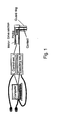
- a device for measuring mechanical properties of elastic bodies shown in Fig. 1 is provided with a probe having one movable contact and one stationary contact and also having a motor (drive section) for driving the movable contact, a control section for controlling forward movement, backward movement and stop of the contact and a detecting section for detecting a stress applied to the contact and, moreover, is provided with a personal computer functioning as a processing section for transmitting a control signal of movement to the control section in accordance with a program, converting this control signal into a position coordinate (X coordinate) and capturing the detected stress as a Y coordinate.
- a personal computer functioning as a processing section for transmitting a control signal of movement to the control section in accordance with a program, converting this control signal into a position coordinate (X coordinate) and capturing the detected stress as a Y coordinate.
- the two contacts are initially set in positions 4 mm apart from each other and the movable contact approaches the unmovable contact by 1 mm in one second. Thereafter, the movable contact keeps this position for five seconds and returns to the original position 4 mm apart from the unmovable contact in one second.
- the computer is programmed to repeat this work five times.
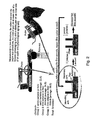
- Positions of a probe and patterns of a stress were measured in a central part on an outer side of an upper arm (photoaging site) and a central part on an inner side of a forearm (physiological aging site) with respect to seven subjects in their twenties, five subjects in their thirtieth and five subjects in their fiftieth using the device of Embodiment 1 and in accordance with a protocol shown in Fig. 2.
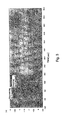
- An example of a pattern of a graph in such measurement is shown in Fig. 3.
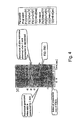
- Parameters shown in Fig. 4 were calculated from coordinates of each site of this pattern. When relationships among these parameters, measured sites and ages were checked, results shown in Table 1 were obtained.
- a measurement device of this embodiment will be described with reference to Fig. 5.
- Contacts are constituted by arms 2 having silicone members 1 for slip prevention at their ends.
- Strain gauges 3 are attached to probe sides of the arms 2 as detecting sections.
- One of the arms 2 is made movable by a stepper motor 4 functioning as a drive section.
- Electric signals from the strain gauges 3 are amplified by a strain amplifier 6 and inputted in a computer 8 functioning as a processing section through a stress signal regulator 7.
- the stepper motor 4 is controlled by a motor controller 5 functioning as a control section based on a control signal from the computer 8.
- An amount of movement of the contact is calculated by the computer 8 from the control signal to the motor controller 5.
- data processed by the computer 8 are displayed on a display 9.
- a guard ring (which is made of metal and has a square shape with one side being 33 mm and a width of 10 mm) is provided around the contacts in order to minimize influence by portions outside the measurement area.
- Motion pattern of the movable contact is the following:
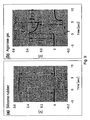
- Silicone rubber was measured as a highly elastic sample and agarose gel was measured as a sample having viscoelasticity using the above-described device.
- An example of measurement results is shown in Fig. 6.
- Fmax(V) in Fig. 6 maximum stress at the time of skin contraction
- Fv(V) in Fig. 6 attenuation of a stress observed in step 2
- Fv is considered to be a parameter relating to viscoelasticity.
- Fmax increases dependently on hardness of the silicone rubber or concentration of the agarose gel. Therefore, Fmax is considered to be a parameter relating to hardness.
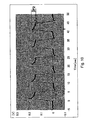
- Silicone rubber was measured as a highly elastic sample and agarose gel was measured as a sample having viscoelasticity using the above-described device.
- An example of measurement results is shown in Fig. 9.
- a maximum stress at the time of skin contraction F1(V) in Fig. 9
- a maximum value of a stress attenuating at the time of maintenance of the distance F2(V) in Fig. 9
- a maximum value of a stress decreasing at the time of releasing contraction F3(V) in Fig. 9
- F2 observed in the agarose gel was hardly observed in the silicone rubber. Therefore, F2 and T calculated based on F2 are considered to be parameters relating to viscoelasticity.
- F1 and F3 increase dependently on hardness of the silicone rubber or concentration of the agarose gel. Therefore, F1 and F3 are considered to be parameters relating to hardness.
- the above-described device for measuring mechanical properties of elastic bodies of the present invention has the following effects.
Landscapes
- Health & Medical Sciences (AREA)
- Life Sciences & Earth Sciences (AREA)
- Physics & Mathematics (AREA)
- General Health & Medical Sciences (AREA)
- Pathology (AREA)
- Biomedical Technology (AREA)
- Engineering & Computer Science (AREA)
- Heart & Thoracic Surgery (AREA)
- Medical Informatics (AREA)
- Molecular Biology (AREA)
- Surgery (AREA)
- Animal Behavior & Ethology (AREA)
- Biophysics (AREA)
- Public Health (AREA)
- Veterinary Medicine (AREA)
- Analytical Chemistry (AREA)
- Chemical & Material Sciences (AREA)
- Biochemistry (AREA)
- General Physics & Mathematics (AREA)
- Immunology (AREA)
- Dermatology (AREA)
- Investigating Strength Of Materials By Application Of Mechanical Stress (AREA)
- Measurement Of The Respiration, Hearing Ability, Form, And Blood Characteristics Of Living Organisms (AREA)
- Measuring And Recording Apparatus For Diagnosis (AREA)
- Investigating Or Analyzing Materials By The Use Of Electric Means (AREA)
- Measurement Of Length, Angles, Or The Like Using Electric Or Magnetic Means (AREA)
- Geophysics And Detection Of Objects (AREA)
Claims (6)
- Vorrichtung zum Messen von mechanischen Eigenschaften eines elastischen Körpers, umfassend:mindestens zwei Kontakte (1, 2), die dazu geeignet sind, eine Oberfläche eines zu vermessenden elastischen Körpers zu kontaktieren, wobei mindestens einer der Kontakte ein beweglicher Kontakt ist,eine Antriebseinheit (4) zum Bewegen des beweglichen Kontakts,eine Steuereinheit (5) zum Steuern einer Tätigkeit der Antriebseinheit,eine Detektionseinheit (6) zum Detektieren einer durch die Bewegung des Kontakts hervorgerufenen Spannung in Form eines elektrischen Signals undeine Verarbeitungseinheit (7, 8) zum Verarbeiten des elektrischen Signals für die Spannung, die durch die Detektionseinheit detektiert wird, und zum Verarbeiten eines Ausmaßes der Bewegung des beweglichen Kontakts,dadurch gekennzeichnet, dass die Bewegung der Kontakte, die die Oberfläche des elastischen Körpers kontaktieren, eine Schließbewegung der zwei Kontakte und eine auf die Schließbewegung folgende stationäre Haltetätigkeit umfasst.
- Vorrichtung zum Messen von mechanischen Eigenschaften elastischer Körper nach Anspruch 1, wobei die Vorrichtung ferner eine Anzeigeeinheit (9) zum Anzeigen von durch die Verarbeitungseinheit verarbeiteten Daten aufweist.
- Vorrichtung zum Messen von mechanischen Eigenschaften elastischer Körper nach Anspruch 1 oder 2, wobei der zu vermessende elastische Körper eine Haut ist.
- Vorrichtung zum Messen von mechanischen Eigenschaften elastischer Körper nach einem der Ansprüche 1 bis 3, wobei ein Messfühler die Kontakte (1, 2), die Antriebseinheit (4) und die Detektionseinheit (3) aufweist, und wobei die Vorrichtung einen Auslegerabschnitt zum Halten des Messfühlers in einer Position aufweist.
- Vorrichtung zum Messen von mechanischen Eigenschaften elastischer Körper nach einem der Ansprüche 1 bis 4, wobei die Vorrichtung eine Halteeinheit zum Halten des zu vermessenden elastischen Körpers aufweist.
- Vorrichtung zum Messen von mechanischen Eigenschaften elastischer Körper nach einem der Ansprüche 1 bis 5, wobei die Kontakte (2) an der Oberfläche des elastischen Körpers festgelegt sind.
Applications Claiming Priority (3)
| Application Number | Priority Date | Filing Date | Title |
|---|---|---|---|
| JP2000009671 | 2000-01-19 | ||
| JP2000009671 | 2000-01-19 | ||
| PCT/JP2001/000304 WO2001052724A1 (fr) | 2000-01-19 | 2001-01-18 | Dispositif de mesure des proprietes physiques de corps elastiques |
Publications (3)
| Publication Number | Publication Date |
|---|---|
| EP1249202A1 EP1249202A1 (de) | 2002-10-16 |
| EP1249202A4 EP1249202A4 (de) | 2005-06-22 |
| EP1249202B1 true EP1249202B1 (de) | 2006-05-03 |
Family
ID=18537789
Family Applications (1)
| Application Number | Title | Priority Date | Filing Date |
|---|---|---|---|
| EP01901426A Expired - Lifetime EP1249202B1 (de) | 2000-01-19 | 2001-01-18 | Gerät zur messung von physikalischen eigenschaften von elektrischen körpern |
Country Status (10)
| Country | Link |
|---|---|
| US (1) | US6786100B2 (de) |
| EP (1) | EP1249202B1 (de) |
| JP (1) | JP3939984B2 (de) |
| KR (1) | KR100729161B1 (de) |
| AT (1) | ATE324829T1 (de) |
| AU (1) | AU2001227062A1 (de) |
| CA (1) | CA2397100A1 (de) |
| DE (1) | DE60119284T2 (de) |
| DK (1) | DK1249202T3 (de) |
| WO (1) | WO2001052724A1 (de) |
Families Citing this family (14)
| Publication number | Priority date | Publication date | Assignee | Title |
|---|---|---|---|---|
| FR2858206B1 (fr) * | 2003-07-28 | 2006-04-14 | Fabre Pierre Dermo Cosmetique | Extensiometre de la peau |
| JP2009500065A (ja) * | 2005-06-30 | 2009-01-08 | ナショナル ユニヴァーシティ オブ シンガポール | 皮膚の生体内生体力学特性を測定するための装置及び方法 |
| US7784150B2 (en) * | 2007-04-06 | 2010-08-31 | Standard Car Truck Company | Railroad car door pivot assembly |
| US8161826B1 (en) * | 2009-03-05 | 2012-04-24 | Stryker Corporation | Elastically stretchable fabric force sensor arrays and methods of making |
| US9668691B2 (en) * | 2011-09-22 | 2017-06-06 | Lvmh Recherche | Method to measure skin elasticity and firmness |
| AU2013211903A1 (en) * | 2012-01-27 | 2014-08-21 | Revance Therapeutics, Inc. | Methods and assessment scales for measuring wrinkle severity |
| DE102013006209A1 (de) * | 2013-04-10 | 2014-10-16 | Universität Heidelberg | Vorrichtung und Verfahren zur Induktion von nichtgewebeschädigenden Reizen zum Testen einer mechanisch induzierten Schmerzempfindung eines Probanden |
| JP6550642B2 (ja) * | 2014-06-09 | 2019-07-31 | パナソニックIpマネジメント株式会社 | 皺検出装置および皺検出方法 |
| US10199962B2 (en) | 2015-03-18 | 2019-02-05 | Johnson Controls Technology Company | Plug and play universal input actuator |
| BR112019002398A2 (pt) * | 2016-08-09 | 2019-06-04 | Koninklijke Philips Nv | dispositivo, sistema para determinação da elasticidade da pele, e método para determinar a elasticidade de pele da pele com um dispositivo ou sistema |
| US12484837B2 (en) | 2018-05-11 | 2025-12-02 | Carruthers Instruments Inc. | Skin torsionometer |
| JP7356927B2 (ja) * | 2019-02-12 | 2023-10-05 | ポーラ化成工業株式会社 | 肌解析方法、肌解析システム及び肌解析プログラム |
| JP7321951B2 (ja) * | 2019-03-01 | 2023-08-07 | ポーラ化成工業株式会社 | 肌解析方法、肌解析システム及び肌解析プログラム |
| WO2021130998A1 (ja) * | 2019-12-26 | 2021-07-01 | 株式会社 資生堂 | 皮膚特性検出システム及び皮膚特性検出方法 |
Family Cites Families (10)
| Publication number | Priority date | Publication date | Assignee | Title |
|---|---|---|---|---|
| JPS61181438A (ja) | 1985-02-08 | 1986-08-14 | 株式会社資生堂 | 皮膚の粘弾性測定方法及び装置 |
| JPS61181436A (ja) * | 1985-02-08 | 1986-08-14 | 株式会社資生堂 | 皮膚の粘弾性測定方法及び装置 |
| JPH01115342A (ja) * | 1987-10-29 | 1989-05-08 | Shiseido Co Ltd | 皮膚のかたさ及びハリの測定表示方法 |
| US5123284A (en) * | 1990-09-26 | 1992-06-23 | Edinburgh John D | Method and apparatus for mesurement of tension in an elastic surface |
| DE9202914U1 (de) * | 1992-03-05 | 1992-09-24 | Jäger, H., Dipl.-Ing. | Gerät zur richtungsspezifischen Messung der Hautelastizität in vivo |
| DE4209314C1 (de) * | 1992-03-23 | 1993-02-11 | Fagus-Grecon Greten Gmbh & Co Kg, 3220 Alfeld, De | |
| US5571973A (en) * | 1994-06-06 | 1996-11-05 | Taylot; Geoffrey L. | Multi-directional piezoresistive shear and normal force sensors for hospital mattresses and seat cushions |
| JPH09202914A (ja) * | 1996-01-25 | 1997-08-05 | Sumitomo Metal Ind Ltd | 真空精錬容器耐火物の補修方法 |
| DE19719336A1 (de) * | 1997-05-07 | 1998-11-12 | Beiersdorf Ag | Verfahren und Meßgerät zur in vivo-Messung der elastischen Eigenschaften der Haut |
| WO2001029528A2 (en) * | 1999-10-19 | 2001-04-26 | Benthos, Inc. | Multiple sensor in-line container inspection |
-
2001
- 2001-01-18 AT AT01901426T patent/ATE324829T1/de not_active IP Right Cessation
- 2001-01-18 DK DK01901426T patent/DK1249202T3/da active
- 2001-01-18 KR KR1020027009224A patent/KR100729161B1/ko not_active Expired - Fee Related
- 2001-01-18 DE DE60119284T patent/DE60119284T2/de not_active Expired - Fee Related
- 2001-01-18 JP JP2001552781A patent/JP3939984B2/ja not_active Expired - Lifetime
- 2001-01-18 EP EP01901426A patent/EP1249202B1/de not_active Expired - Lifetime
- 2001-01-18 WO PCT/JP2001/000304 patent/WO2001052724A1/ja not_active Ceased
- 2001-01-18 US US10/182,020 patent/US6786100B2/en not_active Expired - Fee Related
- 2001-01-18 AU AU2001227062A patent/AU2001227062A1/en not_active Abandoned
- 2001-01-18 CA CA002397100A patent/CA2397100A1/en not_active Abandoned
Also Published As
| Publication number | Publication date |
|---|---|
| US20030005781A1 (en) | 2003-01-09 |
| WO2001052724A1 (fr) | 2001-07-26 |
| ATE324829T1 (de) | 2006-06-15 |
| CA2397100A1 (en) | 2001-07-26 |
| JP3939984B2 (ja) | 2007-07-04 |
| US6786100B2 (en) | 2004-09-07 |
| EP1249202A1 (de) | 2002-10-16 |
| DE60119284T2 (de) | 2007-05-10 |
| KR20020077886A (ko) | 2002-10-14 |
| AU2001227062A1 (en) | 2001-07-31 |
| DK1249202T3 (da) | 2006-08-21 |
| DE60119284D1 (de) | 2006-06-08 |
| KR100729161B1 (ko) | 2007-06-19 |
| EP1249202A4 (de) | 2005-06-22 |
Similar Documents
| Publication | Publication Date | Title |
|---|---|---|
| US6786100B2 (en) | Device for measuring physical properties of elastic bodies | |
| US5810005A (en) | Apparatus and method for monitoring intraocular and blood pressure by non-contact contour measurement | |
| US10463276B2 (en) | Nonlinear system identification techniques and devices for discovering dynamic and static tissue properties | |
| US5860934A (en) | Method and device for mechanical imaging of breast | |
| US8326397B2 (en) | Mountable unit for biological signal measurement and biological signal measuring method | |
| EP3566655B1 (de) | Verfahren und vorrichtung zur erfassung eines biomechanischen parameters gemäss ultraschall-elastizitätsmyogramm | |
| Junker et al. | Assessing quality of healing in skin: review of available methods and devices | |
| HK117195A (en) | Method and device for determining the state of health of a living being | |
| US7958775B2 (en) | Triboacoustic probe | |
| JPWO2001052724A1 (ja) | 弾性体の物性の測定装置 | |
| CN106264485A (zh) | 监护系统、体温监测仪及其人体体温数据处理装置 | |
| EP1919356B1 (de) | Verfahren zur messung des feuchtigkeitsgehalts der haut | |
| Kempf et al. | Understanding eye deformation in non-contact tonometry | |
| JPH10262935A (ja) | 動脈系血管周辺組織の押圧変形特性測定方法および装置、ならびに脈診装置 | |
| JP2024175069A (ja) | 皮膚処置システム | |
| KR20260003103A (ko) | 생체 조직 표면의 점탄성을 측정하는 방법 및 장치 | |
| JP3815918B2 (ja) | 繊維状物の力学的特性の測定方法およびそれに用いる装置 | |
| CN106264479A (zh) | 人体体温数据处理方法 | |
| Peng et al. | Proposal of dental demineralization diagnosis with OCT echo based on multiscale entropy analysis | |
| Maurissen et al. | One-year reliability of vibration sensitivity thresholds in human beings | |
| Kaneko et al. | Measurement and analysis of human eye excited by an air pulse | |
| KR100635028B1 (ko) | 정규화된 맥파 신호를 출력하는 맥파 계측 시스템 | |
| CN222870538U (zh) | 超声探头、超声诊断设备及超声内镜 | |
| KR102130309B1 (ko) | 피부 상태 측정 장치 | |
| Tsuchimi et al. | Development of a haptic sensor system for monitoring human skin conditions |
Legal Events
| Date | Code | Title | Description |
|---|---|---|---|
| PUAI | Public reference made under article 153(3) epc to a published international application that has entered the european phase |
Free format text: ORIGINAL CODE: 0009012 |
|
| 17P | Request for examination filed |
Effective date: 20020725 |
|
| AK | Designated contracting states |
Kind code of ref document: A1 Designated state(s): AT BE CH CY DE DK ES FI FR GB GR IE IT LI LU MC NL PT SE TR |
|
| AX | Request for extension of the european patent |
Free format text: AL;LT;LV;MK;RO;SI |
|
| RAP1 | Party data changed (applicant data changed or rights of an application transferred) |
Owner name: POLA CHEMICAL INDUSTRIES INC. |
|
| A4 | Supplementary search report drawn up and despatched |
Effective date: 20050510 |
|
| RIC1 | Information provided on ipc code assigned before grant |
Ipc: 7A 61B 5/103 B Ipc: 7G 01N 3/00 B Ipc: 7A 61B 5/00 A |
|
| GRAP | Despatch of communication of intention to grant a patent |
Free format text: ORIGINAL CODE: EPIDOSNIGR1 |
|
| GRAS | Grant fee paid |
Free format text: ORIGINAL CODE: EPIDOSNIGR3 |
|
| GRAA | (expected) grant |
Free format text: ORIGINAL CODE: 0009210 |
|
| AK | Designated contracting states |
Kind code of ref document: B1 Designated state(s): AT BE CH CY DE DK ES FI FR GB GR IE IT LI LU MC NL PT SE TR |
|
| PG25 | Lapsed in a contracting state [announced via postgrant information from national office to epo] |
Ref country code: LI Free format text: LAPSE BECAUSE OF FAILURE TO SUBMIT A TRANSLATION OF THE DESCRIPTION OR TO PAY THE FEE WITHIN THE PRESCRIBED TIME-LIMIT Effective date: 20060503 Ref country code: IT Free format text: LAPSE BECAUSE OF FAILURE TO SUBMIT A TRANSLATION OF THE DESCRIPTION OR TO PAY THE FEE WITHIN THE PRESCRIBED TIME-LIMIT;WARNING: LAPSES OF ITALIAN PATENTS WITH EFFECTIVE DATE BEFORE 2007 MAY HAVE OCCURRED AT ANY TIME BEFORE 2007. THE CORRECT EFFECTIVE DATE MAY BE DIFFERENT FROM THE ONE RECORDED. Effective date: 20060503 Ref country code: CH Free format text: LAPSE BECAUSE OF FAILURE TO SUBMIT A TRANSLATION OF THE DESCRIPTION OR TO PAY THE FEE WITHIN THE PRESCRIBED TIME-LIMIT Effective date: 20060503 Ref country code: BE Free format text: LAPSE BECAUSE OF FAILURE TO SUBMIT A TRANSLATION OF THE DESCRIPTION OR TO PAY THE FEE WITHIN THE PRESCRIBED TIME-LIMIT Effective date: 20060503 Ref country code: AT Free format text: LAPSE BECAUSE OF FAILURE TO SUBMIT A TRANSLATION OF THE DESCRIPTION OR TO PAY THE FEE WITHIN THE PRESCRIBED TIME-LIMIT Effective date: 20060503 |
|
| REG | Reference to a national code |
Ref country code: GB Ref legal event code: FG4D |
|
| REG | Reference to a national code |
Ref country code: CH Ref legal event code: EP |
|
| REF | Corresponds to: |
Ref document number: 60119284 Country of ref document: DE Date of ref document: 20060608 Kind code of ref document: P |
|
| REG | Reference to a national code |
Ref country code: IE Ref legal event code: FG4D |
|
| PG25 | Lapsed in a contracting state [announced via postgrant information from national office to epo] |
Ref country code: ES Free format text: LAPSE BECAUSE OF FAILURE TO SUBMIT A TRANSLATION OF THE DESCRIPTION OR TO PAY THE FEE WITHIN THE PRESCRIBED TIME-LIMIT Effective date: 20060814 |
|
| REG | Reference to a national code |
Ref country code: DK Ref legal event code: T3 |
|
| REG | Reference to a national code |
Ref country code: SE Ref legal event code: TRGR |
|
| PG25 | Lapsed in a contracting state [announced via postgrant information from national office to epo] |
Ref country code: PT Free format text: LAPSE BECAUSE OF FAILURE TO SUBMIT A TRANSLATION OF THE DESCRIPTION OR TO PAY THE FEE WITHIN THE PRESCRIBED TIME-LIMIT Effective date: 20061003 |
|
| ET | Fr: translation filed | ||
| REG | Reference to a national code |
Ref country code: CH Ref legal event code: PL |
|
| PGFP | Annual fee paid to national office [announced via postgrant information from national office to epo] |
Ref country code: FI Payment date: 20070104 Year of fee payment: 7 |
|
| PGFP | Annual fee paid to national office [announced via postgrant information from national office to epo] |
Ref country code: GB Payment date: 20070112 Year of fee payment: 7 |
|
| PGFP | Annual fee paid to national office [announced via postgrant information from national office to epo] |
Ref country code: SE Payment date: 20070117 Year of fee payment: 7 |
|
| PG25 | Lapsed in a contracting state [announced via postgrant information from national office to epo] |
Ref country code: IE Free format text: LAPSE BECAUSE OF NON-PAYMENT OF DUE FEES Effective date: 20070118 |
|
| PGFP | Annual fee paid to national office [announced via postgrant information from national office to epo] |
Ref country code: DE Payment date: 20070118 Year of fee payment: 7 |
|
| PGFP | Annual fee paid to national office [announced via postgrant information from national office to epo] |
Ref country code: NL Payment date: 20070125 Year of fee payment: 7 Ref country code: DK Payment date: 20070125 Year of fee payment: 7 |
|
| PG25 | Lapsed in a contracting state [announced via postgrant information from national office to epo] |
Ref country code: MC Free format text: LAPSE BECAUSE OF NON-PAYMENT OF DUE FEES Effective date: 20070131 |
|
| PLBE | No opposition filed within time limit |
Free format text: ORIGINAL CODE: 0009261 |
|
| STAA | Information on the status of an ep patent application or granted ep patent |
Free format text: STATUS: NO OPPOSITION FILED WITHIN TIME LIMIT |
|
| 26N | No opposition filed |
Effective date: 20070206 |
|
| PG25 | Lapsed in a contracting state [announced via postgrant information from national office to epo] |
Ref country code: GR Free format text: LAPSE BECAUSE OF FAILURE TO SUBMIT A TRANSLATION OF THE DESCRIPTION OR TO PAY THE FEE WITHIN THE PRESCRIBED TIME-LIMIT Effective date: 20060804 |
|
| PGFP | Annual fee paid to national office [announced via postgrant information from national office to epo] |
Ref country code: FR Payment date: 20061229 Year of fee payment: 7 |
|
| REG | Reference to a national code |
Ref country code: DK Ref legal event code: EBP |
|
| EUG | Se: european patent has lapsed | ||
| GBPC | Gb: european patent ceased through non-payment of renewal fee |
Effective date: 20080118 |
|
| NLV4 | Nl: lapsed or anulled due to non-payment of the annual fee |
Effective date: 20080801 |
|
| PG25 | Lapsed in a contracting state [announced via postgrant information from national office to epo] |
Ref country code: NL Free format text: LAPSE BECAUSE OF NON-PAYMENT OF DUE FEES Effective date: 20080801 Ref country code: FI Free format text: LAPSE BECAUSE OF NON-PAYMENT OF DUE FEES Effective date: 20080118 Ref country code: DE Free format text: LAPSE BECAUSE OF NON-PAYMENT OF DUE FEES Effective date: 20080801 |
|
| REG | Reference to a national code |
Ref country code: FR Ref legal event code: ST Effective date: 20081029 |
|
| PG25 | Lapsed in a contracting state [announced via postgrant information from national office to epo] |
Ref country code: GB Free format text: LAPSE BECAUSE OF NON-PAYMENT OF DUE FEES Effective date: 20080118 |
|
| PG25 | Lapsed in a contracting state [announced via postgrant information from national office to epo] |
Ref country code: SE Free format text: LAPSE BECAUSE OF NON-PAYMENT OF DUE FEES Effective date: 20080119 Ref country code: DK Free format text: LAPSE BECAUSE OF NON-PAYMENT OF DUE FEES Effective date: 20080131 |
|
| PG25 | Lapsed in a contracting state [announced via postgrant information from national office to epo] |
Ref country code: FR Free format text: LAPSE BECAUSE OF NON-PAYMENT OF DUE FEES Effective date: 20080131 |
|
| PG25 | Lapsed in a contracting state [announced via postgrant information from national office to epo] |
Ref country code: LU Free format text: LAPSE BECAUSE OF NON-PAYMENT OF DUE FEES Effective date: 20070118 Ref country code: CY Free format text: LAPSE BECAUSE OF FAILURE TO SUBMIT A TRANSLATION OF THE DESCRIPTION OR TO PAY THE FEE WITHIN THE PRESCRIBED TIME-LIMIT Effective date: 20060503 |
|
| PG25 | Lapsed in a contracting state [announced via postgrant information from national office to epo] |
Ref country code: TR Free format text: LAPSE BECAUSE OF FAILURE TO SUBMIT A TRANSLATION OF THE DESCRIPTION OR TO PAY THE FEE WITHIN THE PRESCRIBED TIME-LIMIT Effective date: 20060503 |