EP1252201B1 - Catalyseur au fer de copolymerisation - Google Patents
Catalyseur au fer de copolymerisation Download PDFInfo
- Publication number
- EP1252201B1 EP1252201B1 EP00984706A EP00984706A EP1252201B1 EP 1252201 B1 EP1252201 B1 EP 1252201B1 EP 00984706 A EP00984706 A EP 00984706A EP 00984706 A EP00984706 A EP 00984706A EP 1252201 B1 EP1252201 B1 EP 1252201B1
- Authority
- EP
- European Patent Office
- Prior art keywords
- radical
- complex
- independently
- process according
- alkyl
- Prior art date
- Legal status (The legal status is an assumption and is not a legal conclusion. Google has not performed a legal analysis and makes no representation as to the accuracy of the status listed.)
- Expired - Lifetime
Links
- -1 Iron olefin Chemical class 0.000 title claims description 81
- XEEYBQQBJWHFJM-UHFFFAOYSA-N iron Substances [Fe] XEEYBQQBJWHFJM-UHFFFAOYSA-N 0.000 title claims description 39
- 229910052742 iron Inorganic materials 0.000 title claims description 11
- 239000003054 catalyst Substances 0.000 title description 35
- JRZJOMJEPLMPRA-UHFFFAOYSA-N olefin Natural products CCCCCCCC=C JRZJOMJEPLMPRA-UHFFFAOYSA-N 0.000 title description 5
- 238000007334 copolymerization reaction Methods 0.000 title description 2
- PXHVJJICTQNCMI-UHFFFAOYSA-N Nickel Chemical compound [Ni] PXHVJJICTQNCMI-UHFFFAOYSA-N 0.000 claims abstract description 30
- 229910052759 nickel Inorganic materials 0.000 claims abstract description 15
- 238000000034 method Methods 0.000 claims description 34
- 239000012190 activator Substances 0.000 claims description 32
- ZOXJGFHDIHLPTG-UHFFFAOYSA-N Boron Chemical compound [B] ZOXJGFHDIHLPTG-UHFFFAOYSA-N 0.000 claims description 27
- 229910052796 boron Inorganic materials 0.000 claims description 27
- 229910052751 metal Inorganic materials 0.000 claims description 23
- 239000002184 metal Substances 0.000 claims description 23
- 238000006116 polymerization reaction Methods 0.000 claims description 23
- 150000001875 compounds Chemical class 0.000 claims description 17
- BTBUEUYNUDRHOZ-UHFFFAOYSA-N Borate Chemical compound [O-]B([O-])[O-] BTBUEUYNUDRHOZ-UHFFFAOYSA-N 0.000 claims description 16
- 239000003446 ligand Substances 0.000 claims description 12
- 150000003254 radicals Chemical class 0.000 claims description 12
- 229910052782 aluminium Inorganic materials 0.000 claims description 11
- 239000004711 α-olefin Substances 0.000 claims description 11
- 125000005843 halogen group Chemical group 0.000 claims description 10
- OLFPYUPGPBITMH-UHFFFAOYSA-N tritylium Chemical compound C1=CC=CC=C1[C+](C=1C=CC=CC=1)C1=CC=CC=C1 OLFPYUPGPBITMH-UHFFFAOYSA-N 0.000 claims description 10
- 150000001336 alkenes Chemical class 0.000 claims description 9
- 125000004432 carbon atom Chemical group C* 0.000 claims description 9
- 125000000041 C6-C10 aryl group Chemical group 0.000 claims description 8
- 125000003118 aryl group Chemical group 0.000 claims description 8
- 229910052801 chlorine Inorganic materials 0.000 claims description 8
- 125000001309 chloro group Chemical group Cl* 0.000 claims description 8
- KWKAKUADMBZCLK-UHFFFAOYSA-N 1-octene Chemical compound CCCCCCC=C KWKAKUADMBZCLK-UHFFFAOYSA-N 0.000 claims description 7
- WKBOTKDWSSQWDR-UHFFFAOYSA-N Bromine atom Chemical group [Br] WKBOTKDWSSQWDR-UHFFFAOYSA-N 0.000 claims description 7
- 229910052763 palladium Inorganic materials 0.000 claims description 7
- 229910052697 platinum Inorganic materials 0.000 claims description 7
- 125000000008 (C1-C10) alkyl group Chemical group 0.000 claims description 6
- XAGFODPZIPBFFR-UHFFFAOYSA-N aluminium Chemical compound [Al] XAGFODPZIPBFFR-UHFFFAOYSA-N 0.000 claims description 6
- 125000004122 cyclic group Chemical group 0.000 claims description 6
- 150000004703 alkoxides Chemical class 0.000 claims description 5
- VOLGAXAGEUPBDM-UHFFFAOYSA-N $l^{1}-oxidanylethane Chemical compound CC[O] VOLGAXAGEUPBDM-UHFFFAOYSA-N 0.000 claims description 4
- QUPDWYMUPZLYJZ-UHFFFAOYSA-N ethyl Chemical compound C[CH2] QUPDWYMUPZLYJZ-UHFFFAOYSA-N 0.000 claims description 4
- 229910052731 fluorine Inorganic materials 0.000 claims description 4
- 125000001153 fluoro group Chemical group F* 0.000 claims description 4
- WCYWZMWISLQXQU-UHFFFAOYSA-N methyl Chemical compound [CH3] WCYWZMWISLQXQU-UHFFFAOYSA-N 0.000 claims description 4
- 239000000203 mixture Substances 0.000 claims description 4
- 125000004178 (C1-C4) alkyl group Chemical group 0.000 claims description 3
- 125000004435 hydrogen atom Chemical group [H]* 0.000 claims description 3
- 125000000999 tert-butyl group Chemical group [H]C([H])([H])C(*)(C([H])([H])[H])C([H])([H])[H] 0.000 claims description 3
- CIUQDSCDWFSTQR-UHFFFAOYSA-N [C]1=CC=CC=C1 Chemical compound [C]1=CC=CC=C1 CIUQDSCDWFSTQR-UHFFFAOYSA-N 0.000 claims description 2
- 229910052740 iodine Inorganic materials 0.000 claims description 2
- OLRJXMHANKMLTD-UHFFFAOYSA-N silyl Chemical compound [SiH3] OLRJXMHANKMLTD-UHFFFAOYSA-N 0.000 claims description 2
- 125000001424 substituent group Chemical group 0.000 claims description 2
- GRVDJDISBSALJP-UHFFFAOYSA-N methyloxidanyl Chemical compound [O]C GRVDJDISBSALJP-UHFFFAOYSA-N 0.000 claims 3
- VEXZGXHMUGYJMC-UHFFFAOYSA-N Hydrochloric acid Chemical group Cl VEXZGXHMUGYJMC-UHFFFAOYSA-N 0.000 claims 2
- 150000001450 anions Chemical class 0.000 claims 1
- QLNAVQRIWDRPHA-UHFFFAOYSA-N iminophosphane Chemical compound P=N QLNAVQRIWDRPHA-UHFFFAOYSA-N 0.000 abstract description 8
- 229920001519 homopolymer Polymers 0.000 abstract description 2
- 229920000089 Cyclic olefin copolymer Polymers 0.000 abstract 1
- YXFVVABEGXRONW-UHFFFAOYSA-N Toluene Chemical compound CC1=CC=CC=C1 YXFVVABEGXRONW-UHFFFAOYSA-N 0.000 description 39
- UHOVQNZJYSORNB-UHFFFAOYSA-N Benzene Chemical compound C1=CC=CC=C1 UHOVQNZJYSORNB-UHFFFAOYSA-N 0.000 description 18
- 239000002904 solvent Substances 0.000 description 15
- 229920000642 polymer Polymers 0.000 description 12
- IMNFDUFMRHMDMM-UHFFFAOYSA-N N-Heptane Chemical compound CCCCCCC IMNFDUFMRHMDMM-UHFFFAOYSA-N 0.000 description 11
- NFHFRUOZVGFOOS-UHFFFAOYSA-N palladium;triphenylphosphane Chemical compound [Pd].C1=CC=CC=C1P(C=1C=CC=CC=1)C1=CC=CC=C1.C1=CC=CC=C1P(C=1C=CC=CC=1)C1=CC=CC=C1.C1=CC=CC=C1P(C=1C=CC=CC=1)C1=CC=CC=C1.C1=CC=CC=C1P(C=1C=CC=CC=1)C1=CC=CC=C1 NFHFRUOZVGFOOS-UHFFFAOYSA-N 0.000 description 11
- 239000000047 product Substances 0.000 description 11
- OKKJLVBELUTLKV-UHFFFAOYSA-N Methanol Chemical compound OC OKKJLVBELUTLKV-UHFFFAOYSA-N 0.000 description 9
- 238000006243 chemical reaction Methods 0.000 description 8
- 239000000178 monomer Substances 0.000 description 7
- BWHDROKFUHTORW-UHFFFAOYSA-N tritert-butylphosphane Chemical compound CC(C)(C)P(C(C)(C)C)C(C)(C)C BWHDROKFUHTORW-UHFFFAOYSA-N 0.000 description 7
- IJGRMHOSHXDMSA-UHFFFAOYSA-N Atomic nitrogen Chemical compound N#N IJGRMHOSHXDMSA-UHFFFAOYSA-N 0.000 description 6
- VGGSQFUCUMXWEO-UHFFFAOYSA-N Ethene Chemical compound C=C VGGSQFUCUMXWEO-UHFFFAOYSA-N 0.000 description 6
- 239000005977 Ethylene Substances 0.000 description 6
- 239000012954 diazonium Substances 0.000 description 6
- IJGRMHOSHXDMSA-UHFFFAOYSA-O diazynium Chemical compound [NH+]#N IJGRMHOSHXDMSA-UHFFFAOYSA-O 0.000 description 6
- VLKZOEOYAKHREP-UHFFFAOYSA-N n-Hexane Chemical compound CCCCCC VLKZOEOYAKHREP-UHFFFAOYSA-N 0.000 description 6
- 229910052757 nitrogen Inorganic materials 0.000 description 6
- 239000002002 slurry Substances 0.000 description 6
- 239000007787 solid Substances 0.000 description 6
- MZRVEZGGRBJDDB-UHFFFAOYSA-N N-Butyllithium Chemical compound [Li]CCCC MZRVEZGGRBJDDB-UHFFFAOYSA-N 0.000 description 5
- 125000004433 nitrogen atom Chemical group N* 0.000 description 5
- VXNZUUAINFGPBY-UHFFFAOYSA-N 1-Butene Chemical compound CCC=C VXNZUUAINFGPBY-UHFFFAOYSA-N 0.000 description 4
- LIKMAJRDDDTEIG-UHFFFAOYSA-N 1-hexene Chemical compound CCCCC=C LIKMAJRDDDTEIG-UHFFFAOYSA-N 0.000 description 4
- 230000002152 alkylating effect Effects 0.000 description 4
- 238000002474 experimental method Methods 0.000 description 4
- 238000010528 free radical solution polymerization reaction Methods 0.000 description 4
- 239000012535 impurity Substances 0.000 description 4
- TVMXDCGIABBOFY-UHFFFAOYSA-N octane Chemical compound CCCCCCCC TVMXDCGIABBOFY-UHFFFAOYSA-N 0.000 description 4
- 238000002360 preparation method Methods 0.000 description 4
- 239000002516 radical scavenger Substances 0.000 description 4
- 238000003756 stirring Methods 0.000 description 4
- OJJVPGJEBAZOIF-UHFFFAOYSA-N (2,3,4,5-tetrafluorophenoxy)boronic acid Chemical compound OB(O)OC1=CC(F)=C(F)C(F)=C1F OJJVPGJEBAZOIF-UHFFFAOYSA-N 0.000 description 3
- FWUHUNUOUDQTFG-UHFFFAOYSA-N (3,4,5-trifluorophenoxy)boronic acid Chemical compound OB(O)OC1=CC(F)=C(F)C(F)=C1 FWUHUNUOUDQTFG-UHFFFAOYSA-N 0.000 description 3
- BNUHTPCULLFDEA-UHFFFAOYSA-N 1,2,2-trifluoroethenoxyboronic acid Chemical compound OB(O)OC(F)=C(F)F BNUHTPCULLFDEA-UHFFFAOYSA-N 0.000 description 3
- PBKONEOXTCPAFI-UHFFFAOYSA-N 1,2,4-trichlorobenzene Chemical compound ClC1=CC=C(Cl)C(Cl)=C1 PBKONEOXTCPAFI-UHFFFAOYSA-N 0.000 description 3
- 229910021576 Iron(III) bromide Inorganic materials 0.000 description 3
- 239000004698 Polyethylene Substances 0.000 description 3
- 125000000217 alkyl group Chemical group 0.000 description 3
- 230000029936 alkylation Effects 0.000 description 3
- 238000005804 alkylation reaction Methods 0.000 description 3
- QVGXLLKOCUKJST-UHFFFAOYSA-N atomic oxygen Chemical compound [O] QVGXLLKOCUKJST-UHFFFAOYSA-N 0.000 description 3
- 229920001577 copolymer Polymers 0.000 description 3
- 239000000706 filtrate Substances 0.000 description 3
- 238000005227 gel permeation chromatography Methods 0.000 description 3
- 238000011065 in-situ storage Methods 0.000 description 3
- 238000002156 mixing Methods 0.000 description 3
- 229910052760 oxygen Inorganic materials 0.000 description 3
- 239000001301 oxygen Substances 0.000 description 3
- 229910052698 phosphorus Inorganic materials 0.000 description 3
- 229920000573 polyethylene Polymers 0.000 description 3
- 230000037048 polymerization activity Effects 0.000 description 3
- 239000011541 reaction mixture Substances 0.000 description 3
- 230000035484 reaction time Effects 0.000 description 3
- 239000000126 substance Substances 0.000 description 3
- FEONEKOZSGPOFN-UHFFFAOYSA-K tribromoiron Chemical compound Br[Fe](Br)Br FEONEKOZSGPOFN-UHFFFAOYSA-K 0.000 description 3
- 229910001868 water Inorganic materials 0.000 description 3
- OUHOZBRDLAZZLQ-UHFFFAOYSA-N (2,3,5,6-tetrafluorophenoxy)boronic acid Chemical compound OB(O)OC1=C(F)C(F)=CC(F)=C1F OUHOZBRDLAZZLQ-UHFFFAOYSA-N 0.000 description 2
- AFFLGGQVNFXPEV-UHFFFAOYSA-N 1-decene Chemical compound CCCCCCCCC=C AFFLGGQVNFXPEV-UHFFFAOYSA-N 0.000 description 2
- XKRFYHLGVUSROY-UHFFFAOYSA-N Argon Chemical compound [Ar] XKRFYHLGVUSROY-UHFFFAOYSA-N 0.000 description 2
- 0 C*C(C1CC1)NC Chemical compound C*C(C1CC1)NC 0.000 description 2
- 239000004215 Carbon black (E152) Substances 0.000 description 2
- XDTMQSROBMDMFD-UHFFFAOYSA-N Cyclohexane Chemical compound C1CCCCC1 XDTMQSROBMDMFD-UHFFFAOYSA-N 0.000 description 2
- OFBQJSOFQDEBGM-UHFFFAOYSA-N Pentane Chemical compound CCCCC OFBQJSOFQDEBGM-UHFFFAOYSA-N 0.000 description 2
- 230000004913 activation Effects 0.000 description 2
- 239000002168 alkylating agent Substances 0.000 description 2
- 229940100198 alkylating agent Drugs 0.000 description 2
- 239000007795 chemical reaction product Substances 0.000 description 2
- 239000007810 chemical reaction solvent Substances 0.000 description 2
- 239000000460 chlorine Substances 0.000 description 2
- 150000004696 coordination complex Chemical class 0.000 description 2
- 150000001993 dienes Chemical class 0.000 description 2
- YNLAOSYQHBDIKW-UHFFFAOYSA-M diethylaluminium chloride Chemical compound CC[Al](Cl)CC YNLAOSYQHBDIKW-UHFFFAOYSA-M 0.000 description 2
- 238000009826 distribution Methods 0.000 description 2
- 229910052736 halogen Inorganic materials 0.000 description 2
- 229930195733 hydrocarbon Natural products 0.000 description 2
- 150000002430 hydrocarbons Chemical class 0.000 description 2
- 230000007062 hydrolysis Effects 0.000 description 2
- 238000006460 hydrolysis reaction Methods 0.000 description 2
- AMXOYNBUYSYVKV-UHFFFAOYSA-M lithium bromide Chemical compound [Li+].[Br-] AMXOYNBUYSYVKV-UHFFFAOYSA-M 0.000 description 2
- KWGKDLIKAYFUFQ-UHFFFAOYSA-M lithium chloride Chemical compound [Li+].[Cl-] KWGKDLIKAYFUFQ-UHFFFAOYSA-M 0.000 description 2
- UAEPNZWRGJTJPN-UHFFFAOYSA-N methylcyclohexane Chemical compound CC1CCCCC1 UAEPNZWRGJTJPN-UHFFFAOYSA-N 0.000 description 2
- YWAKXRMUMFPDSH-UHFFFAOYSA-N pentene Chemical compound CCCC=C YWAKXRMUMFPDSH-UHFFFAOYSA-N 0.000 description 2
- 125000004437 phosphorous atom Chemical group 0.000 description 2
- 238000000746 purification Methods 0.000 description 2
- 229910052723 transition metal Inorganic materials 0.000 description 2
- 150000003624 transition metals Chemical class 0.000 description 2
- IMFACGCPASFAPR-UHFFFAOYSA-N tributylamine Chemical compound CCCCN(CCCC)CCCC IMFACGCPASFAPR-UHFFFAOYSA-N 0.000 description 2
- IMFACGCPASFAPR-UHFFFAOYSA-O tributylazanium Chemical compound CCCC[NH+](CCCC)CCCC IMFACGCPASFAPR-UHFFFAOYSA-O 0.000 description 2
- VOITXYVAKOUIBA-UHFFFAOYSA-N triethylaluminium Chemical compound CC[Al](CC)CC VOITXYVAKOUIBA-UHFFFAOYSA-N 0.000 description 2
- GETQZCLCWQTVFV-UHFFFAOYSA-N trimethylamine Chemical compound CN(C)C GETQZCLCWQTVFV-UHFFFAOYSA-N 0.000 description 2
- XLYOFNOQVPJJNP-UHFFFAOYSA-N water Substances O XLYOFNOQVPJJNP-UHFFFAOYSA-N 0.000 description 2
- RRKODOZNUZCUBN-CCAGOZQPSA-N (1z,3z)-cycloocta-1,3-diene Chemical compound C1CC\C=C/C=C\C1 RRKODOZNUZCUBN-CCAGOZQPSA-N 0.000 description 1
- UFHFLCQGNIYNRP-UHFFFAOYSA-N Hydrogen Chemical compound [H][H] UFHFLCQGNIYNRP-UHFFFAOYSA-N 0.000 description 1
- 229910021578 Iron(III) chloride Inorganic materials 0.000 description 1
- VEJCZWPPVBSIIR-UHFFFAOYSA-N N=[PH2]C[PH2]=N Chemical compound N=[PH2]C[PH2]=N VEJCZWPPVBSIIR-UHFFFAOYSA-N 0.000 description 1
- OAICVXFJPJFONN-UHFFFAOYSA-N Phosphorus Chemical compound [P] OAICVXFJPJFONN-UHFFFAOYSA-N 0.000 description 1
- NINIDFKCEFEMDL-UHFFFAOYSA-N Sulfur Chemical compound [S] NINIDFKCEFEMDL-UHFFFAOYSA-N 0.000 description 1
- 240000004922 Vigna radiata Species 0.000 description 1
- YACGPHWARKLDHJ-UHFFFAOYSA-N [B+2]C(CCC(C1=CC=CC=C1)(C1=CC=CC=C1)C1=CC=CC=C1)C1=CC=CC=C1.CCN(CC)C1=CC=CC=C1 Chemical compound [B+2]C(CCC(C1=CC=CC=C1)(C1=CC=CC=C1)C1=CC=CC=C1)C1=CC=CC=C1.CCN(CC)C1=CC=CC=C1 YACGPHWARKLDHJ-UHFFFAOYSA-N 0.000 description 1
- 238000010521 absorption reaction Methods 0.000 description 1
- 239000002253 acid Substances 0.000 description 1
- 230000002411 adverse Effects 0.000 description 1
- 125000001931 aliphatic group Chemical group 0.000 description 1
- 239000003513 alkali Substances 0.000 description 1
- WYTGDNHDOZPMIW-RCBQFDQVSA-N alstonine Natural products C1=CC2=C3C=CC=CC3=NC2=C2N1C[C@H]1[C@H](C)OC=C(C(=O)OC)[C@H]1C2 WYTGDNHDOZPMIW-RCBQFDQVSA-N 0.000 description 1
- PNEYBMLMFCGWSK-UHFFFAOYSA-N aluminium oxide Inorganic materials [O-2].[O-2].[O-2].[Al+3].[Al+3] PNEYBMLMFCGWSK-UHFFFAOYSA-N 0.000 description 1
- 229910052786 argon Inorganic materials 0.000 description 1
- 150000005840 aryl radicals Chemical class 0.000 description 1
- 239000012298 atmosphere Substances 0.000 description 1
- 230000015572 biosynthetic process Effects 0.000 description 1
- 230000015556 catabolic process Effects 0.000 description 1
- 230000003197 catalytic effect Effects 0.000 description 1
- 150000001768 cations Chemical class 0.000 description 1
- 239000003153 chemical reaction reagent Substances 0.000 description 1
- 150000001805 chlorine compounds Chemical class 0.000 description 1
- 150000004700 cobalt complex Chemical class 0.000 description 1
- 239000013065 commercial product Substances 0.000 description 1
- 239000013078 crystal Substances 0.000 description 1
- 239000002178 crystalline material Substances 0.000 description 1
- 230000003247 decreasing effect Effects 0.000 description 1
- 238000006731 degradation reaction Methods 0.000 description 1
- XBPCUCUWBYBCDP-UHFFFAOYSA-O dicyclohexylazanium Chemical compound C1CCCCC1[NH2+]C1CCCCC1 XBPCUCUWBYBCDP-UHFFFAOYSA-O 0.000 description 1
- GGSUCNLOZRCGPQ-UHFFFAOYSA-O diethyl(phenyl)azanium Chemical compound CC[NH+](CC)C1=CC=CC=C1 GGSUCNLOZRCGPQ-UHFFFAOYSA-O 0.000 description 1
- 238000000113 differential scanning calorimetry Methods 0.000 description 1
- UAOMVDZJSHZZME-UHFFFAOYSA-N diisopropylamine Chemical compound CC(C)NC(C)C UAOMVDZJSHZZME-UHFFFAOYSA-N 0.000 description 1
- 239000003085 diluting agent Substances 0.000 description 1
- 239000000539 dimer Substances 0.000 description 1
- JLTDJTHDQAWBAV-UHFFFAOYSA-O dimethyl(phenyl)azanium Chemical compound C[NH+](C)C1=CC=CC=C1 JLTDJTHDQAWBAV-UHFFFAOYSA-O 0.000 description 1
- 230000000694 effects Effects 0.000 description 1
- 230000008030 elimination Effects 0.000 description 1
- 238000003379 elimination reaction Methods 0.000 description 1
- 238000001704 evaporation Methods 0.000 description 1
- 230000008020 evaporation Effects 0.000 description 1
- 238000001914 filtration Methods 0.000 description 1
- 239000012467 final product Substances 0.000 description 1
- 150000004820 halides Chemical class 0.000 description 1
- 238000010438 heat treatment Methods 0.000 description 1
- 125000001183 hydrocarbyl group Chemical group 0.000 description 1
- 239000001257 hydrogen Substances 0.000 description 1
- 229910052739 hydrogen Inorganic materials 0.000 description 1
- 150000004698 iron complex Chemical class 0.000 description 1
- RBTARNINKXHZNM-UHFFFAOYSA-K iron trichloride Chemical compound Cl[Fe](Cl)Cl RBTARNINKXHZNM-UHFFFAOYSA-K 0.000 description 1
- 239000011777 magnesium Substances 0.000 description 1
- KJJBSBKRXUVBMX-UHFFFAOYSA-N magnesium;butane Chemical compound [Mg+2].CCC[CH2-].CCC[CH2-] KJJBSBKRXUVBMX-UHFFFAOYSA-N 0.000 description 1
- YHNWUQFTJNJVNU-UHFFFAOYSA-N magnesium;butane;ethane Chemical compound [Mg+2].[CH2-]C.CCC[CH2-] YHNWUQFTJNJVNU-UHFFFAOYSA-N 0.000 description 1
- 239000000463 material Substances 0.000 description 1
- 238000002844 melting Methods 0.000 description 1
- 230000008018 melting Effects 0.000 description 1
- 229910001507 metal halide Inorganic materials 0.000 description 1
- 150000005309 metal halides Chemical class 0.000 description 1
- 229910052752 metalloid Inorganic materials 0.000 description 1
- 150000002738 metalloids Chemical class 0.000 description 1
- 150000002739 metals Chemical class 0.000 description 1
- GYNNXHKOJHMOHS-UHFFFAOYSA-N methyl-cycloheptane Natural products CC1CCCCCC1 GYNNXHKOJHMOHS-UHFFFAOYSA-N 0.000 description 1
- 239000002808 molecular sieve Substances 0.000 description 1
- 150000005673 monoalkenes Chemical class 0.000 description 1
- 239000012452 mother liquor Substances 0.000 description 1
- 150000002825 nitriles Chemical class 0.000 description 1
- 238000006384 oligomerization reaction Methods 0.000 description 1
- 125000002524 organometallic group Chemical group 0.000 description 1
- 239000011574 phosphorus Substances 0.000 description 1
- 239000002574 poison Substances 0.000 description 1
- 231100000614 poison Toxicity 0.000 description 1
- 239000002685 polymerization catalyst Substances 0.000 description 1
- 239000000843 powder Substances 0.000 description 1
- 239000002243 precursor Substances 0.000 description 1
- 238000004886 process control Methods 0.000 description 1
- QQONPFPTGQHPMA-UHFFFAOYSA-N propylene Natural products CC=C QQONPFPTGQHPMA-UHFFFAOYSA-N 0.000 description 1
- 125000004805 propylene group Chemical group [H]C([H])([H])C([H])([*:1])C([H])([H])[*:2] 0.000 description 1
- 238000005086 pumping Methods 0.000 description 1
- 239000000376 reactant Substances 0.000 description 1
- 230000009257 reactivity Effects 0.000 description 1
- 238000010992 reflux Methods 0.000 description 1
- 230000002000 scavenging effect Effects 0.000 description 1
- 238000000926 separation method Methods 0.000 description 1
- URGAHOPLAPQHLN-UHFFFAOYSA-N sodium aluminosilicate Chemical compound [Na+].[Al+3].[O-][Si]([O-])=O.[O-][Si]([O-])=O URGAHOPLAPQHLN-UHFFFAOYSA-N 0.000 description 1
- 241000894007 species Species 0.000 description 1
- 229910052717 sulfur Inorganic materials 0.000 description 1
- 239000011593 sulfur Substances 0.000 description 1
- 238000003786 synthesis reaction Methods 0.000 description 1
- LMBFAGIMSUYTBN-MPZNNTNKSA-N teixobactin Chemical compound C([C@H](C(=O)N[C@@H]([C@@H](C)CC)C(=O)N[C@@H](CO)C(=O)N[C@H](CCC(N)=O)C(=O)N[C@H]([C@@H](C)CC)C(=O)N[C@@H]([C@@H](C)CC)C(=O)N[C@@H](CO)C(=O)N[C@H]1C(N[C@@H](C)C(=O)N[C@@H](C[C@@H]2NC(=N)NC2)C(=O)N[C@H](C(=O)O[C@H]1C)[C@@H](C)CC)=O)NC)C1=CC=CC=C1 LMBFAGIMSUYTBN-MPZNNTNKSA-N 0.000 description 1
- ZMANZCXQSJIPKH-UHFFFAOYSA-O triethylammonium ion Chemical compound CC[NH+](CC)CC ZMANZCXQSJIPKH-UHFFFAOYSA-O 0.000 description 1
- RIOQSEWOXXDEQQ-UHFFFAOYSA-O triphenylphosphanium Chemical compound C1=CC=CC=C1[PH+](C=1C=CC=CC=1)C1=CC=CC=C1 RIOQSEWOXXDEQQ-UHFFFAOYSA-O 0.000 description 1
- YFTHZRPMJXBUME-UHFFFAOYSA-N tripropylamine Chemical compound CCCN(CCC)CCC YFTHZRPMJXBUME-UHFFFAOYSA-N 0.000 description 1
- GIIXTFIYICRGMZ-UHFFFAOYSA-N tris(2,3-dimethylphenyl)phosphane Chemical compound CC1=CC=CC(P(C=2C(=C(C)C=CC=2)C)C=2C(=C(C)C=CC=2)C)=C1C GIIXTFIYICRGMZ-UHFFFAOYSA-N 0.000 description 1
- COIOYMYWGDAQPM-UHFFFAOYSA-N tris(2-methylphenyl)phosphane Chemical compound CC1=CC=CC=C1P(C=1C(=CC=CC=1)C)C1=CC=CC=C1C COIOYMYWGDAQPM-UHFFFAOYSA-N 0.000 description 1
- 125000002221 trityl group Chemical group [H]C1=C([H])C([H])=C([H])C([H])=C1C([*])(C1=C(C(=C(C(=C1[H])[H])[H])[H])[H])C1=C([H])C([H])=C([H])C([H])=C1[H] 0.000 description 1
- 238000002424 x-ray crystallography Methods 0.000 description 1
Classifications
-
- C—CHEMISTRY; METALLURGY
- C07—ORGANIC CHEMISTRY
- C07F—ACYCLIC, CARBOCYCLIC OR HETEROCYCLIC COMPOUNDS CONTAINING ELEMENTS OTHER THAN CARBON, HYDROGEN, HALOGEN, OXYGEN, NITROGEN, SULFUR, SELENIUM OR TELLURIUM
- C07F15/00—Compounds containing elements of Groups 8, 9, 10 or 18 of the Periodic Table
- C07F15/06—Cobalt compounds
- C07F15/065—Cobalt compounds without a metal-carbon linkage
-
- C—CHEMISTRY; METALLURGY
- C07—ORGANIC CHEMISTRY
- C07F—ACYCLIC, CARBOCYCLIC OR HETEROCYCLIC COMPOUNDS CONTAINING ELEMENTS OTHER THAN CARBON, HYDROGEN, HALOGEN, OXYGEN, NITROGEN, SULFUR, SELENIUM OR TELLURIUM
- C07F15/00—Compounds containing elements of Groups 8, 9, 10 or 18 of the Periodic Table
- C07F15/0006—Compounds containing elements of Groups 8, 9, 10 or 18 of the Periodic Table compounds of the platinum group
- C07F15/006—Palladium compounds
- C07F15/0066—Palladium compounds without a metal-carbon linkage
-
- C—CHEMISTRY; METALLURGY
- C07—ORGANIC CHEMISTRY
- C07F—ACYCLIC, CARBOCYCLIC OR HETEROCYCLIC COMPOUNDS CONTAINING ELEMENTS OTHER THAN CARBON, HYDROGEN, HALOGEN, OXYGEN, NITROGEN, SULFUR, SELENIUM OR TELLURIUM
- C07F15/00—Compounds containing elements of Groups 8, 9, 10 or 18 of the Periodic Table
- C07F15/0006—Compounds containing elements of Groups 8, 9, 10 or 18 of the Periodic Table compounds of the platinum group
- C07F15/0086—Platinum compounds
- C07F15/0093—Platinum compounds without a metal-carbon linkage
-
- C—CHEMISTRY; METALLURGY
- C07—ORGANIC CHEMISTRY
- C07F—ACYCLIC, CARBOCYCLIC OR HETEROCYCLIC COMPOUNDS CONTAINING ELEMENTS OTHER THAN CARBON, HYDROGEN, HALOGEN, OXYGEN, NITROGEN, SULFUR, SELENIUM OR TELLURIUM
- C07F15/00—Compounds containing elements of Groups 8, 9, 10 or 18 of the Periodic Table
- C07F15/02—Iron compounds
- C07F15/025—Iron compounds without a metal-carbon linkage
-
- C—CHEMISTRY; METALLURGY
- C08—ORGANIC MACROMOLECULAR COMPOUNDS; THEIR PREPARATION OR CHEMICAL WORKING-UP; COMPOSITIONS BASED THEREON
- C08F—MACROMOLECULAR COMPOUNDS OBTAINED BY REACTIONS ONLY INVOLVING CARBON-TO-CARBON UNSATURATED BONDS
- C08F10/00—Homopolymers and copolymers of unsaturated aliphatic hydrocarbons having only one carbon-to-carbon double bond
-
- C—CHEMISTRY; METALLURGY
- C08—ORGANIC MACROMOLECULAR COMPOUNDS; THEIR PREPARATION OR CHEMICAL WORKING-UP; COMPOSITIONS BASED THEREON
- C08F—MACROMOLECULAR COMPOUNDS OBTAINED BY REACTIONS ONLY INVOLVING CARBON-TO-CARBON UNSATURATED BONDS
- C08F2410/00—Features related to the catalyst preparation, the catalyst use or to the deactivation of the catalyst
- C08F2410/03—Multinuclear procatalyst, i.e. containing two or more metals, being different or not
Definitions
- the present invention relates to late transition metal complexes, a process for their preparation and their use in the polymerization of olefins.
- a poster presentation by Christopher M. Ong and Professor D. W. Stephan at the Chemical Institute of Canada's annual meeting in the summer of 1999 discloses phosphinimine complexes of aluminum.
- One of the complexes disclosed is similar to those of the present invention except that the metal is aluminum rather than a Group 8, 9 or 10 metal other than nickel.
- the poster did not disclose the use of such complexes for the polymerization of olefins.
- M is a Group 8, 9 or 10 metal other than nickel
- each R 1 and R 2 are independently selected from the group consisting of a hydrocarbyl radical having up to 20 carbon atoms
- each X is independently selected from the group consisting of an activatable ligand and n is 1
- a further aspect of the present invention provides a complex of formula II: wherein M is Fe, Co, Pd or Pt; each X is a halide atom, a C 1-10 alkyl or alkoxoide radical, or a C 6-10 cyclic alkyl, alkoxide, aryl and aryloxide radical; and each of R 1 and R 2 is independently a C 3-10 branched or straight chain alkyl radical, C 6-10 cyclic alkyl radical and a C 6-10 aryl radical.
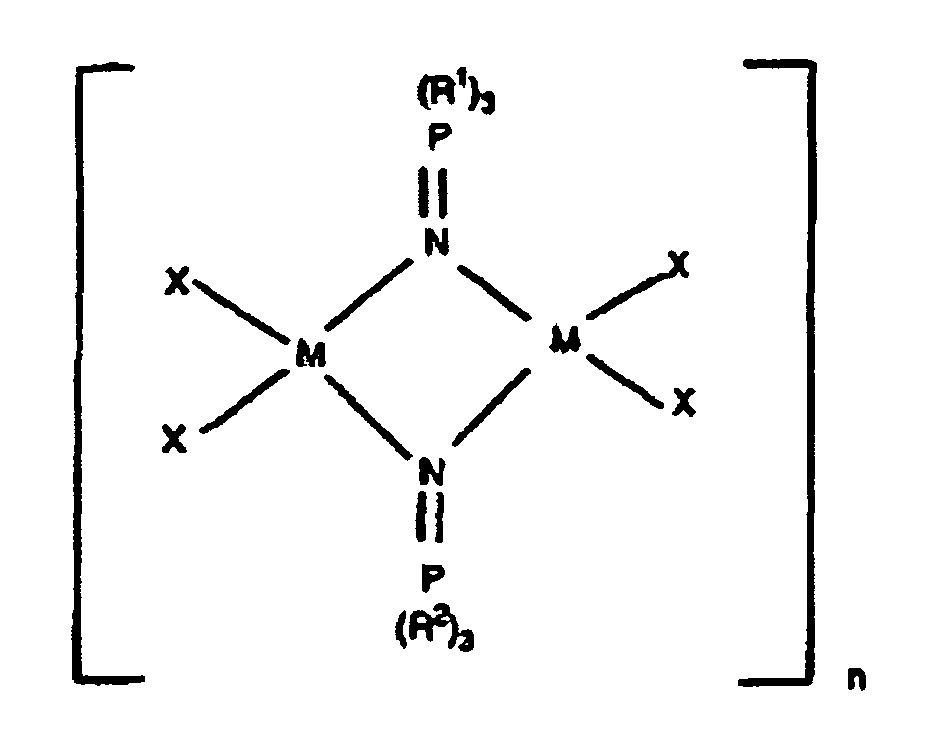
- the present invention provides a complex of formula I: wherein M is Fe, Co, Pd or Pt; each X is independently a halide atom, a C 1-10 alkyl or alkoxoide radical, or a C 6-10 cyclic alkyl, alkoxide, aryl and aryloxide radical; each of R 1 and R 2 is independently a C 3-10 branched or straight chain alkyl radical, C 6-10 cyclic alkyl radical and a C 6-10 aryl radical; and n is 1 or 2 provided that if n is and R1 and R2 are not branched, cyclic or aromatic radicals, the complex may be cubic and if the complex is cubic, M can not be Co or Fe.
- scavenger as used in this specification is meant to include those compounds effective for removing polar impurities from the reaction solvent. Such impurities can be inadvertently introduced with any of the polymerization reaction components, particularly with solvent, monomer and catalyst feed; and can adversely affect catalyst activity and stability. It can result in decreasing or even elimination of catalytic activity, particularly when an activator capable of ionizing the iron complex is also present.
- the term "cubic" when applied to the complex means the central structure in the complex is a cube with alternating "M” and nitrogen atoms at the corners of the cube.
- M is a Group 8, 9 or 10 metal other than nickel, preferably Fe, Co, Pd or Pt and most preferably Fe. If the complexes are cubic, M may not be Fe or Co, preferably Pd or Pt.
- R 1 and R 2 are independently selected from the group consisting of a hydrocarbyl radical having up to 20 carbon atoms; and each X is independently selected from the group consisting of an activatable ligand.
- n is 1 or 2 provided that if n is 2 and R 1 and R 2 are not branched, cyclic or aromatic, the complex may be cubic.
- R 1 and R 2 are independently selected from the group consisting of C 3-10 branched or straight chained alkyl radicals and C 6-10 cyclic alkyl radicals and C 6-10 aryl radicals.
- R 1 and R 2 are independently selected from the group consisting of C 1-4 straight chained or branched alkyl radicals. In a particularly preferred embodiment of the present invention, R 1 and R 2 are the same and most preferably a t-butyl radical.
- each X is independently an activatable ligand. Generally, X may be selected from the group consisting of a halogen atom, C 1-10 alkyl or alkoxide radicals, C 6-10 cyclic alkyl radicals, cyclic alkoxide radicals, aryl radicals and aryl oxide radicals.
- X is independently selected form the group consisting of a chlorine atom, a bromine atom, a C 1-4 alkyl radical and a C 1-4 alkoxy radical.
- Suitable alkyl and alkoxy radicals include a methyl radical, an ethyl radical and an ethoxy radical. In some cases it is advantageous if each X is the same.
- the metal complexes of the present invention may be prepared by reacting the phosphinimine ligand with a compound such as butyl lithium in an inert hydrocarbyl solvent or diluent.
- a compound such as butyl lithium in an inert hydrocarbyl solvent or diluent.
- the resulting lithiated ligand may then be reacted with a precursor compound containing M, where M is as defined above, to form the complex.
- M is as defined above
- the above reactions may be conducted at temperatures from about -30°C up to the degradation temperature of the phosphinimine, preferably less than 100°C, most preferably from about 20°C to about 80°C.
- the molar ratio of lithiated phosphinimine ligand to M (Group 8, 9 or 10 metal other than nickel) is from about 1.90 to 2.10, preferably from about 1.92 to 2.05.
- the molar ratio of lithiated phosphinimine ligand to M is from about 3.90 to 4.10, preferably from 3.95 to 4.05.
- the dimer form e.g. formula I wherein n is 2. It should be noted that if R 1 and R 2 are straight chained alkyl groups, particularly having less than four carbon atoms, the resulting complex may be cubic.
- R 1 and R 2 are not linear, the complex will be linear (i.e. not cubic with nitrogen and M at alternating corners). It is possible to condense two moles of compound of formula I to a mole of compound of formula II. This may be done by reflux or other suitable means.
- the complex of formula II in the present invention is prepared by the hydrolysis of the compounds of formula I. This may be accomplished by routine methods known to those skilled in the art. Preferably the complex of formula I is treated under mild conditions, either acid or alkali to hydrolyze the compound.
- Solution polymerization processes are fairly well known in the art. These processes are conducted in the presence of an inert hydrocarbon solvent, typically a C 5-12 hydrocarbon which may be unsubstituted or substituted by a C 1-4 alkyl group such as pentane, hexane, heptane, octane, cyclohexane, methylcyclohexane or hydrogenated naphtha.
- an inert hydrocarbon solvent typically a C 5-12 hydrocarbon which may be unsubstituted or substituted by a C 1-4 alkyl group such as pentane, hexane, heptane, octane, cyclohexane, methylcyclohexane or hydrogenated naphtha.
- An additional solvent is Isopar E (C 8-12 aliphatic solvent, Exxon Chemical Co.).
- the polymerization may be conducted at temperatures from about 20°C to about 250°C. Depending on the product being made, this temperature may be relatively low such as from 20°C to about 120°C for a slurry process and from 120°C to 250°C for the solution process.
- the pressure of the reaction may be as high as about 1.03 MPa (about 15,000 psig) for the older high pressure processes or may range from about 103.4 to 31.026 kPa (about 15 to 4,500 psig).
- Suitable olefin monomers may be ethylene and C 3-20 mono- and diolefins.
- Preferred monomers include ethylene and C 3-12 alpha olefins which are unsubstituted or substituted by up to two C 1-6 alkyl radicals.
- Illustrative non-limiting examples of such alpha olefins are one or more of propylene, 1-butene, 1-pentene, 1-hexene, 1-octene and 1-decene.
- the reaction product of the present invention in the presence of a single alpha olefin, may be an oligomer having a molecular weight (Mw) less than about 1500.
- the reaction product of the present invention may also be a co- or homopolymer of one or more alpha olefins.
- the polymers prepared in accordance with the present invention have a good molecular weight. That is, weight average molecular weight (Mw) will preferably be greater than about 50,000 ranging up to 10 7 , preferably 10 5 to 10 6 .
- the polyethylene polymers which may be prepared in accordance with the present invention typically comprise not less than 60, preferably not less than 70, most preferably not less than 80 weight % of ethylene and the balance of one or more C 4-10 alpha olefins, preferably selected from the group consisting of 1-butene, 1-hexene and 1-octene.
- the polyethylene prepared in accordance with the present invention may contain branching (e.g. one or more branches per 1000 carbon atoms, preferably 1-30 branches per 1000 carbon atoms, typical 1-20 branches per 1000 carbon atoms and most preferably 1-10 branches per 1000 carbon atoms).
- the activator may be selected from the group consisting of:
- the aluminoxane activator may be of the formula (R 20 ) 2 AlO(R 20 AlO) m Al(R 20 ) 2 wherein each R 20 is independently selected from the group consisting of C 1-20 hydrocarbyl radicals, m is from 0 to 50, and preferably R 20 is a C 1-4 alkyl radical and m is from 5 to 30.
- the aluminoxane activator may be used prior to the reaction but preferably in situ alkylation is typical (e.g. alkyl groups replacing leaving ligands, hydrogen or halide groups).
- the amount of aluminoxane will depend on the reactivity of the alkylating agent. Activation with aluminoxane generally requires a molar ratio of aluminum in the activator to the Group 8, 9 or 10 metal other than nickel in the complex may range from 50:1 to 1000:1.
- the activator of the present invention may be a combination of an alkylating activator which also serves as a scavenger other than aluminoxane in combination with an activator capable of ionizing the Group 8, 9 or 10 metal other than nickel in the complex.
- the alkylating activator (which may also serve as a scavenger) may be selected from the group consisting of: (R) p MgX 2-p wherein X is a halide, each R is independently selected from the group consisting of C 1-10 alkyl radicals, preferably C 1-8 alkyl radicals and p is 1 or 2; RLi wherein R is as defined above; (R) q ZnX 2-q wherein R is as defined above, X is halogen and q is 1 or 2; (R) s AlX 3-s wherein R is as defined above, X is halogen and s is an integer from 1 to 3.
- R is a C 1-4 alkyl radical and X is chlorine.
- Commercially available compounds include triethyl aluminum (TEAL), diethyl aluminum chloride (DEAC), dibutyl magnesium ((Bu) 2 Mg) and butyl ethyl magnesium (BuEtMg or BuMgEt).
- the activator capable of ionizing the Group 8, 9 or 10 metal other than nickel in the complex may be selected from the group consisting of:
- R 18 is a pentafluorophenyl radical
- R 15 is a triphenylmethyl cation
- Z is a nitrogen atom
- R 16 is a C 1-4 alkyl radical or R 16 taken together with the nitrogen atom forms an anilium radical which is substituted by two C 1-4 alkyl radicals.
- the activator capable of ionizing the Group 8, 9 or 10 metal other than nickel in the complex abstracts one or more X ligands so as to ionize the metal into a cation, but not to covalently bond with the metal and to provide sufficient distance between the ionized metal and the ionizing activator to permit a polymerizable olefin to enter the resulting active site.
- Examples of compounds capable of ionizing the Group 8, 9 or 10 metal other than nickel complex include the following compounds:
- the complex is activated with a combination of an aluminum alkyl compound (generally other than aluminoxane), and a compound capable of ionizing the Group 8, 9 or 10 metal other than nickel complex (e.g. activators (i) and (iii) above)
- the molar ratios of Group 8, 9 or 10 metal other than nickel:metal in the alkylating agent (e.g. Al); metalloid (e.g. boron or phosphorus) in the activator capable of ionizing the complex (e.g. boron) may range from 1:1:1 to 1:100:5.
- the alkylating activator is premixed/reacted with the complex and the resulting alkylated species is then reacted with the activator capable of ionizing the Group 8, 9 or 10 metal other than nickel.
- the monomers are dissolved/dispersed in the solvent either prior to being fed to the reactor, or for gaseous monomers, the monomer may be fed to the reactor so that it will dissolve in the reaction mixture.
- the solvent and monomers Prior to mixing, are generally purified to remove polar moieties.
- the polar moieties or catalyst poisons include water, oxygen, metal impurities, etc.
- steps are taken before provision of such into the reaction vessel, for example by chemical treatment or careful separation techniques after or during the synthesis or preparation of the various components.
- the feedstock purification prior to introduction into the reaction solvent follows standard practices in the art (e.g.
- molecular sieves are used for the purification of ethylene, alpha-olefin and optional diene.
- the solvent itself as well e.g. cyclohexane and toluene
- excess scavenging activators may be used in the polymerization process.
- the feedstock may be heated prior to feeding into the reactor. However, in many instances it is desired to remove heat from the reactor so the feedstock may be at ambient temperature to help cool the reactor.
- the catalyst components may be premixed in the solvent for the reaction or fed as separate streams to the reactor. In some instances premixing is desirable to provide a reaction time for the catalyst components prior to entering the reaction.
- premixing is described in a number of patents in the name of DuPont Canada Inc. For example, it is described in U.S. patent 5,589,555 issued December 31, 1996.
- the reactor may comprise a tube or serpentine reactor used in the "high pressure" polymerizations or it may comprise one or more reactors or autoclaves. It is well known to use two such reactors in series, each of which may be operated independently to achieve different polymer molecular weight distributions.
- the residence time in the reactor system will depend on the design and the capacity of the reactor. Generally, the reactors should be operated under conditions to achieve a thorough mixing of the reactants. On leaving the reactor system the solvent is removed and the resulting polymer is finished in a conventional manner.
- weight means weight % and parts means parts by weight (e.g. grams).
- t Bu 3 P NLi (0.223 g, 1 mmol) in toluene ( ⁇ 10 mL) was added to a toluene solution ( ⁇ 20 mL) of FeCl 3 (162 mg, 1 mmol) at -100°C. The mixture was warmed to room temperature and was stirred overnight. A dark green slurry formed which was then filtered. The green solid produced was washed with heptane and then dried. The filtrate was concentrated to a couple of milliliters by vacuum pumping and was stored at -70°C overnight. Dark crystals formed which were separated from the mother liquor, washed with heptane and dried. The combined yield was 180 mg (53%).
- Polymerization temperature setting was 50°C for slurry polymerization runs and 160°C for solution polymerization runs.
- the reaction was terminated by adding 5 mL of methanol to the reactor and the polymer was recovered by evaporation of the toluene.
- the polymerization activities were calculated based on the weight of the polymers produced.
- the catalysts (Fe catalyst 1-4) were dissolved in toluene.
- the anhydrous toluene was purchased from Aldrich and purified over molsieves prior to use.
- PMAO-IP was purchased from Akzo-Nobel and contained 13.5 weight % of Al.
- [CPh 3 ][B(C 6 F 5 ) 4 ] (hereinafter trityl borate) was purchased from Asahi Glass Inc.; lot #: 980224.
- Polymer molecular weights and molecular weight distributions were measured by GPC (WATERSTM 150-C) at 140°C in 1,2,4-trichlorobenzene calibrated using polyethylene standards.
- DSC was conducted on a DSC 220 from SEIKOTM Instruments.
- the heating rate is 10°C/minute from 0 to 200°C.
- Fe catalyst 1/PMAO-IP/trityl borate 139.6 1.7 136.2 Fe catalyst 1/PMAO-IP 2 509.9 7.0 106.7 Fe catalyst 2/PMAO-IP 120.0 44.7 127.5 Fe catalyst 3/PMAO-IP 149.5 50.7 132.0 Fe catalyst 3/PMAO-IP 2 468.8 16.7 125.3 Fe catalyst 4/ PMAO-IP 480.3 11.3 132.1 1 General homopolymerization conditions: 50°C as a setting temperature; 2.1 MPa (300 psig) of C2; 300 umol/L of catalyst concentration; PMAO-IP as a cocatalyst with Al/Fe 60; 216 mL of toluene as solvent.
- the present invention provides catalyst systems based on late transition metals, preferably iron, which are suitable for the polymerization of one or more alpha olefins in a slurry or solution process.
Landscapes
- Chemical & Material Sciences (AREA)
- Organic Chemistry (AREA)
- Health & Medical Sciences (AREA)
- Chemical Kinetics & Catalysis (AREA)
- Medicinal Chemistry (AREA)
- Polymers & Plastics (AREA)
- Transition And Organic Metals Composition Catalysts For Addition Polymerization (AREA)
- Addition Polymer Or Copolymer, Post-Treatments, Or Chemical Modifications (AREA)
- Organic Low-Molecular-Weight Compounds And Preparation Thereof (AREA)
- Polymerization Catalysts (AREA)
Claims (41)
- Procédé pour la polymérisation d'une ou plusieurs alpha-oléfines en C2-12 en présence d'un complexe activé choisi dans le groupe consistant en des complexes de formule I :dans laquelle M est un métal du groupe 8, 9 ou 10 autre que le nickel ; chacun parmi R1 et R2 sont indépendamment choisis dans le groupe consistant en un radical hydrocarbyle ayant jusqu'à 20 atomes de carbone ; chaque X est indépendamment choisi dans le groupe consistant en un ligand activable et n est 1 ou 2 à condition que si n est 2 et R1 et R2 ne sont pas des radicaux ramifiés, cycliques ou aromatiques, le complexe peut être cubique ; et
des complexes de formule II :dans laquelle M, R1, R2 et X sont comme définis ci-dessus,
et un activeur. - Procédé selon la revendication 1, dans lequel l'activeur est choisi dans le groupe consistant en :(i) un composé d'aluminium choisi dans le groupe consistant en des alkyl-aluminium de formule AlR3-nXn dans laquelle R est indépendamment choisi dans le groupe consistant en un radical alkyle en C1-8, X est un atome d'halogène et n est 0, 1, 2 ou 3 de manière à obtenir un rapport molaire d'aluminium à M d'au moins 5:1 ;(ii) des composés aluminoxane R20 2AlO(R20AlO)mAlR20 2 dans lesquels chaque R20 est indépendamment un radical hydrocarbyle en C1-20 et m est de 5 à 30 de manière à obtenir un rapport molaire d'aluminium à M de 50:1 à 1000:1 ;(iii) des anions de formule [B(R18)4] dans laquelle chaque R18 est indépendamment un radical phényle qui est non substitué ou substitué par jusqu'à 5 substituants choisis parmi un atome de fluor, un alkyle en C1-4 ou un radical alcoxy qui est non substitué ou substitué par un atome de fluor et un radical silyle de formule -Si-(R19)3 ; dans laquelle chaque R19 est indépendamment un atome d'hydrogène ou un radical alkyle en C1-4 ; et un activeur de formule [B(R18)3] dans laquelle R18 est comme défini ci-dessus et de manière à obtenir un rapport molaire de M au bore de 1:1 à 1:3 ; et(iv) un mélange d'activeurs (i) à (iii) de manière à obtenir un rapport de M à l'aluminium au bore de 1:1:1 à 1:100:5.
- Procédé selon la revendication 2, dans lequel lesdites une ou plusieurs oléfines sont l'éthylène, le propylène, le butylène, l'hexène et l'octène.
- Procédé selon la revendication 3, dans lequel M est choisi dans le groupe consistant en Fe, Co, Pd ou Pt.
- Procédé selon la revendication 4, dans lequel, dans le complexe, chaque X est un atome d'halogénure, un radical alkyle ou alcoxyde en C1-10, ou un radical alkyle cyclique, alcoxyde, aryle et aryloxyde en C6-10.
- Procédé selon la revendication 5, dans lequel, dans le complexe, chacun parmi R1 et R2 est indépendamment un radical alkyle à chaíne ramifiée ou linéaire en C3-10, un radical alkyle cyclique en C6-10 ou un radical aryle en C6-10.
- Procédé selon la revendication 6, dans lequel, dans le complexe, tous les radicaux R1 et R2 sont identiques.
- Procédé selon la revendication 7, dans lequel, dans le complexe de formule I, chaque X est indépendamment un atome de chlore, un atome de brome, un radical alkyle en C1-4 ou un radical alcoxy en C1-4.
- Procédé selon la revendication 8, dans lequel, dans le complexe de formule I, chaque X est indépendamment un atome de chlore, un atome de brome, un radical méthyle, un radical méthoxy, un radical éthyle ou un radical éthoxy.
- Procédé selon la revendication 9, dans lequel le complexe est de formule I et n est 1.
- Procédé selon la revendication 9, dans lequel le complexe est de formule I et n est 2.
- Procédé selon la revendication 11, dans lequel, dans le complexe de formule I, chacun parmi R1 et R2 est indépendamment un radical alkyle à chaíne linéaire en C3-10.
- Procédé selon la revendication 12, dans lequel le complexe de formule I est linéaire.
- procédé selon la revendication 11, dans lequel le complexe de formule I est cubique.
- Procédé selon la revendication 14, dans lequel R1 et R2 sont indépendamment un radical alkyle ramifié en C3-10, un radical alkyle cyclique en C6-10 ou un radical aryle en C6-10.
- Procédé selon la revendication 9, dans lequel le complexe est de formule II.
- Procédé selon la revendication 10, la revendication 13, la revendication 15 ou la revendication 16, dans lequel la température est de 120°C à 250°C, la pression est de 0,69 à 31 MPa (100 à 4 500 psig) et l'activeur est un aluminoxane dans lequel chaque R20 est choisi dans le groupe consistant en des radicaux alkyle en C1-4 et m est de 5 à 30.
- Procédé selon la revendication 10, la revendication 13, la revendication 15 ou la revendication 16, dans lequel la température est de 20°C à 120°C, la pression est de 100 à 4 500 psig et l'activeur est un aluminoxane dans lequel chaque R20 est indépendamment un radical alkyle en C1-4 et m est de 5 à 30.
- Procédé selon la revendication 10, la revendication 13, la revendication 15 ou la revendication 16, dans lequel la température est de 120°C à 250°C, la pression est de 100 à 4 500 psig et l'activeur est le borate de N,N-diméthylaniliniumtétrakispentafluorophényle, le borate de triphénylméthylium-tétrakispentafluorophényle ou le trispentafluorophényl-bore.
- Procédé selon la revendication 10, la revendication 13, la revendication 15 ou la revendication 16, dans lequel la température est de 20°C à 120°C, la pression est de 15 à 4 500 psig et l'activeur est le borate de N,N-diméthylaniliniumtétrakispentafluorophényle, le borate de triphénylméthylium-tétrakispentafluorophényle ou le trispentafluorophényl-bore.
- Procédé selon la revendication 10, la revendication 13, la revendication 15 ou la revendication 16, dans lequel la température est de 120°C à 250°C, la pression est de 15 à 4 500 psig et l'activeur est une combinaison de borate de N,N-diméthylaniliniumtétrakispentafluorophényle, borate de triphénylméthylium-tétrakispentafluorophényle ou trispentafluorophényl-bore et d'un composé alkyl-aluminium.
- Procédé selon la revendication 10, la revendication 13, la revendication 15 ou la revendication 16, dans lequel la température est de 20°C à 120°C, la pression est de 0,1 à 31 MPa (15 à 4 500 psig) et l'activeur est une combinaison de borate de N,N-diméthylaniliniumtétrakispentafluorophényle, borate de triphénylméthylium-tétrakispentafluorophényle ou trispentafluorophényl-bore et d'un composé alkyl-aluminium.
- procédé selon l'une quelconque des revendications 17 à 22, dans lequel M est Fe, dans lequel M est Fe, X est un atome de chlore et R1 et R2 sont des radicaux butyle tertiaire.
- Complexe de formule II :dans lequel M est Fe, Co, Pd ou Pt ;
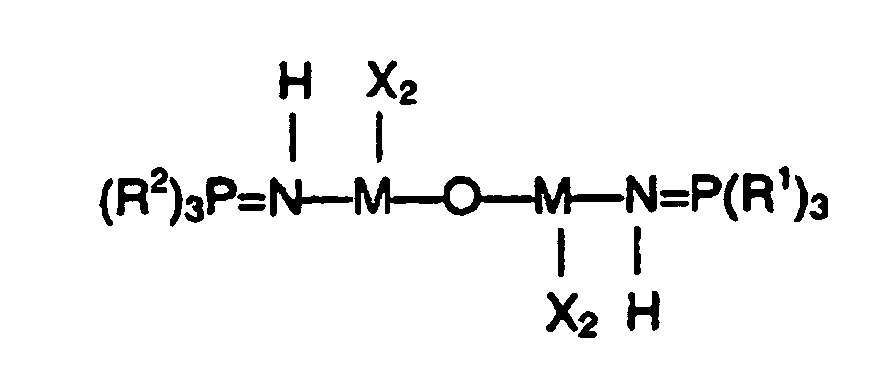
chaque X est un atome d'halogénure, un radical alkyle ou alcoxyde en C1-10 ou un radical alkyle cyclique, alcoxyde, aryle et aryloxyde en C6-10 ; et
chacun parmi R1 et R2 est indépendamment un radical alkyle à chaíne ramifiée ou linéaire en C3-10, un radical alkyle cyclique en C6-10 et un radical aryle en C6-10. - Complexe selon la revendication 24, dans lequel tous les radicaux R1 et R2 sont identiques.
- Complexe selon la revendication 25, dans lequel chaque R1 et R2 est un radical t-butyle
- Complexe selon la revendication 26, dans lequel chaque X est indépendamment un atome de chlore, un atome de brome, un radical alkyle en C1-4 ou un radical alcoxy en C1-4.
- Complexe selon la revendication 27, dans lequel chaque X est indépendamment un atome de chlore, un atome de brome, un radical méthyle, un radical méthoxy, un radical éthyle ou un radical éthoxy.
- Complexe selon la revendication 28, dans lequel M est Fe.
- Complexe selon la revendication 29, dans lequel chaque X est un atome de chlore.
- Complexe de formule I :dans laquelle M est Fe, Co, Pd ou Pt ;

chaque X est indépendamment un atome d'halogénure, un radical alkyle ou alcoxyde en C1-10, ou un radical alkyle cyclique, alcoxyde, aryle et aryloxyde en C6-10 ;
chaque R1 et R2 est indépendamment un radical alkyle à chaíne ramifiée ou linéaire en C3-10, un radical alkyle cyclique en C6-10 ou un radical aryle en C6-10 ;
et n est 1 ou 2 à condition que si n est 2 et R1 et R2 ne sont pas des radicaux ramifiés, cycliques ou aromatiques, le complexe peut être cubique et si le complexe est cubique, M ne peut pas être Co ou Fe. - Complexe selon la revendication 31, dans lequel tous les radicaux R1 et R2 sont identiques.
- Complexe selon la revendication 32, dans lequel chaque X est indépendamment un atome de chlore, un atome de brome, un radical alkyle en C1-4 ou un radical alcoxy en C1-4.
- Complexe selon la revendication 33, dans lequel chaque X est indépendamment un atome de chlore, un atome de brome, un radical méthyle, un radical méthoxy, un radical éthyle ou un radical éthoxy.
- Complexe selon la revendication 34, dans lequel R1 et R2 sont indépendamment un radical alkyle ramifié en C3-10, un radical alkyle cyclique en C6-10 ou un radical aryle en C6-10.
- Complexe selon la revendication 35, dans lequel chaque R1 et R2 est un radical t-butyle et M est Fe.
- Complexe selon la revendication 33, dans lequel R1 et R2 sont indépendamment des radicaux alkyle à chaíne linéaire en C3-10.
- Complexe selon la revendication 37, dans lequel n est 1.
- Complexe selon la revendication 37, dans lequel n est 2.
- Complexe selon la revendication 39 qui est linéaire.
- Complexe selon la revendication 39 qui est cubique.
Applications Claiming Priority (3)
| Application Number | Priority Date | Filing Date | Title |
|---|---|---|---|
| US466510 | 1995-06-06 | ||
| US09/466,510 US6300435B1 (en) | 1999-12-17 | 1999-12-17 | Iron olefin copolymerization catalyst |
| PCT/CA2000/001463 WO2001044316A1 (fr) | 1999-12-17 | 2000-12-06 | Catalyseur au fer de copolymerisation |
Publications (2)
| Publication Number | Publication Date |
|---|---|
| EP1252201A1 EP1252201A1 (fr) | 2002-10-30 |
| EP1252201B1 true EP1252201B1 (fr) | 2005-07-06 |
Family
ID=23852042
Family Applications (1)
| Application Number | Title | Priority Date | Filing Date |
|---|---|---|---|
| EP00984706A Expired - Lifetime EP1252201B1 (fr) | 1999-12-17 | 2000-12-06 | Catalyseur au fer de copolymerisation |
Country Status (6)
| Country | Link |
|---|---|
| US (1) | US6300435B1 (fr) |
| EP (1) | EP1252201B1 (fr) |
| AT (1) | ATE299154T1 (fr) |
| AU (1) | AU2135201A (fr) |
| DE (1) | DE60021210T2 (fr) |
| WO (1) | WO2001044316A1 (fr) |
Families Citing this family (5)
| Publication number | Priority date | Publication date | Assignee | Title |
|---|---|---|---|---|
| US7378537B2 (en) * | 2006-07-25 | 2008-05-27 | Chevron Phillips Chemical Company Lp | Olefin oligomerization catalysts and methods of using same |
| US8901334B2 (en) * | 2012-12-21 | 2014-12-02 | Governors Of The University Of Alberta | Transition metal-phosphoranimide catalysts |
| US9051229B2 (en) * | 2012-12-21 | 2015-06-09 | Governors Of The University Of Alberta | Transition metal catalysts for C—O hydrogenolysis and hydrodeoxygenation |
| US9120741B2 (en) * | 2012-12-21 | 2015-09-01 | Governors Of The University Of Alberta | Transition metal catalysts for hydrogenation and hydrosilylation |
| CA2871463A1 (fr) | 2014-11-19 | 2016-05-19 | Nova Chemicals Corporation | Supports passives : catalyseur, procede et produit |
Family Cites Families (5)
| Publication number | Priority date | Publication date | Assignee | Title |
|---|---|---|---|---|
| US5589555A (en) | 1991-10-03 | 1996-12-31 | Novacor Chemicals (International) S.A. | Control of a solution process for polymerization of ethylene |
| WO1993008839A1 (fr) * | 1991-11-08 | 1993-05-13 | Curators Of The University Of Missouri | Ligands multifonctionnels potentiellement utiles pour realiser des agents therapeutiques ou de diagnostic par imagerie radiopharmaceutique |
| US5557023A (en) | 1995-05-23 | 1996-09-17 | The Governors Of The University Of Alberta | Olefin oligomerization in the presence of novel complexes |
| IL129929A0 (en) | 1996-12-17 | 2000-02-29 | Du Pont | Polymerization of ethylene with specific iron or cobalt complexes novel pyridinebis (imines) and novel complexes of pyridinebis(imines) with iron and cobalt |
| US6121181A (en) * | 1998-08-07 | 2000-09-19 | Equistar Chemicals, L.P. | Cyclic oligomeric oxo- and imido- metal complexes as olefin polymerization catalysts |
-
1999
- 1999-12-17 US US09/466,510 patent/US6300435B1/en not_active Expired - Fee Related
-
2000
- 2000-12-06 AU AU21352/01A patent/AU2135201A/en not_active Abandoned
- 2000-12-06 WO PCT/CA2000/001463 patent/WO2001044316A1/fr not_active Ceased
- 2000-12-06 DE DE60021210T patent/DE60021210T2/de not_active Expired - Fee Related
- 2000-12-06 AT AT00984706T patent/ATE299154T1/de not_active IP Right Cessation
- 2000-12-06 EP EP00984706A patent/EP1252201B1/fr not_active Expired - Lifetime
Also Published As
| Publication number | Publication date |
|---|---|
| DE60021210D1 (de) | 2005-08-11 |
| DE60021210T2 (de) | 2006-04-20 |
| US6300435B1 (en) | 2001-10-09 |
| EP1252201A1 (fr) | 2002-10-30 |
| WO2001044316A1 (fr) | 2001-06-21 |
| AU2135201A (en) | 2001-06-25 |
| ATE299154T1 (de) | 2005-07-15 |
Similar Documents
| Publication | Publication Date | Title |
|---|---|---|
| EP0881233B1 (fr) | Procédé de polymérisation en solution à haute température | |
| JP3014455B2 (ja) | エチレン−α−オレフィンコポリマー製造触媒のためのモノシクロペンタジエニル金属化合物 | |
| US7022788B2 (en) | Polymerization process catalyzed by a bidentate bisphosphine-group VIII metal complex | |
| JP2001517714A (ja) | 変性アルミノキサン触媒活性化剤 | |
| US6239237B1 (en) | Group 8, 9 or 10 transition metal catalyst for olefin polymerization | |
| US5955625A (en) | Monocyclopentadienyl metal compounds for ethylene-α-olefin-copolymer production catalysts | |
| US6313331B1 (en) | Carbene transition metal catalysts | |
| US6133387A (en) | Group 8, 9 or 10 olefin copolymerization catalyst | |
| US6677441B2 (en) | Cationic group 3 catalyst system | |
| US6638887B1 (en) | Monocyclopentadienyl metal compounds for ethylene-α-olefin-copolymer production catalysts | |
| EP1252201B1 (fr) | Catalyseur au fer de copolymerisation | |
| CA2248463A1 (fr) | Complexes iminophosphonamides pour la polymerisation d'olefines | |
| US6696532B2 (en) | Phosphinimine methanide transition metal catalysts | |
| US6492474B2 (en) | Aluminum complexes for olefin polymerization | |
| US6686491B2 (en) | Aluminum complexes for olefin polymerization | |
| US6380333B1 (en) | Group 8, 9 or 10 olefin copolymerization catalyst | |
| EP1134235B1 (fr) | Catalyseur pour la polymérisation d'oléfines des groupes 8, 9 ou 10 | |
| CA2424887A1 (fr) | Systeme de catalyseur cationique | |
| CA2285523C (fr) | Catalyseur de copolymerisation d'olefines contenant un metal du groupe 8, 9 ou 10 | |
| EP1379561B1 (fr) | Procede de polymerisation d'olefines en utilisant des complexes de metal de transition |
Legal Events
| Date | Code | Title | Description |
|---|---|---|---|
| PUAI | Public reference made under article 153(3) epc to a published international application that has entered the european phase |
Free format text: ORIGINAL CODE: 0009012 |
|
| 17P | Request for examination filed |
Effective date: 20020708 |
|
| AK | Designated contracting states |
Kind code of ref document: A1 Designated state(s): AT BE CH CY DE DK ES FI FR GB GR IE IT LI LU MC NL PT SE TR |
|
| AX | Request for extension of the european patent |
Free format text: AL;LT;LV;MK;RO;SI |
|
| 17Q | First examination report despatched |
Effective date: 20040803 |
|
| GRAP | Despatch of communication of intention to grant a patent |
Free format text: ORIGINAL CODE: EPIDOSNIGR1 |
|
| GRAS | Grant fee paid |
Free format text: ORIGINAL CODE: EPIDOSNIGR3 |
|
| GRAA | (expected) grant |
Free format text: ORIGINAL CODE: 0009210 |
|
| AK | Designated contracting states |
Kind code of ref document: B1 Designated state(s): AT BE CH CY DE DK ES FI FR GB GR IE IT LI LU MC NL PT SE TR |
|
| PG25 | Lapsed in a contracting state [announced via postgrant information from national office to epo] |
Ref country code: CH Free format text: LAPSE BECAUSE OF FAILURE TO SUBMIT A TRANSLATION OF THE DESCRIPTION OR TO PAY THE FEE WITHIN THE PRESCRIBED TIME-LIMIT Effective date: 20050706 Ref country code: BE Free format text: LAPSE BECAUSE OF FAILURE TO SUBMIT A TRANSLATION OF THE DESCRIPTION OR TO PAY THE FEE WITHIN THE PRESCRIBED TIME-LIMIT Effective date: 20050706 Ref country code: LI Free format text: LAPSE BECAUSE OF FAILURE TO SUBMIT A TRANSLATION OF THE DESCRIPTION OR TO PAY THE FEE WITHIN THE PRESCRIBED TIME-LIMIT Effective date: 20050706 Ref country code: FI Free format text: LAPSE BECAUSE OF FAILURE TO SUBMIT A TRANSLATION OF THE DESCRIPTION OR TO PAY THE FEE WITHIN THE PRESCRIBED TIME-LIMIT Effective date: 20050706 Ref country code: ES Free format text: LAPSE BECAUSE OF FAILURE TO SUBMIT A TRANSLATION OF THE DESCRIPTION OR TO PAY THE FEE WITHIN THE PRESCRIBED TIME-LIMIT Effective date: 20050706 Ref country code: TR Free format text: LAPSE BECAUSE OF FAILURE TO SUBMIT A TRANSLATION OF THE DESCRIPTION OR TO PAY THE FEE WITHIN THE PRESCRIBED TIME-LIMIT Effective date: 20050706 Ref country code: AT Free format text: LAPSE BECAUSE OF FAILURE TO SUBMIT A TRANSLATION OF THE DESCRIPTION OR TO PAY THE FEE WITHIN THE PRESCRIBED TIME-LIMIT Effective date: 20050706 |
|
| REG | Reference to a national code |
Ref country code: GB Ref legal event code: FG4D |
|
| REG | Reference to a national code |
Ref country code: CH Ref legal event code: EP |
|
| REG | Reference to a national code |
Ref country code: IE Ref legal event code: FG4D |
|
| REF | Corresponds to: |
Ref document number: 60021210 Country of ref document: DE Date of ref document: 20050811 Kind code of ref document: P |
|
| PG25 | Lapsed in a contracting state [announced via postgrant information from national office to epo] |
Ref country code: GR Free format text: LAPSE BECAUSE OF FAILURE TO SUBMIT A TRANSLATION OF THE DESCRIPTION OR TO PAY THE FEE WITHIN THE PRESCRIBED TIME-LIMIT Effective date: 20051006 Ref country code: DK Free format text: LAPSE BECAUSE OF FAILURE TO SUBMIT A TRANSLATION OF THE DESCRIPTION OR TO PAY THE FEE WITHIN THE PRESCRIBED TIME-LIMIT Effective date: 20051006 Ref country code: SE Free format text: LAPSE BECAUSE OF FAILURE TO SUBMIT A TRANSLATION OF THE DESCRIPTION OR TO PAY THE FEE WITHIN THE PRESCRIBED TIME-LIMIT Effective date: 20051006 |
|
| PG25 | Lapsed in a contracting state [announced via postgrant information from national office to epo] |
Ref country code: IE Free format text: LAPSE BECAUSE OF NON-PAYMENT OF DUE FEES Effective date: 20051206 Ref country code: CY Free format text: LAPSE BECAUSE OF FAILURE TO SUBMIT A TRANSLATION OF THE DESCRIPTION OR TO PAY THE FEE WITHIN THE PRESCRIBED TIME-LIMIT Effective date: 20051206 |
|
| PG25 | Lapsed in a contracting state [announced via postgrant information from national office to epo] |
Ref country code: PT Free format text: LAPSE BECAUSE OF FAILURE TO SUBMIT A TRANSLATION OF THE DESCRIPTION OR TO PAY THE FEE WITHIN THE PRESCRIBED TIME-LIMIT Effective date: 20051212 |
|
| PG25 | Lapsed in a contracting state [announced via postgrant information from national office to epo] |
Ref country code: MC Free format text: LAPSE BECAUSE OF NON-PAYMENT OF DUE FEES Effective date: 20051231 Ref country code: LU Free format text: LAPSE BECAUSE OF NON-PAYMENT OF DUE FEES Effective date: 20051231 |
|
| REG | Reference to a national code |
Ref country code: CH Ref legal event code: PL |
|
| ET | Fr: translation filed | ||
| PLBE | No opposition filed within time limit |
Free format text: ORIGINAL CODE: 0009261 |
|
| STAA | Information on the status of an ep patent application or granted ep patent |
Free format text: STATUS: NO OPPOSITION FILED WITHIN TIME LIMIT |
|
| 26N | No opposition filed |
Effective date: 20060407 |
|
| REG | Reference to a national code |
Ref country code: IE Ref legal event code: MM4A |
|
| PGFP | Annual fee paid to national office [announced via postgrant information from national office to epo] |
Ref country code: NL Payment date: 20081203 Year of fee payment: 9 |
|
| PGFP | Annual fee paid to national office [announced via postgrant information from national office to epo] |
Ref country code: IT Payment date: 20081224 Year of fee payment: 9 |
|
| PGFP | Annual fee paid to national office [announced via postgrant information from national office to epo] |
Ref country code: FR Payment date: 20081212 Year of fee payment: 9 |
|
| PGFP | Annual fee paid to national office [announced via postgrant information from national office to epo] |
Ref country code: DE Payment date: 20081205 Year of fee payment: 9 |
|
| PGFP | Annual fee paid to national office [announced via postgrant information from national office to epo] |
Ref country code: GB Payment date: 20081203 Year of fee payment: 9 |
|
| REG | Reference to a national code |
Ref country code: NL Ref legal event code: V1 Effective date: 20100701 |
|
| GBPC | Gb: european patent ceased through non-payment of renewal fee |
Effective date: 20091206 |
|
| REG | Reference to a national code |
Ref country code: FR Ref legal event code: ST Effective date: 20100831 |
|
| PG25 | Lapsed in a contracting state [announced via postgrant information from national office to epo] |
Ref country code: FR Free format text: LAPSE BECAUSE OF NON-PAYMENT OF DUE FEES Effective date: 20091231 Ref country code: NL Free format text: LAPSE BECAUSE OF NON-PAYMENT OF DUE FEES Effective date: 20100701 |
|
| PG25 | Lapsed in a contracting state [announced via postgrant information from national office to epo] |
Ref country code: DE Free format text: LAPSE BECAUSE OF NON-PAYMENT OF DUE FEES Effective date: 20100701 |
|
| PG25 | Lapsed in a contracting state [announced via postgrant information from national office to epo] |
Ref country code: GB Free format text: LAPSE BECAUSE OF NON-PAYMENT OF DUE FEES Effective date: 20091206 |
|
| PG25 | Lapsed in a contracting state [announced via postgrant information from national office to epo] |
Ref country code: IT Free format text: LAPSE BECAUSE OF NON-PAYMENT OF DUE FEES Effective date: 20091206 |