EP1255213A2 - Verfahren und System zur Auswertung text-basierter Produkte - Google Patents
Verfahren und System zur Auswertung text-basierter Produkte Download PDFInfo
- Publication number
- EP1255213A2 EP1255213A2 EP02009457A EP02009457A EP1255213A2 EP 1255213 A2 EP1255213 A2 EP 1255213A2 EP 02009457 A EP02009457 A EP 02009457A EP 02009457 A EP02009457 A EP 02009457A EP 1255213 A2 EP1255213 A2 EP 1255213A2
- Authority
- EP
- European Patent Office
- Prior art keywords
- customer
- text content
- database
- search
- data
- Prior art date
- Legal status (The legal status is an assumption and is not a legal conclusion. Google has not performed a legal analysis and makes no representation as to the accuracy of the status listed.)
- Withdrawn
Links
Images



Classifications
-
- G—PHYSICS
- G06—COMPUTING OR CALCULATING; COUNTING
- G06Q—INFORMATION AND COMMUNICATION TECHNOLOGY [ICT] SPECIALLY ADAPTED FOR ADMINISTRATIVE, COMMERCIAL, FINANCIAL, MANAGERIAL OR SUPERVISORY PURPOSES; SYSTEMS OR METHODS SPECIALLY ADAPTED FOR ADMINISTRATIVE, COMMERCIAL, FINANCIAL, MANAGERIAL OR SUPERVISORY PURPOSES, NOT OTHERWISE PROVIDED FOR
- G06Q30/00—Commerce
- G06Q30/06—Buying, selling or leasing transactions
-
- G—PHYSICS
- G06—COMPUTING OR CALCULATING; COUNTING
- G06Q—INFORMATION AND COMMUNICATION TECHNOLOGY [ICT] SPECIALLY ADAPTED FOR ADMINISTRATIVE, COMMERCIAL, FINANCIAL, MANAGERIAL OR SUPERVISORY PURPOSES; SYSTEMS OR METHODS SPECIALLY ADAPTED FOR ADMINISTRATIVE, COMMERCIAL, FINANCIAL, MANAGERIAL OR SUPERVISORY PURPOSES, NOT OTHERWISE PROVIDED FOR
- G06Q30/00—Commerce
- G06Q30/02—Marketing; Price estimation or determination; Fundraising
-
- Y—GENERAL TAGGING OF NEW TECHNOLOGICAL DEVELOPMENTS; GENERAL TAGGING OF CROSS-SECTIONAL TECHNOLOGIES SPANNING OVER SEVERAL SECTIONS OF THE IPC; TECHNICAL SUBJECTS COVERED BY FORMER USPC CROSS-REFERENCE ART COLLECTIONS [XRACs] AND DIGESTS
- Y10—TECHNICAL SUBJECTS COVERED BY FORMER USPC
- Y10S—TECHNICAL SUBJECTS COVERED BY FORMER USPC CROSS-REFERENCE ART COLLECTIONS [XRACs] AND DIGESTS
- Y10S707/00—Data processing: database and file management or data structures
- Y10S707/99931—Database or file accessing
- Y10S707/99932—Access augmentation or optimizing
Definitions
- the present invention relates generally to information (e.g. information regarding product) acquisition and product reviews, and more specifically, to a computer system for providing ratings for customized text base product and/or a computer system for recommending the product.
- Collaborative filtering methods in this field operate at the most basic level by asking each customer to rate books or other written matter that the customer is familiar with. These ratings are then analyzed and used to correlate and divulge various specific characteristics or commonalities from the totality of ratings data. A profile may be derived for each customer, and comparison of one customer's profile with similar profiles can be done to identify items of potential interest.
- a drawback with some current collaborative methods of providing text content-related assistance over a network is that the procedures undertaken to acquire and populate a database with current customer preference data frequently present a complex, large or frustrating burden to customers, particularly new users, of the system. For systems that otherwise derive advantage from ease-of-use and/or other such characteristics of attractiveness to a customer, this again presents a burden in acquiring appropriate results and presenting helpful information.
- the present invention provides a network computer system and computer-based method for providing customized text content ratings and/or recommendations based on certain information, such as information concerning the text content that a customer has read.
- the network computer system includes a first (or book) database (160), a customer database (170), a database server (110) for searching, retrieving and comparing data from these databases, a web server (120) to connect the database server (110) to the network (130), and a computer for a customer connected to the database server (110) over a network (130).
- the customer performs a book registration function followed by a book rating function. In the book registration function, information regarding the books and other periodicals that have been read by the customer is acquired, compiled by the database server (110), and stored in the customer database (170).
- One book registration method done prior to any rating function includes the generation of a search result list (based on criteria entered by the customer), from which the customer can then select one or more books to register.
- a customer establishes or selects a book that he is considering, and the web server requests the database server (110) to search keyword data of the customer database (170) based on keywords associated with the chosen book.
- the database server (110) (1) determines one or more books having the most matching keywords and grades the books according to a calculated similarity rate, and (2) presents similarity information and a rating (for the chosen book) keyed to the closest book the customer has read.
- the database server (110) first provides (via keyword matching) a list of books related to a chosen book, allowing the customer to then select and register any books he has read from the list.
- Yet another embodiment employs another algorithm to provide a different result; wherein data on related books is retrieved, sorted according to sales, keywords and other factors, and presented on a result list. An unsuitable result list can yield a new search based on different factors.
- aspects of the present invention may be implemented on one or more computers executing software instructions.
- computer system which comprises server computer (hereinafter referred as “server”) and client computer (hereinafter referred as “client”), transmit and receive data over a computer network or standard telephone line.
- server server computer
- client client computer
- Internet-based communication via bi-directional networks is the preferred embodiment, although wireless and other data transmission systems not requiring a persistent cable connection are also contemplated.
- the steps of accessing, downloading, and manipulating the data, as well as other aspects of the present invention are implemented by central processing units (CPU) in the server and client executing sequences of instructions stored in a memory.
- the memory may be a random access memory (RAM), read-only memory (ROM), a persistent store, such as a mass storage device, or any combination of these devices. Execution of the sequences of instructions causes the CPU to perform steps according to embodiments of the present invention.
- the instructions may be loaded into the memory of the server or client from a storage device or from one or more other computer systems over a network connection.
- a client computer may transmit a sequence of instructions to the server computer in response to a message transmitted to the client over a network by the server.
- the server receives the instructions over the network connection, it stores the instructions in memory.
- the server may store the instructions for later execution, or it may execute the instructions as they arrive over the network connection.
- the downloaded instructions may be directly supported by the CPU.
- the instructions may not be directly executable by the CPU, and may instead be executed by an interpreter that interprets the instructions.
- hardwired circuitry may be used in place of, or in combination with, software instructions to implement the present invention.
- the present invention is not limited to any specific combination of hardware circuitry and software, nor to any particular source for the instructions executed by the server or client.
- Figure 1 is a block diagram of a network computer system that can be used to provide book ratings and/or recommendations that can be tailored to a preference or etc. of an individual customer and to other information, according to embodiments of the present invention.
- the book rating and recommendation system 100 of Figure 1 enables book ratings and review (recommendations) to be customized based on books that the customer has read, and more specifically, based on keywords or other information related to and/or representative of books that have been read by the customer and registered in the customer database 170.
- the book rating and recommendation system 100 can be discussed in terms of a server side having a database server 110, a book database 160, a customer database 170, and a web server 120 for connecting the database server 110 to a bi-directional network 130.
- the database server 110 is shown connected directly to the databases 160, 170 in this embodiment, however server connection to these or comparable databases can be made over any type of network as well. Data and information covering all books within the scope of the system are stored in the book database 160.
- the customer database 170 accumulate information about the books that each individual customer or customer has read.
- the database server 110, the book database 160 and the customer database 170 may be addressed as a single unit and referred to as the rating/database system 150, as seen in Figure 1.
- the web server 120 and the database server 110 can be the same computer, or the database server 110 and one of the databases can be one computer, etc. Essentially, these hardware components can be arranged in any functioning variation.
- the database server 110 is a server system that is set up to handle book-related search requests from a customer. Access to the database server 110, which may comprise one of several servers, is facilitated through web server 120 and a typical device known as a router (not shown) on the network 130. The web server 120 and then the database server 110 interact with and/or receive interactive data from a customer, and they execute different server functionality, such as the database server 110 procedure of accessing requested book data/information from the book database 160, as detailed below. Along with handling such requests for access of book data and information associated with the book data, the database server 110 also processes the customer's book data from the customer database 170. All of the necessary data and information handled by both the web server 120 and the database server 110, then, is generally transmitted by the web server 120 via the network by means of a known networking protocol standard, such as FTP (file transfer protocol).
- FTP file transfer protocol
- the customer side includes a client 140 and an web browser process 142 executed in the client 140.
- the client 140 can be a personal computer, a set top box, a computer/gaming device such as a Sony® PlayStation®2, a computing device of comparable capabilities, or any terminal device providing access to the system.
- the web browser process 142 is complimentary to a web server process 122 (executed by the web server 120) on the other side of the network 130.
- the web server 120 is a World-Wide Web (WWW) server that stores data in the form of 'web pages' and transmits these pages as Hypertext Markup Language (HTML) files over the network 130 (preferably the Internet) to one or more of the client 140.
- WWW World-Wide Web
- HTML Hypertext Markup Language
- the client computer 140 runs the "web browser" process 142 to access the web pages served by web server 120. Additional web based content can be provided to client computer 140 by separate content providers, such as a supplemental server (not shown).
- the network 130 may be a Wide Area Network (WAN), a Local Area Network (LAN), or any combination of these and/or the Internet.
- the network is normally a bi-directional digital communications network that connects a client's hardware with the web server 120.
- CATV compact television
- ISDN Integrated Services Digital Network
- DSL Digital Subscriber Line
- xDSL high-speed networks
- the book rating and recommendation system of the currently preferred embodiment is realized by means of a graphical user interface (GUI) displayed on applicable computers or devices participating over the network.
- GUI graphical user interface
- One objective of the invention is to supply a customer with the power of interactive capabilities to register the books he or she has read.
- a web server such as web server 120 in Figure 1, handles all of the initial functionality surrounding the GUI and associated interactivity of the customer.
- graphical user interfaces showing input and display information for the book registration and evaluation or rating functionalities, according to one or more embodiments of the present invention.
- evaluation most properly includes both the rating and similarity data or estimates provided for a search item (i.e., desired book), although the term rating may also be used in this broad fashion (i.e., to cover both rating and similarity data or estimates).
- a customer initially registers books he has read.
- a customer then interacts with the rating functionality, which is provided by the client 140, to produce a review, recommendation or estimate of interest.
- Preliminary and subsequent graphical user interfaces that provide interactive registration options and functionality for display at the client 140 are shown in Figures 2 and 3.
- Three stages of graphical user interfaces that provide interactive rating and estimate functionality or options for display at the client 140 are shown in Figures 4, 5 and 6.
- a graphical user interface displaying an exemplary web page output for book registration, provided to the client 140 by the web server 120 and showing a preliminary input/request page to be filled in by the customer, according to one embodiment of the present invention is shown in Figure 2.
- the preliminary registration GUI 200 of Figure 2 includes a header field 202, an instruction field 204, a book title section 206, a book genre section 208, a book author section 210, a date of publication section 212, a search button 214, and a reset button 216.
- the header field 202 recites "Registration of books you have read,” outlining the purpose of these two GUIs ( Figures 2 and 3) and the registration function in general.
- the instruction field 204 recites "Please enter at least one item and click on the 'search' button," indicating the instruction for using the next four search fields to locate or identify books that the customer has read or has potentially read.
- the four fields of Figure 2 are the book title field 206, the book genre field 208, the book author field 210, and the date of publication field 212. Each of these four fields is comprised of a header line (stating 'title,' 'genre,' 'author' and 'date of publication,' respectively), and a text entry box, as is well known in the field of interactive web-based search environments.
- the reset button 216 is provided to clear unwanted entries from the text entry boxes of each of the above four fields.
- the search button 214 can be selected to execute a search of the book database 160 for books that satisfy the one or more criteria entered in the fields above.
- the customer operates the client 140 for transmitting the search criteria over the World Wide Web, to the web server 120; the web server 120 then transmits the search criteria to the database server 110.
- the database server 110 searches the book database 160 and retrieves information associated with the book(s) that the customer is attempting to register.
- the book database 160 stores various data (hereinafter referred as "book data") for each of the books within the scope of the system.
- This book data includes at least a book identification category, a title category and a keyword category for rating, and may optionally include an author category, a summary category, a contents category, a publisher category, sales information, publication date, an evaluation by other customers category and/or any other book-related categories such as those being utilized by Amazon.com®.
- the database server 110 locates one or more matching books from the book database 160, information on these one or more matching books is transmitted to the web server 120 for transmission over the network to the client 140.
- a graphical user interface displaying an exemplary web page output for book registration provided to the client 140 by the web server 120, showing the subsequent (to Figure 2) input/request page to be addressed by the customer, according to one embodiment of the present invention is shown in Figure 3.
- the subsequent registration GUI 300 of exemplary shown in Figure 3 includes a header field 302, an instruction field 304, a results list header box 306, a results list 320, one or more 'more detail' buttons 322, and a registration button 330.
- the header field 302 recites “Registration of books you have read,” outlining the purpose of these two GUIs and the registration function in general.
- the instruction field 304 recites "Please choose the book(s) you have read and click on the 'registration' button," indicating the instruction for commencing the population of the customer database (170) with the books that the customer has read.
- the results list header box 306 contains the column headings of the particular categories, for the items in the result list, that are desired to communicate the potential books that the customer may have read.
- the results list header box 306 includes title and author headers of the potential books, as well as a check box column-header.
- the corresponding results list 320 contains the titles of the potential books (here, ABC and XYZ) as well as the authors of the potential books (here, Jeff Richards and Tom Bednash).
- the result list 320 can contain a single book or a plurality of books.
- the result list 320 also contains check boxes selectable with a cursor/mouse that will flag that entry for registration into the customer database 170. All of the flagged potential book entries are then registered into the customer database (170) when the registration button 330 is selected.
- the above book registration methodology lends itself well to preliminary search techniques that allow a customer to search a book database 160 based on one or more fields, and then choose any books he has read from the potential books in the result list 320.
- the web server 120 sends information regarding the preliminary registration GUI to the client 140.
- the client 140 displays this information, as seen in Figure 2.
- the web server 120 requests the database server 110 to search the book database 160 based on the inputted information.
- the database server 110 searches the book database 160 and sends the search results to the web server 120.
- the web server 110 generates a result list 320 of books and sends it to the client 140, who displays the result list 320 as seen in Figure 3. Once the customer selects the applicable books and clicks the 'registration' button, the selected book data is sent to the web server 120. The web server 120 then requests the database server 110 to store the assigned book identification in the customer database 170, associated with the customer ID or customer profile.
- the step of registering can consist of simply storing the information in question, or it can also include additional methodology such as that detailed throughout the specification and figures.
- a customer may also register books that he or she has read in a variety of other fashions, many of which are well known. The customer might simply be able to enter the book ISBN (International Standard Book Number), or if the books are present, the customer can use a barcode reader to scan the books in. Additionally, books may be registered by the recordation and transfer of such book information from purchase records. Such a purchase record cannot only be imported from online purchases, but also from offline purchases using any sort of identification record (i.e., credit card, etc.). In addition to registering books purchased at either conventional or online stores, a customer can also register any magazines that the customer has read or receives regularly.
- the preliminary rating GUI 400 of Figure 4 includes a header field 402, a first instruction field 404, a second instruction field 406, a book title section 408, a book genre section 410, a book author section 412, a date of publication section 414, a search button 416 and a rest button 418.
- the header field 402 recites "Rating the book for you," outlining the purpose of this GUI, and also the rating function, in general.
- the first instruction field 404 of Figure 4 delineates the first (preliminary) step of the rating function, reciting "Search for the book you are considering.”
- the second instruction field 406 of Figure 4 provides specific instruction for the first step in the rating function, as outlined in the first instruction field 404; the specific instruction is "Please enter at least one item and click on the 'search' button.”
- the second instruction field 406, indicates instruction for using the next four search fields to locate or identify books that the customer wishes to get an estimate for.
- the items to be entered in the search fields are detailed below.
- the four search fields of Figure 4 are the book title field 408, the book genre field 410, the book author field 412, and the date of publication field 414. Each of these four fields is comprised of a header line (stating 'title,' 'genre,' 'author' and 'date of publication,' respectively), and a text entry box, as is well known in the field of interactive web-based search environments.
- the reset button 418 is provided to clear unwanted entries from the text entry boxes of each of the above four fields.
- the search button 416 is provided to execute a search of the book database for books that satisfy the one or more criteria entered in the fields above.
- the subsequent rating GUI 500 of Figure 5 has a header field 502, a first instruction field 504, a second instruction field 506, a results list header box 508, a results list 520, one or more 'more detail' buttons 528, and a 'get estimate' button 530.
- the header field 502 recites "Rating the book for you," as with Figure 4.
- the first instruction field 504 of Figure 5 delineates the second (subsequent) step of the rating function, reciting "Identify the book.”
- the second instruction field 506 of Figure 5 provides specific instruction for this second step in the rating function (per first intruction field 504 of Figure 5); the specific instruction is "Please choose the book you are looking for and click on the 'get estimate' button.
- the second instruction field 506, then, indicates instruction for selecting one or more of the books from the results list 520, which is described in detailed below.
- the results list 520 and the results list header box 508 are located below the second instruction field 506 in the embodiment of Figure 5.
- the results list header box 508 of Figure 5 contains the column headings of the particular categories, for the items in the result list 520, that are desired to communicate the potential books that the customer might consider receiving a rating on.
- the results list header box includes title and author headers of the potential books, as well as a check box column-header.
- the corresponding results list 520 contains the titles of the potential books (here, ABC and XYZ) as well as the authors of the potential books (here, Jeff Richards and Tom Bednash).
- the result list 520 also contains check boxes selectable with a cursor/mouse that will flag that entry for getting an estimate or rating. When the 'get estimate' button 590 is selected, the flagged book entry is then processed by the database server to determine an estimate or rating according to the respective algorithm. The resultant estimate or rating is then displayed to the customer, as shown in Figure 6 and described next.
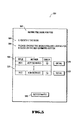
- a graphical user interface that shows an exemplary web page output displaying of an estimate or rating of the book that has been determined (by the database server) to be an appropriate result for the book the customer has selected, is shown in Figure 6.
- the estimate GUI 600 of Figure 6 includes a header field 602, a book identifier field 604, a book information field 606, a first 'more detail' button 608, a value field 612, a similarity field 614, and a second 'more detail' button 620.
- the header field 602 recites "Estimate of the book for you," explaining that the information below describes, with respect to the book selected by the customer, an estimate keyed to the most appropriate book registered by the customer.
- Field headings such as 'title' and 'author' are contained in the book identifier field 604 for the purpose of indicating the corresponding information in the book information field 606. Data corresponding to these field headings are then located in the book information field 606 (i.e., 'xyz' and 'Tom Bednash' in Figure 6).
- the first 'more detail' button 608 may be selected by a customer to show further details of the prospective book, such as publication information, a book summary or the like.
- the value field 612 and the similarity field 614 are located below these book-related fields on the estimate GUI 600.
- the value field 612 supplies the customer with an overall rating of the estimated book; the gauge on the right side of this field (i.e., 0-5 stars, etc.) provides the customer with some sort of general value of reading the book, as determined by empirical techniques such as collaborative filtering.
- the similarity field 614 is also located below the book-related fields, and provides a measure of how closely the estimated book matches the chosen book. According to the method used, the magnitude of this measure correlates to how closely the estimated book matched the chosen book, and can be expressed in simple percentages.
- the second 'more detail' button 620 can be located in the lower right hand corner, near to the similarity field 614, and is selected by a customer to provide further detail with regard to the book upon which the estimate has been keyed.
- a customer first enters information concerning a book, about which the customer is wondering whether he or she should read. This information is entered at the client 120 via the interactive GUI of Figure 4.
- the web server 120 requests the database server to search the book database 160 based on the information sent by the customer via the client 140. These search results are then sent to the web server 120, and the web server 120 sends corresponding GUI information to the client 140.
- the client 140 displays the subsequent rating GUI 500 shown in Figure 5. From the subsequent rating GUI 500 screen, the customer chooses or confirms the book that he or she is considering.
- the web server 120 requests the database server 110 to search all keyword data of the customer database (170) 160 based on the keywords of the chosen book data.
- the database server finds 110 a book that has the most keywords in common to the chosen book keywords.
- the database server can also calculate the similarity rate of the keywords, and grades the chosen book according to the rate.
- a customer does not have to register the books that he or she has read in advance of the book rating process.
- the database server first finds the books that are related to the chosen book according to the keywords of the chosen (to be estimated) book. The list of the related books is then displayed. From this display, the customer checks all of the books he or she has read off of the list.
- the rating and estimate processes are identical to the previous embodiment described above.
- the checked books may be registered in the customer database (170) so that the customer does not have to input the same books.
- the registered books should be checked before the customer's input (checking).
- Another alternate embodiment of the present invention contemplates the scenario in which a customer has not identified a particular book for rating and estimation.
- the rating algorithm is different from the algorithm used in the preferred embodiment above.
- a four-step algorithm is used to find a book that suits a customer's taste.
- the database server 110 narrows the object field based on keywords or natural language inputted by a customer, and then the book data of the books that the customer is interested in is extracted from the book database 160.
- the book data is sorted according to sales.
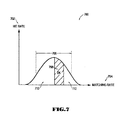
- Figure 7 shows a keyword-match graph 700 illustrating a representative bell curve 706 associated with such keyword search results.
- Graph 700 has, as its x-axis, the 'matching rate' 704 or quantity of keywords that match, with the greatest number of matches extending to the right.
- the y-axis of keyword-match graph 700 reflects the 'result rate' 702 or the quantity of books that satisfy the corresponding rate (x-axis) value of matched keywords.
- books within the acceptable range 708 of matched keywords share a certain percentage of the sought keywords, with this range being reflected on the x-axis (i.e., perhaps a range of approximately 60-75%, as seen in Figure 7).
- the algorithm rejects books sharing too few keywords 710 as well as books sharing too many keywords 712, leaving books within the acceptable range 708.
- the matching rate of keywords (x-axis) then, relates to the result rate or quantity of books by a bell curve relationship 706. This is simply to say that a greater number of results or books will share a middle range of keyword with the chosen book, as seen in the center (highest point) of the curve, with the number of results or books tapering off as the matching rate either increases or decreases.
- the fourth step is essentially a reiteration of the first three steps if the particular results are found to be unacceptable. If the results of step three are not suitable, the keywords are exchanged to another data type (i.e., author, publisher, etc.) and the matching procedure is executed again.
- another data type i.e., author, publisher, etc.
Landscapes
- Business, Economics & Management (AREA)
- Accounting & Taxation (AREA)
- Finance (AREA)
- Strategic Management (AREA)
- Engineering & Computer Science (AREA)
- Development Economics (AREA)
- General Physics & Mathematics (AREA)
- Economics (AREA)
- Marketing (AREA)
- Physics & Mathematics (AREA)
- General Business, Economics & Management (AREA)
- Theoretical Computer Science (AREA)
- Game Theory and Decision Science (AREA)
- Entrepreneurship & Innovation (AREA)
- Information Retrieval, Db Structures And Fs Structures Therefor (AREA)
- Information Transfer Between Computers (AREA)
- Management, Administration, Business Operations System, And Electronic Commerce (AREA)
Applications Claiming Priority (2)
| Application Number | Priority Date | Filing Date | Title |
|---|---|---|---|
| US846100 | 2001-04-30 | ||
| US09/846,100 US7149804B2 (en) | 2001-04-30 | 2001-04-30 | Method and system for providing evaluation of text-based products |
Publications (2)
| Publication Number | Publication Date |
|---|---|
| EP1255213A2 true EP1255213A2 (de) | 2002-11-06 |
| EP1255213A3 EP1255213A3 (de) | 2004-01-14 |
Family
ID=25296941
Family Applications (1)
| Application Number | Title | Priority Date | Filing Date |
|---|---|---|---|
| EP02009457A Withdrawn EP1255213A3 (de) | 2001-04-30 | 2002-04-25 | Verfahren und System zur Auswertung text-basierter Produkte |
Country Status (5)
| Country | Link |
|---|---|
| US (1) | US7149804B2 (de) |
| EP (1) | EP1255213A3 (de) |
| JP (1) | JP2003036270A (de) |
| KR (1) | KR100532575B1 (de) |
| CN (1) | CN1270260C (de) |
Cited By (2)
| Publication number | Priority date | Publication date | Assignee | Title |
|---|---|---|---|---|
| US7246106B2 (en) * | 2003-07-02 | 2007-07-17 | Red Paper Llc | System and method for distributing electronic information |
| US8375040B2 (en) | 2007-03-30 | 2013-02-12 | Pioneer Corporation | Content explaining apparatus and method |
Families Citing this family (25)
| Publication number | Priority date | Publication date | Assignee | Title |
|---|---|---|---|---|
| US7505984B1 (en) | 2002-12-09 | 2009-03-17 | Google Inc. | Systems and methods for information extraction |
| JP2004194108A (ja) * | 2002-12-12 | 2004-07-08 | Sony Corp | 情報処理装置および情報処理方法、記録媒体、並びにプログラム |
| US20040177149A1 (en) * | 2003-03-05 | 2004-09-09 | Zullo Paul F. | System and method for presentation at the election of a user of media event information and further media event information of media events all related to a preselected time period |
| US8447775B2 (en) * | 2003-06-13 | 2013-05-21 | Microsoft Corporation | Database query user interface to assist in efficient and accurate query construction |
| US8006197B1 (en) | 2003-09-29 | 2011-08-23 | Google Inc. | Method and apparatus for output of search results |
| US7836038B2 (en) * | 2003-12-10 | 2010-11-16 | Google Inc. | Methods and systems for information extraction |
| US7647300B2 (en) * | 2004-01-26 | 2010-01-12 | Google Inc. | Methods and systems for output of search results |
| US20070078833A1 (en) * | 2005-10-03 | 2007-04-05 | Powerreviews, Inc. | System for obtaining reviews using selections created by user base |
| US7620651B2 (en) * | 2005-11-15 | 2009-11-17 | Powerreviews, Inc. | System for dynamic product summary based on consumer-contributed keywords |
| US7860803B1 (en) * | 2006-02-15 | 2010-12-28 | Google Inc. | Method and system for obtaining feedback for a product |
| US20070292826A1 (en) * | 2006-05-18 | 2007-12-20 | Scholastic Inc. | System and method for matching readers with books |
| US7793230B2 (en) * | 2006-11-30 | 2010-09-07 | Microsoft Corporation | Search term location graph |
| US20080168045A1 (en) * | 2007-01-10 | 2008-07-10 | Microsoft Corporation | Content rank |
| JP2008293211A (ja) * | 2007-05-23 | 2008-12-04 | Hitachi Ltd | アイテム推薦システム |
| JP4963110B2 (ja) | 2008-01-25 | 2012-06-27 | インターナショナル・ビジネス・マシーンズ・コーポレーション | サービス検索システム、方法及びプログラム |
| US20100083123A1 (en) * | 2008-10-01 | 2010-04-01 | Anthony Bodetti | System and method for identifying biographical subjects |
| CN101464897A (zh) * | 2009-01-12 | 2009-06-24 | 阿里巴巴集团控股有限公司 | 一种词匹配及信息查询方法及装置 |
| US20110066526A1 (en) * | 2009-09-15 | 2011-03-17 | Tom Watson | System and Method For Electronic Publication and Fund Raising |
| US20110238670A1 (en) * | 2010-03-23 | 2011-09-29 | Microsoft Corporation | Crowd-sourcing and contextual reclassification of rated content |
| CN102567408B (zh) | 2010-12-31 | 2014-06-04 | 阿里巴巴集团控股有限公司 | 推荐搜索关键词的方法和装置 |
| US20140156554A1 (en) * | 2012-03-29 | 2014-06-05 | George Stewart Payne, IV | Apparatus and method for the categorization of scanned information, in particular the maturity level of literature distributed to consumers, to express the categorizations to consumers |
| WO2013161510A1 (ja) * | 2012-04-25 | 2013-10-31 | インターナショナル・ビジネス・マシーンズ・コーポレーション | 評価の極性に基づいた文章の分類方法、コンピュータ・プログラム、コンピュータ |
| JP6492889B2 (ja) * | 2015-03-31 | 2019-04-03 | 大日本印刷株式会社 | サーバ装置、プログラム、及び情報提供方法 |
| KR20190002857A (ko) * | 2017-06-30 | 2019-01-09 | (주) 올윈웨어 | 아이템의 가치 평가 방법 및 장치 |
| CN108984531A (zh) * | 2018-07-23 | 2018-12-11 | 深圳市悦好教育科技有限公司 | 基于语文教材的图书阅读难度方法及系统 |
Family Cites Families (30)
| Publication number | Priority date | Publication date | Assignee | Title |
|---|---|---|---|---|
| US4996642A (en) * | 1987-10-01 | 1991-02-26 | Neonics, Inc. | System and method for recommending items |
| US5317568A (en) * | 1991-04-11 | 1994-05-31 | Galileo International Partnership | Method and apparatus for managing and facilitating communications in a distributed hetergeneous network |
| US5694546A (en) * | 1994-05-31 | 1997-12-02 | Reisman; Richard R. | System for automatic unattended electronic information transport between a server and a client by a vendor provided transport software with a manifest list |
| US5758257A (en) * | 1994-11-29 | 1998-05-26 | Herz; Frederick | System and method for scheduling broadcast of and access to video programs and other data using customer profiles |
| US6460036B1 (en) * | 1994-11-29 | 2002-10-01 | Pinpoint Incorporated | System and method for providing customized electronic newspapers and target advertisements |
| US5596705A (en) * | 1995-03-20 | 1997-01-21 | International Business Machines Corporation | System and method for linking and presenting movies with their underlying source information |
| US5749081A (en) * | 1995-04-06 | 1998-05-05 | Firefly Network, Inc. | System and method for recommending items to a user |
| US6041311A (en) | 1995-06-30 | 2000-03-21 | Microsoft Corporation | Method and apparatus for item recommendation using automated collaborative filtering |
| US6112186A (en) * | 1995-06-30 | 2000-08-29 | Microsoft Corporation | Distributed system for facilitating exchange of user information and opinion using automated collaborative filtering |
| US5872850A (en) * | 1996-02-02 | 1999-02-16 | Microsoft Corporation | System for enabling information marketplace |
| US5704017A (en) * | 1996-02-16 | 1997-12-30 | Microsoft Corporation | Collaborative filtering utilizing a belief network |
| US5867799A (en) * | 1996-04-04 | 1999-02-02 | Lang; Andrew K. | Information system and method for filtering a massive flow of information entities to meet user information classification needs |
| US5790426A (en) * | 1996-04-30 | 1998-08-04 | Athenium L.L.C. | Automated collaborative filtering system |
| US5950172A (en) * | 1996-06-07 | 1999-09-07 | Klingman; Edwin E. | Secured electronic rating system |
| US6016504A (en) * | 1996-08-28 | 2000-01-18 | Infospace.Com, Inc. | Method and system for tracking the purchase of a product and services over the Internet |
| US6108493A (en) * | 1996-10-08 | 2000-08-22 | Regents Of The University Of Minnesota | System, method, and article of manufacture for utilizing implicit ratings in collaborative filters |
| US6016475A (en) * | 1996-10-08 | 2000-01-18 | The Regents Of The University Of Minnesota | System, method, and article of manufacture for generating implicit ratings based on receiver operating curves |
| US5897622A (en) * | 1996-10-16 | 1999-04-27 | Microsoft Corporation | Electronic shopping and merchandising system |
| US5870579A (en) * | 1996-11-18 | 1999-02-09 | Advanced Micro Devices, Inc. | Reorder buffer including a circuit for selecting a designated mask corresponding to an instruction that results in an exception |
| US6266659B1 (en) * | 1997-08-07 | 2001-07-24 | Uday P. Nadkarni | Skills database management system and method |
| US6055513A (en) * | 1998-03-11 | 2000-04-25 | Telebuyer, Llc | Methods and apparatus for intelligent selection of goods and services in telephonic and electronic commerce |
| US6064980A (en) * | 1998-03-17 | 2000-05-16 | Amazon.Com, Inc. | System and methods for collaborative recommendations |
| JP2000029895A (ja) * | 1998-07-13 | 2000-01-28 | Hitachi Ltd | 読書支援システム |
| US6321221B1 (en) * | 1998-07-17 | 2001-11-20 | Net Perceptions, Inc. | System, method and article of manufacture for increasing the user value of recommendations |
| US6631404B1 (en) * | 1998-09-11 | 2003-10-07 | Lv Partners, L.P. | Method and system for conducting a contest using a network |
| AU1818000A (en) | 1998-11-10 | 2000-05-29 | Panopticon, Inc. | System and method for matching users with items in a network |
| US6363390B1 (en) * | 1999-08-20 | 2002-03-26 | Newsgems Llc | System and method for structured news release generation and distribution |
| JP2001290838A (ja) * | 2000-04-04 | 2001-10-19 | Hitachi Ltd | 情報メディア検索方法および装置 |
| US6739508B2 (en) * | 2000-08-18 | 2004-05-25 | Fujitsu Limited | Evaluation apparatus with voting system, evaluation method with voting system, and a computer product |
| US6953343B2 (en) * | 2002-02-06 | 2005-10-11 | Ordinate Corporation | Automatic reading system and methods |
-
2001
- 2001-04-30 US US09/846,100 patent/US7149804B2/en not_active Expired - Lifetime
-
2002
- 2002-04-25 EP EP02009457A patent/EP1255213A3/de not_active Withdrawn
- 2002-04-26 JP JP2002126022A patent/JP2003036270A/ja active Pending
- 2002-04-29 CN CNB021188270A patent/CN1270260C/zh not_active Expired - Lifetime
- 2002-04-30 KR KR10-2002-0023750A patent/KR100532575B1/ko not_active Expired - Lifetime
Cited By (2)
| Publication number | Priority date | Publication date | Assignee | Title |
|---|---|---|---|---|
| US7246106B2 (en) * | 2003-07-02 | 2007-07-17 | Red Paper Llc | System and method for distributing electronic information |
| US8375040B2 (en) | 2007-03-30 | 2013-02-12 | Pioneer Corporation | Content explaining apparatus and method |
Also Published As
| Publication number | Publication date |
|---|---|
| EP1255213A3 (de) | 2004-01-14 |
| KR20020084418A (ko) | 2002-11-07 |
| CN1270260C (zh) | 2006-08-16 |
| JP2003036270A (ja) | 2003-02-07 |
| US20040073625A1 (en) | 2004-04-15 |
| US7149804B2 (en) | 2006-12-12 |
| KR100532575B1 (ko) | 2005-12-02 |
| CN1384452A (zh) | 2002-12-11 |
Similar Documents
| Publication | Publication Date | Title |
|---|---|---|
| US7149804B2 (en) | Method and system for providing evaluation of text-based products | |
| US7184974B2 (en) | Online used car information search method, program, and device | |
| US6868392B1 (en) | System and method for electronic shopping using an interactive shopping agent | |
| US7673044B2 (en) | Information processing system, apparatus and method for processing information, and program | |
| Lightner et al. | Shopping behaviour and preferences in e-commerce of Turkish and American university students: implications from cross-cultural design | |
| US6064980A (en) | System and methods for collaborative recommendations | |
| US6611814B1 (en) | System and method for using virtual wish lists for assisting shopping over computer networks | |
| US7113917B2 (en) | Personalized recommendations of items represented within a database | |
| US20030061202A1 (en) | Interactive product selector with fuzzy logic engine | |
| US20040024656A1 (en) | Interactive product selector with inferential logic engine | |
| WO2012151401A1 (en) | Item discovery tools and methods for shopping in an electronic commerce environment | |
| US20070299745A1 (en) | Method and apparatus for marketing products over the internet | |
| US8620756B2 (en) | Method and apparatus for permitting stage-door access to on-line vendor information | |
| WO2000051050A1 (en) | System and method of providing personalized e-commerce recommendations via the internet | |
| WO2001003036A1 (en) | Method and apparatus for comparing, ranking and selecting data items including web pages | |
| US7072859B1 (en) | Electronic commerce checkout system | |
| JP6567688B2 (ja) | 管理装置、管理方法、非一時的な記録媒体、およびプログラム | |
| JP2002259757A (ja) | 販売価格提示サービスシステム | |
| US7054929B2 (en) | Communication system, information agent method and recording medium | |
| JP5371668B2 (ja) | 情報仲介サーバ、情報提供方法、情報提供プログラム、および、情報提供システム | |
| JP2001229268A (ja) | オンラインショッピングシステム及び商品提案方法 | |
| JP2002099764A (ja) | 情報提供方法および情報提供装置 | |
| JP2002150147A (ja) | 情報提供システム及び方法並びに情報提供用プログラムを記録した記録媒体 | |
| EP1176531A1 (de) | System und Verfahren zur Unterstützung von Einkäufen über ein Computernetzwerk | |
| JP2001229224A (ja) | オンラインショッピング装置、オンラインショピング方法とそのシステムおよびその端末装置 |
Legal Events
| Date | Code | Title | Description |
|---|---|---|---|
| PUAI | Public reference made under article 153(3) epc to a published international application that has entered the european phase |
Free format text: ORIGINAL CODE: 0009012 |
|
| AK | Designated contracting states |
Kind code of ref document: A2 Designated state(s): AT BE CH CY DE DK ES FI FR GB GR IE IT LI LU MC NL PT SE TR |
|
| AX | Request for extension of the european patent |
Free format text: AL;LT;LV;MK;RO;SI |
|
| 17P | Request for examination filed |
Effective date: 20030321 |
|
| PUAL | Search report despatched |
Free format text: ORIGINAL CODE: 0009013 |
|
| AK | Designated contracting states |
Kind code of ref document: A3 Designated state(s): AT BE CH CY DE DK ES FI FR GB GR IE IT LI LU MC NL PT SE TR |
|
| AX | Request for extension of the european patent |
Extension state: AL LT LV MK RO SI |
|
| AKX | Designation fees paid |
Designated state(s): DE ES FR GB IT |
|
| 17Q | First examination report despatched |
Effective date: 20041123 |
|
| STAA | Information on the status of an ep patent application or granted ep patent |
Free format text: STATUS: THE APPLICATION HAS BEEN WITHDRAWN |
|
| 18W | Application withdrawn |
Effective date: 20051010 |